PART2:“YOU CAN’T REMOVE THAT BRIDGE, YOU STUPID RANCHER—86 FAMILIES OWN THIS ROAD NOW!” HOA Karen Locked Me Out of My Own 600-Acre Ranch, Never Imagining What My Father’s Old Bridge Would Reveal.v
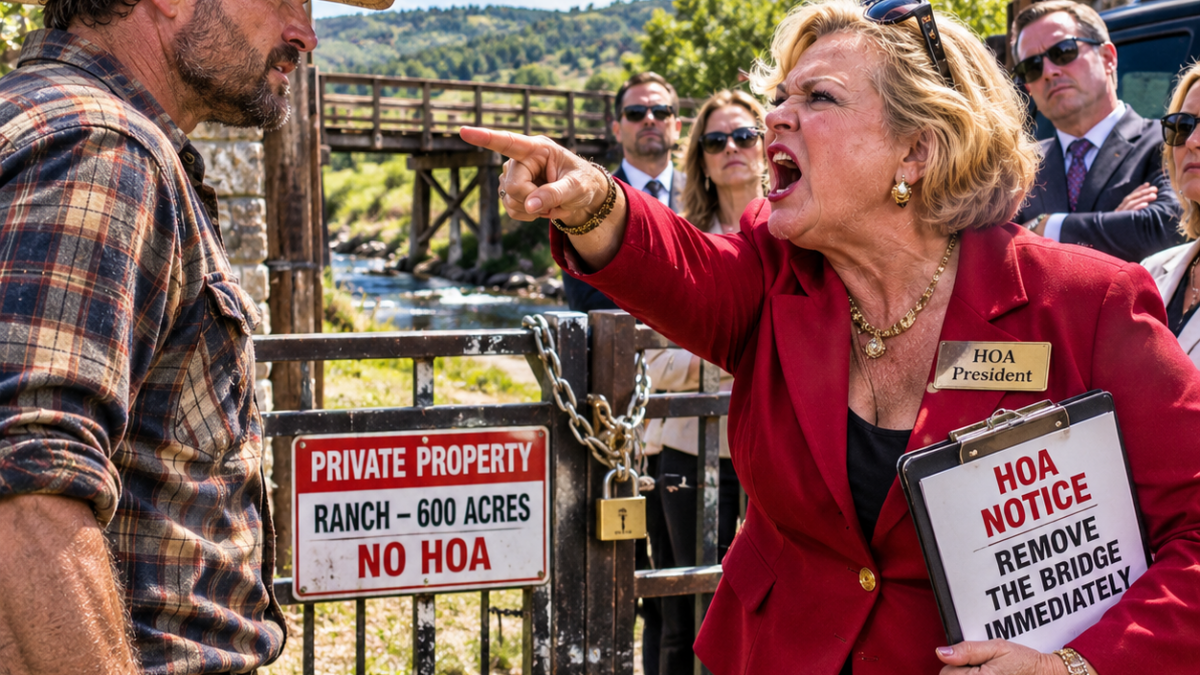
My name is Daniel Mercer.
I’m fifty-five years old, and I own six hundred acres of cattle country in western Montana.
My grandfather bought the property after returning from the Korean War, back when the surrounding hills were mostly grazing land, pine trees, and people who understood that a handshake could carry more weight than a hundred pages of legal threats.
My father, Robert Mercer, inherited the ranch and spent his life making sure there would be something worth passing down to me.
He wasn’t a wealthy man.
He owned land, machinery, cattle, and enough debt during difficult seasons to keep him awake at night.
But he believed a man should understand exactly what belonged to him, what he owed other people, and what responsibilities came with both.
The southern part of our ranch was divided by Pine Run Creek.
It was beautiful in late summer, with cold mountain water slipping between smooth rocks and trout holding beneath the shadows of cottonwood trees.
In spring, though, it became a different animal.
Snowmelt poured down from the mountains, and the current could turn violent enough to carry logs and rocks that weighed more than a grown man.
When I was eighteen, Dad decided we needed a proper crossing.
Our cattle trucks were spending too much time using a northern route that added nearly nine miles to ordinary ranch work.
Dad found a used steel structure, bought timber, hired a few local men, and spent the summer building a bridge across Pine Run.
I worked beside him.
Some days we started before sunrise and didn’t finish until the mosquitoes came out after dark.
I can still remember Dad standing beside the unfinished supports, his work gloves covered in grease, telling me something I didn’t fully understand until years later.
“Danny, building something is only half the job. The other half is taking responsibility for it.”
He was right.
For thirty-seven years, our family maintained that crossing.
We replaced boards, checked bolts, cleared debris after storms, and kept the approaches safe for heavy ranch equipment.
The bridge belonged to us because it stood entirely inside our property boundaries.
That fact was recorded in our land documents.
For decades, nobody questioned it.
Our eastern neighbor was a rancher named Harold Briggs.
Harold raised sheep, complained constantly about cattle prices, and made blackberry jam that could turn even the worst winter morning into something worth getting out of bed for.
He and Dad argued about almost everything.
They argued about fencing.
They argued about weather forecasts.
They argued about which truck manufacturer made the least unreliable engine.
But when one of them needed help, the other arrived without being asked twice.
Harold had a recorded easement allowing him to use part of Mercer Road and cross Pine Run Bridge to reach the county highway.
That agreement granted passage, not ownership.
Harold understood the distinction.
Whenever one of his trucks damaged the wooden deck, he helped Dad repair it.
If we needed to close the bridge for maintenance, he coordinated his livestock deliveries around the work.
Nobody installed a gate.
Nobody demanded access codes.
Nobody accused the other of violating neighborhood standards.
The arrangement worked because both men respected the difference between having a right to use something and having the right to control it.
When Harold died, his children eventually sold most of the property.
A development company purchased the land and announced plans for Maple Ridge Estates.
Eighty-six luxury homes.
A private clubhouse.
A swimming pool.
Landscaped entrances.
Mountain views.
The advertising promised exclusive country living.
Frank Dawson, my ranch foreman, studied the development brochure while we drank coffee in the barn office.
“Exclusive country living,” he read aloud.
Then he looked out the window at three cows standing in a muddy pasture.
“Think those ladies know they’re supposed to be exclusive?”
I laughed.
“Give the new people a chance.”
Frank had worked for my family almost twenty years.
He was the kind of man who could diagnose a tractor engine by listening to it for ten seconds and knew more about cattle than most people knew about their own children.
He could also be more stubborn than a fence post.
But he was loyal, and I trusted him.
When the first Maple Ridge families arrived, I was pleased to discover that most were perfectly decent neighbors.
Children rode bicycles near the entrance.
Parents waved when our trucks passed.
Some residents stopped to ask questions about ranch life.
A retired firefighter named George Miller came over one afternoon to introduce himself.
He was in his early sixties, broad-shouldered, with gray hair and the calm expression of someone who had spent a lifetime dealing with emergencies.
He wanted to understand the access arrangement.
I brought out a copy of the easement.
He studied it carefully.
“So our neighborhood has the right to cross your road?”
“That’s correct.”
“But you own the road?”
“Yes.”
“And the bridge?”
“My father built it.”
George nodded.
“So technically, we’re guests on your property.”
I smiled.
“Good guests.”
He laughed.
That conversation became the foundation of a friendship.
George’s wife, Linda, occasionally brought homemade bread during calving season.
Their grandson, Mason, loved visiting the horses.
When Linda developed heart trouble, I made sure George knew he could call us if he ever needed assistance.
That was how neighbors behaved where I grew up.
You didn’t have to share an address or a property line to care about someone.
For almost a year, Maple Ridge felt like another small part of our community.
Then Karen Whitmore became HOA president.
Karen was forty-nine, blonde, sharp-eyed, and always looked as though she had dressed for a corporate board meeting even when standing beside a gravel road.
She lived in one of the largest homes near the clubhouse.
Her husband apparently worked in commercial real estate, although I rarely saw him.
Karen had an extraordinary talent for making ordinary conversations feel like disciplinary hearings.
The first time she visited my ranch, she arrived in a spotless white SUV.
I was inspecting a cattle trailer with Frank when she stepped out wearing expensive boots that had probably never touched actual pasture mud.
“Mr. Mercer?”
“That would be me.”
“I’m Karen Whitmore, president of the Maple Ridge Homeowners Association.”
I extended my hand.
She looked at it.
Then she looked toward the muddy trailer.
She didn’t shake it.
“I need to discuss the condition of the access road.”
“What condition?”
“The dirt.”
I stared at her.
“The dirt?”
“Yes. Your agricultural vehicles are tracking mud onto the neighborhood’s main entrance.”
I glanced down at the gravel beneath us.
“Karen, this is Montana.”
She folded her arms.
“That’s not a sufficient response.”
Frank turned away.
I could see his shoulders shaking.
I tried to remain polite.
“What exactly would you like me to do?”
“Implement vehicle-cleaning procedures before your trucks enter the shared access corridor.”
“You mean wash the tires?”
“At a minimum.”
“Our trucks use that road to reach our own pastures.”
“And our residents pay premium prices for a clean, attractive community.”
I looked toward the distant cattle.
“They’re going to be disappointed when they discover where beef comes from.”
Her eyes narrowed.
“I don’t appreciate sarcasm.”
“And I don’t appreciate being told to wash a tractor every time it crosses my own property.”
Karen left without another word.
A week later, an official HOA letter arrived.
It requested that Mercer Ranch comply with neighborhood appearance standards, including vehicle cleanliness, equipment visibility, and road maintenance practices.
I called my attorney, Sarah Mitchell.
Sarah had represented my family for years.
She was intelligent, patient, and possessed the kind of dry humor that appeared only when someone had said something particularly ridiculous.
She read the letter.
Then she started laughing.
“Daniel, are you serious?”
“Unfortunately.”
“They’re trying to enforce HOA appearance rules against a six-hundred-acre ranch that isn’t part of their development?”
“Apparently.”
Sarah sent a professional response explaining that Mercer Ranch was not subject to Maple Ridge’s governing documents.
The association had no authority over my agricultural operations.
The easement allowed defined access across private property; it did not place that property under HOA control.
I thought the explanation would settle things.
Instead, it seemed to offend Karen personally.
Another letter arrived.
This one complained about cattle noise.
Then came a complaint about hay bales being visible from the neighborhood entrance.
Then a demand that I repaint my old red ranch gate because it clashed with the stone columns at Maple Ridge.
Frank held up the letter.
“Daniel, if she asks us to put sweaters on the cows, I’m quitting.”
I laughed.
“If that happens, I’m leaving with you.”
At the time, the conflict seemed irritating rather than dangerous.
Karen wanted a neighborhood that looked like a real-estate advertisement.
I owned a working ranch.
We had different priorities.
I thought that was all it was.
I was wrong.
The first real trouble began after several Maple Ridge homeowners reported missing packages.
Someone had also entered the neighborhood pool at night.
A resident described seeing an unfamiliar pickup driving slowly near houses.
Those were legitimate concerns.
I understood why families wanted better security.
When Karen announced plans for a controlled entrance, I didn’t object to the idea.
What I objected to was the location.
Maple Ridge already had a decorative entrance on its own property.
Karen wanted to move the security checkpoint farther west.
That meant installing it directly across Mercer Road, between Pine Run Bridge and the turnoff leading to my lower pastures.
The proposal included black steel gates, security cameras, license-plate readers, electronic controls, and a keypad.
I studied the drawings with Sarah.
“They want to put this on my land.”
“Yes,” she said.
“And control who gets through?”
“Yes.”
“Can they do that?”
“Not without your permission.”
I rejected the proposal.
Karen called me the following afternoon.
“Mr. Mercer, I received your response.”
“Good.”
“Your refusal is unreasonable.”
“It’s my property, Karen.”
“The neighborhood needs a secure entrance.”
“Then put the gate on neighborhood land.”
“That location is less desirable.”
“Desirable for whom?”
“For our security plan.”
“I’m not going to register my cattle trucks with your management company.”
“We can issue permanent access codes.”
“That’s not the point.”
“Then what is the point?”
I lowered my voice.
“The point is that my ranch doesn’t belong to your HOA.”
She laughed dismissively.
“Property rights don’t mean you can obstruct community safety.”
“Community safety doesn’t mean you can take control of somebody else’s road.”
There was a long silence.
Then she said something I never forgot.
“You need to understand that eighty-six families have more influence in this county than one rancher.”
I looked across my desk at my father’s photograph.
“Karen, influence doesn’t change a deed.”
She hung up.
Sarah sent another formal notice.
The HOA was not authorized to install gates, cameras, electrical infrastructure, or permanent barriers on Mercer Ranch.
We even proposed a compromise.
Karen could put the gate approximately 120 yards farther east, entirely inside Maple Ridge property.
It would still control entrance to the homes.
It simply wouldn’t control access to my ranch.
I thought the offer was generous.
George called after the next HOA meeting.
“Daniel, did you really offer to let us build the gate farther east?”
“Of course.”
George sighed.
“Karen never mentioned that.”
“What did she tell everybody?”
“That you refused to cooperate because you don’t like the neighborhood.”
I closed my eyes.
“George, I like the neighborhood just fine.”
“I know.”
“Then why is she doing this?”
He hesitated.
“I think she’s gotten used to nobody telling her no.”
That sentence explained more than any legal document could.
My wife, Nancy, had died four years earlier.
Losing her changed the way I looked at conflict.
Nancy had been a schoolteacher.
She was kind, intelligent, and capable of making me reconsider an argument without making me feel foolish.
When I got stubborn, she would say, “Danny, you don’t have to win every argument. You only have to protect what matters.”
After she died, I tried to live by those words.
The ranch mattered.
Safety mattered.
Our neighbors mattered.
Karen’s pride didn’t.
So I avoided unnecessary confrontation.
I continued running the ranch.
I let Sarah handle the letters.
I hoped Karen would eventually move her gate to the proper location.
Then, one Tuesday morning, Frank called me at 6:31.
I was standing in a farm supply store in town.
“Daniel, you better come home.”
“What happened?”
“There’s a crane truck on the south road.”
“A crane truck?”
“Installing Karen’s gate.”
I left my shopping cart in the aisle.
By the time I reached Mercer Road, workers had already poured concrete around two large steel posts.
An electrical trench ran beside the road.
A camera pole stood near the shoulder.
Karen’s white SUV was parked twenty feet away.
I stepped out of my truck and forced myself to walk slowly.
The contractor supervisor approached me.
“Morning, sir. Rick Palmer.”
“Daniel Mercer. I own this land.”
His expression changed.
“You do?”
“Yes.”
Rick glanced toward Karen.
“We were told the association had authorization.”
“Who told you?”
“The HOA president.”
“Did she show you a deed?”
“No, sir.”
“Written permission from the property owner?”
“No.”
“Then you need to stop.”
Karen marched toward us.
“Absolutely not!”
I turned.
“Karen, what do you think you’re doing?”
“Completing a board-approved security project.”
“On my property?”
“Within the access easement.”
“You have a right to pass across that easement. You don’t own it.”
“Our attorney disagrees.”
“Then let me see his opinion.”
“He doesn’t need to provide that to you.”
I took out my phone.
“Fine. My attorney can speak with yours.”
I called Sarah.
Then I called the sheriff’s office.
Rick immediately instructed his crew to stop.
Karen practically exploded.
“We’ve already paid your company a deposit!”
Rick shook his head.
“Ma’am, a deposit doesn’t give me permission to build on somebody else’s property.”
Deputy Brian Hayes arrived twenty minutes later.
He studied the deed, the recorded easement, and the contractor’s work order.
Brian made it clear that he wasn’t going to resolve a civil property dispute on the roadside.
But he also told Rick that continuing permanent construction after the landowner had objected, without clear authorization, was a serious problem.
Rick agreed to suspend work.
Karen accused everyone of siding against homeowners.
Brian remained calm.
“Mrs. Whitmore, you can pursue the appropriate legal process. You cannot settle this by pouring more concrete.”
By noon, the crew had left.
Two unfinished posts remained beside the road.
I went home believing the worst was over.
Three days later, Frank and I were moving twenty-four cattle from the lower pasture.
We approached Mercer Road with two loaded trailers.
And there it stood.
A completed electronic gate.
Black steel bars stretched across the entire road.
A camera pointed directly toward approaching vehicles.
A large sign announced:
MAPLE RIDGE RESIDENTS AND AUTHORIZED GUESTS ONLY.
Frank stared.
“Daniel?”
“Yeah?”
“Are we residents?”
“No.”
“Are we guests?”
“No.”
He nodded slowly.
“Then apparently we’re trespassing on our own ranch.”
I wasn’t laughing anymore.
I called Karen.
She answered on the fourth ring.
“Mr. Mercer.”
“Open the gate.”
“You’ll need to visit the management office to register your vehicles.”
“Karen, I have cattle trailers sitting on my road.”
“Then I suggest you complete registration.”
I felt my face growing hot.
“You installed a gate after being told not to, and now you’re demanding that I ask your permission to enter my property?”
“Every authorized vehicle must follow the security procedure.”
“I’m the property owner.”
“And I’m responsible for community safety.”
I looked at the gate.
Then I looked at the cattle trailers waiting behind us.
“Open it.”
“Not until you’re registered.”
For several seconds, neither of us spoke.
Then I said quietly, “You’re making a very expensive mistake.”
She laughed.
“Is that a threat?”
“No, Karen. It’s a warning.”
I ended the call.
Frank watched me.
“What now?”
“Turn around.”
The northern route added eleven miles.
We took it anyway.
The cattle arrived safely.
But that evening, when Sarah came to my house and saw photographs of the completed gate, she was furious.
“This is outrageous.”
“I know.”
“We can seek emergency court relief.”
“How soon?”
“We’ll move as quickly as possible. But courts operate on evidence and procedure, not our preferred schedule.”
I stared out the window toward the southern hills.
Then I asked the question that changed everything.
“Sarah, what happens if I stop maintaining Pine Run Bridge?”
She looked up.
“Why?”
“Because I own it.”
“Yes.”
“And they’re using it.”
“Yes.”
“But they won’t let me use the road leading to it.”
She studied my expression.
“Daniel, where are you going with this?”
I sat down across from her.
“My father built that bridge. The easement lets them cross. But does it require me to keep providing a bridge forever, regardless of its condition or who pays for repairs?”
Sarah didn’t answer immediately.
She opened the original easement and began reading.
The agreement described the route, the right of passage, maintenance expectations, and procedures for necessary repair closures.
One section allowed temporary closure when maintenance or safety work required it.
I watched Sarah reread the language.
“Interesting,” she murmured.
“Can I remove the bridge?”
She looked directly at me.
“Not because Karen made you angry.”
“I didn’t ask that.”
“Daniel, listen carefully. An easement is a legal right. You cannot simply destroy access to punish the people who hold it.”
I said nothing.
“If the bridge is unsafe, necessary maintenance or replacement may justify closing it under proper procedures. But we need engineering evidence, appropriate notices, emergency planning, and a legitimate infrastructure decision.”
I nodded.
She leaned forward.
“Promise me you’re not treating a bridge like a weapon.”
I looked at my father’s photograph.
“I’m treating it like something my family owns and has maintained for thirty-seven years.”
“Good. Then let’s find out what condition it’s actually in.”
The next morning, I called structural engineer Peter Collins.
Peter was thorough, cautious, and almost irritatingly unwilling to give an answer before he had inspected everything.
He spent hours examining the bridge.
He checked the timber deck.
He inspected connections and steel members.
He photographed corrosion.
He reviewed the history of traffic loads.
When he finished, he didn’t look pleased.
“Daniel, how much traffic did this bridge carry when your father built it?”
“Mostly ranch trucks and Harold Briggs’s sheep trailers.”
“And now?”
“Eighty-six homes, delivery trucks, school buses, service vehicles, and our ranch equipment.”
Peter shook his head.
“That’s a very different workload.”
His written report arrived two days later.
The bridge was not in immediate danger of collapse, but several timber members were severely worn.
One steel support showed advanced corrosion.
The deck required major repairs.
Traffic from Maple Ridge had accelerated deterioration.
Peter recommended significant rehabilitation within the year.
I sat at my kitchen table reading the report.
For the first time, I realized how much responsibility had quietly accumulated on my family’s bridge.
It was no longer just a ranch crossing.
It had become a critical transportation link for an entire residential neighborhood.
And the people depending on it had spent $28,000 making sure I couldn’t cross my own road without registering with their HOA.
Sarah reviewed the engineering report.
“This gives us a legitimate reason to address the bridge.”
“Can we close it?”
“Under the appropriate circumstances and procedures, yes. But closure must genuinely be necessary for safety or work, and we have to deal with the easement obligations and emergency access.”
“And removal?”
“That depends on further engineering, legal review, and the long-term access solution.”
I nodded.
“Then let’s do it properly.”
We sent Maple Ridge a formal letter.
It included Peter’s findings.
It explained that Pine Run Bridge needed major work.
It requested removal of the unauthorized gate.
It proposed discussions about maintenance contributions, future access, and transportation planning.
We offered several practical options.
The HOA could remove its gate and contribute to bridge rehabilitation.
It could negotiate a new shared-access agreement.
Or it could develop an independent entrance while necessary bridge work proceeded.
Karen responded within six hours.
The association denied financial responsibility because the bridge belonged to me.
She also refused to remove the gate.
Frank read the response in the barn office.
He looked at me.
“Let me understand this.”
“Go ahead.”
“She says the bridge is yours?”
“Yes.”
“So she doesn’t have to pay for it?”
“That’s her position.”
“But the road is somehow hers?”
“Apparently.”
“And you’re supposed to ask permission to use it?”
I nodded.
Frank took a slow sip of coffee.
“That woman wants every benefit of ownership and none of the bills.”
I couldn’t have said it better.
George visited the next evening.
He had seen the engineering report and looked worried.
“Daniel, are you really thinking about closing the bridge?”
“If it needs to close for safety, yes.”
“Linda’s been having heart trouble again.”
“I know.”
“And there are other elderly residents.”
“I know that too.”
He looked down.
“I don’t want to defend Karen. I’m worried about people getting to the hospital.”
I placed a hand on his shoulder.
“George, I will not knowingly leave those families without an emergency route.”
He looked relieved.
Then he mentioned something I had forgotten.
Maple Ridge owned a narrow corridor along its eastern boundary.
Years earlier, the developer had graded a rough road toward State Route 8.
The project had never been completed.
The route was longer and needed drainage improvements, but it could potentially provide independent access.
I called Sarah.
Then Peter.
Then the county transportation office.
Within a week, we confirmed that an eastern connection was feasible.
It wasn’t ready to serve as a permanent neighborhood entrance.
But with temporary improvements and emergency coordination, it could function as an alternate route during planned bridge work.
That was enormously important.
Maple Ridge was not inherently dependent on Pine Run Bridge forever.
The developer had simply chosen the more convenient route across our ranch.
We sent another proposal.
Karen rejected it.
At the following HOA meeting, she accused me of threatening to isolate the neighborhood out of personal spite.
George stood.
“That’s not what happened.”
Karen snapped, “George, sit down.”
He didn’t.
“Daniel offered to let us build the security gate on our own property.”
Murmurs spread through the room.
“He also informed us that the bridge needs repairs.”
Karen gripped the podium.
“He’s using that report to pressure this association.”
George held up the paperwork.
“Then why aren’t we discussing bridge maintenance instead of spending money on a gate that keeps the bridge owner out?”
A woman near the front raised her hand.
Her name was Susan Clark.
“How much did that gate cost?”
Karen hesitated.
“Twenty-eight thousand dollars.”
The room erupted.
“Twenty-eight thousand?”
“For a gate on someone else’s property?”
“Did the board know he refused permission?”
Karen banged her hand against the podium.
“Order!”
Susan stood.
“Why did we spend that money when the bridge carrying our cars needs repairs?”
Karen began explaining security priorities.
Then she made an announcement that stunned even the residents who supported her.
Beginning Monday, all vehicles without registered Maple Ridge access tags would be denied entrance.
No exceptions for ranch vehicles.
No exceptions for unregistered deliveries.
I was sitting beside Sarah near the back.
Sarah rose slowly.
“Mrs. Whitmore, preventing the underlying property owner from using his own road is an extremely serious matter.”
Karen stared down at her.
“Then take us to court.”
Sarah gathered her papers.
“We intend to.”
But before the court could hear the emergency request, the weather changed.
On Sunday afternoon, a supply truck arrived at the gate carrying fencing materials and veterinary supplies for the lower pastures.
The keypad rejected every code we had.
The management office didn’t answer.
Then the gate motor locked completely.
Frank called me.
When I arrived, the driver was sitting behind the wheel looking frustrated.
“Sir, I’ve got other deliveries.”
“I understand.”
“Your gate won’t open.”
“It’s not my gate.”
He looked confused.
I pointed toward the black steel.
“It’s sitting on my land. That’s different.”
While we were trying to arrange another route, Peter arrived for a scheduled reinspection before the approaching storm.
He saw the gate and shook his head.
Then we drove to the bridge.
The creek was already rising.
Mountain snowmelt had increased the flow, and the forecast called for heavy rain.
Peter examined the corroded support.
He spent nearly an hour inspecting the deck and approach.
When he climbed back onto the road, his expression was serious.
“Daniel, I don’t want heavy vehicles crossing this bridge during the storm.”
“Just ranch equipment?”
“Everybody.”
“Maple Ridge residents too?”
“Yes.”
I called Sarah immediately.
By evening, county officials and emergency coordinators had been notified.
Peter explained the structural concerns and the worsening creek conditions.
The county coordinated temporary access through the eastern developer road.
Emergency services received route information.
Warnings went to residents.
Signs and barricades were installed.
Pine Run Bridge closed under a documented safety plan.
Karen appeared before the last barrier was placed.
She jumped from her SUV and marched toward me.
“YOU THINK YOU CAN JUST SHUT DOWN OUR ENTIRE NEIGHBORHOOD?”
Peter stepped forward.
“Mrs. Whitmore, I’m the engineer recommending closure.”
She barely glanced at him.
“Then you’re working for him!”
“I’m evaluating a bridge.”
“He’s using you to punish us!”
Peter’s expression hardened.
“I’m concerned about structural deterioration, rising water, and storm loads. Those conditions are not interested in your HOA dispute.”
Karen pointed at the bridge.
“We’ll reopen it ourselves tomorrow!”
Sarah spoke before I could.
“Any attempt to bypass the safety closure will create serious liability.”
Karen spun toward her.
“You lawyers think you can intimidate everybody!”
Sarah remained calm.
“No, Mrs. Whitmore. We expect people to comply with legitimate safety requirements.”
Karen stormed away.
Six hours later, heavy rain struck the valley.
Water hammered the ranch buildings.
Pine Run rose nearly four feet.
By morning, part of the eastern bank had eroded.
Soil around one approach had loosened.
Peter returned to inspect the damage.
His new report was worse.
The old bridge needed extensive work.
Replacing it might be more practical than repairing it.
I sat with Sarah and Peter in my kitchen.
“What would you recommend if this were your bridge?” I asked.
Peter studied the photographs.
“Given its age, the corrosion, the deck deterioration, and the bank damage, I’d recommend evaluating full replacement rather than spending heavily to extend its life.”
“And the old structure?”
“It may have to be removed.”
Sarah looked at me.
“Daniel, I need you to understand something.”
“I do.”
“This decision has to stand independently of the gate dispute.”
I nodded.
“Even if Karen had never installed that gate, my father’s bridge would still be thirty-seven years old.”
Peter nodded.
“And it would still need major work.”
We proceeded carefully.
Engineers documented the condition.
Attorneys addressed the easement obligations.
County personnel coordinated necessary safety measures.
The eastern road was prepared for temporary access.
Residents received formal notice.
Emergency responders were informed.
Then a licensed bridge contractor arrived with cranes, trailers, and a removal plan.
Frank and I stood beside the old railing before work began.
He ran his hand over the weathered timber.
“Your dad loved this bridge.”
“He complained about it every spring.”
Frank smiled.
“That’s how he showed love.”
I touched the railing.
I remembered working beside Dad when I was eighteen.
I remembered Nancy and me driving across it after our wedding.
I remembered my daughter leaning out the truck window and counting trout.
The bridge wasn’t just steel and timber to me.
It carried thirty-seven years of family history.
Watching the crew remove it hurt more than I expected.
The deck came apart section by section.
Steel connections were separated under controlled procedures.
The crane lifted each piece onto a flatbed.
Nothing was dumped into the water.
No one was taking reckless shortcuts.
It was a planned infrastructure removal.
Not revenge.
But Karen refused to see the difference.
She arrived with a line of residents and immediately began shouting.
“LOOK WHAT HE’S DONE TO YOU!”
I turned.
She was pointing toward the partially dismantled bridge.
“HE’S DESTROYING YOUR ONLY WAY HOME BECAUSE HE DOESN’T LIKE YOUR HOA!”
I pointed toward the signs identifying the eastern access route.
“Karen, nobody is trapped.”
“That road is longer!”
“Yes.”
“It’s unfinished!”
“It has been prepared for temporary access.”
“Our entrance is here!”
“Not while this bridge is being replaced.”
Her face reddened.
“You’re doing this because of my gate!”
I glanced toward the black electronic barrier still standing across Mercer Road.
“Your gate is certainly memorable.”
Frank coughed to disguise a laugh.
Karen took another step toward me.
“You think this is funny?”
“No. I think it’s unfortunate that you spent twenty-eight thousand dollars controlling an entrance you didn’t own while refusing to discuss maintenance of the bridge everyone depended on.”
Several homeowners looked at her.
Karen turned away.
“Don’t listen to him!”
But they were listening.
By late afternoon, the last major bridge section was ready to lift.
The contractor secured the crane lines.
The steel rose slowly.
For the first time in thirty-seven years, daylight appeared across the entire empty span.
I felt a strange heaviness in my chest.
Then the ambulance siren sounded.
That was the moment everything changed.
The ambulance had entered Maple Ridge using the temporary eastern route after receiving a call about a medical emergency.
But an outdated dispatch map directed the driver toward the old crossing.
And Karen’s electronic gate was locked.
The driver stopped.
Lights flashed.
The horn blasted.
Karen tried desperately to open the keypad.
Nothing worked.
George began moving traffic.
I called the county emergency coordinator.
Responders directed the ambulance back toward the open eastern route.
Another emergency vehicle helped clear space for it to turn around.
The delay lasted several minutes.
But everyone knew those minutes mattered.
The patient was Tyler Johnson.
Sixteen years old.
A severe allergic reaction.
His mother, Rebecca, had called 911 after he suddenly developed difficulty breathing at a friend’s house.
Paramedics reached him, provided emergency care, and transported him through the eastern road to the hospital.
Two hours later, George received the call we had all been hoping for.
Tyler was stable.
He was expected to recover.
I sat on the tailgate of Frank’s truck and closed my eyes.
Relief washed over me so powerfully that my hands began shaking.
Karen stood about twenty feet away.
For a long time, she said nothing.
Then she walked toward the useless black gate and stared at it.
I wondered whether she finally understood.
I hoped she did.
The following morning, George forwarded an email Karen had sent to every homeowner.
It blamed me for the emergency disruption.
According to Karen, removing Pine Run Bridge had caused a transportation crisis.
She claimed the incident demonstrated why Maple Ridge needed greater control over access infrastructure.
There was no mention of Peter’s safety findings.
No mention of the advance closure notices.
No mention of the temporary emergency road.
And not one word about the locked gate.
Frank read the message over breakfast.
“She nearly blocks an ambulance and still manages to blame you.”
“She’s consistent.”
Sarah was not amused.
She prepared a detailed record.
Engineering inspections.
Closure notices.
Emergency route coordination.
Contractor schedules.
Photographs.
Communications with the HOA.
Everything was dated and organized.
Then she sent it to the association board, its attorney, and the relevant county officials.
“Facts,” she told me, “are more useful than shouting.”
That evening, Maple Ridge held an emergency meeting.
The clubhouse was packed.
Karen began with a speech about the neighborhood suffering because one landowner had decided to eliminate its primary access.
George interrupted.
“The bridge was closed for documented safety reasons.”
Karen glared at him.
“George, you are out of order.”
He held up the engineering report.
“Residents received this.”
Then he raised the temporary route map.
“And this.”
A murmur moved through the audience.
Karen tried to regain control.
“The eastern road is unacceptable as a permanent solution!”
I stood.
“I agree.”
The room became quiet.
Even Karen seemed startled.
“The eastern road is longer and needs permanent improvements,” I continued. “That’s why I’ve been asking the association to discuss long-term access for months.”
Susan raised her hand.
“How much would our contribution toward the original bridge repairs have been?”
Sarah referred to Peter’s earlier estimate.
The proposed contribution would have been less than the $28,000 already spent on the unauthorized gate.
Susan stared at Karen.
“So we could have helped maintain our entrance for less than you spent blocking the ranch owner?”
Karen struck the podium.
“That is an unfair comparison!”
Robert Gaines, another homeowner, stood.
“I supported the security gate.”
Karen looked relieved.
“Thank you, Robert.”
“But I need to know something.”
Her expression changed.
“Why couldn’t we put it on our own property, where Mr. Mercer suggested?”
Karen hesitated.
“Because controlling the approach road provides better security.”
Robert looked straight at her.
“But the approach road belongs to him.”
She didn’t answer.
He continued.
“So this was never just about controlling who enters Maple Ridge. You wanted to control his road.”
Nobody laughed.
Nobody interrupted.
The silence was worse for Karen than shouting.
Then George asked the HOA attorney a direct question.
“Does our easement give us the legal right to prevent Mr. Mercer from accessing his own property?”
The attorney cleared his throat.
“The easement grants passage rights over a defined route. It does not clearly convey ownership of the underlying road or authority to exclude the landowner.”
Karen’s voice rose.
“Whose side are you on?”
The attorney looked at her.
“I’m advising the association about its legal position.”
Frank leaned toward me.
“I like that fellow.”
For the first time in months, I almost smiled.
The board voted that evening.
Six members supported removing the gate.
Karen voted against it.
Six to one.
The motion passed.
Three days later, the gate contractor returned.
Workers disconnected the electrical system and lifted the black steel sections from their posts.
George watched beside me.
“Twenty-eight thousand dollars.”
“Expensive lesson,” I said.
He looked toward the empty bridge supports.
“Unfortunately, it’s not the only expensive lesson.”
He was right.
Removing the gate hadn’t solved the neighborhood’s transportation problem.
Maple Ridge still needed reliable permanent access.
And I still had to decide whether another bridge would ever cross Pine Run.
Peter prepared three options.
The first was a new heavy-duty bridge at the original location.
The second was a smaller ranch-only crossing, leaving Maple Ridge to finish the eastern route independently.
The third was a shared replacement supported by a new written agreement defining ownership, maintenance, emergency access, and restrictions on HOA interference.
Frank preferred the second.
“Build something for us and let them take their fancy cars somewhere else.”
Sarah saw advantages in the third.
“Clearer obligations could prevent a future conflict.”
I wasn’t certain.
Part of me wanted nothing more to do with Maple Ridge.
Then Rebecca Johnson came to visit.
Tyler’s mother.
She arrived carrying a homemade pie.
I invited her onto the porch.
She sat across from me and looked toward the creek.
“I wanted to thank you.”
“For what?”
“For making sure there was another emergency route before the old bridge came down.”
I shook my head.
“Rebecca, the ambulance still lost time.”
“Yes. Because of the gate and the route confusion. But there was another way out.”
She looked at her hands.
“I thought I was going to lose my son.”
I said nothing.
“When Tyler couldn’t breathe, I didn’t care about property lines or HOA rules. I just wanted someone to help him.”
Her voice cracked.
“He’s going to be okay.”
“I’m glad.”
She wiped her eyes.
“Please don’t blame all of us for Karen.”
I looked at her.
“I don’t.”
She nodded.
“I know. George told me.”
For a moment, we listened to the wind moving through the trees.
Then she said something that settled the question for me.
“I want my family to have a safe road, Mr. Mercer. But I also want you to be able to use your ranch without asking our HOA for permission.”
I stared at her.
That was all I had wanted from the beginning.
After she left, I called Sarah.
“I think we should negotiate the shared bridge.”
She was silent for a moment.
“Are you certain?”
“No.”
She laughed.
“That’s probably a good sign. It means you’ve considered the consequences.”
We began negotiations.
The basic idea was straightforward.
The bridge would remain privately owned by Mercer Ranch.
Maple Ridge would receive legally defined passage rights.
The association would contribute to construction and ongoing maintenance.
Ranch vehicles would retain unrestricted access.
No gate or electronic control system could be installed on my property without written consent.
Emergency services would have reliable access.
And Maple Ridge would complete the eastern road so residents had two usable exits.
George supported it.
Susan supported it.
Most residents seemed relieved.
Karen called it surrender.
Although she had lost the gate vote, she remained HOA president.
Removing her from that position required a separate process.
She began telling homeowners that the proposed agreement would turn them into tenants of Mercer Ranch.
That was nonsense.
But Karen understood something about frightened people.
If you repeated an alarming claim often enough, some would begin treating it as a fact.
She argued that the original easement made me responsible for the bridge and therefore the HOA shouldn’t pay most of the replacement cost.
Sarah disagreed with that interpretation.
The old agreement contemplated maintenance responsibilities and contributions associated with use.
It had been drafted for a neighboring ranch, not eighty-six luxury homes generating constant traffic.
A new agreement would need to address modern conditions.
Karen wanted a lawsuit.
George wanted negotiation.
The board divided.
Meanwhile, residents continued using the eastern road.
Their cars became dusty.
Morning traffic backed up near State Route 8.
School buses took longer routes.
Delivery drivers occasionally missed entrances.
It was inconvenient.
But people were safe, and no one was trapped.
Susan circulated a petition supporting the shared bridge proposal.
More than sixty households signed.
Karen dismissed the petition as emotional.
Susan replied, “Driving four extra miles every morning has given us plenty of emotion.”
Even Frank laughed.
For a little while, things became almost normal.
The ranch road was quiet.
We moved cattle without worrying about neighborhood traffic.
Peter’s crew finished removing the old bridge supports.
One afternoon, I found an original bolt from Dad’s bridge lying in the dirt.
I cleaned it and placed it on a shelf in the barn.
Frank looked at it.
“Keeping souvenirs?”
“It’s one of Dad’s.”
He nodded.
Some things don’t need further explanation.
Then Karen sent another certified letter.
She claimed the HOA had discovered language in its easement granting authority to make reasonable improvements necessary for continued access.
Because the original bridge was gone, she argued that Maple Ridge could build a temporary replacement across my property.
Without my approval.
Sarah called as soon as she received the notice.
“Daniel, don’t engage with Karen directly.”
“Do you think she’s serious?”
“I think she’s serious enough that I’m checking the contractors.”
The next morning, my phone rang at 5:42.
Frank.
I answered immediately.
“Please tell me it’s a broken water line.”
“Worse.”
“What?”
“She’s got trucks at the creek.”
I was already putting on my boots.
When I arrived at Pine Run, three flatbeds were parked near the old crossing.
Large steel bridge sections rested on their trailers.
A tracked excavator stood near the bank.
Workers were unloading equipment.
Karen wore a yellow safety vest over expensive outdoor clothing.
She looked delighted when she saw me.
“Good morning, Daniel.”
I stopped in front of her.
“What is this?”
“Our temporary bridge.”
“Your what?”
“A modular crossing to restore community access.”
“On my land?”
“Within our easement.”
“Without authorization?”
She smiled.
“The easement provides authorization.”
I stared at her.
Months of letters.
A completed illegal gate.
A sheriff’s intervention.
An emergency.
A removed bridge.
And she had learned nothing.
The contractor supervisor approached.
“Sir, I’m Mark Stevens.”
“Daniel Mercer. I own the property.”
Mark’s expression changed.
He turned toward Karen.
“You told us site permission was confirmed.”
“It is!”
Mark looked at me.
“Have you authorized this work?”
“No.”
“Has the county approved the waterway construction?”
“Not that I’m aware of.”
Mark immediately stopped his crew.
Karen’s smile disappeared.
“You have a contract!”
“Yes, ma’am,” Mark answered. “And that contract requires appropriate site permissions and approvals.”
“You’re refusing to perform?”
“I’m refusing to build a bridge on disputed property without documentation.”
I called Sarah.
Then county officials.
Peter arrived soon afterward.
A county engineer asked Karen for the waterway permit.
She didn’t have one.
He asked about design approval for the creek conditions.
Karen said the contractor handled those details.
Mark explained that his company had been hired to deliver and install the modular bridge after the site was approved.
No approved site meant no installation.
Then Susan arrived carrying an HOA financial report.
Her face was pale.
“Karen?”
Karen ignored her.
Susan held up the page.
“Did you spend ninety-two thousand dollars on this project?”
Everything went quiet.
Karen folded her arms.
“The board approved emergency transportation expenses.”
George, who had just arrived, frowned.
“No, we didn’t.”
Karen turned.
“Yes, we did.”
George shook his head.
“We authorized engineering research up to twelve thousand dollars.”
Susan pointed at the report.
“There’s a ninety-two-thousand-dollar deposit.”
Karen looked around at the growing crowd.
“This is association business.”
George stared at her.
“You used association money to hire a contractor to build on somebody else’s land without permission.”
Karen raised her chin.
“I acted to restore our community’s access.”
I looked toward the trucks.
“Karen, who authorized you to spend ninety-two thousand dollars?”
She glared at me.
“You don’t get to question our finances.”
“No,” I replied, “but your neighbors certainly do.”
By noon, Mark had ordered the crew to reload most of the materials.
County officials posted a notice preventing unauthorized construction.
Sarah prepared another legal response.
George scheduled an emergency board meeting.
I thought that would be the worst of it.
That evening, Peter called.
His voice was unusually tense.
“Daniel, I need you at the creek.”
“What happened?”
“I found something downstream.”
Frank and I met him near Pine Run.
About two hundred yards below the old bridge site, fresh tire tracks crossed part of my pasture.
They led toward the water.
We followed them.
A pile of crushed stone had been dumped directly into the creek.
It wasn’t large enough to form a proper crossing.
But it narrowed the channel.
Water was rushing around the obstruction and pushing toward the bank.
Peter crouched near the edge.
“This wasn’t here yesterday.”
Frank pointed across the water.
“Look over there.”
A small excavator stood on the opposite bank.
Its bucket was wet.
More crushed stone lay nearby.
Fresh tracks led toward the Maple Ridge maintenance area.
I felt a cold heaviness in my stomach.
“Peter, could this cause flooding?”
“I need to assess the hydraulics properly. But nobody should be placing fill in an active creek without approval.”
My phone rang.
George.
I answered.
“Daniel, we have a problem.”
“What kind of problem?”
“Water’s coming through the lower part of Maple Ridge.”
I looked toward Peter.
George kept speaking.
“The drainage ditch behind the clubhouse is overflowing.”
“How bad?”
“Three houses have water rising around their yards.”
Peter was already heading for his truck.
We drove to Maple Ridge through the eastern access road.
Rain was falling lightly.
As we approached the clubhouse, headlights reflected off water spreading across the lower lawns.
Residents were moving vehicles.
Others carried patio furniture toward higher ground.
Three houses near the drainage corridor were threatened.
A woman named Patricia Lane stood beside the curb holding her young son’s hand.
She looked terrified.
“My husband is out of town,” she said. “The water was at the fence twenty minutes ago.”
I looked toward her backyard.
The water had already spread across half the grass.
“Emergency crews are coming.”
“Is the creek flooding?”
“We’re checking. I don’t want to tell you something I don’t know.”
She nodded, fighting tears.
Frank joined several residents carrying sandbags.
George directed people away from the overflowing ditch.
I helped move storage boxes and outdoor furniture.
Nobody asked whether I belonged to Maple Ridge.
Nobody mentioned the lawsuit.
When water is threatening a family home, the important thing is getting people safe.
County crews arrived and assessed the drainage conditions.
Firefighters helped place temporary barriers.
Peter worked with the responders to examine the creek obstruction and drainage outlet.
The water slowed after about an hour.
No home suffered major interior damage.
Nobody had to evacuate.
But the evening left the neighborhood shaken.
When Peter returned, he explained that the dumped rock appeared to have narrowed Pine Run enough to raise upstream water levels during the rain.
That likely contributed to water backing toward the drainage system serving Maple Ridge’s lower homes.
He emphasized that the conditions needed further evaluation.
I asked who dumped the rock.
He shook his head.
“We don’t know.”
“The tire tracks lead toward Maple Ridge.”
“That’s a lead, Daniel. Not proof.”
I didn’t like the answer.
But he was right.
Karen appeared at the clubhouse after midnight.
George confronted her.
“Was any work authorized inside Pine Run?”
“No.”
“Who brought the excavator to the creek?”
“I have no idea.”
Susan held up photographs.
“Did the temporary bridge contractor prepare the banks?”
Karen folded her arms.
“Ask the contractor.”
Mark Stevens returned after hearing about the incident.
He studied the pictures.
“That rock isn’t ours.”
“How do you know?” George asked.
“We didn’t unload aggregate. Our crew stopped before any bank work began.”
Then Mark mentioned something important.
His company had left one locally rented excavator near the worksite, scheduled for collection the next morning.
I looked at him.
“The excavator on the far bank?”
He examined another photograph.
His expression changed.
“That looks like our rental.”
“Who had the key?”
“A spare was in the site lockbox.”
“Who knew the code?”
Mark hesitated.
“My supervisor. The rental company. And the HOA representative had the site information packet.”
Every eye turned toward Karen.
She raised her voice.
“Plenty of people could have found that code!”
I said nothing.
I was learning that silence sometimes forced people to listen harder.
The sheriff’s office became involved.
Deputy Brian Hayes instructed that the excavator remain untouched until the scene was documented.
County environmental personnel inspected the creek.
The rock would have to be removed carefully to avoid creating another sudden change in water flow.
Investigators photographed the tire tracks.
They examined the stone.
Similar material had recently been delivered to Maple Ridge’s maintenance yard.
That didn’t identify who moved it.
But it raised questions nobody could ignore.
The HOA board called an emergency financial meeting.
When Karen entered the clubhouse, George was sitting at the front table.
She stopped.
“What are you doing in my chair?”
George looked tired.
“The board held an emergency vote.”
“Without me?”
“We followed our governing procedures.”
“About what?”
“Temporary restrictions on your authority over construction contracts, expenditures, and related systems while the board reviews what happened.”
Karen laughed.
It was a sharp, unpleasant sound.
“You can’t do that.”
Susan placed the vote record on the table.
“We already did.”
Karen sat at the far end.
Her expression was murderous.
Then Susan opened the financial report.
“Ninety-two thousand dollars was deposited with the modular bridge contractor.”
Mark stood.
“That amount was received by my company.”
Susan nodded.
“There’s also an eighteen-thousand-dollar payment for site preparation and emergency access services.”
George looked at Mark.
“Did your company receive that?”
“No.”
Karen shifted in her chair.
Susan continued.
“Who received the money?”
Karen spoke sharply.
“Those details are with the treasurer.”
Paul Erikson, the HOA treasurer, looked startled.
“They aren’t.”
Karen turned.
“Paul!”
He straightened.
“I approved the bridge deposit after you said emergency board authority had been granted. I later learned the full board hadn’t approved the amount.”
Susan stared at him.
“And the additional eighteen thousand?”
Paul swallowed.
“That went through the maintenance reserve account under a vendor name I don’t recognize.”
George leaned forward.
“What vendor?”
Paul read the screen.
“Mountain Access Solutions.”
Mark shook his head.
“Never heard of them.”
Susan searched the state business database on her phone.
She couldn’t find a matching record under the name provided.
Karen insisted the vendor was legitimate.
But she couldn’t produce supporting documents at the meeting.
Then Brian Hayes entered.
He made it clear that he wasn’t there to arrest anyone.
The sheriff’s office was collecting records concerning the excavator, the creek work, and related authorizations.
He requested relevant documents, access information, and available surveillance footage.
George agreed to cooperate.
Karen said all requests should go through the HOA attorney.
Brian nodded.
Then Susan asked an uncomfortable question.
“Who controls the maintenance-yard cameras?”
Karen shrugged.
“The management office.”
“Were they recording yesterday?”
“I don’t know.”
Susan stared at her.
“They were working earlier that afternoon.”
Karen looked irritated.
“Then check them.”
They did.
The main cameras had stopped recording at 5:13 p.m.
The system log indicated a manual shutdown.
Not a storm-related power failure.
Not a random outage.
A manual command.
Three accounts had administrator access.
The management company.
The maintenance supervisor.
And Karen Whitmore.
The room went silent.
Still, Sarah later reminded me that access did not prove who issued the command.
That distinction mattered.
George asked the board to restrict Karen’s remaining access to association financial and surveillance systems while the review continued.
The motion passed six to one.
Karen was the only opposing vote.
She looked directly at me.
“You’re enjoying this, aren’t you?”
I held her gaze.
“Karen, three families almost had water inside their homes.”
She turned away.
After the meeting, George came to my ranch.
Frank brought coffee onto the porch.
George sat heavily in a wooden chair.
“I moved here to retire.”
Frank nodded.
“You picked an ambitious neighborhood.”
George gave a tired laugh.
Then he looked at me.
“Do you still want to build the shared bridge?”
I thought carefully.
It would have been easy to refuse.
I could insist Maple Ridge finish its eastern road and leave my land alone.
Legally, we would still need to resolve the easement obligations, but I could take a much harder negotiating position.
Part of me wanted that.
Then I remembered Rebecca Johnson sitting on my porch.
Tyler’s ambulance.
Patricia holding her son’s hand.
Linda’s heart condition.
Mason brushing the horses.
George helping people move furniture while floodwater climbed across their lawns.
Most Maple Ridge residents had never asked Karen to install a gate on my ranch.
They certainly hadn’t asked someone to dump rock into the creek.
They wanted a safe place to live.
“Yes,” I said.
George looked surprised.
“Still?”
“Yes. But with stronger safeguards.”
“Such as?”
“No bridge construction until your eastern road provides dependable emergency backup access.”
He nodded.
“No HOA equipment on my land without written permission.”
“Agreed.”
“Shared maintenance funding. Clear financial records.”
“Absolutely.”
“And no single president should be able to authorize major emergency contracts without oversight.”
George sighed.
“I suspect that will become our next rule.”
The following weeks were calmer.
The creek obstruction was removed under county supervision.
Drainage damage was repaired.
Residents cleaned mud from their yards.
The sheriff’s office continued investigating the excavator.
The board formally removed Karen as president under its governing process.
George was elected interim president.
His first official action was sending me a written apology for the unauthorized gate.
Frank printed it.
Framed it.
And hung it in the barn office.
I told him to take it down.
He refused.
“Historic document,” he said.
Maple Ridge began work on the eastern road.
This time there were engineers, permits, drainage plans, and properly approved contracts.
It wasn’t glamorous.
But it was responsible.
Peter worked with a larger engineering firm on the new Pine Run Bridge design.
The replacement would accommodate modern traffic, including emergency vehicles, school buses, cattle trailers, and agricultural equipment.
For the first time in months, I felt we were moving toward a real solution.
Then Sarah received an email from Karen’s attorney.
Karen claimed to possess an older version of the Briggs-Mercer easement.
According to her attorney, this version included broader language permitting the neighboring property owner to construct, improve, maintain, and control access facilities.
If authentic and legally operative, it could substantially affect the dispute.
Sarah asked for a copy.
The document arrived as a scan.
I opened it at my kitchen table.
My father’s name was there.
Harold Briggs’s name.
A notary stamp.
Old-looking paper.
And a page containing language I had never seen before.
I read it twice.
Then a third time.
My chest tightened.
Dad had always told me exactly what the agreement allowed.
He never mentioned giving the neighboring property the right to control the road.
Frank looked over my shoulder.
“That doesn’t sound like Robert.”
“No.”
“Do you think he signed it?”
I stared at the image.
“I don’t know.”
Sarah refused to speculate.
She requested access to the physical document and arranged an examination.
Three days later, we sat in a conference room with a document specialist.
The old papers were laid out carefully.
The signatures appeared aged.
The notary information looked consistent with the period.
For a long, uncomfortable hour, I wondered whether my father had made a legal agreement he never fully explained to me.
Then the examiner noticed something.
She compared the pages.
The paper differed slightly.
The staple holes did not align.
One page contained the original access provisions.
The additional page contained the broader construction and control language.
The examiner showed us the differences.
“These pages may not have originated as one document.”
Sarah leaned forward.
“Can you establish that conclusively?”
“Not without further forensic examination.”
Then she pointed toward the margins.
My father’s initials appeared on the original page.
So did Harold’s.
The questioned page contained neither.
The examiner explained that those details were significant but not by themselves definitive.
I looked at the document.
Someone might have assembled pages from different sources.
Someone might have substituted a page.
We didn’t yet know.
But we had enough reason to question its authenticity.
Sarah requested the history of the file.
The HOA management company had scanned it into its records six months earlier.
The upload was associated with Karen’s account.
That didn’t prove she changed anything.
But it established that she had introduced the document into the HOA system.
George called another board review.
Karen attended with her attorney.
She maintained that the document had come from archived development files.
Susan asked where the archive box was.
Karen said she no longer had it.
George asked when she found the papers.
She couldn’t give a clear date.
Sarah asked whether anyone could verify the source.
Karen said the original development records had passed through several hands.
Then a voice came from the back of the room.
“Actually, I might be able to help.”
I turned.
An older man stood in the doorway carrying a brown file box.
William Briggs.
Harold Briggs’s youngest son.
I hadn’t seen him in nearly twenty years.
He walked slowly toward the table.
“My father kept copies of every land document he signed.”
He placed the box in front of George.
Karen’s face tightened.
William opened it.
Inside were old correspondence files, property records, and the original Briggs-Mercer easement.
Two pages.
The same language my father had kept.
Nothing granting an HOA authority to install gates.
Nothing authorizing control over Mercer Ranch.
Nothing allowing unilateral bridge construction.
William looked at Karen.
“I don’t know where your additional page came from.”
The room erupted.
George called for order.
Karen rose.
“None of that proves I altered anything!”
Sarah nodded.
“That’s correct. Further examination would be needed.”
For an instant, Karen seemed relieved.
Then William spoke again.
“But I can tell you something else.”
He reached into the box.
“Last year, someone contacted me asking about my father’s old signature records.”
George looked up.
“Who?”
William turned toward Karen.
“She did.”
Karen stopped moving.
Susan whispered, “Oh my God.”
Karen’s attorney stood immediately.
He advised her not to answer questions about the disputed document without further review.
Karen gathered her belongings.
She left without looking at anyone.
I thought the evening couldn’t become more disturbing.
Ten minutes later, Deputy Brian Hayes entered the clubhouse.
He asked George, Susan, and me to step outside.
The sheriff’s office had reviewed additional video footage.
The main maintenance-yard cameras had been shut off.
But an older backup camera near a fuel shed had continued recording.
Brian showed us a still frame.
The excavator was leaving the yard.
The driver wasn’t clearly identifiable.
The passenger was.
Karen Whitmore.
George closed his eyes.
Brian showed us another frame.
The excavator returned forty-seven minutes later.
Karen was no longer in the cab.
The driver stepped down and removed his hood.
George recognized him.
“Scott Reynolds.”
I looked at him.
“Who’s Scott?”
“Our maintenance manager.”
Brian nodded.
Then he told us something that made my stomach drop.
Scott had just been found unconscious inside the Maple Ridge equipment shed.
Emergency responders were with him.
And taped to his clothing was an envelope.
My name was written across the front.
I didn’t ask another question.
We drove straight to the shed.
An ambulance stood outside.
Firefighters were gathered near the door.
Scott was already on a stretcher when we arrived.
He was breathing.
Brian told us that immediately.
It was the only thing I wanted to hear.
The paramedics were treating him and preparing transport.
An empty medication bottle had been found nearby.
Brian warned us not to assume what had happened.
The medical circumstances were unclear.
Scott might have taken medication incorrectly.
He might have been ill.
Investigators and doctors would determine what they could.
Whatever the explanation, I was relieved he was alive.
The envelope remained with law enforcement for documentation.
I didn’t argue.
By then I had seen enough suspicious paperwork to understand why preserving evidence mattered.
Sarah arrived shortly afterward.
She agreed that we should wait for the proper process.
The following morning, Brian invited Sarah and me to the sheriff’s office.
Scott was stable at the hospital.
Doctors would determine when he could speak with investigators.
Brian placed copies of several documents on the table.
They had been inside the envelope.
A handwritten letter.
Three printed emails.
And an invoice from Mountain Access Solutions.
The letter began:
Mr. Mercer, I’m sorry.
I read those words several times.
Scott explained that he had worked at Maple Ridge for nine years.
When Karen became HOA president, he initially considered her demanding but competent.
Then she began asking him to make questionable changes to maintenance records.
She wanted projects described as older than they were.
She wanted certain signs moved before inspections or meetings.
She frequently described ordinary work as an emergency.
According to Scott, Karen believed emergency classifications allowed decisions to move faster than normal board procedures.
Scott admitted he had helped her access the excavator after the temporary bridge contractor stopped work.
He claimed Karen wanted rock placed near Pine Run so the bridge site would appear partially prepared before county officials could intervene again.
Scott wrote that he had driven the excavator while Karen directed the location.
He dumped the first load of stone.
Then the water began behaving differently.
He became alarmed.
He refused to place more.
According to his account, Karen told him the HOA would correct the problem the following morning.
Scott drove the excavator back alone.
The camera footage was consistent with part of that account.
I kept reading.
Scott also admitted shutting down the main security cameras.
He said Karen had told him the footage could cause unnecessary misunderstandings about unfinished emergency work.
He knew it was wrong.
He did it anyway.
He wrote that he was afraid of losing his job.
He had a mortgage.
His elderly mother depended on him financially.
He didn’t have enough savings to survive months without income.
I could understand fear.
But I couldn’t excuse what he had done.
Three homeowners had watched water approach their houses.
Patricia had stood in the street with her little boy, frightened that her home would flood.
And Scott had known more about the cause than anyone helping those families.
Then I reached the invoice.
Mountain Access Solutions.
Eighteen thousand dollars.
Scott explained that the vendor had been created in the HOA payment system at Karen’s direction.
It was supposed to account for unexpected access-related expenses.
He said he never received the money personally.
He did not know who ultimately controlled the receiving account.
Brian told us investigators had identified an account associated with a consulting business managed by Karen’s brother-in-law.
He emphasized that the transaction was still under investigation.
The existence of the payment alone did not prove criminal wrongdoing.
It did, however, require a clear explanation.
The bridge contract.
The questionable vendor.
The excavator.
The surveillance shutdown.
The disputed easement.
There were now too many serious issues for the HOA to dismiss as simple misunderstandings.
Scott’s letter ended with another apology.
He acknowledged that fear for his job didn’t repair the creek or excuse his conduct.
He asked me not to blame ordinary Maple Ridge residents for the actions he had helped carry out.
I placed the papers on the table.
George had said almost the same thing.
Rebecca had too.
And my wife, Nancy, would have reminded me that holding someone accountable didn’t require punishing everyone connected to them.
I asked Brian whether Scott had deliberately harmed himself.
He said the medical situation remained private and unresolved.
I didn’t press.
Whatever Scott had done, his life mattered.
Within forty-eight hours, Karen’s remaining position inside Maple Ridge collapsed.
The board voted unanimously to remove her from all association roles while the investigations proceeded.
Her access to financial accounts and management systems was terminated.
The board required multiple approvals for large expenditures.
Construction contracts would undergo documented review.
George became the association’s elected president.
He called me after the vote.
“Daniel?”
“Yeah?”
“We still building a bridge?”
I looked out toward Pine Run.
“Yes.”
He laughed tiredly.
“You realize you could tell us to finish the eastern road and never bother you again.”
“I realize that.”
“Then why?”
I thought about the people I’d met.
Not Karen.
The others.
Tyler.
Rebecca.
George.
Linda.
Mason.
Patricia and her little boy.
The school bus drivers.
The people whose only mistake had been believing their HOA president understood the land their neighborhood depended on.
“Because the people who need that bridge aren’t the same people who caused the mess.”
George was quiet.
Then he said, “Nancy would’ve liked that answer.”
I swallowed.
“Yeah,” I said. “I think she would.”
The final agreement took another six weeks.
We didn’t rush.
Peter’s engineering firm completed the designs.
The county reviewed flood conditions and drainage.
Emergency officials evaluated the access routes.
Maple Ridge made the necessary improvements to establish the eastern road as a permanent emergency exit before construction on the new bridge began.
Sarah drafted the agreement carefully.
Mercer Ranch would own Pine Run Bridge.
Maple Ridge would possess defined passage rights.
The HOA would pay seventy percent of ordinary bridge maintenance costs.
I would pay thirty percent.
That split reflected the much greater volume of residential traffic while recognizing that my ranch also used the crossing.
Major repairs would require documented estimates and clear procedures.
Neither side could arbitrarily prevent the other from using the route.
Emergency closures would be governed by genuine safety considerations.
And no HOA gate, keypad, camera pole, license reader, electronic barrier, or control system could be installed on my ranch without written permission.
Frank read that section.
“Sarah, can you make it bold?”
She laughed.
“Frank, legal contracts don’t work like Facebook posts.”
“They should.”
The HOA also agreed to recognize the original Briggs-Mercer easement and not rely on the disputed altered copy.
William Briggs supplied a signed statement confirming his family’s records.
The questionable document remained subject to examination.
Karen continued denying that she had personally altered it.
I let the investigators handle that question.
I had learned a long time ago that suspicion and proof weren’t the same thing.
I didn’t need to invent answers.
I needed my property protected and my neighbors safe.
Before construction began, I visited Scott Reynolds.
He had been released from the hospital and was recovering while staying with his sister.
Sarah told me I wasn’t obligated to visit.
George agreed.
Frank said nothing, which usually meant he was on their side.
But I went anyway.
Scott opened the door.
He looked exhausted.
For several seconds, neither of us spoke.
Then he lowered his eyes.
“I’m sorry.”
“I read your letter.”
He nodded.
“I should’ve said something months ago.”
“Yes,” I replied.
He looked down.
I didn’t tell him everything was fine.
It wasn’t.
He had helped operate equipment in a waterway without authorization.
He had interfered with surveillance records.
His actions had contributed to a situation that threatened people’s homes.
But humiliating him would not undo any of it.
“Why did you write to me?” I asked.
He rubbed his hands together.
“Because you’re the person we kept hurting.”
The words struck me harder than I expected.
Scott looked up.
“Do you hate me?”
“No.”
He seemed surprised.
“I’m angry about what you did,” I continued. “You endangered people. You helped someone ignore rules that exist for a reason.”
“I know.”
“But hating you won’t repair Pine Run.”
He nodded slowly.
He told me he intended to cooperate with investigators and accept responsibility for his own choices.
I said that was the right thing to do.
When I left, I felt something I hadn’t felt in months.
Peace.
Not because the situation had become harmless.
Not because everyone had been forgiven or every question answered.
But because I finally understood that Karen’s behavior didn’t have to determine mine.
Construction began in late summer.
Frank arrived before sunrise on the first day.
George showed up carrying coffee.
Peter brought the engineering plans.
County inspectors arrived with clipboards and enough paperwork to make Frank groan.
Maple Ridge residents gathered behind the safety barriers.
Children watched the cranes from the far bank.
There was no black HOA gate anymore.
Even the posts had been removed.
I had kept one small piece of the old gate hardware in the barn.
Frank asked why.
“To remember.”
“Karen?”
“No.”
“Then what?”
“What happens when people confuse the right to use something with the right to own it.”
Frank nodded.
“Pretty deep for a rancher before breakfast.”
The new bridge took three months.
It was wider than Dad’s.
Stronger.
Built with modern steel, concrete, improved guardrails, and a deck engineered for today’s traffic.
At first, seeing the old timber bridge replaced with something modern made me sad.
Dad had welded the original beams himself.
I had helped carry lumber.
Nancy and I had crossed those boards so many times that I could almost hear their familiar rattle beneath the tires.
Peter suggested preserving a section of the old railing near the new approach.
We mounted it beside a small plaque.
PINE RUN BRIDGE
Original Crossing Built by Robert Mercer, 1988
Rebuilt Through Shared Stewardship
George suggested putting Mercer Ranch Bridge in larger letters.
I told him the plaque was enough.
Frank secretly attached a tiny metal plate underneath.
NO HOA GATES.
I discovered it two days later.
I left it there.
The reopening ceremony took place on a cold Saturday morning.
County officials completed their final checks.
Emergency responders tested the crossing first.
A fire truck rolled across.
Then a school bus.
Children pressed their faces against the windows and waved toward the people standing along the road.
I felt a lump form in my throat.
Peter approached me.
“Daniel, how would you like to make the first private crossing?”
I looked toward Dad’s old pickup.
It had been restored years earlier but still carried the dents and worn steering wheel I remembered from childhood.
“I know exactly what I’m driving.”
Frank climbed into the passenger seat.
George followed in his own truck.
I started the engine.
We rolled onto the bridge.
Slowly.
Halfway across, I looked down at Pine Run.
The water moved freely beneath us.
No dumped stone.
No improvised obstruction.
No excavator waiting beside the bank.
Just cold mountain water rushing over rocks exactly as it had before any luxury development existed.
I remembered Dad standing on the original crossing with a welding mask under his arm.
I remembered his voice.
Building something is only half the job. The other half is taking responsibility for it.
When we reached the far bank, Maple Ridge residents applauded.
I felt embarrassed.
Then Mason ran toward the safety fence.
“MR. MERCER!”
I leaned out the window.
“Yeah, buddy?”
“ARE YOU GOING TO REMOVE THIS BRIDGE TOO?”
Everybody laughed.
I looked at George.
“Only if somebody puts another HOA gate on my ranch!”
George raised both hands.
“Don’t give anyone ideas!”
Even I laughed.
The eastern road remained open.
That was nonnegotiable.
Maple Ridge now had two proper exits.
If snow blocked one route, the other could serve as an alternative.
If the bridge needed repairs, residents wouldn’t have to rely on a single crossing.
If another emergency occurred, responders would have multiple ways to reach families.
Tyler’s ambulance scare had taught everyone that lesson.
Some lessons cost money.
Some cost pride.
That one had nearly cost something far more precious.
The financial investigation continued for months.
Independent accountants reviewed the association’s contracts and payments.
Some expenditures were legitimate.
Others lacked proper approval or supporting records.
Insurers, attorneys, and investigators dealt with disputed funds.
The modular bridge contractor recovered costs associated with cancellation and returned much of the remaining deposit.
The HOA directed part of the recovered money toward its permanent transportation improvements.
As for Karen, she eventually sold her house.
Her family moved away.
I didn’t attend any farewell gathering.
I never received an apology from her.
There was no dramatic final confrontation.
She didn’t appear at my ranch begging forgiveness.
She didn’t admit that my father had been right about the easement.
She simply left while the remaining legal and financial questions continued through the appropriate processes.
I was satisfied to let the evidence determine the rest.
Maple Ridge adopted new spending controls.
Large emergency expenditures required multiple authorizations except where immediate action was genuinely necessary to protect life or safety.
Susan jokingly called it the Karen Rule.
George told her they couldn’t officially name it that.
Susan shrugged.
“I can call it whatever I want at home.”
The ranch eventually returned to normal.
Cattle trucks crossed Pine Run without codes.
Veterinarians arrived without registering license plates.
Hay deliveries no longer stopped beside an HOA checkpoint.
Maple Ridge residents crossed under the agreed easement rights.
Most waved.
Some stopped to talk.
Nobody confused passage with ownership anymore.
One evening, George and Linda came over for dinner.
Linda’s health had improved enough that she could take short walks comfortably.
After we ate, the three of us wandered down to the bridge.
The sun was setting behind the hills.
Golden light stretched across the water.
Every few minutes, a car passed.
I didn’t mind the traffic.
I had never really minded the neighbors.
George rested a hand on the railing.
“You know what the funniest part of this whole mess is?”
“What?”
“If Karen had moved that gate a hundred and twenty yards east like you offered, none of this would have happened.”
I considered that.
The twenty-eight-thousand-dollar gate.
The legal notices.
The old bridge closure.
The ninety-two-thousand-dollar modular bridge contract.
The suspicious payments.
The creek obstruction.
The drainage emergency.
The disputed easement.
Months of arguments, investigations, and unnecessary expense.
All because someone couldn’t accept the limits of her authority.
“Maybe,” I said.
George looked at me.
“Maybe?”
“The old bridge still needed replacement.”
He laughed.
“You always have to be reasonable, don’t you?”
“Sarah charges me enough to keep reminding me.”
We stood there until the evening air grew cold.
Before heading home, I touched the piece of Dad’s old timber railing mounted beside the plaque.
Nancy’s words came back to me.
You don’t have to win every argument. You only have to protect what matters.
For months, Karen had acted as though power meant controlling everyone around her.
She controlled meetings.
She controlled the gate.
She tried to control contractors, records, and decisions that were never hers to make alone.
But the harder she tried to control things, the more damage her decisions caused.
I had removed the old bridge.
That was true.
But I hadn’t removed it to trap eighty-six families.
I hadn’t removed it because Karen insulted me.
I hadn’t done it to satisfy some childish desire for revenge.
It had been an aging, heavily used private structure facing serious engineering problems, and its removal had required a real safety plan.
What Karen never understood was that the families depending on that crossing deserved more than an argument over who could order whom around.
They deserved a safe bridge.
A dependable second exit.
Honest financial management.
Clear property rights.
And leaders who understood that authority came with responsibility.
The following spring, I found Frank standing beside the little metal plate beneath the bridge plaque.
He was tightening one of the screws.
“What are you doing?” I asked.
“Making sure this thing stays put.”
“Why?”
“Somebody might steal it.”
I stared at the plate.
NO HOA GATES.
“Frank, who in the world would steal that?”
He looked toward Maple Ridge.
“Daniel, after everything we’ve been through, I don’t underestimate people anymore.”
I started laughing.
So did he.
Behind us, a cattle trailer rolled slowly onto the bridge.
A neighborhood family waited patiently for it to pass.
The driver waved.
The family waved back.
No gate closed.
No keypad flashed.
Nobody needed to register a vehicle or ask Karen Whitmore for permission.
And Pine Run continued flowing beneath the bridge, just as it had long before any HOA existed.
I stood there for a moment, watching the water.
My father had built the original crossing to connect two pieces of land.
What took us nearly four decades to understand was that a bridge could connect more than that.
It could connect neighbors.
It could connect generations.
And sometimes, after the wrong person tried to turn it into a symbol of control, rebuilding it properly could remind an entire community of something much more important.
A right to cross somebody else’s land is not a right to rule their life.
And no matter how expensive the gate, how powerful the HOA president, or how loudly someone claims authority, a boundary doesn’t disappear simply because they refuse to respect it.








