PART2:“YOU BURNED YOUR OWN SHOP—WE OWE YOU NOTHING!” My Insurer Branded Me an Arsonist and an Ex-Con—Then Their Own PDF Proved They’d Fabricated the Evidence
PART2
The letter was called a reservation of rights.
That phrase is insurance-company poetry.
It means:
We are not officially refusing to pay you yet.
We are only warning you that we are carefully building reasons why we might.
Meridian Forensic Group had inspected the site.
Investigator:
Lyle Barnhart.
He had spent maybe ninety minutes there.
Barely spoke to me.
Took photographs.
Collected three samples in small metal cans.
Left.
His report claimed there were burn patterns near the east wall consistent with the introduction of an ignitable liquid accelerant.
It also mentioned “recent financial strain.”
That part made me laugh.
Then get angry.
The supposed financial strain was apparently one equipment-loan payment that had posted late in March because the bank’s automatic transfer failed for a week.
One.
Payment.
Harbor Point now wanted three years of tax returns.
Bank records.
Phone records.
Equipment loan history.
Vendor records.
Customer deposits.
They referred the claim to Special Investigations.
Translation:
They thought I burned my own shop down.
I called Greg.
He sounded uncomfortable.
“It’s out of my hands now.”
“Do you think I did this?”
“Cal—”
“Do you?”
“I don’t make cause determinations.”
“That isn’t what I asked.”
Silence.
Then:
“Cooperate with SIU.”
I knew people.
Or at least I used to.
I knew what discomfort sounded like.
Greg sounded like a man saying the company line while wishing the conversation would end.
That mattered later.
The investigator from SIU was Bryce Toliver.
Sounded twenty-nine.
Maybe thirty.
Talked like somebody had watched too many police procedurals and was disappointed insurance work did not come with a badge.
He called.
“Where were you at approximately 2:30 a.m.?”
“Asleep.”
“With?”
“My wife.”
“Anyone else in the home?”
“My four-year-old.”
“Can anyone besides your wife verify you were home?”
“My four-year-old.”
“Mhm.”
I could hear him writing.
That “mhm” made me want to reach through the phone.
I sent every document requested.
Every bank statement.
Every tax return.
Every loan record.
Every invoice.
I had nothing to hide.
At least nothing about the fire.
September came.
Claim denied.
The letter arrived on a Tuesday.
Harbor Point said available evidence supported intentional fire-setting and that material questions remained regarding my financial motive and disclosures.
By then the builder had already canceled the eight-kitchen contract.
I did not blame him.
He had closing dates.
Families expecting houses.
He could not wait for my insurance company to decide whether I was a criminal.
The Granville couple wanted their deposit back.
I gave it to them.
They tried to refuse part.
I insisted.
The CNC loan remained.
Thirty-eight thousand dollars.
The machine itself was now a melted sculpture under a collapsed section of roofing.
Bank expressed sympathy in the way banks do.
Letters printed on nicer paper.
Payment still due.
Marcus found another job.
I told him to.
He stood beside the burned shop while I handed him his last check.
“You’ll rebuild.”
“I hope.”
“I can come back.”
“You need full-time hours.”
His eyes filled.
“I’m good.”
He wiped his face and pretended sawdust had somehow gotten into it three months after the shop stopped producing sawdust.
I pretended to believe him.
Jess reached thirty weeks.
Then bed rest.
Her blood pressure kept climbing.
The OB looked at me across the examination room with the expression doctors use when they are trying not to scare you while making sure you understand you should be scared.
“Stress needs to come down.”
Jess laughed.
“Sure.”
That night she refreshed our checking account over and over.
We had paid bills.
Used savings.
Lost my income.
Lost her income earlier than planned.
Twins coming.
Nora still needed us to act like children did not understand money.
Children always understand more than adults think.
One morning she asked:
“Daddy, when are you fixing your work?”
Not the shop.
My work.
“Soon.”
“After the babies?”
“Maybe.”
“Can I help?”
“Yes.”
She nodded seriously.
Problem solved.
Then October brought another Harbor Point letter.
Jess was in bed when I came inside.
She held the envelope.
Face pale.
“Cal.”
I knew.
“What now?”
“They’re canceling the policy.”
“What?”
“Not canceling.”
She handed it over.
“Rescinding.”
Retroactively.
Back to the original issue date.
As if the policy had never existed.
They would refund my premiums.
All of them.
A little over twenty thousand dollars across the years.
Generous.
My claim was around ten times that before bad-faith damages.
Reason for rescission:
Material misrepresentation in application.
Question 14:
Has the applicant been convicted of a felony within the previous fifteen years?
Their file supposedly showed I checked:
NO.
Jess looked at me.
She knew my past.
Had known since our third date.
“Did you lie?”
“No.”
Her eyes searched mine.
“I need the real answer.”
“That is the real answer.”
“Cal.”
“There was no Question 14.”
Silence.
I need to explain who I was before Cal.
When I was eighteen, I went by Danny Kessler.
And I was very good at convincing elderly people to hand me money.
I am not proud of that sentence.
I am also done disguising it.
Probate scams mostly.
Florida.
Georgia.
Recent death in a family.
Obituary.
Public records.
I would show up claiming to represent some estate-recovery company.
Beautiful letter.
Official-looking forms.
Unclaimed account supposedly connected to a deceased relative.
All the person needed to do was cover filing fees.
Three hundred dollars sometimes.
A thousand.
Once eleven thousand.
I knew how to read people.
That was my real skill.
Not lying.
Anybody can lie.
The trick is understanding which truth someone wants.
Some people needed to feel intelligent.
I let them discover the opportunity themselves.
Some needed to feel helpful.
I framed it as protecting family inheritance.
Some were lonely.
I sat down.
Listened.
Looked at photographs.
Asked about the dead husband.
Dead sister.
Dead brother.
Then I became the person they wanted sitting across from them.
I hate remembering how easy it was.
Documents mattered.
That was something I learned young.
The big parts of fake paperwork almost never expose you.
People expect letterhead.
Signatures.
Official language.
The subconscious notices small things.
Date formats.
Form numbers.
Font.
Footer.
Revision code.
REV 06/19.
Get that wrong and somebody feels something is off before they know why.
I got caught at twenty-one because a retired postal inspector in Valdosta noticed my footer.
He looked at the form.
Then another legitimate federal form.
Dates did not line up.
I thought I had everything perfect.
He called somebody.
My career ended.
Three years in Georgia state prison.
Sixty-one thousand dollars restitution.
Month seven inside, I got assigned to the furniture shop.
Correctional industries.
Desks.
Cabinets.
Institutional furniture.
That was where I met Pete Lindquist.
Sixty.
Minnesotan.
Doing twelve years for killing a teenager while driving drunk.
Pete was not some wise prison mentor.
He was miserable.
Short-tempered.
Obsessive.
Exact.
He made me remake one drawer nine times.
First time:
“Too loose.”
Second:
“Front isn’t square.”
Third:
“Slide binds.”
Fourth:
“Again.”
By number eight, I wanted to throw the drawer through the wall.
Ninth time, I fitted it.
Pete opened it.
Closed it.
Opened it again.
Pushed slowly.
Air hissed around the fit.
He said:
“Okay.”
That was all.
Okay.
I had talked strangers out of thousands.
Made people believe whole fictional institutions existed.
Nobody had ever made me feel what that one word did.
You cannot charm a drawer.
It fits or it does not.
Wood does not care if you are persuasive.
That saved me more than prison did.
When I got out, I owed restitution.
I paid.
Years.
Last payment landed the year Nora was born.
I wrote letters to every victim I could still locate.
Not asking forgiveness.
Just saying what I had done.
Most never answered.
Two did.
One was Mrs. Dupree in Ocala.
Every Christmas she still sends Nora a two-dollar bill.
No note.
I have never asked what it means.
Some gifts are better left unexplained.
After prison, I moved to Ohio.
Worked four years in a cabinet shop.
Met Jess.
Opened Kessler Woodworks at twenty-eight.
Started using Calvin, my middle name.
Cal.
Nobody in Ohio knew Danny.
That was not me hiding from a background check.
Every serious application I filled out that asked about convictions, I answered truthfully.
Jobs.
Business financing.
Licenses when applicable.
I had paid for that life.
I refused to pretend it never happened.
So when Harbor Point discovered the conviction, I knew what they saw.
Convicted fraudster.
Financial trouble.
Burned business.
Insurance claim.
It was a beautiful story.
Almost too beautiful.
And because I used to manufacture beautiful stories, something inside me woke up.
Jess saw it.
Immediately.
“What are you thinking?”
“Nothing.”
“Cal.”
“Just thinking.”
“No.”
She sat up.
“Whatever you’re about to do, nothing illegal.”
I laughed.
“Nothing illegal.”
“Promise me.”
“I promise.”
She stared.
“Like you mean it.”
“I do.”
“Not like Danny.”
That hurt.
It was fair.
I promised again.
And I kept it.
The thing people misunderstand about con men is they think the central talent is deception.
It is not.
It is pattern recognition applied without conscience.
What does somebody fear?
What do they want?
What are they motivated not to examine closely?
What contradiction will they ignore because accepting it would cost them something?
Those skills are like a pry bar.
Burglars use pry bars.
Carpenters use pry bars.
Tool does not choose the job.
I chose a different job.
First:
Lawyer.
Linda Okafor.
Columbus.
Insurance bad faith.
Twenty years.
Contingency fee.
She listened to everything.
Including prison.
I told her immediately.
When I finished, she said:
“Arson theory sounds weak.”
“Good.”
“Rescission is more dangerous.”
“I didn’t lie.”
“If they prove you checked no on a felony question and the answer was material to underwriting, we have a problem.”
“There was no felony question.”
“How do you know?”
“Marty filled out the application on his iPad.”
“Did you review before signing?”
“I reviewed what he showed me.”
“Can you prove the question wasn’t there?”
“Not yet.”
She watched me.
“Mr. Kessler, I give every client the same advice.”
“What?”
“Do not do anything stupid on your own.”
“I won’t.”
True.
I had no interest in stupid.
I started with Greg Pollard.
The original adjuster.
I had read him on day one.
Greg did not look comfortable when he said cause-and-origin expert.
Comfortable people make eye contact.
People following instructions they dislike tend to look at clipboards.
I did not pressure him.
Pressure would turn him into Harbor Point’s employee.
I wanted Greg to remain Greg.
So I called every couple of weeks.
Asked questions.
Nothing dramatic.
How’s your kid?
Ohio State going okay?
Twins coming soon.
Jess on bed rest now.
Her blood pressure sent us to hospital one night.
All true.
I never lied.
That was important to me.
Ohio law allowed a participant to record a call.
Linda confirmed.
I recorded every conversation.
Call five.
Greg sighed.
“Cal.”
“Yeah?”
“Off record.”
I almost laughed at that phrase on a recorded call.
“You didn’t get a fair shake on Meridian.”
I stayed quiet.
“What do you mean?”
“They’re who SIU calls when they want a certain answer.”
Silence.
“Greg?”
“That’s all I’m saying.”
Enough.
I went back to Lyle Barnhart’s report.
Nine pages.
I had read it thirty times.
Something on page four had always bothered me.
Sentence:
The irregular pour pattern observed along the east wall is consistent with the introduction of an ignitable liquid.
Except he had typed pour strangely in the copied PDF? In the source the typo was “pour pattern” maybe technically could be right, but what bothered me was the same odd phrasing. More importantly, it felt canned.
Technical reports usually have fingerprints.
People use favorite phrases.
That does not mean fraud.
But I knew something from my old document days.
People who do not proofread often do not rewrite either.
So I searched court records.
Insurance disputes become lawsuits.
Lawsuits produce exhibits.
Exhibits become public.
Ohio.
Indiana.
Pennsylvania.
Night after night after Nora went to bed.
County websites.
Search terms.
Harbor Point.
Meridian.
Barnhart.
Fire.
Claim.
Arson.
Three weeks.
Six cases.
Four attached Meridian reports used the same sentence.
Irregular pour pattern.
Same wording.
Same structure.
Different fires.
Horse barn in Indiana.
Restaurant in Erie.
Quilting shop in Zanesville.
Another commercial fire.
Two reports even said east wall.
One involved a building where photographs showed the east wall barely burned.
I sat staring at the screen.
Then laughed.
Not because it was funny.
Because I recognized laziness.
I had once forged documents for a living.
Even at nineteen I would have changed the wall direction.
I printed everything.
Took it to Linda.
She was angry for about one day.
“At me?”
“At you.”
“For researching public records?”
“For behaving like a private investigator without telling me.”
“Public records.”
“Cal.”
“Legal.”
She rubbed her temples.
Then she read the reports.
All four.
By the end, anger had become interest.
“You understand this doesn’t prove his conclusion is wrong.”
“Yes.”
“But it creates impeachment.”
“Yes.”
“And maybe a pattern.”
“Yes.”
“You already contacted the claimants?”
I looked at her.
She closed her eyes.
“Of course you did.”
I had.
Old skills again.
Finding marks once meant obituaries.
Property records.
Relatives.
Addresses.
Now the same process found people Harbor Point had accused.
Wendell Haas.
Horse barn.
Lost nearly everything.
Settled for nineteen cents on the dollar because he could not keep fighting.
Restaurant owner in Erie.
Bankrupt.
Teresa Gaines.
Quilting shop in Zanesville.
When I called Teresa and explained what I found, she cried for ten minutes.
“They told my son I was lying.”
I stayed quiet.
“They looked at me like I burned my own shop.”
“I know.”
“No.”
She cried harder.
“You don’t know.”
I almost told her exactly how well I knew being the person everyone thinks is a liar.
From both sides.
I did not.
Linda had already hired our own fire investigator.
Ray Stoltz.
Retired Columbus fire captain.
He reviewed Meridian photographs.
Scene notes.
Laboratory results.
First thing Ray told us:
Two of three laboratory samples showed no ignitable liquid.
The third showed petroleum distillate.
Sounds sinister until location matters.
Sample came from floor near my finishing bench.
Where for five years I had used Danish oil and mineral spirits.
Meridian’s summary said:
Petroleum distillate detected.
It did not emphasize:
Sample collected beside finishing area where petroleum-based products were routinely used.
Second:
Pour patterns.
Ray explained flashover.
Once a room reaches full involvement, burning materials, ventilation, melting products, collapsing debris, and extreme heat can create irregular floor patterns investigators once wrongly treated as proof of accelerants.
NFPA 921 had warned investigators for decades against relying on those patterns alone.
Ray’s likely cause?
Electrical arcing from an extension cord running along the east wall.
Not certain.
But credible.
Linda leaned back.
“Arson defense, I like.”
Then pointed at me.
“Application still scares me.”
“I know.”
“If they can prove you knowingly concealed a felony and that the answer mattered to underwriting, they could potentially rescind regardless of fire cause.”
“So get the application.”
We requested it.
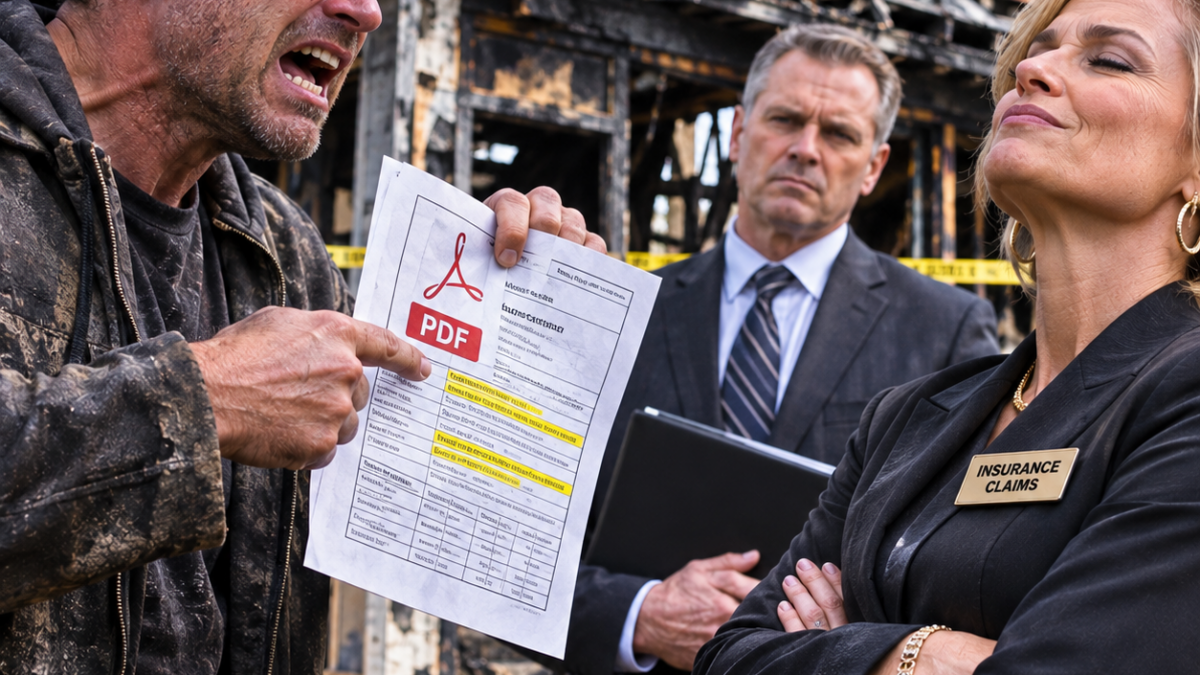
Harbor Point sent a PDF.
Four pages.
Electronic signature at bottom.
Date:
April 9, 2021.
Page two.
Question 14.
Felony conviction within past fifteen years?
NO checked.
I stared.
Jess stared.
Linda stared.
For five seconds, I wondered whether I had somehow forgotten.
That is what good false evidence does.
It makes the target doubt memory.
Then I scrolled.
Bottom footer.
Small.
Exactly the kind of thing almost nobody reads.
HBC CP APP REV 08/22
Revision August 2022.
I supposedly signed the document in April 2021.
Sixteen months before the form version existed.
I started laughing.
Linda looked at me.
“What?”
I pointed.
She read.
Looked again.
“What does that mean?”
“Maybe nothing.”
“You’re laughing.”
“Because if it means what I think it means, somebody screwed up badly.”
“Explain.”
“The version code says this form was revised in August 2022.”
“You signed in April 2021.”
“Exactly.”
“Could the code mean something else?”
“Maybe.”
“Then why are you smiling?”
“Because this is how a retired postal inspector caught me.”
That stopped her.
I told her.
Footers.
Revision codes.
Document consistency.
Then:
“Either they gave us the wrong template…”
“Or?”
“Somebody generated a later form and represented it as the application I signed.”
Linda stared at the page.
“Do not tell them.”
“I wasn’t going to.”
That surprised her.
“Why?”
“Because if we show the hole now, they call it clerical error.”
“They ‘find’ another copy.”
“They explain the footer.”
“They repair the story.”
“You sound experienced.”
“I am.”
Not proud.
Useful.
We needed the real application.
Marty Strom had been avoiding me.
Calls unanswered.
Texts vague.
So I found him at the Little League field on a Saturday dragging the infield even though the season was over.
He liked doing it.
Saw my truck.
His shoulders rose.
“Kyle—”
“Cal.”
“Cal. Right. Man, I’ve been meaning to call.”
“No, you haven’t.”
His laugh came out at half volume.
I explained.
Harbor Point had already called him.
Regional manager asked whether Marty remembered discussing my criminal history.
Marty said he did not remember.
Which was true.
Sort of.
He did not remember because the topic never came up.
Because the question was not on the application he used.
But Harbor Point represented about forty percent of his book.
Regional manager’s tone made the preferred memory clear.
“They can terminate my appointment on thirty days.”
He looked exhausted.
“I got two kids in braces.”
Old Danny would have known exactly what to do.
Lean on identity.
Marty needed to be the good guy.
Coach.
Honest local agent.
Tell him silence makes him complicit.
Make him confess.
I could feel the old words forming.
Easy.
Too easy.
I hated that.
So I stopped.
“I’m not asking you to say anything for me.”
He looked suspicious.
“What?”
“I’m asking you to look in your system.”
“For what?”
“The application actually submitted April 9, 2021.”
He rubbed his face with a work glove.
Left red dirt across his forehead.
“Agency system keeps everything.”
“Good.”
“E&O carrier requires it.”
“Even better.”
Monday, Marty called.
Voice shaking.
“I found it.”
“How many pages?”
“Three.”
I closed my eyes.
“Felony question?”
“No.”
“Confirmation?”
“Yes.”
Not only did Marty’s system contain the original application.
It contained Harbor Point’s own underwriting confirmation email from April 9, 2021.
Sent from Harbor Point’s server.
Attached PDF.
Three pages.
No Question 14.
No felony question.
“I’ll sign whatever Linda needs.”
Marty sounded sick.
“Just give me a warning before this blows up.”
“You did nothing wrong?”
“I should’ve called you sooner.”
“Why didn’t you?”
“Scared.”
At least he said it.
Then I searched Ohio Department of Insurance filing records.
Public.
Painful website.
Coffee required.
July 2022.
Harbor Point commercial application revision filing.
New felony question added.
There it was.
Question did not exist when I applied.
Twins arrived the week before Thanksgiving.
Thirty-five weeks.
Five pounds and change each.
NICU nine days.
June.
Pete.
Yes, I got to name one Pete.
Jess claims she does not know why.
She knows.
Hospital became our world.
Machines.
Tiny diapers.
Vending machine on third floor that stole dollar bills.
Nora pressing her hand against incubator glass.
In the middle of that, Linda prepared suit.
Breach of contract.
Bad faith.
The easy move would have been confronting Harbor Point immediately.
Send Marty’s real application.
Department filing.
Footer.
Demand payment.
Linda would have done that.
I asked her not to.
“Why?”
“Because they have not fully committed.”
She stared.
“They denied.”
“On rescission, not fully.”
“What do you want?”
“Sworn answer.”
Her expression changed.
The old skill scared Jess.
It scared me too.
In fraud, the hardest part was waiting for someone else to commit to the false assumption you built for them.
Show contradiction too early and they adjust.
Let them declare certainty and the contradiction becomes evidence.
This time I was not fabricating anything.
I was simply not correcting Harbor Point’s mistake before they formally owned it.
Right before filing, Bryce called me directly.
Linda had already instructed Harbor Point to contact her.
He called anyway.
I recorded.
I sounded beaten.
Was not much acting.
“Is there any settlement?”
Bryce relaxed.
People get comfortable when they think resistance has ended.
“We could potentially make an accommodation without admitting coverage.”
“How much?”
“Eleven thousand.”
Claim value around two hundred ten thousand.
Full release.
NDA.
I breathed slowly.
“My wife is sick.”
True.
“I just need this over.”
Also true.
Then I asked:
“I don’t understand that application.”
“What about it?”
“I don’t remember the felony question.”
Bryce’s voice became firm.
“Mr. Kessler, I personally pulled the application from our underwriting system.”
I stayed quiet.
“The one we have is the one you signed.”
“You’re sure?”
“It’s not going to change.”
I let silence sit.
Then:
“Okay.”
Nothing else.
After lawsuit filed, Linda served written discovery.
One interrogatory asked source of the application.
Harbor Point answered under oath:
True and complete copy maintained in underwriting system since policy issuance.
Bryce signed verification.
Linda scheduled deposition.
Harbor Point seemed delighted.
They had already deposed me.
My felony.
My finances.
Fire.
Everything.
I answered straight.
Now their investigator would explain routine records.
Deposition happened in Columbus.
Conference room.
Burnt coffee smell.
Harbor Point lawyer:
Carol Wexler.
Professional.
Efficient.
Not stupid.
Linda spent hours on boring material.
Bryce’s training.
Work history.
SIU processes.
How documents are retrieved.
How claim files are maintained.
How application records are accessed.
Then she handed him the PDF.
“Mr. Toliver, is this the application you obtained from Harbor Point’s underwriting system?”
“Yes.”
“True and accurate copy?”
“Yes.”
“Document Mr. Kessler electronically signed April 9, 2021?”
“Yes.”
“Unaltered?”
“That is correct.”
Linda waited.
Then:
“Would you read the footer on page two?”
Bryce looked down.
“Rev 08/22.”
He kept looking.
Did not understand.
Carol did.
I watched her face change half a second before his.
Linda asked:
“What date did Mr. Kessler allegedly sign the application?”
Bryce:
“April 9, 2021.”
“And the revision code?”
“August 2022.”
Silence.
The court reporter stopped moving for a second.
Carol said:
“Let’s take a break.”
Linda smiled politely.
“Before we do, I have a few documents.”
First:
Blank Harbor Point 2021 application form preserved by Teresa Gaines from a policy purchased around the same period.
No Question 14.
Second:
Ohio Department of Insurance filing showing felony question introduced July 2022.
Third:
Marty’s agency system printout.
Harbor Point underwriting confirmation email.
April 9, 2021.
Three-page application attached.
No Question 14.
Bryce stared.
Carol stared.
I sat behind Linda thinking about Valdosta.
A retired postal inspector looking at my fake footer.
Twenty-one years old.
Arrogant.
Certain nobody would read the bottom.
I wondered whether every life eventually turns you around and makes you stand on the opposite side of your own lesson.
Harbor Point recessed.
Two weeks later, rescission defense disappeared.
Linda did not stop.
She requested original electronic records.
Metadata.
Audit logs.
Generation history.
Harbor Point objected.
Linda moved to compel.
Judge ordered production.
Audit records showed the four-page application PDF had been generated eleven days after SIU ran my criminal-background check.
Login:
Bryce Toliver.
That did not automatically prove some companywide conspiracy.
Important.
Audit log showed his credentials generated the document.
Questions remained about who instructed whom.
What internal process existed.
Whether he acted alone.
Whether system tools made alteration routine.
But one thing was no longer reasonably debatable.
The four-page PDF was not the application I signed in April 2021.
Harbor Point’s own records proved it.
Four months later, settlement.
I cannot give the amount.
Contract.
Confidential number.
I can say it covered the destroyed shop.
Equipment.
Lost business income.
Canceled kitchen contract.
Outstanding CNC loan.
Other losses.
And a substantial additional amount tied to bad-faith exposure.
More than Harbor Point likely would have paid if they had simply handled the claim properly.
I refused one thing.
NDA about facts.
They could require settlement amount confidential.
I wanted the story usable.
Linda fought for that harder than I expected.
Harbor Point admitted no wrongdoing.
Of course.
Settlement language has its own religion.
Linda forwarded the evidence to Ohio Department of Insurance.
Altered application.
Audit history.
Recorded calls.
Meridian reports.
Also prosecutor’s office.
Bryce was fired.
Harbor Point’s position:
He acted alone.
Maybe.
Maybe not.
I do not claim facts I cannot prove.
Prosecutor opened a file.
No charges when I last checked.
Linda said investigations can take forever and sometimes end without charges.
That disappointed the revenge-story part of my brain.
Real life rarely provides handcuffs on schedule.
Department of Insurance began reviewing Harbor Point claims practices.
Lots of letters.
No dramatic press conference.
Lyle Barnhart?
Still working last I heard.
Copy-pasting expert language is not automatically a crime.
But Meridian stopped getting Harbor Point assignments.
And those old reports became much less useful once attorneys knew to compare them.
Wendell Haas’s lawyer got Ray Stoltz’s number.
Wendell eventually settled for far more than nineteen cents on the dollar.
Teresa Gaines kept fighting.
Last summer she mailed us two quilts for the twins.
One blue.
One yellow.
She wrote:
Didn’t know your colors.
June sleeps under yellow.
Pete uses blue.
Marty lost his Harbor Point agency appointment during a broader producer review.
He replaced the business with two other carriers by summer.
Says he is fine.
I believe him around seventy percent.
Still drags the Little League infield every Saturday.
Greg Pollard retired early.
I never used his recorded comment publicly.
He did not fabricate anything.
He did not deny my claim.
He had simply told the truth to a man who was listening carefully.
I built him a walnut humidor.
He had mentioned once that he liked cigars but his wife made him smoke in the garage.
He texted:
You didn’t have to do this.
I replied:
I know.
The fire marshal eventually closed the origin investigation.
Most likely cause:
Electrical fault.
Frayed extension cord running to a dehumidifier.
Marcus and I had both forgotten it remained plugged in.
Ordinary mistake.
That mattered to me more than I expected.
For months I had wanted the cause to be something dramatic.
Manufacturing defect.
Lightning.
Hidden wiring problem.
Something nobody could blame on us.
Instead:
Old extension cord.
Dehumidifier.
My shop.
My responsibility.
Nobody criminal.
Nobody malicious.
Just ordinary carelessness.
I could live with that.
The new shop went up the following spring.
Same location.
Larger footprint.
Better electrical layout.
Separate finishing room.
Modern dust collection.
Sprinkler system.
Fire-rated storage.
New CNC.
Not identical.
Better.
The first morning I unlocked the new door, I stood there alone.
Fresh concrete.
Clean walls.
Machines where I had spent months imagining them.
Pete Lindquist came into my head.
Not physically.
He had died years earlier.
But I could hear:
Okay.
Marcus came back.
Full-time now.
He pretended the other job had been terrible.
I pretended that was why.
Nora was six.
Twins were toddling.
She had a kid-sized workbench in one corner.
I bought her a small hammer.
Coping saw she could only use with me.
One afternoon, she built a box from scrap pine.
Probably four hundred nails.
Nothing square.
Lid fell off.
She brought it over.
“Daddy.”
“What?”
“Is it good?”
I opened the lid.
It fell onto the floor.
I put it back.
Turned the box.
Looked at it slowly.
Exactly the way Pete used to inspect my drawers.
Nora waited.
I said:
“Okay.”
Her face lit up like I had handed her a trophy.
I had to turn away for a second.
Jess noticed.
She notices everything.
That night she asked:
“You thinking about Pete?”
“Yes.”
“You ever tell Nora?”
“When she’s older.”
“About prison?”
“Everything.”
Jess nodded.
That was the agreement.
I would never build our family on secrecy.
The thing Harbor Point had tried to use against me had happened.
I was convicted.
I defrauded people.
I went to prison.
I owed restitution.
No court settlement changes that.
No insurance company becoming worse makes nineteen-year-old Danny better.
That distinction became important because people who heard the story started calling me a hero.
I am not.
I used to steal from grieving people.
Then I stopped.
Stopping wrong does not turn old wrong into virtue.
It turns stopping into the minimum.
I got lucky enough to build something better afterward.
That is different.
People ask whether it felt good using my old con skills against Harbor Point.
Yes.
And no.
The first few months frightened me.
How quickly the mental machinery returned.
Reading Greg.
Reading Marty.
Knowing Bryce would become more certain if I sounded defeated.
Knowing not to reveal the footer too early.
There was pleasure in competence.
That disturbed me.
Because Danny had felt that pleasure too.
Same brain.
Same pattern recognition.
Different target.
Jess saw it.
One evening before Bryce’s deposition, she asked:
“Do you miss it?”
“What?”
“The game.”
I pretended not to understand.
She waited.
I said:
“Sometimes.”
That was the honest answer.
“The lying?”
“No.”
“Winning?”
I thought.
“Seeing the move before somebody else does.”
She nodded.
“That scares you.”
“Yes.”
“Why?”
“Because it used to be enough.”
“Enough for what?”
“To make anything feel okay.”
Jess took my hand.
“Does it now?”
I looked toward Nora’s room.
Twin monitors.
Bills on the counter.
The half-built insurance lawsuit.
“No.”
“Then maybe that matters.”
It did.
Danny used understanding to remove choice.
He manufactured realities so people would hand him money they would not have given if they knew the truth.
What I did with Harbor Point worked only because I stayed inside truth.
I did not forge their application.
They generated it.
I did not alter the reports.
Barnhart wrote them.
I did not tell Bryce to swear the PDF was original.
He did.
I did not tell Greg what to say.
He chose his words.
I did not invent Marty’s email.
His agency preserved it.
The old skills helped me know where to look.
Evidence did the rest.
That became the difference I needed.
Still, Linda gave me rules.
No contacting Harbor Point employees without discussing it first.
No pretending to be somebody else.
No accessing private systems.
No deceptive pretexts.
No threats.
No “investigation” beyond lawful public records and voluntary conversations.
I obeyed.
Mostly.
She would say the “mostly” is because I contacted Teresa and Wendell before telling her.
Fair.
At settlement dinner, Linda raised a glass.
“To clients who eventually listen.”
I said:
“To lawyers who bill after settlement.”
She laughed.
Jess asked Linda:
“Was he the worst client?”
Linda said:
“No.”
I looked offended.
“Not even top five?”
“You disappoint me.”
Then she became serious.
“You did one thing most clients don’t.”
“What?”
“You understood the other side’s incentives.”
I smiled.
“That used to be my job.”
“Exactly.”
She took a drink.
“Insurance bad faith often becomes easier when somebody on the other side starts protecting their own prior decision instead of reassessing the claim.”
That was Harbor Point.
Initial fire report.
Then suspicion.
Then felony discovery.
Once they saw me as a fraudster, every fact started bending toward that story.
Late loan payment?
Motive.
Solvent near finishing bench?
Accelerant.
Old felony?
Character.
No felony disclosure?
Fraud.
Except the last fact had to be manufactured because the actual application did not contain the question.
Maybe Bryce acted alone.
Maybe somebody pressured him.
I do not know.
But I understand how a bad institutional decision can become self-protective.
The claim starts weak.
Then people invest reputation in it.
Every correction threatens someone.
So instead of asking:
Could we be wrong?
They ask:
How do we prove we were right?
That question can ruin people.
Teresa nearly lost everything.
Wendell accepted pennies.
Restaurant owner went bankrupt.
I had one advantage they did not.
I knew what manufactured certainty looked like.
Because I had manufactured it myself.
A year after settlement, Mrs. Dupree sent Nora another two-dollar bill.
I finally wrote back more than our normal Christmas card.
I told her—not details protected by settlement amount, but enough.
Shop fire.
Insurance accusation.
Old conviction resurfacing.
I wrote:
The strangest part is that something I learned while doing wrong helped me recognize when someone else was doing something wrong to me. I don’t know what to make of that.
Her reply arrived in January.
Handwritten.
One page.
She wrote:
A hammer can build a house or break a window. I never blamed the hammer.
Then:
You still owe me eleven thousand dollars emotionally.
I stared.
Then laughed so hard Jess came from the kitchen.
“What?”
I handed her the letter.
Mrs. Dupree continued:
But your restitution check cleared years ago, so I suppose the books are balanced.
At bottom:
Tell Nora the two-dollar bills are for luck. Stop overthinking everything.
I cried.
Not because she forgave me.
She never used that word.
Because she had given me something better.
A boundary.
What happened happened.
Debt paid.
Do better.
Move forward.
I framed the letter in the shop office.
No customer knows what it means.
That is fine.
Sometimes redemption stories get dangerous.
People tell them like the past disappears once the person becomes useful.
Mine did not.
I remember victims.
I remember prison.
I remember Pete.
I remember the first cabinet shop owner who hired me after I checked yes next to felony conviction.
His name was Howard.
He interviewed me.
Read the application.
“Fraud?”
“Yes.”
“How long ago?”
“Four years.”
“Steal from me?”
“No.”
“How do I know?”
“You don’t.”
He stared.
Then hired me.
Why?
Years later I asked.
He said:
“You were the only applicant who answered that question without explaining why it wasn’t really your fault.”
I never forgot.
That was why Harbor Point’s fake Question 14 made me furious beyond money.
If they had actually asked, I would have said yes.
I had spent years refusing to hide.
They turned honesty I would have given them into a lie I never told.
That felt like being dragged backward into Danny against my will.
Jess understood.
She said:
“They wanted you ashamed enough not to fight.”
Maybe.
Or maybe they simply thought a jury would dislike me.
They were not wrong about the risk.
Linda told us from the beginning:
“Your conviction will come in.”
“I know.”
“Harbor Point will make the story about credibility.”
“I know.”
“A jury may hear ‘fraud conviction’ and stop listening.”
“I know.”
“Then we build documentary proof strong enough that liking you becomes irrelevant.”
That was perfect.
I did not need a jury to believe Cal was a good man.
I needed records showing Harbor Point’s application did not exist in 2021.
The date code did not care who I used to be.
Marty’s email did not care.
Department filing did not care.
Audit log did not care.
That is what evidence can do for people whose credibility is complicated.
It creates a place where character is not the only battlefield.
I learned the same thing from Pete’s drawers.
Wood either fits.
Or it does not.
Question 14 either existed on April 9, 2021.
Or it did not.
It did not.
Years later, people still ask me about Bryce.
“Do you hate him?”
I did.
For a while.
Especially during NICU.
Sitting beside Pete’s incubator at two in the morning while knowing some man had apparently generated a document that could erase our insurance.
Hate came easily.
Then time passed.
I learned Bryce was fired.
Maybe career destroyed.
Maybe prosecutor investigates.
I expected satisfaction.
Got less than I thought.
Because once you stop needing revenge to keep moving, another person’s collapse loses some flavor.
I wanted accountability.
I wanted Harbor Point to pay.
I wanted the record corrected.
I wanted other claimants to know.
Got those things.
Whether Bryce spends the rest of his life miserable does not rebuild my shop.
Jess would say that means therapy worked even though I never went.
I tell her woodworking is therapy.
She says sawdust is not a licensed provider.
We disagree.
Greg came to the new shop once.
After I mailed the humidor.
He stood in the doorway.
Looked around.
“This is nice.”
“Better.”
“Sprinklers?”
I pointed up.
He laughed.
Then his face changed.
“I’m sorry.”
“For what?”
“Not saying more.”
“You said enough.”
“I knew Meridian had a reputation.”
“You were an adjuster.”
“I could’ve pushed.”
“Would it have changed SIU?”
He hesitated.
“Probably not.”
“Then stop.”
He looked at the humidor on my desk.
“You really didn’t have to send that.”
“I know.”
“Why did you?”
I thought.
“Because you told the truth before it was safe.”
He looked uncomfortable.
People often do when thanked for things they consider small.
He left an hour later.
I never saw him again.
Marcus came back full-time when we rebuilt.
Eventually became foreman.
Then partner.
He hated the title.
Said:
“I still sweep.”
“Partners can sweep.”
“Do partners get more money?”
“Eventually.”
“Sounds like fraud.”
I stared.
He froze.
Then realized.
“Oh.”
I laughed until I had to sit down.
“You’re fine.”
“Thought I was fired.”
“You almost were.”
He has a key now.
His own customers.
Better eye for finish than I do.
He was the one who finally found the exact damaged extension cord in the debris pile months after the fire report.
He held it up.
“So this stupid thing did all that?”
“Probably.”
“Six-dollar cord.”
“Yep.”
“Insurance paid lawyers God knows how much because of this.”
“Yep.”
He shook his head.
“We should frame it.”
We did.
It hangs in the shop office inside a shadow box.
Label:
MOST EXPENSIVE EXTENSION CORD IN OHIO
Linda saw it.
Said:
“Do not make factual claims about statewide rankings.”
Lawyers.
June and Pete are old enough now to understand there was a fire before they were born.
Nora remembers orange sky.
Sometimes she describes it differently.
Children turn memories into stories.
“I woke Daddy.”
Correct.
“And I saved everybody.”
Arguable.
Jess says:
“Let her have it.”
So Nora saved us.
Fair.
She really did wake us before the fire spread toward the house.
Fire department later said wind could have moved embers.
I do not think about that too long.
Nora’s ugly pine box sits on my desk.
Still does not close.
Lid still falls off if opened wrong.
I could repair it in ten minutes.
Never will.
That box reminds me of Pete saying okay.
Quality matters.
But so does knowing what stage a person is in.
At twenty-one, I needed Pete to make me redo a drawer nine times.
At six, Nora needed her father to see that she had built something.
Standards without mercy become cruelty.
Mercy without standards becomes useless.
Pete understood that better than I did.
I named my son after him.
Jess definitely knows.
She pretends she does not because sometimes love lets a person keep one private explanation.
The settlement money changed our life.
Not mansion money.
Not private-jet nonsense.
Enough.
Rebuild without crushing debt.
Replace equipment.
Recover lost income.
Set aside college money.
Create reserve.
Pay NICU bills.
Jess still returned to work eventually.
Because she wanted to.
Not because we needed her paycheck immediately.
That difference felt enormous.
I could have stopped working.
For a while.
Maybe years.
Did not.
I like wood.
That sounds simple.
After everything, simple is valuable.
A walnut board does not care about my conviction.
Insurance claim.
Bryce.
Danny.
Cal.
It cares about grain direction.
Moisture.
Blade.
Pressure.
Cut.
You cannot manipulate curl.
Cannot flatter maple.
Cannot intimidate cherry into staying flat.
Wood tells the truth slowly.
That is why prison furniture shop worked on me.
I had spent years believing intelligence meant getting around reality.
Wood taught me intelligence could mean respecting it.
Harbor Point forgot that in its own way.
They built a story.
Arson.
Financial motive.
Felony.
Misrepresentation.
Every piece seemed to fit until physical reality refused.
No accelerant where they implied.
Reports copied.
Application date impossible.
Original email preserved.
Audit log.
They tried to persuade the record.
Records are bad audiences.
I know.
I used to forge them.
The funniest part?
Harbor Point could probably have handled the original claim for much less.
Investigate fairly.
Find electrical cause.
Pay property limit.
Business income.
Equipment.
Done.
Instead, suspicion grew into strategy.
Strategy grew into altered evidence.
Altered evidence grew into bad-faith exposure.
Then lawyers.
Regulators.
Other claimants.
Public filings.
The company paid more because somebody became too committed to not paying me.
That is a lesson I wish more institutions understood.
Winning every small decision can create a catastrophic large loss.
Greg once told me adjusters are trained to control severity.
I said:
“Seems like they increased it.”
He laughed.
“Sometimes.”
People also ask if I think Harbor Point executives knew about the altered application.
I do not know.
That sentence frustrates audiences.
They want the evil boardroom.
Someone saying:
“Forge the form.”
Evidence did not establish that.
The audit showed Bryce’s login.
Maybe he acted alone.
Maybe pressure created incentives.
Maybe supervisors looked away.
Maybe there were broader practices regulators would uncover.
I will not invent certainty because certainty feels satisfying.
I know what false stories can do.
Truth deserves the same discipline when it favors me.
Meridian?
Same.
Copied language looks terrible.
Ray dismantled Barnhart’s technical reasoning.
Other cases were harmed.
But copy-paste does not by itself prove intentional fraud.
Could be lazy template use.
Could be biased methodology.
Could be worse.
The lawyers can argue.
I know only what records show.
That is another way Cal differs from Danny.
Danny filled gaps with whatever story made money.
Cal has learned to let gaps remain gaps.
Harder than it sounds.
Especially when angry.
A few months after the new shop opened, Teresa visited.
She brought her son.
He was grown.
Thirty-ish.
She walked through the shop.
Touched a stack of walnut.
Said:
“Smells good.”
“Better than burnt.”
She laughed.
Then cried.
We stood awkwardly.
She said:
“I thought I’d never walk into another shop without thinking about mine.”
“What happened to the building?”
“Sold.”
“You want another business?”
“No.”
Immediate.
Then:
“Maybe.”
We had coffee.
She told Jess what it was like being accused.
Her son barely spoke.
Then he said:
“I believed them at first.”
Teresa looked at him.
He stared at table.
“I’m sorry.”
She put her hand over his.
That was a private moment.
I looked away.
Accusations do that.
They infect families.
Insurance company says:
We suspect fraud.
Even people who love you start asking:
Could they know something I don’t?
Jess asked me too.
Did you lie?
I do not blame her.
Evidence is powerful precisely because trust can be shaken.
That is why fabricating evidence is so corrosive.
It does not merely alter a file.
It enters marriages.
Children.
Friendships.
My old victims knew that long before I did.
I once gave grieving people official-looking letters and watched them trust paper over instinct.
Years later, an insurance company gave Jess an official-looking application and, for a few seconds, she looked at me wondering whether Danny had returned.
That was punishment no court ever sentenced me to.
Maybe I deserved some version of that.
Maybe nobody does.
I do not spend much time deciding.
I spend time being someone whose wife does not have to ask twice now.
When something scares me, I tell Jess.
Usually.
She would dispute the usually.
The shop now carries more insurance than before.
Different carrier.
Different agent.
Application had a felony question.
I checked yes.
Attached explanation.
Conviction date.
Restitution completed.
No problem.
Premium slightly higher.
Fine.
When policy binder arrived, I read every page.
Footer too.
Marty laughed when I told him.
“You’re going to make some poor underwriter nervous forever.”
“Good.”
He no longer sells Harbor Point.
New carriers.
Business recovering.
His kids’ braces eventually came off.
That is how I measure time now.
Claims resolve.
Children lose teeth.
People move on.
The prosecutor never called me to testify.
Maybe someday.
Department review produced findings I cannot fully discuss because some are ongoing and some never became public.
I stopped checking every week.
That was another stage.
At first I needed consequences constantly.
Bryce fired?
Good.
Meridian dropped?
Good.
Regulator reviewing?
Good.
Prosecutor file?
Good.
Then one morning, I realized I had not searched Harbor Point for three months.
That felt better than revenge.
My life had become larger than their consequences again.
That is the ending people skip.
Not the settlement.
Not deposition.
The day your enemy stops being the first thing you think about.
That is winning.
Years ago, Danny thought winning meant the other person never realized what happened until he had their money.
Then Pete taught me winning could be a drawer sliding correctly.
Jess taught me winning could be telling the truth before somebody drags it out.
Nora taught me winning could be a box with four hundred nails because your daughter thinks you are worth impressing.
Harbor Point taught me something too.
The truth does not always protect you immediately.
Sometimes it sits quietly while a lie gets letterhead.
A claim number.
A lawyer.
A denial.
A sworn verification.
Truth can look weak for months.
Then somebody reads the footer.
I have thought a lot about that retired postal inspector in Valdosta.
I hated him for years.
Did not know his first name until after prison.
Mr. Howard Bell.
He died before I ever considered writing.
Sometimes I wish I could tell him:
You were right.
You looked at a tiny code.
Refused to ignore the feeling that dates did not match.
That destroyed the life I had built.
Thank God.
Because if he had not caught me at twenty-one, I would have kept going.
Maybe hurt more people.
Maybe become better at it.
Maybe never learned furniture.
Never met Jess.
No Nora.
No June.
No Pete.
No shop.
No fire.
Strange thing, gratitude.
Sometimes it arrives decades late wearing the face of the man who put handcuffs on you.
If you want a clean moral, I do not have one.
People change.
Sometimes.
Systems fail.
Often.
Past wrongdoing can make you vulnerable to future accusations.
True.
A person with a criminal record can also be telling the truth.
Also true.
Insurance companies have legitimate reasons to investigate fires.
Absolutely.
Arson happens.
Fraudulent claims happen.
People lie.
I know.
That makes fair investigation more important, not less.
Once an investigator decides the insured is guilty and starts bending evidence toward that conclusion, investigation stops being investigation.
It becomes construction.
And I know construction.
Bad foundations do not improve because you keep building higher.
Eventually somebody checks the level.
Our level was a footer:
REV 08/22.
Tiny.
Boring.
Fatal.
That footer did not win the case alone.
Marty’s archived email mattered.
Department filing.
Audit logs.
Ray’s fire analysis.
Greg’s comment.
Copied Meridian reports.
All pieces.
But the footer was the crack.
The thing that made me stop asking:
How do I prove I didn’t lie?
and start asking:
Where did their document come from?
Different question.
Better question.
That is often what solves hard problems.
Not better answers.
Better questions.
The fire took my shop in eleven minutes.
Harbor Point took almost a year trying to convince everyone I had done it myself.
Rebuilding the shop took months.
Rebuilding my own trust in institutions took longer.
Maybe still ongoing.
But I am not cynical about everything.
Fire department showed up.
Linda fought.
Ray did honest work.
Marty eventually found records.
Greg told truth.
Judge ordered production.
Regulators reviewed.
Systems can fail because people make bad choices.
Systems can also correct because other people insist on evidence.
That distinction keeps me from becoming Walt.
Everyone needs one Walt.
Nobody should become him full-time.
Marcus says I need a sign over the shop entrance.
READ THE FOOTER.
Jess says customers will think we print documents.
Nora says:
MEASURE TWICE, READ FOOTERS ONCE.
I may actually make that.
Walnut.
Carved letters.
Pete would hate the kerning.
The twins are older now.
June likes drawing.
Pete likes taking things apart and forgetting where screws belong.
Jess says genetics.
I say which side?
She stares until I stop talking.
One Sunday, Pete found the shadow box with the extension cord.
“What did this do?”
“Burned the shop.”
His eyes widened.
“This?”
“Probably.”
“Why do you keep it?”
“Reminder.”
“Not to use extension cords?”
“Also.”
He thought.
“What else?”
I looked at him.
“Small things matter.”
He nodded.
Then:
“Can I have it?”
“No.”
“Why?”
“It cost me a lot of money.”
He accepted that as perfectly reasonable.
Maybe someday I will explain the form footer too.
Question 14.
Revision dates.
His father’s conviction.
The insurance case.
Not yet.
Children deserve truth.
They also deserve timing.
That is another thing Danny never understood.
Information can be used to manipulate.
Or protect.
Difference is intent and consent.
I spent years making people feel urgency so they would act before thinking.
Now, when a customer wants a decision fast, I do the opposite.
“Go home.”
“Measure your kitchen.”
“Talk to your spouse.”
“Think about wood species.”
“Call me tomorrow.”
One customer laughed.
“You’re bad at sales.”
“Probably.”
Business remains good.
Turns out people like being allowed to think.
I wish I had learned that before prison.
But learning late is still learning.
That is probably what I would tell anybody with a past like mine.
You do not become clean by pretending the dirt was never there.
You become different by choosing what you do with the same hands.
Danny forged paper.
Cal reads it.
Danny studied grieving families so he could exploit vulnerability.
Cal used the same patience to find Teresa and Wendell.
Danny waited for people to commit to a lie he created.
Cal waited for Bryce to commit to the truth of a document Bryce’s own system could not support.
Same nervous system.
Same eyes.
Same instincts.
Different job.
I cannot change the tools in my head.
I can change who they serve.
Last Christmas, Mrs. Dupree sent Nora another two-dollar bill.
Nora is old enough now to ask:
“Who is she?”
I said:
“Someone I hurt a long time ago.”
Nora became very still.
“Why does she send me money?”
“I’m not completely sure.”
“Are you friends?”
“I don’t know if that’s the word.”
“Did you say sorry?”
“Yes.”
“Did she forgive you?”
“I don’t know.”
Nora frowned.
“You don’t know a lot.”
“Correct.”
She held the bill.
“Can I spend it?”
“Sure.”
She looked offended.
“No.”
“Okay.”
“I’m saving them.”
“For what?”
“I don’t know.”
Perfect.
Maybe uncertainty is not always a problem to solve.
Sometimes it is simply honest.
The old me hated uncertainty.
Uncertainty makes marks hesitate.
So I created certainty for them.
Fake official letters.
Deadlines.
Fees.
Authority.
Harbor Point tried the same strategy.
Cause expert.
SIU.
Official application.
Conviction.
Rescission.
The institutional version of:
We know what happened.
But they did not.
And the harder they insisted, the more expensive being wrong became.
When people ask whether I got revenge, I usually say no.
That disappoints them.
I got paid.
I exposed evidence.
Helped other claimants.
Watched an investigator lose his job.
Watched an expert’s credibility weaken.
Got my shop back.
Those things can look like revenge.
But revenge would have required their suffering to be the point.
It was not.
My point was survival.
Then truth.
Then making sure the same evidence could help people after me.
That is why I refused the factual NDA.
Linda understood.
Harbor Point wanted silence.
Settlement amount can stay private.
Fine.
Facts belong to the story.
A company accused me of arson.
Tried to erase coverage using an application question that did not exist when I applied.
Their own records disproved it.
That deserves daylight.
Not because I am pure.
Because I am not.
That is what makes it more important.
If only perfect people deserve honest claims handling, dishonest institutions can choose targets very efficiently.
Ex-con.
Poor person.
Immigrant.
Addict.
Anybody with something embarrassing in the file.
Justice cannot depend on whether the victim looks good on a poster.
I was guilty once.
I was innocent this time.
Both facts fit inside one person.
Harbor Point wanted the first fact to erase the second.
It did not.
The shop is quiet tonight.
Machines off.
Dust collector empty.
Nora’s terrible box on my desk.
Extension cord shadow box on the wall.
Mrs. Dupree’s letter framed beside it.
Greg’s humidor photograph in a drawer.
Pete’s name on my son’s school paperwork.
All these little objects.
Evidence of different lives.
Before prison.
Prison.
After.
Fire.
Fight.
Rebuild.
I walked through the shop before locking up.
Ran my hand along a walnut cabinet awaiting finish.
Drawer slid clean.
Air hissed softly as it closed.
I smiled.
“Okay.”
That word still works.
Outside, the house lights were on.
Jess had texted:
GET MILK.
I had forgotten.
Again.
Cal Kessler.
Former fraudster.
Insurance bad-faith plaintiff.
Woodworker.
Husband.
Father.
Man who can identify forged document footers but apparently cannot remember milk.
I drove to the store.
Normal life.
That is the ending.
Not a courtroom.
Not handcuffs.
Not Harbor Point executives begging.
Just normal life restored after somebody tried to turn my worst past mistake into permission to deny me the truth in the present.
They picked me because they thought my conviction made me easy to discredit.
They were right about one thing.
I knew exactly how a fraud works.
They were wrong about the part that mattered.
I was not running one anymore.
And unfortunately for them, whoever created that four-page application was not nearly as good at it as I used to be.
They remembered the felony.
They remembered the question.
They remembered to check the box.
They remembered the electronic signature.
They remembered the story they wanted everybody to believe.
But they forgot the smallest thing.
The thing a retired postal inspector had taught a twenty-one-year-old con man never to ignore.
The footer.
And sometimes the difference between losing everything and getting your life back is one tiny line at the bottom of a page that somebody powerful was absolutely certain nobody would ever bother to read.








