PART2:“WRITE YOUR NAME DOWN OR LEAVE!” Our Receptionist Humiliated a Deaf Old Man—Then the CEO Bowed to Him and Asked Me One Question
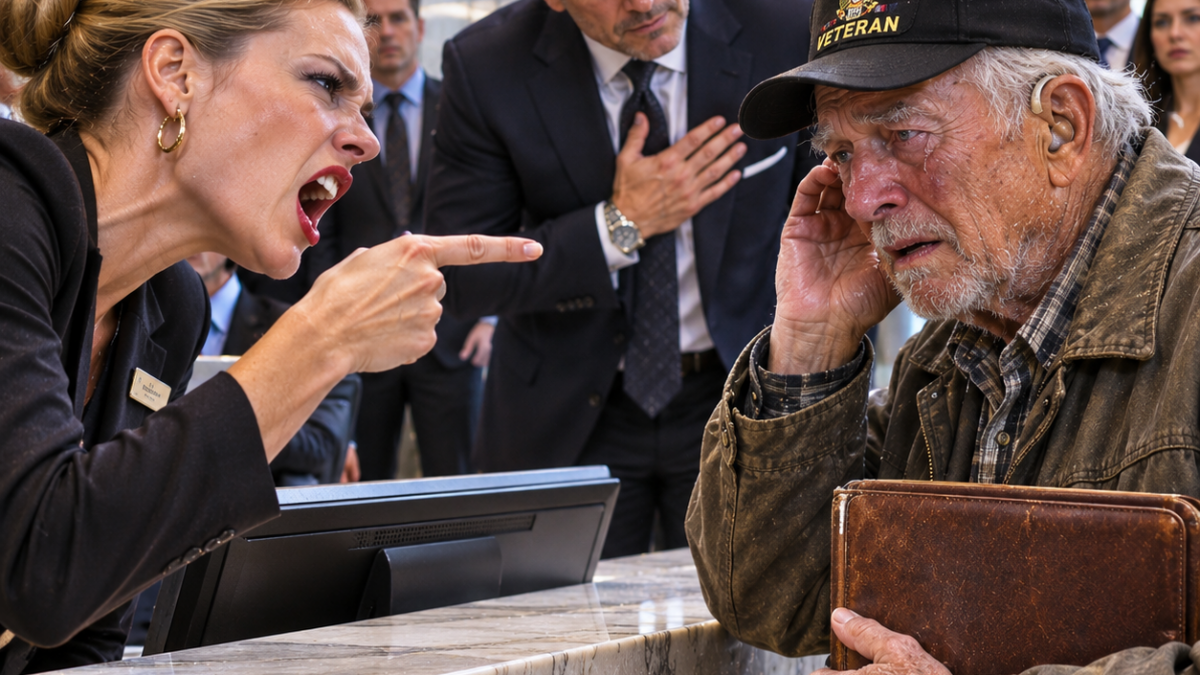
Not anger.
Humiliation.
I knew that posture.
My younger brother Daniel had been deaf since birth.
When we were children, I watched adults speak over him instead of to him.
I watched teachers answer me when Daniel had asked the question.
I watched a restaurant server once turn toward me and say:
“Can you just tell me what he wants?”
Daniel had been fourteen.
He sat there staring at the table.
That evening he signed something I never forgot.
Sometimes people stop seeing me once they realize I can’t hear them.
The old man in Meridian’s lobby had the same face.
I heard Marissa’s warning in my head.
Eight-forty.
Keep walking.
You need this job.
Your rent is due.
Your student loans do not care about strangers.
Then Jessica said:
“Security can escort you outside if you’re confused.”
I stopped thinking.
I lowered the binders onto a credenza.
Two slid sideways.
Someone nearby gasped as though I had dropped original Picasso sketches.
I stepped in front of the elderly man so he could see me clearly.
His eyes moved to mine.
I lifted my hands.
Slowly.
Clearly.
Hello, sir. My name is Catherine. Can I help you?
The man froze.
Completely.
His hazel eyes widened.
For several seconds he stared only at my hands.
Then at my face.
Then his shoulders dropped.
The tension left him so visibly that it hurt to watch.
His hands rose.
You sign?
I smiled.
Yes.
His fingers trembled.
Thank God.
Then:
I thought I had walked into a tomb full of ghosts.
Despite everything, I almost laughed.
He glanced toward the executives flowing around us.
I have been waving at stone statues for twenty minutes.
Then toward Jessica.
The woman at the counter treated me like I was trying to steal something.
I swallowed.
I’m sorry.
He shook his head.
You didn’t do it.
I signed:
Who are you here to see?
He hesitated.
That hesitation would end up changing everything.
His eyes moved toward the enormous Meridian logo mounted above reception.
Then upward toward the elevators.
Finally:
My son.
Which department?
Another pause.
I did not make an appointment.
That’s okay. What’s his name?
His fingers moved slowly.
M.
I.
C.
H.
A.
E.
L.
I felt something cold move down my back.
Then:
H.
A.
R.
T.
W.
E.
L.
L.
I forgot the binders.
Forgot my supervisor.
Forgot the pitch.
Michael Hartwell.
The founder.
Chairman.
Chief executive officer.
The man whose name was attached to almost everything inside Meridian except the restrooms.
The billionaire business magazines described as “relentlessly private.”
The executive whose rare appearances on ordinary floors made senior vice presidents suddenly remember how to stand straight.
I raised my hands.
They were shaking now.
Michael Hartwell?
The old man smiled gently.
Yes.
The CEO?
A slightly amused nod.
My son Michael.
My mouth went dry.
You’re his father?
He signed:
Robert Hartwell.
Behind me, Jessica suddenly called:
“Security!”
I turned.
She was pointing toward us.
“Why is that man still here?”
A security officer looked uncertain.
Jessica stood.
“Get that beggar out of VIP reception before the client delegation comes through.”
Then, with a disgusted little gesture:
“Don’t let trash clutter the lobby.”
My face burned.
Robert could not hear her.
But deafness does not prevent a person from reading contempt.
He looked at Jessica.
Then down.
That was worse.
I turned to the guard.
“Do not touch him.”
Jessica stared at me.
“Excuse me?”
“He’s a guest.”
“He’s not registered.”
“He’s here to see Michael Hartwell.”
Her expression changed.
Only slightly.
“Which Michael Hartwell?”
I looked directly at her.
“Our CEO.”
For the first time, fear appeared behind her eyes.
Then she recovered.
“Catherine, pick up your binders and stop making a scene.”
I ignored her.
I crossed to the executive phone.
Dialed the four-digit extension every Meridian employee knew and almost nobody used.
Two rings.
“Office of the Chief Executive. Patricia speaking.”
Patricia Sloane.
Michael Hartwell’s executive assistant.
A woman vice presidents reportedly rehearsed before calling.
“Good morning, Patricia. This is Catherine Walsh.”
“Department?”
“Brand Strategy.”
“Reason?”
“I’m in the first-floor lobby with Mr. Robert Hartwell.”
Silence.
Then:
“Repeat that.”
“Robert Hartwell.”
I looked at him.
“The CEO’s father.”
Longer silence.
Keyboard clicks.
Then Patricia’s voice became colder.
“Mr. Hartwell is currently in a closed session with the European delegation.”
“I understand.”
“No interruptions before one.”
“Patricia, his father is downstairs.”
“I heard you.”
“He uses sign language.”
Another pause.
“Tell him to arrange an appointment formally.”
I thought I had misunderstood.
“He’s his father.”
“Miss Walsh, Mr. Hartwell has given explicit instructions regarding interruptions.”
Robert was watching my face now.
I knew he already understood enough.
I tried once more.
“The receptionist was calling security to remove him.”
Patricia’s voice sharpened.
“I am busy.”
Then:
“Escort him out.”
The line went dead.
I lowered the receiver.
Robert gave me a small, sad smile.
His hands moved before mine.
He is too busy.
I started to explain.
Robert shook his head.
It is all right.
Then:
He has an empire to run.
His hands slowed.
I am only an old man chasing memories.
He took his cane.
Turned toward the revolving doors.
And something inside me broke.
I stepped in front of him.
He stopped.
I signed:
Have you ever seen what your son built?
Robert frowned.
I gestured around us.
This building. His office.
He shook his head.
Only photographs.
Then:
When he bought this building eight years ago, he mailed me pictures.
That sentence lodged somewhere in my chest.
Not invited me.
Not showed me.
Mailed pictures.
I looked toward the elevators.
Then back.
Don’t leave yet.
His eyebrows rose.
Michael is busy until one.
That gives us almost two hours.
Robert stared at me.
I smiled.
Let me show you Meridian.
His expression became alarmed.
Won’t you lose your job, little bird?
Little bird.
No one at Meridian had ever called me anything that gentle.
I signed:
Possibly.
He almost laughed.
Then:
Do not risk your livelihood for an old man who arrived without an appointment.
I answered slowly.
I’m not risking it because you arrived without an appointment.
He waited.
I’m doing it because everybody here treated you like you weren’t a person.
Robert looked away.
His eyes filled.
Then he nodded.
PART2
FULL STORY CONTINUATION
I handed my presentation binders to another junior associate named Melissa.
She looked at me as if I were asking her to smuggle diamonds across a border.
“Conference Room A.”
“Catherine, Marissa is looking for you.”
“I know.”
“She’s furious.”
“I know.”
“Where are you going?”
I glanced at Robert.
“Upstairs.”
Melissa’s eyes widened.
“Upstairs where?”
“Forty-five.”
She whispered:
“Oh my God.”
“Please get the binders there.”
She took them.
“Fine.”
Then:
“If you survive, you owe me lunch.”
Fair.
Robert and I crossed toward the VIP elevator.
Jessica came around the reception desk.
“Catherine.”
I kept walking.
“Catherine!”
I stopped.
She lowered her voice.
“You cannot take him upstairs.”
“He’s Michael Hartwell’s father.”
“You were told the executive floor is closed.”
“How do you know what I was told?”
That shut her up for half a second.
She had been listening.
Then she said:
“If you disrupt this pitch, you’re finished.”
I looked at Robert.
Then Jessica.
“You called him trash.”
Her face hardened.
“I didn’t know who he was.”
“That’s exactly the problem.”
I turned away.
Robert watched the exchange.
He signed:
What did she say?
I considered lying.
Then decided he deserved the truth.
She said she didn’t know who you were.
Robert’s mouth twisted sadly.
So now I am a person?
I had no answer.
The elevator opened.
We stepped inside.
The doors closed.
Silence.
Actual silence.
Not the isolating kind Robert had experienced downstairs.
Just two people standing inside an elevator.
The floor numbers climbed.
Robert looked at me.
You are shaking.
I looked at my hands.
He was right.
I may have made several questionable career decisions.
He smiled.
Too late now.
I laughed.
The elevator passed thirty.
Robert pointed toward my badge.
Catherine Walsh.
I nodded.
How long have you worked here?
Four months.
His eyebrows rose dramatically.
And you are already invading the executive floor?
I’m ambitious.
He laughed silently.
Then his expression softened.
Why do you sign so well?
My brother Daniel.
I smiled.
He was born deaf.
Robert nodded immediately.
I continued.
Our parents learned enough to communicate. I wanted to be fluent.
Daniel hated depending on me, so I learned because I wanted to talk to him, not speak for him.
Robert watched.
Then signed:
That distinction matters.
I know.
He looked at the doors.
People often speak louder when they cannot communicate.
Yes.
They become angry with us for their inability to understand.
That sentence hurt.
I signed:
That happened to Daniel constantly.
Robert nodded.
To me too.
The elevator reached thirty-eight.
My phone vibrated.
Marissa.
Three missed calls.
Message:
WHERE ARE YOU?
Another:
IF YOU ARE NOT IN CONFERENCE A IN FIVE MINUTES, DO NOT COME BACK TO MY TEAM.
Robert noticed.
Your supervisor?
Yes.
Go back.
I locked the phone.
No.
His eyebrows drew together.
Catherine.
I signed:
Maybe I’m tired of proving I belong here by pretending not to notice when something is wrong.
That came out before I could reconsider it.
Robert stared.
Then:
You are very brave.
I shook my head.
No. I’m terrified.
He smiled.
Most courage is.
The elevator reached forty-five.
Patricia Sloane was waiting.
Black suit.
Silver-framed glasses.
Perfectly controlled posture.
Her eyes went straight to Robert.
For the first time, her face moved.
Just slightly.
Recognition.
Then she looked at me.
“What are you doing?”
“Showing Mr. Hartwell the building.”
“I instructed you to escort him out.”
Robert watched her mouth.
I positioned myself slightly so he could keep both of us in view.
“He only wants to see where his son works.”
“The executive floor is restricted.”
“He’s the CEO’s father.”
“That does not change access protocol.”
Something in her wording bothered me.
Not surprise.
Protocol.
As though this problem had existed before.
I asked:
“Has he been here before?”
Patricia’s eyes flickered.
Tiny.
But I saw it.
She answered:
“That is not relevant.”
Robert noticed too.
His hands moved.
What did you ask?
I signed:
Whether you’ve come here before.
Robert looked at Patricia.
Then at me.
Three times.
My stomach tightened.
You’ve been here three times?
Over the years.
I slowly turned toward Patricia.
“Did you know that?”
She said:
“Miss Walsh, this is not your concern.”
Before I could answer, Robert touched my sleeve.
Do not fight. Show me something.
I breathed.
Patricia looked at the clock.
“Ten minutes.”
I blinked.
She continued:
“Do not enter the closed boardroom.”
I nodded.
Robert signed:
Generous kingdom.
I almost laughed.
The executive corridor contained photographs from Meridian’s history.
Michael with presidents.
Michael with European CEOs.
Michael opening offices in London, Singapore, Dubai.
Robert stopped at a photograph showing Michael outside Meridian’s first headquarters.
Much younger.
Proud.
His fingers rose.
He looks like Evelyn.
I signed:
His mother?
Robert nodded.
His expression changed.
My wife.
He touched the air near the photograph.
Not the glass.
Michael had her eyes when he was young.
There was something heavy in the sentence.
We moved to another picture.
Michael cutting the ribbon on the current headquarters eight years earlier.
Robert stared.
Then signed:
This is one of the photographs he sent.
Did he send many?
Robert’s hands paused.
One whenever something important happened.
No note?
Sometimes one line.
His eyes stayed on Michael’s photograph.
“We opened London.”
“The company survived another year.”
“I bought the building.”
It sounded less like communication than evidence of life.
A heartbeat transmitted through envelopes.
I wanted to ask what had happened between them.
Before I could, two executives exited a side room.
One looked at Robert.
“Can we help you?”
I said:
“This is Robert Hartwell.”
Nothing.
Then:
“Michael’s father.”
Both men immediately straightened.
“Mr. Hartwell.”
Robert could not hear.
I interpreted.
He nodded politely.
The executives moved on.
Robert watched them leave.
Then signed:
Interesting.
What?
I became more respectable after you said my son’s name.
I had no defense for the building.
We reached the windows overlooking the city.
Robert stood there quietly.
Then signed:
When Michael was eight, he built towers out of cardboard boxes.
I smiled.
He would make me sit on the floor so they looked taller.
His eyes remained on the skyline.
He always wanted to build something nobody could ignore.
A pause.
I did not realize he might build it so high that he could no longer see the people below.
Behind us, doors opened.
Conversation.
Footsteps.
Then silence.
Robert turned.
So did I.
Michael Hartwell stood twenty feet away.
Board members behind him.
European delegates.
Two senior vice presidents.
Michael’s face changed instantly.
Color drained.
His mouth opened.
Nothing came.
Robert stood perfectly still.
Michael walked toward us.
Not the stride I had seen at company town halls.
No authority.
No performance.
Just a son approaching someone he had not expected to see.
He stopped.
Then bowed.
Deeply.
A full ninety degrees.
The entire corridor froze.
When Michael straightened, his eyes were wet.
He looked at Robert.
Then at me.
“Catherine.”
My name in the CEO’s voice made my stomach drop.
He asked:
“Do you know who you just brought up here?”
I glanced at Robert.
Then signed as I spoke so he remained inside the conversation.
“Your father.”
Michael’s jaw tightened.
Robert slowly raised his hands.
Hello, Michael.
Michael stared.
Then his own hands rose.
He signed.
Not perfectly.
But fluently enough.
Hello, Dad.
Patricia inhaled.
And suddenly the whole lobby disaster became even uglier.
Michael could sign.
Whatever had kept father and son apart, deafness had never been the barrier.
Michael turned toward the executives.
“Clear the floor.”
Nobody questioned him.
European delegates were escorted to the dining lounge.
Board members disappeared.
Michael looked at Patricia.
“You stay.”
Then at me.
“Catherine stays too.”
My stomach sank.
Robert watched me.
Terrified again?
I signed:
Very.
He almost smiled.
Michael saw it.
“Dad.”
Robert looked at him.
Michael signed:
Why didn’t you tell me you were coming?
Robert’s expression closed.
His hands moved slowly.
Because I did not know whether I was welcome.
Michael froze.
I felt the air change.
Why would you think you weren’t welcome?
Robert stared.
Then:
Because the last thing you said to me ten years ago was, “Don’t ever come looking for me again.”
Michael’s face went white.
Not metaphorically.
Actually white.
He glanced at Patricia.
Then away.
Robert continued.
I took you seriously.
Michael’s hands dropped.
He whispered aloud:
“Oh God.”
Robert could not hear it.
But he read his son’s face.
Michael signed:
I was angry.
I know.
I didn’t mean forever.
Robert’s response came immediately.
Ten years is close enough.
No one moved.
Michael looked suddenly much older.
Then he gestured toward his office.
“Please.”
Robert hesitated.
Michael signed:
Please, Dad.
Robert nodded.
Inside Michael’s office, one wall held family photographs.
That surprised me.
Robert stopped.
Young Michael.
Robert.
A beautiful dark-haired woman I assumed was Evelyn.
Christmas mornings.
Graduation.
Lake trips.
One picture showed Michael around twenty, laughing so hard his head was thrown backward.
Robert touched the frame.
His fingers trembled.
Michael stood several feet behind him.
Finally Robert signed:
You kept them.
Michael answered:
All of them.
Robert looked at him.
Then why did you keep me outside?
Michael closed his eyes.
No CEO training could help him now.
He sat.
Robert sat across from him.
Michael looked at me.
“Catherine.”
“Yes?”
“Please interpret if we need you.”
I nodded.
Although both could sign.
I understood what he really wanted.
Someone in the room.
A witness.
Maybe courage.
Michael signed:
I thought you chose to let Mom die without telling me.
Robert went completely still.
There it was.
The wound.
Michael continued.
I was in Paris.
You knew she had gotten worse.
You knew the doctors said days.
And you did not call me.
Robert’s eyes filled.
She made me promise.
Michael’s jaw tightened.
You said that ten years ago.
And you called me a liar.
Michael flinched.
Robert reached into the inside pocket of his suit.
Pulled out a worn cream envelope.
He placed it on the table.
Michael stared.
The handwriting on the front was feminine.
For Michael. When he is ready to stop being angry.
Michael stopped breathing.
Robert signed:
Your mother wrote this three days before she died.
Michael did not touch it.
Robert continued.
I tried to give it to you after the funeral.
Michael looked up.
You threw it back at me.
I came to your apartment six months later.
Security said you would not see me.
Michael slowly turned toward Patricia.
Her face changed.
Robert kept signing.
I came to Meridian three years after that.
I left the letter.
Michael’s eyes snapped to Patricia.
Robert:
It came back unopened.
Patricia’s mouth opened.
Michael said:
“Patricia?”
She swallowed.
“Michael—”
“Did my father leave a letter?”
She said nothing.
“Did he?”
“Yes.”
Robert could not hear her answer.
I signed it.
His eyes closed.
Michael stared at Patricia.
“What happened to it?”
“You had standing instructions.”
“What happened to it?”
“I returned it.”
“Why was I never told he came?”
“You told me you did not want contact.”
“That was ten years ago.”
“You never rescinded it.”
Michael stood.
His hands were shaking now.
“So you turned away my father every time he came here?”
Patricia’s face tightened defensively.
“I protected your schedule.”
Michael’s voice dropped.
“You protected my schedule.”
Silence.
“By erasing my father.”
Patricia looked toward me.
Then Robert.
“I followed your instruction.”
Michael stared at her.
And then, unexpectedly, he nodded.
“Yes.”
Patricia looked surprised.
Michael continued:
“I gave you that instruction.”
His voice cracked.
“I said it in grief.”
“I never corrected it.”
“That part is mine.”
He looked directly at her.
“But returning personal correspondence without informing me?”
“Labeling a family member an access problem?”
“Allowing him to be repeatedly denied entry without review?”
“That part is yours.”
Patricia lowered her eyes.
For the first time, she looked human.
Not sympathetic.
Human.
Michael said:
“Leave us.”
She went.
The envelope remained on the table.
Michael finally touched it.
Then pulled his hand away.
Robert signed:
Read it.
Michael looked terrified.
Not CEO terrified.
Child terrified.
What does it say?
Robert shook his head.
Your mother wrote it to you.
Michael opened the envelope.
The paper inside was yellowed slightly along the fold.
He began reading.
His eyes moved across the first line.
Then stopped.
His face collapsed.
He covered his mouth.
I looked away.
But Michael spoke aloud as he read, perhaps because he forgot Robert could not hear or perhaps because he needed the words outside his own head.
“My darling Michael…”
His voice broke.
He started again.
“My darling Michael, if your father has given you this letter, then I have probably left you both with more pain than either of you deserves.”
Robert watched his lips.
Michael continued.
“I made your father promise not to call you home from Paris.”
His shoulders began shaking.
“You were fighting to keep Meridian alive, and I knew if you came home you would abandon everything you built and sit beside my hospital bed trying to bargain with something none of us could change.”
Michael stopped.
“No.”
Robert’s eyes filled.
Michael kept reading.
“I wanted one of us to finish something.”
Tears dropped onto the paper.
“You will be angry with your father because he keeps promises even when they hurt him.”
Robert looked down.
Michael read:
“Please do not punish him for loving me enough to honor my choice.”
That was the sentence that broke him.
Michael folded forward.
Elbows on his knees.
Face in his hands.
The billionaire who made boardrooms shake was sobbing like somebody had finally allowed him to be the thirty-two-year-old son who never got to say goodbye.
Robert did not move at first.
Then he crossed the space between them.
Placed one hand on Michael’s shoulder.
Michael looked up.
Signed through tears:
You should have told me anyway.
Robert nodded.
Maybe.
Michael stared.
Robert continued:
I was her husband.
You were her son.
There was no choice that did not hurt somebody.
Michael signed:
I hated you.
Robert’s face tightened.
I know.
I wanted you to hurt the way I hurt.
I know.
Michael’s hands shook.
I wasted ten years.
Robert stared at him.
Then signed something I will remember for the rest of my life.
Then do not waste eleven.
Michael broke again.
This time Robert pulled his son into his arms.
Michael held on.
Hard.
No executive dignity.
No billionaire distance.
Just two men who had lost a woman they both loved and spent a decade turning the same grief against each other.
I quietly stood.
Started toward the door.
Robert saw me.
One hand remained on Michael’s back.
The other signed:
Stay.
So I stayed.
After several minutes, Michael sat back.
His eyes were red.
Robert reached into his suit again.
“I have something else,” he signed.
He removed another folded document.
Older.
Bank letterhead.
Michael frowned.
Robert slid it across.
Michael read.
Then looked at his father.
“What is this?”
Robert signed:
The mortgage on the house.
Michael looked confused.
Robert continued.
The second one.
I took it when Meridian could not make payroll in your second year.
Michael stared.
No.
Robert nodded.
Your investor pulled out.
Michael’s face changed.
He remembered.
Robert continued.
Evelyn knew.
She told me you would never accept money from us because you thought it meant admitting failure.
Michael shook his head.
The bridge financing came from Hartwell Family Holdings.
Robert smiled sadly.
Who did you think owned Hartwell Family Holdings?
Michael went completely still.
I almost stopped breathing.
Robert signed:
Your mother and I sold the lake property.
Then borrowed against our house.
The money kept Meridian alive for nine weeks.
Michael stared at the empire visible through his office windows.
Then back at the paper.
Why didn’t you tell me?
Robert gave him a look only a father could give.
Because you were thirty-two and impossible.
I bit my lip.
Michael almost laughed through his tears.
Robert continued:
And because we did not want gratitude.
We wanted you to succeed.
Michael looked at the photographs.
At his mother.
At Robert.
Something about him seemed to collapse and rebuild at the same time.
For ten years he had apparently told himself he was a self-made man whose father had betrayed him at the worst moment of his life.
Now he was learning that the father he banished had once put his own home on the line to keep Michael’s company alive.
Robert touched the bank paper.
I did not come today for money.
Michael’s hands rose quickly.
I know.
I did not come for shares.
I know.
I came because it is ten years today.
Michael froze.
Robert looked toward Evelyn’s photograph.
Ten years since your mother died.
Then:
I did not want to spend another anniversary pretending I had no son.
Michael stood.
Walked around the table.
Then knelt in front of his father.
Actually knelt.
He took Robert’s hands.
And signed:
I am sorry.
Robert’s eyes closed.
Michael continued.
I am sorry for the funeral.
For what I said.
For every Christmas.
For every letter.
For every photograph I sent because I was too proud to write what I really wanted to say.
Robert opened his eyes.
Michael’s hands trembled.
I wanted you to know I was alive.
Robert gave a broken smile.
I knew.
Michael signed:
I wanted you to answer.
Robert stared at him.
Then:
You told me never to come looking.
Michael lowered his head.
Robert lifted his chin gently.
So start again.
Michael looked up.
Robert signed:
I came for lunch.
For the first time, Michael laughed.
A real laugh.
Wet with tears.
Embarrassed.
Human.
Lunch.
Robert nodded.
A modest one.
Michael laughed harder.
My phone buzzed.
Again.
Marissa.
I had almost forgotten I was employed.
Michael noticed.
“Your supervisor?”
“Yes.”
“How bad?”
I showed him the screen.
He read:
DO NOT COME BACK TO MY TEAM.
Michael’s eyebrows rose.
Robert leaned toward the phone.
I signed the message.
Robert looked offended on my behalf.
Michael said:
“You abandoned your assignment.”
“Yes.”
“You ignored Patricia.”
“Yes.”
“You accessed my floor without authorization.”
“Yes.”
“You disrupted a closed executive session.”
“Technically, you ended the session.”
His eyebrow lifted.
I immediately regretted the sentence.
Robert’s shoulders shook with silent laughter.
Michael looked at him.
Then at me.
“You have an unusual relationship with self-preservation.”
“So I’ve been told.”
He almost smiled.
Then his expression became serious.
“Why did you stop for him?”
I answered honestly.
“My brother.”
He waited.
“Daniel’s deaf.”
“I have watched people treat him as inconvenient his entire life.”
I looked at Robert.
“When your father lowered his hands downstairs, I knew exactly what that meant.”
Michael asked quietly:
“What did it mean?”
“That he had decided nobody in the room wanted to understand him.”
Michael looked toward the lobby forty-five floors below.
I continued.
“I didn’t know who he was.”
Robert signed:
That is why it mattered.
Michael looked at his father.
Then me.
Something settled in his face.
Not emotion.
Decision.
“Catherine.”
“Yes?”
“You’re not fired.”
I exhaled so sharply Robert smiled.
Michael continued:
“But you are not going back to your desk yet.”
I stiffened.
“Why?”
“Because I need you downstairs.”
We took the executive elevator together.
Michael.
Robert.
Me.
No European delegates.
No board members.
The doors opened into the lobby.
Everything stopped.
Jessica was still at reception.
Marissa stood nearby with her arms crossed, clearly waiting to kill me professionally.
Several executives were clustered near the elevators.
Michael stepped out first.
Robert beside him.
I followed.
Jessica’s face lost all color.
Michael did not raise his voice.
“Jessica.”
She stood.
“Mr. Hartwell.”
He looked at Robert.
Then at her.
“My father tells me you had difficulty communicating with him.”
Jessica swallowed.
“I didn’t realize—”
Michael cut her off.
“Realize what?”
She stopped.
“That he was your father.”
There it was.
Michael’s expression became colder.
“My question was whether you had difficulty communicating.”
Jessica looked at me.
Then Michael.
“He wouldn’t write his name.”
Robert watched.
I interpreted.
Michael asked:
“And what did you do?”
“I asked him to leave.”
“Anything else?”
Jessica’s voice dropped.
“I called security.”
Michael looked at me.
I did not want to become vindictive.
But he had asked.
“She called him a beggar.”
Jessica said quickly:
“I was frustrated.”
“And trash,” I added.
Silence.
Jessica’s eyes filled with panic.
“I did not know who he was.”
Michael stared at her for several seconds.
Then spoke slowly.
“That sentence is why this is not a private family matter.”
Jessica swallowed.
“If you had known he was my father, you would have treated him differently.”
She said nothing.
Michael continued.
“The next deaf visitor may not have a billionaire son.”
Robert’s eyes softened.
Michael turned toward the security supervisor.
“Please preserve lobby footage and incident logs.”
Then to HR, who had apparently appeared during our descent.
“Jessica is off the desk pending formal review.”
Jessica burst out:
“You’re suspending me because I insulted your father?”
Michael shook his head.
“No.”
“Then why?”
“Because you insulted a visitor you believed had no power.”
That shut down the entire lobby.
He continued:
“My father’s identity is the reason I learned about it.”
“It will not be the reason HR decides the outcome.”
That distinction mattered.
To me.
To Robert.
Maybe even to Jessica.
Then Michael turned toward Marissa.
My supervisor looked suddenly less eager to fire me.
“Ms. Kent.”
“Yes, sir.”
“Were the European pitch binders delivered?”
“Yes.”
“On time?”
She hesitated.
“Yes.”
“Did Miss Walsh prepare them correctly?”
“Yes.”
“Then what operational loss occurred because she stopped to assist a visitor?”
Marissa looked at me.
“Her assigned responsibilities—”
“I asked what loss occurred.”
“None.”
Michael nodded.
Then:
“She exercised poor judgment regarding hierarchy.”
My stomach dropped again.
“However…”
He looked toward Robert.
“…she exercised excellent judgment regarding another human being.”
Marissa said nothing.
Michael turned to me.
“You should still notify your supervisor before disappearing for two hours.”
“Understood.”
Robert signed:
She was busy rescuing me from the ghosts.
I interpreted.
Michael laughed.
Several executives looked stunned by the sound.
Michael asked the lobby director:
“How many people working reception today know ASL?”
No answer.
“Anyone?”
Silence.
Michael looked around.
“How many have been trained to use the text-relay system in the accessibility station?”
The receptionist beside Jessica looked confused.
“There’s a text-relay system?”
Michael’s expression changed.
Meridian Communications.
A company built around communication.
And front-desk staff did not know how to use its own accessibility equipment.
The irony was brutal.
Michael looked at me.
“Catherine.”
“Yes?”
“After lunch, I want you in a meeting.”
“With whom?”
“HR.”
“Facilities.”
“Guest Services.”
“Internal Communications.”
“And someone from Legal.”
My heart pounded.
“Why me?”
“Because you noticed.”
That was all.
Patricia came downstairs ten minutes later.
She looked as though she had aged since leaving Michael’s office.
Michael asked her into a side conference room.
Robert wanted me there.
So I went.
Michael had IT and Security records on a tablet.
Access logs.
Archived correspondence.
Visitor notes.
The investigation had barely begun, but enough existed already.
Robert had visited Meridian three times over nine years.
Each visit had been logged.
Once he left the letter.
Once he waited forty minutes.
Once he was told Michael was traveling even though Michael had been in the building.
Michael looked at Patricia.
“Why?”
Patricia’s voice remained controlled.
“Because you told me never to allow unscheduled family visits.”
“Once.”
“You said, ‘My father is not to be brought upstairs.’”
Michael closed his eyes.
“I was grieving.”
“I did not know when your grief became a different instruction.”
“That is fair.”
Patricia looked surprised.
Michael continued:
“I created the rule.”
Then:
“But you expanded it.”
She said nothing.
“You returned correspondence without notifying me.”
“I believed—”
“You marked him as a recurring security concern.”
Patricia’s face tightened.
“He kept appearing without appointments.”
Robert watched my interpretation.
His expression did not change.
Michael said:
“He is deaf.”
“He is elderly.”
“He is my father.”
Patricia answered:
“And you told me you wanted no contact.”
Michael nodded.
“Yes.”
“That failure begins with me.”
His voice became harder.
“But you were hired to manage access.”
“Not my personal relationships.”
“Not to bury information because you decided what I should know.”
Patricia looked at the table.
For the first time I wondered how many years she had believed she was protecting Michael.
Perhaps she had.
People can do enormous damage while calling it loyalty.
Michael said:
“You are being placed on administrative leave while this is reviewed.”
Patricia looked up.
“After fifteen years?”
“After fifteen years, I owe you a fair process.”
Then:
“And I owe my father the same.”
She nodded once.
No scene.
No begging.
She walked out.
Robert watched her leave.
Then signed:
Do not make her carry all of this.
Michael looked at him.
I know.
Robert pointed between them.
This began here.
Michael nodded.
That mattered too.
Michael did not buy forgiveness by firing everyone below him.
He accepted that his grief had created an order other people later weaponized.
Lunch happened at a diner six blocks from Meridian.
Not a private club.
Not the hotel restaurant.
Robert chose it.
Michael offered a car.
Robert signed:
We have legs.
Michael looked at his cane.
Robert raised one eyebrow.
Mostly.
We walked.
Slowly.
I tried to excuse myself.
Robert refused.
You started this.
Michael said:
“He’s right.”
So I went to lunch with the billionaire CEO and the deaf father everyone downstairs had tried to remove.
Nothing about my career preparation covered that.
Robert ordered tomato soup and grilled cheese.
Michael stared.
“You came all this way for grilled cheese?”
Robert signed:
Modest lunch. I warned you.
Michael ordered the same.
I got coffee because my nervous system had already given up.
They talked.
Not about Meridian at first.
About small things.
Robert’s garden.
Michael’s bad knee from college soccer.
The diner’s terrible coffee.
Daniel.
Robert asked about my brother.
I showed him a photograph.
Daniel grinning beside the motorcycle he had rebuilt.
Robert signed:
Handsome.
Then:
Tell him an old deaf man says his sister is trouble.
I promised.
Eventually, the conversation returned to Evelyn.
Michael asked:
Were you alone when she died?
Robert nodded.
Michael’s face crumpled again.
Was she afraid?
Robert answered:
No.
Then:
She was worried about you.
Michael looked down.
Did she ask for me?
Robert paused.
I felt the entire table hold its breath.
Then:
Yes.
Michael closed his eyes.
Robert immediately continued.
And then she told me not to call.
Both things can be true.
Michael looked at him.
Robert signed:
She wanted you.
And she wanted you to finish what you had started.
People dying are allowed to want two impossible things.
Michael rubbed his eyes.
I looked out the window.
Their grief was not going to resolve over grilled cheese.
That would have been dishonest.
But for the first time in ten years, they were speaking about the same memory instead of using it as a weapon.
That was enough for one lunch.
Back at Meridian, I attended the accessibility meeting.
I expected to sit in a corner.
Michael had placed me at the table.
HR.
Legal.
Facilities.
Security.
Guest Services.
Internal Communications.
A disability-access consultant joined by video.
Michael opened with one sentence:
“This morning my father was treated badly.”
Then:
“But if our response only protects my father, we have learned nothing.”
He asked me to describe what happened.
I did.
No drama.
Jessica refusing to use alternate communication.
Security called prematurely.
Executive office rejecting Robert because he lacked an appointment.
Front desk unaware of text-relay equipment.
No clear procedure for deaf visitors.
Michael asked:
“What should have happened?”
The consultant answered.
Visual communication tools.
Trained staff.
Clear accessibility protocols.
Qualified interpretation resources.
Emergency video relay access.
Basic disability etiquette.
And, most importantly, treating the visitor as an adult capable of communicating.
I thought about Daniel.
All the times people looked at me instead.
I said:
“Don’t make family members the default interpreter.”
Everyone looked toward me.
I continued.
“My brother hates that.”
The consultant nodded.
“Correct.”
That one sentence went into the new policy.
Jessica’s HR review took several days.
I did not participate beyond giving my statement.
Michael kept his promise.
The decision was not based on Robert’s wealth.
The investigation found two earlier complaints involving visitors with disabilities.
One visually impaired courier had been mocked for needing directions repeated.
Another elderly visitor had been told to “bring someone next time” because he struggled with a digital check-in screen.
Jessica had never been formally disciplined because each incident had been treated separately.
This time HR looked at the pattern.
She was terminated.
Not because she insulted the CEO’s father.
Because she repeatedly treated people she considered inconvenient as less worthy of respect.
When I heard, I felt no joy.
Relief, perhaps.
But not joy.
A satisfying consequence is not the same thing as enjoying somebody’s collapse.
Patricia’s case was more complicated.
Michael told me months later that she chose to resign after the internal review confirmed she had returned two letters and blocked one visit without informing him.
But he also refused to let Meridian describe her as the sole cause of the estrangement.
In an executive meeting, he apparently said:
“I built the wall.”
“She kept maintaining it.”
Both truths remained.
Robert respected him more for saying that.
My own career changed.
Not overnight into some ridiculous vice presidency.
Real life is usually less theatrical than internet stories.
Michael did call me into his office a week later.
I expected an awkward thank-you.
Instead, HR was there.
My internship had three months remaining.
They offered to convert it immediately into a full-time associate position after the current rotation.
Fair salary.
Benefits.
Nothing magical.
Then Michael said:
“There is another role I’d like you to consider part-time until we build the team properly.”
I frowned.
“What role?”
“Accessibility liaison for internal communications and guest experience.”
I stared.
“I’m not qualified to run accessibility.”
“Correct.”
I appreciated that.
He continued:
“That’s why you wouldn’t run it.”
“You would work with qualified consultants.”
“User groups.”
“Employees.”
“And people who actually live with the problems.”
Then he added:
“You have one qualification we cannot train easily.”
“What?”
“You notice when somebody has disappeared in plain sight.”
I thought of Daniel.
Robert.
The stone statues in the lobby.
I accepted.
Daniel thought the entire story was hilarious.
Not the cruelty.
My career panic.
When I video-called him and explained that I had nearly gotten fired for escorting a billionaire’s father into a restricted executive floor, he signed:
Finally, your inability to mind your business became employable.
I told him Robert called me trouble.
Daniel replied:
Smart man.
Several months later, Daniel visited Meridian.
Not as my little brother.
As one of twelve deaf community members invited to test new visitor-access procedures.
He walked into the same lobby.
Different reception staff.
A screen offered text-based check-in.
A small sign indicated video relay and interpretation support.
Employees had been trained not to shout at people who could not hear them.
Nothing flashy.
Daniel tested the system.
Then looked at me.
Signed:
Better.
I almost cried.
He immediately added:
Still too much marble.
Brothers exist to preserve humility.
Robert began visiting Michael.
Slowly.
Not every day.
Not suddenly living in the penthouse.
They had ten years of absence to cross.
There were awkward lunches.
Arguments.
Long silences.
One Christmas dinner ended early because Michael became defensive over something Robert said about Evelyn.
Robert called me afterward.
Not because I was their therapist.
I made that boundary very clear.
But sometimes he wanted help checking whether Michael’s newest accessibility initiative sounded ridiculous.
He also liked sending me photographs of terrible sandwiches.
His messages always ended:
Little bird, do not get fired today.
I usually answered:
No promises.
Michael visited Robert too.
That mattered more.
Robert lived modestly outside the city in the same small house he and Evelyn had shared.
Not the original family home.
That had been sold years earlier partly to keep Meridian alive.
The first time Michael returned, he stood in the doorway for nearly five minutes.
Robert finally signed:
The house is not going to apologize first.
Michael entered.
They found boxes of Evelyn’s belongings.
Letters.
Recipes.
Old video tapes.
One tape showed Michael at twelve signing terribly while Robert patiently corrected him.
Michael sent me a clip.
Caption:
Apparently I was always arrogant.
I replied:
I cannot comment on executive matters.
He sent a laughing emoji.
It may have been the strangest professional relationship in America.
The European account Meridian had been pitching that morning?
We won it.
That became a company joke.
The pitch everyone believed could be destroyed by one intern leaving the lobby survived without me.
That lesson was useful.
Organizations often convince junior employees that every tiny assignment is life or death because fear makes people compliant.
The binders arrived.
The presentation happened.
The company continued.
No one died because Catherine Walsh spent two hours helping a deaf man find his son.
In fact, Meridian became better because of it.
Six months later, Michael gathered employees for a company-wide meeting.
He rarely discussed family publicly.
That day Robert sat in the front row.
An interpreter stood to one side despite Michael and Robert both signing, because the event was for everyone.
Michael spoke about the new accessibility program.
Then paused.
“There’s another thing I need to say.”
The room quieted.
“My father came into this building six months ago.”
Robert watched.
Michael continued:
“He was treated as though his inability to hear meant he had less right to be understood.”
“I would like to tell you that the problem was one receptionist.”
He shook his head.
“It wasn’t.”
“The problem was a culture that had become extremely good at identifying who mattered.”
The room went still.
“And extremely bad at remembering that everybody matters before we know their title.”
I felt my throat tighten.
Michael looked toward me.
I wanted to disappear.
Too late.
He said:
“A junior employee stopped.”
“Not because she knew who my father was.”
“She stopped before she knew.”
“That is the standard.”
Then he looked toward Robert.
“And I failed that standard long before she did.”
People shifted.
Michael continued.
“For ten years, I allowed anger and pride to turn my own father into someone who needed permission to reach me.”
Robert’s eyes filled.
Michael signed as he spoke:
I am sorry, Dad.
Robert watched.
Then signed:
I know.
Michael’s voice cracked.
“Still?”
Robert smiled.
Still.
Nobody applauded immediately.
I was glad.
Some moments do not need noise.
Then Robert stood.
Turned toward the employees.
His signing was interpreted aloud.
“I spent most of my life being told communication was difficult because I was deaf.”
He smiled.
“But communication is rarely difficult because one person is deaf.”
Pause.
“It is difficult when one person decides the effort belongs entirely to the other.”
You could have heard a pin fall.
Robert continued:
“When I came here, Catherine did not solve my life.”
I looked at him.
“She did something smaller.”
His eyes met mine.
“She said hello in a language I could understand.”
Then:
“Do not underestimate small things.”
That was when people finally applauded.
I cried.
Daniel, sitting beside me, saw it.
He signed:
Embarrassing.
I elbowed him.
A year after the morning we met, Robert came back to the lobby.
December.
Cold.
He wore the same midnight-blue suit.
I recognized it immediately.
This time he did not stand near reception looking lost.
The new receptionist looked up.
Saw him signing.
Then signed back:
Good morning. Welcome to Meridian. How may I help you?
Her ASL was basic.
Not fluent.
But respectful.
Robert froze.
Exactly as he had frozen when I first signed to him.
Then he smiled.
I was standing across the lobby waiting for an elevator.
He saw me.
Signed from a distance:
Little bird.
I walked over.
Showing up without an appointment again?
He gave me an offended look.
I have an appointment.
Then, proudly:
Lunch with my son.
Michael appeared from the executive elevator before I could answer.
No board.
No entourage.
He walked straight toward Robert.
This time he did not bow.
He hugged him.
Right there in the lobby.
Robert held him.
And the thing that struck me most was how ordinary it looked.
Not a billionaire.
Not a corporate founder.
Not a mysterious deaf visitor.
Father.
Son.
That was all.
Michael looked at me.
“Coming?”
“Where?”
“Lunch.”
Robert signed:
Modest.
I laughed.
“I have a meeting.”
Michael raised an eyebrow.
I pointed at him.
“Do not use the ‘I own the company’ argument.”
Robert laughed.
Michael said:
“I wasn’t going to.”
He absolutely was.
Before they left, Robert took my hands.
Not in a formal handshake.
Both of them.
He signed slowly.
You know what I thought the first morning?
What?
I thought I had come to see my son.
He smiled.
I did not know I had come to find him.
My eyes burned.
He continued:
And I did not know he needed finding too.
I looked toward Michael.
He had heard none of it.
But he knew we were talking about him.
His face softened.
Robert released my hands.
Then signed:
Thank you for seeing me before you knew who I was.
I answered:
You never needed to be anyone else.
His eyes filled.
Then he hugged me.
For a long time, people at Meridian told the story wrong.
They said:
“Catherine helped the CEO’s father.”
No.
That description missed the point.
If Robert had turned out to be a retired mechanic—
Help him.
If he had been unemployed—
Help him.
If his son worked in the mailroom—
Help him.
If he had no son at all—
Help him.
What made that morning important was not that the stranger turned out to be powerful by association.
It was that I stopped before I knew.
Jessica’s cruelty became uglier after we discovered who Robert was.
But it was already cruel before that.
My choice did not become right because Michael Hartwell bowed.
It had been right downstairs.
Before the reveal.
Before the executive elevator.
Before the letter from Evelyn.
Before anyone knew about the mortgage that had helped keep Meridian alive.
Before Robert became “Mr. Hartwell’s father.”
He was already Robert.
That should have been enough.
I kept working at Meridian.
Eventually I stopped feeling invisible.
Not because people knew the story.
Because I stopped confusing invisibility with safety.
I learned to speak when something mattered.
Not about everything.
You do not become effective by fighting every small battle.
But silence can become habit.
And habits become culture.
Sometimes one person has to interrupt the habit.
That morning, it happened to be me.
Another day, I hope it is somebody else.
Robert once asked whether I regretted risking my job.
I told him the truth.
“For about six minutes in the elevator.”
He laughed.
Then I asked whether he regretted coming.
His expression became serious.
He signed:
I regretted not coming sooner.
I said:
Michael told you not to.
Robert shrugged.
Parents are allowed to disobey their children occasionally.
Fair.
Then:
But I think I needed to be ready too.
That mattered.
The reconciliation was not entirely Michael’s responsibility.
Robert had hidden behind obedience because rejection hurt.
Michael hid behind anger because grief hurt.
Patricia hid behind policy because uncertainty hurt.
Jessica hid behind procedure because empathy required effort.
Everybody had a reason.
Reasons explain behavior.
They do not always excuse it.
Healing began when people stopped using reasons as shields.
Michael never recovered the ten lost years.
Robert never got back the visits he was denied.
Evelyn never watched her husband and son reconcile.
There is no ending that fixes those things.
I would not insult them by pretending otherwise.
But Robert was right.
They did not waste year eleven.
Or twelve.
They celebrated Christmas together.
They fought.
Made up.
Shared photographs instead of mailing them across silence.
Michael began visiting Evelyn’s grave with Robert.
The first time, they stayed almost three hours.
Neither told me what they discussed.
Good.
Some things belonged only to them.
Three years after that morning, Robert stood beside Michael at the opening of Meridian’s new Accessibility and Communication Center.
Daniel attended.
So did representatives from several disability organizations.
The center was not named after Robert.
He refused.
He said naming buildings after living people made them behave badly.
Instead, the plaque read:
COMMUNICATION BEGINS WHEN WE DECIDE THE OTHER PERSON IS WORTH UNDERSTANDING.
Robert chose the sentence.
Michael paid for the center.
I helped build the program.
Daniel criticized the chairs.
Everyone contributed.
At the opening, a reporter asked Robert:
“Mr. Hartwell, what changed Meridian?”
Robert looked toward me.
Then toward Michael.
He signed.
The interpreter voiced it.
“One woman raised her hands and said hello.”
I shook my head.
Robert ignored me.
Then he added:
“But she did not change the company alone.”
He looked at Michael.
“My son changed when he decided being wrong was less important than remaining wrong.”
Michael lowered his head.
Then smiled.
Robert continued:
“And I changed when I decided pride had already taken enough years.”
That answer was better than any corporate speech Meridian had ever produced.
Sometimes enormous change begins with evidence.
Sometimes with lawsuits.
Sometimes with money.
That morning it began with attention.
A deaf old man raised his hands.
Hundreds of people saw movement.
Only one person stopped long enough to ask what it meant.
I am not saying that because I think I was extraordinary.
I was not.
I was scared.
Late.
Underpaid.
One angry supervisor away from unemployment.
I simply recognized a kind of pain I already knew.
That was enough.
If Daniel had not been my brother, maybe I would have walked past.
I think about that sometimes.
It bothers me.
Then I remember what Michael said months later.
We cannot control what taught us to notice.
We can control what we do once we notice.
So now I try to notice more.
Not perfectly.
More.
That is all.
And every December, Robert still comes to Meridian for lunch.
He checks in properly now because he enjoys teasing me about rules.
The receptionist signs hello.
Michael comes downstairs himself.
No private elevator drama.
No boardroom silence.
No deep bow.
Just a son meeting his father.
The first year after they reconciled, I watched them leave together and thought about the old Robert standing by reception with his hands falling to his sides.
The difference was almost unbearable.
That man had believed he was unwanted.
This one argued with Michael about where they were eating.
Healing sometimes looks ridiculously ordinary.
That is how you know it has become real.
The last time I saw Robert before writing this, he caught me rushing through the lobby with another ridiculous stack of binders.
He stepped directly into my path.
I nearly ran into him.
He signed:
Still carrying the company?
I answered:
Apparently nobody else is qualified.
He nodded solemnly.
Then:
Do you have five minutes?
I looked at the clock.
Meeting.
Deadline.
Emails.
Then at him.
I smiled.
Yes.
Robert pointed toward the coffee shop.
We sat.
Five minutes became twenty.
Nothing life-changing happened.
No secret letter.
No CEO bow.
No career crisis.
We drank coffee.
He complained about Michael buying him a smartphone with too many features.
I complained about executive committees.
Then he stood to leave.
Before walking away, he signed:
You know, Catherine, the first day I came here, I thought nobody could hear me.
I smiled.
I remember.
He shook his head.
No.
Then tapped his chest.
I thought nobody could hear me.
He pointed toward my hands.
You taught me that hearing and listening are not the same thing.
My throat tightened.
I signed:
You taught Meridian that.
Robert smiled.
Then walked toward the elevators.
This time, nobody ignored him.
But I knew better than to believe that was the victory.
The victory was that even if nobody in that lobby had known his name, he still deserved to be seen.
He always had.
And that is why, whenever somebody asks me when my career at Meridian truly began, I never say the day HR converted my internship.
I never say the accessibility program.
I never say the European account.
I say it began on a morning when I was late, terrified, and carrying too many binders—
when an old man raised his hands in a room full of powerful people,
and I finally understood that sometimes the smallest act of courage is simply answering:
Hello. Can I help you?








