PART2:“WHEN’S YOUR TURN, CAROLINE?” Mom Humiliated Me at My Sister’s 300-Guest Wedding—So I Showed Everyone Why They Missed Mine
PART2
Two minutes later, my phone rang.
Bella.
I smiled when I saw her name.
That alone should tell you how naïve I still was.
“Did you get it?”
There was silence.
Then:
“What is this?”
My smile faded.
“My wedding invitation.”
“I can see that.”
Her nails tapped against something.
I could hear it through the phone.
“Why did you send this Victorian funeral box to Mom and Dad’s house?”
“It’s velvet.”
“It looks like something Dracula sends before a burial.”
I laughed weakly.
“Did Dad open his?”
Another silence.
Then Bella said:
“He saw your name.”
My chest tightened.
“And?”
“He tossed it.”
“What?”
“Into the fireplace.”
I stopped breathing.
“You’re lying.”
Bella laughed.
“Why would I make that up?”
I gripped the edge of my desk.
“Because Dad wouldn’t do that.”
“Oh, Caroline.”
Her voice softened in that way she used when cruelty needed to sound compassionate.
“You really still don’t understand them.”
My throat burned.
“What about Mom?”
“She opened hers.”
“And?”
“She said March twenty-ninth doesn’t work.”
I stared at the calendar beside my monitor.
“What do you mean it doesn’t work?”
“My campaign.”
“What campaign?”
“Maison Éclat.”
French cosmetics brand.
Bella had been negotiating with them for months.
“They locked the Highland Park shoot.”
“On my wedding date?”
“Apparently.”
“They knew my date.”
Bella sighed.
“Caroline, you mentioned a date.”
“I sent save-the-dates three months ago.”
“No one wrote it in blood.”
My hand started shaking.
“Bella.”
“What?”
“Tell them I need them there.”
Another sigh.
“They know.”
I closed my eyes.
“What did Mom say?”
“You don’t want to know.”
“Tell me.”
“She said your wedding is fifty people in an Austin garden.”
I felt something cold move through my chest.
“And?”
“My campaign is worth six figures.”
“Bella.”
“You asked.”
I could barely speak.
“What exactly did she say?”
Bella paused.
Then delivered the sentence that would live in my head for months.
“She said, ‘Caroline will understand. Bella’s opportunity affects her whole future.’”
Of course.
Caroline will understand.
Family motto.
I sat at my drafting desk after the call ended and stared at nothing.
My coworker Rebecca eventually walked over.
“You okay?”
“Fine.”
“You’re crying.”
I touched my face.
Had not noticed.
“I’m fine.”
Strong children become adults who say fine while actively falling apart.
That evening, Nathan found me on the floor beside the bed with Dad’s handwritten invitation copy in my lap.
He sat down.
Did not ask what happened.
I told him anyway.
When I reached the fireplace part, his jaw tightened.
“Do you believe Bella?”
“I don’t know.”
“Call your father.”
I did.
No answer.
Mom.
No answer.
Again.
Voicemail.
I texted the family group.
I really need to know whether you received the wedding invitations. Please call me.
Dad responded an hour later.
Busy tonight. Talk later.
Mom sent a heart.
Bella sent nothing.
I should have driven to Dallas.
I should have forced the conversation.
But there is a particular humiliation in begging people to attend your wedding.
I had already invited them.
Written letters.
Called.
Texted.
How many times should love require you to audition?
Nathan said:
“We can delay.”
“No.”
“Caroline.”
“No.”
I wiped my face.
“If I move the wedding, Bella learns that her calendar controls my life.”
He nodded.
“What do you want?”
I whispered:
“I want them to choose me once.”
Nathan took my hand.
“And if they don’t?”
I looked at him.
“I marry you anyway.”
So we kept March twenty-ninth.
For six weeks, I told myself my parents would come.
Every morning.
Maybe Dad had been embarrassed by the invitation.
Maybe Bella exaggerated.
Maybe Mom would call.
Maybe someone would surprise me.
Hope is a structural defect when it has no evidence supporting it.
Wedding morning, I still reserved four seats.
Mom.
Dad.
Bella.
And one for Richard, Dad’s older brother, who had said he would travel with them.
At 9:45, the chairs were empty.
Ceremony at ten.
10:00.
Empty.
10:10.
Empty.
Guests were seated.
Fifty people.
Nathan’s parents in the front row.
His sister.
My friends.
Coworkers.
A few cousins.
Four empty chairs on my side.
I had carved little wooden place markers myself.
Daisy for Mom.
Miniature golf club for Dad.
Camera for Bella.
At 10:23, I called Mom.
Voicemail.
Dad.
Two rings.
Declined.
That hurt more than voicemail.
A declined call requires a hand.
Someone saw my name.
Pressed a button.
Chose silence.
I called Bella.
Once.
Twice.
Third time.
No answer.
Fourth.
Nothing.
Fifth.
She picked up.
Noise exploded through the speaker.
Hair dryers.
Music.
People talking.
“Caroline?”
“Where are you?”
Silence.
“Bella.”
“Oh.”
Her voice changed.
“What?”
“The wedding.”
My knees weakened.
“Where is everyone?”
“Mom and Dad are here.”
My vision blurred.
“Why?”
“I told you.”
“No.”
I looked toward the garden entrance as if my parents might still appear.
“You told me they might have a conflict.”
“They made a choice.”
“My ceremony was supposed to start twenty minutes ago.”
Bella sighed.
Actually sighed.
“Caroline, we’re in the middle of a commercial shoot.”
I could not breathe.
“Tell them to call me.”
“Mom’s in makeup.”
“Dad?”
“Helping production.”
“Bella.”
“What?”
“Please.”
The word escaped before I could stop it.
“Please come.”
Silence.
Then:
“It’s three hours away.”
“You knew that.”
“I can’t just abandon a contract.”
“I’m getting married.”
“People get married every day.”
That sentence.
I still remember the exact way she said it.
Flat.
Bored.
As if I had called because I needed help assembling furniture.
I whispered:
“I’m your sister.”
Bella replied:
“And I’m working.”
Then:
“Have a nice life, Caroline.”
Click.
My legs gave out.
Not dramatically.
I sat on the floor of the bridal cottage because my knees simply stopped doing their job.
Rebecca knelt beside me.
Nathan’s sister Anne closed the door so guests would not see.
I cried into both hands.
Not because Bella was absent.
Because Dad had declined my call.
Because Mom had not answered.
Because four empty chairs were about to tell fifty people exactly where I ranked.
Someone knocked.
Nathan’s father, George.
Seventy.
Retired civil engineer.
Widower.
Kind eyes.
He stepped inside.
He did not ask whether my family was coming.
He had seen the chairs.
He simply held out his arm.
“If you’ll have me.”
I looked at him.
He smiled gently.
“An architect should never have to walk alone.”
Through tears, I corrected him automatically.
“Structural engineer.”
He smiled.
“Even better.”
I laughed.
And cried harder.
George walked me down the aisle.
When we reached Nathan, he whispered:
“Take care of her.”
Nathan answered:
“With everything I have.”
My parents never saw that.
Bella never saw that.
Not then.
After the wedding, I stopped calling home.
Not as punishment.
Because I had nothing left.
Mom texted two days later.
Hope your weekend went okay. Bella’s campaign was exhausting but beautiful.
I stared at the message for ten minutes.
She did not say wedding.
Did not ask whether I had married Nathan.
I typed:
It went fine.
Then deleted it.
Typed:
I got married.
Deleted.
Finally sent:
Glad Bella’s campaign went well.
That was cowardly.
Maybe.
Or self-preservation.
Dad called a week later.
I did not answer.
He left no voicemail.
Bella sent me a link to the cosmetics campaign.
I did not click.
Nathan and I went back to work.
We were married.
Quietly.
Legally.
Happily.
No family photographs from my side.
No father-daughter dance.
No mother helping with my veil.
No sister fixing lipstick.
I had survived all of it.
That is what people said.
“You still had a beautiful day.”
True.
“Nathan’s family showed up for you.”
True.
“You know who really loves you now.”
True.
All true.
And still painful.
Gratitude and grief can occupy the same body.
Nathan never told me to get over it.
That may be one of the reasons I married the right man.
Months passed.
My family apparently constructed an entirely different version of what had happened.
I learned that later.
Bella told Mom and Dad my wedding had been “downsized.”
Then “probably postponed.”
Then that Nathan and I were having “relationship issues.”
Because I stopped calling, nobody verified anything.
Nobody asked me directly.
They simply accepted Bella’s version because asking me might require confronting the possibility that they had missed something important.
That should have shocked me.
It didn’t.
Eight months after my wedding, Bella married Preston Carlisle.
If Dallas society has hereditary nobility, the Carlisles were close.
Real estate.
Hospitality.
Private equity.
Old money married to newer money.
Preston himself was not a bad man.
That matters.
He was forty.
Educated.
Polished.
Private.
His family business controlled billions in development assets.
Bella had met him at a charity gala.
Within a year, they were engaged.
The wedding invitation arrived in a white lacquered box so elaborate it made my emerald velvet boxes look restrained.
Mom called immediately.
“You’re coming.”
Not a question.
I almost laughed.
“I’ll check.”
“Caroline.”
“What?”
“This is your sister’s wedding.”
I stared at my office wall.
Eight months earlier.
My wedding.
“I know.”
“It would mean so much to her.”
That sentence was almost impressive.
I asked:
“Did mine mean anything?”
Silence.
Mom recovered.
“What?”
“Nothing.”
I should have told her then.
I did not.
Why?
Because a part of me wanted to see how long they could go without asking.
That sounds unhealthy.
It was.
Sometimes pain turns into an experiment.
If I stop supplying the truth, will anyone come looking for it?
They didn’t.
I accepted Bella’s invitation.
Nathan did not attend.
Not because he refused.
He had a board meeting in New York.
And because neither of us thought Bella’s wedding was where he should first confront my family.
He kissed me before I left.
“If anyone is cruel, leave.”
“I know.”
“You don’t owe them a performance.”
“I know.”
He smiled.
“You say that like someone who absolutely intends to perform.”
I kissed him.
“Engineer.”
“Structural engineer.”
“Very good.”
I arrived alone.
Mistake number one.
The seating chart placed me at Table 14.
Back corner.
Behind a flower arrangement large enough to conceal a small vehicle.
Near the catering doors.
Meanwhile, Bella’s influencer friends had tables near the dance floor.
Mom said:
“Oh, sweetheart, seating was impossible.”
Of course.
Before dinner, Bella called several bridesmaids around her.
I was walking past.
She said:
“Wait.”
Then handed me a wrapped package.
“For you.”
I looked at it.
“Why?”
“Just open it.”
Everyone was watching.
Phones out.
I should have refused.
Instead, I opened it.
Paperback.
How to Die Alone: A Practical Guide to Becoming a Cat Lady
Not a real title.
Custom gag cover.
My photograph badly edited beside six cats.
Bella laughed.
Bridesmaids laughed.
One whispered:
“Oh my God.”
Bella leaned toward me.
“You’re almost forty.”
“I worry.”
I looked at her.
“Do you?”
She smiled.
“Someone has to.”
I held the book.
Inside, something old and familiar cracked.
Then I thought of Nathan.
Our kitchen.
His shoes beside mine.
His toothbrush.
Our wedding photograph in the hallway.
The private joke about how he always loaded the dishwasher incorrectly.
My husband existed whether Bella knew it or not.
That gave me calm.
I smiled.
“Thoughtful.”
Bella blinked.
She had expected pain.
I placed the book on a table.
Walked away.
Chloe Benton found me ten minutes later.
Former bridesmaid from Bella’s influencer circle.
She looked uncomfortable.
“Caroline?”
“Yes?”
“Can we talk?”
“Sure.”
She pulled me into a hallway.
“I need to show you something.”
My stomach tightened.
She opened her phone.
A bridesmaid group chat.
Months old.
Bella’s messages.
Chloe said:
“I left this group after Bella and I fell out.”
“Why are you showing me?”
“Because I saw the wedding gag.”
She swallowed.
“And I can’t pretend this is funny anymore.”
She scrolled.
February 12.
Bella:
Guess what just showed up at Mom’s.
Photo.
My green velvet invitation package.
My breath stopped.
Next message:
Caroline is actually doing the sad little park wedding.
Another bridesmaid responded:
Are your parents going?
Bella:
Not if I can help it. Maison Éclat just offered March 29. I’m taking it. Mom will choose the campaign.
Another:
Does Caroline know?
Bella:
She will. Eventually.
Then:
I signed for the package. I’m going to make this easy for everybody.
A photo appeared.
My father’s invitation.
Still sealed.
Beside a trash bin.
My hands began to shake.
“No.”
Chloe touched my arm.
“There’s more.”
Voice note.
Bella’s voice.
Laughing.
“Caroline thinks Dad is going to walk her down the aisle. I almost feel bad, but can you imagine Mom missing my six-figure shoot to sit in an Austin park with fifty engineers? Absolutely not. I’m removing the temptation.”
I stopped breathing.
Chloe said:
“I’m sorry.”
I whispered:
“She told me Dad burned it.”
Chloe’s eyes closed.
“Oh God.”
“She told me he opened it.”
“He didn’t.”
“No.”
I stared at the screen.
“He never saw the letter.”
Chloe shook her head.
I felt physically sick.
Another message.
Two days later.
Handled. Told Caroline Dad tossed the invite. She sounded devastated. Kind of dramatic, but at least she won’t keep begging them.
I handed Chloe the phone back before I dropped it.
“Send me everything.”
She hesitated.
“Bella will know.”
“Yes.”
Chloe looked toward the ballroom.
Then at me.
“Okay.”
She AirDropped screenshots and a screen recording of the chat to my tablet and phone.
That was the first evidence.
The second had arrived weeks earlier.
A courier tracking archive I had never deleted.
Delivered February 12.
10:14.
Signed:
Bella Montgomery.
The third was my wedding video.
Nathan had insisted we hire a videographer despite the small ceremony.
I had barely watched it.
Too painful.
But it existed.
George offering his arm.
Me walking.
Nathan waiting.
Vows.
Rings.
Marriage certificate signing.
Everything Bella had erased from my family’s reality.
I did not arrive at her wedding planning revenge.
That matters.
I had not brought a prepared presentation.
I had brought my tablet because I had been reviewing structural drawings in the hotel that morning.
Chloe gave me the messages less than an hour before Mom’s speech.
That was when the architecture of the entire lie became visible.
Then my mother took the microphone.
Dinner had ended.
Champagne poured.
Three hundred guests.
Bella and Preston at the center table.
Mom looked radiant.
Proud.
She spoke about Bella being “born for love.”
About Preston’s success.
About the families joining.
Then she said:
“Bella has found her fairytale.”
People smiled.
“And as a mother, I suppose I have only one question left.”
My stomach tightened before she even looked at me.
“Caroline.”
There it was.
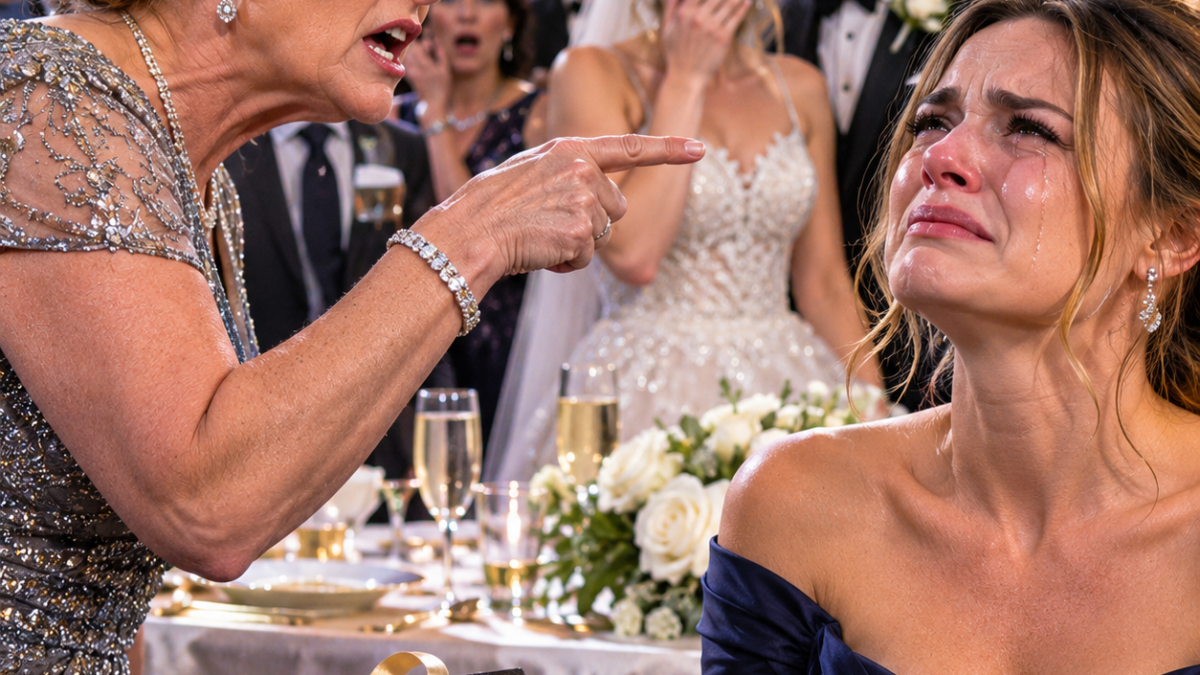
The whole ballroom followed her gaze toward Table 14.
She smiled.
“When is it going to be your turn?”
Polite laughter.
My body went cold.
Mom continued.
“When are we finally going to see you stop hiding behind blueprints and find someone willing to take care of you?”
More laughter.
Not everyone.
Enough.
Dad smiled awkwardly.
Bella covered her mouth, pretending embarrassment while enjoying every second.
I looked at her.
She knew.
She knew I was married.
Not only knew.
She had engineered my family’s absence from the wedding.
And now she sat in white silk watching Mom humiliate me for being single.
Something inside me became perfectly still.
Structural failure has a moment when the load exceeds what the system can carry.
Before that moment, cracks.
Deflection.
Warning.
Then:
Failure.
I set down my napkin.
Stood.
The laughter thinned.
Mom smiled uncertainly.
“Caroline?”
I walked toward the head table.
Not rushing.
My heels clicked across the ballroom floor.
Bella watched me.
Her smile disappeared.
I stopped ten feet from Mom.
“You asked when my turn is.”
Mom laughed nervously.
“It was only a joke.”
“I know.”
I looked around the ballroom.
Then back at her.
“My turn was eight months ago.”
Silence.
“I married Nathan on March twenty-ninth.”
Mom’s face emptied.
Dad stopped smiling.
Bella went white.
Mom whispered into the microphone:
“What?”
“I was married March twenty-ninth.”
The microphone carried my words through the room.
“You were invited.”
Mom stared.
“So was Dad.”
Dad looked at Bella.
I continued.
“So was Bella.”
Bella shot upright.
“She’s lying.”
The speed of it told everyone something was wrong.
I looked at her.
“Am I?”
“Yes!”
She grabbed Preston’s arm.
“She’s doing this because she’s jealous.”
People shifted.
Phones began appearing.
I hated that.
Still.
We were beyond privacy.
Bella continued:
“She couldn’t stand one night being about me.”
I reached for my tablet.
Dad stood.
“Caroline.”
I looked at him.
“Sit down.”
His face darkened.
“Do not turn this into a circus.”
I almost laughed.
“It became a circus when Mom used the microphone.”
Mom lowered it slightly.
“Caroline, sweetheart—”
“No.”
My voice shook.
“Please.”
I looked at Bella.
“She just called me a liar in front of three hundred people.”
I held up the tablet.
“So we can settle that.”
The ballroom had multiple LED screens used for wedding videos.
Earlier, Preston’s childhood montage had played on them.
A technician stood near the AV station.
I did not hack anything.
I walked over.
Showed him my tablet.
“I need to display something.”
He looked toward Preston.
Preston nodded slowly.
Bella snapped:
“No.”
Preston looked at her.
“Why?”
“Because this is insane.”
He said:
“If she’s lying, let her prove herself wrong.”
Bella’s face changed.
The technician connected the tablet.
Screen one lit.
Courier tracking page.
DELIVERED — FEBRUARY 12 — 10:14 A.M.
SIGNATURE: B. MONTGOMERY
I zoomed.
The room murmured.
Bella shouted:
“That proves nothing!”
“You’re right.”
I swiped.
Screenshot from Bella’s bridesmaid chat.
Photo of the emerald package.
Timestamp.
Her message:
CAROLINE IS ACTUALLY DOING THE SAD LITTLE PARK WEDDING.
Murmurs grew.
Bella turned toward Chloe.
Chloe stood near the side wall.
Bella’s face twisted.
“You.”
Chloe said nothing.
I swiped again.
I SIGNED FOR THE PACKAGE. I’M GOING TO MAKE THIS EASY FOR EVERYBODY.
Mom’s hand covered her mouth.
Dad’s face changed.
I brought up the photograph of his unopened invitation beside the trash bin.
“Dad.”
He stared at the screen.
“That’s yours.”
His eyes filled.
“No.”
I swallowed.
“It had a letter inside.”
He looked at me.
“What letter?”
My throat closed.
“The one asking you to walk me down the aisle.”
Three hundred people disappeared.
For a second it was only Dad and me.
His face collapsed.
“I never…”
“I know.”
He whispered:
“I never saw that.”
“I know.”
Bella screamed:
“She’s manipulating you!”
Preston stood now.
“Bella.”
“Shut up!”
The room gasped.
She turned toward me.
“You don’t get to destroy my wedding because your little event wasn’t important enough!”
That sentence did more damage than anything on the screens.
Mom looked at her.
“Bella.”
“No!”
She was crying.
Mascara perfect.
Voice breaking.
“She has spent my entire life making everything about her.”
I stared.
“I wasn’t at your campaign.”
“What?”
“I wasn’t there.”
“What does that—”
“You chose your campaign.”
“You got Mom and Dad there.”
“You got the attention.”
“I married my husband three hours away with fifty people.”
I laughed bitterly.
“You won.”
Bella stared.
“Whatever competition you thought existed, you won that day.”
I pointed toward the screens.
“And it still wasn’t enough.”
Silence.
Then I tapped the voice note.
Bella’s recorded laughter filled the Grand Venetian Ballroom.
“Caroline thinks Dad is going to walk her down the aisle. I almost feel bad, but can you imagine Mom missing my six-figure shoot to sit in an Austin park with fifty engineers? Absolutely not. I’m removing the temptation.”
My mother’s knees seemed to buckle.
She grabbed a chair.
Dad stared at Bella as though she were a stranger.
Bella screamed:
“Turn it off!”
I did.
Immediately.
Enough.
I was not trying to torture her.
I had proved the point.
Then Preston said:
“March twenty-ninth.”
I looked at him.
“Yes.”
He frowned.
“Who did you marry?”
Bella turned.
“Preston, it doesn’t matter.”
He ignored her.
“Caroline.”
“Nathan Mercer.”
His face changed.
Not pale immediately.
Recognition first.
Then disbelief.
“Nathaniel Mercer?”
I nodded.
“Yes.”
Bella looked between us.
“Who cares?”
Preston stared at her.
“You’ve met Nathan Mercer?”
“No.”
“You knew your sister married him?”
Bella snapped:
“She married some engineer.”
Preston actually stepped backward.
One of his business partners at the table murmured:
“Oh, hell.”
Bella looked around.
“What?”
Preston’s voice became quiet.
“Mercer Structural Group.”
She shrugged.
“So?”
Preston stared.
“Our Riverline project.”
She looked blank.
He continued.
“The independent structural and resilience consultant.”
Still nothing.
“The firm my company spent nine months getting through technical review with.”
Bella’s mouth opened.
I immediately raised a hand.
“Nathan has nothing to do with this.”
Preston looked at me.
“I know.”
I continued:
“And he will not be used as leverage in a family dispute.”
That mattered.
I had no intention of turning my husband’s professional position into revenge.
Preston nodded.
“I understand.”
Then he looked at Bella.
“You’ve been telling people your sister is an unsuccessful lonely engineer.”
Bella snapped:
“I never said unsuccessful.”
Several bridesmaids looked away.
Preston noticed.
“So you did.”
Bella’s eyes filled.
“This is my wedding.”
He stared at her.
“Yes.”
“And apparently I’ve learned more about your family in ten minutes than I did in eighteen months.”
She slapped the table.
“Stop making this about Caroline!”
Preston almost laughed.
“Your mother literally made a speech about Caroline.”
That shut her up.
Mom was crying now.
“Caroline.”
I looked at her.
She said:
“I thought you canceled.”
My heart hardened.
“Why?”
Mom looked at Bella.
Bella turned away.
“She told us…”
Mom stopped.
“What?”
“She said Nathan left.”
Silence.
Even I was stunned.
Bella screamed:
“I said they were having problems!”
Mom turned.
“You told me the wedding wasn’t happening.”
“I said I thought—”
“No.”
Mom’s voice changed.
For the first time in my life, I heard her speak to Bella the way she used to speak to me.
“No.”
Bella stared.
Mom continued.
“You told me Caroline had canceled and didn’t want us asking questions because she was embarrassed.”
I looked at Bella.
She could not meet my eyes.
Dad whispered:
“That’s why you told me not to call.”
Bella snapped:
“She stopped calling us anyway!”
Dad looked at me.
I said:
“I called you the morning of my wedding.”
His face froze.
“You declined.”
“I…”
I pulled out my phone.
Not because I needed proof.
Because I had it.
Call log.
March 29.
10:23 a.m.
Dad.
Outgoing call — declined.
I showed him.
His eyes filled.
“I was on set.”
“I know.”
“Bella said you were calling because you were upset about canceling.”
“I was standing in a wedding dress.”
He covered his face.
My anger cracked.
Underneath it was the old grief.
I whispered:
“I called five times.”
Mom sobbed.
“I didn’t know.”
I looked at her.
“No.”
“You didn’t.”
Then:
“But you didn’t ask either.”
That silenced her.
I continued.
“Not once.”
“Eight months.”
“You never asked me whether the wedding happened.”
“You never asked what happened to Nathan.”
“You accepted Bella saying I’d been left because that explanation was easier than calling your daughter.”
Mom cried harder.
“Caroline…”
“I needed you.”
The words slipped out.
I hated how young they sounded.
“I needed you that morning.”
Mom put her hand over her mouth.
“I waited.”
My voice shook.
“I left four chairs empty until the ceremony started because I thought maybe you’d surprise me.”
Dad turned away.
I continued anyway.
“George Mercer walked me down the aisle.”
Preston looked toward the screen.
I realized we had not shown the wedding video yet.
I should have stopped.
Maybe.
Then Mom asked:
“Can I see it?”
I stared.
“What?”
“Your wedding.”
Her voice broke.
“Please.”
That word.
The same one I had used with Bella eight months earlier.
I looked at Nathan’s wedding video file.
Then at Mom.
“All right.”
I tapped.
The ballroom screens changed.
No chat messages.
No tracking.
Just a garden under Texas oak trees.
Fifty chairs.
Four empty ones visible in the front row.
My heart stopped.
I had forgotten the camera captured them.
Mom made a sound.
On screen, George stepped into the bridal cottage.
The microphone had picked up his voice.
“If you’ll have me, Caroline… an architect should never have to walk alone.”
Video-me laughed through tears.
“Structural engineer.”
The ballroom laughed softly.
Not mockingly.
George smiled on screen.
“Even better.”
Then he offered me his arm.
Mom bent forward and cried into both hands.
Dad stopped trying to hide his tears.
On screen, I walked down the aisle.
Nathan waited.
Preston whispered:
“That’s him.”
His business partner nodded.
Bella stared at the screen.
Something strange happened to her face.
Not anger.
Pain.
Maybe because the wedding looked happy.
Small.
But happy.
No cameras.
No influencers.
No giant floral ceiling.
No designer wall.
Just people.
When the video reached our vows, I stopped it.
Enough.
The screen went black.
The ballroom remained silent.
I disconnected my tablet.
Then said:
“That’s all.”
Bella laughed.
A terrible, fractured sound.
“All?”
I looked at her.
“You destroyed my wedding and now you’re just done?”
I stared.
“I did not destroy your wedding.”
“Look around!”
She waved at the room.
“Everyone is staring at me!”
I said:
“Now you know how Table 14 felt.”
Her face twisted.
“You waited for this.”
“No.”
“Yes.”
“You wanted to humiliate me.”
“I wanted to eat dinner and leave.”
“You connected the screens!”
“After you called me a liar.”
“You should have let it go!”
I almost laughed.
There it was.
The family inheritance.
Let it go.
I looked at Mom.
She lowered her eyes.
I said:
“I have let things go my entire life.”
Then to Bella:
“This one was carrying my wedding inside it.”
Silence.
“I couldn’t let that go anymore.”
Bella’s eyes filled.
“For once, I wanted one day that was mine.”
I stopped.
The sentence sounded familiar.
Different family.
Same wound.
I said:
“Your wedding was yours.”
“No.”
She shook her head.
“Not once you stood up.”
“You made my marriage a joke before I stood up.”
“You always do this.”
“What?”
“Exist in a way that makes me look shallow.”
I stared.
Several people shifted uncomfortably.
Bella continued.
“You’re the engineer.”
“The responsible one.”
“The smart one.”
“Do you know what Mom and Dad said my whole childhood?”
I looked at Mom.
Bella laughed bitterly.
“Caroline will take care of herself.”
“Caroline has a future.”
“Caroline doesn’t need help.”
“So what was left for me?”
I whispered:
“Everything else.”
Bella stared.
“You got Mom.”
“You got Dad.”
She laughed.
“No.”
“Yes.”
“When you cried, they came.”
“When I cried, they told me I was strong.”
Mom flinched.
“When you needed money, they rearranged things.”
“When I needed time, I was supposed to understand.”
Bella shook her head.
“You don’t know what it was like.”
“Neither did you.”
Silence.
There it was.
Not forgiveness.
Recognition.
Two daughters built into opposing roles by the same family.
Bella whispered:
“I hated you.”
That hurt.
“Why?”
“Because you never seemed to need them.”
I swallowed.
“I needed them at my wedding.”
Her eyes dropped.
“And you made sure they weren’t there.”
Bella covered her face.
For the first time that night, she stopped fighting.
She cried.
Not beautiful crying.
Shoulders shaking.
Makeup finally breaking.
Preston stood beside her.
He did not touch her immediately.
I respected that.
Then Dad moved toward me.
I stepped back.
He stopped.
“Caroline.”
I looked at him.
“I’m sorry.”
I almost laughed.
Too small.
Too late.
True.
“I’m sorry I didn’t call.”
I said nothing.
“I’m sorry I believed what I was told because it was easier.”
My throat tightened.
“I’m sorry I declined your call.”
That one broke me.
Tears came.
Dad continued.
“If I had known…”
I interrupted.
“You knew the date.”
He froze.
Yes.
That mattered.
“I told you three months before.”
He nodded slowly.
“I know.”
“You knew Bella’s shoot was March twenty-ninth.”
“Yes.”
“You chose to go.”
His face collapsed.
“Yes.”
There it was.
No escape.
Bella had manipulated.
But my parents had chosen too.
I needed them to own it.
Dad whispered:
“I thought we’d celebrate you later.”
I laughed through tears.
“That’s always what you thought.”
His eyes closed.
“Caroline.”
“Later.”
“After Bella.”
“When she’s done.”
“When her thing is over.”
“When the timing is better.”
I wiped my face.
“My wedding happened once.”
Dad cried.
“I know.”
“No.”
“You know now.”
That difference mattered.
Mom approached carefully.
“Can I hug you?”
I stared at her.
Then shook my head.
“Not tonight.”
Pain crossed her face.
But she nodded.
“Okay.”
That was the first boundary she respected without arguing.
I picked up my tablet.
Preston said:
“Caroline.”
I turned.
He looked uncomfortable.
“I want you to know Nathan’s professional relationship with my company will not be brought into any of this.”
“Good.”
“And I won’t bring this to him.”
“He already knows what Bella did to the invitations.”
Preston looked at Bella.
She stared at the table.
I continued:
“He saw what it did to me.”
Preston nodded.
“I’m sorry.”
“Thank you.”
Then he surprised me.
He looked toward the ballroom.
“At this point, I think the reception needs to end.”
Bella’s head snapped up.
“What?”
He said:
“Not the marriage.”
Important distinction.
“But this.”
He gestured around.
“The performance.”
Her face crumpled.
“Preston.”
“I don’t want three hundred people standing around filming us.”
Neither did I.
He asked the coordinator to shut down the screens and music.
Guests began leaving slowly.
No dramatic stampede.
Mostly stunned silence.
Some hugged Bella.
Some avoided us.
Chloe squeezed my hand.
“I’m sorry.”
I said:
“Thank you for telling me.”
Mom sat at the head table.
Dad stood beside her.
Bella disappeared into a bridal suite.
I walked out alone.
My phone rang before I reached the valet.
Nathan.
Of course.
“Hey.”
His voice immediately changed.
“What happened?”
I started crying.
Not because I had lost control.
Because I could finally.
“I told them.”
Silence.
Then:
“All of it?”
“Yes.”
“Are you safe?”
“Yes.”
“Do you want me there?”
Three words.
No judgment.
No:
I told you so.
No:
Why did you go?
Just:
Do you want me there?
“Yes.”
“I’m getting on a flight.”
“You have the board meeting.”
“It ended.”
“Nathan.”
“Caroline.”
His voice softened.
“You spent your wedding waiting for people who didn’t come.”
“I’m not letting you leave another ballroom alone.”
That broke me.
He arrived after midnight.
I was sitting in the hotel lobby wearing the same dress.
Shoes off.
Makeup gone.
Tablet beside me.
When he walked through the doors, I stood.
He crossed the lobby and held me.
No words.
Just held.
Sometimes the person who saves you does not solve the problem.
They become the place where you are allowed to stop solving it yourself.
The next morning, my phone contained seventy-eight messages.
Family.
Guests.
Unknown numbers.
Bella’s wedding had become gossip before breakfast.
Someone had recorded portions of the confrontation.
Clips circulated privately.
Then publicly.
I did not post them.
I asked anyone who contacted me not to send footage.
I did not need my most painful family moment becoming content.
Ironically, Bella’s entire career depended on content.
For three days she did not post.
That was almost unprecedented.
Preston canceled the honeymoon.
Not the marriage.
He moved into another suite at the hotel.
Bella stayed with Mom and Dad.
Nathan and I flew home.
On the plane, I kept replaying one moment.
Not the ballroom.
Not Bella screaming.
Dad declining my call.
Nathan said:
“You need to stop punishing yourself.”
“I’m not.”
“You are.”
“How?”
“You keep asking what you should have done differently.”
I looked at him.
He continued.
“You sent invitations.”
“You called.”
“You told them the date.”
“You asked them to come.”
“You were not required to kidnap them.”
I laughed despite myself.
Then cried again.
He took my hand.
I said:
“I should have driven there.”
“No.”
“I should have confronted Bella.”
“Maybe.”
“I should have told Mom after.”
“Maybe.”
“I should have told them we were married.”
He looked at me.
“That one is true.”
I stared.
He smiled sadly.
“But not because you owed them.”
“Because hiding it kept you inside the same system.”
I thought about that.
He was right.
After my wedding, I had gone silent hoping they would notice.
That was still a form of waiting for them to choose me.
I had not actually detached.
I had simply changed the test.
Would they call?
Would they ask?
Would they discover?
They failed.
Again.
But I had designed another test they did not know they were taking.
That realization hurt.
At home, I began therapy.
Not because Bella was crazy.
Not because my parents were monsters.
Because I was tired of living my adult life around childhood measurements.
Who called first.
Who got more attention.
Who mattered.
Who chose whom.
My therapist, Dr. Lena Park, asked:
“What would happen if you stopped trying to prove you were equally lovable?”
I hated the question.
“I’m not.”
She waited.
I sighed.
“Fine.”
Then:
“I don’t know.”
She said:
“Maybe you’d find out whether you believe it without proof.”
Uncomfortable woman.
I returned the next week.
Mom called daily.
I did not answer for two weeks.
Then I did.
She said:
“Hi.”
No crying.
No dramatic apology.
I appreciated that.
“Hi.”
“Can we talk?”
“For ten minutes.”
“Okay.”
She accepted the limit.
Progress.
Mom said:
“I found something.”
“What?”
“Your save-the-date.”
I froze.
“Where?”
“In my desk.”
“What?”
She started crying.
“Bella gave it to me months before the invitation.”
I remembered.
Digital save-the-date printed by Mom.
“So you did know.”
“Yes.”
Her voice broke.
“I knew March twenty-ninth.”
I closed my eyes.
“I forgot.”
That almost hurt worse than conspiracy.
Forgot.
My wedding date.
“But when Bella scheduled the shoot,” Mom continued, “I remembered there was a conflict.”
“And?”
“She said your plans were flexible.”
I said nothing.
“I believed her because…”
Mom stopped.
“Because?”
“Because I wanted to.”
There.
Truth.
“She told me the campaign could change her career.”
“I thought your wedding was small.”
“I told myself Nathan would understand.”
I whispered:
“You never met Nathan.”
“I know.”
“That’s the point.”
Mom cried.
“I made decisions about your life without knowing anything about it.”
“Yes.”
“I’m sorry.”
That apology mattered more than:
Bella tricked me.
Because Bella did trick them.
But Mom had supplied fertile ground.
She had always expected me to understand.
We talked ten minutes.
Then I ended the call.
No reconciliation.
Yet.
Dad wrote a letter.
Actual paper.
Six pages.
Nathan handed it to me after work.
I left it unopened for three days.
Then read.
Dad wrote about the invitation letter he never saw.
He said he had replayed the wedding video repeatedly.
Especially George offering me his arm.
He wrote:
I have spent my life believing that because you rarely asked me for anything, I had succeeded in raising an independent daughter. I see now that I often used your independence as permission not to show up.
I cried.
Then:
The worst part is that Bella did not force me to attend her shoot. I chose it. I told myself your ceremony was smaller and therefore more flexible. I ranked my daughters’ milestones by size and money. I cannot undo that.
That was accountability.
Painful.
Real.
He ended:
I do not expect to walk you down an aisle I missed. I would only like the opportunity someday to meet the man who stood at the end of it.
I gave the letter to Nathan.
He read it.
Then said:
“What do you want?”
“I don’t know.”
“Okay.”
No pressure.
Bella did not contact me for six weeks.
Then a package arrived.
Not velvet.
Plain cardboard.
Inside:
My father’s invitation box.
Crushed on one corner.
Unopened.
I sat on the kitchen floor holding it.
Nathan found me there.
There was a note.
I lied about burning it. I kept it because I couldn’t make myself throw it away. I don’t know why. Maybe because some part of me knew exactly what I was stealing.
I opened Dad’s box for the first time.
My letter was still inside.
Unread.
Nathan sat beside me.
I handed it to him.
He read.
Then closed his eyes.
“What?”
He shook his head.
“Nothing.”
“Nathan.”
He handed it back.
“You deserved better.”
I cried.
Again.
I had done a lot of crying that year.
Bella’s letter continued.
I told myself Mom and Dad would choose my shoot anyway. Maybe they would have. But I didn’t want to risk being wrong.
That sentence explained everything.
She did not trust her favorite-child status enough to let our parents make a free choice.
She controlled the information.
Golden children can be terrified too.
If your identity depends on being chosen, the possibility of not being chosen becomes unbearable.
Bella wrote:
When I saw your invitation, I did not think, my sister is getting married. I thought, this will compete with me.
That is ugly.
Yes.
I lied to you about Dad opening the letter because I wanted you to stop trying.
I lied to Mom and Dad that Nathan left because if they knew you got married without them, they would eventually ask why.
I mocked you at my wedding because I needed everyone to keep believing the version of you I had created.
That was the hardest line.
Version of me.
Lonely.
Plain.
Bitter.
Unmarried.
Engineer who made eighty-nine thousand dollars and spent weekends with blueprints.
While Bella was beautiful.
Rich.
Chosen.
Married to Preston Carlisle.
My actual happy marriage threatened the architecture.
So she hid it.
Her letter ended:
I am sorry. I know that is not enough.
It wasn’t.
But it was a start.
Preston and Bella separated for five months.
Not because Nathan was involved.
Nathan actually recused himself from any direct technical review involving Preston’s Riverline project once the family connection became public.
Professional ethics mattered to him.
Another independent principal handled it.
Preston later told me:
“That may have been the first thing that made me realize this wasn’t some power play.”
Bella had initially insisted I exposed the marriage because I wanted Nathan to intimidate Preston.
Nathan’s recusal destroyed that narrative.
Preston’s issue with Bella was simpler.
Trust.
He discovered the invitation lie.
Then smaller lies.
Her income had been exaggerated.
Some sponsorships were unpaid product deals she described as paid campaigns.
A debt she had minimized.
Not criminal.
Not catastrophic individually.
Collectively?
A pattern.
They went to counseling.
I stayed out.
That was hard for Mom.
She wanted updates.
I refused.
“Bella and Preston’s marriage is theirs.”
Mom nodded.
Learning.
Slowly.
My relationship with my parents rebuilt differently.
Dad came to Austin first.
Alone.
He asked permission.
Nathan and I met him for dinner.
Dad was visibly nervous.
For once, Nathan looked amused.
He shook Dad’s hand.
“Mr. Montgomery.”
Dad said:
“Nathan.”
Then:
“I owe you an apology too.”
Nathan shook his head.
“You don’t owe me the wedding.”
Dad looked confused.
Nathan continued.
“You owe Caroline.”
Dad’s eyes filled.
“Yes.”
Good man.
During dinner, Dad did not ask about Mercer Structural Group for the first hour.
That was an achievement.
Finally he said:
“I’ve apparently underestimated what you do too.”
Nathan smiled.
“Caroline says that runs in the family.”
I kicked him under the table.
Dad laughed.
The tension broke.
After dinner, Dad asked:
“Can I see your wedding photographs?”
My chest tightened.
We went home.
I brought out the album.
Dad sat on our couch and turned pages.
Slowly.
When he reached the photograph of George walking me down the aisle, he stopped.
He touched the page.
“I’m glad somebody did.”
I whispered:
“Me too.”
He cried.
I sat beside him.
For the first time since the wedding, I let him hug me.
Forgiveness did not happen in that hug.
Something smaller.
Permission to continue.
Mom visited two months later.
The night before she arrived, I almost canceled.
Nathan asked:
“What are you afraid of?”
“That she’ll walk in and act normal.”
“And?”
“I’ll hate her for being normal.”
He nodded.
“Then tell her.”
So I did.
When Mom arrived, before coffee, I said:
“I need you not to pretend nothing happened.”
She put down her bag.
“Okay.”
“I’m not ready for normal.”
“Okay.”
“I may be angry.”
“I understand.”
“I don’t need you to explain Bella.”
Mom’s eyes filled.
“I won’t.”
That conversation changed everything.
For decades Mom had managed emotions by smoothing them.
Now she sat inside discomfort.
No fixing.
We watched the full wedding video together.
That was harder than the ballroom clip.
At one point video-me looked toward the empty chairs before walking.
Mom paused.
“Were you looking for us?”
I nodded.
She covered her mouth.
I could have protected her.
Said:
Maybe.
Instead:
“Yes.”
She cried.
I let her.
That was accountability too.
Bella came last.
Almost a year after the wedding.
By then she and Preston were trying again.
No guarantee.
No public couple content.
She had lost several sponsorships after clips from the wedding circulated.
Not because I contacted brands.
I didn’t.
Some brands dislike public scandals.
Others simply waited until engagement stabilized.
Her income dropped.
For the first time in years, Bella lived without constant public validation.
She hated it.
Then, according to Mom, started changing.
Therapy.
Less posting.
More actual work behind the scenes.
She arrived at my house wearing jeans.
No camera.
No assistant.
No Preston.
I opened the door.
Neither of us spoke.
Then she said:
“I almost brought flowers.”
“Why didn’t you?”
“Felt manipulative.”
I almost smiled.
“Therapy?”
“Yes.”
“Good.”
She came inside.
Nathan left us alone.
Bella looked around.
Wedding photo on mantel.
Her eyes stopped.
“You look happy.”
“I was.”
She flinched.
“I know.”
We sat.
She did not apologize immediately.
Good.
Instead:
“Can I ask you something?”
“Yes.”
“Did you hate me before this?”
I thought.
“No.”
“Do you now?”
Long pause.
“No.”
Her eyes filled.
“I don’t trust you.”
She nodded.
“That’s fair.”
“I don’t understand you.”
“Also fair.”
“I don’t know if we can ever be close.”
She cried.
“Okay.”
That surprised me.
No:
But we’re sisters.
No:
You have to forgive.
Just okay.
Then she said:
“I think I hated that you never seemed jealous of me.”
I frowned.
“I was jealous.”
She stared.
“Of what?”
“Mom doing your hair before prom.”
Her face changed.
“Dad flying to New York because your first campaign launch mattered.”
“Everyone knowing what you were doing because your work could be shown.”
“People asking about your relationships.”
“I was jealous all the time.”
Bella whispered:
“I thought you looked down on me.”
“Sometimes.”
She laughed through tears.
“Thank you for honesty.”
“I thought influencer culture was shallow.”
“Some of it is.”
“Some engineering culture is insufferable.”
“I believe you.”
Then I said:
“But I never thought you were stupid.”
She started crying harder.
“Dad did.”
I froze.
“What?”
She stared at her hands.
“He never said it directly.”
“But…”
She swallowed.
“When I failed statistics in college, he said, ‘Not everyone gets Caroline’s brain.’”
My chest hurt.
“I didn’t know.”
“When my first business failed, he said I should stick to what I was good at.”
“What was that?”
“Being likable.”
Jesus.
There it was.
The invisible injury on her side.
No excuse for what she did.
But context.
Bella said:
“I spent my life thinking if people stopped looking at me, there’d be nothing left.”
I whispered:
“That sounds exhausting.”
“It is.”
We sat quietly.
Then she said:
“I’m sorry I stole your wedding from them.”
My eyes filled.
“You didn’t steal my wedding.”
She looked up.
“You stole their chance to be there.”
I swallowed.
“My wedding was still mine.”
Nathan.
George.
Anne.
Rebecca.
The fifty people who came.
That realization mattered.
For months, I had described it as the wedding my family missed.
Not the wedding I had.
I continued:
“But yes.”
“You stole that chance.”
Bella nodded.
“I’m sorry.”
“And you lied about Dad burning the letter.”
“Yes.”
“That was cruel.”
“Yes.”
“You wanted me to stop trying.”
“Yes.”
“You succeeded.”
Her face collapsed.
“I know.”
For the first time, I understood why she had kept Dad’s box.
Not sentiment.
Evidence of the thing she could not completely destroy.
She had wanted control.
Not annihilation.
Some part of her had known there might be a future day when she needed to return what she stole.
I did not forgive her that afternoon.
But I made coffee.
We talked for three hours.
That was enough.
My first wedding anniversary arrived March twenty-ninth.
Nathan asked what I wanted.
I said:
“A dinner.”
“Just us?”
I thought.
Then:
“No.”
We invited everyone who had been at our original wedding.
George.
Anne.
Rebecca.
Friends.
And, after three days of debate, Mom and Dad.
Not Bella.
Not yet.
I felt guilty.
Dr. Park said:
“Boundaries do not require equal timelines.”
So my parents came.
We held dinner under the same oak trees.
Not a vow renewal.
No replacement aisle.
Nothing could recreate the wedding.
I did not want to.
Dad stood beside the four old place markers I had kept.
Daisy.
Golf club.
Camera.
The fourth blank one for Uncle Richard.
He touched the golf club.
“Can I have this?”
I stared.
“Why?”
“To remember what I missed.”
I handed it to him.
Mom took the daisy.
I kept Bella’s camera.
Not as punishment.
Not yet ready.
At dinner, Dad raised a glass.
No microphone.
Thank God.
He said:
“To the people who were here the first time.”
Then looked at me.
“And to those of us who should have been.”
That was all.
Perfect.
Bella and Preston stayed married.
That surprises people when I tell the story.
They worked.
Hard.
No magical turnaround.
No instant trust.
He postponed combining certain assets.
They signed a postnuptial agreement after full disclosure.
Not punishment.
Clarity.
Bella rebuilt her business on a smaller scale.
Less luxury fantasy.
More event design and brand consulting.
She lost followers.
Gained stability.
Two years after the ballroom disaster, she called.
“Can I come for your birthday?”
I hesitated.
Nathan looked at me.
My decision.
“Yes.”
She came.
No camera.
She brought a gift.
A small wooden box.
Inside:
The camera-shaped place marker from my wedding.
I stared.
“How?”
“I made a copy.”
She looked nervous.
“Mom showed me a picture.”
I touched it.
Bella said:
“I know I don’t deserve the original.”
I swallowed.
“It isn’t about deserve.”
She nodded.
Then handed me another envelope.
Inside was a photograph.
My wedding.
George and me walking down the aisle.
Framed with a small engraved plate:
You were never alone. I was simply too selfish to see who showed up.
I cried.
Bella cried.
Nathan disappeared into the kitchen because men who understand sisters know when to evacuate.
That night I took the original camera marker from my desk drawer.
The one meant for Bella’s empty chair.
I gave it to her.
She stared.
“Caroline.”
“Don’t make me regret this.”
She hugged it to her chest.
Not me.
The marker.
Then asked:
“Can I hug you?”
“Yes.”
That was forgiveness beginning.
Not finished.
Beginning.
Years later, people still occasionally recognize Bella’s wedding story because somebody reposts old footage.
The internet loves a public downfall.
Especially a beautiful woman crying in a wedding gown.
I hate those clips.
Not because Bella was innocent.
She wasn’t.
Because they flatten the story.
Golden daughter evil.
Ignored sister victorious.
Screens turn on.
Truth exposed.
Villain destroyed.
The end.
Real families are worse and better than that.
Bella hurt me deliberately.
My parents failed me repeatedly.
I retaliated publicly because I had been publicly accused of lying.
All true.
But I also stayed silent after my wedding partly because I wanted my family to notice without being told.
My parents were manipulated.
They were also willing participants in a hierarchy they had built.
Nathan was professionally powerful.
That did not make me more worthy.
Preston was wealthy.
That did not make Bella less insecure.
Nobody was a cartoon.
That made the damage harder.
And the healing more meaningful.
My relationship with Mom became almost unrecognizable.
She stopped asking:
“When are you giving me grandchildren?”
That alone deserved an award.
She started asking about engineering projects even when she did not understand.
“What are you building?”
“Parking structure.”
“That sounds boring.”
“It is.”
She laughed.
Then:
“Still important?”
“Yes.”
“Tell me one thing about it.”
So I did.
Dad started calling Nathan for absolutely unnecessary engineering advice.
Deck beam.
Garage crack.
Retaining wall.
Nathan finally said:
“Richard, you understand I bill developers hundreds of dollars an hour for this.”
Dad said:
“You married into free consulting.”
Nathan replied:
“I see where your daughters got it.”
Dad laughed.
Then sent him a bottle of bourbon.
Progress.
Bella and I never became inseparable sisters.
That is another lie people tell about reconciliation.
We became honest sisters.
Better.
She stopped competing with me.
Mostly.
I stopped secretly judging her.
Mostly.
When she had a major campaign success, I called.
Not because Mom told me to.
Because I was proud.
When one of my designs won an engineering award, Bella posted nothing publicly because I asked her not to.
Instead she sent flowers to my office.
The card said:
Apparently blueprints are sexy now.
I laughed.
She knew me.
That mattered.
Nathan remained Nathan.
Quiet.
Low profile.
Still drove the old Land Cruiser until the transmission finally surrendered.
When he replaced it, Bella said:
“You run a multimillion-dollar firm and bought another Toyota?”
Nathan said:
“I like buttons I understand.”
Preston laughed.
The two men became cordial.
Not close.
Business between their companies remained professionally separated where conflicts existed.
No retaliation.
No threats.
No:
You hurt Caroline, so your tower fails.
Reality does not need corruption to deliver consequences.
Preston’s consequences were private.
Learning who his wife had been.
Deciding whether she could become someone else.
Bella’s consequences were trust.
The expensive kind.
Years after all of it, Mom and I were sitting in her kitchen.
She said:
“I still think about that microphone.”
“So do I.”
“I thought I was teasing.”
“I know.”
“That scares me.”
“Why?”
“Because I didn’t understand how cruel it was.”
She looked at me.
“I thought you were single.”
“That wouldn’t have made it kind.”
She closed her eyes.
“No.”
That was the lesson.
If I had truly been single at thirty-eight, the joke would still have been cruel.
If Nathan had been an ordinary engineer nobody recognized, Bella’s deception would still have been wrong.
If my wedding had cost five hundred dollars instead of thousands, it still mattered.
If fifty guests attended instead of three hundred, it still counted.
My family had spent years measuring importance by spectacle.
Bella’s campaign had more money.
Therefore bigger.
Her wedding had more guests.
Therefore more important.
Preston’s family had more wealth.
Therefore more impressive.
Nathan’s identity shocked them because they suddenly discovered quiet things could carry enormous weight.
That is a lesson structural engineering teaches constantly.
The most dramatic element is rarely the one keeping the building upright.
A hidden connection.
A buried footing.
Reinforcement no guest will ever see.
Quiet systems carry spectacular spaces.
People can too.
I once told Nathan that.
He said:
“Did you just compare yourself to rebar?”
“Yes.”
“Romantic.”
“You proposed using risk analysis.”
“Fair.”
Our marriage became the first family relationship where I did not have to earn stability by carrying everything.
If I was angry, Nathan could handle it.
If I was tired, he did not call me strong.
He made dinner.
If I cried, he did not say:
You’ll be fine.
He asked:
Do you want me to fix anything?
Sometimes the answer was no.
He stayed anyway.
That is love too.
Three years after Bella’s wedding, she and Preston had a daughter.
Isabella Grace.
Bella called from the hospital.
“You’re an aunt.”
“I was already an aunt to your ego.”
She laughed.
Then cried.
Hormones.
Probably.
A few months later, Bella asked:
“Will you be her godmother?”
I froze.
“Are you sure?”
“Yes.”
“Why me?”
She laughed softly.
“Because if I ever start turning her into a version of me, I need someone who knows what that costs.”
That was heavy.
I said:
“Yes.”
At Isabella’s first birthday, Mom made a speech.
I stiffened when she reached for the microphone.
Bella noticed.
“Mom.”
Mom stopped.
“What?”
“No public jokes about anybody’s relationship status.”
The table laughed.
Mom put one hand over her heart.
“I have learned.”
Then she looked at me.
“Painfully.”
I smiled.
She kept the speech about Isabella.
Nobody was humiliated.
Civilization advanced.
Years later, Dad gave me back the miniature golf-club place marker.
I asked why.
He said:
“I don’t need it anymore.”
“What does that mean?”
“I remembered.”
He put it in my hand.
“Keeping the object started feeling like I was making your wedding about my guilt.”
I stared.
That was insightful.
Therapy?
Mom, probably.
He continued:
“It belongs to your wedding.”
So I took it home.
I placed it beside the daisy Mom eventually returned.
The camera Bella had.
Three markers.
Evidence of absence transformed into something else.
Not erased.
Reframed.
The empty chairs happened.
Nothing changes that.
But they are no longer the first thing I remember about March twenty-ninth.
I remember George’s arm.
Nathan’s face.
Rebecca repairing my mascara.
Anne slipping champagne into the bridal cottage when she thought nobody was watching.
Fifty people who came.
That was another lesson.
Pain directs attention toward absence.
Healing teaches you to look at presence.
I had spent months staring at four empty chairs while ignoring fifty occupied ones.
Not literally.
Emotionally.
My family mattered.
But they were not the entire definition of family.
Nathan’s father did not become less meaningful because Dad should have been there.
George stepping forward was not a consolation prize.
It was love.
I finally understood that.
When George died several years later, I spoke at his funeral.
I told the story.
Not all of it.
Just one piece.
“My father-in-law once offered me his arm when the person I expected was not there.”
I looked at Nathan.
“He thought he was helping me walk down one aisle.”
“He had no idea he was teaching me something about love.”
“Love is not always the person who was assigned the role.”
“Sometimes it is the person who notices the empty space and quietly steps into it.”
Nathan cried.
So did Dad.
Dad attended George’s funeral.
Afterward, he stood beside the casket and whispered something.
I did not hear.
Later I asked.
He said:
“I thanked him.”
“For what?”
“For doing my job when I didn’t.”
That broke me.
Some regrets never disappear.
They become humility.
Dad carried his differently after that.
Bella’s daughter grew.
So did our family.
No perfect ending.
Mom still occasionally favors Bella in ridiculous tiny ways.
Bella can still turn a restaurant reservation into a military campaign.
Dad still checks engineering projects by asking Nathan instead of me first, which irritates me beyond reason.
I still withdraw when hurt.
Still expect people to notice without being told.
Therapy does not erase personality.
It gives you alarms.
Mine goes off sooner now.
Last Christmas, Mom asked:
“Caroline, are you okay?”
I almost said:
Fine.
Habit.
Then stopped.
“No.”
She immediately looked concerned.
“What’s wrong?”
“Work has been awful.”
“Can you tell me about it?”
“Yes.”
And I did.
Twenty minutes.
Mom listened.
Did not compare me to Bella.
Did not tell me I was strong.
Did not say I would be fine.
She said:
“That sounds exhausting.”
Such a simple sentence.
I had waited forty years for it.
The strangest thing is that if you ask my mother what changed our family, she says:
“The wedding speech.”
If you ask Dad:
“The invitation.”
If you ask Bella:
“The courier box.”
If you ask Preston:
“The moment the screens came on.”
If you ask Nathan:
“The four empty chairs.”
I think all of them are wrong.
The real turning point was years earlier.
Every time someone said:
Caroline will understand.
And I did.
Without protest.
That is where the structure began failing.
I taught them I could carry infinite weight.
Then blamed them when they kept adding more.
They were responsible for what they did.
I was responsible for learning to say:
Enough.
That ballroom was simply the first time I said it loudly enough for everybody to hear.
And yes, there is something satisfying about remembering Bella’s face when the courier receipt appeared.
I am human.
There is something deeply satisfying about a liar encountering a timestamp.
Structural engineers appreciate documentation.
But the real justice was not three hundred people learning Bella lied.
It was my mother learning being the peacekeeper had sometimes made her an accomplice.
My father learning that the daughter who asked for less did not love him less.
Bella learning that being the golden child was not the same as being secure.
Me learning that being overlooked did not make me invisible.
And all of us learning that importance has nothing to do with guest count.
Bella had three hundred guests.
I had fifty.
She had crystal chandeliers.
I had oak trees.
She had a couture gown.
Mine came from a small Austin boutique.
She had a billionaire groom.
I had Nathan.
Neither marriage became meaningful because of those things.
The question was who showed up when the performance ended.
Nathan did.
Again and again.
That is why, when people ask about my wedding now, I no longer begin with:
“My family didn’t come.”
I say:
“I married Nathan on March twenty-ninth under a grove of live oaks.”
If they ask who walked me down the aisle:
“My father-in-law.”
If they ask why:
“That’s a longer story.”
Sometimes I tell it.
Sometimes I don’t.
The story belongs to me now.
Not Bella.
Not the ballroom.
Not the viral clips.
Me.
On our tenth anniversary, Nathan and I returned to the same garden.
Nothing elaborate.
Dinner.
A few friends.
Mom and Dad.
Bella and Preston.
Their daughter.
George had passed.
His chair remained empty by choice.
Not painful.
Honored.
Before dinner, I placed a small plaque beneath the oak tree.
Nathan read it.
FOR THE PEOPLE WHO SHOW UP.
He looked at me.
“Subtle.”
“I’m an engineer.”
“No, you’re not.”
I laughed.
Bella walked over.
Read it.
Then quietly took my hand.
No apology.
We had passed that stage.
She squeezed once.
I squeezed back.
Mom called everyone to dinner.
Dad complained the chairs were uneven.
Nathan told him to bring a level next year.
Preston laughed.
Isabella chased butterflies.
Ordinary family noise.
I sat.
Looked around.
No chandeliers.
No ballroom screens.
No microphone.
No public humiliation.
Just people who had done terrible, thoughtless, selfish things to each other and somehow, through consequences and uncomfortable truth, learned how to become safer people.
Not perfect.
Safer.
That is enough for me.
There is one final thing I should tell you.
The original emerald invitation box Bella intercepted?
I kept Dad’s.
For years.
Eventually, I had the damaged velvet repaired.
Inside, I placed the letter I wrote him.
The one he never got to read before the wedding.
Then on his seventieth birthday, I gave him the box.
He stared at it.
Hands shaking.
“Caroline.”
“Open it.”
He did.
Read the letter.
The old words.
Dad, I saved the first row for you.
He had to stop.
Then continue.
When he finished, he cried.
“I don’t deserve this.”
I said:
“It isn’t a gift.”
He looked confused.
“It’s history.”
I sat beside him.
“You can’t change it.”
“Neither can I.”
“But I don’t want Bella’s decision to be the reason you never read what I wrote.”
Dad held the letter to his chest.
“I would have walked you.”
I looked at him.
“I know.”
Then:
“But you didn’t.”
He nodded.
“I know.”
Both statements allowed to exist.
That is healing.
Not rewriting.
Not pretending.
Truth without permanent punishment.
Dad keeps the box now.
Sometimes when I visit, I see it on his bookshelf.
He never hides it.
One day Isabella asked:
“What’s the green box?”
Dad looked at me.
I shrugged.
His story.
He said:
“Something I almost lost.”
She asked:
“What?”
Dad smiled sadly.
“My chance to show up for someone I love.”
Isabella, being six, said:
“That’s sad.”
“Yes.”
“Did you fix it?”
Dad looked at me again.
Then answered:
“I couldn’t fix the old day.”
“But I try to show up for the new ones.”
I had to leave the room because I was crying.
Children get the simplest version of truth.
Maybe the best one.
You cannot fix the old day.
Show up for the new ones.
That is what my family did.
Slowly.
Badly.
Then better.
And that is why Bella’s wedding is no longer the worst day of my life.
My own wedding morning still holds that title for pain.
But even that has changed shape.
I no longer see the four empty chairs first.
I see George standing in the doorway.
Arm extended.
I hear:
If you’ll have me.
I see Nathan waiting.
I see fifty people turn as I walk toward him.
I hear myself laughing through tears when George calls me an architect.
I see the Texas sky.
I feel Nathan’s hand close around mine.
Those were the load-bearing moments.
The things holding the day upright while I stared at what was missing.
That is what engineers do eventually.
We identify what actually carried the structure.
My family did not carry my wedding.
Love did.
And eight months later, when Mom put a microphone in my humiliation and Bella called me a liar, I finally stopped protecting the people who had failed to carry their share.
I showed the receipts.
Not because I wanted to destroy my sister.
Because I was done letting her version of my life become the family record.
The screens went dark eventually.
The guests went home.
The internet found another scandal.
The flowers died.
The ballroom hosted another wedding the following weekend.
Life moved.
But the truth stayed.
I was never the lonely sister waiting for her turn.
I had already taken it.
Under oak trees.
With fifty people.
Beside a man who chose me without an audience.
My family simply missed it.
And when they finally saw the video eight months later, three hundred people were watching them realize what that absence had cost.
The greatest irony?
Bella spent years believing visibility meant importance.
She was wrong.
The most important day of my life happened almost entirely outside her view.
And it mattered anyway.








