PART2:“THROW THAT FILTHY OLD MILITARY DOG OUT—AND FIRE THE MAID!” My Fiancée Framed Our Housekeeper for Stealing a Dead Soldier’s Dog Tags—She Had No Idea Who the Girl Really Was
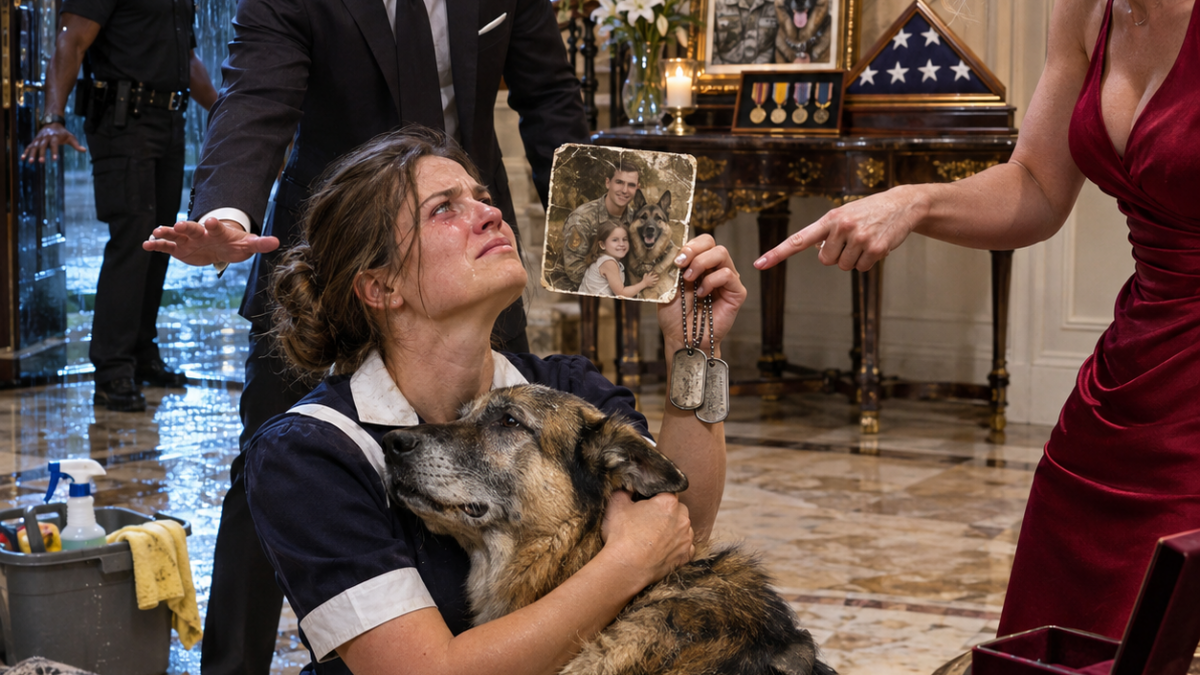
PART2
The first video was timestamped Tuesday, 3:18 p.m.
Celeste Wharton stood in Reed’s living room wearing cream trousers and a black cashmere sweater, one hand pressed against her nose as though Titan’s orthopedic dog bed were a hazardous-material spill.
Jenna stood nearby holding cleaning supplies.
“Mrs. Wharton, please.”
Celeste pointed.
“Get rid of it.”
“But Mr. Garrison bought that bed for Titan’s hips.”
“Mr. Garrison isn’t here.”
“He said Titan needs—”
“I know what Reed said.”
Celeste’s mouth hardened.
“I’m telling you what I want in the house I’m about to live in.”
Jenna looked down at Titan.
The old shepherd was sleeping beside the fireplace.
“He’s a retired military dog.”
Celeste laughed.
“He’s an animal.”
Jenna flinched.
Celeste continued.
“He sheds everywhere.”
“He smells.”
“And that hideous bed makes my living room look like a kennel.”
“It can be cleaned.”
“Throw it away.”
Jenna did not move.
Celeste stepped closer.
“You’ve been here six weeks.”
“Yes, ma’am.”
“Do you want a seventh?”
Jenna’s face changed.
Reed paused the video.
His jaw tightened.
Then played.
Jenna whispered:
“Yes.”
“Then stop arguing with me.”
Celeste pointed toward Titan.
“From now on he stays in the laundry room.”
“He doesn’t like being shut away.”
“Neither do I like dog hair on imported furniture.”
“He’s used to sitting with Mr. Garrison.”
Celeste smiled coldly.
“Reed will adjust.”
Jenna looked at Titan.
For a moment, Reed thought she might refuse.
Instead she bent.
Lifted the orthopedic bed.
Carried it toward the service door.
Titan woke.
Followed her.
Jenna stopped.
The dog pressed his nose against the bed.
“I’m sorry, Big T.”
Reed froze again.
Big T.
Tyler’s name for Titan.
Not Reed’s.
Not the unit’s.
Tyler’s.
Most handlers called the shepherd Titan.
Ty.
Occasionally T.
Only Tyler Kincaid called him Big T.
Reed had not said the nickname aloud in years.
He clicked to the kitchen camera.
Twenty minutes later Jenna sat at the corner of the counter eating half a sandwich.
Celeste entered.
“Are you eating?”
Jenna stood instantly.
“I started at five this morning.”
“That was not my question.”
“I’m sorry.”
“You’re paid to work.”
“Yes, ma’am.”
“Then eat before your shift.”
Jenna carefully wrapped the sandwich.
Celeste’s eyes moved to a folder beside Jenna’s purse.
“What is that?”
Jenna covered it.
“Nothing.”
Celeste reached for it.
Jenna stopped her.
“Please.”
Celeste’s expression changed.
“You are in my house.”
“It’s personal.”
That seemed to offend her more.
“What kind of personal?”
Jenna swallowed.
“Family-court papers.”
Reed leaned closer.
Celeste opened the file anyway.
Reed felt anger move through him.
Jenna stood rigid.
Celeste read.
“Eli Ward?”
“My little brother.”
“You have a child?”
“No.”
Jenna looked embarrassed.
“Not biologically.”
“We grew up in the same foster home.”
“How old?”
“Ten.”
“And you’re trying to get custody?”
“Temporary placement first.”
Celeste laughed.
“You?”
Jenna’s face flushed.
“Yes.”
“Where would you put a ten-year-old?”
“I’m saving for an apartment.”
“With housekeeping wages?”
Jenna swallowed.
“I have another part-time job.”
Celeste closed the folder.
“The court actually thinks you can raise a child?”
“They need proof of stable employment and housing.”
“And this job is part of that?”
“Yes.”
Celeste smiled.
There it was.
Reed knew that smile.
Power discovering leverage.
“Then I suppose you should be very careful.”
Jenna’s face changed.
“About what?”
“Keeping me happy.”
Reed stopped the recording.
For several seconds, he could hear only the hotel air conditioner.
Then he played again.
“One complaint to your agency,” Celeste said, “and the court starts wondering whether you’re responsible enough for Eli.”
“Please don’t do that.”
“Then stop challenging me about a dog.”
Titan entered from the hallway.
He walked directly to Jenna.
She placed one hand on his head.
Celeste rolled her eyes.
“You two deserve each other.”
Reed shut the laptop.
Then opened it again.
He needed the rest.
Facts first.
He had learned that the hard way.
The Friday party video was worse.
Celeste had hosted twelve friends at Reed’s house while he was away.
Wine.
Catering.
Music.
Titan had been shut in the laundry room.
At 9:34 p.m., Jenna entered carrying a tray of champagne glasses.
Titan somehow pushed through the partially latched laundry-room door.
He did not run into the party.
He walked toward Jenna.
Tail low.
Seeking her.
One guest laughed.
“Celeste, your dog escaped.”
“He is not my dog.”
Jenna set down the tray.
“Titan.”
The shepherd approached.
Before Jenna could take him back, Celeste snapped:
“Get him out.”
The sudden voice startled Titan.
He turned sharply.
His hip struck Jenna’s leg.
The champagne tray tipped.
Two glasses shattered.
Red wine spilled across a cream rug.
Celeste screamed.
“Look what you’ve done!”
Jenna immediately knelt.
“I’m sorry.”
Titan backed toward her.
Celeste pointed at him.
“He leaves that laundry room again and he is gone.”
Jenna’s face drained.
“Please don’t send him away.”
“This is my house.”
“It’s Mr. Garrison’s dog.”
“Reed is marrying me.”
Jenna whispered:
“He loves Titan.”
Celeste’s face became hard.
Then she said the sentence Reed replayed three times.
“A dead soldier and an old dog have taken up enough room in this house.”
Jenna stared.
Celeste continued.
“If you cannot understand that, I’ll call your agency.”
Jenna’s breathing changed.
Celeste smiled.
“And maybe you can explain to Eli why you aren’t bringing him home.”
Reed stopped the video.
He stood.
Walked to the hotel window.
His reflection looked older than forty-three.
Tyler had been dead seven years.
Yet Reed still heard his final words with cruel clarity.
Dust.
Blood.
Rotor noise in the distance.
Titan barking somewhere beyond the wall.
Tyler’s hand gripping Reed’s sleeve.
Find Jenna.
Reed had promised.
Then failed.
Not because he had not tried.
But failure does not always care about effort.
Tyler’s teenage sister had been seventeen when he deployed.
Their mother had died.
Their father was already gone.
Tyler believed Jenna was living with a distant aunt in Kentucky.
By the time Reed came home from Afghanistan, the aunt had died unexpectedly.
Jenna entered temporary foster placement.
Then another.
Records changed.
Surname changed.
She disappeared into a system that protected minors for good reasons but made informal searches almost impossible.
Reed wrote letters.
Contacted county offices.
Hired an investigator.
Reached out to social workers.
Nothing.
Eventually the trail ended.
He never stopped keeping Tyler’s dog tags in his study.
Never stopped keeping Titan.
The dog had been retired and legally transferred to Reed after Tyler’s death because Reed had served alongside both of them and had the experience to manage him.
Seven years later, a young woman was sleeping on Reed’s laundry-room floor singing Tyler’s song.
He opened Thursday’s study footage.
At 8:11 p.m., Celeste entered.
Alone.
She went to Reed’s memorial shelf.
Tyler’s photograph.
Dog tags.
A folded flag from a separate unit memorial.
She removed the tags.
Held them.
Then looked toward the camera.
Not directly.
She had forgotten it existed.
Reed’s stomach went cold.
Celeste carried the tags out of the room.
He switched cameras.
Hallway.
Kitchen.
Laundry-room doorway.
Jenna’s work bag hanging on a hook.
Celeste opened it.
Placed the dog tags inside.
Closed it.
Then walked away.
Reed did not move.
He had seen men do terrible things.
Violent things.
Desperate things.
This was quieter.
Calculated.
A woman terrified of losing control over a household planting a dead serviceman’s identification tags inside a young housekeeper’s bag because that housekeeper loved an old dog too much.
Reed called Earl.
“Did she call the police?”
“Not yet.”
“When is Jenna back?”
“Seven tomorrow morning.”
“Celeste?”
“Here.”
“Do not confront her.”
“Reed—”
“No.”
His voice dropped.
“Do not touch anything.”
Earl heard the tone.
“Understood.”
“Back up the camera files.”
“Already did.”
Reed almost smiled.
“Chief.”
“I raised you better than that.”
“You didn’t raise me.”
“Debatable.”
Reed looked at the highway route on his phone.
Nine hours if traffic held.
He packed in four minutes.
At 2:51 a.m., while driving south, Reed called Jenna’s agency.
He did not make accusations.
He asked for employment verification.
Six weeks.
No complaints.
Perfect attendance.
Then he called the family-law attorney listed on the photographed court papers.
She could not discuss details without Jenna’s authorization.
Good.
That was exactly what Reed wanted to hear.
Privacy mattered.
He called a former teammate next.
Evan Hale.
“You awake?”
“I am now.”
“Do you remember Tyler’s sister?”
Silence.
“Jenna?”
“Yes.”
“Why?”
“I think I found her.”
Long pause.
“No.”
“I think she’s been working in my house for six weeks.”
Evan swore.
“How?”
“Different last name.”
“How sure?”
“She sings his song.”
“That is not evidence.”
Reed almost smiled.
“You sound like me.”
“What else?”
“She calls Titan Big T.”
Silence.
Only Tyler’s closest teammates knew the nickname.
Evan’s voice changed.
“Reed.”
“I know.”
“You tell her yet?”
“No.”
“Why?”
“Because Celeste planted Tyler’s dog tags in her bag last night.”
Evan went completely silent.
Then:
“What?”
Reed told him.
At the end, Evan said:
“Turn around and get me.”
“No.”
“I’m coming.”
“No.”
“Reed.”
“I need witnesses who are not old teammates.”
“You need somebody beside you.”
“I have Earl.”
“That fossil?”
“Careful.”
Evan exhaled.
“Call me when you get home.”
“I will.”
“And Reed?”
“What?”
“If it’s Jenna…”
“I know.”
“No.”
Evan’s voice softened.
“You kept the promise as long as you could.”
Reed looked at the dark interstate.
“No.”
“I kept looking.”
“That is not the same as keeping it.”
Evan said nothing.
Neither did Reed.
At 6:52 a.m., Jenna arrived at the Garrison house.
She parked an old Honda Civic near the service entrance.
She carried a canvas tote and a travel mug.
Titan met her at the back door before Celeste was awake.
The camera recorded Jenna crouching.
“Morning, Big T.”
Titan leaned against her.
“Sleep okay?”
The shepherd wagged once.
She checked his hip.
“You’re stiff.”
She glanced toward the stairs.
Then reached into her tote.
Pulled out an old folded blanket.
“Don’t tell her.”
She spread it in the laundry room.
Titan lay down.
Jenna smiled.
“Better.”
Reed was seventy miles away.
Watching through his phone mounted beside the dashboard.
He had never wanted to get home faster.
At 7:31, Celeste came downstairs.
She saw the blanket.
“What is that?”
Jenna froze.
“Just something softer for Titan.”
“I told you no bedding.”
“You said his old bed had to go.”
“I said he stays in here.”
“The tile hurts him.”
Celeste grabbed the blanket.
Titan rose.
Jenna stood between them.
“Please.”
Celeste stared.
“Move.”
“No.”
That one word changed everything.
Jenna seemed surprised she had said it.
Celeste certainly was.
“What?”
“He’s hurting.”
“He’s a dog.”
“He served.”
“So?”
Jenna’s eyes filled.
“So he deserves better than this.”
Celeste laughed.
“You think because you mop floors for six weeks you understand what belongs in this family?”
Jenna’s jaw tightened.
“No.”
“But I understand cruelty.”
Celeste went still.
Then smiled.
“Interesting.”
She dropped the blanket.
“Since you suddenly care about morality, maybe we should discuss theft.”
Jenna frowned.
“What?”
Celeste held up her phone.
“I’m calling the sheriff.”
Jenna went pale.
“Why?”
“Something valuable disappeared from Reed’s study.”
“I don’t go in his study unless I clean.”
“Exactly.”
“I didn’t take anything.”
“We’ll see.”
Reed gripped the steering wheel.
He called Earl.
“Now.”
Earl answered immediately.
“I’m here.”
“Stay near Jenna.”
“Already am.”
“Celeste is making the call.”
“I heard.”
“Do not let anyone remove Jenna before I arrive unless the deputy lawfully requires it.”
“ETA?”
“Forty-eight minutes.”
“Drive slower.”
“Chief.”
“Dead heroes are inconvenient witnesses.”
Reed almost laughed despite everything.
At 8:12, Deputy Aaron Fallon arrived.
Young.
Professional.
Body camera.
Reed later liked him immediately for one reason.
He assumed nothing.
Celeste met him dramatically.
“Thank God.”
Fallon looked around.
“What’s missing?”
“Military dog tags.”
“Whose?”
“A sailor who died saving my fiancé.”
Jenna stood near the laundry-room doorway.
Titan beside her.
Celeste continued.
“They’ve been displayed in Reed’s study for seven years.”
“When did you last see them?”
“Earlier this week.”
“Who has access?”
“Me.”
“Reed.”
“Earl.”
“Cleaning staff.”
She looked toward Jenna.
Fallon followed the glance.
“Ma’am, your name?”
“Jenna Ward.”
Celeste said:
“She’s been here six weeks.”
Fallon raised one hand.
“I asked her.”
Celeste shut her mouth.
Jenna answered.
Fallon asked:
“Do you know anything about missing dog tags?”
“No.”
“Have you been in the study?”
“Tuesday when I dusted.”
“Did you touch the display?”
“No.”
Celeste laughed.
“Of course she’ll deny it.”
Fallon ignored her.
Then Celeste pointed toward Jenna’s bag.
“That’s hers.”
Jenna looked confused.
“Yes.”
Fallon asked:
“Would you consent to me checking it?”
Celeste jumped in.
“Obviously.”
Fallon looked at her.
“Not your bag.”
Then toward Jenna.
“You can say no.”
Jenna’s breathing became shallow.
She glanced at Celeste.
Reed knew why.
Employment.
Eli.
One complaint.
Her entire future hanging from a woman who had already threatened to use it.
Jenna whispered:
“Yes.”
Fallon put on gloves.
He opened the bag on the counter where everyone could see.
Wallet.
Phone charger.
Sandwich.
Court folder.
Old paperback.
Sweater.
Then metal clicked against the counter.
Fallon pulled out a chain.
Two military identification tags.
Jenna stopped breathing.
Celeste covered her mouth.
“Oh, Jenna.”
The performance was flawless.
Jenna stared at the tags.
“I didn’t put those there.”
Celeste shook her head sadly.
“How could you?”
“I didn’t.”
Titan moved toward Jenna.
She touched his neck.
Fallon examined the tags.
Then read:
“Tyler Kincaid.”
Jenna went completely still.
“What?”
Fallon looked at her.
“Tyler Kincaid.”
Her face drained.
“Can I see them?”
Celeste stepped forward.
“No.”
Fallon held up a hand.
Jenna whispered:
“Please.”
“Do you know that name?”
Her eyes filled.
“My brother.”
The room changed.
Celeste recovered first.
“Deputy, she’s obviously trying to confuse you.”
Jenna stared at the tags.
“My brother’s name was Tyler Kincaid.”
“You said your name was Ward.”
“My foster family’s name.”
Her voice broke.
“I changed it.”
Celeste laughed.
“Convenient.”
Jenna ignored her.
“Where did you get those?”
She looked at Earl.
Then Fallon.
“Please.”
“No one ever gave me anything of Tyler’s.”
Titan whined.
Jenna dropped to her knees.
“Oh, Big T.”
The dog pressed his head into her chest.
Fallon frowned.
“You know this dog?”
Jenna cried.
“I don’t know.”
“What do you mean?”
“My brother used to call his military dog Big T.”
Celeste snapped:
“Enough.”
Titan turned sharply toward her.
Not aggressive.
Protective.
He moved between Celeste and Jenna.
Celeste stepped back.
“Get that animal away from her.”
A voice came from the foyer.
“That’s enough, Celeste.”
Everyone turned.
Reed stood inside the front door.
Travel bag in one hand.
Eyes cold.
Earl exhaled.
“About time.”
Celeste rushed forward.
“Reed.”
He did not hug her.
She stopped.
“I didn’t want you walking into this.”
“Apparently.”
“Jenna stole Tyler’s dog tags.”
Jenna looked up.
Reed’s eyes met hers.
He saw Tyler immediately.
Not in appearance.
Jenna had their mother’s darker eyes.
Tyler had been blond.
But the expression.
Trying to be brave while frightened.
Exactly what Tyler had described.
She thinks she has to be strong all the time.
Celeste continued.
“The deputy found them in her bag.”
Reed turned toward Fallon.
“Deputy, before you make any determination, I’d like to show you security footage from my home.”
Celeste froze.
“What footage?”
Reed looked at her.
“The cameras.”
Her face changed.
“I know about the cameras.”
“No.”
He set down the bag.
“You knew about the visible cameras.”
Silence.
Reed had installed small backup cameras after a burglary attempt eighteen months earlier.
Not hidden in bedrooms or private areas.
Common spaces.
Entry points.
Study.
Laundry-room doorway.
Clearly lawful under his security arrangement and used for property monitoring.
Celeste had forgotten the study camera existed because it blended into the alarm sensor.
Reed opened his laptop.
Fallon watched first.
Tuesday.
Bed.
Threat.
Friday party.
Titan.
Eli.
Then Thursday.
Celeste entering the study.
Removing Tyler’s dog tags.
Walking to Jenna’s bag.
Putting them inside.
Nobody spoke.
The video ended.
Fallon turned.
“Ms. Wharton.”
Celeste’s face went white.
“Reed.”
Fallon repeated:
“Ms. Wharton.”
She looked toward the deputy.
“I can explain.”
“I’m sure you can.”
“I wasn’t trying to steal anything.”
“No one said you were.”
“She was getting too comfortable here.”
Reed stared.
Celeste continued too quickly.
“She was undermining me.”
“With the dog.”
“With everything.”
“She treated me like I was cruel.”
Reed’s expression did not change.
“You threw away Titan’s medical bed.”
“It smelled.”
“You took food from Jenna while she was working.”
“She was eating on my time.”
“You threatened her custody case.”
“I was trying to make her responsible.”
“You planted Tyler’s tags in her bag.”
Celeste’s eyes filled.
“I was trying to make things better for us.”
Reed looked at her.
“You tried to erase everything I loved before the wedding.”
That sentence landed.
Celeste’s mouth opened.
Reed turned to Fallon.
“I would like the footage preserved and provided to you formally.”
Fallon nodded.
“Yes, sir.”
Jenna was still kneeling beside Titan.
Her eyes remained on the dog tags.
Reed approached slowly.
“Jenna.”
She looked up.
“Mr. Garrison.”
“Was Ward always your last name?”
She shook her head.
“No.”
“What was it before?”
Her lips trembled.
“Kincaid.”
Reed stopped.
Even knowing, hearing it hurt.
“Jenna Kincaid?”
“Yes.”
Titan whined.
Reed crouched.
His knees ached.
He did not care.
“I knew Tyler.”
Jenna stared.
“What?”
“Your brother.”
Her face went blank.
Reed continued.
“He was a Navy dog handler assigned to my team in Afghanistan.”
Jenna looked at Titan.
Then Reed.
Then back.
“No.”
“This was his dog.”
Jenna’s hand covered her mouth.
“Big T?”
Titan licked her wrist.
She started crying.
Not softly.
Years came out at once.
“I thought…”
She could barely speak.
“I thought Tyler forgot me.”
“No.”
Reed answered immediately.
“Never.”
“He stopped writing.”
“He couldn’t write.”
“He said he’d come back.”
“I know.”
“You knew him?”
Reed’s eyes filled.
“One of the best men I ever knew.”
Jenna stared.
Then:
“How did he die?”
Reed had rehearsed this conversation a thousand times for a girl he could never find.
Nothing prepared him.
“He saved my life.”
Silence.
“Tyler and Titan were working with our team.”
Reed swallowed.
“We were hit.”
“He got me behind cover.”
“Then went back for another man.”
“He was hurt.”
“Badly.”
Jenna closed her eyes.
Reed continued because she deserved truth.
Not every operational detail.
Enough.
“I stayed with him.”
“Was he alone?”
“No.”
Her shoulders collapsed.
“Was he scared?”
Reed thought carefully.
“Yes.”
She cried harder.
“But he was thinking about you.”
Her eyes opened.
Reed could hear Tyler’s voice again.
Find my sister.
“His last clear words to me were about you.”
Jenna stopped breathing.
“What did he say?”
Reed’s voice broke.
“He said, ‘Find Jenna.’”
Silence.
“‘Tell her I’m sorry I didn’t come home.’”
Jenna folded over Titan.
The dog pressed beneath her.
Reed continued through tears.
“He told me to take care of Big T.”
“And he made me promise I would find you.”
Jenna looked up.
“You did?”
“I tried.”
“For how long?”
“Seven years.”
She stared.
“I went to Kentucky.”
“The aunt Tyler thought you were living with had died.”
“I contacted county offices.”
“Wrote letters.”
“Hired someone.”
“But your foster records were protected.”
“You changed your last name.”
Reed shook his head.
“I never found you.”
Jenna whispered:
“I thought nobody looked.”
Reed closed his eyes.
“I looked.”
Her face crumpled.
“I’m sorry it took so long.”
She threw her arms around him.
Reed froze for half a second.
Then hugged her.
Titan pushed between both of them.
Earl began crying openly.
Fallon looked away.
Even Celeste cried.
But the tears meant something different now.
When Jenna finally pulled away, Reed placed the dog tags into her hands.
Celeste spoke.
“Reed, those belong in Tyler’s memorial.”
Reed turned.
“No.”
“They’re his.”
“Yes.”
He looked at Jenna.
“And she is his family.”
Jenna held the tags against her chest.
“I thought I’d lost everything that belonged to him.”
Reed looked toward Titan.
“You didn’t.”
Titan’s ears lifted.
Reed smiled through tears.
“You found the part of him that never stopped waiting.”
Earl whispered:
“That old dog knew.”
Maybe he did.
Maybe he recognized Tyler’s scent buried somewhere in Jenna.
Maybe he recognized the song.
Maybe her voice.
Maybe none of those things could be proven.
Nobody cared.
Fallon needed to complete his job.
He took statements.
Copied footage.
Documented the planted property.
Jenna was not arrested.
Not charged.
Not treated as a suspect after the evidence was reviewed.
Celeste faced potential consequences for making the report and planting evidence.
Reed asked Fallon what would happen.
The deputy answered honestly.
“I document.”
“Prosecutor reviews.”
“Intent matters.”
“Statements matter.”
“Evidence matters.”
No dramatic handcuffs.
No instant prison.
Reed appreciated that.
Procedure mattered most when emotion wanted shortcuts.
Celeste sat on the sofa.
Her face looked destroyed.
Jenna stood near the kitchen.
Titan beside her.
Eventually Celeste said:
“Can I explain?”
Reed did not answer for Jenna.
He looked at her.
Jenna hesitated.
Then nodded.
Celeste wiped her face.
“My mother cleaned houses.”
Everyone became still.
“She cleaned houses like this.”
Celeste looked around Reed’s expensive home.
“When I was little, I sat on laundry-room floors while she worked.”
Jenna’s expression changed.
“I wasn’t allowed on the furniture.”
Celeste laughed once.
Bitterly.
“Some homeowners didn’t even let me eat at their tables.”
“I hated them.”
“I promised myself I would never be treated like that.”
Reed listened.
Celeste continued.
“I worked.”
“College.”
“Real estate.”
“Everything.”
“I wanted people to look at me and know I mattered.”
Then she looked at Jenna.
“And somehow I became the woman who told another girl she couldn’t sit on the furniture.”
Jenna said nothing.
Celeste cried.
“I saw you with Titan.”
“I saw how much Reed loved that dog.”
“How much this house still had Tyler in it.”
“His photograph.”
“His tags.”
“Titan.”
“And then you came.”
“You loved the dog more naturally than I could.”
“I felt like there wasn’t room for me.”
Reed finally spoke.
“You could have told me you were hurting.”
“I know.”
“You could have told me Tyler’s memory made you feel excluded.”
“I know.”
“You could have asked me to help Titan transition.”
“I know.”
“You planted a dead man’s dog tags on a nineteen-year-old girl trying to get her brother out of foster care.”
Celeste covered her face.
“I know.”
Reed’s voice stayed calm.
“Pain explains things.”
He looked at her.
“It does not give us permission to hurt somebody else.”
Jenna flinched slightly.
Reed realized he had repeated almost exactly something Tyler once said.
Tyler had believed damaged people were often carrying invisible pain.
He also believed invisible pain did not make cruelty invisible.
Celeste lowered her hands.
“I’m sorry.”
She looked at Jenna.
“For the bed.”
“For the party.”
“For the food.”
“For threatening Eli.”
Her voice shook.
“And for Tyler’s tags.”
Jenna held them tighter.
“I knew those were sacred.”
“Yes,” Reed said.
Celeste looked at him.
“I don’t expect you to forgive me.”
Reed’s answer surprised her.
“Good.”
Silence.
“Because forgiveness is not what we discuss today.”
Celeste’s eyes filled.
“What about the wedding?”
There it was.
Three weeks away.
Venue booked.
Flowers.
Hundreds of invitations.
Deposits.
Families traveling.
Reed looked at the woman he had planned to marry.
Then at Jenna.
Titan.
The discarded bed.
The videos.
He knew.
“There won’t be one.”
Celeste closed her eyes.
“Reed.”
“No.”
“Please.”
“I cannot marry somebody because canceling a wedding is embarrassing.”
“I can change.”
“I hope you do.”
Her eyes opened.
“But not in my house.”
That was the boundary.
Celeste packed that afternoon.
Not everything.
Enough.
Her sister collected her.
Reed did not humiliate her publicly.
Did not call wedding guests with the story.
The cancellation message simply said:
The wedding will not take place. We ask for privacy.
People speculated.
Let them.
Jenna tried to resign.
Reed laughed when she told him.
“I can’t stay.”
“Why?”
“This is too much.”
“What is?”
She gestured around.
“Everything.”
“You knew Tyler.”
“Titan.”
“Celeste.”
“My job.”
Reed leaned against the kitchen counter.
“What exactly are you resigning from?”
“Housekeeping.”
“You work for an agency.”
“Yes.”
“Then finish whatever you want through them.”
“I don’t want you thinking—”
“What?”
“That I’m staying because…”
She stopped.
“Because Tyler was my brother.”
Reed looked at her.
“I already know why you’re not staying as my employee.”
Jenna frowned.
“Why?”
“Because you’re nineteen.”
“You’re working from five in the morning.”
“You have another job.”
“You’re trying to get custody of a ten-year-old.”
“And you sleep on laundry-room floors instead of telling people when something hurts.”
Jenna looked offended.
“That last one is not relevant.”
“Extremely relevant.”
Reed smiled.
“You’re Tyler’s sister.”
She blinked.
“What does that mean?”
“It means I owe him a promise.”
Jenna stiffened.
“I’m not charity.”
Reed immediately stopped smiling.
“Good.”
“What?”
“Because I’m not offering charity.”
“Then what?”
“Help.”
“Same thing.”
“No.”
Reed shook his head.
“Help you can refuse.”
“That is not charity.”
Jenna stared.
Reed continued.
“You need stable employment?”
“Yes.”
“You need housing suitable for Eli?”
“Yes.”
“You need references?”
“Yes.”
“Then we solve those things honestly.”
“No fake job.”
“No fake apartment.”
“No lying to a court.”
Jenna’s shoulders lowered slightly.
“What would that look like?”
“First, you call your attorney.”
“Second, I tell the truth about what happened here.”
“Third, we find out what you actually need.”
Jenna looked down.
“I don’t want you buying custody for me.”
“You cannot buy custody.”
“Good courts know that.”
“Then why?”
“Because Tyler asked me to find you.”
Jenna’s voice sharpened.
“That doesn’t mean you get to decide my life.”
Reed stopped.
There it was.
Tyler again.
Same stubbornness.
“You’re right.”
Jenna looked surprised.
Reed nodded.
“Tell me what you want.”
She thought.
Then:
“I want Eli.”
Simple.
“And?”
“I want enough money to keep him.”
“And?”
“A place that isn’t somebody’s couch.”
“And?”
She looked at Titan.
“I want Big T to stop sleeping on tile.”
Reed smiled.
“Finally, a solvable problem.”
He ordered a replacement orthopedic bed that afternoon.
Expedited.
It arrived next day.
Titan sniffed it.
Walked around twice.
Then lay beside Jenna instead.
Reed stared.
“Unbelievable.”
Jenna laughed.
“He has preferences.”
“He has betrayal issues.”
“Understandable.”
For the first time since Reed came home, the house felt alive.
Not healed.
Alive.
Those are different.
Jenna’s family-court case became the next problem.
Eli was ten.
He had entered foster care after the foster mother who cared for both him and Jenna became seriously ill.
Jenna had aged out.
Eli had not.
They were not biologically related.
That complicated everything.
But they had lived together for five years.
Called each other brother and sister.
Jenna visited consistently.
The placement agency documented the relationship.
The court needed proof Jenna could provide stability.
Income.
Housing.
Childcare plan.
References.
No serious criminal record.
No recent employment problems.
Celeste’s false theft accusation could have destroyed that.
Instead, the footage became part of proving what actually happened.
Jenna’s attorney, Monica Reyes, watched the clips.
Then stared at Reed.
“You have all of this?”
“Yes.”
“And Deputy Fallon’s report?”
“Yes.”
“Agency statement?”
“Yes.”
“And you’re willing to testify?”
“Yes.”
Monica looked at Jenna.
“Your employment issue just became considerably less concerning.”
Jenna exhaled.
“But housing?”
Still an issue.
She lived in a rented room from an elderly couple.
Safe.
Clean.
Not suitable for a ten-year-old long term.
Reed offered his guesthouse.
Jenna immediately refused.
“No.”
“Rent it.”
“No.”
“Market rent?”
“I can’t afford market rent.”
“Reduced rent.”
“That’s charity.”
Reed sighed.
Monica intervened.
“Stop.”
Both turned.
“Courts routinely evaluate family support.”
She looked at Jenna.
“Accepting temporary support is not evidence you are incapable.”
Then at Reed.
“But you do not get to make her dependent on you.”
“Agreed.”
Jenna crossed her arms.
Monica continued.
“What’s the guesthouse?”
“Separate entrance.”
“Two bedrooms.”
“Kitchen.”
“Bathroom.”
“Earl uses one side?”
“No.”
“Earl has a cottage on the other end of the property.”
Monica nodded.
“Lease.”
Jenna frowned.
“What?”
“Written lease.”
“Affordable rent based on Jenna’s income.”
“Fixed term.”
“Tenant rights.”
“No condition based on personal relationship.”
Reed smiled.
“That works.”
Jenna glared.
“Why are you smiling?”
“Because lawyers are terrifying.”
Monica smiled.
“As intended.”
The lease was signed.
Not free.
Affordable.
Jenna kept working through her agency temporarily, then accepted a daytime administrative position at a veterinary clinic after Earl’s niece mentioned an opening.
Better hours.
Stable pay.
Benefits.
No Reed intervention beyond a truthful reference when asked about her reliability.
Jenna insisted on that.
Reed respected it.
The biggest issue remained emotional.
Eli.
At their weekly supervised visit, Jenna told him:
“I found Tyler.”
The boy frowned.
“Your dead brother?”
Children have a gift for directness.
“Yes.”
“What do you mean found him?”
“Not him exactly.”
She showed him the dog tags.
Eli touched them.
“Were these his?”
“Yes.”
Then she showed Titan’s photograph.
Eli’s eyes widened.
“That big dog?”
“That’s Titan.”
“Is he scary?”
“No.”
“He looks scary.”
“Sometimes.”
“Does he bite?”
“Probably bad people.”
The social worker cleared her throat.
Jenna smiled.
“Kidding.”
Eli studied the photograph.
“He knew your brother?”
“Yes.”
“Do dogs remember that long?”
Jenna looked at the image.
“I think some do.”
Eli became quiet.
“Did Tyler forget you?”
Jenna’s throat tightened.
“No.”
“How do you know?”
“His friend told me.”
“Reed?”
“Yes.”
“What did Tyler say?”
Jenna hesitated.
Then:
“He asked Reed to find me.”
Eli stared.
“And he did.”
“Eventually.”
The boy smiled.
“Like you’re finding me.”
Jenna nearly broke.
She reached across the table.
“I never stopped.”
Eli squeezed her hand.
“I know.”
The final custody review happened four months later.
Not instantly.
Nothing important moved as fast as people wished.
Reed testified.
He wore a dark suit.
No uniform.
No medals.
No theatrics.
Monica asked:
“How did you meet Jenna Ward?”
“She was employed through a housekeeping agency at my home.”
“When did you learn her birth surname?”
“The day my former fiancée falsely accused her of theft.”
The judge looked up.
Monica continued.
“What did you learn?”
“That Jenna Ward was born Jenna Kincaid.”
“And that meant what to you?”
Reed swallowed.
“Her brother Tyler served with me.”
“In what capacity?”
“Navy dog handler attached to my team.”
“Did he survive?”
“No.”
“Did you know Jenna before his death?”
“Only through Tyler.”
“What did Tyler tell you about her?”
Reed smiled faintly.
“That she thought she had to be brave all the time.”
Jenna looked down.
“Anything else?”
“He loved her.”
Silence.
“And before he died?”
Reed’s voice changed.
“He asked me to find her.”
The courtroom became quiet.
“Did you?”
“I tried.”
“Did you eventually?”
“Yes.”
Reed looked at Jenna.
“Seven years late.”
Monica asked about Titan.
Reed explained.
Tyler’s partner.
Retirement.
Arthritis.
Jenna’s care.
Sleeping beside him during storms.
Celeste’s actions.
Then Monica asked:
“Did Jenna ever neglect employment duties in your home?”
“No.”
“Steal?”
“No.”
“Act dishonestly?”
“No.”
“Was the accusation against her true?”
“No.”
“Why did your former fiancée later admit making it?”
“Because she wanted Jenna removed from the house and planted Tyler’s dog tags in Jenna’s bag.”
The judge looked toward the evidence.
Security footage had already been admitted through proper procedure.
Reed continued.
“Jenna still wished Celeste peace when she apologized.”
Monica paused.
“Why is that relevant to Eli?”
Opposing counsel objected.
The judge allowed a narrower question.
Monica asked:
“What have you personally observed about Jenna’s behavior toward vulnerable people?”
Reed thought.
Then:
“She takes care of them when nobody is watching.”
Silence.
“Explain.”
“She slept on a tile floor beside an old military dog because he was afraid of thunder.”
“No one asked her.”
“No one knew.”
“She gave him her own coat after his orthopedic bed was thrown away.”
“She went to work the next morning like nothing happened.”
Reed looked toward Eli sitting with a court-appointed advocate.
“That tells me more about how she would care for a child than anything I can say about Tyler.”
Jenna cried.
The court reviewed employment records.
Guesthouse lease.
Income.
Childcare arrangements.
School district.
Background checks.
Relationship history.
Eli’s wishes given appropriate weight.
No fairy-tale permanent adoption that afternoon.
The judge granted Jenna temporary kinship-style custodial placement under the applicable arrangement, subject to six-month review and continued supervision.
The words took several seconds to register.
Then Eli ran.
“Jenna!”
She dropped to her knees.
“You came back for me.”
The boy wrapped both arms around her.
Jenna cried into his shoulder.
“I promised.”
Reed looked away.
Titan waited outside the courtroom with Earl because dogs were not permitted inside that proceeding.
When Jenna and Eli emerged, the boy stopped.
Titan stood.
Large.
Gray around the muzzle.
Still impressive.
Eli moved behind Jenna.
“That’s him?”
“Yes.”
“That is a huge dog.”
Reed smiled.
“His name is Titan.”
Eli stared.
Jenna crouched.
“You can call him Big T.”
Titan sniffed the boy.
Eli held out a hand exactly as Reed taught him.
The dog leaned forward.
Then licked his fingers.
Eli gasped.
“He likes me.”
Jenna laughed through tears.
“He likes family.”
That evening, the guesthouse had boxes everywhere.
Eli’s room contained one borrowed bed.
A desk Reed found in storage.
Blue sheets.
Three books.
A cheap lamp.
Jenna stood in the doorway.
“It’s not much.”
Eli looked around.
“Mine?”
“Yes.”
“All mine?”
“Yes.”
He smiled.
“It’s a lot.”
That humbled her.
Children measure abundance differently.
Titan slept outside Eli’s door the first night.
Jenna found him there at 2 a.m.
Thunder.
Of course.
She sat beside him.
“Big T.”
Titan lifted his head.
She started singing.
The same song.
From across the hall, Eli’s sleepy voice came:
“You sing bad.”
Jenna laughed.
“My brother taught me.”
“You said you taught him.”
“Okay.”
“We taught each other.”
Eli came out holding a blanket.
He sat on Titan’s other side.
“Is he scared?”
Jenna stroked the dog.
“Maybe.”
“Of thunder?”
She looked at Titan.
Then remembered years of waiting.
Tyler.
War.
Loss.
Laundry-room floors.
“Maybe not the thunder.”
“What then?”
“Being alone.”
Eli thought.
Then placed his blanket over Titan.
“Not anymore.”
Jenna cried.
Quietly.
The six-month custody review went well.
Then another.
Eventually Jenna secured more permanent legal guardianship consistent with Eli’s case plan and circumstances.
She did not become wealthy.
Life did not transform into effortless happiness because Reed knew her brother.
She worked.
Budgeted.
Dealt with school problems.
Eli lied about homework.
Broke a neighbor’s window with a baseball.
Forgot lunch.
Got sick.
Needed braces.
Real family.
Real inconvenience.
Reed remained part of their lives.
Not father.
Not savior.
Uncle Reed, eventually.
He hated the title for approximately eight minutes.
Then bought Eli a fishing rod.
Earl became Grandpa Earl without anyone formally approving it.
Titan became everybody’s dog.
Technically Reed’s.
Emotionally impossible to assign.
Celeste’s story continued separately.
The wedding cancellation devastated her.
So did the investigation into the false accusation.
The legal consequences did not turn into some dramatic prison term.
She cooperated.
Admitted what she did.
The matter resolved through appropriate legal process involving the false report and attempted framing, with restitution for certain losses and consequences that became part of her record.
More importantly for her, she lost Reed.
Lost the house.
Lost the future she had constructed.
For months, she blamed Jenna.
Then therapy complicated the story.
Almost a year after everything happened, Celeste wrote Jenna.
Monica reviewed the letter first because Jenna requested it.
No threats.
No manipulation.
The letter began:
I spent most of my life trying to become the woman who would never have to sit on a laundry-room floor.
Jenna stopped reading.
She remembered Celeste’s mother.
The houses.
The shame.
Then continued.
I thought success meant becoming impossible to dismiss. Somewhere along the way I began dismissing people who reminded me of where I started.
Celeste apologized again.
Specific.
Not:
Sorry if you were hurt.
She named things.
Titan’s bed.
Food.
Party.
Eli.
Dog tags.
Police.
Class humiliation.
At the end:
What I did to you was not caused by my childhood. My childhood only helped me understand later why I chose the particular ways I hurt you. I am responsible for choosing them.
Jenna folded the letter.
Reed asked:
“You okay?”
“Yes.”
“Want to respond?”
“I don’t know.”
“You don’t have to.”
“I know.”
Weeks later, Jenna wrote one paragraph.
My brother used to say people who hurt others are sometimes carrying pain nobody else can see. I believe that. He also believed pain does not excuse cruelty. I hope you find peace without needing someone beneath you to feel safe.
She did not forgive Celeste in writing.
Did not need to.
Peace can exist without reunion.
Titan aged.
That was inevitable.
His arthritis worsened the winter after Eli came home.
He struggled on cold mornings.
Reed bought every ridiculous orthopedic product advertised.
Earl mocked him.
“You spent two hundred dollars on a heated dog mat.”
“He served his country.”
“He also steals hamburger.”
“Complex veteran.”
Titan preferred Jenna’s old coat folded on top of the expensive mat.
Naturally.
One stormy night, Reed found all three asleep in the living room.
Jenna on the sofa.
Eli on a sleeping bag.
Titan between them.
Reed stood in the doorway.
Seven years earlier, Tyler had been dying in his arms.
Find my sister.
Reed had believed the promise broken.
Now Jenna was twenty.
Eli safe.
Titan gray.
The house quiet.
Reed whispered:
“I brought her home, brother.”
Nobody heard except Titan.
The dog opened one eye.
Then went back to sleep.
Maybe that was enough.
A year later, Titan’s health declined sharply.
Not sudden tragedy.
Age.
Degenerative hips.
Kidneys beginning to fail.
Loss of appetite.
Good days increasingly surrounded by hard ones.
The veterinarian, Dr. Fallon—unrelated to Deputy Fallon, to everyone’s amusement—sat with Reed and Jenna.
“He’s not there yet.”
Reed nodded.
“But?”
“You need to start thinking about quality of life.”
Jenna’s eyes filled.
Eli immediately said:
“No.”
Everyone looked at him.
“He’s not dying.”
Jenna moved closer.
“Eli.”
“No.”
“He’s fine.”
Titan lay beneath the examination table, breathing heavily.
Eli cried.
“He waited seven years.”
Jenna wrapped an arm around him.
“I know.”
“He just found us.”
“I know.”
“It’s not fair.”
“No.”
She held him.
“It isn’t.”
That was one of the hardest lessons Jenna had to teach.
Love does not guarantee fairness.
Tyler did not come home.
Titan did not become young again because he found Tyler’s sister.
Eli’s past did not disappear because Jenna gained custody.
Reed’s guilt did not vanish because he finally kept the promise.
Good endings still contain loss.
Titan had another nine months.
They used them.
Beach trips.
Chicken.
Short walks.
Sleeping wherever he wanted.
Furniture rules permanently abolished.
One afternoon, Reed found Titan on Celeste’s old white sofa.
Mud on his paws.
Reed stared.
“You know she would’ve had a stroke.”
Titan sighed.
Reed smiled.
“Good boy.”
Eli started middle school.
Titan waited by the driveway every afternoon.
On the first day, the bus stopped.
Eli ran toward him.
“Big T!”
The old shepherd attempted to run.
Managed three awkward steps.
Eli dropped his backpack.
Met him halfway.
Jenna watched from the porch.
Something inside her healed.
Tyler had not come home from war.
But the dog who carried pieces of Tyler had waited long enough to greet Eli.
Family can arrive through strange routes.
Titan’s final storm came in early spring.
Thunder began after midnight.
Jenna woke instinctively.
She was twenty-one now.
No longer employed in Reed’s house.
No longer sleeping on laundry-room tile because she feared losing a job.
Still, she crossed the property in pajamas when she saw lightning.
Reed was already beside Titan.
The dog lay on his bed.
His breathing shallow.
Earl sat nearby.
Eli came minutes later wrapped in a blanket.
Jenna knelt.
“Hey, Big T.”
Titan’s tail moved once.
Barely.
Thunder rolled.
Jenna began singing.
Same song.
Her voice broke on the high note exactly where Tyler’s always had.
Reed laughed through tears.
“You still miss it.”
“Family tradition.”
Titan breathed.
Jenna stroked his face.
“I found you.”
She swallowed.
“Or maybe you found me.”
Eli sat beside her.
“Is he scared?”
Reed looked at the old dog.
“No.”
This time he believed it.
“Not anymore.”
The veterinarian came before dawn.
They had planned for this.
Titan was in pain.
His kidneys had failed further.
He could no longer stand.
There were no heroic treatments left.
Only ways to delay goodbye.
Reed hated that.
Jenna hated it.
Eli hated everyone for an hour.
Normal grief.
Eventually he knelt and wrapped his arms around Titan.
“You’re family.”
Titan licked his hand weakly.
Eli sobbed.
Reed looked at Jenna.
“Do you want to…”
He could not finish.
She nodded.
“Yes.”
They stayed.
All of them.
Reed held Titan’s front paw.
Eli rested his forehead against the dog’s shoulder.
Jenna placed Tyler’s dog tags beside Titan’s collar.
Then sang.
Softly.
Amazing grace…
Her voice shook.
Titan’s breathing slowed.
Thunder rolled farther away.
Jenna whispered:
“Sleep well, Big T.”
Tears fell onto his fur.
“I’m right here.”
He died with people touching him.
No laundry-room floor.
No locked door.
No storm alone.
Reed stayed seated long after.
Earl finally placed a hand on his shoulder.
“Son.”
“I know.”
Titan was cremated.
They buried part of his ashes beneath a maple tree near the guesthouse.
Reed kept the rest with Tyler’s memorial.
But the dog tags?
Those belonged to Jenna now.
She wore them only once.
At the small memorial.
Afterward, she placed them in a wooden box with Tyler’s photograph.
Eli asked:
“Why don’t you wear them?”
“Because they’re not jewelry.”
“What are they?”
Jenna thought.
“Proof.”
“Of what?”
“That somebody existed.”
“That somebody remembered.”
Years passed.
Eli grew.
The temporary scared ten-year-old became a tall teenager who ate everything in Reed’s kitchen and insisted he had never been afraid of Titan.
Everyone laughed.
Jenna finished community college.
Then university part-time.
She became a veterinary technician.
Of course.
She specialized eventually in older dogs and working animals transitioning into retirement.
When someone asked why, she usually answered:
“I knew one.”
Never told the whole story unless she wanted to.
Reed eventually retired fully.
His knees complained.
Earl said justice had arrived.
Reed ignored him.
They turned part of Reed’s property into a temporary foster program for retired working dogs whose permanent placements were pending.
Not an enormous charity.
No viral empire.
Four kennels.
A fenced field.
Medical partnerships.
Jenna handled most animal care.
Eli volunteered when bribed with pizza.
They named it:
Tyler & Titan Transition House.
Jenna initially hated the name.
“Too sentimental.”
Reed stared.
“You literally sing to dogs.”
“Private information.”
They kept the name.
The first dog they accepted was a retired military Labrador named Moses.
He slept on every piece of furniture.
Jenna allowed it.
Reed laughed.
“Celeste would love this.”
Jenna smiled.
“I hope she has better furniture now.”
That was healing.
Not forgetting.
Being able to say a name without reopening the wound.
One afternoon, years after Titan died, Celeste came to the property.
She had asked permission first.
Jenna almost said no.
Then agreed.
Celeste looked different.
Older.
Simpler clothes.
No engagement ring.
She brought nothing extravagant.
Just a new orthopedic dog bed.
Jenna stared.
Celeste smiled nervously.
“I checked with the vet.”
“It’s the right kind.”
Reed looked away to give them space.
Celeste said:
“I know it doesn’t replace his.”
“No.”
“I know.”
She looked toward the maple tree.
“Can I see where he is?”
Jenna led her.
They stood beneath the tree.
Celeste cried.
“I was horrible to him.”
“Yes.”
“And you.”
“Yes.”
Celeste nodded.
“I still think about your coat on that floor.”
Jenna looked at her.
“How do you know about that?”
“Reed told me during one of our last conversations.”
Silence.
Celeste continued.
“My mother used to put her coat under my head when I slept on laundry-room floors.”
That image connected them in a way Jenna had never wanted.
Two girls.
Different decades.
Same tile.
Different choices afterward.
Celeste whispered:
“I forgot what it felt like.”
Jenna said:
“No.”
Celeste looked up.
“I think you remembered.”
“What?”
“You just decided never to be the girl on the floor again.”
Jenna paused.
“So you became the person deciding who belonged there.”
Celeste cried.
“Yes.”
Neither spoke.
Then Jenna said:
“I hope you’re different now.”
“I’m trying.”
“That’s all I can give you.”
Celeste nodded.
“It’s more than I deserve.”
“No.”
Jenna shook her head.
“Don’t say that.”
Celeste looked surprised.
“People are not only the worst thing they do.”
Silence.
“My brother believed that.”
Jenna looked toward Titan’s tree.
“So I’m trying to.”
They did not hug.
Not every redemption requires physical proof.
Celeste left.
The orthopedic bed went to Moses.
He destroyed one corner within three days.
Jenna texted Celeste a photograph.
He likes it.
Celeste replied:
Apparently too much.
That was the beginning of a cautious, distant peace.
Not friendship.
Enough.
Eli’s permanent future settled too.
By his late teens, nobody called Jenna’s relationship with him “temporary.”
Legal terminology had caught up with what both children already knew.
Family.
At his high-school graduation, Eli wore Tyler’s dog tags under his shirt.
Jenna did not know until after the ceremony.
She saw the chain.
Her eyes widened.
“Where did you get those?”
“Your box.”
“Eli.”
“I was careful.”
“That is not the point.”
He smiled nervously.
“I wanted Tyler there.”
Jenna stopped.
Then cried.
“Unfair.”
“What?”
“You can’t make me mad and emotional simultaneously.”
“Talent.”
Reed stood nearby.
“Runs in the family.”
Jenna glared.
At graduation dinner, Eli raised his glass of soda.
“To Tyler.”
Then:
“And Big T.”
Everyone drank.
Earl whispered:
“And housekeepers who ignore job descriptions.”
Jenna threw a napkin at him.
Life continued.
That was perhaps the strangest part.
The night Reed discovered Jenna beside Titan felt enormous.
The planted tags.
The deputy.
Tyler’s name.
The promise.
Family court.
All of it seemed like a dividing line.
Before.
After.
Yet life eventually became groceries.
School.
Vet appointments.
Taxes.
Birthdays.
Broken appliances.
Ordinary things.
Those were the reward.
Trauma makes ordinary life feel insignificant until you lose it.
Then ordinary becomes sacred.
Reed understood.
Jenna too.
Years after Tyler & Titan Transition House opened, a local reporter asked to write about it.
Jenna refused three times.
Then agreed under one condition.
“No headline about a hero dog magically finding a lost sister.”
The reporter looked disappointed.
“But that’s what happened.”
“No.”
Jenna shook her head.
“Titan didn’t solve a mystery.”
“He loved me before he knew who I was.”
The reporter paused.
That was better.
“Why?”
“I don’t know.”
Jenna smiled.
“Maybe because I sat with him.”
She looked toward an elderly shepherd sleeping nearby.
“Maybe that’s enough for dogs.”
The article focused on retired working animals and the difficulty of transition.
At the end, the reporter included Tyler.
One paragraph.
Reed’s promise.
The missing sister.
The tags.
Titan.
The court.
But the title was simple:
THE LOVE THAT HAPPENS WHEN NOBODY IS WATCHING
Jenna approved.
That had always been the point.
Celeste was cruel when she believed Reed was not watching.
Jenna was kind for exactly the same reason.
She did not know about the cameras.
She slept beside Titan because he hurt.
She gave him her coat because the floor was cold.
She sang because thunder frightened him.
No audience.
No reward.
No knowledge that the dog belonged to her dead brother.
That was character.
Later, people called Jenna extraordinary.
She disliked it.
“What else was I supposed to do?”
Reed answered:
“Most people would’ve gone home.”
She frowned.
“He needed somebody.”
“Exactly.”
She never understood why that made her unusual.
Tyler had been the same.
Reed remembered one night overseas.
They had returned exhausted.
Everyone wanted sleep.
A local child near the base had a dog with an injured paw.
Tyler spent forty minutes cleaning it.
Reed said:
“You’re insane.”
Tyler answered:
“It hurts now.”
As if that resolved every question.
Maybe kindness ran in families.
Not genetically.
Learned.
Shared.
Passed through song.
Eli eventually joined the Coast Guard.
Jenna nearly had a breakdown.
“No.”
He laughed.
“I’m twenty-one.”
“Exactly.”
“You cannot use my own age against me.”
“Yes, I can.”
Reed stayed wisely silent.
Eli looked at him.
“Help.”
“No.”
“Coward.”
“Experienced.”
Before Eli left for training, Jenna gave him Tyler’s tags.
This time voluntarily.
Eli stared.
“I can’t take these.”
“Yes.”
“They’re yours.”
“They’re family’s.”
His eyes filled.
“What if I lose them?”
“I’ll kill you.”
“Comforting.”
She hugged him.
“Come home.”
He whispered:
“I promise.”
Jenna froze.
Those words.
Tyler.
Years.
Reed noticed.
He stepped closer.
“Jenna.”
She breathed.
Then looked at Eli.
“No.”
He frowned.
“What?”
“Don’t promise what life controls.”
She swallowed.
“Promise me you’ll do your best.”
Eli nodded.
“I promise.”
That was enough.
When he came home from training months later, Jenna cried anyway.
Reed teased her.
She ignored him.
Some wounds never disappear completely.
They simply stop choosing for you.
Reed grew old.
Older than Earl had been when this started.
Tyler’s photograph stayed in his study.
Titan’s collar beside it.
Dog tags gone with Eli.
The memorial shelf changed.
Less like grief.
More like history.
One night Reed sat alone in the study.
Thunder outside.
A foster dog named Ranger paced the hallway.
Jenna, now married and living ten minutes away, happened to call.
“You okay?”
“Yes.”
“Storm.”
“I noticed.”
“Ranger?”
“Pacing.”
“Sit with him.”
“I know.”
Pause.
Then she started singing through the phone.
Wrong high note.
Reed laughed.
“You still can’t hit it.”
“Tyler’s fault.”
“No.”
“Genetic.”
“Absolutely not.”
Ranger settled near Reed’s feet.
He closed his eyes.
For one second, Titan was there.
Not literally.
Memory.
Enough.
“Jenna?”
“Yes?”
“I’m glad he found you.”
She went quiet.
“Titan?”
“Yes.”
She smiled through the phone.
“Me too.”
After they hung up, Reed looked at Tyler’s photograph.
Twenty-five years old forever.
Grinning.
Titan sitting beside him.
Reed whispered:
“Kept it.”
The promise.
Late.
Imperfectly.
But kept.
That was the truth Reed finally accepted.
For years he had defined his promise by the time he failed to find Jenna.
Seven years.
Too long.
He treated delay as failure.
But promises can survive imperfect execution.
He searched.
Then fate placed Jenna inside his house without either of them understanding.
When truth appeared, he did not run from it.
He helped without trying to own her future.
That mattered.
Tyler had not asked Reed to become Jenna’s father.
He had asked:
Find her.
Reed eventually understood finding someone is not the same as rescuing them.
Jenna never needed to be rescued as a person.
She needed information.
Safety.
A fair chance.
Someone to tell the truth when another person lied.
A lease she could afford without surrendering dignity.
A reference based on what she actually did.
Then she built the rest.
Eli too.
That distinction became Reed’s favorite lesson whenever people praised him.
They would say:
“You saved Tyler’s sister.”
Reed corrected them.
“No.”
“She saved herself.”
“What did you do?”
“I finally showed up.”
That was enough.
Jenna’s version was similar.
People asked:
“Did Titan know you were Tyler’s sister?”
She answered:
“I don’t know.”
“But he loved you.”
“Yes.”
“Why?”
She would smile.
“Maybe he knew something.”
Then:
“Or maybe an old dog was scared of thunder and I sat down beside him.”
Either explanation was beautiful.
Years later, when Titan’s maple tree had grown high enough to cast shade over the yard, Jenna installed a small plaque.
Reed objected.
“No monuments.”
“It’s a plaque.”
“Same disease.”
She ignored him.
It read:
TITAN “BIG T” KINCAID-GARRISON
MILITARY WORKING DOG
LOYAL PARTNER. PATIENT FRIEND.
Then underneath:
He never cared what job you had, what family you came from, or whether anyone else thought you belonged in the room. Sit beside him once, and you were his.
Earl read it.
“Too sentimental.”
Jenna nodded.
“Definitely.”
They kept it.
At the bottom, in smaller letters:
TRUE KINDNESS IS WHAT WE DO WHEN NOBODY IS WATCHING.
That sentence outlived all of them.
People visiting the transition house saw it.
Some knew the story.
Most did not.
They saw aging military dogs.
Old police dogs.
Search dogs whose joints had given out before their hearts did.
Volunteers sat beside them.
Changed bedding.
Cleaned kennels.
Administered pills.
Scrubbed floors.
Work Celeste once believed made someone less important.
Jenna never forgot that.
Whenever a new volunteer apologized for smelling like dogs, she laughed.
“Congratulations.”
“You worked.”
When a teenager complained about cleaning kennels, Jenna handed them a mop.
“No job makes you smaller.”
They usually rolled their eyes.
Teenagers.
Eventually some understood.
Jenna had learned that lesson on a laundry-room floor.
From a mother she barely remembered.
From Tyler.
From Titan.
Even, indirectly, from Celeste.
Pain travels through families.
So does repair.
That may have been the deepest truth.
Celeste’s mother was humiliated as a cleaner.
Celeste responded by climbing until she could humiliate someone else.
Jenna experienced the same kind of humiliation and chose differently.
Not because she was morally perfect.
Because somewhere in her memory, Tyler’s voice had survived.
People who hurt others may be carrying pain nobody sees.
But pain does not create permission.
That is how cycles break.
Not by pretending history did not happen.
By refusing to pass it forward.
When Reed eventually died peacefully in his seventies, Jenna was at his bedside.
So was Eli.
So was Earl’s daughter; Earl himself had died years earlier.
No drama.
Reed had lived long enough.
His breathing slowed.
Jenna held his hand.
“You kept your promise.”
Reed opened his eyes.
Barely.
“Late.”
She smiled through tears.
“Still counts.”
His mouth moved.
“What?”
She leaned closer.
“Tyler…”
“Yes?”
“Tell him…”
His voice disappeared.
Jenna waited.
“Tell him what?”
Reed tried again.
“Found you.”
She cried.
“You tell him yourself.”
Reed smiled faintly.
Maybe.
His eyes closed.
He died with Tyler’s photograph on the table and Titan’s old collar nearby.
At Reed’s memorial, Jenna spoke last.
She did not talk about Navy SEAL missions.
Reed had hated people turning his service into mythology.
She talked about security cameras.
Laundry-room floors.
An old dog.
A promise.
Then:
“Reed spent years believing he failed my brother because he could not find me.”
She looked toward Eli.
“He was wrong.”
Silence.
“Sometimes finding somebody does not mean locating them first.”
“It means recognizing them when life finally puts them in front of you.”
She looked toward Reed’s photograph.
“He recognized me.”
Then she smiled.
“Eventually.”
People laughed through tears.
“More importantly, he never asked me to become grateful enough to belong.”
“That was his gift.”
Jenna swallowed.
“He gave me room.”
“Room to work.”
“Room to raise Eli.”
“Room to be angry.”
“Room to forgive slowly.”
“Room to become more than Tyler’s little sister.”
She looked toward the old maple tree visible beyond the memorial hall.
“And Titan?”
Her voice broke.
“Titan gave me something simpler.”
“He sat beside me before either of us knew why.”
That was enough.
At the end of the service, Eli placed Tyler’s dog tags beside Reed’s urn for one minute.
Then picked them back up.
Jenna noticed.
“You keeping them?”
“Yes.”
“Good.”
“Why?”
“Because dead people don’t need objects.”
Eli smiled.
“Memories don’t need drywall?”
“Wrong family story.”
They laughed.
Life continued again.
It always does.
The transition house expanded modestly.
Never enormous.
Jenna refused.
“I want dogs, not bureaucracy.”
Eli said:
“You literally have forty-seven forms.”
“Quiet.”
They eventually established a small fund helping former handlers adopt aging military dogs and cover initial veterinary costs.
Named after Titan.
Reed would have approved.
Tyler too.
Celeste sent a donation every year.
Anonymous at first.
Jenna knew.
Eventually Celeste stopped hiding it.
No reunion needed.
Just different choices.
On stormy nights, Jenna still thought of Titan.
Sometimes she would wake and expect to hear nails against tile.
Then remember.
She had her own dog by then.
A mutt named Daisy who feared absolutely nothing except the vacuum cleaner.
Jenna would laugh.
“Big T would be embarrassed.”
Daisy did not care.
Jenna would sing anyway.
Same hymn.
Same wrong note.
Tyler’s song.
One evening her daughter—years later, a child named Grace—asked:
“Mom, why do you always mess that part up?”
Jenna froze.
Then laughed.
“My brother taught me.”
“You have a brother?”
“I had two.”
Grace frowned.
“Uncle Eli.”
“And Tyler.”
“Where is Tyler?”
Jenna looked toward the framed photograph.
“Gone a long time.”
“Did he know me?”
“No.”
“Do I know him?”
Jenna thought.
Then:
“A little.”
“How?”
“Songs.”
“Stories.”
“A stubborn old dog.”
Grace accepted that.
Children often understand legacy better than adults.
She sang the next line incorrectly too.
Jenna cried.
Grace stared.
“Did I do something?”
“No.”
Jenna hugged her.
“You did it perfectly.”
That was how Tyler continued.
Not through medals.
Not through dog tags.
Not through a memorial shelf.
Through people.
A song.
A promise.
A girl who once believed nobody had looked for her.
A boy who got to come home because she kept trying.
A retired SEAL who finally understood promises can arrive late without becoming meaningless.
And an old German shepherd who never once asked Jenna whether she had money, status, a respectable surname, or permission to sit in the living room.
Titan simply walked toward the lonely person.
Again.
And again.
Until the lonely people found one another.
For years, Reed thought Tyler’s final request had been a burden he failed to carry.
Jenna thought her brother had forgotten her.
Eli believed nobody would come back for him.
Titan was terrified of storms because separation had taught him that frightening sounds sometimes ended with people disappearing.
Every one of them was wrong in some way.
Tyler remembered.
Reed searched.
Jenna returned.
Eli came home.
Titan was not alone.
And even Celeste—the person whose cruelty nearly destroyed all of it—eventually learned that becoming powerful enough to escape humiliation does not heal you if you use that power to create a new person on the floor.
Healing began only when people stopped asking:
Who deserves to be above whom?
And started asking:
Who needs somebody beside them right now?
That was the question Jenna had answered at two in the morning without knowing a camera was recording.
Thunder outside.
Cold tile beneath her.
An old military dog shaking beside the washing machine.
She had no idea Titan once belonged to Tyler.
No idea Reed was watching.
No idea the choice would lead to her brother’s dog tags, to Eli, to a home, to the family she thought she had lost forever.
She only knew Big T was frightened.
So she took off her coat.
Lay down beside him.
And stayed.
Sometimes the smallest act in a story is the one that tells you who everybody really is.
Celeste thought nobody important was watching.
Jenna thought nobody was watching at all.
Only one of them behaved with kindness.
And years later, after the accusations, the court hearings, the apologies, the funerals, the new families, and the old dog’s final storm, that was the part Jenna remembered most clearly.
Not the deputy.
Not the planted tags.
Not the shock of hearing Tyler’s name.
Not even the moment Reed told her her brother’s final words.
She remembered cold tile.
Thunder.
Titan’s head against her leg.
And the song Tyler had taught her when she was little.
She remembered whispering:
You’re not alone anymore, Big T.
She had believed she was comforting a dog.
She did not know those words were also waiting for her.
Because she was not alone either.
She never had been as completely forgotten as she feared.
Her brother had carried her name into his final moments.
His best friend had spent years searching.
His dog had carried something of him home.
And the little boy she refused to abandon would one day understand the same thing.
Some promises survive longer than the people who make them.
Some love waits quietly through grief, locked doors, foster records, oceans, wars, and thunderstorms.
And sometimes, when no one is watching, one small act of kindness is enough to bring a lost family home.








