PART2:Three Newborn Puppies Were Freezing in the Snow, and One Was Almost Gone—But the Little Female Who Reached for Me Would Eventually Lead Me Back to the Nightmare I Had Buried for Fourteen Years
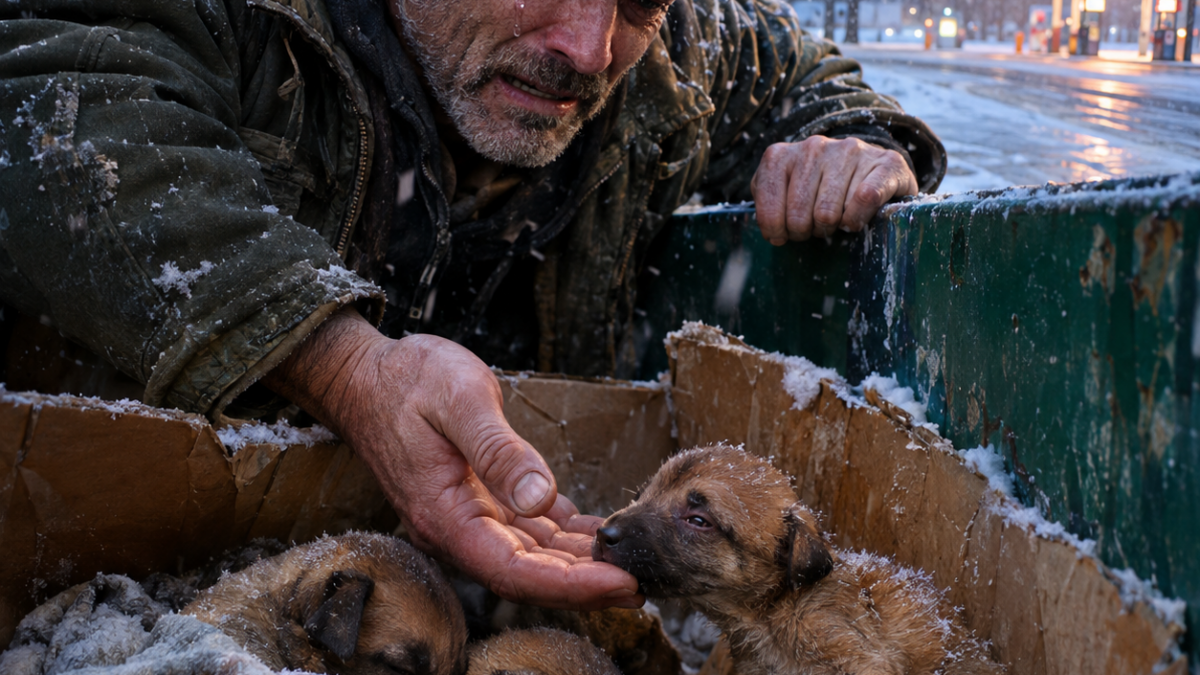
Garbage doesn’t ask how you’re feeling.
It doesn’t offer condolences.
It doesn’t expect you to explain why you can’t sleep.
You drive your route, empty the containers, finish your shift, and go home.
And when you get there, nobody asks why you’re still alive when so many people you loved aren’t.
That was how I preferred things.
At least, that’s what I told myself.
At 5:42, I put Clare’s photograph beside the kitchen lamp, pulled on my insulated work jacket, and stepped outside into falling snow.
By 6:05, I was driving the sanitation truck through streets that looked abandoned beneath the gray winter sky.
At 7:41, I turned onto Old Quarry Road.
Behind a closed convenience store stood a commercial dumpster.
I positioned my truck.
Checked the mirrors.
Reached for the controls.
Then I heard something.
A faint, thin cry.
I shut off the engine.
Waited.
Heard it again.
I climbed down and walked toward the dumpster.
The sound came from somewhere beneath the cardboard.
When I lifted the lid, I found a dirty plastic storage bin wedged among flattened boxes.
Inside were two fleece towels and a disposable warming pad that had nearly gone cold.
And beneath those towels lay three puppies.
Belgian Malinois.
Barely three weeks old.
One larger fawn-colored male struggled weakly against the blanket.
Another, darker male barely lifted his head.
The third was a tiny light-fawn female curled against her brothers.
She wasn’t moving.
I pulled off one glove.
“Come on, sweetheart,” I whispered.
I touched the towel beside her.
Nothing.
I moved my fingers closer.
Her nose twitched.
Then, with an effort so painful to watch that my throat closed, she dragged herself toward the warmth of my hand.
One inch.
Then another.
Until her tiny nose rested against my palm.
I stood there with snow falling onto my shoulders, staring at a creature no bigger than something I could hold in one hand.
And suddenly I wasn’t fifty years old.
I was back in a hospital room eight months earlier, holding Clare’s thin fingers while she struggled to say something she knew I didn’t want to hear.
Don’t make remembering me your reason to stop living.
I had promised her.
Then I’d gone home and broken that promise, one empty morning at a time.
The little puppy moved again.
I swallowed.
“All right,” I whispered. “I’m here.”
I grabbed my phone and called my supervisor, Harlon Beck.
He answered on the fourth ring.
“Truck broken?”
“No.”
“You hurt?”
“No.”
“Then what?”
I looked into the bin.
“Three puppies. Dumpster behind the old store on Quarry Road. One’s barely moving.”
Harlon’s voice changed.
“Are they alive?”
“For now.”
“Get them to Calder’s clinic. I’ll send Luis to finish your route.”
“Harlon, I’m on the clock.”
“And I’m your supervisor. Go.”
He hung up.
I lifted the bin from the dumpster, carried it toward my truck, and tucked another clean jacket around the puppies to keep out the cold.
The smallest female barely moved.
As I settled them securely inside the heated cab, her tiny mouth opened.
A sound came out.
So weak I almost missed it.
I looked down.
“Stay with me, little one.”
Then I started the engine and headed toward Black Alder Veterinary Clinic.
For eight months, I hadn’t cared much whether tomorrow came.
Now three helpless animals depended on me getting there.
And the smallest was growing frighteningly still.
FULL STORY CONTINUATION
I had driven vehicles through weather that made experienced men question their judgment.
Sandstorms.
Flooded roads.
Mountain passes where visibility disappeared without warning.
But that twenty-minute drive to Black Alder Veterinary Clinic frightened me more than I wanted to admit.
Every time I stopped at an intersection, I looked toward the plastic container secured beside me.
The two larger puppies were moving.
Not much, but enough that I could see their little bodies shifting beneath the fleece.
The smallest one remained curled against the towel.
“Come on,” I muttered.
Snow swept across the windshield.
“Don’t you quit on me.”
I knew almost nothing about caring for newborn puppies.
I knew they needed warmth.
I knew they needed their mother.
And I knew that at three weeks old, they had no business being in a dumpster behind a closed convenience store in the middle of a Massachusetts winter.
The warming pad told me whoever had left them there understood at least something about that last part.
That bothered me more than finding them without any protection at all.
Someone had thought about the cold.
Someone had known these little creatures could freeze.
And whoever it was had walked away anyway.
I tightened my hands around the steering wheel.
Then the smallest puppy made another sound.
I glanced down.
Her head had shifted slightly toward the edge of the blanket.
“That’s it, girl.”
I swallowed.
“Keep fighting.”
By the time I reached the clinic, my hands were shaking.
I parked crookedly near the entrance, grabbed the container, and hurried inside.
A receptionist looked up.
“Can I help—”
“Three abandoned puppies. Found them outside. They’re freezing.”
She was already moving.
“Dr. Calder!”
A woman in navy scrubs appeared from a treatment room.
Dark hair tied behind her neck.
Calm brown eyes.
The efficient movements of someone who had spent years learning how to make frightened people useful instead of letting their panic become another problem.
“I’m Naomi Calder,” she said. “Bring them here.”
I followed her into an examination room.
A technician cleared the counter.
Naomi pulled back the towels.
Her expression grew serious.
“How long were they outside?”
“Don’t know. Warming pad was nearly cold.”
“That may matter.”
She lifted the largest puppy carefully.
The little male protested with a thin squeak.
“Good,” Naomi murmured. “I like hearing that.”
She passed him to the technician and turned toward the darker male.
Then she examined the female.
The change in her expression made my stomach tighten.
“How bad?” I asked.
Naomi checked the puppy’s temperature and breathing.
“She’s the one I’m most concerned about.”
I stared at the tiny body.
“Is she dying?”
Naomi looked up.
“She’s dangerously cold and weak. We’re going to warm her carefully and assess her response. I can’t promise anything yet.”
I hated that answer.
Not because it was unkind.
Because it was honest.
For most of my adult life, I’d been trained to identify problems and act.
Find the threat.
Assess the risk.
Choose a response.
Move.
But standing inside that examination room, I couldn’t do anything useful.
I couldn’t warm the puppies faster by wanting it.
I couldn’t force the smallest one to breathe more strongly.
I couldn’t order her heart to keep beating.
I had to stand back and let someone else take over.
Naomi seemed to understand.
“Mr.—”
“Sloan. Merrick Sloan.”
“Mr. Sloan, you did the important thing. You brought them here.”
I looked through the glass toward the treatment area.
“Will that be enough?”
She paused.
“I don’t know yet.”
Then she returned to work.
I stood there while the technicians moved with practiced precision.
Temperature checks.
Controlled warming.
Hydration assessment.
Feeding response.
Weights.
Medical notes.
I understood almost none of the terminology.
But I understood the urgency.
The largest male was weak but responsive.
The darker male was quiet, though he followed movement with his eyes.
The little female barely reacted at first.
Naomi placed her in a carefully warmed enclosure.
Then we waited.
I remained near the glass.
Minutes passed.
Eventually, Naomi approached me.
“The smallest one is responding to warming.”
I turned.
“She is?”
“Yes.”
“Is she going to make it?”
“It’s too soon to know. But that’s encouraging.”
I nodded.
My throat tightened.
“Thank you.”
Naomi studied me.
“Are you all right?”
It was such an ordinary question.
I hadn’t been asked it in a way I believed for months.
“Fine,” I said.
She glanced at my trembling hands.
“Okay.”
She didn’t argue.
Didn’t ask about my military background.
Didn’t question why a garbage-truck driver looked as though he’d just walked out of a disaster.
Instead, she said, “The next several hours are important. Especially tonight.”
I stared toward the enclosure.
The tiny female lay beneath a warming blanket, her two brothers resting nearby.
Three small bodies.
Three lives that had been thrown away before they’d even had a chance to begin.
“Can I stay?” I asked.
Naomi considered it.
“For a little while. Then I need you to let us work.”
I nodded.
“Fair enough.”
I sat on a chair outside the treatment room.
And for the first time since Clare died, I found myself afraid of losing something that was still alive.
Clare used to tell me that I confused control with safety.
She said it gently most of the time.
Occasionally, when I was being especially difficult, she said it while pointing a wooden spoon at me.
“You can’t organize the entire universe, Merrick.”
“I can organize the garage.”
“You haven’t organized the garage in six months.”
“That’s because it has its own operational structure.”
She’d raise an eyebrow.
“You mean a mess?”
“A flexible storage system.”
Then she’d laugh.
Clare had a way of making me laugh when I didn’t want to.
She never treated my military career as the most important thing about me.
When we first met, she was more interested in whether I knew how to cook.
I told her I could make eggs.
She asked whether they were edible.
I said that depended on how hungry she was.
She laughed so hard she nearly spilled her coffee.
Twenty-four years.
That’s how long we had.
Not nearly long enough.
There were deployments.
Arguments.
Quiet Sundays.
Long drives.
Home repairs.
Birthdays.
Bad movies.
Good dinners.
And the kind of ordinary evenings you never think to photograph because you assume there will be thousands more.
When the doctors found the cancer, Clare listened carefully.
She asked questions.
She took notes.
She remained calmer than I did.
For more than a year, treatment became the center of our lives.
Appointments.
Blood work.
Medication.
Exhaustion.
Brief improvements.
Disappointments.
And the constant effort of pretending we weren’t terrified.
She lost her hair before the second round of chemotherapy.
One evening, she handed me the electric clippers.
“Do it.”
I stared at her.
“Clare—”
“It’s coming out anyway.”
“I know.”
“Then stop looking at me like I asked you to defuse a bomb.”
I tried to smile.
My hands were shaking.
She reached up and touched my face.
“Merrick.”
I looked at her.
“If you cry, I’ll divorce you just to make the paperwork inconvenient.”
I laughed.
Then cried anyway.
She did too.
We stood together in the bathroom, two middle-aged people facing something neither of us could defeat by being brave enough.
When the last of her hair fell onto the towel, she studied herself in the mirror.
Then she turned toward me.
“Well?”
I swallowed.
“Beautiful.”
She narrowed her eyes.
“Liar.”
“Absolutely not.”
She smiled.
Then took the clippers from me.
“Your turn.”
I stepped backward.
“Not happening.”
“Oh, come on. Solidarity.”
“I’m a retired Navy SEAL, not a fool.”
She laughed until she had to sit down.
That was Clare.
Even while cancer was taking her strength, she found ways to make the world less frightening for the people around her.
Especially me.
I hadn’t known how much I depended on that until she was gone.
Naomi called me late that afternoon.
I answered before the second ring.
“Dr. Calder?”
“Mr. Sloan, I wanted to give you an update.”
I stood beside my kitchen table.
“How are they?”
“All three are alive.”
My knees nearly weakened.
I gripped the chair.
“And the little girl?”
“Still our biggest concern, but she’s responding to treatment.”
I closed my eyes.
“Thank God.”
“We’ve managed to get some nutrition into her. She’s warmer, and she’s showing more response.”
I nodded as though Naomi could see me.
“Good.”
“But we still need to monitor her closely.”
“I understand.”
She hesitated.
“Do you have any idea who owned the puppies?”
“No.”
“Animal control will need a report.”
“Of course.”
“Someone will likely contact you.”
“Fine.”
I looked toward Clare’s photograph.
“Doctor?”
“Yes?”
“Can I come by tomorrow?”
There was a brief pause.
Then her voice softened.
“Yes, Mr. Sloan. You can come by tomorrow.”
After we hung up, I stood in the kitchen for several minutes.
I realized I hadn’t eaten since the previous evening.
I opened the refrigerator.
Stared at the shelves.
Closed it.
Then opened it again.
Clare used to say that if I could remember the names of thirty pieces of equipment but couldn’t remember to eat lunch, something was fundamentally wrong with military training.
I made a sandwich.
Sat down.
Ate half.
Then looked at my phone.
No new messages.
No update.
Nothing to do but wait.
I hated waiting.
But I hated the thought of not caring even more.
I returned to the clinic before sunrise.
Fresh snow covered the parking lot.
The windows glowed warmly against the dark.
I sat in my truck for a moment, gripping the steering wheel.
Then I went inside.
Naomi met me in the hallway.
She looked tired.
But she smiled.
“They’re alive.”
I exhaled.
A long, shaky breath.
“All three?”
“All three.”
I closed my eyes.
For a moment, I couldn’t speak.
Naomi waited.
Then she said, “The little female ate a small amount during the night.”
“How small?”
She gave me a look.
“Enough that I’m telling you she’s improving instead of declining.”
I nodded.
“I’ll take it.”
She led me toward the warmed enclosure.
The largest puppy was awake.
He was trying to climb over a rolled towel with the stubborn determination of a creature who had never been told that his legs were too short for his ambitions.
The darker male lay beside him.
His eyes followed us.
And the smallest female rested against the bedding, warm and breathing.
I stood there for a long time.
Then the large male squeaked.
Naomi smiled.
“He’s got opinions.”
I almost laughed.
“He does.”
The darker one watched without making a sound.
“And that one?”
“Quieter. Alert, though.”
I leaned closer.
The tiny female moved her head.
Her pale fawn coat looked softer now that it was dry.
Her black muzzle rested against the fleece.
“Hey, little one,” I whispered.
One of her ears twitched.
I stopped.
Naomi noticed.
Neither of us said anything.
I leaned closer.
“Remember me?”
The puppy shifted slightly.
I knew better than to imagine she understood my words.
But she had heard my voice.
And something about that tiny movement reached a place in me that had been shut for months.
Naomi spent the next forty minutes explaining what caring for puppies this young would involve.
I took notes.
Actual notes.
In a small spiral notebook I’d found in the glove compartment.
Puppy milk replacer.
Not cow’s milk.
Controlled warmth.
Frequent feedings.
Daily weight checks.
Clean bedding.
Careful observation for changes in breathing, appetite, temperature, or behavior.
As the puppies grew, their feeding schedule would change.
Their nutritional needs would change.
Eventually, they’d need socialization, veterinary care, training, and a safe environment suited to an active working breed.
I wrote everything down.
Naomi leaned against the counter.
“Do you always take notes like this?”
“Only when mistakes matter.”
“With puppies this young, they do.”
I looked up.
She wasn’t smiling.
Neither was I.
Then a woman wearing a dark green county jacket entered the room.
She carried a weatherproof folder.
Her brown hair was tied beneath a knit cap, and she had the calm expression of someone who had learned that raising her voice rarely improved a difficult situation.
“Mr. Sloan?”
“Yes.”
“I’m Tessa Monroe. Animal control.”
We shook hands.
“I understand you found the puppies.”
I nodded.
She opened her folder.
“Can you walk me through it?”
I described everything.
Old Quarry Road.
The dumpster.
The plastic storage bin.
The fleece towels.
The nearly depleted warming pad.
The position of the container beneath the cardboard.
Tessa wrote carefully.
When I mentioned the warming pad, her pen stopped.
“That detail matters.”
“I thought so.”
“Whoever left them knew they needed warmth.”
I felt anger rise.
“Apparently not enough to keep them out of a dumpster.”
Tessa looked at me.
“No. Not enough.”
She didn’t defend the decision.
But she didn’t speculate either.
I respected that.
She explained that the puppies would need to remain part of an animal-control investigation while ownership was checked.
The county shelter was crowded.
Very young puppies required round-the-clock attention.
And separating the three without a medical reason wasn’t ideal.
Then she looked at me.
“Would you consider fostering them?”
I stared.
“What?”
“All three.”
I looked through the glass.
The largest male had managed to crawl halfway across his brother.
The darker puppy looked thoroughly unimpressed.
The little female remained tucked between them.
“Fostering?”
“Temporarily. While we complete the required process.”
I thought about my house.
The silence.
The untouched rooms.
Clare’s things.
My garbage route.
The fact that I hadn’t taken care of a dog in years.
Then I thought about the little female dragging herself toward my hand.
“How temporary?”
Tessa smiled slightly.
“Depends on what we find. Think weeks, not days.”
I stared at the puppies again.
Then I heard myself speak.
“Okay.”
Tessa looked up.
“All three?”
I nodded.
“Temporary.”
Her expression became professionally neutral.
“Of course.”
I should have recognized that look.
It was the expression of a woman who already suspected I had no idea what I was agreeing to.
The clinic kept the puppies under observation until they were stable enough for the next stage of care.
While I signed the foster documents, the smallest female began making a restless sound.
Naomi checked her.
Adjusted the bedding.
Offered a feeding.
Nothing obvious appeared wrong.
Then I moved closer.
“Easy, little one.”
The puppy became quiet.
Her head turned slightly toward me.
Naomi looked up.
I looked at her.
Neither of us said anything for a moment.
Then she smiled.
“She knows your voice.”
I swallowed.
“Maybe.”
“She recognizes something familiar.”
I stared at the little animal.
She had known me for less than a day.
She didn’t know my name.
She didn’t know what I had done before driving a garbage truck.
She didn’t know that I’d spent years sleeping badly.
She didn’t know Clare had died.
She knew only that a voice she’d heard in the cold had returned.
For some reason, that felt like enough.
I named the puppies before I brought them home.
Not because I’d decided to keep them.
I told myself it was practical.
Medical records were easier when each animal had a name.
The largest male became Finn.
He had a deep fawn coat, a dark mask, and the determination of a little bulldozer.
The second male became Moss.
He was darker, with mahogany shading through his coat and a narrow, watchful face.
He rarely wasted movement.
Even as a newborn, he seemed to prefer studying a situation before deciding whether it deserved his participation.
The smallest female became June.
I didn’t have a clever explanation for that one.
The name simply came to me.
June sounded warm.
Gentle.
Like sunlight on the garden Clare had loved.
I looked at the little female resting beneath the warming blanket and thought she deserved a name that belonged to something other than winter.
Naomi wrote the names on the chart.
“Finn, Moss, and June.”
I nodded.
She looked toward the enclosure.
“Good names.”
“Temporary names,” I said.
Naomi looked at me.
“Of course.”
There was that expression again.
I was beginning to dislike it.
By late afternoon, I was driving home with three puppies secured inside a warmed carrier and enough supplies to make my truck look like a veterinary equipment delivery service.
Milk replacer.
Feeding supplies.
Washable pads.
Fleece blankets.
A digital kitchen scale.
A low exercise pen.
Cleaning products.
A thermometer.
Written instructions.
I had also bought a small basket of toys, although Naomi had explained that the puppies weren’t ready to use most of them yet.
I wasn’t sure why I’d bought them.
They had looked cheerful.
My phone rang while I was leaving the store.
Harlon.
“How many survived?”
“Three.”
“Good.”
A pause.
“You keeping them?”
“I’m fostering.”
“That wasn’t my question.”
I stared through the windshield.
“Harlon.”
“Yes?”
“Don’t you have trucks to manage?”
He laughed.
Then hung up.
By six o’clock, I had transformed the living room into a puppy nursery.
I positioned the enclosure near the fireplace but far enough away to avoid excessive heat.
I arranged the bedding.
Checked the warming equipment.
Organized the formula.
Placed the feeding instructions on the refrigerator.
Then I wrote three names across a sheet of paper.
FINN. MOSS. JUNE.
Beside each name, I made columns for feeding time, amount, weight, and observations.
It looked like a mission log.
That made me comfortable.
For the first time in months, I had a reason to organize something beyond the next day’s garbage route.
At eleven-thirty, my phone alarm sounded.
Finn protested the feeding process with the indignation of a puppy who believed the universe had delayed dinner deliberately.
Moss accepted his portion quietly.
June required more patience.
I sat on the floor, holding her carefully while she took the milk replacer according to Naomi’s instructions.
“Come on, sweetheart.”
She swallowed.
“That’s it.”
Another small swallow.
“Good girl.”
Her tiny body fit against my hand.
I looked toward the dark hallway.
And suddenly I thought of Clare.
“She was stubborn too,” I told June.
The name made my throat tighten.
Clare.
I hadn’t spoken it inside the house for days.
Not because I’d forgotten.
Because saying it aloud sometimes made the emptiness worse.
June shifted against my fingers.
I looked down.
“Your Aunt Clare would’ve liked you.”
The words came out before I could stop them.
I smiled faintly.
“She would’ve pretended she didn’t.”
June continued feeding.
I brushed one finger gently along her back.
“Then she would’ve bought you a ridiculous sweater and insisted you were the prettiest dog in Massachusetts.”
A laugh escaped me.
Small.
Rusty.
Almost unfamiliar.
I looked toward Clare’s photograph.
For a moment, I could imagine her standing in the kitchen doorway.
Arms folded.
Eyebrow raised.
“Three puppies, Merrick?”
I’d shrug.
“Temporary.”
She’d laugh.
“Of course they are.”
The image hurt.
But not quite the way it had before.
For a moment, remembering her felt warm.
Not only painful.
I hadn’t realized how badly I’d missed that.
At 2:37 the next morning, I woke from a nightmare.
I had fallen asleep on the sofa.
For several seconds, I didn’t recognize the room.
The fireplace had burned low.
Wind pressed against the windows.
A branch scraped the roof.
And in my half-awake mind, I was somewhere else.
Afghanistan.
A dim corridor.
Radio static.
Dust.
A voice calling my name.
Aaron.
I sat upright, breathing hard.
My hands moved before my thoughts caught up.
Then a thin sound came from the puppy enclosure.
I froze.
Another whimper.
I looked toward the living room floor.
June was awake.
She was trying to move toward the side closest to me.
I stared at her.
The room began returning in pieces.
Fireplace.
Sofa.
Wooden floor.
Black Alder.
Home.
I stood slowly.
Then lowered myself beside the enclosure.
June pressed against the bedding near my hand.
I rested my fingers beside her.
She settled.
My breathing slowed.
For almost twenty minutes, I sat there without speaking.
Then I looked toward Clare’s photograph.
“She lost her hair before the second round,” I whispered.
June slept against the edge of my hand.
“She made me shave what was left.”
I smiled sadly.
“Threatened to divorce me if I cried.”
I swallowed.
“She was brave.”
The house remained quiet.
Then I corrected myself.
“No. That’s not right.”
I looked down.
“She was scared too.”
My eyes burned.
“She just didn’t let it stop her from being herself.”
I stayed there until the shaking in my hands passed.
Then I returned to the sofa.
But before closing my eyes, I looked toward the puppies.
Three little bodies sleeping beneath warm blankets.
For eight months, I had dreaded waking up.
Now I wanted to wake up because they would need breakfast.
It wasn’t happiness.
Not yet.
But it was something.
And something was more than I’d had.
The next ten days changed my house in ways I hadn’t expected.
At first, everything revolved around feeding schedules.
I set alarms.
Measured portions.
Recorded weights.
Washed blankets.
Checked the puppies for signs of trouble.
Kept the room warm.
Called Naomi when I had questions.
Sometimes I called about things she probably considered obvious.
She never made me feel foolish.
Once, I asked whether Finn’s habit of trying to climb over his siblings meant something was wrong.
Naomi laughed.
“No, Merrick. It means Finn is being Finn.”
I looked toward the enclosure.
He was doing it again.
“Wonderful.”
Then I began making other changes.
I replaced the burned-out bulb in the hallway because I didn’t want to carry June through the dark.
I brought in extra firewood.
I cleaned the kitchen more regularly.
I opened the curtains in the morning.
I started eating breakfast because I was already awake.
The first time I cooked eggs instead of drinking coffee and leaving for work, I stood staring at the frying pan as though someone else had made the decision.
Then I noticed Clare’s blue ceramic mug on the shelf.
I took it down.
Washed it.
Filled it with coffee.
And sat at the table.
I didn’t drink from it.
It was still hers.
But I let it sit across from me.
Not as a punishment.
Not as proof of what I’d lost.
Just because I liked seeing it there.
That morning, I ate every bite of my breakfast.
When I returned to work, Harlon noticed the dog hair on my jacket.
He leaned against his office door.
“Temporary?”
I looked at him.
He raised both hands.
“Didn’t say anything.”
“You’re thinking loudly.”
He grinned.
“Occupational hazard.”
I walked past him.
He called after me.
“Good to see you eating again, Sloan.”
I stopped.
Turned.
He looked almost embarrassed.
Then he shrugged.
“You’ve been throwing half your lunch away for months.”
I stared.
I hadn’t known anyone noticed.
Harlon looked down at his clipboard.
“Anyway, Route Six has a blocked alley. Watch the ice.”
I nodded.
“Will do.”
Then I went back to work.
Two weeks later, I brought the puppies to Naomi for another examination.
Finn complained loudly.
Moss watched the thermometer with deep suspicion.
June remained the smallest.
But she had gained weight.
Her appetite had improved.
Her movements were stronger.
Naomi finished her notes.
“They’re doing well.”
I released a breath.
“All three?”
“All three.”
She looked at June.
“She’s cleared the period that worried me most.”
I closed my eyes.
“Thank you.”
Naomi smiled.
“You’ve done a good job following instructions.”
I looked at the puppies.
“They’ve done the hard part.”
She nodded.
“They have.”
On the drive home, Finn fell asleep with one paw across Moss’s back.
Moss accepted this indignity without protest.
June curled between them.
I watched them whenever it was safe to glance toward the carrier.
Relief should have been the only thing I felt.
Instead, something else settled into my chest.
Fear.
Not fear that they’d die that night.
Not the urgent terror I’d felt when I found them.
A slower fear.
The kind that comes when you realize you have something to lose.
For eight months, I’d built my life around minimizing that feeling.
I didn’t make plans.
Didn’t visit people.
Didn’t allow anyone close enough to disappoint me.
I told myself I was protecting what remained of my peace.
But the truth was uglier.
I had been avoiding anything that might make tomorrow matter.
Now Finn, Moss, and June were sleeping in my truck.
And I cared very much about tomorrow.
That frightened me.
Almost as much as the thought of losing them.
By the final week of March, the puppies had become considerably more difficult to ignore.
They were approaching ten weeks old.
Finn had grown fastest.
His deep fawn coat had darkened across the shoulders, and one ear stood upright while the other folded sideways whenever he ran.
He approached every room as though it contained something specifically designed for him to investigate.
Moss remained darker and quieter.
His face had become narrower.
His eyes followed everything.
If Finn charged toward a new object, Moss usually waited.
He watched.
Considered the results.
Then decided whether participation seemed worthwhile.
June was still the smallest.
Her coat remained a lighter fawn.
She had become stronger, but she moved more carefully than her brothers.
And she’d developed a habit I couldn’t explain.
She followed me.
Not directly underfoot.
Not demanding attention.
She simply stayed close enough to know where I was.
If I moved into the kitchen, she’d appear in the doorway.
If I sat in the living room, she’d settle nearby.
If I walked toward the back door, she’d lift her head and watch.
Sometimes she’d rest one paw against my boot.
Just enough contact to make sure I was still there.
I pretended not to notice.
I noticed every time.
The house looked completely different.
Puppy gates appeared in doorways.
Washable rugs replaced the expensive ones Clare had chosen years earlier.
A basket of toys sat beneath the living room window.
I bought more towels.
More cleaning supplies.
More food.
Finn decided my work gloves were better than any toy money could buy.
One morning, I found one glove beneath the dining table.
The other behind the sofa.
Finn sat between them, wagging his tail.
I stared.
“Those cost money.”
His tail moved faster.
“Compelling defense.”
Moss sat in the doorway watching the proceedings as though studying how theft was handled in this household.
June tilted her head.
And I laughed.
A full laugh.
Loud enough to surprise me.
I stopped immediately.
The sound died in my throat.
Clare was gone.
Aaron was gone.
Wes was gone.
Caleb was gone.
How could I stand in my kitchen laughing about a stolen glove?
The thought came automatically.
Cruelly.
As though happiness were something I had no right to experience while people I loved were dead.
I looked toward Clare’s photograph.
Her face smiled back from the frame.
And for one brief moment, I imagined what she’d say.
Oh, for heaven’s sake, Merrick. They’re puppies. Laugh.
I stared at the picture.
Then looked down at Finn.
He had picked up the glove again.
“Drop it.”
He considered the request.
Apparently, his legal counsel advised against cooperation.
I laughed again.
This time, I let myself.
Harlon noticed the changes before I admitted them.
One morning, I arrived at the operations office carrying three bags of puppy food.
I’d bought them on the way to work and forgotten to leave them at home.
Harlon looked at the bags.
Then at me.
Then back at the bags.
“Temporary foster situation?”
I set them beside my locker.
“You have trucks to manage.”
He leaned back.
“Just checking operational status.”
“Operational status is none of your business.”
He smiled into his coffee.
“That bad, huh?”
I walked away.
But I was smiling too.
My coworkers began talking to me more.
Or perhaps I began answering them.
I helped a younger driver free a frozen hydraulic latch without being asked.
At the gas station, I caught myself discussing the weather with the cashier.
Small things.
Things most people wouldn’t notice.
But I noticed.
Because for eight months, I’d been living as though conversation required more energy than I could spare.
Now I found myself telling people about the puppies.
Not long stories.
Just small things.
Finn stealing gloves.
Moss watching everything.
June falling asleep beside my boot.
And sometimes, after I spoke, I’d realize I was smiling.
That still frightened me.
But less than before.
Tessa Monroe called one Thursday afternoon.
“Merrick, I have an update about Old Quarry Road.”
My posture changed immediately.
“What kind of update?”
“Security footage from a property across the street.”
I stood.
“Did you identify whoever left them?”
“Not yet. But we have something useful.”
I looked toward the living room.
Finn was wrestling a towel.
Moss watched from the rug.
June slept near the fireplace.
“I’ll come by.”
Twenty minutes later, I was sitting in Tessa’s office.
She turned her computer monitor toward me.
The footage was grainy.
A fixed camera pointed across the road toward the closed convenience store.
The timestamp showed the morning I’d found the puppies.
A faded pickup entered the frame.
Stopped near the dumpster.
A figure climbed out.
Young.
Thin.
Wearing a hooded jacket.
The person carried a plastic storage bin.
My hands tightened.
I watched the figure place the container near the dumpster and move it out of sight.
Then turn back toward the truck.
Before getting in, the figure stopped.
Looked over one shoulder.
Waited.
Then drove away.
I stared at the screen.
“Play it again.”
Tessa did.
The same sequence.
The truck.
The container.
The hesitation.
The departure.
I felt anger rise.
“He knew they were alive.”
Tessa nodded slowly.
“He knew he was leaving living animals.”
“He knew how cold it was.”
“Yes.”
I stared at the monitor.
“Then why?”
“That’s what I’m trying to find out.”
I looked at her.
“Can you identify the truck?”
“We have a partial match. I’m working on it.”
I started to stand.
Tessa spoke sharply.
“Merrick.”
I stopped.
“Don’t.”
I looked at her.
“I haven’t said anything.”
“You don’t have to.”
I stared.
She leaned forward.
“Let me do my job.”
For a moment, the old part of me wanted to argue.
To demand the address.
To find the person.
To ask how anyone could walk away from three helpless puppies.
But Tessa was right.
This was her investigation.
Not mine.
I sat back down.
“Call me when you know.”
“I will.”
I nodded.
Then left.
That evening, I found June near Clare’s old wicker basket.
The basket sat beside the sofa.
It held gardening catalogs, a pale green scarf, and a few things I’d never been able to sort.
June had pulled the scarf halfway out.
I stopped in the doorway.
“Hey.”
She looked up.
The scarf hung from her mouth.
“That’s not yours.”
I crouched.
She released it without protest.
I took the fabric gently.
It still carried a faint trace of the perfume Clare used to wear.
For a moment, my throat tightened.
I had avoided that basket for eight months.
Not because I wanted to forget what was inside.
Because I remembered too much.
June nudged the edge.
A few gardening catalogs slipped onto the floor.
Then something else fell out.
A blue clothbound notebook.
I stared.
I’d never seen it before.
I picked it up.
The cover was worn at the corners.
Inside, on the first page, were four words in Clare’s handwriting.
Things I can’t say yet.
My chest tightened.
I turned one page.
Then another.
There were notes about medication.
Appointments.
Groceries.
Small jokes written in the margins.
Clare had always made lists.
Sometimes she’d leave them on the refrigerator with comments about how I was apparently incapable of remembering milk unless it appeared in writing.
I smiled.
Then I reached a later page.
The handwriting had changed.
Still hers.
But weaker.
More careful.
The date was five months before she died.
I read the first sentence.
I am not afraid Merrick will forget me.
I stopped.
My hands began shaking.
I read it again.
Then the next line.
He doesn’t know how to forget anything. That is part of the problem.
I closed the notebook.
Couldn’t go farther.
I sat on the floor.
June settled beside my knee.
I stared at the blue cover for a long time.
Then I stood.
Carried it to the kitchen.
Placed it on the counter.
And walked away.
For almost six hours, I couldn’t bring myself to open it again.
At 1:08 in the morning, I came downstairs.
I had tried to sleep.
Failed.
The house was quiet except for the furnace and the occasional movement inside the puppy pen.
Finn and Moss were asleep.
June lifted her head when I passed.
I took the notebook from the counter.
Sat at the kitchen table.
Turned on the lamp.
Then opened it.
I read the first pages slowly.
Clare’s practical notes.
Medication reminders.
Questions for doctors.
Things she wanted to remember.
Then the entries became more personal.
Some were funny.
One complained about the hospital coffee.
Another described how I’d spent twenty minutes searching for reading glasses that were resting on top of my head.
I laughed softly.
Then I reached the entry I’d stopped reading earlier.
I am not afraid Merrick will forget me.
He doesn’t know how to forget anything.
That is part of the problem.
I swallowed.
Then kept reading.
What frightens me is that he will remember me so completely that he forgets the rest of his life.
My breathing changed.
I stared at the words.
He has already spent years apologizing for surviving one war.
I don’t want him turning loving me into another war he thinks he has to lose.
I closed my eyes.
Aaron.
Wes.
Caleb.
Three names I had carried for fourteen years.
Three men who had died during an operation in Afghanistan.
Three men whose deaths had become something I used against myself whenever the world grew quiet.
Clare knew.
Of course she knew.
She had spent years watching me wake from nightmares.
Years listening when I couldn’t speak.
Years telling me that surviving wasn’t something I had stolen from the men who died.
And now she was gone.
And I had turned her death into another reason to stop living.
I looked down at the notebook.
My hands were trembling.
I read another passage.
I don’t need Merrick to stop missing me.
I don’t need him to become happy overnight.
I just need him to understand that loving me doesn’t require him to disappear.
I pressed one hand against my mouth.
Tears blurred the page.
I want him to open the curtains.
Eat breakfast.
Fix the porch railing he keeps promising to repair.
Call Daniel.
Plant something in the garden.
Laugh when something is funny.
And someday, when he is ready, I want him to stop treating tomorrow like a punishment.
I bent forward.
For a long time, I couldn’t move.
I had spent months staring at Clare’s photograph, telling myself that grieving her meant remaining exactly where she’d left me.
But she had known what I would do.
She had been afraid of it.
And she’d written the words down because she knew there might come a time when I couldn’t hear them from anyone else.
I touched the page.
“Clare.”
My voice broke.
“I’m sorry.”
A soft movement came from beneath the table.
June.
She had followed me into the kitchen without my noticing.
She rested her chin against my boot.
I looked down.
Her eyes were half-closed.
She wasn’t performing some miraculous act of comfort.
She was a ten-week-old puppy who liked sleeping near me.
But for some reason, that ordinary little gesture made it possible for me to keep breathing.
I reached down and touched her head.
“She would’ve liked you,” I whispered.
June’s tail tapped the floor.
I laughed through tears.
“Oh, she would’ve loved you.”
Then I closed the notebook.
Not because I was finished.
Because for the first time, I wanted to read the rest tomorrow.
The following morning, I opened the curtains in Clare’s old workroom.
The sunlight came in through the glass.
Dust floated above the furniture.
Her sewing basket sat on a chair.
Gardening gloves lay beside a stack of books.
A faded cardigan hung behind the door.
I stood there for ten minutes.
Then I moved three boxes.
Only three.
It wasn’t much.
But it was the first time I’d changed anything in that room since the funeral.
Over the weekend, I folded some of Clare’s clothing.
Placed it carefully into storage containers.
Kept her favorite cardigan hanging behind the door.
Kept the blue mug.
Kept the photographs.
Kept the notebook.
I didn’t throw away anything that mattered to me.
I wasn’t trying to erase her.
I was trying to make room for life to move through the house again.
Outside, I repaired the loose section of porch railing she’d complained about two summers earlier.
Then I walked into the garden.
Dead stalks covered the beds.
The soil was hard.
The tools were rusty.
I stood there for a long time.
Then cleared one small section.
Just one.
By the time I finished, my hands were dirty and my back hurt.
But when I looked at the cleared patch, I felt something I hadn’t experienced in months.
Satisfaction.
Not because the whole garden was fixed.
Because I’d started.
That evening, I sat in the kitchen with Clare’s notebook open beside me.
Finn was asleep near the fireplace.
Moss watched the back door.
June rested against my boot.
I looked at the page.
Then toward the garden.
“Okay, sweetheart,” I whispered.
“One thing at a time.”
Tessa called four days later.
I was standing beside the sanitation truck, drinking coffee that tasted as though someone had filtered hot water through a rusty toolbox.
“Merrick?”
“Yeah.”
“We identified the pickup.”
I lowered the cup.
“Who?”
“A nineteen-year-old farmhand named Eli Mercer.”
My jaw tightened.
“Where is he?”
“At the moment, that’s not something you need to worry about.”
I closed my eyes.
“Tessa.”
“Listen to me before you get angry.”
“I’m already angry.”
“I know.”
She paused.
“Would you come by the office? There’s more to the story.”
I stared at the snow piled along the roadside.
Then said, “I’ll be there after my shift.”
She didn’t ask me to promise I would stay calm.
Maybe she’d learned that people who promised too easily were often the ones least prepared to keep their word.
The photograph on Tessa’s desk showed a thin young man with messy brown hair, narrow shoulders, and a patchy attempt at growing a beard.
Nineteen years old.
He looked even younger.
I stared at his face.
“This is him?”
Tessa nodded.
“Eli Mercer.”
I thought about that frozen plastic container.
About June barely breathing.
About the warming pad that had almost gone cold.
“What happened to the mother dog?”
Tessa folded her hands.
“She had complications after the litter. According to what we’ve been told, the property owner didn’t want responsibility for the puppies.”
I looked at her.
“So he told this kid to throw them away?”
“He told Eli to get rid of them.”
I felt my face grow hot.
“And Eli chose a dumpster.”
“Yes.”
I stood.
Tessa’s voice sharpened.
“Merrick, sit down.”
I looked at her.
She didn’t move.
“Please.”
I sat.
She continued.
“Eli says he panicked. He knew the sanitation truck serviced that location in the morning. He believed someone would find the puppies before they were harmed.”
I stared.
“He believed?”
“Yes.”
“Three-week-old puppies. In freezing weather.”
“I know.”
“He could’ve called the shelter.”
“Yes.”
“The clinic.”
“Yes.”
“You.”
“Yes, Merrick.”
My hands tightened.
Tessa leaned forward.
“I’m not defending what he did.”
I looked away.
“He made a terrible decision. The consequences are being handled through the proper process.”
I stared at the photograph again.
Then asked the question I hadn’t intended to ask.
“Does he know they’re alive?”
Tessa nodded.
“Yes.”
“What did he say?”
She hesitated.
Then answered quietly.
“He cried.”
I looked at her.
For some reason, that unsettled me more than anything else she’d said.
I had imagined a cruel person.
Someone who could throw helpless animals into a dumpster and drive away without caring.
Instead, I was looking at a frightened young man who had made a dangerous, irresponsible choice and apparently regretted it.
That didn’t excuse him.
It didn’t make the puppies less vulnerable.
It didn’t erase what might have happened if I’d arrived twenty minutes later.
But it complicated the anger.
And I hated that.
Because anger was so much easier when the person responsible fit neatly into the role of a villain.
Tessa watched me.
“What are you thinking?”
I shook my head.
“That somebody should’ve taught him to ask for help.”
She nodded slowly.
“Maybe.”
I looked toward the window.
Snow fell across the parking lot.
Then I said, “I don’t want to meet him.”
“That’s your choice.”
“Not now.”
“Okay.”
I stood.
Tessa looked up.
“Merrick?”
I stopped.
“The puppies are doing well because you got them help.”
I nodded.
“But don’t make yourself responsible for every choice that came before yours.”
The words stayed with me all the way home.
A week later, Tessa called again.
“The required hold is almost finished,” she said.
I was in the living room.
Finn was attempting to drag a blanket twice his size through the doorway.
Moss watched from the carpet, apparently waiting to see whether the strategy had any chance of success.
June lay beneath my chair with one paw touching my boot.
“Meaning?” I asked.
“Once the paperwork clears, the puppies may become available for adoption.”
I looked around.
Three bowls.
Three beds.
A cabinet full of supplies.
Puppy gates.
Chewed toys.
A living room rug that would probably never recover.
“And?”
“And people can apply to adopt them.”
I stared at Finn.
He had succeeded in moving the blanket approximately fourteen inches.
He looked immensely proud.
“All three?”
“Potentially.”
I sat down.
Tessa waited.
Then she said, “Merrick?”
“Yeah.”
“Are you thinking about applying?”
I looked at June.
She raised her head.
I looked at Moss.
He was studying the blanket situation.
Then at Finn.
Who had finally surrendered and fallen asleep on top of his prize.
“I don’t know.”
Tessa didn’t push.
“Okay.”
After we hung up, I sat in silence.
For weeks, I’d been telling myself the puppies were temporary.
I was their foster home.
A stopping point.
Somewhere safe until they found permanent families.
That was the agreement.
I understood it.
I had signed the papers.
But suddenly, imagining the house without them felt almost unbearable.
I thought about Finn’s stolen gloves.
Moss watching me from doorways.
June following me from room to room.
The feeding charts.
The blankets.
The toys.
The way I had begun opening the curtains every morning because they liked watching the yard.
I looked toward Clare’s photograph.
“What do you think?” I asked.
The woman in the picture smiled her familiar irritated smile.
I laughed softly.
“You’d tell me I’m out of my mind.”
Then I looked at the puppies again.
“And you’d probably be right.”
I called Naomi that evening.
She answered from the clinic.
“Merrick?”
“I have a question.”
“Go ahead.”
“If somebody wanted to keep all three puppies, how stupid would that be?”
Silence.
Long enough that I began regretting the call.
Then she said, “Are you asking as their temporary foster?”
“I’m asking as a hypothetical responsible adult.”
I could hear her smile.
“Merrick.”
“Naomi.”
“They’re Belgian Malinois.”
“I noticed.”
“Three of them.”
“My counting skills remain intact.”
She laughed.
Then became serious.
“They’re intelligent, active dogs. They’ll need consistent training, exercise, structure, socialization, veterinary care, and a great deal of time.”
“I know.”
“Three young Malinois could overwhelm someone who isn’t prepared.”
“I understand.”
She paused.
“Have you thought about your work schedule?”
“Yes.”
“Your finances?”
“Yes.”
“Long-term training?”
“Yes.”
“Having appropriate support if you’re sick or unavailable?”
I looked toward Harlon’s number on the refrigerator.
And Tessa’s.
And Naomi’s.
I had spent months avoiding people.
Now there were names on my refrigerator again.
“Yes.”
Naomi was quiet.
Then she asked, “Have you already decided?”
I looked at June.
She had moved closer to my chair.
Moss was lying near the doorway.
Finn had finally abandoned the blanket and was attempting to chew the corner of a toy box.
I sighed.
“Probably.”
Naomi laughed.
“Then let’s talk about making the decision responsibly.”
And we did.
For almost an hour.
We discussed training.
Veterinary expenses.
Exercise.
Care arrangements.
The difference between loving three puppies and being prepared to raise three demanding working-breed dogs.
By the time we finished, I knew the decision would require more planning than I’d originally imagined.
But I also knew something else.
I wanted to do it.
Not because I couldn’t bear another loss.
Not because I wanted to keep everything the same forever.
Because I could picture a future with them.
A real future.
Years of walks.
Training.
Muddy floors.
Veterinary appointments.
Broken toys.
Quiet evenings.
And eventually, someday, the heartbreak that comes with loving animals whose lives are shorter than ours.
I knew that part.
I wasn’t pretending otherwise.
But for the first time since Clare died, the possibility of future grief didn’t make me want to stop living in the present.
The following morning, I drove to Tessa’s office before work.
I placed three adoption applications on her desk.
She looked down.
Then up at me.
Then back down.
“Three?”
“Yes.”
“Finn, Moss, and June?”
“Unless you’ve got three other puppies with those names.”
She smiled.
“So much for temporary.”
I stared.
She lowered her eyes to the papers.
“Permanently temporary. Understood.”
I almost laughed.
She began reviewing the applications.
There would still be a process.
The legal hold needed to end.
The paperwork needed approval.
My home and care arrangements needed to meet the requirements.
But I had started something.
I had signed my name to a decision that assumed I’d still be here years from now.
I didn’t fully understand why that mattered until I returned to my truck.
For months, I’d avoided making plans farther ahead than the next workday.
Now I was planning a life that might last another decade or more.
And I wanted to be there for it.
The storm arrived before the adoption paperwork was finalized.
By late afternoon, Black Alder had disappeared beneath thick, fast-moving snow.
The Berkshire Hills looked like shadows behind a white curtain.
I brought extra firewood inside.
Checked the emergency lights.
Filled water containers.
Charged my phone.
Inspected the backup heat.
Made sure the puppies had a warm, secure area away from drafts.
Preparation had always calmed me.
In the military, knowing where your equipment was before you needed it could make the difference between a manageable problem and a disaster.
At home, it meant I didn’t have to search for a flashlight while three young dogs tried to discover why the world had suddenly gone dark.
Finn considered the storm an invitation.
Every time I opened the back door, he tried to investigate the snow.
Moss watched from a safe distance, apparently assessing whether the weather deserved his attention.
June stayed close to me.
She had become stronger.
More confident.
But she still preferred knowing exactly where I was.
By seven that evening, electricity failed across part of town.
The house went dark.
I lit two battery lamps.
Started the wood stove.
Checked the temperature.
Then sat in my armchair.
The dogs settled around the room.
Finn dragged a rope toy beneath the table.
Moss lay near the hallway.
June curled beside the sofa.
Outside, wind struck the windows.
I watched the fire.
And for a moment, I thought about Clare.
She had loved storms.
Not dangerous ones.
But ordinary winter evenings when the wind blew and the house felt warm.
She’d make cocoa.
Bring blankets.
Insist we watch old movies.
I had always complained.
She’d tell me I had terrible taste.
We’d argue over the movie.
Then she’d fall asleep against my shoulder halfway through it.
I looked toward the empty sofa cushion.
The familiar ache returned.
I let it.
For once, I didn’t try to force the memory away.
After midnight, a tree came down somewhere beyond the property line.
The sound was enormous.
Wood splitting.
A heavy crash.
Then silence.
I was on my feet before I knew I had moved.
My heart hammered.
The room seemed to shift.
For one terrible instant, I wasn’t standing in my Massachusetts living room.
I was back in Afghanistan.
Fourteen years earlier.
Dust in the air.
A dim corridor.
Static crackling through a radio.
A distant impact.
Someone calling my name.
Aaron.
My breathing shortened.
I moved into the hallway.
I knew, somewhere in the rational part of my mind, that I was home.
But knowing something and feeling it are not always the same.
My shoulders tightened.
Every shadow looked wrong.
The hallway seemed too narrow.
The storm outside became another sound from another place.
My hands rose slightly.
Not because I wanted to hurt anyone.
Because my body had remembered a situation that no longer existed.
I stared toward the dark window at the end of the hall.
My mind tried to tell me something was coming.
Something I needed to stop.
Something I had failed to stop before.
“Aaron,” I whispered.
The name came out before I realized I was speaking.
Then I heard paws on the wooden floor.
Finn appeared first.
He trotted toward me, then stopped when I didn’t respond.
June stood near the living room doorway.
Moss came into the hall.
He didn’t rush.
Didn’t jump.
Didn’t bark.
He stood several feet away and watched.
I barely noticed him.
My breathing was too fast.
My mind was trying to connect the house around me with memories that didn’t belong there.
Then I heard a small sound.
Tap.
I looked down.
Moss had lifted one front paw and touched the wooden floor.
He waited.
Then tapped again.
Tap.
Pause.
Tap.
It was such a small sound.
Nothing dramatic.
Nothing trained.
Just a young dog making a repetitive movement because something about the person standing in front of him had changed.
But I heard it.
Wood.
Not concrete.
A house.
Not a compound.
Snow beyond the window.
Not dust.
Moss.
Black Alder.
Home.
I swallowed.
My breathing slowed slightly.
Moss lowered his head.
Not submissively.
Not fearfully.
In the same careful way he’d learned to wait before approaching during our simple training sessions.
He remained still.
Giving me space.
And suddenly I remembered Clare.
She used to do something similar after my nightmares.
She never grabbed me.
Never demanded that I calm down.
She’d sit nearby.
Sometimes with coffee.
Sometimes with nothing at all.
And she’d wait until I found my way back.
Moss wasn’t Clare.
He didn’t understand what had happened in Afghanistan.
He wasn’t performing a trained psychiatric intervention.
But there was something familiar about his patience.
Something that allowed me to stop fighting the room around me.
I lowered myself slowly to the floor.
My knees hit the wood.
Moss approached.
Then June.
She pressed her shoulder against my thigh.
Finn circled twice before lying across my boots, apparently deciding that occupying my feet was the most efficient way to resolve the situation.
I sat there with all three.
The storm moved around the house.
The wood stove crackled.
And for several minutes, I said nothing.
Then I looked at Moss.
“I came home,” I whispered.
He blinked.
I stared toward the dark window.
“They didn’t.”
My voice cracked.
“Aaron Pike.”
The name felt enormous.
I swallowed.
“Wes Morgan.”
June shifted closer.
“Caleb Trent.”
Three names.
Three men.
Three lives that had ended fourteen years earlier.
I’d carried them inside me for so long that remembering them had become almost indistinguishable from punishing myself.
I pressed my hands against my knees.
“I’ve been apologizing ever since.”
The words sounded different spoken aloud.
Not like a private thought.
Like a confession.
I thought about Clare sitting across from me on countless sleepless nights.
I remembered something she’d said after one particularly difficult anniversary.
You keep acting like coming home was something you did to them.
I’d gotten angry.
Not because she was cruel.
Because I couldn’t bear the possibility that she was right.
I had spent years believing that surviving meant I owed something impossible to the dead.
Then Clare died.
And the guilt changed shape.
I had survived again.
She hadn’t.
Some damaged part of me had turned that fact into another accusation.
I looked at the puppies.
Finn lifted his head and rested his chin across my ankle.
June pressed closer.
Moss remained beside my knee.
Three animals who had been abandoned in a freezing dumpster.
Three lives that might have ended before they properly began.
They were alive because somebody had stopped.
Because Harlon had told me to leave my route.
Because Naomi had treated them.
Because Tessa had found a way for them to remain together.
Because other people had helped.
And because I had stayed.
I closed my eyes.
What if surviving wasn’t always a debt?
What if sometimes being the one who remained meant you still had something to do?
Not some grand heroic purpose.
Not a mission that would make the past worthwhile.
Just ordinary things.
Feeding three puppies.
Cleaning their bedding.
Opening the door when they needed to go outside.
Calling someone you’d avoided for months.
Being present.
I looked down at Moss.
He was watching me quietly.
“Good boy,” I whispered.
His tail moved.
I reached out and touched his shoulder.
Then I looked at Finn.
June.
The three of them gathered around me in the dark hallway.
And for the first time in fourteen years, I said the names of my dead teammates without immediately asking what I should have done differently.
“Aaron. Wes. Caleb.”
I took a long breath.
“I remember you.”
The storm continued.
But the hallway was only a hallway again.
And I was home.
By morning, the wind had weakened.
Snow covered the yard.
The road was nearly invisible.
But the house felt different.
I made coffee.
Fed the puppies.
Checked the backup heat.
Then stood beside the kitchen counter with my phone in my hand.
There was a number I hadn’t called in eight months.
Daniel Cross.
Danny.
We’d served together for years.
He was fifty-two now, broad-shouldered, dark-haired with silver at the temples, and still possessed the patient expression of a man who could wait through almost anything without making the silence uncomfortable.
He’d called after Clare’s funeral.
Repeatedly.
I’d stopped answering.
Not because he’d done anything wrong.
Because talking to him meant acknowledging a part of myself I was trying to bury.
I stared at his number.
Then pressed call.
He answered after two rings.
“Merrick?”
That single word nearly broke me.
“Yeah.”
A pause.
“I wasn’t sure you’d ever call.”
I looked down.
June sat beside my boot.
“Neither was I.”
Danny didn’t fill the silence.
That had always been one of the things I liked about him.
Finally, I said, “Danny, I think I need to talk.”
He answered immediately.
“Okay.”
I waited.
No questions.
No lecture.
No demand that I explain why I’d ignored him for eight months.
Just one word.
Okay.
Then he added, “Whenever you’re ready.”
I looked through the kitchen window.
Finn was standing near the back door, desperate to investigate the fresh snow.
Moss watched him.
June looked between her brothers and me.
“Soon,” I said.
“Soon,” Danny agreed.
We hung up.
I stood there for a long moment.
Then Finn barked.
One sharp, impatient sound.
I looked at him.
“You’re impossible.”
He barked again.
I laughed.
Pulled on my boots.
And opened the back door.
The puppies rushed onto the porch.
Finn launched into the snow as though attacking an enemy position.
June followed carefully.
Moss stepped outside, looked back at me, and waited.
For months, I’d often stood in the doorway while the dogs ran.
I watched them play.
Watched them explore.
Then returned inside.
That morning, I stepped down from the porch.
Snow rose around my boots.
Cold air filled my lungs.
Finn bounded ahead.
June chased him.
Moss stayed beside me for several yards before joining them.
I walked after them.
Slowly.
The war hadn’t disappeared.
Clare was still gone.
Aaron, Wes, and Caleb were still gone.
But I’d finally said their names without using them as a reason to disappear.
And for that morning, it was enough.
Spring arrived gradually.
The snowbanks collapsed into gray ridges.
Water ran along the roads.
The garden began showing signs of life.
And Finn, Moss, and June grew into the sort of young dogs who could make a grown man reconsider every furniture purchase he’d ever made.
Finn became athletic and fearless.
He treated the backyard as a personal kingdom.
Moss remained deliberate.
He preferred observing before acting.
June was still the smallest, but she had developed a quiet confidence that sometimes surprised me.
She followed me through the house, watched my movements, and chose where to settle.
Usually close.
Not because she was helpless anymore.
Because that’s where she preferred to be.
Their food occupied half a pantry shelf.
Their bedding appeared in every room.
Their toys migrated into places I didn’t understand.
Finn discovered exactly which cabinet held treats.
Moss claimed the spot near the back door.
June preferred the floor beside my chair.
And slowly, without any dramatic announcement, the house stopped feeling like a monument to loss.
It became a home again.
Messy.
Noisy.
Full of chores.
Full of movement.
Full of living creatures who didn’t know or care that I had once spent twenty-five years in the Navy.
They cared whether breakfast was on time.
Whether the door was open.
Whether I remembered their walks.
And whether I was willing to throw a ball until my shoulder hurt.
I loved them for that.
Tessa called one Tuesday morning.
“The hold is complete.”
I was standing beside the sanitation truck.
“Meaning?”
“Meaning the paperwork is clear. You can complete the adoptions.”
I gripped the phone.
“All three?”
“All three.”
I closed my eyes.
For a moment, I couldn’t speak.
Then I said, “I’ll be there this afternoon.”
She smiled through the phone.
“I figured.”
That afternoon, I signed the final documents.
Finn.
Moss.
June.
Three names.
Three permanent responsibilities.
Three lives that had somehow become part of mine.
Tessa looked over the paperwork.
“So. Temporary?”
I stared.
She nodded solemnly.
“Right. Permanently temporary.”
I laughed.
Then signed the final page.
When I walked outside, I felt something strange.
Not relief exactly.
Not excitement alone.
Commitment.
For the first time since Clare’s diagnosis, I’d made a decision that reached years into the future.
I intended to be there.
For their training.
Their veterinary visits.
Their walks.
Their old age.
Whatever came.
I wasn’t simply surviving another day.
I was building something I wanted to continue.
A few days later, three new collars appeared in the house.
Finn’s was tan.
Moss’s was dark charcoal.
June’s was cream-colored, with her name stitched in muted blue thread.
Harlon saw a photograph and laughed for nearly a minute.
“Color coding?” he asked.
“Practical.”
“Of course.”
“Three dogs need three collars.”
“Absolutely.”
He grinned.
“Nothing sentimental about that.”
I gave him a look.
He laughed harder.
Then his expression softened.
“Good to see you, Merrick.”
I frowned.
“You see me every weekday.”
He shook his head.
“Not like this.”
I didn’t know what to say.
So I said nothing.
But I understood.
Daniel Cross arrived on a clear Saturday morning.
His dark pickup rolled into the driveway just after nine.
I stood on the porch with the three dogs behind the gate.
Danny stepped out.
He looked older.
Silver threaded through his hair.
His beard had gone more gray than black.
But his eyes were the same.
Steady.
Observant.
Patient.
He looked at Finn.
Then Moss.
Then June.
Finally, he looked at me.
“You got three Malinois.”
“It wasn’t planned.”
Danny nodded.
“Your worst decisions always start that way.”
I laughed.
He smiled.
Then we shook hands.
For a moment, neither of us let go.
I looked away first.
“Coffee?”
“Thought you’d never ask.”
We sat on the porch.
The dogs settled nearby.
For the first hour, we talked about nothing important.
Weather.
Trucks.
Harlon’s terrible jokes.
The price of lumber.
The condition of county roads.
I hadn’t realized how much I’d missed conversations that didn’t require me to defend myself against concern.
Eventually, the silence changed.
I stared toward the yard.
“Danny.”
“Yeah?”
“I need to talk about something.”
He turned slightly.
“Okay.”
I swallowed.
“Aaron.”
Danny said nothing.
“Wes.”
His expression softened.
“Caleb.”
I looked down.
For years, those names had felt like accusations.
Now I wanted to speak them without turning away.
I told Danny about the storm.
The hallway.
Moss tapping the floor.
The memory returning.
The way I’d sat there with the puppies and finally said the names aloud.
He listened.
Didn’t interrupt.
Didn’t tell me I was overreacting.
When I finished, he leaned forward.
“You know they never blamed you.”
I looked toward the field.
“That’s not the same as me not blaming myself.”
“No,” Danny said.
He paused.
“But maybe it’s where you start.”
I swallowed.
We sat quietly.
Then Moss stood.
Walked toward Danny.
Sniffed his offered hand.
And settled between our chairs.
One shoulder touching my boot.
The other touching Danny’s.
We both looked down.
Danny smiled faintly.
“Smart dog.”
I rested my hand on Moss’s neck.
“Yeah.”
For a long time, neither of us spoke.
The dog had chosen no side.
He’d simply settled between two men who had spent years carrying memories neither could entirely explain.
And for the first time, I felt that I might not have to carry all of mine alone.
Two weeks later, Tessa called with another request.
“Eli Mercer wants to meet you.”
My first reaction was immediate.
“No.”
She didn’t argue.
“Okay.”
I stared out the window.
Then asked, “Why?”
“He wants to apologize.”
I felt anger rise.
“He already told you what happened.”
“Yes.”
“Then what does he want from me?”
Tessa paused.
“I think he wants you to know he’s sorry.”
I looked toward the living room.
Finn was asleep.
Moss watched the yard.
June lay beside my chair.
I thought about that freezing morning.
The plastic container.
The nearly dead warming pad.
The little female barely moving.
I still felt angry.
I suspected I always would.
But then I remembered the frightened young face in the photograph.
Nineteen years old.
A farmhand.
Someone who had made a terrible decision under pressure.
I closed my eyes.
Then said, “All right.”
Tessa sounded surprised.
“You’re sure?”
“No.”
A pause.
“But I’ll come.”
Eli looked younger in person.
Thin shoulders.
Messy brown hair.
A faded green work jacket over a gray hoodie.
Scuffed boots.
Hands locked tightly together.
He barely looked at me when I entered the animal-control office.
Tessa introduced us.
Then stepped aside.
Eli swallowed.
“Mr. Sloan?”
I nodded.
He stared at the floor.
“I’m sorry.”
I said nothing.
His voice shook.
“The owner told me to get rid of them. I didn’t know what to do.”
I felt my jaw tighten.
“You could’ve called somebody.”
“I know.”
“The clinic.”
“I know.”
“Animal control.”
His eyes filled.
“I know.”
I took a breath.
I hadn’t intended to sound so harsh.
But remembering June’s tiny body inside that dumpster still hurt.
Eli wiped at his face.
“I knew the trash truck came that morning. I thought somebody would find them.”
I stared.
“You thought?”
He flinched.
I immediately regretted the sharpness in my voice.
Not because the question was unfair.
Because I could see he already knew how badly he’d failed.
I looked toward Tessa.
She remained quiet.
Then I turned back to Eli.
“You should’ve asked for help.”
He nodded.
“I know.”
“You should never have put them somewhere they could be crushed or freeze.”
“I know.”
I studied him.
He was crying openly now.
And something inside me shifted.
I didn’t suddenly forgive him.
I didn’t decide his actions were harmless.
They weren’t.
Three puppies had nearly died.
But I also realized I didn’t need to hurt him in order to make the truth matter.
Tessa was handling the consequences.
My role wasn’t to become his judge.
Eli swallowed.
“Are they okay?”
I looked at him for a long time.
Then nodded.
“Yeah.”
His shoulders sagged.
I continued.
“They’re more than okay.”
He covered his mouth.
Tears rolled down his face.
I thought about Finn stealing my gloves.
Moss waiting in doorways.
June sleeping beside my boot.
Then I said, “They’re healthy. Growing. They’ve got a home.”
Eli nodded repeatedly.
“Thank you.”
I looked at him.
“Don’t thank me for something you should’ve done yourself.”
He lowered his eyes.
I softened my voice.
“But next time you’re frightened and don’t know what to do, ask somebody.”
He nodded.
“I will.”
I believed he wanted to mean it.
Whether he would live by it wasn’t something I could decide.
I left without offering a grand statement of forgiveness.
But I also left without the need to keep hating him.
That was enough.
As spring moved toward summer, Naomi encouraged me to enroll the dogs in a structured obedience program.
It operated near a small veterans community center outside town.
At first, I resisted.
Not because I disliked training.
Because I disliked groups.
Especially groups of veterans where everyone knew the questions nobody wanted asked.
But three young Belgian Malinois required serious work.
Finn needed constant challenge.
Moss enjoyed precision.
June needed confidence-building and positive experiences.
So I went.
The first Saturday, I stood near the edge of the training field and watched the other participants.
Dogs of different ages and breeds.
Veterans in jeans and work boots.
Trainers explaining basic exercises.
No speeches.
No pressure to tell war stories.
Just people helping animals learn how to live calmly around the world.
I liked that.
I discovered I still enjoyed teaching.
Not commanding.
Teaching.
There was a difference.
I could show Finn how to wait.
Help Moss practice staying focused around distractions.
Encourage June to approach unfamiliar objects without pressure.
And when a dog struggled, I could adjust the exercise.
Give it time.
Try again.
I’d spent years believing my usefulness had ended with my military career.
But standing on that field, I realized experience could still matter.
Not because I needed to prove I was the man I’d once been.
Because I knew some things that could help.
And helping felt good.
That was where I met Lucas Shaw.
He was twenty-nine.
Former Army combat engineer.
Medium build.
Close-cut brown hair.
Clean-shaven face.
But his eyes looked older than the rest of him.
He stood near the edge of the group, slightly apart from everyone else.
He watched the exits.
I recognized the posture.
I didn’t approach him.
Some people need space before they need conversation.
June apparently had a different opinion.
She walked a few feet away from me.
Stopped well short of Lucas.
Then sat down.
Lucas looked at her.
She waited.
No barking.
No jumping.
No demand.
Just a young dog sitting quietly.
After a while, Lucas crouched.
He extended his hand.
June moved forward and sniffed it.
Then rested her chin briefly on his knee.
Lucas closed his eyes.
I looked away.
Not because I didn’t care.
Because I remembered Clare doing that for me.
Giving me enough privacy to feel something without having to explain it.
A minute later, Lucas stood.
He looked toward me.
“She’s yours?”
I nodded.
“June.”
He looked down at her.
“Good dog.”
I smiled.
“Yeah.”
He hesitated.
Then said, “She seems calm.”
“She is.”
“Different from the other two.”
I laughed.
“Finn thinks life is a competition. Moss thinks it’s a research project.”
Lucas smiled faintly.
“And June?”
I looked at her.
“She likes knowing everybody’s where they’re supposed to be.”
Lucas nodded.
He didn’t say anything else.
Neither did I.
But the following Saturday, he returned.
And June went to sit near him again.
I didn’t start a foundation.
I didn’t open a rehabilitation center.
I didn’t decide I was going to save every struggling veteran in Massachusetts.
I was still a garbage-truck driver with an old pickup, a modest house, and three dogs who ate an astonishing amount of food.
But I began spending a few hours each week helping at the obedience program.
Sometimes I assisted with basic training.
Sometimes I helped someone understand why their dog was reacting to a particular situation.
Sometimes I just sat with another veteran and drank coffee while the dogs rested nearby.
I learned that being useful didn’t always require a uniform.
Sometimes it meant showing someone how to use patience instead of force.
Sometimes it meant listening.
Sometimes it meant letting a young man stand quietly beside you without demanding that he explain why his hands were shaking.
And sometimes it meant going home afterward and accepting that you’d had a good day.
Without apologizing for it.
By early June, Clare’s garden had begun returning.
I’d cleared only part of it.
Some beds remained overgrown.
A few plants hadn’t survived the winter.
The porch still needed repairs.
And there were corners of the house I hadn’t been ready to touch.
But green shoots had begun pushing through the soil.
The hydrangeas were showing leaves.
A few flowers had returned near the fence.
One evening, I sat on the porch with Clare’s photograph and her blue notebook beside me.
Finn lay across my boots.
Moss watched the tree line.
June rested her head against my knee.
The sun was low.
The air smelled of warm earth and cut grass.
I opened the notebook.
There was one passage I’d read so many times that I nearly knew it by heart.
You don’t have to become the man you were before the war.
You only have to decide who you want to be after it.
I stared at the words.
For years, I’d thought recovery meant becoming who I’d been before.
Before Afghanistan.
Before Aaron, Wes, and Caleb died.
Before the nightmares.
Before Clare got sick.
Before the house became silent.
I’d spent so much time trying to return to an earlier version of myself that I’d barely noticed the life still waiting in front of me.
But the man I’d been before those losses no longer existed.
And I couldn’t go backward.
I couldn’t return to the years before the war.
Couldn’t bring back my teammates.
Couldn’t erase the cancer.
Couldn’t make Clare walk through the kitchen door carrying groceries and complaining about the price of tomatoes.
Those things were gone.
But I was still here.
And for a long time, I’d treated that as a failure.
I looked down at Finn.
He was asleep with his mouth slightly open.
Moss turned his head toward a bird moving near the fence.
June shifted closer, her light-fawn shoulder resting against my leg.
I smiled.
The puppies hadn’t performed some miracle that erased my grief.
They hadn’t cured my nightmares.
They hadn’t brought Clare back.
They’d simply needed me.
Every day.
Again and again.
And in meeting those needs, I’d begun doing ordinary things I’d stopped doing for myself.
Getting out of bed.
Eating.
Cleaning.
Planning.
Calling people.
Leaving the house.
Laughing.
Remembering without always punishing myself.
I thought about Old Quarry Road.
The dumpster.
The plastic bin.
Three tiny bodies pressed together beneath a blanket.
That morning, I believed I’d found three abandoned creatures.
Now, sitting in the summer light, I understood there had been four.
Finn.
Moss.
June.
And me.
I had pulled them out of a dark container.
They had pulled me out of something darker.
Not with one grand gesture.
Not with magic.
But through ordinary responsibilities repeated every day.
Feeding.
Walking.
Training.
Patience.
Presence.
I closed Clare’s notebook.
Then placed her photograph beside it.
For the first time, I didn’t feel compelled to hold the picture against my chest.
I didn’t need to put it away either.
I simply let it remain on the table.
A photograph of the woman I’d loved.
Part of the home.
Part of my life.
Still important.
Still loved.
But no longer the only reason I sat on that porch.
I looked at the garden.
Then at the dogs.
“Come on, guys.”
Finn rose immediately.
Of course he did.
Anything involving movement interested Finn.
June stood and stretched.
Moss took three steps toward the yard, then looked back to make sure I was following.
I stood.
My knees protested.
I ignored them.
Then we walked down the dirt road beneath the long summer light.
Finn bounded ahead.
June followed.
Moss stayed beside me for several yards before joining them.
I watched the three dogs moving through the grass.
And for the first time since Clare died, I wasn’t walking because I needed to get somewhere.
I wasn’t going to work.
Wasn’t responding to an emergency.
Wasn’t trying to escape a memory.
I was simply taking a walk.
Because the evening was beautiful.
Because the dogs wanted to go.
And because I wanted to be there with them.
Later that night, I returned to the kitchen.
The same kitchen where I’d sat alone at 3:17 in the morning eight months after Clare’s death.
The same table.
The same lamp.
The same photograph.
But the house was different now.
Finn lay near the doorway.
Moss rested beside the hall.
June curled up beneath my chair.
I made coffee.
Sat down.
And opened Clare’s notebook one last time.
Near the back, I found a short entry I’d read before but hadn’t fully understood.
If Merrick ever finds something that makes him laugh again, I hope he doesn’t feel guilty.
I hope he lets it happen.
I stared at the words.
Then looked toward the sleeping dogs.
“I’m trying, Clare.”
My voice was quiet.
“I’m really trying.”
I turned the photograph toward me.
Her irritated smile looked exactly as I remembered.
I imagined her standing in the garden.
The watering can.
The cream cardigan.
The way she’d look at me when I was being stubborn.
I smiled.
“You would’ve loved them.”
Finn moved in his sleep.
Moss lifted his head.
June opened one eye.
I laughed softly.
“And they would’ve driven you absolutely crazy.”
For a moment, I could almost hear her answer.
Probably. But we’d keep them anyway.
I looked around the room.
There were chew toys beneath the table.
A blanket hanging crookedly from the sofa.
Three food bowls near the kitchen.
A little mud by the back door.
And dog hair on my jacket.
Clare would have complained about the mess.
Then she’d have sat on the floor with the puppies and forgotten all about it.
The thought hurt.
But it also made me smile.
I was beginning to understand that grief and happiness didn’t have to take turns.
They could exist together.
I could miss my wife and still enjoy a beautiful evening.
I could remember Aaron, Wes, and Caleb without treating every good moment as a betrayal.
I could be grateful for surviving.
And I could build a future without pretending the past hadn’t happened.
I closed the notebook.
Then rested my hand against the cover.
“Thank you,” I whispered.
Not because Clare had somehow sent the puppies to me.
I didn’t know why our paths had crossed on Old Quarry Road that morning.
I didn’t know whether it was luck, timing, or something I would never understand.
But I knew what happened afterward.
I stopped.
I listened.
I lifted the lid.
And I chose not to drive away.
That choice changed three lives.
Then those three lives changed mine.
The following Saturday, Lucas came to the training field again.
He stood near the fence.
June noticed him before I did.
She looked toward me, then walked over and sat nearby.
Lucas crouched.
Smiled.
Then reached out to greet her.
I watched from a distance.
After a while, he approached me.
“Mr. Sloan?”
“Merrick.”
He nodded.
“Merrick.”
“What can I do for you?”
He looked toward June.
“Can I ask you something?”
“Sure.”
He hesitated.
“Does it ever get easier?”
I knew what he meant.
Not because he’d explained.
Because I’d spent years asking the same question.
I looked toward the dogs.
Finn was enthusiastically investigating a training obstacle.
Moss stood beside a volunteer.
June sat quietly at Lucas’s feet.
I thought about giving him the kind of answer people usually offer.
Time heals.
Stay strong.
Everything happens for a reason.
But none of those phrases had ever helped me.
So I told him the truth.
“Some days.”
He looked up.
I continued.
“Other days, it still hurts.”
He nodded slowly.
“But I think the goal isn’t to make everything that happened disappear.”
He watched me.
“The goal is to build enough life around it that the pain isn’t the only thing you carry.”
Lucas stared at the ground.
Then looked toward June.
“She helps.”
I smiled.
“She helps me too.”
He nodded.
For a moment, neither of us spoke.
Then I added, “You don’t have to do everything alone.”
He looked at me.
I thought about Danny.
Naomi.
Tessa.
Harlon.
The people I’d spent months avoiding.
And the three dogs who had made it impossible to keep disappearing.
“Believe me,” I said. “I learned that the hard way.”
Lucas smiled faintly.
Then June stood and leaned against his leg.
I watched him rest a hand against her shoulder.
Nothing miraculous happened.
No dramatic revelation.
He simply stayed there a little longer than he had the week before.
And when he left, he said he’d come back next Saturday.
I believed him.
That evening, I sat on the porch until the sun disappeared.
The air was warm.
Crickets sounded from the grass.
The dogs were tired after training.
Finn slept across my boots.
Moss rested near the porch steps.
June lay close enough that her fur touched my ankle.
I looked toward the garden.
Clare’s flowers moved gently in the breeze.
I thought about the man I’d been on the morning I found the puppies.
A fifty-year-old widower driving a garbage truck because it was the only job that didn’t ask him questions.
A man who woke at three in the morning and stared at his dead wife’s photograph.
A man who had stopped answering old friends.
A man who had mistaken isolation for peace.
I remembered hearing that first faint cry inside the dumpster.
I remembered lifting the lid.
The cold.
The cardboard.
The almost-dead warming pad.
Three tiny puppies pressed together.
And June dragging herself toward my bare hand.
I had no idea then what those moments would become.
I didn’t know that Finn would make me laugh.
That Moss would help me find the present during a terrible night.
That June would lead me to Clare’s notebook.
I didn’t know I’d begin answering phone calls again.
Or planting flowers.
Or helping train dogs alongside other veterans.
I didn’t know I’d learn to speak the names of the men I’d lost without using those names to condemn myself.
And I didn’t know I’d ever look toward tomorrow with anything other than dread.
But here I was.
Sitting on my porch.
Watching summer settle over the hills.
With three young dogs sleeping beside me.
And a life that had begun moving again.
I reached down and rested my hand against June’s back.
She sighed.
Finn shifted across my boots.
Moss opened one eye, decided nothing required his attention, and went back to sleep.
I smiled.
“Good dogs,” I whispered.
Then I looked toward Clare’s garden.
“I’m still here, sweetheart.”
The words caught in my throat.
For so long, I’d spoken those words like an apology.
I’m still here.
As though surviving were something I needed to explain.
But that evening, they felt different.
I wasn’t apologizing.
I was simply telling the truth.
I was still here.
I missed her.
I would always miss her.
I missed Aaron.
Wes.
Caleb.
There would always be empty places in my life where their voices belonged.
But I didn’t have to turn those empty places into a prison.
I could remember them.
Love them.
Speak their names.
And keep living.
I looked at Finn, Moss, and June.
Three abandoned puppies who had entered my life because someone else had walked away from responsibility.
Three little creatures who had nearly died in the cold.
And who now slept peacefully outside a warm house, safe and loved.
I thought about Clare’s final promise.
Don’t make remembering me your reason to stop living.
I had spent eight months breaking it.
Then one freezing morning, three tiny animals gave me a reason to begin keeping it.
Not by replacing Clare.
Not by erasing my grief.
But by needing me to stay.
And somewhere along the way, I discovered that I needed them too.
When the last of the sunlight faded, I stood.
“Come on, guys.”
Finn rose first.
June followed.
Moss took a few steps, then turned to make sure I was coming.
I smiled.
“I’m right behind you.”
We went inside together.
I filled their water bowls.
Checked the doors.
Turned down the lights.
Then paused beside Clare’s photograph.
For years, I’d been afraid that moving forward meant leaving her behind.
Now I understood.
I wasn’t leaving her.
I was carrying the love she’d given me into the life I still had.
I touched the edge of the frame.
“Goodnight, Clare.”
Then I turned toward the living room.
Three dogs were waiting.
One impatient.
One watchful.
One standing quietly beside my chair.
I laughed.
“All right. I’m coming.”
And for the first time in longer than I could remember, I wasn’t afraid of the next morning.
Because tomorrow no longer felt like another day I had to survive.
It felt like a day I wanted to wake up for.
And the three little lives I had pulled from a freezing dumpster were the reason I finally understood that being the one who survives can still be a beautiful thing.








