PART2:“THOSE LIGHTS BELONG TO THE COMMUNITY NOW!” HOA Karen Tore Down My Late Wife’s Christmas Display and Sold $75 Tickets to See It—Then the First Cruise Came Back
PART2
I called the marina.
A man named Caleb answered.
He operated the passenger boat that ran short sightseeing trips during the warmer months.
I had waved to him plenty of times from my dock, but we had never spoken for more than a minute.
“The HOA hired us for two Saturday-night Christmas cruises,” he told me.
“Are you going to be lit up?”
“My display?”
“Yeah. Hope so. Yours is the best stretch of shoreline.”
I paused.
“Did anyone tell you I’m part of the event?”
“In what way?”
“Providing something. Hosting something. Running a show.”
Caleb hesitated.
“I just handle the boat, Mr. Bennett. The association handles the event.”
That answer should have sent me digging immediately.
Instead, I pictured families looking at my lights from the lake.
People had done that for years.
Fishing boats slowed.
Neighbors waved.
Kids pointed from pontoon decks.
There was nothing wrong with somebody looking.
I didn’t own the view.
So I let the matter sit until Thursday.
The planning meeting was held in a small conference room near the HOA clubhouse.
Only five people attended.
Evelyn sat at the head of the folding table.
Beside her was the treasurer, Amelia Grant, a quiet woman in her early fifties who always looked as though somebody had handed her one more problem on the way through the door.
Two other board members sat across from her.
Paul Jenkins and Denise Harper.
And at the far end sat a contractor named Wade Collins.
A large drawing of the marina lay across the table.
The lawn above the docks had been labeled:
HOLIDAY VILLAGE
Evelyn smiled when I entered.
“Russell. Good. We’d like to make your display an official part of the celebration.”
I stayed standing.
“What exactly does that mean?”
“Coordinated signage. Scheduling. Promotion. A proper contribution toward the event.”
“The six hundred dollars?”
“That covers your participation.”
“I didn’t ask to participate.”
Wade looked from Evelyn to me.
He shifted his chair slightly.
The movement was small.
But I noticed it.
Evelyn turned the marina drawing toward me.
“Your figures would be beautiful here.”
She tapped the lawn beside the dock.
“Better access. More room. We could have the larger pieces moved professionally.”
“No.”
She blinked.
“You haven’t heard the arrangement.”
“I don’t need to.”
I put my property map on top of hers.
“My lights stay on my land.”
Amelia looked up.
Evelyn’s smile tightened.
“The display could still carry your family name.”
“I’m not moving June’s Christmas display.”
Nobody spoke for several seconds.
Then Wade cleared his throat.
“So there isn’t an agreement?”
“Not with me.”
He picked up a yellow pad and wrote something down.
At the time, I didn’t think much of it.
Later, that note mattered.
Amelia looked toward Evelyn.
“Should we stop using the Bennett display in event materials until this is resolved?”
Evelyn waved one hand.
“The materials describe the general holiday experience.”
“What materials?” I asked.
“They’re still being revised.”
“Let me see them.”
“There’s nothing final to see.”
I left.
But before I did, I said it again.
“No fee. No move. No use of my name as a partner.”
The next morning, I put it in writing.
I emailed Evelyn and copied Amelia.
For the record: I have not agreed to participate in the HOA holiday cruise, I have not agreed to relocate any part of my display, and I have not given permission for my name to be used as an event host or partner.
Amelia replied within an hour.
Received. I will keep this with the meeting records.
It was the first answer all week that made me feel better.
For two days, nobody bothered me.
I finished the arches.
Replaced a bad string of lights.
Adjusted the wooden train.
One wheel caught at the same joint it had caught for nearly a decade.
I filed the edge.
Tested it again.
Smooth.
Sunday evening, my neighbors Ruth and Frank stopped at the fence.
Frank used a walker.
The slope down toward the shore was too steep for him now, so I moved a bench onto the flat side of my driveway where he could see almost the entire display.
Ruth watched the train travel beneath the arches.
Then she held out a twenty-dollar bill.
“For electricity.”
I shook my head.
“No.”
“Russell.”
“June always said something didn’t have to make money to earn its place.”
Frank smiled.
“That sounds like her.”
We sat there until the cold bothered his knees.
Before leaving, Ruth pointed toward the HOA marina.
“They’re putting yours on their flyers.”
“I know they’re running a boat past.”
She shook her head.
“No, Russell.”
“What?”
“The flyer says you’re part of it.”
I stared at her.
She promised to bring me one the following morning.
I should have insisted she get it immediately.
Instead, I told her there was no hurry.
I wanted one evening where Christmas was just Christmas.
No bills.
No maps.
No lawyers.
No HOA.
There was hurry.
Monday morning, I drove into town for a dental appointment.
Before leaving, I shut off the outdoor breaker feeding part of the display.
One connector needed replacement.
I didn’t want anyone accidentally energizing the line while I was gone.
I returned shortly after noon.
A white work truck sat inside my open driveway.
For a few seconds, my brain refused to understand what I was seeing.
Two men stood beside the wooden train.
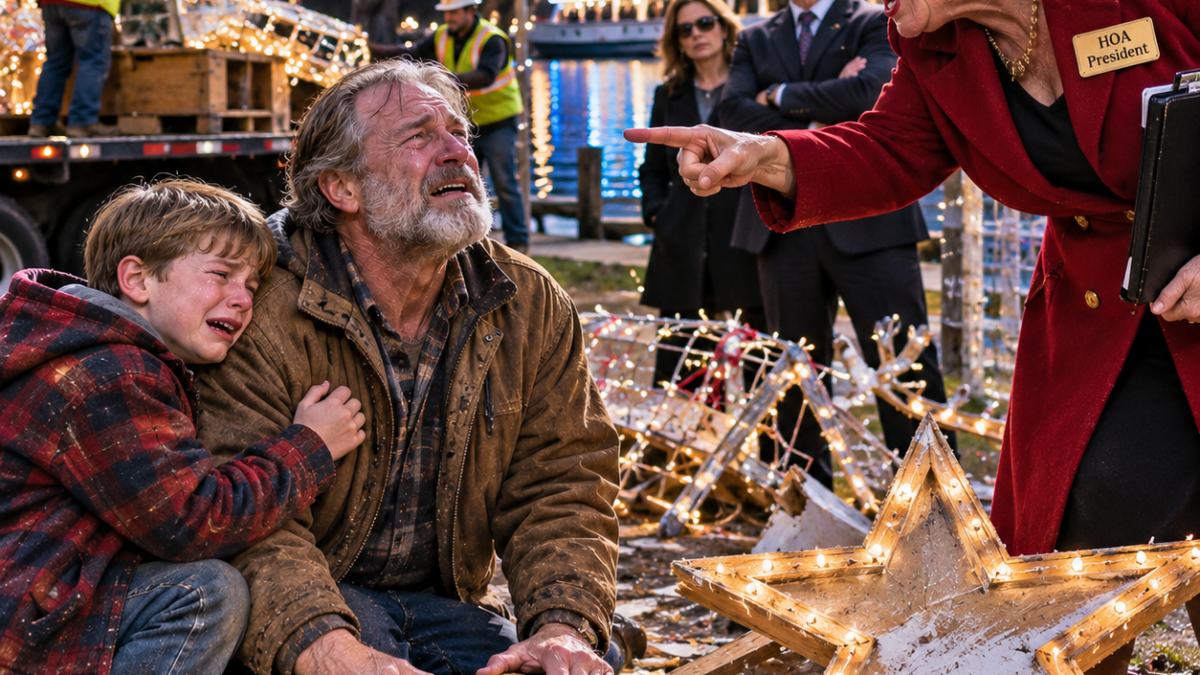
One held a drill.
The other was lifting the first arch from its ground sleeves.
My reindeer lay flat.
The crescent moon had been removed.
Blue lights dragged through the grass toward a trailer.
Then I saw the star.
Down from the dock.
Lying across the trailer bed.
“Put that down.”
My voice came out louder than I intended.
The man holding the arch froze.
“Are you Mr. Bennett?”
“Yes.”
I walked toward him.
“Put it down carefully.”
He lowered it.
The older worker approached holding paperwork.
“We were told this was ready for pickup.”
“By who?”
“Mrs. Price. Through our office.”
I looked at the trailer.
The moon had been placed underneath part of the train engine.
One of the wooden points had snapped.
The break exposed pale wood where June’s paint had once covered the edge.
My pulse hammered.
For half a second, I wanted to grab the paperwork out of his hand.
I wanted to yell.
Then I saw the men watching me.
They didn’t look smug.
They looked confused.
If I started screaming, they would stop listening.
So I forced my voice down.
“Don’t load anything else.”
The older worker nodded.
“Okay.”
“Please.”
His name was Joel.
He called Wade, the contractor from the meeting, and put him on speaker.
Wade sounded genuinely surprised.
“Evelyn said you came around after the meeting.”
“You heard me say no.”
“I did.”
“She told you I changed my mind?”
“Yes.”
“Ask her to show you where.”
Joel handed me the work order.
My name was typed beneath the address.
OWNER APPROVED HOLIDAY DISPLAY RELOCATION
No signature.
No attached email.
Nothing from me.
I photographed it.
Then the trailer.
The broken moon.
The empty sleeves in the ground.
The tire tracks.
Joel helped me unload the train engine.
When we lifted it, I saw where a strap had crushed part of the thin plywood roof.
He looked away.
“Some of this wood was already brittle.”
“Some of it was.”
I touched the damaged roof.
“That’s why it wasn’t supposed to go anywhere.”
He didn’t argue.
Then he told me something worse.
They had already taken one load to the marina.
The tall star.
Two reindeer.
Several small figures.
Boxes of lights.
Metal bases.
I felt sick.
“Bring them back.”
Wade answered from the phone.
“The first load was left inside the marina’s locked storage yard. I need to coordinate access.”
“No.”
My voice rose.
Then I stopped myself again.
“Give me a written list of everything your crew moved.”
“I can do that.”
“And preserve every message Evelyn sent you.”
A pause.
“I will.”
Then I called her.
Evelyn answered almost immediately.
“I understand there’s been some confusion.”
“There are broken pieces in my yard.”
“The crew was supposed to handle them carefully.”
“You weren’t supposed to send a crew.”
She exhaled.
“Russell, we offered you a reasonable way to keep your display involved.”
“Involved in what?”
“The Christmas program.”
“Bring my things back.”
“We need to discuss the costs you’re creating.”
That was when I hung up.
Not because I had nothing to say.
Because I had too much.
I knew if I stayed on the phone another thirty seconds, anger would make decisions for me.
For the next hour, I worked slowly.
I carried the broken moon into the workshop.
Put loose screws into an old coffee can.
Stacked damaged wiring on the bench.
Then I found Owen’s shepherd.
Face down.
Near a tire mark.
The sleeve he had painted blue two days earlier was scraped almost completely to bare wood.
That was when my hands began shaking.
Not when I saw the broken moon.
Not when I heard the star was gone.
The shepherd.
Because Owen had held that little figure at my kitchen table and worried that his blue didn’t match June’s.
I sat on the workshop step.
For four years, I had found ways to live around June’s absence.
Different coffee.
Different side of the bed.
Different silence in the house.
But every December, I could still touch something her hands had touched.
That display was the one place where memory had physical weight.
And now somebody had decided it was movable inventory.
I called my daughter Beth.
“Dad?”
“Don’t bring Owen over after school.”
Her voice sharpened.
“Are you hurt?”
“No.”
“Then what happened?”
I tried to explain the train.
Couldn’t.
Beth waited.
She didn’t fill the silence.
Finally, I told her.
Everything.
She offered to come.
Instead, I asked her to find the photographs she had taken the previous weekend and send me the originals.
I needed evidence of what the display looked like before the contractor arrived.
Having a task helped both of us.
Ruth showed up around four.
She carried the flyer.
I nearly told her I had enough paper for one day.
Then I saw the front.
A photograph of my dock.
Taken the previous Christmas.
June’s star glowing over the water.
Underneath, in large gold letters:
BENNETT CHRISTMAS COVE CRUISE
Then:
A SPECIAL SHORELINE LIGHT SHOW HOSTED BY RUSSELL BENNETT
Tickets:
$75 per person.
I stared.
Ruth touched the edge of the flyer.
“Frank bought ours last week.”
I looked at her.
“Why?”
“He thought it helped you keep doing the display.”
Until that moment, I had believed Evelyn wanted my decorations moved because she wanted control of the HOA event.
Now I understood something else.
She had already sold my Christmas.
My name.
My dock.
My lights.
My late wife’s work.
To strangers.
“How much did you pay?”
“Two tickets. A hundred and fifty dollars.”
“Did any of that money come to me?”
She already knew the answer.
“No.”
Her face changed.
She had arrived worried about my broken decorations.
Now she was realizing that she and Frank had paid for something I had never agreed to sell.
“I’m sorry.”
“Don’t be.”
I took a photograph of the flyer.
“You paid for what somebody promised you.”
Ruth opened the QR code.
The ticket page was still live.
There was my name again.
A promise of a special light show.
Even a line about meeting the man behind the display.
I had never agreed to meet anybody.
Ruth opened her receipt.
Payment recipient:
ASHEWOOD LANDING HOMEOWNERS ASSOCIATION
Not the boat company.
Not me.
I wrote down the event email address.
Then helped her send a short refund request.
Nothing angry.
Nothing dramatic.
The advertised Bennett display has been removed, and Mr. Bennett has confirmed he never agreed to host the event. We are requesting a refund for two tickets.
I thought that would be the simple part.
It wasn’t.
After Ruth left, I opened the ticket page on my desktop computer.
Saved a copy.
Photographed the screen.
Printed it.
Machines had taught me something over forty years.
Document the problem before anybody changes the settings.
The page listed two cruises for Saturday evening.
The boat would leave from the HOA marina.
Circle the cove.
Pause beside my dock.
Return.
My property was the main attraction.
I called Caleb again.
This time, I read the exact words from the advertisement.
He went silent.
“They told me you were supplying the shore display.”
“They tore it down today.”
“What?”
I explained.
He asked whether anybody had been hurt.
“No.”
“Thank God.”
Then I asked him a question.
“What were you told I was supposed to do during the cruise?”
“I have a route sheet.”
“Can you send it to me?”
There was hesitation.
Then he said yes.
The email arrived that evening.
I opened the attachment.
The route sheet instructed the captain to slow beside my dock for ten minutes.
Beside that line:
Bennett light sequence begins on host signal.
My name.
My home phone number.
I stared at it for a long time.
Evelyn hadn’t merely advertised my lights.
She had planned a performance around me.
A performance I had never agreed to perform.
I sent Caleb a written notice.
I was not a host.
I was not a partner.
I had received no ticket revenue.
The display had been damaged and would not be available Saturday.
I copied Evelyn.
Amelia.
Paul.
Denise.
Then I called the sheriff’s non-emergency number.
A deputy arrived the following morning.
He looked at the broken moon.
The crushed train roof.
The photographs.
The contractor paperwork.
He took notes.
He didn’t promise handcuffs.
Didn’t tell me everything would be solved by lunch.
“Make a full list.”
“I will.”
“Keep every damaged piece.”
“I will.”
“Don’t throw anything away.”
“I won’t.”
I asked whether I could go into the HOA marina yard and take back the missing figures.
He shook his head.
“Arrange access.”
“They’re mine.”
“I understand. But don’t solve one unauthorized-entry problem by creating another.”
I didn’t like the answer.
But it made sense.
At ten, Wade arrived.
Alone.
He carried a folder and one wooden antler.
He placed it on my workbench.
“Joel found this in the trailer.”
I picked it up.
One of June’s reindeer.
“I should have called you before sending the crew.”
“Yes.”
“I took Evelyn’s word for it.”
“Yes.”
He rubbed his palms together.
Then opened the folder.
A complete list.
Star.
Two reindeer.
Six small figures.
Three boxes of lights.
Metal bases.
The inventory helped.
At least now I knew what was missing.
Then Wade showed me the work order.
It had two stages.
COLLECT BENNETT DISPLAY
INSTALL BENNETT DISPLAY AT MARINA HOLIDAY VILLAGE
Evelyn hadn’t intended to store my decorations.
She intended to relocate Christmas itself.
“What did she tell you after the meeting?”
Wade opened his phone.
A message from Evelyn.
Russell has accepted the move in place of the review payment. He will be out Monday morning. Please finish collection before he returns.
I read it twice.
“She knew I’d be gone.”
“I guess so.”
“She told you to do it before I came home.”
Wade said nothing.
“Send me that.”
He nodded.
“And keep everything else.”
“I will.”
Then he looked at the broken train.
“I’ve told her we’re not installing anything else until ownership is sorted.”
“Ownership isn’t what needs sorting.”
He looked at me.
“I know that now.”
He gave me his insurance information.
I put it in the folder.
I didn’t treat it as a promise.
I wanted repair estimates before money.
Paper before argument.
Amelia called that afternoon.
Her voice sounded different.
Less official.
More tired.
“I saw your pictures.”
“Have you seen the work order?”
“No.”
I emailed it while we were on the phone.
I heard pages shifting after she opened the attachment.
“The board approved the boat rental,” she said. “Refreshments. Promotion. General holiday setup.”
“Did you approve removal of my display?”
“No.”
“Did the board?”
“No.”
“Then who paid Wade?”
“The association paid a deposit.”
“Authorized by who?”
Silence.
Then:
“Evelyn.”
I sat back.
Amelia explained that the HOA had been trying to raise money for repairs to the marina’s floating dock.
Evelyn had proposed holiday cruises instead of another homeowner assessment.
That explained the event.
It did not excuse my yard.
“She needs to stop selling tickets.”
“I’ve requested a board call tonight.”
“Make sure my refusal email is included.”
“It will be.”
There was strain in her voice.
“Are you okay?”
Another silence.
“I should’ve asked more questions at the planning meeting.”
“You did ask.”
“Not enough.”
I understood that feeling.
For the rest of the day, I built a damage list.
Bent metal base.
Cut wiring.
Crushed plywood roof.
Broken moon point.
Scraped paint.
Missing antler.
The mechanical damage was simple.
Money could describe it.
June’s brush marks were harder.
I refused to put a price on memory.
So I wrote:
repair existing painted face if possible
Not:
replace decoration
Beth came over with printed photographs.
Owen stood beside the shepherd in one picture, showing off the blue sleeve.
She saw the damaged figure.
Turned the photograph face-down.
“Don’t.”
She looked at me.
“Leave it.”
She turned it back over.
We matched pictures to the inventory.
Numbered each image.
Measured damage.
By the time Beth left, the workbench looked less like wreckage.
More like evidence.
That helped.
At eight, Amelia called.
“The board voted to remove your name from the advertising and arrange return of your property.”
“And cancel the cruises?”
“No.”
“Why?”
“Evelyn says the marina lights will be enough.”
“She sold tickets using my dock.”
“I know.”
“Tell people the main display is gone and let them decide.”
“I said that.”
“What happened?”
“They agreed to send an updated notice.”
I opened the ticket website after we hung up.
My name had disappeared.
The photograph of my dock remained.
The language now read:
HOLIDAY LIGHTS AROUND THE LAKE
I saved that version too.
Wednesday morning, Ruth brought me the response to her refund request.
I read it.
Decorations subject to change. Tickets nonrefundable. Cruise will proceed as scheduled.
Frank had seen it.
“He thinks maybe he misunderstood the flyer.”
That bothered me more than Evelyn’s original bill.
“Tell him he didn’t.”
“He doesn’t want to fight.”
“He doesn’t need to.”
I folded the refund denial and handed it back.
“He just needs to keep the original flyer beside this.”
That afternoon, I went to the marina.
Amelia had arranged access to the storage yard.
Behind the chain-link fence stood my two reindeer.
One missing an antler.
The other with an orange tag tied around its neck.
Dennis, the HOA maintenance supervisor, met me.
He looked uncomfortable.
“I was told you need to sign this first.”
He handed me a release.
The top half listed my property.
Fine.
The bottom contained a sentence:
Owner accepts all returned items in good condition and considers matter fully resolved.
I looked through the fence.
At the reindeer missing its antler.
“That one isn’t in good condition.”
Dennis rubbed the back of his neck.
“I didn’t write the form.”
“I know.”
I crossed out the sentence.
Wrote:
Items received subject to documented damage claim.
Initialed it.
Dennis called Evelyn.
He turned away, but her voice carried.
When he returned, he wouldn’t open the gate.
“She says the form can’t be changed.”
I stared through the fence.
June’s painted faces were ten feet away.
I could have signed.
For five seconds, I almost did.
Just get them home.
Deal with everything later.
Then I thought about Evelyn’s advertisement.
Wade’s work order.
The sentence claiming I had agreed.
Every step depended on somebody putting words in my mouth.
I wasn’t signing another sentence that wasn’t true.
I photographed the release.
Then left empty-handed.
That afternoon hurt.
More than the contractor truck.
Because my things were right there.
And I had walked away from them.
Beth found me sitting at the kitchen table.
“You should talk to somebody.”
“Who?”
“A lawyer.”
“I don’t want a lawsuit.”
“I didn’t say lawsuit.”
She pointed at the paper.
“I said stop guessing.”
The next morning, I paid for one hour with Grace Miller.
Local attorney.
Small office above a pharmacy.
She read everything.
The property map.
Emails.
Work order.
Refund flyer.
Release.
Then she said something that helped more than I expected.
“Separate the problems.”
“What?”
“The guests bought tickets. That’s their issue with the association.”
She pointed at my photographs.
“Your property was entered and moved. That’s yours.”
Another page.
“The contractor relied on instructions. His responsibility gets handled separately.”
Then the advertising.
“Use of your name is another issue.”
She looked at me.
“You don’t have to solve all of them at once.”
For the first time all week, the mess felt smaller.
Not easy.
Smaller.
Grace drafted a short written demand.
Return my property.
No condition falsely stating it was undamaged.
Preserve all records.
Stop using my name.
I sent it.
By Friday, Amelia secured another pickup time for Saturday afternoon.
Dennis would open the yard.
Wade would bring his trailer.
No release.
Just an inventory receipt.
Saturday morning, Wade called.
A repair job had run late.
He wouldn’t reach the marina until after four.
“I’ll start with the smaller pieces.”
I loaded blankets into my truck.
Then Owen’s little red wagon.
Its wheels were low enough to carry light boxes without repeated lifting.
When I reached the marina, people were already waiting near the boarding gate.
First cruise.
Winter coats.
Tickets.
Caleb checked names.
I stayed away.
I had come for my property.
Dennis met me.
“I need to show you something.”
He led me around the boat shed.
Large open dumpster.
Service lane.
My star was inside.
One wooden point rose above the rim wrapped in blue lights.
I stopped breathing for a second.
Painted figures lay underneath broken boards.
One reindeer was wedged against the metal wall.
I looked at Dennis.
“Who did this?”
He held out a work sheet.
Dated that morning.
CLEAR DAMAGED BENNETT DISPLAY BEFORE GUEST BOARDING
DISPOSE OF UNUSABLE MATERIAL
Signed:
EVELYN PRICE
Beyond the dumpster, the first cruise was pulling away.
Passengers waved from the boat.
I looked back at the star.
Nineteen Christmases.
June’s handwriting on the back.
And somebody had put it in a dumpster so paying guests wouldn’t see what had happened.
“When does this get emptied?”
“Six.”
I set Owen’s wagon beside the dumpster.
“Find me a ladder.”
Dennis hesitated.
“I could lose my job.”
“You don’t have to climb in.”
He looked toward the lake.
Then the dumpster.
Then went for the ladder.
Before touching anything, I photographed the entire scene.
Wide shot.
Dumpster location.
Star.
Reindeer.
Disposal order.
Then I put on gloves.
The star was trapped under a folding display stand.
I shifted the stand.
Lifted one edge.
Stopped.
A light cord had twisted around the reindeer below.
Dennis opened the side door.
Loosened it.
Together, we eased the star onto a blanket.
A crack ran through one point.
June’s painted dots still circled the edge.
I turned it over.
Dirt covered the back.
I brushed it with my thumb.
Her handwriting appeared.
Top faces the house when stored.
I had forgotten that note.
Because I always stored the star backward.
She used to laugh at me every year.
“Russell, how can a man repair a furnace blindfolded and still put the same wooden star away upside down?”
I sat on the edge of the wagon.
Couldn’t speak.
Dennis pretended to inspect the ladder.
That kindness almost made it worse.
I called Amelia.
“Russell?”
“My decorations are in the marina dumpster.”
Silence.
“The board ordered them returned.”
“Somebody ordered them thrown away this morning.”
“Send me a picture.”
I did.
Then another.
She swore quietly.
I had never heard Amelia swear.
“Stay there.”
“I’m not leaving.”
“I’m coming.”
I called the waste company.
The woman on the phone couldn’t cancel a pickup for someone who wasn’t the customer.
But after I explained that my property was inside the container, she agreed to flag the route and require the driver to speak to someone on site before lifting it.
Time.
That was all I needed.
Wade arrived a little after four.
He got out.
Saw the star on the blanket.
Stopped.
“We didn’t do this.”
“I know.”
“Russell—”
“Help me get them out.”
He removed his coat.
Went to work.
We opened the side door.
Recovered both reindeer.
Six small figures.
Two boxes of lights.
One sheep had lost a foot.
The wooden faces were scratched.
A light strand had twisted around a stand so tightly Wade cut the cheap plastic tie instead of pulling the wire.
For once, nobody rushed.
Nobody said Christmas event schedule.
Nobody said community needs.
Nobody said cost.
We handled each object like it mattered.
Because to me, it did.
Dennis unlocked the storage yard and brought out the third light box and metal bases.
We checked everything against Joel’s list.
I wrote damaged beside several items.
Dennis signed the inventory.
No one asked me to pretend things were fine.
Amelia arrived while we were loading the first reindeer.
She read the disposal order.
“Dennis, make me a copy.”
He hesitated.
“I’m asking as treasurer.”
He went to the office.
Amelia stood beside Owen’s wagon.
“I’m sorry.”
I looked at her.
She didn’t add excuses.
No speech about misunderstanding.
No claim that everyone meant well.
Just:
“I’m sorry.”
Then she took out her phone.
“Let me make sure the waste truck doesn’t come until we’re done.”
That was an apology I could use.
The first cruise returned before we finished.
The boat rounded the bend.
Cabin lights reflected across the darkening water.
Passengers crowded the windows.
I heard no music.
Only the engine.
Water against the dock.
The gate opened.
A woman in a green coat stepped through holding a ticket.
Then she saw the star across Owen’s wagon.
She stopped.
Her eyes moved from the photograph on the ticket to the broken wooden point.
“Is that from the display?”
“Yes.”
“Why is it here?”
Before I could answer, Evelyn came down the path.
“Please keep the exit clear.”
The woman lifted the star slightly to inspect it.
I supported the other side.
Behind her, a man said:
“We want our money back.”
Another raised his phone.
“So do we.”
Evelyn’s face tightened.
The woman looked toward the dumpster.
“Why were these decorations in there?”
Evelyn reached for the star.
The woman pulled it away.
“Don’t.”
That one word stopped her.
Then Evelyn pointed at me.
“He agreed to provide the display and backed out.”
The woman turned her ticket over.
My name was printed there.
YOUR CHRISTMAS HOST — RUSSELL BENNETT
I lowered the wagon handle.
“Would you show me where you bought that?”
“The association newsletter.”
“When?”
“Last Sunday.”
“Keep it.”
“I intend to.”
Her name was Patricia.
She had brought her sister and two friends.
Driven more than an hour.
Evelyn stepped forward.
“Everyone received a lovely boat ride.”
Patricia looked at the star.
“You seem to have removed the thing we paid to see.”
“We cannot control individual homeowners.”
Patricia’s eyebrows lifted.
“You controlled his decorations enough to put them in your dumpster.”
More passengers gathered.
I didn’t want thirty angry people blocking the dock.
“Take your questions up near the clubhouse.”
Patricia nodded.
“Let everyone get off safely.”
Caleb stepped ashore last.
He looked tired.
And angry.
He went straight to Evelyn.
“I’m not running the second cruise unless the waiting group is clearly told the Bennett display is gone.”
“They were notified the route might change.”
“The route didn’t change.”
He pointed across the water.
“The attraction disappeared.”
“They’re still getting a boat ride.”
“That’s not what you sold me either.”
Amelia walked toward the second group.
Evelyn grabbed her arm lightly.
“You cannot announce changes without board approval.”
Amelia looked down at Evelyn’s hand.
Evelyn removed it.
Then Amelia raised her voice.
“The Bennett display is not available tonight. Mr. Bennett did not agree to host this event. Please do not board until we explain your options.”
People immediately started asking questions.
Refunds.
Partial refunds.
Rescheduling.
Some couples said they would still take a cheaper boat ride.
Parents with children wanted to leave.
That was reasonable.
Choice.
The exact thing Evelyn had denied everyone.
Patricia returned while we loaded the star.
“Can I photograph the disposal order?”
I asked Dennis.
He nodded.
Patricia took a picture.
Then sent me her original booking email.
My dock.
My name.
Special light show.
Host appearance.
There was no way to erase what people had received by editing the website later.
Then Ruth and Frank arrived.
Frank moved slowly with his walker.
Ruth carried their tickets in a clear plastic sleeve.
She saw the trailer.
Stopped.
“Oh, Russell.”
“We got most of it back.”
Frank looked at the star.
He didn’t say:
Christmas is ruined.
He didn’t curse Evelyn.
He asked one thing.
“Can you fix it?”
I looked at the crack.
“I think so.”
He nodded.
“Then I can hold a paintbrush.”
That was the first time I smiled all day.
Ruth showed Amelia the written refund denial.
The email mattered because Evelyn had started telling people anyone unhappy with changes should have contacted the HOA earlier.
Ruth had.
Monday.
Amelia photographed the denial.
Then Paul and Denise arrived.
The board members.
We moved inside.
Evelyn sat at a long clubhouse table.
Amelia across from her.
Paul.
Denise.
Patricia and several passengers stood near the door.
Beth arrived with my blue folder.
Evelyn spoke first.
“Before we spend association money, everyone needs to understand that Russell withdrew his support.”
Paul looked at me.
“Did you agree to provide the show?”
“No.”
Evelyn slid an email across the table.
“He gave permission for the boat to use his display.”
I recognized the line.
You can take your boat past my lights like anybody else.
Highlighted.
Beth opened the full email.
Placed it beside Evelyn’s copy.
Paul read the next lines.
I am not joining your event. Do not move anything or use my name as a partner.
Silence.
Wade put his phone on the table.
“You need to read what she sent me.”
Evelyn reached for it.
He pulled it back.
“No.”
The room changed.
He opened the message.
Russell has accepted the move in place of the review payment. He will be out Monday morning. Please finish collection before he returns.
Amelia stared at Evelyn.
“You had his refusal.”
No answer.
“You told the contractor he agreed.”
Evelyn pushed her chair back.
“I am still president of this association.”
Denise placed the disposal order on the table.
“Then you need to answer for what you authorized.”
“I was trying to save the event.”
Denise looked at the paper.
“Which part of throwing his property away saved it?”
“They were damaged.”
I spoke.
“After you ordered them moved.”
Evelyn turned toward me.
Paul raised a hand.
“Stop.”
He looked around.
“We’re doing this in order.”
So we did.
The $600 fee.
My rejection.
Property map.
Planning meeting.
Amelia confirmed I said no.
Written refusal.
Wade’s work order.
Message claiming I changed my mind.
Contractor entry.
Damage.
Ticket flyer.
Route sheet.
Refund request.
Refund denial.
Marina return form.
Disposal order.
Revised cruise sheet.
Each item had a date.
Each date pointed in the same direction.
Nobody needed a speech.
At the end, Paul asked:
“Do you have any message from Russell agreeing to relocate the display?”
Evelyn pointed at the boat email.
“That gives permission to use the display.”
Paul shook his head.
“To look at it from the water.”
He waited.
“Do you have anything else?”
She didn’t.
Patricia stepped forward.
“I would like to know when we get our money back.”
Evelyn immediately started talking about boat-rental costs.
Refreshments.
Advertising.
Staffing.
Patricia let her finish.
Then said:
“I understand you spent money.”
A pause.
“You spent it after promising something you didn’t have.”
That was the sentence that finally made Evelyn look away.
Amelia asked passengers to leave booking information.
“The board needs to approve refunds properly.”
Evelyn snapped:
“I will not agree.”
Denise looked at her.
“There are three directors here besides you.”
Paul pulled out the bylaws.
“We’ll follow the voting procedure.”
That mattered to me.
After a week dealing with a woman who treated wanting something as the same thing as having authority, I watched the rest of the board stop and check the rules before acting.
They called Caleb inside.
Asked what canceling the second cruise would cost.
“I’ll waive the trip charge,” he said. “But crew time still has to be paid.”
“Fair,” Amelia answered.
The second cruise was canceled.
The first group’s full-refund request was put to a vote.
Then the second group.
Approved.
Evelyn voted no.
Three voted yes.
Next, Denise proposed suspending Evelyn’s ability to direct holiday contractors or authorize further event spending pending a formal review.
Again, they checked procedure.
Then voted.
Passed.
Evelyn stood.
“You’ll regret making this personal.”
I almost let it go.
I was exhausted.
Then I looked through the window.
My star lay beneath a blanket on Wade’s trailer.
“It became personal when your truck entered my yard.”
She stared.
I tapped the folder.
“These papers are how I’m keeping it fair.”
She left.
Nobody applauded.
I was glad.
My Christmas display was still broken.
My grandson still hadn’t seen it.
No vote repaired June’s paint.
Before leaving, I asked Amelia for written confirmation that I had never agreed to host the cruise and had received none of the ticket money.
She added it to the minutes.
I also requested removal of every photograph of my dock from HOA advertising.
“Tonight,” she said.
Wade followed me home.
Beth followed behind.
We unloaded under the workshop lights.
Reindeer against the wall.
Small figures on the bench.
Star on two padded stands.
Wade stayed after the trailer was empty.
“I’m reporting everything to my insurer.”
I nodded.
“Including that I didn’t call you first.”
“Thank you.”
“I want to help repair what I can.”
“First we document everything.”
He smiled faintly.
“Paper first.”
“Paper first.”
After he left, Beth picked up Owen’s shepherd.
The sleeve was still scraped.
“He knows something happened.”
I said nothing.
“I can’t keep telling him Grandpa’s busy.”
“You don’t have to.”
She watched me.
“Are you ready for him to see this?”
“No.”
I looked around the workshop.
“But bring him tomorrow.”
Owen arrived carrying his paint box.
He entered slowly.
Didn’t ask why everything was inside.
Beth had prepared him.
He looked at the train.
Moon.
Reindeer.
Star.
Then found his shepherd.
Picked it up.
“Can I paint it again?”
“Yes.”
“Will it still count as Grandma’s if we fix it?”
That question hit me harder than anything Evelyn had said.
I pulled a stool beside him.
“She fixed these every year.”
He turned the shepherd over.
There were four different types of screws in the base.
I pointed.
“See that?”
He nodded.
“Your grandmother kept repairing them.”
He looked at the blue sleeve.
“So fixing it doesn’t make it not hers?”
“No.”
“It means we’re still taking care of it.”
That seemed to settle something.
He opened his paint.
I mixed glue for the moon.
We didn’t try to restore Christmas that day.
We fixed what was in front of us.
One thing at a time.
On Monday, Grace helped me prepare a written claim.
Repair costs.
Recovery expenses.
Legal consultation.
Documented damage.
No emotional multiplication.
No made-up value.
No attempt to become rich.
Two local repair shops gave estimates.
One handled metal.
One specialized in painted wood and signs.
The sign-shop owner studied June’s star.
“We can save the front.”
“What about the backing?”
“Replace it.”
“The painted face stays?”
“Yes.”
“Put that in writing.”
He looked at me.
“I will.”
Meanwhile, Amelia sent the ticket records.
Sixty-eight tickets.
Seventy-five dollars each.
$5,100.
I sat at my kitchen table staring at the total.
Sixty-eight people had paid because they believed they were coming to see something I had created with June.
Some probably thought the money supported the display.
None reached me.
Within a week, Ruth called.
“Refund came.”
Patricia sent me a photograph of hers.
Eventually, Amelia confirmed every ticket had been refunded.
The HOA also sent buyers a written correction.
Russell Bennett had not agreed to host the event.
He received none of the ticket revenue.
He had not caused the advertised display to be canceled.
I printed that message.
Put it beside the original flyer.
At the next properly noticed HOA meeting, Evelyn Price was removed as president.
Not dragged away.
Not publicly destroyed.
Not magically bankrupted.
Removed by the board under its procedures after the records were reviewed.
The $600 bill was canceled in writing.
The association formally acknowledged my land was outside HOA jurisdiction.
No right to enter.
No right to move property.
No right to use my name or display for events without written permission.
Wade’s insurer handled damage caused during the initial removal.
The HOA covered additional damage from the disposal order, plus reasonable recovery and legal expenses.
The final written settlement came to $6,240.
Not a jackpot.
Not revenge.
It paid the people who straightened frames.
Repaired wood.
Rewired lights.
Rebuilt bases.
Helped me recover what had been damaged.
Grace made certain the same loss wasn’t paid twice.
And the agreement contained the sentence I cared about most.
No future use of the Bennett property, name, likeness of the shoreline display, or display materials without Russell Bennett’s prior written consent.
When the money cleared, I finally removed the blue folder from the kitchen table.
For weeks, every meal had been eaten beside pictures of broken things.
I put the folder into a drawer.
Wiped the table clean.
Made coffee.
And for one evening, did not open my email.
We could not restore the full display before Christmas.
The train needed too much work.
Two metal bases needed rebuilding.
Some wiring was unsafe.
For a day, that felt like defeat.
Then I realized I was still measuring Christmas against Evelyn’s schedule.
Her gala.
Her cruise.
Her deadline.
Enough.
So we made the display smaller.
Moon over the workshop.
Owen’s shepherd near the sheep.
One repaired reindeer beside the driveway.
Frank came over on a dry afternoon.
I set a table where he could sit beside his walker.
He painted a replacement wooden foot for the sheep.
His first coat ran.
I looked at it.
“June would make you sand that.”
Frank didn’t look up.
“Then don’t tell her.”
Ruth laughed so hard she had to set down her coffee.
Wade returned when the star was ready.
Before stepping across the flower bed, he stopped.
“Where do you want my boots?”
I pointed.
“There.”
He nodded.
Took his time.
Lifted the repaired star with me.
The new backing was strong.
The old painted face remained.
We secured it.
Wade stepped back.
“That right?”
I looked.
The crack across one point was still faintly visible.
June’s dots remained.
“Yes.”
“That’s right.”
Wade had made a serious mistake.
He had trusted Evelyn instead of calling me.
But when the truth became clear, he admitted it.
Preserved the messages.
Helped recover my property.
Worked with his insurer.
Helped repair what he could.
I could live beside a man who made a mistake and told the truth about it.
Before Christmas Eve, we put out one final piece.
A wooden sign June had painted years earlier.
Nothing elaborate.
It read:
MERRY CHRISTMAS FROM OUR HOME TO YOURS
No sponsor.
No ticket price.
No logo.
No host package.
Christmas Eve arrived clear and cold.
Beth brought Owen before dark.
Ruth and Frank joined us.
I moved the bench to the flat part of the driveway so Frank could see the shoreline without walking downhill.
Owen stood beside the switch.
“Ready?”
I looked toward the dock.
The star stood above it.
A faint repair line crossed one point.
You could see it if you knew where to look.
I did.
But the painted dots were still there.
June’s handwriting remained safe on the back.
The old face had survived.
“Ready.”
Owen flipped the switch.
The shepherd’s sleeve glowed bright blue beneath the lights.
The moon lit above the workshop.
The repaired reindeer stood near the driveway.
Out by the water, the star came alive.
Its yellow reflection stretched across the cove.
Long.
Quiet.
Warm.
A small boat appeared near the mouth of the inlet.
It slowed.
Someone aboard waved.
I waved back.
They stopped for maybe a minute.
No ticket.
No announcement.
No promise.
No ten-minute show.
They simply saw lights along the shore and wanted to look.
Then the boat continued across the lake.
Owen slipped his hand into mine.
“Next year we fix the train.”
“Yes.”
“We make it exactly the same?”
I looked at the repaired star.
“No.”
He looked up.
“Why?”
“Because it was never exactly the same.”
I pointed toward the shepherd.
“You painted that sleeve.”
He looked at it.
“Frank painted the sheep’s foot.”
He nodded.
“Your mom helped with the wiring.”
Another nod.
“Your grandmother made these things so we could keep using them.”
He considered that.
“So it changes?”
“A little.”
“Is that okay?”
I squeezed his hand.
“Yes.”
We stood there watching the star.
For weeks, I had believed my fight with Evelyn was about property.
Technically, it was.
She had no right to enter my yard.
No right to move the display.
No right to sell tickets using my name.
No right to dispose of my belongings.
But standing beside Owen on Christmas Eve, I finally understood why the whole thing had hurt so much.
Evelyn looked at June’s display and saw an attraction.
A thing that could sell tickets.
A thing that could move from one lawn to another.
A thing worth using if it helped repair the HOA marina.
I looked at that same display and saw nineteen winters.
June kneeling in the workshop with paint on her fingers.
Our daughter carrying extension cords when she was still in high school.
Neighbors stopping beside the fence.
Frank watching the train.
Owen repainting a shepherd with the wrong blue.
Memory made visible.
That was what Evelyn had never understood.
She thought ownership was about who could make the best use of something.
I had learned from June that value was sometimes exactly the opposite.
Some things deserved to exist without earning a dollar.
The following December, the train returned.
Owen helped rebuild the damaged roof.
We kept one crushed section underneath where nobody could see it.
His idea.
“Proof it happened.”
Frank painted another sheep.
Ruth brought coffee.
Beth replaced several electrical connectors.
Wade helped set the heavy arches.
That year, the HOA ran another holiday cruise.
Different board.
Different advertising.
Before they announced it, Amelia called me.
“We’d like permission for the boat to slow near the cove so passengers can look at your lights from the water.”
I smiled.
“You don’t need permission to look from the lake.”
“I know.”
She paused.
“I wanted to ask anyway.”
That mattered.
“No advertising my name.”
“Understood.”
“No ticket language promising a show.”
“Understood.”
“No moving anything.”
She laughed softly.
“Definitely understood.”
The boat passed twice that December.
People waved.
I waved back.
No one came onto my land.
No one sold my name.
No workers appeared in my driveway.
No bills arrived.
No one tried to improve June’s Christmas by taking it away from me.
One evening, I opened the storage drawer in the workshop and found the original $600 invoice.
I nearly threw it away.
Instead, I put it in the same folder as the old flyer.
Not because I wanted to keep anger alive.
Because I wanted Owen to understand something someday.
Authority often arrives on paper.
Invoices.
Notices.
Work orders.
Forms.
Official seals.
Evelyn had used paper to make false things look legitimate.
But paper had also protected me.
My property map.
My emails.
Wade’s messages.
Ticket receipts.
Board minutes.
The disposal order.
Photographs.
Repair estimates.
A written settlement.
The difference wasn’t the paper.
It was whether the words matched the truth.
That became the lesson I remembered most.
Not how to defeat an HOA president.
Not how to win money.
Not how to embarrass someone who abused authority.
How to slow down when anger tells you to explode.
The day I found the contractor taking apart the train, I wanted to shout.
Instead, I photographed the work order.
When my property sat behind the marina fence, I wanted to sign whatever they put in front of me.
Instead, I walked away and asked a lawyer.
When I found the star in the dumpster, I wanted to storm into the clubhouse.
Instead, I photographed the disposal instruction and recovered what I could.
Every time Evelyn pushed me toward an emotional mistake, the best response was the same.
Stop.
Document.
Protect the truth.
Months later, Amelia stopped by my driveway.
Not as treasurer.
Just as a neighbor.
The repaired star was still stored in the workshop.
She looked toward the dock.
“Do you hate us?”
“The HOA?”
She nodded.
“No.”
She seemed surprised.
“I thought you might.”
“I hated what Evelyn did.”
“That’s different?”
“Very.”
I leaned against the fence.
“Most of the people in Ashewood Landing didn’t know any of this was happening.”
“No.”
“You asked questions.”
“Too late.”
“But you asked.”
She looked toward the marina.
“We let one person make too many decisions.”
“That happens.”
“We should’ve caught it.”
“Yes.”
She accepted that.
No excuses.
Then she smiled.
“The new president is terrified of approving anything without three signatures.”
“Probably healthy for a while.”
She laughed.
Before leaving, she looked at the workshop.
“Will the star be back this year?”
“Yes.”
“Good.”
That December, Owen was ten.
He had grown enough to carry one end of the wooden train.
Not safely.
But he insisted.
We set it on the track.
Tested it.
One wheel caught at the same old joint.
I reached for the file.
Owen stopped me.
“I know.”
He took it.
Filed the edge.
Tested again.
Smooth.
I looked at him.
“What?”
“Nothing.”
“You’re smiling.”
“Your grandmother would’ve liked that.”
“Because I fixed it?”
“No.”
“Why?”
“Because you remembered where it always sticks.”
He grinned.
Then ran toward the workshop for another extension cord.
I stayed beside the track.
The lake was gray.
Cold.
Quiet.
For a moment, I could almost hear June behind me.
Russell, fix the angel’s nose before you put her out.
I turned.
There was no one there.
Just the display.
Owen.
Beth.
Ruth and Frank coming down the road.
The repaired star waiting beside the dock.
I no longer needed everything to stay exactly as June had left it.
That had been impossible from the day she died.
Wood cracks.
Paint fades.
Wires fail.
People grow.
Grandchildren repaint sleeves.
The important thing was that nobody else got to decide when those memories stopped belonging to us.
That Christmas Eve, we gathered again on the driveway.
No cruise passengers.
No board members.
No reporters.
No argument.
Frank sat on the bench.
Ruth wrapped a blanket over his knees.
Beth held coffee.
Owen stood beside the switch.
I looked out toward the water.
“Ready?”
This time, he didn’t ask me.
He knew.
He flipped the switch.
The train moved.
Slowly.
Through the first arch.
Then the second.
Then the third.
The reindeer lit.
The shepherd’s blue sleeve glowed.
The moon came on above the workshop.
Last came the star.
June’s star.
The crack remained faintly visible.
We never painted over it completely.
I had decided not to.
Not because I wanted to remember Evelyn.
Because the repair had become part of the object’s history.
June built it.
I maintained it.
Evelyn damaged it.
People helped save it.
Owen would someday inherit it.
The line in the wood held all of that.
A boat slowed near the cove.
Someone waved.
Owen waved back.
Frank lifted his coffee.
The boat moved on.
No one had promised those people anything.
No one had charged them.
No one had told them I was their host.
They had simply seen a warm yellow star over dark water on a cold December night.
And stopped long enough to enjoy it.
Owen took my hand.
“Grandpa?”
“Yeah?”
“Do you think Grandma can see it?”
I looked at the reflection stretching across the lake.
I had never been good at answering questions I couldn’t prove.
Maybe that was another thing paperwork had taught me.
Know what you know.
Be honest about what you don’t.
So I squeezed his hand.
“I don’t know.”
He nodded.
Then leaned against me.
“I think she can.”
I looked at the star.
“So do I.”
And we stood there together until the train made another slow trip beneath the arches, carrying nothing for sale, promising nothing to strangers, earning not one dollar.
Exactly the way June had intended.








