PART2:“THIS RANCH IS SOLD—GET OUT!” HOA Karen Put a Closing Sign on My Gate Christmas Eve—She Didn’t Know What My Uncle Left in the Safe
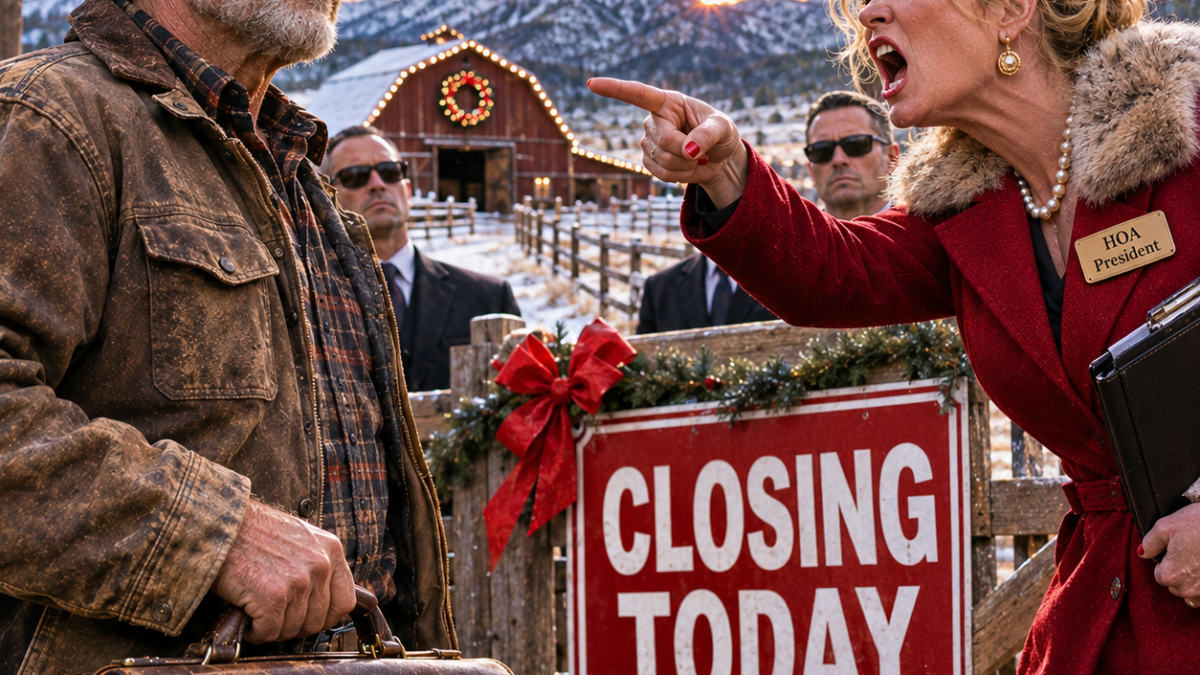
PART2
Blake looked from Karen to me.
I handed the clipboard back to him.
Karen folded her gloved hands.
“You’ve had months to cooperate.”
“Cooperate with what?”
“The association.”
“I’m not in your association.”
Her eyes tightened.
“You live inside the community.”
“No.”
“You live surrounded by it.”
“That doesn’t make me a member.”
Karen let out a tired little sigh, the same sound she always made when facts failed to obey her.
“Gideon, your property has been under enforcement for months.”
“Whose enforcement?”
“Elk Ridge.”
“You don’t have jurisdiction here.”
“We’ve been through this.”
“Yes.”
“And you were wrong every time.”
Blake shifted uncomfortably.
Karen ignored him.
She pointed toward my barn.
“Look at this place.”
I looked.
“She still standing?”
“That is exactly your problem.”
“What is?”
“You refuse to understand what this valley has become.”
Her voice grew sharper.
“Old fencing.”
“Livestock visible from premium residences.”
“An unpaved access road.”
“Outbuildings.”
“Utility lighting.”
“A chicken coop.”
I nearly laughed.
“You drove here in a blizzard to complain about chickens?”
“This isn’t funny.”
“No.”
I looked at the SOLD sign.
“That part isn’t.”
She stepped closer.
“Property values in Elk Ridge have tripled.”
“Good for Elk Ridge.”
“This valley is becoming one of the most desirable private communities in the state.”
“Still good for Elk Ridge.”
“And your ranch sits in the middle of everything like an abandoned agricultural lot.”
I stared at her.
That land had buried my childhood grief.
It had fed me.
Raised me.
Taught me to work.
Walt had built sections of the barn with his own hands.
And Karen called it an abandoned agricultural lot because the fence wasn’t decorative enough for somebody’s vacation home.
I said quietly:
“You really don’t understand what you’re looking at.”
She smiled.
“I understand exactly what I’m looking at.”
“No.”
“You understand what somebody might pay for it.”
Her expression changed.
Only slightly.
But enough.
That was when I realized money was sitting beneath all of this.
Not covenant enforcement.
Not property values.
Money.
Karen tilted her chin toward the sign.
“A developer has acquired the property.”
“I didn’t sell it.”
“You didn’t have to.”
That stopped me.
She continued.
“The association has authority arising from longstanding unpaid assessments, violations, legal enforcement rights, and seller authorization.”
“No, it doesn’t.”
“Your opinion is irrelevant now.”
“My deed isn’t.”
For half a second, she looked irritated.
Then she recovered.
“Gideon, this has gone beyond you.”
She said it almost gently.
“There will be cabins.”
“A grand lodge.”
“An ice rink.”
“Sleigh routes.”
“A full Christmas village.”
“People will travel here from all over the country.”
I looked toward my house.
“Where exactly do I go?”
“You’ll be compensated according to the transaction.”
“What transaction?”
“The sale.”
“I didn’t sell.”
Karen stepped close enough that I could smell her perfume through the cold air.
“I’m simply finishing something you can no longer afford to stop.”
Then she smiled.
Not triumphantly.
Worse.
Pityingly.
As if she truly believed she was explaining my own defeat to me.
She climbed back into her SUV and left.
Blake stood there another few seconds.
He no longer looked comfortable.
“I was told everything was authorized.”
“I believe you.”
He nodded toward the paperwork.
“You want a copy?”
“Yes.”
He gave it to me.
Then left too.
I stayed beside the gate until their taillights disappeared.
The sign remained.
PROPERTY SOLD.
Snow gathered on top of it.
I could have ripped it out.
I wanted to.
Instead, I drove to the barn.
Fed the horses.
Broke ice from the trough.
Put away the oats.
Then walked inside the house.
Because Walt taught me something Karen never understood.
When somebody tells you your fence is in the wrong place, you don’t scream.
You get the survey.
My uncle Walt bought Mercer Ranch in 1987.
Back then there was no Elk Ridge.
No stone entrance.
No gatehouse.
No million-dollar vacation homes.
Mostly hay fields, cattle, gravel roads, and creek water.
My parents died when I was young enough that I remember their voices more clearly than their faces.
Walt took me in.
He wasn’t the kind of man who talked much about feelings.
He showed love by fixing things.
He fixed breakfast.
Fixed broken fences.
Fixed my bicycle.
Fixed the bedroom window that rattled in winter.
And slowly, without either of us naming it, he helped fix me.
The ranch became the first place after my parents died where I stopped expecting everything I loved to disappear.
Walt taught me how to read weather.
How to judge hay.
How to reset a horseshoe.
How to rebuild a gate hinge.
And one lesson he repeated constantly:
“Read the paper before you sign it.”
At twelve, I thought he meant feed-store receipts.
At forty-two, I understood he meant life.
When Walt died, Mercer Ranch passed to me.
Free and clear.
Taxes current.
No mortgage.
No HOA.
That final part was deliberate.
Elk Ridge was formed in 2009.
Twenty-two years after Walt purchased the land.
When subdivision documents were drafted, Walt made sure Mercer Ranch remained outside the association.
He didn’t want community amenities.
Didn’t want architectural committees.
Didn’t want voting rights.
Didn’t want obligations.
He wanted his ranch.
The documents reflected it.
Karen knew.
That is important.
She did not make an innocent mistake.
She knew.
Karen became HOA president six years before the Christmas incident.
Before her, Elk Ridge was boring.
Two meetings a year.
Snow removal.
Shared landscaping.
Maybe arguments about streetlights.
Then Karen won the presidency.
Within twenty-four months, Elk Ridge had rules for things I did not know anybody cared about.
Fence heights.
Mailbox dimensions.
Approved planting species.
Contractor work hours.
Outdoor furniture placement.
Parking.
Holiday displays.
Exterior paint colors.
Eleven approved shades.
Every single one looked beige to me.
A retired couple got fined because their grandson left a basketball hoop in their driveway.
A family received three violation notices for a wind chime.
Karen called it:
“Preserving standards.”
Everyone else used less polite language when she wasn’t present.
The first time she came to my porch carrying HOA membership forms, she smiled like she was offering me insurance.
“We’re regularizing all properties in the immediate area.”
I leaned against the doorframe.
“Congratulations.”
She opened the binder.
“I’d like you to sign.”
“No.”
“You haven’t read it.”
“Don’t need to.”
“It would benefit you.”
“No.”
“You use association roads.”
“One of your roads crosses my land.”
That silenced her for about two seconds.
Then:
“We all live together.”
“Already doing that.”
I closed the door.
She returned months later with a map.
The new line she had drawn around Elk Ridge conveniently swallowed my ranch.
I looked at it.
Then at her.
“No.”
“You’re being difficult.”
“I’m being accurate.”
Karen hated accuracy when it arrived without permission.
Then the letters started.
First fine:
Fifty dollars.
Unpainted gate.
Next:
One hundred dollars.
Hay trailer visible from neighboring property.
Then:
Two hundred fifty.
“Unapproved agricultural structure.”
My chicken coop.
I kept every notice.
Mostly because throwing them away required more effort than dropping them into a drawer.
Then rules became even more specific.
No livestock visible from designated common areas.
No dirt driveway longer than one hundred feet.
No bright utility lighting.
No unapproved agricultural fencing.
At that point I began to wonder whether Karen kept binoculars in her kitchen.
At one HOA meeting, she finally said it publicly.
“Every property within the greater Elk Ridge community answers to this board.”
I stood in the back.
Hat in my hands.
Everybody turned toward me.
“Not mine.”
That was all.
Karen’s face nearly matched her lipstick.
But I had the records.
Everybody knew it.
Or should have.
That night after the SOLD sign appeared, I went into the back bedroom and pulled Walt’s old steel lockbox from beneath the bed.
Dented corner.
Scratched lid.
Latch polished from years of use.
I carried it to the kitchen.
Opened it.
Inside were the papers Karen apparently assumed I had forgotten.
Recorded deed.
County seal.
Original boundary documents.
Tax records.
Old survey.
Letters from Walt’s attorney.
The signed exemption confirming Mercer Ranch remained independent from Elk Ridge.
I spread everything across the kitchen table.
Then I emptied the drawer containing the HOA letters.
Nineteen envelopes.
The dates told their own story.
August.
September.
October.
November.
December.
Violation notices.
Assessment claims.
Retroactive dues.
Administrative charges.
Supposed debts dating back to the year Elk Ridge formed.
Total:
More than forty thousand dollars.
Every single invoice depended on one false premise.
That Mercer Ranch belonged to Elk Ridge.
It never had.
Then I noticed something else.
Several notices had been mailed to an old P.O. box I had closed years before.
That bothered me.
If Karen truly wanted me to receive legal notice, why send important letters to an address she knew was outdated?
Then the answer came.
Maybe delivery wasn’t the point.
Maybe the record of “sending” them was.
I looked at the clock.
After nine.
Then called a man I had not spoken with in almost three years.
Marlo Pierce.
Marlo was fifty-six and looked like somebody who had been born already tired of other people’s bad decisions.
Attorney.
Office above the hardware store.
Old friend of Walt’s.
He had handled Walt’s estate.
Recorded the transfer to me.
Reviewed the original Elk Ridge documents.
If anybody knew what Karen was trying to rewrite, it was Marlo.
He answered after several rings.
“Gideon?”
“Sorry about the hour.”
“What happened?”
I told him.
Sign.
Broker.
Karen.
Closing date.
Nineteen letters.
He did not interrupt.
When I finished, he asked:
“Did you touch the sign?”
“No.”
“Good.”
“Why?”
“If they’re actually attempting to transfer your land, this isn’t an HOA argument anymore.”
I looked through the kitchen window.
The sign was visible down by the road.
“What is it?”
Marlo paused.
“Potential fraud.”
The word changed the room.
“What do I do?”
“Nothing.”
I frowned.
“Nothing?”
“Don’t call Karen.”
“Don’t call the broker.”
“Don’t pull the sign.”
“Why?”
“Because people who believe they’ve won tend to become careless.”
A pause.
“Let them keep becoming careless.”
I looked down at Walt’s deed.
“All right.”
That was the beginning.
Not revenge.
Evidence.
At seven the next morning, I sat in Marlo’s office.
Cracked leather chair.
Radiator knocking.
Coffee powerful enough to dissolve metal.
He searched county records.
Parcel history.
Recent recordings.
Transfer instruments.
Then his hand stopped on the mouse.
“What?”
He leaned closer.
Scrolled.
Read something twice.
Then slowly removed his glasses.
“Gideon.”
“What?”
“Three weeks ago, somebody recorded a durable power of attorney relating to Mercer Ranch.”
I stared.
“What power of attorney?”
He turned the monitor.
There it was.
My name.
Karen Whitlock’s name.
Language supposedly giving her full authority to sell, transfer, convey, negotiate, and sign documents concerning Mercer Ranch.
Notary stamp.
County two hundred miles away.
My signature.
Almost.
The G was wrong.
Walt taught me a particular way to sign my name.
I had been doing it since high school.
Whoever forged that document had copied the letters but not the movement.
“I never signed that.”
“I know.”
“How?”
Marlo looked at me.
“Because I’d remember if you gave Karen Whitlock authority to sell your ranch.”
Fair.
Then he tapped the screen.
“This is how they’re doing it.”
“What?”
“They’re not claiming Elk Ridge owns the ranch.”
He leaned back.
“They created a recorded instrument making it appear you voluntarily appointed Karen as your legal agent.”
“So the broker sees this…”
“And assumes she can sign.”
“The buyer?”
“Same.”
I stared at the screen.
For the first time since seeing the SOLD sign, real anger arrived.
Not loud.
Cold.
Marlo watched me.
“Do not do anything stupid.”
“I’m not.”
“Good.”
I stood.
“I want to know who is buying my ranch.”
Northstar Development Group.
Denver.
Major resort developer.
Their planned Montana project already had a name.
NORTHSTAR CHRISTMAS ESTATE.
Two hundred luxury cabins.
Grand lodge.
Private skating rink.
Sleigh routes.
Holiday village.
High-end dining.
Projected final value:
More than $180 million.
Then Marlo found the renderings.
I stared at the screen.
My valley.
My ridge.
My creek.
My cottonwoods.
But Mercer Ranch had vanished.
My house replaced with a timber lodge.
The barn replaced with guest arrival landscaping.
The stable gone.
My field converted into a central plaza.
Architects in Denver had erased my home before anybody told me somebody was selling it.
That hurt more than the sign.
Because the sign was a lie somebody planted in snow.
The rendering showed how completely Karen expected me to disappear.
Two days later, Karen hosted a private presentation at the Elk Ridge clubhouse.
Northstar executives.
HOA leadership.
Investors.
I parked a quarter mile away and walked through snow.
The clubhouse glowed.
Huge Christmas tree.
Music.
Champagne.
Through a partially open patio door, I heard Karen speaking.
“The landowner has agreed to sell.”
I stopped.
“Everything is in order.”
Another voice answered.
Male.
Calm.
Preston Hail, Northstar’s vice president of acquisitions.
“And Mr. Mercer signed?”
Karen answered instantly.
“I hold full legal authority to represent him.”
No hesitation.
No uncertainty.
No misunderstanding.
I stood there long enough to hear exactly what I needed.
Then walked back to my truck.
Called Marlo.
“I need everything ready.”
“For litigation?”
I looked back at the clubhouse.
“No.”
Pause.
“Then what?”
“The closing.”
Marlo went silent.
Then:
“I’ll start tonight.”
Karen scheduled closing for Christmas Eve.
Smart.
County offices would close early.
Lawyers gone.
Banks on holiday hours.
Judges harder to reach.
If the transaction completed, money could move before I ever challenged it.
Undoing the mess might take months.
Maybe years.
She believed I was isolated.
In one way, she was right.
No wife.
No children.
Walt gone.
No wealthy family behind me.
Just the ranch.
But Karen confused being alone with having nobody.
She had not counted on Marlo Pierce.
The morning before closing, a courier arrived.
Elk Ridge envelope.
FINAL NOTICE.
Forty-eight hours to vacate.
The letter threatened court action, access restrictions, enforcement costs, and supposedly accumulated covenants.
I called Marlo.
“She sent me an eviction notice.”
He laughed once.
“She thinks this is over.”
“Apparently.”
“Town rumor says she’s already shopping for a condo in Scottsdale.”
I looked at the notice.
“Good.”
“Good?”
“Confidence makes people careless.”
Marlo chuckled.
“I’ve taught you too much.”
That night Karen held the Elk Ridge Christmas party.
Packed clubhouse.
Stone fireplace.
Twelve-foot tree.
I wasn’t there.
Later, Frank Delaney told me what happened.
Karen tapped a wineglass.
“Friends, I have an early Christmas gift.”
People quieted.
“Tomorrow, the last uncontrolled parcel in this valley will finally belong to us.”
Some people applauded.
Others didn’t.
Frank raised his hand.
“Karen, does Gideon know about this?”
“Of course.”
“I’ve known him fifteen years. I can’t imagine him selling.”
Ruth Ellison spoke from another table.
“Mercer Ranch was never part of Elk Ridge.”
Karen’s smile hardened.
“Gideon is a reasonable man.”
Then she added:
“And a reasonable man knows when he’s beaten.”
That sentence reached me later that night.
I was walking my north fence under hard stars.
Snow under my boots.
I touched posts I had installed with Walt when I was fifteen.
One still leaned slightly because Walt insisted it was straight and refused to reset it.
Another section had been rebuilt after an elk broke through.
Across the field stood the barn where I had worked beside him every summer.
Northstar valued the project at $180 million.
I didn’t care.
Price was not value.
I looked toward the house.
Crooked Christmas lights.
Small windows.
No giant dinner.
No children.
No presents stacked under a tree.
Just home.
Then I finally said aloud what had been bothering me.
“They don’t want land.”
The field gave no answer.
“They want to erase me from the only place I ever belonged.”
I went back inside.
In my bedroom closet sat another safe.
Walt’s combination.
I opened it.
Original deed.
Then a yellowed manila envelope beneath it.
Brittle tape.
His handwriting:
ORIGINAL SURVEY — 1987.
I called Marlo.
He arrived within an hour.
We opened it on my kitchen table.
Heavy linen survey.
Licensed surveyor stamp.
Measurements.
Bearings.
Boundary lines.
Marlo leaned over it for nearly twenty minutes.
Then his expression changed.
“Gideon.”
“What?”
He pointed.
“This line is Mercer Ranch.”
Then another.
“This is Elk Ridge’s original plat.”
I leaned closer.
A clean gap separated them.
Marlo tapped the survey.
“Your entire ranch lies outside the HOA.”
“I know.”
“No.”
He looked at me.
“I mean entirely.”
“Not one overlapping corner.”
“Not one disputed strip.”
“Not one shared parcel.”
“Nothing.”
He sat back.
“Every HOA claim Karen has made against you for six years collapses against this survey.”
Then he looked again.
And found the road.
Elk Ridge had one practical road through the narrow canyon.
Every homeowner used it.
Northstar’s plans required widening it for commercial resort traffic.
That road crossed Mercer Ranch for almost half a mile.
Walt had granted the residential easement when Elk Ridge formed.
But the original agreement contained conditions.
Marlo read:
“Residential access only.”
Then:
“No expansion, widening, or commercial use without written consent of the landowner.”
He continued.
Then stopped.
“What?”
He read slowly:
“If Elk Ridge Homeowners Association asserts ownership, possessory interest, or control over Mercer Ranch, the grantor or successor may revoke this easement upon written notice.”
We stared at each other.
Marlo said:
“No road, Northstar doesn’t get the access approval they designed around.”
“No access…”
“No permits.”
“No permits…”
“No resort.”
Suddenly everything made sense.
Karen wasn’t merely selling my ranch.
She was selling the road through it.
That was why I had to disappear from the legal picture.
My signature would never approve commercial access.
So she needed a document giving herself my authority.
Then Marlo found one more thing.
A consulting agreement.
Northstar Development Group.
Red Pine Advisory LLC.
Registered to Karen Whitlock.
Purpose:
Access facilitation services.
Fee:
Large enough to explain six years of obsession.
Karen wasn’t only expecting money from the transaction.
She was being paid for securing the road.
I looked at Marlo.
“This was never about paint.”
“No.”
“The chicken coop.”
“No.”
“The barn.”
“No.”
“She couldn’t control the ranch.”
Marlo nodded.
“So she decided to monetize it.”
He stacked the documents.
Deed.
Survey.
HOA declaration.
Exemption.
Easement.
Forged power of attorney.
Consulting agreement.
“If you walk into closing with this…”
I looked at him.
“What?”
“You can destroy the entire deal in one room.”
Snow tapped the kitchen window.
I shook my head.
“No.”
Marlo frowned.
“No?”
“I don’t want to destroy anything.”
“What do you call this?”
“I want the truth recorded.”
Marlo smiled.
“That may be worse for Karen.”
Christmas Eve arrived gray and heavy.
County offices ran on skeleton staff.
Marlo and I spent most of the morning obtaining certified copies.
Deed record.
Power of attorney.
HOA filings.
Deputy recorder statement.
He submitted a formal title-review request before noon.
By three, everything carried a county seal.
Then he handed me the leather briefcase.
“Go home.”
“Why?”
“Let her see you.”
I understood.
Karen needed one last hour believing she had won.
When I reached the ranch, her SUV waited by the gate.
Red coat.
Black gloves.
The SOLD sign now carried another red panel beneath it.
CLOSING TODAY.
Karen smiled.
“You’re late.”
I stepped from my truck.
Looked at the sign.
Then her.
“The ranch has been sold.”
I said nothing.
“Do you finally understand?”
Nothing.
“You could have made this easier.”
Still nothing.
Her smile became meaner.
“Go ahead, Gideon.”
“Say something.”
I looked down the road toward my house.
Then climbed back into the truck.
Karen laughed.
I heard it even through the closed door.
She watched me turn around.
She believed I was leaving.
She never asked where.
Harland Creek Title & Escrow.
Four o’clock.
Walnut conference table.
Leather chairs.
Brass chandelier.
Pine garland.
Snow outside.
Stacks of documents marked with yellow signature tabs.
Preston Hail sat with a fountain pen.
Laura Brandt, Northstar’s attorney, sat beside him.
Two associates.
Blake Ror.
Title officer Dana Kesler.
Karen arrived at 4:05.
Red coat.
Confidence.
“Today we finish this.”
Then she smiled.
“Merry Christmas.”
Laura asked:
“Where is Mr. Mercer?”
Karen waved dismissively.
“He isn’t coming.”
“You saw him?”
“Less than an hour ago.”
“What happened?”
“He turned around and left.”
She smiled.
“The man’s done.”
Then papers began moving.
Preston signed.
Karen signed as my supposed attorney-in-fact.
Page after page.
The million-dollar escrow authorization appeared.
Dana Kesler looked at her monitor.
Then lifted one hand.
“Stop.”
Karen turned.
“What?”
Dana didn’t look up.
“This office received a formal request this morning to re-examine chain of title.”
Karen’s smile tightened.
“From whom?”
Dana finally looked up.
“Counsel representing Gideon Mercer.”
That was when I opened the door.
Nobody spoke.
I walked in wearing my canvas coat.
Snow still on my shoulders.
Leather briefcase in my hand.
Marlo followed carrying an accordion file.
Karen’s face changed.
Not much.
Enough.
At the far end of the table sat one empty chair.
I took it.
Set down the briefcase.
Opened both latches.
Then placed the original deed on the polished walnut.
No speech.
No accusation.
Just paper.
Dana pulled it closer.
Reading glasses.
County seal.
Recording number.
Legal description.
Walt’s signature.
Notary.
Then the certified copies Marlo provided.
She checked everything.
Minutes passed.
Finally:
“Everything matches.”
Karen sat straighter.
Dana continued.
“This is authentic.”
“And this is the controlling recorded title instrument.”
Karen recovered.
“That proves nothing.”
Everyone looked at her.
“Nobody disputes Mr. Mercer once held title.”
I raised my eyes.
“Once?”
Karen faced me.
“You granted me durable power of attorney.”
“Recorded.”
“Notarized.”
“Legal.”
I looked at her.
“No.”
The word was quiet.
“It isn’t.”
Marlo began laying documents out one at a time.
Original 1987 survey.
HOA declaration.
Recorded exemption.
2009 easement.
Certified county statement.
My sworn affidavit.
Then receipts and livestock-auction records showing that on the date the supposed power of attorney had been notarized two hundred miles away, I had been in Billings selling cattle.
In front of dozens of witnesses.
Laura pulled the affidavit toward her.
Read it.
Then the power of attorney.
Then the survey.
Then the easement.
Her expression hardened.
Karen said:
“I am president of the homeowners association.”
I looked at her.
“HOA president isn’t owner of my ranch.”
Silence.
Preston turned toward Karen.
“You told us Mr. Mercer agreed to sell.”
She didn’t answer.
“You told us you held valid authority.”
Nothing.
He pointed toward the document.
“Did you?”
Karen looked at the signature.
The wrong G.
Her mouth opened.
Closed.
Dana removed her glasses.
Folded them carefully.
Then said:
“Harland Creek Title cannot insure this title.”
Karen jerked toward her.
“What?”
“There is a material dispute over seller authority and credible evidence that the recorded power of attorney may be fraudulent.”
“This is ridiculous.”
Dana remained calm.
“This closing cannot proceed.”
She removed the wire authorization.
Turned it face down.
That simple movement did more damage to Karen than shouting ever could.
Northstar’s money had stopped.
Laura began collecting documents.
Preston capped his pen.
Then I spoke.
“I’m not asking only that you stop the sale.”
Dana looked at me.
“I want the record preserved showing that a potentially fraudulent instrument was filed against Mercer Ranch.”
Karen went pale.
“And I want every transaction based on that instrument investigated.”
“Not corrected quietly.”
“Not forgotten after Christmas.”
“Investigated.”
Laura looked at Preston.
Then Dana.
“My client joins that request.”
Karen stared at her.
Laura continued.
“Northstar relied on the recorded authority.”
“We want to know who created it.”
That was the moment Karen finally broke.
She stood so violently her chair struck the wall.
Her coat slid onto the floor.
“What do you want?”
she demanded.
I stayed seated.
“Gideon.”
Her voice cracked.
“Money?”
I said nothing.
“Is that what this is?”
“Name a number.”
Everyone watched.
“Tell me what you want.”
I looked at the woman who had spent six years trying to tell me what my own land was worth.
“The truth.”
Her face twisted.
Not shame.
Anger.
Because the room no longer obeyed her.
Preston stood.
Went into the hallway.
Made a phone call.
Returned.
“Northstar is withdrawing.”
Karen shook her head.
“No.”
“The purchase agreement is terminated.”
“No.”
“The Red Pine Advisory agreement is also terminated.”
That one hit harder.
Her eyes widened.
Preston continued.
“We will cooperate with the title investigation.”
Karen stepped toward him.
“Preston—”
He moved back.
Laura handed her a letter.
“Future communication through counsel.”
By five o’clock, the $180 million resort plan was collapsing.
By eight, the county had formally flagged the power of attorney.
The recorder, Hollis Grady, reportedly became particularly interested when notary records revealed another problem.
The stamp on Karen’s document belonged to a notary whose commission had been surrendered eight months earlier.
Christmas Eve phones started ringing across Elk Ridge.
Frank Delaney.
Ruth Ellison.
Board members.
Homeowners.
Emergency meeting.
Same clubhouse where Karen had toasted her victory the night before.
The Christmas tree still glowed when I entered.
Half-burned candles.
Holiday music turned off.
Karen sat at the board table.
Pale.
People were angry.
Frank stood first.
“Why did you tell us Mercer Ranch belonged to Elk Ridge?”
Another homeowner:
“Did you have any legal authority to sell it?”
Ruth:
“Did HOA funds pay for any part of this?”
Someone else:
“Are we all exposed?”
Karen tried to answer.
Stopped.
Then everyone noticed me.
I walked forward.
Removed my hat.
Opened the briefcase.
Laid out enough documents for people to understand.
Not every legal argument.
Just the facts.
“My uncle purchased Mercer Ranch in 1987.”
“Elk Ridge formed in 2009.”
“The ranch lies outside the HOA plat.”
“This association has never had authority to impose dues, covenants, fines, or sale rights on my land.”
I pointed toward the easement.
“The road many of you use crosses my property under recorded conditions.”
People shifted.
“That easement belongs to the land records.”
“Not Karen.”
“Not the board.”
“And nobody can sell Mercer Ranch without my lawful consent.”
I looked around.
“That is all.”
“The paper says what it says.”
Then contractor Wes Holloway stood.
“So what happens to us?”
I waited.
He swallowed.
“Are you going to sue the homeowners?”
Everyone went quiet.
They knew about the easement clause now.
I had legal grounds to revoke residential access after the association asserted ownership over Mercer Ranch.
I could have scared them.
Could have made dozens of families feel the fear Karen had tried to give me.
Instead:
“No.”
A visible wave moved across the room.
“I don’t want anything from you.”
Karen looked at me.
“I want this association to obey the law.”
The problem was Karen.
Not every family in Elk Ridge.
That difference mattered.
Before midnight, the board voted.
Karen Whitlock resigned as HOA president.
Effective immediately.
Entered into official minutes.
Every fine issued against Mercer Ranch:
Rescinded.
Every assessment:
Rescinded.
Every notice:
Rescinded.
The board formally acknowledged that Mercer Ranch had never belonged to Elk Ridge.
Karen gathered her coat.
At the door, she stopped beside me.
Her eyes were red.
I didn’t smile.
Didn’t insult her.
Didn’t celebrate.
I said quietly:
“You thought power meant you could own everything.”
She stared.
“But land doesn’t care about your title.”
I touched the briefcase.
“Paper decides who owns land.”
“Not committees.”
“Not speeches.”
“Paper.”
Karen walked outside into the snow.
She never answered.
Christmas morning was clear.
Storm gone.
One foot of fresh snow.
Blue sky.
Smoke rising straight from the chimney.
I stood on my porch drinking coffee.
Down by the road, the fake sign was still there.
PROPERTY SOLD.
CLOSING TODAY.
I finished the cup.
Got a crowbar.
Walked to the gate.
Removed the red closing rider.
Worked the steel legs loose from frozen ground.
Carried the sign behind the barn.
There was an old burn barrel.
I broke the board apart.
Dropped the pieces inside.
Lit a match.
The word SOLD curled black in the heat.
Then disappeared.
I wasn’t angry.
That matters.
I didn’t burn it because I wanted revenge.
I removed it because it was finished.
Some lies should not remain standing once the truth is on record.
My phone rang.
Marlo.
Behind him I could hear children.
Family.
Fireplace.
“Merry Christmas.”
“Merry Christmas.”
“Northstar’s lawyer sent something overnight.”
I waited.
“They abandoned the entire project.”
“Just Mercer Ranch?”
“No.”
“All of it.”
I looked across the valley.
“Why?”
“Without the access arrangement they expected, their approval model no longer works.”
Then:
“And after the title issue, they want nothing to do with Karen.”
“And Karen?”
Marlo paused.
“County attorney opened a file.”
“For what?”
“That’s all I’m giving you on Christmas.”
Fair.
“The law will handle what it handles.”
I looked across the field.
Oddly, I did not care much anymore.
Karen’s future belonged to lawyers.
Investigators.
Courts.
Not me.
I wanted my ranch.
Quiet.
Horses.
Fence posts.
Seasons.
So I spent Christmas morning fixing a gate hinge.
It had groaned for three winters.
I replaced it.
Reset a rotting post.
Then went into the barn.
The night before closing, when I couldn’t sleep, I had carved something out of pine.
Heavy plank.
Sanded smooth.
Weather sealed.
Letters burned into the wood by hand.
I carried it to the gate.
Hung it from two short chains.
Stepped back.
It did not say:
FOR SALE.
It did not say:
SOLD.
It said:
MERCER RANCH
EST. 1987
The board moved once in the wind.
Then settled.
My name.
My gate.
My land.
There are victories that make people shout.
Mine made me quiet.
Because nothing had truly been won.
I had simply prevented someone from stealing what had always been mine.
Weeks later, Elk Ridge residents began visiting.
Frank Delaney brought coffee.
Ruth Ellison brought pie.
Another homeowner apologized.
“We should have asked questions sooner.”
“Yes.”
I answered.
He looked surprised.
Then nodded.
“Fair.”
Someone asked whether I planned to revoke the road easement.
“No.”
“Why not?”
“Because you didn’t forge my name.”
That was the end of it.
I wanted boundaries.
Not collective punishment.
The HOA changed afterward.
New president.
More open records.
Legal review before enforcement action.
Meetings became better attended.
Some of Karen’s rules disappeared.
Others stayed because residents actually wanted them.
Fine.
I did not care what shade of beige they painted their houses.
As long as nobody painted my barn.
The investigation into the forged power of attorney continued.
I provided statements.
Marlo handled communication.
Northstar preserved their documents.
The title company preserved theirs.
I did not spend every morning checking courthouse news.
People kept asking:
“Don’t you want to see Karen punished?”
Of course consequences mattered.
But I refused to make her downfall my new purpose.
She had already occupied too much of my life.
The legal system could handle Karen.
I had fences to repair.
Spring came.
Snow melted.
Creek rose.
Mud swallowed half the dirt road.
The red barn still leaned slightly east.
The horses still wanted breakfast at exactly the same time every morning.
The chicken coop Karen once called an “unapproved agricultural structure” remained in the same place.
There was something almost perfect about that.
Nothing glamorous.
Nothing transformed.
Still here.
One April morning, Blake Ror returned.
The broker.
This time he wore boots.
Smart man.
He stood under the new sign.
“Mercer Ranch.”
“That’s what it says.”
He looked uncomfortable.
“I owe you an apology.”
“For what?”
“I should have verified more.”
“You relied on a recorded document.”
“I still should’ve asked more questions.”
I nodded.
“Yes.”
That surprised him.
People often think forgiveness requires you to pretend no mistake occurred.
It doesn’t.
Blake said:
“I’m sorry.”
“I believe you.”
Then:
“Want coffee?”
He smiled.
“Sure.”
We sat at the same kitchen table where Marlo and I had opened Walt’s survey.
Blake looked around.
“No plans to sell?”
I stared at him.
His face went white.
Then I laughed.
He laughed too.
“No.”
I said.
“Definitely not.”
People later asked why I did not confront Karen immediately after seeing the SOLD sign.
Why not tear it down?
Call the sheriff?
Storm into the clubhouse?
Because anger is loud.
Evidence lasts.
If I had confronted her too early, she could have delayed closing.
Destroyed documents.
Changed stories.
Warned Northstar.
Instead, she kept talking.
Signing.
Celebrating.
Writing things down.
People who think you’ve surrendered often become excellent witnesses against themselves.
Karen’s greatest psychological mistake wasn’t the forged document.
That was simply her most serious act.
Her greatest mistake was believing silence meant weakness.
She expected opposition to look like shouting.
Threats.
Public scenes.
When none came, she assumed victory.
Sometimes silence means somebody is collecting records.
Walt taught me that through fences.
If a boundary is disputed, don’t scream at your neighbor.
Get the survey.
If somebody claims a road right, read the easement.
If a contract sounds strange, read every page before shaking hands.
Paper.
Records.
Dates.
Facts.
Karen had status.
I had documentation.
Only one survives title review.
Walt’s original survey now lives in an archival sleeve.
Marlo insisted.
“Your uncle will haunt both of us if somebody spills coffee on this.”
Probably true.
The original deed stays beside it.
The old steel lockbox remains too.
I could buy something newer.
I don’t want one.
The dent in the corner was there when Walt was alive.
Some things don’t need improvement.
The gate sign survived its first winter.
Snow sometimes covers part of the lettering.
Then sunlight reveals it again.
MERCER RANCH. EST. 1987.
I like that.
Elk Ridge residents still use the road across my property.
Residential access.
Exactly as Walt intended.
Northstar never built its Christmas resort.
No two hundred cabins.
No ice rink.
No enlarged commercial road.
No grand lodge replacing my house.
Sometimes I stand near the creek where the resort rendering showed luxury landscaping.
What is there?
Cottonwoods.
Mud.
Horse tracks.
Better.
At least to me.
People expect me to hate Karen.
I don’t.
I was furious.
She knew Mercer Ranch stood outside Elk Ridge.
She knew she lacked authority.
She knew the road easement had conditions.
She proceeded anyway.
But hate is another kind of permanent attachment.
I had no interest in staying attached to Karen Whitlock.
She wanted my land.
Didn’t get it.
Wanted the commission.
Gone.
Wanted her consulting payment.
Gone.
Wanted Northstar’s resort.
Gone.
Wanted HOA control.
Gone.
Wanted to prove she could erase my boundaries.
She couldn’t.
What else was there?
Nothing.
The strongest moment was not Karen’s chair hitting the wall.
Not Northstar withdrawing.
Not Dana turning over the wire authorization.
It was Christmas morning.
Removing the sign.
No audience.
No attorneys.
No investors.
Just me.
Snow.
Crowbar.
The sound of frozen ground releasing steel.
That was when it felt finished.
I still think about Walt often.
He would have hated Karen’s paperwork.
Not necessarily Karen.
Walt rarely hated people.
But bureaucracy annoyed him.
“Never trust someone who uses six paragraphs where one sentence will do.”
That was Walt.
He would have appreciated Marlo’s strategy.
And he would have laughed at the forged signature.
“Couldn’t even get your G right?”
I can hear him.
Then he would inspect the new gate post.
Tell me it leaned.
It doesn’t.
Probably.
One unexpected result of the whole thing:
I started opening my mail.
Every envelope.
Even HOA-looking ones.
Marlo calls that personal growth.
I told him not to push it.
The following Christmas was quiet.
No closing.
No Karen.
No resort plans.
I hung the same crooked porch lights.
Fed the horses.
Made coffee.
Around noon, Frank Delaney and Ruth Ellison stopped by carrying food.
“HOA invasion,” Frank announced.
I almost closed the door.
Then Ruth held up a pie.
I let them in.
We ate.
Talked.
It was the first Christmas in years when I had more than one guest.
Maybe something good came from all of it.
I still would have preferred a simpler route.
Frank asked:
“If Karen had offered enough honestly, would you have sold?”
“No.”
“What if it was ridiculous money?”
“No.”
“Ten million?”
“No.”
“Twenty?”
“No.”
Ruth slapped his arm.
“Leave him alone.”
Frank shrugged.
“Everybody has a number.”
I looked out the window.
Snow.
Barn.
Field.
Then said:
“Not for everything.”
He stopped asking.
Karen’s biggest misunderstanding was money.
She assumed because Northstar valued the resort at $180 million, I should naturally want a piece.
But price and value are different.
A developer can calculate acreage.
Road capacity.
Cabin density.
Occupancy.
Luxury nightly rates.
What a spreadsheet cannot calculate is what it feels like to walk a fence line beside the man who raised you.
Karen saw an old barn.
I saw Walt on a ladder swearing when roof metal slipped.
Karen saw livestock lowering property values.
I saw mornings feeding horses before school.
Karen saw dirt road.
I saw every bad day when turning onto that road meant I was home.
You cannot negotiate memories with resort renderings.
I understood Northstar better than people expected.
Developers develop.
They relied on representations from Karen.
When they saw a genuine title problem, they stopped.
Their lawyer joined the investigation request.
Preston was not my enemy.
He was a businessman who nearly purchased property from somebody who did not own it.
When the truth appeared, he changed course.
Karen did not.
Difference.
Dana Kesler, the title officer, became one of my favorite people.
Thousands of closings.
Calm.
Precise.
When she said:
“This closing cannot proceed,”
Karen looked like she’d been struck.
Dana didn’t enjoy the drama.
That made her better at her job.
Professionals don’t need theatrics.
They need standards.
Months later I asked Dana:
“Did you know before I entered?”
“Suspected.”
“What did you think when I put down the deed?”
She smiled.
“I thought somebody was about to have a bad Christmas Eve.”
“Me?”
“No.”
Good answer.
Marlo kept a copy of the fake power of attorney.
He occasionally uses a redacted version while teaching younger attorneys about title fraud.
I told him he could leave Karen’s name visible.
He refused.
“Professional ethics.”
Always destroying my fun.
Once I asked:
“What if I’d lost the original deed?”
“We had certified copies.”
I stared.
“So carrying Walt’s original in that dramatic leather briefcase wasn’t legally necessary?”
“Correct.”
“You could’ve told me.”
Marlo smiled.
“The original was better.”
“For evidence?”
“For Karen.”
I laughed harder than I had in years.
Turns out Marlo had a theatrical side too.
That closing room taught me something.
Power changes quickly when facts arrive.
Karen entered as HOA president, seller representative, dealmaker, community authority.
I entered as the man she had already dismissed as finished.
Twenty minutes later, none of her titles mattered.
Because authority has to come from somewhere real.
You cannot create ownership by sounding confident.
You cannot manufacture consent because everybody around a table wants a transaction.
A lawful signature matters.
A boundary matters.
A deed matters.
An easement matters.
Karen spent six years acting like rules were powerful because she enforced them.
Wrong.
Rules are powerful when legitimate authority supports them.
Outside that authority, a fine is only a piece of paper asking for money.
An HOA can regulate land legally subject to its covenants.
It cannot simply absorb neighboring property because its president doesn’t like a chicken coop.
Karen knew that.
She simply believed influence would overcome law.
Until it didn’t.
I never joined Elk Ridge.
Still haven’t.
Nobody asks anymore.
Amazing what one certified survey does for collective memory.
New residents occasionally hear the story.
One kid asked:
“Are you the guy who beat the HOA?”
“No.”
He looked disappointed.
“What happened?”
“I owned my land.”
“That’s boring.”
“Most property law is.”
He walked away.
Good.
Kids deserve better stories.
Eventually I repainted the barn.
Red.
Same red.
Not HOA approved.
No violation letter arrived.
That may have been the best part.
Then one spring the chicken coop collapsed.
Age.
Not Karen.
I rebuilt it.
Bigger.
Frank Delaney drove past.
Stopped.
“Unapproved agricultural structure?”
I stared at him.
He laughed for five minutes.
Some jokes improve with legal history.
The fake $40,000 in dues disappeared from HOA records.
Every Mercer notice rescinded.
Karen’s enforcement practices reviewed.
Other homeowners began questioning unrelated fines.
Some were refunded.
Some weren’t.
Not my fight.
But I was glad people started asking questions.
Authority usually behaves better when somebody reads the minutes.
The investigation into Karen eventually became public.
I won’t invent details beyond what I personally knew.
The apparent forged power of attorney was investigated.
The notary issue was investigated.
Her financial arrangements were reviewed.
Northstar cooperated.
The county handled the rest.
I did not need a courtroom scene.
Did not need Karen begging.
Closing day was enough.
Her most revealing question still returns sometimes:
“What do you want?”
She assumed everyone wanted what she wanted.
Money.
Control.
Position.
That’s why my answer confused her.
“The truth.”
It sounded dramatic.
I hadn’t planned it.
But it was true.
Money couldn’t repair a fraudulent record against my property.
Correction could.
Truth was cheaper than $180 million.
Funny thing.
The original survey remains my favorite document.
Not the deed.
The survey.
Heavy linen.
Red boundary line.
Because that thin line did something I had failed to do for years.
It gave Karen a boundary she could not talk across.
Everybody needs those.
Property boundaries.
Personal boundaries.
Moral boundaries.
Karen’s problem wasn’t simply that she crossed one.
She stopped believing boundaries applied to her.
The moment people decide rules are only for everybody else, trouble follows.
I also learned something about myself.
Peaceful does not mean passive.
For years, ignoring Karen was the right choice.
Fifty-dollar letters did not deserve my life.
But there is a point where restraint must become action.
For me, that point was seeing:
Seller: Karen Whitlock.
Hard to miss.
If she had kept mailing stupid fines, I probably would have kept dropping them into the drawer.
Selling my home moved the problem into another category.
Marlo said it best.
“This isn’t a neighbor dispute anymore.”
Exactly.
I keep those nineteen envelopes.
Not because I obsess over them.
Because they show escalation.
Fifty dollars.
One hundred.
Two hundred fifty.
Forty thousand.
Then attempted transfer.
Abuse of authority rarely begins with the worst act.
It grows every time nobody stops it.
That is worth remembering.
Some Elk Ridge homeowners asked whether they were partly responsible for allowing Karen so much power.
Maybe.
Apathy has consequences.
But so does manipulation.
People had jobs.
Children.
Mortgages.
They thought HOA business was boring.
Karen exploited the gap.
Afterward, meeting attendance improved.
Meetings got longer.
Probably healthier.
More annoying too.
Democracy often is.
I attended one meeting months later.
Frank saw me.
“You joining?”
“No.”
“Then why are you here?”
“Free coffee.”
Ruth laughed.
Karen would have hated that.
The road easement stayed.
I could have revoked it.
Marlo confirmed that.
But why punish dozens of homeowners because Karen abused power?
Roads should bring people home.
That was Walt’s intention.
I saw no reason to destroy it.
Commercial restrictions remain.
If another company wants to widen that road for a resort, they need my written consent.
I know where my pen is.
Years later another developer asked for temporary access on an unrelated project.
They drove to my ranch.
Introduced themselves.
Explained what they needed.
Asked.
We negotiated.
I agreed to limited terms.
Remarkable what people can accomplish when they don’t forge signatures.
Karen wanted to paint me as unreasonable.
I never was.
I simply understood the difference between consent and surrender.
The closing story grew around Harland Creek.
Small towns improve stories whether you ask them to or not.
One version says I rode a horse into the title company.
False.
Another says Karen fainted.
False.
Another says I put a gun on the conference table.
Completely false and incredibly stupid.
Reality was quieter.
Pickup truck.
Briefcase.
Deed.
Survey.
Lawyer.
Paper.
Karen stayed conscious the whole time.
Unfortunately for her, so did everybody else.
I prefer the truth.
A man doesn’t need theater when his documents are stronger than the other side’s entire scheme.
Christmas means something different now.
Not because of Karen.
Because of the morning after.
Clear sky.
Fresh snow.
Pulling down the lie.
Hanging my own name.
That is the image I remember.
MERCER RANCH — EST. 1987.
Three words and a date.
More honest than every letter Karen ever sent.
Sometimes I stand beneath it with coffee.
Horses behind me.
Creek ahead.
Elk Ridge residents driving over the easement.
Nobody bothering me.
That’s my favorite kind of justice.
Not watching somebody suffer.
Being left in peace.
There is a difference between punishment and restoration.
Karen faced consequences.
Fine.
But Mercer Ranch remaining Mercer Ranch was restoration.
The board acknowledging the truth was restoration.
The false fines disappearing was restoration.
The road remaining residential was restoration.
My name over the gate was restoration.
That mattered more.
I think Walt would understand.
He never cared much about winning arguments.
He cared about fixing what was broken.
Fence down?
Fix it.
Roof leaking?
Fix it.
Title record attacked?
Fix it.
Then get back to work.
That became my philosophy.
So I went back to work.
Fed horses.
Cleared snow.
Repaired boards.
Mended fence.
Life continued.
People sometimes think that’s an anticlimactic ending.
I don’t.
After somebody almost sells your home while you’re still standing on it, ordinary chores become beautiful.
One cold morning I found myself complaining about breaking ice from the trough.
Then I stopped.
Smiled.
Still my trough.
Still my ice.
Perspective.
The ranch still isn’t fancy.
Barn leans slightly.
Fence isn’t decorative.
Driveway becomes mud every spring.
Porch lights hang crooked every December.
Somebody once offered to straighten them.
I said no.
At this point they are tradition.
If million-dollar homeowners dislike seeing horses from their windows, they can close the curtains.
That policy has been approved unanimously by me.
Marlo says I got funnier after the closing.
I think I became less patient with nonsense.
Same effect.
Sometimes I imagine the Christmas Eve Karen expected.
I see the SOLD sign.
Panic.
Call attorneys.
Nobody available.
Rush around.
Maybe closing completes before I get there.
Maybe money moves.
Maybe I spend months fighting.
Maybe she imagined I would accept a settlement and disappear.
Instead, she watched me turn my truck around.
For about one hour, she probably believed she had everything she wanted.
I almost feel sorry for her.
Almost.
Confidence becomes dangerous when it depends on believing other people don’t know what you know.
Karen had the recorded forgery.
The broker.
The buyer.
The title company.
The scheduled closing.
The HOA presidency.
She did not know Walt’s original survey was sitting in my safe.
She either forgot or underestimated the easement restrictions.
And she did not understand what happens when a title officer sees credible evidence of a fraudulent authority instrument.
She built a $180 million plan on one assumption.
That the quiet rancher would not open the old box.
Bad foundation.
Deals and buildings share something.
Foundation failure travels upward.
The power of attorney failed.
Seller authority failed.
Title insurance failed.
Closing failed.
Purchase failed.
Commercial road access failed.
Permitting model failed.
Resort failed.
Red Pine Advisory agreement failed.
Karen’s presidency failed.
One false foundation.
Everything above it came down.
That is not revenge.
That is structure.
Marlo probably has a legal phrase.
I prefer structure.
People say I outsmarted Karen.
I didn’t.
Walt preserved documents.
I owned the deed.
Marlo knew the law.
Dana followed title standards.
Northstar’s lawyer responded appropriately when shown evidence.
Karen mostly defeated herself.
The clever part was allowing her to reach the closing table before we showed our hand.
I give Marlo credit.
He accepts too much.
The hardest part was emotional.
Not legal.
Standing by the fence the night before closing.
Looking toward my house.
Knowing somebody had reduced my life to empty acreage on a development rendering.
The barn deleted.
Stable deleted.
House deleted.
Creek turned into resort scenery.
That rendering showed me the mindset behind the entire thing.
If enough money can be made, history becomes inconvenient.
But some places survive because somebody refuses to sell.
That is allowed.
I refused.
Still do.
If I change my mind someday, it will be my decision.
My signature.
My terms.
My price.
Or no price.
That is ownership.
Simple.
Karen spent years making it complicated.
I tell younger ranchers the same things Walt taught me.
Keep records.
Deed.
Survey.
Taxes.
Easements.
Not because every HOA president is Karen Whitlock.
Most aren’t.
Not because somebody is definitely coming for your land.
Probably not.
Because memory isn’t evidence.
Paper is.
And if somebody says:
“Everybody knows where the boundary is,”
get the survey anyway.
Everybody’s memory gets flexible when money appears.
Walt understood that in 1987.
I understood it fully decades later.
Another lesson from a dead man.
He keeps teaching.
The steel lockbox remains in my closet.
Deed.
Survey.
Letters.
When I close the latch, it makes the same little metallic sound it made when I was twelve.
Sometimes I can almost see Walt sitting at the kitchen table.
“Read before you sign.”
“Keep originals.”
“And never give anybody authority you wouldn’t trust with the entire ranch.”
Good rules.
Karen violated the last one without ever receiving permission.
That was her fatal mistake.
The final time I saw Karen was months later across Main Street.
No red coat.
No black SUV.
She saw me.
I saw her.
Neither crossed.
Neither spoke.
I felt no rush of victory.
No anger.
I simply kept walking.
That was when I knew she was finally gone from my life.
Not when she resigned.
Not when Northstar withdrew.
Not when the county opened an investigation.
When seeing her no longer changed my day.
That is freedom.
Mercer Ranch still stands eleven miles outside Harland Creek.
Turn off the highway.
Follow the dirt road between the cottonwoods.
You’ll see the gate.
The pine sign swings from two chains.
MERCER RANCH.
EST. 1987.
Behind it:
Old barn.
Three-stall stable.
Horses.
Fences.
Log house.
Crooked Christmas lights each December.
Nothing worth $180 million to me.
Everything worth keeping.
And every Christmas Eve, I remember Karen beside that false sign.
Red coat.
Smile.
“You’re late.”
I remember climbing back into my truck.
Her laughter.
Then the title office.
Walnut table.
Leather briefcase.
Two latches opening.
The deed sliding across polished wood.
Dana’s glasses.
Laura reading the affidavit again.
Preston closing his fountain pen.
Karen’s chair striking the wall.
Then her voice:
“What do you want?”
My answer hasn’t changed.
The truth.
Because people like Karen mistake position for ownership.
They think a title makes them right.
A committee makes them powerful.
A polished document makes something true.
A wealthy buyer makes resistance pointless.
It doesn’t.
Sometimes the most powerful thing in a room is one old sheet of paper everybody hoped you had forgotten.
On Christmas morning, while the fake PROPERTY SOLD sign burned behind my barn, I didn’t feel like I’d conquered anyone.
I felt like myself again.
That was better.
I put Walt’s survey back in the safe.
Poured another coffee.
Watched snow settle over my fields.
Then looked toward the new sign hanging at my gate.
My name.
My land.
My home.
Karen believed I had walked into the title office to take Mercer Ranch back.
She never understood.
There was nothing to take back.
It had been mine before Elk Ridge existed.
Mine while she mailed the fines.
Mine while she forged the power of attorney.
Mine while Northstar drew a lodge over my house.
Mine while she toasted her victory beneath a twelve-foot Christmas tree.
Mine while she signed closing documents pretending to be my legal agent.
And mine after she walked into the snow with no title, no consulting agreement, no resort, and no HOA presidency.
So I stood at my window that Christmas morning, lifted my coffee toward the gate, and said the only thing that ever needed saying.
“I didn’t buy back my ranch.”
I looked at Walt’s fields.
At the barn.
At the road.
At the land Karen thought she could erase because she had enough signatures and enough confidence.
Then I smiled.
“I just reminded them it was never theirs.”








