PART2:“THIS IS OUR TOWN SQUARE NOW!” HOA Karen Locked Me Out of My Own Lawn—So I Turned On All 36 Sprinklers During Her Christmas Gala
PART2
The following morning, reverse alarms woke me before seven.
I walked outside.
Two flatbed trucks were backing across my lawn.
Steel stage trusses stacked behind their cabs.
Heavy tires carving black ruts through grass I had spent years grading and maintaining.
Workers were already unloading.
I crossed the yard.
“Stop.”
A broad man in a quilted vest turned.
“Morning.”
“Turn the trucks around.”
He frowned.
“Are you Mr. Hallowell?”
“Yes.”
“I’m Gordon Vale.”
“Event manager.”
He held up a contract.
“Cedar Quay retained us for the Christmas illumination.”
“Not on my property.”
He looked confused.
“We have site rights for ten days.”
“From whom?”
“The association.”
I pulled my tablet from the porch.
County parcel map.
Recorded survey.
Deed.
I traced the boundary.
“This line is Cedar Quay.”
Then my parcel.
“This is Hallowell property.”
Gordon read.
His confidence changed.
Not disappeared.
Shifted.
He looked toward the trucks.
Then toward the road.
That was when a white SUV stopped.
Darlene stepped out wearing a camel coat and oversized sunglasses.
She walked directly toward us.
“We have spent more than two hundred thousand dollars on this event.”
Her voice was loud enough for every worker to hear.
I said:
“That has nothing to do with my deed.”
“You think you can cancel the largest Christmas celebration on the coast over a patch of grass?”
“I’m not canceling your event.”
I pointed toward the road.
“I’m stopping you from taking my land.”
She turned to Gordon.
“Continue unloading.”
He hesitated.
Darlene’s jaw tightened.
“I am the HOA president.”
I said:
“And you are not my landlord.”
She looked at the crew.
“Mr. Hallowell is attempting to sabotage a community event.”
I walked to the last truck.
Stood in front of it.
Told the driver:
“Engine off.”
He looked at Gordon.
Gordon looked at the deed again.
Then:
“Hold.”
Darlene exploded.
I took out my phone.
Started recording.
Called the sheriff.
No yelling from me.
No threats.
Just:
“My name is Reed Hallowell.”
“Private property.”
“Commercial trucks are on my lawn without permission.”
“I have ordered them to leave.”
Gordon heard enough.
He told the drivers to back out.
Darlene slammed her leather folder on the hood of her SUV.
The trucks left empty.
But before she drove away, she looked at me.
Not angry anymore.
Something colder.
Calculation.
Unable to take the property in daylight, she changed tactics.
Over the next several days, Cedar Quay began a pressure campaign.
Letters.
Newsletter articles.
Emails.
Renderings.
Every one repeated the same message in slightly different language.
Reed Hallowell was standing between Cedar Quay and Christmas.
One flyer showed my front lawn covered in white chairs and golden lights.
The caption called it:
THE COMMUNITY GREEN
That phrase bothered me.
Not because it was true.
Because repetition can make false things feel ordinary.
Security guards started logging whenever I objected to equipment staging near the boundary.
The HOA’s attorney sent a letter threatening damages if my interference caused the event to fail.
I did not answer personally.
I hired Miriam Sloane.
Miriam was a real estate litigator who seemed incapable of being hurried.
Her calm irritated aggressive people.
That made her extremely useful.
She reviewed my deed.
Survey.
HOA correspondence.
Event packet.
Then said:
“Your ownership is clean.”
“Good.”
“But this is more than an event.”
She turned a page.
“What do you mean?”
The packet did not describe a one-night celebration.
Buried in a planning appendix was language about:
CEDAR QUAY FOUNDERS SQUARE
Permanent holiday plaza.
Permanent performance area.
Permanent commercial programming.
I had never heard the name.
That evening, new promotional flyers arrived in Cedar Quay mailboxes.
Someone sent me one.
My lawn filled the center of the illustration.
My live oaks.
My marsh view.
My house cropped carefully out.
In the middle stood a granite monument.
CEDAR QUAY FOUNDERS SQUARE
And beneath it:
A GIFT FROM DARLENE PRITCHARD
I stared for a long time.
This had never been about Christmas.
The Christmas event was the opening ceremony for something she intended to make permanent.
The next HOA meeting was packed.
Nearly a hundred residents.
I attended with Miriam.
Darlene stood at the podium in a crimson blazer.
“The Grand Christmas Illumination will proceed exactly as planned.”
I raised my hand.
She cut me off.
“You are not a member of this association.”
“That’s correct.”
“You have no standing to dictate our activities.”
I stood anyway.
“You’re right.”
The room quieted.
“I have no say in what your association does.”
Then:
“And your association has no say in what happens on my land.”
Darlene clicked a remote.
A marketing map appeared.
My property shaded bright green.
Label:
COMMUNITY GREEN
She pointed.
“This map has existed for years.”
I carried my certified survey forward.
Placed it beside her podium.
“A marketing map is not a deed.”
Murmurs started.
I explained the boundary.
Recorded parcel.
No HOA membership.
No transfer.
No dedication.
No easement for events.
There was one old footpath near the edge.
Nothing granting the use of my lawn.
Darlene’s face tightened.
Then Paige Newell, the HOA treasurer, leaned toward her microphone.
Paige rarely spoke at meetings.
“If Reed owns that property…”
Darlene turned.
“…why does the event budget include a landscape-improvement line item for that site?”
Silence.
Darlene snapped:
“This is not an audit.”
Interesting answer.
Not:
There is no such item.
Not:
Paige is mistaken.
Just:
This is not an audit.
Then Darlene motioned toward security.
“Escort him out.”
I did not resist.
I placed copies of my deed and survey in front of the board secretary.
Then left.
Miriam came with me.
In the parking lot, she said:
“She’s overcommitted.”
“How do you know?”
“People who can explain usually explain.”
“People who cannot remove the question.”
The next afternoon, the HOA attorney demanded I stop obstructing preparations.
Miriam answered point by point.
Then sent formal notices to:
Gordon’s company.
County officials.
The listed sponsors.
The HOA board.
Every notice stated:
Private land.
Permission refused.
Any contractor entering assumed risk of trespass liability.
I installed steel posts at my entrances.
Large signs:
PRIVATE PROPERTY
NO EVENT ACCESS WITHOUT OWNER’S WRITTEN PERMISSION
Darlene ignored them.
She had already sold sponsor packages.
Mailed engraved invitations.
Promised a live broadcast.
Canceling would mean admitting she had spent money on land she did not control.
For somebody who built her authority on appearing infallible, that was worse than almost anything.
Two days before the event, she came to my gate.
No guards.
No camera.
Just her.
She smiled.
“Five thousand dollars.”
“For what?”
“One night.”
“No.”
“Reed.”
“No.”
“You didn’t even let me finish.”
“The answer remains no.”
Her smile vanished.
“You are going to regret this.”
“I doubt it.”
“I have an entire community behind me.”
I looked at my house.
My trees.
My survey marker.
Then back.
“I have legal title.”
“I don’t need three hundred people to vote on whether I can stand on my own land.”
She spun toward her SUV.
Yanked the door open.
A folded sheet slipped from her folder.
Landed on the gravel.
She drove off without noticing.
I picked it up.
Site plan.
My property outlined in red.
Label:
FOUNDERS SQUARE — PROJECTED CAPITAL COST $1.6M
I called Miriam.
That evening, we went through every publicly available HOA document.
Minutes.
Budgets.
Attachments.
Capital plans.
Buried in an appendix:
Founders Square Redevelopment.
Permanent sixty-foot performance stage.
Stone paving.
Commercial pavilion.
Vendor stalls.
Architectural lighting.
Overflow parking.
Year-round events.
Projected budget:
$1,600,000
Center parcel:
Mine.
Miriam looked up.
“She never intended to rent your lawn for one night.”
“No.”
“She intended to establish a pattern of use.”
I understood.
Stage the spectacular opening.
Bring hundreds of residents.
Broadcast it.
Create photographs.
Create sponsor agreements.
Create memory.
Then later:
“We have always used this as community space.”
“Look how important it is.”
“You cannot take it away now.”
The Christmas event was social leverage.
Darlene wanted public enthusiasm strong enough to make my deed feel selfish.
Miriam said:
“Legally, public enthusiasm changes nothing.”
“I know.”
“But politically?”
I looked at the rendering.
“That’s what she’s counting on.”
Two days later, Paige called me.
From her car.
Grocery-store parking lot.
She did not want anyone on the board seeing her meet me.
“I found something.”
“What?”
“Payments.”
“To whom?”
“Silver Bell Experiences LLC.”
“How much?”
“I don’t know yet.”
Her voice lowered.
“There’s more.”
She emailed me a document.
Five-year land-use agreement.
Hallowell property.
Cedar Quay HOA.
My electronic signature at the bottom.
I stared.
I had never signed it.
Never seen it.
Never created an account on the e-sign platform listed.
Miriam studied it.
Then said:
“This may be forged.”
That sentence changed the case.
Up to then, Darlene was an arrogant HOA president trying to manufacture community pressure.
Now someone had manufactured legal authority in my name.
Miriam issued immediate preservation demands.
Original electronic files.
Signing logs.
IP records.
Email addresses.
Financial records.
Board communications.
Then she sent the agreement to the sheriff.
I sent Gordon another written warning.
So did Miriam.
We urged him to move the event somewhere lawful.
I contacted county officials again.
Anything Darlene claimed as a land-use permit had to be reviewed.
Then I walked my property.
Not because I planned revenge.
Because I wanted to know exactly what still worked.
Thirty-six rotor heads.
Four independent zones.
Dedicated pump.
Twelve-thousand-gallon cistern.
Controller.
Pressure.
Valves.
Everything normal.
I had built that irrigation system myself.
It had one job.
Water my lawn.
Darlene had ordered me not to use it.
That order had no authority.
Still, I did not want somebody’s electrical equipment ruined because of her decisions.
So I documented the system and waited.
County officials warned Darlene her land-use approval appeared invalid.
She did not pause.
According to Gordon later, she told him:
“All we need is the ceremony.”
“Once three hundred people have celebrated Christmas in that square, nobody will let Reed take it back.”
That sentence showed the whole strategy.
Use people.
Use sentiment.
Use spectacle.
Turn trespass into tradition before anyone can stop it.
Gordon knew there was a dispute.
He also knew his company had been paid.
Darlene told him she personally assumed legal responsibility.
He continued.
The night before the celebration, trucks came after dark.
White chairs.
Red carpet.
Sound towers.
Decorations.
Stage pieces.
I watched from my upstairs window.
Then saw a man in a Cedar Quay security jacket close my side gate.
He snapped a brass padlock through the latch.
My gate.
On my property.
Locked against me.
That was the moment Darlene stopped pretending she wanted cooperation.
She was taking possession.
At least for the night.
By late afternoon the next day, my yard looked like a luxury holiday advertisement.
Forty-foot artificial tree.
Huge star.
Lights wound around my live oaks.
Red carpet from the front entrance to the stage.
White chairs.
VIP tables.
Crimson linens.
Pine centerpieces.
Professional camera crews.
Choir.
String quartet.
Catering stations.
More than three hundred guests.
Darlene floated through them in a floor-length red velvet gown.
Above the stage:
A GIFT FROM DARLENE PRITCHARD TO CEDAR QUAY
My name nowhere.
At my own side gate, two security guards stopped me.
“This is a private event, sir.”
I looked at them.
“Yes.”
They misunderstood.
“That means you need a guest pass.”
“No.”
I pointed through the gate.
“That means this event is on private property.”
One guard shifted.
I held up my phone.
Recording.
“You are standing on my land and telling me I cannot enter it.”
Darlene saw us.
She approached holding champagne.
Her smile widened.
“Well.”
Then, loudly:
“It looks like Christmas has found its Grinch.”
A few guests laughed.
She turned toward them.
“He thinks he can stand in the way of an entire community’s happiness.”
The laughter weakened.
I said loudly:
“I told you no.”
People nearby heard.
“This land belongs to me.”
“You know that.”
“And you brought hundreds of people onto it anyway.”
Murmurs.
Darlene’s smile thinned.
I found Gordon near the sound booth.
“Stop the program.”
He looked miserable.
“Darlene told us the dispute was resolved.”
I handed him copies of the sheriff complaint.
My written refusal.
County notice.
He read.
Then looked toward the stage.
I said:
“Deputy Silas Drummond is on his way.”
Gordon rubbed his forehead.
Then I told him:
“My irrigation system is operational.”
He stared at me.
“You planning to run it?”
“Yes.”
“When?”
“After I give everyone clear notice to leave.”
His eyes widened.
I continued:
“I do not want anyone shocked.”
“Kill power to everything vulnerable.”
He studied me for a second.
Then nodded.
To his credit, Gordon did the responsible thing.
Stage audio.
LED screens.
Amplified electrical equipment.
Non-weatherproof systems.
All shut down.
Decorative lights remained on sealed weather-rated circuits.
Camera crew had backup batteries.
Gordon moved technicians toward the driveway.
He said:
“I’m not touching your irrigation.”
“Good.”
At 7:45, Darlene climbed the stage.
A small wireless microphone clipped to her gown for the live broadcast.
She raised her champagne.
The choir stood behind her.
Camera red lights came on.
Darlene said:
“Tonight, we officially give birth to the Christmas Square of Cedar Quay.”
Applause.
Then:
“No selfish individual will ever stand in the way of this community’s future.”
Behind her, a backup screen showed the $1.6 million Founders Square rendering.
My front yard paved.
Vendor stalls.
Permanent stage.
Her name carved into stone.
She promised construction would begin soon.
That removed any doubt left in me.
I walked to my porch.
Turned on the exterior speaker system.
My voice carried across the lawn.
“Ladies and gentlemen.”
The crowd turned.
“My name is Reed Hallowell.”
“This is my private property.”
“The Cedar Quay HOA does not own it.”
“I have never granted permission for this event.”
Guests started looking at one another.
Darlene signaled angrily to the choir.
I continued.
“I am asking every person here to leave through the front and side gates.”
“The side gate has been opened.”
I had cut off the HOA padlock myself.
I held up the bolt cutters for the nearest guests to see.
Then:
“My irrigation system is going to run.”
“Please leave the lawn.”
“Do not remain near equipment.”
“Contractors have been warned.”
Some guests immediately stood.
Gathered coats.
Others laughed.
They believed this was theater.
Darlene grabbed the microphone.
“KEEP SINGING!”
The choir hesitated.
Then continued.
“O Holy Night.”
Of course.
I opened the irrigation app.
Four zones.
Green.
Ready.
Darlene pointed at me.
“You wouldn’t dare.”
I looked across the lawn.
Gates open.
Warning given.
Vulnerable equipment safe.
Guests moving.
Then said:
“Then you’d better be ready to get wet.”
I pressed:
ALL ZONES — START
Behind the carriage barn, the pump came alive.
Low hum.
Then pressure.
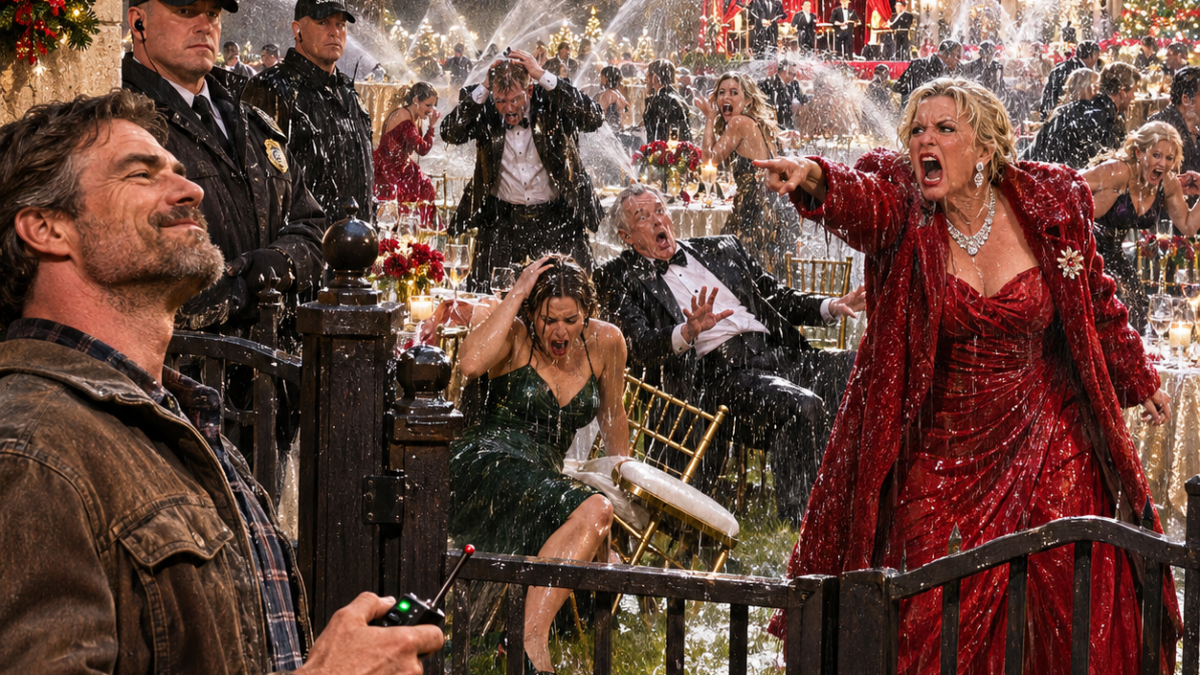
The first rotor rose beside the red carpet.
A sharp hiss.
Silver arc of water crossed the front row.
Three guests shrieked and jumped.
Then zone two opened.
Zone three.
Zone four.
Thirty-six heads emerged in sequence.
Water swept across the lawn.
Not randomly.
Exactly as designed.
Overlapping coverage.
Every blade.
Every row.
Every VIP chair.
Crimson tablecloths darkened.
Centerpieces toppled.
Programs turned to pulp.
Guests grabbed handbags.
Men held folding chairs over their heads.
Servers pushed catering carts toward the driveway.
The choir broke mid-chord.
Twenty-four singers fled stage left holding sheet music over their heads.
The string quartet moved faster than I would have thought possible.
Camera operators covered lenses and backed toward dry ground.
In less than a minute, Darlene’s perfect gala became a migration of soaked formalwear heading toward the gates.
Nobody was trapped.
Nobody seriously hurt.
No live electrical hazard.
Just wet.
Very wet.
A man passing near me said:
“Why does the owner have to turn on sprinklers to get his own yard back?”
A woman beside him answered:
“Because she threw a party here without asking.”
That sentence traveled.
Faster than water.
Darlene stayed onstage.
Trying to preserve dignity.
“Everyone stay calm!”
Her wireless microphone remained live.
“It’s just a technical malfunction!”
Guests could see me at the gate holding my phone.
They knew.
She screamed at security:
“SHUT IT OFF!”
The guards ran around looking for valves.
There were none they could access.
The controls were in my hand.
Main valves secured in the barn.
One guard found Gordon.
Gordon said:
“It’s his system.”
“I’m not touching it.”
Then a rotor completed its sweep.
Turned toward the stage.
Water hit the lower red carpet.
Then Darlene’s gown.
She shrieked.
Lifted velvet in both hands.
Ran down the stairs.
Champagne gone.
Mascara streaking.
People rushed past her without stopping.
The giant banner bearing her name began sagging.
After several minutes, I shut the system down.
The lawn became quiet.
Water dripping from chairs.
Golden decorative lights reflecting in puddles.
Forty-foot tree still glowing.
Beautiful, in a ridiculous way.
I did not laugh.
Did not mock guests.
I asked security to help older people reach cars.
Gordon’s crew assisted.
Darlene came toward me.
Furious.
“You just destroyed an event worth hundreds of thousands of dollars.”
“No.”
“You put that event on someone else’s property after being told to leave.”
“I will sue you for everything you own.”
“Call your lawyer.”
I looked at the lawn.
“Just send him the document proving you own it.”
Several guests were recording.
Darlene realized she had lost the crowd.
She spun away.
Grabbed Gordon by the sleeve.
Dragged him behind the stage.
Then began whisper-shouting at him.
The wireless microphone remained clipped to her gown.
No one remembered that.
Until a young camera operator walked over.
“Mrs. Pritchard?”
She turned.
“Do you know we’re still live?”
Her face went white.
The stage power had been cut.
But the camera crew’s backup transmitter was battery-powered.
The regional stream never stopped.
Neither did Darlene’s microphone.
The camera operator pulled up the archive.
Tapped play.
Darlene’s voice came through the tablet.
Clear.
Angry.
“I DON’T NEED REED’S REAL SIGNATURE.”
Silence.
Then Gordon:
“Then what was that agreement you gave me?”
Darlene:
“A PIECE OF PAPER THAT WAS NECESSARY TO GET THE JOB DONE.”
My heart stopped for a second.
Then her voice again:
“IF TONIGHT GOES WELL, REED CAN’T STAND AGAINST EVERY RESIDENT IN CEDAR QUAY.”
Nobody needed interpretation.
The recording had gone out live.
Regional viewers.
Neighborhood households.
People had already screen-recorded it.
Saved it.
Texted it.
Darlene lunged toward the tablet.
“Delete that.”
Gordon stepped between them.
“No.”
“DELETE IT!”
“It’s already on our archive server.”
She looked around.
Panicked now.
Deputy Silas Drummond arrived ten minutes later.
Darlene ran to him.
“Arrest him!”
She pointed at me.
“He attacked three hundred people with a sprinkler system.”
Silas looked at the wet lawn.
Then at me.
Then at Gordon.
“Everyone slow down.”
That was a good beginning.
He wanted documents.
Timeline.
Video.
Statements.
I showed:
Written denials.
Miriam’s notices.
Open gate.
Speaker warning.
Timestamp.
Irrigation logs.
Time between warning and activation.
Gordon confirmed he had shut down vulnerable electrical equipment before I ran the system.
Silas said:
“This property issue needs documentation.”
He was careful.
Good.
Then the cameraman brought the tablet.
Played Darlene’s recording.
Silas listened once.
Then again.
Darlene tried:
“I was venting.”
Silas said:
“Preserve the recording.”
She looked at her HOA attorney.
He had been standing near the driveway.
Wet overcoat.
Miserable expression.
I asked Darlene:
“You said you didn’t need my real signature.”
She stared.
“So who signed the five-year agreement?”
Nothing.
“And who gave you permission to sell sponsors the use of my property?”
She turned toward the HOA lawyer.
He raised one hand.
“Darlene.”
She opened her mouth.
He said:
“Stop talking.”
For six years, she had controlled meetings.
Contractors.
Security.
Residents.
Now her own attorney was telling her to shut up.
And she did.
Later that night, after the guests left and the lawn went dark, Paige called.
“Reed.”
Her voice sounded different.
Stronger.
“I found the money.”
“What money?”
“One hundred sixty-two thousand dollars.”
I sat down.
“From where?”
“Reserve fund.”
“To whom?”
“Silver Bell Experiences LLC.”
The next morning, Paige met Miriam and me at Miriam’s office.
Bank statements.
Invoices.
Board records.
Everything within Paige’s authority as treasurer.
Payments labeled:
Venue rental.
Landscape preparation.
Program management.
Promotion.
Sponsorship services.
Vendor coordination.
Total:
$162,000
All paid to:
SILVER BELL EXPERIENCES LLC
Miriam pulled state corporate filings.
Managing member:
Darlene’s brother-in-law.
Mailing address:
A post office box two miles from Darlene’s house.
Paige stared.
“I’ve never seen this disclosed.”
Miriam asked:
“Was there competitive bidding?”
“No.”
“Board vote approving the contract?”
“Not that I can find.”
“Land-use authority supporting venue charges?”
Paige looked at me.
“No.”
There could not be.
The HOA did not own the venue.
Laid out together, Darlene’s plan became obvious.
Stage one:
Hold a spectacular event on my property.
Make hundreds of residents experience the lawn as public space.
Stage two:
Use the event’s success to push through the $1.6 million Founders Square project.
Tell residents land rights had already been secured.
Stage three:
Pressure me into signing after the fact while long-term event contracts flowed through Silver Bell.
The point was not one Christmas party.
The point was creating a revenue machine.
On my land.
Controlled by her network.
Miriam forwarded everything to investigators.
They obtained:
Original e-sign agreement.
Audit logs.
Contract records.
Payment receipts.
Board minutes.
The broadcast confession.
My refusal letters.
County notices.
The e-sign log was devastating.
The account used to sign my name was linked to an email address I had never owned.
The signature was applied from a computer inside the HOA office.
Late Sunday night.
Only one person had office access recorded during that period.
Not me.
The document claiming my consent had no connection to me at all.
Darlene learned Paige had provided financial records.
She called her at home.
Threatened to remove her from the board.
Threatened to sue for leaking confidential documents.
Paige listened.
Then said:
“I was elected to protect the residents’ money.”
Pause.
“Not hide your invoices.”
She hung up.
That mattered.
Because by then this was no longer Reed versus Darlene.
Gordon refused to delete evidence.
Paige opened the books.
The HOA attorney stopped backing her.
Residents began asking questions.
The community Darlene claimed as her weapon was beginning to speak without her.
The emergency meeting notice arrived the next morning.
One agenda item:
Removal of Darlene Pritchard as President
And:
Immediate Suspension of Founders Square Project
The clubhouse had never been so crowded.
Every chair full.
Walls lined.
People standing on the veranda.
Many had cheered Darlene at ribbon cuttings.
Now they wanted account statements.
A year earlier, homeowners had paid special assessments for “neighborhood beautification.”
They were furious to learn money had flowed toward a party on land the association did not own.
Darlene entered last.
Perfect blazer.
Chin raised.
“I acted for the community.”
Nobody applauded.
Paige stood.
Walked everyone through the books.
Payment by payment.
Invoice by invoice.
Miriam followed.
My deed.
Survey.
Property history.
No HOA rights.
No valid agreement.
Then one board member asked:
“Can you show us one valid document giving Cedar Quay permission to use Reed’s property?”
Darlene opened her folder.
Shuffled.
Nothing.
Someone dimmed the lights.
The same projection screen where Darlene once displayed the “Community Green” map now played her own broadcast recording.
Her voice filled the room:
I DON’T NEED REED’S REAL SIGNATURE.
The air conditioner hummed in the silence afterward.
A retired pharmacist stood.
His hands were shaking.
“You used our money.”
He pointed toward Darlene.
“To throw a party on another man’s land.”
Then:
“And turned this whole neighborhood into a laughing stock.”
The room erupted.
Darlene blamed Gordon.
Then lawyers.
Then Paige.
Finally me.
Every excuse made the problem worse.
The vote happened.
Six in favor of removal.
Zero against.
Darlene stood at the side of the stage.
The woman who had controlled every meeting for six years could not control that one.
Consequences followed.
The $1.6 million Founders Square project was suspended.
Then canceled.
Forensic audit ordered.
Every Silver Bell payment flagged.
I filed civil claims for:
Trespass.
Actual landscaping damage.
Irrigation damage.
Unauthorized structures.
No fantasy numbers.
No attempt to punish ordinary homeowners who had simply believed their president.
Investigators continued the forgery and financial fraud case.
Eventually, the prosecutor filed criminal charges supported by the evidence.
Again:
Not because sprinklers got people wet.
Because documents, money, and admissions pointed toward deliberate deception.
Outside the clubhouse after the removal vote, Darlene stepped in front of me.
“You destroyed my career over a lawn.”
I stopped.
“No.”
Her face twisted.
“You humiliated me.”
“No.”
“This was my life.”
I looked at her.
“You lost your career the day you decided somebody else’s ownership meant nothing.”
She opened her mouth.
Nothing came.
I walked past.
A week later, a judge ordered complete removal of every temporary structure remaining on my property.
Stage components.
Anchor stakes.
Decorative platforms.
Founders Square signs.
Banner.
The banner with Darlene’s name was specifically included in the removal inventory.
Weeks later, trucks returned.
This time, every crew member had written authorization.
From me.
The work was supervised.
No arguments.
Stage frames lifted.
Steel stakes removed.
Ruts repaired.
Temporary platforms loaded.
The monument signage went onto a flatbed.
Finally, the banner:
A GIFT FROM DARLENE PRITCHARD TO CEDAR QUAY
Folded.
Wet-stained.
Muddy.
Gone.
I watched from my porch.
No phone recording.
No sheriff.
No shouting.
Proper paperwork is remarkably peaceful.
The financial side took months.
Negotiations.
Audits.
Court filings.
Settlements.
Silver Bell Experiences was required to repay money it had received without valid authority.
The conduct proven against Darlene created personal liability.
Responsible parties paid the cost of restoring my irrigation and landscape.
My lawn was regraded.
Resodded.
Damaged irrigation lines repaired.
Compacted areas aerated.
Tree-root zones inspected.
I did not become rich.
I became whole.
That is what damages should do.
The HOA rewrote:
Event approval rules.
Vendor contracting.
Conflict-of-interest disclosures.
Reserve-fund controls.
No major contract without recorded board authorization.
No use of private property without verified written consent.
No officer could create a land-use claim by uploading a marketing map.
Again:
Boring reforms.
Useful ones.
The forgery case moved slowly through the courts.
Darlene hated slow processes.
She had always relied on speed.
Announcement first.
Paperwork later.
Public pressure first.
Consent later.
Once investigators took control, she could no longer force the timeline.
She answered questions.
Produced records.
Sat through hearings.
Watched neighbors who once treated her word as final read audit reports instead.
That may have been one of the hardest consequences for her.
Authority replaced by verification.
The following spring, three members of the new board came to my gate.
No security.
No lawyer.
No folder marked enforcement.
One woman said:
“We owe you an apology.”
I waited.
Another said:
“We should have verified the property before spending a dollar.”
“Yes.”
The third looked uncomfortable.
“We were wondering…”
I almost smiled.
“…whether you might consider renting the lawn for next year’s Christmas event.”
I answered immediately.
“No.”
They looked disappointed.
Not offended.
That was progress.
I continued:
“I’m not in the business of renting out my right to live peacefully in my own home.”
Then I pointed toward downtown.
“There’s a historic town square.”
“Public.”
“Permitted for events.”
“Use it.”
They exchanged looks.
Then nodded.
“Fair.”
That word mattered.
Fair.
Not selfish.
Not sabotage.
Not Grinch.
Just:
Fair.
The next Christmas, Cedar Quay held its celebration downtown.
Real public space.
Permits.
Vendor agreements.
No forged signature.
No padlocked private gate.
No sprinklers.
I did not attend.
I saw photos.
It looked nice.
I was happy for them.
That confuses people who expect the ending to require resentment.
I never hated Christmas.
I hated trespass.
Different thing.
Gordon came to my house one afternoon.
His truck stopped in the driveway.
He carried something wrapped in a moving blanket.
He placed it on the porch.
Unwrapped it.
Metal plaque.
The one that had stood beside the stage.
A GIFT FROM DARLENE PRITCHARD
He grinned awkwardly.
“Thought you might want a souvenir.”
I looked at it.
Then at my lawn.
“No.”
“You sure?”
“Yes.”
“I don’t need a plaque to remind me whose land this is.”
He laughed.
“Want me to scrap it?”
“Please.”
He loaded it again.
Then stopped.
“Reed.”
“Yes?”
“I should’ve pulled out sooner.”
“You should have.”
He nodded.
No excuse.
Then:
“I’m sorry.”
“I know.”
His company had made mistakes.
But when the risk became clear, Gordon shut down vulnerable equipment.
Refused to tamper with my irrigation.
Preserved the broadcast.
Cooperated with investigators.
People are responsible not only for mistakes.
Also for what they do once they understand them.
That mattered.
Paige remained treasurer.
For one term.
Then refused reelection.
She said she had spent enough evenings looking at spreadsheets for people who complained about flowers.
We had coffee once.
She told me:
“I should’ve questioned the Silver Bell invoices earlier.”
“Probably.”
She smiled tiredly.
“You’re not going to tell me I did everything right?”
“No.”
“Good.”
Then:
“But you opened the books when it mattered.”
She nodded.
“I was scared.”
“Of Darlene?”
“Of everyone.”
That made sense.
Power rarely survives because one person is strong.
It survives because many people decide resistance costs too much.
Paige eventually decided silence cost more.
That was the turning point.
I kept one copy of the fake five-year agreement.
Not on display.
Filed.
Sometimes I look at the signature.
It is close.
Whoever created it understood how easy electronic signatures can look official when people see a platform logo.
But the audit trail did not care about appearance.
Wrong email.
Wrong device.
Wrong location.
Wrong time.
No consent.
Technology created the forgery.
Technology also exposed it.
That irony pleased me.
Darlene once treated my irrigation controller the same way she treated my deed.
As something she could simply order me not to use.
She attached a notice.
“Do not operate irrigation.”
As though her letter created authority.
The system had existed before her event.
Permitted.
Contained on my land.
Designed for exactly that lawn.
She built a party around it and then acted offended when the land continued functioning like land.
That was another part of her failure.
She thought the world should stop its normal operations to preserve her performance.
My grass should stop needing water.
My gate should stop being mine.
My deed should stop mattering.
My irrigation should become inactive.
My life should pause because she had sold sponsors a version of my property that required me to disappear.
I refused.
People loved the sprinkler story.
Of course they did.
Thirty-six heads.
Red carpet.
Velvet gown.
Choir running.
It is visual.
Funny.
Satisfying.
But the sprinklers did not defeat Darlene.
They ended the party.
Evidence ended her authority.
The fake signature.
The broadcast confession.
The $162,000.
Silver Bell.
The $1.6 million plaza plan.
The board records.
The money trail.
That is the part I emphasize when people tell the story as if I won because I had a dramatic irrigation system.
Water exposed the arrogance.
Documents exposed the scheme.
The source of Darlene’s power was never the HOA bylaws.
It was certainty.
She said the lawn was community space.
People accepted the label.
She said the agreement was signed.
Contractors accepted it.
She said permits were handled.
Sponsors trusted her.
She said the event could not be stopped.
People acted accordingly.
Each statement borrowed legitimacy from her position.
That is why independent verification matters.
A title can make false information travel faster.
It does not make it true.
I also learned something uncomfortable about community.
Many Cedar Quay residents genuinely liked the idea of Founders Square.
The rendering was beautiful.
Permanent stage.
Market stalls.
Concerts.
Holiday lights.
Marsh views.
People imagined weddings.
Farmers markets.
Music nights.
They were not evil for liking it.
The problem was where it sat.
My lawn.
A good idea does not become ethical because many people enjoy it.
Popularity does not erase ownership.
That distinction sounds obvious until someone frames the owner as standing against everyone else.
Then pressure begins.
Darlene relied on that pressure.
She thought if enough people loved the plaza, my refusal would become socially impossible.
She never understood that a vote among people who do not own something cannot transfer ownership from the person who does.
One of the retired homeowners apologized to me after the emergency meeting.
He said:
“I thought you were being difficult.”
“I know.”
“I saw the rendering.”
“It looked like a great improvement.”
“To my home.”
He looked embarrassed.
“Yes.”
Then he said something I appreciated.
“I never asked myself whether I would have liked the same improvement in my yard.”
That was the whole problem.
People are generous with other people’s property.
The following year, I replaced two sprinkler rotors.
Normal wear.
One valve diaphragm too.
I remember laughing while I worked.
For months, those thirty-six heads had been treated like weapons in neighborhood gossip.
They were not.
They were irrigation equipment.
They watered grass.
The only reason the Christmas incident became dramatic was because Darlene built a gala on top of an active system and refused to leave after warning.
Context changes how ordinary tools appear.
I wanted them ordinary again.
On Christmas afternoon, one year after the gala, I sat on my porch.
No stage.
No red carpet.
No private security.
No guests demanding parking.
No banner.
My lawn had recovered.
Green under low winter sun.
Marsh breeze.
Coffee.
My phone chimed.
Scheduled watering cycle.
I opened the app.
Four zones.
Normal program.
I smiled.
Pressed start.
The pump hummed.
One rotor rose.
Then another.
Thirty-six columns of water arched into the light.
Gold droplets.
Quiet.
No screaming.
No formalwear.
No cameras.
Just water falling on grass.
Exactly what the system had been designed to do.
I thought about Darlene telling me I could never stand against an entire community.
She was wrong.
Because I never needed to.
The community was not my enemy.
Most residents had been misled.
Once they saw the documents, they acted.
Paige opened the books.
Board members voted.
Homeowners demanded accountability.
The new board apologized.
The celebration moved somewhere lawful.
I had never been fighting Cedar Quay.
I had been stopping one person who believed everything she could organize, advertise, and surround with applause somehow became hers.
Darlene brought three hundred twenty people onto my lawn to prove she controlled it.
I needed thirty-six sprinklers to end the performance.
But what mattered afterward was far simpler.
One deed.
One survey.
One audit log.
One recording.
One set of bank statements.
Ownership did not win because I made the bigger spectacle.
It won because underneath every banner and every microphone, the facts had never changed.
The land was mine before Darlene printed her first invitation.
It remained mine while she built the stage.
It remained mine when she padlocked the gate.
It remained mine when her guests applauded.
And it remained mine after the last wet chair was carried away.
That is the thing people like Darlene never understand until the applause stops.
Power can pressure ownership.
Power can inconvenience ownership.
Power can lie about ownership.
But power does not become ownership simply because enough people are watching.
And every Christmas now, when those thirty-six sprinklers rise quietly from the grass, I remember the night Darlene Pritchard tried to turn my home into a monument to herself.
The water washed away the party.
The evidence washed away the lie.
And in the end, the only thing left standing was the truth that had been there from the beginning:
It was never her town square.
It was my front yard.








