PART2:“THIS DOCK BELONGS TO THE HOA NOW—TOUCH THAT LOCK AND I’LL HAVE YOU ARRESTED!” HOA Karen Chained My Private Dock on Christmas Eve—She Had No Idea I Was the State Harbor Investigator
PART2
I stood in the snow long after the white SUV disappeared.
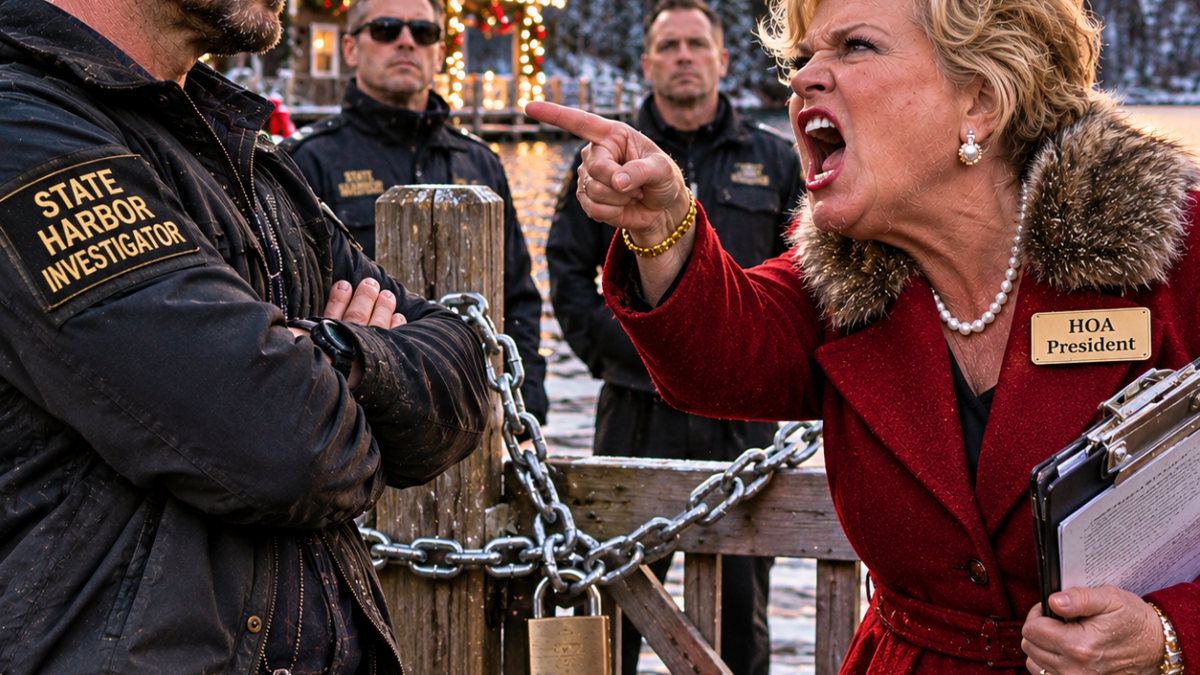
The chain was still wrapped around my railing.
The brass padlock hung from it.
My boat sat behind the barrier.
My electrical equipment.
My storage locker.
My dock.
All of it exactly where it had always been.
I owned bolt cutters.
I could have removed the lock in less than thirty seconds.
I didn’t.
There are moments when anger feels like action.
Most of the time, it isn’t.
Fifteen years investigating shoreline disputes, illegal marina construction, unpermitted pilings, navigation obstructions, and fraudulent permit representations had taught me something simple:
If someone is creating evidence against themselves, let them finish.
I walked inside.
Hung my canvas coat behind the door.
Then went to the enclosed porch and picked up a black leather briefcase.
At the kitchen table, I opened both brass latches.
Inside were inspection reports, copies of permits, photographs, shoreline maps, and the files from a state matter I had been reviewing before Christmas.
Beneath them rested a slim leather credential wallet.
I opened it.
Gold badge.
State seal.
My photograph.
Three words:
STATE HARBOR INVESTIGATOR.
Very few people around Lake Marrow knew what I did.
Most assumed I worked for some dull state office.
They weren’t entirely wrong.
A lot of my job was dull.
Permits.
Surveys.
Engineering drawings.
Water-depth charts.
Marina applications.
Recorded access rights.
Public navigation corridors.
Letters.
Signatures.
Dates.
That dull work mattered because waterways turn dangerous quickly when somebody decides paperwork is optional.
A developer wants six more slips than approved.
A marina expands a fuel dock without review.
A contractor moves a walkway thirty feet into a public channel because the approved route costs more.
Someone says, “It’s only temporary.”
Then somebody gets hurt.
My job was to know where authority began and where it stopped.
That was exactly why I hadn’t shown Karen the badge.
I could have opened my jacket on Christmas Eve.
I could have watched her expression change.
Maybe she would have ordered the chain removed immediately.
Maybe her board members would have apologized.
Maybe the whole thing would have ended before dinner.
But I had been standing on my private property as Gideon Mercer, homeowner.
Not State Harbor Investigator Mercer.
Using government authority to win a personal property dispute would have been wrong.
A badge used as a threat is still a threat.
So I left it inside.
Instead, I took out a yellow legal pad.
At the top I wrote the date.
December 24.
Then:
Lake Marrow Shores HOA entered private shoreline and physically restricted access to permitted dock. No court order, state directive, recorded easement, survey, or permit action presented.
Under that:
Verify prior state communications involving HOA and Mercer permit.
I stopped.
Read it again.
Something about Karen’s confidence bothered me.
People who misunderstand law usually hesitate somewhere.
They say:
“We were told.”
“Our attorney believes.”
“The board thinks.”
Karen had said none of that.
She had acted like the question was already settled.
That suggested she had asked before.
Christmas morning, at 8:42, my phone rang.
Marjorie Pell.
Retired schoolteacher.
Silver hair.
Reading glasses on a beaded chain.
One of the few HOA board members who still asked uncomfortable questions.
“Merry Christmas, Gideon.”
“Merry Christmas.”
“I’m sorry.”
“For what?”
“There’s a meeting at nine.”
“About my dock.”
“Yes.”
I poured coffee.
“What is Karen telling people?”
“That you’ve occupied association shoreline for years without proving your rights.”
I almost laughed.
“Anything else?”
“She says you threatened her.”
“What words did she use?”
“That you told her she’d regret what she did.”
“I did.”
Marjorie went quiet.
“I told her she had created a legal problem.”
“She didn’t include that part.”
“Of course not.”
Marjorie sighed.
“Are you coming?”
“I wasn’t invited.”
“Come anyway.”
I arrived a little after nine.
The clubhouse sat on the western shore overlooking the association marina.
Christmas decorations still glowed around the windows.
A fire burned in the stone hearth.
Five board members sat in folding chairs with paper coffee cups.
Karen stood at the head of the table in a navy blazer.
A shoreline map was projected on the wall behind her.
A red dot marked my dock.
She looked like she’d slept perfectly.
“The owner has occupied a portion of the community shoreline without demonstrating any legal right to do so,” she was saying.
I opened the door.
Cold air rushed into the room.
Every head turned.
Karen’s jaw tightened for half a second.
“Mr. Mercer. This is a board meeting.”
“Then I’m in the right place.”
Marjorie looked down to hide a smile.
I stayed standing.
“I need four documents.”
Karen crossed her arms.
“This is not a courtroom.”
“I know.”
I held up one finger.
“The boundary survey placing my dock on association property.”
Second.
“The state record revoking or suspending my dock permit.”
Third.
“The recorded transfer granting the association shoreline or water-use rights over my parcel.”
Fourth.
“The legal order authorizing you to physically restrict access to privately held property.”
Silence.
Karen opened her leather folder.
Turned one page.
Then another.
Nothing.
Because those documents did not exist.
She closed the folder.
“You live in our community.”
“My house is subject to certain recorded covenants. My shoreline does not become common property because of that.”
“You agreed to association rules when you purchased.”
“Association rules do not automatically override state water law.”
Karen’s eyes narrowed.
“That phrase again.”
“The water beyond my dock is regulated by the state.”
“Record a fine,” she said.
The board secretary froze.
“Karen?”
“For obstruction of association enforcement.”
The secretary looked at me.
Then back at Karen.
“How much?”
“Two hundred fifty dollars per day.”
“Beginning today?”
“Beginning Christmas Eve.”
I took a small black notebook from my coat.
Karen watched me write.
“What are you doing?”
“Documenting what you said.”
“Are you recording this?”
“No.”
“Then stop acting like some kind of investigator.”
I looked up.
“Why?”
That irritated her more than anger would have.
She pointed at the door.
“You’ve made your position clear.”
“So have you.”
I nodded to the board.
“Merry Christmas.”
Then left.
In my truck I wrote:
HOA asserting enforcement authority over state-regulated permitted dock without documentation. Daily fine $250 retroactive to 12/24.
I underlined it once.
The county recorder’s office reopened December 26.
Beverly Toomey answered.
“County records.”
“Morning, Beverly. Gideon Mercer.”
She groaned.
“Don’t tell me you people are working today.”
“So are you.”
“I made bad life choices.”
“I need everything tied to parcel 18-447-C.”
Keyboard clicking.
“House or dock?”
“Both.”
“Okay. Dock permit originally issued 1998.”
“Current?”
“Active.”
“Transferred when I bought?”
“Clean transfer.”
“Any suspensions?”
“No.”
“Violations?”
“No.”
“Revocation?”
“No.”
“Recorded HOA interest?”
Longer pause.
“Nothing.”
Exactly what I expected.
Then I asked:
“Any administrative complaint involving the dock?”
More keys.
Then:
“Oh.”
I sat straighter.
“What?”
“August filing.”
“Who?”
“Lake Marrow Shores Homeowners Association.”
My pen stopped.
“Signed by?”
“Karen Whitlock, President.”
“Read it.”
Beverly did.
The complaint alleged that my dock obstructed future community development along the shoreline and requested transfer of oversight to the association.
“And disposition?”
“Denied.”
“When?”
“September.”
“Reason?”
She read slowly.
“Association lacks jurisdiction over state harbor permit. Existing permit remains with property owner.”
I stared at the wall.
Karen knew.
The state had told her no.
In writing.
Four months before she stood behind my house with a chain.
That distinction changed the nature of the problem.
People make mistakes.
Volunteer boards misunderstand boundaries.
Homeowners misread covenants.
But once the governing agency answers the jurisdiction question, continuing anyway is no longer a misunderstanding.
It is a choice.
“Beverly, send me that entire file.”
“Already going.”
“And pull shoreline development filings around the eastern side of Lake Marrow for the last two years.”
“That’s a bigger request.”
“I know.”
“Something interesting happening?”
“Maybe.”
“You’re terrible company.”
“So I’ve heard.”
The packet arrived electronically within the hour.
Most filings were routine.
Dock repairs.
Retaining walls.
Vegetation management.
A boathouse roof replacement.
Then near the bottom:
PRELIMINARY SHORELINE IMPROVEMENT STUDY — EASTERN LAKE MARROW.
Applicant:
CRESTLINE SHORE DEVELOPMENT.
I searched the state business registry.
Managing member:
Paul Whitlock.
Karen’s husband.
I read that result twice.
Then printed it.
The next day, a certified letter arrived.
HOA letterhead.
My daily fine officially imposed.
$250 per day.
Retroactive to Christmas Eve.
Three days later came another letter.
Different envelope.
Heavy cream paper.
Embossed law-firm letterhead.
Attorney Russell Cain.
The association demanded that I remove all personal property from the dock within ten days, including my boat, electrical equipment, mooring hardware, and storage locker.
Failure to comply would result in removal at my expense and possible action for trespass on association-controlled property.
I read those words three times.
Then sat at my desk and typed one sentence:
Please provide the legal basis for the association’s claimed authority to control this dock.
Nothing else.
No threats.
No badge.
No mention of the state denial.
I sent copies to Russell Cain and the HOA by certified mail.
If there was a legitimate basis, that was their opportunity to show it.
No response came.
Instead, three mornings later, hammering woke me.
I looked out.
Two HOA maintenance workers were planting a white metal sign in the snow.
Bold red letters:
HOA PROPERTY — NO PRIVATE ACCESS.
The sign stood maybe ten feet from my back porch.
I put on boots and walked outside with my phone.
One worker looked nervous.
“Morning.”
“Morning.”
“We were told to put this here.”
“I understand.”
“We don’t want trouble.”
“Neither do I.”
I photographed the sign from four angles.
Then pulled a copy of my survey from my coat.
Measured.
Eleven feet inside my property line.
Measured again.
Same result.
The worker stared at the survey.
“Man, I don’t know anything about this.”
“I know.”
“You want us to take it out?”
“Were you authorized to remove it?”
“No.”
“Then don’t lose your job over somebody else’s order.”
He stared at me.
“You’re not mad?”
“At you? No.”
By afternoon, the same workers returned with orange construction fencing.
They staked it around the base of my dock.
The fence cut me off from the water completely.
I photographed that too.
Work-truck plate.
Employee names.
Date.
Time.
Distances.
Then I went inside.
The story spread through Lake Marrow quickly.
Karen was good at public framing.
She never said anything clearly false.
That would have been easy to challenge.
Instead, she used technically defensible phrases.
“The HOA is addressing a longstanding shoreline compliance issue.”
“The homeowner has refused to cooperate.”
“The board is protecting community assets.”
“I felt threatened during the Christmas Eve interaction.”
People filled the gaps themselves.
Within days, neighbors who had waved to me for years drove past without looking.
Someone told Walter Briggs I was trying to claim HOA property.
Another said I had intimidated Karen.
One woman apparently told a friend that I had “some government connections” and thought normal rules didn’t apply to me.
I could have answered all of it.
I didn’t.
Walter showed up with a tin of fudge.
He stared at the orange fence.
“You planning to let her tell this story by herself?”
“My story won’t matter yet.”
“It matters to me.”
“You’re one person.”
He frowned.
“That’s rude.”
“Accurate.”
Walter looked toward the dock.
“What will matter?”
“The documents.”
He handed me the fudge.
“You government people love paper.”
“Paper doesn’t care who sounds convincing.”
He thought about that.
“Fair.”
That night, near eleven, I went down to inspect the dock from outside the fence.
Something blinked red across the inlet.
I stopped.
Security camera.
Mounted on a tree on HOA common shoreline.
Pointed directly at my dock.
I checked the public notice portal.
The HOA had filed a community-security installation notice two days earlier.
They weren’t simply claiming my dock.
They were monitoring it.
Fine.
Cameras create records too.
The next morning I requested the installation documents, stated purpose, retention policy, and approval record.
Then I returned to Crestline.
Large projects leave trails.
County zoning.
State consultations.
Environmental filings.
Engineering plans.
Financing packages.
I spent four days making calls and pulling public records.
On the fifth day, I found the project.
MARROW POINT COMMUNITY MARINA.
Forty boat slips.
Fuel station.
Floating walkway.
Small waterfront restaurant.
The HOA described it as a major new community amenity.
Crestline Shore Development was the design and construction partner.
I unfolded the preliminary site map across my kitchen table.
And suddenly the entire dispute became obvious.
The proposed walkway needed to run eastward from HOA common shoreline toward deeper water.
My property interrupted the line.
My dock sat directly where the project needed to pass.
Common shoreline.
My parcel.
My dock.
Deep-water access.
Without crossing my property, the plan became more difficult and more expensive.
Karen had already tried the legitimate route.
August complaint.
Request for transfer.
State denial in September.
She could have approached me.
Could have proposed an easement.
Could have made an offer.
Could have redesigned.
She did none of those things.
Instead she started building the appearance that the HOA already controlled the area.
First a notice.
Then a chain.
Then a fine.
Then an attorney letter.
Then a sign.
Then a fence.
Then a camera.
Each step by itself could be described as overzealous administration.
Together they looked different.
Then I found an October planning memo.
One page.
Signed by Karen.
Near the bottom:
NEXT STEPS — Owner use rights must be resolved before final permit submission.
I stared at the word resolved.
Not negotiated.
Not purchased.
Not acquired.
Resolved.
I leaned back.
For the first time, I understood why Karen had come on Christmas Eve.
Holiday.
Reduced offices.
People distracted.
Board members less likely to challenge her.
If I accepted the lock, removed my boat, and stopped using the dock, the HOA would begin to create a factual history of control.
That could later be shown to consultants, lenders, or permitting agencies as evidence that the shoreline corridor was already managed by the association.
Possession would create appearance.
Appearance could become an argument.
Then I opened the state hydrographic survey.
That was when the case became bigger than my property.
The official survey showed a protected navigation corridor beyond my dock.
During low-water periods, that channel was the only reliable route for emergency boats reaching the northern coves.
Crestline’s preliminary plan used a different depth chart.
Their chart moved the channel about forty feet.
That single difference placed the proposed floating walkway directly across part of the actual protected corridor.
If constructed as drawn, rescue access could be restricted.
Now I had a problem.
Not only with Karen.
With myself.
I could not open a state investigation simply because my own property was involved.
That would be a conflict.
So I called my supervisor.
Diane Holloway.
“Tell me everything,” she said.
I did.
My parcel.
The lock.
The September denial.
The Crestline connection.
Paul Whitlock.
The marina.
The protected navigation corridor.
When I finished, she was quiet.
“Do you have copies?”
“Yes.”
“Any state-authority issue independent of your private property?”
“The marina plan intrudes into the protected emergency channel.”
“Then that part is ours.”
“I need independent review.”
“You’ll have it.”
Diane assigned Investigator Lena Hartley.
Lena had worked with me for years.
She was excellent.
Methodical.
Skeptical.
The kind of person who would challenge a comma if the record didn’t support it.
Exactly what I wanted.
I would conduct limited preliminary site work because I knew the location.
Lena would independently verify findings.
My private boundary claims would be separated from the state review.
Diane would authorize every step.
That evening, I completed the preliminary inspection form at my kitchen table.
Outside, snow covered part of the orange fence.
The HOA camera blinked across the inlet.
I almost smiled.
If anyone later claimed I had used state authority secretly, their own camera would show me sitting in my house completing official paperwork after disclosing the conflict.
December 30, the HOA board met again.
Karen had prepared a presentation for Marrow Point.
Glossy renderings.
A waterfront restaurant glowing at sunset.
Rows of boats.
New landscaping.
Paul Whitlock sat near the back.
Russell Cain sat beside Karen.
Ten minutes into the presentation, office manager Tyler Grant walked in carrying a manila envelope.
“Mrs. Whitlock?”
Karen paused.
“This came by courier. Requires your signature.”
She looked irritated.
Signed.
Opened it.
The first page carried the deep blue seal of the State Harbor Division.
According to Marjorie, Karen’s expression changed slowly.
Not panic.
Recognition.
Then calculation.
The letter required the association to produce within five business days:
All records regarding my dock.
All legal documentation supporting the lock.
All fines.
All board minutes relating to the matter.
All sign and fencing authorizations.
All security-camera records.
All documents relating to Marrow Point Community Marina.
All engineering and shoreline studies.
And an explanation concerning possible interference with a protected navigation corridor.
Failure to comply could lead to enforcement.
Karen put the paper down.
“Who sent this?”
Tyler pointed toward the signature block.
Lead Investigator: Gideon Mercer.
Nobody spoke.
Marjorie removed her glasses.
“Gideon Mercer?”
Russell pulled the packet toward himself.
Paul uncrossed his arms.
Karen stared at my name.
Then the clubhouse door opened.
I walked in wearing my navy State Harbor Division parka.
Lena followed carrying a hard equipment case.
I did not feel triumphant.
That part is important.
I felt tired.
Because by then I knew this wasn’t a Christmas feud anymore.
The project implicated a public emergency corridor.
Karen looked at me.
I crossed the room.
Opened my credential wallet.
Placed it on the table.
Gold badge under clubhouse lights.
Her face went pale.
For the first time since I had met her, Karen had no immediate answer.
I sat.
Opened my briefcase.
“Now,” I said, “we can begin the inspection.”
Russell cleared his throat.
“We need to discuss notice and representation.”
I slid Diane Holloway’s signed authorization toward him.
He read it.
Then set it down.
Karen finally spoke.
“You knew.”
“Yes.”
“On Christmas Eve.”
“Yes.”
“You let me chain the dock.”
“I told you not to.”
“You deliberately hid who you were.”
“I was standing on private property as a homeowner.”
“You could have stopped me.”
“I tried.”
“You wanted this.”
“No.”
“You wanted to humiliate me.”
I looked at her.
“This inspection concerns records and a protected navigation corridor.”
Her eyes sharpened.
“You’re using your badge against me.”
“No.”
“You expect anyone to believe that?”
I nodded toward Lena.
“Every finding is independently reviewed.”
Karen looked at Lena.
Lena said calmly:
“I report through the same division, but I was assigned specifically to review Investigator Mercer’s work because his private property is involved.”
Karen turned back toward me.
I continued.
“My property claim is documented separately.”
Russell leaned toward her.
“Karen.”
She sat down.
The inspection began formally at eight the next morning.
Tyler brought files on carts.
One.
Then another.
Then a third.
Lena and I started with permits.
Then county surveys.
HOA maps.
Board minutes.
Enforcement notices.
Attorney correspondence.
Security records.
Crestline plans.
State shoreline records.
We compared each document against official records.
When something matched, it went left.
When it didn’t, it went right.
By noon, the right-hand stack was taller.
The first discrepancy was simple.
The violation notice used to justify my dock restriction cited a section from the 1997 HOA covenants.
That section had been repealed in 2011.
Even when it existed, it did not authorize seizure of private docks.
Second discrepancy:
The Marrow Point project map showed HOA common shoreline extending through my parcel.
The certified county survey did not.
Someone had simply extended the line.
I looked at Tyler.
“Who prepared this map?”
He swallowed.
“I don’t know.”
“Find the source file.”
He nodded.
Third discrepancy:
A document titled AFFIRMATION OF ASSOCIATION AUTHORITY.
Dated December 23.
One day before Karen arrived at my house.
It stated that Lake Marrow Shores HOA possessed lawful authority to secure, restrict, and manage the Mercer dock.
Signature:
Karen Whitlock, President.
I searched for the document supporting that claim.
No easement.
No purchase.
No court order.
No state transfer.
No permit action.
Nothing.
Just an assertion.
Lena found the engineering problem.
Crestline’s private depth chart placed the navigation channel approximately forty feet north of the state-approved position.
That error made their walkway appear clear.
On the official survey, it crossed the emergency route.
Lena laid both charts side by side.
“Forty feet.”
I nodded.
“Enough.”
“For normal recreational traffic?”
“Maybe manageable.”
“For rescue boats in low water?”
“Potentially serious.”
That was the point when my anger over the dock disappeared.
This was larger.
Karen came for questioning at three.
Russell sat beside her.
Her posture was perfect again.
She had prepared.
We began with the depth chart.
Karen answered confidently.
“The association relied on Crestline’s technical consultants.”
Fair.
“I’m not an engineer.”
Also fair.
“I had no reason to believe the chart was inaccurate.”
Possible.
I wrote each answer.
Then placed the December 23 affirmation in front of her.
“This isn’t engineering.”
She looked down.
“Who signed this?”
“The board authorized enforcement.”
I placed the October minutes beside it.
“The board authorized review of shoreline issues.”
Karen said nothing.
“No authorization to lock my dock.”
Silence.
“No authorization to erect a sign.”
Silence.
“No authorization to install fencing.”
She glanced at Russell.
“No authorization declaring the dock association property.”
I tapped the signature line.
“Who signed this?”
“I did.”
“Based on what legal instrument?”
“The association’s longstanding understanding.”
“Which recorded instrument?”
“Community practice.”
“That isn’t an instrument.”
Karen’s jaw tightened.
“The shoreline has always been managed as a community asset.”
“Not my parcel.”
“That is your interpretation.”
I slid the county survey forward.
“It is the recorded survey.”
Russell shifted.
Karen continued:
“Maps can be revised.”
“By whom?”
“The association.”
“Can the association revise a county property line?”
She looked at me.
No answer.
I waited.
Lena kept typing.
Finally Karen said:
“We believed we had authority.”
“Why?”
“Because of the development history.”
“Show me.”
Silence.
I wrote:
No recorded legal instrument identified.
Late afternoon, Lena opened a box of printed email archives.
At 4:15 she stopped.
Read one page.
Read it again.
Then passed it to me.
Email.
December 18.
Karen to Russell Cain and Paul Whitlock.
Subject:
MARROW POINT — NEXT PHASE.
Four lines.
The last said:
If Gideon walks away from that dock, the rest will be easy to handle.
I read it twice.
Then placed it beside the other documents.
That sentence alone proved little.
Karen could reasonably argue it meant voluntary relocation.
Context mattered.
The next morning, she arrived ready with that explanation.
“It was shorthand.”
I nodded.
“If Mr. Mercer voluntarily ceased using the dock, the project would face fewer delays.”
I wrote.
“It was not a threat.”
I nodded.
“It was an internal planning comment.”
“Understood.”
She relaxed slightly.
Then I opened my briefcase.
One by one, I laid the records across the conference table.
December 18 email.
December 23 affirmation claiming legal authority.
December 24 chain and lock.
December 25 fine.
Attorney letter ordering removal of my equipment.
HOA property sign.
Construction fence.
Security camera.
Marina plan.
Then I added the earlier documents.
August complaint requesting control over my dock.
September state denial.
October memo saying owner-use rights had to be “resolved.”
I put them in chronological order.
Then sat back.
I did not call Karen corrupt.
I did not call her a liar.
I did not speculate.
I didn’t need to.
Russell Cain stared at the row of paper.
Then removed his glasses.
Rubbed the bridge of his nose.
“Karen.”
She looked at him.
“As counsel for the association, I’m advising immediate suspension of every enforcement action against the Mercer property.”
Her head snapped toward him.
“Russell.”
“The fines.”
He pointed.
“The sign.”
Another page.
“The fence.”
Another.
“The lock.”
Another.
“Today.”
Karen’s composure cracked.
Not dramatically.
One hard breath.
Then she looked at me.
“You did this.”
“I documented it.”
“You waited.”
“I gave you multiple opportunities to provide authority.”
“You could have told me who you were.”
“The state told you in September that you lacked jurisdiction.”
Her eyes flickered.
There it was.
Not surprise.
Recognition.
I continued.
“Christmas Eve, I told you the dock was state permitted.”
No answer.
“Christmas morning, I requested four documents.”
Nothing.
“My certified letter requested your legal basis.”
Nothing.
“You never provided one.”
She leaned forward.
“You used your position.”
I shook my head.
“This state matter exists because the Marrow Point design intersects a protected emergency channel.”
I gestured toward Lena.
“My work is independently reviewed.”
Then I slid one final folder toward Karen.
Inside were copies of everything bearing her signature.
August complaint.
September denial receipt.
October planning memo.
December 23 authority statement.
Fine authorization.
Sign order.
Fence order.
Camera paperwork.
Karen opened it.
Turned a page.
Another.
Another.
Her own name repeated.
I spoke quietly.
“I didn’t write any of this.”
She kept looking.
“Your own signature is telling the story.”
For the first time, Karen stopped arguing.
The final report took eight days.
I wrote it the way I wrote every report.
Plainly.
No anger.
No dramatic words.
No claims beyond evidence.
Lena independently checked every citation.
She corrected one date.
Flagged two sentences for clarity.
Diane approved the final report January 10.
The findings were straightforward.
My dock had a valid active state permit.
No legal instrument transferred control to the HOA.
The association had no lawful basis for chaining the dock.
The sign and fence were installed on private property without consent.
The fines lacked enforceable authority.
The Marrow Point plans relied on an unapproved depth chart.
The proposed walkway conflicted with a protected navigation corridor.
The project could not proceed without redesign and proper state review.
The association was ordered to remove the sign and fence, rescind the fines, cease interference, and restore access within seventy-two hours.
They complied in forty-eight.
Russell made sure of it.
Maintenance workers came back.
Pulled the sign from frozen soil.
Rolled up the orange fence.
Across the inlet, the security camera disappeared.
A rescission letter arrived.
Every fine canceled.
The only thing remaining was Karen’s brass padlock.
Russell called.
“Apparently the key can’t be located.”
“That’s unfortunate.”
“I can send a locksmith.”
“No need.”
“You sure?”
“I’ve got it.”
That afternoon, I walked down carrying long-handled bolt cutters.
The lake was almost completely frozen.
Snow pressed against the pines.
The brass lock hung where Karen’s maintenance man had placed it Christmas Eve.
I positioned the jaws around the shackle.
Pressed.
At first it resisted.
Then—
Crack.
The lock dropped onto the cedar boards.
That sound was no louder than a branch breaking in the woods.
Still, I felt it in my chest.
I pulled the chain free.
Link by link.
Then heard footsteps behind me.
Karen stood at the top of the slope.
Alone.
No leather folder.
No board members.
No polished presentation.
Her camel coat was buttoned to the throat.
Her hair had come loose around her face.
She walked halfway toward me and stopped.
Snow fell between us.
Neither spoke for a while.
I looked out toward the lake.
“This was never a fight between you and me.”
Her voice was quiet.
“Then what was it?”
I picked up the broken lock.
“Power trying to replace law.”
I looked at her.
“And the law refusing to move.”
She swallowed.
“You really believe that’s all this was?”
“What do you think it was?”
Karen stared at the snow.
“I thought the marina would be good for everyone.”
“That doesn’t answer the question.”
“It would increase values. Improve access. Bring revenue. Upgrade the shoreline.”
“Maybe.”
She looked up, almost surprised I agreed.
I continued.
“A potentially good project doesn’t create rights you don’t have.”
“I thought we could solve the ownership problem afterward.”
“There wasn’t an ownership problem.”
She looked toward the dock.
“There was a project problem.”
“Yes.”
“That’s different.”
Karen said nothing.
“The dock wasn’t wrong because it was inconvenient.”
Her face tightened.
“I know.”
“Do you?”
She looked at me.
“I do now.”
I coiled the chain.
Karen left without another word.
Three weeks later, Lake Marrow Shores held a special meeting.
The clubhouse filled beyond capacity.
Residents who had never attended a board meeting stood against the walls holding copies of the state report.
Marrow Point was formally suspended pending complete redesign and review.
Crestline withdrew the application the following week.
Then residents spoke.
One man stood.
“I believed Gideon was refusing to follow rules.”
Another:
“I told my wife he was arrogant.”
A woman near the back said:
“We never asked to see the documents.”
Marjorie spoke last.
She looked directly at Karen.
“Rules matter.”
Pause.
“But rules without limits become something else.”
Karen sat at the head table.
She did not interrupt.
That alone told me something had changed.
When public comments ended, she stood.
“I believed Marrow Point would benefit this community.”
No one reacted.
“I still believe carefully planned development can benefit this community.”
Her voice was steady.
“But I let that belief take me beyond authority I did not have.”
Somebody shifted in the back.
Karen continued.
“I made decisions that should have gone through proper legal review and proper board approval.”
She looked around the room.
“This association deserves a president it can trust to know the difference.”
Then she placed the gavel on the table.
“I resign, effective tonight.”
No shouting.
No dramatic removal.
No applause.
Karen picked up her coat.
Walked out.
Some residents later told me she deserved harsher consequences.
Others reminded them that Karen had fought for improved county-road maintenance, pushed through drainage repairs, and spent years helping organize lake cleanups.
Both things could be true.
People prefer villains because villains simplify accountability.
Karen was harder.
Intelligent.
Capable.
Driven.
She believed the marina was good.
Then she decided that believing in the destination justified taking any road necessary to get there.
That is how abuse of authority often starts.
Not with someone announcing:
I’m going to violate somebody’s rights.
It starts with:
I know what’s best.
Then:
We don’t have time to wait.
Then:
The rules are standing in the way.
Then:
We’ll fix the paperwork later.
Eventually somebody wakes up and finds a chain across something that belongs to them.
Life around Lake Marrow gradually returned to normal.
I replaced two cracked boards.
Reset mooring hardware.
Walter Briggs arrived with more fudge.
He stared at the dock.
“You could’ve told me you were a state investigator.”
“You never asked.”
He laughed.
“Karen probably wishes she had.”
“Probably.”
“You enjoy watching her resign?”
“No.”
He looked skeptical.
“Not even a little?”
I thought about it.
“I enjoyed the fence disappearing.”
Walter nodded.
“That’s human.”
Neighbors started waving again.
Some stopped to apologize.
One woman caught me near the mailbox.
“I believed her.”
“I know.”
“I’m sorry.”
“Thank you.”
“You’re not mad?”
“I was.”
“And now?”
“Now the record is clear.”
She looked puzzled.
That was fine.
Late January, I still had not removed the Christmas lights from the house.
One evening, footsteps crunched along my gravel drive.
I looked up.
Karen.
She carried a thick manila folder against her chest.
She stopped at the foot of my dock.
The exact place where she had stood Christmas Eve.
This time she didn’t point.
Didn’t announce anything.
Didn’t give an order.
She held out the folder.
I took it.
Inside were original association records concerning my dock.
Violation notice.
Authority affirmation.
Fine assessments.
October memo.
December email.
Everything.
Organized carefully.
On top was a handwritten note.
Three words:
I was wrong.
I looked at her.
Karen spoke quietly.
“I was wrong.”
No explanation.
No excuse.
I closed the folder.
“You knew the state had denied your complaint in September.”
“Yes.”
“Why continue?”
She stared toward the frozen lake.
“Paul had already invested heavily in the project.”
“That doesn’t give you authority.”
“I know.”
“Did the board know you planned to lock the dock?”
“No.”
“Did Russell tell you that you could?”
“No.”
“Then why?”
She took a long breath.
“Because I thought if the marina was far enough along, everyone would accept it.”
I said nothing.
“And because I thought you would say no if I asked.”
There it was.
The simplest answer in the entire case.
“You never asked.”
“No.”
“You decided my answer didn’t matter.”
“Yes.”
Snow gathered on her coat.
I held the folder at my side.
“I’m not going to tell you it’s all right.”
“I don’t expect you to.”
“I’m not going to tell you we’re friends.”
“I know.”
“But you can make sure nobody else gets treated this way.”
Karen nodded once.
“I will.”
Then she turned.
Walked back toward the road.
I watched until the sound of her footsteps disappeared.
Inside, I set the folder on my kitchen table.
Opened my black briefcase one final time.
The case file had grown thick.
Photographs.
Surveys.
Permits.
Emails.
Board minutes.
State records.
Signatures.
I turned to the final page.
Wrote:
Matter resolved.
Below it:
Property rights restored. Unauthorized restriction removed.
Signed.
Closed the file.
Snapped the brass latches.
That should have been the end.
But the case stayed with me.
Not because Karen lost her position.
Not because I revealed my badge.
Not because a marina project collapsed.
What stayed with me was how easily authority can look real when someone performs it confidently.
Karen had the right clothes.
The official-looking folder.
HOA letterhead.
A seal.
Lawyers.
Maintenance crews.
Fines.
Signs.
A camera.
Board language.
She sounded official.
And because she sounded official, people assumed she must have authority.
But none of it changed my deed.
None of it changed the county survey.
None of it changed my state permit.
None of it changed the protected navigation corridor.
Confidence cannot create jurisdiction.
A board vote cannot create private property rights where none exist.
A lawyer’s letter cannot transfer land.
An HOA president cannot turn somebody else’s shoreline into common property by repeating the claim often enough.
I knew how to find those distinctions because it was my profession.
Most homeowners don’t.
That bothered me more than anything.
I kept thinking about what would have happened if I had been somebody else.
A retired teacher.
A truck driver.
A widower.
A mechanic.
Someone who had never read a harbor permit.
Someone who saw the HOA seal, the lawyer’s letter, the daily fine, the metal sign, and thought:
Maybe they really can do this.
How many people would pay?
How many would surrender access?
How many would remove their boat simply because fighting looked too expensive?
That was why the badge reveal never felt like the real victory.
Karen had not been wrong because she happened to chain a State Harbor Investigator’s dock.
She had been wrong because the dock was not hers.
If I had never carried a badge in my life, the property line would have been in the same place.
The permit would still be valid.
The state denial would still exist.
The emergency channel would still be protected.
The law does not become more true because the person invoking it has credentials.
That distinction mattered to me.
A few weeks after closing the case, Diane called.
“I want you to help write a public shoreline-rights guide.”
I laughed.
“Punishment?”
“Public education.”
“Worse.”
She ignored me.
“We need something normal people can understand.”
That was fair.
We created a short guide.
How to verify a dock permit.
How to request a recorded survey.
Difference between HOA covenants and state water regulation.
How to check easements.
How to report unauthorized restrictions.
How to distinguish a private consultant’s map from an official state record.
Plain language.
No unnecessary legal jargon.
Karen never knew her case helped inspire it.
Maybe that was better.
Spring arrived slowly.
Ice cracked.
Dark water returned.
I launched my aluminum boat.
The first morning out, I passed the location where Crestline’s proposed walkway would have crossed the protected channel.
Nothing there.
Open water.
Clean approach.
Walter stood on his shore.
He waved.
I waved back.
The marina idea itself was not evil.
That mattered too.
A community can want better facilities.
Property values matter.
Shared access can be useful.
Economic development is not automatically abuse.
The problem was never the idea.
The problem was the decision that one person’s rights could be treated as an inconvenience to be “resolved.”
That was why the October memo bothered me so much.
Owner use rights must be resolved.
Language can reveal mindset.
Not:
Negotiated.
Not:
Discussed.
Not:
Acquired with consent.
Resolved.
As if I were a drainage issue.
A design obstacle.
A line that needed moving.
That word told me more about the case than Karen’s insults ever had.
Months later, I saw Marjorie at the post office.
She had become acting president after Karen resigned.
“How’s life at the top?” I asked.
“Terrible.”
“Good.”
She laughed.
“We’re reviewing every enforcement policy.”
“Probably wise.”
“And requiring legal citations for property actions.”
“Very wise.”
She looked at me.
“You know, Karen did some good things.”
“I know.”
“I’m glad you say that.”
“Why?”
“Some people want to erase everything she did.”
“That would be another kind of dishonesty.”
Marjorie nodded.
“Exactly.”
People are often uncomfortable holding two truths at once.
Karen could have been effective in some areas and deeply wrong in this one.
She could believe she was helping the community while still abusing authority.
Good intentions do not cancel harmful actions.
Bad actions do not necessarily erase every decent thing a person ever did.
Justice is not improved by turning complicated people into cartoons.
The documents were enough.
Years passed.
Lake Marrow changed slowly.
Homes sold.
Children grew up.
Walter’s cane became a walker.
My beard became grayer.
The dock weathered.
I replaced sections.
Changed the electrical system.
Bought a different boat.
But the shoreline stayed where it was.
The state permit stayed with the property.
The protected channel remained.
Those stable lines became comforting.
Not because change is bad.
Because legitimate change requires consent and process.
One summer evening, emergency lights appeared across the lake.
A teenage boy had fallen from a small sailboat during a sudden storm in the northern coves.
Water levels were unusually low.
The western approach was too shallow for the larger rescue boat.
The crew used the eastern protected channel.
They passed beyond my dock.
Reached the boy.
He survived.
I stood in my yard watching blue lights move across dark water.
For the first time, Crestline’s drawings stopped feeling like paperwork.
If their walkway had been built exactly as proposed, would the rescue crew have been completely blocked?
Maybe not.
Would they have been delayed?
Possibly.
Could delay matter in cold water?
Absolutely.
Public-safety rules do not exist for the day everything works perfectly.
They exist for the day it doesn’t.
The next morning, I opened the old case file.
Looked at the official hydrographic survey.
Then the private Crestline chart.
Forty feet.
That was the difference.
A tiny distance on paper.
Potentially enormous in an emergency.
I closed the folder.
That night confirmed something else for me.
The investigation had needed to happen even if my dock had not been involved.
Karen once accused me of waiting deliberately so I could use the badge against her.
For a long time, I wondered whether I should have identified myself sooner.
Maybe Christmas Eve would have ended differently.
Maybe she would have removed the chain.
Maybe the HOA would have backed down.
But then I remembered the September denial.
Karen already knew what the state said.
The only new information my badge would have given her was that this particular homeowner had enough institutional knowledge to fight back.
That would have changed how she treated me.
It would not have changed what she believed she could do to someone else.
That is why I eventually stopped regretting my silence.
Property rights cannot depend on whether the owner is powerful enough to intimidate the person violating them.
An ordinary homeowner deserves the same boundary.
Maybe more protection.
Because ordinary homeowners usually don’t know which office to call.
I began telling young investigators that story when they joined our division.
One noticed the broken brass lock sitting in a drawer near my desk.
“What’s that?”
“Bad Christmas present.”
He laughed.
Then I told him the story.
When I finished, he said:
“So you destroyed her.”
“No.”
“She lost the presidency.”
“Yes.”
“Her husband’s project collapsed.”
“The application was withdrawn.”
“The state ruled against them.”
“Yes.”
“And you were right.”
“That doesn’t mean I destroyed her.”
He frowned.
“What did?”
I tapped the folder.
“Her decisions.”
He looked disappointed.
“That’s less dramatic.”
“Most law is.”
“So documentation won?”
“Documentation doesn’t win. It proves.”
He thought about that.
Then smiled.
“That sounds like something printed on a government poster.”
“Don’t give Diane ideas.”
Karen remained near Lake Marrow for some time.
We crossed paths occasionally.
Grocery store.
County office.
Once at a shoreline hearing.
We did not become friends.
I would not pretend that.
But we became civil.
She never again approached me with the old certainty.
At one county hearing, she stopped near the exit.
“Gideon.”
“Karen.”
She looked older.
So did I.
“I read the shoreline guide.”
“That surprises me.”
She gave a small smile.
“It’s good.”
“Thank you.”
Pause.
“Did what happened with me cause that?”
“In part.”
She looked down.
“I suppose something useful came from it.”
“Yes.”
Then she said:
“Paul blamed me when Crestline withdrew.”
I didn’t respond.
“He said I handled it badly.”
“He wasn’t wrong.”
Karen laughed once.
“No.”
Then her expression became serious.
“But he wanted that corridor too.”
“I know.”
“He told me you’d never agree.”
“He never asked.”
“I know.”
She looked toward the hearing room.
“That was our mistake.”
“One of them.”
She nodded.
“I still think about Christmas Eve.”
“So do I.”
“I really thought you’d back down.”
“I know.”
“Why didn’t you?”
I considered that.
“Because backing down would have made the wrong record look true.”
Karen nodded slowly.
“That sounds like you.”
Then left.
That was probably the closest we ever came to understanding each other.
Not forgiveness.
Not friendship.
Understanding.
Sometimes that is enough.
Years after the case, the HOA explored a much smaller shared dock project.
Marjorie invited me to review the concept as a neighbor.
Six slips.
No fuel station.
No restaurant.
No private property crossing.
No emergency-channel obstruction.
Full state consultation from the beginning.
At the meeting, Marjorie said:
“Gideon, we want your opinion.”
I laughed.
“You’re asking?”
“Yes.”
“That’s new.”
Walter, still attending meetings whenever free coffee was available, laughed so hard he coughed.
I reviewed the concept.
“Looks reasonable.”
Marjorie stared.
“That easy?”
“That’s what happens when people ask before bringing chains.”
The room laughed.
The smaller dock eventually received approvals.
It was built.
Nobody lost land.
Nobody resigned.
Nobody needed an investigation.
To me, that was one of the most satisfying outcomes.
It proved the original conflict had never been about refusing everything.
It was about consent.
Authority.
Process.
A community project can be good.
But a community does not become stronger by teaching one homeowner that his rights disappear when enough people want something.
Years later, Marjorie retired from the board.
At her last meeting, she handed me a small box.
Inside was a brand-new brass padlock.
I stared at her.
“You’re not funny.”
Walter said:
“I told her that.”
“You encouraged this.”
He grinned.
A tiny engraved plate on the lock read:
PROPERTY RIGHTS RESTORED — CHECK THE SURVEY FIRST.
I laughed harder than I expected.
For years, the old broken lock had represented anger.
The new one turned the memory into something else.
Not harmless.
Never harmless.
But survivable.
Communities heal when they can remember mistakes without repeating them.
The old board had stopped asking questions.
The newer board made questions normal.
That was progress.
I eventually replaced the cedar railing where Karen’s chain had rubbed against the wood.
When I removed the old section, I saw two dark marks where the steel had scraped through the finish.
I almost sanded them away before disposal.
Then stopped.
I cut out the small marked section.
Kept it in the workshop.
Not as a trophy.
Evidence.
Small scars matter.
A dock does not need to look untouched to remain strong.
Neither does a community.
Neither does a person.
The goal is not pretending nothing happened.
The goal is understanding exactly what happened well enough not to repeat it.
Every Christmas Eve, I still think about that first lock.
The lake half frozen.
Snow in Karen’s hair.
The board members avoiding my eyes.
Her voice:
You don’t get to say no anymore.
Of everything she said, that was the line I remembered most.
Because ultimately, that was what the dispute was about.
The right to say no.
No, you cannot take my dock.
No, you cannot place your sign on my land.
No, you cannot create an easement because a developer needs one.
No, you cannot redraw a navigation channel because the official one interferes with your design.
No, you cannot replace consent with pressure.
We talk constantly about cooperation.
Community.
Compromise.
Shared interest.
All important.
But healthy cooperation only exists when people retain the right to refuse.
Otherwise cooperation becomes obedience.
Contracts mean something because both sides can decline.
Negotiations mean something because no is possible.
Votes have limits because not everything belonging to an individual can be taken by popularity.
Karen forgot that.
For a while, so did the board.
The record reminded them.
The last page of the official case remains boring.
Government language.
No Christmas snow.
No shouting.
No humiliation.
No mention of Karen’s face when she saw my badge.
No description of the broken lock hitting cedar.
It says:
Matter resolved. Property rights restored. Unauthorized restriction removed.
Dry words.
Exactly as they should be.
Reports strip away emotion.
That is one of their purposes.
But I remember the emotion.
I remember standing behind my house and watching someone chain property I had legally owned for eleven years.
I remember neighbors looking away.
I remember the lawyer’s letter.
I remember wondering how much more difficult the same situation would feel to somebody who did not know where the law stopped.
And I remember the day the fence disappeared.
There was no crowd.
No music.
No celebration.
Just maintenance workers pulling orange plastic from frozen soil.
That was enough.
One Christmas Eve, several years after the case, I walked down the dock near midnight.
Snow fell lightly.
Warm lights from my house reflected on the ice.
No chain.
No fence.
No sign.
I stood where Karen had once announced:
This dock is under HOA control.
The certainty of it still amazed me.
Human beings can be completely certain and completely wrong.
That is why independent records matter.
That is why review matters.
That is why limits matter.
The HOA still existed.
Still collected dues.
Still enforced legitimate rules.
Still maintained shared areas.
My case never proved associations were inherently bad.
It proved any organization becomes dangerous when people stop asking:
Where does your authority end?
Governments need that question.
Corporations need it.
Associations need it.
Investigators need it too.
Especially investigators.
That was why I disclosed my conflict.
Why Lena reviewed me.
Why Diane approved every official step.
Why I separated the dock ownership question from the protected-channel investigation.
The law had to be stronger than my feelings too.
Otherwise Karen and I would simply have been two people using whatever authority we had to overpower each other.
That was never justice.
Justice was the survey being the survey whether Karen liked it or not.
The permit being valid whether I was angry or not.
The channel being protected whether Crestline had already spent money or not.
The documents had to survive all of us.
I turned toward the house.
Before walking back, I looked once more at the cedar boards.
Weathered.
Steady.
Exactly where the deed said they belonged.
Exactly where the state permit said they could remain.
Exactly where Karen once believed a chain could make them hers.
The chain was gone.
The truth remained.
And every Christmas since, when the first layer of snow settles on those boards, I still remember the sharp click of that brass padlock closing.
Karen believed it was the sound of control.
It wasn’t.
It was the first piece of evidence.








