PART2:They Had Prepared the Needle for a 12-Year-Old War Dog Who Had Lost His Soldier Three Years Earlier—Then I Found the Last Promise Engraved on His Collar
I stopped breathing for a second.
Not because eating meant he was healthy.
He was not.
But the file said he had little interest in food and almost no meaningful engagement.
Titan had just contradicted the file twice.
Then he raised one front paw.
Slowly.
He placed it across my wrist.
The weight was gentle.
Deliberate.
I stayed completely still.
A dog described as withdrawn from human contact was touching me by choice.
“Richard.”
Dr. Richard Collins was working in the next room.
“I need you.”
He entered.
Saw Titan’s paw.
Watched me offer another bite.
Titan ate.
Richard’s expression changed.
“The earlier assessment was under very different conditions.”
I said.
“His pain is real.”
“I’m not disputing that.”
“But I don’t think we’ve proven he cannot still experience comfort.”
Richard studied him.
Then the signed authorization on the counter.
“The organization already approved euthanasia.”
“I know.”
“If we postpone, we need medical justification.”
“Then let’s document it.”
Richard looked at me.
I said the sentence that would change everything that followed.
“If we’re going to end his suffering, I need to be sure we aren’t ending the life he still wants to live.”
PART2
Richard did not argue.
That was one reason I trusted him.
Good medicine allows questions even when the original plan seems settled.
We documented Titan’s responses.
Food interest.
Voice recognition.
Social contact.
Pain indicators.
Mobility.
Neurological status.
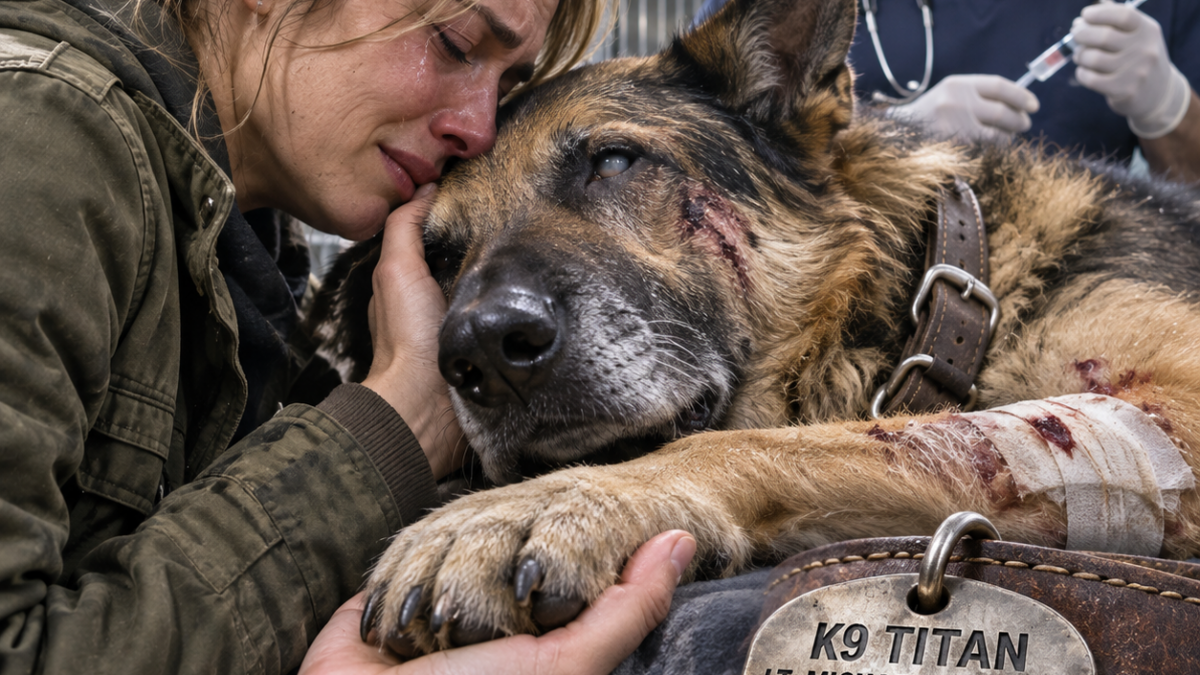
Then, while preparing him for additional examination, I removed the worn leather collar from his neck.
A small metal tag slid beneath my fingers.
Mud and age had darkened it.
I wiped it with gauze.
Letters appeared.
K9 TITAN
LT. MICHAEL SULLIVAN
Below:
NEVER LEAVE A BROTHER BEHIND
I read it twice.
Military identification connected to an individual handler.
That should have been prominent in Titan’s history.
It was not.
I called the rescue organization.
The employee who answered was kind but overwhelmed.
Titan had passed through several facilities after retirement.
Some records were incomplete.
Some military history had never made it into the active veterinary summary.
I asked for everything they had.
Then I searched publicly available memorial records.
I was not looking for drama.
I wanted context.
A photograph appeared.
A young Navy SEAL standing beside a German Shepherd.
The man was smiling.
Titan was younger there.
Dark coat.
Clear eyes.
Powerful body.
But unmistakable.
Same ears.
Same broad skull.
Same markings.
Lieutenant Michael Sullivan.
Killed during a military operation three years earlier.
I looked from the photograph to the old dog sleeping beneath a warm blanket.
Three years.
“What happened to you after he died?”
I whispered.
Titan slept.
No answer.
I called the rescue organization again.
This time I gave them a plan.
Not indefinite treatment without limits.
That would not have been kind.
A real plan.
Improved pain management.
Neurological assessment.
Careful quality-of-life monitoring.
Food response.
Mobility.
Behavioral evaluation in a quieter setting.
“If his comfortable days cannot be maintained, we revisit euthanasia.”
I said.
“But today I don’t think we know enough.”
The authorized representative agreed.
Titan received another chance.
That evening, after the clinic quieted, I kept reading.
Michael’s memorial.
Service history.
Family information.
Near the bottom:
Survived by his father, Commander Jack Sullivan, retired U.S. Navy SEAL, Oregon.
I found a current address near Ashland.
For a long time, I stared at the screen.
A father.
Alive.
In Oregon.
His son’s dog nearly euthanized without him knowing.
Why had no one connected them?
Why had Titan spent three years moving through care when Michael’s father existed?
Then another possibility stopped me.
Maybe they had connected.
Maybe Jack had said no.
I had no right to assume abandonment without knowing.
The next afternoon, I drove to his cabin.
The road climbed through pine forest.
The farther I drove, the quieter everything became.
Jack Sullivan’s house sat alone above a valley.
Weathered wood.
Small porch.
Mountains beyond.
A place that looked deliberately removed from the world.
He answered the door before I knocked twice.
Sixty-eight.
Silver hair.
Shoulders slightly stooped by age but posture still military.
He looked at me cautiously.
“Dr. Harrison?”
“Yes.”
“You said this was about Titan.”
The name changed his face.
Not surprise.
Pain.
So he knew.
“Is he dead?”
That was his first question.
“No.”
Jack closed his eyes.
Something passed through him that I could not name.
Relief?
Fear?
Both.
“Is he in pain?”
“He has significant age-related problems.”
I said.
“Arthritis.”
“Vision loss.”
“Mobility difficulty.”
“But he responds to treatment.”
“He eats when encouraged.”
“He seeks human contact.”
“He recognizes his name.”
“I believe he still has meaningful comfort available.”
Jack stared past me into the trees.
Then he stepped aside.
“Come in.”
The cabin told me more than Jack initially did.
Military photographs.
Unit memorabilia.
A larger portrait above the fireplace.
Michael.
Young.
Graduation.
The same smile as the memorial photograph.
Jack offered coffee.
Neither of us drank much.
I told him what had happened at the clinic.
The euthanasia authorization.
Titan’s response.
The tag.
Jack gripped the back of a chair.
“You found his collar.”
“Yes.”
He nodded.
Then sat.
For a long time, neither of us spoke.
Finally:
“Michael loved that dog.”
“I can tell.”
“No.”
Jack looked at me.
“You don’t understand.”
So I listened.
Michael had grown up under discipline.
Jack admitted that before saying anything else.
“Too much, probably.”
His wife had often told him that Michael needed praise as much as correction.
Jack had spent much of Michael’s childhood deployed.
When he was home, he tried to prepare his son for a difficult world.
Strength.
Responsibility.
Control.
Michael joined the Navy.
Eventually became a SEAL.
Later, Titan entered his life.
Titan, Jack told me, had not been an easy dog.
Smart.
Suspicious.
Independent.
Not the kind that offered immediate trust.
“Michael loved that about him.”
Jack said.
“He used to tell me Titan didn’t want someone dominating him.”
“He wanted someone consistent.”
Michael spent countless hours learning the dog.
Not forcing.
Watching.
Training.
Waiting.
Eventually Titan trusted him.
Then they became inseparable in the way working partnerships sometimes do.
Training together.
Deploying together.
Sleeping near one another in unfamiliar places.
Depending on signals other people barely noticed.
One day Michael told Jack:
“Dad, Titan doesn’t need me to be the toughest man in the room. He needs to know I won’t leave him behind.”
Jack had dismissed it.
“Sentimental.”
He said bitterly.
“That’s what I called it.”
I said nothing.
He was not asking me to absolve him.
Their final disagreement happened during Michael’s last visit home.
Michael admitted he was afraid.
Not afraid to serve.
Afraid of losing people who depended on him.
Jack answered the way Jack had been trained to answer fear.
Control it.
Push it down.
Do the job.
Michael said:
“Being brave doesn’t mean pretending you’re not afraid.”
Jack heard weakness.
Michael heard rejection.
They parted angry.
Several weeks later, Michael died in Afghanistan.
Jack’s voice changed when he reached that part.
Titan had detected signs of an explosive threat and warned the team, helping them avoid an initial danger.
During later movement, another explosion struck.
Michael was fatally injured.
Titan was badly wounded.
Abdominal injuries.
Damage to the left eye.
But he remained near Michael.
Equipment associated with Titan helped rescuers locate two surviving servicemen.
Michael did not come home.
Titan did.
Barely.
Jack stopped speaking.
The clock above the fireplace ticked.
I watched a retired Navy SEAL stare at his dead son’s photograph like three years had not passed at all.
Then he said:
“I went to get Titan.”
I leaned forward.
“What?”
“After Michael died.”
He rubbed both hands over his face.
“I went.”
At Titan’s rehabilitation facility, Jack brought Michael’s old jacket.
He thought the scent might help.
When Titan smelled it, everything changed.
The dog became restless.
Excited.
He went toward the hallway.
Door.
Looked.
Waited.
Searching.
Titan seemed to expect Michael.
Again and again.
Staff tried to guide him toward Jack’s vehicle.
Titan resisted.
His anxiety escalated.
The caregivers recommended more rehabilitation and behavioral evaluation before another transition.
Jack agreed.
Promised to return.
Then Michael’s final belongings arrived.
Uniform.
Photographs.
Personal effects.
A sealed envelope.
A small storage device.
Jack could barely open the box.
He canceled Titan’s next appointment.
He told himself Titan was safer with professionals.
That the dog needed experienced people.
That an older widower living alone in a mountain cabin was not the right home for a wounded military animal.
“Those things were partly true.”
Jack said.
“But not the truth.”
“What was the truth?”
He looked at me.
“Every time I saw that dog, I saw my son waiting to come through the door behind him.”
His voice broke.
“I couldn’t do it.”
He stood abruptly.
Walked into the kitchen.
Opened a cabinet.
Then returned carrying a blue dog bowl.
New.
Original price sticker still underneath.
“I bought this before I went to bring him home.”
He held it with both hands.
“Three years.”
His fingers trembled.
“Nobody has ever eaten out of it.”
I looked at the bowl.
Then at him.
I thought of Titan on the examination table.
The paw on my wrist.
The old dog who still ate when someone sat close enough.
“He’s still here, Jack.”
Jack looked away.
“You may not have three more years with him.”
I said softly.
“But you have today.”
He did not answer.
When I left, the blue bowl was still in his hands.
That night, Jack later told me, he placed the bowl beside his kitchen doorway.
He did not put it back in the cabinet.
A small act.
But grief often changes through small acts before large ones become possible.
Meanwhile, Titan stayed with us for medical observation.
His pain responded somewhat to the adjusted treatment.
He ate more consistently.
He tolerated familiar staff.
The more calm we created around him, the more of him appeared.
That raised another problem.
Where should he go?
A clinic was not a home.
The rescue organization agreed to a supervised foster placement while we continued evaluating his quality of life.
I volunteered.
That decision terrified me more than I admitted.
Not because Titan was a military dog.
I respected that history and understood we needed sensible precautions.
My fear was my son.
Noah.
Eleven years old.
Two years earlier, Noah’s father had died in a traffic accident.
Our home had never recovered properly.
Neither had we.
Before the accident, Noah talked constantly.
Stories at dinner.
Questions.
School drama.
Bad jokes.
Afterward, he withdrew.
Not completely silent.
But close.
He spent hours in his bedroom.
Answered when necessary.
Rarely volunteered anything.
I responded exactly the way I criticize families for responding sometimes.
I worked more.
I told myself the bills had to be paid.
The clinic needed me.
Routine would help Noah.
We were surviving.
That was enough.
Except surviving is not the same as being together.
I prepared the house for Titan.
Orthopedic bed.
Non-slip rugs.
Water bowl.
Easy access to the backyard.
No stairs required.
Medication station.
And rules for Noah.
Never approach Titan suddenly.
Never disturb him while sleeping.
Never touch injured areas.
No unsupervised interaction initially.
Allow the dog to choose distance.
Noah listened.
Then stood in the hallway when Titan arrived.
Old dog.
Old scars.
Cloudy eye.
Slow legs.
Titan settled carefully onto the orthopedic bed.
Noah watched him.
Then asked the first question that changed our house.
“Does he miss somebody?”
I looked at Titan.
Then at my son.
“I think he does.”
Noah lowered his eyes.
“Me too.”
Two words.
I had heard Noah say more than two words many times.
But not like that.
Not with so much underneath them.
I felt suddenly ashamed of every night I had assumed silence meant he wanted to be left alone.
I told Noah Titan needed quiet.
Noah interpreted that creatively.
The next afternoon he brought an adventure book into the living room.
He sat several feet away and started reading aloud.
Not to Titan directly.
Just reading.
His voice was soft.
Titan barely reacted.
Second day, same.
Third.
One afternoon Titan stood.
Slowly.
Crossed the rug.
Noah froze.
Titan sniffed his outstretched fingers.
Then lowered himself beside Noah’s chair with a long old-dog sigh.
Noah looked at me.
His eyes were enormous.
I whispered:
“Keep reading.”
He did.
His voice shook.
But he read.
That became their routine.
By the fifth day, Titan slept near Noah’s feet during homework.
By the seventh, he began stealing one of my gardening gloves.
He would carry it toward Noah’s chair and drop it.
The first time, Noah laughed.
“Mom.”
“What?”
“He steals your stuff because he likes me better.”
I pretended offense.
“Tell your criminal friend I would like my glove returned.”
Noah laughed again.
I had forgotten how much I missed that sound.
By the tenth day, Noah renamed Titan.
“Captain Braveheart.”
I raised an eyebrow.
“He already has a name.”
“It’s a second name.”
“Why?”
“Because he’s brave.”
“And captains are allowed to be old.”
I had no argument.
Titan seemed indifferent.
Which Noah interpreted as approval.
The happiest moment came on an ordinary Saturday.
Laundry.
I had left a basket of warm towels on the floor.
Titan climbed into it.
This enormous retired military German Shepherd curled himself into clean towels as if he had always been intended for laundry service instead of combat.
Noah found him.
He laughed so hard he had to sit down.
I took out my phone.
Then stopped.
I did not photograph Noah first.
I watched.
His whole face.
Open.
Free.
For a second, I saw the child he had been before his father died.
I almost cried.
Instead, I laughed with him.
That evening Noah started telling me every detail again.
How Titan turned in circles.
How he pushed one towel out.
How his tail got stuck under another.
Then my clinic phone rang.
Habit won.
I answered.
Emergency question.
A few minutes.
When I came back, Noah had stopped talking.
“What’s wrong?”
“Nothing.”
He looked down.
“You’re busy.”
That resignation hurt worse than anger.
How many times had he begun something important and watched me choose a phone?
How often had he learned that my patients always came first because their emergencies were visible and his grief was quiet?
I silenced the phone.
Sat on the rug.
“I’m here now.”
He shrugged.
“Tell me again.”
“What?”
“The towel story.”
“You heard it.”
“I want the director’s cut.”
That got a smile.
So he started again.
Every ridiculous detail.
I listened.
No checking messages.
No pretending to listen.
I laughed when he laughed.
Something changed that night.
Not fixed.
Changed.
A package arrived from Jack a few days later.
Inside was a blue blanket.
Michael’s.
Old.
Soft.
Folded carefully.
I placed it on Titan’s bed.
Titan approached.
Stopped.
Sniffed.
Long.
His nose moved along one edge.
Then another.
Finally he lowered himself onto it.
Rested his muzzle against a worn corner.
Noah watched.
“Does he remember?”
“I don’t know exactly how dogs remember.”
“Do they remember people forever?”
I sat beside him.
“Maybe love doesn’t disappear just because somebody is gone.”
The sentence came out before I thought about it.
Noah looked at me.
I realized I was talking about us too.
I photographed Titan asleep on Michael’s blanket beside Noah.
Sent it to Jack.
His response came several minutes later.
Does he still like chicken?
I smiled.
Of all questions.
Not:
Does he still remember Michael?
Not:
Is he dying?
Chicken.
Present tense.
That told me something.
Jack was beginning to think about Titan as a living dog.
Not only as evidence of a dead son.
The next afternoon I spoke on the phone with one of Titan’s veterinary specialists.
Progressive disease.
Quality of life.
Limited time.
Standard language.
Necessary language.
Noah passed the kitchen at exactly the wrong moment.
He heard fragments.
I did not see him.
He went upstairs.
The next morning he entered the kitchen before school.
“Are you sending Titan away?”
The fear in his voice stopped me.
“No.”
“You said he could stay.”
“I promised we would take care of him.”
“You said ‘not much time.’”
I realized.
“Oh.”
His eyes filled.
“Is he dying?”
There is no good lie for that.
“Titan is very old.”
“His arthritis is serious.”
“We can help his pain, but we can’t make him young.”
“You promised.”
“I promised we would care for him.”
“That’s different.”
“Yes.”
I moved toward him.
He stepped back.
Before I could explain more, the clinic phone rang.
Urgent.
I looked at it.
Then Noah.
I wish I could tell you I ignored it.
I answered.
I told Noah:
“Give me two minutes.”
I thought two minutes was reasonable.
For him, it was proof.
Another important conversation could wait.
Again.
By the time I ended the call, his bedroom door was closed.
I knocked.
No answer.
I told myself he needed space.
I had been telling myself that for two years.
That afternoon, I was preparing Titan’s medication when I realized Noah was not upstairs.
Backyard gate open.
His shoes gone.
My stomach dropped.
“Noah?”
Nothing.
I called.
No answer.
Titan had been sleeping near the back door.
Suddenly his head lifted.
He looked toward the yard.
Struggled upright.
Paced.
I assumed he needed outside.
“Okay, old man.”
I opened the door.
Titan did not go toward his usual patch of grass.
He moved toward the gate.
Stopped.
Looked back.
Whined.
Low.
Insistent.
My heart started racing.
“Noah!”
No answer.
Titan moved forward again.
His hind legs were stiff.
He was not the military dog from Michael’s photographs anymore.
But his attention changed completely.
Focused.
I grabbed my jacket and phone.
Followed.
The wooded trail behind our property led toward a creek.
Noah’s father had taken him there to fish.
I knew that.
I also knew Noah occasionally went to the edge of the trail when upset, but never alone beyond the first clearing.
Titan kept moving.
Slowly.
He had to stop twice to steady himself.
My veterinary brain screamed at me.
His arthritis.
The distance.
The uneven ground.
But another part of me saw the old working dog.
Not fast.
Still purposeful.
At one bend, Titan turned toward the creek.
Then I heard it.
“Mom!”
Faint.
I ran.
“Noah!”
“I’m down here!”
He had slipped from the muddy trail into a shallow depression.
His ankle swollen.
Phone lost somewhere uphill.
He was shivering.
Terrified.
“Oh, sweetheart.”
I wanted to climb down immediately.
Forced myself to think.
“Don’t move.”
“I’m calling for help.”
Titan stood above the slope.
Breathing heavily.
Noah saw him.
“Titan.”
The old dog lowered himself near the edge.
Stayed.
Emergency responders arrived.
They brought Noah safely back to the trail.
Likely sprain.
No major injury.
The moment he could reach Titan, Noah wrapped his arms around the dog’s shoulders carefully.
“You came for me.”
He cried.
“Just like Dad would have.”
I knelt beside them.
And something inside me finally shattered.
Not because Titan found him.
Because I realized how much of Noah’s grief I had mistaken for independence.
My son had gone to the creek because it still felt connected to his father.
He was not running away.
He was trying to find a place where loss felt less empty.
And the one who heard him was a twelve-year-old dog carrying his own history of loss.
We took Titan to the clinic too.
The exertion had worsened his arthritis pain.
No new catastrophic injury.
Thank God.
But he needed additional pain management and several days of rest.
Noah stood beside the table.
Face pale.
“If I hadn’t gone out, he wouldn’t hurt.”
I crouched.
“You should not have gone into the woods alone.”
“We will talk about that.”
“But Titan was already sick.”
“You did not cause his age.”
“You did not cause his arthritis.”
“He chose to come.”
Noah cried.
“But he got hurt because of me.”
I touched his chin.
“Something happening after your choice does not mean you caused every part of it.”
That sentence was for more than Titan.
Noah’s father.
The accident.
All the irrational guilt children build when adults do not help them name it.
“We both have things to learn.”
I said.
“And we both still have time.”
That evening, I called Jack.
He arrived at the clinic less than an hour later.
Jack entered Titan’s examination room slowly.
No uniform.
No medals.
No commanding presence.
Just an old father.
Titan lay on Michael’s blue blanket.
Jack stopped.
I watched his face.
For three years he had avoided this dog because the sight of him hurt too much.
Now Titan looked nothing like the powerful animal in the photograph.
Thin.
Gray.
Cloudy eye.
Scars.
Time everywhere.
Jack whispered:
“Titan.”
The dog lifted his head.
Jack lowered himself onto one knee.
Held out a hand.
Did not grab.
Did not command.
Waited.
Titan sniffed his fingers.
Paused.
Then rested his muzzle against Jack’s knee.
Jack broke.
Tears rolled down his face.
“I’m sorry, boy.”
He stroked the silver fur.
“I should have come back.”
Titan stayed.
No accusation.
No explanation required.
Jack cried for Michael.
For Titan.
For three lost years.
For himself.
I stood outside the room after a while and let them have privacy.
Sometimes medicine is knowing when nothing medical is needed.
That night Jack returned to his cabin.
The blue bowl remained beside the kitchen doorway.
He walked into his bedroom.
Opened Michael’s box.
The one he had avoided.
Uniform.
Photographs.
Then the sealed envelope.
Inside:
USB drive.
On the envelope, Michael’s handwriting.
FOR DAD, WHEN YOU’RE READY.
Jack had seen it three years earlier.
Never opened.
He called Sarah Mitchell.
A former military medic who had helped deliver Michael’s belongings.
“Sarah.”
“I found the drive.”
Silence.
Then:
“He made something for you.”
Jack closed his eyes.
“You knew?”
“Yes.”
“Can you come?”
“I don’t think I can watch it alone.”
“Of course.”
Sarah arrived after sunset.
Jack later told me everything.
They sat at his kitchen table.
Photograph of Michael and Titan nearby.
The blue bowl visible near the doorway.
Sarah explained that Michael had recorded personal messages before dangerous deployments.
Not because he expected to die.
Because people in that world understand uncertainty.
She had called Jack after delivering his belongings.
Asked if he watched.
He always said no.
“I thought one day hearing his voice wouldn’t hurt.”
Jack told her.
Sarah said:
“Maybe I should have pushed.”
Jack shook his head.
“You can’t open something for a man who refuses to touch it.”
He connected the drive.
The screen lit.
Michael appeared.
Young.
Alive.
Titan beside him.
Powerful.
Dark eyes.
Ears up.
Jack heard:
“Hey, Dad.”
Three years vanished.
He almost stopped the video.
Sarah kept one hand near his.
Did not touch until he reached.
Michael spoke about childhood.
Baseball games Jack missed.
Meals kept warm.
Anger at having a father somewhere else in the world.
Jack bowed his head.
Then Michael remembered something else.
A childhood fever.
Jack returning after weeks away.
Still wearing uniform.
Sitting beside Michael’s bed all night.
When Michael woke, his father was asleep in a chair with his hand still near the bed.
“I never forgot that.”
Michael said.
Jack cried harder.
The worst memories had not erased the good ones.
His son had carried both.
Then Michael addressed their final argument.
“I wasn’t trying to disappoint you.”
“I was trying to tell you who I was.”
He spoke about fear.
Responsibility.
Men depending on him.
Then:
“Being brave doesn’t mean pretending you’re not afraid.”
Jack covered his mouth.
The sentence he had rejected.
Michael continued:
“I learned that from watching you, even if neither of us understood it then.”
Then he turned to Titan.
Rubbed behind his ears.
The younger Titan leaned against him.
“One day this old boy is going to retire.”
Michael smiled.
“No more explosions.”
“No more orders.”
“No more long nights.”
Titan nudged his hand.
Michael laughed.
Then his expression softened.
“If I don’t get the chance to grow old, Dad, promise me he will.”
Jack stopped breathing.
Michael rested his hand against Titan’s chest.
“Let him chase squirrels.”
“Let him sleep on the couch.”
“Let him be a dog, Dad.”
“Not a soldier forever.”
The video ended.
Black screen.
Silence.
Jack sat completely still.
Then whispered:
“I thought my son died disappointed in me.”
Sarah waited.
Jack wiped his face.
“But he was asking me to live.”
The next morning, Jack started asking questions.
Not about Michael’s death.
Titan’s future.
Records.
Adoption.
How had the process failed?
Why did he never get called again?
The rescue organization cooperated.
There had been errors.
Jack had originally expressed interest.
His information existed.
Then Titan’s care became complicated.
Transfers.
Medical needs.
Departments.
Staff shortages.
No one followed through properly.
Robert Hayes, the organization’s records manager, admitted communication had failed.
Jack requested a formal review.
Not revenge.
Better procedures.
“Titan is still alive.”
He told me.
“I’m not wasting what time he has left fighting about paperwork.”
That sentence told me the video had changed him.
Jack visited our house.
Titan lay beside the fireplace on Michael’s blanket.
When Jack approached, his tail moved slowly.
Jack sat beside him.
No Afghanistan.
No final mission.
No regrets.
Instead:
“I made a promise to your boy.”
He stroked Titan’s head.
“And I’m going to keep it.”
Titan leaned closer.
Jack formally applied to adopt Titan.
We did not rush.
Emotion does not replace care planning.
Titan had serious medical needs.
Arthritis.
Limited vision.
Mobility support.
Medication.
Potential difficult end-of-life decisions.
I explained everything.
Jack listened.
Then said:
“I spent too many years thinking love meant protecting somebody from every danger.”
He looked at Titan.
“I can’t protect him from getting old.”
“But I can make sure he doesn’t face it alone.”
His home was assessed.
Care plan approved.
Jack became Titan’s legal owner.
But we made a decision that surprised some people.
Titan stayed primarily at my house.
Because by then, he had become attached to Noah.
Our house was already arranged for his mobility.
He felt safe there.
Jack did not interpret ownership as possession.
He came every morning.
Shared care.
Paid expenses.
Helped.
Stayed.
That arrangement was exactly what Titan needed.
Not a dramatic relocation.
A bigger family.
Jack arrived early with breakfast.
Sometimes chicken if I had approved it.
He helped Titan stand.
Walked with him into the yard.
Noah often joined.
At first, Noah asked questions about Michael carefully.
“Was he really a SEAL?”
“Yes.”
“Was he scary?”
Jack almost laughed.
“To me?”
“No.”
“Did he ever mess up?”
That opened a door.
Jack began telling funny stories.
Michael burning toast so badly the smoke alarm went off.
Michael refusing swimming lessons as a child because the water was freezing.
Michael trying to teach Titan to catch a ball and slipping in mud while Titan stood over him looking pleased.
Noah laughed.
“Michael was clumsy?”
“Only when somebody was watching.”
Jack smiled.
Every time he told a good memory, something in his face changed.
Grief had spent three years convincing him remembering Michael meant reliving the death.
Titan and Noah taught him otherwise.
Memory also contained toast.
Mud.
Swimming pools.
Laughter.
The dead are not only the moment they died.
That realization healed something in all three of us.
One afternoon Titan lay under the maple tree.
A squirrel ran along the fence.
Titan’s head snapped up.
For several seconds, I saw the younger dog.
Attention.
Interest.
He pushed himself to his feet.
Slow.
Took several steps toward the squirrel.
The squirrel escaped into branches.
Titan stopped.
Looked almost offended.
Noah burst out laughing.
Jack laughed too.
He knelt.
“That’s right, buddy.”
“No orders.”
“No missions.”
“Just squirrels.”
Michael’s words.
Finally real.
Those weeks were not a miracle cure.
Titan remained old.
Arthritis progressed.
Some mornings were good.
Some not.
Medication helped.
Soft food.
Warm bedding.
Short walks.
Sunlight.
Human contact.
What we were measuring was no longer whether Titan could become healthy.
He could not.
We were measuring whether he still had enough good life to enjoy.
Food.
Voices.
Noah’s reading.
Jack’s arrival.
The yard.
Occasionally a squirrel.
As long as those things mattered to him and pain could be controlled, we continued.
That is what quality-of-life medicine asks.
Not:
Can we keep the heart beating?
But:
What is the experience of being alive?
One evening I spoke privately with Jack.
“We need to prepare.”
His face changed.
“For what?”
“The day medication may stop being enough.”
He looked toward Titan sleeping.
“How will I know?”
“We look at pain.”
“Comfort.”
“Eating.”
“Mobility.”
“Whether he can still enjoy the things he loves.”
“We will not decide from panic.”
“We will not keep him suffering because we are afraid.”
Jack nodded slowly.
Keeping Michael’s promise did not mean forcing Titan to stay forever.
It meant giving him the old age Michael wanted.
And when that old age became pain without relief, love would have to change form.
Jack understood.
Intellectually.
Emotionally would take longer.
That evening Titan rested on the blue blanket.
Noah read on the couch.
Jack sat on the floor.
I cooked dinner.
No orders.
No missions.
No expectation.
Just a family spending an ordinary evening.
I remember stopping in the kitchen doorway.
Watching.
This.
This was Michael’s request.
Let him be a dog.
Titan was doing exactly that.
Sleeping.
Stealing gloves occasionally.
Watching squirrels.
Listening to a boy read.
Receiving chicken he did not technically need.
Loved.
That was enough.
Three months passed.
Noah started a blue notebook.
Title:
THE BRAVE SOLDIER WHO CAME HOME
He filled it with Titan stories.
Not military stories.
Laundry basket.
Gardening glove.
Squirrel.
Snoring.
The time Titan refused a medication hidden in food and somehow ate everything around it.
Noah did not care how many missions Titan had served anymore.
To him, Titan was the dog who lay beside his chair when loneliness became too heavy.
That was Titan’s second career.
No uniform.
No handler.
Just presence.
Some careers matter more than they look.
Titan weakened gradually.
His jaws tired.
Sometimes he tried carrying my gardening glove toward Noah and dropped it halfway.
Noah would pick it up.
Place it beside him.
“Good job, Captain.”
“You did your best.”
Titan’s tail would move.
Faint.
Enough.
Jack continued mornings.
Breakfast.
Short walks.
Some days Titan could manage the yard.
Other days only a few steps.
We adjusted.
No heroics.
No demanding yesterday from today.
That is another form of love.
Meeting someone where their body is now.
Then one spring morning, Titan could not stand.
Jack arrived with breakfast.
Titan lifted his head.
That was all.
Food untouched.
I examined him.
His pain had changed.
Not a single bad morning.
A pattern.
The difficult days had begun outnumbering the comfortable ones.
Medication adjustments were no longer restoring meaningful ease.
I called the specialist.
We reviewed everything.
The conclusion was the one I had hoped not to reach soon.
But hope cannot be the clinical standard.
I sat with Jack.
“We’re there.”
He looked at me.
No denial.
Just devastation.
Noah was the harder conversation.
When I told him, he cried immediately.
“But we saved him once.”
I held him.
“Why can’t we save him again?”
Because the first time, Titan still had comfortable life available.
He could eat.
Walk outside.
Enjoy us.
Medication gave him something back.
Now his body was hurting in ways we could no longer make sufficiently better.
Noah shook his head.
“I’m not ready.”
No child is.
No adult is either.
Jack sat beside him.
For a long time he did not speak.
Then:
“After Michael died, I thought loving him meant holding onto everything.”
“His clothes.”
“His photographs.”
“My guilt.”
“I thought if I stopped hurting, maybe I was leaving him behind.”
Noah listened.
Jack looked at Titan.
“I was wrong.”
“Sometimes love is holding on.”
“And sometimes…”
His voice broke.
“Sometimes love is being brave enough to let someone rest.”
Noah stared.
“Will it hurt him?”
“No.”
Jack looked at me.
I nodded.
“We’ll make sure he is relaxed.”
“Comfortable.”
“You can stay.”
Noah wiped his face.
“Can I hold his paw?”
“Yes.”
Jack placed one hand on Noah’s shoulder.
“That’s what family does.”
We prepared the living room.
Not the clinic.
Titan’s favorite place.
Michael’s blue blanket.
Noah brought his small pillow.
Jack placed fresh water nearby even though Titan was unlikely to drink.
Sunlight came through the windows.
Soft.
Warm.
Titan rested.
No fear.
No unfamiliar room.
Only people he knew.
People who loved him.
I followed the end-of-life plan carefully.
I had done this before.
Never with a patient whose story had changed my own family.
That made every professional movement harder.
But Titan needed me to be his veterinarian too.
Not only Emily.
I administered medication to help him relax.
His body softened.
The tension left his face.
Noah held one paw.
Jack stroked his ears.
I listened.
Watched.
Waited until I knew he was comfortable.
Jack bent close.
“Mission complete, soldier.”
His voice trembled.
Then softer:
“Michael’s waiting.”
“You can rest now.”
I completed the final medication.
Titan’s breathing slowed.
Then stopped.
Quiet.
No struggle.
No panic.
A twelve-year-old German Shepherd who had survived explosions, injury, military service, transfers, grief, old age, and almost an early death in my clinic—
died in a living room.
On a blue blanket.
With a child holding his paw.
A father touching his ears.
Loved.
Exactly as Michael had asked.
Not a soldier forever.
A dog.
Finally.
Afterward, nobody moved for a long time.
Noah cried against Jack’s shoulder.
Jack kept one hand on Titan.
I sat on the floor.
Veterinarians are supposed to understand death.
Understanding does not prevent grief.
The house changed immediately.
That is the cruel thing.
A body can still be in the room and absence has already begun.
The following days were quiet.
Titan’s bed beside the fireplace.
Empty.
No nails on wood.
No slow breathing by Noah’s chair.
I would turn automatically sometimes expecting to see him.
Noah stopped reading in the living room for several days.
Then one afternoon he brought the blue notebook.
Sat.
Read one of his own Titan stories aloud.
To nobody.
To us.
Maybe to memory.
That was progress.
Not moving on.
Continuing.
Jack returned to his cabin with the blue food bowl.
The next morning, six o’clock, he woke as he had for decades.
Walked into the kitchen.
Reached toward the bowl.
Then remembered.
He sat down.
Michael.
Titan.
Loss.
But this time he did not shut the cabinet.
Did not hide the objects.
Did not run from memory.
He let it hurt.
That was different.
Several weeks later, Jack went to a local rescue organization.
Older dogs.
Animals people overlooked because age frightened adopters.
He did not go intending to replace Titan.
Replacement is impossible and unfair.
An employee showed him an elderly German Shepherd resting alone.
Jack pulled up a chair.
Kept distance.
No commands.
No reaching.
He opened an old book Michael had once loved.
Started reading.
Softly.
After a while, the dog stood.
Approached.
Settled near Jack’s feet.
Jack smiled.
That was all.
No dramatic adoption on the spot.
No claim that Titan had “sent” the dog.
Just a grieving man realizing he still had companionship to offer.
That mattered.
Noah kept the blue notebook.
The Brave Soldier Who Came Home.
He eventually added the final chapter.
He showed it to me.
I asked permission to read.
He nodded.
The last line said:
Titan did not lose his last mission. His last mission was learning that he was allowed to rest.
I had to stop.
Noah watched me.
“Too sad?”
“Yes.”
“Good sad?”
I smiled.
“Maybe.”
He looked at me.
“Mom?”
“Yes?”
“Do you think Dad would have liked him?”
I thought of Titan leading me toward the creek.
Of Noah holding the old dog.
“Very much.”
Noah nodded.
“So do I.”
Titan changed my relationship with my son more than any parenting book could have.
Not because a dog magically healed grief.
That would cheapen both grief and Titan.
He created moments.
Opportunities.
A reason for Noah to leave his bedroom.
A reason to read aloud.
A reason to ask questions about missing someone.
A reason for me to sit down and listen.
Titan did not fix us.
He brought us into the same room long enough that we could start fixing what distance had done.
That is different.
And more beautiful.
I reduced my clinic hours.
Not drastically.
Patients still needed me.
But I created boundaries.
Dinner became protected more often.
Noah knew emergencies could interrupt.
But ordinary work no longer automatically won.
Sometimes the phone rang and I let another veterinarian handle it.
The first time I did that, Noah noticed.
“You’re not answering?”
“No.”
“Why?”
“I’m talking to you.”
He tried to hide how much that mattered.
He failed.
Jack visited.
Not every morning anymore.
But often.
He and Noah developed a friendship.
The retired Navy SEAL and the eleven-year-old boy.
Michael stories.
Titan stories.
Fishing eventually.
The creek again.
This time with me knowing.
This time safe.
Noah’s father remained absent.
Nothing replaces a parent.
Jack did not try.
He became Jack.
That was enough.
One afternoon, Noah asked Jack:
“Do you still feel guilty about Michael?”
Jack answered honestly.
“Sometimes.”
“Even after the video?”
“Yes.”
“Why?”
“Because feelings don’t disappear just because you understand them.”
Noah thought.
“Then what was the point?”
Jack smiled sadly.
“Understanding tells me what to do when the feeling comes.”
“What do you do?”
“I remember the whole story.”
“Not only the ending.”
I wrote that sentence down later.
It became something I used with families.
Remember the whole story.
Not only the last day.
Not only the accident.
Not only the diagnosis.
A life is larger than its ending.
Titan taught us that.
If I had euthanized Titan that winter morning without reassessing him, I would have followed paperwork.
I might even have believed I had done the compassionate thing.
That thought still frightens me.
Not because euthanasia itself was wrong for Titan.
Eventually, it was exactly the compassionate decision.
Timing was everything.
Three months earlier, he still had life to live.
Chicken.
Noah.
Jack.
Squirrels.
Blankets.
Gloves.
A final rescue along the creek.
A promise kept.
Those months mattered.
That is why end-of-life medicine must be individual.
We are not deciding whether death is sad.
Death is sad.
We are deciding whether life remains meaningfully comfortable.
That winter morning, Titan told me through behavior:
Not yet.
In spring, his body told us:
Now.
Both truths deserve respect.
People sometimes romanticize the tear from his damaged eye.
I do not.
I still believe physiology explains it.
The thing that changed my decision was not a tear.
It was response.
He recognized his name.
He ate.
He sought touch.
He engaged.
Observable things.
Compassion needs evidence too.
Otherwise we risk turning our wishes into medicine.
Titan taught me to hold both.
Science.
Heart.
Neither should eliminate the other.
Jack taught me something too.
Avoidance can look responsible.
He had a dozen respectable explanations for not bringing Titan home.
Medical complexity.
Behavior.
Experience.
Safety.
All partly true.
But beneath them was grief.
The human mind is very good at building logical houses around emotional fear.
I had done the same thing with work.
Noah needs stability.
The clinic needs me.
Bills matter.
Routine matters.
All true.
And beneath:
I do not know how to sit beside my son’s grief because it reminds me of mine.
Titan exposed both of us.
Jack and me.
Different houses.
Same hiding.
Michael’s recording became important far beyond Jack.
I never heard the full original directly; Jack told me what he was comfortable sharing.
But one sentence stayed:
Being brave doesn’t mean pretending you’re not afraid.
For military men.
For children.
For parents.
For veterinarians.
For anyone facing an old dog’s last day.
Courage is not numbness.
Jack had confused emotional control with strength for decades.
Noah had begun confusing silence with protection.
I had confused busyness with coping.
Michael, from a recording made years earlier, challenged all of us.
Fear can exist.
Grief can exist.
You still act with love.
That is courage.
And then:
Let him be a dog, Dad. Not a soldier forever.
That may be one of the most loving things I have ever heard.
Michael knew Titan as a working dog.
He respected the job.
But he also understood Titan’s worth exceeded service.
No missions.
No explosions.
No orders.
Squirrels.
Couch.
Old age.
Rest.
A life after usefulness.
How many creatures—and people—need permission for that?
Jack had built his identity around service.
Michael too.
Titan too.
Maybe the final gift Michael gave them both was permission to stop proving themselves.
Jack was allowed to be a father who missed his son.
Titan was allowed to be an old dog.
That was enough.
Titan never became young again.
His cloudy eye remained cloudy.
Scars remained.
Arthritis remained.
His last months were not a miracle transformation.
That matters.
Rescue stories often pretend kindness reverses biology.
It does not.
We gave him comfort.
Not youth.
Love.
Not immortality.
Time.
Not forever.
Those distinctions make the story more meaningful, not less.
Because knowing something is temporary and choosing to love it anyway is one of the bravest things humans do.
Noah learned that.
Jack learned that.
I did too.
The rescue organization completed its review.
Procedures changed.
Potential previous adopters and family contacts were documented more clearly.
Aging working dogs received additional follow-up.
Robert Hayes never became some villain I needed to destroy.
He had made mistakes inside an overwhelmed system.
Jack held him accountable.
Then focused on improvement.
I respected that.
Anger can identify a problem.
But if anger becomes the mission, the animal disappears behind it.
Jack refused to let paperwork steal Titan’s remaining time.
That was wisdom earned painfully.
Titan’s blue blanket stayed with Jack for a while.
Eventually, he began taking it when he visited older dogs at rescue facilities.
Not as some magical object.
It smelled familiar.
Soft.
Useful.
I liked that.
Michael had wanted Titan to have comfort.
The blanket continued providing comfort to other old bodies.
No plaque required.
No ceremony.
Just practical kindness.
That felt right.
Months after Titan died, I came home one afternoon and found Noah asleep on the living-room rug.
A book on his chest.
For one second, my heart hurt because Titan should have been near his feet.
Then I noticed something else.
Noah’s bedroom door was open.
It stayed open more often now.
He had friends over sometimes.
He talked at dinner.
Not every night.
But enough.
Grief had not left.
His father was still dead.
Titan was now dead too.
But Noah no longer treated love as something safer when hidden.
That was progress.
One evening he said:
“I think losing Titan was different.”
“How?”
“Dad disappeared.”
I winced.
He corrected:
“I know he didn’t choose.”
“I mean it happened.”
“Suddenly.”
“With Titan, we knew.”
“We stayed.”
I understood.
Death still hurt.
But Titan’s goodbye contained agency.
Preparation.
Presence.
No unfinished question of whether the person knew they were loved.
That mattered to Noah.
Maybe that was part of why Titan entered our lives when he did.
Not fate.
I am careful with that word.
But timing gave us an opportunity to show Noah that some goodbyes can be held differently.
Jack once told me:
“I spent three years thinking I failed Michael because our last conversation was an argument.”
Then:
“Titan taught me one bad conversation does not erase a lifetime.”
That sentence became another I carried.
Our minds are cruel after sudden death.
They grab the final moment and crown it as summary.
It is not.
Michael and Jack had baseball games, fever nights, missed dinners, arguments, pride, resentment, love.
All of it.
One argument did not define them.
Noah’s last morning with his father did not define them either.
Titan’s final spring morning did not define Titan.
A life is accumulation.
Remember the whole story.
Years of veterinary practice had taught me animal death.
Titan taught me animal legacy.
Not mystical.
Behavioral.
Human.
The relationships built around an animal continue changing people after the animal is gone.
Noah read more.
Jack visited rescues.
I changed how I talked to families about quality of life.
Our clinic became more careful about behavioral reassessment before final decisions in complicated cases.
Titan’s life influenced choices.
That is legacy enough.
I keep a photograph in my office.
Not Titan as a military dog.
Not the examination-table morning.
The laundry basket.
Yes.
The distinguished retired military working dog asleep in warm towels like a shameless house pet.
Noah took it.
Titan’s cloudy eye closed.
Silver muzzle.
One ear bent against a towel.
No mission.
No danger.
Just sleep.
When families ask whether choosing comfort means giving up, I sometimes look at that photograph.
Comfort was Michael’s final wish for Titan.
Comfort was not failure.
It was the mission.
There are days when I still think about that first morning.
The euthanasia paperwork prepared.
The old dog on the table.
The paw on my wrist.
What if I had been rushed?
What if the clinic had been busier?
What if I had interpreted his growl history without context?
Those questions can become dangerous too.
Hindsight.
We did reassess.
That is what matters.
Medicine must allow the sentence:
“I need another look.”
Even when a decision has already been written.
Especially when the decision is irreversible.
At the same time, Titan’s later death taught the opposite lesson.
Do not endlessly reassess because you cannot emotionally accept the answer.
There comes a point when “one more day” becomes for us, not them.
Jack could have asked for more.
Noah certainly wanted more.
I wanted more.
Titan’s body did not.
So we listened then too.
First:
Not yet.
Later:
Now.
Listening both times was love.
Jack eventually told me the blue bowl remained in his kitchen.
After Titan died, he almost put it back in the cabinet.
He stopped.
Left it out.
Not because he expected Titan.
Because hiding it had once meant hiding Michael.
Now the bowl could simply exist.
An object.
Memory.
No punishment.
That may sound small.
Grief recovery is often small.
A bowl left on the floor.
A photograph returned to a wall.
A name spoken without leaving the room.
A boy reading aloud again.
Small acts.
Life rebuilt from them.
Sarah Mitchell stayed in touch with Jack.
She had carried guilt too.
She believed she should have pushed him harder to watch Michael’s recording.
Jack released her from that.
“You called.”
He told her.
“I said no.”
“We can’t force someone to grieve correctly.”
There is no correctly anyway.
Only ways that move toward connection and ways that move toward isolation.
Jack had chosen isolation.
Then changed.
That was enough.
Noah asked once whether Titan knew Michael had died.
I said I didn’t know.
He asked whether Titan waited for him.
Again, I didn’t know.
Dogs understand absence in their own way.
They search.
They change.
They remember scents.
We should not pretend we can narrate everything inside them.
Noah accepted that.
Then said:
“I think he knew Michael wasn’t there.”
“Yes.”
“But maybe he didn’t know why.”
“Maybe.”
“That’s sad.”
“Yes.”
Then:
“I’m glad Jack came back.”
“So am I.”
Sometimes uncertainty does not prevent compassion.
We do not need to know exactly what Titan understood to know companionship mattered.
When Jack first met Titan again in the clinic and the old dog rested his muzzle on his knee, I did not call it forgiveness.
That word belongs to human moral systems.
Maybe Titan recognized scent.
Voice.
Connection.
Maybe not much else.
But the moment gave Jack permission to stop treating himself as unforgivable.
That was important.
Titan did not need to judge him.
Jack had done enough judging for three years.
The blue notebook remained Noah’s.
I once asked if he wanted to publish the story for school.
He shook his head.
“It’s ours.”
I respected that.
Not every meaningful thing needs an audience.
Some stories exist to help the writer survive.
I tell Titan’s story now only when it serves something.
A family struggling with an elderly dog.
A veterinarian wondering whether a withdrawn animal needs a quieter reassessment.
A parent asking how children handle pet loss.
A veteran holding more guilt than memory.
Then I say:
There was an old German Shepherd.
A military dog.
A dead handler.
A father who waited too long.
A boy who had lost his own father.
And for three months, they taught each other something about staying.
Not forever.
Long enough.
That is the part I return to.
Long enough.
Titan did not need ten more years.
He needed the months he still could enjoy.
Jack did not need to undo three years.
Impossible.
He needed today.
Noah did not need his father brought back.
Impossible.
He needed his mother to sit beside him now.
So much grief comes from bargaining with impossible time.
Healing begins when we ask:
What is still available today?
Titan ate chicken today.
Titan sat in sun today.
Noah wants to read today.
Jack can visit today.
I can silence my phone today.
Small.
Real.
Michael’s message said:
“If I don’t get the chance to grow old, Dad, promise me he will.”
Titan did.
He grew old.
Very old.
His muzzle silvered.
His joints hurt.
His sight dimmed.
That may sound like a sad fulfillment.
It was a privilege.
Old age is what Michael never received.
Titan did.
And because people finally listened, his old age included more than medical decline.
It included family.
That was the promise.
The day Titan died, Jack called him “soldier.”
Then released him from the role.
Mission complete.
I loved that.
Because Titan’s service mattered.
We did not need to erase it to let him rest.
Humans sometimes think peace requires pretending painful histories never happened.
No.
Titan had been a soldier.
Michael had been a SEAL.
Jack had been one too.
Those identities shaped them.
Peace meant they no longer had to be only those things.
Jack could be Dad.
Titan could be old boy.
Michael could be remembered laughing in mud.
That expansion was healing.
If I could return to the examination room on that first winter morning, knowing everything I know now, I would still do the same thing.
Touch the leg.
Say his name.
Offer food.
Wait.
Observe.
Ask another question.
That is all it took to open the possibility.
Not heroism.
Attention.
And if I could return to Titan’s final morning?
I would do the same thing again too.
Listen.
Accept.
Comfort.
Stay.
That duality is what veterinary medicine asks from us.
Fight when there is meaningful life to protect.
Release when fighting becomes suffering.
Neither choice is more loving automatically.
Timing decides.
Titan taught me that better than any textbook.
Noah is older now.
He still occasionally calls Titan Captain Braveheart when we talk about him.
Jack still laughs at that name.
He says Michael would have made fun of it.
Noah says Michael would have secretly liked it.
Jack usually admits he is probably right.
That is what memory sounds like in our home now.
Not silence.
Conversation.
Disagreement.
Laughter.
Pain allowed in.
Not in charge.
The last photograph I took of Titan alive is not dramatic.
He is lying on Michael’s blue blanket.
Jack’s hand resting near his shoulder.
Noah sitting beside him with the blue notebook.
Sunlight on the floor.
Titan’s eye closed.
No one looking at the camera.
I almost deleted it because the composition was poor.
I am glad I didn’t.
That photograph contains the entire story.
A dog once trained for danger resting safely.
A father who once ran from grief staying.
A child who once stopped talking reading.
And me behind the camera, finally present enough to notice.
Some soldiers come home with medals.
Some come home with scars.
Some do not come home.
Titan came home carrying both the visible and invisible remains of service.
He did not need another mission.
He needed someone to understand that survival itself does not create a debt.
He had already done enough.
Michael understood that before the rest of us.
“Let him be a dog.”
So we did.
For three months.
Three months may sound small compared with twelve years.
It was not.
To Titan, those three months contained chicken.
Warm towels.
Squirrels.
A boy’s voice.
A blue blanket.
A father’s hand.
A garden.
Rest.
A family.
No orders.
No explosions.
No one leaving him behind.
And when the day finally came that his body could carry no more, we stayed.
All of us.
Until the last breath.
That was the promise.
Not that Titan would never die.
Not that love could defeat age.
Only this:
He would not face the end alone.
Michael had once said a partner needs to know you will never leave him behind.
Three years after Michael died, Jack finally understood.
Noah understood too.
So did I.
And when Titan’s mission was finally complete—
we were still there.








