PART2:The Police Dog Broke Formation to Wrap Himself Around a Homeless Man—Then His Handler Saw the Badge Hidden Inside the Man’s Coat
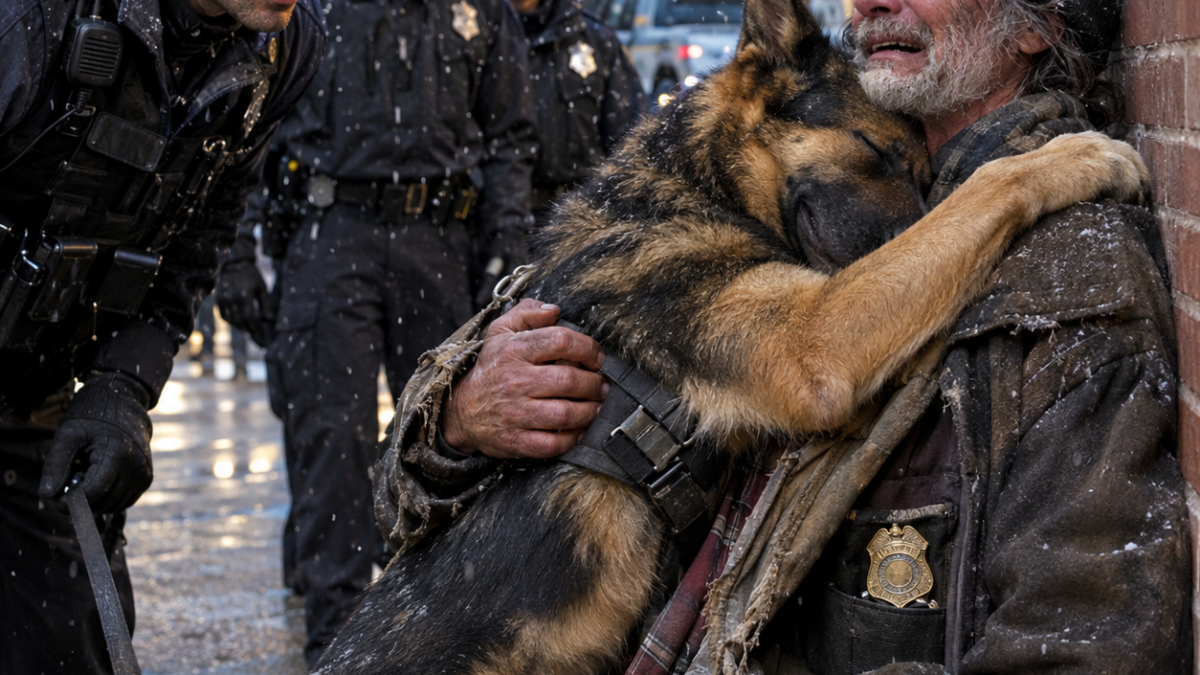
PART2
Ethan forgot about the rain.
“Atlas?”
Michael nodded.
Ranger—Atlas—pressed closer to him.
“That was his academy name.”
“How long were you his handler?”
“Almost four years.”
Ethan stared.
Nobody had ever told him.
Ranger’s personnel file listed prior K9 assignment history, but Ethan had never seen more than administrative summaries.
Original handler transferred.
Dog reassigned.
No detail.
No story.
“What happened?”
Michael looked toward the empty street.
“That’s a long answer.”
“I’ve got time.”
Michael laughed softly.
“You probably don’t.”
Ranger placed one paw on Michael’s thigh.
Ethan sat on the curb.
Rainwater soaked through his uniform trousers.
“Tonight I do.”
Michael looked at him for several seconds.
Then began.
Six years earlier, Michael Rourke had not slept beneath storefront awnings.
He lived in a small brick house twelve minutes from the precinct.
He drove a department SUV.
He wore a uniform that still fit properly.
He coached youth baseball on Saturdays.
He had a daughter named Claire who complained that police dogs smelled worse after rain than regular dogs.
And Atlas slept in a kennel connected to the back porch, though Michael’s wife regularly allowed him inside despite department rules about furniture.
“Atlas knew my wife was the weak link.”
Michael smiled faintly.
“Dogs always know.”
His wife’s name had been Rebecca.
They were married seventeen years.
Claire was fourteen.
Michael had joined the department at twenty-six.
K9 unit seven years later.
Atlas came from a regional working-dog program at eighteen months old.
High drive.
Too much energy.
Three handlers had evaluated him.
Michael was the first one Atlas trusted enough to fall asleep beside.
“The first month was terrible.”
Michael looked at Ranger.
“You remember?”
Ranger’s tail moved against the pavement.
“He bit through two training leads.”
Ethan smiled.
“That sounds familiar.”
“He ate the back seat of my first K9 vehicle.”
“That was him?”
“You know that story?”
“Everybody knows about the destroyed Tahoe seat.”
Michael laughed.
Actually laughed.
A deep sound Ethan suspected had not come from him often lately.
“That was Atlas.”
They trained for months.
Tracking.
Building searches.
Article recovery.
Controlled apprehension.
Obedience.
Crowd exposure.
Long nights.
Cold mornings.
The kind of work that creates a partnership without needing conversation.
Michael learned Atlas’s breathing patterns.
Atlas learned when Michael was worried before Michael admitted it himself.
“If I was upset, he’d sit on my boot.”
“Why?”
“No idea.”
Michael looked down.
“He just did.”
Ranger shifted.
Sat directly on Michael’s shoe.
Michael stopped speaking.
Ethan looked away because watching the man’s face felt too private.
After a moment, Michael continued.
The incident that ended everything happened on a September night.
Officer Daniel Mercer had been twenty-four.
Nine months out of the academy.
Smart.
Hardworking.
Too eager to prove he belonged.
Michael liked him.
Everybody did.
A vehicle pursuit began after officers tried to stop a stolen pickup.
Michael and Atlas joined later.
The chase entered an industrial district.
The truck crashed through fencing and stopped near a warehouse.
Two suspects ran.
One disappeared between buildings.
The other was caught.
During the confusion, Mercer entered the warehouse alone.
Against procedure.
No backup.
No announcement that he was entering.
Michael heard shouting and went in.
What happened next took less than thirty seconds.
Mercer believed a figure near a loading bay was reaching for a weapon.
He fired.
The man was not one of the suspects.
He was a warehouse employee who had hidden during the chase.
The bullet struck a metal support near him.
Nobody was physically injured.
But the discharge triggered an enormous internal investigation.
“Why did you take responsibility?”
Ethan asked.
Michael rubbed Ranger’s neck.
“Because I thought I was helping.”
“How?”
“I told investigators I had authorized Mercer to enter.”
Ethan frowned.
“Had you?”
“No.”
“And the shot?”
“I said I had given a threat warning from behind him and that Mercer reasonably believed I had identified the man as the fleeing suspect.”
“You lied.”
“Yes.”
Michael did not soften it.
“I lied.”
Ethan waited.
“Why?”
“Mercer had a baby coming.”
“That doesn’t—”
“I know.”
Michael’s voice sharpened.
“I know now.”
Rain tapped against the awning.
“At the time, I thought he had made one terrified rookie mistake.”
“He told me he would probably be fired.”
“Maybe charged.”
“His wife was seven months pregnant.”
Michael rubbed both hands over his face.
“I had twelve good years.”
“Commendations.”
“K9 experience.”
“I thought if I absorbed the procedural failure, I’d get suspension.”
“Maybe demotion.”
“Maybe lose K9.”
“But survive.”
Ethan understood before Michael continued.
It did not happen that way.
The investigation uncovered inconsistencies.
Michael’s original radio traffic did not support his statement.
His body camera had malfunctioned earlier that shift, leaving no visual evidence from him.
Mercer’s body camera captured only portions of the incident because of positioning.
Michael doubled down.
By the time he realized investigators were treating his statement not as a minor procedural admission but as deliberate falsification in an officer-involved weapons discharge, he had already trapped himself.
Internal Affairs concluded Michael had lied during an official investigation.
Trust collapsed.
His union attorney told him to correct the record.
Michael refused.
“Why?”
Ethan asked.
Michael stared at the sidewalk.
“Mercer begged me not to.”
The young officer came to Michael’s house.
Cried in his kitchen.
Said he would lose everything.
Michael remembered holding Claire as a baby.
Remembered nearly losing his own job once after a mistake early in his career.
So he remained silent.
The department terminated him for dishonesty.
His certification was suspended.
“Atlas?”
Michael’s hand tightened in Ranger’s fur.
“They took him that morning.”
Ethan’s chest tightened.
Michael had been told to report without the dog.
He knew what it meant.
He sat in the kennel with Atlas for nearly an hour before another handler arrived.
“The worst part?”
Michael whispered.
“What?”
“He thought we were going to work.”
Ethan swallowed.
Michael described fastening Atlas’s collar.
Opening the kennel.
Handing the lead to Sergeant Brennan.
Atlas followed because he was trained.
Then Michael walked toward his personal car.
Atlas stopped.
Looked back.
Pulled toward him.
The new handler gave the heel command.
Atlas obeyed.
Michael got in his car.
He could still see the dog through the windshield.
Watching.
Waiting.
“I drove away before he saw me cry.”
Ranger climbed higher against him now.
Michael closed his eyes.
“That was the last time I saw him.”
Until tonight.
At first, Michael believed losing the job would be temporary.
Appeal.
Hearing.
Maybe reinstatement.
But an officer fired for dishonesty carried a difficult record.
Applications went nowhere.
Private security firms rejected him after background checks.
Police departments would not touch him.
The appeal failed because Michael continued protecting Mercer.
His savings lasted eleven months.
Then Rebecca took a second job.
Their marriage began collapsing beneath money and anger.
“She knew I was lying about something.”
“Did she know Mercer was responsible?”
“No.”
“Why not tell her?”
Michael laughed bitterly.
“I had already destroyed my career protecting a secret.”
“Admitting it at home meant admitting how stupid that sacrifice was.”
Rebecca eventually stopped asking.
Then stopped believing anything.
Michael began drinking.
Not heavily at first.
Then regularly.
He missed Claire’s school events.
Rebecca moved out.
Michael sold the house.
His daughter stopped answering his calls.
The money from the sale covered debts for a while.
He found warehouse work.
Lost it after sleeping through a shift.
Construction.
Seasonal labor.
Delivery driving.
One broken wrist.
No health insurance.
More debt.
Shelters.
Motels.
Then streets.
Six years.
Not one dramatic fall.
A staircase.
One step at a time.
Ethan listened without interruption.
Finally:
“Mercer?”
Michael looked away.
“I don’t know.”
“You never checked?”
“At first.”
Daniel Mercer had remained employed.
The internal case treated Michael as the senior officer whose false account had distorted the investigation.
Mercer received discipline for entering alone but survived.
Michael had told himself that meant the sacrifice worked.
Eventually he stopped looking.
Ethan sat very still.
Because Ethan knew Daniel Mercer.
Not personally.
But everybody did.
Lieutenant Daniel Mercer.
Patrol operations.
Promoted twice.
Officer of the Year three years earlier.
Ethan felt sick.
“Michael.”
“Yeah?”
“Mercer is still here.”
Michael nodded slowly.
“I figured.”
“He’s a lieutenant.”
Something collapsed behind Michael’s eyes.
He did not become angry.
That was worse.
“Good for him.”
“No.”
Michael looked at Ethan.
“What?”
“You don’t mean that.”
Michael gave a tired smile.
“I’ve had six years to learn what I mean doesn’t change much.”
Ranger whined.
Ethan looked at the dog.
“How did Atlas become Ranger?”
Michael smiled faintly.
“The department always renames if they decide operational needs require it after reassignment.”
“Atlas had an association with me.”
“He probably needed a clean set of commands with the new handler.”
Ethan nodded.
Ranger had worked with another officer for two years before Ethan took him after that handler retired.
By then Ranger was six.
Experienced.
Controlled.
Quiet.
Ethan had always wondered why Ranger watched station doors whenever older officers entered.
Now he wondered whether the dog had been searching.
“Come with me.”
Michael immediately shook his head.
“No.”
“To the station.”
“Absolutely not.”
“I’m not arresting you.”
“I know.”
“Then?”
Michael looked at the badge.
“I don’t belong there.”
Ranger pressed his head against his chest again.
Ethan said:
“He disagrees.”
Michael laughed.
Then cried.
It happened silently at first.
One tear.
Then another.
He covered his face.
Ranger pushed beneath his hands.
Ethan turned away.
After a minute:
“I have nowhere else to take you tonight.”
“There’s a shelter.”
“It’s full.”
“How do you know?”
“I checked an hour ago.”
Michael looked surprised.
Ethan continued.
“Temperature’s dropping below twenty-eight.”
“I’ve slept colder.”
“That isn’t an accomplishment.”
Michael almost smiled.
“I know a veterans outreach center.”
“Not a veteran.”
“City warming center.”
“I don’t want—”
“Michael.”
Ethan’s voice softened.
“You told me twelve years of policing taught you responsibility.”
“Yeah.”
“Then let someone else do their job tonight.”
Michael stared.
Ranger sat on his shoe.
Finally:
“Okay.”
Ethan radioed his supervisor.
He did not tell the whole story over the air.
Just:
“Located an unhoused male needing transport to warming services.”
Ranger refused to enter the cruiser until Michael approached.
Then the dog climbed in and immediately turned toward him.
Michael laughed.
“He always hated leaving anybody behind.”
At the warming center, staff arranged a bed.
Michael tried to give the badge back.
Ethan closed his fingers around it.
“No.”
“I’m not a cop.”
“It has your name on it.”
“That doesn’t mean I deserve it.”
“That isn’t my decision.”
Michael stared.
Neither took the badge.
Ethan finally placed it gently into Michael’s coat pocket.
Ranger leaned against his legs.
When Ethan tried to leave, Ranger refused.
“Come.”
No movement.
“Ranger.”
Nothing.
Michael crouched.
“Atlas.”
The dog immediately looked at him.
Ethan’s chest tightened.
Michael touched the muzzle.
“You have to go.”
Ranger whined.
“Hey.”
Michael swallowed.
“You did your job.”
The dog pushed forward.
Michael pressed his forehead against Ranger’s.
“You have him now.”
He glanced toward Ethan.
“Go.”
Ranger remained.
Michael whispered one word.
A command Ethan had never heard.
“Home.”
Ranger turned.
Walked to Ethan.
Ethan nearly cried.
He managed not to until they reached the patrol car.
Then he sat behind the wheel while Ranger stared through the back window toward the warming center.
Ethan lowered his head.
And cried.
The next morning, he did something dangerous for a police officer.
Not illegal.
Not dishonest.
But professionally dangerous.
He asked questions.
He started with Ranger’s K9 file.
The original records were archived.
First handler:
Officer Michael Rourke.
Transfer reason:
Handler separation from department.
Nothing else.
Ethan requested internal case information through appropriate supervisory channels.
His sergeant frowned.
“Why?”
“Ranger recognized him last night.”
“Recognized who?”
“Rourke.”
The sergeant went silent.
“You found Mike Rourke?”
“Homeless.”
Silence.
Then:
“Jesus.”
“You knew him?”
“Everybody over forty knew him.”
“What do you remember?”
The sergeant looked around before answering.
“Good dog cop.”
“Patient.”
“Quiet.”
“Then the warehouse thing happened.”
“You believe he lied?”
“That’s what IA found.”
“Do you believe it?”
The sergeant hesitated.
“That’s different.”
Ethan contacted Professional Standards.
Carefully.
He disclosed the encounter.
The badge.
Michael’s statement.
He did not accuse Lieutenant Mercer.
He simply said:
“I believe information relevant to an old disciplinary case may not have been previously disclosed.”
That sentence started something.
At first, almost nothing happened.
Then an internal attorney found the original investigative file.
Then archived radio logs.
Then body-camera footage.
Then a transcript from Mercer’s interview.
In it, Mercer repeatedly said he could not clearly remember whether Michael had authorized entry.
Not yes.
Not no.
Could not remember.
But another detail mattered.
A warehouse security camera had existed.
The report said footage was unavailable because the system had overwritten before investigators obtained a warrant.
Case closed.
Except one retired detective remembered making a personal working copy during the first seventy-two hours.
Nobody knew whether it still existed.
His name was Frank Dempsey.
Seventy-three years old.
Living in Wisconsin.
Ethan was not allowed to call him directly as part of an official inquiry.
Professional Standards did.
Dempsey had the old hard drive in a box of archived training materials he had believed were department-cleared duplicates.
That discovery caused an administrative headache.
It also changed everything.
The footage was poor.
Grainy.
No audio.
But it showed Mercer entering the warehouse alone.
Michael arrived nearly forty seconds later.
After the shot.
Michael had not been physically present when Mercer entered.
He could not have authorized the entry from behind him as described.
That proved Michael lied.
But it also proved what he lied about.
He had arrived after the critical decision.
Professional Standards interviewed Mercer.
He was now forty.
Lieutenant.
Two children.
Mortgage.
Career.
He initially said he remembered little.
Then investigators showed him the video.
Mercer asked for an attorney.
Good.
Everyone deserved counsel.
Two days later, through representation, he requested a voluntary interview.
And told the truth.
All of it.
Michael had taken responsibility.
Mercer knew it.
Mercer begged him not to retract.
For six years, Mercer had lived with the lie.
“I told myself Mike made his choice.”
He cried during the interview.
“I told myself if he ever wanted to correct it, he would.”
The investigator asked:
“Did you ever contact him?”
“No.”
“Why?”
“I was afraid.”
“Of losing your job?”
“Yes.”
Mercer lowered his head.
“And because every year that passed made telling the truth worse.”
The department opened a formal review.
Mercer was placed on administrative leave pending process.
No dramatic hallway arrest.
No chief shouting.
Due process.
Lawyers.
Union representation.
Evidence.
Michael knew none of this.
Ethan kept visiting the warming center on days off.
Not as investigator.
As Ranger’s handler.
The first visit, Michael was gone.
Ethan panicked.
Then found him three blocks away helping another homeless man push a shopping cart with a broken wheel.
“Thought you disappeared.”
Michael shrugged.
“Where would I go?”
Ranger nearly dragged Ethan across the street.
Michael smiled.
“Hey, old man.”
Ranger pressed against him.
The warming-center staff eventually helped Michael obtain replacement identification.
His driver’s license had expired years earlier.
Social Security card gone.
Birth certificate missing.
No working phone.
No stable mailing address.
Every bureaucratic task required another task first.
Homelessness was not simply the absence of a house.
It was the absence of the little systems that make ordinary life possible.
Ethan helped where appropriate.
But he refused to become Michael’s savior.
A social worker named Teresa did most of the actual work.
Housing application.
Medical exam.
Benefits screening.
Employment services.
Mental-health referral.
Michael resisted counseling.
Teresa said:
“You can refuse.”
“Good.”
“Then you can keep feeling exactly like this without anybody interfering.”
Michael glared.
She smiled.
He attended the appointment.
Three weeks after the sidewalk reunion, Professional Standards asked Michael for a formal statement.
He almost refused.
“Why?”
Ethan asked.
“Because I lied.”
“Yes.”
“They already know that.”
“I deserved to be fired.”
“For lying?”
“Yes.”
“Maybe.”
Michael looked offended.
Ethan continued.
“But that doesn’t mean every fact around the lie was true.”
“I protected Mercer.”
“Yes.”
“That was wrong.”
“Yes.”
“Then why reopen anything?”
“Because truth isn’t a reward for perfect people.”
Michael stared.
Ethan said:
“You can be wrong and still have been wronged.”
That sentence stayed between them.
Michael eventually agreed.
His interview lasted four hours.
He admitted everything.
No excuses.
He had lied.
He interfered with an investigation.
He understood why the department terminated him.
But he confirmed Mercer had entered without authorization and fired before Michael arrived.
He also described Mercer’s later plea for silence.
Investigators asked:
“Why tell the truth now?”
Michael looked toward the observation-room window.
Ranger waited outside with Ethan.
“Because apparently my old partner has decided I’m done hiding.”
The administrative review took five months.
Not five days.
Five months.
During that time, Michael moved into transitional housing.
One room.
Small kitchenette.
His own key.
The first night, Ethan and Ranger visited.
Michael stood in the doorway holding the key.
“You okay?”
Ethan asked.
Michael stared at it.
“I haven’t had one of these in three years.”
Ranger pushed past him into the apartment.
“Apparently inspection started.”
Michael laughed.
The apartment contained a bed.
Table.
Two chairs.
No couch.
One window facing an alley.
Michael walked inside.
Then stopped.
“What?”
Ethan asked.
“Nothing.”
Michael sat on the bed.
Ranger immediately placed his chin on his knee.
Michael looked down.
“I used to complain our house was too small.”
Ethan said nothing.
“My wife wanted a bigger kitchen.”
He smiled faintly.
“I told her when I made sergeant.”
“Did you?”
“Never got there.”
“What happened to Rebecca?”
Michael’s face closed.
“Arizona.”
“Claire?”
“Same.”
“Do they know where you are?”
“No.”
“Would you like them to?”
Michael did not answer.
Ethan left it alone.
Two weeks later, Michael asked Teresa for help finding an address.
Not showing up.
Just writing.
Claire was twenty now.
College.
Michael wrote three letters before sending one.
Claire,
I am alive.
He stared at that first sentence for twenty minutes.
Then:
I am sorry that being ashamed became more important to me than being your father.
No excuses.
No request to forgive him.
He explained he was in transitional housing.
Sober nine months.
Trying to rebuild.
He gave Teresa’s office as a safe contact.
Three weeks passed.
No reply.
Michael pretended he expected that.
Then a letter arrived.
Two pages.
He opened it in front of Ranger.
Ethan waited outside the room.
Michael came out twenty minutes later crying.
“She said she hates me.”
Ethan nodded.
“She said she thought I was dead.”
Silence.
“She said she’s not ready to see me.”
Michael smiled through tears.
“But she wrote back.”
That was enough for then.
The department review concluded in spring.
Michael’s original termination was not erased.
That would have been dishonest.
He had intentionally made false statements during an official investigation.
But the department amended the historical findings to reflect that Michael had not authorized Mercer’s unauthorized entry and had not been present when the critical use-of-force decision occurred.
The record now stated that his dishonesty had been intended to conceal another officer’s misconduct rather than his own actions at the scene.
Still wrong.
But true.
Mercer faced his own disciplinary process.
Ultimately, he resigned before final termination proceedings concluded, with findings preserved according to law and policy.
He also faced whatever certification review applied through the state.
Michael did not celebrate.
When Ethan told him, he sat quietly.
“That’s it?”
“What did you expect?”
“I don’t know.”
“Fireworks?”
“Maybe.”
Ranger slept near his feet.
Michael looked down.
“I thought I’d feel different.”
Ethan understood.
“Six years doesn’t reverse because somebody edits a file.”
“No.”
The chief requested a meeting.
Michael refused twice.
Accepted the third.
He entered headquarters wearing donated slacks and a blue button-down shirt Teresa made him iron himself.
Ranger was waiting in the lobby.
Of course.
Officers recognized Michael.
Some approached.
Some looked embarrassed.
One retired K9 sergeant drove ninety miles just to shake his hand.
Another hugged him.
Michael became overwhelmed.
He went outside.
Ranger followed.
Ethan found them behind the building.
“I can’t do this.”
“Yes, you can.”
“No.”
Michael shook his head.
“They’re looking at me like I’m some hero.”
“You aren’t.”
Michael stared.
Ethan shrugged.
“You lied.”
“You made a terrible decision.”
“You lost years.”
“You hurt your family.”
Michael blinked.
“You’re awful at encouragement.”
“I’m not finished.”
Ethan crouched beside Ranger.
“You also spent twelve years doing good work.”
“You loved this dog.”
“You told the truth when you finally got another chance.”
“And you’re still here.”
Ethan looked up.
“You don’t need to become a hero to deserve a chair at the table.”
Michael’s eyes filled.
That got him back inside.
The chief did not offer reinstatement.
Michael was no longer certified.
His separation history was complicated.
Six years away mattered.
Mental and physical fitness standards mattered.
Background review mattered.
Trust mattered.
Instead, the chief said:
“There may eventually be civilian work.”
Michael looked surprised.
“We’re expanding regional K9 training support.”
The chief folded his hands.
“Not police authority.”
“Not a badge.”
“Training logistics.”
“Kennel support.”
“Scenario setup.”
“Handler mentoring under supervision.”
Michael stared.
“You’d hire me?”
“I said there may be a process.”
The chief almost smiled.
“You taught half the old unit how to read dogs.”
“We have records of that too.”
Michael looked toward the door where Ranger waited.
“What if I fail the background?”
“Then you fail.”
“What if I’m not ready?”
“Then you’re not ready.”
“What if—”
“Michael.”
The chief leaned forward.
“This is not a rescue.”
“It’s an application.”
That mattered.
Michael applied.
Medical screening.
Background.
References.
Interview.
Substance-use evaluation.
Training assessment.
Months.
He failed the first physical-work-capacity screening because of an untreated shoulder injury.
He almost quit.
Teresa threatened to personally drag him to physical therapy.
He went.
Retested.
Passed.
The first paid position he received was not with the department itself but with the city’s contracted regional canine-training facility.
Part-time.
Civilian.
Twenty-two dollars an hour.
Kennel maintenance.
Equipment preparation.
Mock-search environments.
Nothing glamorous.
Michael stared at the offer letter.
“This is less than I made twenty years ago.”
Teresa crossed her arms.
“Do you want the job?”
He smiled.
“Yes.”
His first morning began at 5:30.
Michael arrived forty minutes early.
The kennel manager found him standing outside the gate.
“You know we don’t open until five-thirty.”
“I know.”
“What are you doing?”
“Making sure I didn’t miss it.”
The manager opened the gate.
“Come on.”
Ranger was not there.
Ethan had patrol duty.
Michael thought that might be easier.
It was not.
The smell of kennels hit him.
Disinfectant.
Dog food.
Wet fur.
Memory.
He stopped.
The manager looked back.
“You good?”
“No.”
“Want to leave?”
Michael swallowed.
“No.”
“Then keep walking.”
He did.
For the first week, Michael cleaned kennels.
Filled water bowls.
Moved training barriers.
Repaired leashes.
Young handlers gradually learned who he was.
Some knew the story.
Others did not.
Michael preferred those who did not.
One afternoon a rookie complained that his dog was “being stubborn” during a scent exercise.
Michael watched.
Then said:
“He’s not stubborn.”
The rookie frowned.
“He won’t go through the door.”
“Because your shoulders are telling him you don’t want to go through either.”
“What?”
“You’re anticipating the noise inside.”
“I’m not.”
Michael shrugged.
“Then prove it.”
The rookie reset.
Relaxed.
Dog entered.
The young officer stared.
“How did you know?”
Michael smiled.
“Dogs are annoying.”
Within six months, Michael was assisting trainers.
Not teaching tactics independently.
Helping.
Observing.
Setting scenarios.
His gift returned slowly.
Patience.
Attention.
Reading the tiny shift in a dog’s body before behavior changed.
One morning Ethan arrived with Ranger.
The dog saw Michael across the yard.
Everything stopped.
Then Ranger ran.
Not as fast as before.
Age had taken some speed.
But enough.
Michael dropped to one knee.
Ranger pressed against him.
A dozen officers watched.
Nobody laughed.
Michael buried his face in the dog’s neck.
“You again.”
Ranger whined.
Ethan approached.
“He knew where we were coming.”
“How?”
“He started crying two blocks away.”
Michael’s face collapsed.
Ethan sat on the bench beside him.
For a moment, the scene looked almost like that first night.
Man.
Officer.
Dog between them.
Except Michael wore clean work pants.
Work boots.
Facility ID badge.
Not police.
His own.
On the plastic card:
MICHAEL ROURKE — K9 TRAINING SUPPORT
Michael touched it.
“Not as shiny as the old one.”
Ethan smiled.
“Harder earned.”
Ranger placed his head on Michael’s lap.
Months became a year.
Claire finally agreed to meet.
Michael almost cancelled.
“What if she hates me?”
Teresa said:
“She already told you she does.”
“Helpful.”
“She also agreed to meet.”
Coffee shop.
Public.
Claire walked in wearing a university sweatshirt.
Michael stood.
She looked like Rebecca.
That almost destroyed him.
“Hi.”
“Hi.”
He did not hug her.
She sat.
For ten minutes they discussed coffee.
Weather.
School.
Nothing.
Then Claire asked:
“Why didn’t you come find me?”
Michael looked down.
“I thought you were better without me.”
“That’s such a coward answer.”
“Yes.”
She started crying.
“So you knew?”
“I know now.”
“You missed graduation.”
“I know.”
“My first apartment.”
“I know.”
“Mom had surgery.”
His head snapped up.
“What?”
“She’s okay.”
Michael covered his face.
Claire cried harder.
“You don’t get to disappear because you’re ashamed.”
“No.”
“You don’t get to decide I didn’t need a dad.”
“No.”
“Stop saying no.”
He looked at her.
“What do you want me to say?”
“The truth.”
He breathed.
“I was scared.”
Claire stared.
“I was homeless.”
“Drinking.”
“Embarrassed.”
“I kept thinking I would contact you after I fixed myself.”
“And every month I had less fixed.”
“So I waited.”
His voice cracked.
“Until I had waited so long I thought you’d never forgive me.”
Claire wiped her eyes.
“I don’t.”
He nodded.
“Okay.”
“Not yet.”
Michael looked up.
Not yet.
Two words.
Enormous.
They met again the next month.
Then again.
Rebecca remained more cautious.
Eventually they spoke by phone.
No reconciliation miracle.
No romantic reunion.
Just two people acknowledging that a marriage had died under circumstances more complicated than either understood.
She told him:
“I wish you had trusted me with the truth.”
“I know.”
“I would have been furious.”
“I know.”
“But maybe you wouldn’t have ended up on the street.”
Michael looked toward Ranger asleep beside Ethan’s desk during a visit.
“I know.”
That sentence hurt.
Still necessary.
Ranger retired from active police service at ten.
Arthritis.
Slower recovery.
Hearing beginning to fade.
The veterinarian recommended retirement before the work became painful.
Ethan knew the day would come.
He still hated it.
Department policy allowed Ethan to adopt him.
Everyone expected that.
Then Ranger began dividing his evenings.
When Michael visited, he followed Michael everywhere.
When Michael left, Ranger waited at the door.
One night Ethan said:
“You know what he wants.”
Michael shook his head.
“No.”
“You do.”
“He’s your dog.”
Ethan smiled sadly.
“He’s been my partner four years.”
Michael looked down.
“That’s longer than I had him.”
“So?”
“You love him.”
“So do you.”
Silence.
Ethan scratched Ranger’s ears.
“He found you.”
Michael’s eyes filled.
“No.”
“He found me.”
“What?”
Ethan looked at the dog.
“I thought I understood loyalty because I handled a police dog.”
He laughed quietly.
“Then he broke every command I gave him to get back to you.”
Michael swallowed.
“I think retirement should be his choice.”
So they did something unofficial and ridiculous.
Both men stood twenty feet apart in the training yard.
Ranger between them.
No commands.
No gestures.
Ethan said:
“This is stupid.”
Michael nodded.
“Very.”
Ranger looked at Ethan.
Then Michael.
Then Ethan.
He walked toward Ethan first.
Michael smiled sadly.
“See?”
Ranger pressed his head against Ethan’s leg.
Then turned.
Walked to Michael.
Sat on his shoe.
Ethan laughed until he cried.
“Traitor.”
Michael dropped to his knees.
Ranger leaned into him.
The solution became obvious.
Michael had recently moved from transitional housing into a small permanent apartment that allowed dogs.
Ethan lived fifteen minutes away.
Ranger lived with Michael.
Ethan visited.
Constantly.
Too constantly, according to Michael.
“You know divorced parents usually have schedules.”
“Give me my dog.”
“Your dog is asleep.”
Ranger snored.
“You corrupted him.”
“He was corrupt when I got him.”
Retirement changed Ranger.
At first, he woke every morning at 5:00.
Waited beside the door.
Looked confused when nobody put on a uniform.
Michael began taking him to the training facility a few days a week.
Not working.
Watching.
Ranger loved watching young dogs make mistakes.
Michael insisted he looked judgmental.
Ethan agreed.
For two years, Ranger became something like a grandfather to the K9 unit.
New handlers knew him.
New dogs learned around him.
He slept under Michael’s desk.
Occasionally wandered into training briefings without permission.
Nobody stopped him.
His muzzle turned completely white.
His hips weakened.
Michael built a ramp beside the couch.
One winter, Ranger stopped eating breakfast.
Michael knew.
He called Ethan.
No explanation.
Just:
“Come over.”
Ethan arrived in uniform.
Ranger lay on his blanket.
Head up.
Tail moved when Ethan entered.
“Oh, buddy.”
Ethan sat on the floor.
Ranger placed his head in his lap.
Michael stood by the window.
“The vet’s coming.”
Ethan nodded.
“How long?”
“She thinks kidney failure.”
Silence.
Ethan stroked the dog.
“You couldn’t just retire normally?”
Ranger breathed.
Michael sat on the other side.
For a while, no one spoke.
Then Ethan asked:
“What was his first day like?”
Michael smiled.
“Awful.”
“Tell me.”
Michael did.
The chewed lead.
The destroyed Tahoe seat.
The training instructor who said Atlas might never make patrol certification.
Ethan laughed.
“He did okay.”
“Barely.”
They told stories.
Ranger tracking a burglary suspect through rain.
Ranger finding an elderly dementia patient near railroad tracks.
Ranger refusing to enter the automatic car wash.
Ranger stealing Ethan’s sandwich.
Ranger recognizing Michael under a filthy coat after six years.
That story ended the laughter.
Michael placed his hand on the dog’s chest.
“I don’t know why he remembered.”
Ethan looked at him.
“Because he’s Ranger.”
“Atlas.”
“Both.”
Michael nodded.
The veterinarian arrived.
Dr. Chen.
She examined him.
Listened.
Gave them options.
Hospitalization might produce a little time.
Not meaningful recovery.
Michael looked at Ethan.
Ethan looked at Ranger.
The decision belonged to both.
“No hospital,” Ethan whispered.
Michael nodded.
They moved Ranger onto his favorite blanket.
The old police collar sat on the table.
Michael still had his first Atlas collar in a box.
Faded leather.
Different nameplate.
He brought it out.
Ethan touched it.
“Put it on him?”
Michael hesitated.
Then shook his head.
“No.”
“Why?”
“He doesn’t need a uniform.”
They left him without either collar.
Just Ranger.
Atlas.
Dog.
Michael lay beside him on the floor.
Ethan held one paw.
“Hey.”
Michael’s voice broke.
“Remember the sidewalk?”
Ranger’s eyes moved toward him.
“You embarrassed me.”
Tail moved faintly.
Ethan laughed through tears.
“You embarrassed me too.”
Michael pressed his forehead against the dog’s.
“You gave me back six years I thought were gone forever.”
His voice disappeared.
“No.”
He corrected himself.
“You didn’t give them back.”
“That’s not possible.”
Tears fell into Ranger’s fur.
“You gave me what came after.”
Ethan looked away.
Michael whispered:
“That was enough.”
Dr. Chen administered the medication.
Ranger relaxed.
His breathing slowed.
Michael kept talking.
“You did your job.”
Ethan squeezed the paw.
“Good boy.”
Michael closed his eyes.
“You don’t have to find me again.”
One final breath.
Then stillness.
Michael did not move.
Neither did Ethan.
The room became unbearably quiet.
Eventually Ethan reached across Ranger and placed his hand on Michael’s shoulder.
Michael shook.
Not loudly.
His grief was almost silent.
The same kind of silence he had spent six years living inside.
But this time someone was beside him.
That mattered.
The department held no formal police funeral.
Ranger had already retired.
Instead, the K9 unit gathered at the training field on a Sunday morning.
Handlers.
Retired officers.
Kennel staff.
Teresa.
Claire.
Even Rebecca came, standing beside her daughter.
Michael almost collapsed when he saw them.
Claire hugged him first.
Rebecca touched his arm.
No words.
Ethan carried Ranger’s ashes in a simple wooden box.
Nothing ceremonial beyond what they chose together.
The chief spoke briefly.
“Ranger served this city.”
Then looked at Michael.
“And before Ranger was Ranger, Atlas served beside Officer Michael Rourke.”
Michael lowered his head.
The chief continued.
“Dogs do not understand disciplinary records.”
“Rank.”
“Employment status.”
“Public shame.”
“They know voice.”
“Scent.”
“Routine.”
“Trust.”
“And sometimes they remember what people spend years trying to forget.”
Michael cried openly.
No attempt to hide it.
Afterward, Claire approached the box.
“Was he really mine once?”
Michael smiled through tears.
“You were fourteen.”
“I barely remember.”
“He slept outside your room whenever you were sick.”
Claire touched the wood.
“Mom hated the fur.”
Rebecca said from behind them:
“I still hate dog hair.”
Michael laughed.
So did Claire.
A small sound.
But something healed inside it.
Not everything.
Enough.
Michael continued working at the training facility.
Three years later, he became a full-time civilian instructor specializing in handler-dog communication, stress behavior, and search foundations.
He never tried to regain sworn status.
People asked.
His answer remained:
“I don’t need the badge back.”
The old badge stayed in a drawer.
Not hidden.
Not displayed.
Just part of his life.
He gave occasional talks to academy classes about integrity.
That invitation surprised him more than anything.
The first time, he stood before forty recruits.
He told them exactly what he had done.
“I lied.”
No excuse.
“I thought loyalty meant protecting a young officer from the worst day of his career.”
He looked around the room.
“I was wrong.”
“Loyalty without truth becomes corruption faster than most people realize.”
Silence.
“I cost myself my career.”
“My marriage.”
“Years with my daughter.”
“And I also helped another man avoid accountability long enough for the consequences to become worse.”
He paused.
“Do not confuse protecting a colleague with protecting the truth.”
Nobody moved.
Then he smiled.
“And never underestimate a German Shepherd with boundary issues.”
The recruits laughed.
After class, one young officer stayed.
“My dad was a cop.”
Michael nodded.
“He always said you never rat on another officer.”
Michael looked at him for a long moment.
“Your first loyalty is not to another officer.”
“To what?”
“The truth you swore to serve.”
The young man nodded.
Michael hoped the sentence would matter someday.
Claire finished college.
Then graduate school.
She did not move back home.
There was no home to return to.
Instead, she began calling Michael on Sundays.
At first ten minutes.
Eventually an hour.
She invited him to graduation.
He sat beside Rebecca.
Awkward.
Peaceful.
When Claire’s name was called, Michael stood before anyone else.
Cheered too loudly.
Claire rolled her eyes from the stage.
Later she hugged him.
“You missed the first one.”
“I know.”
“You don’t get to miss another.”
“I won’t.”
She pulled back.
“Don’t promise things like that.”
Michael stopped.
Old habits.
Shame.
Waiting.
“I’ll do everything I can.”
Claire smiled.
“Better.”
Years passed.
Ethan promoted to sergeant.
Then K9 supervisor.
He kept a photograph on his desk.
Not Ranger in tactical gear.
Not an apprehension.
Not a medal ceremony.
The photograph showed a rainy sidewalk.
Taken accidentally by a store security camera.
Ranger pressed against Michael.
Ethan kneeling beside them.
Three figures under an awning.
People occasionally asked:
“What’s that?”
Ethan answered:
“The night my dog disobeyed me.”
Usually they laughed.
Then Ethan added:
“Best thing he ever did.”
Michael kept the same photograph at home.
Beside it sat Ranger’s ashes and the faded Atlas collar.
Claire once asked:
“Do you ever wish you could go back?”
“To before everything?”
“Yes.”
Michael thought.
“Every day.”
“That sounds miserable.”
“It used to be.”
“And now?”
He looked at the photograph.
“Now I understand going back isn’t one of the options.”
Claire waited.
“You get forward.”
“Sometimes barely.”
“But forward.”
She smiled.
“Ranger taught you that?”
Michael shook his head.
“No.”
“He taught me something harder.”
“What?”
“That somebody can remember the person you were without pretending you didn’t become somebody else.”
Claire’s eyes filled.
Michael continued.
“Ranger knew me when I wore a badge.”
“He found me when I smelled like three days of rain and slept under a storefront.”
“He didn’t care which version deserved him more.”
“He just knew I was me.”
Claire hugged him.
For a long time.
Michael finally understood that this was what he had wanted from his family.
Not permission to erase six years.
Not somebody saying the drinking, disappearing, and silence had not hurt them.
He wanted the chance to become someone they could know again.
Ranger had given him that first.
Humans took longer.
Humans always do.
On the tenth anniversary of the warehouse incident, Michael drove to the old industrial district.
The warehouse still existed.
Different company.
New sign.
He parked across the road.
Daniel Mercer had sent him one letter after resigning.
Michael had never answered.
He carried it now.
He read it again.
Mike,
There is no version of what happened where I am the victim.
Good start.
You made your own wrong decision when you lied for me, but I used your decision every day afterward to protect myself. I let you lose everything because admitting the truth felt too expensive.
Michael stared toward the warehouse.
I told myself you were stronger. Older. More established. I told myself you would recover.
Same logic people always use when sacrificing someone else.
They will survive.
I am sorry.
I do not expect forgiveness.
Daniel
Michael folded the letter.
He did not burn it.
Did not answer.
He put it back into the envelope.
Forgiveness, he had learned, did not always require communication.
He hoped Daniel became better.
That was enough.
On his way home, Michael passed the storefront where Ranger had found him.
The furniture store had become a bakery.
Bright windows.
Tables.
People drinking coffee where Michael once slept outside.
He parked.
Went in.
Ordered coffee.
Sat near the window.
For several minutes, he watched pedestrians.
A man carrying groceries.
Two teenagers.
A woman walking a Labrador.
Normal life.
The waitress asked:
“You okay?”
Michael smiled.
“Yes.”
And meant it.
That surprised him.
He finished the coffee.
Left a tip.
Walked outside.
Cold rain had begun.
Same kind as that night.
Michael stood beneath the awning.
Closed his eyes.
He could almost hear claws against wet pavement.
Almost hear Ethan shouting:
Ranger!
Almost feel seventy-eight pounds of German Shepherd crashing into his chest.
He laughed.
Then whispered:
“You stubborn old bastard.”
Nobody answered.
Good.
Ranger was finished.
He did not need to keep appearing in signs.
He had done enough.
Michael pulled his coat tighter and walked toward his car.
A car.
His car.
Used Toyota.
Paid for.
Nothing impressive.
His key turned in the lock.
For years, he had once carried everything he owned in a shopping cart.
Now his apartment contained a couch Claire helped choose.
A table.
Work boots by the door.
Three framed photographs.
One plant he kept forgetting to water.
Life.
Not the old life.
A different one.
That evening, Claire called.
“Dad?”
The word still stopped him.
Every time.
“Yeah?”
“You busy?”
“No.”
“Mom wants to know if you’re coming for Thanksgiving.”
Michael smiled.
“Your mother wants me there?”
“She said you can come.”
“That is not the same sentence.”
“Dad.”
“I’ll be there.”
“Good.”
Then she added:
“Don’t be late.”
Michael looked toward Ranger’s photograph.
“No.”
His voice softened.
“I’ve done enough arriving late.”
Thanksgiving was awkward.
Rebecca’s new partner attended.
Michael shook his hand.
Nobody died.
Claire burned the rolls.
Everybody blamed each other.
At one point Rebecca watched Michael laughing with their daughter.
She walked over.
“You look better.”
“I am.”
“I’m glad.”
He nodded.
“So am I.”
That was all.
Some relationships do not need rebuilding into what they were.
Sometimes peace is the correct shape.
Years later, when Michael finally retired from K9 training at sixty-seven, the facility gave him a plaque.
He hated plaques.
Ethan, now deputy chief, gave the speech.
“Michael has spent the last seventeen years teaching handlers that dogs notice what humans miss.”
Michael sat in the front row.
Claire beside him.
“Which is ironic.”
People laughed.
“Because the biggest thing Michael ever missed was that one dog had been looking for him for six years.”
Michael covered his face.
“Ethan.”
“Too late.”
On the screen behind him appeared the sidewalk photograph.
Ranger.
Michael.
Ethan.
The room quieted.
Ethan continued.
“I thought that night I was watching a police dog recognize an old handler.”
He swallowed.
“I was wrong.”
“I was watching one life refuse to let another life disappear.”
Michael began crying.
So did half the room.
Ethan stepped away from the microphone.
Walked toward him.
Handed him a small box.
Inside was Ranger’s retired service tag.
The one Ethan had kept.
Michael touched it.
“You kept this?”
“Yeah.”
“Why?”
“Because I’m sentimental.”
“You’re irritating.”
“Also true.”
Michael stood.
They hugged.
No uniform hierarchy.
No rank.
Two older men who had once met because a dog ignored an order.
After the ceremony, a young K9 officer approached Michael.
His German Shepherd pulled slightly on the leash.
“Sir?”
“Don’t call me sir.”
“Michael?”
“Better.”
“I heard the Ranger story at the academy.”
Michael sighed.
“Of course you did.”
The officer smiled.
“Is it true he hugged you?”
“He tackled me.”
“That sounds less heartwarming.”
“It hurt.”
The young officer laughed.
Then:
“Do you think he knew what happened to you?”
Michael looked at the dog.
“No.”
“Do you think he knew you needed help?”
Michael thought about the rainy sidewalk.
His coat.
The old badge.
How close he had been to giving up completely.
“I think he knew me.”
The officer waited.
“And apparently that was enough.”
Michael walked home slowly that evening.
His knees hurt.
Age.
Ordinary age.
He had once believed he would die anonymously beneath an awning.
Instead, he had lived long enough to become old in boring ways.
Prescription glasses.
Blood pressure medication.
Complaining about parking.
He loved every irritating part of it.
At home, he opened the drawer.
The old badge remained inside.
Beside Ranger’s service tag.
For years, Michael had wondered whether he should throw the badge away.
He no longer wanted to.
It did not represent innocence.
He had not been innocent of everything.
He lied.
Made choices.
Failed people.
The badge represented a more complicated truth.
A person can fail without becoming only a failure.
A person can deserve consequences without deserving permanent abandonment.
A career can end without a life ending.
A daughter can be angry and still answer the phone.
A former wife can forgive enough to sit across a Thanksgiving table without pretending the marriage never broke.
And a dog can recognize a man after six years when the man himself barely recognizes who he has become.
Michael picked up Ranger’s tag.
Cold metal.
He smiled.
“You knew.”
He placed it back.
Not about Mercer.
Not about the investigation.
Not about innocence.
Ranger never understood any of that.
He knew something smaller.
Simpler.
This person once loved me.
That memory survived the uniform.
The street.
The beard.
The smell of rain.
Six years.
Everything.
And when Ranger found him again, he did not ask where Michael had been.
Did not demand an explanation.
Did not care whether the man had a house.
A job.
A badge.
He just ran.
Sometimes Michael thought that was why he survived long enough to rebuild.
Not because Ranger rescued him by himself.
Teresa helped.
Ethan helped.
Claire eventually helped.
Counselors.
Housing workers.
Trainers.
Doctors.
Michael helped himself too.
That mattered most.
But Ranger began it.
He crossed a wet sidewalk and said, in the only language he had:
There you are.
I remember you.
You’re still here.
And for a man who had spent six years becoming invisible, being recognized was the first step toward becoming human to himself again.
On the final night of Michael’s last year at the training facility, he walked alone through the kennel building.
Dogs barked.
One pawed at the gate.
Another slept.
Michael turned off lights one section at a time.
At the final kennel, a young German Shepherd tilted his head.
Left ear slightly folded.
Michael stopped.
“No.”
The dog wagged.
“Absolutely not.”
The tail moved faster.
Michael laughed.
Then kept walking.
Some stories do not need another dog.
Some love does not need replacing.
At the door, Michael looked back.
For just a moment, he remembered Ranger sitting on his shoe.
Atlas.
Ranger.
Partner.
Friend.
The animal who had been taken from him when his life collapsed.
The animal who found him again when there was almost nothing left.
Michael switched off the final light.
“Good night, buddy.”
Then he walked outside.
Not into homelessness.
Not into shame.
Not into a life restored exactly as it had been.
Into something more believable.
A life rebuilt piece by piece.
His own key in his pocket.
His daughter expecting his call Sunday.
A retirement dinner next month.
A photograph waiting on the shelf.
And two pieces of worn metal in a drawer reminding him of the two identities he once thought defined his worth.
One badge.
One dog tag.
Neither mattered as much as what came after losing them.
Because the police badge had once told the world who Michael Rourke was.
But six years later, sitting beneath a cold awning with nothing left, it was a dog who remembered.
And when Ranger wrapped himself around him in the rain, Michael finally understood something no investigation, department, or uniform could ever put into a report:
sometimes the person you used to be is not gone.
Sometimes he is simply buried beneath too much shame to answer when someone calls his name.
And sometimes it takes the one friend who never learned how to judge you to find him again.








