PART2:THE JUDGE WAS READING MY GUILTY VERDICT WHEN MY MILITARY DOG STARTED CRYING—Then He Dragged a Black Evidence Bag Across the Courtroom
PART2
The sound pulled me backward.
Afghanistan.
A logistics compound outside Bagram.
Temporary joint task force.
My unit had been responsible for coordinating protected communications equipment moving between three coalition sites.
Nothing cinematic.
No secret nuclear codes.
Mostly encrypted hardware, routing modules, serialized components, and technical documentation.
The kind of material that looked boring until it appeared somewhere it should not.
Max was attached to the security detail.
Explosive detection.
Perimeter sweeps.
Vehicle checks.
He technically belonged to Staff Sergeant Aaron Cole.
But Aaron and I had worked together for almost two years, and Max spent enough time around me that the dog had developed what Aaron called “an unauthorized friendship.”
The night of the breach, Max behaved strangely.
We were preparing a convoy.
Three vehicles.
Two pallets of controlled equipment.
One black field bag containing portable recording and communications gear used by an intelligence liaison team earlier that week.
Max stopped near the loading area.
Whined.
Then pulled toward one of the equipment cases.
Aaron corrected him.
“Leave it.”
Max obeyed.
Then circled back.
I remember laughing.
“What’s wrong with him?”
Aaron shrugged.
“Probably smells food.”
There was no food.
Twenty-four hours later, a restricted data package disappeared.
Three weeks after that, investigators found unauthorized copies on a commercial server.
Two months after that, suspicion moved toward me.
Why?
My credentials had accessed one of the source systems.
My encrypted signature appeared on an outbound file.
And surveillance logs showed my badge entering the operations building at 02:13 on the morning of the compromise.
I had been asleep.
Alone.
No witness.
My access badge had supposedly been used.
That became the prosecution’s favorite fact.
Then came the bank account.
A financial institution in Delaware.
$184,000 transferred through shell entities.
Beneficiary:
Daniel Hastings.
I had never seen the account.
Investigators said it was opened using my Social Security number, passport information, and digital copies of documents stored in my personnel file.
The prosecution argued I created it remotely.
My defense argued identity theft.
Then Captain Nolan Briggs testified.
Nolan had served as deputy operations officer.
My friend.
Or so I had believed.
He told investigators he had seen me meeting a civilian contractor named Viktor Markovic three times.
Markovic later disappeared overseas.
The government treated that like fire.
My defense kept saying smoke.
The jury apparently disagreed.
Now Max stood in the courtroom fifteen feet behind me, staring at the black evidence bag on a side table.
The same color.
Same size.
Maybe not the same bag.
But something about it had reached him.
The officer whispered:
“Max, heel.”
The dog lunged.
The leash slipped.
Gasps filled the courtroom.
Max ran.
Not toward me.
Toward the evidence.
He stopped beside the table and began sniffing.
The prosecutor, Richard Brown, stood immediately.
“Your Honor, remove the animal.”
Eleanor rose.
“Wait.”
Brown snapped:
“Counsel, this is absurd.”
Max shoved his nose between two evidence containers.
Then hooked his teeth lightly into the handle of a small black bag.
The evidence technician moved toward him.
Max pulled the bag free.
“Stop the dog!”
Judge Collins struck the bench.
“Everyone stay where you are.”
For once, nobody moved.
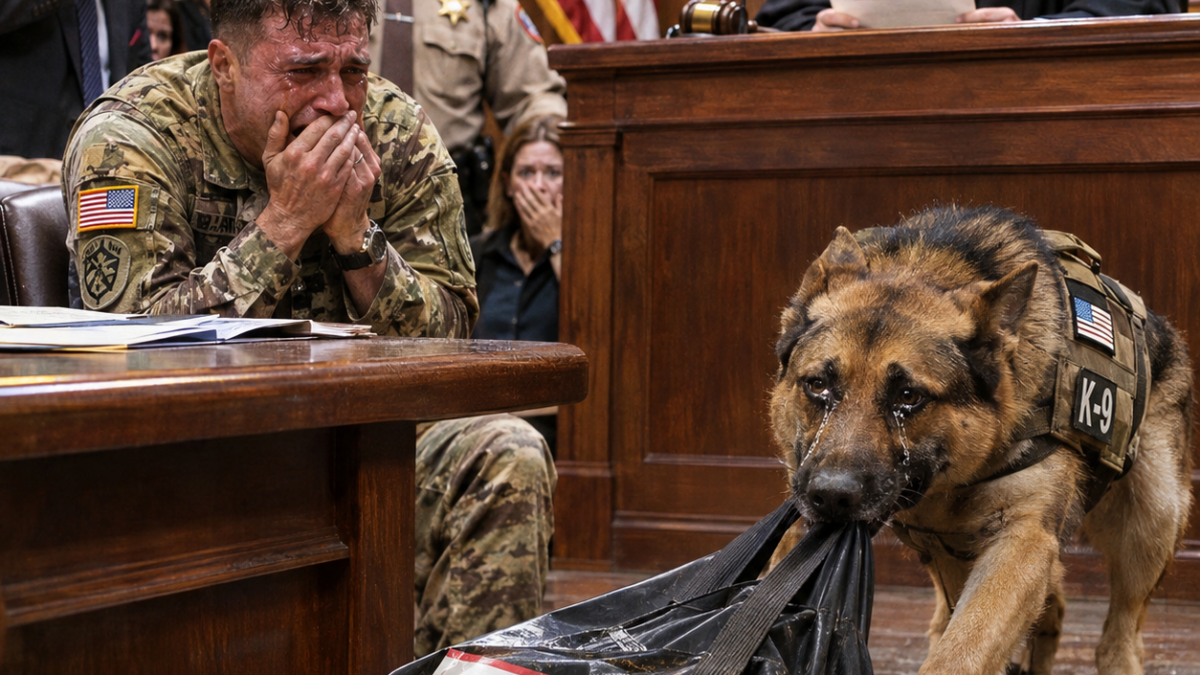
Max carried the bag across the courtroom.
Set it down in front of me.
Then sat.
And cried.
My knees almost failed.
I knew that bag.
Not just similar.
That one.
Scratched buckle.
Gray tape residue along one side.
The field recorder bag from Bagram.
The one Max had reacted to before the breach.
I whispered:
“Jesus.”
Eleanor heard.
“You recognize it?”
“Yes.”
“What is it?”
“I thought it was lost.”
Brown stood.
“Your Honor, this item was previously inventoried as miscellaneous nonresponsive material.”
Eleanor turned sharply.
“Nonresponsive to what?”
“The charged transmission.”
“What is inside?”
Brown hesitated.
My attorney saw it.
So did Judge Collins.
He looked toward the clerk.
“Evidence record.”
The clerk searched.
“Government Exhibit Holding Item 47-B. Seized from joint task force storage. Not admitted.”
“Why?”
Brown answered:
“No evidentiary value was established.”
Eleanor said:
“Then opening it can’t prejudice your case.”
Brown’s face tightened.
“That is not the point.”
Judge Collins stared at him.
“Then what is?”
Silence.
The judge ordered the jury removed.
The room exploded into whispers.
Once the door closed, Eleanor approached the bag.
“Your Honor, I am asking that this item be examined immediately in open court and on the record.”
Brown objected.
“Chain of custody.”
Eleanor laughed without humor.
“The government has custody.”
“Counsel—”
“This bag has apparently sat inside government evidence for months.”
Judge Collins looked at Brown.
“Was its interior searched?”
The prosecutor turned toward the evidence technician.
The technician checked notes.
“Inventory says exterior documents and field accessories.”
“Interior compartments?”
Pause.
“Not specifically documented.”
Judge Collins closed his eyes.
A tired man realizing his courtroom had just become a disaster.
“Open it.”
The technician wore gloves.
Unzipped the main compartment.
Battery cables.
Adapters.
Old notepad.
Nothing.
Then Max stood.
Whined.
Scratched the side pocket.
The technician looked at Judge Collins.
The judge nodded.
Side zipper opened.
Inside:
A small digital recorder.
Military issue.
Older model.
Scratched serial number.
My breathing stopped.
Aaron Cole had used recorders like that during convoy briefings.
So had Nolan Briggs.
Eleanor said:
“Preserve it.”
Brown snapped:
“Obviously.”
She looked at him.
“Your enthusiasm arrived late.”
Judge Collins warned:
“Ms. Green.”
The recorder was bagged separately.
Photographed.
Serial documented.
No one played it immediately.
That mattered.
Television would later report that Max “found the confession in court.”
Not exactly.
He found the device.
The truth came later.
Forensics first.
Hash values.
Storage extraction.
File metadata.
Authentication.
The court recessed before sentencing.
My conviction was not instantly erased.
That was another part the internet got wrong.
The judge did something more realistic.
He postponed judgment on the verdict and ordered an emergency evidentiary hearing.
Eleanor filed a motion for new trial.
Then a motion challenging suppression and disclosure failures.
The government promised complete review.
I went back to detention.
Still convicted by a jury.
Still not free.
That night, I sat alone in a holding cell listening to every sound in the corridor.
I thought about Max.
Why the bag?
Scent memory?
Aaron?
Nolan?
Explosives residue?
Fear?
Dogs do not explain themselves.
But somewhere inside ten years of scent and association, Max had recognized significance.
Two days later, Eleanor visited.
She sat behind glass.
No smile.
That frightened me.
“What?”
“The recorder works.”
My hands tightened.
“What’s on it?”
“Several files.”
“From Afghanistan?”
“Yes.”
My heart slammed.
“Eleanor.”
“One file is dated twelve hours before the data breach.”
I could barely speak.
“Who?”
She looked at me.
“Three male voices.”
“Identified?”
“Not officially.”
“You know them.”
She nodded.
“One appears to be Nolan Briggs.”
My vision narrowed.
“And?”
“One may be civilian contractor Martin Keene.”
I knew Keene.
Systems administrator.
Worked for a subcontractor.
“And the third?”
“Unclear.”
“What do they say?”
Eleanor exhaled.
Then quoted only the essential line.
“‘Hastings is perfect. He already has access. Nobody will question the logs.’”
I stared.
My hands began shaking.
“Again.”
She repeated it.
Another line:
“‘We need someone holding the bag when this breaks.’”
Then:
“‘Use his credentials. The badge clone is already done.’”
I closed my eyes.
For eleven months, the prosecution had argued nobody could explain how my badge entered the building while I claimed I was asleep.
Now we had an explanation.
Clone.
Eleanor continued.
“There’s discussion of creating an account.”
“The Delaware account.”
“Likely.”
“Markovic?”
“They mention paying him.”
I stared.
“So he wasn’t buying from me.”
“Possibly not.”
“He was part of their plan.”
“Maybe.”
I hated her caution.
Needed it.
“Why was the recorder in evidence?”
“That is becoming a serious question.”
“Who found the bag?”
“Military investigators during a later storage review.”
“When?”
“Five months ago.”
My blood went cold.
“Five months.”
“Yes.”
“Before trial.”
“Yes.”
“Did the prosecution know?”
“Brown says his team was told the bag contained field accessories unrelated to the charged files.”
“Who classified it that way?”
“We’re finding out.”
“Did anyone inspect the recorder?”
“Apparently not.”
I laughed.
Then the laugh turned into something ugly.
I stood.
The guard moved.
Eleanor raised a hand.
“Daniel.”
“I spent six weeks on trial while the government had this.”
“I know.”
“They called me a traitor.”
“I know.”
“Sarah had reporters outside her apartment.”
“I know.”
“My father stopped going to church because people stared.”
“I know.”
“And this thing sat in a bag.”
She let me rage.
Then:
“This helps us only if we stay precise.”
I looked at her.
“Precise?”
“Yes.”
“Brown may not have known.”
“He should have.”
“Maybe.”
“Investigators may have mislabeled it.”
“They should have checked.”
“Yes.”
“But negligence is different from conspiracy.”
I hated the word.
“Do not make everyone part of what Nolan did unless evidence says so.”
I sat.
She leaned forward.
“That is how we win cleanly.”
The next week changed everything.
Federal investigators reopened the digital-access evidence.
Not the same team.
A separate review unit.
My badge access logs were compared with physical reader diagnostics.
One device had a firmware anomaly.
Someone had used duplicated credential data.
My badge never needed to leave my possession.
Then the emails.
The prosecution had relied on messages from my secure account.
Forensic review now identified remote session artifacts inconsistent with my assigned device.
The government’s original expert had noted the anomaly but considered it inconclusive.
With the recorder pointing toward credential theft, inconclusive became significant.
Then the Delaware bank account.
Opening IP address traced through a commercial VPN.
No miracle.
But recovery of the application metadata revealed document files that had originated from a personnel administration system.
Who had access?
Several people.
Including Martin Keene.
The contractor.
Then Keene disappeared.
Not overseas forever.
Just enough.
He was arrested in Nevada eleven days after the recorder was discovered.
Cash.
Two passports.
One under another name.
He asked for a lawyer.
Then asked about a deal.
That is when Nolan Briggs began losing sleep.
I know because he started calling Eleanor.
Not me.
He wanted to “clarify” his testimony.
She refused private contact.
Told him to speak to investigators.
Three days later, Nolan retained criminal counsel.
The government moved to stay my sentencing indefinitely.
Eleanor filed to vacate the conviction.
Prosecutor Brown did not oppose further investigation.
That surprised me.
Then he visited.
Personally.
Detention interview room.
Eleanor beside me.
Brown sat across.
He looked older than during trial.
“I owe you an explanation.”
I stared.
“You owe me more than that.”
“Yes.”
He did not argue.
That mattered.
“I did not know what was on the recorder.”
“Did you know it existed?”
“I knew a bag had been logged.”
“Did you ask what was inside?”
“No.”
“Why?”
“Because investigators categorized it as unrelated equipment recovered from storage.”
I laughed.
“You trusted them.”
“Yes.”
“Interesting.”
He accepted the blow.
Then:
“I argued to a jury that you betrayed your country.”
“Yes.”
“If the recorder is authentic, that argument was wrong.”
“If?”
“Legally, I still have to say if until authentication is complete.”
Eleanor nodded.
I understood.
Still hated it.
Brown continued.
“I am reviewing every disclosure decision in the case.”
“Will that give me eleven months back?”
“No.”
“Will it give my father his reputation back?”
“No.”
“Will it erase headlines?”
“No.”
He looked directly at me.
“But I can help correct the record.”
I leaned back.
“Then do it.”
He did.
That also mattered.
Some stories need a prosecutor villain.
Mine didn’t.
Brown was aggressive.
He believed the evidence.
He missed something enormous.
That was failure.
But when the evidence changed, he did not hide behind pride forever.
The man who had called me a traitor in closing argument later stood before Judge Collins and said:
“The government no longer has confidence in this conviction.”
That sentence made my sister cry.
The emergency hearing lasted three days.
Recorder authentication.
Audio experts.
Chain of custody.
Digital metadata.
Witness testimony.
Aaron Cole flew in.
He had retired from active duty six months earlier.
Max’s former primary handler.
When he entered court, Max—allowed in again—stood.
Tail wagging.
Aaron smiled through tears.
“Hey, old man.”
Max pressed against him.
Then Aaron testified.
He recognized the bag.
Recognized the recorder type.
Recognized Nolan’s voice.
More importantly, he remembered Max’s behavior the night before the breach.
“He kept alerting to the equipment area.”
Brown asked:
“Was that considered a trained indication?”
“No.”
“What did you think?”
“I thought he smelled something.”
“Explosive?”
“No.”
“What?”
“I didn’t know.”
“Could he have been reacting to a person’s scent?”
“Yes.”
“Whose?”
Aaron looked toward Nolan, seated behind defense counsel because by then he had been called as a potential witness and target in a separate investigation.
“I don’t know.”
Good answer.
No guessing.
Then Eleanor asked:
“Did Max know Captain Briggs?”
“Yes.”
“Frequently?”
“Yes.”
“Did Briggs use that recording equipment?”
“Sometimes.”
“Did Captain Hastings?”
“Rarely.”
That mattered a little.
Not enough alone.
The audio mattered more.
Forensic analysis found no edits in the critical recording.
Metadata consistent with device use overseas.
Background acoustic signatures matched the logistics building.
One voice belonged to Nolan with very high confidence.
Keene’s voice matched too.
The third was eventually identified as Sergeant First Class Victor Lane.
Supply operations.
He had retired shortly after deployment.
Investigators found him in Arizona.
Lane confessed first.
Not because of Max.
Because his attorney showed him the audio.
Lane described the plan.
Keene had discovered a market for controlled technical data through Markovic.
Not top-secret information.
Still protected.
Still illegal.
Still dangerous.
They needed access.
Nolan had operational privileges.
Keene had systems access.
Lane controlled physical logistics.
But Nolan feared his digital activity would point toward him.
So they chose me.
Why me?
Access.
Credibility.
No obvious financial problems.
Meaning if I was exposed, the story would be shocking enough to satisfy investigators.
They cloned badge credentials using reader data.
Keene hijacked remote authentication.
They opened the Delaware account using stolen identity records.
Then routed payment there.
The account was supposed to look like motive.
“They hated you?” Eleanor asked Lane during a later proceeding.
“No.”
That answer shocked me.
“Then why Daniel?”
Lane looked ashamed.
“He was clean.”
My stomach turned.
I had been selected because I was clean.
A good record made me a better villain.
Nolan’s testimony at my trial had been the finishing piece.
He claimed to see me with Markovic because he knew vague eyewitness testimony could connect digital evidence to human action.
The recorder captured the planning meeting because Keene accidentally left it running after an earlier briefing.
He later discovered it.
Panicked.
Put it into the black equipment bag.
Planned to destroy it.
Then an unexpected movement of supplies separated him from the bag.
It eventually went into storage.
Months later investigators collected that storage during a broad evidence sweep.
Nobody connected the recorder to the case.
Until Max did.
Why?
We never proved that.
Maybe scent.
Maybe memory.
Maybe the bag smelled like Nolan or Keene.
Maybe Max remembered the object from the loading area.
Maybe the dog simply associated it with the anxiety of that night.
Courts do not convict on canine intuition alone.
Thankfully, ours did not need to.
Max only pointed humans toward evidence humans had failed to examine.
That distinction became important when reporters turned him into a supernatural detective.
Eleanor hated those headlines.
HERO DOG SOLVES SPY CASE.
She threw one newspaper at me.
“This is legally offensive.”
I laughed for the first time in months.
“He did better than some investigators.”
She tried not to smile.
Failed.
Judge Collins vacated my conviction seventeen days after the guilty verdict.
The courtroom was full.
No jury.
No applause at first.
The judge read carefully.
“Based on newly discovered evidence, the government’s withdrawal of confidence in key portions of its case, and substantial evidence undermining the integrity of the verdict, the judgment is vacated.”
I stared at him.
Then:
“All charges against Captain Daniel Hastings are dismissed without prejudice at this time upon motion of the government, with the expectation that further proceedings against him are not anticipated absent materially different evidence.”
Not:
You are declared morally perfect.
Not dramatic.
Legal language.
But I heard one thing.
Free.
My sister sobbed.
My father covered his face.
Eleanor squeezed my shoulder.
Max was lying beside Aaron.
Then the dog began whining again.
Judge Collins stopped.
Everyone laughed softly.
Even Brown.
The judge looked toward Max.
“Apparently the court is being corrected again.”
That became the quote newspapers loved.
I walked toward Max.
Kneeled.
He shoved his head beneath my arm.
“You stubborn bastard.”
Aaron laughed.
“Careful. He outranks you emotionally.”
I held the dog.
For eleven months, I had dreamed about vindication.
I imagined anger.
Triumph.
A speech.
Instead, I cried into an old German shepherd’s neck.
Because the first being to treat the evidence like it mattered had no idea what a verdict was.
Outside the courthouse, cameras waited.
Eleanor told me:
“You don’t owe them anything.”
I almost walked past.
Then stopped.
Dozens of microphones.
Questions shouted.
“Captain Hastings, do you blame the Army?”
“Do you blame prosecutors?”
“Will you sue?”
“Do you want your commission restored?”
“Do you forgive Captain Briggs?”
I raised a hand.
Silence spread slowly.
“I was convicted because evidence pointed toward me.”
I paused.
“Some of that evidence was manufactured.”
“Some was misunderstood.”
“Some was not examined closely enough.”
I looked toward Brown standing farther back.
“The people who corrected this case include some of the same institutions that got parts of it wrong.”
That confused reporters.
They wanted enemy lines.
I continued.
“I’m angry.”
That satisfied them.
“I’m also grateful.”
Less satisfying.
“I’m grateful to my attorney.”
“To investigators who reopened their work.”
“To prosecutors who acknowledged new evidence.”
“To the court.”
“To my family.”
Then:
“And to Max.”
Cameras turned.
Max sneezed.
Everybody laughed.
I did too.
Then I walked away.
Freedom felt strange.
The first night home, I slept on my father’s couch.
My old apartment had been surrendered months earlier because legal bills and suspended income made keeping it pointless.
My uniform hung in a storage bag.
My decorations were boxed.
My phone contained eleven months of messages I had stopped reading because too many were versions of:
I hope this isn’t true.
That sentence hurts more than people realize.
Not:
I know you didn’t do it.
Just:
I hope.
Some friends disappeared.
Some colleagues stopped calling.
A woman I had dated for two years ended the relationship after charges were filed.
I did not blame her.
I tried.
Couldn’t.
She had a child.
Reporters outside her house.
She chose safety.
I understood.
Understanding did not stop the pain.
Vindication did not restore the missing year.
The Army began administrative review.
Could I return?
Technically possible.
Practically complicated.
Security clearance had been suspended.
The criminal case was gone.
But institutional trust does not regenerate with a judge’s order.
My psychologist asked:
“What do you want?”
I laughed.
“The truth?”
“That would be useful.”
“I want them to beg me to come back so I can say no.”
She smiled.
“That’s revenge.”
“Yes.”
“What do you actually want?”
I stared out the window.
“I don’t know.”
Good answer.
For years, identity had been easy.
Soldier.
Officer.
Captain.
Now the word itself felt unstable.
Max helped again.
Aaron had adopted him after retirement.
He lived thirty minutes from my father.
Aaron began bringing him over.
At first because he thought I needed emotional support.
Then because Max had arthritis and apparently preferred my father’s living-room rug.
One afternoon I sat on the floor beside him.
“Everybody thinks you saved me.”
Max slept.
“You just wanted the stupid bag.”
No response.
“I don’t even know why.”
His ear moved.
“Good talk.”
My father looked up from the kitchen.
“He’s a better listener than you.”
“Thanks, Dad.”
Max eventually opened one eye.
I rubbed his head.
“You know what bothers me?”
Nothing.
“People keep saying you believed me.”
I swallowed.
“Dogs don’t understand federal charges.”
Max yawned.
“But you knew something was wrong.”
That was enough.
Nolan Briggs was arrested two months after my release.
Keene had already entered cooperation.
Lane too.
Markovic was captured overseas later with help from foreign authorities.
The government’s new case focused on conspiracy, unlawful transmission of defense information, identity fraud, obstruction, and false testimony-related conduct where applicable.
Nolan initially denied everything.
Then audio.
Messages.
Financial records.
Lane.
Keene.
He changed his plea.
I attended sentencing.
Not because prosecutors asked.
Because I needed to see him.
Eleanor warned me:
“You may regret it.”
“I know.”
Nolan looked different.
Thinner.
No uniform.
He saw me.
Looked away.
At allocution, he apologized.
Not elegantly.
“I told myself I was protecting the mission.”
Lie.
Then he corrected himself.
“No.”
He breathed.
“I was protecting myself.”
Better.
He admitted choosing me because my access profile fit.
Because investigators would believe I could have done it.
Because my reputation made the scandal convincing.
Then:
“I did not think he would be convicted.”
I almost stood.
Eleanor put one hand on my arm.
Nolan continued.
“I thought the investigation would create enough confusion for us to disappear.”
I stared.
He had not intended my life to be destroyed permanently.
Only temporarily.
That somehow made it worse.
He looked toward me.
“I’m sorry.”
I felt nothing.
No explosion.
No forgiveness.
Nothing.
The judge sentenced him based on the crimes, not my emotional needs.
Good.
Outside, Eleanor asked:
“Feel better?”
“No.”
“Worse?”
“No.”
“What?”
I looked toward the courthouse steps.
“Finished.”
That was closer.
The Army eventually cleared me administratively of wrongdoing connected to the breach.
My security eligibility was restored after review.
Then came the question.
Return to active service?
A general officer met with me.
Major General Robert Hale.
Not someone I knew personally before the case.
He offered coffee.
I declined.
He said:
“You have every right to be angry.”
“I’m tired of people saying that.”
He nodded.
“Fair.”
Then:
“You can request reinstatement into an equivalent assignment.”
“Equivalent.”
“Yes.”
“Not the same.”
“No.”
“Why?”
“Your previous unit no longer exists in the same structure.”
I laughed.
“Of course.”
He continued.
“You could also pursue separation with favorable characterization and certain corrective actions.”
I looked at him.
“What would you do?”
“I’m not you.”
I respected that answer.
“I don’t know if I trust the institution.”
He leaned back.
“You shouldn’t trust institutions.”
That surprised me.
“You should trust systems when they are tested.”
“Did ours pass?”
He thought.
“Eventually.”
“Eventually almost cost me prison.”
“Yes.”
He did not defend it.
That mattered.
“The system failed at multiple points.”
He continued.
“Then other parts corrected it.”
“That doesn’t erase failure.”
“No.”
“Would you go back?”
Again:
“I’m not you.”
I left without deciding.
Then I visited Walter Reed.
Not for treatment.
For a veterans’ and service-member resilience program where Aaron occasionally brought Max.
That afternoon, Max worked with a young sergeant recovering from a vehicle blast.
The sergeant had lost part of one leg.
He was furious at everyone.
Especially himself.
Max lay beside his wheelchair.
The sergeant ignored him.
Then eventually dropped one hand onto the dog’s back.
Nothing miraculous.
But his shoulders lowered.
I watched.
Aaron stood beside me.
“You miss it.”
“The Army?”
He nodded.
“Some of it.”
“What part?”
“Purpose.”
Aaron smiled.
“There are other kinds.”
That annoyed me because it sounded wise.
I accepted separation four months later.
Honorable.
Corrected records.
Restoration of benefits and back pay issues handled through formal processes.
No triumphant return.
I chose not to go back.
Some people online called it proof the Army had pushed me out.
Not true.
I was offered a path.
I chose another.
That distinction mattered to me.
Eleanor connected me with a nonprofit working on wrongful military and federal prosecutions.
Not as lawyer.
I was not one.
As peer advocate.
Someone who could sit with families during long investigations.
Explain that headlines were not verdicts.
Explain that innocence did not make procedure move faster.
Explain that anger could destroy useful decisions if you let it.
At first I hated the work.
Too many rooms smelled like the one where I had met Eleanor.
Too many wives asked:
“Do you think he did it?”
I never answered.
Not my role.
I would say:
“I think you deserve to know what the evidence actually shows.”
That was enough.
Sarah said:
“You sound like Eleanor.”
“Terrifying.”
“Very.”
My father began going to church again.
The first Sunday, three people apologized.
One did not.
My father told me afterward:
“I almost punched him.”
“You’re seventy-two.”
“I could’ve taken him.”
“Absolutely.”
We laughed.
Then he cried in the parking lot.
My acquittal had not only belonged to me.
Accusations spread through families like smoke.
Max aged faster after that.
Eleven.
Then twelve.
Arthritis.
Hearing weaker.
Still alert when food appeared.
Aaron called me one morning.
“Vet says months.”
My chest tightened.
“What?”
“Cancer.”
I drove over.
Max lay beneath the maple tree behind Aaron’s house.
He lifted his head when I came through the gate.
Tail moved.
Slow.
I sat beside him.
“You always create paperwork.”
Aaron laughed from the porch.
Max rested his head across my thigh.
For the next four months, I visited constantly.
Not because he needed me.
Because I needed time to become ready.
It did not work.
You cannot rehearse losing someone.
One afternoon, Aaron brought out the black evidence bag.
Not the original.
That remained government property.
A duplicate training bag.
Same style.
He placed it near Max.
The dog sniffed it.
Then ignored it completely.
I laughed.
“So much for magic.”
Aaron smiled.
“Maybe it was Nolan’s scent.”
“Maybe Keene.”
“Maybe recorder electronics.”
“Maybe.”
We would never know.
I looked at Max.
“Everyone wants an explanation.”
Aaron nodded.
“People hate mystery.”
The truth was enough.
A dog noticed something.
Humans finally looked.
That does not make dogs infallible.
It makes humans occasionally lucky enough to pay attention.
Max died at home.
Aaron called me before the vet arrived.
Sarah came.
My father too.
Max lay on his favorite blanket.
Breathing shallow.
I knelt.
His eyes opened.
I put my forehead against his.
“Hey.”
Tail tapped once.
That was all.
I whispered:
“You got me home.”
I do not know if he understood.
Probably not the words.
Maybe the voice.
The hand.
The scent.
Enough.
When his breathing stopped, Aaron turned away.
I cried harder than I had after my conviction was vacated.
Grief is strange.
Freedom required me to function.
Loss gave me permission not to.
We held a small memorial at the military working-dog cemetery area associated with his old unit’s tradition.
Nothing grand.
Handlers.
Friends.
A few soldiers who knew him.
I spoke last.
“I owe Max a lot.”
Pause.
“But I want to correct something.”
People looked up.
“Max did not prove my innocence.”
I could almost hear reporters objecting.
“Evidence did.”
“Audio.”
“Metadata.”
“Bank records.”
“Witnesses.”
“Investigators who reopened their own assumptions.”
“Attorneys who refused to accept easy answers.”
I looked at his photograph.
“Max did something smaller.”
Then:
“He made us look.”
That was the whole story.
One action.
Look again.
The recorder existed whether Max found it or not.
The conspiracy existed.
The truth existed.
Humans had simply failed to see it.
Max forced attention.
Sometimes that is enough to change a life.
Years passed.
The case became law-school material in some circles.
Discovery obligations.
Evidence classification.
Digital authentication.
Institutional error.
I hated reading summaries.
They turned eleven months into bullet points.
Defendant convicted.
New evidence discovered.
Verdict vacated.
Charges dismissed.
Four lines.
No mention of waking at 3:00 a.m. convinced guards were coming to tell me the appeal failed.
No mention of my father removing my military photographs because reporters kept photographing the house.
No mention of Sarah breaking down in a grocery store when someone whispered:
“That’s his sister.”
Law compresses suffering.
Maybe it has to.
Life doesn’t.
Eleanor eventually became a federal judge.
I attended her investiture.
Afterward, I said:
“Terrifying.”
She smiled.
“You look disappointed.”
“I liked you better when you were yelling at prosecutors.”
“I can still do that.”
“Excellent.”
She became serious.
“You know, I almost missed the bag too.”
“What?”
“In court.”
“You were the one who asked to open it.”
“After the dog grabbed it.”
She shook her head.
“I had seen the inventory list.”
“You thought it was irrelevant.”
“Yes.”
“So did everyone.”
She looked at me.
“That still bothers me.”
“Good.”
She raised an eyebrow.
“What?”
“Means you’re paying attention.”
She laughed.
I had stolen the line from Thomas Walker—another man with another dog in another story someone once told me.
Maybe all the good lessons belong to someone else first.
The nonprofit eventually hired me full time.
I became director of service-member advocacy.
No uniform.
No rank.
No classified briefings.
My office contained one framed photograph.
Not medals.
Not commissioning.
Not courtroom.
Max.
Young.
Standing beside me overseas.
Someone once asked:
“Is that the dog who proved you innocent?”
I answered automatically:
“No.”
They looked disappointed.
“He reminded everyone the evidence wasn’t finished talking.”
Better.
I kept the old court transcript too.
Page where Judge Collins read:
Guilty.
Then later:
Vacated.
Both true at different moments.
That mattered.
People like clean stories.
Wrongly accused man.
Hero dog.
Hidden recording.
Truth.
Freedom.
But even after exoneration, I had to rebuild credibility.
Some consulting contracts vanished after background searches still surfaced old headlines.
Search engines do not care about emotional closure.
One result:
ARMY CAPTAIN ACCUSED OF DEFENSE DATA THEFT
Another, lower:
CONVICTION VACATED AFTER NEW EVIDENCE
The accusation stayed louder.
My attorney helped correct records where possible.
News outlets updated articles.
Some did not.
I learned not every lie disappears after truth arrives.
You build a life large enough that the old headline stops being its title.
That took years.
At forty-six, I remarried.
Her name was Rebecca Lane.
No relation to Victor Lane, thankfully.
She was a high-school principal.
The first time we met, she already knew my story.
I hated that.
“You Googled me?”
“You were introduced as Daniel Hastings.”
“That’s my name.”
“It’s also searchable.”
Fair.
“Did it scare you?”
She considered.
“It made me curious.”
“About whether I did it?”
“No.”
“What?”
“About whether you’d spend the whole date trying to prove you didn’t.”
That shut me up.
“Did I?”
“No.”
“Good.”
We married two years later.
Small ceremony.
Eleanor attended.
Aaron too.
My father danced.
Sarah cried.
At the reception, Rebecca gave me a gift.
A black leather dog collar.
No tag.
I stared.
“What is this?”
“For the dog you keep saying you’ll never get.”
“I’m not replacing Max.”
“I didn’t say replace.”
I looked at her.
She smiled.
“Add.”
That word stayed.
Dogs do not divide love.
They add.
We adopted Cooper six months later.
Not a German shepherd.
I refused.
Cooper was a ridiculous yellow Labrador mix with enormous ears and no professional ambition.
He stole socks.
Feared vacuum cleaners.
Failed obedience class twice.
Perfect.
The first time he lay beside Max’s framed photograph, I took a picture.
Sent it to Aaron.
He replied:
Max would be embarrassed by his work ethic.
Probably.
Cooper did not save me from prison.
He saved me from taking myself too seriously.
Also useful.
On the tenth anniversary of the verdict, a journalist requested an interview.
I nearly declined.
Rebecca said:
“Why?”
“I’m tired of the dog story.”
“Then tell the other story.”
“What other story?”
“The one you actually care about.”
So I agreed.
The journalist asked:
“Do you believe the truth always comes out?”
I laughed.
“No.”
She looked surprised.
“Your story seems to suggest otherwise.”
“No.”
I leaned forward.
“The truth existed for months inside a recorder nobody checked.”
She waited.
“If Max had not reacted…”
I stopped.
“What?”
“I don’t know.”
That was the honest answer.
Maybe investigators eventually found it.
Maybe not.
Maybe Keene cracked later.
Maybe Nolan made a mistake.
Maybe appeals uncovered digital inconsistencies.
Maybe I spent years in prison first.
Truth does not automatically win because it is true.
People have to preserve it.
Look at it.
Test it.
Defend it.
The journalist asked:
“So what did you learn?”
“That systems need humility.”
“What does that mean?”
“Any investigator can be wrong.”
“Any prosecutor.”
“Any defense lawyer.”
“Any judge.”
“Any jury.”
“Any officer.”
I smiled.
“Any dog.”
She laughed.
“Then why trust the system?”
“Because the alternative is trusting one person.”
She stopped writing for a second.
“The system failed me.”
I continued.
“Then other parts of it corrected the failure.”
“Both things are true.”
That quote made the article.
I liked it.
Years later, I returned to the courthouse where Max had found the bag.
Judge Collins had retired.
The courtroom looked smaller.
Empty gallery.
Different chairs.
Eleanor—Judge Green now—had arranged permission for a legal-education event.
Young military defense attorneys sat in the jury box.
I stood near the evidence table.
One asked:
“What did you feel when Max started crying?”
“Annoyed.”
They laughed.
“Seriously?”
“Yes.”
“I thought the judge would remove him.”
Another asked:
“When did you know you were innocent?”
I stared.
“Always.”
He flushed.
“Sorry.”
“No.”
I smiled.
“I know what you meant.”
“When did I know I could prove it?”
I looked toward the spot where the bag had been.
“When Eleanor told me what was on the recorder.”
Another attorney asked:
“What should defense counsel learn from your case?”
I thought of Eleanor.
Then:
“Never let the government’s label become your label.”
“What do you mean?”
“They called that bag nonresponsive.”
“So nobody looked inside.”
I paused.
“Labels are shortcuts.”
“Sometimes necessary.”
“Sometimes dangerous.”
I pointed toward the imaginary evidence table.
“Ask what the thing actually is.”
Afterward, I stayed behind alone.
Almost.
Rebecca waited outside.
I stood where I had stood during the verdict.
Closed my eyes.
I could still hear:
Guilty.
Then Max.
That cry.
For years, I had remembered it as distress.
Later I wondered if that was projection.
Maybe it was excitement.
Confusion.
Recognition.
Dogs do not provide transcripts.
Humans create narratives because silence makes us uncomfortable.
I no longer needed to know exactly what Max felt.
He had noticed.
That was enough.
I looked at the empty courtroom.
Then whispered:
“Good dog.”
No answer.
Obviously.
Still felt right.
When Aaron died, I inherited one box of Max’s old things.
Leash.
Training toy.
Retirement collar.
Veterinary records.
And one photograph I had never seen.
Taken at Bagram.
The black equipment bag sat on a table in the background.
Max was staring at it.
Aaron had written on the back years later:
Should’ve listened the first time.
I sat with that photograph for an hour.
Not because it proved anything new.
Because it captured the moment before everything.
Before the breach.
Before Nolan.
Before charges.
Before court.
Max had noticed something.
We laughed.
How many disasters begin with a warning someone explains away?
A strange accounting number.
A technician saying something feels wrong.
A junior employee asking why.
A dog refusing to move.
We cannot react to every anomaly as catastrophe.
That would be madness.
But we can build systems where unusual things are examined instead of mocked.
That became part of my advocacy work.
Not dogs.
Human reporting.
Whistleblower channels.
Independent review.
Evidence retention.
Policies allowing people to say:
“This doesn’t fit.”
Without being treated as difficult.
Because sometimes the sentence that saves everything is not:
I know the answer.
It is:
Look again.
My father died at eighty-one.
Peacefully.
By then, my case had become family history rather than emergency.
The night before the funeral, Sarah and I sat on his porch.
She said:
“Do you remember when Dad took down your uniform photos?”
“Yes.”
“He never threw them away.”
“I know.”
“He kept them under the bed.”
I laughed.
“Classic.”
“He put them back after you were cleared.”
“I know.”
She looked at me.
“He always believed you.”
I stared.
“No.”
“What?”
“He was scared.”
“That doesn’t mean he doubted you.”
“I heard him talking to Uncle James once.”
Sarah became quiet.
“He said he couldn’t understand the evidence.”
She took my hand.
“That’s not doubt.”
“It felt like it.”
“Daniel.”
I looked at her.
“Believing someone doesn’t always mean understanding how the facts can look so bad.”
That was true.
My father had sat through every hearing.
Maybe belief with fear still counts.
I had become too strict about loyalty after the case.
You either knew I was innocent or you failed me.
Life is messier.
People can love you and be confused.
They can stay while afraid.
My father stayed.
That mattered.
I softened.
Slowly.
Max had done that too.
He did not need certainty.
He responded to what he knew.
Scent.
Memory.
Bond.
Humans demand explanations before loyalty.
Sometimes wisely.
Sometimes not.
The final time I told the story publicly was at a working-dog memorial fundraiser.
I was older.
Cooper had died years earlier.
Rebecca sat in front.
Someone introduced me as:
“The soldier whose dog proved his innocence.”
I stepped to the microphone.
First sentence:
“He didn’t.”
People laughed nervously.
I smiled.
“Max didn’t prove anything.”
I told them about the bag.
The recorder.
The forensic work.
The new investigation.
Then I said:
“What Max did was remind a room full of humans that evidence we had dismissed still existed.”
I looked across the crowd.
“That may sound less heroic.”
“It isn’t.”
“Attention is a form of service.”
Silence.
“A dog noticed.”
“A lawyer asked a question.”
“A judge allowed another look.”
“A technician preserved a device.”
“An analyst authenticated audio.”
“Investigators reopened logs.”
“A prosecutor admitted his case had changed.”
“A court vacated a verdict.”
“Truth arrived through a chain.”
I paused.
“Max was one link.”
“A very good one.”
That earned laughter.
Then I finished.
“For years, people asked whether Max knew I was innocent.”
I looked toward his photograph on the stage.
“I don’t know.”
“Maybe he knew a smell.”
“Maybe a bag.”
“Maybe a person.”
“But I know this.”
“When everyone else in that courtroom believed the story was finished, Max behaved like something was still wrong.”
I swallowed.
“He was right.”
That was the part that stayed.
Not supernatural loyalty.
Not a dog replacing justice.
Something simpler.
The story was not finished.
Neither was I.
When Judge Collins first said guilty, I thought my life had collapsed into one word.
Traitor.
Then Max cried.
A bag moved.
A recorder surfaced.
Facts changed.
People changed.
My future changed.
But the deepest lesson came much later.
No verdict—legal, professional, social, or personal—gets to define a human being more completely than the truth allows.
Sometimes the world labels you before it has finished looking.
Sometimes people who love you become afraid.
Sometimes institutions fail.
Sometimes evidence sits unopened.
And sometimes the smallest disruption—a question, a discrepancy, a stubborn old dog refusing to stay quiet—creates enough space for someone to look again.
Max never understood the case.
He never understood why reporters followed us.
Never understood why Aaron cried when the conviction disappeared.
Never understood why people clapped when he entered a room after that.
He knew my voice.
My scent.
My hand on his neck.
He knew the black bag meant something.
That was enough.
On the last night of Max’s life, I told him:
“You saved me.”
Years later, I would change the sentence.
He did not save me alone.
Too many people did too much work for that to be fair.
So now, when I think of him, I say something more accurate.
“You noticed.”
And because he noticed, we looked again.
Because we looked again, we found the recorder.
Because we found the recorder, the story cracked open.
Because the story cracked open, truth finally had room to breathe.
That is what I remember whenever I see the old photograph of Max staring at that black bag in Afghanistan.
Not that dogs always know.
Not that justice always wins.
Something more useful.
When something does not fit—
when one piece of evidence keeps pulling at you—
when everyone else is ready to close the file, read the verdict, and move on—
sometimes the most important thing you can do is stop.
And look again.








