PART2:The Golden Retriever Who Cried Outside the Hospital All Night—Then Stopped the Moment He Saw Who Was Waiting in the ICU
PART2
I left Max with Margaret and walked into the ICU.
Thomas Bennett looked smaller than I expected.
Seventy-five years old.
White hair.
Deep lines around his mouth and eyes.
Monitors surrounded him.
The soft mechanical rhythm of critical care filled the room.
He had been admitted during the night after collapsing at home.
Serious cardiac event.
Periods of instability.
Still unconscious.
I checked his chart.
Then his latest numbers.
Nothing about him suggested an easy recovery.
I stood beside the bed.
Took his hand.
“Mr. Bennett.”
No response.
“My name is Dr. Eleanor Vence.”
Nothing.
Then I felt ridiculous.
Doctors do that sometimes.
We know unconscious patients may not process language the way awake people do, yet we talk anyway because silence feels cruel.
So I continued.
“Your dog is here.”
His monitor changed.
Barely.
A slight increase.
Could have been coincidence.
Probably was.
I leaned closer.
“Max.”
Another tiny change.
My pulse quickened.
I looked toward the door.
Then back at Thomas.
“He waited outside for you.”
No eye movement.
No hand squeeze.
Nothing dramatic.
Still, something inside me said:
Bring him.
Hospital policy said no animals in ICU unless they were certified service animals or approved through special circumstances.
Max was neither.
I went to Dr. James Harrison, our department chief.
He listened.
Then looked at me as though I had proposed bringing a goat into intensive care.
“Eleanor.”
“He may respond.”
“To a dog?”
“He already did.”
“He had a heart-rate variation.”
“When I said the dog’s name.”
“That is not evidence.”
“I know.”
“So what exactly are you asking?”
“Five minutes.”
He folded his arms.
“In ICU?”
“Five.”
“No.”
“James.”
“We have infection-control rules.”
“He’s clean.”
“He was sitting in the rain.”
“I’ll clean him.”
“That is not what I mean.”
I lowered my voice.
“His owner may not have another conscious moment.”
That stopped him.
James had spent twenty-eight years in medicine.
He knew there were arguments policy could win and arguments humanity sometimes should.
He exhaled.
“Five minutes.”
“Thank you.”
“If infection control kills me, I’m haunting you.”
“Fair.”
Margaret and I dried Max as best we could.
A tech found pet wipes.
Someone produced a clean blanket.
By the time we reached Thomas’s room, Max had stopped trembling.
Not because he was warm.
Because he knew.
I swear he knew.
The moment the door opened, his entire body went still.
His eyes locked onto the bed.
He did not bark.
Did not whine.
He walked slowly.
One paw.
Then another.
He reached Thomas.
Lifted his head.
And the crying stopped.
Completely.
For the first time since I found him, silence.
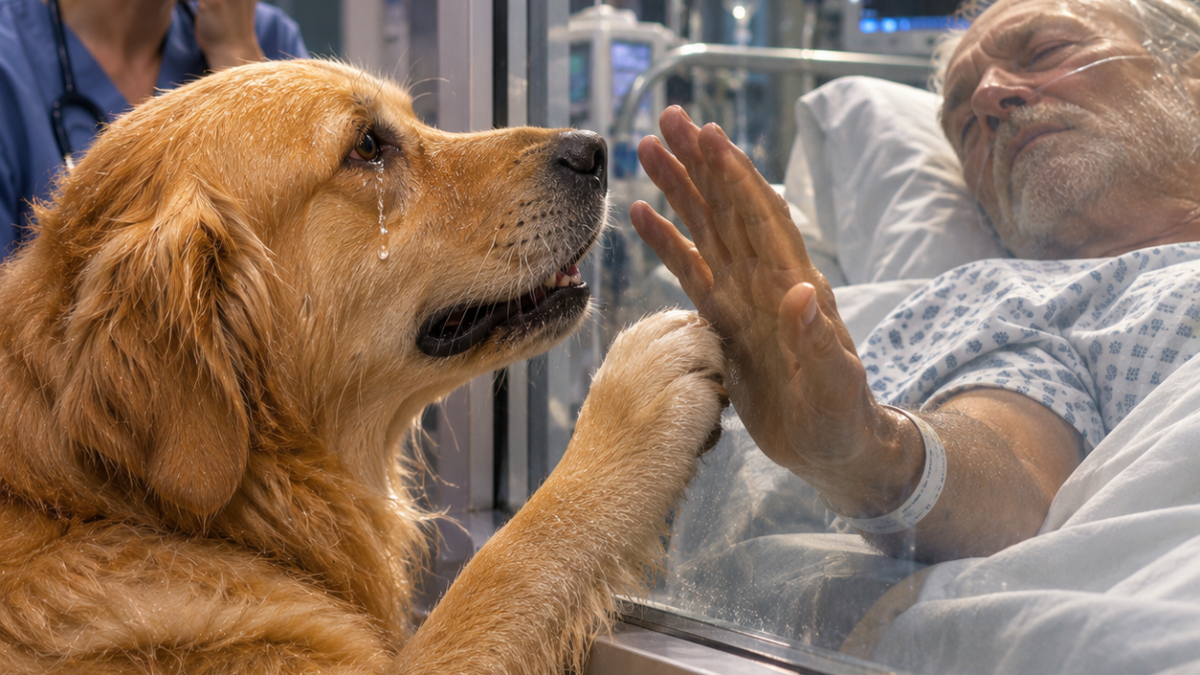
Max placed his front paws against the mattress.
Margaret helped me lift him carefully.
He moved toward Thomas’s hand.
Then lay down.
Pressed his head against Thomas’s palm.
I watched the monitor.
Nothing miraculous.
No sudden awakening.
No movie moment.
But Thomas’s pulse settled slightly.
His breathing pattern became less erratic.
Max closed his eyes.
That was how Victoria Bennett found them several hours later.
Thomas’s daughter came into the ICU looking as though she had not slept in days.
Thirty-three.
Architect.
Dark hair pulled back badly.
She saw Max.
Stopped.
Both hands flew to her mouth.
Then she started crying.
“Max.”
The dog lifted his head.
His tail moved once.
Victoria crossed the room.
Dropped beside him.
“Oh my God.”
She looked at me.
“How did he get in here?”
“I found him outside.”
“Outside?”
“In the courtyard.”
Victoria closed her eyes.
“He stayed.”
“What happened?”
She took a breath.
Then told me.
The evening before, Thomas had called her.
Chest pressure.
Sweating.
Difficulty breathing.
Victoria rushed over.
Called emergency services.
By the time paramedics arrived, Thomas was barely conscious.
Max panicked when they tried moving him.
He followed the stretcher to the ambulance.
Victoria wanted to bring him.
The crew refused.
No animals.
Thomas opened his eyes once.
Mumbled:
“Max.”
Then:
“Don’t leave him.”
Victoria held his hand.
“Dad, I’ll take care of him.”
Thomas shook his head weakly.
“No.”
“Tell him wait.”
She started crying again as she spoke.
“He said…”
Her voice broke.
“Tell Max to wait.”
“I’ll come back.”
The ambulance left.
Max chased it.
Victoria followed in her car.
By the time she reached the hospital, staff had already taken Thomas inside.
She tried catching Max.
He ran from her.
Not away from the hospital.
Toward it.
Every time somebody approached, he moved beneath the walnut tree.
Victoria spent hours between the emergency department and the courtyard.
Eventually a nurse told her to stay near her father because his condition was worsening.
She assumed animal control or security would remove Max.
They could not.
He kept returning.
All night.
Rain.
Cold.
Waiting.
I looked at him lying against Thomas’s hand.
Something tightened in my chest.
“He believed him.”
Victoria nodded.
“Yes.”
“He told Max he was coming back.”
“And Max believed him.”
The next three days became some of the longest of my career.
Thomas’s condition improved.
Then worsened.
Then stabilized.
Then frightened us again.
That is critical care.
Families often imagine medicine as a staircase.
Sick.
Treatment.
Better.
Home.
In reality it is often two steps forward, one backward, sideways, then a night where everything changes for reasons nobody can fully explain.
Max stayed.
Officially, he was supposed to leave after short visits.
Unofficially, nobody had the heart to enforce that anymore.
Margaret found a corner for him.
Victoria brought food from home.
He ate only if Thomas was stable.
If an alarm sounded, Max stood immediately.
If nurses entered, he watched every movement.
He never interfered.
Never barked.
Never growled.
He simply monitored us as though we had joined his team.
Staff began asking:
“How’s Thomas?”
Then:
“How’s Max?”
The two questions became connected.
Victoria told me more about her father.
Thomas had been a mechanical engineer before retirement.
His wife, Margaret—same name as our nurse—had died two years earlier after forty-eight years of marriage.
Afterward, Thomas stopped eating properly.
Stopped going to church.
Stopped answering friends.
Victoria worried constantly.
She visited.
Called.
Invited him to dinner.
Nothing worked.
Then one afternoon she convinced him to visit a local shelter.
He had no intention of adopting.
He said he was “just looking.”
Then he saw Max.
A four-month-old Golden Retriever sitting alone at the back of a kennel.
Too quiet.
Too serious.
Thomas crouched.
Max walked forward.
Pressed his face through the bars.
Thomas later told Victoria:
“His eyes looked like your mother’s.”
Not physically.
The expression.
Warm.
Patient.
Kind.
Thomas adopted him that day.
Within months:
He walked again.
Not hospital walking.
Real walking.
Morning neighborhood loops.
Park trails.
He cooked because Max sat beside the kitchen waiting.
He talked because Max listened.
He slept because Max curled beside the bed.
Victoria said:
“I know this sounds dramatic.”
“No.”
“It doesn’t.”
“Max gave him a reason to organize his day.”
She nodded.
“And then his day became his life again.”
On the second night, Thomas developed another dangerous rhythm disturbance.
We treated it.
Stabilized him.
Victoria stood outside the room shaking.
Max stood beside her.
She leaned down.
“Stay with me.”
The dog pressed against her leg.
That was when I realized Max was no longer only Thomas’s support.
He had become Victoria’s too.
Grief travels through families before death ever arrives.
Sometimes waiting is its own kind of grief.
The third night, I was on call.
It was after two in the morning.
The unit lights were dim.
Machines glowed.
Staff spoke quietly.
Thomas had been stable for several hours.
Max slept at the foot of his bed.
I was reviewing labs when Margaret touched my shoulder.
“Look.”
Max had raised his head.
Nothing had alarmed.
No nurse had entered.
He simply woke.
Slowly moved toward Thomas’s hand.
Then pressed his nose against Thomas’s palm.
He licked his fingers.
Once.
Twice.
Again.
Gentle.
Patient.
Thomas’s fingers moved.
Barely.
I stood.
Margaret froze beside me.
Max licked again.
Thomas’s eyelids fluttered.
I moved closer.
“Mr. Bennett?”
His eyes opened a fraction.
Confused.
Weak.
Then his gaze shifted.
Down.
Toward the dog.
His lips moved.
No sound at first.
Then:
“Max.”
The dog’s entire body changed.
His tail began moving.
Fast.
He pushed his head beneath Thomas’s hand.
Thomas whispered:
“You’re here.”
Max made a sound I had never heard before.
Half whine.
Half breath.
Almost a cry.
But not the desperate crying from the courtyard.
This sounded relieved.
Thomas tried lifting his fingers.
Managed to touch the dog’s head.
Then his eyes closed.
I checked him immediately.
He was still with us.
Stable.
Awake enough to respond.
Margaret pressed both hands against her mouth.
I remember thinking:
Do not turn this into something medicine cannot prove.
Max did not cure Thomas’s heart.
Medication mattered.
Monitoring mattered.
Procedures mattered.
Thomas’s own physiology mattered.
But I also knew what I had just witnessed.
A man had come back far enough to recognize the reason he had promised to return.
And after that morning, his recovery accelerated.
When James came in at six, I told him.
He reviewed the chart.
“Neurologic recovery can be unpredictable.”
“I know.”
“Emotional stimulation can help.”
“I know.”
“He still has a long way to go.”
“I know.”
James looked through the glass.
Max was asleep beside Thomas.
Then he smiled.
“But…”
I waited.
“It didn’t hurt.”
I laughed.
“That is the strongest statement you are willing to make?”
“I’m a physician.”
“So am I.”
“Then stop asking me to write poetry in the chart.”
Thomas was fully awake later that day.
Weak.
Disoriented.
But awake.
Victoria came running.
“Dad.”
He looked at her.
“Hi, sweetheart.”
She cried immediately.
Then he asked:
“Where’s Max?”
Victoria laughed through tears.
“Of course.”
We brought him.
Max walked to the bed.
Thomas touched his head.
Then said:
“You waited.”
Max licked his wrist.
Thomas looked at me.
“He waited?”
“All night.”
“Outside?”
“In the rain.”
Thomas’s face crumpled.
He turned toward Max.
“I told you I was coming back.”
The room went silent.
That sentence hit every person standing there.
Max rested his chin on Thomas’s arm.
And Thomas cried.
His recovery was not magical.
That is important.
He did not stand the next morning and walk home.
He needed therapy.
Medication adjustments.
Cardiac monitoring.
Rest.
He tired easily.
Some days were excellent.
Others frustrating.
But every day Max arrived, Thomas changed.
His posture lifted.
He participated more.
He ate better.
Physical therapists joked that Max was the only staff member Thomas never argued with.
One therapist told him:
“Two more laps.”
Thomas grumbled.
Max stood at the hallway entrance.
Thomas looked at him.
“Traitor.”
Then walked two more laps.
A week after he woke, I sat beside him during a quieter afternoon.
Max slept under the chair.
Thomas looked out the window.
“You found him.”
“Yes.”
“Why?”
I thought the question was strange.
“He was crying.”
“Most people would’ve kept walking.”
“I’m not sure.”
“I am.”
He looked at me.
“People are busy.”
“Doctors especially.”
I smiled.
“True.”
He reached down.
Touched Max’s ear.
“My wife wanted a dog for years.”
“Victoria told me.”
“Margaret.”
He smiled at the name.
“She asked every birthday.”
“And?”
“I said no.”
“Why?”
“Work.”
“Travel.”
“Mess.”
“Hair.”
“I had very intelligent reasons.”
I laughed.
“Of course.”
“Then she died.”
His smile disappeared.
“The house became unbearable.”
He looked toward Max.
“I thought grief meant missing someone.”
“It doesn’t.”
“What does it mean?”
“Having nowhere to put all the love you still have.”
I did not answer.
Thomas continued.
“Then I saw him at the shelter.”
“Max?”
“He had these eyes.”
He laughed weakly.
“I know dogs don’t have human eyes.”
“I didn’t say anything.”
“You were thinking it.”
“Possibly.”
He smiled.
“He looked at me like Margaret used to when I was pretending I didn’t need help.”
Thomas rubbed Max’s head.
“So I brought him home.”
“First week, he ate one shoe.”
“Second week, another.”
“I nearly returned him.”
I smiled.
“Did you?”
“No.”
“He slept beside my bed.”
“First night after Margaret died, I didn’t sleep at all.”
“First night Max came home…”
He paused.
“I slept six hours.”
His eyes filled.
“That little animal probably saved me before any of you did.”
Several days later, discharge planning began.
Thomas could sit independently.
Walk with a cane.
Manage short distances.
Victoria prepared her home in case he needed help.
Thomas protested.
“I have a house.”
Victoria said:
“You also have stairs.”
“I know how stairs work.”
“You fell last year.”
“I was carrying groceries.”
“You still fell.”
“I am seventy-five.”
“Exactly.”
He looked at me.
“Doctor.”
“Do not involve me.”
He pointed accusingly.
“Coward.”
Max wagged his tail.
Thomas looked down.
“You too?”
On the tenth day, he was discharged.
I walked outside with them.
The weather had transformed.
The rain was gone.
Sunlight filled the courtyard.
The old walnut tree had started budding.
Thomas moved slowly with his cane.
Victoria carried a bag.
Max walked beside Thomas, matching his pace exactly.
When they reached the spot where I had first seen him crying, Thomas stopped.
He looked at the tree.
Then at me.
“Here?”
“Yes.”
Max sniffed the wet earth.
Thomas’s eyes filled.
“He stayed here all night?”
“Yes.”
I knelt beside Max.
Wrapped my arms around him.
“You’re a hero.”
He licked my cheek.
Thomas laughed.
Then grew serious.
“You asked Victoria why he cried.”
“I did.”
“He wasn’t crying because he thought I was gone.”
I looked at him.
“What was it?”
“He was calling me.”
Thomas looked toward the hospital.
“Saying…”
“I’m here.”
“I’m waiting.”
“Don’t quit.”
I felt tears rise.
He reached for my hand.
“And you heard him.”
I shook my head.
“Thomas…”
“You did.”
“Maybe the doctors saved my heart.”
“Maybe medicine gave me another chance.”
“But somebody had to bring him through that door.”
He squeezed my fingers.
“You saved two lives.”
“Mine.”
Then he looked at Max.
“And his.”
After they left, the courtyard felt empty.
I returned upstairs.
Work resumed.
Because hospitals do not stop for beautiful moments.
New admission.
Family conference.
Medication problem.
A patient deteriorating in room six.
But Max stayed with me.
Not physically.
In the way certain encounters change the shape of your thinking.
For years, our hospital animal policy had been simple.
Service animals permitted.
Therapy-animal visits scheduled.
Personal pets prohibited except under rare end-of-life exceptions requiring layers of approval.
The policy existed for reasons.
Infection control.
Allergies.
Safety.
Liability.
Not cruelty.
Still, I began wondering whether we had confused caution with rigidity.
Margaret brought it up first.
“You’re going to do something.”
I looked up.
“What?”
“You have that face.”
“What face?”
“The face you had when you convinced Harrison to let a wet dog into ICU.”
“I did not convince him.”
“You harassed him professionally.”
“Fine.”
She sat.
“Do it.”
“What?”
“Change the policy.”
I laughed.
“You think hospitals change policies because one doctor feels inspired by a Golden Retriever?”
“No.”
“I think hospitals change policies because a doctor creates a proposal, gathers evidence, gets infection control involved, annoys legal, annoys nursing administration, annoys the medical board, and refuses to stop until everyone is too tired to argue.”
I stared.
“That sounds awful.”
“It will be.”
She smiled.
“Do it.”
So I did.
Not alone.
James joined, reluctantly at first.
Infection-control specialists helped define conditions.
Vaccination requirements.
Behavior screening.
Cleanliness.
Restricted units.
Patient consent.
Roommate consent where applicable.
Staff discretion.
No animals during certain procedures.
No unmanaged risk.
We reviewed existing animal-assisted-care policies at other facilities.
We spoke with therapists.
Nurses.
Legal counsel.
Patient advocates.
The goal was never:
Pets cure disease.
That would have been irresponsible.
The goal was simpler.
When medically appropriate, emotionally significant animal contact may support patient well-being.
Especially during prolonged hospitalization.
Palliative situations.
Certain rehabilitation settings.
Critical illness where safe controlled visitation can be arranged.
It took weeks.
Then months.
Policy discussions make glaciers look impulsive.
Thomas kept recovering.
Victoria sent updates.
First:
Dad walked to the mailbox today. Max tried to carry the mail.
Then:
First cardiology follow-up went well. He complained about the parking for twenty minutes, so I assume he’s back to normal.
Then:
A photograph.
Thomas on his porch.
Max sitting beside him.
Both looking toward the camera.
I printed it.
Put it in my office.
Three months after his discharge, the hospital board approved a pilot companion-animal visitation program.
Not unrestricted.
Not “bring any animal anytime.”
Controlled.
Safe.
Structured.
But far broader than before.
Someone in administration suggested publicizing the story.
Thomas agreed under one condition.
“Max gets top billing.”
Naturally.
Then the hospital foundation proposed something I had not expected.
The courtyard where Max waited was ugly.
Concrete.
One struggling tree.
A bench with peeling paint.
They wanted to renovate it.
Thomas donated the first amount.
Victoria designed the layout.
Local businesses contributed.
Staff volunteered.
And one Saturday in July, we opened:
MAX’S GARDEN
It was small.
Flowers.
A curved walking path.
A new bench beneath the walnut tree.
And one plaque.
I worried the wording might become too sentimental.
Thomas chose it himself.
Here, a dog waited for the man he loved.
His devotion helped change the way this hospital understands healing.
Then beneath it:
Sometimes medicine begins by listening.
I liked that better than anything the committee suggested.
Max came to the opening wearing a blue bandana.
He behaved for approximately seven minutes.
Then stole half a muffin from a child.
Thomas blamed the child for “poor pastry security.”
No one believed him.
Children gathered around Max.
Patients watched from windows.
One elderly woman from rehabilitation asked whether her cat could visit.
James whispered:
“This is how civilizations collapse.”
I said:
“You approved the policy.”
“Under duress.”
“You voted yes.”
“I was confused.”
“You are department chief.”
“Age-related decline.”
I laughed.
The first official personal-pet visit under the new policy happened two weeks later.
A sixty-eight-year-old patient recovering from a long neurological illness.
His wife brought their elderly beagle.
The dog walked into the room.
The patient, who had barely spoken all morning, smiled.
No miracle.
No sudden cure.
Just a smile.
His wife cried.
That was enough.
The program grew carefully.
Cats mostly stayed out because cats have opinions about institutional policy.
A rabbit visited pediatric rehab.
Several dogs came.
One patient’s parrot was denied after legal read the request and developed what I can only describe as spiritual exhaustion.
But the idea remained.
Illness isolates people from everything familiar.
Sometimes medicine can safely return one small piece.
A voice.
A blanket.
A favorite song.
A dog.
Thomas and Max visited the garden often.
Not because Thomas was sick.
Because he liked the place.
He brought coffee.
Sat beneath the walnut tree.
Max wandered among flowers.
Children recognized him.
Staff recognized him.
Thomas pretended to dislike attention.
He loved it.
One afternoon I found him sitting alone.
Max asleep at his feet.
“How’s the heart?”
“Still there.”
“Excellent.”
“My cardiologist says I’m doing well.”
“Because your cardiologist is brilliant.”
“He’s not you.”
“Even better.”
Thomas laughed.
Then looked toward the hospital.
“You know what scared me most?”
“When?”
“That night.”
“The heart attack?”
“No.”
“The ambulance.”
I sat beside him.
“I could hear Max.”
“What?”
“Barely.”
“I was in and out.”
“But I heard him barking.”
“Then the doors closed.”
Thomas swallowed.
“I thought…”
He looked down.
“I thought I had abandoned him.”
My chest tightened.
“You were having a medical emergency.”
“He didn’t know that.”
“No.”
“He only knew I left.”
Thomas stroked Max’s back.
“When I woke and saw him…”
He smiled.
“I knew I had kept my promise.”
That was the thing I had misunderstood.
I thought Max waited because Thomas told him to.
But perhaps Thomas survived partly because he believed someone was waiting.
Promises work both directions.
Victoria joined us later.
She brought architectural drawings.
She had started volunteering with the hospital foundation.
Designing quieter family spaces near critical-care units.
She told me:
“Max changed my work.”
“How?”
“I used to think hospital design was about efficiency.”
“Movement.”
“Sightlines.”
“Codes.”
“Now?”
“Now I notice where people wait.”
That stayed with me.
Hospitals are full of waiting.
Families waiting for news.
Patients waiting for tests.
Doctors waiting to see whether treatment works.
Dogs waiting beneath walnut trees.
The spaces where waiting happens matter.
A year passed.
Thomas remained stable.
Max matured.
Still energetic.
Still incapable of understanding why squirrels existed if not to be chased.
The garden became part of hospital life.
Staff ate lunch there.
Families sat there after difficult conversations.
Children visiting sick grandparents played beside the flowers.
Sometimes an animal visited.
Sometimes not.
Max’s story appeared in a local newspaper.
Then spread online.
People made it more miraculous with each retelling.
The dog who “woke a dead man.”
The dog doctors said “cured a heart.”
The dog who “broke into ICU.”
None of those versions were true.
I used to correct them aggressively.
Then Margaret told me:
“People like miracles.”
I said:
“I like accuracy.”
“You’re exhausting.”
“Thank you.”
So when asked, I told the real story.
Thomas received excellent medical treatment.
He recovered through many factors.
Max did not replace medicine.
But Max mattered.
Emotionally.
Behaviorally.
Humanly.
We do not have to turn something into magic to admit it was powerful.
One evening Thomas asked if I ever thought about the first morning.
“Constantly.”
“You almost walked past.”
I smiled.
“I did.”
He looked surprised.
“I was late.”
“You were?”
“Seven minutes.”
“Scandalous.”
“I heard him.”
“But for half a second I thought security would handle it.”
Thomas looked at Max.
Then at me.
“What changed your mind?”
“The sound.”
“What about it?”
“It didn’t sound like a lost dog.”
“What did it sound like?”
I thought.
“Like somebody asking not to be ignored.”
Thomas nodded.
“That’s what most grief sounds like.”
I carried that sentence into my work.
Before Max, I had sometimes believed efficiency required emotional distance.
Not cruelty.
Distance.
You cannot absorb every patient.
Every family.
Every grief.
Critical-care physicians who try eventually break.
That remains true.
But distance can become deafness if you are not careful.
Max reminded me to distinguish boundaries from indifference.
I could not save everyone.
I could still listen.
A young resident once found me sitting in Max’s Garden after a difficult death.
He asked:
“Do you come here because it makes you feel better?”
“No.”
“Then why?”
“It reminds me feeling bad is not always something you need to fix immediately.”
He looked confused.
I pointed to the plaque.
“Max sat here all night.”
“He didn’t solve anything.”
“He waited.”
Sometimes waiting with grief is the work.
The resident sat beside me.
Neither of us spoke for ten minutes.
That was enough.
Margaret retired two years after Max arrived.
Her final shift ended at seven in the evening.
Staff gathered.
Cake.
Flowers.
Speeches.
Margaret hated speeches.
At the end, the elevator opened.
Thomas walked out.
Max beside him.
Margaret started crying before they reached her.
“You did this.”
She pointed at me.
I raised both hands.
“I did not.”
Max wore a tiny nurse’s cap.
Badly.
Thomas said:
“He insisted.”
Margaret hugged Max.
Then whispered:
“You knew before all of us.”
I asked:
“Knew what?”
She looked at Thomas.
“That he wasn’t finished.”
James retired later.
At his farewell dinner, he claimed his greatest administrative regret was letting me bring Max into ICU.
Then added:
“My second greatest regret was discovering she was right often enough that she became impossible to manage.”
I stood.
“Your retirement is becoming my favorite policy outcome.”
He laughed.
After dinner, he pulled me aside.
“You know I never believed the dog cured him.”
“Neither did I.”
“But?”
James looked at me.
“I do believe patients are not organs.”
That was as close to poetry as James Harrison ever came.
I hugged him.
He complained.
Thomas grew older.
Of course.
Max did too.
The story did not freeze at the happy discharge.
That is not how life works.
Thomas’s heart remained a heart that had once nearly failed.
He required checkups.
Medication.
Diet changes he ignored selectively.
Victoria monitored him.
Max gained weight.
Then lost it after the veterinarian scolded Thomas.
They lived.
That was the important part.
Ordinary years.
Birthdays.
Walks.
Rain.
Sun.
Veterinary appointments.
Cardiology appointments.
Boring things.
Boring is beautiful after nearly losing someone.
Three years after the hospital stay, Thomas celebrated his seventy-eighth birthday in Max’s Garden.
Victoria brought cake.
Hospital staff drifted in.
Max wore a bow tie.
Thomas announced:
“This dog has more doctors than I do.”
Not true.
But close.
He asked me to sit.
Then handed me a small box.
Inside was Max’s original metal tag.
The one he had worn the morning I found him.
MAX
Scratched.
Worn.
I looked up.
“I can’t take this.”
“Yes.”
“No.”
“Victoria bought him a new one.”
“I’m not taking his tag.”
Thomas closed my fingers around it.
“You found him because of that name.”
“I found him because he was crying.”
“And you knew what to call him because of the tag.”
He smiled.
“Keep it.”
I did.
It still sits in my desk.
Sometimes I hold it when a family asks an impossible question.
“Will she wake up?”
“Will he survive?”
“What would you do?”
Doctors want to answer.
That is our training.
Sometimes the honest answer is:
I don’t know.
Max taught me there can still be something to do inside I don’t know.
Sit.
Talk.
Touch.
Wait.
Love.
Not instead of medicine.
Alongside it.
I visited Thomas at home once.
Victoria invited me.
His house was exactly what I expected.
Books.
Old photographs.
Margaret everywhere.
Her picture on the mantel.
Her gardening gloves still hanging beside the back door.
Thomas never removed them.
Max’s bed sat next to his recliner.
I asked:
“Which shoe did he eat?”
Thomas pointed to a framed photograph.
He had framed the ruined shoe.
“You’re strange.”
“I’m sentimental.”
“That shoe cost $180.”
“Exactly.”
We drank tea.
Max rested his head on my foot.
Thomas said:
“He remembers you.”
“I smell like hospital disinfectant.”
“Romantic.”
Then he showed me a photograph from the shelter.
Max at four months.
Big paws.
Uncertain ears.
Serious eyes.
Thomas said:
“That’s the day everything changed.”
I thought of my first morning.
“No.”
He looked at me.
“Which day?”
“The day you decided to bring him home.”
Thomas considered.
“Maybe.”
Then:
“Funny how a life can turn because somebody stops walking.”
I understood.
He stopped at a kennel.
I stopped in a parking lot.
Max stopped beneath a tree.
Three pauses.
One story.
The hospital eventually expanded Max’s Garden.
Not huge.
A little more seating.
Shade structure.
Accessible path.
Small water station for approved visiting animals.
The plaque remained.
No larger monument.
Thomas insisted.
“Max doesn’t need a statue.”
Victoria laughed.
“Dad, nobody proposed a statue.”
“I’m getting ahead of bureaucracy.”
He had become deeply suspicious of committees after spending time around hospital administration.
I did not blame him.
One spring morning, years after the original event, I arrived at six.
Rain.
Almost identical weather.
Cold.
Gray.
I heard a dog crying near the courtyard.
My heart stopped.
For one absurd second, I thought:
Max.
I ran.
A young woman stood under the walnut tree with a small terrier.
She was crying.
The dog was fine.
Her husband was upstairs after emergency surgery.
Pets were not permitted on his particular unit because of clinical restrictions.
She had brought the terrier hoping.
Then been told no.
She apologized repeatedly.
“I know the rules.”
“I just didn’t know what else to do.”
I sat beside her.
We could not bring the dog upstairs.
Sometimes policy has good reasons.
Instead, we called the unit.
The husband was stable enough for a brief video call.
The woman held the terrier.
The dog heard his voice.
Barked.
The man cried.
Not the same outcome.
Same principle.
Listen first.
Then see what is safely possible.
That is what Max changed.
Not every patient gets a pet beside the bed.
Not every rule disappears.
But we stopped treating emotional connection as irrelevant simply because it did not come in a syringe.
Medicine became a little more flexible.
A little more human.
That matters.
Victoria eventually married.
Thomas walked her down the aisle.
With a cane.
Max wore a ridiculous floral collar.
I attended.
During the reception, Thomas said:
“You’re responsible for this.”
“For the wedding?”
“For me being here.”
“No.”
“Yes.”
“Thomas.”
He smiled.
“We can argue until dessert.”
“You had doctors.”
“Had Max.”
“Had Victoria.”
“Had luck.”
He nodded.
“And someone heard a dog crying.”
I stopped arguing.
Sometimes gratitude should be allowed to exist without being corrected.
Victoria’s first child was born the next year.
A boy.
She named him James Thomas.
James Harrison claimed the first name was obviously in his honor.
Victoria said:
“It absolutely is not.”
He refused to believe her.
Thomas became a grandfather.
Max became what Thomas called:
“Assistant grandfather.”
The baby pulled his fur.
Max endured it with saintly patience.
Thomas sent photographs constantly.
I began regretting giving him my number.
Not really.
One photograph remains my favorite.
Thomas sitting on the floor.
Grandson asleep against his chest.
Max lying beside them.
Three lives.
Different ages.
One afternoon.
Nothing dramatic.
That is what survival is for.
Not extraordinary moments forever.
Ordinary moments you almost did not get.
Years after Max first waited outside our hospital, a medical student asked me whether I believed animals could save people.
I answered carefully.
“Define save.”
She frowned.
“Keep someone alive.”
“Sometimes.”
“Physically?”
“They can alert.”
“Assist.”
“Motivate.”
“Reduce isolation.”
“Encourage activity.”
“But if you mean Max magically repaired Thomas Bennett’s heart, no.”
She seemed disappointed.
I smiled.
“That doesn’t make the story smaller.”
“How?”
“Because love doesn’t have to violate biology to matter.”
She wrote that down.
I told her not to quote me.
She probably did.
Thomas himself hated exaggerated versions.
Once someone introduced him at a fundraiser as:
“The man whose dog brought him back from death.”
Thomas muttered:
“I was unconscious, not in Narnia.”
I laughed so loudly people turned.
Max slept beneath the table.
Heroically uninterested.
But if I am being completely honest, there was one moment I cannot explain clinically.
Not cure.
Not miracle.
The timing.
That third night.
No alarm.
No nurse approaching.
Max simply woke.
Moved to Thomas’s hand.
Began licking his fingers.
Then Thomas opened his eyes.
Could have been coincidence.
Likely was.
But medicine is full of events that can be both explainable and meaningful.
I no longer feel compelled to choose one.
The older I became, the more I understood that science and wonder are not enemies.
Science asks:
What happened?
How?
What can we test?
Wonder asks:
What did it mean to us?
Max’s story can survive both questions.
Thomas’s recovery had medical causes.
Max’s presence had emotional meaning.
Both true.
On the fifth anniversary of Max’s Garden, the hospital held a small ceremony.
Thomas was eighty.
Max’s muzzle had begun turning white.
Victoria stood beside them.
I spoke briefly.
I hate public speaking outside medical conferences because people expect doctors to sound wise.
I rarely feel wise.
I told the crowd the truth.
“Five years ago, I almost walked past a crying dog because I was late for work.”
People laughed softly.
“I thought someone else would handle it.”
Then:
“But hospitals are full of moments where everyone assumes someone else will stop.”
I looked at Max.
“He taught me that sometimes the first act of care is simply refusing to keep walking.”
I did not say more.
Thomas hugged me afterward.
Then whispered:
“You’re getting sentimental.”
“You’re eighty.”
“You started it.”
Max’s Garden became less about Max over time.
That is what I hoped.
People who never knew the story sat there.
Some read the plaque.
Some did not.
Families drank coffee.
Staff decompressed.
Children played.
Visiting animals rested.
The garden did not require everyone to know its origin to serve its purpose.
Maybe that is the best kind of legacy.
Something becomes useful enough that the story no longer has to carry it.
Thomas once asked whether that bothered me.
“That people don’t know?”
“No.”
“Why?”
“Because the garden works.”
He nodded.
“Like a good radio.”
“What?”
“My father used to say good equipment disappears.”
“You only notice the signal.”
I smiled.
“Sounds like something an engineer would say.”
“It is.”
Then he added:
“Same with love.”
I looked at him.
He shrugged.
“If it works, you stop analyzing the machinery.”
Thomas had become poetic in old age.
Dangerous development.
One cold morning, I walked into the garden and found Thomas asleep on the bench.
My heart jumped.
Then Max raised his head.
Thomas opened one eye.
“You’re a doctor.”
“You know better than to terrify people.”
“I was napping.”
“You are eighty.”
“Age discrimination.”
Max wagged his tail.
I sat beside them.
We stayed there until Thomas’s coffee got cold.
I think often about Margaret Bennett, Thomas’s wife.
A woman I never met.
Yet in a strange way she was part of everything.
She wanted a dog.
Thomas refused.
Then after she died, the dog she never got became the creature that helped Thomas continue.
Grief is strange like that.
People leave.
Their wishes remain.
Their habits.
Their phrases.
Their unfinished suggestions.
Sometimes life circles back and fulfills them in forms nobody expected.
Thomas told me one afternoon:
“If Margaret met Max, she would say I took too long.”
“She sounds intelligent.”
“She would like you.”
“I assume because I agree with her.”
“Exactly.”
By then I had spent more than a decade in critical care.
Max’s story did not make death easier.
I still lost patients.
Still had to tell families things no person wants to hear.
Still stood beside beds where no beloved animal, medication, prayer, or brilliant physician could change the outcome.
That matters too.
Love is powerful.
It is not omnipotent.
We dishonor grieving families when we imply the right amount of love guarantees survival.
Thomas was fortunate.
Others are not.
Their love is not lesser.
That became part of how I told Max’s story.
He did not prove love always saves a life.
He proved love always matters to the life being lived.
Even when the outcome cannot be changed.
One patient taught me that later.
An elderly woman with advanced cancer.
Her dog visited during hospice care.
She did not recover.
She was never going to.
But the last afternoon of her life, her hand rested in the dog’s fur.
Her daughter told me:
“She stopped being afraid.”
That was medicine too.
Not cure.
Care.
Max helped us understand the difference.
Thomas eventually started volunteering at the hospital.
Nothing official at first.
He sat in the garden.
Talked to families.
People discovered he was the Thomas from the plaque.
He became what Margaret called:
“Unlicensed emotional support human.”
Max did most of the work.
Thomas accepted the credit.
He particularly liked talking to older widowers.
Men who had no language for grief.
Thomas would sit.
Max between them.
Talk about weather.
Baseball.
Medication costs.
Eventually one man would say:
“My wife used to…”
And the door opened.
Thomas never rushed.
He had learned from Max.
Wait.
One evening I asked:
“Do you ever wish none of it happened?”
“The heart attack?”
“Yes.”
He thought.
“Obviously.”
Then he looked around the garden.
“But life doesn’t offer edits like that.”
“No.”
“It gives you consequences.”
“Sometimes good ones grow beside bad ones.”
I nodded.
The garden.
Policy.
Victoria’s work.
Thomas’s volunteering.
None made the terror worthwhile.
But they were real.
We do not have to call suffering a gift to allow something good to grow afterward.
That distinction matters.
The walnut tree became enormous.
Its branches filled out.
Spring flowers returned every year.
I began measuring time by it without realizing.
Bare branches.
Green buds.
Summer shade.
Gold leaves.
Rain again.
Hospitals measure time in shifts.
The tree measured something larger.
I am older now than I was when I first found Max.
That sounds obvious.
It does not feel obvious.
Some memories remain fixed so sharply you expect yourself to still be the same age inside them.
I can still feel rain on my coat.
Still hear Max crying.
Still see the red metal tag.
Still remember carrying him inside.
I had no idea I was holding the beginning of something that would outlast the shift.
When people ask what Max taught me, they expect one beautiful answer.
I have several.
Wait.
Listen.
Do not confuse rules with wisdom.
Do not confuse emotion with weakness.
Do not confuse treatment with healing.
Do not assume somebody else will stop.
And never underestimate how much one living creature can become the reason another keeps moving.
But the deepest lesson is simpler.
Max did not know Thomas’s diagnosis.
He did not understand coronary physiology.
He did not know what ICU meant.
He did not understand visiting hours.
He only knew:
The person I love went through that door.
He said he would return.
So I will wait.
There is something almost sacred in that simplicity.
People complicate love.
Dogs rarely do.
One spring morning, Thomas and Max came through the hospital doors together.
Not as patient and visitor.
Just two old friends on their way to the garden.
Max moved more slowly now.
Thomas did too.
They passed my office.
Thomas knocked on the glass.
I went out.
He handed me coffee.
“You look tired.”
“I am a doctor.”
“Poor career planning.”
We walked outside.
Max lay beneath the walnut tree.
The same place he had once cried.
No crying now.
Birds.
Sun.
Children laughing near the path.
Thomas sat.
I sat beside him.
For several minutes, we said nothing.
Then he looked at Max.
“You know, I used to think I rescued him.”
I smiled.
“Everyone who adopts a dog says that.”
“Cliché.”
“Extremely.”
Thomas nodded.
“I know better now.”
“What do you think?”
“He rescued me.”
I had heard that before.
But he continued.
“Not just when my heart failed.”
“When Margaret died.”
“Every morning afterward.”
“Every walk.”
“Every meal.”
“The hospital was just the day everyone else noticed.”
I looked at Max.
He opened one eye.
Then closed it again.
Thomas was right.
The greatest acts of love are often invisible because they happen daily.
That afternoon, after they left, I returned upstairs.
A nurse stopped me.
“Dr. Vence?”
“Yes?”
“There’s a patient asking whether his dog can visit.”
I smiled.
“Has the request been screened?”
“Yes.”
“Vaccination records?”
“Yes.”
“Infection control?”
“Approved.”
“Then why are you asking me?”
The nurse grinned.
“Habit.”
“Bring the dog.”
She walked away.
I looked out the window.
Max and Thomas were crossing the courtyard.
Side by side.
Exactly the way they had left the hospital years earlier.
The first morning I found Max, I thought he was crying from grief.
Thomas later told me he believed it was a call.
Maybe both.
Grief is love searching for somewhere to go.
Hope is love refusing to stop searching.
Max carried both in the same sound.
He sat beneath that tree for an entire night because one man had said:
Wait.
I’ll come back.
And when Thomas finally did come back, he found Max exactly where love had left him.
Waiting.
That is why I still think about those cries whenever the world feels too busy.
Not because every cry hides a miracle.
It does not.
But because pain deserves to be noticed before we decide whether we can fix it.
Sometimes you cannot.
Sometimes all you can do is move closer.
Ask a name.
Offer warmth.
Open a door.
Stay.
That morning, I did not save Max by carrying him inside.
Max did not save Thomas by himself.
Thomas did not recover because love defeated biology.
The truth is better than that.
Medicine did its work.
A family did its work.
A dog did what dogs have always done.
He stayed.
And because he stayed, the rest of us learned something we had forgotten.
Healing is not always the moment a heartbeat becomes stronger.
Sometimes healing begins earlier.
In a wet courtyard.
Under a bare walnut tree.
With a small Golden Retriever crying into the rain—
and one person deciding not to walk past.








