PART2:The Filthy Dog Walked Into a Biker Diner and Chose the Loneliest Man There—What He Led Us to in the Woods Broke Every One of Us
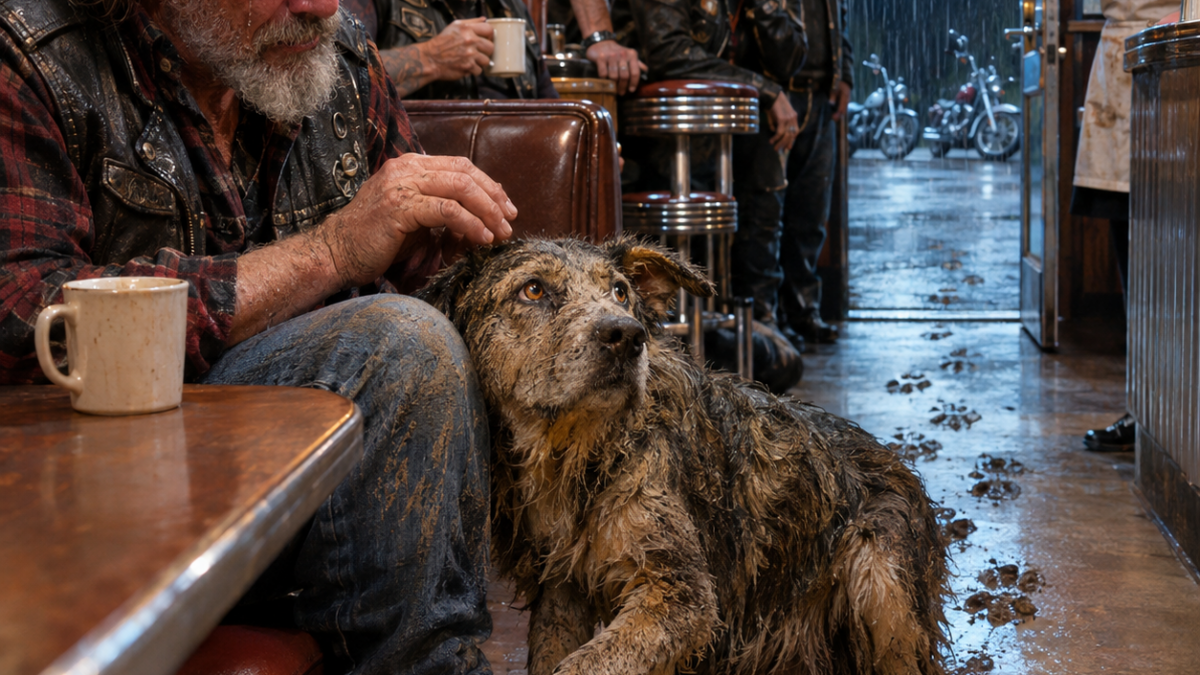
PART2
That was the part that got me.
He kept checking.
Every twenty feet.
Run.
Turn.
Find me.
Run again.
As though he had already lost somebody once that night and could not survive losing the person he had finally convinced to help.
We crossed the parking lot.
The dog slipped through a gap beside the drainage ditch.
I followed.
Behind me, flashlights clicked on.
Sam.
Tommy.
Six or seven others.
The rest stayed near the diner with the bikes.
Nobody knew yet whether we were following an injured stray to an overturned trash can or into something dangerous.
But everyone felt the urgency.
The dog led us along a narrow trail beside Route 17.
Thorns grabbed my jacket.
Wet grass soaked my boots.
The ground sloped toward woods.
For several minutes, the only sounds were breathing, boots, wind, and the small dog’s paws tearing through leaves.
Then he stopped.
A dense thorn bush.
He began digging.
Not randomly.
One exact place.
His injured paw struck earth.
Blood darkened the mud.
“Hey.”
I knelt.
“Stop.”
He ignored me.
I moved him gently aside.
Under dead leaves was a shallow depression.
And inside it—
a blue fabric bag.
Small.
Dirt-covered.
The dog sat beside me.
Panting.
Watching.
I opened it.
The first thing I found was a photograph.
Young woman.
Late twenties.
Brown hair.
Green sweater.
She stood beside a lake with a puppy in her arms.
Same ears.
Same white patch on the chest.
Same dog.
Except clean.
Happy.
Safe.
Tommy crouched beside me.
“That him?”
“Yes.”
Behind the photograph was a key.
Small brass key.
Then several folded pages.
The first had a name.
SARAH WHITMORE
Below it:
An address.
Phone number.
Emergency contact.
Then handwritten lines.
At first, I thought they were notes.
Then I understood.
They were a plea.
Not elegant.
Not complete.
Some sentences ended halfway.
The handwriting became shakier toward the bottom.
If anyone finds this, call police.
They moved me from Miller Road.
Old warehouse near County 8 / abandoned feed storage.
Three men.
I heard them say tomorrow morning.
Then:
Milo got out.
That was the dog’s name.
Milo.
The last line had been written so hard the pen tore the paper.
If he comes back, please follow him.
Tommy whispered:
“Jesus.”
Sam took off his glasses.
Read everything himself.
Nobody spoke for several seconds.
Milo stared at us.
Waiting.
My hand tightened around the paper.
The source story wanted me to become some fearless biker leading thirty motorcycles toward justice.
Reality felt different.
My stomach was cold.
My hands shook.
A kidnapped woman might be alive somewhere.
Or might not.
Three unknown men.
Unknown weapons.
Unknown reason.
Unknown building.
And a dog who had somehow escaped carrying nothing except instinct.
Sam asked:
“What do we do?”
I pulled out my phone.
“We call 911.”
Tommy looked toward the road.
“And then?”
“We give them everything.”
“And if they’re twenty minutes away?”
I looked at Milo.
The dog had begun whining again.
Not loud.
Just enough.
I called.
The dispatcher wanted exact information.
I gave it.
Name.
Location.
Bag.
Note.
Warehouse description.
Potential kidnapping.
Three suspects.
Possible victim named Sarah Whitmore.
Dog led us to evidence.
The dispatcher told us officers were being sent.
Then:
“Do not enter the warehouse.”
I said:
“Understood.”
Tommy looked at me.
“You going to listen?”
“Yes.”
Sam gave me a look.
I continued:
“We find the warehouse.”
“We stay outside.”
“We watch exits.”
“We do not play heroes.”
“If someone comes out with Sarah?”
I stopped.
That was harder.
“We keep her safe if we can do it without making things worse.”
Sam nodded.
That was enough.
We returned to the diner.
The other riders were waiting.
When I showed them the photograph, everything changed.
Men who had spent the evening arguing about engines and sports leaned over a dirty diner table studying Sarah’s face.
Milo stood beneath it.
His head pressed against my leg.
One of the older riders, Frank, whispered:
“Poor kid.”
Tommy pointed at the map on his phone.
County Road 8.
Abandoned agricultural properties.
Sam found an old feed warehouse listed on satellite imagery.
Fifteen to twenty minutes away.
The dispatcher called back.
Deputies were coming from two directions.
State patrol had been notified.
They asked us not to approach closely enough to compromise the scene.
We agreed.
Then thirty motorcycles started.
Not because we needed thirty.
Because nobody wanted to remain behind.
The sound rolled through the parking lot.
Milo jumped.
I crouched.
“Easy.”
His eyes stayed on mine.
I wrapped him in my spare jacket and settled him securely in the sidecar of Sam’s trike rather than trying to balance him on a motorcycle.
Safer.
He resisted until I pointed toward the road.
Then he seemed to understand.
We did not roar into the warehouse yard like an army.
We stopped roughly half a mile away.
Killed the engines.
Split into small groups along public roadside positions.
Enough to see the entrances from a distance.
Not enough to trigger whoever might be inside.
The warehouse was exactly where Sarah’s note said.
Long metal building.
Rusting roof.
Two loading doors.
One yellow security light.
A dark pickup truck outside.
Milo went rigid.
Every muscle.
He began pulling against the blanket.
Whining.
“Sarah?”
His whole body lurched toward the warehouse.
Sam put a hand on him.
“Easy, boy.”
Milo trembled.
That dog knew.
He did not need coordinates.
Police arrived within minutes that felt like hours.
Deputy sheriff.
Then another unit.
Then state troopers.
We handed over the bag exactly as found.
Photograph.
Key.
Notes.
Location.
Deputies asked who touched what.
I told them.
They separated witnesses briefly.
Asked the same questions.
That was good.
Serious.
One officer looked toward the bikers lining the road.
“Everybody with you?”
“Mostly.”
He exhaled.
“Keep them here.”
I nodded.
“Gladly.”
No one wanted to create a hostage situation.
Then we heard a woman scream.
Not loud.
Muffled.
One time.
Milo exploded.
He pulled free from Sam.
Hit the ground.
Ran.
“Milo!”
I went after him.
So did Tommy.
The nearest deputy shouted for us to stop.
I did.
Tommy stopped.
Milo did not.
He raced toward the warehouse.
A side door opened.
A man stepped out.
Saw the dog.
Then saw police.
He turned.
Ran back inside.
That was enough.
The deputies moved.
Fast.
Trained.
Not thirty bikers storming a building.
People whose job was exactly this.
Commands.
Positions.
Backup.
A second suspect appeared at the rear trying to climb a fence.
Two riders standing far down the public road saw him.
They did not chase.
They shouted his direction to officers.
Police intercepted him.
Another man tried leaving through a loading door in the pickup.
A patrol vehicle blocked the road.
Everything happened in bursts.
Noise.
Silence.
Commands.
Milo barking from somewhere near the building.
Then:
“Female located!”
I will remember those words until I die.
Female located.
Alive.
They brought Sarah out beneath a gray emergency blanket.
She could barely walk.
An officer supported one side.
A paramedic supported the other.
Bruising on her face.
Wrists raw.
Hair tangled.
She looked smaller than the woman in the photograph.
Not because she was.
Because fear makes people seem reduced.
Milo saw her.
For half a second, the entire world stopped.
Then he screamed.
Dogs do not scream often.
This one did.
A high, broken sound.
Sarah’s head snapped up.
“Milo?”
The dog ran.
Nobody stopped him.
He crossed the distance so fast his paws slipped on gravel.
Sarah dropped to her knees.
The emergency blanket fell.
Milo hit her chest.
She wrapped both arms around him.
And then she made a sound I have no language for.
Not crying.
Not laughing.
Something between grief and relief.
Something your body makes when it has been holding terror so long that safety itself becomes painful.
“Milo.”
She buried her face in his neck.
“Oh God.”
“Oh God.”
“You came back.”
Milo licked her cheeks.
Whined.
Pressed himself against her.
Sarah kept saying:
“You came back.”
But we all knew that was not the whole truth.
He had not only come back.
He had left.
That was harder.
The dog had run away from the person he loved because she needed something beyond loyalty.
She needed help.
And somehow he understood.
I turned away.
That surprised me.
I had not cried in years.
Not really.
I had learned how to swallow almost anything.
But watching Sarah hold that filthy exhausted dog broke something open.
Sam stood beside me.
He pretended to look at the warehouse.
His eyes were wet.
Tommy had no such pride.
He wiped his face with both hands.
“Man.”
I nodded.
“Yeah.”
The police arrested three men.
One was Sarah’s former boyfriend’s cousin.
The motive turned out to involve money and retaliation connected to a legal dispute, though much of it became part of an investigation we were never entitled to know in detail.
What mattered was that Sarah had been taken against her will.
She had been held for nearly two days.
At one point, during a moment when she was moved between rooms, she slipped outside.
Not far enough to escape.
But far enough to hide the blue bag beneath the thorn bush.
Milo had followed her.
When the men caught Sarah, Milo stayed hidden.
She whispered one word to him:
“Go.”
He would not.
She said it again.
“Go, Milo.”
He whined.
Then she pointed toward the road.
The men dragged her inside.
Milo remained in the trees.
Waited.
Then ran.
Sarah later told me she did not know whether he would understand.
She had trained him to fetch.
Stay.
Come.
Wait.
Nothing like:
Find a group of strangers at one in the morning and convince the sad-looking biker to follow you to evidence.
But love improvises.
Milo ran almost four miles.
Through woods.
Across ditches.
Along road shoulders.
At some point he cut his paw.
He passed houses.
Passed a closed gas station.
Then reached Maggie’s diner because the door opened every few minutes and people were inside.
He walked into a room full of strangers.
And chose me.
Why me?
I asked myself for months.
Maybe nothing mystical.
I was sitting nearest the aisle.
Maybe I smelled like the outdoors.
Maybe I held my hand differently.
Maybe he would have chosen the first person who looked long enough.
But I sometimes prefer Tommy’s explanation.
Animals know.
Not secrets.
Not destinies.
Pain.
Maybe Milo saw a room full of men and recognized the one who understood what it felt like to need someone to follow and not know whether anyone would.
Sarah spent several days in the hospital.
Dehydration.
Exposure.
Bruising.
A wrist injury.
Nothing immediately life-threatening.
That phrase—nothing life-threatening—sounds clinical.
It does not describe trauma.
She woke at night screaming.
Could not tolerate closed doors.
Could not eat if someone stood behind her.
Milo was allowed to visit once police and medical staff cleared it.
The moment he entered, her breathing slowed.
The nurses noticed.
Everybody noticed.
He would lie beside the bed.
If she woke frightened, her hand found his fur.
Sometimes that was the only thing that convinced her she was actually safe.
I visited once.
Then felt awkward.
Why would she want some stranger there?
I was standing near the doorway ready to leave when Sarah said:
“Jake?”
I turned.
She knew my name because police told her.
“Yes?”
“Please stay.”
So I sat.
Milo slept between us.
For several minutes, neither of us spoke.
Then she said:
“He always hated motorcycles.”
I looked down.
“What?”
“Milo.”
“Terrified of them.”
I laughed.
“You could have fooled me.”
“He used to hide behind the couch if one went down the street.”
I thought of thirty engines starting outside Maggie’s.
“He had a bad night for personal growth.”
Sarah smiled.
Small.
First smile I had seen.
Then tears filled her eyes.
“He left me.”
I misunderstood.
“He came back.”
“I know.”
She touched his head.
“That’s what hurts.”
I waited.
“I kept telling him to go.”
“He wouldn’t.”
“I thought they’d kill him too.”
Her voice cracked.
“So I yelled at him.”
“I screamed.”
“Go!”
She covered her face.
“I thought the last thing he would ever hear from me was me screaming at him to leave.”
I swallowed.
“He knew.”
“How?”
“He came back.”
She looked at me.
I said:
“Whatever he heard in your voice, it wasn’t rejection.”
“It was a job.”
That made her cry harder.
I sat there.
Did not try fixing it.
Did not say:
Don’t cry.
I had learned something already.
Sometimes staying is the help.
The diner changed after that night.
Not dramatically.
Maggie still yelled at people for leaving helmets on booths.
Coffee remained terrible.
Tommy still ordered pie at inappropriate hours.
But a metal water bowl appeared beside the entrance.
Sam brought it.
Nobody discussed it.
It stayed.
A few weeks later somebody added a bag of dog biscuits behind the counter.
Maggie complained.
Then bought a nicer container.
Sarah came to the diner for the first time six weeks later.
Daytime.
I almost did not recognize her.
Hair shorter.
Face healed.
Milo on a red leash.
The second he saw the building, he began pulling.
Then he entered.
Every man inside stood.
No plan.
No speech.
They simply stood.
Sarah stopped.
Her hand covered her mouth.
Milo dragged her toward my table.
I crouched.
He put his muzzle into my hand exactly the way he had the first night.
Except he was clean now.
His paw healed.
His eyes different.
No panic.
I rubbed his head.
“You look better.”
Sarah laughed.
“He spent forty minutes at the groomer yesterday.”
“Waste of money.”
“He rolled in mud afterward.”
“Smart dog.”
Tommy came over.
Then Sam.
Then everybody.
Sarah thanked them.
One by one.
Some men became embarrassed.
One man said:
“We mostly stood on a road.”
Sarah answered:
“You stayed.”
He went quiet.
She understood the important part.
Then she thanked me.
I hated it.
Not because I did not appreciate it.
Because gratitude makes me uncomfortable when all I did was what any person should have done.
“I followed a dog.”
“You listened.”
“Milo did the work.”
“He couldn’t call 911.”
Fair.
I said:
“You saved yourself.”
Sarah stared.
“What?”
“You hid the bag.”
“You got him out.”
“You gave us something to find.”
She looked down.
For a long moment she said nothing.
Then:
“I haven’t felt strong since it happened.”
“You were strong before we arrived.”
She started crying.
Quietly.
Milo pressed against her leg.
That was the day I understood survivors often receive praise for escaping but rarely credit for all the invisible decisions that kept them alive until help arrived.
Sarah had listened.
Watched.
Waited.
Hidden information.
Protected her dog.
Found one moment.
That mattered.
Her case went through court.
Slowly.
There were delays.
Hearings.
Statements.
Defense lawyers.
Continuances.
The kind of process that frustrates people who expect justice to feel like the last ten minutes of a movie.
Sarah had to tell the story more than once.
That hurt.
Milo waited outside court buildings because animals were not allowed inside.
I waited sometimes too.
So did Sam.
Tommy.
Not thirty bikers every time.
That would have been theater.
Usually two or three.
Enough so Sarah did not walk back to her car alone.
The defendants were eventually convicted on charges supported by the evidence and received serious sentences.
I will not invent dramatic numbers.
I did not memorize every legal count.
What mattered was that the court recognized what happened.
Sarah had been taken.
Held.
Threatened.
She had not caused it.
She had not imagined it.
She had survived it.
There is power in having a public record say:
This happened.
And it was wrong.
But conviction did not repair her automatically.
That is another lie stories tell.
One verdict.
Then sunlight.
No.
Sarah struggled.
She stopped working for months.
Avoided warehouses.
Could not drive Route 17 after dark.
Jumped when unfamiliar vehicles slowed near her.
Slept with lights on.
Milo slept against the bedroom door.
Therapy helped.
Time helped.
Friends helped.
Nothing worked instantly.
Some days she called herself broken.
I hated that word.
One afternoon at the diner I said:
“Broken things don’t usually drag fifty pounds of dog into therapy twice a week and keep going.”
She smiled.
“Thirty-eight pounds.”
“Feels like fifty.”
“Because he likes you.”
“That makes him heavier?”
“He leans.”
True.
We became friends.
Nothing more.
Not immediately.
That matters.
Another version of this story would turn rescue into romance.
Man saves woman.
Woman falls in love.
That always bothered Sarah when people implied it.
“I was kidnapped.”
She once said.
“I did not emerge needing a boyfriend.”
Fair.
So we drank coffee.
Walked Milo.
Talked.
Sometimes not for weeks.
I never asked for details she did not offer.
She never asked for the history I avoided.
Until one evening.
We sat outside Maggie’s after closing.
Milo beneath the table.
Sarah asked:
“What happened to you?”
I knew what she meant.
“Nothing.”
She smiled.
“That’s a lie.”
“I’m fine.”
“Jake.”
I looked toward the highway.
Cars passed.
Headlights.
Then I said:
“There was a time I needed someone.”
She waited.
“No one came.”
I did not explain more.
Not then.
Sarah nodded.
She did not force me.
That was why eventually I told her.
Not everything.
Enough.
Years earlier, I had gone through a period when grief and depression had hollowed me out.
People around me mistook silence for wanting to be alone.
I helped them believe it.
Then resented them for believing me.
Nobody was entirely responsible.
Nobody entirely innocent.
Eventually I left.
Road.
Bike.
Diners.
No roots.
Sarah listened.
Then said:
“Milo came.”
I laughed.
“Apparently.”
“No.”
She looked at me.
“He came for me.”
“But maybe he found you too.”
I did not answer.
Sometimes people say something true before you are ready to accept it.
A year after Sarah’s rescue, Maggie hung the photograph behind the counter.
Not Sarah’s kidnapping photo.
A new one.
Sarah kneeling beside Milo outside the diner.
Sam.
Tommy.
Me.
Dozens of bikes behind us.
Everyone smiling badly.
Underneath, Maggie wrote:
FOLLOW THE DOG
I hated it.
Everybody else loved it.
Milo became locally famous against Sarah’s wishes.
Children wanted photos.
A newspaper wrote about him.
Someone offered Sarah money for a commercial.
She refused.
“He’s not a mascot.”
Milo disagreed whenever food was involved.
One winter evening, a stray dog appeared near the diner.
Thin.
Terrified.
Would not come close.
The water bowl had frozen.
I brought it inside.
Filled it with warm water.
Placed food near the wall.
Then sat twenty feet away.
Sam watched.
“You’ve changed.”
“No.”
“You absolutely have.”
“Shut up.”
The dog eventually ate.
Animal control found the owner the next day.
Nothing dramatic.
No warehouse.
No rescue.
Just one lost dog going home.
I think that was the moment I realized change does not always announce itself.
Sometimes you simply stop walking past things.
Sarah returned to architecture.
She had designed commercial interiors before.
After the kidnapping, enclosed spaces bothered her.
So she changed focus.
Public parks.
Animal shelters.
Open community spaces.
Buildings designed around visibility and light.
She said:
“If I’m going to spend forty hours a week thinking about rooms, I want people to feel they can leave them.”
I understood more than I told her.
Three years passed.
Milo’s face began getting a little white around the muzzle.
Still energetic.
Still obsessed with Sarah.
Still disliked motorcycles.
He tolerated mine.
Barely.
Whenever I started the Harley, he gave me a look of profound betrayal.
One April evening, almost exactly three years after the rescue, Sarah came into Maggie’s without him.
That scared me instantly.
“Where’s Milo?”
She sat.
Her eyes were swollen.
“At the veterinary hospital.”
My chest tightened.
“What happened?”
“He collapsed.”
We drove together.
No motorcycles.
My truck.
Milo had suffered an acute medical problem.
Serious.
Treatable possibility, but uncertain.
Sarah sat beside his kennel.
The dog lifted his head when we entered.
His tail tapped twice.
Sarah whispered:
“You’re not allowed.”
Her voice cracked.
“Do you understand?”
“You found thirty bikers in the middle of the night.”
“You do not get to quit because of this.”
I stood behind her.
Helpless.
There is nothing worse than owing your life to a creature you cannot bargain with.
Milo stabilized.
He came home two days later.
Not a miracle.
Medication.
Follow-up.
Rest.
Sarah slept on the floor beside him.
So did I one night because she fell asleep sitting upright and I did not want her alone when she woke.
At four in the morning, Milo nudged my hand.
I opened my eyes.
He placed his muzzle in my palm.
Same gesture.
Years collapsed.
Diner.
Mud.
Blood.
Those eyes.
I whispered:
“No.”
He blinked.
“You already used that trick once.”
His tail moved weakly.
“You don’t get to ask anything else from me.”
He breathed.
I rubbed his head.
Then said:
“Okay.”
“Anything.”
I do not know whether dogs understand promises.
I know humans need to make them sometimes.
Milo lived.
Years longer.
Slower.
Whiter.
Still himself.
Sarah and I eventually became something more than friends.
Slowly.
No rescue fantasy.
No debt.
No idea that because I followed her dog she owed me a life.
We fell in love after we knew each other as damaged, difficult, ordinary people.
That felt healthier.
Milo approved mainly because I cooked meat.
When Sarah and I married, it was small.
Maggie closed the diner for three hours, which may be the greatest proof of love I have ever received.
Sam stood beside me.
Tommy, older and somehow still incapable of dressing properly, gave a speech we had specifically asked him not to give.
Milo carried no rings.
Everyone suggested it.
Sarah said:
“He has already had enough responsibility.”
He slept through half the ceremony.
Perfect.
Years later, Sarah asked:
“What if Milo had gone into another building?”
“What?”
“That night.”
“What if he found somebody else?”
“They would have helped.”
“You don’t know that.”
“No.”
She looked at me.
“I think about it sometimes.”
I understood.
The terror of a life hinging on coincidence.
A road.
A door.
A person looking down.
I said:
“But he didn’t.”
“No.”
“He found us.”
Sarah smiled.
“Found you.”
I shook my head.
“All of us.”
That was closer to the truth.
Milo did not only save Sarah.
He reminded thirty men who had grown skilled at looking tough that tenderness was not weakness.
Sam began volunteering at an animal rescue.
Tommy became a firefighter.
Maggie left that water bowl by the door permanently.
And I stopped pretending loneliness was the same thing as freedom.
A dog can change more than one life without understanding any of it.
Milo grew old.
There is no way to make that sentence less painful.
Golden Retrievers do not live long enough.
No dog does.
By thirteen, his hips hurt.
Walks shortened.
He slept more.
Sarah bought ramps.
Rugs.
A ridiculous orthopedic bed he refused to use because he preferred the couch.
One afternoon, I found him beside the old water bowl at Maggie’s.
He had come with us but became tired.
I sat on the floor.
He put his head on my thigh.
Tommy said quietly:
“You remember that first night?”
“Yes.”
“He looked terrible.”
“He smelled worse.”
Sam laughed.
Sarah sat beside us.
Her hand rested on Milo’s back.
Nobody said what everyone knew.
Time was moving.
We made no grand decisions that afternoon.
Just went home.
Milo ate dinner.
Slept.
Woke.
Life continued.
Months.
Good days.
Hard days.
Then one morning he could no longer stand without pain.
Sarah looked at me.
I had seen that expression once before.
Outside the warehouse.
A person realizing love could not protect someone from every ending.
We spoke to the veterinarian.
There were choices.
Treatment.
Comfort.
Time.
Quality of life.
No dramatic sudden death.
No cruel twist.
Just the terrible ordinary responsibility that eventually comes with loving an animal.
Sarah asked:
“How do I know?”
The veterinarian said:
“You know him better than anyone.”
That was almost unbearable.
Because responsibility had returned to her.
Milo had once made the impossible decision to leave Sarah to find help.
Now Sarah had to decide how long to ask him to stay.
She gave him another week.
He ate hamburgers.
Went to Maggie’s.
Lay in the sun.
Visited the trail near the thorn bush one last time.
That surprised me.
Sarah wanted to go.
I thought it might be too much.
She said:
“No.”
“He brought me out of there.”
“I want him to see it when nobody is afraid.”
The warehouse had been demolished years earlier.
Only foundation concrete remained.
Trees had begun reclaiming the area.
We walked slowly.
Milo sniffed.
Stopped near the old bush.
Then sat.
Sarah knelt.
She was crying before she spoke.
“You did it.”
Milo looked at her.
“You found somebody.”
She pressed her forehead against his.
“You found me.”
Then:
“You can stop looking now.”
I turned away.
Some moments do not belong to witnesses.
Even husbands.
Milo died peacefully days later with Sarah’s hand on his chest and my hand beneath his muzzle.
The last thing he did was push his nose weakly into my palm.
Just once.
I broke.
Completely.
Years of grief I had outrun.
People I had lost.
Things I had never admitted hurt.
All of it came out sitting on a veterinarian’s floor beside the dog who had once crossed four miles of darkness because he refused to leave the person he loved alone.
Sarah cried into my shoulder.
I cried into his fur.
Nobody told us to stop.
Nobody said:
He was only a dog.
Thank God.
Because anyone who says that has never understood what an animal can become inside a human life.
We buried his ashes beneath a tree behind our house.
Not all of them.
Sarah kept a small amount.
I kept something else.
His original collar.
Dirty leather.
Scratched metal tag.
The one he wore that night.
MILO
It hangs beside my motorcycle keys.
I touch it almost every time I leave.
Maggie replaced the water bowl after Milo died.
The old one had rusted.
On the new bowl, Tommy had a small engraving added.
I was furious when I saw it.
Then I cried.
It says:
FOR THE NEXT ONE WHO NEEDS SOMEONE TO FOLLOW
The bowl stays beside the door.
Always.
Summer.
Winter.
Day.
Night.
Nobody asks why.
Most people around town know.
Travelers do not.
Sometimes a truck driver fills it.
Sometimes a child.
Sometimes nobody uses it for weeks.
That is not the point.
The point is that it is ready.
Sarah still has difficult nights sometimes.
Trauma does not disappear because years pass.
Certain smells.
Warehouses.
Unexpected footsteps.
Once, a blue fabric bag in a department store made her leave without warning.
I followed.
No questions until she could breathe.
That is one thing Milo taught me.
Follow first.
Understand later.
I still ride.
Less than I used to.
My apartment with one chair is gone.
There are photographs in my house now.
Too many, actually.
Sarah says I complain and then secretly straighten them.
She is correct.
One photograph sits beside our front door.
Milo as a puppy in Sarah’s arms.
The photograph from the blue bag.
Police returned it after the case.
It carries creases.
Dirt stain.
One torn corner.
Sarah could have replaced it with a clean copy.
She never did.
Because the damage is part of the story.
The picture survived.
So did she.
People still ask whether Milo understood what he was doing that night.
I do not know.
Maybe he knew only:
Sarah is gone.
Sarah is afraid.
People are somewhere.
Go.
Maybe that is enough.
We like to make love complicated because humans are complicated.
Dogs reduce it.
Someone you love needs you.
You move.
You keep moving.
If one door does not open, find another.
If one person does not understand, find the next.
Do not stop simply because you cannot explain what you need.
The night Milo entered Maggie’s, there were almost thirty men in that diner.
Leather.
Beards.
Scars.
Big motorcycles.
The kind of group strangers cross a parking lot to avoid.
Milo saw none of that.
He did not know reputations.
Clubs.
Criminal records.
Divorces.
Addictions.
Bad fathers.
Good fathers.
Lonely men.
He looked at faces.
Then chose.
And when he placed his muzzle in my palm, he asked the simplest question any living creature can ask another:
Will you come?
I almost said no.
That part matters.
People want heroes to know immediately.
I did not.
I was tired.
Cynical.
Afraid of caring.
I almost let someone else handle it.
Then Milo walked to the door.
Looked back.
And waited.
Every important thing in my life came after I stood up.
Sarah.
Friendship with men I had kept at emotional arm’s length.
A home.
A marriage.
The courage to admit my own old wounds.
Even the stupid photographs on my walls.
All because one dirty dog refused to accept my first instinct, which was to remain seated.
So if you ever pass Maggie’s Highway Diner late at night, you may see an older biker in the corner.
Gray in his beard now.
Coffee.
Sometimes pie.
Motorcycle outside.
Beside the front door is a clean bowl of water.
There is a photograph behind the counter of a young woman holding a dog between a group of terrible-looking men who are all smiling.
You might ask Maggie about it.
She will probably tell the story badly.
She makes me sound heroic.
Do not believe her.
The hero weighed thirty-eight pounds.
He had one bleeding paw.
He was filthy.
He was terrified.
And he ran farther than anyone had the right to expect because somewhere behind him, the person he loved was waiting for him to do the impossible.
He found us.
He brought us to her.
And years later, when his own strength finally failed, Sarah and I were there to make sure the dog who had refused to let anybody face the darkness alone did not have to face his last moment alone either.
That is the ending I choose to remember.
Not the warehouse.
Not the men who hurt Sarah.
Not the blue bag.
Not even the sirens.
I remember Milo’s nose in my palm.
The first night.
And the last.
The same quiet gesture.
The first time it meant:
Please follow me. Someone I love needs help.
The last time it meant something gentler.
Something I did not understand until after he was gone.
You followed.
You found her.
You stayed.
Now I can rest.








