PART2:The Dog Wouldn’t Leave the Burning Hallway—Then I Heard Two Faint Knocks Behind the Door He Was Guarding
PART2
“James, we’ve got to move,” Michael shouted through his mask.
The heat was worsening.
I knew it.
My training knew it.
Every instinct built through years of firefighting told me not to waste time arguing with a frightened dog in a smoke-filled corridor.
I grabbed the retriever again.
“Come on!”
He twisted free.
Scrambled back.
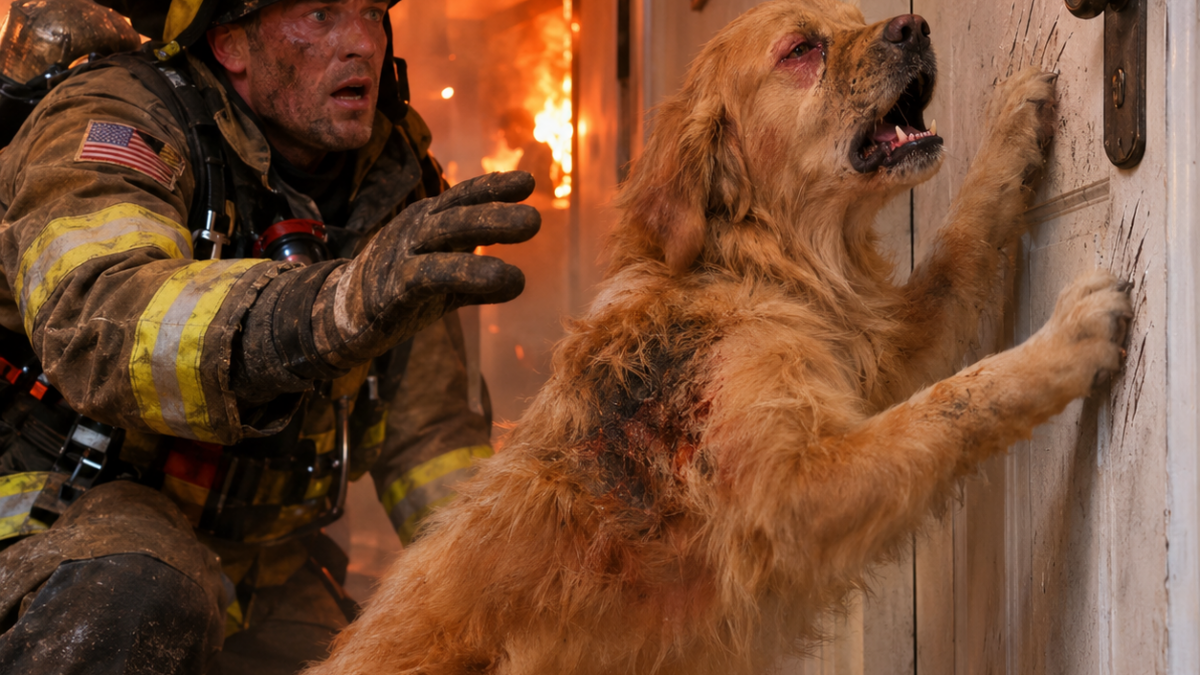
Paw against the bedroom handle.
Then another.
He was trying to open it.
I stared.
“Wait.”
Michael shouted:
“What?”
“This dog wants the room.”
The retriever scratched again.
Then shoved his nose beneath the bottom edge of the door.
“Somebody inside?” Michael asked.
“I don’t know.”
I crouched.
Placed the back of my gloved hand against the door.
Hot.
But not violently hot.
That mattered.
If active flame had fully involved the room, the door might have been too hot to approach safely.
I leaned near it.
“FIRE DEPARTMENT!”
Nothing.
“IF YOU CAN HEAR ME, MAKE A SOUND!”
Still nothing.
The dog barked once.
Short.
Sharp.
Then scratched again.
I pressed closer.
“ANYBODY IN THERE?”
For perhaps two seconds, all I heard was fire.
Then:
Knock.
Knock.
So weak I almost convinced myself I had imagined it.
The dog froze.
So did I.
“Again!”
A pause.
Then one tiny impact against the other side.
Michael looked at me.
“You heard it?”
“Yes.”
I keyed the radio.
“Daniel, Michael, third floor, far end corridor. Possible victim behind locked bedroom door. Bring forcible-entry tools.”
The retriever sat down.
That sounds strange.
But it was as if he understood.
He had finally convinced somebody.
His job had changed.
He no longer clawed wildly.
He simply stared at the handle.
His whole body trembled.
His tongue hung from one side of his mouth.
I put a hand on his head.
“Good boy.”
His ears moved.
“We’re getting him.”
The dog leaned against my leg.
Only for a second.
Then went back to watching the door.
Daniel arrived with the tool.
“Victim confirmed?”
“Possible. Faint response.”
Michael positioned himself.
“Dog?”
“Leave him for the moment.”
Daniel glanced down.
The Golden Retriever did not even look at him.
“All right.”
We forced the door.
The frame resisted first.
Old building.
Heavy wood.
Second strike.
Crack.
Third.
The lock gave.
We pushed inward carefully.
A small bedroom.
Two beds.
Window open.
That open window probably saved the man’s life.
Some smoke had escaped instead of filling the room completely.
But conditions were still bad.
Then my thermal camera showed a human shape low near the opposite wall.
“There!”
We moved in.
Male.
Around forty.
On the floor.
Conscious.
Barely.
He had apparently tried to reach the door and collapsed before making it.
His eyes opened when my light crossed his face.
Then the dog slipped between us.
“Charlie!”
The word came out like air escaping damaged lungs.
The Golden Retriever transformed.
He rushed across the floor.
Tail whipping.
He licked the man’s face.
Hands.
Neck.
Barked once.
Then again.
The man tried to hug him.
“Charlie.”
His voice cracked.
“I thought you got out.”
The dog pressed himself against the man’s chest.
For a few seconds, I forgot the building was burning.
That is dangerous.
Fire does not stop for emotional moments.
Michael snapped me back.
“James.”
“Right.”
We moved.
Daniel and Michael positioned the rescue stretcher.
I checked the man.
“Sir, can you tell me your name?”
“Mark.”
“Mark what?”
“Thompson.”
“Mark, we’re taking you out.”
He tried to turn toward Charlie.
“My dog.”
“I’ve got him.”
“No—”
“I promise. He’s coming.”
Mark’s fingers closed weakly around my sleeve.
“Don’t leave him.”
“I won’t.”
Only then did he let go.
We transferred him carefully.
The instant we lifted the stretcher, Charlie tried to follow.
I picked him up.
This time he didn’t fight.
Not once.
He looked at Mark.
Then at me.
I held him against my chest.
“You did your job.”
His breathing was fast.
“You can let us do ours now.”
We moved into the hall.
Conditions had deteriorated.
The smoke was blacker.
Heat pressed down.
Part of the ceiling near the stairwell was beginning to fail.
“Move!”
Daniel and Michael took the stretcher.
I carried Charlie.
The dog kept his head turned toward Mark.
Every few steps, he made a small sound.
Not a whine exactly.
Almost like he was checking.
Still there?
Still there?
Mark answered once.
“Charlie.”
The tail moved against my arm.
We reached the stairwell.
Water streamed down the steps from crews attacking the fire below.
People outside were shouting.
Sirens everywhere.
We descended.
Third floor.
Second.
First.
Then cold November air hit us.
00:23.
That time remains in my head.
Twelve thirty-three in the morning.
We had evacuated everyone.
Eleven residents rescued.
No fatalities.
No major injuries.
Mark Thompson went directly onto oxygen.
Paramedics loaded him.
Charlie tried to climb into the ambulance.
One medic laughed despite everything.
“Looks like we’ve got another patient.”
Charlie’s paws were burned lightly.
His coat had singed along one side.
He had inhaled smoke.
But he was alive.
Mark was alive.
The building behind us continued burning.
And I stood in the street holding that dog while he stared at the ambulance door as if he was prepared to fight me again if anybody tried taking his person away.
I crouched beside him.
“He’s going with them.”
Charlie watched me.
“You can go too.”
The medic opened the rear doors.
We lifted Charlie inside.
He immediately moved toward the stretcher.
Mark’s hand dropped over the side.
Charlie put his head beneath it.
Mark whispered:
“Good boy.”
That was the first time I truly understood what had happened upstairs.
Charlie could have left.
The bedroom window was open.
The smoke in that room was lighter than in the corridor.
He might have stayed there near the fresh air.
He might have found another route.
He might have panicked and run down the hallway when he heard us.
He did none of those things.
Somehow he knew Mark could not escape.
So Charlie went outside the bedroom.
Into worse smoke.
He stood at the locked door.
Scratched.
Waited.
And kept waiting until someone finally listened.
Later, investigators reconstructed what probably happened.
The fire started in the second-floor kitchen.
Wind pushed flames upward through old structural voids.
Mark was asleep when smoke reached his apartment.
He woke disoriented.
He tried to get out of bed.
Mark had a heart condition.
The combination of smoke, panic, heat, and reduced oxygen overwhelmed him.
He collapsed.
Somehow Charlie got through the bedroom doorway before it closed and latched.
Maybe Mark had tried sending him out.
Maybe Charlie panicked and pushed through.
We would never know.
The door shut.
Mark remained inside.
Charlie stayed outside.
The dog could no longer reach him.
So he started scratching.
That sound saved Mark Thompson’s life.
I did not sleep when I got home.
Firefighters become good at pretending sleep comes easily after calls.
Sometimes it does.
Sometimes your body is so exhausted you collapse.
That morning, I sat at my kitchen table with coffee growing cold beside me.
My wife, Sarah, came downstairs around six.
She took one look at me.
“Bad one?”
“Everyone got out.”
“That wasn’t what I asked.”
I rubbed my eyes.
“There was a dog.”
She sat opposite me.
“What happened?”
I told her.
The hallway.
The scratching.
The closed door.
Charlie refusing to leave.
The two faint knocks.
Mark on the floor.
When I finished, Sarah was quiet.
Then she asked:
“If the dog hadn’t been there?”
I looked down.
“We probably would have searched the room eventually.”
“Probably?”
“Our search pattern was moving that direction.”
“But?”
I knew what she was asking.
“We were running out of time.”
“How much?”
“Not much.”
Sarah reached across the table.
“So the dog bought him time.”
“No.”
I thought about it.
“The dog made sure we used the time we had left.”
Two days later, I called the hospital.
I told myself it was professional follow-up.
That was partly true.
Mostly, I wanted to know whether Mark had made it.
He had.
Smoke inhalation.
Cardiac stress.
No severe burns.
Doctors expected recovery.
Charlie had been treated by a veterinary team and was already back with him.
I waited several days before visiting.
Hospitals have a certain smell firefighters know too well.
Disinfectant.
Coffee.
Plastic.
Warm air.
I reached Mark’s room in the afternoon.
The door was partly open.
I knocked.
“Come in.”
Mark sat propped against pillows.
Paler than he should have been.
Tired.
But smiling.
Charlie was beside the bed.
His head rested on the mattress.
One side of his coat had been trimmed where the singed fur needed treatment.
The moment I stepped inside, Charlie’s head rose.
His eyes fixed on me.
I stopped.
“Hey.”
The tail moved.
Slow at first.
Then harder.
Mark smiled.
“He remembers you.”
Charlie stood.
Walked toward me.
Pressed his head against my leg.
I crouched.
“You caused me a lot of trouble.”
His tail hit the bed frame.
Mark laughed.
“Story of my life.”
I scratched behind Charlie’s ears.
He leaned harder against me.
Then, as quickly as he had come over, he returned to Mark.
Right back to the bed.
Right back to his person.
Mark watched him settle.
“You know what the strangest part is?”
“What?”
“I thought he had abandoned me.”
I sat in the chair.
“Why?”
“When I woke up, he was beside me.”
Mark swallowed.
“I knew something was wrong. Smoke everywhere. Alarm going. I opened the bedroom door.”
He looked toward Charlie.
“I pushed him out.”
“You did?”
“I thought he’d have a better chance.”
That answered one question.
Mark continued.
“I tried to follow.”
His hand tightened around the blanket.
“Made it maybe three steps.”
“Then collapsed.”
He nodded.
“The door shut between us.”
“You remember?”
“Bits.”
He stared toward the window.
“I remember hearing him scratch.”
Mark’s eyes filled.
“At first I thought he wanted back inside because he was scared.”
I said nothing.
“Then I realized he was barking.”
His voice broke.
“Trying to get somebody.”
Charlie lifted his head at the sound.
Mark immediately put his hand on him.
“I kept thinking, go, Charlie.”
His fingers moved through the fur.
“Run.”
“But he didn’t.”
“No.”
Mark laughed once through tears.
“Stubborn idiot.”
Charlie’s tail moved.
I smiled.
“Best kind.”
Mark looked at me.
“Captain, I need you to understand something.”
“James is fine.”
“James.”
He took a breath.
“I don’t have much family.”
I waited.
“My wife died four years ago.”
“I’m sorry.”
“Cancer.”
His eyes returned to Charlie.
“My daughter lives in Canada. We’re close, but she has her own family. Charlie…”
He stopped.
“That dog is the reason I started going outside again after Laura died.”
I felt something tighten in my chest.
“He made me walk.”
Mark smiled.
“Every morning. Rain. Cold. Didn’t care.”
Charlie looked completely unapologetic.
“He made me talk to people in the park.”
Mark shook his head.
“Before him, I could go three days without saying a word to anyone.”
I looked at Charlie.
“So he saved you before the fire.”
Mark nodded.
“Long before.”
We sat quietly.
Then Mark said:
“I lost everything.”
I frowned.
“You mean the apartment?”
“Everything in it.”
His photographs.
Furniture.
Clothes.
Books.
Things belonging to his wife.
The fire damage made the apartment uninhabitable.
Much of what smoke did not destroy, water did.
Mark looked at Charlie.
“But apparently the most important thing walked out.”
Charlie’s tail moved again.
Mark smiled.
“He never lost hope.”
I thought about that.
“Maybe he just refused to leave.”
“That’s hope.”
I looked at him.
Mark continued.
“People think hope is feeling sure everything will be okay.”
He shook his head.
“That isn’t what it is.”
“What is it?”
“Staying.”
That word sat between us.
Staying.
Charlie stayed at the door.
Stayed in smoke.
Stayed when every instinct should have told him to run.
Stayed because Mark was behind it.
I left the hospital thinking about every fire I had worked.
We talk a lot about courage in emergency services.
Firefighters running inside.
Paramedics working in dangerous conditions.
Police officers responding to violence.
Those things matter.
But Charlie’s courage looked different.
He had no protective equipment.
No training.
No radio.
No crew.
He had fear.
Heat.
Smoke.
Pain.
And one certainty:
Mark was still inside.
So Charlie remained.
The investigation eventually confirmed that every known resident was accounted for.
Eleven people had been rescued from the building.
Several treated for smoke exposure.
Nobody died.
Whenever the department praised the operation, I kept thinking:
Eleven people.
And one dog who found the twelfth problem.
Technically Mark was included in the eleven.
Emotionally, Charlie had made him his own incident.
The story spread.
One of our younger firefighters posted a photograph of Charlie online after Mark gave permission.
The image showed the dog at the hospital, one paw resting near Mark’s arm.
People shared it thousands of times.
I hated that part.
Not because Charlie didn’t deserve attention.
Because internet stories become distorted quickly.
Within forty-eight hours, people were saying Charlie had dragged Mark from the burning building himself.
He hadn’t.
Others said Charlie broke the door open.
He didn’t.
One version claimed Charlie ran outside, found firefighters, then led us upstairs.
Also false.
The truth was quieter.
And, to me, more powerful.
Charlie stayed.
That was all.
He stayed at the one place where leaving would have been easier.
A local television reporter asked me:
“Would you call Charlie a hero?”
I looked at the camera.
“I’d call him a dog who loved his owner enough not to abandon him.”
“Isn’t that heroism?”
“Maybe.”
She smiled.
“You firefighters hate that word.”
“Yes.”
“Why?”
“Because people confuse heroism with not being afraid.”
“Was Charlie afraid?”
“Terrified.”
“How do you know?”
“I held him.”
I remembered the trembling.
The fast breathing.
The red eyes.
“He was scared.”
I looked into the camera.
“He just stayed anyway.”
The clip circulated.
For weeks afterward, people mailed dog toys to our fire station.
We sent them to Charlie.
Mark eventually asked us to stop because his new apartment began looking like a pet store.
The building on Tib Street took months to repair.
Some residents never returned.
Others did.
Mark couldn’t.
Too many memories.
Too much damage.
With insurance help and community donations, he found a smaller apartment several streets away.
Ground floor.
Near a park.
The first time I visited, Charlie was waiting at the front window.
He saw me.
His whole body started moving.
“Still remembers.”
Mark opened the door.
Charlie charged toward me.
I braced myself.
He stopped inches away.
Sniffed.
Then leaned against my legs.
“Traitor,” Mark said.
Charlie looked at him.
Then immediately ran back.
I laughed.
“Apparently not.”
Mark’s new place was modest.
A couch.
Kitchen table.
A few framed photographs salvaged from storage and restored.
Near the door hung one photograph of the old building after the fire.
I pointed.
“Why keep that?”
Mark looked at it.
“To remember we left.”
I understood.
Not every reminder of disaster is about suffering.
Sometimes it is proof you survived.
Charlie had recovered well.
The singed fur grew back.
His lungs appeared healthy.
No long-term injury from smoke.
The vet called him lucky.
Mark disagreed.
“He’s stubborn.”
I said:
“That too.”
Over the following months, I started seeing them in the park.
Usually mornings.
Mark walking slowly.
Charlie moving ahead.
Then circling back.
Always checking.
That was something I noticed.
Charlie never let Mark get very far behind.
If the leash loosened too much, he looked back.
If Mark stopped, Charlie stopped.
Once I asked:
“Did he always do that?”
Mark shook his head.
“Not before the fire.”
We both watched Charlie.
Mark said:
“I think he’s keeping count now.”
That sentence stayed with me.
Firefighters count too.
We count crew members.
Victims.
Rooms.
Floors.
Exits.
Air.
Minutes.
Because losing track of one person can change everything.
Charlie had learned his own version.
Mark present?
Good.
Mark gone?
Find him.
I began telling the story to new recruits.
Not because firefighting school needs dog stories.
Because it taught something important about attention.
One recruit asked:
“Why didn’t you just remove the dog?”
“I tried.”
“If he had let you?”
“I might have.”
“And then?”
I thought about Mark behind the door.
“We would have continued searching.”
“Would you have found him?”
“Probably.”
The recruit waited.
I corrected myself.
“Maybe.”
That was the honest answer.
Firefighters hate maybe.
But emergency work is filled with it.
Maybe five minutes.
Maybe one closed door.
Maybe a thermal signature missed through dense smoke.
Maybe a victim too weak to answer.
Maybe a dog scratching.
The margin between rescue and recovery can be terrifyingly small.
Charlie narrowed that margin.
A year after the fire, Mark invited several of us to dinner.
Thomas came.
Michael.
Daniel.
Me.
He cooked too much food.
Charlie stationed himself beneath the table like a professional thief.
Mark raised his glass.
“To the men who saved my life.”
I raised mine.
“To the dog who told us where you were.”
Everyone laughed.
Mark didn’t.
He looked down.
Charlie’s head appeared beside his chair.
Mark touched him.
“To Charlie.”
We drank.
Later that evening, Mark showed me something.
A small framed piece of dark green wood.
“What’s that?”
“The bedroom door.”
I stared.
“Seriously?”
“Building manager saved a piece when they removed it.”
The surface was scratched.
Parallel grooves.
Some shallow.
Some deep.
Charlie’s claws.
Mark ran one finger over them.
“I know it sounds strange.”
“No.”
“I wanted to keep it.”
“I understand.”
He looked at the scratches.
“Every one means he was still trying.”
I had no answer.
Eventually Charlie became known around our station.
Not officially.
He had no title.
But when Mark brought him by, every firefighter stopped what he was doing.
Charlie loved the attention.
Especially from Daniel, who carried treats in his locker specifically for him.
“You’re ruining that dog,” I told him.
Daniel shrugged.
“He saved a guy.”
“He also steals sandwiches.”
“Complex personality.”
On the second anniversary of the fire, our department received an invitation to a community safety event.
Mark and Charlie attended.
A child asked Mark:
“Was Charlie scared?”
Mark crouched beside her.
“Yes.”
The girl frowned.
“But brave dogs aren’t scared.”
Mark looked at me.
Then back at the child.
“Brave doesn’t mean you aren’t scared.”
“What does it mean?”
Mark touched Charlie’s back.
“It means something matters more than being scared.”
The girl thought about that.
Then hugged Charlie.
I think she understood better than many adults.
Years of rescue work taught me that people often imagine courage as dramatic action.
Running.
Fighting.
Breaking doors.
Carrying someone.
Sometimes courage is motion.
Sometimes it is refusing to move.
Charlie’s courage was staying at that threshold.
He did not know whether anyone would come.
He did not know whether the door would open.
He did not know whether Mark was still alive.
He only knew his person was on the other side.
So he stayed.
There is another part of the story I rarely tell.
About three months after the fire, we responded to a different incident.
House fire.
Family already outside.
The mother kept screaming about a cat.
I found the cat hiding beneath a bed.
Terrified.
It scratched through my glove when I grabbed it.
We got out.
Outside, the little girl held that animal against her chest and sobbed.
Later Thomas said:
“Charlie changed you.”
I laughed.
“How?”
“You used to complain about animal rescues.”
“I did not.”
“You absolutely did.”
“I complained when people ran back into buildings for animals.”
“Still do?”
“Yes.”
He smiled.
“But?”
I knew where he was going.
“But I understand it better.”
People love with astonishing intensity.
Sometimes badly.
Sometimes irrationally.
Sometimes beautifully.
A pet is not “just an animal” to the person whose empty house became bearable because that animal was there.
Mark taught me that.
Charlie did too.
Mark’s wife Laura had died four years before the fire.
I learned more about her over time.
She had been the one who originally wanted a dog.
Mark resisted.
“Too much responsibility,” he had said.
Laura brought Charlie home as a puppy anyway.
Mark complained for exactly two days.
Then Charlie began sleeping beside his chair.
Laura died when Charlie was still young.
Afterward, Mark stopped sleeping properly.
Stopped cooking.
Stopped meeting friends.
Charlie forced routines onto him.
Morning walk.
Breakfast.
Afternoon walk.
Dinner.
Evening outside.
There is something healing about being needed by a creature who doesn’t care how broken you feel.
Mark told me:
“If I stayed in bed, Charlie would put both paws on my chest.”
I laughed.
“He’d stare at me.”
“What happened if you ignored him?”
“He sneezed on my face.”
“Effective.”
“Very.”
Mark smiled.
“I think Laura knew what she was doing.”
That made the fire even more painful to think about.
The dog Laura chose was the dog who refused to leave Mark when he needed him most.
Mark never said anything mystical about it.
Neither did I.
Life is powerful enough without inventing miracles.
Charlie loved Mark.
That was sufficient.
Several years passed.
I remained with the fire service.
More fires.
More rescues.
More nights where smoke got into everything.
Charlie aged.
His golden coat lightened around his muzzle.
He still ran when he saw me, but slower.
Mark joked:
“We’re both getting old.”
I said:
“Speak for yourself.”
“You complain every time you stand up.”
“That’s experience.”
One autumn morning, I saw them in the park.
Charlie lay beneath a tree.
Mark sat on a bench.
I joined him.
“He okay?”
“Arthritis.”
Charlie raised his head.
Tail thumped once.
I crouched.
“Still stubborn?”
Mark smiled.
“Worse.”
We sat.
After a while Mark said:
“I still dream about the door.”
I looked at him.
“What happens?”
“Sometimes I’m inside and nobody comes.”
I waited.
“Sometimes Charlie disappears.”
Mark’s voice softened.
“Sometimes I hear the door open.”
“Which one happens most?”
He looked at Charlie.
“The last one now.”
Time had done that.
Not erased the fire.
Changed the ending his mind replayed.
I understood.
Firefighters dream about calls too.
Things we reached.
Things we didn’t.
Doors.
Windows.
Faces.
You learn to live with some memories instead of defeating them.
Mark asked:
“Do you dream about it?”
“Sometimes.”
“What do you remember?”
“The scratching.”
“Not the flames?”
“No.”
“Why?”
I watched Charlie sleeping.
“Because the fire sounded like a hundred other fires.”
Mark nodded.
“But Charlie?”
“I’d never heard anything quite like someone refusing to quit.”
A few months later, our department honored Charlie during an open house.
Nothing excessive.
A small plaque.
FOR EXTRAORDINARY LOYALTY DURING THE TIB STREET FIRE.
Mark hated attention almost as much as I did.
Charlie loved it.
He stood beside the fire engine while children took photographs.
Someone put a tiny plastic firefighter helmet on his head.
He tolerated it for approximately fourteen seconds.
Then shook it off.
Daniel laughed.
“Union rules.”
Mark held the plaque.
When asked to speak, he looked terrified.
Then he said:
“I don’t think Charlie knew he was doing something brave.”
He paused.
“He just knew I was still in there.”
That was the whole speech.
Perfect.
Eventually the Tib Street building reopened.
I went once.
Not officially.
I happened to be nearby.
The third floor had been rebuilt.
New paint.
New wiring.
Fire doors.
Sprinklers upgraded.
I walked down the corridor.
The green bedroom door was gone.
Of course.
A new fire-rated door stood there.
Clean.
Heavy.
Unmarked.
I placed my hand against it.
For a second, I could hear:
Scratch.
Scratch.
Scratch.
Then I left.
I didn’t need to go inside.
The important thing had happened outside that room.
A dog waited.
A firefighter listened.
A man answered.
Sometimes rescue is that simple.
Not easy.
Simple.
Pay attention.
Believe the signal.
Open the door.
One evening years later, Mark called me.
“James?”
His voice sounded different.
“What happened?”
“It’s Charlie.”
I sat down.
Charlie was old now.
Much older than the young dog I had met in smoke.
His health had declined.
Mark was taking him to the veterinarian the next morning.
He didn’t ask me to come.
He didn’t have to.
I went.
Charlie lay on a blanket in the exam room.
Mark sat on the floor beside him.
The dog’s eyes opened when I entered.
Tail moved.
Once.
I crouched.
“Hey, buddy.”
His head lifted slightly.
Then settled again.
Mark smiled through tears.
“He remembers.”
“I told you he would.”
Charlie pressed his nose against my glove.
The same kind of glove?
No.
Just an ordinary winter glove.
But for one moment, I was back in that hallway.
Young Charlie.
Smoke.
Red eyes.
Refusing my hand.
Mark whispered:
“He stayed for me.”
I nodded.
“So now I stay for him.”
There was nothing to add.
Love does not always mean saving.
Sometimes saving is impossible.
Sometimes love means remaining when you cannot change the ending.
I stayed with them.
Mark kept one hand on Charlie’s head.
Talked softly.
Told him about Laura.
The park.
The apartment.
The fire.
Told him he had been a good dog.
The best.
Charlie died peacefully beside the man he once refused to abandon.
I have carried people out of fire.
That morning taught me that sometimes staying beside someone is another form of rescue.
Mark was devastated.
But not destroyed.
Months later, we met in the park.
He carried Charlie’s old collar in his pocket.
“You thinking about another dog?” I asked.
“No.”
I nodded.
Then he added:
“Not yet.”
That was enough.
Almost a year later, he adopted a shelter dog.
Older.
Black coat.
One white paw.
Her name was Molly.
She had been overlooked because she was eight years old.
Mark told me:
“I think Charlie would approve.”
“I think Charlie would steal her bed.”
Mark laughed.
“Also true.”
Molly never replaced Charlie.
That isn’t how love works.
She became something new.
Another chapter.
Another reason to walk outside.
Another heartbeat in the apartment.
Sometimes people ask me what the most important thing Charlie taught me was.
They expect:
Loyalty.
Courage.
Heroism.
Those are part of it.
But not the whole thing.
Charlie taught me about staying.
Emergency responders are trained to move.
Move toward danger.
Move victims.
Move equipment.
Move fast when conditions deteriorate.
But some of the most powerful acts I have ever seen were acts of remaining.
A firefighter staying beside a frightened child until a parent arrives.
A paramedic staying calm while someone screams.
A neighbor staying with an elderly resident after evacuation.
A husband staying beside a hospital bed.
A dog staying beside a closed door.
Love is often described by what people give.
Money.
Time.
Gifts.
Sacrifice.
Charlie showed me another measurement.
How long will you remain when every part of the world is telling you to run?
He could have left that hallway.
He could have searched for cleaner air.
He could have followed other residents.
He could have saved himself.
Instead, he stayed near the one door that mattered.
Not because he expected applause.
Not because he understood bravery.
Because Mark was behind it.
Years after the Tib Street fire, I retired from active duty.
On my final week, Daniel gave me a photograph.
It showed me carrying Charlie out of the building.
I had forgotten anyone took it.
The picture was blurry.
Smoke behind us.
Helmet dirty.
Charlie against my chest.
His face turned toward the stretcher carrying Mark.
Daniel had written something on the back.
HE NEVER STOPPED LOOKING FOR HIS PERSON.
I framed it.
It hangs in my home office now.
Sometimes visitors ask about the dog.
I tell them.
Not every detail.
Just enough.
A burning building.
A locked room.
A stubborn Golden Retriever.
Two faint knocks.
A door that opened in time.
And whenever I reach the end, people usually say:
“What an amazing dog.”
They are right.
But I always think of something Mark told me in the hospital.
“He knew the light would come.”
I’m not sure Charlie knew that.
Maybe he didn’t.
Maybe that makes what he did more beautiful.
Hope is easy when you know help is coming.
The harder kind is staying when you don’t.
Charlie didn’t know firefighters were in the building.
He didn’t know I would hear his claws.
He didn’t know Daniel would bring tools.
He didn’t know Mark would survive.
He knew only this:
The person he loved was still behind the door.
So he stayed.
And sometimes that is all courage asks of us.
Not to know the ending.
Not to be fearless.
Not to be strong forever.
Just to stay a little longer.
To scratch one more time.
To call one more name.
To knock twice from the darkness.
To listen when something is trying desperately to be heard.
Mark still walks in the park.
Molly goes with him now.
When we cross paths, we talk.
He still keeps Charlie’s collar.
Still has the scratched piece of green bedroom door.
Still tells people Charlie saved his life twice.
Once after Laura died.
Once during the fire.
I no longer correct him.
Because he is right.
On November fifteenth every year, I remember 11:47 p.m.
The call.
The flames.
The third-floor hallway.
And that little Golden Retriever standing in smoke that should have driven him away, staring at a door he refused to abandon.
I remember grabbing his collar.
I remember him pulling free.
I remember thinking he was being difficult.
And I remember the moment I finally stopped trying to make him follow me and started asking why he wouldn’t.
That question saved Mark Thompson.
There is a lesson in that too.
Sometimes what looks like resistance is communication.
Sometimes the frightened animal is not refusing help.
Sometimes he is pointing toward someone who needs it more.
We just have to notice.
The Tib Street fire was one of hundreds of emergency calls in my career.
Eleven residents came out alive.
Our crews did their jobs.
The building was repaired.
Reports were filed.
Equipment cleaned.
Life moved on.
But when people ask which rescue I remember most clearly, I don’t remember the biggest flame.
I remember three sounds.
A dog’s claws against wood.
My own voice shouting:
“Is anybody in there?”
And two faint knocks answering from the other side.
Knock.
Knock.
A man saying without words:
I’m still here.
A dog saying with every scratch:
I know.
And a door opening just in time.
That is why, after all these years, I no longer believe the greatest rescues begin with strength.
Sometimes they begin with loyalty.
Sometimes with listening.
And sometimes with one small heart refusing to leave the threshold until help finally comes.








