PART2:The Dog Threw Himself in Front of Our Car on a Dark Forest Road—Then a Man Came Running Out of the Trees Crying His Name
PART2
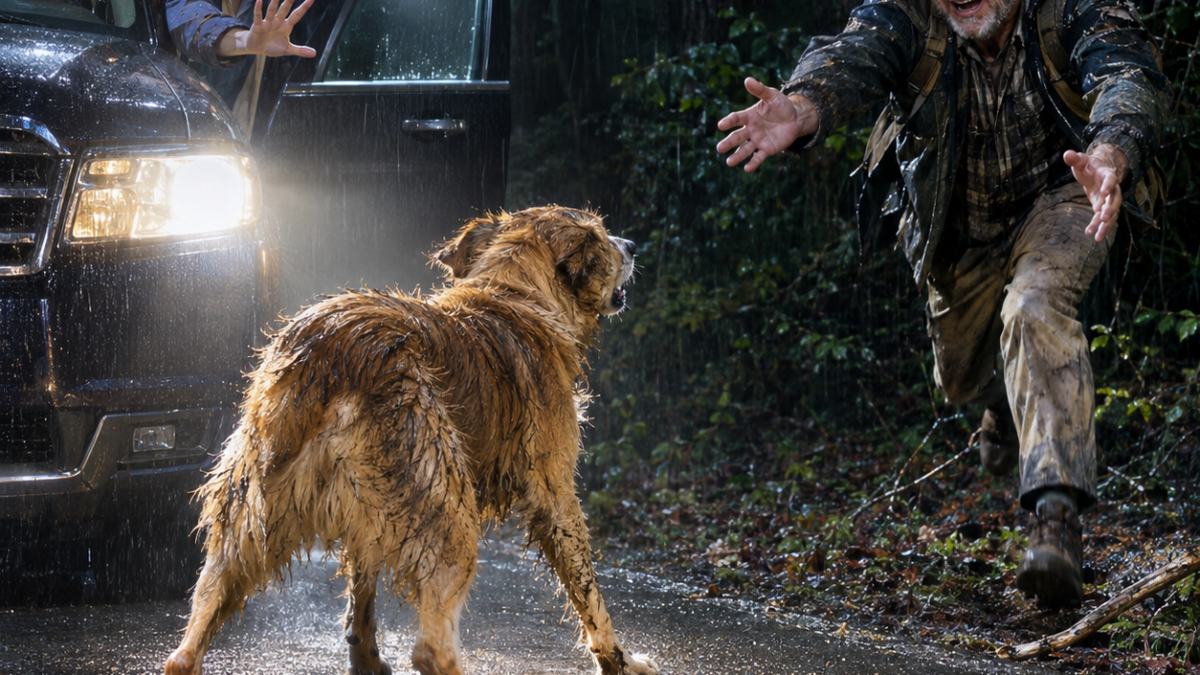
The stranger wrapped both arms around the dog.
For several seconds, he could not speak.
He just held him.
“Rain.”
His voice broke.
“Oh God, Rain.”
The dog pushed against his chest.
Émilie opened her door.
“Are you hurt?”
The man looked up.
His face was streaked with dirt.
One sleeve torn.
There was blood near his temple.
“No.”
He gasped.
“My wife.”
Those two words changed everything.
“Where?”
“Car accident.”
He pointed toward the woods.
“Logging road. Maybe three miles back. Maybe four. I don’t know anymore.”
“You left her?”
“She can’t walk.”
He tried to stand.
His legs nearly gave out.
I caught him.
“What happened?”
“Our tire blew.”
He sucked in air.
“We slid off the road.”
“Anyone else?”
“No.”
“Just you and your wife?”
“Yes.”
“Is she conscious?”
“When I left.”
The answer hit me.
“When did you leave?”
The man checked his watch and stared at it as if he could not understand the numbers.
“Three hours ago.”
Émilie’s face changed.
“Three hours?”
“I thought the ranger station was closer.”
He covered his mouth.
“I got turned around.”
The forest behind him looked endless.
“I lost the road.”
He looked down at Rain.
“He kept trying to pull me one direction.”
“I thought he was confused.”
“I yelled at him.”
The man’s voice collapsed.
“I told him to stay.”
Rain sat against his leg.
“I lost him maybe forty minutes ago.”
I looked at the dog.
He had not been lost.
He had left.
Found the highway.
Found us.
Then stayed in front of a moving car until we stopped.
“What’s your name?”
“James Walker.”
“I’m Alex.”
I pointed toward Émilie.
“My wife, Émilie.”
James nodded quickly.
“My wife is Sarah.”
“Can she call 911?”
“No signal.”
His eyes widened.
“Do you have one?”
I checked.
One weak bar.
Émilie already had her phone out.
She moved toward the shoulder, raising it.
“Come on.”
One bar disappeared.
Returned.
She dialed.
The call dropped.
Again.
This time she got through long enough to give the road number and approximate location.
“We found a man from a vehicle accident.”
Static.
“My phone may drop.”
She listened.
“Yes.”
“His wife is still with the vehicle.”
Then the call cut.
“Did they get it?”
“I think so.”
James shook his head.
“I can take you.”
I looked at the darkness.
“No.”
His face fell.
“We’re going.”
I pointed toward our car.
“But you’re not running another mile through that forest.”
We moved James into the back seat.
Rain jumped in beside him without invitation.
Émilie looked at me.
“You’re driving.”
I nodded.
We turned around.
James guided us toward a narrow gravel road almost completely hidden by brush.
The entrance had no sign.
“Here.”
I slowed.
“This is where you came from?”
“I think so.”
“That answer does not inspire confidence.”
“I’m sorry.”
“I’m not blaming you.”
Rain stood.
His nose pressed against the window.
Then he whined.
James leaned forward.
“Let him out.”
Émilie looked at him.
“What?”
“Rain knows.”
I hesitated.
Then stopped.
James opened the rear door.
Rain jumped onto the gravel.
He stood there.
Looked at us.
Then started walking up the road.
Not running.
Waiting.
I drove behind him.
Fifteen miles per hour.
Ten.
Five.
The road deteriorated.
Branches scraped the doors.
Mud pulled at the tires.
Rain occasionally disappeared around a curve, then came back if we fell too far behind.
“He’s done this before?” I asked.
James shook his head.
“No.”
“What kind of dog is he?”
“Rescue.”
“That wasn’t what I meant.”
James almost smiled.
“Golden retriever mix, probably.”
“How old?”
“Eight.”
“He looks older.”
James rubbed his face.
“He’s had a bad day.”
No one laughed.
The road ended at a washout.
Rain continued into the forest.
I stopped.
“We walk.”
James reached for the door.
Émilie looked at him.
“You can barely stand.”
“My wife is there.”
“You’re coming.”
I handed him a flashlight.
“But slowly.”
We had emergency blankets in the trunk.
A first-aid kit.
Two bottles of water.
Émilie took one.
I carried the other supplies.
Rain led.
The forest swallowed us.
Darkness changes distance.
Every hundred feet felt like half a mile.
The ground sloped downward.
Wet leaves.
Roots.
Branches.
James stumbled repeatedly.
Émilie stayed near him.
“How long have you two been married?”
She asked it not for conversation but to keep him focused.
“Twenty-seven years.”
“Children?”
“Two.”
“Where?”
“Both grown.”
Rain stopped.
Waited.
Then turned sharply left.
James followed.
“Sarah said we shouldn’t take the back road.”
His voice became distant.
“She hates back roads.”
Émilie said:
“Keep talking.”
“I told her it would save forty minutes.”
He laughed once.
Empty.
“She said if we got eaten by bears, she’d haunt me.”
Émilie squeezed his arm.
“She still can.”
James’s mouth trembled.
“Good.”
Then we heard it.
A woman’s voice.
Faint.
“James?”
He stopped.
“Sarah!”
He tried to run.
Fell.
I caught him.
“Sarah!”
Rain took off.
We followed.
The wrecked SUV sat at the bottom of a shallow embankment, nose buried against two young trees.
The driver’s door was open.
A woman sat on the ground beside the vehicle with her back against a tree.
A coat covered her legs.
She looked impossibly small.
Rain reached her first.
She started sobbing.
“Baby.”
The dog pushed into her chest.
She wrapped one arm around his neck.
“I knew you’d find him.”
James collapsed beside her.
“I’m sorry.”
Sarah touched his face.
“You took long enough.”
Then she smiled.
Barely.
It was a married smile.
The kind containing anger and relief simultaneously.
James pressed his forehead against hers.
“I got lost.”
“I assumed.”
“I lost Rain.”
“No.”
Sarah looked at the dog.
“Rain lost you.”
Even James laughed.
I crouched.
“My name’s Alex.”
Sarah nodded.
“Thank you.”
“Where are you hurt?”
“Ankle.”
She looked down.
“And my ribs.”
“Any head injury?”
“Not that I know of.”
“Did you lose consciousness?”
“No.”
“Neck pain?”
“No.”
She answered clearly.
Good.
Émilie wrapped an emergency blanket around her shoulders.
“You’re freezing.”
“I know.”
I checked my phone.
Nothing.
“No signal here.”
James looked terrified again.
“We have to get her out.”
“Yes.”
I examined the slope.
Carrying her through darkness over uneven ground could make things worse.
“We shouldn’t move her farther than necessary unless the situation becomes immediately dangerous.”
Sarah looked at the SUV.
“It smells like gasoline.”
I smelled it too.
Faint.
Could be fuel.
Could be fluids from damage.
That changed the calculation.
I moved them farther from the vehicle carefully, supporting Sarah while she avoided weight on her injured ankle.
We got perhaps forty feet uphill.
Enough.
Rain stayed pressed against her.
Émilie sat beside Sarah.
I looked at James.
“Go back to the road?”
His face tightened.
“No.”
“I’m not asking you to.”
Relief.
“I’ll go.”
Émilie stood.
“No.”
I looked at her.
“You stay with them.”
“No.”
“Émilie.”
“I know what you’re doing.”
“What?”
“You think if one of us has to walk out alone, it should automatically be you.”
“This is not the time.”
“That is what you always say.”
I stared.
James looked away.
Sarah pretended to be fascinated by Rain.
Émilie lowered her voice.
“You don’t even know the path.”
“Rain does.”
The dog looked up at his name.
Sarah whispered:
“He’ll take you.”
Émilie touched my arm.
“Then we both go.”
“And leave two injured people?”
Silence.
She knew I was right.
I crouched in front of her.
“Stay.”
Something old moved across her face.
Pain.
Not fear for this situation.
Something deeper.
“Come back.”
The words were barely audible.
I paused.
“Of course.”
“No.”
She looked directly at me.
“Don’t say it casually.”
My chest tightened.
For months, whenever I left for work, she said:
See you tonight.
I answered:
Of course.
As though return were automatic.
Nothing is automatic.
“I’ll come back.”
She nodded.
I stood.
“Rain.”
The dog looked toward Sarah.
She stroked his head.
“Go.”
Rain did not move.
“Go help him.”
His ears lifted.
James said:
“Go on, buddy.”
Rain stood.
Followed me.
The old path disappeared within a hundred yards.
I trusted the dog.
That is a strange thing for an engineer to say.
But there was no alternative.
Rain moved confidently.
He stopped whenever I slipped.
At one point he returned and nudged my hand.
“I’m fine.”
He stared.
“Keep going.”
We climbed.
I began thinking about Émilie.
Not because I wanted to.
Because the forest stripped away distractions.
No email.
No bills.
No dinner.
No television.
Just darkness and my breathing.
We had been unhappy for eleven months.
I knew the exact month because that was when Émilie had found the apartment listing on my laptop.
I had not rented it.
Only looked.
One-bedroom apartment downtown.
Closer to my office.
She never confronted me directly.
She simply asked:
“Are you planning to leave?”
I said:
“No.”
Technically true.
Planning requires decisions.
I was only imagining.
That distinction did not comfort her.
She asked:
“Do you want to?”
I did not answer quickly enough.
After that, we became polite.
Polite destroys marriages more quietly than rage.
We never separated.
Never repaired.
Just continued.
Maybe that was why her “come back” hurt.
I had physically returned every night.
Emotionally?
I wasn’t sure.
Rain stopped.
I nearly walked into him.
“What?”
He turned right.
The gravel road.
Thank God.
I ran the final stretch.
At the car, I climbed behind the wheel and drove until the phone showed signal.
Two bars.
This time the call held.
I gave everything.
Road.
Approximate coordinates from the phone.
Forest entry.
Vehicle description.
Injuries.
Dispatcher told me responders were already searching based on Émilie’s earlier call.
They had our vehicle location from a partial emergency ping.
I flashed headlights.
Minutes later, red lights appeared through the trees.
County sheriff.
Volunteer fire-rescue.
An ambulance.
I almost collapsed.
The rescue team followed us in as far as vehicles could go.
Then continued on foot.
Rain went ahead with them.
One firefighter laughed.
“Guess we know who’s leading.”
It took nearly forty minutes to stabilize Sarah and carry her out.
By then James was shivering.
Shock.
Exhaustion.
Guilt.
Émilie walked behind the stretcher.
Rain beside her.
When she saw me, she stopped.
For a second, neither of us moved.
Then she crossed the distance and hugged me.
Hard.
I could feel her entire body shaking.
“You came back.”
“I told you.”
“Don’t.”
I pulled away.
“What?”
Her eyes filled.
“I don’t want promises tonight.”
The ambulance doors closed with Sarah and James inside.
A paramedic said James should be evaluated too.
He resisted.
Sarah shouted from the stretcher:
“Get in the ambulance, idiot.”
James obeyed.
Marriage.
Rain remained outside.
He stared as the doors shut.
“They can take the dog?” I asked.
The medic hesitated.
Sarah called:
“He comes.”
The medic sighed.
“Fine.”
Rain climbed in.
Before the doors closed, James reached toward me.
“Alex.”
I stepped closer.
He gripped my hand.
“I don’t know how to repay you.”
“You don’t.”
He shook his head.
“We could have—”
His voice disappeared.
I looked toward Rain.
“He found us.”
James cried again.
“Yes.”
The ambulance left.
Émilie and I stood beside our muddy car.
We should have driven home.
Instead we sat on the hood.
Emergency lights faded down the road.
Night became quiet.
Émilie whispered:
“I was terrified.”
“Me too.”
“No.”
She hugged her arms around herself.
“Not just tonight.”
I knew.
There are moments when you can choose another silence.
I was tired of choosing silence.
“I looked at the apartment.”
She nodded.
“I know.”
“I never called.”
“I know.”
“I thought about it.”
“I know.”
I stared at my hands.
“I don’t know why.”
She laughed bitterly.
“You know exactly why.”
She was right.
“I felt like we had become roommates.”
“So did I.”
“I thought maybe if I left, one of us would finally say something.”
Her eyes filled.
“That is the cruelest part.”
“What?”
“You were willing to leave so I would stop you.”
I had no defense.
“I’m sorry.”
She looked toward the road.
“I spent months wondering if every ordinary day was the day you were secretly deciding to disappear.”
My throat tightened.
“I wasn’t.”
“You already had.”
That landed.
She continued.
“You were home every night.”
“Your body was there.”
“But Alex…”
She looked at me.
“I’ve been alone for almost a year.”
The forest suddenly felt warmer than the space between us.
I said:
“I’m sorry.”
She wiped her cheeks.
“I don’t want another apology.”
“What do you want?”
“I don’t know.”
That answer frightened me.
Then:
“But when you walked into those trees, I realized I still wanted you to come back.”
I looked at her.
“That has to mean something.”
“It does.”
She shook her head.
“It doesn’t fix anything.”
“No.”
“Rain finding us doesn’t mean the universe sent a marriage counselor with fur.”
Despite everything, I laughed.
She did too.
Then she covered her face and cried.
I pulled her close.
For the first time in months, she did not stiffen.
We stayed like that beside the road.
No miracle.
No sudden repair.
Just two people finally admitting there was something left worth trying to save.
We reached home after midnight.
Neither of us slept.
At 6:30, Émilie called the hospital.
James had given us the name.
Sarah had a fractured ankle, two cracked ribs, dehydration, and bruising.
No internal bleeding.
No serious head injury.
James had mild hypothermia and a sprained knee.
Both expected to recover.
Rain had torn a paw pad and was badly dehydrated.
A veterinarian treated him overnight.
“Can we visit?” Émilie asked.
The nurse said:
“Family only.”
Émilie looked at me.
Then:
“Fair.”
At noon, James called.
“Sarah wants to thank you.”
“You already did.”
“She says mine doesn’t count.”
In the background:
“Because you almost got us killed!”
James lowered his voice.
“She’s feeling better.”
I laughed.
Then Sarah took the phone.
“Alex.”
“Yes?”
“Thank you.”
“You’re welcome.”
“Where’s Émilie?”
“Here.”
I passed the phone.
Émilie walked into the kitchen.
I listened from a distance.
Sarah’s voice carried faintly.
Then Émilie started crying.
“What did she say?” I asked later.
She hesitated.
“She said when she was sitting beside the car, she kept talking to Rain.”
“About what?”
“She told him to find James.”
I nodded.
“And?”
“She said when Rain left, she thought she had sent the only warm thing beside her into the forest.”
Émilie’s voice broke.
“She didn’t know if he would come back.”
I thought about Émilie saying those words to me.
Come back.
Not casually.
“They both did.”
“Yes.”
We visited two days later.
Not at the hospital.
At a motel near town where James and Sarah were staying until their vehicle situation was sorted.
Sarah sat in a wheelchair.
Her ankle casted.
James walked with a brace.
Rain lay near the porch.
When he saw our car, he stood.
Slowly.
Then came forward.
Émilie dropped to her knees.
“Hi.”
Rain pressed his head beneath her chin.
She cried instantly.
“You scared me.”
His tail moved.
James watched.
“He likes you.”
Sarah smiled.
“He likes anyone who listens.”
That line stayed with me.
We sat outside for nearly two hours.
James told us what happened.
Their tire had blown on the gravel road.
The vehicle slid down the embankment.
Sarah’s ankle had been trapped briefly.
James freed her.
They tried calling for help.
Nothing.
He waited an hour.
No vehicles.
No signal.
Darkness approaching.
Finally Sarah told him to walk toward the main road.
Rain followed.
James believed he knew the direction.
He did not.
After nearly two hours, he realized he had circled.
Panic took over.
Rain kept pulling toward the west.
James thought he was chasing wildlife.
“I yelled.”
He looked at the dog.
“I actually yelled at him.”
Sarah touched his hand.
“You were scared.”
“I told him to stop.”
“He didn’t.”
“No.”
Eventually Rain slipped from his collar lead and disappeared.
James believed the dog had abandoned him.
“Worst fifteen minutes of my life.”
Sarah raised an eyebrow.
“Worse than crashing the car?”
“Second worst.”
Then James heard Rain barking far away.
He followed.
The barking led him toward the road.
Toward us.
Rain had not abandoned anybody.
He had stopped following the lost human and started solving the problem.
Sarah looked at Émilie.
“He does that.”
“What?”
“Chooses the person who needs him most.”
Émilie stroked Rain.
“Why was he so thin?”
Sarah and James exchanged looks.
“That started before the accident,” Sarah said.
James looked down.
“He stopped eating properly after our son died.”
Silence.
I felt ashamed for having assumed.
“I’m sorry.”
Sarah nodded.
“Our son, Matthew.”
“How old?”
“Twenty-three.”
Émilie froze.
I saw the effect immediately.
Sarah continued.
“Motorcycle accident eighteen months ago.”
Rain had belonged to Matthew first.
When Matthew moved into an apartment that did not allow pets, Rain stayed with his parents.
But every weekend Matthew came home.
Rain waited by the window.
Then Matthew died.
For weeks, Rain continued waiting.
Every Friday afternoon.
Window.
Door.
Driveway.
Sarah said:
“He never understood why Matthew stopped coming.”
James rubbed his face.
“He barely ate.”
They changed food.
Veterinarian.
Tests.
Nothing physically wrong.
Grief.
Dogs carry it differently.
Sarah looked at Rain.
“He eventually started living again.”
“But he never stopped checking the window on Fridays.”
Émilie pressed both hands over her mouth.
Rain leaned against her.
Sarah noticed.
“You okay?”
Émilie nodded too quickly.
Later, driving home, she said:
“I think that’s what broke me.”
“What?”
“Rain still checking the window.”
I waited.
“He didn’t know Matthew was dead.”
“No.”
“He only knew someone who always came back suddenly didn’t.”
I reached for her hand.
She let me.
“I started wondering if that’s what I had been doing.”
“What?”
“Waiting for you while you were sitting three feet away.”
The words were quiet.
They hurt.
“I’m sorry.”
She squeezed my hand.
“This time I’ll accept the apology.”
We started therapy the next week.
Not because Rain magically fixed us.
Because almost losing strangers in the woods made pretending feel obscene.
Our therapist’s name was Dr. Hannah Cole.
During the first session, she asked:
“Why are you here?”
I said:
“We’re having communication problems.”
Émilie laughed.
Hannah looked toward her.
“That description feels incomplete?”
Émilie wiped her eyes.
“He disappeared without leaving.”
There it was.
We spent months unpacking that sentence.
I had become emotionally absent after my company restructuring eliminated the team I had built for seven years.
I had never told Émilie how much that shook me.
I felt replaceable.
Embarrassed.
I worked longer.
Spoke less.
Émilie interpreted distance as rejection.
She stopped reaching because every attempt seemed to embarrass me.
I interpreted her silence as relief.
Two people each protecting themselves from the rejection they assumed was already happening.
No villain.
Just damage.
That was harder than blaming someone.
Some marriages fail because of betrayal.
Some because of cruelty.
Ours nearly failed because neither of us wanted to burden the other with pain.
Rain did not save our marriage.
But he interrupted it at the exact moment silence might have become permanent.
Months passed.
We stayed in contact with James and Sarah.
At Christmas, a card arrived.
Picture of Rain wearing a red scarf.
Underneath:
He still watches the road.
Émilie placed it on the refrigerator.
The following spring, James called.
His voice sounded wrong.
I knew before he finished the first sentence.
“It’s Rain.”
My stomach dropped.
“What happened?”
“Cancer.”
Sarah took the phone.
“Advanced.”
Rain had been slowing down for weeks.
They assumed age.
The veterinarian found a mass.
Surgery would not meaningfully change the outcome.
“How long?”
Sarah’s voice shook.
“Not long.”
Émilie cried when I told her.
“We should go.”
The drive took four hours.
Rain was lying on a blanket beneath a maple tree when we arrived.
He looked smaller.
But when Émilie stepped out, his head lifted.
His tail hit the blanket.
Once.
Then again.
She knelt.
“Hey, hero.”
Rain tried to stand.
“Don’t.”
He ignored her.
Stood anyway.
Walked three steps.
Pressed against her.
Émilie sobbed into his fur.
I sat beside them.
James looked toward the road.
“He doesn’t chase anything now.”
Sarah said:
“Except people leaving.”
I looked at her.
“What?”
“If someone gets in a car, he waits by the driveway until they come back.”
My throat tightened.
Matthew.
The forest.
Us.
Waiting.
Always waiting.
We spent the afternoon there.
No profound speeches.
Rain slept.
We ate sandwiches.
Sarah told embarrassing stories about Matthew teaching Rain to steal socks.
James showed photographs.
Rain as a puppy.
Rain in snow.
Rain asleep beside Matthew.
One photograph made everyone silent.
Matthew sitting on the hood of an old truck.
Rain between his knees.
Both looking toward the camera.
Sarah touched the photograph.
“He waited.”
Her voice shook.
“And then he went back into the forest to save us.”
James looked at her.
“He kept choosing us after we lost the person who taught him to love us.”
Émilie cried again.
Rain opened his eyes.
Looked at her.
She stroked his head.
“You don’t have to take care of everybody anymore.”
Rain sighed.
That evening, we left.
Rain followed us slowly toward the driveway.
James stopped him.
“No.”
The dog struggled.
Émilie walked back.
She knelt.
“We’re coming back.”
I saw her face change as soon as she said it.
Promise.
Return.
All those things suddenly mattered.
She touched Rain’s nose.
“Not because you wait.”
Her voice trembled.
“Because we want to.”
We drove away.
Rain remained beside James.
Watching.
Three weeks later, Sarah called.
Rain had died that morning.
At home.
Between James and Sarah.
He had refused breakfast.
Walked to the front door.
Sat there for several minutes.
Then returned to the living room.
Lay down beside Matthew’s old photograph.
Sarah sat on one side.
James on the other.
They told him everything.
Thank you.
You can rest.
You did enough.
He died with James’s hand on his chest.
Émilie sank onto our kitchen floor.
I sat beside her.
She cried harder than I expected.
So did I.
For a dog we had known less than a year.
Grief does not measure relationships by calendar.
Rain had entered our lives for one night.
But some nights are longer than years.
James and Sarah scattered part of his ashes near Matthew’s grave.
The rest beneath the maple tree.
They invited us.
We went.
Sarah placed Rain’s old collar beside the headstone for a few minutes.
Then picked it up again.
“I can’t leave this.”
“No one asked you to,” Émilie said.
James had made a small wooden marker beneath the tree.
Nothing dramatic.
Just:
RAIN
HE ALWAYS CAME BACK.
Émilie read it.
Then corrected him softly.
“No.”
James looked at her.
“He also knew when to go forward.”
James stared at the marker.
Then nodded.
A week later, he mailed us a photograph of the new inscription.
RAIN
HE ALWAYS FOUND THE WAY.
That was better.
A year after the forest road, Émilie and I returned to the same stretch.
On purpose.
Daylight.
No fog.
The road looked ordinary.
That offended me.
Places where your life changes should look different.
There should be some mark.
Nothing.
Just trees.
Gravel.
Birds.
We parked near where Rain had stopped us.
Émilie stood in the road.
“This is it?”
“I think.”
“It seemed darker.”
“It was.”
She walked toward the tree line.
Then stopped.
“I thought he was going to attack us.”
“So did I.”
“He was asking for help.”
“Yes.”
We stood quietly.
Then Émilie said:
“Do you know what I think about most?”
“What?”
“Not finding Sarah.”
I looked at her.
“Not James running.”
“Not even Rain.”
“What then?”
“You walking into the woods.”
I waited.
“I said come back.”
“Yes.”
“And I realized I had wanted to say that for months.”
My chest tightened.
She turned toward me.
“Not come home.”
“Come back.”
I understood.
We had spent the year learning the difference.
Being physically present is not returning.
Returning is attention.
Honesty.
Vulnerability.
Choice.
We still fought.
Therapy did not turn us into saints.
Émilie still left coffee cups on the piano.
I still answered work email during movies.
She still accused me of loading the dishwasher like an engineer designing a bridge.
I still told her gardens should contain fewer plants with names that sounded invented.
But we talked.
Sometimes badly.
Still talked.
When something hurt, we said it before resentment learned the address.
That was Rain’s gift.
Not mystical.
Not magical.
He had simply made inaction impossible.
Years passed.
James and Sarah became friends.
Real friends.
Not people tied forever to one dramatic evening.
We spent holidays together.
They came to our tenth—technically twelfth—anniversary dinner after therapy.
James brought champagne.
Sarah said:
“You nearly died because he took a shortcut.”
James protested:
“Nobody nearly died.”
She raised her casted ankle in memory.
“Rain disagrees.”
We laughed.
Matthew remained present.
James and Sarah talked about him more over time, not less.
That taught me something else.
Healing does not mean the dead become smaller.
It means the living become large enough to carry them without disappearing.
Émilie planted a tree in our backyard for Rain.
A serviceberry.
White flowers in spring.
Red berries birds stole immediately.
Underneath she placed no plaque.
“No labels,” she said.
“Why?”
“He didn’t need one.”
Every spring, the tree bloomed.
We called it Rain anyway.
At forty-two, Émilie and I became foster parents.
That was not part of some miracle ending.
We had talked about children years earlier.
Tried.
Lost two pregnancies.
Stopped trying.
That grief had been another silence between us I had never properly understood.
Therapy reopened it.
Painfully.
Eventually we realized both of us still wanted to give a child a home, but neither wanted to restart the medical process that had nearly broken Émilie.
Fostering came slowly.
Training.
Background checks.
Waiting.
Our first placement was a ten-year-old girl named Ava.
Three nights.
Then reunification with her aunt.
We cried after she left.
“Maybe we can’t do this,” I said.
Émilie looked at the empty bedroom.
“No.”
“What?”
“That hurt because we did it right.”
She took my hand.
“She was supposed to leave if her family became safe.”
I nodded.
Another kind of love that did not mean holding forever.
Rain again, somehow.
Go forward.
A year later, a nine-year-old boy named Noah arrived.
Quiet.
Suspicious.
He slept with his shoes beside the bed in case he needed to leave quickly.
The first six months were hard.
The second six months harder.
Then one night he asked:
“Are you guys going to send me somewhere else?”
Émilie looked at me.
I remembered the forest.
Promises.
Come back.
Don’t say it casually.
So I did not say:
Never.
Instead:
“We’re going to keep showing up tomorrow.”
Noah frowned.
“That’s weird.”
“Probably.”
Émilie smiled.
“But tomorrow matters.”
He stayed.
Eventually, through a long legal process centered on what was right for him, Noah became our son.
At our adoption hearing, the judge asked if he had anything to say.
Noah shrugged.
Then:
“They always come back.”
Émilie cried.
I almost did.
Afterward, we took him for ice cream.
No speeches.
Life continued.
When Noah was twelve, we finally told him about Rain.
Not as a legend.
As a story.
Forest.
Accident.
Dog.
James.
Sarah.
He listened.
Then asked:
“So the dog saved everybody?”
Émilie smiled.
“Pretty much.”
“Cool.”
I said:
“He was also kind of smelly.”
She hit me.
Noah laughed.
Then:
“Did he really save your marriage?”
Émilie and I looked at each other.
“No,” I said.
“Then why do you guys say he changed everything?”
Because children ask the question adults avoid.
Émilie answered.
“He made us stop long enough to realize we were lost too.”
Noah considered.
“Did he know?”
“No.”
“How do you know?”
“We don’t.”
I shrugged.
“He was a dog.”
Noah looked offended.
“That doesn’t mean he didn’t know.”
Fair.
When Noah graduated high school, James and Sarah attended.
Sarah walked without a limp unless tired.
James had gone completely gray.
Before the ceremony, he gave Noah an envelope.
Inside was an old photograph.
Rain beneath the maple tree.
Noah turned it over.
James had written:
Sometimes finding the way begins with stopping the right car.
Noah framed it in his dorm.
Years later, Émilie became ill.
Not suddenly.
Nothing dramatic.
Breast cancer discovered early.
Treatable.
Still terrifying.
The morning of surgery, I sat beside her hospital bed.
She looked at me.
“You’re making that face.”
“What face?”
“The engineer face.”
“I don’t have a face.”
“You do.”
She reached for my hand.
“I’m scared.”
So was I.
I wanted to say:
Everything will be okay.
The old automatic promise.
Instead:
“I’m here.”
She squeezed my hand.
“That’s better.”
Surgery went well.
Treatment was miserable.
Recovery slow.
She lost her hair.
Hated scarves.
Swore at me for making soup too bland.
We argued.
Laughed.
Cried.
I went to every appointment she wanted me at.
Not because Rain had taught me a lesson years earlier and I was now perfect.
Because love is repetition.
Showing up once is dramatic.
Showing up again on Tuesday morning when nobody is watching is marriage.
Émilie recovered.
Not magically.
Scans.
Follow-ups.
Fear every six months.
But life returned.
When we drove home after the final major treatment appointment, we passed a dog standing beside the highway.
Émilie gasped.
“Stop.”
I did.
Not in the road.
Safely on the shoulder.
The dog belonged to a farmhouse two hundred yards away.
A man came jogging after him.
“Sorry!”
The dog wagged.
Émilie laughed until she cried.
“What?”
“For one second…”
“I know.”
She looked at the dog.
Golden.
Not Rain.
Younger.
Healthy.
No desperation.
Just irresponsible fence maintenance.
The owner apologized again.
We drove away.
Émilie said:
“I thought maybe…”
“Rain?”
She smiled.
“Stupid.”
“No.”
“It wasn’t him.”
“No.”
“Good.”
I looked over.
“Good?”
She nodded.
“Rain finished.”
That was the truth.
Some people need signs because endings are hard to accept.
But a meaningful ending does not require the dead to keep appearing.
Rain had finished.
He found us.
Found James.
Got us to Sarah.
Then returned home.
Years later, what remained was not the dog physically appearing in mist.
It was what we had done because he once did.
When James died at seventy-one from a sudden heart attack, Sarah called us.
Émilie answered.
I knew from her face.
We drove immediately.
No need to ask.
At the funeral, Sarah stood beside Matthew’s photograph.
Then James’s.
Two men.
One dog.
Most of the beings she had loved longest were now gone.
I did not know how she carried it.
At the graveside, she whispered:
“Sometimes I’m angry that I survived all of them.”
Émilie took her hand.
“That’s allowed.”
Sarah nodded.
Then:
“Rain would hate funerals.”
“How do you know?”
“He hated everybody standing still.”
We laughed.
That felt appropriate.
After the service, Sarah gave me something.
Rain’s collar.
Old.
Faded.
Buckled inside a small box.
“I want you to have this.”
“No.”
“Alex.”
“It belongs with you.”
“I have enough things that belong with me.”
She pushed it into my hands.
“Take it.”
“Why?”
“Because he stopped your car.”
I cried.
So did she.
We kept the collar in a drawer.
Not displayed like a relic.
Sometimes years passed without touching it.
Then one rainy evening, Noah came home with his fiancée.
They had been arguing.
Badly.
Not violent.
Not cruel.
Lost.
The way young couples become when both are frightened of losing the other and therefore begin behaving in ways guaranteed to create exactly that loss.
Noah asked:
“How do you know when to leave?”
Émilie looked at me.
I looked at her.
There was no one answer.
Sometimes leaving is necessary.
Sometimes staying is brave.
Sometimes staying is fear.
Sometimes leaving is fear.
So I told him:
“You don’t stay because you’re afraid of being alone.”
Émilie added:
“And you don’t leave just because telling the truth feels harder.”
Noah nodded.
Then saw the old collar in my hand.
I had been reorganizing the drawer earlier.
“Rain?”
“Yes.”
He touched it.
“What would he say?”
I smiled.
“He’d probably scratch the door until somebody did something.”
Noah laughed.
But I meant it.
Rain’s lesson had never been:
Stay.
Or:
Leave.
It was:
Do not freeze when someone needs help.
Sometimes that someone is your partner.
Sometimes a stranger.
Sometimes yourself.
By the time Émilie and I reached our thirtieth wedding anniversary, the serviceberry tree was taller than the house gutter.
Noah came with his wife and their little girl.
James was gone.
Sarah attended with a cane.
She sat beneath the tree and watched our granddaughter collect fallen berries.
Émilie brought lemonade.
Sarah looked up through the branches.
“You know, I still think about that road.”
“So do I.”
“What if he hadn’t found you?”
I hated that question.
We had all asked it privately.
No point answering.
Sarah continued:
“I used to think he saved my life.”
“He probably did.”
“Yes.”
She smiled.
“But James always said Rain saved his.”
“How?”
“James blamed himself for Matthew’s death.”
I had never known that.
“The motorcycle?”
Sarah nodded.
“He had helped Matthew buy it.”
My chest tightened.
“For months James kept saying if he hadn’t given him the money…”
“Sarah.”
“I know.”
She looked toward the tree.
“When Rain disappeared in the forest, James thought he had lost the last living thing that still connected him to Matthew.”
Silence.
“Then Rain found you.”
She smiled.
“And came back.”
A tear moved down her cheek.
“James said that was when he finally understood loving someone does not mean you can control whether they stay alive.”
I looked down.
Sarah touched the bark.
“It means you love them while they are here.”
Émilie sat beside us.
“What are you two doing?”
“Getting sentimental.”
“Disgusting.”
She handed Sarah lemonade.
We laughed.
The sun moved lower.
For a moment, golden light caught the serviceberry leaves.
Same color as Rain’s coat.
I noticed.
Said nothing.
Not every resemblance needs to become a sign.
Sometimes beauty is enough.
Sarah died two years later.
Peacefully.
At home.
She had arranged everything.
In her will, she left funds to the animal rescue where Rain had originally been adopted.
She also left us a sealed envelope.
Inside:
A photograph from the motel porch the morning after the accident.
Émilie sitting beside Rain.
Her hand resting on his back.
James in the doorway.
Sarah in a borrowed wheelchair.
Me standing behind them holding coffee.
I had forgotten anyone took it.
On the back, Sarah had written:
The night Rain found the road, four people thought he was saving one injured woman. We were wrong.
Below:
He brought all of us home in different ways.
Émilie cried.
I did too.
We framed that photograph.
It remains the only Rain-related thing displayed in our house.
Not because he was mystical.
Because the photograph tells the truth.
We looked exhausted.
Dirty.
Scared.
Alive.
Émilie and I were not holding hands.
That came later.
James looked haunted.
Sarah looked relieved.
Rain sat in the center.
Calm.
As though none of it had been extraordinary.
That was who he was.
A dog.
A very good one.
Years later, after Émilie and I both retired, we drove County Route 17 once more.
The state had widened parts of it.
Cell coverage improved.
The old logging road was gated.
We parked legally near a turnout.
No fog.
No emergency.
Just two old people remembering who they had once been.
Émilie walked with a slight limp now from arthritis.
I carried a thermos.
We sat on a fallen log.
“You ever think about what would have happened if I hadn’t stopped?”
She asked.
“You would’ve hit him.”
“Thank you.”
“You asked.”
“I meant if we kept driving.”
I knew.
“Yes.”
“What?”
“I think our marriage would’ve ended.”
She nodded.
“So do I.”
Not dramatically.
Not because we hated each other.
Because eventually silence chooses for you.
She leaned against my shoulder.
“I was already planning to stay with my sister for a while.”
I looked at her.
“You never told me.”
“You never told me about the apartment.”
“Fair.”
“I had packed a bag.”
My chest hurt even after all those years.
“When?”
“That weekend.”
“You were going to leave when we got home?”
“I think so.”
“Why didn’t you?”
She looked toward the trees.
“Rain.”
Simple.
Then she shook her head.
“No.”
I waited.
“Not Rain.”
She touched my hand.
“You.”
I swallowed.
“You went into the forest.”
“You came back.”
“I finally believed there might still be something to come back to.”
I looked at her.
“And I finally realized coming home was something I had to do while already inside the house.”
She smiled.
“Thirty years and you eventually become insightful.”
“I’m an engineer.”
“Tragic limitation.”
We sat there until afternoon faded.
A car passed.
Then another.
No dog.
No running man.
No crisis.
Good.
Before leaving, Émilie stood at the edge of the road.
She looked both directions.
Then smiled.
“What?”
“I’m just imagining him.”
“Rain?”
“Yes.”
“Standing there.”
I could see it too.
Golden coat.
Thin body.
Terrified eyes.
Not asking for himself.
Never for himself.
“Do you think he knew we would help?”
Émilie asked.
“No.”
“Then why stand in front of the car?”
I thought about it.
“He didn’t need to know.”
“What?”
“He just needed to try.”
Émilie nodded.
That answer satisfied both of us.
On the drive home, twilight settled.
The same hour.
The same kind of road.
But not the same people.
Émilie rested her hand over mine on the center console.
After eleven years of marriage, we once believed silence meant comfort.
Then silence became distance.
Rain broke it.
Not with wisdom.
Not with magic.
With claws against a car window.
Tick.
Tick.
Tick.
Look.
Pay attention.
Someone needs you.
That may be the closest thing to a miracle I believe in now.
Not that dogs understand destiny.
Not that forests send rescuers.
But that one living creature can interrupt another creature’s worst moment simply by refusing to walk past it.
Rain could have stayed beside Sarah.
He could have stayed with James when James got lost.
He could have hidden when headlights appeared.
Instead, he ran into the road.
That decision carried consequences far beyond anything his mind could have understood.
Sarah lived.
James found his wife.
Émilie and I finally spoke.
Years later, Noah found a family.
Our granddaughter exists in a world shaped partly by choices made after that night.
Is Rain responsible for all of that?
No.
Life is not that simple.
But he was the first link.
The interruption.
Sometimes that is enough.
As we reached home, Émilie looked toward the serviceberry tree.
Its branches moved in the evening wind.
“You hungry?”
“Yes.”
“What do you want?”
“Anything.”
“You always say anything and then complain.”
“I never complain.”
She laughed.
The sound filled the car.
Ordinary.
Familiar.
Precious.
I turned off the engine.
For a moment, neither of us moved.
Then Émilie said:
“Alex?”
“Yeah?”
“Come inside.”
I smiled.
“I’m coming.”
This time, I understood what the words meant.
Not simply walk through the door.
Be there.
Stay awake to the people beside you.
Answer when they call.
Say when you are afraid.
Say when you are leaving emotionally before you ever pack a bag.
Turn around when somebody disappears.
And if something frightened and exhausted stands in the road asking you to stop—
stop.
Years ago, Rain threw himself in front of our car because Sarah was hurt in the forest and James had lost the way.
For a long time, Émilie said Rain rescued us too.
I used to tell her she was being sentimental.
Now I think she was only partly wrong.
Rain did not rescue our marriage.
He gave us one chance to notice it was drowning.
We did the swimming afterward.
Therapy.
Apologies.
Arguments.
Forgiveness.
Years.
Choices.
Rain just made us look.
And sometimes the difference between losing something forever and saving what can still be saved is no bigger than that.
One moment.
One interruption.
One exhausted golden dog standing in the headlights and refusing to move until somebody finally understands:
Please stop.
Please look.
Please follow me.
Someone you love is still out there.








