PART2:The Dog Had Been Trapped Under Tons of Concrete for 12 Hours… And What We Found Beneath His Broken Body Broke Every Rescuer There
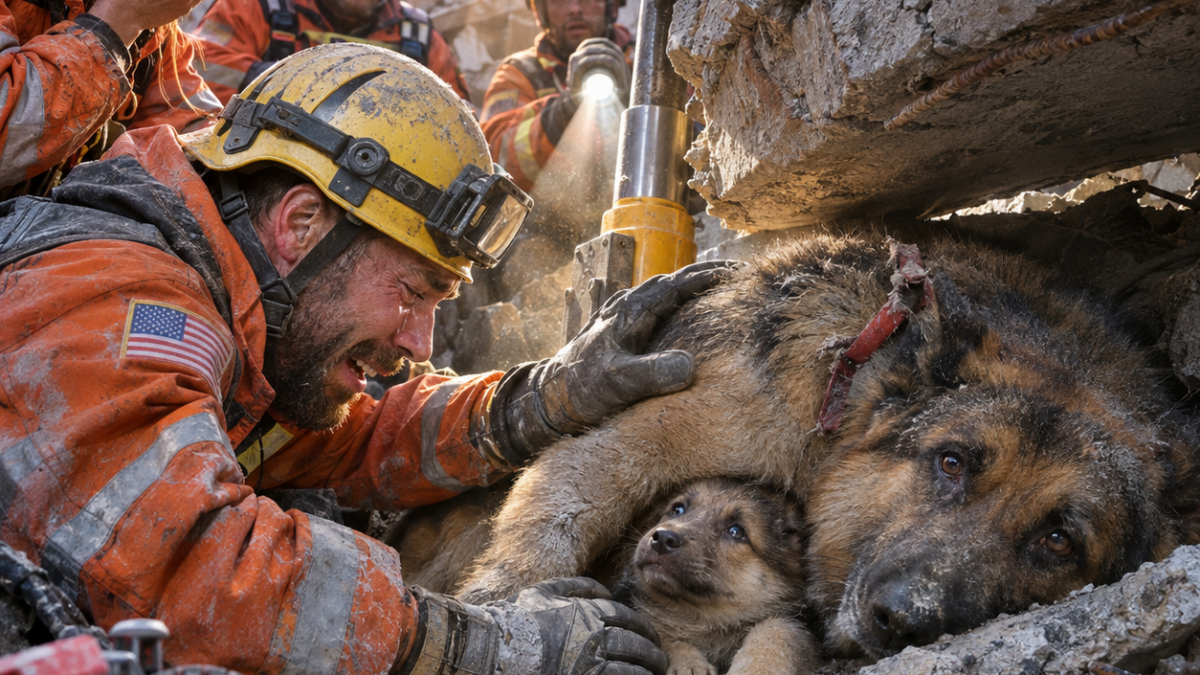
The first twenty minutes were all structure.
Marking safe paths.
Listening.
Calling.
“SEARCH AND RESCUE!”
Pause.
Nothing.
Again.
“IF YOU CAN HEAR ME, MAKE A SOUND!”
No answer.
We removed light debris by hand.
Wood.
Drywall.
Insulation.
Broken furniture.
The dust got into everything.
Eyes.
Mouth.
Gloves.
At thirty-two minutes, my knees already hurt.
At thirty-seven, Marc told me to stop and listen.
We froze.
All machinery outside paused when requested.
Silence.
Not true silence.
Buildings never become silent after collapse.
Pipes hiss.
Water drips.
Concrete settles.
Somewhere glass breaks.
Then—
a sound.
One bark.
Weak.
Rough.
Almost no volume.
I looked at Marc.
“You heard that?”
He nodded.
Julia pointed downward.
“Below us.”
I got flat.
Ear toward a narrow gap.
Nothing.
“Hey!”
I shouted.
“GOOD DOG!”
Ridiculous perhaps.
But sometimes response follows tone more than words.
I waited.
Then—
woof.
Hoarse.
Strained.
Definitely a dog.
Elena smiled for the first time that morning.
“Got one.”
One animal.
That was enough.
We marked the location.
Called for additional stabilization tools.
And started digging.
I did not know then that the dog was not alone.
The sound appeared every several minutes.
Never loud.
Never frantic.
One bark.
Sometimes two.
Then silence.
We followed it.
Concrete fragments.
Wood framing.
A collapsed dresser.
Insulation packed into narrow gaps.
The deeper we moved, the hotter it became despite the cold morning outside.
Dust hung in the beams of our lamps.
My gloves tore at one fingertip.
I replaced them.
Kept going.
After almost an hour, Marc stopped.
“Thomas.”
“What?”
“Listen.”
I froze.
At first, only breathing.
Mine.
His.
Then something else.
A whimper.
Not the dog.
Higher.
Thin.
Human.
I pressed my face toward the gap.
“HELLO?”
Silence.
Then a sound that changed the entire rescue.
A child crying.
Small.
Weak.
One word.
“Mommy.”
Every hair on my arms rose.
I turned and shouted toward the opening behind us.
“CHILD!”
My voice cracked.
“WE HAVE A CHILD IN HERE!”
Everything accelerated.
PART2
Until that moment, I had believed I was rescuing a dog.
That was already enough.
No decent rescuer abandons a trapped animal because it is not human.
But the instant I heard that little voice, something primitive entered my bloodstream.
Pain disappeared.
Fatigue disappeared.
Time narrowed.
Marc radioed command.
“Confirmed juvenile voice in north void. Request medical and heavy stabilization.”
Julia crawled closer.
“How old?”
“No idea.”
I shouted into the debris.
“HEY, SWEETHEART! MY NAME IS THOMAS!”
A pause.
Then crying.
“Can you hear me?”
“Yes.”
Barely audible.
“GOOD. YOU’RE DOING SO GOOD.”
My own hands began shaking.
Not fear.
Adrenaline.
“What’s your name?”
No answer.
“Can you tell me your name?”
A small voice.
“Lily.”
Lily.
The name made everything real.
“Okay, Lily. I’m Thomas. I’m coming to get you.”
Then the dog barked.
One rough sound.
Closer now.
I almost laughed from relief.
“You stay with your dog, okay?”
Lily cried.
“Bailey.”
“What?”
“Bailey.”
The dog’s name.
“Okay. Stay with Bailey.”
That was when I understood something else.
He was not barking randomly.
He was signaling.
Every few minutes.
Enough to be heard.
Saving energy.
Trying to call somebody down into the darkness.
We worked faster but not recklessly.
Those two things must never become confused.
Collapsed structures punish impatience.
One wrong beam.
One unplanned lift.
A survivable void becomes a grave.
Marc identified the load path.
Elena cleared loose material.
Julia stayed near the opening talking to Lily.
I dug.
We rotated when necessary.
I hated rotating.
Every time someone told me to back out for water or air, I felt I was abandoning the child.
Marc grabbed my shoulder once.
“If you pass out, you become another victim.”
I knew.
Still hated it.
We worked in cycles.
Ten minutes.
Fifteen.
Switch.
Drink.
Back in.
My fingers split at the knuckles despite gloves.
My knees swelled.
Dust scraped my throat raw.
I could taste blood from biting my lip.
None of it mattered enough to stop.
Every few minutes:
“Lily?”
A tiny answer.
“Here.”
“Bailey?”
A bark.
Rougher each time.
Near the middle of the second hour, we reached a slab.
Large.
Load-bearing.
Too heavy for human strength.
It blocked the final approach.
Marc stared.
“We lift this wrong, everything above shifts.”
I looked through a fist-sized opening.
Dark.
Could not see Lily.
Could hear breathing.
“We need enough for extraction.”
Elena called for hydraulic jack.
Julia prepared cribbing.
The equipment arrived through a relay of hands behind us.
Marc positioned the jack.
We stabilized.
Lifted fractions.
One inch.
Pause.
Block.
Another inch.
Concrete groaned.
Everybody froze.
No secondary movement.
Again.
The gap widened.
Four inches.
Six.
Dust fell.
Then I saw fur.
Golden.
Covered gray with concrete powder.
“Bailey.”
One eye looked at me through the opening.
The dog tried to bark.
Nothing came out except air.
“Good boy.”
His tail moved.
Once.
Weakly.
My chest tightened.
“Lily?”
A tiny hand appeared beneath him.
That sight almost destroyed my concentration.
“She’s here.”
I said.
Julia was behind me.
“I see her.”
We lifted another few inches.
And then the void opened enough for my lamp.
I will never forget what the light revealed.
Bailey was curled like a crescent.
Medium-size golden mixed-breed dog.
Maybe fifty pounds when healthy.
His body wedged between broken furniture and the concrete above.
One hind leg bent at an unnatural angle.
Blood dried along one ear.
Dust coated his muzzle white.
Ribs visible every time he breathed.
And inside the curve of his body—
Lily.
Tiny.
Three years old, we learned later.
Pink pajama shirt.
One sock missing.
Dust in her hair.
Lips cracked.
Eyes swollen from crying.
But awake.
Bailey’s front legs were positioned around her torso.
His back faced the largest debris field.
He had created a pocket.
Not perfectly.
Not consciously engineered.
But his body had absorbed what came from one direction while the bedframe and fallen dresser created space from another.
Lily was underneath the safest part.
Bailey had chosen the exposed side.
I stared.
He looked at me.
Tail moved again.
“Hi, Lily.”
Her eyes found mine.
“You found me?”
That sentence nearly ended me.
“Yes.”
I had to swallow before continuing.
“Yes, sweetheart. We found you.”
She put one hand on Bailey’s neck.
“He hurt.”
“I know.”
“We’re going to help him too.”
Important.
She looked scared.
“Promise?”
Promises in rescue are dangerous.
We do not promise outcomes we cannot control.
But in that moment I said:
“I promise we are taking Bailey with you.”
Her fingers tightened in his fur.
She nodded.
Extraction order mattered.
Lily first.
Bailey’s body was partly shielding her, but removing him first could expose her to shifting debris.
Julia crawled in beside me.
We placed a small protective shield overhead.
Marc monitored slab.
Elena prepared soft stretcher.
I reached toward Lily.
Bailey lifted his head.
Not growling.
Watching.
I spoke.
“Buddy.”
His eyes.
“We’ve got her.”
I held out my hand.
He sniffed weakly.
Then lowered his head.
Permission.
Or exhaustion.
Maybe both.
I slid my arm behind Lily.
Julia reached from the other side.
Lily weighed almost nothing.
That terrified me.
“I’m going to lift you.”
She started crying.
“Bailey!”
“He’s coming.”
I repeated.
“Bailey is coming.”
We moved her.
Slow.
One shoulder.
Then hips.
Avoiding jagged material.
Her hand refused to release Bailey’s fur.
I had to gently open her fingers.
“He’s right behind you.”
She screamed his name.
Bailey attempted to rise.
His broken leg collapsed.
He whimpered.
Julia looked at me.
“Get her out.”
We passed Lily backward.
Hands received her.
Then others.
Finally she disappeared toward daylight and medical.
Bailey watched the entire direction she went.
He tried standing again.
“Easy.”
I put my hand against his chest.
“She’s safe.”
He did not understand the words.
But he was tracking sound.
Movement.
Lily’s crying receding.
Then a medic outside shouted:
“CHILD CLEAR!”
The tension left Bailey’s body.
Not dramatically.
His head simply lowered.
His eyes closed.
As though one sentence had finally given him permission to stop.
Getting Bailey out was harder than Lily.
Broken hind leg.
Possible rib injuries.
We needed spinal precautions as much as possible.
Julia crawled forward.
Bailey opened his eyes when she touched him.
No resistance.
She supported his chest.
I supported hips and injured leg.
He was lighter than he should have been.
We maneuvered through gap.
Once his broken leg brushed concrete.
He cried out.
The sound cut through me.
“Sorry.”
I whispered.
“I’m sorry, buddy.”
He licked dust from his lips.
No bite.
No panic.
Then we passed him toward stretcher.
The instant strangers took his weight, Bailey’s eyes opened wider.
He looked around.
Searching.
Not at us.
Lily.
Julia noticed.
“She’s over there.”
She turned his head gently toward exit where medics had carried Lily.
He saw a flash of pink blanket.
That was enough.
Bailey closed his eyes.
His head fell against Julia’s arm.
Finally tired.
Finally.
I sat down on broken concrete.
Could not move.
My muscles were finished, yes.
But that was not why.
Something inside me had cracked.
I had spent years learning professional distance.
You need some.
If every rescue enters your bloodstream permanently, you cannot keep doing the job.
But Bailey had gotten through.
Marc sat beside me.
His hands were bleeding through gloves.
Elena leaned against a wall.
Julia followed Bailey out.
Nobody spoke.
We had heard a dog bark.
We followed.
Found a child.
That should have felt victorious.
Instead, all I could think was:
He stayed.
More than twelve hours.
Broken leg.
No water.
No food.
Dust.
Darkness.
And he stayed.
Lily’s medical evaluation was astonishing.
Dehydration.
Bruising.
Minor cuts.
No fractures.
No major internal injury.
No crush syndrome.
The doctors kept repeating the same phrase:
“Remarkably protected.”
Bailey was the explanation nobody could put neatly into a lab report.
His injuries were worse.
Fractured femur.
Two cracked ribs.
Deep laceration to left ear.
Multiple cuts.
Dehydration.
Exhaustion.
Vocal cord irritation from prolonged barking.
The emergency veterinarian told Julia later:
“He must have barked for hours.”
I believed it.
His voice had almost disappeared when we found him.
He used what remained.
Then came the part none of us were ready for.
Lily’s parents.
They had been on the first floor when the building collapsed.
Their bodies were recovered later that afternoon.
Both died instantly, according to the medical examiner.
Lily did not know.
Not yet.
She was three.
How do you explain an earthquake?
A building falling?
Mom and Dad not coming?
There are professionals who specialize in childhood trauma.
Social workers.
Family counselors.
People far better qualified than me.
Still, when I learned, I went into a supply tent and cried.
Marc found me.
Did not say anything.
Just stood near the entrance.
After a while I asked:
“Did we really save her?”
He looked at me like I had asked the stupidest question possible.
“Yes.”
“She lost everything.”
“She didn’t lose everything.”
I knew what he meant.
Bailey.
Lily’s aunt Sarah arrived from another city that evening.
She was thirty-four.
Her older sister had been Lily’s mother.
Sarah walked into the hospital looking as though twenty years had aged her in six hours.
She sat beside Lily.
Held her.
Did not let go.
Then Lily asked:
“Bailey?”
Sarah looked at nurse.
The nurse looked at me because I happened to be standing in the hall.
I stepped inside.
“He’s at the veterinary hospital.”
Lily frowned.
“Hurt?”
“Yes.”
“Coming?”
I looked at Sarah.
She wiped tears.
“Of course he is.”
That was the first decision she made about the dog.
Before paperwork.
Before housing.
Before funeral plans.
Before understanding how her life had changed.
Of course he is.
Bailey stayed hospitalized.
Surgery on his leg.
Wound care.
Pain management.
Fluids.
His ear required stitches.
For the first week, he barely ate.
Veterinary staff tried different foods.
Chicken.
Wet diet.
Hand feeding.
He took little.
Then looked toward the door.
The vet called Sarah.
“Has he always been attached to Lily?”
Sarah said:
“They grew up together.”
Bailey had been adopted as a puppy a few months before Lily was born.
Technically, he was older by about a year.
Every family photo seemed to contain both.
Lily on blanket.
Bailey nearby.
Lily learning to walk holding Bailey’s fur.
Birthday party.
Bailey under high chair.
Nap.
Park.
Halloween.
He had never known home without her.
Now he could smell strangers and medicine.
No Lily.
Of course he waited.
The first reunion happened eight days after the collapse.
Lily had been discharged into Sarah’s care.
Doctors wanted controlled visit.
No jumping.
No pressure on Bailey’s leg.
Everyone expected tears.
What happened was stranger.
Lily entered the veterinary recovery room.
Bailey was lying on orthopedic bed.
He heard her voice.
“Bailey?”
His head shot up.
For one second, he seemed not to believe it.
Then his tail moved.
Hard.
Again.
Again.
His whole rear half started wiggling despite the cast.
The vet shouted:
“Careful!”
Bailey attempted to stand.
We stopped him.
Lily ran forward but Sarah caught her.
“Gentle.”
Lily knelt.
Bailey dragged himself closer with front legs.
Then began licking her face.
Cheeks.
Chin.
Hair.
Lily laughed.
The first laugh Sarah had heard since the earthquake.
Everyone in that room stopped.
That laugh was more powerful than any inspirational speech I have ever heard.
Bailey licked.
Lily laughed.
Then put both arms carefully around his neck.
“My Bailey.”
The dog closed his eyes.
That was when he ate.
Sarah held a small piece of chicken.
Lily offered.
Bailey took it.
Another.
Ate.
The vet looked at me.
“You’ve got to be kidding.”
No.
He had been waiting.
Visits became part of treatment.
Lily came every other day.
Bailey improved faster after.
Not magically.
Medicine did work.
Surgery did work.
Nutrition.
Rest.
Physical therapy.
But motivation matters too.
He began standing.
Then weight-bearing.
Then short steps.
His voice slowly returned.
The first proper bark surprised everyone.
Lily clapped.
“Bailey’s talking!”
Yes.
He had a voice again.
Sarah had to make decisions no aunt should make overnight.
Funeral arrangements.
Guardianship.
Insurance.
Apartment.
School.
Trauma counseling.
And Bailey.
Someone from rescue asked whether she wanted help placing him after recovery.
Sarah stared.
“Placing him?”
“He’s a medium-size dog with ongoing rehab. We just want to make sure—”
Sarah cut her off.
“No.”
Then softer:
“No. They were rescued together.”
She looked through clinic window.
Lily sat beside Bailey.
“They stay together.”
That was the end of that question.
Sarah lived in a small house with a fenced yard.
Not large.
Enough.
She bought a ramp.
Orthopedic dog bed.
Then another because Lily insisted Bailey needed one in her room.
The first night Bailey came home, he walked slowly through the house.
Cast removed by then, leg still weak.
He followed Lily.
Bedroom.
Kitchen.
Living room.
Back to bedroom.
Sarah watched.
“You know you’re allowed to explore without her.”
Bailey did not care.
Lily climbed into bed.
Bailey lay beside it.
Sarah tried calling him to dog bed in hall.
No movement.
Fine.
She moved bed beside Lily.
Bailey lay.
Home arrangement established.
Lily’s grief appeared differently from adults.
Children do not grieve in straight lines.
She could cry for her mother.
Then ask for pancakes.
Ask where Daddy was.
Then play blocks.
Wake screaming.
Then laugh at Bailey chasing a leaf.
Sarah learned not to interpret laughter as recovery complete or tears as regression.
Bailey seemed to understand naturally.
During nightmares, he moved closer.
When Lily played, he played.
When she cried, he lay down.
No questions.
No advice.
Presence.
Sometimes that is the only correct response.
I visited one month later.
Bailey limped.
Still healing.
Lily opened door.
“Thomas!”
I had not expected her to remember me.
But she did.
Maybe face.
Maybe story Sarah told.
Bailey approached.
Tail.
No dramatic recognition at first.
Then he sniffed my gloves.
I always carried same leather work gloves in truck.
His ears lifted.
He pushed his head against my leg.
I crouched.
“Hey, hero.”
Sarah heard.
“That’s what Lily calls him.”
Lily shouted from hallway:
“Bailey is my guardian!”
Guardian.
Better word.
Hero is what strangers call you for one event.
Guardian is someone who stays.
I told Sarah what we found.
Not graphic.
She asked.
Needed to know.
I explained the void.
Bailey’s body.
His broken leg.
The barking.
The way he watched Lily leave before allowing himself to rest.
Sarah cried.
She hugged Bailey.
He tolerated for a few seconds.
Then licked her chin.
I said:
“He could’ve moved.”
Sarah looked.
“Could he?”
“Maybe physically before the leg worsened.”
I could not know exact timeline.
“But he stayed.”
She pressed her forehead to his.
“Of course he did.”
Family sometimes already knows what rescuers discover.
Two months after rescue, Bailey walked without cast.
Still limped if tired.
Physical therapist said likely permanent slight gait change.
Lily did not notice.
Or care.
They went to park.
Sarah sent a photo.
Lily running.
Bailey behind.
Not fast.
But moving.
Sun.
No dust.
I saved it.
Marc, Julia, Elena and I returned to work.
That sounds simple.
It wasn’t.
The earthquake affected all of us.
Julia became quieter around pediatric calls.
Elena started carrying extra child comfort items.
Marc checked home structural plans obsessively for months.
I heard phantom barking sometimes.
In shower.
At night.
During unrelated searches.
Not hallucination.
Memory association.
A weak rough bark.
My body would react before mind.
Listen.
Where?
Nothing.
Our department offered counseling.
I went.
Rescuers are terrible at admitting we need it.
I went anyway.
Bailey had been brave.
That did not mean I had to pretend.
The counselor asked:
“What do you feel when you remember the dog?”
I said:
“Guilt.”
She looked surprised.
“Why?”
“We didn’t get there sooner.”
“Was that possible?”
“No.”
“So?”
“I know.”
Knowing and feeling are separate systems.
She helped me with that.
Bailey had barked until we arrived.
We arrived when we could.
We got them out.
Facts.
Sometimes facts need repetition until nerves accept.
Six months later, the four of us visited Sarah.
Lily ran to Julia first.
Bailey barked at Marc.
Real bark.
Strong.
Marc laughed.
“There it is.”
I knelt.
Bailey came.
He had filled out.
Golden coat clean.
Ear scar visible.
Leg mostly good.
He put paw on my knee.
I scratched chest.
“You sound better.”
Bark.
Lily announced:
“He barks at squirrels now.”
Excellent.
Voice originally used for survival now wasted on squirrels.
That might be the most beautiful rehabilitation outcome imaginable.
Sarah had framed one photograph of Lily’s parents in living room.
Another of Bailey and Lily.
No attempt to replace.
Grief and new life shared walls.
Lily sometimes kissed family photo goodnight.
Then hugged Bailey.
Children can hold both.
Adults should learn.
By Lily’s fourth birthday, Bailey had become neighborhood fixture.
Slight limp.
One ragged ear.
Soft eyes.
He waited at preschool pickup sometimes with Sarah.
Children knew him.
One little boy asked why he walked funny.
Lily answered:
“He saved me.”
Not embarrassed.
Not sad.
Fact.
Then:
“He’s my guardian.”
Bailey wagged.
Lily did not remember the earthquake in narrative detail.
Trauma specialists explained she might retain fragments.
Sounds.
Sensations.
Dreams.
But conscious memory blurred.
What she remembered clearly was Bailey.
That was enough.
Sometimes Sarah worried Lily would forget parents.
Counselor reminded her memory can be maintained through stories, photos, rituals.
So Sarah told good stories.
Mom burning cookies.
Dad singing badly.
Family trip.
Bailey stealing sandwich.
Not only death.
Very important.
People deserve identities larger than how they died.
Dogs too.
Bailey became famous locally for rubble rescue.
But his life was not only rubble.
He loved peanut butter.
Hated baths.
Snored.
Stole socks.
Feared the vacuum.
Barked at delivery trucks.
Chased squirrels unsuccessfully.
Normal.
Thank God.
The media requested interviews.
Sarah agreed once.
Then stopped.
Lily too young.
Bailey not mascot.
Good.
Stories can inspire without consuming survivors.
We protected privacy after initial report.
I learned to say no.
Our department used case in training.
Not sensational photos.
Technical.
Acoustic detection.
Voice preservation.
Void assessment.
Animal signals during human search.
Bailey’s bark became a lesson:
Do not dismiss animal vocalization after structural collapse.
A dog may be trapped.
Or may be alerting to human.
Pause.
Listen.
Map the sound.
One bark led to two lives.
We added protocol reminding teams to report animal sounds immediately, even in human-priority zones.
Some rescuers rolled eyes.
Then heard Bailey case.
No more.
A year later, another collapse.
Smaller.
Gas explosion.
We heard dog scratching.
Followed.
Found elderly woman and terrier.
Alive.
Was Bailey responsible?
Not directly.
But memory sharpened listening.
Lessons travel.
That is how rescues echo.
Bailey turned six.
Then seven.
Lily grew.
Kindergarten.
First day of school.
Sarah sent picture.
Lily backpack.
Bailey beside.
Caption:
He wanted to come too.
Of course.
At pickup, Bailey waited.
Lily ran.
Hug.
Routine.
No rubble needed.
One afternoon Lily fell from bicycle.
Scraped knee.
Screamed.
Bailey ran from porch.
Placed body between her and street.
Sarah watched.
Old instinct.
Protect.
She cleaned knee.
Bailey refused to leave until bandage.
Not dramatic.
Still.
Guardian.
As Bailey aged, the limp became more noticeable.
The old fracture had healed but arthritis arrived early.
Medication.
Weight management.
Shorter walks.
Lily learned to slow.
At eight years old, she no longer pulled Bailey into running.
She walked beside.
Roles shifting.
The protected child became considerate.
One winter evening, Sarah called me.
“Nothing’s wrong.”
Good way to start.
“What?”
“Lily has a school assignment.”
“Okay.”
“She has to write about someone brave.”
I already knew.
“She chose Bailey.”
I smiled.
“She asked me what exactly happened.”
Sarah’s voice softened.
“I don’t know how much to tell.”
I advised professionals, not myself.
“Ask her therapist.”
She did.
They told age-appropriate version.
Building fell.
Bailey stayed.
Rescuers heard him.
Everyone came out.
No details of parents’ bodies.
No burden.
Lily wrote:
My dog Bailey was brave because he was scared and hurt but he stayed with me.
That sentence was better than anything adults wrote.
Bravery is not lack of fear.
It is staying when something matters more.
She read essay in class.
Sarah recorded only audio for me.
Lily’s voice.
Clear.
Confident.
At end:
When I am scared, Bailey sleeps by my bed.
I had to stop listening at work because tears.
Marc saw.
“What?”
I played clip.
He walked away halfway through.
Later claimed allergies.
Rescue culture full of allergies.
Bailey reached ten.
Gray face.
Slower.
Still guardian.
One thing changed.
Nightmares decreased.
Lily sometimes slept with door closed.
Bailey slept in hallway or Sarah’s room.
At first Sarah felt emotional.
Then realized progress.
Lily no longer needed physical confirmation every night.
Bailey no longer needed to monitor every breath.
Safety had become internal.
That is healing.
Not forgetting.
Not separation.
Expansion.
On earthquake anniversaries, adults remembered date.
Lily often did not.
Sarah chose not to make it heavy.
They visited memorial garden for parents.
Flowers.
Bailey came.
Lily sometimes told stories.
Then ice cream.
Life beside grief.
Good.
I attended one anniversary.
Bailey lay beneath bench.
Lily placed flowers.
Then sat on grass and scratched his ear.
I looked at his scar.
My own knees hurt remembering rubble.
He looked at me.
Tail.
No ghosts needed.
Present enough.
Marc eventually retired.
At retirement party, Lily—now older—came with Sarah and Bailey.
Marc knelt painfully.
“There’s my foreman.”
Bailey licked his face.
Marc laughed.
“He never liked me that much under the building.”
“No one liked you under the building.”
Elena said.
True.
Structural guys bossy.
We laughed.
Then Marc cried.
Of course.
Julia became training captain.
She uses Bailey case with new paramedics.
Her favorite detail is not injury.
It is the moment Bailey watched Lily leave.
“He did not close his eyes until he saw the child move toward medical.”
She tells recruits.
“Do not assume an animal’s agitation is about itself.”
Behavior has context.
A dog searching, resisting treatment, vocalizing may be trying to locate family.
Whenever safe, reunification or visual contact can reduce stress.
Practical.
Not sentimental.
Bailey keeps teaching.
Elena transferred to disaster response statewide.
She carries small laminated photo.
Not of Bailey specifically as hero.
Photo of our four-person team covered in dust after extraction.
Behind us, ambulance.
She says it reminds her why teams rotate even when individuals refuse.
Because I had refused rotation.
Could have injured myself.
She tells trainees:
“Thomas was an idiot.”
True.
“Do not become casualty because adrenaline made you special.”
Also true.
Hero stories need corrections.
Teamwork saved them.
Hydraulic equipment.
Structural knowledge.
Medics.
Veterinarians.
Sarah.
Bailey.
Lily.
Many hands.
The original article says sometimes in saving another we save ourselves.
I used to find that phrase sentimental.
Now I understand differently.
Bailey did not erase my exhaustion.
Lily did not cure burnout.
But that call restored something.
Search and rescue can become numbers.
Victims.
Voids.
Probabilities.
Hours.
Bailey made it personal again.
One weak bark.
One little girl.
Enough reason.
There were bad calls after.
People we could not reach.
Silence where we wanted voices.
Families waiting for news we hated giving.
Bailey’s story did not make every outcome good.
That would be dishonest.
What it gave me was a memory to carry into hopeless spaces.
Sometimes someone is still alive.
Listen once more.
Dig one careful inch more.
Check the void.
Not recklessly.
Not beyond safety.
But thoroughly.
At twelve, Bailey’s arthritis worsened.
Lily was a teenager.
She helped with medication.
Ramps.
Vet visits.
She had grown from tiny child under his body into someone who could support his hindquarters getting into car.
That image hit Sarah hard.
“Full circle.”
She said.
Maybe.
But I prefer:
Life.
Roles naturally change when love lasts long enough.
Bailey started sleeping more.
Still waited for Lily after school.
Not always standing.
Sometimes on porch bed.
Tail heard before body rose.
Lily would sit beside him.
Homework.
Head on his side.
He no longer needed to shield her.
Just company.
One evening, I visited.
Lily was fourteen.
Bailey around fifteen.
Old.
Very old for his size.
We sat in yard.
She asked me directly:
“Did he really save my life?”
I had known question would come someday.
“Yes.”
“How sure?”
I looked at Bailey.
“Very.”
“Would I have died?”
I chose carefully.
“We can’t know alternate outcomes.”
“But the injuries Bailey took and the space his body helped preserve likely protected you from debris.”
She looked down.
“He got hurt because of me.”
“No.”
Immediate.
“Don’t do that.”
She looked up.
“He got hurt because a building collapsed.”
I pointed gently.
“He chose where to stay. You were three.”
Tears.
“I don’t remember.”
“You don’t have to.”
She stroked Bailey.
“Does he remember?”
“I don’t know.”
Bailey sighed.
Lily smiled sadly.
“Probably better that way.”
Maybe.
Then she asked:
“Why did he stay?”
There it was.
The question everyone asks.
I could say loyalty.
Instinct.
Attachment.
Dogs and children raised together.
Protective response.
All plausible.
Instead:
“Because you were his family.”
Lily nodded.
That answer fit enough.
Bailey died at sixteen.
Not during disaster.
Not heroic.
At home.
Old age, heart disease, arthritis, kidney decline.
A privilege.
Sarah called.
I drove.
Marc came despite retirement.
Julia.
Elena happened to be in town.
The same four.
Years older.
Bailey lay on his bed near window.
Lily, fifteen, sat on floor.
His head in her lap.
Different from rubble.
Same closeness.
The veterinarian explained.
Everyone understood.
Bailey had stopped eating.
Couldn’t rise without pain.
Comfort no longer enough.
Lily had helped decide.
Bravest thing sometimes is letting guardian rest.
Before medication, Bailey opened eyes when I touched his shoulder.
Did he know me?
Maybe scent.
Maybe not.
Tail moved once.
Enough.
I whispered:
“You kept barking.”
Lily looked at me.
I told her then a detail she had not heard.
“How weak?”
She asked.
“Very.”
“But he kept making noise.”
“Until we heard.”
She bent over him.
“Good boy.”
Bailey breathed.
The veterinarian gave sedative.
Bailey relaxed.
Lily held his face.
Sarah held Lily.
I sat nearby.
Marc stared out window.
Julia cried openly.
Elena held Bailey’s paw.
Then final medication.
Breathing slowed.
One breath.
Another.
Still.
Lily whispered:
“You don’t have to guard me anymore.”
I have heard many final words.
That one stays.
We stayed after.
No rushing.
Bailey had spent twelve hours refusing to leave Lily.
Now Lily stayed with him until she was ready.
Balance.
They cremated him.
Part of ashes placed in memorial garden near Lily’s parents.
Not because Bailey was human.
Because family.
The rest Sarah kept.
His collar hangs by Lily’s childhood photo.
Lily later told me she finally remembered one fragment.
Not verified memory.
Could be dream.
Could be reconstructed from stories.
Darkness.
Warm fur.
A heartbeat near her face.
She asked if that could have been Bailey.
“Yes.”
I said.
“Maybe.”
I refused certainty.
Memory is fragile.
But she smiled.
“I like it.”
Sometimes possibility comforts enough.
At eighteen, Lily graduated.
She wore small golden paw pin inside gown.
No big announcement.
Private.
Sarah sent photo.
I cried.
Again.
Rescuers age into very emotional people.
Lily studied nursing.
Said Bailey influenced desire to help people.
I told her she did not owe life mission to trauma.
She laughed.
“I know.”
Good.
Important.
Survivors do not owe inspirational careers.
She chose.
One day she visited our training facility.
I showed her equipment.
Hydraulic jack type.
Listening devices.
Protective cribbing.
Not exact tools, newer versions.
She touched concrete training block.
“Two hours?”
“From first bark to opening, roughly.”
“Twelve hours for him.”
“More.”
She shook head.
“Stubborn.”
“Very.”
We smiled.
Better word than hero sometimes.
Stubborn love.
The apartment building site became a park after demolition.
Memorial plaque for residents lost.
No mention Bailey initially.
Lily did not care.
Later community added small line acknowledging rescue animals and responders.
Fine.
Bailey did not need monument.
He had Lily.
I still work rescue, though leadership now.
Less crawling.
My knees grateful.
I send younger teams.
Sometimes I miss hands-on.
Then remember age.
Still, on major incidents, I stand command and listen to radios.
Every time someone says:
“Possible canine vocalization,”
my whole body goes back.
Weak bark.
Dust.
Lily.
I steady.
“Mark location.”
“Reduce noise.”
“Listen again.”
Protocol.
Memory converted into procedure.
Best kind of legacy.
New recruits know story.
Sometimes too mythologized.
I correct.
Bailey did not “hold up the building.”
His body did not support tons of concrete supernaturally.
Existing void did most structural protection.
He positioned around Lily within it and took smaller impacts.
Accuracy matters.
The truth remains extraordinary.
No exaggeration needed.
Likewise, we did not dig barehanded recklessly for two hours.
We used tools.
Stabilization.
Rotation.
Training.
Hands when necessary.
Heroic myths encourage unsafe rescue.
Bailey’s story should inspire listening, not stupidity.
But one part requires no correction.
He barked.
Until we heard.
That is documented in my memory more strongly than any report.
Years later, during lecture, a student asked:
“What if you hadn’t heard second bark?”
I paused.
We may have continued search.
Dogs later.
Acoustic equipment.
Maybe.
Maybe not.
I refuse alternate timelines.
They are emotionally addictive and useless.
We heard.
We acted.
Stay in facts.
Another asked:
“Did Bailey know you were rescuers?”
Probably not.
He knew strangers approached.
He wagged.
Maybe relief.
Maybe social response.
We interpreted.
Again, no need to humanize excessively.
His behavior itself enough.
A third asked:
“Was Lily alive because of him?”
Our medical and structural assessment strongly suggested Bailey’s shielding reduced injury.
Could she have survived without?
Unknown.
But he helped.
Significantly.
Accuracy increases respect, not decreases.
I have become wary of stories saying love always saves.
Sometimes love is present and people still die.
Lily’s parents loved her.
They died.
Bailey loved her.
He could not save them.
We saved Lily with teamwork.
Love motivated some actions.
Physics still mattered.
Medicine mattered.
Luck mattered.
We honor reality.
What Bailey proved was not that loyalty defeats every disaster.
He proved a living being can continue protecting another even while injured and afraid.
That is enough.
When I think of him now, I do not first see rubble.
I see Bailey in Sarah’s garden.
Older.
Slight limp.
Lily throwing tennis ball badly.
Bailey trotting after it.
Sun.
No urgency.
I prefer that.
Heroism lasted twelve hours.
Life lasted years.
Always remember the years.
He learned ordinary things after earthquake too.
According to Sarah:
He stole pancakes.
Hated mail carrier.
Loved sprinklers.
Refused vegetables.
Slept under Lily’s desk during homework.
Barked at vacuum.
Snored loudly.
Once ate an entire birthday cupcake including paper wrapper.
These facts matter.
They return him from symbol to dog.
Lily once told me:
“Everybody asks about the earthquake. Nobody asks what Bailey liked.”
I said:
“What did he like?”
“Cheese.”
Important historical correction.
So when I tell his story now, I end with cheese sometimes.
People laugh.
Good.
Survival stories need laughter if survivors had it.
Marc passed away several years after retirement.
Cancer.
At his memorial, Julia, Elena and I sat together.
Lily came.
Adult now.
She hugged us.
Three instead of four.
Another absence.
We told story of Marc complaining about dust.
How he swore at hydraulic jack.
How he insisted on rotations.
Lily said:
“He helped lift the slab?”
“Yes.”
She touched memorial program.
“Then he helped save me.”
Yes.
Bailey did not do it alone.
Neither did I.
Important.
After Marc died, I listened to old team radio logs once.
Bad idea.
Then good.
At one point, my voice:
Child! We have a child!
Then Marc:
Copy. Stabilization first. Nobody moves that slab until it’s cribbed.
That was him.
Calm.
Safety.
His voice saved us too.
Julia retired later.
Elena still consults.
I am last active from original four.
Time collapses structures too, slowly.
We adapt.
Lily sends holiday card every year.
One old card showed teenage Lily beside gray Bailey.
After Bailey died, cards changed.
Sarah.
Lily.
Later Lily’s husband.
Eventually baby.
Life widening.
One year she wrote:
We named the baby’s middle name Marc.
I stared for a long time.
Different legacy.
She has not gotten another dog yet.
People ask.
She says:
“When it feels right.”
Good.
No replacement pressure.
Bailey was Bailey.
Another dog will be another dog.
I have a photograph in my office.
Not extraction.
Privacy.
A later one Sarah gave permission.
Lily, four years old, hugging Bailey in garden.
He looks mildly inconvenienced.
One paw lifted.
Caption on back in Sarah’s handwriting:
MY GUARDIAN.
That’s enough.
When recruits feel overwhelmed, I do not tell them dramatic speeches.
I tell practical things.
Drink.
Rotate.
Check gloves.
Listen.
Trust structural lead.
Do not let adrenaline make you careless.
Then sometimes, if morale low, I point at Bailey photo.
“Forty minutes.”
They know story.
One weak bark.
Continue methodically.
There are times no bark comes.
You still search.
Bailey isn’t excuse to chase hope irrationally.
He’s reminder that faint signals matter.
Professional optimism.
Not denial.
The original article ends with idea that someone is barking somewhere below and waiting for us to hear.
I carry that differently now.
Sometimes the “bark” is literal.
Sometimes a child.
A tapping.
A phone ping.
A neighbor report.
A thermal anomaly.
A dog refusing to leave one spot.
Rescue begins with noticing anomalies.
Pay attention to what does not fit.
Bailey did not fit debris.
His bark created question.
We followed question.
Found Lily.
That is how many lives are found.
Not certainty.
Curiosity.
What is that sound?
Why is that dog there?
Why won’t this animal leave?
Why is one room warmer?
Why did survivor point that direction?
Questions.
Then disciplined action.
I wish Lily’s parents had survived.
No heroic dog story compensates.
That must remain clear.
The rescue was joy inside catastrophe, not justification for catastrophe.
There is no reason they needed to die for Bailey’s loyalty to matter.
We honor both truths.
Lily lived.
Her parents did not.
Life after contained gratitude and grief.
Adults love simple endings.
Real survivors live complex ones.
Sarah did extraordinary work too.
Nobody wrote viral article about thousands of ordinary nights.
Counseling.
Tantrums.
School.
Nightmares.
Paperwork.
Bailey’s vet rehab.
Funeral.
Meals.
Morning.
That is rescue after rescue.
Aunt became parent overnight.
She stayed.
Heroism can look like packing school lunch for ten years.
When Sarah got sick briefly, Lily was older.
Bailey sat by Sarah too.
Guardian expanded.
Not exclusive.
He had enough loyalty for household.
At age fourteen Bailey could no longer climb stairs.
They moved Lily’s bedroom downstairs for a while.
Sarah suggested Bailey sleep alone.
Lily said no.
Compromise.
Guest room became Lily’s.
Bailey bed beside.
Home rearranged around aging.
Love is architecture again.
In his last year, Bailey stopped barking at mail carrier.
Sarah joked age made him wise.
Maybe hearing loss.
He still barked for cheese.
Priorities.
I visited six months before his death.
I brought no cheese.
Mistake.
Lily scolded.
We corrected.
Bailey took cheese from my hand.
Then lay down.
I stroked ear scar.
He sighed.
No flashback.
No dramatic recognition.
Just old dog accepting cheese.
Perfect.
I am glad last memory before final day is ordinary.
We need ordinary memories.
Otherwise trauma owns biography.
Bailey was not only dog under rubble.
Lily was not only child survivor.
Thomas was not only rescuer.
Marc not only engineer.
Julia not only medic.
Elena not only rescuer.
Sarah not only bereaved aunt.
People and animals continue.
That is the point.
If I could go back to myself forty minutes into search, kneeling in dust after first bark, I would not tell him what he was about to find.
Too much.
I would say:
Listen again.
That’s all.
Because if I knew child was below, perhaps panic would have overwhelmed precision.
We found them because we followed process.
One sound.
One layer.
One safe lift.
Bailey did the same in his way.
One bark.
Pause.
One bark.
Energy conservation perhaps instinctive.
He did not scream himself unconscious immediately.
He persisted.
Weakly.
Enough.
Survival rarely looks dramatic from inside.
Often repetitive.
One more breath.
One more sound.
One more minute.
Lily’s cry changed us.
But Bailey’s bark brought us close enough to hear it.
That is his contribution no one can dispute.
A dog does not know emergency response.
Does not know radios.
Does not know hydraulic jacks.
He only knows people sometimes respond to sound.
So he barked.
Maybe initially in fear.
Maybe calling family.
Maybe pain.
Eventually hoarse.
Still.
The simplest tool available.
Voice.
He used until nearly gone.
Then humans used theirs.
“Child!”
“Stabilize!”
“Lift!”
“Clear!”
“Medical!”
Different species.
Same chain of communication.
That thought stays.
On difficult days, I remember when Bailey’s tail moved inside void.
Not because he was happy.
But social response despite exhaustion.
A signal.
Alive.
Aware.
Engaged.
Small movement.
Huge meaning.
Then I remember him closing eyes only after Lily left.
Duty finished.
Rest.
That is where my own burnout lesson lives.
Rescuers often think rest means abandonment.
No.
You do job.
Then rest.
Bailey nearly died because he had no replacement.
We arrived.
He handed over.
Humans need to learn handoff too.
No one can stay on grate forever.
I tell young rescuers:
“You are not the only person who can save somebody.”
Team.
Hand off.
Sleep.
Come back.
Bailey would have benefited from relief sooner.
We can provide it to each other.
Maybe that is how the rescue saved us.
Not mystical.
We learned interdependence.
Bailey protected Lily.
We protected both.
Medical teams protected recovery.
Sarah protected future.
Counselors protected healing.
Everyone eventually needed someone else.
No lone hero.
That is a better story than one man digging with bloody hands until miracle.
I did dig.
My hands hurt.
But others rotated.
Tools mattered.
Training mattered.
Team mattered.
Truth is richer.
Years later, Lily asked if she could meet families of Marc after he died.
She did.
She told his wife:
“He helped find me.”
Marc’s wife cried.
Lily cried.
They hugged.
Consequences ripple.
One bark created relationships nobody predicted.
The building is gone.
People rebuilt.
New apartments elsewhere.
Street changed.
But when I pass, I slow.
Not long.
I do not need monument.
Memory marks location.
I imagine old concrete void sometimes.
Not as tomb.
As temporary shelter Bailey made with body.
Dark.
Dust.
A little girl beneath him.
A dog deciding not to move.
Then light opening.
Hands.
That image no longer makes me only sad.
It makes me precise.
Listen.
Do work.
Respect loyalty.
Do not romanticize suffering.
Get them out.
Then help them live.
That last part matters most.
Getting Lily and Bailey out took roughly two hours after first bark.
Helping Lily grow up took years.
Helping Bailey heal took months physically, longer emotionally.
Saving is not extraction alone.
It is what happens afterward.
Sarah gave them afterward.
So did doctors.
Therapists.
Veterinarians.
Family.
Time.
That is why today I would never say:
“We saved them.”
I say:
“We got them out.”
Then many people helped save what came next.
Humility.
If someone asks me what Bailey was thinking under rubble, I say I don’t know.
Animals do not narrate.
But behavior was clear.
He stayed close.
Positioned body around Lily.
Continued vocalizing.
Watched extraction.
Relaxed after she was safe.
Interpretation can remain modest.
Love is reasonable word.
So is attachment.
Protection.
Loyalty.
Take your pick.
Lily chose “guardian.”
I think she earned naming rights.
Her phrase at four:
“Bailey is my guardian.”
Her phrase at fifteen:
“You don’t have to guard me anymore.”
Between those sentences was an entire childhood.
That alone is enough story.
Sometimes endings line up too neatly and people suspect fiction.
Life occasionally produces echoes.
We should not embellish them.
The real echoes are powerful because they happened.
Dog guarded child.
Child guarded old dog at end.
Roles reversed.
Natural consequence of time.
No need for more.
Bailey’s final resting place near Lily’s parents bothered some people.
“Dog ashes in human memorial?”
Family chose.
Private garden.
No issue.
Sarah said:
“He kept her alive long enough for us to have a future.”
Enough.
Family decides family.
Lily visits sometimes.
Not constantly.
Healthy.
She has life.
She brings flowers on anniversaries.
Sometimes cheese wrapper as joke.
Sarah started that.
Bailey would approve.
I have thought about retiring.
Soon.
When I do, I will miss radio most.
Strange.
Static.
Call signs.
Voices.
Urgency.
One sound in chaos meaning someone is there.
Maybe I will volunteer with disaster-dog teams.
Maybe not.
Knees vote no.
What I know is this:
I will never stop listening for weak sounds.
Age cannot remove that.
A bark in distance.
A child crying.
A pipe tapping.
My body will pause.
Because once, under a collapsed building, a dog had almost no voice left.
And he used what remained.
We heard.
A little girl lived.
He lived.
They got years.
That is enough to change a person permanently.
People ask why I still work after hard calls.
Bailey is one answer.
Not only one.
But one.
Because sometimes under impossible weight, life waits quietly.
Not dramatic enough for movies.
Not visible.
Just there.
And if trained people show up and listen carefully, we can reach it.
Sometimes.
Not always.
Enough times to keep going.
I do not tell new rescuers:
Someone will always come.
Sadly, no.
We cannot guarantee.
I tell them:
Be the person who comes when you can.
And when you arrive, do not stop listening.
More honest.
Bailey could not know we would come.
Lily could not know.
Still, Bailey barked.
Hope without certainty.
Maybe that is courage.
If I had to choose one memory, it is not moment Lily came out.
Not moment Bailey stretchered.
It is seconds before.
My lamp through gap.
Bailey looking directly at me.
Broken leg.
Dust.
Tail moving once.
That tiny wag said something I cannot prove.
But I felt it.
You found us.
Then work continued.
We did find them.
But Bailey had made himself impossible to miss.
Even nearly voiceless.
He kept calling.
And every time my fingers hurt, every time rescue stretches long, every time exhaustion whispers that maybe there is nobody left under the debris, I remember the sound.
Not loud.
Not heroic.
A single hoarse bark from somewhere below.
I remember stopping.
Listening.
Then hearing it again.
That sound led us through concrete.
Past broken furniture.
Under a slab.
To one golden dog curled around one tiny girl.
Bailey had no helmet.
No radio.
No training.
No tools.
He had his body.
His voice.
And the decision to stay.
That was enough until we arrived.
Then it became our turn.
We knelt.
We dug.
We lifted.
We listened.
We carried Lily first.
Bailey watched.
Then we carried him.
And for the rest of his life, he no longer had to prove what kind of dog he was.
He was allowed to limp through a backyard.
Steal cheese.
Sleep beside a child.
Grow gray.
Become old.
Be loved.
That is the ending I care about.
Not that Bailey almost died a hero beneath a collapsed building.
That he lived long enough to become simply Bailey again.
And Lily lived long enough to grow from the little girl beneath his paws into the young woman who held his head at the end and finally told her guardian the only words he had earned after a lifetime of staying:
“You can rest now.”








