PART2:“THAT W@R MEMORIAL IS COMING DOWN TODAY!” HOA Karen Sent a Truck to Destroy My Grandfather’s 1943 Mailbox—She Had No Idea What Six Months of Evidence Would Reveal
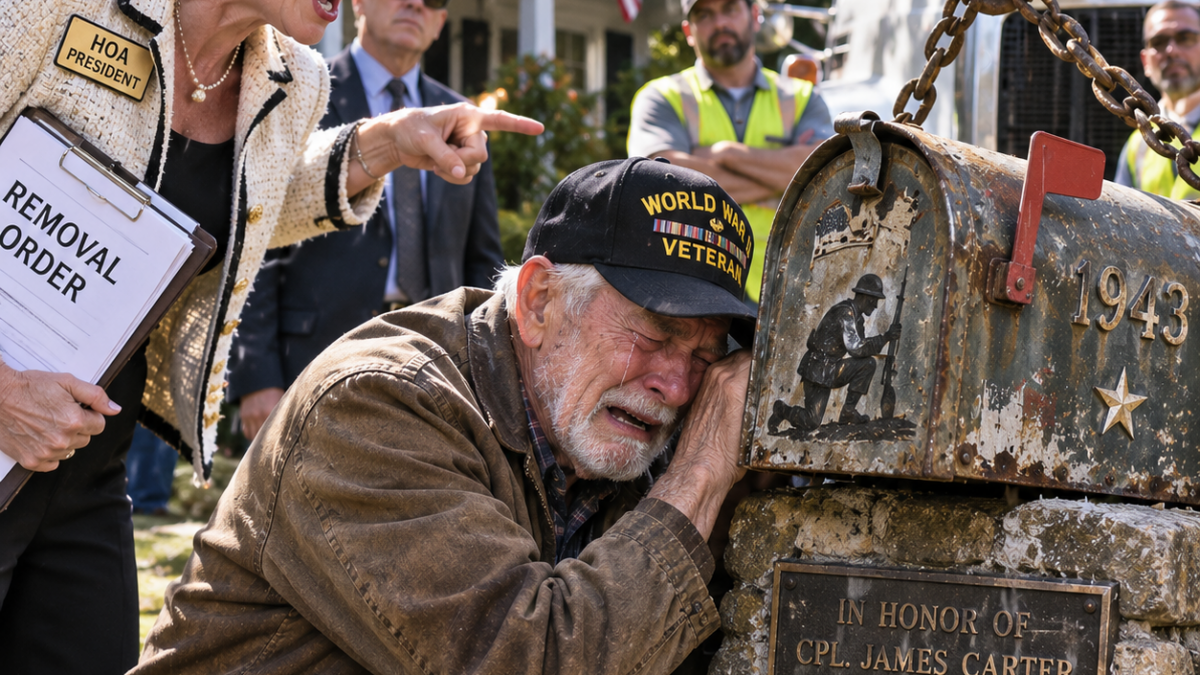
PART2
The officer was polite.
Almost apologetic.
“Mr. Delacroix, we received complaints regarding an unlawful agricultural operation, possible sanitation issues and unauthorized livestock.”
I looked behind me.
Six chickens scratched lazily beside their enclosure.
Napoleon, my rooster, stared at the officer as if preparing to issue his own citation.
“Would you like to see the property?”
The officer smiled.
“That would make my morning easier.”
We spent forty minutes walking the land.
He photographed the coop.
Checked distances.
Reviewed the garden.
Asked several questions.
Then he closed his notebook.
“I’m not seeing what was described in the complaint.”
“Neither am I.”
He hesitated.
“There may be additional complaints.”
“I expect there will be.”
He looked at me.
“You know who filed this?”
“I have a very good idea.”
That should have been the end of it.
It was only Karen’s opening move.
Within two weeks, I received three more visits connected to complaints.
Noise.
Unpermitted structures.
Commercial farming.
Improper waste disposal.
Each allegation sounded serious on paper.
Each one fell apart when someone actually inspected the property.
The legal consultations, however, cost me money.
Eight hundred dollars during the first month alone.
That was when irritation turned into concern.
Karen wasn’t simply trying to enforce rules.
She was trying to exhaust me.
If she couldn’t control my property legally, she would make living there so expensive and stressful that I might leave voluntarily.
I learned later that this was not a new strategy.
At the time, I still thought I was dealing with one aggressive HOA president.
Then came the emergency meeting.
The Willowbrook clubhouse was packed.
Sixty residents sat beneath fluorescent lights while Karen stood beside a projector screen.
She had created a forty-slide presentation about me.
Forty slides.
About a farmhouse that wasn’t even in her HOA.
There were telephoto photographs of my garden.
My chicken coop.
My barn.
The mailbox.
Even the stack of firewood beside my garage.
I stood near the back.
Karen clicked to a photograph of my tomato plants.
“This individual is conducting agricultural activity directly beside our residential community.”
A woman near the front raised her hand.
“Karen, he’s growing tomatoes.”
Karen ignored her.
Another slide appeared.
My chickens.
“Livestock creates odor, vermin and potential disease exposure.”
I almost raised my hand to ask whether Napoleon had been informed he was now a public-health threat.
Instead, I stayed quiet.
Then Karen displayed the mailbox.
She paused dramatically.
“This is the visible result of refusing community standards.”
I could feel people looking at me.
Some curious.
Some uncomfortable.
Most silent.
Karen continued.
“If one neighboring parcel ignores our standards, what prevents everyone else from doing the same?”
That sentence told me everything.
She didn’t care whether my property was legally inside the HOA.
She cared that I had told her no.
My refusal threatened the illusion that her authority had no boundaries.
When she finished, she called for discussion.
I stood.
The room became quiet.
“Mrs. Delgado, would you show everyone the recorded document placing my parcel under Willowbrook covenants?”
Her expression hardened.
“This is not a courtroom, Dominic.”
“No. It’s a meeting where you’re accusing me of violating rules I never agreed to.”
Several people shifted in their chairs.
I continued.
“My grandfather’s property predates this subdivision. You know that.”
Karen clicked off the projector.
“What I know is that your property affects every person sitting in this room.”
“That isn’t the same thing as having jurisdiction.”
“Sit down.”
I remained standing.
Her voice sharpened.
“I said sit down.”
A murmur moved through the room.
I smiled.
“Karen, I’m not one of your board members.”
Her face flushed.
“Then perhaps you should leave.”
“I will.”
I looked around the room.
“But before I do, I suggest everyone here ask one question.”
Karen folded her arms.
I pointed toW@Rd the screen.
“If she can enforce HOA rules against land that isn’t in the HOA, where exactly does her authority stop?”
Nobody answered.
But several people looked at Karen differently.
That was enough.
At 2:07 the following morning, my security camera sent an alert.
I was asleep.
I didn’t see it until sunrise.
When I walked outside, the first thing I noticed was red paint.
One word had been sprayed across Granddad’s mailbox.
VIOLATOR.
I stopped in the driveway.
For several seconds, I couldn’t move.
The paint was still tacky.
A red line had dripped across the blue metal and down onto the post.
I remembered Granddad sitting beside that mailbox with a brush in his trembling hand.
I remembered the last spring before he died.
He had watched me repaint the numbers.
“You missed a spot.”
“I did not.”
“Left corner.”
I looked.
He was right.
He always was.
Now someone had covered his work in red paint because I refused to obey an organization I didn’t belong to.
My anger came fast.
But thirty years as a surveyor had taught me something useful.
Anger makes terrible evidence.
Documentation does not.
I photographed everything before touching the mailbox.
Then I downloaded the camera footage.
There she was.
Karen Delgado.
Dark jacket.
Baseball cap.
Spray can.
Her face visible when she glanced toW@Rd the camera.
Her Escalade visible at the end of the road.
I called the police.
While I waited, Mrs. Elise Patterson walked over from the neighboring house.
She was seventy-four, a widow with silver hair and the habit of watering plants even when rain was forecast.
She stared at the mailbox.
“Oh, Dominic.”
I looked at her.
“You knew?”
She swallowed.
“Not this.”
She glanced toW@Rd Karen’s street.
“But I knew it would get worse.”
“What does that mean?”
Elise lowered her voice.
“She did something similar to the Hendersons.”
“Who?”
“They lived two streets over.”
She looked behind her before continuing.
“Karen started with letters. Then complaints. Then contractors showing up at their house. She claimed their fence violated standards. She kept reporting their son’s car.”
“What happened?”
“They sold.”
“Because of Karen?”
Elise nodded.
“At a loss.”
I stared toW@Rd the street.
“She’s done this before?”
Elise’s eyes filled.
“Dominic, people here don’t argue with her.”
“Why?”
“Because if you do, she makes you her project.”
I looked at the red paint.
Then back at her.
“Well.”
Elise swallowed.
“What?”
“I guess I’m already her project.”
The police report changed nothing about Karen’s behavior.
If anything, it enraged her.
Three days later, another emergency meeting was announced.
This time the subject was “Hostile Surveillance and Anti-Community Conduct.”
I almost laughed when I read the notice.
According to Karen, my security cameras were intimidation devices.
At the meeting, she displayed a photograph of one camera mounted beneath my porch roof.
“This equipment is being used to monitor HOA leadership.”
I raised my hand.
She pretended not to see me.
A man named Bob Martinez did.
Bob was a retired structural engineer in his late sixties.
He had lived in Willowbrook for fifteen years.
He leaned toW@Rd the microphone.
“Karen, the camera is on his own property.”
“It points toW@Rd the street.”
“So do doorbell cameras.”
“This is different.”
“How?”
Karen stared.
Bob continued.
“If he recorded someone vandalizing his mailbox, the problem isn’t the camera.”
A few people laughed nervously.
Karen’s face changed.
“That footage is part of an active dispute.”
Bob shrugged.
“Then maybe stop making appearances on it.”
I liked Bob immediately.
Karen did not.
The following morning, I received a certified letter accusing me of unlawful agricultural activity and demanding that I cease using my garden and chicken coop.
I brought it to my attorney.
David Richardson read the first page.
Then the second.
Then he looked at me.
“Who wrote this?”
“Karen.”
“No attorney?”
“Apparently not.”
He leaned back.
“That explains some things.”
David was fifty-eight, calm, methodical and almost impossible to provoke.
He had handled property disputes for decades.
I trusted him because he never promised victory before reading documents.
He tapped the letter.
“She’s citing provisions that do not apply to you.”
“I know.”
“Then stop replying emotionally.”
“I haven’t replied at all.”
“Good.”
He pointed at me.
“Keep it that way.”
I smiled.
“You sound disappointed.”
“I’ve represented too many intelligent people who ruined good cases because they needed the last word.”
He stood.
“Let’s find your original deed.”
We spent the next week pulling county records.
Development maps.
Subdivision agreements.
Historic surveys.
Agricultural exemptions.
By Friday, we had more than enough to establish the central fact.
My property had never joined Willowbrook Estates.
It had been specifically excluded when the subdivision was created.
David drafted a formal letter.
No insults.
No threats.
Just recorded documents and a clear instruction that the association stop attempting to impose covenants on a non-member parcel.
Copies went to the board.
The association’s counsel.
And relevant county offices.
I thought that would force Karen to retreat.
Instead, she came to my house.
Her Escalade entered my driveway hard enough to scatter gravel.
She stepped out before the vehicle had fully settled.
“You think you’re clever.”
I remained on the porch.
“Good afternoon, Karen.”
“Don’t patronize me.”
“I said good afternoon.”
She waved David’s letter.
“You went behind my back.”
“I hired an attorney.”
“You embarrassed me in front of my board.”
“I sent them property records.”
“You’re hiding behind technicalities!”
I stood.
The word caught me.
“Technicalities?”
“Yes!”
I walked down one step.
“My grandfather owned this land before your streets existed.”
“I don’t care.”
“The recorded boundary is a technicality?”
She pointed at me.
“This entire community has standards.”
“Your community.”
“You live beside it.”
“That does not make me a member.”
Her face reddened.
“You think because you found some dusty document you can do whatever you want?”
“No.”
I kept my voice calm.
“I think because I own my property, I get to use it within the law without taking orders from you.”
Karen stepped closer.
“This isn’t over.”
“It should be.”
“I’ll find a way.”
Several neighbors were outside.
Elise watering flowers.
Bob checking his mailbox.
The Rodriguezes washing their car.
Karen turned toW@Rd her Escalade.
Then shouted loud enough for half the street to hear.
“I’LL FIND A WAY TO GET RID OF YOU PERMANENTLY!”
Silence.
Even Karen seemed to realize what she had said.
She got into her vehicle.
The tires kicked gravel as she accelerated away.
Bob walked across the street.
“You heard that, right?”
I nodded.
“So did I.”
Elise approached.
“So did I.”
For the first time, Karen’s anger had produced something she couldn’t rewrite later.
Witnesses.
Two weeks later, a city planning inspector named Rodriguez arrived.
He carried a thick complaint.
Someone had alleged that I was illegally subdividing my property, operating rental units and running a commercial agricultural business.
Rodriguez read the complaint while standing beside my garden.
Then looked at me.
“Where are the rental units?”
I pointed at the barn.
“Unless my chickens have started paying rent, nowhere.”
He tried not to smile.
We walked the property.
No subdivision.
No commercial rental activity.
No illegal farming operation.
At the end, he handed me a copy.
Karen’s signature appeared on the final page.
Rodriguez shook his head.
“Somebody spent a lot of time writing this.”
“She has a hobby.”
He closed his notebook.
“Mr. Delacroix, planning enforcement isn’t a weapon for neighborhood arguments.”
“I agree.”
“I’m documenting what I found.”
“Thank you.”
As he left, I realized Karen had made another mistake.
She had put her accusations in writing.
Again.
I began keeping a separate binder.
Date.
Incident.
Complaint.
Evidence.
Witnesses.
Response.
By the end of the month, the binder was two inches thick.
Then Karen hired a surveyor.
His name was Brad Sullivan.
He arrived in a marked vehicle carrying modern GPS equipment and a nervous smile.
“Mr. Delacroix?”
“Yes.”
“I’ve been retained to examine an encroachment.”
“By Willowbrook?”
He hesitated.
“Yes.”
I stepped aside.
“Stay off anything not authorized for access.”
He nodded.
Brad worked for nearly two hours.
I watched from a distance.
Something about his setup bothered me.
Eventually, he approached.
“Your fence crosses approximately six inches onto HOA common property.”
“What did you use as your primary boundary control?”
He gave me a strange look.
“A combination of GPS data and existing field evidence.”
“What field evidence?”
He pointed toW@Rd an old utility marker.
I stared at him.
“That isn’t the controlling monument.”
“It’s consistent with modern mapping.”
“It’s twelve feet from the original survey monument.”
Brad’s expression tightened.
“Those old monuments are unreliable.”
I almost laughed.
“Who told you that?”
“My client provided documents.”
“Your client is Karen Delgado.”
He folded his arms.
“My methodology is professional.”
“I hope so.”
He looked offended.
I continued.
“Because I’m going to have it independently checked.”
His confidence flickered.
“I stand behind my work.”
“So do I.”
I did not prepare the counter-survey myself.
That would have made the dispute look personal.
Instead, I hired an independent licensed firm with no connection to me or Willowbrook.
They reviewed the recorded deeds, subdivision plat, historic monuments and modern measurements.
Their conclusion was clear.
Brad’s asserted boundary did not align with the controlling records.
More interestingly, part of the landscaped common area installed by Willowbrook appeared to extend several feet onto my parcel.
Karen had hired a surveyor to prove I was taking HOA land.
The review suggested the opposite problem.
David laughed when he read the report.
Not loudly.
Just one quiet, surprised laugh.
“This is going to be uncomfortable for her.”
“I’m not trying to embarrass her.”
“No?”
“I’m trying to make her leave me alone.”
David closed the report.
“At this point, Dominic, those may be the same thing.”
Karen called another meeting.
This one was packed.
She projected Brad’s original map onto the wall.
“The Delacroix property has occupied association land for decades.”
I stood at the back holding the independent report.
Bob raised his hand before I could speak.
Karen ignored him.
He raised it higher.
“What?”
Bob asked, “Was that survey independently verified?”
“It was prepared by a licensed professional.”
“That wasn’t my question.”
Karen glared.
Bob continued.
“What monuments did he use?”
“Modern GPS.”
“What recorded boundary evidence did he reconcile?”
Karen looked at the screen.
“Modern technology is more accurate.”
Bob shook his head.
“I’m an engineer, Karen, not a surveyor. But even I understand that equipment accuracy doesn’t decide which legal boundary controls.”
The room became very quiet.
I walked forW@Rd.
“I have an independent review.”
Karen snapped, “You are not recognized by the chair.”
I handed a copy to Bob.
Then another to the association attorney.
The attorney began reading.
Karen watched his face.
“What?”
He didn’t answer immediately.
She repeated.
“What?”
He leaned toW@Rd her.
“We need to verify the underlying survey before making further accusations.”
Karen’s cheeks flushed.
“This man is stealing community property!”
The attorney lowered his voice.
“Karen, stop.”
That was the first time I saw genuine fear in her expression.
Not fear of me.
Fear that the room was beginning to see how little control she actually had.
Three days later, my professional licensing board contacted me.
A complaint had been filed alleging falsified surveys, client misconduct and improper use of professional credentials.
Karen had attached several pages of allegations.
For the first time, I felt real panic.
My property was one thing.
My profession was another.
I had spent thirty years building my reputation.
Hundreds of projects.
No disciplinary record.
No findings of misconduct.
Now I had to answer claims serious enough to trigger review.
I called David.
“She’s going after my license.”
“I know.”
“What if clients hear about this?”
“They might.”
I stood in my kitchen.
For a moment, I couldn’t speak.
David continued.
“Dominic, listen to me.”
“I’m listening.”
“You have records.”
“Yes.”
“Project files?”
“All of them.”
“Supporting measurements?”
“Yes.”
“Client correspondence?”
“Yes.”
“Then respond professionally.”
My anger rose.
“She can just make things up and I’m the one who has to spend weeks disproving them?”
David paused.
“That is unfair.”
I appreciated that he didn’t soften it.
“But your best answer is still evidence.”
I closed my eyes.
“My grandfather used to say that.”
David laughed softly.
“I would’ve liked him.”
“No. You would’ve argued about everything.”
“Then I definitely would’ve liked him.”
I spent four days gathering thirty years of professional records.
The process exhausted me.
But it also reminded me who I was before Karen Delgado appeared.
A surveyor.
A professional.
A man whose work could survive scrutiny.
I sent the response.
Then waited.
During that period, Elise came to my house carrying a folder.
She looked frightened.
“What’s wrong?”
She stepped inside.
“Bob and I have been looking at the HOA financial reports.”
I frowned.
“Why?”
“Because Karen keeps saying there’s no money.”
“No money for what?”
“The playground. Road repairs. Pool maintenance.”
She sat at my table.
“Dominic, our dues increased twice.”
I opened the folder.
Bank statements.
Budget summaries.
Minutes.
Invoices.
Several large payments were coded vaguely.
Consulting.
Legal services.
Emergency administration.
Elise pointed to a column.
“These don’t match what the board approved.”
“How much?”
“We don’t know yet.”
“Then don’t accuse anyone.”
“I’m not.”
Her voice trembled.
“But something is wrong.”
I studied the documents.
“Does the treasurer have access to the underlying invoices?”
“Yes.”
“Get an independent accountant.”
Elise nodded.
“I knew you’d say that.”
“Why?”
“Because you document everything.”
I looked toW@Rd the repaired blue mailbox outside.
“Learned the hard way.”
The financial review began quietly.
Karen did not know.
At least not at first.
Meanwhile, her harassment continued.
One Saturday morning, I woke to Napoleon making a sound that pulled me out of bed instantly.
Something had been disturbed around the chicken enclosure.
Unknown material had been scattered near the fence.
I kept the animals away and called the authorities rather than handling anything potentially dangerous.
The security footage showed Karen entering the area during the night.
That changed the tone of the police investigation.
This was no longer paint on metal.
There was concern for the animals.
Fortunately, none of my chickens were harmed.
But an officer named Sarah Wong reviewed the growing record of incidents and looked at me seriously.
“Mr. Delacroix, you need to avoid direct contact with her.”
“I already do.”
“Good.”
“She keeps coming here.”
“Then call us.”
I nodded.
Wong closed her notebook.
“This is escalating.”
“I know.”
She looked toW@Rd my house.
“Do you have somewhere else you can stay temporarily?”
The question hit harder than I expected.
“No.”
“You might consider it.”
I stared at her.
“This is my grandfather’s house.”
“I understand.”
“I’m not leaving because someone wants me intimidated.”
Wong studied me.
Then nodded.
“Then be careful. Pride doesn’t make you safer.”
She was right.
That night, I installed additional lighting and checked every camera.
Not because I wanted a confrontation.
Because I wanted to wake up the next morning.
The licensing investigation eventually resolved in my favor.
The documentation contradicted the allegations, and no professional misconduct was established.
I received the letter on a Tuesday.
I sat on the porch and read it three times.
Then I laughed.
Not because anything was funny.
Because relief had nowhere else to go.
Elise heard me from across the street.
She walked over.
“Good news?”
I handed her the letter.
She read it.
Then hugged me.
I froze.
Elise stepped back.
“Sorry.”
“No.”
I smiled.
“It’s okay.”
She wiped her eyes.
“I hate what she’s done to this street.”
I looked toW@Rd Karen’s house.
“Then help Bob finish the audit.”
Elise nodded.
“We are.”
That evening, Bob called.
“Dominic.”
“Yes?”
“We found something.”
I sat down.
“How bad?”
He exhaled.
“Potentially very bad.”
The independent review had identified transactions requiring explanation.
Large amounts.
Payments routed through vendors with weak supporting documentation.
Legal expenses inconsistent with approved budgets.
Reimbursements involving Karen directly.
Bob refused to call it theft.
So did I.
That word belonged to investigators.
But the numbers were significant.
Enough that the board’s counsel advised formal review.
For the first time, Karen’s authority was being questioned from inside her own organization.
She found out two days later.
Her Escalade stopped in front of Elise’s house.
Karen stepped out carrying a folder.
Elise was in the garden.
I saw the confrontation from my porch.
Karen pointed at her.
“You gave financial records to outsiders.”
Elise looked toW@Rd me.
Karen followed her eyes.
Then marched across the street.
“This is you.”
I stayed on my property.
“What is?”
“You’ve turned them against me.”
“I haven’t touched your accounts.”
“You told them to investigate.”
“I told them to use an accountant.”
Karen laughed bitterly.
“Of course.”
She looked toW@Rd Elise.
Then Bob’s house.
“You think these people are your friends?”
“They’re my neighbors.”
“They’re coW@Rds.”
Elise spoke from across the street.
“No, Karen.”
Karen turned.
Elise’s voice shook.
“We were coW@Rds.”
The street went silent.
Elise continued.
“We were afraid of you.”
Karen stared.
“Don’t be ridiculous.”
“You threatened people.”
“I enforced rules.”
“You made my granddaughter cry over chalk drawings.”
“That was common property.”
“You reported Jim’s wheelchair ramp.”
“It wasn’t approved.”
Elise took a step closer.
“You made the Hendersons leave.”
Karen’s face changed.
“They violated covenants.”
“No.”
Elise shook her head.
“You made their lives miserable until leaving felt easier than fighting.”
Karen looked around.
Other doors had opened.
Bob stood in his driveway.
Sarah Rodriguez beside her car.
Jim Patterson near his porch.
For years, Karen had controlled people privately.
Now they were speaking publicly.
She turned back toW@Rd me.
“You did this.”
I shook my head.
“No.”
Then I pointed gently toW@Rd the neighbors.
“You did.”
That should have been the turning point.
It wasn’t.
Karen became more dangerous when she realized fear was no longer working.
One evening, Elise called me.
“Dominic, there’s a truck at Karen’s house.”
“What kind?”
“Commercial. Large.”
I stepped outside.
A heavy vehicle was parked beside her driveway.
Karen stood talking with the driver and another man.
She repeatedly pointed toW@Rd my property.
ToW@Rd the road.
ToW@Rd the mailbox.
My stomach tightened.
I photographed what I could from my own land.
Then called David.
“You think she’s planning something?”
“Yes.”
“Do you have proof?”
“No.”
“Then don’t accuse her.”
“I know.”
“Notify police if there’s a direct threat. Otherwise document.”
I hated how often that was the answer.
Document.
Wait.
Report.
Let procedure work.
But procedure was the difference between justice and revenge.
And I was not going to become Karen simply because I hated what she was doing.
The next morning, Karen arrived with an attorney.
She was carrying a thick packet.
“I’m serving you.”
I looked at the papers.
“Karen, we’ve been through this.”
“Not like this.”
Her attorney stepped forW@Rd.
“Mr. Delacroix, the association is assessing twelve thousand dollars in accumulated violations and legal fees.”
I looked at him.
“Have you reviewed the title documents?”
He hesitated.
Karen answered for him.
“He doesn’t need to.”
The attorney looked uncomfortable.
“I would like to see them.”
I nodded.
“Finally.”
I went inside.
Returned with the deed, subdivision plat and recorded exclusion language.
We reviewed them on the porch rail.
The attorney became quieter with every page.
Karen watched.
“What?”
He didn’t answer.
“What?”
He pointed.
“This parcel is outside Willowbrook.”
Karen’s face drained.
“That’s impossible.”
“The recorded development boundary excludes it.”
“No.”
“Karen—”
“No!”
She snatched the document.
“Every house here belongs to us!”
I looked at her.
“My grandfather’s house was here before Willowbrook.”
“But you use our road.”
“It’s a public road.”
“You see our landscaping.”
I almost laughed.
“That doesn’t make me a member.”
She looked toW@Rd the mailbox.
Then the garden.
Then the house.
Her entire worldview seemed to be collapsing.
For six months, she had treated me like a rebellious homeowner.
Now her own attorney was telling her I had never been subject to her authority at all.
She whispered, “You made me look stupid.”
“No.”
I met her eyes.
“You did that every time you refused to check the records.”
Her head snapped toW@Rd me.
“This is not over.”
Her attorney touched her arm.
“Karen, stop.”
She pulled away.
“You think you’re safe because of paperwork?”
I said nothing.
“You’re going to learn something.”
She pointed toW@Rd my grandfather’s mailbox.
“Everything can be removed.”
Then she turned and walked away.
The attorney stayed behind for one second.
He looked at me.
“I’m sorry.”
Then followed her.
I stood alone on the porch.
And for the first time since this started, I felt genuinely afraid.
That weekend, eight families gathered in my living room.
Not to attack Karen.
To protect themselves.
Bob.
Elise.
The Rodriguezes.
Jim Patterson.
Two other couples.
David joined by phone.
I laid the incident log on the table.
“Karen is escalating.”
Bob nodded.
“So what do we do?”
“Nothing reckless.”
Sarah Rodriguez leaned forW@Rd.
“She drove past my house six times yesterday.”
Elise said, “She photographed my garden.”
Jim looked angry.
“She told my mother she’d make us remove the wheelchair ramp.”
I raised a hand.
“Listen.”
They quieted.
“If she comes onto your property and threatens you, call police.”
Bob nodded.
“Record if it’s safe.”
“Yes.”
“Don’t confront her?”
“Correct.”
Elise looked at me.
“And you?”
“What about me?”
“She’s obsessed with you.”
I looked toW@Rd the window.
The blue mailbox stood under the streetlight.
“I’m going to keep doing exactly what I’ve been doing.”
Sarah frowned.
“Waiting?”
“Documenting.”
Bob smiled faintly.
“You really are a surveyor.”
I laughed.
“Occupational disease.”
For the first time, the room relaxed.
Then Elise looked at us.
“I don’t want to be scared anymore.”
Nobody laughed.
Bob reached across the table.
“You don’t have to be.”
That was the moment our street changed.
Not when Karen was removed.
Not when the financial investigation began.
That night.
When frightened neighbors stopped whispering separately and began speaking together.
Two nights later, police came to my door.
Someone had reported threatening calls.
The caller provided audio clips that sounded like me.
Threatening Karen.
Threatening her house.
Threatening retaliation.
My stomach dropped.
“I didn’t make those calls.”
The officer remained professional.
“Do you have your phone?”
I handed it over voluntarily for the relevant review.
We compared records.
Times.
Locations.
The audio itself sounded wrong to me.
Phrases cut together.
My voice taken from somewhere else.
After hours of checking, the allegation began falling apart.
I called David after midnight.
“She’s trying to make me look dangerous.”
His voice was tired.
“I know.”
“What if this works next time?”
“Then we respond next time.”
I closed my eyes.
“I’m exhausted.”
Silence.
Then David said something I needed to hear.
“Dominic, you are allowed to be exhausted.”
I laughed bitterly.
“Doesn’t feel like it.”
“You don’t have to enjoy fighting to refuse being bullied.”
I looked toW@Rd the porch.
Granddad’s mailbox reflected the security light.
“I wanted peace.”
“I know.”
David paused.
“But peace purchased by surrendering every boundary isn’t peace.”
I sat there until almost two in the morning.
Thinking about Granddad.
Normandy.
The things he never talked about.
I wondered if courage had ever felt heroic to him.
Probably not.
Maybe courage usually felt like being tired and continuing anyway.
Saturday arrived gray and cold.
At 8:47 a.m., Elise called.
“Dominic.”
Her voice shook.
“She’s here.”
I stepped onto the porch.
A commercial truck was turning onto our residential street.
Too large for the road.
Its brakes hissed.
The driver moved cautiously.
Karen sat beside him.
I felt my heartbeat in my throat.
I called 911.
Then I moved back toW@Rd the house.
The dispatcher instructed me to remain away from the vehicle.
I did.
Neighbors began recording from safe locations.
Not crowding the street.
Not blocking the truck.
Just documenting.
The vehicle stopped near my driveway.
Karen climbed down.
Her face was flushed.
She looked almost triumphant.
“Dominic!”
I remained near the porch.
“Tell the driver to leave.”
She pointed toW@Rd the mailbox.
“You had your chance.”
“Karen, this is private property.”
“You don’t get to mock our community.”
“This has nothing to do with community.”
“You embarrassed me!”
The driver opened his door.
“Ma’am, I’m not comfortable with this.”
Karen turned.
“You were paid.”
“I was told this was authorized removal.”
“It is!”
I called out.
“It is not.”
The driver looked at me.
Then Karen.
Karen’s face twisted.
“He’s lying!”
Sirens sounded in the distance.
Karen heard them.
Something in her expression changed.
Panic.
She pointed at the mailbox.
“Do it now!”
The driver hesitated.
“Ma’am—”
“DO IT!”
The truck moved.
Not fast.
But enough.
The front edge struck the mailbox structure.
Metal folded.
The blue housing broke away.
The post tore loose.
Pieces scattered across the gravel.
The driver stopped immediately.
Karen raised both arms.
“FINALLY!”
My stomach turned.
She laughed.
Actually laughed.
“That’s what happens when you ignore my rules!”
For a moment, everything in me wanted to run toW@Rd her.
To scream.
To shove her.
To make her feel even a fraction of what I felt looking at the twisted blue metal lying in the road.
Then I saw Elise holding her phone.
Bob recording.
Sarah beside her driveway.
The police cruisers turning the corner.
And I remembered David.
Evidence.
Not anger.
I stayed where I was.
Officer Martinez arrived first.
Detective Wong seconds later.
The driver exited the truck with both hands visible.
“I was told the owner authorized removal.”
Karen shouted, “I AM THE AUTHORITY!”
Wong looked at her.
“Ma’am, step away from the vehicle.”
Karen pointed toW@Rd me.
“He’s not even in the HOA!”
The entire street went silent.
I almost couldn’t believe what I had heard.
After six months, she had finally said it herself.
Wong paused.
“What did you say?”
Karen realized too late.
“He refuses to comply with neighborhood standards.”
Wong looked toW@Rd the destroyed mailbox.
“Is this his property?”
Karen said nothing.
The driver spoke quietly.
“I was told the association controlled the roadside structure.”
I handed Wong copies of the deed and previous police reports.
Then I provided access to the footage.
She watched part of the video.
Karen directing the truck.
The driver hesitating.
Karen shouting.
The impact.
The celebration.
Wong’s expression hardened.
“This is going to require a full investigation.”
Karen’s voice rose.
“He provoked me!”
I looked at her.
“How?”
“You challenged my authority!”
Elise shouted from across the street.
“You didn’t have any!”
Karen turned.
“Stay out of this!”
Bob stepped forW@Rd only far enough to be heard.
“No, Karen.”
She looked around.
He continued.
“We’re done staying out of it.”
Karen was removed from the immediate scene while the investigation proceeded.
The driver cooperated.
He produced messages and instructions showing what he had been told about the job.
Those records became important.
So did the footage.
So did six months of incident reports.
The mailbox itself was ruined.
That afternoon, after police released the area, I carried the pieces into my garage.
Blue metal.
Bent hinges.
Broken wood.
White numbers torn away.
I placed everything on an old blanket.
Then found the brass plaque.
HAROLD DELACROIX.
WORLD W@R II VETERAN.
Bent.
Scratched.
Still readable.
I sat on the floor.
And cried.
Not the quiet kind.
The ugly kind.
The kind that leaves you struggling to breathe.
For months, Karen had attacked my pride.
My profession.
My property.
But this was different.
Granddad’s hands had touched that mailbox.
He had stood beside it after coming home from a W@R he rarely discussed.
He had repainted it every spring until his body wouldn’t cooperate.
There was no replacement.
Insurance could pay for materials.
A craftsman could reproduce the design.
But the original was gone.
I held the plaque against my chest.
“I’m sorry, Granddad.”
The garage door was open.
I didn’t notice Elise until she sat beside me.
She placed a covered dish on the floor.
Neither of us spoke.
Eventually, she looked at the pieces.
“Dominic.”
I wiped my face.
“She destroyed it.”
“Yes.”
“I should’ve protected it.”
Elise shook her head.
“You did.”
I looked at her.
“No.”
She touched the plaque.
“You protected what it meant.”
My throat tightened.
She continued.
“Karen thought this was about wood and metal.”
I stared at her.
“It wasn’t.”
“No.”
Elise smiled sadly.
“It was about whether she could make you afraid enough to stop being yourself.”
I looked down.
“And?”
“You didn’t.”
I laughed weakly.
“Feels like she won today.”
Elise looked toW@Rd my house.
Then toW@Rd the neighbors standing outside.
“No.”
She shook her head.
“Look around.”
I did.
Bob was helping clean debris from the roadside.
Sarah Rodriguez had brought coffee.
Jim Patterson was talking with the officer.
People who had spent years avoiding Karen were outside together.
Elise squeezed my shoulder.
“She destroyed a mailbox.”
Her voice broke.
“But she destroyed her own power at the same time.”
The following weeks were complicated.
There was no magical courtroom where everything resolved in ten minutes.
Investigators reviewed the property damage.
The earlier vandalism.
The disputed complaints.
The financial records.
The HOA’s attorney advised the board to separate Karen from association decision-making pending review.
Residents demanded a special meeting.
The independent accounting report was completed.
Approximately $144,000 in transactions required serious explanation.
Some expenditures had inadequate documentation.
Others appeared connected to services or legal activity that had not been properly authorized.
Investigators took over the financial questions.
I stayed out of that portion as much as possible.
This was not my money.
It belonged to Willowbrook residents.
But I attended the special HOA meeting when the board considered Karen’s position.
The clubhouse had never been so full.
Karen sat at the front beside her attorney.
She looked smaller.
Not physically.
Psychologically.
The clipboard was gone.
The confidence too.
The acting board chair opened the meeting.
Residents spoke one after another.
Elise described years of intimidation.
Jim described the wheelchair-ramp complaint.
Sarah described Karen’s treatment of her daughter.
The Hendersons joined by video call.
I had never met them.
The husband’s voice shook.
“We sold our house because we couldn’t take it anymore.”
Karen looked down.
Bob spoke next.
“This association exists to manage shared obligations.”
He paused.
“It does not exist to give one person control over everyone’s life.”
Applause began.
The chair immediately asked for order.
Then came the vote.
Karen was removed from the presidency.
Not arrested at the podium.
Not dragged away.
Just removed.
By the same people who had once been too frightened to question her.
She stared at the result.
Then looked toW@Rd me.
For a moment, I expected anger.
Instead, she looked exhausted.
I almost felt sorry for her.
Almost.
Then I remembered the truck.
The legal proceedings continued for months.
Charges and civil claims were based on what investigators and prosecutors could actually prove.
The financial investigation resulted in formal consequences involving misuse of association funds.
Restitution became part of the resolution.
Property-damage claims were handled separately.
Karen’s personal finances were severely affected.
Her home was eventually sold.
She left Willowbrook.
I never spoke to her again.
People sometimes ask whether I wanted her to go to prison forever.
No.
I wanted accountability.
I wanted the harassment to stop.
I wanted people to get their money back.
I wanted my professional name cleared.
I wanted Elise to stop looking over her shoulder every time a car slowed near her house.
I wanted Karen to lose the ability to misuse a position people had trusted her with.
That was enough.
Anything beyond that belonged to the courts.
Willowbrook changed.
At first, awkW@Rdly.
People didn’t know how to interact without Karen’s rules filling every conversation.
Then somebody organized a potluck.
Elise, naturally.
She put three folding tables in her garden.
Bob brought ribs.
The Rodriguezes brought enchiladas.
Jim’s mother made peach cobbler.
I contributed tomatoes from the supposedly dangerous agricultural operation.
Someone taped a handwritten sign above the serving table.
W@RNING: NONCOMPLIANT VEGETABLES.
I laughed harder than I had in months.
Napoleon received his own bowl of approved chicken feed and spent the evening behaving as if the entire event had been organized in his honor.
Children played in the street.
Neighbors talked.
Not about fines.
Not about violations.
About work.
Family.
School.
Gardening.
Ordinary life.
I stood on my porch after sunset and listened to laughter coming from Elise’s yard.
For years, Karen had called Willowbrook a community.
That was the first night it actually sounded like one.
The residents restructured their governance.
There were still legal obligations.
Shared maintenance.
Budgets.
Rules where rules genuinely applied.
But procedures changed.
Financial reporting became clearer.
Decisions required documentation.
Enforcement was no longer one person’s private weapon.
My property remained outside Willowbrook.
Nobody argued about it anymore.
Ironically, I became closer to those neighbors than I had ever intended.
Bob asked me to help him understand an old drainage map.
Sarah sent her son over when he needed advice about engineering school.
Elise appeared at my door at least twice a week carrying food I had not requested.
I repaired Jim’s garden gate.
They helped me rebuild the barn roof.
No contracts.
No fines.
No clipboard.
Just neighbors.
The insurance settlement for the mailbox damage helped fund a replacement.
I could have ordered an exact reproduction.
I chose not to.
The original mattered because Granddad had made it.
Copying every scratch and brushstroke would not bring him back.
Instead, I commissioned a simple new mailbox.
Blue.
White numbers.
The same general style.
Regulation-compliant and safely installed.
Then, several feet farther inside my property, I built a memorial where vehicles could not easily reach it.
The surviving brass plaque was mounted beneath protective glass.
Beside it, I placed a photograph of Granddad in 1945.
Young.
Thin.
Standing beside two men whose names I never learned.
He wasn’t smiling.
Granddad rarely smiled in military photographs.
Another photograph showed him forty years later beside the farmhouse.
Holding a paintbrush.
Standing next to the original mailbox.
That one made me cry.
Below the photographs, I added words from one of his notebooks.
TAKE CARE OF WHAT YOU’VE BEEN GIVEN.
LEAVE SOMETHING GOOD FOR WHOEVER COMES NEXT.
The day the memorial was finished, I expected to stand there alone.
Instead, almost thirty neighbors arrived.
Elise brought flowers.
Bob brought coffee.
Sarah’s children carried little American flags.
Jim’s mother sat in a folding chair.
Even Inspector Rodriguez stopped by after work.
I stared at everyone.
“What is this?”
Elise smiled.
“A community violation.”
I laughed.
She continued.
“Too many people on private agricultural land.”
Bob added, “Probably need a permit.”
I shook my head.
“You people are terrible.”
Elise hugged me.
“Yes.”
Then her voice softened.
“But we’re here.”
I stood beside Granddad’s plaque.
For a moment, I couldn’t speak.
Then I looked at the neighbors.
“My grandfather never talked much about the W@R.”
The group became quiet.
“He hated being called a hero.”
I glanced at his photograph.
“He used to say the heroes were the men who never came home.”
My voice tightened.
“But he cared deeply about this land.”
I looked toW@Rd the farmhouse.
“When he returned, he wanted one place where nobody could tell him he didn’t belong.”
Elise wiped her eyes.
I continued.
“That’s why the mailbox mattered.”
I rested my hand against the memorial.
“Not because it was valuable.”
A few people nodded.
“Because it was his way of saying, ‘I came home. I built something. I stayed.’”
My throat tightened.
“For months, I thought protecting his legacy meant protecting that exact mailbox.”
I looked toW@Rd the new one.
“I was wrong.”
The neighbors listened.
“His legacy was never metal.”
I looked at Bob.
Elise.
Sarah.
The children.
“It was refusing to let fear decide where you belong.”
Nobody applauded immediately.
I was grateful.
Then Elise began clapping.
Bob joined.
Then everyone.
I laughed through tears.
Somewhere behind the barn, Napoleon crowed.
The entire crowd laughed.
Granddad would have loved that.
My surveying business recovered.
In fact, it improved.
The licensing complaint had been resolved without findings against me, and several local clients told me they respected how carefully I had handled the dispute.
I began incorporating one lesson into professional workshops.
Not the Karen story itself.
The principle.
Documentation first.
Assumptions second.
Boundary disputes are emotional because land feels personal.
But emotions do not move recorded lines.
Evidence does.
I told younger surveyors:
“Never let a loud client persuade you that certainty is a substitute for research.”
Sometimes I thought about Brad Sullivan.
His flawed survey had triggered scrutiny.
The professional consequences belonged to the licensing authorities, not me.
I never celebrated them.
But I hoped he learned something.
A surveyor’s job is not to give clients the answer they want.
It is to tell them what the evidence supports.
That principle had protected my property.
And probably my career.
A year after Karen left, a young couple bought her former house.
Nathan was a mechanic.
Emily taught elementary school.
They had two children and a golden retriever named Max who developed an unhealthy fascination with my chickens.
The first Saturday after they moved in, Nathan walked across the street.
“Mr. Delacroix?”
“Dominic.”
He smiled.
“Dominic.”
He pointed toW@Rd the memorial.
“I heard there’s a story about that mailbox.”
I looked at Emily.
She seemed embarrassed.
“We’re not trying to gossip.”
I laughed.
“It’s fine.”
Their daughter stared at Napoleon.
“Is that the famous chicken?”
I sighed.
“Unfortunately.”
Napoleon crowed.
The girl laughed.
Nathan looked toW@Rd the farmhouse.
“Do you have time?”
I glanced at the porch.
Elise had left an apple pie that morning.
Coffee was fresh.
The afternoon was quiet.
“Come up.”
We sat on Granddad’s porch.
I told them the shorter version.
Not every complaint.
Not every legal letter.
Just enough.
When I finished, Emily looked toW@Rd their new house.
“Karen lived there?”
“Yes.”
She swallowed.
“People seem uncomfortable telling us about her.”
“They’re trying not to make you responsible for somebody else’s behavior.”
Nathan nodded.
“I appreciate that.”
I smiled.
“You’re not Karen.”
Their daughter ran across the lawn chasing Max.
Emily laughed.
“No.”
I looked toW@Rd the street.
“And Willowbrook isn’t the same neighborhood anymore.”
Sometimes I think that is the part Karen would understand least.
She believed control made communities orderly.
She believed fear created respect.
She believed rules mattered more when delivered as threats.
But after she left, property values did not collapse.
Children did not begin painting houses purple.
Chickens did not invade the subdivision.
Civilization survived.
What changed was simpler.
People stopped being afraid of one another.
The board still handled legitimate shared issues.
Residents still disagreed.
Sometimes loudly.
But disagreement was no longer treated as rebellion.
And when someone asked a question, nobody accused them of undermining community standards.
Elise once said something that stayed with me.
“We spent years believing peace meant not upsetting Karen.”
She was sitting on my porch drinking coffee.
“What do you believe now?” I asked.
She smiled.
“That peace means not having to be afraid when somebody disagrees with you.”
I looked toW@Rd the blue mailbox.
Granddad would have liked that too.
I never repaired the old mailbox.
The damaged pieces remain in my garage.
Some people think that is strange.
Maybe it is.
The bent blue housing sits on a shelf.
The white number plate beside it.
I keep them because destruction is part of the story too.
Not every meaningful object survives.
Not every wrong can be undone.
That matters.
If I pretended the replacement was exactly the same, I would be lying to myself.
Karen destroyed something irreplaceable.
I can acknowledge that without letting the loss define the ending.
One Sunday morning, I found a tiny flake of old blue paint on the garage floor.
I picked it up.
For a second, I was thirty-one again.
Granddad sitting beside me.
“Too much paint.”
I smiled.
“You’re still complaining, aren’t you?”
The garage was quiet.
Then Napoleon crowed outside.
I laughed.
“Yeah.”
I slipped the blue paint chip into a small envelope.
Placed it beside Granddad’s photograph.
Then went outside.
People who hear the story often ask why I didn’t fight Karen sooner.
I did fight.
Just not the way they mean.
They expect confrontation.
Someone yelling louder.
Threatening back.
Turning the whole thing into a W@R.
But most meaningful fights don’t look dramatic every day.
They look like collecting documents.
Calling an attorney.
Answering an inspector politely.
Saving camera footage.
Refusing to send an angry email at midnight.
Showing up to meetings.
Letting witnesses speak for themselves.
Allowing institutions time to work even when the process feels painfully slow.
That kind of resistance is less satisfying in the moment.
But it keeps you from becoming the thing you’re fighting.
Karen wanted an emotional opponent.
Someone she could provoke.
Someone who would threaten her so she could claim victimhood.
Someone who would make a mistake.
For six months, she kept trying.
I nearly gave her what she wanted more than once.
Especially after the mailbox.
But Granddad taught me better.
Measure twice.
Cut once.
Know where the boundary actually is before you start digging.
A few months ago, Bob found me beside the memorial.
He stood with his hands in his pockets.
“You ever miss the old mailbox?”
“Every day.”
He nodded.
“Still angry?”
I thought about it.
“Sometimes.”
“At Karen?”
“Yes.”
He waited.
“And sometimes at myself.”
“Why?”
“Because part of me thinks I should’ve stopped her sooner.”
Bob shook his head.
“You’re a surveyor, not a fortune teller.”
I laughed.
“Engineering wisdom?”
“No.”
He smiled.
“Old man wisdom.”
We stood quietly.
Then Bob looked toW@Rd the new mailbox.
“You know what I remember?”
“What?”
“The first meeting.”
I groaned.
“Karen’s forty slides?”
“Yeah.”
“She had a photograph of my tomatoes.”
Bob laughed.
“Very dangerous tomatoes.”
I smiled.
He continued.
“I remember everyone looking down.”
My smile faded.
“Nobody wanted to challenge her.”
“No.”
Bob looked toW@Rd Elise’s house.
“Now Elise challenges everyone.”
From across the road, Elise shouted, “I HEARD THAT!”
Bob nearly dropped his coffee laughing.
I laughed too.
And for a moment, the entire six-month nightmare felt very far away.
This morning, I woke before sunrise.
I made coffee.
Walked onto the porch.
The air smelled of wet grass and cedar.
Napoleon was still quiet.
A miracle.
The street was empty.
Granddad’s farmhouse creaked behind me.
I looked toW@Rd the road.
The new blue mailbox stood at the entrance.
Beyond it, the memorial plaque caught the first light.
I thought about Karen.
Not with rage.
Not even satisfaction.
Mostly with distance.
She had occupied so much of my mind for six months that I once wondered whether I would ever stop expecting her Escalade to appear at the end of the road.
Now I sometimes go weeks without thinking about her.
That may be the greatest victory of all.
Bullies want to become the center of your world.
Every decision.
Every emotion.
Every conversation.
I no longer give her that.
My world is this porch.
My work.
My neighbors.
My grandfather’s memory.
The garden Karen called illegal.
The chickens she called a nuisance.
The farmhouse she said should obey rules written decades after it was built.
All still here.
I sip my coffee.
Elise eventually appears across the street in her robe.
She waves.
I wave back.
Bob’s garage door opens.
A school bus turns at the corner.
Nathan walks Max past the driveway.
The dog stares longingly toW@Rd Napoleon’s coop.
“Don’t even think about it,” Nathan says.
I laugh.
This is the neighborhood now.
Not perfect.
Not silent.
Not controlled.
Alive.
Granddad once told me that property lines mattered because people needed to know where responsibility began and ended.
At twenty-five, I thought he was talking about surveying.
At fifty-two, I understand he meant something bigger.
Boundaries are not walls.
They are agreements.
This is mine.
That is yours.
Here is where my authority ends.
Here is where yours begins.
Respect depends on understanding that line.
Karen Delgado never did.
She believed authority expanded whenever nobody challenged it.
A garden became her concern because she could see it.
A mailbox became her concern because she disliked its color.
My land became her concern because it sat beside her subdivision.
My profession became her target because it prevented her from getting what she wanted.
And eventually, the people who trusted her became obstacles too.
That is what unchecked power does.
It stops asking, “Am I allowed?”
It begins asking only, “Who will stop me?”
For years, nobody in Willowbrook answered.
Then one old farmhouse did.
Not because I was fearless.
I wasn’t.
There were nights when I checked the locks twice.
Mornings when an unexpected car made my stomach tighten.
Days when I wondered whether moving back to Portland would be easier.
But leaving would have taught Karen the wrong lesson.
Not that she was right.
That intimidation worked.
Granddad survived a W@R and came home to build a life.
I could survive a clipboard.
The last thing Karen ever said directly to me was at the courthouse after one of the property-related proceedings.
We happened to be standing on opposite sides of a corridor.
She looked tired.
Older.
Nothing like the woman who had arrived on my porch wearing sunglasses and issuing orders.
For a moment, I considered walking away.
Then she spoke.
“You ruined my life.”
I stopped.
There were a thousand answers I could have given.
You ruined your own life.
You vandalized my property.
You threatened my career.
You terrorized your neighbors.
You destroyed Granddad’s mailbox.
All true.
Instead, I said, “No, Karen.”
She looked at me.
“I told you no.”
Silence.
“That was all.”
Her face tightened.
I continued.
“You decided no was something you couldn’t tolerate.”
She looked away.
I didn’t wait for an answer.
I walked down the corridor.
Outside, Elise and Bob were waiting.
Elise handed me coffee.
“You okay?”
I nodded.
“What did she say?”
I looked back at the courthouse.
Then smiled.
“Nothing important.”
We went home.
And that is the part of this story I remember whenever someone tells me one person cannot change a neighborhood.
They are right.
One person usually cannot.
I did not save Willowbrook.
Karen did not destroy it by herself either.
Communities become what people repeatedly tolerate.
For years, residents tolerated intimidation because resistance looked expensive.
Then the cost of silence became higher.
Elise spoke.
Bob asked questions.
The Rodriguezes documented what they saw.
Jim defended his mother.
The Hendersons finally told their story.
Accountants reviewed records.
Attorneys read deeds.
Inspectors checked complaints.
Police examined evidence.
No single person produced the ending.
Everyone did a piece.
That is how real accountability usually works.
Slowly.
Imperfectly.
Together.
If Granddad were alive, I know exactly what he would say about all of this.
First, he would inspect the new mailbox.
Then he would criticize my paint.
“Too thick.”
I would tell him I had paid a professional.
He would say the professional used too much paint.
Then he would sit on the porch.
Look across the street.
See Elise arguing with Bob about tomatoes.
Watch children ride bicycles past the driveway.
Hear Napoleon crow.
And smile.
He would never say, “You defended my legacy.”
Granddad hated grand language.
He would probably take a sip of coffee and say something like:
“Place looks good.”
And from him, that would be enough.
Karen Delgado sent a truck to destroy my grandfather’s mailbox because she believed the object was my weakness.
She was partly right.
It mattered deeply.
Watching it break hurt in a way I still struggle to describe.
But she misunderstood what made it valuable.
She thought my attachment to it meant she could control me by threatening it.
Instead, destroying it reminded every person on that street exactly what her campaign had become.
Not neighborhood management.
Not standards.
Not community protection.
Control.
And when people finally saw that clearly, her authority evaporated.
Not because I destroyed her.
Because she exposed herself.
One false complaint at a time.
One threat at a time.
One vandalized mailbox at a time.
One line crossed after another.
Until eventually there was nowhere left for her to hide behind the word “HOA.”
This afternoon, I repainted the numbers on the new mailbox.
White over blue.
The brush felt familiar in my hand.
I heard Granddad’s voice in my head.
Too much paint.
I smiled.
“Quiet.”
Elise was walking past.
“Talking to yourself?”
“My grandfather.”
She nodded as though that were perfectly normal.
“What does he say?”
“That I’m using too much paint.”
She examined the numbers.
“He’s right.”
I stared at her.
Elise laughed.
I pointed the brush.
“Get off my property.”
She put both hands up.
“I’m going.”
“You are a menace.”
“I learned from Karen.”
We both stopped.
Then burst out laughing.
It felt good.
Not because Karen was funny.
Because her name no longer frightened anyone.
She had become part of the past.
A lesson.
Not a ruler.
When I finished, I stood back.
The numbers were imperfect.
One slightly thicker than the other.
Granddad would definitely have complained.
But sunlight caught the blue paint exactly the way it used to.
Behind me, the farmhouse stood where it had stood since 1943.
The garden was full.
The chickens scratched beneath the old oak tree.
Napoleon strutted around like a decorated veteran.
Children shouted somewhere down the street.
And I realized I finally had what I came here looking for after my divorce.
Peace.
Not the kind where nothing bad ever happens.
That kind doesn’t exist.
Real peace.
The kind that comes from knowing where you stand.
Knowing your neighbors will speak if something is wrong.
Knowing the documents are in order.
Knowing you survived the person who wanted to make you afraid.
I touched Granddad’s plaque.
“Still here.”
The words came out quietly.
They were meant for him.
Maybe for me too.
Karen thought authority meant making people afraid to tell her no.
Granddad had taught me the opposite.
Real strength is knowing exactly where your rights end and someone else’s begin—and having enough character to respect that boundary even when you don’t like it.
His mailbox didn’t survive.
But the lesson did.
The farmhouse survived.
The land survived.
My career survived.
The chickens survived.
The neighborhood survived.
And, strangely enough, Willowbrook became better after the person who claimed to love it most was no longer controlling it.
I used to look at that blue mailbox and see my grandfather.
Now I see something more.
I see Elise finding her voice.
Bob raising his hand.
Sarah protecting her daughter.
Jim refusing to let anyone shame his mother.
The Hendersons finally being heard.
A street full of ordinary people discovering that bullies become powerful when everyone believes they have to face them alone.
That is Granddad’s memorial now.
Not metal.
Not paint.
People standing together.
So when someone asks me what I would do differently, I have an answer.
I would document sooner.
I would call an attorney sooner.
I would talk to the neighbors sooner.
I would never assume that a person abusing authority is only abusing it against me.
But I would not shout louder.
I would not threaten harder.
I would not build some revenge fantasy and call it justice.
Because the thing that finally stopped Karen was not rage.
It was evidence.
It was boundaries.
It was witnesses.
It was people refusing to remain frightened in separate houses.
And that is a lesson I wish every homeowner understood.
A clipboard is not a deed.
A title is not unlimited authority.
A loud voice is not law.
And no organization gets to invent jurisdiction simply because nobody has challenged it yet.
I finished my coffee.
Walked to the end of the drive.
Checked the new mailbox.
Inside was an envelope.
No HOA notice.
No violation letter.
Just a birthday card from an old surveying client.
I laughed.
I turned toW@Rd the farmhouse.
The porch waited in the morning light.
Elise waved from across the road.
Napoleon crowed.
And somewhere in my memory, Granddad sat in his folding chair beside a freshly painted blue mailbox, telling me I had missed a spot.
I smiled.
“Beautiful day, Granddad.”
Then I walked home.
Because that was what he had built this place for.
Not W@R.
Not conflict.
Not proving who was stronger.
Home.
And after everything Karen Delgado tried to take from me, that was the one thing she never managed to touch.
She destroyed my grandfather’s mailbox believing she was destroying my courage with it. Instead, she gave sixty frightened families the evidence they needed to stop living under hers.
The mailbox was rebuilt.
The neighborhood healed.
And the boundary Karen refused to respect became the very line that finally stopped her.
My grandfather survived Normandy and came home believing one simple thing: nobody should have to be afraid on their own land. Eighty years later, when Karen tried to prove him wrong, the entire neighborhood finally stood up and proved him right.








