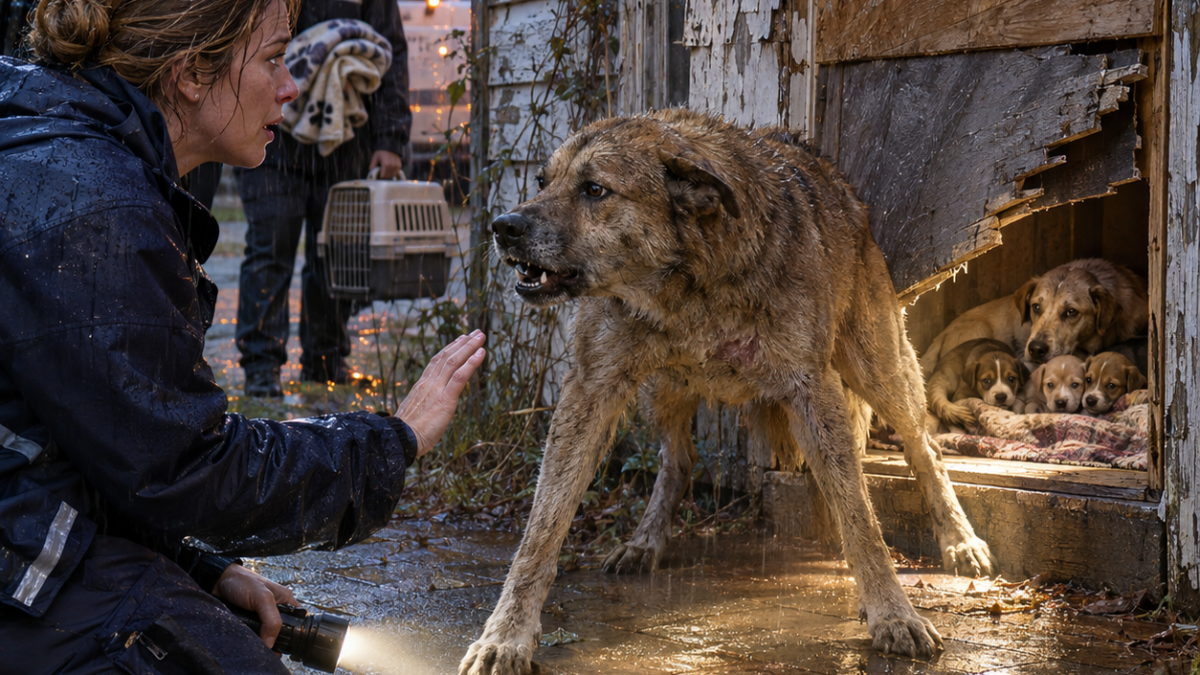
PART2:“THAT STRAY IS DANGEROUS—DON’T GO NEAR HIM!” Dispatch Sent Me After an Aggressive Dog—Then I Saw What He Was Guarding Behind a Boarded Door
PART2
I wrapped the little girl inside my heavy sheriff’s coat and pressed her against my chest.
Her body felt colder than the air outside.
For a terrible second, I wondered whether the movement I had seen inside that tote had been her last.
Then she made a sound.
Not a cry.
Not even a proper breath.
A tiny rasp.
The dog heard it.
His whole body changed.
His tail moved once.
Just once.
I looked at him.
“You knew.”
He whined.
I ran.
Out of the kitchen.
Across the yard.
Past the rusted tractor.
Snow filled my shoes and slapped against my pants.
The dog ran beside me.
At the cruiser, I opened the passenger door and placed the child across the seat while keeping her wrapped in my coat.
Then I grabbed my radio.
“Unit Four to dispatch.”
My voice came out louder than I intended.
“Go.”
“Emergency medical response, 889 Hollow Creek. Pediatric patient, approximately two years old. Severe hypothermia, altered consciousness, possible dehydration and neglect. Start ambulance and fire.”
The dispatcher hesitated.
“A child?”
“Yes.”
I looked at the tiny face.
“Move everybody.”
“Copy.”
I could hear the tone change in the room even through the radio.
“EMS is ten minutes.”
I looked at the girl again.
Ten minutes for them to arrive.
Then another twelve to Millbrook Community Hospital.
Too long.
“I’m transporting.”
“Four, weather conditions—”
“I’m transporting.”
I started the engine.
Turned the heat high.
Not directly blasting her skin.
Just warming the cabin.
Then I looked outside.
The dog stood beside my cruiser.
Snow collecting along his spine.
He stared through the passenger window at the child.
I opened the rear door.
“Get in.”
He did not move.
I pointed.
“Come on.”
He jumped inside.
No hesitation.
I drove.
Hollow Creek Road was a mess.
Snow and slush.
Visibility maybe a hundred yards.
I used emergency lights but kept my speed within what the road would tolerate.
People later said I made the twelve-minute drive in seven.
Maybe.
I never checked.
The child’s breathing mattered more than the clock.
I kept one hand near her whenever I could.
“Stay with me.”
No response.
“You’ve already done the hard part.”
Nothing.
The dog leaned between the front seats.
He never touched her face.
He kept his nose near the edge of my coat.
Every few seconds he made that same soft, broken whine.
“Is she yours?”
Stupid question.
But cops talk when scared.
The dog’s ears lifted.
“You keep watching.”
His eyes never left her.
Millbrook’s emergency department had received the radio call.
A trauma team waited beneath the ambulance awning.
I stopped.
Opened the passenger door.
A nurse took one look.
“Age?”
“Two, maybe.”
“Known history?”
“None.”
“How long exposed?”
“Unknown.”
They lifted her onto a stretcher.
The dog jumped from the rear seat.
One nurse shouted:
“Sir, the dog—”
“He stays outside.”
I caught his collar.
No tag.
No actual collar either.
Just matted fur.
He tried to follow the stretcher through the emergency doors.
I held him back.
“Hey.”
He twisted.
“Easy.”
The doors closed.
The little girl disappeared.
The dog stopped struggling.
Then sat.
Directly in front of the glass.
I looked down at him.
“You did your part.”
He stared through the doors.
I crouched.
My hands were shaking.
His were too, in their way.
The snow on my uniform melted onto the tile just inside the entryway.
A security guard brought me an old towel for the dog.
Then another for myself.
I called dispatch.
“Secure Hollow Creek.”
“Already sending two units.”
“Treat it as a crime scene.”
“Copy.”
“Get child services.”
“Already contacted.”
“Animal control?”
“Still blocked.”
I looked at the dog.
“He’s with me.”
Three hours passed.
I gave statements.
Called investigators.
Answered questions.
What exactly did the tote look like?
Where was it located?
Was the tape intact before I cut it?
Yes.
Did I touch anything else?
Only what was necessary to rescue the child.
Did I see footprints?
Yes.
Multiple, but snow contamination outside.
Did the dog appear aggressive?
No.
That answer became important later.
The “dangerous stray” report had come from two delivery drivers.
One said the dog charged his van when he approached the back yard.
The other said it stood barking near the driveway.
Neither had been bitten.
At the hospital, the dog slept against the wall beneath a bench for maybe twenty minutes.
Then woke every time the emergency doors opened.
Around nine that night, a doctor came toward me.
Young.
Dark hair pulled back.
Exhaustion around her eyes.
“Deputy?”
“Sheriff’s office.”
“You brought the child?”
“Yes.”
She looked at the dog.
“Him too?”
“He insisted.”
Her mouth almost smiled.
Then she became serious.
“She’s stable.”
My knees weakened.
I leaned against the wall.
“Stable?”
“Yes.”
“Brain injury?”
“Too early for complete assessment.”
“Frostbite?”
“Superficial injury to fingers and one foot. We’re cautiously optimistic.”
“Anything else?”
“Severe dehydration.”
She paused.
“Malnutrition.”
“How severe?”
“Not from two days.”
I looked at her.
“What does that mean?”
“This child was underfed before she was placed in that container.”
My stomach tightened.
“She could have been in there how long?”
“Based on condition and what you described?”
She exhaled.
“At least a day. Probably closer to two.”
I looked through the glass toward the treatment area.
“How much longer?”
The doctor knew what I meant.
“A few hours at most.”
Then she corrected herself.
“That’s an estimate. But not long.”
I closed my eyes.
The dog pressed against my boot.
The doctor looked down.
“He was there when you found her?”
“Yes.”
“Outside?”
“Yes.”
I told her about the scratched boards.
The bloody paws.
The way he moved aside when I brought the pry bar.
She crouched.
The dog watched her.
“He probably heard her.”
“Maybe.”
“He may have kept her awake.”
I looked at him.
“How?”
“Barking. Scratching. Noise. We don’t know.”
Then:
“If he stayed close to that building, he may also have scared away wildlife or other people who might have disturbed her.”
The dog lowered his head.
The doctor extended one hand.
He smelled it.
Then let her touch his forehead.
“Good boy.”
His eyes closed.
I had heard those two words thousands of times.
That night they nearly broke me.
The child had no identification.
No missing-person report matched immediately.
No diaper bag.
No coat.
No shoes.
Nothing inside the tote except a filthy blanket and an empty plastic water bottle.
The blanket had fur on it.
Investigators initially thought the dog might have been inside the house before the door was boarded.
Later evidence suggested otherwise.
He had probably entered during an earlier period, because his hair appeared in several rooms.
But at some point, somebody sealed the rear door with boards.
The dog remained outside.
Trying to return.
The investigation began with the property.
The farm belonged to Victor Crane.
Forty-one.
Nephew of the previous owner.
Unemployed much of the year.
Minor arrests.
Drug possession years earlier.
Domestic disturbances.
Nothing that explained a toddler in a taped box.
Then child services found a connection.
Victor had a sister.
Lena Crane.
Twenty-eight.
Died six months earlier.
Official cause:
Opioid overdose.
She had a daughter.
Emma.
Two years old.
Temporary guardianship after Lena’s death had been granted to Victor while social services attempted to identify other relatives able to take long-term custody.
The child in the hospital matched the records.
Emma Crane.
I drove home after midnight.
The dog came with me.
Technically, I should not have done that.
I was not stealing evidence.
Animal control still could not reach the hospital, and the dog needed shelter.
I called the on-call supervisor.
Explained.
He said:
“Keep him separated from your animals.”
“I don’t have animals.”
“Then congratulations.”
“On what?”
“You do tonight.”
I put the dog in my mudroom with blankets and water.
He drank too fast.
I pulled the bowl away.
“Slow.”
He stared at me as if I had personally betrayed him.
“Veterinarian tomorrow.”
I gave smaller amounts.
Then canned chicken.
He ate standing.
Every few seconds he stopped and looked toward the door.
“You’re not going back.”
He whined.
“She’s safe.”
He did not believe me.
I slept on the couch.
At two-thirty, claws clicked across the floor.
The dog appeared beside me.
He rested his head on the cushion.
I opened one eye.
“What?”
He stared.
“Go lie down.”
No movement.
I reached out.
Touched the scar on his muzzle.
His eyes closed.
Five minutes later, he lay beside the couch.
At five, I woke to his nose touching my hand.
That became our first morning.
I did not know then that it would become routine.
The veterinary exam happened at eight.
Dr. Larkin had treated working dogs for our department.
She looked at him.
Then at me.
“What did you do?”
“I found him.”
“You always say that before making animals my problem.”
“I do not own animals.”
“You do today.”
She examined him.
Male.
Probably four or five years old.
Shepherd-hound mix.
Underweight by nearly twenty pounds.
Old healed rib fracture.
Torn ear.
Cuts on front paws.
Several nails cracked.
Muzzle abrasions consistent with chewing wood.
No microchip.
No collar scar suggesting recent ownership.
Dr. Larkin cleaned his feet.
He tolerated everything until she tried separating one badly split nail.
He growled.
Not loud.
Warning.
She stopped.
“Fair.”
Then approached more slowly.
He let her continue.
“Dangerous?”
I asked.
She glanced at me.
“No.”
“Two drivers reported aggression.”
“Protective behavior can look aggressive from a truck window.”
She touched his ribs.
“This dog is exhausted.”
“Could he have stayed outside two days?”
“Yes.”
“In that temperature?”
“If he had shelter.”
“He didn’t.”
She looked at me.
“Then he’s lucky too.”
I went to the office.
Detective Hannah Pierce had taken lead on the case.
She was already buried in records.
“Victor’s missing.”
“Since when?”
“Neighbor saw his pickup leave Sunday night.”
“What day is it?”
“Wednesday.”
The girl had probably been placed in the tote sometime Sunday.
The dog likely remained there from then until I arrived Tuesday afternoon.
Hannah continued.
“We got a warrant for Victor’s current residence.”
“Anything?”
“Child’s clothes.”
“Where?”
“Apartment in Millbrook.”
“Any sign Emma lived there?”
“Yes.”
“Recently?”
“Hard to say.”
Then Hannah’s mouth tightened.
“What?”
“Neighbors heard crying over the past few months.”
“Reported?”
“One did.”
“And?”
“Welfare check in October. Victor presented Emma. She appeared alive, no visible acute injury. Apartment had food.”
“Case closed?”
“Follow-up requested.”
I hated that phrase.
Not because social workers did not care.
Because overloaded systems create gaps.
Every case competes with fifty others.
Victor had apparently told social services Emma was difficult, cried constantly, and had developmental problems.
Medical records did not support significant developmental disability.
She was small.
Underweight.
Quiet.
But before her mother died, pediatric notes described a normal toddler.
Hannah found another fact.
Victor had been receiving survivor-related benefits intended for Emma’s care.
Not enormous.
Enough to matter to a man without steady work.
If Emma were transferred permanently to another guardian, the payments changed.
That provided financial context.
Not proof of what he did.
But context.
We located Emma’s maternal grandmother, Marjorie Ellis.
She lived across the state line in a small town three hours away.
Why was she not guardian?
Because after Lena’s death, Victor told social services Marjorie was medically unfit.
He submitted a letter claiming she had dementia.
The letter was false.
Marjorie had arthritis.
No dementia.
She had repeatedly tried contacting Emma.
Victor blocked her.
When Hannah called, Marjorie began crying before she understood why.
“My granddaughter?”
“She’s alive.”
“What do you mean alive?”
That question told Hannah Victor had lied to her too.
He had told Marjorie Emma was with another foster placement and that legal restrictions prevented contact.
Marjorie arrived at the hospital that night.
I happened to be there dropping off information.
The dog came with me because he refused to stay home without destroying my mudroom door.
Hospital administration agreed to let him wait outside the main entrance with me.
Marjorie walked from the parking lot.
Seventy-one.
Gray hair.
Yellow winter coat.
She looked at the dog first.
Then at me.
“You’re the sheriff who found her?”
“Deputy sheriff.”
She grabbed my hands.
“Thank you.”
I shook my head.
“Thank him.”
The dog watched her.
Marjorie crouched.
“Is this the dog?”
“Yes.”
She touched his cheek.
He leaned toward her hand.
Then she said something that surprised me.
“Brownie.”
I looked down.
“What?”
The dog’s ears lifted.
Marjorie started crying.
“Oh, honey.”
The dog stood.
Tail moving.
“Brownie?” I repeated.
She nodded.
“Lena used to feed a stray behind her apartment.”
She pulled out her phone.
Scrolled.
Found a photograph.
Emma, maybe eighteen months old, sitting on a porch.
Behind her:
The same dog.
Healthier.
Cleaner.
No torn ear.
Marjorie showed me.
“Lena called him Brownie.”
The dog’s tail began moving harder.
“She wanted to adopt him, but Victor hated dogs.”
I looked at Brownie.
He looked at the hospital doors.
Suddenly the relationship made sense.
He had known Emma before Hollow Creek.
He had not stumbled onto a crying child inside an abandoned farm.
He had followed her.
Protected someone he already knew.
The next morning, investigators found tire impressions near the farmhouse matching Victor’s pickup.
A convenience-store camera captured his truck driving toward Hollow Creek Sunday afternoon.
Another camera showed it returning alone forty-three minutes later.
Monday morning, Victor used Emma’s benefit card at an ATM.
Tuesday, after news of the rescue began spreading locally, he disappeared.
A motel clerk two counties south recognized his photograph.
State police went there.
Victor was gone.
But he had left clothing and a receipt.
The trail continued.
Hannah called me Wednesday evening.
“We have him.”
“Where?”
“Bus depot motel outside Cedar Junction.”
“Emma?”
“Still improving.”
“What happened?”
“He was buying a ticket.”
“Where?”
“South.”
Rumors later turned that into Mexico.
The actual itinerary involved a series of bus connections south toward Texas.
Whether he intended to cross the border became a question for investigators.
I never liked exaggerating evidence.
The truth was already enough.
When officers arrested Victor, he had a fresh bite wound on his right hand.
That detail mattered.
At first he said it came from a stray.
Then refused further questions.
Investigators obtained photographs.
Dr. Larkin compared the general size and spacing with Brownie’s jaw.
She could not identify a specific dog from a bite with courtroom certainty.
That is not how forensic science works.
But the wound was consistent with a medium-large dog bite occurring within the relevant time period.
We later found dried blood on a damaged piece of board near the farmhouse door.
DNA matched Victor.
The working theory became clearer.
Victor took Emma to Hollow Creek.
Brownie followed.
At some point, Victor tried to keep the dog away.
The dog bit him.
Victor got Emma inside.
Sealed the rear entrance.
Possibly left through the front.
Brownie remained.
But investigators needed more than a theory.
They searched Victor’s truck.
Industrial duct tape.
Same manufacturer and width as the tape on the tote.
A roll partially used.
Fibers and adhesive later showed consistent characteristics.
Not unique enough to say one roll beyond doubt.
Still relevant.
Inside the truck were Emma’s missing boot and a child’s winter coat.
That coat made me angrier than almost anything.
Victor had transported a two-year-old through freezing weather with warm clothing available.
Then left her in one sock.
Whether he intentionally removed the clothing or failed to put it on before abandoning her mattered little emotionally.
Legally, details mattered.
Investigators documented everything.
The farmhouse produced more.
Emma’s DNA inside the tote.
Victor’s fingerprints on the lid and tape layers.
His prints elsewhere were expected because he controlled the property.
On the tote, less innocent.
A store receipt showed he purchased the tote and industrial tape two days before the abandonment.
That receipt changed the case.
Planning.
Not momentary panic.
Not accidental neglect.
Preparation.
Hannah sat across from me in the briefing room.
“He bought the box Friday.”
“And tape.”
“Yes.”
“Took her Sunday.”
“Yes.”
I stared at the timeline.
“What was he going to tell people?”
“He already started.”
“What?”
“He texted Marjorie Sunday night.”
Hannah handed me a printout.
Emma’s placement changed. Social worker says no contact while they stabilize her.
I felt sick.
“He planned for everyone to think she was somewhere else.”
“That’s what it looks like.”
“What about social services?”
“He missed a scheduled check Monday. Caseworker began escalating Tuesday.”
“Same day we found her.”
“Yes.”
If Brownie had not attracted delivery drivers—
If those drivers had not complained—
If dispatch had dismissed it—
If I had waited for animal control—
Too many ifs.
Police officers learn not to live inside alternate timelines.
They will eat you alive.
Still, those followed me for weeks.
Emma spent six days in intensive pediatric care.
Then transferred to a regular room.
Marjorie received emergency temporary placement approval after background checks and medical review.
The first time Emma consciously saw Brownie after waking, hospital staff arranged it outdoors near a sheltered courtyard.
I was there because Marjorie asked.
Brownie stood beside me on a temporary leash.
Emma sat on Marjorie’s lap wrapped in blankets.
She looked smaller awake.
Dark curls.
Huge eyes.
Still pale.
Brownie saw her.
He froze.
Then his entire body began trembling.
Not from cold.
Emma stared.
Her mouth opened.
“Bownie.”
One word.
Brownie pulled toward her.
I released enough leash.
He approached slowly.
No jumping.
No licking her face.
He lowered himself onto his belly beside her chair.
Emma reached down.
Touched the torn ear.
Brownie closed his eyes.
Marjorie cried.
I looked away.
Cops become skilled at pretending dust enters their eyes at inconvenient moments.
Emma whispered:
“Good dog.”
Brownie’s tail struck the pavement.
Once.
Twice.
Then continuously.
The pediatric nurse standing beside me said:
“Well, I guess she knows who saved her.”
I answered:
“Yes.”
Because that part I was willing to say without qualification.
He saved her.
Maybe not in the legal sense investigators use.
Maybe I opened the tote.
Doctors rewarmed her.
Nurses treated her.
Social workers found family.
Detectives built the case.
But Brownie created the alarm.
He stayed.
He scratched.
He chased strangers.
He refused to leave the door.
The dangerous stray report was the reason my radio sent me to Hollow Creek.
Without him, the farmhouse might have remained silent.
That is rescue.
The case against Victor moved through the courts slowly.
As it should.
People wanted immediate punishment.
News stories called him a monster.
I understood the anger.
I also understood that prosecutors needed admissible evidence, not adjectives.
Victor’s attorney initially suggested Emma had been placed in the tote temporarily to keep her safe from the dog.
That explanation collapsed under the tape.
Multiple layers.
The cold.
The duration.
The purchased materials.
The text to Marjorie.
The abandoned clothing in Victor’s truck.
His departure.
The medical findings.
Another argument suggested he planned to return.
Investigators asked when.
No food.
Little water.
No heat.
No working phone.
No adult supervision.
Temperatures below freezing.
There was no safe interpretation.
The prosecution charged Victor with serious offenses related to attempted killing, child abuse, unlawful confinement, and neglect under applicable state law.
The exact labels changed as the case developed.
I testified about what I personally found.
Nothing more.
The dog.
The boards.
The tote.
The tape.
Emma’s condition.
My rescue actions.
Defense counsel asked:
“You believed the dog was dangerous when dispatched?”
“I believed a caller reported him dangerous.”
“Did the dog display aggression toward you?”
“No.”
“Did he growl?”
“No.”
“Charge you?”
“No.”
“Bare his teeth?”
“No.”
“What did he do?”
“He blocked the door.”
“Could that be territorial behavior?”
“Possibly.”
“You’re not an animal behavior expert?”
“No.”
“So you cannot tell this jury what the dog intended.”
“No.”
“Then why have you repeatedly described him as protecting the child?”
The prosecutor objected.
Judge sustained.
The attorney rephrased.
“What did you observe?”
That I could answer.
“Every time I moved toward the door, the dog repositioned himself between me and it.”
“That sounds protective of the building.”
“Until I returned with a pry bar.”
“What happened then?”
“He moved aside.”
“Anything else?”
“He sat down.”
“And?”
“He whined until I opened the door.”
The courtroom went quiet.
Defense counsel changed subjects.
I had no need to interpret.
Behavior speaks well when described accurately.
Marjorie testified.
Social workers.
Doctors.
Detectives.
Forensic analysts.
Store clerk.
Motel staff.
No one witness carried everything.
Cases rarely work that way.
The store receipt mattered.
So did the vehicle video.
So did the purchase history.
So did the false message claiming Emma had been transferred.
So did Victor leaving town.
So did the tote.
So did the temperature.
So did Emma.
She did not testify.
Thank God.
She was too young.
The case resolved without forcing that child into a courtroom to explain terror she could barely put into language.
Victor eventually entered a plea to major charges carrying a substantial prison sentence.
Some people complained because they wanted a trial and the maximum imaginable punishment.
I did not.
A guaranteed conviction.
Long incarceration.
No child testimony.
Accountability.
That was justice enough for me.
The earlier death of Lena Crane—Emma’s mother—was reviewed again because of Victor’s conduct and inconsistencies surrounding the circumstances.
Investigators did not find sufficient evidence to prove Victor caused her death.
That mattered.
Rumors online later claimed he had murdered his sister.
No.
The death remained classified according to the evidence available.
I refused to repeat something investigators could not prove.
One terrible crime does not give us permission to invent another.
Marjorie became Emma’s permanent guardian.
The yellow house came later.
A small place on Maple Street.
White trim.
Two bedrooms.
A porch swing.
Nothing fancy.
Marjorie painted Emma’s room pale green because Emma apparently hated pink after the farmhouse.
I learned that from Marjorie.
“Everything people gave her was pink.”
“Toddlers hold grudges.”
“She certainly does.”
Emma gained weight.
At first, she hid food.
Bread under pillows.
Crackers inside toy bins.
Common trauma response.
Marjorie did not punish her.
She kept a small basket of snacks where Emma could always see it.
Eventually the hiding stopped.
Nightmares took longer.
Closed closets frightened her.
Plastic storage tubs were removed from the house.
Bathtubs made her panic for a while because enclosed spaces triggered something she could not explain.
Therapists helped.
Time helped.
Safety repeated often enough began teaching her body a new expectation.
Brownie helped too.
For weeks after discharge, he lived with me.
Animal control technically took custody after the case because nobody could establish legal ownership.
Lena had fed him.
She had never formally adopted him.
Victor did not claim him.
No microchip.
No registration.
After the required hold and veterinary clearance, he became eligible for adoption.
The shelter director called.
“You want first application?”
“No.”
Pause.
“No?”
“I work twelve-hour shifts.”
“He sleeps twelve hours.”
“I’m not a dog person.”
“He followed your cruiser home emotionally if not literally.”
“I have furniture.”
“Not for long.”
I hung up.
Two hours later, I filled out the application.
I renamed him Adjutant.
People asked why not Brownie.
Because Brownie had been Lena’s name for the stray she fed.
Emma still called him Brownie.
I wanted his new home to carry something new without erasing what came before.
In military language, an adjutant is somebody who assists.
Keeps things moving.
Stays close.
It fit.
Emma could call him Brownie forever.
At my house, he became Adjutant.
The first week was chaos.
He hated closed doors.
Absolutely hated them.
Bathroom.
Bedroom.
Closet.
If I shut a door between us, he scratched.
Not destructively at first.
Just one paw.
Then another.
I learned quickly.
Interior doors stayed open.
He slept beside the front door.
Never on the dog bed I bought.
I spent eighty dollars on that bed.
He preferred an old bath towel.
Ungrateful animal.
He woke whenever snowplows passed.
Barked at cardboard boxes.
Would not approach plastic storage totes.
Those disappeared from my house.
He ate too fast.
We used a slow feeder.
He gained weight.
His coat changed.
Under dirt and neglect, he had warm brown fur across his shoulders and black along his back.
The scar remained.
Torn ear too.
Kids loved him.
Mail carriers did not initially.
We worked with a trainer.
No punishment.
Desensitization.
Routine.
Adjutant learned that delivery trucks did not always mean someone was leaving a child behind.
It took months.
That sentence sounds ridiculous.
For him, maybe it wasn’t.
I visited Emma and Marjorie regularly.
At first, Adjutant came every time.
Emma would sit on the floor and press her forehead against his.
Neither needed much conversation.
When Emma became stronger, she tried climbing onto his back.
Marjorie stopped her.
Adjutant looked disappointed.
At three years old, Emma’s language improved quickly.
One afternoon she told me:
“Brownie scratched.”
I froze.
“What?”
She pointed at Adjutant’s paw.
“Brownie scratch door.”
Marjorie and I exchanged a look.
“Do you remember that?”
Emma nodded.
“Loud.”
I sat down.
“What else?”
Marjorie gently said:
“She doesn’t have to.”
I nodded.
Emma touched Adjutant’s head.
“Brownie stayed.”
That was all.
Enough.
I never asked again.
Trauma memory in children is complicated.
Suggestibility is real.
Adults can accidentally create memories by questioning too aggressively.
The professionals handled what needed handling.
I did not turn Emma into a source.
I was her friend.
Adjutant was her dog who lived at my house.
By spring, the old farmhouse had been secured by the county.
Windows boarded properly.
No trespassing signs.
Eventually the property went through legal disposition.
I drove past Hollow Creek sometimes.
Usually without stopping.
One afternoon, I did.
Snow gone.
Dead grass turning green.
The rear door had been replaced.
I stood beside the cruiser.
Adjutant sat inside.
He saw the house.
His posture changed.
Ears forward.
Body rigid.
I opened his door.
He did not jump out.
“Want to?”
Nothing.
“Good answer.”
I closed it.
We left.
Neither of us needed to go back inside.
Years of law enforcement taught me people often mistake returning to a traumatic place for closure.
Sometimes closure is knowing you never have to enter again.
The two delivery drivers who originally reported Adjutant as dangerous both contacted me.
One felt terrible.
“I almost called for someone to shoot him.”
“You didn’t.”
“I thought he was rabid.”
“He was starving.”
“He charged my van.”
“Probably.”
“Was he trying to keep me away from the girl?”
“I don’t know.”
The man looked sick.
“I should’ve gotten out.”
“No.”
“What?”
“You did the safe thing.”
“But if I had looked—”
“Stop.”
I knew that disease.
The alternate timeline.
“If you had approached an unknown distressed dog, you might have been bitten. You reported the problem. That report got sent.”
He nodded.
Still guilty.
I said:
“You helped.”
That was true.
The second driver later donated dog food to the shelter every Christmas.
People make meaning however they can.
Dispatch received an award.
They hated that.
The dispatcher who sent me, Jenny Cole, said:
“I literally gave you an animal complaint.”
“Yes.”
“You’re acting like I solved a kidnapping.”
“You put it on the board.”
“That’s my job.”
“Exactly.”
She accepted the certificate eventually.
Then hid it in a drawer.
I liked her.
The emergency physician, Dr. Maya Chen, remained part of Emma’s life too.
Marjorie sent her birthday cards.
The trauma team saved Emma’s life after Adjutant bought us time.
People online wanted one hero.
Dogs.
Cop.
Doctor.
Grandmother.
That misunderstands rescue.
Rescue is a chain.
One missing link changes the ending.
Lena fed a stray.
That stray bonded with Emma.
Two drivers reported behavior.
Dispatch sent me.
I brought a pry bar.
Doctors treated her.
Detectives investigated.
Marjorie came.
Shelter rehabilitated the dog.
Prosecutors built the case.
Therapists helped Emma.
No single person owns the word saved.
Adjutant came closest.
I’m comfortable saying that.
Three years later, Emma started kindergarten.
Marjorie sent me a photograph.
Backpack almost as large as the child.
Yellow coat.
Red boots.
No fear of winter footwear anymore.
Caption:
She insisted Brownie come to the bus.
Adjutant and I drove over.
Emma held his leash while the bus approached.
He watched the giant yellow vehicle suspiciously.
Emma said:
“It’s okay.”
He looked at her.
Then sat.
The bus door opened.
Emma climbed the steps.
Halfway up, she turned.
“Brownie!”
His ears lifted.
“I come back!”
The door closed.
Adjutant stared as the bus pulled away.
Then looked at me.
“Welcome to parenting.”
He sighed dramatically.
We waited with Marjorie until the bus disappeared.
She wiped her eyes.
“I didn’t think we’d get here.”
I understood.
Emma had been nearly three when I found her.
Now five.
Alive.
Healthy.
Bossy.
Marjorie said:
“She wants a dog.”
I looked at Adjutant.
“He’s technically available.”
“No.”
She laughed.
“She wants one who lives with us.”
“Fair.”
A month later, they adopted a golden retriever puppy from a rescue.
Emma named him Sunny.
Because children have no respect for originality.
She still loved Adjutant.
But Sunny belonged to her present.
That mattered.
Adjutant belonged partly to the past.
A good past in one way.
A terrible one in another.
Sunny had no association with doors.
Totes.
Snow.
Victor.
He was just a puppy who ate socks.
Emma needed that too.
One Christmas, Marjorie invited me for dinner.
Adjutant came.
Sunny spent the entire evening trying to steal his food.
Adjutant allowed it twice.
On the third attempt he growled.
Sunny backed away.
Emma pointed.
“Good boundary.”
I stared at Marjorie.
“Therapy vocabulary?”
“Lots.”
Emma continued eating mashed potatoes as if nothing had happened.
I thought:
Good.
Let her learn boundaries through dogs and therapists instead of fear.
By then I had become close enough to Emma that she called me Uncle Cal even though I was not related.
My first name is Calvin.
At the sheriff’s office, everybody called me Cal.
Emma initially called me “Sheriff Coat.”
Then “Cal.”
Then “Uncle Cal.”
I never corrected her.
One afternoon, she asked:
“Did you find me?”
“Yes.”
“Brownie found you.”
I thought.
“That’s probably more accurate.”
She smiled.
“Brownie smart.”
“Unfortunately.”
Adjutant lifted his head.
“He knows we’re talking about him.”
Emma whispered:
“He saved me.”
I looked at her.
“Yes.”
No qualifications.
At nine, Emma asked a harder question.
“Why did Uncle Victor put me there?”
Marjorie had told her parts of the story in age-appropriate language.
She knew Victor was in prison.
Knew he had hurt her.
Did not know every detail.
I said:
“I don’t know everything that was in his mind.”
“Was I bad?”
That question almost stopped my heart.
“No.”
“Maybe I cried too much.”
“No.”
“He said I did.”
I crouched.
“Emma.”
She looked at me.
“Two-year-olds cry.”
“But—”
“There is nothing a two-year-old can do that makes what happened your fault.”
She stared.
“Nothing?”
“Nothing.”
“What if I screamed?”
“Nothing.”
“What if I wouldn’t sleep?”
“Nothing.”
“What if I threw food?”
“Nothing.”
She thought a long time.
Then:
“Okay.”
Kids sometimes accept truth more cleanly than adults.
Years later, she would revisit the question.
Trauma does that.
The answer stayed the same.
Nothing.
Victor sent Marjorie letters from prison.
At first she returned them unopened.
Later legal counsel advised keeping them because any threats should be documented.
Most were self-pity.
Claims of misunderstanding.
Claims he never intended Emma to die.
Claims stress.
Claims drugs.
Claims Lena’s death had destroyed him.
One line said:
I thought somebody would find her.
Marjorie showed it to me.
I stared.
“Do you believe that?”
“No.”
Neither did I.
But even if true, leaving a toddler sealed inside a tote in an abandoned freezing house and hoping some unknown person finds her is not mercy.
It is abandonment with fantasy attached.
Marjorie eventually stopped reading the letters.
An attorney screened them.
Good boundary.
Adjutant aged.
That surprised me more than it should have.
When I adopted him, he felt indestructible.
The dog who survived snow.
Starvation.
Splintered nails.
Two days beside a door.
But time does not care about legends.
His muzzle went gray.
Then white.
He slowed on stairs.
At ten or eleven—best estimate—arthritis began.
Dr. Larkin put him on medication.
I bought another expensive orthopedic bed.
He still preferred the floor.
Some habits are principle.
By then I was nearing retirement.
Twenty-eight years in uniform.
Then thirty.
I had thought twenty-two was a long time when Hollow Creek happened.
Eventually my department held a retirement dinner.
Adjutant attended.
Unofficially.
The sheriff made a speech.
Then Emma walked to the microphone.
Fourteen years old.
Tall.
Strong.
Golden retriever hair permanently attached to her clothes.
She said:
“When I was little, people thought Brownie was dangerous.”
Adjutant lay near my chair.
One ear lifted.
Emma continued.
“He was dangerous.”
Everyone laughed nervously.
She smiled.
“To anybody trying to leave me behind.”
My eyes filled.
Then she looked at me.
“And Uncle Cal listened to him.”
I covered my face.
Great.
Retire after three decades and get destroyed by a teenager.
She finished:
“So I think rescuing somebody starts with paying attention when something doesn’t make sense.”
That was better than anything I could have said.
After retirement, Adjutant and I settled into slower mornings.
No radio.
No patrol car.
At first, silence bothered both of us.
I woke at five automatically.
He still checked the front window whenever a diesel engine passed.
We developed a routine.
Coffee for me.
Breakfast for him.
Walk.
Then he slept by my desk while I pretended retirement required paperwork.
Emma visited often.
At sixteen, she got her driver’s permit.
Marjorie refused to teach her in downtown traffic.
I volunteered.
Mistake.
“I’m braking.”
“You are not.”
“I am.”
“You are coasting.”
“That counts.”
“No.”
Adjutant sat in the back seat wearing a harness.
He looked as concerned as I felt.
Emma checked the mirror.
“Brownie thinks I’m good.”
“Brownie ate a paper towel yesterday.”
“Rude.”
She learned.
Eventually.
At eighteen, Emma graduated high school.
She wore a small dog-shaped pin on her gown.
Not because she wanted to make her trauma public.
Most classmates knew only that she lived with her grandmother.
But she wanted Brownie there symbolically.
Adjutant could no longer handle crowds.
He watched the livestream from my living room.
Meaning:
I placed the laptop in front of him while he slept.
When Emma’s name was called, I shouted.
Adjutant woke.
Barked once.
Then went back to sleep.
Perfect.
Emma chose veterinary nursing.
Everyone assumed it was because of Adjutant.
She said:
“Partly.”
Then:
“Animals don’t lie about being scared.”
I thought about that.
Probably true.
They communicate differently.
But fear is honest.
Adjutant’s fear at Hollow Creek had looked like aggression to strangers.
That changed how I thought about people too.
How many “difficult” children are frightened?
How many “hostile” adults are defending something?
How often do we label behavior before asking what it protects?
Police work trains suspicion.
Adjutant added curiosity.
Danger and fear can exist together.
You still stay safe.
You also ask why.
That lesson followed me through my remaining years in uniform.
I used it on calls.
Teenager refusing to leave a bedroom.
Dog growling beneath a porch.
Veteran screaming at paramedics.
People barricaded emotionally before they barricade physically.
Not every case resolves gently.
But questions matter.
What are you protecting?
Who are you afraid for?
Sometimes that changes everything.
Adjutant died on a quiet October morning.
He was old.
Older than anyone could prove.
His heart had been weakening.
Dr. Larkin warned me.
Still, warning does not prepare you.
The night before, he ate chicken from my hand.
Walked outside.
Stood under the maple tree.
Then came in and lay beside my bed.
Not on it.
Never liked beds.
At four-thirty, I woke because something felt wrong.
His breathing was slow.
I got onto the floor.
“Hey.”
His eyes opened.
Brown.
Clouded with age.
Still him.
I put one hand on his head.
He pressed his nose against my wrist.
That old gesture.
The same way he woke me during our first week.
“Good boy.”
His tail moved.
Once.
I called Dr. Larkin.
She came to the house.
Some veterinarians deserve sainthood.
Emma and Marjorie drove over too.
Emma was twenty.
She lay beside him on the floor.
“Brownie.”
His eyes opened at the name.
She put her forehead against his.
“You can go.”
I turned away.
Could not watch her say it.
Then I heard:
“You already stayed long enough.”
That sentence broke all of us.
Adjutant died with Emma’s hand on his torn ear and mine against his shoulder.
No snow.
No locked door.
No one abandoned.
We buried his ashes beneath the maple tree because local rules and practicality made that easier than burying a seventy-pound dog.
Emma chose the marker.
Simple stone.
ADJUTANT “BROWNIE”
Below it:
HE STAYED.
That was all.
Perfect.
For weeks afterward, I woke expecting his nose on my hand.
Sometimes grief is a missing sound.
No nails across the floor.
No sigh beside the couch.
No bark at delivery vans.
My house felt too clean.
Emma brought Sunny over often.
Sunny was elderly too by then but still ridiculous.
He helped.
Different dog.
Different history.
That was good.
A year after Adjutant died, Millbrook County converted part of an old municipal building into a combined child-advocacy and animal-services outreach center.
They asked whether they could name a small emergency animal-care fund after him.
I said yes.
Not the building.
Not a statue.
Just a fund.
The Adjutant Fund helped cover emergency veterinary care when animals were found during child welfare or domestic violence cases.
That connection mattered.
Pets often remain with victims.
Protect children.
Protect animals.
Sometimes they are protecting each other.
Emma became the fund’s first volunteer coordinator after completing training.
She still called him Brownie.
I called it fair.
At the opening, one reporter asked me:
“Do you consider yourself the hero of the Hollow Creek rescue?”
“No.”
“Then who?”
I looked at Emma.
She was talking with Marjorie nearby.
Then at the photograph of Adjutant on the wall.
“The dog.”
The reporter smiled.
“Seriously?”
“Yes.”
“But you opened the box.”
“He got me to the door.”
“But you drove her to the hospital.”
“Doctors saved her medically.”
“So there were multiple heroes.”
“I don’t like the word.”
“Why?”
“Because people start forgetting the chain.”
I explained.
A driver reported a dog.
Dispatcher sent a unit.
Dog stayed.
Officer checked.
Doctor treated.
Grandmother came.
Investigators worked.
Shelter rehabilitated.
Everybody did one thing.
The reporter wrote a better story than I expected.
Headline:
THE DOG WHO REFUSED TO LEAVE.
That one I kept.
Not because of me.
Because it was true.
Emma eventually asked to visit Hollow Creek as an adult.
I did not encourage it.
Did not discourage it.
“Why?”
She said:
“I want to see how small it is.”
“What?”
“The place.”
I understood.
Trauma expands spaces in memory.
A room becomes a world.
She wanted scale.
The property had changed owners.
The original farmhouse still stood but had been renovated.
We contacted the new owner.
Explained only what was necessary.
She knew the history.
She agreed.
Emma asked me to come.
We drove there in spring.
No snow.
Flowers along the repaired fence.
The rusted tractor gone.
New siding.
The back door painted blue.
Emma stood in the yard.
“That’s it?”
“Yes.”
She laughed once.
Not happily.
“I thought it was huge.”
“You were two.”
We did not enter the kitchen.
She looked at the back door.
Walked closer.
Touched the frame.
Then stepped away.
“What are you feeling?”
I asked.
She thought.
“Nothing dramatic.”
“Good.”
“I thought I’d cry.”
“You still can.”
“I don’t want to.”
“Also good.”
She looked across the yard.
“Where was Brownie?”
I showed her.
Approximately.
“Right here.”
She stood in that spot.
Then:
“He must’ve been so cold.”
That was what made her cry.
Not the box.
Not Victor.
The dog.
She crouched in the grass.
“He stayed outside because of me.”
“Yes.”
“Why?”
“I don’t know.”
“You always say that.”
“Because dogs don’t give depositions.”
She laughed through tears.
Then:
“He loved me.”
I looked at her.
“I think so.”
She nodded.
“That’s enough.”
We left.
No ritual.
No burning sage.
No dramatic closure.
Just a woman looking at the place where she nearly died and choosing to drive home.
That is enough too.
Victor remained incarcerated through the years when Emma grew up.
His exact legal status changed according to sentence and corrections decisions.
I stopped tracking every filing.
Emma eventually did too.
A victim’s life should not require permanent orbit around the offender.
When notifications arrived, Marjorie’s attorney reviewed them.
Relevant information passed along.
Nothing else.
That allowed Emma’s life to become about school.
Friends.
Work.
Relationships.
Bad haircut at nineteen.
First apartment.
Sunny.
Adjutant Fund.
Normal problems.
One evening when she was twenty-four, Emma came to my house with dinner.
She had started working at a veterinary clinic.
I was older.
Slower.
We sat beneath the maple tree.
Adjutant’s marker between us.
She asked:
“Do you still think about the box?”
“Yes.”
“How often?”
“Less.”
“Me too.”
She looked at the stone.
“What do you think about most?”
I answered honestly.
“The boards.”
“Why?”
“Because I almost saw a dangerous dog.”
She frowned.
“I don’t understand.”
“When dispatch called, I expected a dog problem.”
I looked at her.
“If I had stayed inside that assumption, I might have removed him and left.”
“But you didn’t.”
“No.”
“Why?”
I thought about Adjutant standing in the snow.
Tail tucked.
Eyes fixed on mine.
“The fear was wrong.”
“What?”
“He was supposed to be afraid for himself.”
I remembered.
“He wasn’t.”
Emma smiled.
“He was afraid for me.”
“Yes.”
We sat quietly.
Then she said:
“I think that’s why I like animals.”
“Because?”
“They make you pay attention to what they do, not what somebody says they are.”
Dangerous stray.
Good dog.
Victim.
Survivor.
Monster.
Sheriff.
Labels help sometimes.
They mislead too.
Adjutant taught me that before I knew I needed the lesson.
The first report described him as aggressive.
That description was not malicious.
He probably did run at those vans.
He probably barked.
Maybe he snapped.
That behavior was real.
So was the reason.
Understanding does not erase risk.
It adds context.
I wish people did that for each other more often.
Emma eventually married.
Small wedding.
Marjorie walked her down the aisle.
I sat in the front row.
An empty chair beside me held Adjutant’s old collar.
Emma’s idea.
At the reception, she gave a speech.
I braced myself.
She said:
“Most people have a story about how their family found them.”
Then looked at Marjorie.
“My grandmother fought for me.”
At me.
“Uncle Cal opened a door.”
Then at the collar.
“And a homeless dog refused to leave one.”
Half the room cried.
I blamed allergies.
Emma continued:
“I used to think being saved meant one moment.”
She shook her head.
“It doesn’t.”
“It’s every person who keeps showing up afterward.”
That was the best definition I ever heard.
Rescue was not only Tuesday afternoon at Hollow Creek.
It was Marjorie packing lunches.
Therapists sitting through nightmares.
Doctors attending follow-ups.
Teachers understanding food hoarding.
Adjutant lying beside her chair.
Me answering midnight phone calls.
Emma learning to trust.
Staying is the second half of rescue.
Maybe the harder half.
The night after her wedding, I went home alone.
The house was quiet.
I passed Adjutant’s old sleeping spot.
Still looked there sometimes.
Then I opened a drawer and found the original incident report.
Printed years ago.
First line:
Complaint: aggressive stray dog.
I smiled.
Below it, my later narrative.
Boarded door.
Plastic tote.
Female juvenile.
Emergency transport.
Dog followed.
Facts.
Ordinary police language trying to hold something enormous.
I closed the file.
Went outside.
Sat beneath the maple tree.
Moonlight on the stone.
HE STAYED.
People say dogs do not understand loyalty the way humans do.
Maybe.
I’m not a scientist.
I won’t pretend to know what lived inside Adjutant’s mind.
I only know what he did.
He followed a little girl to an abandoned farm.
He remained after the man who brought her there left.
He clawed a door until his paws bled.
He chewed boards until his muzzle tore.
He chased strangers who came near.
He sat in freezing snow.
He waited.
When I arrived, he did not ask me to feed him.
He did not run.
He did not protect the property.
He moved in front of the one door that mattered.
Then when he saw the pry bar in my hand, he stepped aside.
That is what I know.
What we do matters more than what someone calls us.
Aggressive.
Stray.
Dangerous.
He was all three in somebody’s report.
In mine, he became something else.
Witness.
Guardian.
Friend.
Family.
I spent twenty-two years wearing a badge before Hollow Creek and almost eight more after.
I saw courage in many forms.
Firefighters entering smoke.
Parents identifying children.
Teenagers testifying against abusers.
Officers standing between strangers and danger.
But when people ask what courage looked like to me, I still picture a starving dog standing in dirty snow outside a boarded farmhouse.
One torn ear.
Bloody paws.
Tail tucked.
Terrified.
Not leaving.
Because courage is not the absence of fear.
Sometimes it is shaking so hard you can barely stand and staying anyway because somebody behind the door needs you.
Emma is grown now.
Marjorie is gone.
She died peacefully years after getting the chance to watch her granddaughter become an adult.
Sunny is gone too.
Time takes everyone eventually.
Emma has another dog now.
A shepherd mix.
Of course.
She named her Hope.
I told her the name was sentimental.
She said:
“You named a stray Adjutant.”
Fair.
Every December, on the anniversary of Hollow Creek, Emma comes to my house.
We make coffee.
She brings dog treats for whatever animal she currently owns.
Then we walk to the maple.
No ceremony.
No sadness required.
Some years we talk about Adjutant.
Some years we talk about football.
Bills.
Work.
Weather.
Life.
That is what he bought her.
Not a heroic story.
Life.
Ordinary, irritating, beautiful life.
And every time I remember the radio call that started it, I hear Jenny’s voice:
Dangerous stray dog. Use caution.
She was right about one thing.
I did need caution.
Just not for the dog.
The most dangerous creature at 889 Hollow Creek had already driven away.
The one everyone feared was the only one still trying to save the child he left behind.








