PART2:“THAT ROAD IS OURS—ARREST HIM!” HOA Karen Blocked My Only Shop Access With 12 Volunteers—Then the Missing Page Exposed the Road She’d Been Hiding
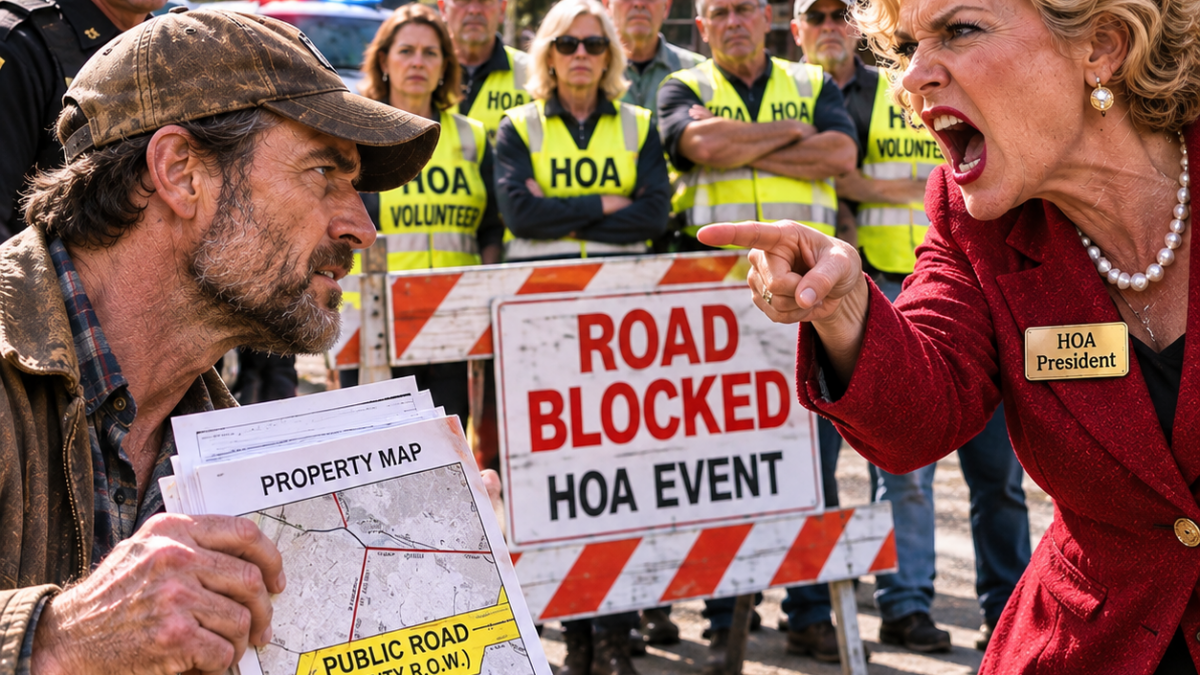
PART2
Amos explained something Cynthia had apparently spent months hoping nobody would explain aloud.
Ownership and easement rights are not the same thing.
I owned the ground beneath Switchback Lane.
The railroad held a limited easement over part of it for maintenance, inspection, and operations.
My 2009 agreement allowed me to use the corridor to reach my shop so long as I did not interfere with the railroad.
None of those documents gave Hawthorn Ridge ownership.
Cynthia’s face tightened.
“The HOA has maintained that road for years.”
“How?” Amos asked.
“Gravel. Drainage. Lights. Snow clearing. More than one hundred eighty thousand dollars.”
Several residents nodded.
One said:
“We paid for this.”
Amos nodded too.
Then:
“Maintaining somebody else’s road does not automatically transfer ownership.”
Cynthia looked offended.
“That’s absurd.”
“If I mow your yard for ten years, do I own your lawn?”
Silence.
Amos added carefully:
“I am not ruling on final property rights. That belongs to a court.”
Then he looked toward me.
“My question this morning is whether I have probable cause to arrest Mr. Latham for trespassing.”
Cynthia crossed her arms.
“You do.”
“He appears to be standing on land he owns.”
“He’s blocking community property.”
“My truck hasn’t moved,” I said.
Amos opened my 2009 agreement.
Read it again.
Then looked at Cynthia.
“I’m not arresting him.”
Her expression went from anger to disbelief.
“Sheriff—”
“No.”
“He is threatening fifty-four families.”
“He shut off his engine.”
“He’s refusing to comply with our safety plan.”
“That is a civil dispute.”
She pointed at the barricades.
“We have children up there.”
“And?”
“If heavy trucks use this road—”
Amos interrupted.
“Then take your argument to court.”
His radio crackled.
Dispatch informed him the North Fork and Western had a maintenance vehicle scheduled through the corridor that afternoon.
That ended the barricade problem for the moment.
Amos told Cynthia no one was to damage property, use force, or erect anything that interfered with rail access while the legal questions remained unresolved.
Then Cynthia gave in.
Barely.
She ordered the twelve volunteers to move the barricades to the shoulder.
They did.
No one looked quite as proud in those matching vests anymore.
I started my truck.
Then Cynthia called after Amos.
“Sheriff.”
He turned.
She reached into a leather portfolio.
Pulled out a crisp three-page document.
Railroad letterhead.
Real logo.
Dated 2018.
She held it high enough for the residents filming to see.
“The railroad gave Hawthorn Ridge permission to use Switchback Lane.”
A few volunteers clapped.
Cynthia looked at me.
“Your ancient document means nothing.”
Amos glanced at the permit.
Then:
“You’re welcome to present that to a judge.”
He drove away.
I stayed.
Something about the document bothered me.
I stepped closer.
“May I see it?”
Cynthia hesitated.
Then held the pages out just far enough for me to read.
The letterhead looked genuine.
North Fork and Western.
Developer name.
Road-use permit.
Then I saw the table of contents.
Page one.
Page two.
Page three.
Appendix B.
Four sections.
But Cynthia held three pages.
“Where’s Appendix B?”
Her eyes flicked toward me.
“What?”
“Page four.”
“There is no page four.”
“The first page says there is.”
She pulled the document back.
“You’ve seen enough.”
That was the first moment I felt genuine uncertainty.
Until then, I knew my deed.
I knew the easement.
I knew my own access agreement.
But if the railroad had separately granted Hawthorn Ridge a right to use the lane, the dispute might be more complicated.
Not ownership.
But access.
And if that right had somehow become permanent, Cynthia might have something real beneath all the nonsense.
I did not know.
That mattered.
People make mistakes when they become more committed to winning than understanding.
I went to work.
Unloaded my steel.
Then called Audra Fisk.
Thirty-nine.
Property attorney.
Specialized in easements, shared access, and title disputes.
I told her:
“I need somebody to find page four.”
She asked:
“What happened to pages one through three?”
“I have copies coming.”
“Why page four?”
“Because the HOA president didn’t want me to see it.”
Audra said:
“That’s usually a reason.”
By evening, Cynthia had already turned the morning into propaganda.
Emergency HOA meeting.
Fifty-four homeowners packed the clubhouse.
I learned what happened because three separate people sent me video.
Cynthia played edited footage of Sheriff Ridley at the barricade.
She removed the part where he explained I owned the ground.
Removed the part where he said he would not arrest me.
The clip started with me standing beside the truck holding documents.
Then Amos looking uncertain.
Then Cynthia displaying the 2018 permit.
She told the room:
“Porter Latham is trying to close our emergency access road.”
Not true.
I had never said residents could not pass.
But fear does not wait for complete sentences.
Residents had bought homes under brochures showing two routes.
Main entrance.
Secondary route.
Switchback Lane.
Cynthia told them:
“If fire or flooding closes the main entrance, Mr. Latham wants your families trapped.”
That sentence did what it was designed to do.
People signed a petition.
Dozens.
Some residents who had barely spoken to me in years suddenly believed my machine shop was threatening their children.
Then Cynthia announced that if I continued operating heavy commercial trucks through “community property,” the HOA would sue me for nuisance and property-value damage.
The pressure reached my business almost immediately.
One supplier called Tuesday.
“We’re suspending deliveries.”
“What?”
“Our driver was told the access road is closed.”
“By who?”
“HOA volunteers.”
“It isn’t closed.”
“He doesn’t want to get into a confrontation.”
I looked at the fabrication schedule on my wall.
Eighty-six-thousand-dollar contract.
Deadline.
Steel components arriving late could cost me the job.
I called the supplier.
Sent sheriff report number.
My access agreement.
Photographs.
They still hesitated.
“Our insurer wants clarification.”
That phrase would become familiar.
Everybody wanted clarification.
Meanwhile, Cynthia added a new charge to every homeowner’s account.
COMMUNITY ACCESS PROTECTION ASSESSMENT.
Legal fund.
Gate planning.
Emergency-route defense.
Residents paid because they believed I was trying to remove their second exit.
One of the twelve volunteers at the barricade was Ellis Paddock.
Sixty-three.
Retired insurance adjuster.
He came into my shop three days later with the expression of a man who had practiced an argument during the entire drive.
“You’re destroying property values.”
I shut off the grinder.
Removed my safety glasses.
“Good morning.”
“I paid for that road.”
“How?”
“HOA dues.”
“Your HOA maintaining a road doesn’t mean you bought it.”
“You people keep saying that.”
“Who is ‘you people’?”
He ignored that.
“We bought these houses with secondary access.”
“Show me.”
He frowned.
“What?”
“The recorded document.”
“What document?”
“The one granting you access over Switchback Lane.”
“The HOA has it.”
“Which one?”
“The railroad permit.”
“Have you seen all four pages?”
His expression shifted.
“Four?”
“Cynthia showed three.”
“She said that’s the permit.”
“Maybe.”
I unrolled the original subdivision plat on my workbench.
“If your house was sold with permanent secondary access, it should appear in the recorded development documents.”
Ellis leaned closer.
I pointed toward the western edge of Hawthorn Ridge.
There.
Faded ink.
A roadbed.
Notation:
PERMANENT COMMUNITY ACCESS — OLD MILL GATE.
Ellis stared.
“That road is closed.”
“Why?”
“It doesn’t connect anymore.”
“Who told you?”
“Everyone knows.”
“That isn’t what I asked.”
He looked at the map.
Then:
“Cynthia.”
“When?”
“When I bought.”
“What did she say?”
“That it was removed from the development plan.”
I tapped the recorded plat.
“It’s right here.”
Ellis said nothing.
Neither did I.
He had entered my shop angry at me.
He left confused about his own HOA.
That was more useful than winning an argument.
The railroad entered the dispute the next day.
Della Crowhurst arrived in a white North Fork and Western truck.
Forty-four.
Operations and land-access supervisor.
Clipboard.
Measuring wheel.
I expected her to confirm everything I believed.
She did not.
Good professionals rarely arrive to validate your feelings.
They arrive to inspect.
Della read:
1926 easement.
My 2009 agreement.
Cynthia’s 2018 permit.
All three pages.
Then she walked Switchback Lane.
Measured clearances.
Checked drainage.
Signal equipment.
At the upper bend she stopped beside a concrete pillar the HOA had installed for some old access-control system.
Electrical conduit ran beside it.
She measured again.
Her expression tightened.
“This is narrow.”
“How narrow?”
“Possibly too narrow for one of our specialized maintenance units.”
Cynthia had arrived with two board members.
She heard that.
“The railroad never objected.”
Della turned.
“Silence isn’t a building permit, ma’am.”
One board member looked away.
Then Della told me something I did not like.
“Our preliminary archive shows residential traffic was permitted here for a period.”
I frowned.
“Permanent?”
“I didn’t say that.”
“Transferable?”
“I don’t know yet.”
Cynthia smiled.
Della continued:
“We are retrieving the complete permit file.”
The smile stayed.
“Until then, nobody should assume more rights than the documents support.”
That included me.
Important.
My 2009 agreement did not make me owner of the railroad easement rights.
I owned the land.
The railroad held specific rights.
I could not block railroad operations just because I was angry at the HOA.
Della expected everyone to keep the corridor clear.
Cynthia heard only that she needed time.
Within a week, the HOA approved an automated gate across Switchback Lane.
License plate recognition.
Registered residents only.
Commercial access subject to HOA approval.
Treasurer Shelby Dugan asked:
“What does it cost?”
Cynthia brushed her aside.
“We’ll discuss financing later.”
Board approved it in under ten minutes.
A neighbor who quietly thought Cynthia was going too far sent me the engineering drawing.
I spread it beneath my shop lights.
I fabricate from drawings for a living.
Dimensions tell you what speeches hide.
The gate footing sat directly beside the railroad signal-access path.
Swing arm across the maintenance approach.
Control cabinet behind it.
I called Della.
Sent drawing.
Site measurements.
Photographs.
Two days later, she called.
“If they build this, we have a problem.”
“How bad?”
“We have scheduled signal maintenance next week.”
“Can trucks fit?”
“Not with that footing.”
“Can you stop them?”
“We can enforce our easement rights.”
“What happens if construction starts?”
“We document and pursue proper remedies.”
Then she added:
“Porter, do not move equipment yourself.”
“I know.”
“I mean it.”
“I know.”
Cynthia went to court first.
Emergency motion.
She asked Judge Ingrid Vale to restrict heavy industrial traffic on Switchback Lane.
Her argument:
Years of community use.
Safety risk.
Emergency access.
Property values.
And the three-page 2018 railroad permit.
Dozens of residents signed statements.
Many honestly believed losing Switchback Lane meant losing their second exit.
Audra stood beside me in court.
She did not call Cynthia a liar.
She pointed at the table of contents.
“Your Honor, the HOA has provided pages one through three.”
Judge Vale looked over her glasses.
“Where is Appendix B?”
HOA counsel answered:
“We believe it contains standard administrative terms.”
“You believe?”
“It is not material to temporary relief.”
Audra said:
“The document itself says the authorization is subject to Appendix B.”
Judge Vale looked at Cynthia’s lawyer.
“Then it sounds material.”
The hearing did not give me a total win.
The judge refused to declare the HOA owner of Switchback Lane.
Good.
But she also refused to decide final resident-access rights without the full railroad file.
Reasonable.
She ordered status quo.
No new obstruction.
No interference with railroad operations.
Existing proven access preserved temporarily.
Full legal rights later.
Cynthia walked into the courthouse hallway and told waiting residents:
“We won.”
People cheered.
I stood fifteen feet away.
Audra whispered:
“Do not react.”
“I wasn’t.”
“You were making the face.”
“What face?”
“The face where you explain things to people who aren’t listening.”
I left.
My supplier still had deliveries suspended.
Insurance wanted additional information.
Audra’s invoices grew.
The eighty-six-thousand-dollar job was slipping.
That was where Cynthia had leverage.
Not law.
Fatigue.
Every letter cost me time.
Every delay cost money.
Every rumor demanded explanation.
I began waking at four.
Reading documents.
Running the shop during the day.
Calling attorneys after closing.
One night I sat at my office desk staring at Cynthia’s three-page permit for the tenth time.
Bottom of page three.
Tiny sentence.
This authorization is subject to all conditions contained in Appendix B.
I called Audra.
She answered tired.
“You found something?”
“The missing page isn’t supplemental.”
“No.”
“It controls the whole permit.”
“Yes.”
“When do we get it?”
“Railroad archive package is being produced.”
“I hate waiting.”
“That’s why courts have deadlines.”
“Still hate it.”
Two days later Audra called.
“Come now.”
I drove to her office.
The complete railroad file sat on her conference table.
She looked serious.
“The permit is real.”
That was not what I wanted to hear.
“Meaning?”
“The railroad genuinely gave the Hawthorn Ridge developer permission to use Switchback Lane.”
My stomach dropped.
Then she turned page four toward me.
Appendix B.
Temporary construction access.
Twelve months maximum.
Issued because the subdivision’s primary entrance road had been damaged in a landslide while development work continued.
Construction vehicles.
Contractors.
Limited residential access during restoration.
Non-transferable without written railroad consent.
No permanent easement.
No perpetual homeowner access.
Automatically terminated when the main road reopened or twelve months expired.
Whichever came first.
Clipped behind it:
2019 termination letter.
Permit ended.
I read everything twice.
Then:
“She knew?”
Audra held up one hand.
“Not yet.”
“What?”
“We know the permit expired.”
“She’s been showing people three pages.”
“That is suspicious.”
“She sold the story as permanent.”
“Also suspicious.”
“What else do you need?”
“Evidence she knew the terms.”
I sat back.
That was Audra’s discipline.
Facts first.
Then another document surfaced.
HOA sales flyer.
Beautiful border.
Embossed seal.
LIFETIME SECONDARY ACCESS CERTIFICATE.
Guaranteed permanent use of Switchback Lane.
Price:
$3,600 per household.
Forty-one homeowners had bought one.
Total:
$147,600.
Railroad signature?
None.
Railroad seal?
None.
Recorded easement?
None.
These were HOA-created certificates based on a temporary permit that had expired.
I wanted to print Appendix B and tape it to Cynthia’s front door.
Audra said:
“No.”
“Why?”
“Because we are sending it through counsel.”
“She’s collecting money.”
“We document.”
“She’s still telling people—”
“Porter.”
I stopped.
She leaned forward.
“If you want the strongest case, stop trying to win Tuesday.”
“What does that mean?”
“Win the final record.”
I hated good advice.
We sent the complete permit.
Appendix B.
Termination letter.
Formal notice.
Demand that the HOA stop claiming permanent ownership or permanent railroad-granted access until a court determined the rights.
Then Shelby Dugan called me.
HOA treasurer.
Her voice was low.
“I saw the letter.”
“Okay.”
“The certificate money is in a separate account.”
“Why?”
“Cynthia told the bookkeeper to keep it isolated.”
“Board reporting?”
“Not detailed.”
“Do you have records?”
“Yes.”
“Then talk to Audra.”
Silence.
“Porter.”
“Yes?”
“The certificates aren’t the biggest problem.”
I sat straighter.
“What is?”
“There’s another road.”
“Old Mill Gate.”
She went silent.
That was confirmation.
Then:
“Cynthia has been getting paid to keep it closed.”
I looked through my office window toward the ridge.
Suddenly the entire dispute changed shape.
I could have become vindictive at that point.
I owned the ground under Switchback Lane.
The HOA’s permanent right was collapsing.
I could have pushed to exclude residents entirely.
Some people told me later that would have been justice.
It would not.
The homeowners bought houses in good faith.
They trusted sales materials.
They trusted certificates.
They trusted their board.
Punishing fifty-four families because Cynthia misled them would turn me into another person using access as leverage.
So instead, I invited residents to my shop.
Saturday morning.
Coffee.
Workbenches.
No press.
Ellis came.
Six others.
Three had signed Cynthia’s petition against me.
Ellis brought his access certificate.
I placed Appendix B beside it.
He read slowly.
Then the 2019 termination.
Then turned over his certificate.
No railroad signature.
His face went red.
“Three thousand six hundred dollars.”
Nobody answered.
“For this?”
I said:
“I’m not here to tell you whether you have claims against your HOA.”
“Then what are you telling us?”
“I’m telling you I don’t intend to keep anybody from getting home.”
His anger softened slightly.
“But this road is not what Cynthia told you it was.”
I unrolled the recorded subdivision plat.
Pointed.
“Old Mill Gate.”
One woman said:
“That’s gone.”
“Physically blocked is not the same as legally gone.”
Ellis stared.
“Cynthia said it had been abandoned.”
“Recorded plat says otherwise.”
“Can we use it?”
“I don’t know yet.”
That surprised them.
One man asked:
“Why are you helping us?”
I looked around the shop.
“Because this is not you versus me.”
Then I pointed toward Switchback Lane.
“It is everyone versus bad paperwork.”
That became the first meeting where homeowners began seeing me as something other than the man stealing their emergency route.
I hired a licensed surveyor to examine Old Mill Gate.
No trespass.
No dramatic confrontation.
County records.
Public rights-of-way.
Existing markers.
Planning documents.
The survey came back.
Roadbed still existed.
Connection to county road still possible.
Recorded community access corridor intact.
But containers and commercial equipment occupied much of the area.
A logistics business was using it.
That explained why residents thought the road had vanished.
Della and I developed an interim plan.
Railroad access protected.
My shop access protected.
No sudden lockout of residents while legal rights were sorted.
Old Mill Gate restoration evaluated.
Ellis began going door-to-door.
Not for me.
For transparency.
Residents who had signed Cynthia’s petition now signed another requesting a full HOA meeting and independent review.
Cynthia responded with fear.
Porter wants your road.
Porter wants your homes devalued.
Porter wants to isolate the ridge.
I made one public offer.
If the HOA demonstrated its recorded rights at Old Mill Gate, I would provide engineering support—free—to help evaluate reopening it safely.
That offer hurt Cynthia more than any insult could have.
Because residents began asking:
“Why wouldn’t we reopen our own road?”
The answer arrived through Shelby.
Five-year-old HOA minutes.
Resolution allowing a private logistics company to use Old Mill Gate as a truck and container staging yard.
Approved by Cynthia.
No full membership supermajority, even though the bylaws required one for that type of common-property arrangement.
Audra followed the money.
The land belonged to the HOA.
The recorded access corridor ran through it.
Yet the association had leased the area to a logistics operator.
Annual rent:
$96,000.
Five years.
Residents had not been told the lease was blocking the secondary road shown on their plat.
That alone was serious.
Then came the consulting company.
Invoices:
TRANSPORT ACCESS ADVISORY SERVICES.
Forty-eight thousand dollars per year.
Five years.
$240,000.
Business filings showed ownership ties between the consulting company and Cynthia.
Audra said:
“Do not call this theft.”
“I wasn’t going to.”
“You were thinking it.”
“Yes.”
“We need service records.”
Shelby searched.
No reports.
No engineering studies.
No meeting notes.
No deliverables.
No identifiable work product matching the invoices.
That did not prove every dollar was unlawful.
It proved there was a conflict requiring explanation.
Then the entire scheme made sense.
Cynthia leased out Old Mill Gate.
Residents lost practical use of their recorded second access.
They became dependent on Switchback Lane.
Cynthia sold lifetime certificates for Switchback Lane.
Then when my business challenged HOA control, she created a special assessment to “protect” the same access.
Meanwhile, a company tied to her collected consulting money supposedly related to transportation access.
Switchback Lane was never her prize.
It was cover.
Keep fifty-four families staring east.
Nobody asks what happened west.
When Ellis understood, he sat in my shop holding his certificate.
“So we paid her for the road she didn’t own because she rented out the one we did.”
I said:
“That is what the records appear to show.”
He laughed once.
No humor.
“I wore a safety vest for her.”
I did not rub it in.
People remember who gave them room to correct themselves.
The next HOA meeting was standing room only.
Cynthia began with prepared remarks.
Community safety.
Hostile outside business interests.
Legal uncertainty.
Then Ellis stood.
Certificate in his hand.
“You sold us access to a road we didn’t own.”
The room went silent.
Cynthia stopped.
Ellis continued:
“While renting out the road we actually had.”
Someone gasped.
He held up Appendix B.
“Why did we never see this?”
Cynthia looked toward her attorney.
Then back at the room.
“The permit issue is being mischaracterized.”
“Did it expire?”
“Legal interpretation—”
“Did it expire?”
She refused to answer.
Then she announced:
“The automated gate will be installed tomorrow.”
The room erupted.
Her own attorney leaned toward her.
She kept talking.
“We will protect Switchback Lane.”
One homeowner shouted:
“From who?”
She pointed toward me.
I had been invited by residents.
I stood at the back.
Said nothing.
Then:
“The community will not surrender control.”
That was her final escalation.
An hour later, my phone buzzed.
Photograph from a neighbor.
Concrete truck.
Excavator.
Work lights.
Staged near the railroad corridor.
Cynthia planned to build the gate despite Judge Vale’s status-quo order.
I called Audra.
Then Della.
“She’s building.”
Della’s voice went cold.
“We have signal maintenance scheduled.”
“I know.”
“If they pour those footings, our access is blocked.”
“What do you need?”
“Send me the latest drawing.”
“Already sent.”
“I’ll prepare technical findings.”
Audra said:
“We file tonight.”
Before dawn, emergency motion.
Not:
Cynthia is evil.
Not:
HOA tyranny.
Specific.
Proposed gate conflicts with existing court order.
Blocks railroad technical access.
Interferes with scheduled maintenance.
Threatens rail operations.
Della submitted measurements.
Vehicle dimensions.
Signal-cabinet requirements.
Maintenance schedule.
The railroad temporarily paused the affected maintenance activity rather than force equipment through a disputed obstruction.
That pause generated a written operational record.
Real consequence.
I organized the hearing binder like a fabrication job.
Set One:
1926 easement.
My deed.
2009 agreement.
Set Two:
2018 permit.
Appendix B.
2019 termination.
Set Three:
Old Mill Gate plat.
Survey.
Lease.
Minutes.
Set Four:
Certificates.
Assessment.
Consulting invoices.
Corporate records.
Set Five:
Gate design.
Della’s technical report.
Railroad maintenance interruption.
Audra laughed when she saw it.
“You put tabs on everything.”
“I like tabs.”
“I can tell.”
At the hearing, Cynthia took the stand.
She said I was trying to endanger residents.
Audra asked:
“Has Mr. Latham ever physically blocked a resident from reaching Hawthorn Ridge?”
“No.”
“Has he installed a gate?”
“No.”
“Has he charged a resident?”
“No.”
“Did he propose a temporary access arrangement while rights were verified?”
“Yes, but—”
“Did you accept it?”
“No.”
“Why?”
“Because the HOA controls its access.”
Audra held up Appendix B.
“This permit expired in 2019, correct?”
Cynthia hesitated.
“Our legal position—”
“Did the railroad send a termination letter?”
“Yes.”
The room changed.
“Did you sell lifetime certificates after that date?”
Cynthia’s attorney objected.
Judge Vale allowed limited questioning.
Cynthia answered:
“The certificates reflected historic community access.”
“Were they issued by the railroad?”
“No.”
“Recorded with the county?”
“No.”
“Supported by a current railroad permit?”
“We believed—”
Audra turned.
“Your Honor, I’ll move on.”
Then Old Mill Gate.
Recorded plat.
Access corridor.
Lease.
Cynthia said breaking the logistics lease would cause serious financial damage to the HOA.
She meant it as defense.
It sounded exactly like what it was.
The HOA had financial reasons to keep the legal road closed.
Audra introduced my restoration concept.
Survey.
Engineering estimate.
Staged reopening.
No immediate cutoff of anyone.
Railroad corridor protected.
Existing community access transitioned safely.
Judge Vale studied it.
Then issued broader temporary measures.
No new Switchback gate.
Railroad maintenance access must remain unobstructed.
No new lifetime certificates.
All relevant financial records preserved.
And because the evidence showed serious conflict-of-interest concerns and substantial risk that the board could not impartially manage the disputed common property, she appointed an independent manager with defined powers to supervise Old Mill Gate restoration and review related spending.
Cynthia stood before the judge finished.
“This association does not need an outsider running our property.”
Judge Vale looked at her.
“The order exists because there is substantial evidence the homeowners’ common property may not have been managed solely for their benefit.”
Cynthia sat.
Her attorney did not look at her.
Outside the courthouse, residents waited.
Local news too.
Cynthia saw me.
Walked straight over.
“You think you’ve taken our road?”
I looked at her.
“No.”
She stopped.
“I helped your neighbors get their real road back.”
Ellis stood behind her.
Then turned away.
Another homeowner followed.
Then another.
For the first time since the barricade morning, Cynthia stood without a line of people behind her.
The independent manager started immediately.
Old Mill Gate.
Survey markers.
Container inventory.
Lease review.
Safety connection to county road.
Then came a detail so symbolic it almost felt invented.
The ornamental stone arch at the western end of Hawthorn Ridge—massive, expensive, built during Cynthia’s presidency—stood partially within the width required to restore the recorded access corridor.
Bronze plaque:
MORROW GATEWAY — 2022 COMMUNITY BEAUTIFICATION INITIATIVE.
Cynthia’s name.
Right where the legal road needed to reopen.
I told Audra:
“Do not make jokes.”
“I wasn’t.”
“You were thinking one.”
“Several.”
The independent manager did not tear it down for revenge.
Engineers evaluated alternatives.
Could traffic safely pass around it?
No.
Could the road shift?
Not without affecting adjacent property and drainage.
Could the structure be modified?
Partially.
Eventually, after proper approvals, the obstructing portion came down block by block.
The bronze plaque was removed.
Not smashed.
Stored.
The image traveled through Hawthorn Ridge faster than any legal memo.
For years, Cynthia’s name had literally stood in the road homeowners were told no longer existed.
The logistics lease was negotiated toward resolution.
Containers removed.
Truck staging relocated.
The access corridor cleared.
Drainage repaired.
Connection inspected.
Signage installed.
HAWTHORN RIDGE COMMUNITY ACCESS — OLD MILL GATE.
Not glamorous.
Legal.
Recorded.
Real.
North Fork and Western dealt with Switchback Lane separately.
The railroad restored full technical clearance.
Removed or required modification of HOA-created obstructions within its easement area.
Then installed its own controlled access arrangements for legitimate railroad maintenance.
Not Cynthia’s private plate-recognition system.
I continued using Switchback Lane exactly as I had for seventeen years.
Under my 2009 agreement.
No new fee.
No HOA permission.
I did not install a gate against residents out of spite.
During the transition, limited traffic continued where legally permitted and operationally safe.
Once Old Mill Gate opened, most neighborhood traffic moved there naturally.
It was wider.
Connected directly to the county road.
Did not pass my shop.
Did not cross sensitive railroad maintenance space.
It was the road their development documents had intended all along.
My supplier resumed deliveries after Audra sent the court order and railroad confirmation.
I salvaged the eighty-six-thousand-dollar fabrication contract.
Barely.
We worked two Saturdays.
I paid overtime.
Lost some profit.
But delivered.
When the client asked what happened, I said:
“Road dispute.”
He looked at the stacks of legal folders.
“That’s a road dispute?”
“Apparently.”
The independent audit took longer.
Financial records.
Consulting agreements.
Access-certificate funds.
Special assessments.
Old Mill lease income.
Board approvals.
Related-party disclosures.
Some numbers were legitimate.
That mattered.
The $96,000 annual logistics rent had actually gone into HOA accounts.
Not Cynthia’s personal pocket.
The problem was the lease process, conflict with recorded access, and lack of required member approval.
The consulting fees were different.
$48,000 per year.
Five years.
$240,000.
Cynthia-linked company.
Auditors found insufficient support for the claimed advisory services.
No meaningful reports.
No documented deliverables matching the invoices.
No transparent conflict disclosure to members.
That became the basis for separate civil claims and repayment demands.
After litigation and supervised negotiation, the company tied to Cynthia was required to repay the full $240,000 determined to have been improperly received.
The access-certificate money required its own resolution.
Forty-one homeowners.
$3,600 each.
$147,600.
Some residents wanted immediate checks.
Others wanted credits.
The final resolution was handled through the HOA and independent oversight.
Nobody pretended the certificates had ever created legal rights.
That was important.
Fancy seal.
Elegant paper.
No easement.
The Community Access Protection Assessment was reviewed too.
Residents demanded to know why they had paid extra to defend a right the HOA did not possess in the form Cynthia described.
Credits and accounting adjustments followed according to the final review.
The HOA survived.
That mattered to me.
People expected me to enjoy the idea of bankrupting Hawthorn Ridge.
I did not.
Why would I want fifty-four innocent families destroyed?
They had been misled.
Some had supported Cynthia loudly.
Yes.
Ellis had stood in a safety vest blocking my truck.
Yes.
People had called me greedy.
Dangerous.
Anti-family.
But they were homeowners trusting leadership.
Justice does not require punishing everybody who believed a lie.
It requires correcting the lie and placing responsibility where it belongs.
Cynthia’s presidency ended through the bylaws.
Member removal process.
Vote.
It was not close.
Shelby remained treasurer.
At the first meeting after the transition, she opened the books.
Everything.
Lease.
Certificates.
Consulting.
Legal costs.
Assessment.
People asked questions for three hours.
Shelby answered what she knew.
When she did not know, she said:
“I don’t know.”
That may have been the most refreshing phrase Hawthorn Ridge had heard in years.
Cynthia hated uncertainty.
So she filled every gap with confidence.
Shelby allowed the gap to remain until records answered it.
Different kind of leadership.
Four months after the orange barricades, Old Mill Gate officially reopened.
No ribbon-cutting.
Residents did not want one.
The first morning, I drove over to look.
I did not use the gate.
Not my route.
Just looked from the county shoulder.
New sign.
Fresh gravel.
Clear lane.
Ellis stood nearby with a box of donuts.
He laughed when he saw me.
“Peace offering.”
“You already apologized.”
“Donuts are stronger.”
We leaned against his truck.
He looked toward the new road.
“Funny.”
“What?”
“We spent years fighting for the wrong road.”
I looked back toward Switchback Lane.
Freight train moving below the ridge.
“You didn’t lose a road.”
He waited.
“You found the one somebody kept hidden from you.”
He nodded.
Then handed me a donut.
A week later, he came to my shop.
No safety vest.
He brought his old lifetime certificate.
“I’m framing it.”
“Why?”
“To remind myself not to trust embossed seals.”
I laughed.
“You know what bothered me most?”
“What?”
“The first morning.”
“Barricades?”
“No.”
“The map.”
He shook his head.
“Cynthia held that glossy map like it was scripture.”
I nodded.
“I believed her because she looked certain.”
“Common mistake.”
“Retired insurance adjuster.”
“Still human.”
He smiled.
“Confidence isn’t a deed.”
“That’s pretty good.”
“I stole it from you.”
“You’re welcome.”
The road dispute changed my relationship with the neighborhood.
Not instantly.
Some people avoided me.
Embarrassed.
A few never apologized.
Fine.
Not every story needs reconciliation.
But others stopped by.
One woman brought cookies.
A man who had signed both petitions asked whether I could recommend a contractor for drainage work.
A young father said:
“I told my kids you were trying to trap us.”
I did not know what to say.
He continued:
“I was wrong.”
“Okay.”
“I’m sorry.”
“Thank you.”
That was enough.
Cynthia faced civil claims.
Legal costs.
Repayment consequences.
Loss of office.
Her consulting business lost the association relationship.
The exact legal outcomes took time.
I did not track every hearing like a sports score.
Once my road access was protected and Old Mill Gate restored, I had a business to run.
Audra told me:
“That is healthy.”
“I’m paying you to say that?”
“Six-minute increment.”
“You’re awful.”
“Yet correct.”
The industrial gate Cynthia wanted across Switchback Lane was never built.
The concrete truck left.
Excavator left.
No license plate system.
No HOA control booth.
North Fork and Western installed appropriate railway-controlled measures where needed.
Della sent me updated technical access drawings.
I read every line.
She asked:
“Looking for missing pages?”
“Yes.”
“Good.”
The railroad also clarified its historical records with Hawthorn Ridge.
Temporary access permit.
Expired.
No transferable permanent resident right created through that 2018 document.
That written clarification ended years of ambiguity.
Cynthia had depended on nobody asking the railroad directly.
Once they did, her version collapsed.
The same thing happened with Old Mill Gate.
Nobody had physically erased the road.
It was buried under assumptions.
Containers.
A lease.
A monument.
A president repeating:
That entrance is gone.
Enough repetitions and people stop checking.
That lesson bothered me more than the money.
How many communities function through inherited statements nobody verifies?
We can’t use that entrance.
Why?
It was abandoned.
By whom?
When?
Recorded where?
Nobody knew.
Cynthia knew people rarely ask the fourth question.
I started asking more fourth questions myself.
Business contracts.
Vendor changes.
Access terms.
Insurance.
Not paranoid.
Precise.
One year later, Hawthorn Ridge asked if I would attend its annual safety meeting.
I almost declined.
Shelby called personally.
“Please.”
“Why?”
“People still associate emergency access with Switchback.”
“You have Old Mill.”
“Exactly.”
She wanted me to explain how industrial traffic and community traffic could coexist without another conflict.
I went.
No grand speech.
I brought two maps.
Old.
New.
I said:
“The best road dispute is one where everybody knows what road they actually have.”
Small laugh.
Then I explained:
Switchback Lane served my property and railroad operations under specific rights.
Old Mill Gate served the neighborhood.
Emergency plans should rely on roads the neighborhood legally controls.
Not assumptions.
Not favors.
Not temporary historical permissions.
One homeowner asked:
“Can residents still use Switchback if Old Mill is blocked during an emergency?”
I answered carefully.
“Emergency services will make decisions based on actual conditions and lawful authority. But your planned secondary exit is Old Mill.”
“Would you stop us in a fire?”
“No.”
He looked surprised.
“I never wanted to trap anybody.”
That sentence mattered.
For months Cynthia had described me as a man willing to endanger families to protect gravel.
The truth was simpler.
I wanted control of my own property.
The railroad wanted access to its equipment.
Residents needed a legitimate second route.
Those interests were compatible once the wrong road stopped being treated as the answer to everything.
After the meeting, a woman named Denise approached.
“You could’ve closed us out.”
“I could have tried.”
“Why didn’t you?”
I thought about it.
“Because you bought homes. You didn’t write the permit.”
She nodded.
Simple.
I had been angry.
Very.
The first time I saw the $147,600 certificate total, I wanted every car off Switchback immediately.
The first time Shelby told me Cynthia had been paid while Old Mill stayed blocked, I wanted to lock the lane.
That would have felt fair for about fifteen minutes.
Then fifty-four families would have been punished for something Cynthia created.
Anger is excellent at identifying pain.
Terrible at assigning liability.
That is why I needed Audra.
Della.
Amos.
Judge Vale.
People with narrower questions.
What does the deed say?
What does the permit say?
What does the railroad need?
What did the bylaws authorize?
What money can be documented?
Those questions prevented the story from becoming revenge.
Sheriff Ridley stopped at my shop months later.
Coffee.
He looked at Switchback.
“No barricades.”
“Miss them?”
“Terribly.”
He smiled.
Then:
“You know what Cynthia told me after the first hearing?”
“What?”
“That I embarrassed her.”
“You read a document.”
“I know.”
He shook his head.
“She thought my refusing to arrest you was choosing your side.”
“What did you say?”
“That criminal law doesn’t become a weapon because an HOA has matching vests.”
I laughed.
“I wish you’d said that on camera.”
“Sheriffs also need hobbies.”
Amos had done one of the most important things in the entire story.
Nothing dramatic.
He refused to convert a civil disagreement into an arrest.
That prevented the first morning from becoming something worse.
Imagine if he had accepted Cynthia’s map as authority.
Imagine if I had been handcuffed.
Truck impounded.
Delivery missed.
The entire neighborhood would have treated the arrest itself as proof she was right.
Police restraint preserved room for the civil facts to emerge.
I thanked him.
He shrugged.
“Job.”
Good public service often looks like somebody refusing to do the dramatic thing.
Della was the same.
I originally wanted her to arrive and declare:
Porter is right.
She refused.
She reviewed everything.
Even told me my access rights had limits.
That annoyed me.
It also made her later conclusions stronger.
When she said the HOA gate would obstruct railroad maintenance, nobody could dismiss her as my ally.
She had been consistent.
Railroad first.
Documents first.
Safe operations first.
That is what credible witnesses look like.
Years later, I still used the same shop.
Thirty-two acres.
Same presses.
Same welding tables.
Some newer machines.
Different crew.
Switchback Lane remained gravel.
No grand gate.
No HOA sign.
North Fork and Western maintained what it needed.
I maintained what was mine.
We coordinated.
Simple.
Old Mill Gate became ordinary too.
Kids waited near it for school buses.
Residents used it during road work.
Delivery trucks entered there.
Nothing about it looked like a secret worth fighting over.
That was perhaps the strangest part.
Cynthia built years of fear around something physically boring.
A road.
She needed people to believe losing Switchback meant isolation.
Then Old Mill reopened and life continued.
One resident told Ellis:
“I thought the ridge would change.”
He said:
“It did.”
“How?”
“We have two roads that make sense now.”
Sometimes the satisfying ending is logistical.
Cynthia’s stone arch bothered some people.
After the obstructing section was removed, arguments started over what to do with the salvaged stone.
One group wanted a smaller monument.
Another wanted to sell it.
Someone suggested using the blocks at Old Mill.
Ellis objected.
“Absolutely not.”
“Why?”
“I don’t want Cynthia’s name resurrected.”
The bronze plaque remained in storage.
Eventually the reusable stone became landscaping around the clubhouse without any commemorative marker.
That felt appropriate.
Material reused.
Ego discarded.
Shelby once asked whether I wanted the plaque.
“For what?”
“You were kind of responsible.”
“No.”
“Paperweight?”
“It weighs forty pounds.”
“Large desk.”
I declined.
I did keep one object.
An orange barricade reflector.
Ellis found it near the shoulder after everything ended.
He brought it to the shop.
“Souvenir.”
“I don’t want this.”
“You’re keeping it.”
“Why?”
“Because someday you’ll be eighty and forget how mad you were.”
I put it in a drawer.
Years later, I found it while looking for drill bits.
I did remember.
Not the anger first.
The silence after Sheriff Ridley asked Cynthia:
“What gives your association the right to charge the landowner for driving on his own road?”
Twelve people standing behind her.
Nobody answering.
That was the first crack.
Then page four.
Then Old Mill.
Then money.
Big scandals often collapse through small questions.
Where is the missing page?
Who owns the land?
When did the permit expire?
What did residents actually buy?
Why is the legal road blocked?
Who receives the consulting fee?
No dramatic genius.
Just follow-up.
Cynthia’s strongest weapon had been exhaustion.
Not the map.
Not the gate.
Not the lawyers.
She made every question expensive.
If I wanted to use my road:
Attorney.
If I wanted deliveries:
Insurance explanation.
If I wanted court clarity:
Time.
If residents wanted answers:
Meetings.
Records.
Conflict.
Most people do not surrender because the other side proves them wrong.
They surrender because continuing to ask costs too much.
That is why her system worked as long as it did.
Homeowners paid $3,600 because fighting seemed harder.
Paid assessments because uncertainty scared them.
Accepted Old Mill’s closure because investigating required effort.
I understood that more after meeting older residents.
One woman said:
“My husband had cancer when we bought here. Cynthia handed us the access certificate and said everything was handled. I was relieved.”
Relief.
Another thing fraud sells.
The certificate gave her one less problem.
She paid.
Did not research railroad law.
Why would she?
People have jobs.
Children.
Illness.
Lives.
Systems should not depend on every person becoming a title lawyer just to avoid being misled.
That is why transparency matters.
The new HOA board published important agreements.
No hidden appendices.
Recorded property rights summarized with links to source documents.
Related-party transactions disclosed.
Large contracts voted openly.
Not perfect.
Nothing is.
But better.
Porter Latham did not become HOA president.
People joked.
Never.
I did not live there.
Also, I had enough problems.
I did occasionally help review engineering drawings when asked.
For free.
Cynthia once told residents I wanted control of their roads.
Ironically, once Old Mill opened, I had less involvement with their access than ever.
Exactly what I wanted.
The consulting-fee litigation lasted longer than the road fight.
That surprised residents.
Money disputes are like that.
Audit findings.
Service claims.
Corporate ownership.
Invoices.
Depositions.
Eventually the $240,000 repayment became final through the legal resolution.
People asked if Cynthia went to prison.
No.
This was primarily a civil and governance case in the source events we had.
I refused to invent criminal punishment because people wanted a cleaner villain ending.
She lost the presidency.
Her linked company repaid funds deemed improperly received.
She faced legal costs and claims.
Her influence collapsed.
Residents saw the books.
The certificates were resolved.
That was enough truth.
Justice does not become stronger because you add handcuffs that never existed.
I learned to distrust dramatic embellishment almost as much as glossy HOA maps.
The clearest victory came four months after the barricades.
Old Mill Gate opened.
Cars drove through.
Nobody cheered after the first ten minutes.
They just used it.
That was success.
Infrastructure should become boring.
Roads should not need speeches.
Access should not depend on one person’s personality.
Ellis drove down to my shop afterward.
Box of donuts.
He placed his old certificate beside the orange reflector.
“Museum.”
“I’m not building a museum.”
“Too late.”
He looked around the shop.
“You know what Cynthia used to say about you?”
“I can imagine.”
“That you wanted everybody to kneel because you owned the dirt.”
I looked toward the lane.
“What do you think now?”
Ellis thought.
“I think you wanted her to stop pretending she owned it.”
Exactly.
Ownership did not make me king of the corridor.
Railroad rights existed.
Public safety existed.
Temporary transition needed cooperation.
My deed did not erase everyone else.
Cynthia’s mistake was the reverse.
She treated community interest as if it erased me.
It doesn’t work that way.
Rights overlap.
They do not disappear because one side has more houses.
One of my favorite mornings came two years later.
Snow overnight.
I drove down Switchback before dawn.
Railroad maintenance truck ahead.
It stopped at the signal cabinet.
I waited.
No anger.
No barricade.
Worker finished.
Waved me through.
I continued to the shop.
On the ridge above, school traffic moved through Old Mill.
Two roads.
Each serving its purpose.
No fight.
I parked.
Made coffee.
Turned on the shop lights.
That morning felt more satisfying than the hearing.
Because order had replaced drama.
The eighty-six-thousand-dollar client had become a repeat customer by then.
One of their managers visited.
He looked at the lane.
“This the famous road?”
“I wish people would stop calling it that.”
He laughed.
“Worth all the trouble?”
I considered.
“Keeping the shop open?”
“Yes.”
“Then yes.”
“Would you do anything differently?”
“Yes.”
“What?”
“I would hire Audra before reading HOA emails at midnight.”
He laughed.
I was serious.
Legal disputes distort time.
Every message feels urgent.
Most are not.
Cynthia used urgency constantly.
Emergency meeting.
Emergency gate.
Emergency access threat.
Emergency assessment.
Everything required immediate compliance.
But the document that beat her was a page written years earlier.
Appendix B.
Old.
Quiet.
Patient.
Truth often has better endurance than urgency.
One afternoon Cynthia herself came to the shop.
Years after losing office.
I almost didn’t recognize her.
No safety vest.
No entourage.
She stood outside until I noticed.
“What can I do for you?”
“I wanted to talk.”
“About?”
“The road.”
I leaned against the doorframe.
“Which one?”
She gave me a tired smile.
“I deserved that.”
I said nothing.
She looked toward Switchback.
“I thought if I lost control of this road everything else would unravel.”
“That was true.”
Her smile disappeared.
“Yes.”
“Why sell certificates after the permit ended?”
She looked down.
“People wanted certainty.”
“That’s not an answer.”
“I told myself the historic access would eventually become permanent.”
“Did the railroad tell you that?”
“No.”
“Then?”
She inhaled.
“The association needed money.”
“For what?”
“Everything.”
I waited.
“Landscaping. Legal. Projects. Old Mill lease helped. The certificates helped.”
“And your consulting company?”
Her face tightened.
“That agreement was more complicated.”
“The audit didn’t think so.”
She looked away.
Then:
“I should have disclosed it.”
“Yes.”
“I should have shown the appendix.”
“Yes.”
“I should have reopened Old Mill.”
“Yes.”
Her mouth twisted.
“Do you ever say anything besides yes?”
“When someone finally says the accurate thing, I try not to interrupt.”
She almost laughed.
Then she looked toward the shop.
“I really thought you were the enemy.”
“I know.”
“Why didn’t you close everyone out?”
That question mattered.
“Because Ellis didn’t write your permit.”
She frowned.
“What?”
“Neither did the families.”
I pointed uphill.
“They were wrong about me.”
“Yes.”
“They were still homeowners who had paid you for something you told them was legal.”
Cynthia went quiet.
Finally:
“You made me look terrible.”
“No.”
I did not say it angrily.
“The records did.”
She nodded.
Then left.
No reconciliation.
No friendship.
No hug.
Fine.
Some apologies are useful because they confirm understanding.
They do not create obligation.
I did not need her in my life.
I needed her out of my road.
That had already happened.
The shop eventually expanded.
Not because of Cynthia.
Demand.
New contracts.
I added a second fabrication bay.
When the engineer designed truck circulation, he asked:
“Any access restrictions?”
I handed him the railroad agreement.
“Read every page.”
He laughed.
Then saw my face.
“Every page.”
“Yes.”
We designed within the existing rights.
Della reviewed clearances.
No conflict.
Simple.
One of my younger employees asked why I kept certified copies of land documents in the office safe.
I told him:
“Because signs are cheaper than deeds.”
He did not understand.
Then Ellis’s certificate fell from a folder one day.
He read it.
“Lifetime Secondary Access.”
“Expired before it was sold.”
“What?”
Long story.
He shook his head.
“That’s crazy.”
“No.”
I thought about it.
“It was paperwork.”
That was the point.
Abuse of authority rarely begins looking like abuse.
It looks administrative.
Fee.
Certificate.
Maintenance project.
Gate.
Assessment.
Map.
By the time people recognize the pattern, they have already normalized each piece separately.
Cynthia never announced:
I am hiding your legal road.
She said:
Old Mill is unavailable.
She never announced:
I am selling a right I cannot grant.
She called it a certificate.
She never announced:
My company is getting association money.
She called it advisory services.
She never announced:
I need Porter’s road to keep my other decisions hidden.
She called me a threat to public safety.
Language matters.
Evidence matters more.
At the five-year mark after the dispute, Hawthorn Ridge replaced the old glossy community map.
The new one showed:
Main entrance.
Old Mill Gate.
Switchback Lane outside HOA ownership.
Railroad easement corridor.
Clear.
No red words pretending something belonged to the association.
Ellis brought me a copy.
“Frame this one?”
“No.”
“You hate decoration.”
“I work with steel.”
“You can frame steel.”
“Go home.”
He left laughing.
I eventually did frame one thing.
Not the map.
Not the judgment.
Not Cynthia’s certificate.
A photograph of Old Mill Gate on the morning it reopened.
No people.
No ribbon.
Just gravel disappearing between trees.
Why that?
Because it reminded me that the best solution had existed the entire time.
The fight only became enormous because one person benefited from everyone believing it did not.
That is what made the case bigger than a road.
Power often survives by narrowing what people think their choices are.
Cynthia gave residents two options:
Control Switchback or lose emergency access.
False choice.
The third option was sitting on the plat.
Old Mill.
Once people saw it, her control weakened.
That lesson applied everywhere.
When someone tells you:
There is no alternative.
Ask what happened to the alternative.
When someone says:
This is permanent.
Ask where it is recorded.
When someone says:
Everyone knows.
Ask who verified it.
When someone says:
Trust me.
Ask for page four.
That last one became a joke around the shop.
New contract comes in.
Employee says:
“Page four there?”
Yes.
Insurance renewal.
“Appendix B?”
Yes.
I pretended to be annoyed.
I wasn’t.
Good habits can come from bad experiences.
Sheriff Ridley retired a couple years later.
At his retirement dinner, someone mentioned the barricade morning.
He pointed at me.
“This guy nearly got me killed.”
I laughed.
“How?”
“I refused to arrest you in front of twelve angry HOA volunteers.”
“They had safety vests.”
“Exactly. Organized.”
The room laughed.
Then he became serious.
“Porter did one thing right from the start.”
I looked at him.
“He didn’t move the truck.”
Simple.
If I had pushed a barricade.
If I had driven forward.
If one volunteer stepped into the lane.
The story would have changed.
Cynthia called 911 describing aggression.
I gave her no aggression to show.
That mattered.
Sometimes the first act of self-defense is refusing to provide the image someone wants.
I remembered that.
Years later, when a delivery driver got into an argument with a neighbor at another property, I told him:
“Park.”
“What?”
“Park the truck.”
“But—”
“Then call.”
He did.
Problem resolved.
No viral video.
No police escalation.
Good.
I had enough stories.
The last time I saw Cynthia’s bronze plaque, it was still in the HOA storage building.
Shelby showed me while we were reviewing an unrelated drainage plan.
MORROW GATEWAY.
Dust.
Scratched.
No longer attached to stone.
Shelby asked:
“What should we do with it?”
“Not my problem.”
She laughed.
“I was hoping you’d say melt it.”
“I own a machine shop, not a revenge foundry.”
She nearly dropped her clipboard laughing.
Eventually they recycled it.
That felt fine.
Metal changes form.
So do communities.
Hawthorn Ridge did not remain the place Cynthia built.
New board.
Better records.
Different habits.
Residents who once accepted assessments automatically began attending meetings.
Some probably overcorrected.
Every invoice questioned.
Every contract debated.
Democracy is messy.
Better than blind trust.
Shelby once complained:
“Meetings take forever now.”
I smiled.
“Transparency.”
“I miss efficient tyranny.”
“That should go in the minutes.”
She laughed.
The greatest irony was that Old Mill Gate improved property values.
Not dramatically.
But buyers liked having a documented secondary entrance.
Realtors could show a recorded right instead of an HOA certificate.
Insurance companies liked the clear emergency access.
Residents had less commercial traffic conflict.
Switchback had less neighborhood traffic.
Railroad had better control.
My trucks had fewer cars to navigate.
Everyone gained from the solution Cynthia had hidden.
That is why I never believed her claim she was protecting the community.
At some point protecting the community would have required telling them the truth about Old Mill.
She protected control.
Different thing.
One winter evening, I drove home as fog settled over Blackstone Creek.
Freight line humming below.
Switchback Lane quiet.
I reached the bend where twelve people had once stood behind barricades.
Nothing there.
No sign.
No vests.
No phones.
Just gravel.
For some reason I stopped.
Turned off the engine.
Sat.
I remembered Cynthia:
That road is ours.
Then Sheriff Ridley:
What gives your association the right to charge the man who owns it?
Then Ellis:
Funny how we spent years fighting for the wrong road.
I looked toward the ridge.
Old Mill Gate lights visible through trees.
Residents using their own entrance.
I started the truck again.
Went home.
There was no need to win anything else.
Cynthia called the sheriff because she wanted an arrest to turn her glossy map into reality.
It failed.
Then she relied on a real railroad permit missing the one page that explained what it actually meant.
That failed.
Then she tried to build a gate that would have obstructed railroad maintenance.
That failed.
Then the homeowners learned she had sold them $147,600 worth of lifetime certificates tied to an expired temporary permit while their recorded road sat blocked behind a commercial lease.
Then they learned about the consulting payments.
Then the court appointed an independent manager.
Then Old Mill reopened.
Then her monument came down.
Then her company repaid $240,000.
Then the homeowners removed her.
Not because I destroyed Cynthia Morrow.
Because each new layer of evidence made it harder for her own neighbors to keep believing the story she needed them to believe.
That is the ending I prefer.
People sometimes ask:
“Did you get the road?”
Wrong question.
I already owned the ground.
The railroad already held its easement.
The residents already had Old Mill.
Nobody needed to take anything from anybody.
We needed the documents to be read correctly.
That was all.
And somehow that was enough to unravel years of control.
The morning after the final access work was completed, I drove my flatbed down Switchback Lane before sunrise.
Thirty-two tons of steel behind me.
No barricades.
No fee.
No HOA gate.
The railroad signal cabinet stood clear.
I passed beneath the ridge.
At Old Mill Gate, headlights from neighborhood cars moved toward the county road.
Two roads.
Two legitimate purposes.
No conflict.
I smiled.
Not because Cynthia lost.
Because everyone finally stopped fighting over something that had never needed to be fought over.
The answer had been sitting in the records the whole time.
Page four.
A faded plat.
A termination letter.
A road hidden behind containers.
Facts do not shout.
They wait.
Cynthia had spent years counting on nobody being patient enough to find them.
She was wrong.








