PART2:“THAT OLD MAN’S PHONING EISENHOWER AGAIN!” My Son Mocked My Husband’s Broken Radio—After the Funeral, Walter’s Real Voice Told Me Why I Had to Run
PART2
Three days later, Gregory tried to sell the radio for forty dollars.
That was when Walter began speaking again.
Not from heaven.
From a machine my entire family had dismissed as broken.
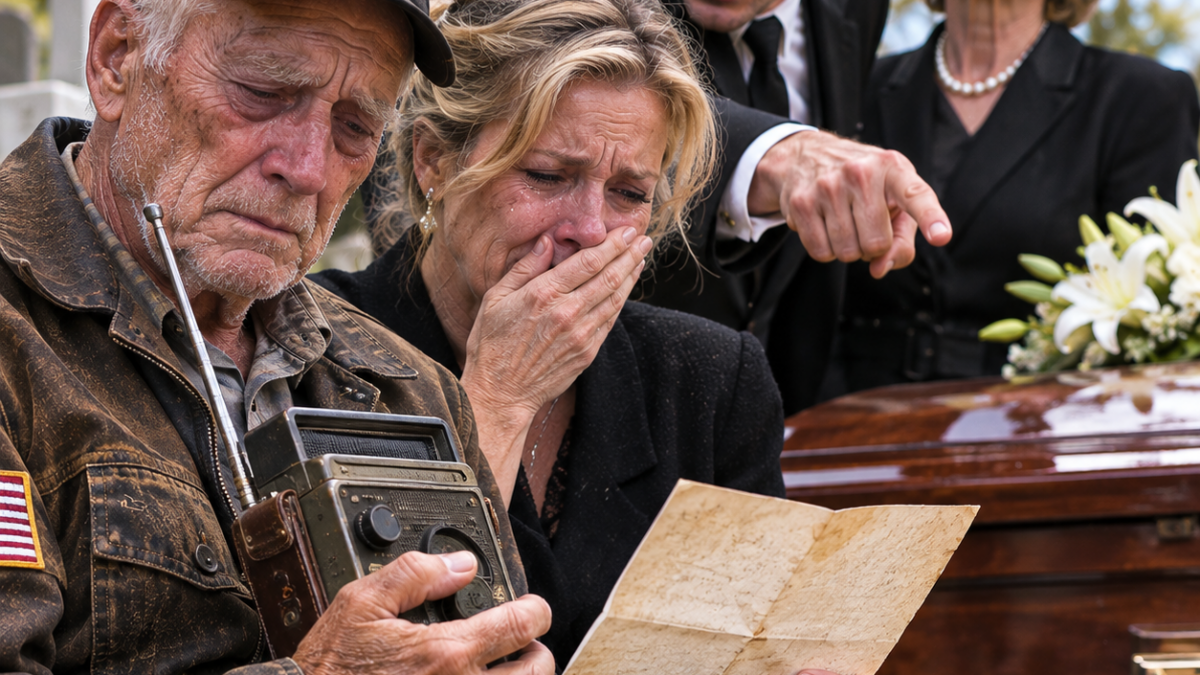
The funeral ended shortly after four.
Neighbors filled our West Tenth Street house afterward carrying casseroles, pound cakes, coffee, deviled eggs, and the quiet awkwardness people wear when they do not know what to say to a new widow.
I was seventy-three years old.
I had spent fifty-one years married to Walter.
Suddenly people were asking whether I needed help opening bottles.
Whether someone should stay overnight.
Whether I remembered to take my blood pressure medicine.
Grief had apparently turned me into a child before sunset.
Gregory waited until most people were preparing to leave.
Then he tapped a silver spoon against a china saucer.
Clink.
Clink.
Clink.
Conversation stopped.
My son stood beside the fireplace in a dark suit.
Tiffany sat behind him with one manicured hand resting dramatically beneath her chin.
Gregory cleared his throat.
“There is something the family needs to understand.”
My daughter Denise looked confused.
I was too tired to feel anything yet.
Gregory continued.
“Last autumn, before Dad’s decline became absolute, he updated his estate plan.”
I sat straighter.
“He did what?”
Gregory ignored me.
“To spare Mom from the burdens of property management, Dad transferred control of this residence to me.”
Our neighbor Mrs. Alvarez dropped a cookie onto her plate.
I stared at my son.
“This house?”
“Yes.”
“No.”
Gregory gave me a patient smile.
The kind people use with someone they have already decided is confused.
“Mom.”
“Your father and I have reciprocal wills.”
“I know.”
“The house comes to me.”
“That was the previous arrangement.”
He removed a packet from his briefcase.
Placed it in my lap.
“Dad changed his mind.”
Purple notary seal.
Walter’s name.
Date:
October eighteenth.
My stomach turned.
The document supposedly transferred the house into a trust controlled by Gregory.
Another document gave him broad authority over property maintenance and eventual sale.
Then came the sentence that finally woke me from the shock.
“We’ve secured you a room at Maple Grove Manor.”
I looked up.
“What?”
“April first.”
Maple Grove.
Walter hated that place.
A county inspection had cited it repeatedly over the years.
He once made me promise:
“Never put me somewhere they park people in hallways like broken furniture.”
Now Gregory wanted to send me there.
I said:
“I’m not going.”
Tiffany finally spoke.
“Ruth, please don’t make this harder.”
My eyes moved toward her.
“My husband died three days ago.”
She looked away.
Gregory crouched beside my chair.
“Mom.”
His voice softened.
Fake kindness.
“This house is too much.”
“I have lived here fifty-one years.”
“You’re not safe alone.”
“You stole sixty-three thousand dollars from us.”
His expression changed.
Only for a second.
Enough.
Then:
“That has nothing to do with this.”
“It has everything to do with this.”
He stood abruptly.
“I’m not discussing finances while you’re emotional.”
Then he reached directly into my open handbag.
Took my Buick keys.
I grabbed his wrist.
“What are you doing?”
“At your age, you have no business driving right now.”
“Give those back.”
“No.”
“Gregory.”
“Take a few days.”
He pocketed them.
“Adjust to reality.”
I looked around the room.
Neighbors.
Relatives.
Nobody knew where to look.
Then my granddaughter Lily dropped to her knees beside me.
Twenty-five years old.
Gregory’s only daughter.
She took my hands.
Her face was wet with tears.
“Grandma.”
I looked at her.
“Do not sign anything.”
Gregory stiffened.
“Lily.”
She ignored him.
“Don’t pack a suitcase.”
“Lily, enough.”
She tightened her fingers around mine.
“Tonight we’re opening Grandpa’s radio.”
Gregory tried to stay.
Lily made him leave.
That surprised him more than it surprised me.
“Dad.”
Her voice trembled.
“You announced Grandma’s eviction at Grandpa’s funeral reception.”
“I’m handling an estate.”
“No.”
“You’re leaving.”
“This is my property now.”
Lily looked at him.
“Then call the police.”
The room became silent.
Gregory stared at his daughter.
Perhaps he expected her to flinch.
She did not.
Eventually he picked up his briefcase.
“Tiffany.”
His wife followed.
At the door, Gregory looked back at me.
“Do not start dismantling property that belongs to the estate.”
Lily laughed once.
“The forty-dollar radio?”
His face reddened.
He left.
Denise stayed another twenty minutes.
My daughter had always been different from Gregory.
Not cruel.
Avoidant.
Which can sometimes feel similar when cruelty enters a room.
She kept rubbing her palms together.
“Mom, maybe Greg really thinks he’s helping.”
Lily stared at her aunt.
“Dad stole Grandma’s car keys.”
Denise winced.
“I saw.”
“He told her he owns the house.”
“I heard him.”
“And you’re still saying maybe?”
Denise looked at me.
“I don’t know what to believe.”
That sentence broke something small inside me.
Not because she doubted Gregory.
Because she doubted me.
I said quietly:
“Go home, sweetheart.”
“Mom—”
“Please.”
She left crying.
I let her.
At nine that night, the house became painfully quiet.
Walter’s chair sat empty.
His reading glasses rested on the side table.
I could still see the indentation his head had left in the cushion.
Then I noticed the Zenith.
Orange sticker across the walnut cabinet.
$40 — AS IS
I peeled it off.
Slowly.
Lily sat beside me on the floor.
“Grandpa said brass screws.”
“Yes.”
At the back of the cabinet were six ordinary dark screws.
And two small brass ones.
I had seen them for years.
Never thought about them.
Lily brought Walter’s old screwdriver set.
We removed the brass screws.
A narrow walnut panel came loose.
Behind it was not the original vacuum-tube chassis I expected.
Walter had modified the radio.
Of course he had.
Tiny digital recorder.
Memory-card slot.
Small rechargeable battery pack.
A miniature microphone mounted behind the speaker grille.
And one old-fashioned toggle switch wired into the playback circuit.
Lily stared.
“Grandpa built this?”
I touched the wiring.
Clean solder joints.
Labels written in Walter’s handwriting.
Yes.
He built it.
Lily whispered:
“Turn it on.”
My hand shook.
I flipped the switch.
Nothing.
Then a click.
And Walter said:
“Ruthie.”
Clear.
Strong.
Healthy.
Not the uncertain voice I had heard for the last two years.
My knees gave way.
Lily caught my shoulder.
Walter continued:
“If you are hearing this, I am probably already three feet under.”
He breathed.
A sound so familiar that I covered my mouth.
“Forgive the drama.”
“That part is for Lily.”
Lily started crying.
Then Walter’s voice changed.
“Listen carefully.”
“I did not lose my mind the way Gregory wants everyone to believe.”
My chest tightened.
“I am sick.”
“I forget things.”
“Some days are worse.”
“But I have had more clear hours than he knows.”
“And once I understood what he was doing, I let him believe the fog was thicker than it was.”
Lily whispered:
“Oh my God.”
Walter continued.
“Gregory took money.”
“He used my illness to create papers.”
“And there is something worse.”
Long pause.
Then:
“He has already set one fire in this house.”
Every hair on my arms lifted.
“He was waiting for smoke to take you.”
I stopped breathing.
Walter said:
“I found it before it spread.”
“I repaired what I could.”
“I photographed the rest.”
“If he learns I knew, I believe he will try again after I’m gone.”
Lily grabbed my hand.
Walter’s voice became urgent.
“Ruthie, do not sleep in this house tonight.”
“Do not let Gregory move you.”
“Do not sign anything.”
“Eleven steps.”
“Start at the radio.”
“Walk toward the basement door.”
“On eleven, lift what is beneath your right foot.”
Then the recording stopped.
I wanted to call Gregory immediately.
Lily physically took my phone.
“No.”
“He tried to burn me alive.”
“We don’t know exactly what Grandpa meant yet.”
“I know what he said.”
“And Dad has already threatened your housing.”
She stood.
“We follow the evidence.”
That sounded like Walter.
Not Gregory.
Walter.
We counted.
One.
Two.
Three.
Across the living room.
Four.
Five.
Into the hallway.
Six.
Seven.
Eight.
Nine.
Ten.
Eleven.
My right foot rested on an old floor register.
Brass.
I had vacuumed around it for decades.
Lily removed the screws.
Lifted the grate.
Beneath it was a cloth pouch tied to a string.
Inside:
A small brass key.
Three memory cards.
A folded note.
And a safe-deposit receipt.
Walter’s handwriting:
Ruthie—bank first. Lawyer second. Police third. Never Greg.
Lily looked at me.
“We’re leaving.”
This time I did not argue.
We slept at Lily’s apartment.
If sleep is what you call staring at a ceiling until sunrise with your dead husband’s voice repeating inside your skull.
At eight-thirty, Lily drove me to the bank.
The safe-deposit key belonged to a box Walter opened eighteen months earlier.
I had never known.
Inside were organized envelopes.
Walter always labeled everything.
APEX CAPITAL
MARTY KESSLER
HOUSE
FIRE
ORIGINAL WILLS
My hands shook so badly Lily opened the first folder.
Apex Capital records.
Bank statements.
Copies of transfer documents.
Walter’s handwritten notes.
Then a letter from the real pension administrator confirming no legitimate request had been received from Walter to move his military funds.
Next:
A printed corporate registration.
Apex Capital LLC.
Registered agent:
Martin Kessler.
Business mailing address linked to a storefront Gregory had once rented for a failed sales consultancy.
Lily stopped.
“My dad knows Marty.”
“Yes.”
“More than knows.”
“Yes.”
Then we opened:
ORIGINAL WILLS
Our reciprocal wills.
Mine.
Walter’s.
Proper attorney signatures.
House to surviving spouse.
After the surviving spouse’s death, equal distribution to Gregory and Denise.
Nothing complicated.
Nothing giving Gregory immediate control.
Then another paper.
Letter from Walter’s estate attorney.
Dated six months before his death.
Mr. Mercer has expressly confirmed he has made no new will, trust, deed transfer, or power of attorney concerning the residence.
I started crying.
Walter knew.
He knew they were building paperwork around him.
And he had built a paper wall behind theirs.
The FIRE envelope was worst.
Photographs.
Basement wall.
Scorching near a utility area.
A smoke detector opened on Walter’s workbench.
Its internal connection deliberately disabled.
Another photograph of a second detector with the same problem.
No technical instructions.
No explanation of exactly how the fire began.
Just damage.
Then Walter’s note.
March 11. Ruthie asleep upstairs. Greg came “to check furnace.” Left 8:42 p.m. Smell at 9:05. Found smoke downstairs. Small fire contained before extension. Detectors did not sound. Both had been tampered with. Gregory returned next morning before I called anyone and insisted it was electrical.
My stomach rolled.
I remembered that night.
Walter woke me because he said something in the basement had overheated.
Gregory arrived the next morning carrying coffee.
He told me:
“Old wiring, Mom. You guys really need to let me manage this house.”
I had thanked him.
Thanked him.
Walter’s notes continued.
I confronted Greg indirectly. He lied without blinking. After that I installed independent alarms he does not know about.
Then another photograph.
A tiny camera mounted above Walter’s basement workbench.
Lily looked at me.
“The memory cards.”
We went straight to a lawyer.
Her name was Elaine Porter.
Sixty.
Probate and elder-abuse litigation.
Lily found her through a colleague.
Elaine did not react dramatically.
That reassured me.
She reviewed:
Gregory’s alleged new will.
Walter’s original will.
Attorney confirmation.
Bank records.
Notary documents.
Apex records.
The recording.
Fire photographs.
Then she said:
“We separate facts from conclusions.”
I nodded.
“First, we protect you.”
“Second, we challenge any transfer of the house.”
“Third, we preserve everything.”
“Fourth, law enforcement and financial investigators determine what crimes, if any, can be proved.”
I asked:
“What if Gregory comes back?”
“Does he have a key?”
“Yes.”
“Change the locks.”
“What if he says it’s his house?”
“Then he can ask a court.”
That sentence felt wonderful.
The police took the fire evidence seriously.
Not because Walter’s recording alone proved attempted murder.
It did not.
But the photographs.
Disabled detectors.
Timing.
Financial motive.
Gregory’s property claims.
Those justified questions.
Investigators pulled the original fire-dispatch history.
I had never called the fire department that night because Walter extinguished the small fire himself.
That complicated things.
But Walter’s hidden basement camera had survived.
One memory card contained video from that evening.
Not a perfect view.
Not enough to show every action.
But enough to show Gregory entering the basement utility area alone after telling me he was “checking the furnace.”
Enough to show him reaching toward one of the detector locations.
Enough to establish he had been somewhere he later claimed not to have entered.
Investigators took it from there.
No one announced an attempted-murder charge that afternoon.
Real cases are not television.
They corroborated.
The notary problem broke first.
Marty Kessler was not the untouchable “officer of the Commonwealth” Gregory had described.
He was a commissioned notary.
Nothing more.
The bank transfer authorization claimed Walter appeared before Marty, understood the transaction, and signed voluntarily.
Walter’s medical calendar showed he was home.
So did our doorbell camera.
More importantly, Marty’s notary journal contained gaps.
The transfer entry had been inserted out of sequence.
Different ink.
Investigators later obtained electronic records showing the Apex documents had been prepared on Gregory’s laptop.
That did not automatically prove every offense.
But it destroyed the story Gregory had told me in the bank lobby.
The house documents were worse.
The supposed new will dated October eighteenth had Walter’s signature.
So did a trust certificate.
But Walter’s physician records showed that on October eighteenth he was hospitalized overnight for dehydration and medication adjustment.
Hospital security records showed no Marty.
No Gregory.
No outside notary signing session.
And the law office Gregory claimed had prepared the will said:
“We did not.”
Elaine found the template.
Downloaded from an online legal-form service.
The purple “official” notary seal belonged to Marty.
Again.
Gregory’s beautiful legal packet began looking less like an estate plan and more like stationery.
Two days after I left my house, Gregory arrived there with Tiffany and a real-estate auction representative.
The locks had been changed.
A police officer was already present because Elaine had anticipated the possibility.
Gregory stood on my porch screaming:
“My father transferred this property.”
Elaine arrived with certified deed records.
My name and Walter’s.
No recorded transfer.
No valid probate order giving Gregory possession.
The officer told him:
“This is not getting resolved on a porch.”
Gregory pointed toward the windows.
“My mother is incompetent.”
I was standing inside.
I opened the door.
“Then prove it.”
He froze.
For years, that word would have frightened me.
Incompetent.
Guardian.
State.
Audit.
Now Elaine stood beside me.
So did Lily.
I said:
“Go ahead.”
“Ask a judge.”
Gregory stared.
He had spent years using the threat of legal scrutiny because he believed I was more afraid of scrutiny than he was.
He had miscalculated.
The auction representative left first.
Tiffany followed.
Gregory stayed.
“Mom.”
His voice softened.
“Please.”
That frightened me more than yelling.
“I can explain.”
“No.”
“Dad was confused.”
“No.”
“He hated me.”
“He protected me.”
Gregory’s face twisted.
“From what?”
“From you.”
Silence.
Then:
“You think Lily is helping you?”
He turned toward his daughter.
“She wants your money.”
Lily laughed.
Actually laughed.
“Oh, Dad.”
His face hardened.
“You think you’re better than me?”
“No.”
She pointed at the house.
“But I’m not trying to steal Grandma’s home three days after Grandpa’s funeral.”
Gregory flinched.
Not enough.
He looked at me.
“You don’t understand how much debt there is.”
There it was.
Not denial.
Debt.
“What debt?”
He stopped.
I repeated:
“What debt, Gregory?”
He said nothing.
Elaine quietly closed the door.
That question opened another part of the investigation.
Gregory’s finances were a disaster.
Business losses.
Credit lines.
Personal guarantees.
A second mortgage on his own home.
Tax obligations.
A private investment failure.
Apex Capital had not been an investment opportunity for Walter.
It had been a funnel.
Our $63,000 had been used to cover obligations tied to Gregory and Marty.
Not one cent had purchased an asset for Walter.
Investigators traced what remained.
Some money had moved again.
Some had paid creditors.
Some was recoverable.
Not all.
I wanted Gregory to repay everything immediately.
Elaine said:
“Wanting and recovering are different.”
I hated that sentence.
It was also true.
Denise finally came to Lily’s apartment.
She looked terrible.
“I’m sorry.”
I waited.
“I should have believed you.”
“Yes.”
She cried.
“I was afraid Greg would turn on me.”
“He did that to all of us.”
Denise shook her head.
“No.”
“You fought him.”
“I didn’t.”
I looked at her.
“Walter did.”
For years.
Silently.
Through notes.
Recordings.
Copies.
That radio had not been dementia theater.
It had been an evidence archive.
We listened to the recordings in order.
Walter had dated them.
At first, they were simple observations.
January 9. Greg asked again whether Ruthie and I would consider adding him to the deed. I said no.
Then:
February 17. Marty came during lunch. Greg told Ruthie he was helping me organize pension paperwork. I did not authorize transfer.
Then:
March 11. Fire.
Then:
April 2. Greg asked whether Ruthie sleeps through smoke alarm. Pretended joke. Recording preserved.
Lily covered her mouth.
I stopped playback.
“I can’t.”
“We don’t have to finish tonight.”
I looked at Walter’s radio.
“Yes.”
“We do.”
Another recording.
Gregory’s voice.
Walter had left the radio microphone running while sitting in his chair.
Gregory apparently believed his father was too impaired to understand.
“Once Mom’s alone, we can move faster.”
Tiffany:
“Greg, lower your voice.”
“She doesn’t know any of this.”
“What about Denise?”
“Denise won’t fight.”
Then Gregory:
“Dad’s paperwork handles the house.”
Tiffany asked:
“And Maple Grove?”
“Already talked to admissions.”
My blood went cold.
They had contacted Maple Grove before Walter died.
Before the funeral.
Before Gregory announced anything.
This was not a grieving son making fast decisions.
This was a schedule.
Then came a recording with Marty.
Marty said:
“The pension transfer already looks ugly.”
Gregory:
“Dad’s diagnosis protects us.”
Marty:
“It protects nobody if somebody challenges the signature.”
Gregory:
“Who’s going to challenge it? Mom?”
Then laughter.
My hands shook.
Walter’s weak voice entered.
“Greg?”
Gregory instantly changed tone.
“Hey, Dad.”
“Need anything?”
The tenderness was almost worse.
The final recording Walter made before his death contained only his voice.
“Ruthie.”
“I am sorry.”
“Not because I doubted you.”
“Because I knew if I told you everything too soon, you would confront Greg.”
He knew me.
I would have.
“And he would hide the papers.”
“So I let him think I was farther gone.”
“I hate that I had to lie to you.”
“But I needed him careless.”
I pressed my hand against the speaker.
Walter continued:
“My doctors are not wrong.”
“My memory is failing.”
“Some mornings I do not know what year it is.”
“But incapacity is not a light switch.”
“Greg decided that because I forgot names, I could no longer recognize greed.”
Then:
“I recognized his.”
I cried harder than I had at the funeral.
Because there he was.
My husband.
Still himself.
Sick.
Afraid.
Fighting.
And I had sat ten feet away while our son mocked him.
Elaine eventually explained something that helped me forgive myself.
Cognitive illness is complicated.
A person can have real decline and still understand certain decisions at certain times.
Walter had never been pretending to be completely healthy.
He had been hiding how often he was lucid.
Gregory benefited from everyone assuming diagnosis meant total incompetence.
Walter weaponized that assumption against him.
Not perfectly.
But enough.
The fire case took longer.
Investigators obtained insurance records.
Phone records.
Messages.
One message between Gregory and Marty was particularly damaging.
Marty:
You need to stop talking about the house like it’s already yours.
Gregory:
It will be.
Another:
If Mom stays there alone after Dad, she’ll fight every paper.
Marty:
Then don’t give her time.
Those words were ugly.
But still not proof of a murder plot by themselves.
Then came Tiffany.
She broke.
Not because she suddenly became brave.
Because investigators told her she could be charged in connection with forged financial documents if evidence showed she knowingly participated.
Tiffany hired her own lawyer.
Then began talking.
She claimed she had no knowledge Gregory caused the basement fire.
But she admitted hearing him say afterward:
“Smoke would have solved a lot.”
She said she thought he was joking.
Maybe she did.
She also confirmed Gregory had discussed moving me into Maple Grove months before Walter’s death.
And that he expected proceeds from selling my house to cover his debts.
That gave Walter’s warning context.
Marty cooperated after the financial evidence closed around him.
He admitted notarizing documents Walter had not signed in his presence.
That alone shattered the validity of key paperwork.
He claimed Gregory told him Walter had already approved everything verbally.
Investigators found no evidence Walter had.
Instead, Walter’s recordings showed repeated refusal.
Marty insisted he knew nothing about the fire.
Maybe true.
Maybe not.
Prosecutors handled that.
I stopped trying to become detective, judge, and mother all at once.
I had lived seventy-three years.
I wanted some of the remaining ones back.
Gregory was charged first with financial and document-related offenses.
The more serious allegations connected to the fire remained under investigation longer because prosecutors wanted corroboration strong enough to survive court.
That frustrated Lily.
“Grandpa literally said Dad tried to kill Grandma.”
Elaine answered gently:
“Walter’s belief matters.”
“But the state still has to prove what Gregory actually did.”
Lily hated it.
I understood.
Because precision was what separated us from Gregory.
He created paperwork first and expected reality to follow.
We were going to do the opposite.
Reality first.
Then consequence.
The probate court invalidated the supposed new will and related trust documents after the evidence was reviewed.
Walter’s actual estate plan remained controlling.
The house passed to me.
Exactly as Walter and I had planned decades earlier.
Gregory’s announcement at the funeral became what it had always been.
A performance.
I asked Elaine:
“Can he appeal?”
“He can try.”
“Will he take my house?”
“No court has awarded him your house.”
That was enough.
I changed the locks again anyway.
It made me feel better.
I did not sell the Zenith.
Obviously.
Gregory’s orange forty-dollar sticker remained stuck inside my evidence folder.
Lily wanted me to frame it.
I refused.
“Why?”
“Because your grandfather would haunt us for turning a price sticker into home décor.”
She laughed.
It was the first time laughter inside that house did not feel wrong.
Maple Grove called me.
That still shocks me.
An admissions coordinator wanted to confirm my move-in date.
April first.
Gregory had paid a deposit.
With what money, I do not know.
I told the woman:
“I will not be coming.”
She sounded confused.
“Your son completed the family intake paperwork.”
“He did not have my permission.”
Pause.
Then:
“I’m sorry.”
“So am I.”
I asked for copies.
Elaine received them.
One question on the form:
Reason resident can no longer remain safely at home.
Gregory had written:
Progressive cognitive impairment and inability to manage finances independently.
Mine.
Not Walter’s.
He had already begun rewriting me too.
That hurt differently.
My son did not just want my house.
He wanted a story explaining why I should disappear from it.
That realization changed me.
For months after Walter died, I had been terrified of forgetting small things.
Where I placed glasses.
Whether I locked the door.
A neighbor’s name.
Every normal lapse made me wonder:
Is Gregory right?
Lily noticed.
One afternoon she said:
“Grandma.”
“What?”
“You’ve checked the stove four times.”
“I know.”
“You think forgetting one thing makes you Grandpa.”
I looked at her.
Then started crying.
She held me.
“Dad did that.”
“What?”
“Made both of you afraid of your own minds.”
That sentence may be the cruelest truth in the whole story.
Gregory used Walter’s diagnosis as leverage against all of us.
Walter’s confusion became permission.
My age became future evidence.
Fear made us easier to control.
Once I understood that, I stopped apologizing every time I forgot where I put my keys.
Healthy people misplace keys too.
Denise began visiting every Sunday.
At first, conversation was awkward.
She overcorrected.
“Do you need anything?”
“Do you want me to check that?”
“Should I call someone?”
Finally I said:
“Denise.”
“Yes?”
“I am your mother.”
“Not your patient.”
She looked ashamed.
Then laughed.
“Understood.”
Healing takes practice.
The bank recovered part of the $63,000.
Not all.
Apex accounts were frozen where funds remained.
Restitution later became part of the criminal resolution.
I wish I could tell you every dollar returned immediately.
It did not.
Some money had already gone to creditors.
Tracing took time.
Legal costs existed.
But the financial truth was restored.
Walter had not voluntarily handed Gregory our savings.
That mattered more than the number at first.
My husband’s name had been used against him.
The record now said so.
Gregory eventually accepted a negotiated criminal resolution on the charges supported by the evidence rather than forcing every issue through a full trial.
Financial exploitation.
Forgery-related conduct.
Fraudulent notarized documents.
The fire-related conduct resulted in additional serious consequences after investigators corroborated enough of Walter’s evidence, Tiffany’s statement, digital records, and physical evidence for prosecutors to proceed.
I will not pretend the courtroom felt satisfying.
Mostly it felt terrible.
This was my son.
The same boy whose fever I sat beside when he was six.
The teenager Walter taught to change brake pads.
The young man who danced badly at Denise’s wedding.
Human beings do not become strangers just because they become dangerous.
That is why accountability hurts.
If Gregory had meant nothing to me, punishment would have been simple.
He was my child.
And I still wanted the court to stop him.
Both truths lived together.
Before sentencing, Gregory asked through his attorney if I would meet him.
Elaine advised against a private meeting.
So it happened in a controlled room.
Attorney present.
Officer nearby.
Gregory looked thinner.
Older.
No tailored coat.
No smooth funeral voice.
He stared at his hands.
“Mom.”
I waited.
“I didn’t mean for any of this to happen.”
That sentence angered me more than I expected.
“What did you mean to happen?”
He looked up.
“I wanted to fix my finances.”
“With your father’s pension?”
“I thought I could put it back.”
“With my house?”
His jaw tightened.
“Dad was dying.”
“And I wasn’t?”
“No.”
“Then why Maple Grove before he was buried?”
Silence.
“Why tell everyone I was incapable?”
“Because you wouldn’t sell.”
There.
Truth.
Plain.
Small.
He continued.
“I was drowning.”
My eyes filled.
“You should have asked for help.”
“You would’ve said no.”
“Maybe.”
He laughed bitterly.
“Exactly.”
I leaned forward.
“Gregory.”
He looked at me.
“No is not something you forge around.”
He shut his eyes.
I continued.
“You did not steal because I failed to help you.”
“You stole because you decided your need was more important than my consent.”
His face crumpled.
Then I asked the question I had feared for months.
“The fire.”
Gregory went still.
“Did you want me dead?”
His attorney shifted.
Gregory looked at him.
Then at me.
He did not answer directly.
He whispered:
“I wanted the problem gone.”
My heart broke.
Not loudly.
Not dramatically.
Quietly.
Like an old wire finally giving way inside a wall.
I stood.
The meeting ended.
I never asked again.
At sentencing, I read a statement.
I did not call Gregory a monster.
He was not a creature from another species.
That would have made the warning useless.
I said:
“My son became dangerous by telling himself that desperation excused one small violation after another.”
“First money.”
“Then signatures.”
“Then my husband’s illness.”
“Then my home.”
“Then my safety.”
I looked at him.
“The lesson I want my granddaughter to learn is not that evil people are easy to recognize.”
“They are not.”
“The lesson is that love does not require us to surrender reality when someone we love becomes unsafe.”
Gregory cried.
So did I.
The judge imposed the consequences the law allowed based on the proven conduct.
Restitution.
Supervision and incarceration components.
Restrictions.
Financial judgments.
The exact punishment mattered less to me than this:
He could no longer walk into my house, take my keys, and tell me reality had changed because he said so.
Marty lost his notary commission and faced his own legal consequences.
Apex Capital dissolved.
Tiffany divorced Gregory the following year.
She sent me a letter.
I read it once.
She apologized for laughing at Walter.
For sitting on my sofa while Gregory manipulated documents.
For pretending not to know because knowing would have required action.
I wrote back one sentence:
Take responsibility for what you knew, learn from what you refused to see, and leave Lily out of the damage between adults.
That was enough.
Lily became my anchor.
Not because she took control of my life.
Because she refused to.
That distinction matters.
When I asked:
“What should I do with the house?”
She said:
“What do you want?”
“What about the money?”
“What do you want?”
“Should I stop driving?”
“Did your doctor tell you to?”
“No.”
“Then why are you asking me?”
The first time, I became irritated.
Then understood.
Gregory made every decision for me.
Lily kept handing decisions back.
That is what respect looks like.
I kept driving the Buick.
Passed my vision test.
Passed a voluntary driving evaluation too, mostly to silence the voice Gregory had planted in my head.
Dad—Walter—would have laughed at me for being so stubborn.
I could almost hear him:
“Ruthie, you parallel parked a station wagon in 1978 with three screaming children in the back. You’ll be fine.”
The house stayed mine.
I replaced the basement smoke detectors with a professionally monitored system.
Electrician inspected everything.
Fire investigator documented the old damage.
Then I repainted the basement.
Not because paint erases memory.
Because I wanted to decide what that room became next.
Walter’s workbench stayed.
Tools still arranged exactly as he left them.
The hidden camera came down once investigators released the scene.
I kept it in a drawer beside his soldering iron.
The Zenith remained in the living room.
I had a technician help me preserve Walter’s modifications.
Not restore them away.
The radio itself still could not receive ordinary broadcasts.
That no longer mattered.
Its most important transmission had already arrived.
Sometimes I played Walter’s harmless recordings.
He made dozens.
Not all evidence.
Some were messages.
For me.
For Denise.
For Lily.
Even for Gregory.
That surprised me.
One recording said:
“Greg, if you ever hear this…”
Long pause.
“I remember the boy you were before needing things became more important than people.”
Then:
“I still love that boy.”
“But loving him does not require me to trust the man.”
I never gave Gregory the recording.
Not then.
Years later, after Elaine said there was no legal reason to withhold it, I sent a copy through his attorney.
I never learned how he reacted.
Some things do not need witnesses.
Walter left one message for Lily that made us both laugh.
“Lilybug.”
She covered her face.
“He called me that until college.”
Walter continued:
“If your father ever tells you this radio is worth forty dollars, charge him sixty for the privilege of being wrong.”
We laughed until we cried.
Then Walter said:
“Take care of your grandmother.”
Lily whispered:
“I did.”
I squeezed her hand.
Denise’s recording was harder.
“Sweet pea.”
My daughter started sobbing before he finished the first word.
Walter said:
“You avoid fights because you think silence keeps the family together.”
“It doesn’t.”
“Sometimes silence is the room where the worst person gets to work.”
Denise lowered her head.
Walter continued:
“Do not spend your life being peaceful at the expense of being honest.”
That changed her.
Slowly.
She began therapy.
Stopped making excuses for Gregory.
Learned to disagree with me without apologizing afterward.
I got my daughter back too.
My recording was the longest.
Twenty-three minutes.
Walter told stories.
Our first apartment.
Gregory’s birth.
Denise breaking her arm at nine.
The year our furnace failed on Christmas Eve.
The time I backed the Buick through the garage door and convinced him a “wind event” had occurred.
I shouted at the radio:
“You promised never to tell anyone!”
Lily laughed so hard she had to leave the room.
Then Walter’s voice softened.
“Ruthie.”
“I know you’re going to blame yourself.”
He knew me.
“You are going to ask why you did not see it.”
“You were busy loving your family.”
“That is not a crime.”
My eyes closed.
“But love needs locks.”
“Doors.”
“Records.”
“Boundaries.”
“Not because love is weak.”
“Because greed knows exactly where kindness leaves things unlocked.”
I pressed my forehead against the warm walnut cabinet.
Then he said:
“Do not let what Gregory did turn you suspicious of everyone.”
“Make you wiser.”
“Not smaller.”
That became my rule.
A year after Walter died, I held a small dinner.
Not memorial.
Dinner.
Mrs. Alvarez.
Denise.
Lily.
A few neighbors.
We ate Walter’s favorite pot roast.
At nine, everyone looked toward the radio.
Lily smiled.
“Should we?”
I flipped the switch.
Walter’s voice:
“Testing, testing.”
Then:
“If Ruthie is serving the pot roast, somebody tell her the carrots need salt.”
The table exploded.
I shouted:
“You dead old fool!”
And for the first time, Walter’s voice in the house did not feel haunted.
It felt like company.
I never sold the radio.
Forty dollars.
That orange sticker became a family joke.
Years later, Lily had a small brass plate made for the back.
Not the front.
Walter hated showiness.
It reads:
W.H. MERCER
1952 ZENITH
VALUE: NOT FOR SALE
I approved that one.
Barely.
My house changed too.
Not ownership.
Meaning.
For years after Gregory’s betrayal, I thought of it as the thing he tried to steal.
Then Lily got married in the backyard.
Small ceremony.
Forty people.
No ballroom.
No speeches about inheritance.
Before walking outside, she came into the living room wearing her dress.
Stopped beside the Zenith.
Touched the cabinet.
“Think Grandpa’s here?”
I smiled.
“He would complain about the speaker system.”
She laughed.
Then:
“He’d like my husband.”
“Yes.”
“How do you know?”
“Your husband asks before moving furniture.”
Low bar.
Important one.
At the reception, Denise danced.
Mrs. Alvarez drank too much champagne.
I drove the Buick home from the caterer because I was still perfectly capable of driving.
And late that night, after everyone left, I sat beside Walter’s radio.
The house was quiet.
Safe.
Mine.
I flipped the switch.
One of Walter’s final recordings played.
“Ruthie.”
Then his familiar breath.
“If you made it this far…”
Pause.
“…I suppose Greg didn’t get the house.”
I laughed through tears.
“No.”
“He didn’t.”
Walter continued:
“Good.”
Then:
“Now stop listening to an old man and go live.”
The recording clicked off.
I sat there for several minutes.
Then stood.
And did exactly that.
People who hear my story usually focus on the frightening parts.
The money.
The forged will.
The fire.
Maple Grove.
The secret radio.
But when I think about those years now, the image that stays with me is not Gregory threatening me.
It is Walter sitting beside that radio every night while everyone laughed.
He looked lost.
Weak.
Finished.
My son believed illness had erased the father who once knew every circuit board in town.
Gregory thought if Walter forgot the day of the week, he could no longer understand betrayal.
He was wrong.
Walter had dementia.
But dementia did not make him nothing.
It did not erase his right to own property.
To refuse transactions.
To be believed.
To recognize his son.
To protect his wife.
And most of all, it did not turn Gregory’s greed into permission.
The hardest truth I learned was that illness can make a person vulnerable without making everyone around them trustworthy.
We assume family will protect weakness.
Most families do.
But weakness can also attract people who see opportunity.
That is why Walter made copies.
Recorded conversations.
Saved original documents.
Created the radio archive.
Not because he stopped loving Gregory.
Because love and evidence are not enemies.
Sometimes evidence is what love has to become when trust is no longer safe.
Gregory thought his father’s broken radio proved Walter had lost his mind.
In reality, it was the one place Walter had hidden the clearest version of himself.
Gregory slapped forty dollars on the cabinet because he saw junk.
I saw fifty-one years.
Walter saw something else.
A witness.
My son tried to turn my husband’s illness into a signature.
Our savings into his rescue fund.
My home into his property.
My age into incompetence.
And fear into obedience.
For a while, it worked.
Because I still believed a mother’s job was to keep the family from breaking.
Walter understood something I did not.
Sometimes the family is already broken.
Your job is to stop pretending the crack is not there before the whole house falls through it.
The night I first heard Walter’s recording, I collapsed beside the Zenith because I believed my dead husband was warning me that my life was ending.
He wasn’t.
He was telling me how to keep it.
He gave me the truth.
Then Lily gave me the courage to use it.
The bank gave us records.
The lawyers gave the truth structure.
Investigators gave it consequence.
And eventually, I gave myself something I had not realized Gregory had been taking from me long before the funeral.
Authority over my own life.
I am older now.
I forget names occasionally.
I walk into rooms and forget why.
Sometimes I call Lily by Denise’s name and Denise by Lily’s.
Walter would have found that hilarious.
None of it means I have surrendered ownership of myself.
That is the final thing Gregory taught me by trying to take it.
Age is not consent.
Illness is not consent.
Family is not consent.
Fear is not consent.
And a forged signature does not become real because the victim is too confused, too grieving, too old, or too dead to shout.
Walter could no longer shout.
So he built a radio that could speak after he was gone.
And every time I look at that walnut cabinet, I remember Gregory laughing from my sofa:
“Old man’s phoning Eisenhower again.”
No.
Walter was not calling Eisenhower.
He was calling me.
He just had to wait until I was finally ready to listen.








