PART2:“THAT MUTT DOESN’T BELONG HERE—AND NEITHER DO YOU!” HOA Karen Tried to Fine Me Out of My Own Home—Then She Broke In and Found My German Shepherd Waiting
PART2
Three mornings later, the first “friendly notice” appeared in my mailbox.
VISIBLE TRASH RECEPTACLE.
My trash can was behind the fence.
The next notice concerned an American flag I had temporarily hung from the porch before installing the proper bracket.
Two days later:
NOISE DISTURBANCE — DOG BARKING AT 7:15 A.M.
Max had barked once.
The mail truck hit a pothole.
Apparently Pine Ridge could survive diesel engines, lawn mowers, leaf blowers, and a teenager practicing drums three houses down, but one German shepherd saying hello to the mail carrier threatened civilization.
I laughed.
Then I attended my first HOA meeting.
That was my second mistake.
I sat near the back of the clubhouse hoping to listen, learn the budget, maybe discover whether they planned to fix the pothole Max had apparently objected to.
Deborah spotted me immediately.
“Ah, Mr. Lawson.”
Every head turned.
“Our newest resident.”
I raised a hand.
“Still me.”
A few people smiled.
Deborah did not.
She looked down at her papers.
“We’ve already received multiple concerns regarding your dog.”
I glanced around the room.
“Multiple?”
Silence.
“Who?”
Deborah’s mouth tightened.
“Residents are entitled to confidentiality.”
“Then how do I answer complaints I can’t verify?”
“You comply with the rules.”
“What rule did he break?”
“Noise disturbance.”
“He barked once.”
“Once can be enough.”
I leaned back.
“I’ll have him submit a written apology.”
Laughter came from the left side of the room.
An older man covered it with a cough.
Deborah’s face hardened.
“That attitude is precisely what disrupts community harmony.”
There it was.
Community harmony.
Her favorite phrase.
“I’m not trying to disrupt anything.”
“Then demonstrate responsible ownership.”
Max was not at the meeting.
Good thing.
He would have sensed what I was thinking.
Deborah continued.
“Large breeds can create fear.”
“So can public shaming.”
The room went quiet.
She stared.
I stared back.
Finally she said:
“If you find our standards unreasonable, perhaps Pine Ridge isn’t the right community for you.”
That sentence mattered.
Not because it frightened me.
Because half the room looked down.
They had heard it before.
Afterward, an older woman named Margaret Harris approached while Deborah spoke with board members.
“You should be careful.”
“With my dog?”
“With her.”
I looked across the room.
Deborah was laughing.
“Why?”
Margaret lowered her voice.
“She doesn’t like being challenged.”
“I gathered.”
“She fined my husband twice over his flagpole.”
“Military flag?”
“United States.”
I stared.
“My husband served twenty-eight years.”
She smiled sadly.
“Didn’t matter.”
Before I could ask more, Deborah looked over.
Margaret stepped away immediately.
That told me more than anything she could have said.
Over the next two weeks, Deborah stopped pretending her interest in my property was administrative.
She began walking the street twice a day.
Slowly.
Always past my house.
Phone up.
Clipboard ready.
She photographed my mailbox.
My hedges.
My garage.
The edge of my driveway.
Max hated cameras pointed toward the house.
He would walk to the fence.
Sit.
Watch her.
Never bark unless she approached too closely.
That seemed to make her angrier.
One afternoon, I caught her peering through the slats of my backyard gate.
I stepped onto the porch carrying coffee.
“Lose something?”
She jumped.
Then recovered.
“Routine landscaping inspection.”
“You inspect through locked gates?”
“Our covenants allow exterior review.”
“Exterior.”
I walked closer.
“My backyard is not common property.”
She lifted her chin.
“You wouldn’t want violations accumulating.”
“Is that a threat?”
“An observation.”
“Here’s mine.”
I pointed toward the sidewalk.
“You’re standing on my property.”
Her face tightened.
“I am HOA president.”
“And?”
“Do not speak to me that way.”
“What way?”
“Disrespectfully.”
I laughed.
“Lady, you came into my driveway to look through my fence.”
“You will regret being difficult.”
There.
No community harmony.
No standards.
Just control.
Max appeared beside me.
Silent.
Deborah looked at him.
Then me.
“Large aggressive dogs often create insurance issues.”
“He isn’t aggressive.”
“He looks aggressive.”
“So does your clipboard.”
Her nostrils flared.
She spun and walked away.
Her heels hit the pavement hard enough to sound like gunshots.
Max watched her until she disappeared.
Then looked up at me.
“Yeah.”
I scratched behind his ear.
“I don’t like her either.”
The first fine arrived two days later.
Fifty dollars.
IMPROPERLY SCREENED TRASH CONTAINER.
I walked outside.
Checked.
The bin was exactly where it had been.
Behind the fence.
Invisible from the street.
Unless someone walked twenty feet up my driveway and leaned over.
I photographed it.
Date.
Time.
Angle.
Then I started a folder.
That folder later became one of the most important things I owned.
At the time, I called it:
DEBORAH’S NONSENSE.
Second fine:
Mailbox height.
She claimed it exceeded the approved standard by half an inch.
I measured.
It did not.
Third:
Exterior lighting color temperature.
Apparently my porch bulb was not sufficiently “warm white.”
Fourth:
Unauthorized exterior decoration.
One small wind chime hanging beside the back porch.
Susan had bought it on our twentieth anniversary.
That one made me stop laughing.
I held the notice in one hand and looked at the wind chime moving lightly in the evening air.
Susan had loved that sound.
Deborah wanted one hundred dollars because she disliked it.
I took the notice to the next board meeting.
Deborah was halfway through budget updates when she saw me.
Her expression changed.
“Mr. Lawson.”
I held up the letter.
“Unauthorized decoration.”
“Yes.”
“The wind chime?”
“Yes.”
“It’s three inches wide.”
“Rules are rules.”
“Show me.”
She blinked.
“What?”
“Show me the exact covenant.”
“Mr. Lawson—”
“The one banning wind chimes.”
She looked down.
Board member Thomas Reed began flipping through a binder.
Deborah said:
“Exterior items require approval.”
Thomas stopped.
“Actually…”
She looked at him.
He hesitated.
Then continued.
“The architectural clause specifically lists permanent fixtures.”
“Exactly,” Deborah said.
“A wind chime isn’t permanent.”
The room went silent.
Thomas looked terrified.
Deborah said:
“We can interpret the covenant broadly.”
I laughed.
“No.”
She glared.
“You don’t get to make a rule mean whatever you need that afternoon.”
Murmurs.
Someone behind me whispered:
“Finally.”
Deborah heard.
Her face flushed.
She folded both hands on the table.
“Mr. Lawson, this board has worked very hard to maintain property values.”
“My wind chime survived cancer with my wife.”
Silence.
I continued.
“I’m not taking it down because you need to prove you can order me around.”
That was the moment the dispute became personal for both of us.
I knew it.
So did she.
After the meeting, I heard her speaking to Thomas near the storage room.
“If he thinks he can ignore me, he’s mistaken.”
Thomas said something I couldn’t hear.
Deborah answered loudly enough.
“I will find something serious enough to force compliance.”
Then:
“If that means forcing him to sell, so be it.”
I stepped around the corner.
Both froze.
“Good meeting.”
Thomas looked at the floor.
Deborah smiled.
Thin.
Cold.
“You misunderstand.”
“No.”
I held up my phone.
“I heard you.”
Her eyes dropped to it.
I had not recorded.
She did not know that.
“Be careful, Mr. Lawson.”
“About?”
“Making accusations.”
I stepped closer.
“No.”
“My advice is for you.”
Her smile vanished.
“Stay off my property.”
I went home.
Installed two additional security cameras.
Not because I expected a crime.
Because I no longer believed Deborah recognized boundaries.
Neighbors slowly began talking.
Jim Parker lived next door.
Sixty-three.
Retired electrician.
A man who could spend forty minutes explaining why one brand of extension cord was morally superior to another.
He stopped by one afternoon.
“You’re collecting Deborah letters?”
“Apparently.”
He laughed.
“Need a bigger folder.”
“What did she do to you?”
“Satellite dish.”
“You have one?”
“Not anymore.”
“Why?”
“Three years ago she threatened legal action.”
“Was she right?”
Jim shrugged.
“Probably not.”
“You didn’t fight it?”
“I had a wife in chemo.”
That shut me up.
He looked toward Max sleeping beneath the porch table.
“Deborah knows who has energy to fight.”
That sentence stayed.
People like her did not bully everyone equally.
They selected people who were busy.
Grieving.
Older.
Financially stretched.
People who would pay fifty dollars because fighting cost more emotionally.
Then Margaret Harris told me about the flagpole.
Another family told me about bicycles left outside for twelve minutes.
A widower said Deborah had entered his backyard while he was hospitalized because she wanted to verify a fence stain.
None had formally complained.
Why?
Deborah controlled meeting agendas.
Fine appeals.
Architectural approvals.
Landscaping contracts through committees she chaired.
Nobody wanted a war over something small.
That was how she kept power.
Everything was individually small.
A lightbulb.
A trash can.
A bike.
A flag.
A dog bark.
By the time the pattern became large, everyone felt alone in it.
I stopped feeling alone.
I began scanning every notice.
Photographing every condition.
Saving doorbell footage.
Recording board meetings where state law and HOA policy allowed.
Asking for copies of minutes.
Requesting the written complaint logs behind my fines.
Deborah hated documentation.
Bullies usually do.
At the following meeting, I asked:
“How many written complaints exist concerning Max?”
She looked annoyed.
“Multiple.”
“Number.”
“Several.”
“That isn’t a number.”
“Mr. Lawson.”
“I requested records.”
“Resident privacy—”
“I didn’t ask for names.”
Thomas Reed looked down at his papers.
“Deborah.”
She snapped:
“What?”
“We have two documented animal complaints.”
I turned.
“Two?”
Thomas nodded.
“One says barking.”
“When?”
He gave the date.
I checked my phone.
“I was at the veterinarian that morning.”
The room shifted.
“Max was with me.”
Deborah said:
“Perhaps the complainant confused the date.”
“Who filed the second?”
She glared.
I smiled.
“Relax. I don’t want the name.”
Thomas read:
“Large dog creating intimidating presence at fence.”
I laughed.
“He sat down?”
Thomas looked uncomfortable.
“That appears to be the complaint.”
A man across the room raised his hand.
“I filed that.”
Everyone turned.
His name was Kevin Marsh.
He looked embarrassed.
“Deborah asked whether your dog made me uncomfortable.”
I waited.
“I said any big dog can look intimidating.”
He swallowed.
“She told me to submit a statement.”
Deborah snapped:
“Kevin.”
He looked at her.
“You wrote most of it.”
The room erupted.
Deborah hit her gavel.
“Order.”
I looked at her.
“So one complaint happened while Max was at the vet, and the other you solicited.”
Her face went hard.
“You are creating hostility.”
“No.”
I stood.
“You are.”
Applause started.
Scattered.
Then stopped because people were still afraid.
Deborah noticed.
That was when she began escalating outside meetings.
The first time someone rattled my gate at night, Max woke me at 1:12 a.m.
Low growl.
I checked the camera.
A shadow near the fence.
By the time I got outside, gone.
Second time:
11:47 p.m.
Same.
Third:
12:26.
The camera caught a sleeve.
Red.
Could have been anyone.
But I knew.
I moved the camera angle.
Then installed a motion light.
Deborah began walking by at dawn instead.
Phone raised.
One afternoon, I caught her with a measuring tape in my driveway.
She crouched beside a row of shrubs.
“Seriously?”
She stood.
“Routine setback verification.”
“From my driveway.”
“Your landscaping appears noncompliant.”
“Which section?”
“I will send notice.”
“You’re leaving now.”
“Do not order me around.”
I walked toward her.
Not threatening.
Just direct.
“Deborah.”
She stared.
“I have told you twice.”
“This is your final warning.”
“If you enter my property without permission again, I call police.”
She laughed.
“For an HOA inspection?”
“For trespassing.”
“You wouldn’t dare.”
“You keep confusing me with your board.”
Her smile vanished.
Max appeared behind the screen door.
Deborah looked at him.
“You think that animal scares me?”
“No.”
I opened the screen and clipped his leash on.
Max walked beside me.
Sat.
Perfect.
“Actually, I think the fact that you can’t control him bothers you.”
She stared.
“Control your mutt.”
My patience snapped.
“First, he isn’t a mutt.”
“Second, he is trained better than most people I know.”
“And third, if you ever step inside my house without permission, Max will treat you exactly like what you are.”
Her eyes narrowed.
“What is that?”
“An intruder.”
For the first time, she hesitated.
Then she smiled.
“We’ll see.”
She walked away.
That night, I sat on the porch with a beer.
Max at my feet.
The wind chime moved.
I said:
“She’s going to break in, isn’t she?”
Max’s ears twitched.
I laughed.
“Yeah.”
“Me too.”
Two weeks later, work sent me to Richmond for three days.
I considered boarding Max.
Normally I would have.
Then I remembered Deborah.
I checked every lock.
Verified cameras.
Left automatic feeders backed up with Jim checking twice daily.
Max had a dog door into a secured section of the yard.
Water inside and outside.
Everything set.
I gave Jim an emergency key.
“Only if needed.”
“Got it.”
“And if Deborah comes over?”
He smiled.
“I call you before I call Jesus.”
“Jim.”
“Kidding.”
“Call police if she enters.”
His smile faded.
“Seriously?”
“Seriously.”
The morning I left, Deborah sat inside her Lexus two houses down.
Sunglasses on.
Phone in hand.
Pretending not to watch.
I stopped beside my truck.
Looked directly at her.
Waved.
She froze.
Then waved back.
I drove away.
First evening:
Jim texted.
Red blazer did a porch inspection. Max barked. She nearly fell off your step.
I laughed.
Second night:
Lights near your back fence. Max going nuts. Went outside. Nobody there.
I called.
“Check locks.”
“All good.”
“Max?”
“Mad because I gave him one treat instead of two.”
“Normal.”
Third afternoon, I was finishing the job early when Jim called.
Not text.
Call.
I answered immediately.
“What?”
“I think she went in.”
My entire body tightened.
“What do you mean think?”
“I saw her go through your side gate.”
“Inside house?”
“Couldn’t see from here.”
“Max?”
“He barked like hell.”
“And?”
Jim paused.
“He went quiet.”
That was worse.
“Call 911.”
“David—”
“Now.”
I was already moving.
I threw tools into the truck.
Three-hour drive became two hours and twenty-seven minutes.
Not proud of that.
I called dispatch myself on the way.
Reported possible unlawful entry.
Explained dog inside.
Gave permission for officers to enter if necessary.
But Pine Ridge sat on the county edge, and response was delayed by a collision on Route 17.
Jim texted:
Police say unit coming. She may still be inside.
Then:
Saw flashlight.
Then:
Max still quiet.
I hated that silence.
Max barked when warning.
He went quiet when working.
By the time I turned onto Pine Ridge Drive, evening had fallen.
My gate stood open.
Porch light on.
Door not fully closed.
I left the truck running.
Walked toward the porch.
Then heard papers moving.
Inside.
I pushed the door wider.
Living room dim.
A flashlight beam moved across the wall.
Then I heard it.
A low growl.
Steady.
Controlled.
Max.
I stepped inside.
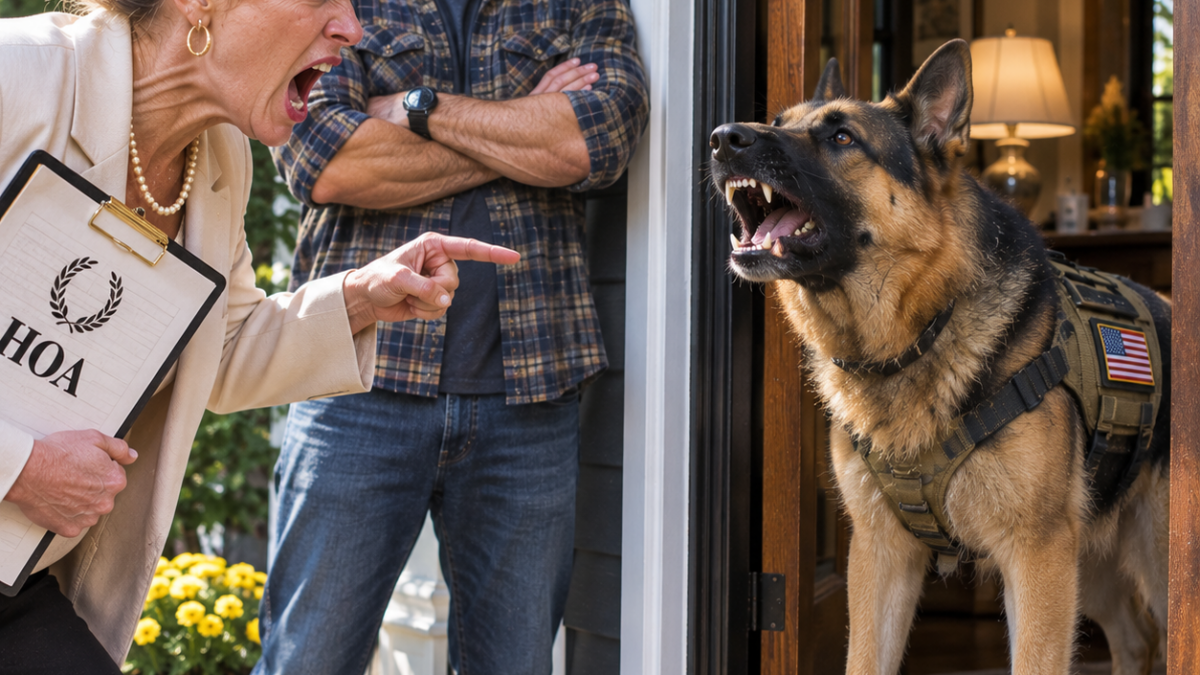
And there she was.
Deborah Morgan.
Inside my living room.
Red blazer wrinkled.
Hair frizzed.
Clipboard tucked under one arm.
One of my desk drawers open.
Papers in her hand.
She had apparently entered through the mudroom after tampering with the side door.
Her handbag sat on my dining chair.
My file cabinet stood open.
And between Deborah and the front door stood Max.
Silent now.
Body rigid.
Head lowered slightly.
No lunging.
No biting.
No uncontrolled aggression.
Just ninety-six pounds of:
You are not leaving until my person comes home.
Deborah’s flashlight trembled.
“Good dog.”
Max growled.
Her voice rose.
“Nice doggy.”
I almost laughed.
Then she said:
“I’m here on official business.”
That did it.
“Official business?”
She spun.
Her face became white.
“Mr. Lawson.”
“What exactly are you inspecting?”
She stared at me.
Then the papers in her hand.
Then Max.
“This is not what it looks like.”
“It looks like you broke into my house.”
“I did not break in.”
“My gate was locked.”
“I have HOA authority to inspect—”
“Inside?”
She stopped.
I took out my phone.
Started recording.
“Say that again.”
“Stop recording me.”
“You’re in my living room.”
“I am conducting an investigation.”
“Into what?”
“Potential covenant violations.”
“In my desk drawer?”
Her face twisted.
“You have been operating an unapproved commercial security activity.”
I stared.
“What?”
“The dog.”
I laughed.
“You broke into my house because Max sits at the fence.”
“You’ve described him as trained.”
“He is trained.”
“That could constitute commercial activity.”
“No.”
“Your own statements—”
“Deborah.”
I looked around.
“You came into my home looking for evidence of an imaginary security business.”
Her mouth opened.
Closed.
I pointed to the floor.
“Put the papers down.”
She did not.
“Those are HOA-related.”
“They’re my tax records.”
Her eyes dropped.
Wrong folder.
Perfect.
I held out my hand.
She placed them on the table.
Then moved toward the door.
Max stepped sideways.
Blocked her.
She froze.
“Call him off.”
“Stay, Max.”
He stayed.
“Mr. Lawson!”
“Police are coming.”
Her face changed.
“No.”
“Yes.”
“This is unnecessary.”
“Funny.”
I walked toward the front door.
“You didn’t seem worried about necessity when you opened my drawers.”
She looked at Max.
“He threatened me.”
“He has not touched you.”
“He trapped me!”
“You entered his home.”
“He is dangerous.”
I said:
“Max.”
His ears lifted.
“Heel.”
Instantly he left the doorway and moved to my left side.
Sat.
Deborah stared.
I smiled.
“That’s control.”
She swallowed.
Then tried to walk out.
I said:
“Don’t.”
She stopped.
“You cannot hold me here.”
“No.”
“I can’t physically detain you.”
I pointed toward the open door.
“You are free to walk outside.”
She stared at Max.
He sat at heel.
Calm.
“Go ahead.”
She didn’t.
Because outside were neighbors.
Lots of them.
Jim stood at the edge of my driveway.
Margaret Harris beside him.
Kevin Marsh.
Thomas Reed.
Phones out.
Apparently Jim had started knocking on doors after calling police.
Deborah saw them.
Her face changed.
“They’re recording.”
I looked through the window.
“Yes.”
“Tell them to stop.”
“No.”
“This is harassment!”
Jim called from outside:
“Everything okay, David?”
I opened the door wider.
“Caught an intruder.”
The neighborhood erupted in whispers.
Deborah hissed:
“You’re humiliating me.”
“No.”
I looked at her.
“You did that when you crossed the threshold.”
She shifted toward me.
Max stood.
Not lunging.
Just standing.
Deborah stopped immediately.
“Make him sit!”
“Max.”
He looked at me.
“Sit.”
He sat.
Again.
Perfect.
Someone outside laughed.
Deborah’s face turned red.
Then negotiation began.
People like Deborah negotiate when authority fails.
“David.”
First name now.
Interesting.
“Why don’t we resolve this privately?”
“No.”
“I can waive your fines.”
I almost laughed.
“You can’t waive fines you fabricated in exchange for silence about breaking into my house.”
“They weren’t fabricated.”
“Then don’t waive them.”
Her jaw tightened.
“I can make things easier.”
“You already promised to make my life miserable.”
“That was frustration.”
“So was entering my home?”
“I was investigating.”
“No.”
“You were searching.”
She lowered her voice.
“You don’t understand what’s at stake.”
“What’s at stake?”
“The integrity of the community.”
I stared.
“Deborah, you are standing beside my tax documents after entering through a locked gate.”
Her face hardened.
“You think this is over?”
“No.”
“I think it’s finally starting.”
Sirens appeared two minutes later.
Red and blue washed across perfectly trimmed hedges.
Officer Michael Daniels entered first.
I knew him by sight.
Small town.
He looked at me.
Then Deborah.
Then Max.
Then the open drawer.
“What happened?”
I answered:
“I came home and found Ms. Morgan inside my residence without permission.”
Deborah launched immediately.
“Officer, thank goodness.”
Daniels looked at her.
She pointed toward Max.
“This animal trapped me.”
Max wagged once.
Daniels looked almost amused.
“You entered voluntarily?”
“I entered pursuant to HOA inspection authority.”
Daniels stared.
“Inside his house?”
“Yes.”
“No.”
One word.
Deborah blinked.
“What?”
“No HOA covenant gives you police powers to enter an occupied private residence without consent.”
“I had reason to believe—”
“Did Mr. Lawson give you permission?”
“No, but—”
“Did a court?”
“No.”
“Did law enforcement?”
“No.”
“Then why are you inside?”
The neighbors outside became silent.
Deborah’s confidence faltered.
“I was trying to verify violations.”
Daniels looked at me.
“Any damage?”
“Side door appears tampered with.”
His partner moved toward the mudroom.
I said:
“Security cameras cover exterior.”
Deborah’s face changed.
Daniels noticed.
“You have video?”
“Yes.”
“Preserve it.”
“Already cloud-backed.”
Good phrase.
Deborah looked as though she wanted to disappear.
Daniels asked:
“Anything missing?”
“I don’t know yet.”
“Anything moved?”
“Desk drawers. File cabinet.”
“What was she holding?”
“Tax records.”
Deborah snapped:
“I picked them up by accident.”
Daniels looked at her.
“You were going through a private file cabinet?”
“I was looking for commercial records.”
“Why?”
“Unauthorized business.”
Daniels stared.
“Ma’am.”
He sounded tired.
“Even if he were running an illegal casino in here, you still wouldn’t get to search his cabinets.”
Someone outside laughed.
Deborah turned toward the window.
“Stop filming me!”
Daniels said:
“Ms. Morgan.”
She looked back.
“I need you to step outside.”
“You can’t treat me like a criminal.”
He paused.
“You entered a residence without permission and searched private property.”
Then:
“That’s why we’re here.”
The sentence traveled through the crowd like electricity.
Deborah walked toward the door.
Max rose.
She froze.
“Get that dog away from me!”
“Max.”
“Heel.”
He moved beside me.
The crowd applauded.
I hated the applause a little.
This wasn’t entertainment.
But after years of people lowering their heads around Deborah, I understood what they were cheering.
Not me.
Not Max.
Permission.
Permission to stop being afraid.
Outside, Officer Daniels spoke privately with Deborah.
His partner photographed the side door.
I reviewed camera footage with them.
There she was.
3:14 p.m.
Deborah entering my side gate.
3:17.
Trying the mudroom handle.
3:19.
Using something near the latch.
3:21.
Door opening.
Max barking.
Then interior footage from the living room.
Deborah entering.
Max backing away at first.
She pointed at him with her clipboard.
Shouted something inaudible.
He barked.
She moved toward the office.
He followed.
At no point did he touch her.
At 3:25, she opened my desk.
At 3:29, file cabinet.
At 3:31, Max positioned himself near the front door.
Then waited.
For almost an hour.
He did not attack.
Did not chase.
Did not bite.
He simply kept himself between her and the easiest exit while she repeatedly tried to order him away.
Daniels watched.
Then looked at Max.
“That dog has more restraint than a lot of people.”
“Tell Deborah.”
He almost smiled.
Then:
“Do you want to make a formal complaint?”
“Yes.”
That differed from the original version I had imagined in my head.
I had spent weeks thinking public humiliation would be enough.
It wasn’t.
Not anymore.
Because Deborah had not only annoyed me.
She had entered my home.
If I told everyone rules mattered and then declined the only consequence that could create a record, I would be repeating the pattern that let her become powerful.
So I signed the complaint.
Daniels explained the process.
Charges would depend on prosecutor review, evidence, state law, and intent.
No dramatic instant felony conviction.
Fine.
I wanted a record.
The officers escorted Deborah away for further investigation.
Not in handcuffs at that moment.
She walked past the crowd.
Phones followed.
Someone said:
“Smile for the inspection.”
I did not know who.
Deborah’s face turned crimson.
I stayed quiet.
That night, after everybody left, I sat on my porch.
Max beside me.
The wind chime moved.
I looked at him.
“You know you’re getting steak.”
Tail thump.
“One steak.”
Another thump.
“Don’t negotiate.”
He stared.
“Fine.”
“Two.”
The HOA sent an email the next morning.
COMMUNITY NOTICE:
An unfortunate misunderstanding occurred last evening involving the HOA president and a resident. Residents are asked not to spread unverified information or inflammatory recordings.
I laughed so hard I nearly spilled coffee.
Unverified.
Twenty-seven residents had video.
My security system had timestamps.
Police had body-camera footage.
Deborah had apparently discovered misinformation only after becoming the subject of accurate information.
Then something unexpected happened.
People began comparing records.
Margaret Harris brought me seven years of letters.
Jim had copies of old fines.
Kevin Marsh admitted Deborah had pressured him into filing complaints.
A young mother named Natalie showed us notices for “excessive child noise.”
A veteran named Harold Finch produced citations over his flagpole.
Another homeowner had landscaping fines that matched no published rule.
Thomas Reed, still on the board, finally came to my house.
He looked exhausted.
“I need to show you something.”
“What?”
“Board records.”
I stared.
“Why?”
“Because she’s going to blame all of us.”
He carried a flash drive.
I did not touch it.
“Thomas.”
“What?”
“Talk to an attorney.”
His face fell.
“I thought you’d want evidence.”
“I do.”
“But not if you aren’t authorized to give it to me.”
He stared.
Then smiled weakly.
“You really are annoying.”
“Documentation changes a man.”
He contacted the HOA’s independent counsel.
That was the right move.
Three days later, Pine Ridge’s board announced an emergency meeting.
Deborah attended.
Of course she did.
Red blazer again.
Defiance restored.
The clubhouse was packed beyond capacity.
Residents stood along walls.
Some outside.
The board’s attorney opened.
“Due to pending legal matters and concerns raised regarding enforcement practices, tonight’s meeting will address governance only.”
Deborah immediately interrupted.
“This is a coup.”
The attorney said:
“Deborah.”
“I have served this community for eleven years.”
A man behind me muttered:
“Feels longer.”
Laughter.
She slammed her palm on the table.
“This is exactly the mob mentality I warned about.”
I sat beside Jim.
Max stayed home.
I wanted no claim that I was using him to intimidate anyone.
Deborah pointed at me.
“This man has manipulated all of you.”
I did not respond.
She continued.
“He moved here months ago.”
“He mocks our rules.”
“He threatens board members.”
“He uses an aggressive dog to frighten residents.”
Margaret Harris stood.
“Sit down, Deborah.”
The room froze.
Margaret had spent years avoiding her.
Deborah stared.
“Excuse me?”
Margaret held up a folder.
“You fined my husband while he was undergoing chemotherapy.”
“That is not—”
“You fined Harold for his flag.”
Harold stood.
“You fined the Carters because their twins left bicycles outside after school.”
Natalie raised her hand.
“That was me.”
Voices began rising.
One after another.
Stories.
Years of them.
Deborah tried the gavel.
Nobody stopped.
Thomas Reed finally spoke.
“We conducted an internal review.”
That quieted the room.
Deborah looked at him.
“You did what?”
“Board counsel reviewed enforcement records.”
Her face changed.
Thomas continued.
“There are significant inconsistencies.”
“What inconsistencies?”
“Selective enforcement.”
Deborah laughed.
“Discretion.”
“Missing votes.”
“Administrative oversight.”
“Fines issued without required notices.”
“Emergency circumstances.”
“Inspection charges assigned to homeowners despite no documented inspection.”
Silence.
I leaned forward.
That was new.
Thomas continued.
“And payments to a landscaping consultant without full board authorization.”
Deborah stood.
“Careful.”
There.
Not denial.
Warning.
Thomas swallowed.
The attorney stepped in.
“We are not making accusations tonight beyond what records support.”
Good.
“This meeting concerns whether Ms. Morgan should remain president pending review.”
Deborah looked around.
“You remove me, this neighborhood falls apart.”
Jim whispered:
“Potholes survived you somehow.”
I elbowed him.
Barely.
Vote came.
Not unanimous.
Better.
Real democracy usually isn’t.
But more than two-thirds voted to remove Deborah as president.
She remained a homeowner.
For the moment.
Lost office.
Lost control of committees.
Lost access to HOA enforcement files pending review.
When results were read, nobody cheered immediately.
Deborah sat completely still.
Then looked at me.
“This is what you wanted.”
I stood.
“No.”
“What?”
“I wanted you out of my house.”
Silence.
“You did the rest.”
She left before adjournment.
The new interim president was Thomas.
He looked like a man sentenced to community service.
His first action was to suspend disputed fines while counsel reviewed enforcement history.
My folder went to the association attorney.
Not just my notices.
Everyone’s.
Two weeks later, I received a letter.
All fines issued to Mr. David Lawson during the reviewed period are hereby withdrawn pending finding that enforcement was inconsistent with governing documents and board procedure.
I read it twice.
Then the next page.
Formal apology.
Not from Deborah.
From the association.
That mattered more.
The board also refunded several residents whose fines lacked proper basis.
Not all.
Some violations had been real.
Again, important.
Justice did not mean every rule disappeared.
It meant the rules became rules again instead of weapons.
Deborah’s criminal case moved separately.
The side-door footage mattered.
The internal camera mattered.
Her statement that she had entered for inspection mattered.
Ultimately, she resolved the matter through a plea or negotiated disposition on trespass-related conduct and property interference, with penalties and conditions determined through the local court process.
She did not go to prison for twenty years.
Nobody parachuted from a helicopter.
The FBI did not arrive because an HOA president opened my desk.
Real consequences were smaller.
Criminal record consequences.
Court costs.
Restrictions.
Lawyer fees.
Public embarrassment.
Loss of authority.
Civil exposure.
Enough.
I considered suing.
My attorney, Jennifer Cole, reviewed everything.
“You have claims worth discussing.”
“How much?”
She smiled.
“Everyone asks that first.”
“I’m practical.”
“You’re angry.”
“Both.”
She explained costs.
Time.
Insurance.
Emotional burden.
Potential settlement.
I listened.
Then asked:
“What actually fixes what happened?”
She paused.
“Nothing completely.”
Exactly.
We eventually pursued a narrowly tailored civil resolution through counsel.
The HOA’s insurer became involved.
Deborah had acted beyond authority.
The association wanted closure.
I wanted reimbursement for damaged door hardware, security upgrades, legal consultation, and cancellation of improper fines.
I also wanted policy changes.
That became the most important part.
No board member could enter private property beyond common-area inspection rights without written consent, emergency conditions, or lawful authority.
Complaint documentation required.
Fine appeals heard by members without direct involvement in issuing the citation.
Inspection photos timestamped and tied to actual covenant sections.
No anonymous “resident concern” could become a fine by itself.
Board members received training.
Boring.
Beautiful.
The first new-policy meeting lasted three hours.
Half the room complained.
That made me happy.
Healthy governance should be annoying.
People asking questions.
Reading language.
Debating.
Not one woman saying:
“Trust me.”
Pine Ridge changed.
Slowly.
Kids left bikes near garages without neighbors treating it like societal collapse.
Flags appeared.
Porch decorations.
Wind chimes.
Not chaos.
Just homes that looked lived in.
The playground got repaired.
Two potholes finally filled.
HOA dues did not dramatically vanish, but spending became clearer.
Monthly statements were posted.
Contracts competitively reviewed.
The landscaping company connected to Deborah’s preferred consultant was replaced after the contract expired.
Not because corruption was proven beyond doubt.
Because bidding showed another company offered better service for less.
Transparency has a way of making miracles look like arithmetic.
Max became famous.
I hated that at first.
People called him:
Security Chief.
Sheriff Max.
HOA Enforcement.
One neighbor ordered a blue bandana reading:
PINE RIDGE NEIGHBORHOOD SECURITY
I refused to put it on him.
Then Susan’s sister visited.
Saw it.
Put it on him.
Max loved the attention.
Traitor.
At the summer barbecue, children lined up to pet him.
Deborah had spent months calling him dangerous.
Now he lay beneath a picnic table while a four-year-old put a plastic firefighter helmet on his head.
He looked humiliated.
I took fourteen photographs.
For evidence.
Months later, Deborah put her house on the market.
People expected celebration.
I didn’t feel much.
Jim did.
He brought champagne.
“Too much?”
“Yes.”
“Still drinking it?”
“Yes.”
We sat on my porch.
Deborah’s moving truck arrived across the street.
She supervised workers.
No red blazer.
Jeans.
Baseball cap.
For a moment she looked like an ordinary tired woman.
I remembered something Susan used to tell me.
“People are rarely monsters in every room.”
That did not excuse what Deborah did.
But it stopped me from needing her to be evil every second.
She had built an identity around control.
The HOA gave her a little power.
People yielded.
She learned that pressure worked.
Then more pressure.
Then fear.
Eventually she walked into a private house and genuinely seemed to believe her title transformed trespassing into inspection.
Power had distorted her judgment long before Max stopped her at the door.
She noticed me watching.
Walked across the street.
Jim whispered:
“Want me to stay?”
“Yes.”
He stayed.
Deborah stopped at the edge of my driveway.
Did not step onto it.
That alone was progress.
“David.”
“Deborah.”
She looked toward Max.
He was lying beside my chair.
Eyes open.
She almost smiled.
“I still don’t like that dog.”
“He’ll survive.”
Silence.
Then:
“I lost everything here.”
I looked across at her house.
“No.”
She frowned.
“You sold your house.”
“You still have whatever comes next.”
She looked irritated.
Then tired.
“I suppose you think I deserved it.”
“Some of it.”
She stared.
At least I was honest.
“You humiliated me.”
“I came home.”
“You let everyone record.”
“They were on public property.”
“You pressed charges.”
“You entered my house.”
She looked down.
That was the first time I saw shame.
Not enough to rewrite history.
Enough to recognize.
“I convinced myself you were hiding something.”
I waited.
“Why?”
She shrugged.
“You resisted everything.”
“That made me suspicious?”
“It made me angry.”
Better.
Truth.
She continued.
“Everyone else complained and eventually complied.”
“I didn’t.”
“No.”
She looked at Max.
“And that dog…”
“What?”
“He watched me like he knew.”
I laughed softly.
“He knew you didn’t belong in the yard.”
She almost smiled.
Then:
“When I entered the house, I thought if I found something—anything—I could prove I’d been right.”
“And if you found nothing?”
She was silent.
Exactly.
The search was never designed to discover truth.
Only justification.
Finally she said:
“I’m sorry I entered your home.”
Not sorry for everything.
Not enough for some people.
Enough for that moment.
I nodded.
“Thank you.”
She looked surprised.
“You forgive me?”
“No.”
Her expression tightened.
“I accept the apology.”
“That’s different.”
“Yes.”
She looked toward the moving truck.
“I suppose it is.”
Then she left.
I never saw her again.
Last I heard, she moved two towns away.
Someone joked we should warn the new HOA.
I didn’t.
Maybe she changed.
Maybe not.
People deserve the possibility without pretending the past didn’t happen.
Max grew older.
His muzzle whitened.
Hip stiffened.
He stopped running the fence line when mail trucks passed.
Eventually he mostly watched from the porch.
The neighborhood changed around him.
Children he first barked at became teenagers.
Margaret Harris lost her husband.
We attended the funeral.
Jim replaced his roof and complained about every contractor even though he had been one.
Thomas served two years as board president, then quit happily.
His campaign slogan for replacement was:
PLEASE ELECT LITERALLY ANYONE ELSE.
Someone printed signs.
I still had the folder.
Deborah’s Nonsense.
It grew thick.
Then one evening, years after the break-in, I took it out.
Max was asleep near the fireplace.
The wind chime moved outside.
I opened the first notice.
Trash can.
Second.
Flag.
Third.
Dog bark.
Then the wind-chime fine.
I stared at it.
Susan’s wind chime was still outside.
Same place.
No HOA letter had mentioned it in years.
I began shredding the notices.
One by one.
Not the police records.
Not legal documents.
Those stayed.
But the petty letters?
Gone.
Max opened one eye at the noise.
“You disagree?”
He closed it again.
I shredded them all.
Because keeping evidence when needed is wisdom.
Keeping anger forever is storage.
I no longer needed every insult.
The next spring, Max’s health declined quickly.
Degenerative disease.
Age.
Nothing dramatic.
Nothing Deborah did.
Just time.
Dr. Patel—not Hannah’s Dr. Patel, different life, different dog story—told me:
“He’s had a good run.”
I hated that phrase.
Good run sounds like a race.
Max had been my family.
He stayed another four months.
Slow walks.
Sunlight.
Steak he absolutely was not supposed to eat.
People visited.
Jim brought bacon.
I threatened him.
Margaret brought a blanket.
Kids sat beside Max on the porch.
One little boy asked:
“Was he really a police dog?”
“Almost.”
“What does almost mean?”
“He had opinions.”
The boy nodded as if this made perfect sense.
One evening Max could not stand easily.
I helped him.
He looked frustrated.
That was Max.
Pride until the end.
The vet came to the house two days later.
I sat on the porch.
Susan’s wind chime above us.
Max’s head in my lap.
I rubbed the scar near his ear.
“You know you caused a lot of trouble.”
His eyes stayed on me.
“HOA president lost her job.”
Tail moved once.
“Neighborhood nearly turned you into a mascot.”
Another small movement.
“You’re lucky you’re cute.”
He was not especially cute.
He was beautiful.
Different.
I whispered:
“You protected the house.”
Then corrected myself.
“No.”
“You protected me.”
The medication made him sleepy.
His breathing slowed.
I cried.
No embarrassment.
A man can spend twenty years on construction sites, survive a wife’s cancer, fight an HOA president, argue with police, lawyers, boards, and contractors—
and still become a child when his dog dies.
Max went quietly.
The neighborhood planted a tree near the common green.
I told them not to put up some ridiculous statue.
Jim proposed one anyway.
German shepherd in bronze.
I threatened to move.
We compromised.
A small plaque.
MAX LAWSON
GOOD NEIGHBOR.
That was all.
Perfect.
A year later, Pine Ridge held another barbecue.
I sat beneath Max’s tree.
A new family had moved into Deborah’s old house.
Young couple.
Two children.
Labrador puppy.
The puppy had no manners.
Barked constantly.
Chewed sprinkler heads.
Escaped twice.
The new HOA president approached me.
“Think we need to send them a notice?”
I looked at the puppy running in circles.
“Has anyone talked to them?”
He paused.
“No.”
“Try that first.”
He smiled.
“Look at you.”
“What?”
“Becoming diplomatic.”
“Don’t spread that around.”
He walked over to the couple.
Conversation.
Laughter.
The next week, they repaired the fence.
No fine.
No war.
Amazing what happens when rules begin with human beings.
People still occasionally asked me about Deborah.
Usually new residents.
They heard a version.
HOA Karen breaks into house.
German shepherd holds her hostage.
Police arrive.
Board collapses.
Funny.
Dramatic.
Mostly true.
But I always corrected one phrase.
“Max didn’t hold her hostage.”
They would laugh.
“Come on.”
“No.”
“He never bit.”
“Never lunged.”
“He obeyed every command.”
“He simply stood where he was trained to stand.”
Between threat and home.
That mattered.
Because the story was not about a dangerous dog defeating a woman.
It was about restraint defeating entitlement.
Deborah had authority.
A little.
She used it without limits.
Max had power.
Real physical power.
He used exactly enough.
Nothing more.
That difference stayed with me.
People often think strength means doing the most you are capable of doing.
It doesn’t.
Sometimes strength is having the ability to do more and choosing not to.
Max could have hurt Deborah.
He didn’t.
Officer Daniels could have turned the scene into spectacle.
He didn’t.
I could have screamed.
Threatened.
Dragged her out.
I didn’t.
The neighborhood could have replaced one tyrant with another.
It didn’t.
We documented.
Reported.
Reviewed.
Voted.
Changed policy.
Then moved on.
That was the real victory.
Years after Max died, I adopted another dog.
Not a shepherd.
I wasn’t ready for comparison.
A mutt from county rescue.
Brown.
White chest.
One ear up.
One ear down.
Name on kennel card:
Pickles.
I changed it immediately.
“Absolutely not.”
The volunteer laughed.
“What are you naming him?”
I looked at the dog.
He stole my glove.
I froze.
Then laughed harder than I had in months.
“Sam.”
Why Sam?
No reason.
Sometimes a dog just looks like Sam.
Sam had no training.
None.
He barked at delivery trucks.
Stole socks.
Feared thunderstorms.
Refused to heel.
Max would have been embarrassed.
I loved him anyway.
The first time the HOA sent a pet reminder, I opened it cautiously.
Please remember all dogs must remain leashed in common areas. This notice is community-wide and not a fine.
I looked outside.
Sam had escaped my grip that morning and introduced himself to three joggers.
Fair.
I wrote back:
Received. Working on it.
Then laughed.
Rules were still rules.
That was never the problem.
The problem was when someone used them to become bigger than everyone else.
Deborah needed obedience.
Pine Ridge needed governance.
Those were not the same.
One night I sat on the porch with Sam asleep under my chair.
Susan’s wind chime moved.
Max’s tree visible across the street.
The house quiet.
Peace.
Actual peace.
The thing I thought I had purchased when I first moved in.
Turns out you cannot purchase peace with a deed.
Sometimes you have to defend it.
Sometimes with lawyers.
Sometimes with cameras.
Sometimes by showing up at a meeting.
Sometimes by refusing a fifty-dollar fine.
And sometimes, if you are very lucky, by having a stubborn German shepherd who understands exactly where home ends and somebody else’s authority should stop.
Deborah once told me:
“Perhaps this community isn’t a good fit for you.”
She was right in one sense.
The Pine Ridge she controlled was not.
The Pine Ridge that came after?
Neighbors talking.
Children playing.
Flags flying.
Transparent budgets.
Arguments handled in meetings instead of driveways.
That community fit me just fine.
And Max?
He never knew any of it.
Never understood HOA bylaws.
Never understood why neighbors started calling him hero.
Never understood why a woman in a red blazer stopped appearing outside the fence.
To him, the entire saga was probably simple.
A stranger entered.
He watched.
He waited.
I came home.
He stayed beside me.
Job done.
Maybe the rest of us make power too complicated.
We invent titles.
Rules.
Committees.
Boards.
Penalties.
Authority.
Max understood the simplest rule better than any of us:
Protect what matters.
Do not cross lines that are not yours to cross.
And when somebody finally does?
Stand your ground.
That was what he did.
Not loudly.
Not recklessly.
Not cruelly.
Steady.
Unshaken.
Loyal.
The night Deborah Morgan entered my house believing her HOA title made her untouchable, she learned something every neighborhood bully eventually needs to learn.
A clipboard is not a warrant.
A fine is not ownership.
Fear is not respect.
And power without restraint eventually walks through the wrong door.
When she walked through mine, Max was waiting.








