PART2:“THAT GATE COMES DOWN TODAY—THE HOA OWNS THIS ROAD!” HOA Karen Fined Me $500 for the Wrong Shade of White—Then I Bought the 50 Acres Beneath Her Shortcut
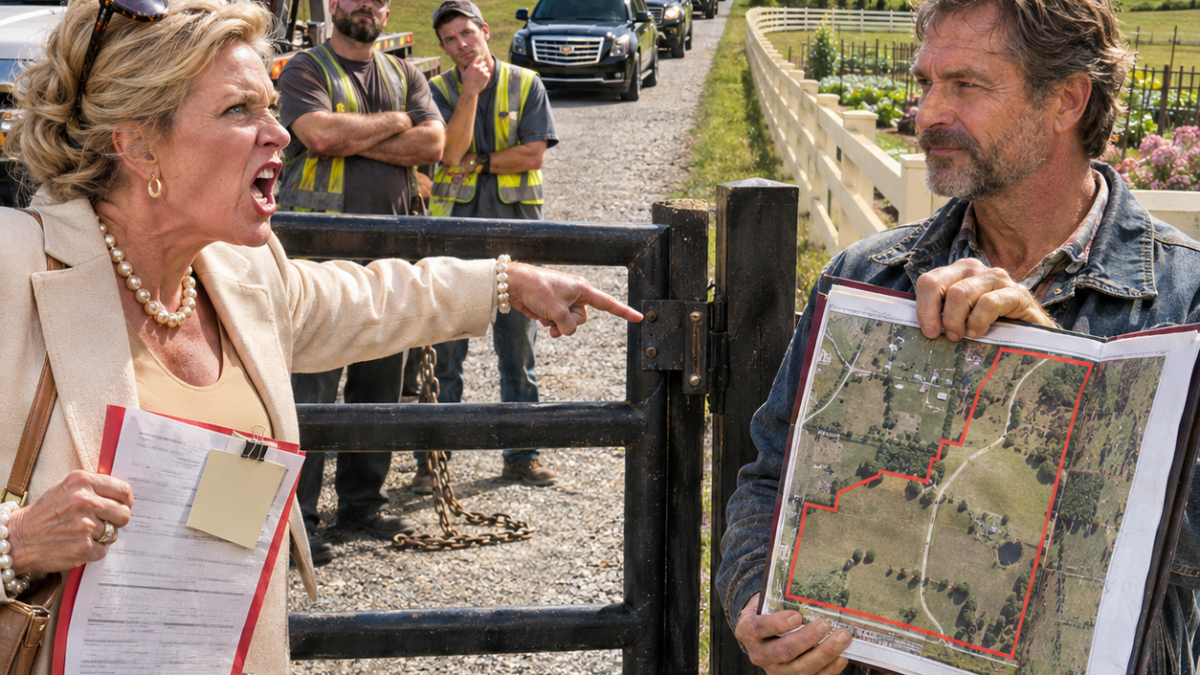
PART2
I did not drive home and immediately chain the road shut.
That would have been emotionally satisfying.
Engineering had trained me to prefer satisfying things that also survived inspection.
I requested certified copies.
All of them.
My deed.
The subdivision plat.
The temporary easement.
Its expiration language.
The county completion certificate.
The tax parcel map.
Then I hired an independent licensed surveyor.
Not Delia’s surveyor.
Mine.
His name was Calvin Moore.
Sixty-one.
No patience for drama.
He walked the entire eastern boundary with GPS equipment, old monuments, and county references.
Two days later he put a signed survey in front of me.
“Your original deed is clean.”
“And the trail?”
“Partly crosses your fifteen acres, then continues onto the Hartwell parcel.”
“Public road?”
“No.”
“Permanent easement?”
“No.”
“Willowbrook property?”
He laughed.
“Not unless somebody moved the subdivision since Tuesday.”
Good.
Then Calvin asked:
“Why do you care?”
I handed him Delia’s violation letter.
He read the approved color.
Looked up.
“Cream Dream?”
“Apparently.”
He handed it back.
“You retired people have too much time.”
“That’s becoming clear.”
The most interesting discovery came from conversation, not records.
Calvin knew the old owner.
Harold Westbrook.
No relation to the subdivision developer despite the similar name.
Harold had tolerated occasional neighborhood traffic on the abandoned trail because he was elderly and rarely used the eastern pasture.
After he moved into assisted living, nobody paid attention.
Convenience hardened into expectation.
Expectation became entitlement.
By the time I purchased the property, Delia apparently believed decades of nobody challenging the route had transformed it into hers.
That distinction mattered.
I wanted everything clean before I touched the road.
So I called attorney Sarah Kaye.
Property litigation.
Real estate.
A recommendation from the closing lawyer who handled my purchase.
Sarah read the records.
Then read Delia’s fine.
Then read them again.
“Your property is not subject to the Willowbrook covenants.”
“That’s my understanding.”
“It’s not a matter of understanding.”
She tapped the recorded plat.
“It isn’t.”
“Can they fine me?”
“They can mail you a piece of paper with numbers printed on it.”
“Meaning?”
“It doesn’t automatically create a valid debt.”
I liked Sarah immediately.
“What about the old access trail?”
“We need to be careful.”
“Why?”
“Because long-term use can produce arguments people like to litigate, depending on facts.”
“So I don’t just drop a gate tomorrow.”
“You notify them.”
“Formally?”
“Yes.”
“Then document continued use.”
I smiled.
Sarah saw it.
“No traps, Marcus.”
“I’m an engineer.”
“That is not reassuring.”
We sent a certified notice to Willowbrook’s board.
Simple.
Professional.
My property lay outside HOA jurisdiction.
The $500 violation was rejected.
The access route crossed private property.
The recorded temporary easement had expired.
Continued use after written notice was not authorized.
The board should instruct residents to use the subdivision’s lawful entrances.
Delia signed for the letter herself.
Twenty-six minutes later, my phone rang.
“Mr. Thompson.”
“Delia.”
“You hired an attorney.”
“Yes.”
“That was unnecessary.”
“You mailed me a $500 fine.”
“We could have handled this neighbor to neighbor.”
“You started with certified mail.”
Silence.
Then:
“You cannot close that route.”
“Why?”
“Because residents have used it for years.”
“Do you have a recorded permanent easement?”
“We have established access rights.”
“That wasn’t my question.”
“You’re not a lawyer.”
“No.”
I looked at Sarah sitting across from me.
“But one is listening.”
Delia immediately changed tone.
Sarah took the call.
Fifteen minutes later, Delia hung up after promising Willowbrook’s legal counsel would respond.
Their letter arrived nine days later.
It was much more polished than Delia’s violation notice.
It discussed historical use.
Potential prescriptive rights.
Reliance.
Community access.
Possible nuisance theories.
But buried inside six pages of expensive language was one revealing omission.
No recorded permanent easement.
No deeded right.
No document granting Willowbrook ownership or access.
Sarah read the letter.
“They want you scared enough to keep the road open.”
“Should I be?”
“You should take them seriously.”
“That wasn’t my question.”
She smiled.
“No.”
That evening I walked the eastern line.
Fresh BMW tire marks crossed the grass.
Delia had driven through that morning.
After receiving notice.
A camera I had temporarily mounted on an oak tree had recorded the silver BMW.
Timestamp:
7:43 a.m.
The following morning:
7:42.
Then 7:44.
Same car.
Same route.
Delia was nothing if not punctual.
I began keeping a log.
Date.
Time.
Vehicle.
Direction.
By the end of two weeks, I had eleven documented crossings after written notice.
Then fate placed a FOR SALE — 50 ACRES sign on County Road 847.
The Hartwell parcel.
The same land Calvin told me contained most of the abandoned construction trail.
I called the number.
Jennifer Patterson answered.
“Patterson Real Estate.”
“I’m calling about the Hartwell property.”
There was a pause.
“The fifty-acre tract?”
“Yes.”
She became noticeably more enthusiastic.
“You’d like to schedule a showing?”
“Today.”
Two hours later, Jennifer and I stood on a hill overlooking one of the prettiest undeveloped parcels I had seen in years.
Hardwood forest.
Meadow.
Creek tributary.
Long eastern boundary wrapping around Willowbrook.
And there, cutting through the southern portion:
The trail.
Delia’s shortcut.
Jennifer explained:
“It isn’t a county road.”
“I know.”
“Old construction access.”
“I know.”
She looked at me.
“You’ve researched this.”
“Some.”
The asking price was $229,000.
The property had been listed almost a year.
I offered $200,000 cash with a short inspection period, subject to clear title and independent survey.
Jennifer stared at me.
“You’re buying fifty acres because somebody drives across it?”
“No.”
That would have sounded insane.
I looked toward Willowbrook’s rooftops.
“I’m buying fifty acres because I like controlling what happens on land I own.”
Close enough.
The seller accepted.
I did not spend my entire retirement account like an angry man in a revenge fantasy.
I transferred money from investments after speaking with my financial adviser, confirmed the purchase would not compromise my retirement income, ordered environmental review, title work, and another survey.
Sarah reviewed every document.
When closing finally occurred, I owned sixty-five contiguous acres.
Fifteen original.
Fifty new.
And every foot of the abandoned trail between Willowbrook’s edge and County Road 847 now crossed my land.
That afternoon, I called Sarah.
“Can I put up the gate now?”
“You’ve provided written notice.”
“Yes.”
“Survey complete?”
“Yes.”
“Permits?”
“I checked.”
“Emergency access issues?”
“County fire marshal confirmed it is not a designated emergency route.”
“Then install your lawful fence.”
I had been waiting three weeks to hear those words.
I did not build Fort Knox.
Despite what Delia later told television cameras.
I installed what professionals recommended.
Agricultural fencing along sensitive areas.
Eight-foot security fencing only where repeated vehicle trespass occurred.
Reflective private-property signs.
Cameras at established entrances.
And one commercial steel gate across the abandoned construction trail.
The gate cost less than Delia later claimed.
But it was still substantial.
Powder-coated steel.
Concrete footings.
Electronic lock.
Reflective markers.
Camera.
On the left post:
PRIVATE PROPERTY — NO THROUGH ACCESS
On the right:
USE AUTHORIZED PUBLIC ROADS
Simple.
Legal.
Impossible to misunderstand.
The contractor completed it Friday afternoon.
Saturday morning I made coffee.
At 7:41, I sat on my porch.
At 7:43, the silver BMW appeared.
Delia came around the bend too quickly.
Brakes.
Dust.
Stop.
Ten yards from the gate.
Silence.
Then a horn.
One blast.
Then another.
Then continuous.
I drank coffee.
After approximately three minutes, Delia got out.
She marched toward the gate.
Designer workout clothes.
Sunglasses.
Phone in hand.
“Marcus!”
I raised my cup.
“Morning.”
“OPEN THIS.”
“No.”
“You cannot block this road.”
“It isn’t a road.”
“It has been used as one for twenty years.”
“It’s a private trail.”
She rattled the gate.
Camera recorded everything.
“You are deliberately obstructing Willowbrook residents.”
“I’m deliberately controlling access to my property.”
Her face reddened.
“You bought this land just to block us.”
“Not entirely.”
“That is malicious.”
“Buying property?”
“You know what I mean.”
I stood.
Walked closer, staying on my side.
“Delia, Willowbrook has two public entrances.”
“The north entrance adds twelve minutes.”
“That sounds inconvenient.”
“You can’t force three hundred homeowners to change their lives because you have some personal obsession with property lines.”
“Actually, property lines are exactly where my authority begins and yours ends.”
Her sunglasses came off.
“You think this is funny?”
“No.”
I looked at the BMW.
“You drove across somebody else’s private property for eight years because nobody stopped you.”
“That doesn’t make it yours.”
She stared at me.
“Open it.”
“No.”
“I’ll fine you.”
“For what?”
“Obstruction of community access.”
“On land outside your HOA?”
“I will find a violation.”
There it was.
Not law.
Not rights.
Power.
Delia’s real problem was not the gate.
It was somebody telling her no and remaining calm afterward.
She pointed at me.
“This is not over.”
I believed her.
Monday brought a new certified notice.
WILLOWBROOK HOA — EMERGENCY VIOLATION.
Unauthorized barrier interfering with established community traffic flow.
$2,500.
I forwarded it to Sarah.
She called.
“Are you laughing?”
“Yes.”
“Stop enjoying this.”
“I’m trying.”
The next letter came from Willowbrook’s attorney.
Request for immediate removal pending resolution.
Sarah replied with survey documents, title records, easement expiration, prior notice, and a demand that the HOA cease representing it had jurisdiction over my parcels.
Then we did something Delia hated.
We requested formal records.
Board meeting minutes.
Legal authorization for the action against me.
Vote authorizing counsel expenditures.
Any document establishing Willowbrook jurisdiction over my property.
Any evidence that association funds were being used for a dispute involving land outside its boundaries.
The response was slow.
Incomplete.
Interesting.
While lawyers exchanged letters, Delia escalated physically.
First, she began using another path across my original fifteen acres.
My cameras caught her BMW driving through pasture to go around the gate.
The next day I extended fencing along that section.
Then someone removed two private-property signs.
No camera angle clearly identified who.
I replaced them.
Three nights later, a camera captured Delia walking along the fence with a flashlight and another man.
They did not damage anything.
But they measured.
The next morning she arrived with a surveyor named Michael Grant.
Michael was professional.
Almost apologetic.
Delia pointed toward my vegetable garden.
“Show him where his illegal fence crosses HOA jurisdiction.”
Michael reviewed his field equipment.
Then Calvin’s survey pins.
Then county monuments.
He spent ninety minutes working.
Finally he walked toward us.
Delia smiled triumphantly.
“Well?”
Michael removed his cap.
“Ms. Kramer, Mr. Thompson’s property line matches the recorded survey.”
Her smile disappeared.
“What about the development boundary?”
“Stops east of his original parcel.”
“And the Hartwell land?”
“Also outside Willowbrook.”
She stared.
“You told me there were discrepancies.”
“I said old maps should be field-verified.”
“So verify them.”
“I did.”
Delia lowered her voice.
“What about the easement?”
“Expired construction access.”
“Prescriptive use?”
“That’s a legal question.”
“You’re an expert.”
“I’m a surveyor.”
Michael packed his equipment.
Delia followed.
“You can create documentation supporting the historical route.”
He stopped.
“I can document physical conditions.”
“Then do that.”
“I cannot create a property right that isn’t in the record.”
Watching a licensed professional refuse to manufacture Delia’s preferred reality was beautiful.
But I said nothing.
Delia left.
Two days later, she returned with bolt cutters.
I was in the barn when my phone alerted me to motion near the southern gate.
Camera feed.
Delia.
Bolt cutters.
My pulse jumped.
I called the county sheriff’s non-emergency line.
Then Sarah.
Then walked toward the gate while recording from a safe distance.
“Delia.”
She turned.
“Stay back.”
“What are you doing?”
“Removing an unlawful obstruction.”
“That fence is on my property.”
“You’ve been warned.”
“So have you.”
She placed the cutter jaws against a chain securing an auxiliary barrier.
I said:
“Police are on the way.”
She froze.
Then laughed.
“You called the sheriff over a fence?”
“I called because someone is attempting to damage property after written notice.”
She dropped the cutters slightly.
“You really want your neighbors seeing you have me arrested?”
“They aren’t my neighbors.”
That made her angrier than anything else.
Deputy Miguel Rodriguez arrived twelve minutes later.
He spoke separately to both of us.
Reviewed my survey.
Photographed the gate.
Looked at Delia’s bolt cutters.
Then asked:
“Ma’am, did you cut anything?”
“No.”
“Did you intend to?”
“I intended to remove an illegal obstruction.”
“Do you have a court order authorizing removal?”
“No.”
“Deed?”
“HOA authority.”
“Does the HOA own this parcel?”
She hesitated.
“It has access rights.”
“Recorded?”
Her answer became complicated.
Rodriguez raised a hand.
“Here’s what happens today.”
He pointed toward the BMW.
“You leave.”
Delia’s mouth dropped.
“He’s blocking a road.”
“This is a civil property dispute unless somebody starts damaging things.”
He pointed toward the bolt cutters.
“Don’t make it a criminal one.”
Delia looked at me.
“You planned this.”
“No.”
“You wanted police here.”
“I wanted you not to bring bolt cutters.”
She left.
I thought that embarrassment might slow her.
It did not.
Friday morning, a rented moving truck arrived.
Two laborers climbed out.
Delia followed in her BMW.
The men began unloading pry bars, shovels, and a portable cutting tool.
I called Sarah.
Her first words:
“Do not go outside and confront them alone.”
“I know.”
“Marcus.”
“I know.”
“Call law enforcement.”
“Already did.”
“Good.”
“And?”
“Yes?”
“Sarah.”
“What?”
“Bring coffee.”
She hung up on me.
The workers approached the fence.
I spoke through the camera speaker.
“You are on private property. The owner does not consent to removal of any fence or gate. Law enforcement has been contacted.”
Both men stopped.
One looked toward Delia.
She shouted:
“Keep working. I hired you.”
The man said:
“Do you own this?”
“The HOA has rights.”
“That wasn’t his question,” I said through the speaker.
The second worker lowered his tool.
Delia screamed:
“Don’t listen to him!”
By the time Sarah arrived, neither man had touched the gate.
Good.
Sarah walked directly toward them with copies of the survey.
“Gentlemen, I’m counsel for the property owner.”
One immediately said:
“I’m done.”
Smart man.
The other followed.
Delia looked furious.
“You’re breaching a contract!”
The first worker laughed.
“Lady, you told us this was HOA property.”
They loaded their tools.
Left.
Delia remained.
Sarah looked at her.
“Your attorney has my number.”
Delia pointed at the gate.
“This is going to cost him everything.”
Sarah smiled.
“Then file a lawsuit.”
Delia hesitated.
That was interesting.
People with excellent claims usually do not spend weeks avoiding the courthouse while escalating everywhere else.
Why had Delia not sued?
We learned soon enough.
Our records request finally produced partial board minutes.
The HOA board had never formally voted to pursue my fence.
Never authorized the $2,500 fine.
Never voted to retain counsel specifically over my property.
Delia had used general legal authority as president to push the matter herself.
Worse, association money had paid legal invoices related to land everyone now knew sat outside Willowbrook.
Sarah said:
“This is no longer only your fence.”
I read the statements.
“How much?”
“About eighteen thousand so far.”
“For this?”
“Yes.”
“Does the board know?”
“We’re going to find out.”
Before we could, someone else did.
Her name was Linda Harper.
Willowbrook resident.
Retired accountant.
She called me Monday morning.
“Are you Marcus Thompson?”
“Depends who’s asking.”
She laughed.
“I’ve been wanting to meet you.”
“Why?”
“Because you’re the first person in ten years who told Delia no and made her prove something.”
Linda had watched the gate dispute from inside the HOA.
She had served on the finance committee two years earlier.
Then resigned after asking why landscaping expenses kept rising even though common-area maintenance had visibly declined.
Delia called her “negative.”
Removed her from the committee.
Linda had kept copies.
“Copies of what?”
“Budgets.”
“Invoices.”
“Meeting packets.”
My engineer brain activated.
“Have you shown anyone?”
“I tried.”
“The board?”
“Yes.”
“And?”
“Delia controls four of seven votes.”
“How?”
“Mostly loyalty.”
Then Linda paused.
“And proxies.”
Sarah became involved immediately.
We did not promise Linda anything.
We listened.
Then two more residents contacted us.
Then five.
Stories varied.
Selective fines.
Unexplained assessments.
Contracts awarded to companies connected to Delia’s friends.
Board votes held with questionable proxy forms.
Residents fined while Delia’s supporters received informal exceptions.
Most were HOA governance complaints.
Not automatically crimes.
Sarah emphasized that constantly.
“Bad management is not necessarily fraud.”
“Unfairness is not automatically embezzlement.”
“Suspicion is not evidence.”
I respected that.
So did Linda.
She brought evidence.
Invoices.
Emails.
Bank summaries available to members.
One invoice caught my attention.
Greencrest Landscaping.
Annual HOA contract.
The owner shared a surname with Delia’s sister’s husband.
Coincidence?
Maybe.
Then Linda showed me photographs of Delia’s private yard being landscaped by Greencrest crews during the same months the association paid unusually high “common area enhancement” charges.
Still not proof.
But worth asking.
Another resident named Peter Sloan had spent three years trying to see complete financial statements.
Requests delayed.
Partial responses.
Different totals.
Sarah told them:
“If you believe association leadership is misusing funds, the members—not Marcus—need to pursue the records and remedies available under your governing documents and state nonprofit law.”
That mattered.
I did not want to become the heroic outsider who magically fixed three hundred people’s HOA.
They lived there.
They paid dues.
They had rights.
They needed to use them.
Linda started organizing.
Not a mob.
A records committee.
Residents pooled money to hire an independent HOA attorney and forensic accountant.
They petitioned for a special membership meeting under Willowbrook’s bylaws.
Delia tried to reject the petition.
Too many signatures.
She challenged some.
More residents signed.
Meanwhile, my own lawsuit remained simple.
Sarah filed for declaratory relief establishing that my sixty-five acres were not subject to Willowbrook covenants and that the HOA had no enforceable right to use the abandoned construction trail.
We also sought an injunction against further interference with my gate and reimbursement for property damage already documented.
No claims about statewide conspiracies.
No billion-dollar damages.
Just lines on paper.
Delia finally had to appear in court.
That changed her.
For months she had controlled the setting.
Letters.
Meetings.
Driveway confrontations.
Phone calls.
Now a judge controlled the room.
Her attorney argued long-standing community use.
Sarah presented the recorded temporary easement.
The expiration.
The subdivision plat.
My deeds.
Calvin’s survey.
The county’s confirmation that the trail was not public.
The judge asked Delia’s counsel:
“Do you have a recorded document granting the association permanent access?”
“No, Your Honor.”
“Any deed covenant binding Mr. Thompson’s property?”
“No.”
“Any authority establishing the association has jurisdiction over either parcel?”
“No.”
Silence.
The judge granted preliminary relief prohibiting Willowbrook and its representatives from interfering with the gate while the case proceeded.
Outside court, Delia cornered me.
“You think you won?”
“I think the judge read the documents.”
“This community will hate you.”
“I don’t live in it.”
Her eyes narrowed.
Again.
That fact infuriated her.
Because she could not fine me into obedience.
Could not vote me off a committee.
Could not threaten my amenities.
I was outside her system.
Her only power over me had depended on my believing she had some.
Two weeks later, Willowbrook held its special membership meeting.
Delia attempted to preside.
Residents objected.
Their independent attorney cited the bylaws.
A temporary chair was selected.
More than two hundred homeowners attended in person or by valid proxy.
Linda presented the financial questions.
No accusations.
Numbers.
Three years of landscaping expenditures.
Security contracts.
Legal fees.
Unexplained transfers.
Residents voted overwhelmingly for an independent forensic audit.
They also voted to suspend Delia’s discretionary spending authority pending review.
She screamed.
Actually screamed.
“You people have no idea what I’ve done for this neighborhood!”
A man in the back shouted:
“That’s exactly what we’re trying to find out!”
Even I laughed.
The audit took three months.
That was the part viral stories usually skip.
Real accountability is boring.
Invoices.
Bank statements.
Vendor confirmations.
Contracts.
Checks.
Emails.
Deposits.
Board authorizations.
Then more questions.
The independent accountants found approximately $417,000 in transactions requiring explanation over several years.
Not all stolen.
Some were poorly documented.
Some were legitimate but improperly approved.
Some were related-party arrangements never disclosed to homeowners.
Several were much worse.
Greencrest Landscaping had indeed performed work at Delia’s residence while billing significant amounts through association contracts.
A security vendor had provided private monitoring equipment for Delia and two board allies while charges were embedded in association invoices.
A waste contractor had given Delia’s household discounted service tied to renewal of the HOA contract.
There were payments described as consulting fees to an entity connected to a longtime friend.
Then came the proxy ballots.
Some signatures belonged to people who had sold their Willowbrook homes before the election in which their proxies were supposedly cast.
That was when the HOA’s independent attorney stopped talking only about governance.
He referred portions of the audit to law enforcement.
County investigators requested records.
The district attorney’s office reviewed them.
The state agency overseeing nonprofit corporate filings became involved on the governance side.
Tax authorities received information relevant to unreported benefits.
Nobody arrested Delia the next morning.
Investigations took time.
But her presidency ended quickly.
The board voted to remove her from officer duties under the association’s bylaws pending the outcome of the financial review.
Several allied directors resigned.
A temporary board took control.
The first letter I received from them began:
Dear Mr. Thompson,
The Interim Board of Willowbrook Estates formally withdraws all violation notices previously issued against your property and acknowledges that your parcels are not subject to the association’s declaration.
I read it twice.
Then poured bourbon.
Ellen’s favorite bottle had been sitting unopened since I moved.
I took it onto the porch.
Raised the glass toward the empty chair beside mine.
“You would have hated every second of this.”
Then I smiled.
“No.”
I corrected myself.
“You would have loved Delia.”
Not as a friend.
As entertainment.
The new Willowbrook board asked to meet.
Linda came.
Temporary president was a man named Robert Hayes.
School principal.
Calm.
Apologetic.
Sarah attended.
Robert placed a folder on my table.
“First, we owe you an apology.”
“Accepted.”
“Second, we want this litigation finished.”
“So do I.”
They agreed to recognize my property boundaries permanently.
Reimburse documented gate damage.
Cover an agreed portion of my legal expenses attributable to the HOA’s unauthorized actions.
Withdraw fines.
No future claim of access without a separately negotiated recorded agreement.
In return, I dismissed the remaining civil claims against the association itself once the settlement was complete.
Delia remained separately responsible for her own conduct where applicable.
That distinction mattered.
Willowbrook residents should not lose their homes because one president abused authority.
Justice should identify responsibility, not spread punishment for emotional satisfaction.
The criminal case against Delia took almost a year.
She was ultimately charged based on specific financial transactions prosecutors believed they could prove—not because she was an unpleasant HOA president, not because she hated my gate, and not because residents disliked her.
Property damage.
Financial misconduct.
False records tied to association transactions.
The final resolution involved a plea to several counts.
Restitution.
Probationary requirements on some offenses.
And an eighteen-month custodial sentence on the most serious financial count, followed by supervision.
I did not attend sentencing.
People found that surprising.
“After everything?”
Sarah asked.
“I already know she lost.”
“What do you mean?”
I looked toward my pasture.
“The gate works.”
That was enough for me.
Rita Walsh from Channel 7 eventually covered the story.
But not because Sarah called her to manufacture a scandal.
Rita found it after the court filings and audit became public.
She interviewed homeowners.
Linda.
Robert.
Calvin.
Me.
Her first question:
“Did you really buy fifty acres because of an HOA dispute?”
“Partly.”
“That’s an expensive response.”
“Land usually is.”
“Was it revenge?”
I thought.
“At first?”
“Yes.”
“What changed?”
I looked toward the creek.
“I realized owning land just to stop one person from crossing it is a pretty small use for fifty acres.”
That became important later.
The access problem that had made the old trail convenient was real.
Willowbrook’s lawful northern entrance added ten to fifteen minutes during morning traffic.
Delia had exploited that inconvenience instead of solving it properly.
The new board approached the county transportation department.
They studied the intersection.
Traffic counts.
Turn movements.
Sight distance.
A legitimate engineering problem.
That was language I understood.
The county proposed improvements to the main entrance.
Turn lane.
Signal timing.
Safer geometry.
Willowbrook voted to fund its appropriate share through a transparent assessment.
No fake shortcut required.
Then Robert asked me something unexpected.
“Would you consider one emergency-only access connection across the southern edge of your new parcel?”
My first instinct:
No.
Then he placed plans on the table.
Proper survey.
Fire department recommendation.
Locked emergency gate.
No daily traffic.
Insurance.
Maintenance responsibility.
Recorded agreement.
Termination terms.
Everything Delia should have done if she believed community access mattered.
I looked at Robert.
“You’re asking.”
“Yes.”
“Not telling.”
“Yes.”
“Interesting strategy.”
He smiled.
“Apparently it works.”
I agreed in principle.
Sarah drafted the agreement.
County fire officials approved the design.
Willowbrook paid construction and maintenance.
The route could be opened only by emergency services.
No residents using it to save twelve minutes on the way to brunch.
Then came the fifty acres.
I had purchased them angry.
The land itself had done nothing wrong.
I walked it more after the lawsuit ended.
Twenty acres along the creek were beautiful hardwood habitat.
Wild turkey.
Deer.
Owls.
Wildflowers Ellen would have known by name.
One afternoon, my granddaughter visited.
She was ten.
We walked down to the creek.
She asked:
“Grandpa, why did you buy all this?”
I almost told her the funny version.
Because an HOA lady annoyed me.
Instead:
“I was angry.”
She nodded seriously.
“Are you still?”
“No.”
“Then what are you going to do with it?”
Children ask rude questions.
I had no answer.
So I found one.
I contacted a local conservation organization.
Then the county parks department.
Then Willowbrook’s new board.
Not to donate everything.
I still liked privacy.
But we created a land plan.
Twenty acres placed under a conservation easement protecting creek habitat.
Ten acres leased at nominal cost for a community garden managed independently of the HOA.
A walking trail along a carefully surveyed section open during daylight.
Environmental education visits for local schools.
The remainder stayed private.
My house.
Pasture.
Garden.
And yes, the gate.
I kept the gate.
Some principles deserve architecture.
For the emergency-access lease, Willowbrook offered annual payment.
I declined personal payment.
Instead, we established a scholarship account administered through a local community foundation.
Engineering.
Surveying.
Public administration.
Law.
Students whose families could not easily afford college.
The first awards were modest.
Not full tuition fantasies.
Enough for books and fees.
Then residents contributed.
Local businesses matched.
The fund grew.
The first recipient studying civil engineering was Maria Gonzalez.
At the award dinner, she shook my hand.
“I heard you bought fifty acres because somebody fined your fence.”
“That is an oversimplification.”
“Is it wrong?”
“No.”
She laughed.
“I want to design stormwater systems.”
I nearly hugged her.
“Finally, somebody with sensible ambitions.”
The second recipient wanted law school.
James Patterson.
His mother lived in Willowbrook.
Delia had once fined her $1,200 over a shed.
He told Sarah:
“I want to learn how documents beat people who yell.”
Sarah hired him as a summer intern three years later.
That felt better than watching Delia lose.
Much better.
The strangest part came when the new Willowbrook board invited me to its annual picnic.
I declined.
They asked again.
Linda called.
“You’re being dramatic.”
“I’m protecting my reputation.”
“People like you now.”
“That’s exactly what concerns me.”
She hung up.
Then my granddaughter begged.
So I went.
Hundreds of residents.
Children playing near the garden plots.
County naturalists leading a walk.
Robert grilling burgers badly.
Someone had placed a sign near the old trail.
Not mine.
The community’s.
HISTORIC CONSTRUCTION ACCESS — CLOSED TO VEHICLE TRAFFIC
Below:
PLEASE RESPECT PRIVATE PROPERTY
I stood there longer than necessary.
Linda appeared beside me.
“Beautiful, isn’t it?”
“It’s a sign.”
“You know what I mean.”
“I do.”
“What are you thinking?”
“Twenty years.”
“What?”
“That route should have been restored when construction ended.”
She nodded.
“It took twenty years and one insane president.”
“And one expensive fence.”
“Yes.”
We laughed.
A year after Delia left prison, I heard she moved to Florida.
Not from gossip.
Rita called asking whether I wanted to comment.
“No.”
“Nothing?”
“Nothing.”
“You’ve never struggled for words before.”
“I don’t know the woman anymore.”
That was true.
For months Delia had occupied enormous space in my life.
Then slowly she didn’t.
The greatest victory over someone obsessed with control is not controlling what happens to them afterward.
It is losing interest.
My mornings changed.
7:43 became just a time.
No BMW.
No horn.
No gate alerts.
Sometimes deer triggered the motion sensor.
Once a turkey spent eight minutes attacking its reflection in the camera housing.
I saved that footage.
Much more entertaining than Delia.
The vegetable fence remained galvanized chain link.
Four feet high.
No decorative caps.
I never painted it Cream Dream.
One afternoon Robert stood beside it.
“You realize if you’d just changed this fence none of this happens.”
I looked at him.
“You’re blaming tomatoes?”
“I’m blaming Antique Ivory.”
We laughed.
Then I thought about the original $500 notice.
I still had it.
Framed?
No.
I was not that sentimental.
It sat in a folder marked:
WILLOWBROOK — CLOSED
Sarah insisted I keep the records.
Lawyers.
Ellen would have thrown them away.
She hated clutter.
I sometimes imagined explaining the whole story to her.
She would listen until the part where I spent $200,000 buying fifty acres.
Then:
“You did WHAT?”
“It was strategic.”
“Marcus.”
“It appreciated.”
“Marcus.”
“I diversified.”
“You bought fifty acres because a blonde woman annoyed you.”
When phrased that way, it sounded less distinguished.
I missed Ellen.
The story began because I had retired to fifteen quiet acres after losing her.
That part often disappeared when people retold it.
They liked the HOA war.
The steel gate.
The BMW.
The satisfying reversal.
But anger filled a space grief had already hollowed out.
Delia gave me something to fight.
For a while, that was easier than sitting in a quiet house realizing the woman I had planned retirement with would never see it.
Sarah noticed before I did.
After settlement she asked:
“What are you going to do now?”
“Fish.”
“No.”
“What?”
“You’ve spent a year waking up with a mission.”
“I had hobbies before Delia.”
“Name three.”
“Coffee.”
“That’s a beverage.”
“Fishing.”
“One.”
“Complaining about lawyers.”
She stared.
“Find something.”
The land became that something.
Not revenge.
Stewardship.
I joined the watershed group.
Helped design a small footbridge for the education trail.
Reviewed drainage around the community gardens.
Taught middle-school kids why putting houses in floodplains eventually makes everybody unhappy.
One boy asked:
“Are you famous?”
“No.”
“My mom said you destroyed the HOA.”
“No.”
“Did you buy a giant gate?”
“Yes.”
“So you’re famous.”
Middle school logic.
At seventy, I was busier than I had been at sixty-five.
But differently.
No deadlines that followed me to bed.
No clients calling Sunday.
No board president telling me my garden fence was the wrong shade of white.
Willowbrook still had an HOA.
That surprised some people.
They assumed justice meant dissolving it completely.
Residents voted not to.
They rewrote financial controls.
Independent annual audit.
Two-signature requirements.
Conflict disclosures.
Competitive bids above specified amounts.
Proxy verification.
Open member access to meeting minutes and budgets.
Term limits.
Boring governance.
Beautiful.
HOAs were not the villain.
Unaccountable people were.
Rules themselves were not oppression.
Rules applied dishonestly were.
That distinction mattered enough that when Rita interviewed me for the anniversary follow-up, I corrected her.
She asked:
“So was your lesson that homeowners associations have too much power?”
“No.”
She raised an eyebrow.
“No?”
“My lesson is that nobody should accept a claim of power without asking what document creates it.”
“HOA.”
“Government.”
“Business.”
“Neighbor.”
“Me.”
I pointed toward my gate.
“Ownership gives me rights too.”
“But if I told Willowbrook I owned their streets because my gate is expensive, they should make me prove it.”
Rita smiled.
“That’s less dramatic.”
“Reality often is.”
The follow-up story focused on the gardens.
Scholarships.
Traffic improvements.
That pleased me.
Five years after Delia first drove up my driveway, Maria graduated with a civil engineering degree.
She mailed me a photograph.
Hard hat.
Diploma.
Underneath she had written:
Cream Dream forever.
I laughed for ten minutes.
James entered law school.
Linda became Willowbrook board treasurer.
Robert finished his term and refused another.
“Term limits,” he told me.
“Your idea.”
“Good.”
The community garden donated thousands of pounds of produce to the local food pantry.
The emergency gate was used exactly twice.
Once during a house fire.
Once when a fallen tree blocked the north entrance during a storm.
Both times emergency crews opened it, passed through, closed it afterward.
Exactly what a legitimate access agreement looks like.
One morning after the fire, Robert called.
“That gate saved response time.”
“Good.”
“Thank you.”
“You negotiated.”
“Still.”
I hung up and looked toward the southern property.
That was the real irony.
Delia had insisted community benefit gave her the right to take access.
The new board demonstrated community benefit was achievable by asking.
Negotiating.
Paying.
Documenting.
Respecting no.
That was the entire difference.
My granddaughter eventually became old enough to drive.
One Saturday she borrowed my truck.
“Where are you going?”
“Willowbrook.”
I stared.
“Why?”
“My friend lives there.”
“Use the north entrance.”
She rolled her eyes.
“Grandpa.”
“I’m serious.”
“There’s literally an emergency gate.”
“Emergency.”
“What if I’m late?”
“That’s not an emergency.”
“You bought fifty acres because somebody made your commute difficult.”
“No.”
“That is how Dad tells it.”
Your own children will slander you for free.
She used the north entrance.
Good kid.
Delia’s old BMW route eventually disappeared beneath grass.
That fascinated me.
For decades, tires had carved two hard tracks through the land.
Then traffic stopped.
Rain softened the soil.
Grass returned.
Wildflowers appeared.
Within three years, parts of the trail became difficult to identify.
Nature erased entitlement faster than courts did.
One spring morning, I stood where Delia’s tires used to cross.
A doe and two fawns stepped from the trees.
They froze.
I froze.
Then they continued.
Ellen would have loved it.
That thought no longer destroyed me.
Grief changed too.
At first Ellen’s absence was the loudest thing in every room.
Later it became part of the room.
Still present.
Less sharp.
I built a bench near the creek.
Small brass plate:
ELLEN’S VIEW
Nothing else.
No dates.
No speeches.
My daughter cried the first time she saw it.
“Mom would like this.”
“She’d complain the bench isn’t level.”
My daughter checked.
“It isn’t.”
I swore.
Retired engineer.
Humiliating.
We fixed it.
At seventy-two, I finally repainted the porch railing.
White.
My granddaughter brought me two sample cards.
One:
Antique Ivory.
The other:
Cream Dream.
She stood there trying not to laugh.
I looked at her.
“You have your father’s sense of humor.”
“So which one?”
I took Cream Dream.
Her mouth fell open.
“No!”
I started laughing.
Then handed it back.
“Absolutely not.”
Antique Ivory.
Naturally.
The new Willowbrook president heard about it and mailed me a mock violation notice.
FINE: ONE HOMEMADE PIE
I paid under protest.
The pie was blueberry.
Not bad.
There are people who believe satisfying justice requires your enemy to lose everything.
I used to understand that feeling.
When Delia stood at my gate furious, part of me wanted complete destruction.
President removed.
Money gone.
Reputation ruined.
Jail.
Everything.
Then the investigation found actual misconduct.
And I learned something important.
Justice is stronger when you do not need to exaggerate it.
Delia did not need fictional federal conspiracies piled onto her story.
What she actually did was enough.
She used association authority where she did not have jurisdiction.
Spent community money without proper authorization.
Interfered with private property.
Tried to have lawful fencing removed.
Participated in financial arrangements she had not properly disclosed.
Allowed association governance to serve personal power.
Evidence proved specific financial crimes.
She faced consequences for those.
No more.
No less.
That was better than revenge.
Because revenge depends on how angry I felt.
Evidence did not.
The gate remains today.
Steel.
Dark powder coat.
Camera above it.
The original PRIVATE PROPERTY sign has faded slightly.
I could replace it.
I don’t.
I like the weathered version.
It reminds me boundaries are not hostility.
A gate is not hatred.
A fence is not cruelty.
A boundary simply tells another person:
This is where your choice ends and mine begins.
Healthy communities need that as much as healthy people do.
Delia believed leadership meant she could cross boundaries because her intentions—or convenience—were important.
The people who replaced her learned leadership meant recognizing boundaries before somebody had to build steel around them.
One October evening, Willowbrook held its fall festival on the education parcel.
Kids everywhere.
Food trucks.
Pumpkins.
The first scholarship recipients had returned.
Maria brought her fiancé.
James had passed the bar and joined Sarah’s firm.
Linda was arguing with somebody about raffle tickets.
Robert burned hamburgers exactly as expected.
My daughter stood beside me.
“You realize none of this happens without Delia.”
I looked around.
“That gives her too much credit.”
“You know what I mean.”
“I do.”
“What would Mom say?”
I thought.
Ellen would look at the gardens.
The preserved creek.
The students.
The children.
Then she would look at me.
“She’d say I spent two hundred thousand dollars because I was too stubborn to repaint a fence.”
My daughter laughed.
“Accurate.”
Then:
“But she’d be proud.”
I looked toward Ellen’s bench far across the pasture.
“Maybe.”
“No maybe.”
I nodded.
“Okay.”
Sunset fell over sixty-five acres.
The same land I had once viewed as a weapon.
That embarrassed me now.
Land should not be a weapon.
Law should not be a weapon either.
They are structures.
What matters is what people build with them.
Delia built control.
I almost built revenge.
The residents eventually built community.
That was the ending worth keeping.
The next morning, I woke at 7:30.
Made coffee.
Walked onto my porch.
At exactly 7:43, the gate camera sent an alert.
I opened the feed.
For one brief second, my body remembered the silver BMW.
Instead, Maria Gonzalez stood outside the gate wearing a hard hat.
She was working for an engineering firm on a county drainage project nearby.
She held up a cardboard sign toward the camera.
YOUR FENCE IS THE WRONG COLOR.
I laughed so loudly a deer ran from the garden.
I opened the gate remotely.
Maria drove in.
She stepped out holding two coffees.
“Morning, Mr. Thompson.”
“You’re trespassing.”
“You opened the gate.”
“Technicality.”
She handed me coffee.
We sat on the porch.
She looked across the fields.
“You ever regret buying the fifty acres?”
I considered it.
Financially?
It had appreciated.
Emotionally?
It had changed almost everything.
“Ask me what I regret instead.”
“What?”
“Letting somebody else decide how angry I stayed.”
Maria waited.
“For a while, every fence post was about Delia.”
“Every camera.”
“Every document.”
“Every dollar.”
I looked toward the creek.
“Then one morning I realized she had moved into my head without paying an easement fee.”
Maria laughed.
“So I evicted her.”
“How?”
“I started deciding what the land was for after she was gone.”
She nodded.
“That’s very philosophical for a man who once bought fifty acres to block a BMW.”
“Get off my porch.”
She laughed harder.
The gate stood open behind her.
That mattered.
I had spent a year building barriers because someone would not respect boundaries.
Later, once respect existed, I could choose when to open them.
That is what Delia never understood.
A closed gate does not mean it can never open.
It means the person on the other side is no longer entitled to decide.
After Maria left, I walked to the vegetable garden.
Tomatoes.
Peppers.
Beans.
Same little chain-link fence.
Four feet.
Galvanized steel.
The entire war had supposedly started there.
I touched one post.
Still solid.
No decorative cap.
I thought of Delia stepping from her BMW with the clipboard.
Community standards.
Then the certified fine.
$500.
Then Cream Dream.
Then county records.
The expired easement.
The gate.
The bolt cutters.
The audit.
The courtroom.
The new board.
The gardens.
The scholarships.
All because one woman could not tolerate hearing:
You don’t have authority here.
People often ask what moment felt best.
Delia trapped at the gate?
No.
The judge recognizing my property line?
Good, but no.
Her removal as president?
Necessary.
The audit?
Important.
Her sentencing?
Sad, mostly.
The best moment happened much later.
A Willowbrook teenager working in the community garden opened the emergency gate to let a county fire truck through during the house fire.
He waited.
The truck passed.
Then he closed it.
Locked it.
Exactly as the agreement required.
No argument.
No entitlement.
No one claiming permanent access because it had opened once.
Just people honoring a boundary while cooperating for a legitimate reason.
That was the entire story in thirty seconds.
Property rights and community responsibility did not have to be enemies.
They only became enemies when someone decided cooperation was slower than taking what she wanted.
Delia chose taking.
The people after her chose asking.
The difference changed everything.
I am seventy-three now.
Still on the property.
Still drink coffee on the porch.
Still fish badly.
Still refuse golf.
Willowbrook’s roofs are visible through the trees in winter.
In summer, leaves hide most of them.
I like it that way.
The gate remains closed most mornings.
But the trail beyond it is no longer a scar through my land.
Grass.
Wildflowers.
Young trees.
The old construction route is disappearing.
Maybe someday nobody will know it existed.
Except the records.
And me.
That feels appropriate.
Because paper remembers what people conveniently forget.
The 2003 easement remembered it was temporary.
The plat remembered where Willowbrook ended.
The deeds remembered who owned the land.
The invoices remembered where HOA money went.
The bank statements remembered who benefited.
The cameras remembered who carried bolt cutters.
The minutes remembered which votes actually happened.
And eventually all those boring documents did what shouting never could.
They made reality impossible to ignore.
Delia once assumed a retired civil engineer would be an easy man to intimidate with a $500 fine and a clipboard.
She was wrong about one thing.
I had not spent forty years waiting to fight somebody.
I had spent forty years learning that every structure fails when people ignore its limits.
Bridges.
Pipes.
Drainage systems.
Organizations.
Authority.
All of them.
Pressure is not the problem.
Uncontrolled pressure is.
Boundaries are what keep systems from failing.
That is what I eventually learned my gate represented.
Not revenge.
A boundary.
Delia could honk.
Threaten.
Fine.
Call lawyers.
Bring surveyors.
Bring bolt cutters.
But she could not make that boundary disappear simply because she disliked where it was.
And once everyone else saw that clearly, they began looking at the other boundaries she had crossed.
Financial.
Ethical.
Legal.
Personal.
My fence did not destroy Delia Kramer.
Her own decisions did.
My gate simply forced her to stop long enough for everyone to see them.
That is why, even now, when someone asks whether spending $200,000 on fifty acres was worth it, I never answer the way they expect.
I do not say:
“Yes, because I beat the HOA.”
I say:
“Yes, because I bought land I eventually learned how to use for something better than anger.”
The fifty acres gave children trails.
Families gardens.
Wildlife habitat.
Emergency access.
Scholarships.
And me a reason to stop sitting alone in a house waiting for retirement to feel like the life Ellen and I once planned.
Delia gave me the shove.
She does not get credit for the destination.
That belongs to everyone who chose what came afterward.
One final thing.
The original $500 violation?
I still have it.
Not framed.
Not displayed.
Folded inside that old file.
Sometimes my granddaughter asks why I keep it.
I tell her:
“Because someday you’re going to meet somebody who speaks with absolute confidence about what you’re allowed to do.”
She asks:
“Then what?”
I smile.
“Ask them to show you the document.”
That is the whole lesson.
Not every loud person has authority.
Not every official-looking letter creates an obligation.
Not every path used for years belongs to the people walking it.
Not every leader deserves obedience simply because they have a title.
And not every gate is meant to keep a community out.
Sometimes a gate exists because somebody finally had the courage to say:
You may come through when we agree you have the right.
Until then, use the road that actually belongs to you.
At 7:43 tomorrow morning, that steel gate will still be standing.
Delia’s BMW will not be there.
The horn will not sound.
The trail behind it will remain quiet.
And somewhere beyond the fence, children will be learning beside the creek on land that once existed only because an angry widower bought fifty acres to stop one entitled woman from taking a shortcut.
That might not be the retirement I planned.
But looking across those fields now, coffee in hand, I can finally admit something Ellen would probably have known before I did.
Sometimes peace is not what you find after avoiding every fight.
Sometimes peace is what remains after you defend the right boundary, tell the truth, let consequences belong to the people who earned them—
and then finally put the fight down.








