PART2:“THAT DOG IS STILL MILITARY PROPERTY—YOU CAN’T TAKE HIM HOME!” A Soldier Thought His K9 Had Died a Year Ago—Then Max Found Him at the Airport
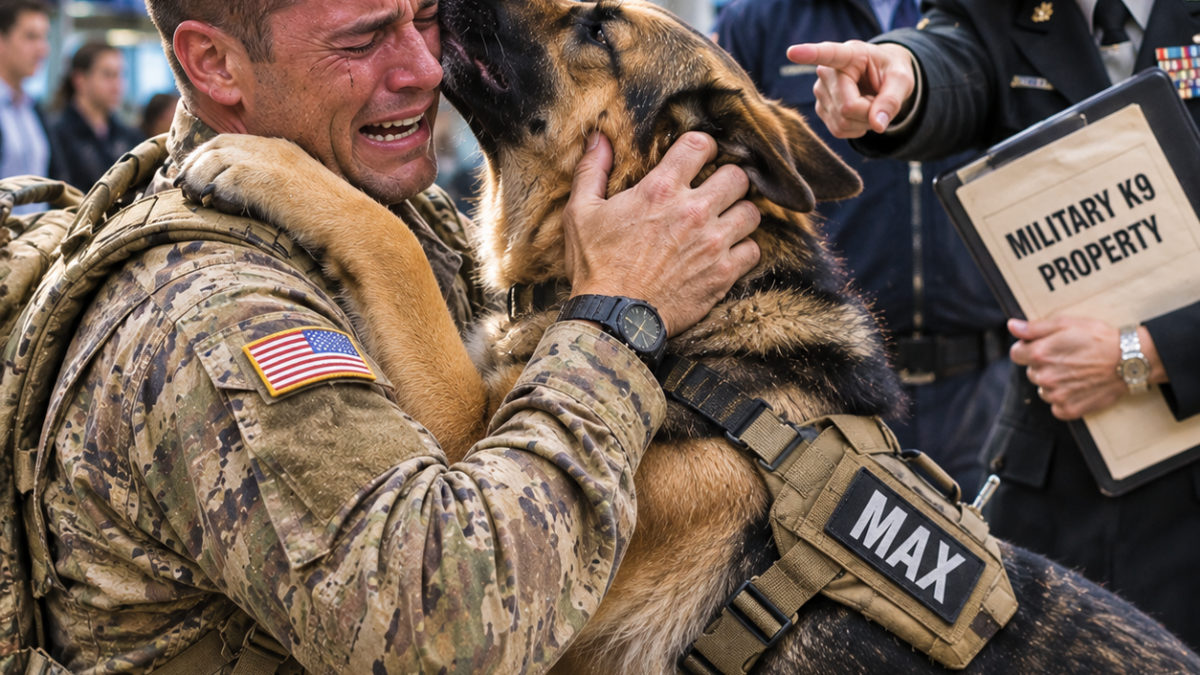
PART2
The wait lasted fifty-three minutes.
James knew because he stared at the airport clock every few minutes even though time seemed to have stopped the moment Max recognized him.
A small crowd formed.
Not close enough to interfere.
Close enough to watch.
Someone brought James a bottle of water.
He forgot to open it.
A little girl asked her mother why the soldier was crying.
Her mother whispered:
“Because he found somebody.”
That nearly broke James again.
Max never moved farther than six inches from him.
Every time footsteps approached, the shepherd raised his head.
Every time James shifted, Max touched him with one paw.
At one point the assigned handler, Sergeant Cole Ramsey, crouched nearby.
“I’ve never seen him like this.”
James looked at him.
“You’re his handler?”
“For the last six months.”
James felt a strange flash of jealousy.
Immediately followed by shame.
Ramsey must have noticed.
“I know.”
James looked away.
“No, you don’t.”
Ramsey nodded slowly.
“Probably not.”
He sat on the floor anyway.
“For what it’s worth, he’s a good dog.”
James almost laughed.
“Yeah.”
“Best I’ve worked with.”
“That sounds right.”
Ramsey looked at Max.
“He never fully bonded with me.”
James’s eyes lifted.
“What do you mean?”
“He works.”
“Searches.”
“Tracks.”
“Obeys commands.”
“But?”
Ramsey hesitated.
“Always felt like he was waiting for somebody else.”
James’s throat tightened.
Before he could ask more, the automatic glass doors opened.
Captain Ethan Wilson entered at a near run.
James stood so quickly Max rose with him.
Wilson stopped.
His face changed completely.
“Jesus.”
Max barked.
Wilson crossed the distance.
He crouched.
“Hey, old man.”
Max sniffed him.
One tail wag.
Then immediately leaned back into James.
Wilson laughed through wet eyes.
“Well.”
He looked at James.
“You found him.”
James shook his head.
“No.”
He placed one hand on Max’s shoulder.
“I think he found me.”
The lieutenant colonel approached.
“Captain Wilson?”
“Yes, sir.”
“Lieutenant Colonel Harris.”
They shook hands.
Harris looked toward Max.
“You know this dog?”
Wilson gave a short laugh.
“Sir, I spent three years watching those two act like separation was a personal insult.”
James almost smiled.
Harris held out the photograph.
“Sergeant Walker claims prior assignment.”
“Correct.”
“Records show Max was recovered overseas approximately seven months ago.”
James stared at Wilson.
“Seven months?”
Wilson’s expression changed.
James stepped forward.
“You knew?”
“No.”
“I swear.”
“When did you know he was alive?”
“Three months ago.”
James went completely still.
Three months.
“You knew for three months.”
Wilson lowered his voice.
“Yes.”
“And you didn’t call me?”
“I tried.”
“No.”
James stepped back.
“You had my number.”
“There were restrictions.”
“What restrictions?”
“James.”
“What restrictions stop you from telling a man his dog is alive?”
People nearby went quiet.
Wilson looked at Harris.
Then back at James.
“Operational medical review.”
James laughed bitterly.
“Medical review.”
“Max had trauma.”
“So did I.”
“I know.”
“They found him injured and alone after the unit withdrew.”
James’s anger collapsed into something else.
“Where?”
“Sixteen kilometers from the original site.”
James stared.
Wilson continued.
“A local patrol found him.”
“He was dehydrated.”
“Underweight.”
“Shrapnel in his left shoulder.”
James’s hand immediately moved to Max’s shoulder.
He felt the thickened tissue beneath the fur.
His eyes closed.
Wilson said:
“He was treated in theater, then transferred through Germany.”
“Why wasn’t I notified?”
“Because at first they couldn’t confirm identity.”
James looked at the dog.
“The chip.”
“Damaged.”
“The tattoo?”
“Partially obscured.”
“Then how—”
“Dental identification and deployment records.”
James shook his head.
“Seven months.”
“I know.”
Wilson lowered his voice.
“By the time we had confirmation, he was already under behavioral evaluation.”
“For what?”
Wilson glanced at Max.
“Refusal to transition.”
James frowned.
“What does that mean?”
Ramsey answered.
“He wouldn’t accept another primary handler.”
James looked at him.
Ramsey continued.
“He’d work.”
“But he wouldn’t bond.”
“Wouldn’t sleep in the assigned kennel unless exhausted.”
“Wouldn’t take food from certain handlers.”
“Kept watching vehicles.”
Wilson added:
“Every evening he sat by the gate.”
James’s face changed.
“What?”
“For hours.”
Wilson looked at him.
“Always facing the access road.”
James’s eyes filled.
“No.”
“Yes.”
“One night he got through an open maintenance gate.”
“Where did he go?”
“Almost four miles.”
James stared.
“They found him sitting beside the road.”
Wilson’s voice softened.
“Facing west.”
James could not speak.
“That was the direction convoy traffic took when your unit rotated out.”
The airport blurred.
Wilson continued.
“We thought it was conditioned behavior.”
“Separation stress.”
“Residual trauma.”
Then he looked at James.
“But he did it again.”
“Three weeks later he followed a transport truck off the training side.”
“Ramsey caught him before he reached the main road.”
Ramsey nodded.
“He heard the diesel engine and went crazy.”
James covered his face.
Wilson placed a hand on his shoulder.
“He wasn’t looking for a base.”
James lowered his hands.
Wilson’s own eyes were red now.
“He was looking for you.”
Max pressed against James’s leg.
James sank back into the airport chair.
For eleven months, he had lived with one image.
Smoke.
Noise.
A damaged vehicle.
Max disappearing into chaos after the blast.
James being evacuated.
His own concussion.
Broken wrist.
Three days of confusion in a field hospital.
By the time he asked about Max, nobody had an answer.
One report said missing.
Another said presumed lost.
A week later, an officer used the phrase:
unlikely to have survived.
James turned that into certainty because uncertainty was worse.
He blamed himself.
Every night.
Max had been sent ahead during the search.
James had given the command.
When the blast hit, everything separated.
Humans.
Equipment.
Dogs.
Memory.
James woke in Germany asking for Max.
Nobody knew.
He kept asking.
Eventually people stopped answering.
His sister Sarah flew out when he returned home.
She stayed with him for two weeks.
The first night, James sat on the kitchen floor staring at Max’s empty bed.
Sarah said:
“You don’t know for sure.”
James answered:
“I know.”
He had not known.
That was the cruelty.
He had mourned a living friend.
Now Lieutenant Colonel Harris stood before him saying procedure still mattered.
James understood procedure.
He had worn a uniform for twelve years.
Procedure had kept men alive.
Kept weapons accounted for.
Kept responsibility clear.
But understanding did not make the idea of losing Max again survivable.
Harris spoke carefully.
“Captain Wilson, I understand the history.”
“Yes, sir.”
“But Max remains assigned.”
Wilson nodded.
“For now.”
James looked up.
“For now?”
Wilson reached into his bag.
Pulled out a folder.
“I didn’t come empty-handed.”
Harris’s expression changed.
“What is that?”
“Behavioral review.”
“Veterinary report.”
“Handler transition notes.”
“Medical recommendation.”
Ramsey leaned forward.
“You brought the retirement packet?”
Wilson looked at him.
“Draft packet.”
James stopped breathing.
“Retirement?”
Wilson sat beside him.
“Max is nine.”
James stared at the dog.
In his head, Max was still five.
Fast.
Explosive.
Endless energy.
He had lost an entire year of the dog’s life and somehow forgotten that time continued for animals too.
Wilson continued.
“Shoulder injury.”
“Recurring inflammation.”
“Early hip degeneration.”
“He can work.”
“But the veterinary board has already recommended transition out of full operational service within months.”
“How many months?”
“Possibly three.”
“Possibly six.”
James looked at Harris.
“Then give him to me.”
Harris exhaled.
“It isn’t that simple.”
James almost laughed.
“It can be.”
“No.”
The officer crouched so they were closer to eye level.
“I know what you want.”
“You don’t.”
Harris’s expression remained calm.
“I had a working dog fifteen years ago.”
James stopped.
“Malinois.”
“Duke.”
Harris looked away for a second.
“He retired to his handler.”
James’s anger softened slightly.
“Then you understand.”
“I understand why this matters.”
He tapped the folder.
“I also understand why retirement transfers exist.”
“Medical ownership.”
“Veterinary clearance.”
“Public property disposition.”
“Liability.”
“Certification.”
James nodded slowly.
“What can we do?”
Harris looked at Wilson.
Wilson said:
“Emergency review.”
“Today?”
“If we can.”
Harris checked his watch.
“Veterinary command is closed in forty minutes.”
Wilson already had his phone out.
“I know who to call.”
For the next two hours, the airport became an office.
Phones.
Emails.
Scanned documents.
Signatures.
Ramsey remained with Max.
James remained with Max.
Wilson made calls.
Harris made more.
A military veterinarian joined by video from another installation.
Dr. Rebecca Hale.
She asked Ramsey questions.
Appetite.
Mobility.
Pain.
Performance.
Aggression.
Sleep.
Transition.
Then she asked James:
“When was the last time you handled Max operationally?”
“Eleven months ago.”
“What commands did you use?”
James answered.
German verbal commands.
Hand signals.
Whistle pattern.
She nodded.
“Try three.”
Harris looked around.
“Here?”
The veterinarian smiled through the screen.
“Safe commands.”
James stood.
His heart pounded.
Max looked at him.
James had not given a command since the day they were separated.
“Max.”
The dog’s ears rose.
“Fuß.”
Heel.
Max immediately moved to James’s left leg.
Perfect position.
Ramsey’s eyebrows lifted.
James swallowed.
“Platz.”
Max lowered to the floor.
No hesitation.
James took five steps away.
The airport crowd had grown again.
He turned.
“Bleib.”
Stay.
Max remained.
James walked ten yards.
His vision blurred.
Then turned back.
“Hier.”
Come.
Max launched.
Not wild.
Controlled.
Directly to James.
Sat at his left side.
Eyes up.
Waiting.
Dr. Hale stared through the screen.
“How long since you two worked together?”
“Almost a year.”
She nodded slowly.
“That is not ordinary retention.”
Ramsey smiled.
“Told you.”
James crouched.
Max licked his chin.
“Professional,” James whispered.
The veterinarian asked:
“Any signs of pain during those movements?”
Ramsey answered.
“No.”
She continued.
“Given age and injury history, I would support expedited retirement evaluation.”
James nearly collapsed with relief.
But Harris raised a hand.
“Support is not completion.”
James nodded.
“I know.”
The paperwork began.
Military working dogs were not simply handed away because a reunion moved people.
Ownership records had to be transferred.
Medical responsibility acknowledged.
Suitability of adopter reviewed.
James had no criminal record.
Stable housing.
Fenced yard.
Financial ability to care for an older working dog.
Veterinary access.
Experience as Max’s former handler.
No competing household animals.
No children too young to safely understand the dog’s training history.
Everything helped.
Then one question stopped James.
Dr. Hale asked:
“If Max develops chronic orthopedic problems requiring expensive care, are you prepared to assume that responsibility?”
“Yes.”
“Without military reimbursement after transfer?”
“Yes.”
“Even if costs become substantial?”
James looked at Max.
“Yes.”
No hesitation.
She nodded.
“And if behavioral adjustment is difficult?”
“Yes.”
“Nightmares?”
“Yes.”
“Separation anxiety?”
“Yes.”
“Hypervigilance?”
James almost smiled sadly.
“We can work on ours together.”
Even Harris looked away after that.
By late afternoon, the airport had become golden with sunlight through the high glass windows.
James had missed his connecting ride.
Did not care.
Sarah called.
“Are you home?”
“No.”
“Why?”
James turned the camera.
Max’s face filled the screen.
Sarah screamed.
Actually screamed.
“No!”
James laughed.
Max barked at the phone.
Sarah started crying.
“Is that—”
“Yes.”
“Oh my God.”
“I know.”
She covered her mouth.
“You said he was gone.”
“I was wrong.”
“James.”
“I know.”
“Bring him home.”
James’s smile faded.
“Working on it.”
“What does that mean?”
“Paperwork.”
Sarah wiped her face.
“Of course the government found a way to put paperwork between a man and a dog.”
James laughed.
Harris pretended not to hear.
By 5:08 p.m., the preliminary retirement recommendation had been approved.
Not final transfer.
But enough to prevent Max from leaving the airport with his current transport team that evening.
He would remain temporarily housed nearby under Ramsey’s supervision while final disposition paperwork was completed.
James hated that.
He still had to leave without Max.
The moment he understood, his body tightened.
“No.”
Wilson sat beside him.
“James.”
“No.”
“It’s one night.”
“You don’t know that.”
“I do.”
“You said he was dead.”
Wilson flinched.
James regretted it immediately.
“That wasn’t fair.”
“No.”
Wilson shook his head.
“You’re allowed.”
“I’m not.”
“You are.”
James looked at Max.
“What if something changes?”
Harris answered.
“Then I call you personally.”
James looked at him.
“You promise?”
The lieutenant colonel hesitated only a second.
“Yes.”
James nodded.
That night he stayed at a hotel six minutes from the airport rather than drive home.
Max stayed at a military kennel twenty minutes away.
James barely slept.
Neither did Max.
Ramsey texted at 1:13 a.m.
HE’S FINE. STOP WORRYING.
At 1:16:
HE’S PACING. SO ARE YOU PROBABLY.
At 1:21:
A photograph.
Max sitting beside the kennel door.
James stared.
Then typed:
TELL HIM TOMORROW.
Ramsey replied:
YOU TELL HIM.
The final review happened at 9:30 the next morning.
James arrived wearing the same clothes.
No sleep.
Coffee he had forgotten to drink.
Wilson joined remotely.
Harris attended.
Dr. Hale.
Property officer.
Legal representative.
Ramsey.
And Max.
The meeting was less dramatic than the airport reunion.
That was good.
People checked records.
Asked questions.
Reviewed service history.
Max had served nearly seven years.
Detection work.
Patrol support.
Multiple deployments.
Medical incidents.
Training scores.
No disqualifying aggression toward civilians.
Strong obedience.
Excellent scent work.
Declining endurance after shoulder injury.
Veterinary recommendation:
Retirement appropriate.
Preferred placement:
Experienced former handler if approved.
James felt his hands shake.
The property officer asked:
“Staff Sergeant Walker, do you understand that upon legal transfer you accept responsibility for Max’s food, veterinary care, housing, behavior, and end-of-life decisions?”
James swallowed.
“Yes.”
End-of-life.
There it was.
The part nobody wanted.
Taking Max home meant eventually losing him for real.
That did not make James hesitate.
It made the decision more sacred.
The officer turned the final page.
“Do you accept?”
“Yes.”
“Sign here.”
James signed.
Then another.
Initial.
Date.
Witness.
The property officer signed.
Dr. Hale.
Harris.
Ramsey.
Then the officer slid one document across the table.
“Effective 10:07 a.m., Military Working Dog Max-472 is retired from active service and transferred to James Walker under approved adoption disposition.”
James stared.
The words blurred.
“Say it again.”
The officer smiled.
“He’s yours.”
James looked at Max.
No.
Not yours.
That language felt wrong.
Max had never belonged to James the way equipment belonged to anyone.
They belonged with each other.
That was different.
Ramsey removed Max’s official working lead.
He held it for a second.
Then handed it to James.
“I’m going to miss him.”
James looked at him.
“I know.”
Ramsey crouched beside Max.
“You gave me six good months, buddy.”
Max licked his hand.
Ramsey’s eyes filled.
“Traitor.”
James laughed.
Then Ramsey stood.
“You don’t owe me anything.”
“I know.”
“Good.”
He looked toward Max.
“But if you’re ever back around Norfolk…”
James nodded.
“You’ll see him.”
Ramsey smiled.
“That’s enough.”
The doors opened.
James walked outside.
Max beside him.
No military handler.
No temporary custody.
No uncertainty.
Just James holding the leash.
He stopped in the parking lot.
Max looked up.
James crouched.
“We’re going home.”
The dog’s tail moved.
James laughed.
“Do you remember home?”
Max barked.
“Okay.”
James opened the truck.
Max hesitated.
For one second, fear crossed James’s face.
Then Max jumped into the passenger side exactly the way he used to.
Turned twice.
Sat.
James stood outside the open door crying again.
“Yeah.”
He wiped his face.
“You remember.”
The drive home took three hours.
James drove slower than usual.
Every few minutes he looked over.
Max watched the road.
Sometimes slept.
Once rested his head on the center console.
James placed his hand there.
Did not move it for nearly twenty miles.
When they reached the familiar neighborhood outside Virginia Beach, Max stood.
His ears rose.
James laughed.
“No way.”
The dog began whining.
“You remember this too?”
Max moved toward the passenger window.
James turned onto Hawthorne Drive.
Three houses.
Then his.
Sarah stood in the driveway.
She had brought balloons.
James honked.
Max barked.
Sarah covered her mouth.
The moment the truck stopped, James opened the passenger door.
Max jumped down.
Sarah knelt.
“Max!”
The dog ran to her.
Nearly knocked her over.
She wrapped both arms around him.
“Oh, you idiot.”
Max licked her face.
“You stupid, beautiful idiot.”
James leaned against the truck.
His sister looked up.
“You okay?”
“No.”
She smiled.
“Good.”
Then she cried harder.
Inside the house, nothing was ready.
Not really.
James still had Max’s old bed in the garage.
The food bowls had been packed into a cabinet.
The leash hook remained beside the back door because James could never bring himself to remove it.
Sarah had put the bowls back out that morning after the video call.
One read:
MAX
The dog walked directly to it.
Sniffed.
Then looked at James.
James sat on the kitchen floor.
“That’s yours.”
Max drank.
Then wandered.
Living room.
Hallway.
Bedroom.
Back door.
Every room inspected.
Every smell absorbed.
Then Max stopped outside James’s bedroom.
The dog’s old bed was gone.
He looked back.
James understood.
“Yeah.”
He walked to the garage.
Found the faded black bed.
Dusty.
Flattened.
Sarah said:
“I can buy a new one.”
“No.”
James carried it inside.
Set it beside his own bed.
Max circled twice.
Lay down.
Released one enormous sigh.
James sat on the floor beside him.
For the first time in eleven months, the house sounded correct.
Breathing.
Dog tags.
Tail tapping once against wood.
James stayed there until sunset.
The next weeks were not the perfect reunion people imagined when they saw the airport video.
Max was home.
That did not mean Max was unchanged.
He woke at 2 a.m. and paced.
Certain sounds made him freeze.
Diesel engines.
Metal banging.
Fireworks.
One afternoon a delivery truck stopped outside and Max bolted to the window, whining so desperately James had to sit beside him for nearly twenty minutes.
He guarded the front door.
Followed James from room to room.
If James showered, Max waited outside.
If James went to the mailbox, Max watched through the front window.
The first time James left for grocery shopping, Max scratched the inside of the door.
James came home twenty-five minutes later to find blood on one paw from a split nail.
Guilt crushed him.
“I’m sorry.”
Max limped toward him.
James knelt.
“You thought I left again.”
The vet warned him.
“This can happen.”
Dr. Melissa Grant was a civilian veterinarian with experience treating retired military and police dogs.
She examined the shoulder.
Hips.
Paw.
Teeth.
“Physically, he’s doing reasonably well for his age.”
James nodded.
“Behavior?”
“Trauma.”
James looked down.
“Can we fix it?”
Dr. Grant smiled gently.
“Don’t think of him as broken.”
James immediately regretted the word.
She continued.
“He learned something terrible.”
“What?”
“That his person can disappear.”
James swallowed.
“So what do I do?”
“Teach him something new.”
“What?”
“That you come back.”
Simple.
Not easy.
James began with five minutes.
Walk out.
Return.
No dramatic greeting.
Ten minutes.
Return.
Fifteen.
Return.
Max paced.
Then improved.
James used the old command:
“Stay.”
Then:
“Back.”
Every return became evidence.
James comes back.
Again.
Again.
Again.
The same therapy worked on James too.
Max was not going to vanish because James looked away.
He did not need to wake six times every night to check whether the dog was breathing.
He did that anyway for a while.
Sarah caught him once.
She had stayed over after dinner.
At 3 a.m., she found James kneeling beside Max.
“What are you doing?”
“Nothing.”
“You’re checking him.”
“No.”
“You have your fingers on his ribs.”
James sighed.
Sarah sat beside him.
“You know he’s here.”
“I know.”
“Do you?”
James looked at Max.
“No.”
That was the honest answer.
He still expected reunion to be temporary.
Some mornings, for the first second after waking, James believed the airport had been a dream.
Then Max snored.
Reality returned.
Captain Wilson visited three weeks later.
Civilian clothes.
Pizza.
Max met him at the door.
Tail wagging.
Wilson scratched his ears.
“You look retired.”
Max sneezed.
“Disrespectful.”
They ate outside.
James finally asked the question he had avoided.
“Why didn’t you tell me sooner?”
Wilson put down his drink.
“I knew this was coming.”
“Good.”
James waited.
Wilson looked toward Max.
“When he was first confirmed, I argued to contact you.”
“And?”
“Medical behavioral command said no.”
“Why?”
“They weren’t sure what condition he was in.”
“Meaning?”
“Whether he could return to work.”
James frowned.
“What does that have to do with telling me he was alive?”
Wilson sighed.
“They were worried about interference.”
“From me.”
“Yes.”
James laughed bitterly.
“They thought I’d demand him back.”
“Would you?”
“Yes.”
Wilson smiled sadly.
“Exactly.”
“That makes it worse.”
“I know.”
James looked at him.
“You could’ve ignored them.”
“I could have.”
“Why didn’t you?”
Wilson took a long breath.
“Because I was afraid.”
James blinked.
“Of what?”
“That if I told you he was alive and then the medical board decided he had to be transferred somewhere you couldn’t access…”
Wilson looked at him.
“I’d make you lose him twice.”
James stared at the yard.
“That was my decision to risk.”
“Yes.”
Wilson nodded.
“I know that now.”
Silence.
“I’m sorry.”
James did not immediately answer.
Max walked over.
Placed his head on Wilson’s knee.
Traitor.
James almost laughed.
Finally:
“I’m angry.”
“I know.”
“I may stay angry.”
“You’re allowed.”
“But I know you were trying to protect me.”
Wilson nodded.
“That doesn’t mean it was right.”
“No.”
James looked at him.
“Good.”
They sat quietly.
Another lesson.
Protection without permission can become control even when the motive is love.
James had lived under enough military orders to understand hierarchy.
But grief had taught him the value of being told the truth and allowed to decide what to do with it.
Wilson learned too.
Their friendship survived.
At the end of the first month, the base organized a small ceremony.
James almost refused.
“What for?”
Wilson said:
“Max’s retirement.”
“He already retired.”
“You know how the military feels about ceremonies.”
“Unfortunately.”
The courtyard was gray beneath a pale autumn sky.
Not dramatic.
No giant crowd.
Twenty people.
Ramsey came.
Harris.
Dr. Hale by video.
Several former teammates.
Sarah.
James wore his formal uniform.
Max wore a clean black harness without operational markings.
The commander read a short citation honoring Max’s years of service.
Detection missions.
Patrol support.
Deployment work.
Recovery after injury.
Then James’s name.
Not because James needed a medal.
Because their partnership had mattered.
Harris handed James a framed retirement certificate.
Then attached a small commemorative badge to Max’s harness.
People applauded.
Max looked bored.
James whispered:
“Same.”
Then Wilson stepped forward.
“This next part is unofficial.”
James frowned.
“What did you do?”
Wilson held out a narrow wooden box.
Inside was Max’s old identification tag.
The original.
Damaged.
Recovered with him months earlier.
The edge had been burned.
Numbers scratched.
James stopped breathing.
He picked it up.
MAX-472.
He had seen that tag every day for years.
“You had this?”
Wilson nodded.
“Recovered with him.”
James closed his hand around it.
“Why didn’t you give it back at the airport?”
“Because you might have hit me with it.”
Fair.
Everyone laughed.
James did too.
Then cried.
Again.
He had become tired of crying in public.
Max did not care.
After the ceremony, Ramsey approached.
“Can I ask you something?”
“Sure.”
“Does he still sit by the front door?”
James smiled.
“Sometimes.”
“Road?”
“Only when trucks pass.”
Ramsey nodded.
“He used to wait by the gate every night.”
James’s expression changed.
“How long?”
“An hour.”
“Sometimes two.”
“Rain?”
“Yep.”
“Cold?”
“Yep.”
“You let him?”
“We tried moving him.”
Ramsey smiled.
“He’d go back.”
James looked toward Max, who was accepting attention from Sarah.
“I thought he forgot me.”
Ramsey laughed.
“Not even close.”
That night James placed the damaged tag beside the photograph in his bedroom.
The photograph that had been folded so many times the edges were white.
James and Max.
Years younger.
Neither knew what was coming.
He considered replacing it with a new photograph.
Didn’t.
Some images are not supposed to stay perfect.
Winter arrived.
Max hated cold mornings more than before.
His joints stiffened.
James bought an orthopedic bed.
Max ignored it for three days and slept on the old flattened one.
“You are impossible.”
Max yawned.
Eventually James placed the old bed on top of the new one.
Problem solved.
They walked every morning.
Slowly.
Not military pace.
Max sniffed everything.
Mailboxes.
Trees.
Grass.
James had once believed walking was about getting somewhere.
Max taught him otherwise.
Their route became part of recovery.
At first James scanned intersections automatically.
Checked rooftops.
Noticed parked cars.
Counted exits.
Then Max stopped at a bush for two full minutes.
James waited.
The world did not end.
Small progress.
One morning, a school bus stopped nearby.
A boy pressed his face to the window and waved.
Max wagged.
James waved back.
Ordinary life.
That was the reward.
Not medals.
Not airport applause.
Not viral videos.
Ordinary Tuesday mornings with a dog who should have been dead according to the story James had told himself.
The airport reunion clip spread online.
James hated that too.
Someone titled it:
SOLDIER FINDS DEAD K9 ALIVE AFTER ONE YEAR.
Millions of views.
Comments.
People crying.
News requests.
James declined almost all.
One reporter wrote:
“Your story proves loyalty always finds its way home.”
James did not like that either.
Because sometimes loyalty does not get a reunion.
Sometimes dogs die.
Sometimes soldiers do.
Sometimes people wait and nobody returns.
Turning his luck into a universal promise felt disrespectful.
When he finally agreed to one interview for a military-family magazine, he said:
“I don’t think the lesson is that everyone gets somebody back.”
The reporter looked surprised.
“What is it?”
James thought.
“Maybe that love doesn’t become meaningless just because separation happens.”
He looked at Max.
“And sometimes, if you’re incredibly lucky, you get another chance to use it.”
That quote mattered more to him.
A year after the reunion, Max’s shoulder worsened.
Dr. Grant showed James the images.
Arthritis.
Old trauma.
Compensation.
“Medication can help.”
“How much time?”
She paused.
James hated that pause.
“With what?”
“Comfortable mobility.”
“Months?”
“Years?”
“Could be years.”
She looked at him.
“But he’s aging.”
James nodded.
Nine became ten.
Ten is old for a large German shepherd.
James knew.
Did not like knowing.
He began adjusting the house.
Rug runners.
Ramp to the porch.
Lower step into the truck.
Sarah laughed.
“You built him retirement housing.”
James looked offended.
“He served.”
“I know.”
“He deserves accessibility.”
“I agree.”
She smiled.
“You’re ridiculous.”
Probably.
Max’s second year home was quieter.
No major events.
That became precious.
James started taking college classes at night.
Emergency management.
He had thought about leaving active duty eventually.
The reunion changed his priorities.
Not because he resented service.
Because he wanted a future that did not require disappearing for months at a time.
Max slept beside his desk while he studied.
Once James turned in a paper with fur stuck under the binder clip.
Professor commented:
Evidence of unauthorized collaboration.
James laughed.
He framed that too.
Captain Wilson retired the following spring.
At his ceremony, James brought Max.
Wilson saw them and smiled.
“Full circle.”
James approached.
“You ready?”
“No.”
“Good.”
Wilson laughed.
Max leaned against him.
Afterward, Wilson said:
“I still think about those three months.”
James knew.
“You apologized.”
“I know.”
“Stop.”
“I should have called.”
“Yes.”
“James.”
“What?”
“I’m serious.”
“So am I.”
James looked at him.
“You made the wrong call for a reason you thought was right.”
Wilson waited.
“I lived.”
“Max lived.”
“We got another chance.”
James smiled.
“Use yours.”
Wilson nodded.
That was forgiveness.
Not declaring nothing happened.
Deciding the mistake no longer needed daily payment.
Years earlier, James thought forgiveness meant erasing anger.
Now he understood it often meant releasing someone from repeatedly auditioning for mercy.
Max turned eleven.
His muzzle almost completely gray.
Hearing reduced slightly.
Eyes still sharp.
Nose still better than James’s judgment.
On his birthday, Sarah brought a ridiculous dog cake.
James said:
“He has no idea what a birthday is.”
Sarah stared.
“Neither do babies.”
Fair.
Max ate half.
Slept for four hours.
Perfect celebration.
That autumn, James separated from active duty.
Honorably.
Not because of injury.
Not because of Max.
Because twelve years had become enough.
He accepted a position coordinating emergency response for a regional agency near Virginia Beach.
First day of civilian work, he wore a button-down shirt.
Max stared at him.
“What?”
The dog sneezed.
“Uniform critic.”
James drove home at five.
Max waited behind the door.
Not panicked.
Not scratching.
Waiting.
James opened it.
“I came back.”
The phrase had become ritual.
Every day.
I came back.
Max’s tail moved.
Evidence.
Again.
Again.
Again.
One evening, James sat in the backyard with Max’s head resting against his leg.
The sky was pale blue fading into gray.
Exactly the kind of quiet evening that would have seemed impossible when James sat on that airport floor.
He scratched behind Max’s ears.
“You never gave up.”
Max closed his eyes.
James smiled.
“I did.”
That was the truth.
“I gave up on you.”
The dog breathed slowly.
“I’m sorry.”
No response.
Dogs are merciful that way.
They do not demand explanations for grief.
James continued.
“I thought believing you were dead was easier than not knowing.”
Max opened one eye.
“Yeah.”
James laughed.
“Still selfish.”
He leaned back.
“Wilson said you waited by that road every night.”
Max’s ear moved.
“What did you think?”
Silence.
“That I was coming?”
James swallowed.
“I wish I had.”
He looked toward the horizon.
“But I didn’t know.”
That mattered too.
People carry guilt for things they could not possibly have known.
James had done that often.
Max had not been abandoned intentionally.
James had not chosen to leave him.
War had separated them.
Bureaucracy extended it.
Fear delayed truth.
Chance reunited them.
No single villain.
No perfect system.
Just a chain of human limits.
Understanding that eased something inside James.
The following spring, Max suffered his first serious mobility episode.
He tried to stand after breakfast and his hind legs slipped.
James caught him.
Panic exploded instantly.
“No.”
Max tried again.
Failed.
James lifted him.
Carried him to the truck.
Emergency vet.
X-rays.
Neurological check.
No catastrophic injury.
Severe arthritis flare.
Pain.
Medication adjustment.
Rest.
James nearly collapsed with relief.
Dr. Grant looked at him.
“James.”
“Yes?”
“You need to prepare.”
His face closed.
“No.”
She waited.
“No.”
“He may have good time left.”
“Then we use it.”
“Yes.”
“But preparation doesn’t mean giving up.”
James looked away.
“That sounds like something Wilson would say.”
“It sounds like medicine.”
She softened.
“You spent a year believing he was gone.”
James nodded.
“You may be trying to protect yourself from grieving twice.”
He stared.
That hurt because it was true.
Max recovered enough to walk again.
Slower.
Shorter distances.
James bought a support harness.
Max hated it.
James bribed him with chicken.
Military discipline deteriorated rapidly in retirement.
One afternoon, Ramsey visited.
He had transferred nearby.
Max recognized him immediately.
Ramsey cried.
Denied it.
James said nothing.
They sat on the porch.
Ramsey watched Max sleeping.
“He looks good.”
“He’s old.”
“So are you.”
“I’m thirty-seven.”
“Ancient.”
James laughed.
Then Ramsey asked:
“Do you ever wonder what would’ve happened if you hadn’t been in that airport?”
Every day.
James answered honestly.
“Yes.”
“He was transferring through for a medical review.”
“Could’ve gone another route.”
“Could’ve been another day.”
Ramsey nodded.
“Probably would’ve retired somewhere else.”
James stared.
That possibility still frightened him.
Ramsey continued.
“But you were there.”
James nodded.
“You can ruin good luck by spending your whole life measuring how close you came to missing it.”
James looked at him.
“That was annoyingly wise.”
“I’ve grown.”
“Unfortunate.”
They laughed.
Max woke and looked offended.
By twelve, Max no longer climbed into James’s truck.
James lifted him.
The dog weighed seventy-three pounds.
James complained dramatically every time.
“You used to do your own work.”
Max panted.
“Retirement made you soft.”
Sarah said:
“He’s literally elderly.”
“He’s manipulative.”
Max received another piece of chicken.
Sarah raised an eyebrow.
“Who’s manipulated?”
James ignored her.
The final summer was beautiful.
James did not know it was the final summer.
That is probably mercy.
They went to the beach at sunrise.
Max walked along the wet sand.
Slowly.
Water touched his paws.
He barked at gulls with half his old conviction.
James took photographs.
Not because he expected loss.
Because he had finally learned to stop avoiding cameras.
One became his favorite.
Max facing the ocean.
Gray muzzle.
Ears up.
Morning light around him.
No James visible.
Just Max.
Existing.
Enough.
In October, Max stopped eating breakfast.
That frightened James more than the mobility problems.
Max loved food.
Always.
Dr. Grant examined him.
Tests.
Ultrasound.
Blood work.
Cancer.
Splenic.
Advanced.
James sat in the examination room.
No sound.
Dr. Grant waited.
“How long?”
“We can’t know exactly.”
“Weeks?”
“Possibly.”
“Months?”
“Maybe.”
“Surgery?”
“At his age, with the spread…”
She stopped.
James understood.
“No.”
His voice broke.
“No surgery.”
“That may be the kindest decision.”
He nodded.
“I don’t want him scared.”
“I know.”
“We manage pain.”
“Yes.”
“When it’s time…”
Dr. Grant did not finish.
James looked at Max.
The dog stared back.
Same eyes.
Airport.
Deployments.
Home.
Everything.
James whispered:
“I spent a year thinking I lost you.”
His throat closed.
“I’m not going to waste the time I know I have.”
They went home.
James told Sarah.
Wilson.
Ramsey.
Nobody knew what to say.
Good.
Some moments do not need optimism.
They need presence.
Wilson came the next day.
Sat beside Max.
“Hey, old man.”
Max’s tail moved.
Wilson cried openly.
James pretended not to notice.
Ramsey brought grilled chicken.
Dr. Grant said limited treats were fine.
Max ate like a king.
Sarah slept on James’s couch for three nights.
The house filled.
Not because Max needed everyone.
Because everyone needed Max.
His last morning came quietly.
He could not stand.
Would not eat.
His breathing changed.
James knew.
Dr. Grant came to the house.
That had been arranged.
James lay on the floor beside Max’s bed.
The old bed.
On top of the orthopedic one.
Max’s head rested across his forearm.
Exactly as it had across his thigh in the airport.
James whispered:
“You found me.”
Max breathed.
“You stubborn dog.”
His eyes opened.
James cried.
“You waited.”
Another breath.
“I came back.”
He smiled through tears.
“I came back, Max.”
Dr. Grant sat nearby.
No rush.
James kissed the dog’s forehead.
“You can stop waiting now.”
Those were the hardest words of his life.
Max’s body relaxed.
James kept his hand on him.
Until breathing stopped.
And after.
A long time after.
There was no miracle.
No second reunion.
This loss was real.
But it was different.
James had not been robbed of goodbye.
He had been given years.
Not enough.
Never enough.
But real.
Sarah arrived before Dr. Grant left.
She found James sitting beside Max.
Sat too.
No words.
Eventually James whispered:
“He’s gone.”
Sarah nodded.
“I know.”
This time James cried immediately.
No delay.
No pretending.
Progress can look like allowing grief to arrive on schedule.
Max was cremated.
James kept the ashes in a simple wooden box.
Beside it:
The damaged identification tag.
The airport photograph.
Retirement certificate.
No giant shrine.
Just evidence of a life.
Captain Wilson wrote James a letter.
Actual paper.
You once told me Max finding you at the airport felt impossible. Maybe it was. But I think the more important thing is what you did after. You didn’t spend the second chance proving the first loss shouldn’t have happened. You used it.
James kept that.
Ramsey wrote:
Best dog I ever worked with. Second-best handler.
James replied:
BLOCKED.
Ramsey sent a laughing emoji.
A year after Max died, James returned to Norfolk airport.
Not intentionally.
Work trip.
Same terminal.
Different gate.
He walked past the spot where Max had run toward him.
His body remembered before his mind did.
He stopped.
People moved around him.
Exactly like before.
For one second, he almost heard the claws on tile.
Then nothing.
James smiled.
Not because he was over it.
Because memory no longer felt like an emergency.
He sat in a chair.
Took out the old folded photograph.
James and Max.
Years younger.
He had stopped carrying it daily after Max came home.
Started again after Max died.
That amused him.
Humans are strange.
A man sat nearby with a service dog.
Black Labrador.
The dog looked at James.
James smiled.
“Good boy.”
The handler nodded.
James did not tell his story.
Did not need to.
Some experiences become part of you without requiring an audience.
Later that year, James volunteered with an organization placing retired working dogs with former handlers and qualified adoptive families.
Not because every dog had a James.
Many did not.
Some handlers had died.
Some could not adopt.
Some dogs required specialized homes.
James helped with paperwork.
Home evaluations.
Transportation.
The least glamorous pieces.
He loved it.
One young veteran became frustrated during an adoption delay.
“They know he was mine.”
James corrected him.
“You worked together.”
The veteran frowned.
“Same thing.”
“No.”
James smiled.
“It feels like the same thing.”
He explained.
“The paperwork matters because the dog deserves the right home, not just the most emotional story.”
The veteran looked annoyed.
James understood.
Then:
“But keep calling.”
The veteran smiled.
“Okay.”
Three weeks later, the adoption cleared.
James attended.
The dog recognized his former handler immediately.
Chaos.
Crying.
James stood back.
Someone asked:
“You okay?”
“Yes.”
He was.
The reunion hurt.
Also healed.
Both.
That night James went home to an empty house.
Not empty exactly.
He had people.
Work.
Life.
But no dog tags clicking across hardwood.
He sat in the backyard.
Looked at Max’s favorite corner.
Then whispered:
“Good job, old man.”
Wind moved through the trees.
No mystical sign.
No bark.
James did not need one.
Love was not validated by supernatural proof.
Max had been real.
That was enough.
Years later, when people retold the airport story, they often changed it.
They said James saw Max after one year and demanded the military give him back immediately.
Not quite.
They said the commander realized true love was more important than rules and handed over the leash on the spot.
False.
There were forms.
Veterinary review.
Property transfer.
Legal approval.
People laughed when James explained.
“Ruins the story.”
“No.”
He would say.
“Makes it true.”
They said Max had intentionally traveled to the airport searching for James.
No.
He was being transferred through.
Luck put them in the same building.
But Max recognized him.
Ran.
Chose him immediately.
That was enough drama.
Truth rarely needs extra decoration.
The part James always corrected most strongly was this:
People said Max had never given up, while James had.
James disliked the comparison.
Dogs do not process uncertainty like humans.
Max waited because that was what Max did.
James grieved because that was what James needed to do.
Neither betrayed the other.
He learned that slowly.
He had not failed Max by believing the reports.
He had survived the information he was given.
And when truth changed, he changed with it.
That became another lesson.
Hope is not always refusing to accept loss.
Sometimes hope means being willing to let reality surprise you after you have accepted it.
James eventually adopted another dog.
Not a military dog.
A brown shelter mutt named Scout.
Three years after Max died.
Scout was afraid of thunderstorms.
Stole socks.
Had absolutely no obedience discipline.
Sarah loved him instantly.
James resisted for two weeks.
Then Scout fell asleep with his head on James’s boot.
Game over.
Scout never replaced Max.
Nobody asked him to.
James kept Max’s box.
Scout had his own bed.
His own leash.
His own story.
One evening, Wilson visited and saw Scout chewing a cardboard box.
“He’s terrible.”
James nodded.
“Completely.”
“Max would be ashamed.”
“Max ate a communications cable once.”
Wilson blinked.
“You never told me.”
“I protected his record.”
They laughed.
Then Wilson looked toward Max’s photograph.
“You think about him every day?”
James considered.
“Probably.”
“Still hurts?”
“Yes.”
Then:
“Not always badly.”
That was grief years later.
Present.
Not always painful.
Wilson nodded.
“I’m glad he found you.”
James smiled.
“So am I.”
“And I’m sorry again—”
“No.”
Wilson stopped.
James pointed.
“You are officially banned from apologizing about the three months.”
Wilson laughed.
“Copy.”
They moved on.
That was healing too.
The final story James told publicly happened at a military working-dog retirement ceremony nearly fifteen years after the airport reunion.
He had been invited to speak.
He stood before handlers, families, veterinarians, commanders, and several gray-muzzled dogs.
Scout stayed home.
Unqualified.
James held no notes.
He said:
“When people hear about Max and me, they usually say the same thing: ‘He never stopped waiting for you.’”
He paused.
“That’s true.”
He looked across the audience.
“But I used to hear it as an accusation.”
People became quiet.
“I thought it meant he was more loyal than I was.”
“That he kept believing while I accepted that he was gone.”
James shook his head.
“I was wrong.”
He continued.
“Loyalty is not measured by how well you deny loss.”
Silence.
“Sometimes loyalty looks like waiting.”
“Sometimes it looks like grieving.”
“Sometimes it looks like letting go when the time comes.”
He looked toward one old shepherd resting at a handler’s feet.
“And if you are lucky enough to get someone back—whether it is a dog, a friend, a member of your family, or simply a part of yourself you thought was gone—don’t spend the second chance being angry that the first chance ended.”
James smiled.
“Use it.”
That was all.
No grand applause initially.
Just quiet.
Then people stood.
James hated standing ovations.
Max would have barked.
Maybe.
Afterward, a young handler approached.
“Sir?”
“Yes?”
“Did you really know it was Max from one bark?”
James smiled.
“I thought I did.”
“What if you were wrong?”
“I was prepared to look very stupid.”
The handler laughed.
James continued.
“But Max wasn’t.”
He never forgot the sound.
One bark.
The entire airport disappearing.
A dog running.
A year of grief collapsing in thirty yards.
James sometimes wondered what Max experienced during those seconds.
Did the dog understand time?
Absence?
Death?
Probably not the way humans do.
Maybe Max simply saw James and knew:
There.
My person.
That simplicity moved James more than any philosophical explanation.
Humans complicate belonging.
Dogs usually don’t.
For Max, the airport decision had already been made.
He had found James.
Everything else was paperwork.
That did not make paperwork meaningless.
It simply meant the heart and the government operated on different schedules.
Eventually they matched.
James lived long enough to become the gray-haired man at ceremonies younger soldiers sought out for stories.
He disliked being called sir after retirement.
They did it anyway.
Someone would ask:
“Was Max the best dog you ever had?”
James always answered:
“Yes.”
Scout, if nearby, looked offended.
Then James added:
“And Scout is the worst.”
Scout wagged.
Truth.
One evening, decades after the airport, James opened the cedar box containing Max’s things.
The folded photograph was almost falling apart.
He carefully unfolded it.
Young James.
Young Max.
Standing side by side.
He turned it over.
For years, the back had been blank.
That night he wrote one line.
He waited for me. Then I learned how to come home.
James folded it again.
Placed it beside the identification tag.
Closed the box.
Outside, Scout barked because a squirrel had committed some unforgivable crime.
James laughed.
Life continued.
That was perhaps the greatest gift Max gave him.
Not proof that loyalty conquers every separation.
Not proof that everyone we lose comes back.
Something more honest.
Max taught James that love can survive uncertainty.
That grief does not invalidate love.
That accepting loss is not betrayal.
That second chances deserve to be lived rather than worshiped.
And that sometimes, on an ordinary morning when you are exhausted, carrying too much, and expecting absolutely nothing extraordinary, the thing you believed was gone forever may suddenly come running across a crowded airport floor.
When that happens, James would tell you, do not waste the moment asking whether you deserve it.
Get down on your knees.
Open your arms.
And hold on.








