PART2:“THAT DOG ESCAPED AGAIN—FOLLOW HIM!” A Military K9 Kept Running to the Same Empty Beach for Days—Then a Ship Appeared on the Horizon
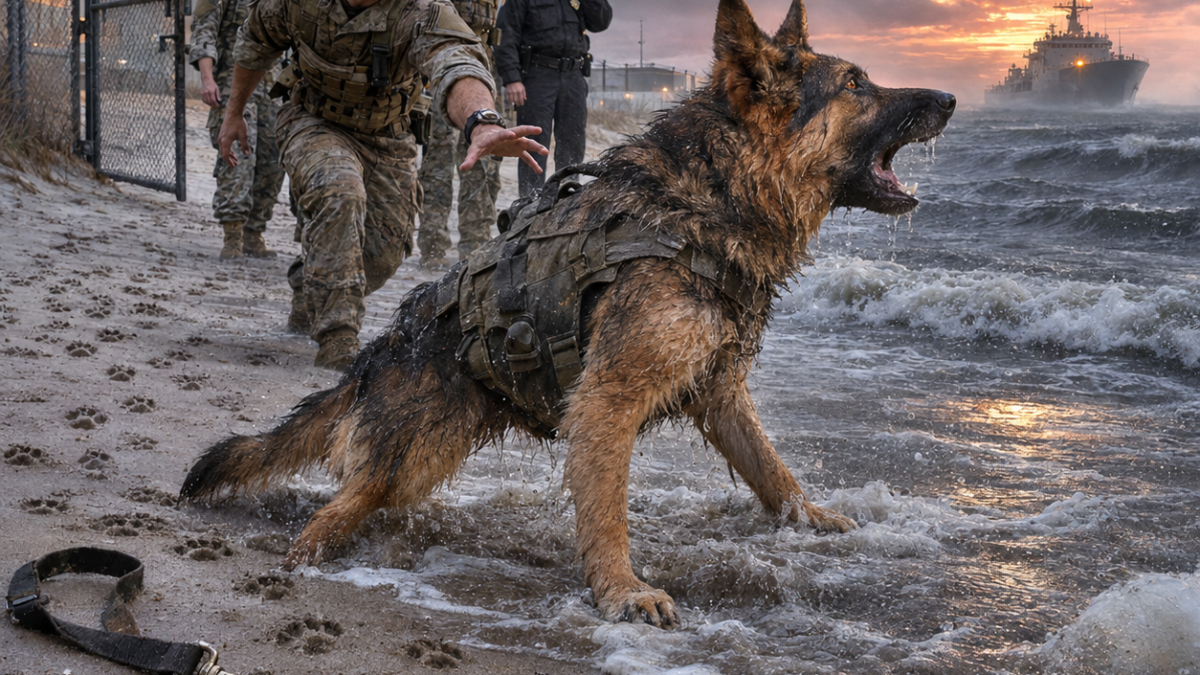
PART2
For several seconds, Colonel Williams forgot Shaun was beside him.
Forgot Mendoza.
Forgot the phone.
Forgot that officers were expected to respond to information with something more useful than silence.
“Sir?”
The operations officer’s voice came through again.
“Colonel?”
Williams swallowed.
“Repeat that.”
“Captain Carter has been positively identified.”
The ocean seemed to grow louder.
“Alive?”
“Yes, sir.”
Williams closed his eyes.
“Alive.”
“Yes.”
“What condition?”
“Stable enough for transport.”
“Who else knows?”
“Command staff.”
“Family notification is underway.”
Williams turned toward Shaun.
The dog had begun trembling.
Not visibly enough for anyone twenty feet away to notice.
Williams noticed.
A vibration beneath the coat.
Breathing faster.
Eyes locked on the approaching vessel.
“How long have we known?”
“Final confirmation came overnight.”
“Why wasn’t I told?”
“Need-to-know restrictions until diplomatic handover was complete.”
Williams almost laughed.
Of course.
Years of uncertainty ended with a sentence at five-thirty in the morning.
“How many returning?”
“Three personnel and one civilian.”
“Carter among them.”
“Yes.”
Williams ended the call.
Mendoza was staring.
“Sir?”
Williams looked at him.
“He’s alive.”
Mendoza frowned.
“Who?”
“Carter.”
The sergeant stopped breathing.
“No.”
“Yes.”
Mendoza looked toward the ship.
Then at Shaun.
“No.”
His voice cracked.
Williams nodded.
“He’s on that vessel.”
Mendoza covered his mouth.
Shaun barked.
One sharp bark.
Then another.
He moved toward the water.
Mendoza grabbed the lead attached to his harness.
“Easy.”
Shaun pulled.
Not violently.
Desperately.
Williams had seen dogs alert on explosives.
Seen them track suspects.
Seen them transition from stillness to action in less than a second.
This was different.
Shaun was not responding to a trained scent cone.
The ship was still too far away.
He could not possibly know which human beings were aboard.
Williams knew that.
Logically.
Still, the timing unsettled him.
Maybe the dog recognized engine vibration.
Maybe routine.
Maybe some combination of sound, place, and heightened expectation.
Maybe humans did not understand enough to explain everything.
He no longer cared.
“Call security,” Williams said.
Mendoza looked at him.
“To remove him?”
“No.”
Williams watched the ship.
“To keep everyone else back.”
Within twenty minutes, the empty beach became organized chaos.
Military police.
Medical staff.
Command representatives.
An honor detail that had clearly been assembled with almost no notice.
A public-affairs officer begging everybody not to record anything until family notifications were completed.
The harbor access point sat farther south, but the returning personnel would be transferred to shore at the secure beach landing because of medical and security requirements.
Shaun remained where he had positioned himself.
Every few minutes he whined.
Williams crouched beside him.
“Did you know?”
The dog glanced at him once.
Then returned his eyes to the water.
“You’ve been coming here all week.”
No answer.
“Why?”
Mendoza stood nearby.
“You know he can’t explain himself, sir.”
“I’m aware.”
“Just checking.”
Williams almost smiled.
The ship grew larger.
Gray hull.
White wake.
Slow approach.
The sight pulled memories from four years earlier.
Williams had been a lieutenant colonel then.
He remembered the morning Captain Carter’s convoy was attacked.
The first report.
Incomplete.
Then casualty confirmation.
Then the missing names.
James Carter.
Thirty-two years old.
Unmarried.
No children.
Parents living in Ohio.
One younger sister.
Military working dog Shaun assigned operationally alongside him.
For the first forty-eight hours, everyone expected recovery.
Then seventy-two.
Then a week.
The longer Carter remained missing, the more people lowered their voices when speaking about him.
Shaun did not.
Dogs have no etiquette around hopelessness.
He searched.
Pulled handlers toward gates.
Sniffed aircraft cargo.
Ran toward every arriving vehicle.
For months after returning stateside, he reacted to anyone who smelled vaguely like Carter’s equipment.
A familiar detergent.
Canvas.
Certain tobacco smoke because Carter’s team leader smoked cheap cigars.
The behavior diminished.
The waiting did not.
Every year.
Same dates.
Same agitation.
Williams had once told Mendoza:
“You’re encouraging it.”
“Encouraging what?”
“The idea he’s waiting for Carter.”
Mendoza replied:
“Maybe he is.”
Williams said:
“That isn’t healthy.”
Mendoza looked at him.
“For who?”
Williams had no answer.
Now the ship was less than a mile away.
Shaun rose again.
His entire body leaned forward.
Mendoza shortened the leash.
“Easy.”
The dog barked.
Then whined.
A sound so different from his usual working voice that several soldiers turned.
Williams felt his throat tighten.
A petty officer nearby whispered:
“Does he know?”
Nobody answered.
The vessel aligned with the landing zone.
A portable gangway was positioned.
Medical personnel waited.
The first returning individual appeared.
A civilian man.
Thin.
Wrapped in a gray jacket.
Two medical staff supported him.
Applause almost started, then died because nobody had been instructed whether applause was appropriate.
The second figure emerged.
A service member.
Not Carter.
Shaun watched.
Still.
Third.
Another serviceman.
Shaun’s breathing accelerated.
Then a fourth silhouette appeared at the top of the gangway.
The man stopped.
Williams knew immediately.
James Carter looked older by more than four years.
Too thin.
Hair streaked with gray at the temples.
Beard recently trimmed but uneven.
He used a cane in his right hand.
His left shoulder sat slightly lower than the other.
His uniform had been replaced with plain recovery clothing—dark trousers, Navy jacket, boots.
No rank visible.
No ribbons.
No symbol of what he had once been.
But the face was James.
Alive.
Carter looked toward the beach.
His gaze moved over the medical personnel.
Officers.
Honor detail.
Then stopped.
Shaun screamed.
That was the only word Williams could later use.
A bark broke into a whine and something almost like a cry.
Carter froze.
His cane slipped.
A medic grabbed his elbow.
James did not seem to notice.
“Shaun.”
The name barely carried over the water.
The dog exploded forward.
Mendoza lost the leash.
Or let go.
He never admitted which.
“Shaun!”
The Malinois ran.
Sand sprayed behind him.
Military police stepped aside.
Medical staff shouted.
Williams did nothing.
James descended the last few steps too quickly.
His weakened leg buckled.
He dropped to one knee.
Shaun reached him.
For half a second the dog stopped.
Just stopped.
Four feet away.
Staring.
James stared back.
Nobody moved.
Years compressed into that distance.
Then James opened his arms.
Shaun hit him.
Hard.
Carter fell backward into the sand.
The dog climbed across his chest, whining, licking his face, pawing his shoulders, pressing his entire body into him as though physical contact alone could prevent disappearance.
James laughed.
Then sobbed.
Then tried to speak.
“I came back.”
Shaun whined louder.
“I came back, buddy.”
The dog buried his muzzle under Carter’s chin.
James held him.
“I told you.”
His voice broke.
“I told you I’d come back.”
Colonel Williams looked away because suddenly seeing seemed intrusive.
Around him, soldiers were crying.
Mendoza openly.
The public-affairs officer had stopped pretending professionalism.
A medic wiped her face.
The honor guard maintained formation but several men had wet eyes.
Shaun did not care.
James did not care.
For several minutes, rank stopped existing.
There was only a man who had spent four years surviving somewhere far from home and a dog who had never accepted the conclusion everybody else slowly learned to live with.
Eventually the medical team needed to move Carter.
Shaun refused.
Not aggressively.
He simply positioned himself against James’s left leg and would not step away.
The medic said:
“Captain, we need to get you evaluated.”
James nodded.
“Shaun.”
The dog looked up.
“Heel.”
Instant obedience.
The first command in four years.
Shaun moved into position.
Mendoza whispered:
“Oh, come on.”
Williams looked at him.
“What?”
“That shouldn’t still be that clean.”
James heard.
He smiled through tears.
“He always was smarter than us.”
Shaun’s tail moved.
They walked together toward the medical vehicle.
Slowly.
James with cane.
Shaun matching every step.
The dog that had spent years looking toward the horizon was finally walking away from the ocean.
That evening, details remained limited.
James was transferred to a military hospital.
Shaun initially could not go inside certain clinical areas.
The dog reacted badly.
Paced.
Refused food.
Stared at the doors.
Williams intervened.
Not because he believed rules should disappear for emotional stories.
Because medical staff eventually agreed James’s psychological response improved markedly when Shaun was nearby.
The dog was cleared for controlled visitation.
James slept for fourteen hours.
Shaun slept beside the bed.
The first time Williams visited, James was awake.
He looked smaller in hospital clothing.
Shaun lay against the bed frame.
“Colonel.”
Williams pulled up a chair.
“Captain.”
James gave him a tired smile.
“Still captain?”
“You’ll have to argue with personnel.”
“I’m too tired.”
“Good.”
Silence.
Williams looked at Shaun.
“He’s been escaping.”
James’s eyes shifted.
“What?”
“Base.”
“Why?”
“To the beach.”
James stared.
“How often?”
“This week? Every morning.”
“No.”
“Yes.”
“Same place?”
“Yes.”
James’s eyes filled.
Williams continued.
“Apparently you used to train there.”
James looked toward Shaun.
“Before deployment.”
He swallowed.
“I’d bring him down before sunrise.”
“He loved the water.”
Shaun opened one eye.
James whispered:
“Did you remember?”
Williams said:
“He sat facing the ocean.”
James covered his face.
For a moment, Williams regretted telling him.
Then James lowered his hands.
“Every year?”
“Not exactly the escape behavior.”
“Mendoza says he became restless around the anniversary.”
James nodded slowly.
“I counted years too.”
Williams leaned forward.
“You knew the date?”
“How could I not?”
His voice changed.
“Every year I thought, if Shaun survived, maybe he remembers.”
Williams was silent.
James continued.
“There were nights I convinced myself he died.”
“Other nights I thought he was waiting.”
“What kept you alive?”
The question came out before Williams could decide whether it was appropriate.
James looked toward the ceiling.
“Several things.”
“Training.”
“Anger.”
“Other prisoners.”
“Thinking about my parents.”
“My sister.”
Then he looked at Shaun.
“And him.”
The dog’s ears moved.
James smiled faintly.
“I used to picture him getting old.”
“Mad at me.”
“Still waiting by a door.”
Williams felt his throat close.
“That sounds cruel.”
“It was useful.”
James took a breath.
“The people holding us wanted time to become meaningless.”
“No dates.”
“No clocks.”
“No seasons if they could help it.”
“So I built my own calendar.”
Williams listened.
“Shaun’s birthday.”
“My sister’s birthday.”
“The day my parents got married.”
“The day I first handled Shaun.”
“The day we used to go to that beach.”
James looked out the hospital window.
“I would repeat them.”
“Again.”
“Again.”
“Because if I remembered a future date, I could imagine reaching it.”
Williams asked quietly:
“Did you believe rescue would come?”
James smiled without humor.
“Depends which day you’re asking about.”
That honesty mattered.
“Some days yes.”
“Some days I only believed in the next hour.”
“Sometimes the next five minutes.”
He looked at Shaun.
“But I never let myself believe nobody remembered me.”
Shaun stood.
Walked to the bedside.
Placed his chin beside James’s hand.
James curled his fingers into the fur.
“Especially him.”
Over the next week, James’s story emerged slowly.
He had been captured with an interpreter named Farid Rahmani.
They were moved repeatedly.
Sometimes separated.
Eventually joined by two other detainees from another coalition unit.
Conditions varied.
Some months brutal.
Others merely bleak.
Negotiations happened without their knowledge.
One attempted rescue failed before reaching the holding site.
James never heard about it until years later.
A change in regional power eventually created an opening.
A local faction transferred custody through intermediaries.
Months of secret negotiation followed.
Then medical verification.
DNA.
Family notification held until extraction was physically secured.
That was why Williams only received confirmation hours before the ship appeared.
James’s parents had been informed the night before.
They flew in the following morning.
His mother, Margaret Carter, entered the hospital room and stopped.
James stood too quickly.
His knee buckled.
She reached him before the nurse did.
For a long time, neither spoke.
His father, Robert, stood behind them with both hands over his face.
Shaun watched.
When Margaret finally noticed the dog, she broke again.
“You too?”
Shaun wagged.
James laughed through tears.
“He waited.”
Margaret knelt slowly.
Her knees were older than four years earlier.
She held Shaun’s face.
“Thank you.”
James said:
“Mom, he’s a dog.”
“I know.”
“Then why are you thanking him?”
She looked at her son.
“Because I need to thank something.”
Nobody argued.
His sister Emily arrived that afternoon.
She slapped James’s shoulder.
Then hugged him.
“You’re horrible.”
James laughed.
“For what?”
“For making us wait four years.”
“I’ll schedule better next time.”
She started crying.
“Don’t joke.”
“I have to.”
“No, you don’t.”
James looked at her.
Then cried too.
Shaun moved between them.
Emily knelt.
“You got old.”
The dog sneezed.
James said:
“Careful.”
“He’s sensitive.”
Emily stroked the gray beginning around Shaun’s muzzle.
“You waited for him?”
Shaun looked toward James.
Emily shook her head.
“You’re both ridiculous.”
That became family language.
Ridiculous meant alive.
Ridiculous meant together.
Ridiculous meant the nightmare had ended enough for teasing to return.
But recovery was not a straight line.
James had survived.
That did not mean he simply resumed being the person who left.
He woke screaming.
Could not tolerate closed doors.
Sat facing exits.
Hated being touched unexpectedly.
Food insecurity appeared in strange ways.
He hid crackers in drawers.
Kept bottled water beside the bed.
One nurse discovered three pieces of bread wrapped in napkins inside his nightstand.
James was embarrassed.
The psychologist was not.
“Your body learned shortage.”
James stared.
“I know I’m safe.”
“Your body doesn’t believe you yet.”
Shaun had his own habits.
He followed James everywhere.
If James entered the bathroom and closed the door, Shaun scratched once.
Then sat outside.
If medical staff wheeled James for imaging, Shaun watched the hallway until he returned.
The first time James spent a night in a restricted unit where Shaun could not stay, the dog refused dinner.
Mendoza stayed with him.
At 2 a.m., he called Williams.
“He’s still awake.”
“So?”
“He’s lying against the door.”
Williams sighed.
“What do you want me to do?”
“I don’t know.”
“You called me.”
“I needed someone else to feel bad.”
“Effective.”
The next morning, James returned.
Shaun ate.
No one called it coincidence anymore.
Two weeks later, a question nobody wanted arrived.
What happened to Shaun now?
Technically, he remained military property.
James’s return did not automatically transfer the dog.
Shaun was eleven.
Past normal operational prime.
He had already been placed on reduced-duty status because of age and recurring hip stiffness.
Mendoza had assumed retirement was approaching.
Before James’s return, the likely placement was with a qualified former handler or approved adopter.
Now everyone knew what the obvious answer seemed to be.
Still, process mattered.
Colonel Williams visited James with a folder.
The captain looked suspicious.
“That face means paperwork.”
“It does.”
“No.”
“You haven’t read it.”
“Still no.”
“Shaun retirement request.”
James sat straighter.
“What?”
Williams placed the folder on the table.
“Veterinary command recommends retirement.”
“Because of me?”
“Because he’s eleven.”
Williams looked offended.
“The universe did not wait for your dramatic return before aging the dog.”
James smiled.
“Fair.”
“Hip degeneration.”
“Some hearing loss.”
“Slower recovery.”
“He’s still capable.”
“I know.”
“But he’s earned retirement.”
James looked at Shaun.
The dog slept beside the window.
“Who gets him?”
Williams stared.
“Who do you think?”
James looked up.
“Don’t.”
“What?”
“Don’t make me hope until it’s signed.”
Williams understood.
Four years of uncertainty changes a person’s relationship with possibility.
“Fine.”
He opened the folder.
“Retirement approval is not adoption approval.”
James nodded.
“Separate process.”
“Home assessment.”
“Veterinary responsibility.”
“Financial responsibility.”
“Behavioral considerations.”
James almost laughed.
“I handled him in combat.”
“And now you’ll handle him around Amazon deliveries.”
“More dangerous.”
Williams continued.
“Do you intend to remain in service?”
James’s expression changed.
“I don’t know.”
That question was larger.
Before capture, the Army had been the central structure of his adult life.
Now wearing uniform again felt both comforting and impossible.
He had not decided.
Williams said:
“You don’t need to decide today.”
“Good.”
“The dog part, however, requires an answer.”
James looked at Shaun.
“Yes.”
“You want him?”
“Yes.”
“Even with aging-care costs?”
“Yes.”
“Medication?”
“Yes.”
“Mobility support?”
“Yes.”
“Possible behavioral issues?”
James looked at Williams.
“Colonel.”
“Right.”
The process took nine days.
James hated all nine.
Every morning he asked:
“Update?”
Every afternoon:
“Update?”
Williams eventually blocked him for two hours.
When approval came, they held no grand ceremony at first.
Just an office.
James.
Williams.
Mendoza.
Veterinarian.
Property officer.
Shaun.
The documents were signed.
Ownership transferred lawfully.
James read every page.
Twice.
Mendoza complained.
“You never read paperwork this carefully before.”
“I disappeared for four years.”
“Different skill set.”
The property officer handed James the final document.
“Captain Carter, effective today Shaun is formally retired and transferred into your care.”
James stared.
“He’s mine?”
The officer smiled.
“He’s yours.”
James looked at the dog.
“No.”
Everyone turned.
James crouched.
“Not mine.”
He scratched Shaun’s neck.
“We’re home.”
Mendoza looked away.
Williams pretended to study the file.
The veterinarian cried openly.
Nobody teased her.
A formal retirement ceremony happened three days later.
Small.
Gray sky.
Ocean visible beyond the training grounds.
James wore uniform.
It felt strange.
Too clean.
Too familiar.
Shaun wore a ceremonial harness.
Captain Wilson—another officer who had worked with James earlier—read the service summary.
Years of work.
Deployments.
Detection missions.
Search operations.
Recovery support.
Then the unusual final line:
For steadfast service beyond expectation and extraordinary loyalty to assigned personnel.
James almost objected.
Shaun would have hated praise.
Or loved the attention.
Hard to know.
A small retirement badge was attached to the harness.
James received a unit commendation related to his pre-capture service and recovery cooperation.
He barely looked at it.
Afterward, Williams walked beside him.
“Good ceremony.”
James nodded.
“Too many speeches.”
“You’re an officer. Complaining about speeches is treason.”
James smiled.
They reached the beach.
Same beach.
Shaun immediately pulled toward the water.
James let him.
They walked slowly.
No leash tension.
No orders.
Shaun stopped at the place he had waited.
James knew because Mendoza had marked it mentally.
A patch beside the dune fence.
James crouched.
“This is where?”
Mendoza nodded.
“Every morning that week.”
“And other years?”
“Sometimes farther down.”
James looked at the horizon.
For several minutes he said nothing.
Then:
“I used to imagine this.”
Williams waited.
“What?”
“Not exactly.”
James pointed to the water.
“I didn’t know where Shaun was.”
“But when things got bad, I pictured him somewhere looking for me.”
He laughed softly.
“Probably unrealistic.”
Mendoza said:
“He escaped a military installation four days in a row to sit here.”
James looked at him.
“Fair.”
He rested one hand on Shaun’s back.
“I pictured him refusing to believe I was gone.”
Williams asked:
“Did it help?”
“Yes.”
James answered immediately.
“Even if it was imaginary.”
Shaun looked up.
James smiled.
“Turns out I underestimated you.”
The weeks after discharge from the hospital were harder than the reunion footage suggested.
James moved temporarily into a small house near his parents rather than return immediately to the apartment he had lived in before deployment.
Too many preserved objects.
His family had packed his belongings years earlier.
Opening those boxes felt like excavation.
Old boots.
Coffee maker.
Books.
A shirt still smelling faintly of the detergent he used before capture.
Shaun’s old toys.
One rubber ball cracked with age.
James sat on the floor holding it.
Shaun sniffed.
Then took it from his hand.
James laughed.
“You remember this?”
The dog chewed once.
Dropped it.
Apparently not impressed.
Normality returned through stupid moments.
Dog hair.
Vet appointments.
Coffee.
Grocery lists.
James learning how to sleep in a bed again.
He often chose the floor.
Shaun approved.
His therapist, Dr. Rebecca Lang, did not.
“You have a mattress.”
“I know.”
“Use it.”
“Floor feels safer.”
“Why?”
“No space underneath.”
She waited.
James understood.
Fear of hidden spaces.
Doors.
Footsteps.
He sighed.
“I hate therapy.”
“Very original.”
Shaun attended some sessions.
James talked more when his hand was resting on the dog.
Dr. Lang noticed.
Did not comment every time.
One afternoon she asked:
“Why do you think Shaun kept returning to the beach?”
James smiled.
“Because he’s stubborn.”
“Anything else?”
“He associated it with me.”
“Does that make you feel guilty?”
“Yes.”
There.
Immediate.
“Why?”
“He waited.”
“You were captive.”
“I know.”
“You did not choose not to return.”
“I know.”
“Then why guilt?”
James looked down.
“Because he didn’t understand.”
Dr. Lang waited.
“I hate thinking he believed I abandoned him.”
Shaun lifted his head.
James’s eyes filled.
Dr. Lang said:
“You’re assigning human interpretation to him.”
“I know.”
“But let’s assume for a moment he did experience something like abandonment.”
James swallowed.
“What does that make you responsible for?”
“I don’t know.”
“Were you able to come home?”
“No.”
“Were you able to send word?”
“No.”
“Did you choose the separation?”
“No.”
“Then perhaps grief occurred without guilt being required.”
James stared.
That sentence was harder than it sounded.
He had lived four years with guilt woven into survival.
Why was he alive when others were not?
Why had the convoy taken that road?
Why had Farid been separated later?
Why had Shaun been left?
Why had his parents suffered?
Guilt gave pain a reason.
If nobody was guilty, then terrible things could simply happen.
That frightened him more.
Shaun had no interest in philosophy.
He nudged James’s hand until he resumed petting him.
Dr. Lang smiled.
“Good therapist.”
“Terrible confidentiality.”
Months passed.
James grew stronger.
Gained weight.
Cane became occasional instead of constant.
Sleep improved.
Nightmares did not disappear.
They became less frequent.
He began driving again.
The first time he approached a tunnel, he pulled over.
Shaun waited in the passenger seat.
James breathed.
Ten minutes.
Then drove through.
On the other side, he laughed.
“Ridiculous.”
Shaun sneezed.
“Supportive.”
The dog aged too.
His hips worsened.
James built a ramp into the back of the SUV.
The first version was too steep.
Shaun refused it.
James rebuilt.
His father watched.
“You were an engineering officer?”
“No.”
“Obvious.”
James glared.
Robert smiled.
Family teasing felt miraculous.
One Sunday, Margaret served dinner.
James sat at the table where his childhood photographs still hung.
Emily asked:
“When did you know you were coming home?”
James looked at her.
“Never.”
She frowned.
“What do you mean?”
“I hoped.”
“But when did you know?”
“On the ship.”
“That late?”
“Yes.”
He cut his food slowly.
“Until the final transfer, I assumed something could go wrong.”
Emily looked toward Shaun sleeping beneath the table.
“So when you saw the coast?”
James smiled faintly.
“When I saw the coast, I believed it.”
His mother asked:
“And when did you know Shaun was there?”
James stopped.
“I didn’t.”
“What did you think when you heard him?”
James closed his eyes.
“One bark.”
He smiled.
“I knew before I saw him.”
Margaret started crying.
James groaned.
“Mom.”
“You were captured for four years. I’m allowed.”
Fair.
He continued.
“The sound…”
He searched.
“It was like four years collapsed.”
“Everything I had imagined.”
“Every night I thought he might be alive.”
“Every night I thought maybe he wasn’t.”
Then:
“He barked.”
James looked toward the dog.
“And suddenly one question was answered.”
Emily asked:
“What question?”
James smiled.
“Was I remembered?”
Nobody spoke.
That became one of the deepest wounds captivity left.
Not fear of death.
Fear of disappearance.
People continuing.
Names fading.
Photographs being packed away.
The world adjusting until your absence became normal.
Shaun’s waiting did not erase that fear.
It answered it.
Yes.
You were remembered.
By a dog.
By family.
By soldiers.
By people who never stopped working through channels James never saw.
He had not vanished.
He had only been unable to see the remembering.
That distinction slowly healed him.
A year after the return, the base invited James to the anniversary ceremony for missing and recovered personnel.
He almost declined.
Then accepted.
Shaun attended.
They stood near the same beach.
Not exactly where the ship had landed.
Close.
Families of still-missing personnel attended too.
That changed the tone.
James felt uncomfortable being the happy ending in a place where other people still had none.
A woman approached.
Her brother had been missing seven years.
She looked at Shaun.
“This is him?”
James nodded.
She smiled.
“He waited.”
“Yes.”
“My brother had a dog.”
James did not know what to say.
She continued.
“She died two years ago.”
His throat tightened.
“I’m sorry.”
“She waited by his bedroom door.”
James looked down.
“I used to think that meant he was coming back.”
Her voice did not break.
“Now I think it just meant she loved him.”
James looked at her.
She smiled sadly.
“That can be enough.”
That conversation changed his understanding of Shaun.
The dog’s waiting was not prophecy.
Not supernatural certainty.
Shaun did not know a ship would appear.
He knew absence.
Memory.
Habit.
Attachment.
He returned to the beach because something in that place remained connected to James.
The ship arriving did not prove loyalty controls fate.
It proved James was extraordinarily lucky.
That mattered.
At the ceremony, James spoke.
Briefly.
“I came home.”
He looked toward families.
“I know not everybody gets that sentence.”
Silence.
“So I will not tell you hope guarantees an outcome.”
He rested one hand on Shaun.
“But I will tell you that being remembered mattered to me even before I knew I was being remembered.”
He paused.
“And if you are waiting for somebody, your waiting is not wasted simply because you cannot control how the story ends.”
Some people cried.
James almost did.
Afterward, he walked Shaun along the shoreline.
No ceremony.
No cameras.
The dog sniffed seaweed.
Chased one gull for three steps.
Stopped because old hips overruled ambition.
James laughed.
“You used to be faster.”
Shaun looked offended.
Two years passed.
James chose medical retirement rather than return to full operational service.
That decision hurt.
Uniform had structured his entire adult life.
But his injuries, both visible and invisible, made continued active duty unrealistic.
He resisted the label.
Retired.
Sounded finished.
Colonel Williams corrected him.
“Transitioned.”
“Corporate nonsense.”
“Fine.”
Williams shrugged.
“Unemployed with honors.”
James laughed.
He enrolled in graduate study in emergency management and later worked with an organization supporting families of missing service members.
Not because his experience gave him answers.
Because it taught him what not to say.
He never told families:
“Stay positive.”
Never:
“Everything happens for a reason.”
Never:
“They’ll come home.”
He said:
“I’m here.”
“I can help with the paperwork.”
“Do you need someone to sit with you?”
Useful things.
Shaun sometimes came to the office.
Official title:
None.
Actual function:
Everyone’s favorite employee.
Families touched his head.
Some cried.
One boy whose father was missing asked:
“Did Shaun know Captain Carter was alive?”
James sat beside him.
“No.”
The boy looked disappointed.
“He didn’t?”
“I don’t think so.”
“Then why did he wait?”
James thought.
“Because he remembered me.”
The boy nodded.
“Is that different?”
“Yes.”
“How?”
James smiled sadly.
“You can remember someone even when you don’t know what happens next.”
The boy looked at Shaun.
“I remember my dad.”
James nodded.
“That matters.”
The child pet Shaun.
The dog closed his eyes.
No miracle promised.
No false hope.
Just memory acknowledged.
That was enough.
Shaun turned thirteen.
Ancient for a working Malinois.
He moved slowly.
Hearing weakened.
Eyes clouded slightly.
Still recognized James from across any room.
James began carrying him up stairs.
The dog hated it.
Growled mildly.
“Complain all you want.”
Shaun grumbled.
“You carried me emotionally for years.”
James adjusted his grip.
“My turn.”
One winter morning, Shaun could not stand.
James’s stomach dropped.
“Come on.”
The dog tried.
Hind legs slipped.
James lifted him.
Emergency vet.
Arthritis flare.
Nerve compression.
Medication.
Rest.
Not the end.
Yet.
James sat in the parking lot afterward and shook.
He had faced captivity.
Interrogation.
Years of uncertainty.
But watching an old dog fail to stand nearly undid him.
Emily called.
“You okay?”
“No.”
“He’s alive?”
“Yes.”
“Then today?”
James breathed.
“Today.”
She said:
“Stay in today.”
Good advice.
He brought Shaun home.
Made chicken.
Sat on the floor.
Stayed in today.
Shaun improved enough to walk with support.
Spring came.
They returned to the beach.
Not every day.
Once a month.
Shaun no longer ran.
James no longer needed him to.
They sat.
Watched ships.
Sometimes James wondered whether Shaun remembered the reunion specifically.
Probably not as a narrative.
Dogs remember differently.
Scent.
Emotion.
Place.
James stopped needing to know.
One afternoon, Colonel Williams joined them.
Now retired.
Gray-haired.
Civilian jacket.
No command voice.
They sat on folding chairs.
Shaun slept between them.
Williams said:
“You know I almost ordered Mendoza to stop bringing him here.”
“When?”
“Before you came home.”
James looked at him.
“Why?”
“I thought the behavior was unhealthy.”
“For Shaun?”
“For everyone.”
Williams stared at the sea.
“It felt like we were encouraging a dog to wait for a dead man.”
James was quiet.
“You thought I was dead?”
“Some days.”
“Fair.”
Williams continued.
“I thought acceptance was kindness.”
James nodded.
“Sometimes it is.”
“Was I wrong?”
James looked down at Shaun.
“About stopping him?”
“Yes.”
Williams smiled.
“Thought so.”
“About acceptance?”
James considered.
“No.”
The colonel looked surprised.
James continued.
“I had to accept plenty of things to survive.”
“Couldn’t control time.”
“Couldn’t control negotiations.”
“Couldn’t control where they moved us.”
“I accepted each day.”
“That didn’t mean I stopped hoping.”
Williams nodded slowly.
“So both.”
“Usually.”
The dog sighed.
Williams smiled.
“He always hated binary thinking.”
James laughed.
“Especially sit versus stay.”
They watched sunset.
Years earlier, Shaun had come there to wait.
Now he slept.
That felt right.
The final year arrived quietly.
There was no dramatic diagnosis at first.
Just appetite changes.
Longer sleep.
More difficulty standing.
James adapted.
Raised food bowls.
Support harness.
Pain medication.
Short walks.
Good days.
Bad days.
Then cancer.
Liver.
Advanced.
The veterinarian spoke gently.
James hated gentleness because it usually carried bad news.
“How long?”
“Could be weeks.”
“Maybe a few months.”
James looked at Shaun.
The dog was sleeping on the examination-room floor.
He had waited years for James.
James wanted to bargain for more months.
Another year.
Another miracle.
He knew better.
“Comfort?”
“Yes.”
“That’s the priority.”
The veterinarian nodded.
James brought Shaun home.
Told his parents.
Emily.
Williams.
Mendoza.
Captain Wilson.
People visited.
Not all at once.
Shaun received more steak in six weeks than a military working dog should legally consume.
James said retirement law protected him.
Nobody checked.
One morning, Shaun refused to rise.
James sat beside him.
The dog’s breathing had changed.
James knew.
He called the veterinarian.
Home visit.
Then drove nowhere.
Did nothing.
Just stayed.
Shaun’s head rested on his leg.
Same position as years earlier in the airport.
Different dog.
Gray muzzle.
Thin body.
Same eyes.
James rubbed behind his ears.
“You waited long enough.”
His voice broke.
“I’m here.”
Shaun breathed slowly.
“I’m not going anywhere.”
The veterinarian arrived.
James asked for time.
She gave it.
He called Williams on video.
The retired colonel cried.
Mendoza too.
Emily sat beside James.
Margaret and Robert were there.
A small circle.
No honor guard.
No ceremony.
Better.
James leaned close.
“Remember the beach?”
Shaun’s ear moved.
James laughed through tears.
“Probably not.”
He kissed the dog’s forehead.
“I remember.”
Then:
“You don’t have to wait anymore.”
The words nearly stopped him.
For years, waiting had been the symbol of Shaun’s love.
Now love meant releasing him from it.
James held him as medication was given.
Breathing slowed.
Then stopped.
No sound.
No dramatic final bark.
Just stillness.
James stayed on the floor for a long time.
Nobody pulled him away.
When he finally stood, the room felt wrong.
Exactly as it had during captivity.
A space where something essential was missing.
But this time James had been there for the ending.
That mattered.
He had no unanswered question.
No wondering whether Shaun was alone.
No imagined road.
No unverified report.
He knew.
Painful certainty.
Strangely kinder than uncertainty.
Shaun was cremated.
James scattered part of the ashes at the beach.
Not all.
He kept some in a small wooden urn beside the retired service tag.
Williams attended.
Mendoza.
Family.
No formal speech planned.
Of course someone spoke.
Mendoza.
“He escaped because none of us could convince him his shift was over.”
People laughed through tears.
Then Williams said:
“He spent years looking for one man.”
James looked at the horizon.
Williams continued.
“And when that man came home, Shaun finally stopped looking.”
James swallowed.
“No.”
Everyone turned.
James smiled faintly.
“He kept checking every room I walked into.”
Laughter.
Better.
James knelt.
Released a handful of ashes into the wind.
They scattered over sand.
Some blew back onto his trousers.
Emily laughed.
“Shaun.”
James looked down.
“Still refusing orders.”
Perfect.
Life after Shaun was quieter.
Too quiet.
James did not get another dog immediately.
People asked.
He said no.
Not because he believed replacing Shaun was betrayal.
Because he needed time.
The absence deserved acknowledgment.
Two years later, a rescue organization called.
A retired military dog needed temporary foster placement.
Eight-year-old shepherd mix named Ranger.
Former handler overseas.
Adoption delayed.
James refused.
Then accepted “for one week.”
Ranger stayed permanently.
Of course.
Different personality.
Afraid of vacuum cleaners.
Loved children.
Hated ocean water.
First beach visit, Ranger took one look at the waves and retreated twenty feet.
James laughed until he cried.
“You are definitely not Shaun.”
Ranger wagged.
Good.
He did not need to be.
That was another lesson.
Love does not honor the dead by refusing the living.
Ranger created new habits.
New jokes.
New grief eventually.
But no replacement.
Shaun remained Shaun.
Years later, the story of the beach and the ship circulated online.
As stories do, it changed.
Some versions said Shaun escaped every single day for four years.
Not true.
Others claimed the dog somehow sensed James’s ship hundreds of miles away.
Impossible.
Some said Captain Carter was officially declared dead.
He was not.
Some said James had survived entirely because he knew Shaun was waiting.
Too simple.
People wanted magic.
James preferred truth.
The truth was already extraordinary.
A dog remembered.
Returned to a meaningful place.
Repeated the behavior around the anniversary.
A ship arrived.
A missing man came home.
The dog recognized him instantly.
That was enough.
When asked in interviews whether Shaun “knew,” James always answered carefully.
“I don’t know what he knew.”
Then:
“I know what he did.”
“What did he do?”
“He kept going back.”
That was observable.
Real.
Beautiful.
No mythology required.
At sixty, James spoke at a memorial event for missing service personnel.
He brought no dog.
Ranger had died years earlier.
James stood alone near the ocean.
He told the audience:
“For a long time, people said Shaun never gave up hope.”
He paused.
“I’m not sure dogs experience hope the way we describe it.”
People listened.
“But he remembered.”
James looked toward the water.
“He returned to a place associated with me.”
“He waited.”
“And during captivity, I remembered him.”
“We were both doing something simpler than predicting the future.”
“We were refusing to let the other disappear from memory.”
The families understood that.
Waiting is often treated as passive.
It is not.
Waiting requires surviving ordinary days when nothing changes.
Eating breakfast.
Paying bills.
Answering calls.
Going to work.
Sleeping badly.
Waking up.
Again.
Again.
Again.
Shaun waited through mornings.
James waited through years without calendars.
Their reunion lasted minutes.
The waiting formed most of the story.
That was why the beach mattered.
Not because fate had chosen it.
Because repetition had.
Shaun kept returning.
The place accumulated meaning.
By the time the ship appeared, the beach was carrying years of absence.
When James stepped onto shore, that weight broke.
People called it a miracle.
James called it Tuesday.
Then Wednesday.
Then Thursday.
Because after miracles, life still has to continue.
Dogs need medication.
People need therapy.
Paperwork needs signatures.
Relationships need rebuilding.
Bodies age.
Grief returns.
That never diminished the reunion.
It made it human.
One evening late in life, James sat on the same beach with Colonel Williams.
Both old now.
Williams used a cane.
James teased him.
“Finally.”
“Shut up.”
They sat.
No dog.
No ship.
Just horizon.
Williams said:
“Do you still think about the moment?”
“Every time I come here.”
“What part?”
James considered.
“The second before he ran.”
Williams nodded.
“He froze.”
“Yes.”
“Why?”
“I don’t know.”
James smiled.
“I like imagining he was making sure.”
Williams laughed.
“As if a dog performs identity verification.”
“Shaun was professional.”
They sat quietly.
Then Williams said:
“I spent years wondering whether I should’ve stopped him escaping.”
James looked at him.
“Still?”
“Yes.”
“You would have failed.”
“Probably.”
“And if you succeeded?”
Williams waited.
James looked at the horizon.
“Maybe nothing changes.”
“The ship still arrives.”
“I still come home.”
“Someone drives Shaun to the base later.”
“He recognizes me anyway.”
Williams nodded.
“So the beach wasn’t necessary.”
“No.”
James smiled.
“But I’m glad he was there.”
That distinction mattered.
Meaning is not always causation.
Shaun did not cause James’s return.
James did not survive only because of Shaun.
The beach did not summon a ship.
Still, each mattered.
Humans live on meaning as much as facts.
As long as we do not confuse one for the other.
James eventually stopped visiting every year.
Age.
Distance.
Life.
But he kept one photograph on his desk.
Not the reunion.
He disliked reunion photographs.
Too much emotion frozen into spectacle.
The photograph showed Shaun alone on the beach after retirement.
Facing the water.
Not waiting.
Just watching.
James liked that distinction.
On the back he wrote:
Waiting ended here. Living started again.
That was how he remembered the story.
Not:
The dog waited until love brought his soldier home.
Too pretty.
Too absolute.
Instead:
A dog remembered.
A man survived.
A ship returned.
They recognized each other.
And then they were given time.
Time to walk.
Time to sleep.
Time to heal badly, then better.
Time to argue with veterinarians.
Time to sit in sand.
Time to grow old.
Time to say goodbye correctly.
That was the gift.
Not permanent reunion.
No reunion is permanent.
The gift was time neither expected to receive.
When people asked James what Shaun taught him, he rarely said loyalty.
Everyone expected loyalty.
He said:
“Presence.”
“What does that mean?”
“Shaun didn’t ask me to explain four years before he loved me again.”
James would smile.
“He didn’t ask whether I deserved to have survived.”
“He didn’t care that I was different.”
“He saw me.”
“He came.”
That was presence.
James tried to offer it to others afterward.
Missing families.
Veterans.
Friends.
His aging parents.
Eventually himself.
No fixing.
No promises.
Stay.
Sometimes that is all loyalty ever was.
Years after both James and Shaun were gone, a small plaque appeared near the beach access path.
Not commissioned by the military.
Funded by former members of Carter’s unit.
The inscription was simple.
No grand claims.
No miracles.
It read:
CAPTAIN JAMES CARTER & MILITARY WORKING DOG SHAUN
THEY WERE SEPARATED BY WAR.
THEY WERE REUNITED HERE.
NEITHER WAS FORGOTTEN.
Below that, smaller:
For all who wait.
People walked past.
Some knew the story.
Some did not.
Dogs ran along the sand.
Ships appeared and disappeared on the horizon.
Waves erased footprints.
Then new footprints replaced them.
The world continued.
Exactly as it always had.
But for one dog and one soldier, on one quiet morning, the waiting ended.
Shaun had returned to that beach again and again because something in him refused to let James become only an absence.
James had survived years of captivity by doing something remarkably similar.
He remembered.
The sound of paws.
The feel of a harness.
A dog sleeping outside his door.
Sunrise over gray water.
A promise he had once made without knowing how hard it would become to keep:
I’ll come back.
When the ship finally appeared, neither loyalty nor love had defeated time.
Time had done what time always does.
It had taken years.
Changed bodies.
Whitened hair.
Aged a dog.
Wounded a man.
But it had failed at one thing.
It had failed to make either forget.
And when James stepped onto the shore and Shaun ran toward him, that was enough.
More than enough.
The dog who had spent years facing the horizon no longer needed to watch it.
His person was finally standing in front of him.
And for the rest of Shaun’s life, whenever James walked from one room to another, the old military dog followed—not because he was still on duty, not because he feared an order, and not because he was waiting for somebody who might never return.
He followed because this time James was there.
This time James came home.
And this time, when Shaun finally stopped waiting, he did not have to stop loving.
He simply got to live beside the man he had remembered all along.








