PART2:“THAT BABY ISN’T MINE—YOU LEAVE WITH NOTHING!” My Husband Denied Our Newborn in Court Eight Days After My C-Section—He Didn’t Know the FBI Was Waiting Outside.v
PART2
Sterling turned toward Grant.
Grant’s smile remained.
For another five seconds.
I lifted the first page.
“At 11:42 last night, forty thousand dollars was wired from Apex Logistics LLC into an account designated by my former attorney, Samuel Finch.”
Grant laughed once.
“Your Honor, this is ridiculous.”
Judge Prescott raised a hand.
“Mr. Whitaker.”
I continued.
“Apex Logistics is wholly owned by Grant Whitaker.”
Sterling’s posture changed.
He looked at his client.
Grant leaned toward him and whispered something.
Judge Prescott said:
“Mrs. Whitaker, are you alleging opposing counsel paid your attorney to withdraw?”
“No, Your Honor.”
Grant smiled again.
I looked directly at him.
“I’m saying my husband tried to.”
The smile vanished.
I handed the envelope to the bailiff.
“My attorney reported the approach before accepting any money. The transfer was monitored. He withdrew because he became a material witness.”
The judge opened the envelope.
Sterling took one step away from Grant.
“Your Honor, I was not aware of any such transaction.”
I believed him.
Not because I trusted him.
Because his face had changed in a way expensive lawyers cannot fake when they suddenly realize their client may have used them inside a criminal scheme.
Judge Prescott read silently.
Then looked toward Sterling.
“Counsel, did you know about Apex Logistics?”
“No, Your Honor.”
Grant whispered:
“This has nothing to do with paternity.”
I heard him.
So did the judge.
Judge Prescott looked over his glasses.
“You will remain silent unless addressed.”
Then he looked at me.
“Continue.”
My hands were shaking.
I reached into the diaper bag.
Silver flash drive.
“I also have records concerning the DNA report.”
Sterling objected immediately.
“Your Honor, Mrs. Whitaker is not an expert witness.”
“I’m not claiming to be.”
I placed the flash drive beside the envelope.
“But the laboratory named on Mr. Sterling’s exhibit is.”
Judge Prescott looked down.
Sterling’s report carried the name:
SOUTHEASTERN GENETIC DIAGNOSTICS.
I continued.
“The accession number on that report belongs to an unrelated test performed six months ago.”
Sterling stared at the paper.
“What?”
“The lab provided an affidavit.”
Grant finally moved.
“Brooke.”
Just her name.
Quiet.
But I heard it.
Brooke’s face lost color.
I reached into the envelope and removed another page.
“The laboratory states it has never received a sample from me, my daughter, or Grant Whitaker.”
Sterling turned toward his client.
“Grant.”
Grant said:
“That’s impossible.”
Judge Prescott raised his voice.
“Mr. Whitaker.”
The room stopped.
“Not another word unless I ask you a question.”
Penny began fussing.
The sound changed me instantly.
Courtroom disappeared.
Fraud disappeared.
Grant disappeared.
My baby needed me.
I bent carefully, pain tearing across my incision, and lifted her from the carrier.
Judge Prescott watched.
His expression softened slightly.
“Mrs. Whitaker, do you need a recess?”
“No, Your Honor.”
My mother stood in the back row.
I could feel her wanting to take Penny.
I shook my head almost imperceptibly.
I needed to finish.
Sterling looked at the document again.
“Your Honor, I respectfully request time to authenticate these new materials.”
“That seems reasonable.”
Then he added:
“And I want to state clearly that the DNA report was provided to my office by my client.”
Grant’s head snapped toward him.
“You said—”
Sterling stepped back.
“I said nothing, Grant.”
The first crack.
Small.
Visible.
Judge Prescott asked:
“Mrs. Whitaker, do you have authenticated paternity evidence?”
“No final legal test yet.”
Grant leaned back again as if that saved him.
I continued.
“But I have evidence that the report he submitted is fabricated.”
Judge Prescott nodded.
“That is a different issue.”
He looked at Sterling.
“And a significant one.”
Then I said:
“I’m willing to submit Penny and myself to court-ordered testing immediately.”
Grant’s jaw tightened.
The judge noticed.
“And Mr. Whitaker?”
Grant hesitated.
Sterling whispered something to him.
Grant said:
“Of course.”
Too late.
Everyone had seen the hesitation.
Judge Prescott removed his glasses.
“I am not signing an annulment today.”
Grant’s expression collapsed.
Sterling began:
“Your Honor—”
“No.”
The judge looked toward him.
“Even if I accepted your client’s allegations as true—which I do not at this stage—a private prenuptial provision does not determine the parentage or custody of an infant.”
That was the first moment all morning that I felt the floor beneath me again.
Grant had spent three days telling everyone I was about to lose Penny because of a contract.
He had lied about that too.
The judge continued.
“This court will order expedited legal parentage testing with documented chain of custody.”
He paused.
“Mrs. Whitaker will retain physical care of the child pending further order.”
Grant stood.
“What?”
Sterling grabbed his sleeve.
Judge Prescott’s voice hardened.
“Sit down.”
Grant did.
His face had turned red.
Then the judge picked up the GBI letter again.
“I am also directing the clerk to preserve every document submitted in connection with today’s hearing.”
That frightened Grant.
I could see it.
He looked toward the doors.
For the first time, he understood the courtroom might not be the most dangerous place in the building.
Judge Prescott called a fifteen-minute recess.
I remained standing.
Grant rose.
Brooke whispered:
“We should go.”
Sterling turned around.
“No.”
They both looked at him.
“You stay exactly where you are until I have spoken with the court.”
Grant’s eyes narrowed.
“You work for me.”
Sterling stared at him.
“I represent you.”
Then, very quietly:
“Those are not the same thing.”
My mother reached me.
“Give me Penny.”
This time I did.
The second my daughter left my arms, my knees weakened.
Mom caught my elbow.
“Claire.”
“I’m okay.”
“No, you’re not.”
She guided me into a chair.
The incision felt like fire.
I pressed one hand against my abdomen.
Across the aisle, Brooke was crying.
Grant leaned close to her.
I watched him say:
“Stop.”
Not comfort.
Command.
That told me something.
I had once mistaken the way Grant controlled a room for confidence.
By the end of that day, I would understand it had always been fear.
Fear of losing control.
Judge Prescott returned.
The court reconvened.
Then something unusual happened.
The bailiff approached the bench and handed him a note.
The judge read it.
Looked toward Grant.
Then toward the rear doors.
His face became unreadable.
“Mr. Sterling.”
“Yes, Your Honor?”
“Your client is to remain in the courtroom for five minutes after adjournment.”
Sterling understood immediately.
Grant did not.
“Why?”
Judge Prescott ignored him.
He set the next hearing.
Issued the parentage-testing order.
Continued all property matters.
Directed that neither party transfer identified marital assets pending further proceedings.
Then:
“Court is adjourned.”
Everyone stood.
Grant grabbed his briefcase.
The bailiff stepped in front of him.
“You heard the judge.”
Grant looked toward the doors.
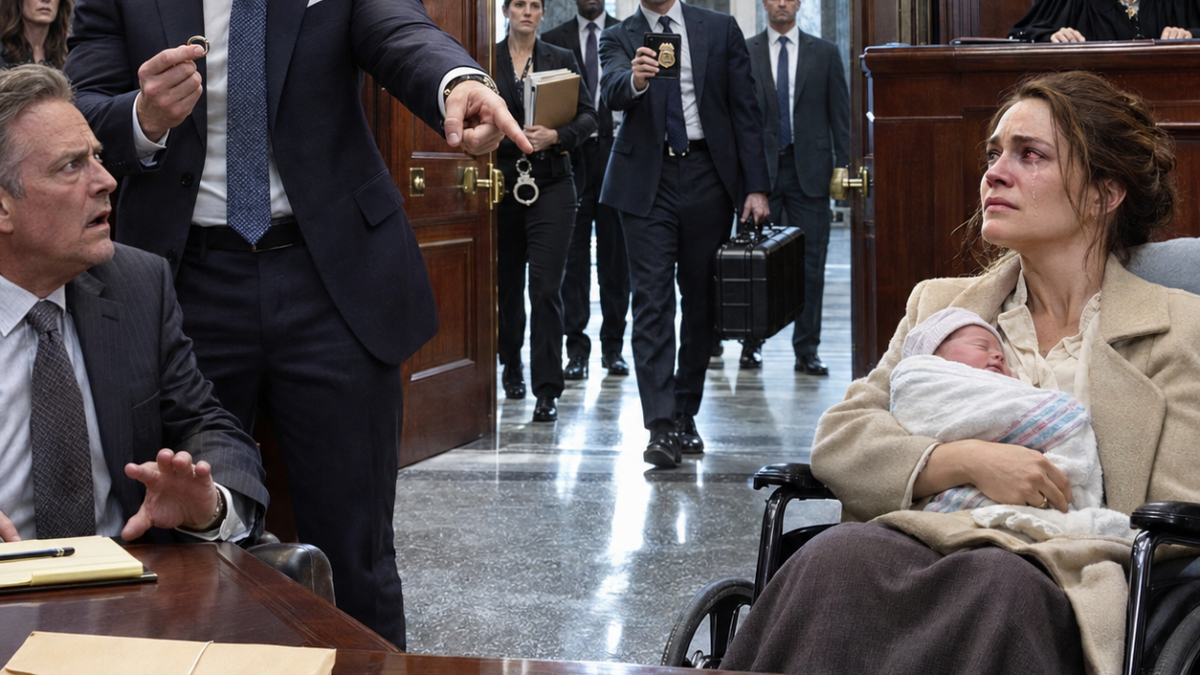
Two men entered.
Dark suits.
Federal credentials.
One woman followed.
FBI.
The courtroom went silent for the second time that morning.
Grant’s face drained completely.
The lead agent stopped in front of him.
“Grant Whitaker?”
Sterling closed his eyes.
The agent continued.
“We have a federal warrant for your arrest.”
Brooke made a sound behind him.
Grant looked at me.
Not at the agents.
At me.
“What did you do?”
That question almost broke something inside me.
Even then.
Even with a forged DNA report on the bench.
Even after a controlled bribe.
Even with federal agents holding a warrant.
His first instinct was still to believe I had done something to him.
I tightened my hand over my incision.
“Nothing you didn’t already do yourself.”
The agent turned Grant around.
Handcuffs closed.
Penny slept through it.
That remains one of the strangest details of my life.
My eight-day-old daughter slept against my mother while federal agents arrested her father ten feet away.
Brooke backed toward the benches.
“Grant?”
He did not look at her.
He kept looking at me.
Then the agents walked him out.
The courtroom erupted.
Reporters had not been inside.
But word travels faster than elevators.
By the time we reached the courthouse lobby, cameras were already gathering outside.
My mother wanted to take me through a side exit.
The FBI agent who had arrested Grant approached us first.
“Mrs. Whitaker?”
I stopped.
“Special Agent Maya Torres.”
She showed me credentials.
“I know this is not a good time, but I need to confirm you received the sealed package.”
“Yes.”
“Did you open anything before court?”
“Only after the DNA claim.”
“Good.”
“What is he being arrested for?”
She glanced toward my mother.
Then back at me.
“Federal wire fraud, money laundering, obstruction-related conduct, and witness tampering.”
My mouth went dry.
“How much?”
“That investigation is ongoing.”
“Is this about our divorce?”
“No.”
“Then what is it about?”
Agent Torres hesitated.
“Whitaker Health Distribution.”
Grant’s company.
My husband had built it ten years earlier.
Medical logistics.
Hospital equipment.
Emergency supplies.
He liked telling people he had built a company that saved lives.
I had believed him.
“What did he do?”
“Claire,” my mother said softly.
I looked at Agent Torres.
She understood.
“We’ll speak when you’re medically able.”
That was the first adult in days who looked at me and remembered I had given birth eight days earlier.
I almost cried.
Instead, I asked:
“Is Brooke involved?”
Agent Torres looked toward the courtroom doors.
Brooke had not emerged.
“She is part of the investigation.”
That answer was enough.
Mom drove me directly back to the hospital.
Not because my burns or stitches had reopened.
Because I started bleeding again in the courthouse garage.
My body had reached its limit.
The emergency-room physician examined the incision.
No major dehiscence.
No new internal hemorrhage.
Stress.
Overexertion.
Postoperative bleeding that needed monitoring.
The doctor looked at me with open disbelief.
“You went to court today?”
“Yes.”
“Eight days after surgery?”
“Yes.”
“Why?”
I began laughing.
Not because anything was funny.
Because explaining the morning sounded insane.
Then I started crying.
The doctor stopped asking.
My mother stayed beside me.
Penny slept in a bassinet the hospital provided.
At some point after midnight, Mom asked:
“How long have you known?”
“About Brooke?”
“Yes.”
I looked at the ceiling.
“Five weeks.”
Her face changed.
“You knew before Penny was born?”
“I suspected.”
“Why didn’t you tell me?”
“Because I didn’t know what was real anymore.”
That was the truth.
Grant had been manipulating my sense of reality for months.
The first sign came during my seventh month of pregnancy.
He started sleeping with his phone facedown.
That sounds cliché because betrayal has habits.
New password.
Late meetings.
Sudden criticism.
My weight.
My clothes.
The way I breathed too loudly at night.
Brooke’s name appeared constantly.
Brooke had always existed in our lives.
We had been roommates sophomore year at Georgia State.
She was funny.
Beautiful.
Restless.
The kind of person who could turn a trip to Target into a story.
After college, we drifted.
Then, three years into my marriage, Grant hired her.
Senior marketing associate.
He said she was perfect for the company.
I agreed.
Why wouldn’t I?
I trusted both of them.
The first time I worried was when Brooke began knowing things I had told Grant privately.
My fears about childbirth.
The name Penny.
A fight about Grant missing a prenatal appointment.
Brooke joked about all three at dinner one night.
I asked:
“How do you know that?”
She smiled.
“Grant talks.”
Grant squeezed my knee under the table.
“You’re not jealous, are you?”
That question trained me to silence myself.
If I objected, I was jealous.
If I stayed quiet, I was reasonable.
I chose reasonable.
Again.
Again.
Again.
Then Grant started accusing me.
Not directly at first.
“Who’s texting you?”
“Why are you staying late?”
“You and Daniel from accounting seem close.”
Daniel from accounting was sixty-one and showed me photographs of his grandchildren.
Grant still asked.
He began checking my phone.
Then apologizing.
“Pregnancy has me paranoid.”
I comforted him.
That embarrasses me now.
At thirty-six weeks, I discovered Apex Logistics.
Not because I was investigating.
Because Grant asked me to email him a tax form from his home office.
I opened the wrong folder.
APEX LOGISTICS — DISTRIBUTION RECONCILIATION
Inside were invoices.
Hundreds of thousands of dollars.
Transportation services.
Warehousing.
Emergency equipment deliveries.
The strange part?
I had never heard of Apex.
Grant ran a logistics company.
He talked about vendors constantly.
I knew most major partners.
Apex was everywhere in those spreadsheets.
I clicked the corporate-registration PDF.
Owner:
Grant Whitaker.
Why would his company pay millions to another company he privately owned?
I photographed three pages.
Then Grant walked in.
“What are you doing?”
I jumped.
“Looking for the tax form.”
He crossed the room quickly.
Closed the folder.
“You shouldn’t be in company files.”
“You told me to use the computer.”
“Not dig around.”
“I clicked the wrong folder.”
His expression softened instantly.
Too instantly.
“Sorry.”
He kissed my forehead.
“I’m stressed.”
Then he deleted the folder while I stood there.
That night, I sent the photographs to Samuel Finch.
At the time, Samuel was not my divorce attorney.
He had handled my father’s estate and a small business matter for me.
I asked:
“Does this look strange?”
He answered the next morning.
Yes. Do not confront Grant.
That frightened me.
Two days later, Samuel called.
“Claire, have you ever signed anything for Apex Logistics?”
“No.”
“Any guarantees?”
“No.”
“Any ownership documents?”
“No.”
“Do you have access to Whitaker Health Distribution’s accounting system?”
“No.”
“Then leave it alone.”
“What are you doing?”
“Checking something.”
I did not know he had contacted federal investigators through counsel he trusted.
I did not know Whitaker Health was already on the FBI’s radar.
Grant had built much of the company’s growth during the pandemic.
Medical supply contracts.
Hospital systems across four states.
Federal emergency reimbursements on some orders.
Apex Logistics billed Whitaker Health for transportation and warehousing.
According to the later indictment, many Apex invoices were dramatically inflated.
Some shipments never existed.
Some warehouse charges related to facilities Apex did not operate.
Money left Whitaker Health.
Moved through Apex.
Then into investment accounts, luxury purchases, and entities connected to Grant.
Millions.
The FBI had been building the case for nearly nine months before I ever opened that folder.
My photographs simply connected Grant personally to documents investigators had struggled to tie directly to him.
I had unknowingly walked into an active federal case.
Samuel knew enough to be afraid.
Then Grant apparently discovered I had consulted him.
How?
We never proved that completely.
My best guess was shared cloud access.
Grant managed our family phone plan.
Samuel’s number appeared repeatedly.
That was enough.
Two weeks before Penny’s birth, Grant became different.
Not cold.
Sweet.
Too sweet.
Flowers.
Breakfast in bed.
A prenatal massage.
He told me:
“Whatever happens, I want you to know I love you.”
I thought he was afraid of childbirth.
Now I know he was building an exit.
Three days later, he asked me to sign a revised prenuptial acknowledgment.
I laughed.
“We’ve been married four years.”
“It’s just estate planning.”
I refused.
He became irritated.
Then apologized.
Five days after that, Samuel advised me to prepare for divorce.
“Why?”
“Because Grant is preparing documents.”
“How do you know?”
“Because his attorney requested a copy of your original prenup from the firm that drafted it.”
I felt sick.
“What did I do?”
Samuel said:
“Claire.”
“What?”
“Stop asking that.”
I started crying.
Then my water broke at thirty-seven weeks.
Grant did not answer his phone.
My mother drove me to Northside Hospital.
Penny’s heart rate dropped during labor.
Emergency C-section.
Everything moved fast.
Blue drapes.
Masks.
Bright lights.
Someone saying:
“We need to move now.”
I remember asking:
“Where is my husband?”
No one answered.
Grant arrived forty minutes after Penny was born.
Brooke drove him.
That detail did not register until later.
He came into recovery.
Looked at our daughter.
Did not touch her.
“You okay?”
I was shaking from anesthesia.
“I almost died.”
He frowned.
“Your mom said it was under control.”
I stared at him.
Then:
“Where were you?”
“Client dinner.”
Brooke waited in the hallway.
At midnight.
During an emergency C-section.
Client dinner.
The next morning, Grant kissed my forehead.
Said he needed to leave for work.
He did not return that day.
Or the next.
On the third day, I received divorce papers in the hospital.
Petition alleging adultery.
Fraud.
Nonpaternity.
Extreme misconduct.
I vomited into a plastic basin after reading them.
Then I called Samuel.
He came to the hospital.
Read every page.
His face became very still.
“Claire, have you ever had an affair?”
“No.”
“Any relationship Grant could plausibly mischaracterize?”
“No.”
“Any reason Penny would not be his?”
“No.”
“Then breathe.”
“How can you tell me to breathe?”
“Because this petition contains claims that can be tested.”
He pointed at the DNA allegation.
“Science can be tested.”
Then he pointed at screenshots of supposed text messages between me and two men I barely knew.
“Metadata can be tested.”
Then bank records alleging hotel payments.
“Transactions can be traced.”
He looked at me.
“Truth is slower than accusation.”
I hated that sentence.
It was true.
The DNA report appeared two days later.
Zero percent.
I called Grant.
He answered.
For once.
“Explain this.”
He sounded bored.
“There’s nothing to explain.”
“You know Penny is yours.”
“No, Claire.”
“Grant.”
“You cheated.”
“I never cheated.”
“Then explain the DNA.”
“I can’t because it’s fake.”
He laughed.
“You’re delusional.”
I almost believed him.
That was how damaged my confidence had become.
For ten minutes after the call, I looked at Penny and wondered whether hospitals could make mistakes.
Whether my memory could be wrong.
Whether something impossible had happened.
Then she opened her eyes.
Grant’s eyes.
Gray with a dark ring.
My mother saw my face.
“What?”
“Nothing.”
“Claire.”
“I know who my daughter’s father is.”
Mom took my hand.
“Yes.”
That was the moment I stopped asking Grant for explanations.
Samuel began verifying everything.
The lab first.
Southeastern Genetic Diagnostics had never tested us.
The accession number was real.
The report was not.
Someone had taken a legitimate laboratory template and altered it.
The supposed medical director’s signature was copied from another public document.
Then the text messages.
A digital-forensics consultant found formatting inconsistent with my phone’s operating system version.
Two timestamps occurred while my phone was in airplane mode during a prenatal MRI.
The hotel charge?
Not mine.
A corporate Visa number ending in digits similar to mine.
Grant’s evidence was not simply weak.
It had been constructed.
Samuel prepared to attack it.
Then Grant approached him.
Not personally.
Through an intermediary named Calvin Moss.
A consultant who had worked for Whitaker Health.
The first offer:
Withdraw before the emergency hearing.
Fifty thousand dollars.
Samuel immediately contacted federal authorities.
Agents told him to continue communication.
The amount became forty thousand.
Grant insisted on wiring through Apex Logistics.
At 11:42 the night before court, the money moved.
Monitored.
Recorded.
Traceable.
Samuel withdrew because the moment the payment landed, he was no longer merely my lawyer.
He was evidence.
Now, lying in the hospital after Grant’s arrest, I finally understood why Samuel could not explain.
My mother sat beside Penny’s bassinet.
“Why didn’t the FBI arrest him before court?”
“They wanted the transfer completed.”
“How do you know?”
“Agent Torres told me.”
Mom looked furious.
“They let you walk into that courtroom alone.”
“No.”
I thought about the envelope.
“They made sure I wasn’t completely alone.”
The next morning, Agent Torres and an Assistant U.S. Attorney named Daniel Cho came to the hospital.
Cho was forty-something, calm, precise, and visibly uncomfortable questioning a woman holding an eleven-day-old baby.
He sat across from me.
“Mrs. Whitaker, the criminal case and your divorce are separate.”
“I understand.”
“We cannot direct family-court strategy.”
“I understand.”
“We can provide subpoenaed material through appropriate legal channels where permitted.”
“Okay.”
Then Agent Torres said:
“We also need to tell you that the investigation expanded overnight.”
My stomach tightened.
“Brooke?”
“Yes.”
“What did she do?”
Torres placed a photograph on the table.
A bank-transfer record.
Apex Logistics to an account held by:
B. Hayes Consulting.
Brooke.
$18,500.
Description:
Research support.
Another transfer.
$7,200.
Another.
$12,000.
“Why?”
“We believe some payments relate to document creation and communications used in your divorce.”
I felt physically sick.
“My college roommate helped fabricate evidence that I cheated.”
“That is one theory supported by evidence we’re developing.”
“Because she wanted Grant?”
Torres did not answer.
Cho did.
“Motives can be multiple.”
That turned out to be true.
Brooke wanted Grant.
She also wanted money.
And position.
She had been helping him route marketing expenses through Apex for more than a year.
Her affair with Grant started ten months before Penny’s birth.
Long enough to betray me repeatedly.
Short enough that she still apparently believed he was going to leave me and build a new life with her.
Agents had recovered messages from one of Grant’s cloud backups.
Brooke:
Once Claire is out, do we announce us?
Grant:
After the asset order. Not before.
Brooke:
You promised.
Grant:
I promised we’d be together. I didn’t promise to be stupid.
That message was the first time I felt almost sorry for her.
Almost.
Then agents recovered another.
Brooke:
The paternity thing is brutal.
Grant:
Brutal works.
Brooke:
What if she demands a real test?
Grant:
By then Finch will be gone and Prescott will freeze her out under the prenup. We only need the first order.
He had not expected a final victory.
He wanted momentum.
An emergency order.
A headline.
A court record questioning my fidelity.
Then leverage.
Grant understood something I had not.
The first story people hear often becomes the one they remember.
He wanted:
Cheating wife.
Another man’s baby.
Fraudulent marriage.
Not:
CEO under federal investigation leaves postpartum wife for her roommate.
He was laundering reputation the same way he laundered money.
Through layers.
I hired new counsel.
Her name was Evelyn Hart.
Fifty-six.
Family-law specialist.
No patience for theatrics.
She visited the hospital with a legal pad and said:
“First thing.”
“What?”
“You are not going back to court carrying an infant unless absolutely necessary.”
I almost smiled.
“Thank you.”
“Second.”
She pointed at me.
“Your husband’s lawyer is not the enemy.”
I frowned.
“Sterling?”
“He withdrew from representing Grant this morning.”
“What?”
“He notified the court that material evidence supplied by his client may be fraudulent.”
That surprised me.
“He humiliated me.”
“He advocated aggressively using information his client gave him.”
“He called me adulterous.”
“Yes.”
“Feels like the enemy.”
“Feel whatever you want.”
Evelyn shrugged.
“But legally, distinguish conduct from knowledge.”
That lesson saved me from becoming Grant.
Not everyone who stood beside him knew what he was doing.
Richard Sterling eventually provided his entire client file under court orders and legal obligations after privilege issues were sorted through judicial review.
He had emails showing Grant personally transmitted the DNA report.
He had asked:
Is chain of custody complete?
Grant answered:
Yes. Lab handled everything.
Sterling had been lied to too.
Not like me.
But enough.
The court-ordered paternity test happened when Penny was three weeks old.
A nurse swabbed her cheek.
Another professional swabbed mine.
Grant’s sample was collected under supervision at the federal detention center because he had been denied immediate release pending a detention hearing, then later released under strict conditions after bond litigation.
Every tube sealed.
Every signature documented.
No mystery.
No room for arguments.
The results arrived four days later.
Probability of paternity: 99.9998%.
I read the number.
Then read it again.
Mom started crying.
I did not.
I felt nothing for almost a minute.
Then anger came.
Not relief.
I had never doubted whose child Penny was.
The test did not tell me anything new.
It proved Grant had forced his three-week-old daughter to become evidence because destroying my reputation mattered more to him than acknowledging his own child.
I called Evelyn.
“We have it.”
“I know.”
“What happens now?”
“Now we file.”
The next family-court hearing looked different.
I did not attend in person.
Doctor’s orders.
Video appearance.
Penny slept against my chest at home while Evelyn stood in court.
Grant appeared beside his third lawyer.
That alone said something.
Judge Prescott had the real paternity test.
The laboratory affidavit.
The forensic analysis of the fabricated report.
Evidence concerning the attempted payment to Samuel.
Grant’s lawyer tried to limit discussion because of the pending criminal case.
Fair.
The judge did not need to decide criminal guilt.
He only needed to decide what evidence was credible in his courtroom.
He vacated temporary findings premised on Grant’s false submissions.
He rejected the request for annulment on the record then before him.
The divorce continued.
He expressly noted that custody would be determined according to Penny’s welfare, not a private financial clause.
Then he said something I wrote down afterward.
“Parentage is not a litigation tactic.”
Grant stared at the table.
The judge also imposed restrictions on asset transfers and ordered detailed financial disclosures.
That was when the divorce and criminal case began colliding financially.
Grant had told me Whitaker Health was worth nearly forty million dollars.
The real number depended on how much of its revenue had been distorted by Apex transactions.
Forensic accountants started rebuilding years of books.
My prenup mattered.
But not the way Grant thought.
When we married, Grant insisted on it.
At the time, Whitaker Health was growing.
My assets were modest.
He had more to protect.
The agreement kept premarital property separate.
Fair.
It also created a contractual settlement if the marriage ended after three years.
And yes, an infidelity provision could affect certain contractual payments.
What it could not do was erase statutory rights, decide custody, or magically transfer every marital asset to Grant.
His first petition had exaggerated the contract because intimidation worked faster than legal nuance.
Evelyn explained it simply.
“He wanted you too frightened to fight.”
That worked for seventy-two hours.
Then it stopped.
The deeper financial discovery revealed another reason Grant needed me branded a cheater.
Our prenup had a reciprocal misconduct provision.
If either spouse intentionally concealed substantial marital assets or committed specified financial fraud against the other, the other spouse retained the contractual settlement and could seek fees associated with uncovering the misconduct.
Grant had moved money.
A lot of it.
Not all criminal.
Some simply concealed.
A brokerage account in Nevada.
Two investment properties held through an LLC I had never heard of.
A boat titled through Apex.
Crypto holdings.
Payments to Brooke.
Hundreds of thousands in personal expenses charged to business entities.
He had been preparing to argue that my alleged adultery voided the payout before I could investigate his finances.
The divorce had not caused the financial crimes.
It had made hiding them useful.
The federal indictment arrived when Penny was seven weeks old.
Grant was charged with multiple counts involving wire fraud, money laundering, falsified corporate records, and witness-tampering conduct tied to the attempted payment to Samuel.
The indictment alleged that over four years Grant and others diverted millions from Whitaker Health through Apex Logistics using inflated or false invoices.
Brooke was not charged immediately.
That fueled gossip.
People assumed she had immunity.
She did not.
She was cooperating.
Agent Torres warned me not to read social media.
I did anyway.
Worst decision.
Some people believed Grant.
Even after the real DNA result.
Wives lie too.
Maybe she bribed the second lab.
Why was she in court eight days after surgery? Attention seeking.
Convenient that FBI arrested him. Her family probably knows people.
I threw my phone across the room.
It landed on a pillow.
My mother picked it up.
“Stop.”
“I hate them.”
“You don’t know them.”
“They hate me.”
“They don’t know you.”
That did not help.
Then Mom held Penny.
“Look at her.”
I did.
Tiny face.
Dark hair.
Gray eyes.
“She doesn’t care about strangers.”
I started crying.
“I’m scared she’s going to read all this one day.”
“She might.”
“What do I tell her?”
“The truth.”
“What truth?”
Mom looked down at my daughter.
“That her father made terrible choices.”
She looked at me.
“And that she was never one of them.”
That became my rule.
No matter what happened to Grant, Penny would never hear:
Your father ruined my life.
Because she carried half his DNA.
Children internalize things adults think are insults toward someone else.
I would not make her wonder whether half of her was contaminated.
Grant’s parents were harder.
His mother, Margaret Whitaker, called me three weeks after the indictment.
I almost ignored it.
Then answered.
“Claire.”
“Margaret.”
She was crying.
“I need to see my granddaughter.”
I closed my eyes.
Margaret had visited Penny once in the hospital.
Before Grant filed.
Afterward, silence.
“Why now?”
“That isn’t fair.”
“Neither was disappearing.”
“I didn’t know what to say.”
“You could have asked if I was alive.”
She started crying harder.
“I was afraid.”
Everyone was afraid.
Grant.
Brooke.
Margaret.
Fear had become the universal excuse.
I said:
“Afraid of what?”
“Grant said you cheated.”
“And you believed him.”
“He showed us the DNA.”
“You knew I nearly died giving birth.”
“I know.”
“You did not call.”
Silence.
Then:
“I’m sorry.”
I believed she meant it.
That did not erase anything.
I allowed supervised visits later.
Not immediately.
After consultation with Evelyn and a family therapist.
Margaret loved Penny.
That mattered separately from whether Margaret had failed me.
Her husband, Grant’s father, Robert, never apologized.
He sent one email.
This family matter has become unnecessarily destructive.
I forwarded it to Evelyn.
Then deleted it.
The criminal discovery produced the ugliest evidence four months later.
Brooke had created the fake romantic messages.
Not from scratch.
She used real photographs and names from my social-media contacts.
Two men.
A college friend named Adam.
A former coworker named Luis.
She created screenshots suggesting sexual conversations.
Grant supplied details about my schedule to make dates plausible.
Brooke also obtained a legitimate Southeastern Genetic Diagnostics template through a marketing vendor who had previously worked with the lab.
The fake DNA report was assembled on her work laptop.
The metadata survived.
So did an early draft.
Filename:
CLAIRE PATERNITY FINAL2.pdf
I laughed when Evelyn showed me.
Not because it was funny.
Because evil is often embarrassingly ordinary.
A file named FINAL2.
A typo in a timestamp.
An accession number nobody bothered to verify.
Grant had almost convinced a judge to treat me like a liar using something created between marketing presentations.
The federal government eventually charged Brooke with conspiracy, obstruction, and wire-related offenses tied to the scheme.
She surrendered.
No dramatic raid.
No handcuffs at a nightclub.
Her lawyer arranged it.
She pleaded not guilty initially.
Then continued cooperating.
Months later, through discovery, I saw her interview transcript.
Agent Torres asked:
“Why did you help fabricate evidence against Claire?”
Brooke answered:
“Because Grant said she was trying to destroy him.”
“Did you believe that?”
“At first.”
“And later?”
“No.”
“Then why continue?”
Long pause.
“Because I wanted him to choose me.”
I stared at that sentence.
Five years of friendship in college.
Birthdays.
Breakups.
Graduation.
My wedding.
She had stood beside me while I got dressed.
She knew how badly my first boyfriend’s betrayal had affected me.
And she helped fabricate adultery because she wanted my husband to choose her.
Agent:
“Did Grant promise marriage?”
“Yes.”
“Did he?”
“No.”
“What did he promise?”
“That once Claire was discredited and the asset issues were finished, we could be together publicly.”
“Did you understand Penny was his child?”
Another pause.
“Yes.”
I stopped reading.
That was the hardest part.
Brooke knew.
She watched my newborn daughter get publicly denied.
She sat in court and smiled.
I could understand greed.
Cowardice.
Even obsession.
That smile took longer.
Months later, Brooke wrote me from her attorney’s office.
I did not read the letter for six weeks.
When I did, one paragraph stayed with me.
I smiled because if I admitted even for a second what we were doing to you, I would have had to see myself clearly. Cruelty was easier when I performed certainty.
I hated how honest that sounded.
She continued:
Grant told me you were trying to take his company, that the baby would bind him to you forever, and that you had secretly cheated anyway. I knew some of that was false. I chose to believe the parts that made me feel less guilty.
That was not an excuse.
She said so.
You were my friend before he was my boss. There is no version of this where I am the victim of him enough to stop being responsible for what I did to you.
I folded the letter.
For the first time, I cried for the friendship.
Not for Grant.
Brooke.
The woman who once held my hair while I threw up after bad tequila at twenty.
The woman who helped me move apartments.
The woman who knew my father died of a stroke and slept on my couch for three nights because I was afraid to be alone.
People who betray you do not erase the people they once were.
That is what makes betrayal hurt.
If they had always been monsters, you would never have loved them.
I did not reply.
Grant’s company entered receivership before his criminal trial.
That did not mean every employee lost a job.
A court-appointed restructuring team separated legitimate operations from Apex-related transactions.
Whitaker Health still had real customers.
Real warehouses.
Real employees.
A larger medical-distribution company eventually purchased most of the healthy operating assets.
Hundreds of jobs remained.
Grant lost control.
That mattered more to him than the money.
I knew because of jail calls introduced as evidence later.
He told his father:
“They stole my company.”
Robert said:
“Who?”
“The government. Claire. Finch. Everybody.”
Not once:
I stole from my company.
Responsibility remained something Grant assigned outward.
The divorce lasted fourteen months.
Long enough for Penny to learn to sit.
Then crawl.
Then stand holding furniture.
My life became divided into two timelines.
Federal case.
Family case.
And actual life.
Actual life mattered most.
Penny’s first laugh.
First fever.
First tooth.
The first time she fell asleep gripping my finger.
There were nights I read motions while pumping breast milk.
Conference calls during nap time.
A deposition scheduled around pediatric appointments.
Evelyn once looked at me during mediation and said:
“You know what I hate about litigation?”
“What?”
“It convinces people the litigation is their life.”
I looked at the stack of binders.
“It feels like my life.”
“It isn’t.”
She pointed toward my phone.
Wallpaper:
Penny laughing in a yellow sweater.
“That is.”
I started rebuilding.
Slowly.
I returned to work part-time when Penny was five months old.
I had been a compliance manager for a regional hospital network before maternity leave.
That detail became ironic after Grant’s indictment.
My job was literally to ask whether procedures matched reality.
At home, I had failed to ask.
My therapist corrected me the first time I said that.
“You did ask.”
“Not enough.”
“You asked about Brooke.”
“He called me jealous.”
“You asked about Apex.”
“He deleted it.”
“You consulted Samuel.”
I stared.
She leaned forward.
“The lesson is not that you failed to detect deception.”
“What is it?”
“That he chose deception.”
That distinction took months to believe.
The divorce settlement eventually gave me what the law and prenup actually supported.
Not everything.
I did not “take his empire.”
Most of the company value had collapsed or become entangled in restitution claims.
I kept my separate retirement accounts.
My inheritance from my father.
My share of our home equity.
The contractual marital settlement under the prenup remained enforceable after Grant failed to establish the fabricated misconduct and financial-disclosure issues were resolved.
He was ordered to contribute toward my legal fees because of discovery violations and false filings.
Child support was calculated from legitimate available income and assets, not fantasy numbers from his former company valuation.
A trust was later established for Penny using certain non-forfeited funds and insurance proceeds, subject to court oversight.
I sold the house.
People asked why.
“It was beautiful.”
It was.
Four bedrooms.
Back patio.
Kitchen Grant renovated.
Nursery we painted pale green.
I still sold it.
The last night there, I sat on Penny’s nursery floor.
She was fourteen months old.
Already asleep at Mom’s.
The room was empty except for moonlight.
I touched the wall where her crib had been.
I thought losing the house would feel like Grant winning something.
It didn’t.
A house can be evidence of a life.
It does not have to remain the location of one.
I bought a smaller home ten minutes from Mom.
Two bedrooms.
Tiny yard.
Mortgage I could afford alone.
The first thing I did was paint Penny’s room yellow.
No reason.
I simply wanted a color Grant had never chosen.
The federal trial was scheduled eighteen months after his arrest.
It never happened.
Grant pleaded guilty.
That shocked people who expected a dramatic courtroom showdown.
His lawyers had spent months challenging evidence.
Some motions succeeded partially.
Most did not.
The controlled transfer to Samuel was documented.
Apex bank records were extensive.
Corporate emails survived.
False invoices existed.
The fabricated divorce evidence created a separate trail.
Brooke was cooperating.
Calvin Moss was cooperating.
Two former finance employees were cooperating.
Grant faced more risk at trial than he was willing to accept.
His plea covered major wire-fraud and money-laundering conduct and the attempted witness-tampering scheme.
Other counts were dismissed as part of the agreement.
That is how real cases often end.
Not every accusation becomes a conviction.
The proven core becomes enough.
At sentencing, I had the right to speak.
For weeks, I refused.
“What would I say?”
Agent Torres asked:
“The truth.”
“I’ve said the truth for two years.”
“You don’t owe the court a speech.”
That helped.
Then I decided to write one.
Not for Grant.
For Penny.
I stood in federal court holding no baby this time.
Penny was almost two.
She stayed with Mom.
Grant sat at the defense table.
Older.
Thinner.
No navy suit I recognized.
When I walked to the lectern, he looked at me.
I had not seen him in person in months.
I unfolded one page.
“My name is Claire Avery Whitaker.”
My voice shook.
Then steadied.
“Grant’s crimes affected a company, employees, lenders, and taxpayers. Other people can speak to those harms better than I can.”
I looked at him.
“I can speak to what happens when financial fraud becomes personal.”
The courtroom was silent.
“He used the same methods at home that he used in business.”
“Conceal.”
“Reframe.”
“Pressure.”
“Create a false record.”
“When I questioned him, he made the question itself the problem.”
I paused.
“When I discovered evidence, he did not tell the truth. He tried to purchase my attorney’s silence.”
Grant looked down.
“When our daughter was eight days old, he submitted a fabricated DNA report claiming she was not his.”
My voice broke.
I waited.
“He did not do that because he doubted paternity.”
I looked at the judge.
“He knew Penny was his.”
“He did it because making me look immoral was useful.”
The prosecutor’s table remained still.
“That is the part I will explain to my daughter one day.”
“Not that her father went to prison.”
“Not that he lost a company.”
“But that when he was afraid of consequences, he treated her identity as a disposable tool.”
Grant closed his eyes.
I finished:
“I do not ask the court to punish him because he hurt me.”
“I ask the court to consider the choices he made after every opportunity he had to stop.”
Then I folded the page.
Grant said my name as I walked past.
“Claire.”
I stopped.
His attorney looked alarmed.
The judge had not invited conversation.
Grant whispered:
“I’m sorry about Penny.”
Not:
I’m sorry.
About Penny.
I looked at him.
“You should be.”
Then sat down.
The federal judge sentenced Grant to a substantial term of imprisonment followed by supervised release and ordered restitution tied to the financial scheme.
The exact number of years mattered intensely to reporters.
Less to me.
Long enough that Penny would be much older when he came home.
Short enough that a life still existed afterward if he chose to build one.
Brooke received a significantly lighter sentence because of her cooperation, her lesser financial role, and her plea.
There was incarceration.
Supervision.
Restitution.
Professional consequences.
No fairy-tale immunity.
No absurd lifetime sentence.
Consequences proportionate to what prosecutors proved.
Samuel Finch returned the forty thousand dollars from the controlled account according to federal instructions after the investigation.
The first time I saw him afterward, I hugged him.
Then hit his shoulder.
“Ow.”
“You could have told me something.”
“I legally could not.”
“Something.”
“Claire.”
“I thought you abandoned me.”
His face changed.
“I know.”
That was his wound.
Not mine.
He had listened from another room while Grant’s intermediary called me a desperate postpartum woman who would “fold without counsel.”
He had wanted to warn me.
Agents told him not to compromise the operation.
He said:
“I’m sorry you walked into court believing I left.”
“You gave me the envelope.”
“It wasn’t enough.”
“No.”
I looked at him.
“But it was what you could do.”
That became another theme in my life.
People can fail you without betraying you.
Intent and limits matter.
Richard Sterling eventually sent me a formal letter too.
Not an apology for representing Grant.
He was right not to apologize for that.
Everyone deserves counsel.
He apologized for one thing.
I repeated allegations in open court that I believed had been verified. I have since changed my firm’s internal procedures for independently confirming certain scientific exhibits before emergency hearings.
I respected that.
He had learned something.
So had Judge Prescott.
At a later continuing-education panel, according to Evelyn, he referenced my case anonymously when discussing fabricated digital evidence in domestic litigation.
The system had not worked perfectly.
But parts of it changed.
Penny grew.
At two, she loved blueberries.
At three, dinosaurs.
At four, she asked:
“Where’s my daddy?”
I had prepared for that question.
Still froze.
We were sitting on the kitchen floor building blocks.
I said:
“Your daddy lives somewhere else right now.”
“Why?”
“He made some serious choices that broke important rules.”
“Was he bad?”
There it was.
The question I feared.
I picked up a red block.
“No.”
She frowned.
“But he broke rules.”
“Yes.”
“Bad people break rules.”
I smiled sadly.
“Good people can do bad things too.”
She thought.
“Did he do bad things?”
“Yes.”
“To you?”
“Yes.”
“To me?”
My throat tightened.
“Yes.”
She looked down.
“What?”
“He said something untrue about you when you were a baby.”
“What?”
I was not going to explain paternity fraud to a four-year-old.
“He said you weren’t part of his family.”
Penny looked offended.
“I am.”
“Yes.”
“Was he confused?”
I almost laughed.
“No.”
Then I corrected myself.
“Maybe in a different way.”
She stacked another block.
“Do I have to be mad?”
“No.”
That mattered most.
“You never have to feel what I feel.”
She nodded.
Then asked for juice.
Children save adults by refusing to make every conversation symbolic.
Grant began writing letters to Penny from prison when she was three.
At first, I did not give them to her.
I saved them.
Consulted a child therapist.
The letters were appropriate.
No manipulation.
No blaming me.
No legal discussion.
He wrote about books.
Birds outside the prison yard.
Memories of being a child.
He apologized in one letter.
I made choices before you were old enough to know me that hurt you and your mother. None of those choices were because of you.
That line mattered.
When Penny was older, I gave her selected letters.
Not all at once.
She could decide later what relationship she wanted.
I would not create it.
I would not destroy it.
That belonged to her.
Grant and I communicated only through a parenting application and counsel for years.
The first direct message he sent after sentencing was:
Thank you for not telling Penny I don’t love her.
I stared at it.
Then replied:
What she believes about your love will ultimately depend on what you do with the opportunities you have left.
No anger.
No comfort.
Just truth.
Brooke’s apology took longer.
Five years after the courtroom, I received an email from an address I almost deleted.
Subject:
No response expected.
I opened it.
Claire, I have rewritten this sentence for three hours and every version sounds selfish. So I will use the simplest one. I am sorry.
I read on.
She had completed her sentence.
Worked in a printing company.
Went to therapy.
No longer worked in marketing.
She wrote:
I used to tell myself Grant manipulated me. He did. That fact became the hiding place I used to avoid admitting I also manipulated you.
Then:
You were eight days postpartum when I sat behind him in court. I knew the report was false. I knew Penny was his. I smiled because I wanted you to believe you had lost. There is nothing I can say that makes that less cruel.
I stopped.
My hands shook.
Years had passed.
The wound still knew its name.
She continued.
The woman I was in that room is part of me. I do not want to erase her because then I can pretend I am incapable of becoming her again.
That sounded like therapy too.
Useful therapy.
I am not asking for forgiveness or friendship. I only want you to know that I no longer tell the story in a way that makes me innocent.
I closed the email.
Did not answer.
A month later, I did.
Three sentences.
I received your message. I believe you understand the harm more clearly now. I do not want contact beyond this, but I hope you continue living honestly.
She replied:
I will respect that.
And she did.
That was enough.
My mother moved closer when Penny started kindergarten.
Not because I needed saving.
Because Mom wanted to walk her to school.
Every morning Penny wore a backpack nearly as large as her body and told my mother facts about sharks.
I watched from the porch.
Sometimes I thought about the courtroom.
Eight-day-old Penny.
Fluorescent lights.
Grant denying her.
Then I looked at the child running down my sidewalk shouting:
“Grandma, whale sharks aren’t whales!”
Life had refused to remain inside the worst day.
I was grateful.
The silver flash drive stayed in a locked box for years.
One evening, when Penny was seven, I found it while reorganizing.
Small.
Cold.
Ordinary.
It had once felt like a weapon.
Now it looked like obsolete technology.
I almost threw it away.
Then hesitated.
My therapist asked:
“What does it mean to you?”
“Proof.”
“Of what?”
“That I wasn’t crazy.”
She waited.
I hated when therapists waited.
“That I wasn’t lying.”
“Do you still need it for that?”
I looked at her.
“No.”
“Then what do you want to keep?”
I thought about Penny.
Not the drive.
Not the fake DNA report.
Not court transcripts.
I wanted the hospital bracelet from the day she was born.
The photograph of Mom holding her.
The first tiny hat.
I wanted evidence of life.
Not only evidence of harm.
I still kept the legal documents I was required to preserve.
But I stopped keeping them in my bedroom closet.
They moved to secure storage.
The silver flash drive went with them.
That night I put Penny’s newborn hat into the memory box instead.
Yellow.
Ridiculously small.
That was healing too.
Not forgetting evidence.
Changing which evidence I touched most often.
I eventually stopped using Whitaker professionally.
Not immediately.
Penny had the name.
I wanted continuity during the case.
But five years after the divorce, I changed mine back.
Claire Avery.
The clerk asked:
“Reason?”
I smiled.
“Personal preference.”
That was all.
No speech.
No revenge.
I had once thought reclaiming my maiden name would feel dramatic.
It felt administrative.
Then surprisingly peaceful.
Penny asked whether she needed to change hers.
“No.”
“Why not?”
“Because your name is yours.”
“Can I be Avery too?”
“If you want someday.”
She thought for three seconds.
“I like Whitaker.”
“Then keep it.”
That surprised some people.
They asked why I allowed her to keep Grant’s name.
Allowed?
It belonged to her.
I would not teach my daughter that her identity had to be edited to make my pain easier.
When Grant eventually learned, he sent:
Thank you.
I did not reply.
Not every decent choice needs applause.
Seven years after the arrest, Agent Maya Torres retired from the FBI.
She invited me to a small gathering.
I almost declined.
Then went.
She hugged me.
“You look rested.”
“Insultingly so.”
She laughed.
We sat outside a restaurant.
I asked something I had never asked.
“Were you really outside the courtroom the whole time?”
“Yes.”
“How long?”
“Before you arrived.”
I stared.
“You saw me walk in?”
“Security feed.”
“You knew I was eight days postpartum?”
“Yes.”
“Why didn’t you stop the hearing?”
“We couldn’t control the family court.”
“I know.”
“We also needed Grant to commit fully to the witness-tampering transaction before arrest.”
I looked down.
“Did you know about the fake DNA report?”
“Not until Samuel gave us the affidavit that morning.”
“So if I hadn’t challenged it?”
“Your lawyer had arranged for the evidence to reach the court.”
I breathed out.
“Why let me present it?”
She smiled.
“Because Samuel said you’d want to.”
That sounded like him.
Torres became serious.
“You know what impressed me?”
“What?”
“You offered a real test immediately.”
“Why?”
“Because people who manufacture evidence often avoid neutral verification.”
I laughed.
“That’s your big insight?”
“Occupational hazard.”
Then she said:
“Grant’s biggest error was thinking everyone else saw truth the way he did.”
“What does that mean?”
“He thought evidence was whatever could win the next five minutes.”
I never forgot that.
Grant lived in short intervals.
Win the meeting.
Win the contract.
Win the hearing.
Win the headline.
He never imagined all those five-minute victories being placed beside one another.
When they were, they formed a pattern.
Patterns are harder to lie about.
By the time Penny was nine, Grant had served much of his sentence and was preparing eventually for supervised release according to his legal timeline.
He asked through the parenting app whether he could begin regular video calls.
I spoke with Penny’s therapist.
Then Penny.
“Your dad wants to talk more.”
She stared at her cereal.
“Do I have to?”
“No.”
“Do you want me to?”
“This is not about what I want.”
She frowned.
“Adults always say that when they want something.”
I laughed.
Fair.
“I want you to choose what feels okay.”
“Will he be sad if I say no?”
“Probably.”
“Is that my fault?”
My throat tightened.
“No.”
She looked at me.
“Did someone teach you that?”
“Yes.”
“Who?”
“A lot of expensive professionals.”
She laughed.
Then said:
“I want to try once.”
So she did.
Ten-minute call.
I remained nearby but out of frame.
Grant appeared older.
Gray at his temples.
He smiled when Penny appeared.
“Hi.”
“Hi.”
Long awkward silence.
Then Penny asked:
“Do you like dinosaurs?”
Grant looked startled.
“Yes.”
“Which one?”
He answered:
“Triceratops.”
Wrong answer, apparently.
Penny spent six minutes explaining why ankylosaurus was superior.
I sat in the kitchen crying silently.
Not because I wanted Grant back.
Not because I had forgiven everything.
Because my daughter was building something independent of the courtroom.
Maybe tiny.
Maybe temporary.
Hers.
Afterward she asked:
“Was that weird for you?”
“You’re nine.”
“I can tell.”
“Yes.”
She nodded.
“Sorry.”
I crouched.
“No.”
She looked at me.
“You never apologize for having a relationship with someone because I have complicated feelings about them.”
“Even Dad?”
“Especially Dad.”
That was the promise I had made when she was a newborn.
Keep her out of the emotional debt.
I tried.
Imperfectly.
But I tried.
Years earlier, Grant had attempted to use Penny as a legal weapon against me.
I would not use her as one against him.
That did not mean unrestricted access.
Safety.
Therapy.
Court conditions.
Boundaries.
All still mattered.
Compassion without boundaries becomes surrender.
Boundaries without compassion can become punishment.
I spent years learning the space between.
On the tenth anniversary of Penny’s birth, Mom brought out photographs.
Hospital.
Tiny bassinet.
My pale face.
Penny under a pink blanket.
Then one photo I had forgotten.
Taken three days after birth.
Grant standing beside the hospital bed.
His hand resting on the edge of Penny’s bassinet.
He was looking down at her.
Not smiling.
But soft.
I stared.
Mom asked:
“Want me to throw it away?”
“No.”
She looked surprised.
“He was her father in that moment too.”
Mom sat beside me.
“Are you sure?”
“Yes.”
Photographs do not become false because the future becomes ugly.
Grant had looked at his daughter.
Maybe loved her.
Then eight days later denied her because strategy mattered more.
Both facts existed.
Human beings are difficult that way.
I put the photograph into Penny’s box.
Not mine.
Someday she could decide what it meant.
The story people repeated about me became much simpler than the life I lived.
Postpartum mother exposes husband in court while FBI waits outside.
It made a good headline.
It was not the story.
The real story lasted years.
It was learning to sleep after betrayal.
Learning that a court filing could contain lies.
Learning not to panic when an official-looking document accused me.
Learning that DNA reports have accession numbers and chain-of-custody records.
Learning that attorneys can withdraw without abandoning you.
Learning that a judge can be skeptical without being your enemy.
Learning that being married to a criminal does not make you responsible for detecting his crimes.
Learning that being cheated on does not make you foolish.
Learning that a child can love a parent who hurt you without betraying you.
Learning that justice is rarely one dramatic moment.
Grant’s handcuffs were dramatic.
Justice was slower.
The fake DNA report being formally rejected.
Penny’s paternity established correctly.
My attorney’s name cleared.
The money traced.
Employees protected through the company sale.
Restitution ordered.
My home equity divided lawfully.
My daughter supported.
Grant forced to describe what he did without blaming me.
Brooke required to admit her role.
Me going back to work.
Penny learning dinosaurs.
Those were justice too.
Maybe more.
One afternoon when Penny was eleven, she came home from school furious.
A girl had told her:
“Your dad went to prison.”
I froze.
Penny threw her backpack down.
“She said it like I did something.”
I sat beside her.
“What did you say?”
“That I know.”
My heart broke.
“And?”
“She said, ‘Aren’t you embarrassed?’”
I waited.
“What did you say?”
Penny looked at me.
“I said, ‘Why would I be embarrassed about something another person did?’”
I stared.
She frowned.
“What?”
“Nothing.”
“Mom.”
“That’s a very good answer.”
She rolled her eyes.
“I learned it from you.”
I went to the bathroom afterward and cried into a towel.
There are moments you realize your child inherited more than trauma.
She inherited language for surviving it.
That was enough to make every therapy appointment worth the money.
Grant eventually returned to Georgia under supervised release when Penny was older.
Their relationship developed cautiously.
Not instantly.
No movie reunion.
He lived in transitional housing first.
Worked in a compliance-monitored operations job far below his former status.
The irony was almost excessive.
He followed conditions.
Paid restitution from earnings.
Attended therapy.
He and Penny met in supervised settings before moving toward ordinary public visits under appropriate family-court arrangements.
I did not attend most of them.
Penny came home from the first visit quiet.
“Okay?”
“Yeah.”
“Want to talk?”
“No.”
“Okay.”
An hour later:
“He looks old.”
I laughed before I could stop myself.
Penny glared.
“That’s mean.”
“You’re right.”
Then she laughed too.
Later she said:
“He cried.”
I stayed quiet.
“He said he was sorry.”
“What did you say?”
“I said I don’t know him well enough to forgive him.”
I stared.
“Where did you learn to talk like that?”
“Therapy.”
“Of course.”
She smiled.
Then became serious.
“He said that was fair.”
That told me Grant had changed at least a little.
The old Grant would have negotiated.
Explained.
Demanded.
This one had apparently accepted an answer he disliked.
Change is not proved by tears.
It is proved by what someone does after hearing no.
I knew that better than almost anyone.
Years after the case, Samuel Finch retired.
At his dinner, he told the courtroom story.
Not details protected by confidentiality.
Just one part.
“My client walked into court eight days after major surgery carrying a newborn and more composure than every lawyer in the room combined.”
I shouted from my table:
“That is not how I remember it.”
Everyone laughed.
He continued:
“She also threatened to fire me from a case I had already withdrawn from.”
“That happened.”
Afterward, he gave me something.
The original sealed-envelope copy.
The yellow highlight still there.
THE $40,000 TRANSFER TO COUNSEL WAS MADE UNDER FEDERAL DIRECTION…
I stared.
“Why do you have this?”
“Copy from my file.”
“I don’t want it.”
“I thought you might.”
“No.”
He looked surprised.
Then smiled.
“Good.”
“What?”
“You don’t need it anymore.”
Exactly.
I handed it back.
The courthouse itself changed in my memory.
For years, I could smell fluorescent dust whenever I thought about it.
Hear Grant laugh.
See Brooke’s cream dress.
Feel Penny’s weight against my incision.
Then one day, when Penny was thirteen, we passed the building downtown.
She pointed.
“Is that the court?”
“Yes.”
“The court?”
“Yes.”
“Where Dad got arrested?”
“Yes.”
She stared through the car window.
“Can we stop?”
My hands tightened on the steering wheel.
“Why?”
“I want to see it.”
Every instinct screamed no.
Then I remembered what I had told her.
Her history belonged to her too.
We parked.
Security allowed us into the public building.
Courtroom 302 was in session, so we did not enter.
We stood in the hallway.
Penny looked at the oak doors.
“You carried me here?”
“Yes.”
“You were eight days after surgery?”
“Yes.”
“That was stupid.”
I laughed.
“Your grandmother agrees.”
“Why did you come?”
I looked at her.
“Because your dad told a judge you weren’t his daughter.”
Her face tightened.
“I know.”
“I wanted the record corrected.”
“Was that for you or me?”
Good question.
“Both.”
She nodded.
Then looked toward the elevator.
“Were the FBI guys really waiting here?”
“Basically.”
“That’s kind of cool.”
I laughed.
“Please never say that to Agent Torres.”
“Can we call her?”
“She’s retired.”
“So?”
Teenagers.
I texted Torres.
Penny wants to know if being arrested by the FBI was “kind of cool.”
Her reply arrived two minutes later.
Tell her paperwork is cooler.
Penny groaned.
“Adults ruin everything.”
We left.
No panic attack.
No tears.
Just hallway.
That was another victory.
The last time Grant and I spoke alone happened years after his release.
Penny was sixteen.
She had gone into a bookstore with my mother.
Grant and I were both waiting outside after one of Penny’s events.
He said:
“Claire.”
I looked over.
He appeared ordinary.
That was strange.
For years, he had been villain, defendant, prisoner, ex-husband.
Now he looked like a middle-aged man in a jacket.
“What?”
“I need to tell you something.”
I waited.
“I knew.”
“About what?”
“Penny.”
My chest tightened.
“I knew the whole time she was mine.”
“I know.”
“No.”
He looked at me.
“I mean before the report. Before everything. There was never one second I doubted it.”
I stared.
Why tell me now?
His eyes filled.
“I used to tell myself that I convinced myself you might have cheated.”
He shook his head.
“That was another lie.”
I said nothing.
“I knew.”
“Yes.”
“I wanted the court to believe something I knew was false because I thought losing money was worse than what it would do to you.”
His voice cracked.
“And because I thought I could fix what it did to Penny later.”
That sentence chilled me.
“Later.”
“Yes.”
“You thought fatherhood could be paused for strategy.”
He closed his eyes.
“Yes.”
I looked toward the bookstore doors.
Penny was inside laughing at something Mom said.
Then back at Grant.
“Why are you telling me?”
“Because I spent years apologizing in ways that still made me less guilty.”
That was honest.
“I wanted you to know there is no version where I was confused.”
I nodded.
“Okay.”
He looked surprised.
“That’s it?”
“What do you want?”
“I don’t know.”
“Forgiveness?”
“No.”
I waited.
“Maybe.”
I considered.
“I don’t hate you.”
His face shifted.
“That isn’t forgiveness.”
“No.”
“Do you forgive me?”
I looked at the man I once loved enough to build a family with.
“I forgave myself.”
He stared.
“For what?”
“For believing you.”
His face crumpled.
I continued gently.
“That was the forgiveness I needed most.”
Penny and Mom came through the doors.
Conversation ended.
I never answered his question.
Maybe that was answer enough.
Today, Penny is older than the baby I carried into Courtroom 302 by more years than I can comfortably count.
She knows the entire story now.
Not internet version.
Not headline version.
The real one.
I showed her documents when she was mature enough.
The fake DNA report.
The real one.
Not because I wanted to poison her relationship with Grant.
Because children deserve truthful family history when they are old enough to carry it.
She read both.
Then said:
“The fake one looks official.”
“Yes.”
“That’s scary.”
“Yes.”
“How did you know?”
“I didn’t.”
She looked surprised.
“I verified.”
That became the lesson.
Not:
Trust nobody.
Not:
Official documents are lies.
Verify when stakes are high.
Ask questions.
Preserve records.
Get independent advice.
Do not let urgency force you into believing the loudest person.
Grant created urgency.
Emergency hearing.
Summary judgment.
DNA.
Prenup.
Newborn.
No lawyer.
He wanted me too overwhelmed to check.
That tactic works far beyond courtrooms.
Fear hates time.
Truth often needs it.
Penny eventually chose to study biomedical engineering.
The irony pleased her enormously.
At her high-school graduation, Grant attended.
So did Mom.
So did Agent Torres.
Samuel, despite being retired.
Evelyn Hart.
Too many adults from one terrible chapter of her infancy.
Penny walked across the stage.
Grant stood when her name was called.
So did I.
For one second, we were both simply her parents.
Not plaintiff and defendant.
Not betrayed wife and convicted husband.
Parents.
That was possible only because years of boundaries had made it safe enough.
After the ceremony, Penny took photographs.
One with me.
One with Grant.
One with both of us.
I hesitated.
Grant did too.
Penny rolled her eyes.
“Oh my God, just stand there.”
Teenagers can resolve twenty years of adult complexity with irritation.
We stood.
Not touching.
Penny between us.
Camera clicked.
I expected the photograph to feel wrong.
It didn’t.
It was not a portrait of reconciliation.
It was a portrait of reality.
Three people whose history was complicated and still existed.
Later that evening, Penny sent it to me.
I saved it.
In a folder nowhere near the legal files.
The story began with a man telling a courtroom:
That baby is not mine.
Years later, there was no argument left.
Not because DNA had finally proven what I knew.
That happened in weeks.
Because fatherhood became something Grant had to earn in actions after spending years reducing it to biology when biology suited him and denying biology when denial suited him.
Penny eventually decided what kind of father he could be in her life.
Not me.
Not Grant.
Not a prenup.
Not Judge Prescott.
Her.
That felt like justice too.
When people ask me what I remember most from that morning, they expect:
The FBI.
Handcuffs.
Grant’s face.
Brooke’s smile disappearing.
The judge refusing the annulment.
All dramatic.
All real.
But what I remember most is Penny’s weight.
Seven pounds, two ounces.
Warm against my chest.
The smell of hospital baby soap.
Her tiny breath touching the inside of my jacket while adults argued about contracts and DNA and money.
Grant thought that hearing was about what he could take from me.
He thought if he destroyed my reputation fast enough, he could keep the company, protect the money, control the narrative, and walk into a new life beside Brooke while I left carrying shame.
He misunderstood the most important thing.
I had already survived the worst part.
Not the divorce.
Not court.
Eight days earlier.
Operating room.
Bright lights.
Penny’s heart rate dropping.
A surgeon saying:
“We need to move now.”
Me lying there terrified I might never hear my daughter cry.
Then she did.
One tiny, furious scream.
Everything after that was smaller.
Grant’s lies were smaller.
His money was smaller.
His company.
His mistress.
His lawyers.
His forged report.
Even the FBI agents waiting outside.
All smaller than the fact that my daughter was alive.
That was the advantage Grant never understood.
He came into Courtroom 302 fighting to preserve an empire.
I came in holding the only thing I was absolutely unwilling to surrender.
And once the truth reached the room, he discovered something men like Grant always learn too late:
You can manufacture evidence.
You can buy silence for a little while.
You can frighten people.
Delay consequences.
Move money.
Forge reports.
Rewrite stories.
But every lie creates another record that has to survive reality.
His didn’t.
Penny did.
And so did I.








