PART2:“TEAR THAT UGLY GARAGE DOWN!” HOA Karen Demolished My Workshop Over a Paint Color—She Never Expected the Judge to Make Her Rebuild It in Brick
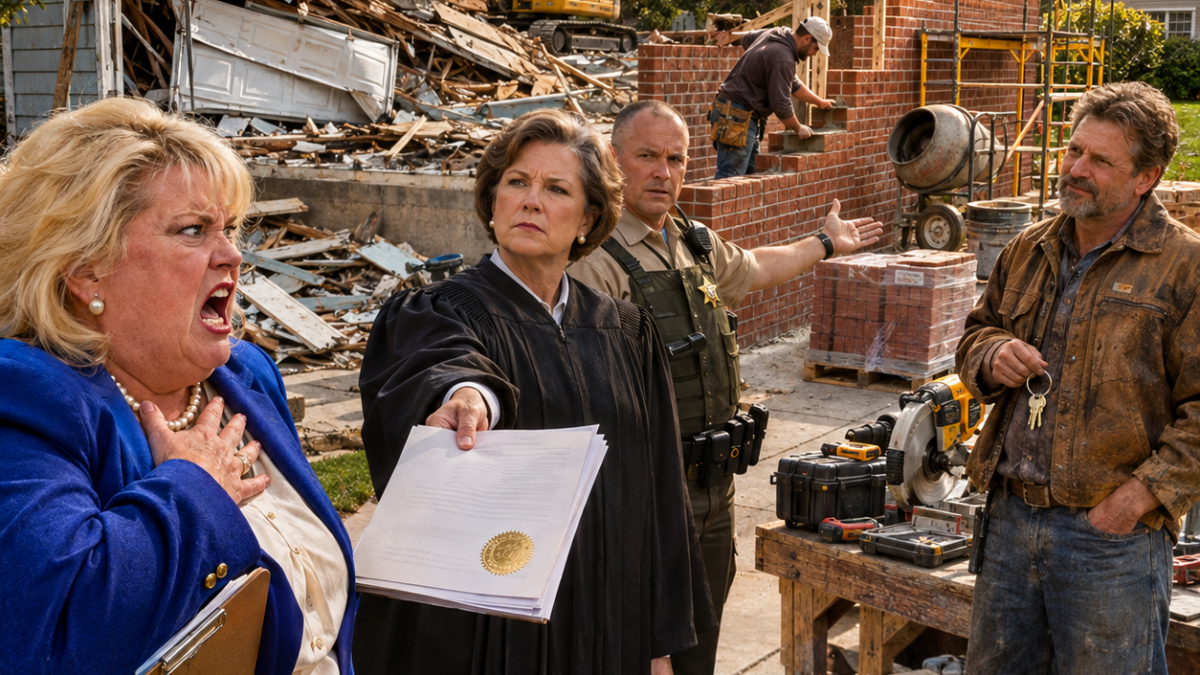
PART2
The first letter arrived Tuesday.
White envelope.
Ridgeline Estates logo.
Red stamp across the top.
FINAL NOTICE.
Which was interesting because it was the first notice I had ever received.
The stamp smeared across my thumb.
The letter ordered me to repaint the garage within thirty days.
Reason:
COLOR NOT IN HARMONY WITH NEIGHBORHOOD AESTHETIC.
No section number.
No covenant citation.
Nothing.
Just Pamela’s large looping signature at the bottom.
I went online that night.
Downloaded the recorded Ridgeline Estates covenants.
Fourteen pages.
I read them twice.
Structural modifications.
Yes.
Commercial signage.
Yes.
Parking.
Fences.
Certain landscaping rules.
Paint color?
Nothing.
Exterior color?
Nothing.
Aesthetic harmony?
Nothing.
I wrote Pamela one paragraph.
Dear Ms. Garrett, I reviewed the recorded CC&Rs for Ridgeline Estates and cannot locate any provision restricting exterior paint color. Please provide the specific section authorizing the violation.
Polite.
Short.
No insults.
She never answered.
Instead, my HOA account suddenly showed a $150-per-day fine.
Earl Dawson caught me at the mailbox.
Sixty-eight.
Retired pipefitter.
Quiet man.
One of those neighbors who knows everything because he spends most afternoons sitting where he can see the street.
“She did the same thing to the Andersons.”
“What?”
“Letters.”
He lowered his voice.
“They sold.”
“Over paint?”
“Not paint.”
“Then what?”
“Everything.”
Earl looked toward Pamela’s street.
“Fence stain. Mailbox. Landscaping. Fines kept coming.”
“How much?”
“Six grand before they gave up.”
I stared at him.
“You saying she pushed them out?”
“I’m saying they were tired.”
He walked back toward his house.
Then stopped.
“Keep your papers.”
That advice was worth more than he knew.
By the second week, I supposedly owed $2,100.
Pamela called an emergency board meeting.
I heard about it afterward.
No notice.
No agenda.
No opportunity for homeowners to attend.
Three people showed up.
Pamela.
Glenda Brooks.
Ruth Palmer, the treasurer.
Three votes.
Three yeses.
A new “resolution” appeared in everyone’s email.
My garage had to be painted white.
Only white.
Within fourteen days.
Failure would authorize “corrective action.”
I printed it.
Placed it beside the original covenants.
Then I drove to Dollar General and bought a black-and-white composition notebook.
College ruled.
$1.20.
I wrote the date on the first page.
Then every interaction I could remember.
Pamela’s first visit.
First letter.
My response.
Daily fine.
Emergency meeting.
Resolution.
At the time, I had no lawyer.
No strategy.
I just knew that when someone kept changing the story, I needed a version that didn’t change.
Two days later, I came home from work and found a bright-red sticker stuck dead center on my garage door.
NON-COMPLIANT STRUCTURE.
Eight inches wide.
Industrial adhesive.
I spent two hours with mineral spirits trying to remove it.
The solvent damaged the paint.
Left a pale rectangle in the middle of the sage green.
I photographed everything.
Printed the pictures.
Taped the torn sticker inside the notebook.
Then I messaged Pamela through the HOA portal.
Five words.
Please don’t touch my property.
The app showed she read it.
No reply.
But while checking the portal, I noticed a documents tab.
Annual budgets.
I didn’t open it that night.
I should have.
The fine jumped from $150 to $300 per day.
No explanation.
No board meeting.
No notice.
Just a number changing on a screen.
$4,200.
I stared at it.
Then laughed.
Not because it was funny.
Because once a penalty becomes ridiculous enough, fear turns into curiosity.
Who exactly was giving Pamela the authority to do this?
The answer, as far as I could tell, was Pamela.
Then she stopped relying on paperwork.
I came home Thursday and noticed the garage looked wrong before I got out of my truck.
Too bright.
Too clean.
White.
Someone had painted it white.
A full coat.
My sage green gone beneath flat latex.
I walked closer.
Paint still tacky.
I touched the siding.
White came off on my fingertip.
That smell.
Wet latex.
Sharp enough to sting my nose.
I opened the Ring footage.
11:14 a.m.
White van.
Two men.
Rollers.
Five-gallon bucket.
They worked fast.
At 12:41 a silver Lexus stopped at the curb.
Pamela stepped out.
Looked at the garage.
Nodded.
Drove away.
She had done exactly what I asked her not to do.
Entered my property.
Sent workers.
Painted my building.
I saved the footage.
Original file.
USB drive.
Cloud folder.
Screenshots.
Then I wrote everything in the notebook.
I expected to feel furious.
Instead, I felt something colder.
Pamela didn’t think rules limited her.
Rules were tools.
She could invent them when useful.
Ignore them when inconvenient.
I decided then that if this fight was going to continue, I was going to treat it like a bad electrical system.
Trace every wire.
Find every connection.
Document every failure.
That same week, flyers appeared in every mailbox.
Full-color photograph of my garage before the repaint.
The sage-green version.
Bold text beneath:
PROPERTY VALUE ALERT
THIS IS WHAT IS DRAGGING YOUR HOME VALUE DOWN.
No name.
Didn’t need one.
Everybody knew.
Neighbors stopped waving.
One person left a note under my windshield wiper.
JUST PAINT IT WHITE AND STOP MAKING TROUBLE.
I stood in my driveway reading it.
Then looked at the garage.
It was already white.
Pamela had won the color battle.
Yet she was still attacking me.
That told me something important.
The color had never been the real issue.
Obedience was.
I pulled the original covenants again.
Third reading.
This time I treated them like a wiring diagram.
Not what Pamela said they meant.
What they actually connected to.
No paint rule.
No aesthetic-harmony clause.
No board authority to invent one by simple resolution.
There were procedures for amendments.
Homeowner votes.
Recorded changes.
Pamela had used none of them.
I printed all fourteen pages.
Highlighted every relevant provision.
Then sent her another certified letter.
Please identify the recorded covenant authorizing paint restrictions and associated fines. If no such provision exists, cease all fines immediately.
Return receipt came back.
Pamela’s signature.
No answer.
Fines continued.
Then she reached into my business.
I sold furniture through Facebook Marketplace.
Small orders.
Useful extra income.
A woman in Jenks had ordered floating shelves.
Two days before delivery, she messaged:
Kyle, I’m going to cancel. Sorry.
I asked why.
She sent a screenshot.
From the official Ridgeline Estates HOA account.
Under her public Marketplace post:
BUYER BEWARE. THIS MAN CAN’T EVEN MAINTAIN HIS OWN PROPERTY.
I stared at the screen.
My hands went cold.
One lost order.
Then another.
I screenshotted everything.
Notebook.
Date.
Customer.
Lost sale.
That night, I seriously considered repainting the garage whatever color Pamela wanted and apologizing just to end it.
Then I remembered something.
It was already white.
And she was still coming.
There was no finish line.
Only surrender.
Monday morning.
6:58 a.m.
I was driving east on I-44 toward a commercial job site.
Ninety minutes from home.
My phone buzzed.
Ring motion alert.
I glanced when traffic allowed.
Yellow excavator backing into my driveway.
I pulled onto the shoulder.
Opened the feed.
Two men stepped from a flatbed.
One carried a sledgehammer.
The other unhooked a chain from the excavator arm.
For a few seconds, my brain refused to understand.
Then I realized.
They were going to demolish my garage.
My tools were inside.
Table saw.
Hand planes.
Clamps.
Cedar.
Three unfinished bookshelves.
Everything I had built over three years.
I called 911.
“Someone is demolishing my garage.”
The dispatcher asked about the HOA dispute.
“Yes.”
She explained deputies would respond but that property disputes could involve civil questions.
I shouted:
“They are physically tearing down a building I own.”
She repeated that a unit was being sent.
I called Pamela.
Voicemail.
Again.
Voicemail.
Third time.
Call ended immediately.
I turned the truck around.
Ninety-three miles.
I drove faster than I should have.
I am not proud of that.
Every few miles I checked the feed only when safely stopped or able to glance without taking my eyes off traffic.
7:22.
First sledgehammer hit.
7:39.
Excavator arm punched through roof sheathing.
8:14.
North wall collapsed.
The camera image filled with dust.
8:31.
I turned onto my street.
My garage was gone.
Not damaged.
Gone.
Splintered studs.
Broken drywall.
Roofing nails.
Insulation.
Tools crushed beneath debris.
Cedar boards snapped.
The excavator idled on my lawn.
Diesel hung in the air.
The operator sat in the cab eating breakfast.
I parked.
Walked onto the slab.
Dangling conduit.
Severed junction box.
Three years of tools mixed with broken wood.
I did not yell.
I took photographs.
Eighty-six of them.
Wide shots.
Close shots.
License plate.
DOT number.
Operator.
Flatbed.
Destroyed tools.
Damaged wiring.
Every angle.
Then I called the demolition company.
“Who hired you?”
Office manager answered.
“Pamela Garrett.”
“Amount?”
Pause.
“Sir—”
“I’m the property owner.”
Longer pause.
“Two thousand eight hundred.”
“Did she provide a demolition permit?”
“I’d have to check.”
“Check.”
I wrote the manager’s name.
Time.
Amount.
Added it to the notebook.
Then I drove to the county building department.
“Was a demolition permit issued for my address?”
The clerk searched.
“No.”
I asked for written confirmation.
He gave me a copy of the search result and guidance on requesting formal records.
I put it in the folder.
That night, Pamela posted a photograph of my empty slab to the HOA Facebook page.
Caption:
HANDLED.
Fourteen likes.
Glenda left a heart.
Ruth wrote:
Finally.
I screenshotted all three.
Then I sat in my truck in the driveway because I could not make myself walk into the house.
The cedar smell was disappearing.
The diesel remained.
Pamela had destroyed something I built.
Worse, she was proud of it.
The first week after demolition, I barely slept.
I would come home.
Park.
Stare at the slab.
By Wednesday the diesel smell faded.
By Friday the cedar was gone.
Only concrete.
Open air.
Dangling conduit.
I knew enough electrical work to isolate and make the damaged wiring safe.
But I left one disconnected section visible for photographs until my attorney later told me the documentation was sufficient.
At that point I did something I should have done sooner.
I requested HOA financial records.
Ruth Palmer, treasurer.
Three years.
Budgets.
General ledger.
Invoices.
Check register.
Board minutes.
She ignored me.
Three weeks.
I sent the request again by certified mail.
This time, she produced only one year.
Not everything I asked for.
But enough.
Tuesday night, kitchen table.
Highlighter.
Calculator.
Dues.
Landscaping.
Insurance.
Pool.
Legal reserve.
Then:
LANDSCAPING MAINTENANCE — $2,800.
I stopped.
Same amount.
Demolition company.
I pulled the check register.
Check 1184.
$2,800.
Sooner State Demolition.
Memo:
LANDSCAPING.
Signed:
Pamela Garrett.
I stared at it.
Then pulled the emergency-board minutes.
Paint resolution.
No demolition authorization.
No vote approving $2,800.
No discussion of destroying my garage.
Pamela had apparently used association money to hire the demolition company and coded it as landscaping.
I had four things now.
Property destroyed without my permission.
No county demolition permit.
HOA money used without a clear board authorization in the records I received.
The expense mislabeled.
Plus Ring footage.
Photos.
Company confirmation.
Facebook brag.
Notebook.
I searched for a lawyer.
First wanted a $5,000 retainer.
Second didn’t handle HOA cases.
Third never returned my call.
Fourth was Nora Sullivan.
Twenty-nine.
Two years out of law school.
Small office between a nail salon and phone-repair shop on South Peoria.
I almost left before going inside.
Then remembered that Pamela had probably assumed I could not afford to fight.
I walked in.
Nora listened for forty-five minutes.
Did not interrupt except to ask dates.
When I finished, she looked at the folder.
Then the notebook.
“Did you make this?”
“Yes.”
“All of it?”
“Yes.”
She opened the Ring-video index.
Photos.
Financial records.
Certified receipts.
“This is better organized than half the discovery files I get from opposing counsel.”
“I’m an electrician.”
“What does that have to do with it?”
“I label wires.”
She laughed.
Then became serious.
“This isn’t a maybe case.”
I looked at her.
“What is it?”
“A very strong property-damage case with association-governance issues attached.”
“Against the HOA?”
“Maybe some claims.”
She tapped the demolition payment.
“But if Pamela personally ordered something the board never authorized, we need to look hard at personal liability.”
That sentence changed everything.
Pamela had hidden behind the HOA every step.
Nora wanted to know whether the HOA had ever legally stood behind her.
We calculated documented losses.
Garage value.
Tools.
Materials.
Lost furniture orders.
More than $23,000.
Too large for small claims.
District court.
Nora offered contingency terms because she believed the evidence justified taking the risk.
I signed.
She did not promise me a brick garage.
That part came later.
First, she wanted restitution.
Reconstruction.
Costs.
Lost income.
Cancellation of fines.
And a court order clarifying that Pamela could not simply invent covenants.
We built a witness list.
Earl Dawson first.
He had saved two years of Pamela’s emails.
He admitted why.
“Cowardice.”
I shook my head.
“Survival.”
“Same thing sometimes.”
Then Pamela fined Earl’s wife because her climbing roses extended six inches above the fence line.
Two hundred dollars.
Earl came to my slab carrying two beers.
“She can come after my grass.”
He sat.
“My mailbox.”
Opened one beer.
“But she is not taking my wife’s roses.”
He handed me the second.
“I’ll testify.”
Terry Blanchard came next.
Nurse at Saint Francis.
Two kids.
Pamela had forced her to remove a backyard playset under an invented visual-obstruction rule.
Terry still had the $1,100 removal receipt.
And a crayon drawing her daughter made of the swings the night before they were taken down.
Then Wade Collins.
He no longer lived in Ridgeline.
Pamela had fined him $8,500 in one year for violations he said did not appear in the covenants.
He sold $20,000 below market.
Moved to Bixby.
“Will you come back?”
“Yes.”
“Why?”
He looked at me.
“Because I wish somebody had for me.”
Nora filed:
Mitchell v. Garrett.
Not Ridgeline Estates HOA.
Pamela Garrett.
Personally.
That was deliberate.
The board had never documented a vote to demolish my garage.
She had ordered it.
Signed the check.
Bragged online.
The summons landed at her house.
For the first time, Pamela was receiving official paper instead of sending it.
She reacted exactly as Nora predicted.
She called an emergency homeowner meeting.
This time, notice actually went out.
Pamela wanted money.
Six hundred dollars per household.
“Legal Defense Fund.”
Her pitch:
Kyle Mitchell is suing the HOA.
If Kyle wins, chaos.
Purple houses.
RVs.
Machine shops.
Property values collapse.
Fourteen homeowners attended.
I stayed home.
Nora said:
“Let her talk.”
Earl attended.
Phone in shirt pocket.
Voice recorder running.
Forty-three minutes.
At eleven minutes sixteen seconds, Pamela said:
“I made the call to take that garage down, and I’d do it again tomorrow.”
Nora played the recording once.
Then leaned back.
“That may be the cleanest admission we get.”
Pamela had just removed one of her best defenses.
She filed another code complaint.
Claimed I was operating an illegal commercial workshop.
Inspector arrived.
Looked at empty slab.
Looked at dangling junction box.
Left.
Report:
NO VIOLATION FOUND. NO STRUCTURE PRESENT TO INSPECT.
I read it at a QuikTrip while eating the saddest hot dog in Oklahoma.
Sent Nora a screenshot.
She got herself.
Nora replied:
Keep the screenshot.
Of course.
I bought more folder tabs.
Pamela hired attorney Dwight Pearson.
His first letter threatened a countersuit for $15,000 in unpaid fines and attorney fees.
Heavy cream paper.
Expensive-looking.
Nora read it.
Took one sip of coffee.
“The fines come from a paint rule that doesn’t exist.”
“So?”
“So let him sue.”
She replied in three paragraphs.
Recorded CC&Rs contained no paint restriction.
Fines therefore disputed as unauthorized.
Any counterclaim based solely on those fines would be challenged.
Pearson never filed it.
I later learned he had begun asking Pamela questions she did not enjoy.
Then she targeted Wade.
Saturday morning.
Wade making breakfast in Bixby.
Phone rang.
Ridgeline HOA.
Pamela.
Soft voice.
Apology tone.
Five thousand dollars.
Personal money.
“Goodwill.”
All Wade had to do was withdraw his statement.
He told her he would think about it.
Then called me.
“She offered me five grand.”
My stomach dropped.
Wade was important because he showed a pattern.
“What are you doing?”
“I’m eating my eggs.”
“Wade.”
“And then I’m calling Nora.”
“You’re turning it down?”
He laughed bitterly.
“She cost me twenty grand on my house and thinks I’ll disappear for five?”
Pause.
“No.”
Nora documented the conversation.
Not sensationally.
No exaggeration.
She would let the judge decide what it meant that a defendant offered money to an adverse witness in exchange for withdrawing his statement.
The closer we got to court, the less Pamela seemed to understand that every attempt to control the case became another piece of it.
The night before trial, I sat on the slab.
October air.
Cool.
Earl walked over with two folding chairs.
Two beers.
We sat without talking.
I could hear somebody’s television through an open window.
Game show.
Audience applause.
My house lights reflected off the concrete.
Earl eventually said:
“Tomorrow.”
I nodded.
Inside the house waited:
Folder.
Six tabs.
Composition notebook.
$1.20.
I picked up the beer.
“Tomorrow.”
Courtroom 4B.
Tulsa County District Court.
9:15 a.m.
Judge Caldwell.
Mid-sixties.
Reading glasses.
Expression of someone who had heard every creative excuse available to humanity.
The gallery was fuller than I expected.
Earl and his wife.
Terry.
Other Ridgeline homeowners.
People I barely knew.
They had not coordinated.
At least not with me.
They simply came.
Reporter from the Tulsa World sat in back.
Pamela at defendant’s table.
Navy blazer.
Hair pinned perfectly.
Dwight Pearson beside her.
He looked like a man who had recently discovered his client had explained only half the story.
Nora went first.
No drama.
Documents.
Tab by tab.
Recorded covenants.
She held them up.
“Your Honor, the restrictions governing Mr. Mitchell’s property do not contain a paint-color provision.”
She went through the relevant sections.
“No color standard.”
Then the emergency resolution.
No proper notice.
Procedural problems.
Then the demolition.
No owner consent.
No recorded board authorization.
No demolition permit.
Ring footage.
The screen showed the excavator.
Wall collapsing.
Dust.
My stomach tightened watching it again.
Then Earl’s audio.
Courtroom speaker.
Pamela’s voice:
I made the call to take that garage down, and I’d do it again tomorrow.
Silence.
Then the check.
$2,800.
Sooner State Demolition.
Memo:
LANDSCAPING.
Pamela’s signature.
Displayed large enough that the gallery could see it.
I looked at her.
She stared straight ahead.
Pearson argued the board possessed general authority to enforce standards.
Judge Caldwell asked:
“Where is the paint restriction?”
Pearson flipped pages.
“It was established by board resolution.”
The judge looked over his glasses.
“A board resolution is not necessarily the same thing as a recorded covenant binding the property, counselor.”
Pearson moved on.
There was nowhere useful to move.
Earl testified.
Terry testified.
Wade joined by phone.
He described the fines.
Sale.
Move.
Then volunteered the phone call.
“She offered me $5,000 if I withdrew my statement.”
Pearson objected.
Nora explained relevance.
Judge allowed limited testimony.
Pamela’s hands moved under the table.
Then the judge addressed her directly.
“Mrs. Garrett, did you personally authorize the demolition?”
Pamela lifted her chin.
“Somebody had to do something.”
The judge paused.
“So that is yes?”
Pamela looked at Pearson.
He looked back with the expression of a man begging a client to stop speaking.
She said:
“Yes.”
The ruling came in pieces.
My $4,200 in paint fines?
Voided.
Pamela exhaled.
Then reconstruction.
The judge ordered her to pay for rebuilding the garage and restoration of my property.
Nora had argued that because the demolition was deliberate and because replacing the same vulnerable structure could leave the parties fighting again, the rebuilt garage should use a more durable exterior system meeting county requirements.
The court accepted a brick design submitted through the damage evidence and reconstruction estimate.
Solid brick exterior.
Pamela’s personal expense.
Completed within 120 days.
Her head came up.
Then reimbursement.
$2,800 back to the HOA general fund.
$3,800 for tools and materials.
$1,200 documented lost income.
Other litigation costs allocated according to the judgment.
And the questionable use of HOA funds?
Referred for further review by the appropriate authorities.
Finally:
Properly noticed HOA elections within ninety days.
Pamela stood when court adjourned.
No speech.
No final threat.
Just heels against tile.
Click.
Click.
Click.
Every person in the gallery heard them.
The reporter was already typing.
Pamela resigned four days later.
One-line email.
Glenda resigned the same day.
Ruth lasted two more.
Then she left Pamela’s white clipboard on Earl Dawson’s porch.
Sticky note:
It’s yours now.
Earl called me.
“I don’t want this.”
“What?”
“The presidency.”
“Then don’t run.”
“My wife already volunteered me.”
I laughed.
Emergency election.
Proper notice.
Fourteen days.
Agenda distributed.
Earl won twelve to one.
Glenda apparently cast the only vote against him.
His first proposal:
Review and void aesthetic fines issued under rules not found in the recorded covenants.
Passed unanimously.
Terry received reimbursement relating to the playset dispute.
Other homeowners received corrections and refunds after review.
Second proposal:
No fine without citing the exact covenant provision.
If it isn’t written in the governing documents or lawfully adopted under the procedures, the board doesn’t invent it in a meeting.
Simple.
Painfully obvious.
Apparently revolutionary.
The Tulsa World story ran Sunday.
Headline about an HOA president being ordered to rebuild a garage after unauthorized demolition.
Nora gave a quote.
I declined.
The judge had said enough.
Construction began in November.
Pamela hired a masonry contractor.
Court-approved plan.
For fourteen weeks, four men worked on my property.
Red brick.
Course after course.
Clean mortar lines.
Steel roll-up door.
New concrete apron.
Upgraded framing.
Code-compliant electrical system.
I checked that part personally.
The electrician laughed.
“You going to inspect every outlet?”
“Yes.”
“Thought so.”
Pamela drove past every morning.
Every evening.
I never waved.
Never gloated.
Didn’t need to.
The garage rose one brick at a time.
By February, it was finished.
And there was no polite way to say this.
It was beautiful.
Nicer than the old one.
Nicer than Pamela’s.
Nicer than almost any detached garage in Ridgeline.
Brick walls.
Insulated roof.
New lighting.
Proper tool storage.
Enough room for everything I lost.
The woman who destroyed my workshop over sage-green paint had been ordered to finance the strongest building on the street.
I would have been lying if I said that didn’t feel good.
The day the contractor left, I threw a party.
Nothing elaborate.
Folding table.
Cooler.
Charcoal.
Earl dragged over his Weber.
Terry brought coleslaw.
Wade drove from Bixby with donuts.
Eleven neighbors.
Kids in the yard.
Portable speaker.
Creedence.
Hickory smoke.
The kind of evening I had thought Ridgeline would be when I bought the house.
Across the garage door hung a white bedsheet.
Black spray paint.
BUILT TWICE. SECOND TIME IN BRICK.
Pamela’s curtains stayed closed.
Nobody mentioned her.
That was better.
The entire fight had revolved around her for months.
I wanted one night that didn’t.
By spring, the garage smelled like cedar again.
That mattered more than the bricks.
New table saw.
New clamps.
Replacement hand tools.
I rebuilt the pegboard.
Made a new workbench.
Then Earl came over one Saturday with his grandson.
Fifteen.
Bored.
Phone permanently attached to his hand.
“You need help?”
I looked at the kid.
“He know how to use a tape measure?”
Earl laughed.
“No.”
“Then no.”
The kid looked offended.
I handed him a piece of cedar.
“Come back next Saturday.”
He did.
Then another kid came.
Then Terry’s nephew.
Then two girls from down the block who wanted to build planter boxes.
Before long, I was opening the garage every Saturday morning.
No fees.
No official program.
Show up.
Wear safety glasses.
Respect the tools.
Learn how to measure twice.
We called it the Ridgeline Workshop.
Eventually eleven teenagers rotated through.
One sixteen-year-old named Danny built a bookshelf.
Clean joints.
Sanded smooth.
Sold it online for eighty-five dollars.
He came running into the garage with his phone.
“Somebody bought it.”
“Good.”
“What do I do?”
“Build another.”
The garage smelled like cedar.
Sweet.
Sharp.
Exactly the way it had before Pamela.
Maybe better.
On the back wall, I hung a framed photo of my original garage.
Sage green.
Picture taken one week before demolition.
Beneath it, a strip of masking tape.
Two words:
FIRST DRAFT.
People laugh when they see it.
I do too.
Now.
I didn’t for a long time.
The most difficult part after winning was realizing I had changed.
Every unfamiliar vehicle made me look toward the driveway.
Every HOA email tightened my shoulders.
For months, I photographed things that did not need photographs.
Kept copies of ridiculous notices.
Saved receipts for mulch.
Once I took three pictures of my trash can because pickup had been delayed and I was afraid somebody would claim I left it out intentionally.
Earl saw me.
“Kyle.”
“What?”
“You’ve lost your mind.”
“Documentation.”
“That is a trash can.”
“Evidence.”
He shook his head.
“You need a hobby.”
I pointed toward the brick garage.
“That went well.”
He laughed.
Healing is strange.
You don’t notice the fear leaving.
One day you simply realize you forgot to be afraid.
Pamela’s misuse of association funds was reviewed separately.
I stayed out of that as much as possible.
I had my judgment.
The HOA had its own records.
The new board examined legal reserves, unauthorized expenditures and earlier fines.
Not every dollar Pamela spent was improper.
That distinction mattered.
She had done enough wrong.
Nobody needed to invent more.
Where money had been used without authorization, the board pursued reimbursement.
Where homeowners had been charged under invalid or unsupported rules, accounts were corrected.
No mass revenge.
No one replaced Pamela by becoming Pamela.
Earl insisted on that.
“If we start making up penalties because we hate what she did, then what exactly changed?”
Good question.
The new board removed the “red-ink walk.”
There had never actually been an official policy requiring the president to patrol twice a week.
Pamela had simply done it.
Earl refused.
“You want me to measure grass?”
“No.”
“Good.”
“People still complain.”
“Send it in writing.”
“What if the grass really is too high?”
“Then we cite the actual rule.”
It was amazing how much calmer the neighborhood became when enforcement required someone to point at words that actually existed.
Mrs. Dawson’s climbing roses went six inches over the fence again.
Earl stood outside staring at them.
I walked over.
“Violation.”
He gave me the finger.
His wife laughed from the porch.
Normal neighborhood.
Perfect.
Terry put up another playset.
Bigger.
Not out of spite.
Her kids had grown.
Needed something larger.
She checked the covenants first.
No prohibition.
Installed it properly.
One afternoon her daughter was swinging while I walked past.
Terry smiled.
“Looks terrible.”
I nodded.
“Destroying property values.”
“Absolutely.”
We laughed.
There is something satisfying about turning a sentence that once frightened you into a joke.
Wade never moved back.
That part never became a happy ending.
He had sold.
Moved.
Started over.
The judgment in my case did not magically return the twenty thousand dollars he lost selling under pressure.
He pursued his own remedies with counsel.
I never asked exactly what he received.
His business.
But he visited the brick garage occasionally.
The first time, he stood inside.
Looked at the walls.
Then said:
“Wish I had fought.”
I shook my head.
“No.”
“You did.”
“I had different circumstances.”
“I gave up.”
“You survived.”
He looked at me.
“Same thing?”
“Sometimes.”
Earl had taught me that.
One of the hardest things about HOA stories is that people want heroes and villains.
Pamela made the villain part easy.
But I was not a hero.
I made mistakes.
I waited too long to hire a lawyer.
I underestimated her.
I assumed reading the covenants would make her behave rationally.
I drove too fast after seeing the excavator.
I almost got myself hurt.
I let anger keep me awake.
There were nights I imagined painting Pamela’s three-car garage sage green.
Not my finest thought.
I did not do it.
That matters.
Justice is not proving you can be as destructive as the person who hurt you.
Nora became busier after the case.
Local paper mentioned her.
HOA cases started coming in.
She called me six months later.
“This is your fault.”
“What?”
“I have three homeowners in my waiting room.”
“Congratulations.”
“I used to handle car wrecks.”
“You’re welcome.”
She laughed.
Then said:
“Your notebook is still the best thing you did.”
“The $1.20 one?”
“Yes.”
“Not the Ring camera?”
“No.”
“The financial records?”
“Important.”
“Facebook screenshot?”
“Useful.”
“What made the notebook different?”
“It connected everything.”
Dates.
Times.
Names.
What happened before what.
Pamela’s entire defense depended on making each event seem separate.
The sticker.
The paint.
The fines.
The demolition.
The customer comment.
The board vote.
The payment.
The notebook turned separate incidents into a timeline.
That changed how the case looked.
I started telling the workshop kids the same thing.
Not about lawsuits.
About work.
“Write measurements.”
Danny rolled his eyes.
“I’ll remember.”
“No, you won’t.”
“I will.”
“You’ll remember the wrong number confidently.”
He laughed.
I handed him a pencil.
“Write it.”
Months later, he cut a board incorrectly because he trusted memory.
I said nothing.
He stared at the ruined cedar.
Then at me.
“I hate you.”
“Write it down.”
He did.
Grandpa-level satisfaction.
Pamela eventually sold her house.
I heard before I saw the moving truck.
Someone texted me.
I didn’t go outside.
Didn’t stand by the window.
Didn’t watch.
That surprised people.
“Don’t you want to see her leave?”
No.
The day she stopped controlling my attention was more important than the day she left Ridgeline.
A person can move away and still occupy your head.
I wanted mine back.
Months later, I saw her at a hardware store.
Paint aisle.
Of course.
She saw me.
I saw her.
Neither moved for a second.
Then Pamela said:
“Kyle.”
“Pamela.”
She looked older.
No clipboard.
No board title.
Just a woman buying paint.
I had imagined this meeting dozens of times.
Brilliant speeches.
Perfect insult.
Nothing came.
Finally she said:
“The garage looks good.”
I almost laughed.
“Yeah.”
Pause.
“I didn’t think it would go that far.”
I looked at her.
“You hired an excavator.”
She looked away.
“That’s not what I meant.”
“What did you mean?”
“The lawsuit.”
Of course.
She had not meant her behavior went too far.
She meant the consequences did.
I nodded.
“Take care, Pamela.”
Then walked away.
I bought cedar oil and went home.
That conversation taught me something.
Not everybody reaches the lesson you want them to reach.
You can still move on.
The sage-green color came back.
Not on the brick.
That would have been ridiculous.
I painted the steel side door sage green.
Small.
Quiet.
Inside, one wall has sage-green cabinets.
The county doesn’t care.
The covenants don’t care.
Earl says it looks good.
Terry says it looks like rebellion.
I say it looks like paint.
That is the point.
People sometimes ask whether I would have accepted money instead of a rebuilt garage.
Maybe.
If Nora had told me that was the smartest settlement, I would have listened.
But rebuilding mattered.
Pamela destroyed a place where I made things.
Money alone would have turned the story into a check.
Reconstruction restored function.
The brick was almost funny.
More durable.
More valuable.
A physical reminder that deliberate destruction carries consequences.
But the best part was never that Pamela paid.
The best part was hearing a saw inside again.
The workshop became more organized over time.
Tool wall.
Safety station.
First-aid kit.
Fire extinguisher.
Dust collection.
Every Saturday, teenagers come in.
Some stay.
Some don’t.
No pressure.
A girl named Maya built a cedar planter for her grandmother.
Another kid built a bench for the bus stop.
Danny started an apprenticeship program after graduation.
He still sells furniture.
Probably better than mine now.
I pretend otherwise.
One afternoon, he looked at the photograph of the old garage.
“Pamela really tore that down?”
“Yes.”
“Because it was green?”
“Mostly because I wouldn’t obey her.”
He stared.
“That’s stupid.”
Youth has a gift for simplifying things adults spend years litigating.
“Yes.”
Ridgeline Estates never collapsed.
That was Pamela’s favorite threat.
If Kyle wins, chaos.
Purple houses.
RVs.
Machine shops.
Property values destroyed.
None of that happened.
A few people changed colors.
One neighbor painted shutters dark blue.
Someone installed a basketball hoop.
Earl’s roses kept growing.
The sun still rose.
Homes still sold.
People still mowed lawns.
The neighborhood survived residents having slightly more freedom than Pamela preferred.
Imagine that.
The board retained reasonable rules.
Parking.
Common areas.
Maintenance assessments.
Safety.
Nobody argued those should disappear.
The lesson was not “all HOAs are evil.”
The lesson was “authority needs limits.”
If you want to tell someone they owe money, show them the rule.
If you want to enter property, show them the authority.
If you want to spend association funds, show the vote.
If you want to demolish a garage?
Get a court order and make absolutely sure it is your garage.
Basic civilization.
Earl became a surprisingly good president.
Mostly because he hated being president.
He delegated.
Published minutes.
Sent budget reports.
Whenever somebody praised him, he said:
“I’m doing paperwork, not governing Rome.”
Meetings became shorter.
Pamela’s could last two hours.
Earl aimed for forty minutes.
At minute forty-one, he became visibly angry.
People learned to get to the point.
Best reform in Ridgeline.
One meeting involved paint.
New homeowner wanted bright turquoise trim.
Technically not prohibited.
A few neighbors complained.
Everyone looked at me.
I held up both hands.
“Do not involve me.”
Earl smiled.
“Trauma?”
“Experience.”
The board followed amendment procedures rather than inventing a rule on the spot.
Homeowners voted.
The proposal failed to reach the threshold.
Turquoise stayed.
Nobody died.
I kept the original composition notebook.
It sits in a locked drawer in the workshop.
Cover bent.
Pages stained.
Blue ink.
Inside the back cover, pieces of the red NON-COMPLIANT sticker remain taped.
Sometimes legal-aid groups ask me to speak.
I bring the notebook.
Not the giant folder.
I hold it up.
“This cost $1.20.”
People laugh.
Then I tell them:
“You don’t need to become a lawyer before you protect yourself.”
Write dates.
Save notices.
Take photographs.
Keep receipts.
Ask for the exact rule.
Get qualified help before things become catastrophic.
No revenge.
No threats.
No screaming at a camera for social media.
Evidence is boring.
Boring wins.
I also tell them something else.
Do not assume every violation notice is wrong because mine was.
Sometimes you really did break a rule.
Check.
Read.
Ask.
If you are wrong, fix it.
The power of my case came partly from the fact that I had complied with everything actually required.
Permits.
Inspection.
No prohibited commercial sign.
Reasonable hours.
The truth was clean.
Keep yours clean too.
Years later, people still refer to my garage as “the brick one.”
Delivery drivers.
New neighbors.
Kids.
“Is this the famous garage?”
I sigh.
“Yes.”
One man drove by slowly and took a photo.
I almost called Earl.
Then realized I had become Pamela.
I went inside.
The garage appraisal eventually increased my property value.
That irony was not lost on anyone.
Pamela’s stated goal:
Protect property values.
Her unauthorized demolition:
Forced reconstruction.
Result:
My property became more valuable.
Earl told me:
“You should thank her.”
I told him:
“Leave.”
The financial review of earlier HOA activity uncovered other questionable fines.
Not every one resulted in refund.
Records were incomplete.
Statutes of limitation mattered.
People had moved.
Documentation missing.
That frustrated residents.
They wanted a perfect cleanup.
No such thing.
But the new board corrected what it could support.
That is how responsible governance works.
Not rewriting history.
Repairing what evidence allows.
Terry’s daughter eventually outgrew the playset.
They donated it.
Before removal, Terry took a photograph.
Her daughter on the swing.
She sent it to me.
Caption:
VISUAL OBSTRUCTION.
I laughed.
Wade bought another house.
No HOA.
First thing he told me:
“I read every page before closing.”
“Paint rules?”
“No.”
“Playsets?”
“No.”
“Garages?”
“Mine.”
He smiled.
Good.
Nora eventually moved out of the strip mall.
Bigger office.
Staff.
She framed the Tulsa World article.
I visited.
“You framed that?”
“Marketing.”
“Shameless.”
“Legal.”
She pointed toward my old notebook, which she had photographed and enlarged for the wall.
I stared.
“You’re exploiting my trauma.”
“Contingency fee already closed.”
We laughed.
Pamela’s white clipboard disappeared.
For years I imagined it in a landfill.
Then one Saturday Earl walked into the workshop carrying it.
“No.”
He smiled.
“No.”
“Where did you get that?”
“Ruth left it on my porch when she resigned.”
“You kept it?”
“I thought you’d want it.”
“I absolutely do not.”
He placed it on my bench.
White plastic.
Red pen clipped to the side.
Ridiculous.
Small.
This thing had once made people nervous.
I picked it up.
Turned it over.
Then handed it back.
“Throw it away.”
Earl nodded.
“Sure?”
“Yes.”
He did.
That felt better than keeping it as a trophy.
My original garage photograph stays.
First draft.
Not because I want to remember Pamela.
Because I want to remember myself before the fight.
Thirty-four.
Proud.
Standing beside a building I rebuilt.
Sometimes conflict steals the original reason something mattered.
The garage mattered before Pamela.
It mattered because I could make things there.
That is what I wanted back.
The most painful photograph isn’t the demolition.
It is the white garage.
After Pamela sent painters.
Why?
Because the building was still standing.
Nothing physically destroyed except color.
But looking at it felt invasive.
Somebody made a decision about my property and simply acted.
That photograph taught me why boundaries matter.
Not because every intrusion is catastrophic.
Because small violations test whether you will resist the next one.
Pamela painted.
I objected.
She demolished.
Escalation rarely begins with the excavator.
One year after the rebuilt garage opened, the Ridgeline Workshop kids made a gift.
Cedar sign.
Hand carved.
MEASURE TWICE.
I hung it above the workbench.
Earl said:
“Cut once?”
I shook my head.
“Second line costs extra.”
Kids laughed.
Later Danny added a smaller plaque underneath:
READ THE CC&Rs THREE TIMES.
Perfect.
I never repainted the house.
Never added some dramatic green stripe.
Never hung anti-HOA signs.
I did not want my home to become a permanent protest.
Pamela had taken enough normal life.
The brick garage is just a garage now.
Saturday mornings.
Wood shavings.
Music.
Kids.
Occasional customer.
The best revenge, if you insist on calling it that, was making the place useful again.
One December, snow covered the cul-de-sac.
Rare enough around Tulsa to make everyone act like the apocalypse.
Earl knocked.
“Workshop open?”
“Why?”
“Grandkids.”
“No.”
“They’re bored.”
“No.”
“Please.”
Twenty minutes later, four kids were making cedar ornaments.
My floor covered in sawdust.
Hot chocolate everywhere.
Earl sat by the heater smiling.
I looked around.
Pamela had once called this a machine shop that would destroy community character.
Now half the neighborhood’s grandchildren were inside.
Community character seemed fine.
The phrase “property values” still annoys me.
Not because they don’t matter.
For most people, a home is their largest financial asset.
Of course value matters.
But if protecting value becomes permission to treat neighbors like obstacles, you have forgotten what neighborhoods are.
A house is not only an investment.
It is where somebody sleeps.
Raises kids.
Mourns.
Works.
Builds shelves on Saturday.
Pamela saw Ridgeline as a spreadsheet.
Anyone outside her standard became a risk.
Eventually people became numbers too.
That is when leadership becomes dangerous.
I heard later that the Andersons, the family who left before me, saw the article.
Mrs. Anderson emailed.
“Wish we’d stayed.”
I replied:
“You did what you needed to do.”
She wrote back:
“Still glad somebody stopped her.”
That one sentence sat with me.
I was not the first person Pamela hurt.
I was simply the person whose circumstances made fighting possible.
That creates responsibility.
Not superiority.
Sometimes people tell my story like I had a master plan from day one.
I did not.
Day one, I thought Pamela was an irritating woman who hated green.
Week two, I thought she was abusing HOA authority.
Month one, I thought I could solve it with a certified letter.
The morning of demolition, I had no idea whether I would recover anything.
The case formed because I responded to each step.
Document.
Verify.
Get help.
You do not need to see the whole road.
You need to stop driving when someone removes the bridge.
The demolition company apologized privately.
Their manager said Pamela represented herself as having legal authority.
Nora handled that part carefully.
They had responsibilities too.
They should have verified permits and ownership authority before demolishing a structure.
The company’s role was addressed through insurance and the litigation process.
I never became friends with the excavator operator.
But I stopped seeing him as some cartoon villain eating a breakfast burrito while destroying my life.
He was a man who accepted a job he should have verified better.
Different failure.
Still consequential.
Real life has layers.
The court’s order requiring brick reconstruction became the detail everybody loved.
“Judge made Karen build it in brick!”
Yes.
But the more important parts were less exciting.
Fines voided.
Funds reimbursed.
Elections required.
Records reviewed.
Procedures changed.
Those changes protected people after my garage was already rebuilt.
The brick helped me.
Process helped everyone.
One of the workshop teenagers later asked:
“What would you do if the same thing happened again?”
“Hire Nora earlier.”
He laughed.
“Seriously?”
“Yes.”
“Not fight harder?”
“That is fighting harder.”
Adults waste enormous energy trying to solve legal problems with arguments.
Sometimes the strongest move is bringing the right person in before your pride makes the problem worse.
Earl died a few years later.
Seventy-two.
Heart condition.
Not sudden.
Still too soon.
His wife asked whether we could hold a small memorial in the brick garage.
We moved the workbenches.
Set out chairs.
His photograph near the cedar sign.
Terry brought food.
Wade drove in.
Neighbors filled the room.
I stood at the workbench and told the story about Earl whispering at the mailbox:
“She did the same thing to the Andersons.”
That was the first time anyone warned me I wasn’t alone.
His wife cried.
So did I.
Afterward, his grandson found Earl’s old folding chair in the truck.
We kept it in the workshop.
That became another reason the garage mattered.
Buildings collect memory when you let people use them.
The new HOA president after Earl was Terry.
She laughed when nominated.
“No.”
Everyone ignored her.
She won.
Her first meeting:
“No clipboard.”
She placed a laptop on the table.
“That thing has trauma.”
Ridgeline laughed.
Good leadership can begin with understanding what symbols people have learned to fear.
Pamela eventually disappeared from neighborhood conversation.
At first, everybody talked about her.
Then less.
Then only when some bizarre old rule surfaced.
“Why do we have this?”
“Pamela.”
Delete.
Amend.
Move on.
Eventually new families moved in who had never met her.
That felt healthy.
A neighborhood should not be organized around a former bully forever.
I turned forty.
The brick garage was six years old.
Still solid.
Sage-green side door needed repainting.
Danny, now working professionally, came by.
“You want help?”
“No.”
“You’re old.”
“Get out.”
He laughed.
Then helped anyway.
We painted the door together.
Same color.
Sage green.
When we finished, he stepped back.
“Looks good.”
“It always did.”
He nodded.
“You know, if Pamela had just left you alone, this would still be a wood garage.”
“Yes.”
“You kind of upgraded.”
“Do not call her.”
He laughed.
Property value?
Higher.
Workshop business?
Still small by choice.
I never wanted a furniture empire.
I wanted Saturdays.
The Ridgeline Workshop continued.
Some years five kids.
Some years fifteen.
We created basic safety rules.
Parents sign forms.
No power tool without supervision.
No fees.
We sell a few projects at community events and put proceeds back into lumber.
A legal structure now.
Insurance.
Paperwork.
I learned.
On the wall beside FIRST DRAFT hangs another photograph.
The empty slab.
Pamela’s HANDLED screenshot underneath.
Why keep that?
Because the two photographs tell different stories.
First draft.
Empty slab.
Then turn around.
Brick walls.
Tools.
Kids.
Handled?
No.
Interrupted.
That is how I think about it now.
Pamela did not end the workshop.
She interrupted it.
I resumed.
I no longer hate white paint either.
For months, I did.
Any flat white exterior made me angry.
Ridiculous.
Color had done nothing.
Pamela had.
Eventually I painted the workshop ceiling white.
Best light reflection.
Practical.
Terry saw it.
“Traitor.”
I smiled.
“Growth.”
The original fines?
Gone.
The account statement showing $4,200 still sits in the folder.
Next to a later statement:
BALANCE: $0.00.
I like those two pages together.
Not because zero means victory.
Because it shows invented debt can still feel real while you’re living under it.
Letters.
Threats.
Numbers.
They create pressure even when legally shaky.
That is why people pay.
Sometimes paying is rational.
Fighting costs money too.
Never shame someone for choosing peace.
If I had been supporting children, caring for a sick parent, working three jobs, maybe I would have painted white on day one.
Circumstances matter.
My situation gave me enough stability to fight.
Union job.
Some savings.
No dependents.
Evidence.
Then Nora.
Then neighbors.
I try to remember that whenever someone asks:
“Why didn’t the Andersons fight?”
Because fighting is expensive.
Emotionally.
Financially.
Time.
People do what they can.
The answer to abusive systems is not expecting every individual homeowner to become a warrior.
It is designing systems that do not require one.
That is why the Ridgeline reforms mattered.
One day Terry brought a proposed fine policy.
I read it.
“If the violation is under fifty dollars, written warning first?”
“Yes.”
“Specific covenant required?”
“Yes.”
“Appeal?”
“Yes.”
“Independent review above five hundred?”
“Yes.”
I handed it back.
“Good.”
She stared.
“That’s all?”
“What do you want?”
“I expected trauma-induced editing.”
“Charge extra.”
She laughed.
Pamela had turned enforcement into punishment.
Good enforcement should be boring.
Notice.
Rule.
Time to cure.
Appeal.
Decision.
Nothing personal.
No public shaming.
No flyers.
No Facebook insults.
No excavators.
The fact we needed a court case to rediscover that says more than any brick wall.
I occasionally visit Nora’s office.
Not as a client.
Mostly because she keeps asking me to talk to new homeowners dealing with disputes.
I always tell them:
“I am not your lawyer.”
Nora from across the room:
“Say it louder.”
“I AM NOT YOUR LAWYER.”
Then:
“Also, my case is not your case.”
Important.
Stories create expectations.
Not every judge orders brick.
Not every HOA president is personally liable.
Not every fine is void.
Get real advice.
Use facts.
The $1.20 notebook has become a joke.
Nora once offered me $100 for it.
“No.”
“$200.”
“No.”
“$1.21?”
“Tempting.”
It stays with me.
Earl’s first warning.
Pamela’s first visit.
Every date.
My handwriting becomes worse as the months progress.
You can see stress on paper.
At the end, after judgment, I wrote one final entry.
Garage to be rebuilt. Fines void.
Then beneath:
Buy more cedar.
That is my favorite line.
Because that was the point.
Not destroy Pamela.
Build again.
People talk about justice like it is always subtraction.
Take money.
Take position.
Take freedom.
Sometimes justice is construction.
Put back what was destroyed.
Restore.
Return.
Rebuild.
That is what the judge gave me.
Not merely damages.
A place to build again.
Today, I am sitting inside that brick garage.
Saturday morning.
One teenager is sanding a cutting board.
Another is measuring a bookshelf.
Somebody has the radio too loud.
Cedar dust floats in the sunlight coming through the open door.
On the back wall:
FIRST DRAFT.
MEASURE TWICE.
Earl’s folding chair.
The old sage-green photo.
The room smells exactly the way my original garage smelled before Pamela Garrett ever noticed it.
Sweet.
Sharp.
Alive.
A new family moved into Pamela’s old house last month.
Nice people.
Young couple.
Baby.
The husband came over.
“I heard there’s a story about this garage.”
I laughed.
“There are several.”
“Did the old HOA president really knock it down?”
“Yes.”
“Because of paint?”
“Yes.”
He stared at the brick.
“Then she had to pay for this?”
“Yes.”
He whistled.
“That’s incredible.”
I looked toward his house.
“You know what’s better?”
“What?”
“You’ll never meet her.”
He smiled.
That is better.
Pamela once posted one word beneath the photograph of my empty slab.
Handled.
She thought demolition was the ending.
She believed removing the garage would remove the disagreement.
Instead, it created the evidence nobody could ignore.
The Ring footage.
Demolition invoice.
Missing permit.
HOA check.
Facebook post.
Her recorded admission.
She turned an argument over color into a property-damage case so obvious that even her own lawyer eventually had nowhere useful to go.
That is what arrogance does.
It convinces you that escalation is proof of strength.
Sometimes escalation is simply making the evidence larger.
If Pamela had answered my first letter with one sentence—
You’re right, Kyle. The covenants do not contain a paint restriction.
—the entire story ends there.
No fines.
No white paint.
No excavator.
No lawsuit.
No brick garage.
No Ridgeline Workshop.
No newspaper.
Just one green building.
But she could not accept being wrong.
That inability cost more than any shade of paint ever could.
I have been asked whether I would change anything.
Yes.
Hire counsel sooner.
Talk to neighbors sooner.
Request financial records sooner.
Never drive ninety-three miles in seventy-one minutes again.
But repaint the garage?
No.
Not because sage green is sacred.
Because the rule did not exist.
There are moments when giving in does not create peace.
It teaches the person pushing you that pushing works.
Knowing the difference is hard.
I got lucky enough to have documents, witnesses, cameras and a lawyer help me figure it out.
The brick garage will probably outlive me.
That thought makes me smile.
Some future owner may hate cedar.
May paint the side door blue.
May turn the place into a gym.
Fine.
Their property.
Their life.
As long as they follow whatever lawful covenants actually apply, I hope nobody with a clipboard decides personal taste is the same thing as authority.
Every once in a while, a workshop kid asks why there is one sage-green cabinet in a room full of brick and unfinished wood.
I tell them:
“Long story.”
Then usually they ask.
So I give them the shortest version.
“A woman hated a color.”
“Then what?”
“She tore down my garage.”
“What happened to her?”
“She built me a better one.”
Their faces always look confused.
Good.
Maybe that confusion teaches the lesson better than a speech.
Authority is not ownership.
A board vote is not automatically a covenant.
An official-looking letter is not automatically correct.
A fine is not automatically valid.
A person with a clipboard can still be wrong.
And a garage can be torn down without the story ending there.
Pamela Garrett thought the empty slab meant she had won.
For one night, I almost believed her.
I sat in my truck.
Looked at the concrete.
Tools gone.
Cedar gone.
Workshop gone.
Her Facebook page said:
HANDLED.
But the slab wasn’t an ending.
It was evidence.
And evidence, unlike Pamela’s invented rule, had somewhere to go.
Into a notebook.
Into a folder.
Into a lawyer’s office.
Into a courtroom.
Then into a judgment that required the woman who destroyed my workshop to rebuild it stronger than before.
Pamela demolished a sage-green garage because she believed being HOA president gave her the power to decide what other people were allowed to own; sixty-three days later, she learned that a clipboard could not outrank a deed, a permit, a bank record, a witness, and the truth.
The garage stands today.
Brick.
Solid.
Useful.
Full of cedar dust and teenagers learning how to build something correctly the first time.
Pamela tried to prove that destruction was authority.
Instead, she paid for a building that became more valuable to the neighborhood than the one she destroyed.
And every Saturday morning, when I unlock that garage and smell fresh-cut cedar again, I remember the lesson she never understood:
If you tear down something that belongs to another person just because you believe you have the power, don’t be surprised when the thing you destroyed comes back stronger—and the power you abused doesn’t.








