PART2:“TEAR DOWN THAT UGLY CATTLE BRIDGE—YOU’LL HAVE TO SELL!” HOA Karen Trapped My 600 Longhorns—Then Her Own Deed Opened the Main Road
PART2
I looked past Naen toward Main Crest Boulevard, the broad road curving through Silver Crest less than a mile away.
Fresh pavement.
Landscaped median.
Stone walls.
Decorative streetlights.
The road residents treated like the ceremonial front hallway of their subdivision.
Then I looked back at the ruined bridge.
Something old stirred in my memory.
Not a legal clause yet.
Just my father’s voice.
If that bridge ever goes down, the old route comes back.
I had been maybe sixteen when he said it.
We had been replacing boards after a flood.
At the time, I thought he was talking about some ranch tradition.
I looked at Emmett.
“Don’t order trailers.”
He frowned.
“What?”
“Not yet.”
Naen laughed.
“You’re going to move six hundred Longhorns by wishful thinking?”
I ignored her.
Three hours after her contractor loaded the last usable beams onto a flatbed, an email arrived from Northvale Development.
Offer:
Purchase 186 acres of western pasture.
Price:
About sixty percent of fair market value.
Expiration:
Seventy-two hours.
I read it twice.
Then called Karen Maddox.
Karen was a land-use attorney.
Forty-four.
Sharp enough that county planners either respected her or hated seeing her walk through the door.
Usually both.
I forwarded the offer.
She called me ten minutes later.
“Do not sign anything.”
“I wasn’t planning to.”
“When did they draft this?”
“Today?”
“No.”
“How do you know?”
“Document metadata says two days ago.”
I stopped.
“Before the bridge demolition.”
“Yes.”
Silence.
Then Karen said:
“This is not an acquisition offer.”
“What is it?”
“Pressure.”
That afternoon she drove to the ranch.
We sat at my kitchen table.
Emmett joined us.
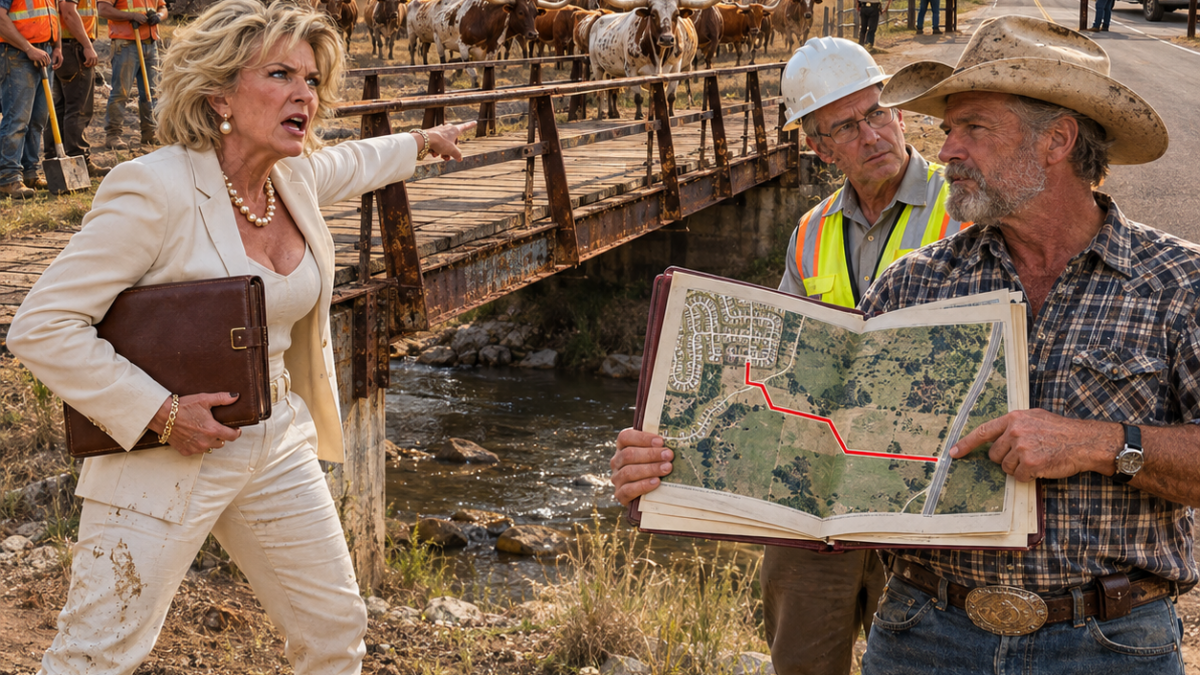
Karen spread maps across the wood.
“Northvale has preliminary plans for ninety-two additional homes.”
“Where?”
She pointed.
Silver Crest’s western expansion.
“The new phase cannot connect efficiently to the existing road system without this strip.”
Her finger moved.
My 186 acres.
“They need your land.”
I leaned back.
“And Naen destroys the bridge.”
“Which damages the operational value of the parcel.”
“Then Northvale offers sixty cents on the dollar.”
Karen nodded.
“That timing is not subtle.”
Before she left, Naen arrived uninvited.
Of course she did.
She walked into my kitchen carrying a folder like she owned the room.
“I came to make peace.”
Karen looked at me.
I almost smiled.
Naen placed the folder on the table.
“The association is willing to forgive your outstanding violations.”
“What violations?”
She slid an invoice toward me.
Total:
$84,600.
I laughed.
Not because it was funny.
Because sometimes the only response to nonsense is air leaving your lungs.
Naen’s list included:
Unauthorized bridge.
Improper fence section.
Nonconforming ranch signage.
Livestock noise during calving season.
I looked up.
“You fined cows for making noise?”
“Excessive agricultural disturbance.”
“You know I’m not in your HOA.”
“The annexation changed jurisdiction.”
“No.”
“Silas, this hostility is unnecessary.”
She pushed another document toward me.
“If you sell the 186 acres to Northvale, the association will waive every penalty, decline further enforcement, and assist with livestock relocation.”
Karen said:
“That sounds remarkably generous.”
Naen looked at her.
“And you are?”
“My attorney.”
For the first time, Naen hesitated.
Only a fraction.
Then the smile returned.
“Wonderful. Then she can explain why cooperation is cheaper than litigation.”
I leaned forward.
“Did you know Northvale drafted its offer before my bridge came down?”
Silence.
Small.
But real.
Naen recovered.
“I don’t manage their paperwork.”
“Did you know they need my parcel for phase two?”
“Everyone knows development creates value.”
“My land already has value.”
“To you.”
She stood.
“Think carefully.”
I held up the $84,600 invoice.
“About this?”
“About whether you want six hundred cattle stranded without water.”
She left.
Headlights swept across the barn.
Karen waited until the sound of Naen’s car disappeared.
Then asked:
“Do you have the 1989 sale documents?”
That question changed everything.
My father kept records the way other men kept photographs.
Tax receipts.
Survey plats.
Mineral leases.
Old cattle contracts.
Anything involving land went into a steel safe in his office.
I had never thrown the contents away.
I carried out a thick yellowed folder.
Karen opened it.
We started reading.
Original sale.
Survey.
Developer agreement.
Utility easements.
Drainage easements.
Road dedication.
Then she stopped.
Not dramatically.
She just stopped turning pages.
“What?”
She read one paragraph again.
Then a third time.
“Silas.”
“What?”
“What did your father tell you about an old cattle route?”
My heart kicked.
I stood.
“Give me that.”
The clause was buried in an easement schedule.
PERPETUAL STOCK DRIVE EASEMENT.
Recorded route:
Western Bradock pasture to county road.
The path ran almost exactly where Main Crest Boulevard sat now.
Karen kept reading.
When my father sold the original development parcel, our family agreed cattle would ordinarily use the dedicated bridge instead of crossing the future residential road.
In return, the developer built and maintained the crossing.
But there was a fallback.
If the bridge became destroyed, obstructed, closed, structurally unusable, or otherwise unavailable because of action attributable to the residential side—
the livestock easement automatically reactivated.
Until the bridge was restored.
I looked at Karen.
“You’re telling me—”
“I’m telling you we verify this at the county recorder tomorrow morning.”
“If it’s valid?”
She almost smiled.
“Naen Kessler just demolished the one thing that kept six hundred Longhorns off her boulevard.”
The county record confirmed it.
Not a photocopy.
Not family folklore.
Recorded.
Indexed.
Running with the land.
Older than Silver Crest.
Older than its HOA.
Older than most houses there.
Then Karen found something even better.
When the HOA assumed control over Main Crest Boulevard from the developer years earlier, the title package contained the livestock easement in Schedule B.
Right there.
Disclosed.
Naen either had not read it—
or had read it and assumed it did not matter.
I asked:
“Can we move Friday?”
Karen answered carefully.
“Legally, the easement appears active.”
“Appears?”
“We get a licensed survey confirming the corridor.”
“Okay.”
“We notify the HOA.”
“Okay.”
“We notify the sheriff.”
“Okay.”
“Veterinary check.”
I smiled.
“You planning the cattle drive now?”
“I am planning to make it impossible for them to call you reckless.”
That mattered.
I did not want revenge.
I wanted my herd moved safely.
Silver Crest homeowners had not demolished my bridge.
Most of them probably had no idea what Naen was doing.
I was not sending six hundred horned animals through a neighborhood just to make a point.
So we did everything properly.
Surveyor.
Route staking.
Sheriff notice.
Veterinary review.
Experienced riders.
Traffic-control plan.
Crew assignments.
Emergency contingencies.
Then formal notice went to Naen at 5:17 p.m.
Six hundred Texas Longhorns scheduled to use Main Crest Boulevard Friday morning pursuant to recorded 1989 livestock easement.
She called me within minutes.
“You will not bring one cow into my neighborhood.”
“I’m not planning to.”
“What?”
“I’m bringing six hundred.”
Her breath caught.
“You think this is funny?”
“No.”
“I will have private security block every entrance.”
“You received the easement.”
“Old paper means nothing.”
“It predates your HOA.”
“My board passed a livestock prohibition.”
“Your board can prohibit whatever it wants inside its own rules.”
“And you will comply.”
“No.”
Her voice rose.
“You arrogant bastard.”
I stayed quiet.
Then she said:
“You are going to regret trying to humiliate me.”
“Naen.”
“What?”
“I had a bridge.”
Silence.
“I didn’t want your road.”
I hung up.
Friday morning, Naen built a blockade.
Orange barricades.
Temporary fencing.
Two private security SUVs turned sideways across Main Crest Boulevard.
She stood near the gate in a heavy coat.
Arms folded.
She looked almost pleased.
Then Sheriff Hollis Keane arrived.
Fifty-five.
Quiet.
Nobody’s friend during disputes.
Exactly the kind of sheriff you want.
Karen had delivered the recorded easement and preliminary survey the night before.
Hollis stepped from his cruiser.
Naen marched toward him.
“Sheriff, thank God. He is threatening to release livestock onto a residential roadway.”
Hollis looked toward me.
Then at Karen.
Then back to Naen.
“I’ve reviewed the easement.”
“Our bylaws ban livestock.”
“Your bylaws postdate the recorded property right.”
“That road belongs to Silver Crest.”
“Subject to recorded encumbrances.”
Naen’s face hardened.
“I’m ordering security to keep the gate closed.”
Hollis said:
“No.”
She blinked.
“Excuse me?”
“You received formal notice.”
“This is my community.”
“This is a property-right dispute.”
“I am responsible for resident safety.”
“And I am telling you not to obstruct the recorded route until a judge says otherwise.”
Naen turned toward her security team.
“Keep the barriers in place.”
Hollis’s voice changed.
Not loud.
Harder.
“Mrs. Kessler.”
She stopped.
“Deliberately blocking a documented access right after formal notice may create additional liability.”
Her jaw tightened.
Slowly, she ordered the barricades moved.
I could have brought the herd through that morning.
I did not.
That surprised Naen more than anything.
I wanted a court ruling.
Not chaos.
I wanted no resident later saying I had stampeded cattle through their subdivision while lawyers were still arguing.
So the fight moved downtown.
Emergency hearing.
Old courthouse.
Wood benches.
Bad air-conditioning.
The HOA attorney opened with safety.
Bridge allegedly deteriorating.
Liability concerns.
Architectural standards.
Public welfare.
Karen waited.
Then placed photographs on the table.
Bridge photographed three days before demolition.
Intact steel.
Solid decking.
No visible collapse.
No county condemnation.
No engineering report.
No independent safety inspection.
Then she produced Pierce Doway’s invoice.
The contractor’s description read:
Bridge Removal — Western Parcel Access Strategy
Karen looked toward the judge.
“Your Honor, the word safety does not appear once.”
Naen shifted in her chair.
Then Karen gave the timeline.
1989:
Stock-drive easement recorded.
1990:
Dedicated livestock bridge completed.
1998:
Road expanded.
2007:
Silver Crest HOA created.
2014:
HOA assumed control over Main Crest Boulevard subject to recorded title exceptions.
The easement came first.
Every time.
The judge kept returning to one question.
“Who made the bridge unusable?”
The HOA attorney talked around it.
Karen did not.
She submitted the board resolution approving demolition.
Naen’s signature sat at the bottom.
Blue ink.
The judge looked at her.
“Mrs. Kessler authorized removal?”
The HOA attorney stood.
“My client relied on board authority—”
“That was not my question.”
Naen’s face tightened.
“Yes.”
“Without the ranch owner’s consent?”
“We believed the structure fell under association jurisdiction.”
“Did you possess a deed to the bridge location?”
Silence.
“Any county demolition order?”
“No.”
“Engineering report?”
“No.”
The judge denied the HOA’s emergency request to block my easement.
The underlying case would continue.
But while it did, the route had to remain open.
Outside the courthouse, Naen came after me.
No cameras.
No homeowners.
Just parking-lot heat.
“Silas.”
I kept walking.
“We can negotiate.”
Karen stopped beside me.
Naen pointed toward a map.
“Use the ridge route.”
Emmett laughed.
“Eleven miles.”
Naen ignored him.
“It keeps cattle out of the neighborhood.”
Emmett stepped forward.
“Eleven miles of steep grade, rock, drainage cuts, and two unstable slopes.”
“We can improve it.”
“By tomorrow morning?”
She looked at me.
“I am offering compromise.”
I shook my head.
“I had one.”
“What?”
“A bridge.”
I walked away.
That evening, the case changed again.
A Silver Crest board member contacted Karen privately.
He had documents.
Emails.
One mattered more than the rest.
Sent by Naen to a Northvale executive six weeks before demolition.
Karen printed it.
Placed it in front of me.
I read one line.
Then again.
Once the bridge is removed, Braddock will have no commercially practical option except disposition of the western tract.
I sat there a long time.
There it was.
Not suspicion.
Not timing.
Intent.
She had demolished the bridge to damage my ranch operation and force a sale.
Emmett read over my shoulder.
“Son of a bitch.”
I folded the paper.
“Get the herd ready.”
Six a.m.
All six hundred.
The next morning the sky shifted from dark blue to gold over the valley.
The herd gathered near the ranch boundary.
Longhorn breath rose in the cold.
Horns moved above backs like branches.
Emmett rode one flank.
Experienced hands spread through the groups.
Nobody shouted unnecessarily.
Nobody rushed.
This was not revenge theater.
This was a livestock movement.
Safe.
Controlled.
Necessary.
I rode at the front.
Main Crest Boulevard appeared beyond the gate.
Residents were already outside.
Balconies.
Driveways.
Phones.
Kids wrapped in blankets.
The first thing they heard was not mooing.
It was vibration.
Six hundred cattle moving together make the ground speak.
Naen stood near the central roundabout.
She still seemed convinced I would bring twenty animals through.
Maybe fifty.
A symbolic stunt.
Then the first Longhorn rounded the curve.
Then another.
Then thirty.
Then a hundred.
Then the road filled.
Horn after horn catching sunrise.
Hooves striking pavement in a steady rhythm.
The herd stretched hundreds of yards.
A sign at the front read:
LEGAL LIVESTOCK CROSSING — RECORDED EASEMENT
Naen’s face changed.
She turned toward private security.
“Block the roundabout.”
Sheriff Hollis stepped between them and the temporary barrier.
“No.”
“They cannot occupy this entire road.”
“They’re staying inside the easement.”
“This is insane!”
Karen stood nearby holding the survey.
“Survey line is marked.”
Naen shouted across the herd.
“This is retaliation!”
I stopped my horse.
Looked at her.
“No.”
“You’re doing this to humiliate me.”
“I built a bridge so I would never have to do this.”
The cattle kept moving.
“You tore it down.”
For once, Naen had no answer.
Silver Crest had marketed Main Crest Boulevard as prestige.
Wide entrance.
Manicured landscaping.
Exclusive arrival experience.
That morning, the road became what the 1989 document had always allowed it to become.
A stock route.
The cattle stayed off lawns.
Away from private driveways.
Within the survey corridor.
No vandalism.
No gates broken.
No chaos.
Just six hundred Longhorns moving exactly where recorded property law said they could move.
That distinction mattered.
Because Naen desperately needed me to become the villain she had been describing.
I refused.
Within days, she called an emergency HOA board meeting.
Her solution?
Ban livestock on all HOA-controlled roads.
Karen sent formal notice.
You cannot erase a preexisting easement with a later bylaw.
Naen pushed the vote anyway.
It barely passed.
Then she ordered new physical obstacles.
Concrete barriers.
Retractable bollards.
Electronic gate.
Surveillance cameras positioned across the easement.
That was when the judge stopped treating her actions as ordinary legal disagreement.
We returned to court.
Karen placed the prior order in front of the judge.
Then Naen’s new plans.
“Mrs. Kessler was formally warned.”
The judge looked toward the HOA table.
Their attorney looked tired.
“Why are barriers being placed inside the easement?”
Naen whispered to him.
He stood.
“The association believes enhanced security is necessary.”
The judge said:
“Security may not obstruct a recorded access right this court has already ordered left open.”
The tone was different now.
More serious.
Then another piece of discovery arrived.
Northvale had promised Silver Crest roughly $1.4 million toward clubhouse renovations, entrance upgrades, and community improvements if the ninety-two-home expansion moved forward.
The expansion depended on my parcel.
Naen had never fully disclosed the financial arrangement to homeowners.
Suddenly Silver Crest residents began asking different questions.
Why had their HOA president been trying so hard to acquire land from a rancher who was not a member?
Why had she destroyed a bridge?
Why had she issued $84,600 in fines against someone outside the association?
Why had Northvale offered money?
Then Naen made one more mistake.
The HOA mailed me an invoice.
$126,400.
Road cleaning.
Traffic management.
Landscape impact.
Pressure washing.
Administrative costs.
I looked at it.
Passed it to Karen.
She smiled.
“What?”
“Remember the 1989 agreement?”
“Unfortunately, I’ve memorized it.”
“Read the cost clause again.”
The agreement said that if the stock-drive easement reactivated because the residential side caused the bridge to become unusable, reasonable costs associated with restoring and accommodating passage could be charged to the party responsible for creating the disruption.
Silver Crest had just billed me for costs created by its own demolition.
Worse, they had itemized the damages.
Karen turned their invoice into part of our claim.
Unauthorized demolition.
Replacement bridge engineering.
Survey.
Herd-management costs.
Operational disruption.
Legal fees recoverable under the agreement.
Traffic costs.
Temporary livestock logistics.
Expert expenses.
Initial total:
More than $400,000.
Naen had started with an $84,600 fake bill.
Now her association faced a real claim several times larger.
Still, money was not my main demand.
I wanted the bridge.
Rebuilt properly.
Permanent.
Engineered.
No temporary patch.
No future argument.
The same physical separation that had protected both ranch and subdivision for decades.
At the next hearing, contractor Pierce Doway testified.
He had decided cooperation was safer than loyalty.
Under oath, he confirmed Naen told him to begin demolition before county offices opened.
Why?
“So the owner couldn’t stop the work.”
The courtroom went quiet.
Karen asked:
“Did you ask whether she had authorization from Mr. Braddock?”
“Yes.”
“What did she say?”
“She said the association would handle paperwork.”
“Did you ever see written consent from Silas Braddock?”
“No.”
“County demolition order?”
“No.”
“Engineering report?”
“No.”
“Emergency safety report?”
“No.”
Naen stared straight ahead.
Northvale began backing away.
Public exposure changed the economics.
A development company might tolerate aggressive negotiations.
An email describing a plan to make land functionally unusable looked different once filed in court.
They withdrew from the acquisition arrangement.
The judge issued a stronger order.
No obstruction of the easement.
Period.
My ranch retained reasonable livestock access across Main Crest Boulevard until a replacement bridge became operational.
The HOA was ordered to begin restoring the destroyed crossing.
That was the legal turning point.
The political one came next.
Homeowners received notice that Silver Crest might need a special assessment because legal costs were climbing.
For the first time, residents demanded documents.
They got them.
Naen’s email to Northvale.
The $1.4 million development incentive.
My $84,600 penalty notice.
The 1989 easement.
The contractor invoice.
The demolition resolution bearing Naen’s signature.
People who had once complained about cattle manure on Main Crest Boulevard started asking:
“Why did we destroy the bridge that kept cattle off Main Crest Boulevard?”
That was the question Naen could not answer.
Silver Crest called a special meeting.
Packed clubhouse.
People standing along walls.
Naen tried to frame me as hostile.
“A combative neighboring landowner.”
I did not attend.
That disappointed some people.
Good.
I did not need applause.
Karen carried one page for me.
A diagram.
Route A:
Bridge intact.
Cattle cross Dry Creek.
No cattle on boulevard.
Route B:
Bridge destroyed.
1989 easement activates.
Cattle use Main Crest Boulevard.
That was it.
No speech.
No accusation.
One picture.
The residents understood.
They voted.
Halt further aggressive litigation.
Rescind every HOA penalty issued to me.
Fund bridge reconstruction.
Open an internal review of Naen’s conduct.
Examine whether she had exceeded board authority.
Then came the board election.
Naen lost.
Badly.
For years she had spoken as if Silver Crest and Naen Kessler were the same thing.
That night, homeowners reminded her they were not.
She walked out of the clubhouse without the president title.
No microphone.
No security detail.
No applause.
The new board contacted Karen within forty-eight hours.
Tone changed immediately.
“We want this resolved.”
So did I.
Bridge engineering accelerated.
Insurance carriers became involved.
Settlement discussions became serious.
Nobody pretended the HOA owed me the moon.
We documented losses.
They documented expenses.
We argued.
Then narrowed them.
A good settlement is usually less emotionally satisfying than revenge and far more useful.
Several weeks later, the replacement bridge still was not complete.
Steel footings were in.
Supports rising.
But cattle needed to move again.
So I issued another notice.
Second crossing.
This time Silver Crest did not barricade Main Crest Boulevard.
The new board coordinated with us.
Temporary traffic control.
Residents informed.
Gate opened.
Sheriff notified.
Six hundred Longhorns entered the neighborhood again.
Very different morning.
No shouting.
No private security.
Some residents even brought coffee outside.
Children watched from sidewalks.
The herd moved.
Steady.
Professional.
Naen stood near the clubhouse.
Alone.
No blue coat this time.
No clipboard.
Just watching.
As I reached the roundabout, she called my name.
I stopped.
Emmett kept the herd moving behind me.
Naen walked closer.
Her voice was quieter.
“You satisfied?”
I looked at her.
“With what?”
“This.”
She gestured toward the cattle.
“Driving them through here. The lawsuits. Removing me.”
“I didn’t remove you.”
“You started it.”
“No.”
“You could have sold.”
I almost laughed.
“You could have left my bridge alone.”
Her expression tightened.
“Was all this really worth it?”
I looked toward the Longhorns.
Then back.
“I never wanted your road.”
She said nothing.
“I already had a bridge.”
That was all.
I rode on.
Months later, the new Dry Creek Bridge was completed.
Modern steel reinforcement.
Deep concrete footings.
Higher load standard.
Better flood tolerance.
Engineers tested it.
County inspected it.
Then came opening morning.
No speeches.
No ribbon.
I did not need either.
Emmett and I stood on the east side.
The first Longhorn stepped onto the new deck.
Then another.
Hooves struck fresh timber.
The sound rolled through the steel.
The whole herd crossed.
Once the bridge was fully operational, the Main Crest Boulevard stock-drive easement returned to dormant status under the original agreement.
I voluntarily stopped using the HOA road.
Immediately.
That mattered.
Because I had never wanted control over Silver Crest.
I wanted access to my own ranch.
The settlement required the HOA to cover the majority of documented bridge-restoration and dispute-related costs.
The fake fines disappeared.
Northvale abandoned its effort to acquire my 186 acres.
Bradock Ranch stayed intact.
The new board adopted procedures requiring outside legal review before taking action affecting neighboring non-HOA property.
Probably a good idea.
Naen stopped attending meetings.
At least for a while.
People told me she complained privately that the neighborhood had betrayed her.
Maybe she believed it.
Power changes perspective.
When people agree with you for years, accountability can feel like betrayal.
I stopped caring.
The settlement closed.
The bridge stood.
My cattle had water.
That was enough.
Or should have been.
But the emotional part took longer.
One evening I walked out to the bridge alone.
The old bridge had carried my father.
Grandfather.
Thousands of cattle.
I had been angry at Naen for destroying property.
I had not admitted what else she destroyed.
Memory.
My father had taught me to drive cattle across that bridge when I was thirteen.
He stood behind me on horseback.
“Don’t push from the front.”
I said:
“I’m leading.”
“No.”
“You’re in front.”
“Still not leading.”
I remember being irritated.
“What am I doing?”
“Showing them where safe is.”
That was my father.
Everything became a lesson eventually.
When Naen’s excavator tore that bridge apart, I watched more than steel fall into Dry Creek.
I watched part of him disappear.
That was why the rebuilt bridge mattered more than damages.
You can reimburse steel.
You cannot reimburse memory.
Still, the new bridge became its own thing.
First calving season after completion, Emmett and I moved the herd at sunrise.
Halfway across, he said:
“You remember her face?”
“Whose?”
He laughed.
“You know whose.”
I did.
Naen standing at Main Crest Boulevard when the first horns appeared.
“I remember.”
“Worth it?”
I looked down through the rail toward Dry Creek.
“No.”
Emmett glanced over.
“No?”
“I would’ve preferred the old bridge.”
He nodded.
“Me too.”
That was the truth.
People told the story later like I had discovered a brilliant legal weapon and deliberately unleashed six hundred Longhorns on an HOA president.
That version is entertaining.
Wrong.
I never wanted cattle on Main Crest Boulevard.
The road had cars.
Children.
Decorative landscaping.
Bad footing compared with ranch ground.
It made my job harder too.
The livestock easement was not revenge.
It was a fallback.
A contingency written by people who understood something Naen forgot:
Access matters.
The 1989 agreement had balanced two worlds.
Ranch.
Subdivision.
Bridge kept them separate.
If one side destroyed the balance, the old right returned.
Simple.
The genius was not mine.
It belonged to lawyers and landowners decades earlier who imagined failure.
The irony belonged entirely to Naen.
She demolished the bridge to isolate my western land.
The demolition itself opened another route.
She tried fines.
But I was not an HOA member.
She tried bylaws.
But the easement came first.
She tried physical barriers.
The court blocked them.
She tried charging me for the cattle drive.
The underlying agreement shifted responsibility back toward the party that caused the bridge failure.
Every move assumed her authority was larger than it actually was.
That was the pattern.
HOA power is real inside its legal boundaries.
Naen confused real power with unlimited power.
Those are dangerous things to confuse.
Silver Crest improved after she left.
Not overnight.
Residents were angry.
Some blamed the entire board.
Others blamed themselves for not asking questions.
The new president, Malcolm Reyes, invited me to one meeting months later.
I almost declined.
Karen said:
“Go.”
“Why?”
“Because normal relations are cheaper than litigation.”
Lawyers ruin good grudges.
So I went.
Clubhouse.
Folding chairs.
Coffee.
No cattle.
Malcolm stood.
“Mr. Braddock, we owe you an apology.”
I said:
“The association does.”
Several people looked uncomfortable.
He nodded.
“You’re right.”
He did not hide behind:
Mistakes were made.
He said:
“Our board authorized destruction of property it did not own.”
Good start.
“We imposed penalties without jurisdiction.”
Better.
“And residents benefited from decisions we did not question enough.”
A woman raised her hand.
“I didn’t know about Northvale.”
I looked at her.
“I believe you.”
“Then why should all of us pay?”
Fair question.
Because HOA legal costs ultimately affect members.
I answered carefully.
“You shouldn’t be personally blamed for decisions you didn’t make.”
She relaxed slightly.
“But an association acts through its board. That’s why board elections matter.”
She nodded.
Nobody liked the answer.
Truth often feels unfair when organizations make bad decisions.
The new board negotiated internally about insurance, reserves, and responsibility.
They also investigated whether Naen could be held personally responsible for certain unauthorized expenditures beyond her authority.
I stayed out of that fight.
Not my job.
My claim was resolved.
Let Silver Crest govern itself.
Months passed.
Northvale bought land somewhere else.
The ninety-two-home expansion disappeared.
My west pasture remained grass.
Exactly what Naen hated.
One morning, I stood on the ridge watching calves move beside their mothers.
Karen drove up.
She leaned against her SUV.
“You know how much that land is worth now?”
“Don’t.”
“I’m serious.”
“I know.”
“Northvale’s original full-value estimate was substantial.”
“I know.”
“You could still sell part.”
“No.”
She smiled.
“Just checking.”
“Why?”
“People win property fights and then sell two years later.”
“I’m not people.”
“You are aggressively people.”
I laughed.
She looked toward the herd.
“Your father would be pleased.”
“You never knew him.”
“I know you.”
“Poor substitute.”
“Probably.”
Karen became a friend after the case.
That happens when somebody spends months reading your family’s ancient documents at midnight.
She also became the person I called whenever a certified envelope arrived.
PTSD, legal edition.
The contractor, Pierce Doway, lost business for a while.
People assumed I hated him.
I did not.
He should have demanded proof of authority.
He admitted that.
His testimony helped.
Eventually he sent a letter.
Not an excuse.
Apology.
He wrote:
I knew the early start was meant to keep you from responding. I should have walked away.
I respected that.
Did not erase what happened.
But accountability begins somewhere.
Years later, he bid on a ranch project.
Emmett said:
“You hiring him?”
“No.”
“Still mad?”
“No.”
“Then why?”
“His price was terrible.”
Fairness.
The 1989 documents stayed in a fireproof cabinet after that.
Copies in two places.
Digital scans.
Karen mocked me.
“You’re becoming paranoid.”
“I had a bridge disappear before breakfast.”
“Reasonable.”
I read the old easement occasionally.
The wording was dry.
Dense.
Unromantic.
Yet that paragraph protected four generations of ranch operations.
People romanticize land with sunsets and fences.
Sometimes the most important part of land is boring paperwork sitting in a county office.
Recorded correctly.
Indexed.
Forgotten.
Waiting.
That is why Naen lost.
Not because I shouted louder.
I rarely did.
Not because six hundred cattle were intimidating.
They were.
Not because residents liked me.
Some did not.
She lost because the record existed.
Then evidence connected motive to action.
Northvale’s advance offer.
Naen’s email.
Pierce’s invoice.
Demolition timing.
$1.4 million community incentive.
$84,600 pressure fines.
Barriers after court notice.
Each piece was bad.
Together, they told the story.
Force the bridge down.
Strand the herd.
Damage the parcel’s operational value.
Create financial pressure.
Offer below-market purchase.
Acquire connector land.
Expand ninety-two luxury homes.
Call it community improvement.
That was the plan.
When people ask whether Naen was evil, I usually say something less satisfying.
She was convinced.
Convinced that development was more valuable than ranching.
Convinced that HOA needs justified pressure.
Convinced that rules were tools for getting the result she wanted.
Convinced my refusal was selfish.
Convinced homeowners would forgive anything if property values rose.
Once people believe the end is good enough, bad methods become easier.
That scares me more than cartoon villains.
Naen did not wake up thinking:
How do I destroy a rancher?
She thought:
How do I solve a development obstacle?
I became the obstacle.
The bridge became the leverage.
That language makes cruelty easier.
Obstacle.
Parcel.
Connector.
Asset.
Impact.
None of those words include:
Family.
Livelihood.
Memory.
Cattle needing water.
My father’s bridge.
One afternoon, years after the settlement, a young Silver Crest homeowner stopped by.
His name was Lucas.
He had bought after Naen’s removal.
“Mr. Braddock?”
“Silas.”
“I have a weird question.”
“Usually the best kind.”
“My property title says something about livestock rights.”
I smiled.
“Schedule B?”
His face changed.
“Yes.”
“Come inside.”
I showed him the old map.
He stared.
“So technically cattle can still use Main Crest?”
“If the triggering conditions happen.”
“What conditions?”
“Bridge unavailable through the residential side’s action, mainly.”
He looked worried.
“Are you planning to?”
“No.”
“Ever?”
“Keep the bridge standing.”
He laughed.
Then became serious.
“Why didn’t they tell us this when we bought?”
“They should have.”
“It’s in the title.”
“That’s them telling you.”
He winced.
“Fair.”
I pointed toward the bridge.
“I prefer that route.”
He nodded.
“I prefer it too.”
Good neighbor.
That was all I ever wanted.
The ranch continued.
Calves.
Drought.
Rain.
Vet bills.
Broken fences.
Nothing cinematic.
Silver Crest continued too.
Pool repairs.
Trash disputes.
Landscaping contracts.
People complaining about annual dues.
Normal.
The bridge did its job.
Every day it stood was a day nobody needed the easement.
That was the best possible outcome.
Emmett retired before I did.
Ranch manager, not ranching.
He bought a place ten miles away.
Still showed up constantly.
One morning, I found him standing on the new bridge.
“You lost?”
“Checking your workmanship.”
“You didn’t build it.”
“Exactly why it looks good.”
He kicked the rail.
Solid.
“Remember when Naen said you should sell?”
“Unfortunately.”
“You ever think about what would’ve happened?”
“If I had?”
“Yeah.”
I looked west.
Northvale would have built.
Road connection.
Homes.
Maybe beautiful.
Maybe profitable.
Nothing inherently wrong with development.
But not like that.
“I would’ve spent the rest of my life wondering whether I sold because I wanted to or because she broke me.”
Emmett nodded.
“That’s the difference.”
Exactly.
I might sell land someday.
My children might.
Their children.
Choice changes everything.
Naen wanted to turn pressure into consent.
That is not consent.
The final court settlement included something I insisted on.
Acknowledgment.
Written.
Recorded.
Silver Crest recognized:
Bradock Ranch was not HOA property.
No HOA covenants applied to our ranch.
The stock-drive easement remained valid according to its terms.
The association had no unilateral authority to demolish structures on our parcel.
Karen asked:
“You really need all that?”
“Yes.”
“Why?”
“So twenty years from now, another president doesn’t start over.”
She smiled.
“Now you’re thinking like a land lawyer.”
“Insult me again and you’re fired.”
The document recorded.
Future buyers would see it.
Future boards.
Future lenders.
Future idiots.
That gave me peace.
The new bridge eventually weathered.
Wood darkened.
Steel lost its shine.
That made it better.
New things feel temporary on old ranches.
Time has to approve them.
One fall morning, I led the herd across.
Last cow passed.
Emmett stood on the far bank.
He called:
“You coming?”
I stayed.
Looked down at the water.
Dry Creek was running shallow.
Sunlight through cottonwoods.
I remembered the old bridge.
My father.
The excavator.
Naen’s blue coat.
Main Crest filled with horns.
Courtroom.
Residents.
All of it.
Then I looked at the new rail.
No anger.
That surprised me.
I had expected the story to live in me as rage.
It didn’t.
Eventually it became instruction.
Read the deed.
Know the boundary.
Document the action.
Do not let humiliation choose your response.
Do not punish innocent people for somebody else’s misconduct.
Ask what you actually want.
For me, the answer had always been simple.
My bridge.
My cattle.
My land intact.
That was enough.
Naen disappeared from leadership.
I heard she sold her Silver Crest house a few years later.
Maybe true.
Maybe not.
I did not check.
That is another victory people underestimate.
Not needing to know.
For months, her choices determined my schedule.
Court hearings.
Surveyors.
Cattle routes.
Legal letters.
Repair meetings.
Then one day they did not.
The ranch took up the space again.
That was better than watching her suffer.
People love punishment.
I understand.
But peace is quieter.
And more durable.
Karen once asked me to speak at a county landowners’ seminar.
I refused.
She put my name on the program anyway.
So I went.
Room full of farmers, homeowners, developers, HOA board members.
Somebody asked:
“What’s the single biggest lesson from the Silver Crest dispute?”
I said:
“Do not assume because somebody has rules, their rules apply to you.”
Karen nodded.
Another person:
“What else?”
“Do not assume because something is old, it expired.”
Another:
“Would you drive the herd through Silver Crest again?”
“If the bridge becomes unusable under the easement conditions.”
Laughter.
A Silver Crest resident in the audience shouted:
“We’ll guard the bridge ourselves.”
More laughter.
That was good.
Humor means the wound is becoming scar tissue.
At the end, an elderly rancher approached.
“My neighbor’s HOA keeps sending me letters.”
“Are you a member?”
“No.”
“Attorney?”
“Can’t afford much.”
I gave him Karen’s legal-aid referral list.
“Start with your deed.”
He shook my hand.
That felt useful.
Not revenge.
Useful.
Maybe that is what stories like mine should become.
Warnings.
Not fantasies.
Because in real life, releasing six hundred cattle without surveys, notice, traffic planning, or court review could end horribly.
Animals injured.
Drivers hurt.
Lawsuits.
My case worked because we slowed down.
That was Naen’s biggest miscalculation.
She expected anger.
She expected me to act stupid.
Every time I didn’t, her own evidence got worse.
She demolished before sunrise to prevent an injunction.
We waited for court.
She built barricades.
We called the sheriff.
She passed a new bylaw.
We returned to the judge.
She billed us.
We read the contract.
She lied about safety.
Her contractor’s invoice said access strategy.
She claimed development had nothing to do with it.
Her email said otherwise.
Patience turned her certainty against her.
One morning, a photographer came to take pictures of the bridge for a property-law journal.
He wanted me standing in front.
I refused.
“Why?”
“Photograph the bridge.”
“The story is about you.”
“No.”
“It kind of is.”
“It’s about a clause.”
He laughed.
“Hard to photograph a clause.”
“Try.”
Eventually, he photographed the bridge with Main Crest Boulevard visible beyond the ridge.
Good picture.
No cowboy posing.
No angry Karen.
Just two routes.
That told the whole story.
The old easement did not defeat Naen.
Her own decision activated it.
That difference matters.
She built the trap.
Then stepped into it.
Years later, the original demolition invoice came back to me after the files closed.
I kept a copy.
Bridge Removal — Western Parcel Access Strategy.
Six words.
Naen probably thought nobody outside the contractor’s office would ever see them.
They became one of the strongest pieces of evidence.
Words matter.
So do invoices.
So do timestamps.
So do email drafts.
People committing bad acts often imagine intent disappears if they give the public a nicer reason.
Safety.
Standards.
Community.
Property values.
Words can hide motive temporarily.
Records tend to be less polite.
Another document stayed with me.
Her $84,600 violation notice.
Sometimes I pull it out when I need to laugh.
Excessive livestock noise during calving season.
Imagine telling cattle they violate HOA quiet hours.
Maybe Naen would have tried.
Emmett once said:
“You should frame that.”
“No.”
“Why?”
“Too much wall space.”
He framed it for me anyway.
Birthday present.
It hangs in the ranch office now.
Visitors read it.
Most laugh.
I do too.
But beneath the humor was something serious.
The notice was designed to create a paper debt.
Pressure.
Something to waive later in exchange for land.
That is why Karen made me preserve everything.
Not every ridiculous document is harmless.
Sometimes ridiculous paperwork is part of a rational scheme.
The bridge stayed.
The herd stayed.
The west pasture remained ours.
That is the ending.
No dramatic foreclosure of Naen’s house.
No secret federal arrest.
No miracle payout.
Just legal consequences that matched what happened.
She lost authority.
The HOA paid heavily.
Northvale lost the parcel.
The bridge was rebuilt.
The easement remained.
Residents learned.
That was enough.
One dawn, years after it all, I stood on the bridge as six hundred Longhorns crossed beneath a pale Texas sky.
Fresh calves among them.
Older cows I recognized.
Hooves hitting timber.
Steel humming under weight.
Emmett leaned against the rail.
“Still think the old bridge was better?”
“Yes.”
“You’re impossible.”
“My father built part of it.”
“He reinforced it.”
“Same thing in family history.”
Emmett laughed.
Then:
“You know what Naen never understood?”
“What?”
“She thought the road was power.”
I looked toward Silver Crest.
Main Crest Boulevard disappeared beyond the trees.
“No.”
“What was?”
I put one hand on the bridge rail.
“Choice.”
He nodded.
That was exactly it.
The bridge gave us a choice not to use their road.
The easement gave us a choice when the bridge was taken.
The deed gave us a choice to keep the land.
The court protected that choice.
Naen tried to remove choices until selling looked inevitable.
That was why I fought.
Not because I hated Silver Crest.
Not because I wanted cattle on expensive pavement.
Not because I needed to embarrass a woman with a title.
Because nobody gets to destroy your options and then call the surrender voluntary.
That is not negotiation.
That is pressure wearing paperwork.
The new bridge carried the final Longhorn across.
Emmett closed the gate.
I looked down at Dry Creek.
Morning light moved across the water.
“Worth it?” he asked again.
This time I smiled.
“The bridge is.”
He shook his head.
We walked back toward the ranch.
Behind us, the steel and timber settled beneath the rising sun.
Ahead, six hundred cattle spread across open pasture.
And somewhere beyond the ridge, Main Crest Boulevard stayed perfectly clean, perfectly quiet, and completely free of Longhorns.
Exactly the way I had wanted it from the beginning.
Naen Kessler had spent weeks trying to force me onto that road.
She just never understood that until she tore down my bridge, I had no reason to use it at all.








