PART2:“TEAR DOWN THAT RUSTED EYESORE—600 FAMILIES SHOULDN’T HAVE TO LOOK AT YOUR FARM!” HOA Karen Destroyed My Family’s 80-Year-Old Windmill—Two Hours Later Her Entire Neighborhood Started Losing Water
PART2
The HOA meeting happened without me.
Vanessa presented photographs of my tower taken through a long lens from the Red Willow walking trail.
The angles made it look like the windmill leaned toward rooftops.
She called it a catastrophic failure risk.
Twice.
A retired attorney named Paul Ostrander apparently stood up and told her the HOA had no authority over land outside the subdivision.
Vanessa did not disagree directly.
She changed the question.
She said Red Willow had a responsibility to protect its infrastructure corridor.
That phrase became her doorway.
The northern maintenance easement ran behind the final row of houses.
My transfer line ran farther beyond it.
The windmill stood uphill.
Vanessa argued that assessing a possible hazard affecting the corridor was not the same thing as exercising authority over my land.
Thin distinction.
Still enough to get an inspection approved.
That was how Caleb Finch arrived at my fence.
Caleb ran the HOA’s maintenance crew.
Mid-thirties.
Company truck.
Clipboard.
Expression of a man who had spent years receiving instructions from people who never held the tools.
He stopped outside the fence.
Did not enter.
Called my name.
I waved him through.
“I want to be straight with you,” he said.
“I appreciate straight.”
“They want me to photograph the tower, document condition, and price removal.”
“Removal.”
“Yes.”
“Who authorized that?”
“I was told assessment only.”
I looked at him.
He shrugged.
“I don’t like being used as somebody’s crowbar.”
That earned him respect.
“Come see it properly.”
We walked uphill.
I showed him the anchor bolts.
Replaced eleven years earlier.
Guy wires.
Tight.
Tower sections.
Some surface corrosion.
Nothing structurally unusual.
Gear head.
Fresh grease.
Then the pump house.
Concrete built into the hillside.
Two signs on the door.
The old enamel one had been there since before I was born.
PRIVATE UTILITY EQUIPMENT — AUTHORIZED ACCESS ONLY
The newer one included Hawthorne County Utility Cooperative’s operations number.
Caleb stopped.
He read both.
Then looked uphill.
“Windmill ties into this?”
“Yes.”
“What does it run?”
“Mechanical pump.”
“Anything else?”
“Auxiliary generator.”
His expression changed.
“For what?”
“Controller reference.”
He looked at the cabinet through the window.
“What does this system serve?”
“Transfer well.”
“And?”
“Booster station.”
He stared.
“What side?”
I pointed toward Red Willow.
“Yours.”
Caleb stopped writing.
Then started again faster.
“The neighborhood?”
“Part of its common system.”
“How much?”
“Enough that I wouldn’t cut anything without calling the cooperative.”
He stared at me.
“Vanessa knows?”
“She’s been told the equipment is active.”
“Specifically?”
“Certified mail.”
He looked uncomfortable.
I opened the pump house.
Showed him the gauges.
The old control panel.
The maintenance log.
He read several pages.
My father’s writing.
Mine.
Then asked:
“Can you write down what you just told me?”
“Why?”
“So nobody says I misunderstood.”
That made me like him more.
On the back of his form, I wrote:
Windmill, driveshaft, pump assembly, auxiliary generation, and associated controls are active utility infrastructure connected to transfer-well and booster operations serving systems beyond Boone Acre. No component should be altered without cooperative review.
Signed.
Dated.
Caleb folded the page into his clipboard.
“I’m putting that in the report.”
“Good.”
He did.
I know because Vanessa later quoted another sentence from the same report.
Caleb noted corrosion near the lower tower section.
Normal.
A structure standing outdoors since Truman had been president tends to develop imperfections.
Vanessa used that line.
Ignored the active-utility paragraph.
Eleven days later, I received a certified ultimatum.
72 HOURS TO DISABLE AND REMOVE WIND-WHEEL ASSEMBLY
Failure would cause the association to take whatever action it deemed necessary to protect safety and property values.
I stood at my mailbox in the rain reading it twice.
Then I took the response letterhead they included.
Wrote one word.
NO.
Signed.
Certified mail.
There is something comforting about certified mail.
Paper is patient.
It remembers without getting angry.
Vanessa arrived the following afternoon.
This time she drove onto my property.
Parked behind my truck.
Walked onto my porch without invitation.
She looked at the mud on my boots.
Then the old truck.
That same smile.
“Do you really want to pick a fight with an entire homeowners association over scrap metal?”
“No.”
That surprised her.
“Good.”
“I don’t want a fight.”
I pointed toward the hill.
“I want your people to stay off my land.”
She folded her arms.
“We have safety obligations.”
“You have no jurisdiction here.”
“There are easement interests.”
“Utility easement.”
“Exactly.”
“That does not mean HOA demolition authority.”
She rolled her eyes.
“Darius, normal people do not keep eighty-year-old machinery in operation beside six hundred homes.”
“Normal according to who?”
“You know exactly what I mean.”
“No.”
I stepped closer.
“Say what you mean.”
She stopped.
For the first time, her confidence slipped.
Then returned.
“I mean this community has invested hundreds of millions of dollars in maintaining a certain standard.”
“And my family invested eighty years in maintaining that machine.”
“It is rusting.”
“It is working.”
“It is an eyesore.”
“It is mine.”
“Why are you being so difficult?”
I laughed.
“Because you’re standing on my porch telling me your view matters more than my deed.”
She stared.
I continued.
“One more time.”
I pointed uphill.
“That windmill is live equipment.”
“It connects to the pump house.”
“It connects to infrastructure beyond my land.”
“If anyone cuts it, disables it, removes it, or interferes with the drivetrain, consequences will not stop at my fence.”
Vanessa waited until I finished.
I could see it.
Not listening.
Waiting.
Then she went down the steps.
Turned at the bottom.
“Well, don’t blame me when the board handles it itself.”
I stared at her.
“Was that your final answer?”
“What?”
“To everything I just told you.”
She smiled.
“My final answer is that nobody gets to hold six hundred homeowners hostage with a pile of obsolete machinery.”
She got into her car.
Backed down my driveway too fast.
Gravel scattered into the ditch.
I stood there watching her taillights.
And knew.
Not suspected.
Knew.
She was going to touch it.
Thursday morning I left home at 5:40.
Supply yard two counties away.
Replacement seal.
Length of shafting I had been waiting on.
Four-hour round trip.
Before leaving, I fed my dog, checked the pump-house gauge through the window, locked the gate, wrapped the chain, snapped the padlock shut.
The wind was steady.
Wheel turning beautifully.
Soft clack from the gear head.
The same sound I had heard thousands of mornings.
I remember thinking my father would have liked the wind.
That thought mattered later.
I returned a little after eleven.
I saw the contractor trucks before I saw the hill.
Flatbed in my pasture.
Crane outriggers in the grass.
Cutting rig.
Two pickups.
Five men in high-visibility vests.
Coffee cups.
Like any jobsite.
My chain lay on the ground.
One link cut bright and clean.
The fence beside the access had been crushed enough for the crane.
My dog was shut inside the barn.
At least someone had done that.
Then I looked uphill.
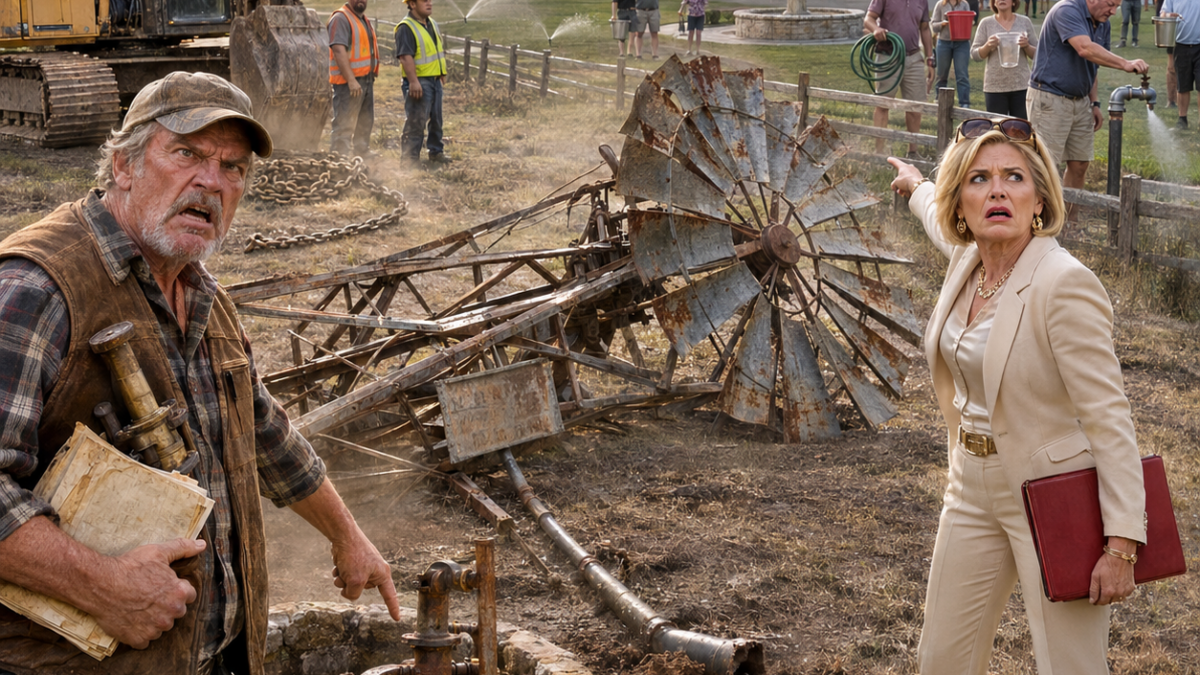
The windmill was down.
There are things your brain refuses to recognize because recognition hurts too much.
The tower had been cut through near the second brace.
Folded.
The wheel lay on its side.
Several sails bent underneath.
My grandfather’s tail vane was snapped from its mount and half-buried in mud.
Gear head separated.
Driveshaft cut.
Coupling tossed into a contractor’s bucket with scrap.
Eighty years of my family’s work reduced to a disposal pile.
Vanessa stood beside it.
Tan coat.
Boots.
Folder.
Contractor with a tablet.
She saw me.
Walked toward me.
No fear.
No apology.
No hesitation.
“Darius.”
I looked past her.
“What did you do?”
“The board exercised its emergency safety authority.”
“On my property.”
“The structure posed a foreseeable hazard.”
“You cut my lock.”
“The contractor required access.”
“You crushed my fence.”
“That can be repaired.”
“You cut the driveshaft.”
She glanced uphill.
“It was part of the structure.”
I stared at her.
Behind us, a contractor looked away.
Vanessa continued.
“The tower had documented deterioration.”
“You mean Caleb’s report?”
“Yes.”
“The report that says active utility infrastructure?”
Her face changed.
Barely.
“That description was unverified.”
“You read it.”
“I read the entire report.”
“So you knew.”
“I knew what you claimed.”
“No.”
I stepped closer.
“What Caleb wrote.”
“He is not a utility engineer.”
“Neither are you.”
Her jaw tightened.
“The board made a determination.”
“Your board has no authority on Boone Acre.”
“We acted to protect residents.”
“You cut a locked gate.”
“Because you refused cooperation.”
“You broke into my land.”
“Do not dramatize this.”
Something hot moved through me.
I want to tell the truth about that moment.
I wanted to shout.
I wanted to take her folder and throw it into the mud beside my grandfather’s tail vane.
I wanted every contractor there to hear exactly what I thought of a woman who had been warned repeatedly and still walked through a cut lock as though my boundary belonged to her.
But I did not.
I am a Black man who had lived forty-eight years in a country where people can decide what kind of story they are watching before you finish your first sentence.
I knew what happened if I became the loudest man in the pasture.
So the anger sat down.
I took out my phone.
Vanessa watched.
“What are you doing?”
“Documenting.”
I photographed the chain.
Gate.
Fence.
Tire tracks.
Crane.
License plates.
Contractor company name.
Cuts through the tower.
Gear head.
Driveshaft.
Coupling.
Pump-house signs.
Every worker.
Vanessa.
The contractor.
Timestamp running.
One worker whispered:
“We good?”
The contractor looked toward Vanessa.
She said:
“We’re finished.”
Then she looked uphill.
At the open sky where my windmill had stood.
And smiled.
Actually smiled.
“This already looks better.”
I looked at her.
She continued.
“The whole area looks more civilized.”
There are sentences people say because they do not know what they reveal.
I felt that one enter me and settle somewhere old.
I did not answer.
Walked into the pump house.
Unlocked the door.
Pressure gauge:
Forty-one.
Normal operating pressure had been sixty-two.
Auxiliary input indicator:
Red.
Red meant controller reference lost.
Backup mode.
Limited duration.
I had seen that red light once before during a 2009 ice storm.
Never since.
I walked back outside.
“Vanessa.”
She turned from her car.
“Do you have any idea what you disconnected?”
She laughed.
Not maliciously.
That almost made it worse.
Easy.
Tired.
The laugh of somebody dealing with an unreasonable man.
“A windmill, Darius?”
She shook her head.
“I disconnected a windmill.”
I stared.
Then nodded.
“All right.”
“What?”
“Nothing.”
I walked back into the pump house.
Closed the door.
At 11:51 I called Hawthorne County Utility Cooperative.
Gave the dispatcher the equipment site number.
Her voice changed before I finished the second sentence.
“Hold, please.”
Muffled conversation.
Then:
“Mr. Boon?”
“Yes.”
“Do not alter anything further.”
“I didn’t alter it.”
“Understood.”
“We have a crew departing now.”
I looked through the window at Vanessa’s contractor loading equipment.
“How soon?”
“Forty minutes.”
“What happens on your side?”
A pause.
“Depends how far the controller has drifted.”
That answer told me enough.
At 1:07, sprinklers across Red Willow’s south common green started.
Half pressure.
Ninety seconds.
Stopped.
At 1:42, the HOA called its irrigation contractor.
At 2:10, the north ornamental pond’s automatic makeup supply dropped out.
At 2:36, its liner started showing a pale ring.
At 2:51, one aerator began sucking air and making a sound like machinery drowning.
At 3:04, booster station B7 faulted.
Restarted.
Faulted again.
Then locked out on protection.
Twenty minutes later, another pump group north of the tree line went into dry-run protection.
No houses lost drinking water.
That matters.
The cooperative moved fast enough to keep residential service stable.
But outdoor pressure softened.
Irrigation died.
Pond makeup stopped.
Common landscaping began dropping.
The HOA office phone started ringing.
And ringing.
And ringing.
Denise later told me the office manager finally stopped answering.
Vanessa’s first position was coincidence.
Her second was utility negligence.
Her third was that the cooperative should immediately repair its equipment.
She still had not understood the problem.
The windmill never directly supplied one house.
It supported the system.
When Red Willow’s developer arrived in the early 2000s, they needed water-service capacity on the north side.
The old transfer well on Boone Acre had been permitted decades earlier.
Rights ran with my family land.
A new permit battle could have cost the developer two construction seasons.
So they negotiated with my father.
In 2003 they signed an agreement.
Red Willow received an allocation of flow.
Utility crews received a limited maintenance easement.
The association assumed part of annual system-maintenance cost.
Boone Acre retained ownership of everything on Boone Acre.
Windmill.
Tower.
Well station.
Pump house.
Controller.
Valves.
Transfer equipment.
Maintenance corridor.
The windmill drove a mechanical pump that kept transfer-well flow stable.
It also turned a small auxiliary generator.
That generator supplied reference power to the old control system and helped hold pilot valves in position.
Low steady input.
Day.
Night.
Wind.
The electric side could carry load.
But it depended on the old system staying stable.
Without the mechanical input, storage began drawing down.
Without reference power, the controller became unreliable.
Electric pumps tried compensating.
Ran harder.
Hit low-supply conditions.
Thermal protection.
Dry-run protection.
Shutdown.
The windmill was not the only thing keeping Red Willow’s system functioning.
It was the thing keeping everything else honest.
My father understood that.
I understood that.
Vanessa understood lawns.
At 3:22, two cooperative trucks came up my driveway.
The first man out was Graham Keane.
Operations engineer.
Large man.
Reading glasses pushed onto his head.
I had spoken to him maybe twelve times over the years.
Never met him.
He made six steps.
Then saw the windmill.
Stopped.
He looked at the severed shaft.
The tower.
The crane tracks.
Then Vanessa.
“Who authorized this?”
Vanessa walked forward immediately.
“The Red Willow Estates board.”
Graham stared.
“For what?”
“Removal of a deteriorated structure presenting a safety risk to our community.”
Graham took his glasses down.
Held them in one hand.
“The cooperative authorized this?”
“The association acted under its own emergency authority.”
Graham blinked.
“You cut this equipment without calling us?”
“Our contractor is licensed.”
“That’s not what I asked.”
Vanessa’s posture changed.
“If the cooperative had scheduling concerns, it should have communicated them.”
Scheduling.
The word hung there.
Graham looked toward me.
“Key?”
I handed it over.
He entered the pump house.
Stayed eleven minutes.
I heard radio calls.
Numbers.
Pressure.
Transfer depth.
Controller state.
Then his voice got flatter.
Serious people often sound quieter when things become bad.
When he came out, he told me the transfer well had dropped almost four feet.
Two more pump groups had entered protection.
Temporary supply would need to be installed before evening demand.
Then he asked:
“What happened?”
Not what I thought.
What happened.
I gave him times.
Departure.
Return.
Cut gate.
Crew.
Vanessa.
She jumped in.
“Mr. Boon never properly communicated the importance of this equipment.”
I stared.
Graham looked at her.
She continued.
“He repeatedly refused to cooperate.”
“The association made good-faith attempts.”
“If we had been given accurate technical information—”
I walked to the pump-house door.
Placed my palm against the enamel sign.
PRIVATE UTILITY EQUIPMENT — AUTHORIZED ACCESS ONLY
Everybody read it.
Then I opened my truck.
Pulled out the accordion file I kept behind the seat.
Found my response from two years earlier.
Certified-mail receipt stapled behind it.
I read:
“Windmill and pump assembly are active utility infrastructure. Do not enter or alter equipment.”
I handed it to Graham.
Then pulled the letter from eleven days earlier.
Same warning.
Certified receipt.
Association office signature.
Vanessa looked at the pages.
Then said quietly:
“I believed he was exaggerating.”
I looked at her.
“You believed.”
She did not answer.
Graham stared at her for several seconds.
Then turned away.
Took out his phone.
That was more devastating than yelling.
She had stopped being worth arguing with.
By Friday morning, Vanessa had built a new theory.
If Red Willow benefited from equipment on Boone Acre, Red Willow had an interest in that equipment.
Interest meant stewardship.
Stewardship meant authority to act.
She put that in writing.
Copied the board.
Copied the cooperative.
I read it at my kitchen table.
Coffee went cold.
Then called Lydia Shaw.
Real-estate attorney.
County seat.
Had handled my father’s estate.
Filing system that could shame a courthouse.
She arrived Saturday with a document box.
For two hours we spread eighty years of land history across my kitchen.
Deeds.
Permits.
Easements.
Water agreements.
Recorded amendments.
Maintenance agreements.
My father’s notes.
Lydia read the 2003 instrument twice.
Then looked at me.
“Darius.”
“What?”
“I’ve practiced twenty-two years.”
She tapped the page.
“I don’t often get to say this.”
“What?”
“They are spectacularly outside their authority.”
I smiled for the first time all week.
She read the clause.
Red Willow possessed a right to receive defined flow.
Utility maintenance access with notice.
Nothing more.
No unilateral inspection.
No alteration.
No reconstruction.
No improvement.
No removal.
Then the clause my father had insisted on.
Any structural work to covered equipment required:
Written consent of landowner.
Lydia asked:
“Why did your father negotiate this?”
I laughed.
“Developer spent six months treating him like an old man who didn’t understand water rights.”
“He remembered?”
“My father remembered everything.”
For three years Vanessa had told Red Willow a story about Boone Acre.
I heard pieces.
That I was lucky the association tolerated an old farm parcel beside their community.
That western property values lagged because of “adjacent rural blight.”
That she had offered me money to improve the property out of kindness.
That I was stubborn.
Poor.
Hostile.
The truth sat in the county recorder’s office.
Her ponds.
Clubhouse landscaping.
Entry gardens.
Walking-trail beds.
The perfect lawns she used as proof of civilization.
All depended partly on infrastructure my family had maintained before Red Willow existed.
She thought I was the neighbor benefiting from proximity to her community.
In one narrow but important way, the reverse was true.
Vanessa drove out Sunday afternoon.
I met her at the fence.
Did not open the gate.
She looked offended.
“You’re really going to make me stand here?”
“Yes.”
“Why?”
“Because last time your people came through, they cut the lock.”
Her face tightened.
“I came to discuss resolution.”
“Good.”
“We need access for repair.”
“No.”
She stared.
“What?”
“You personally need no access.”
“Darius.”
“Cooperative personnel can contact me.”
“The HOA has infrastructure interests.”
“You have water rights under an agreement.”
“Exactly.”
“Rights you nearly destroyed.”
Her eyes narrowed.
“You are enjoying this.”
“No.”
“You finally have leverage.”
“I had a deed before you arrived.”
She stepped closer to the fence.
“Six hundred families cannot be held hostage because you’re angry.”
I stared.
“You cut the equipment.”
“We made a mistake.”
“No.”
I shook my head.
“Mistake is missing a line in a report.”
“You received certified warnings.”
“You received Caleb’s report.”
“You cut a lock.”
“You entered nine acres your HOA does not govern.”
“You cut through machinery marked utility equipment.”
“Then stood there and told me my land finally looked civilized.”
Her face went white.
“I was frustrated.”
“I was standing beside eighty years of my family on the ground.”
“You think one sentence makes me a monster?”
“No.”
I stepped closer.
“I think everything you did before and after makes you a woman who never believed I was worth listening to.”
She looked away.
I continued.
“You called me an outsider.”
“You told people my land lowered values.”
“You offered to clean up my property.”
“You treated my father’s infrastructure like junk.”
“And now you want me to make this easier for you.”
She looked back.
“Then what do you want?”
“Nothing from you.”
“What?”
“I want the county to inspect.”
“I want the cooperative to stabilize service.”
“I want lawyers to read the agreement.”
“And I want you off my land.”
Her voice became sharp.
“You cannot exclude the association from infrastructure serving the association.”
“Read the easement.”
“I have lawyers too.”
“Use them.”
“Darius—”
“Vanessa.”
I pointed toward the road.
“You wanted a clean property line.”
“Now you have one.”
She stood there several seconds.
Then left.
County infrastructure inspector Nolan Pierce arrived Tuesday.
Sixties.
Metal clipboard.
Zero interest in neighborhood drama.
Within two minutes, he made his position clear.
“I don’t care whether the tower is pretty.”
Vanessa had shown up again.
Nolan looked at her.
“I care that somebody without utility authorization cut into permitted operating infrastructure and placed a county service area into emergency posture.”
Vanessa said:
“We dispute that characterization.”
Nolan wrote something.
Did not look up.
“You may dispute gravity.”
“I’m measuring steel.”
He spent ninety minutes on Boone Acre.
Cuts.
Gate.
Fence.
Shaft.
Tower.
Pump-house signs.
Logbook.
He read every page.
When he reached my entry from twelve days before demolition, he underlined something.
Then requested documents.
I gave him copies.
He gave me a receipt.
After that he went to the HOA office.
Requested everything.
Board minutes.
Resolution.
Demolition contract.
Work order.
Inspection report.
Insurance communications.
Every warning I sent.
Vanessa’s emails.
That last one changed the room.
Caleb called next morning.
“I talked to Nolan.”
“I figured.”
“I told him everything.”
“Good.”
“I told him I read the utility signs.”
“Good.”
“Told him what you showed me.”
“Good.”
“I told him I put it in the report.”
“I know.”
Silence.
Then:
“I told Vanessa not to touch the assembly until the cooperative reviewed it.”
I stopped.
“You told her directly?”
“Hallway.”
“When?”
“Day after inspection.”
“What did she say?”
“That the board had already determined it was a safety issue.”
He took a breath.
“She said my job was execution, not analysis.”
There it was.
“Caleb.”
“Yeah?”
“You wrote any of that?”
“Email.”
“To her?”
“Yes.”
“Keep it.”
“I already gave Nolan a copy.”
Smart man.
Then his voice lowered.
“Are you coming after me?”
“For what?”
“I was part of their maintenance operation.”
“You didn’t cut my gate.”
“No.”
“You didn’t send demolition.”
“No.”
“You warned me.”
“Yes.”
“You documented the danger.”
“Yes.”
“Then why would I come after you?”
He exhaled.
“Vanessa said you might sue everybody.”
“Vanessa says a lot.”
Caleb laughed weakly.
“I’ve got a mortgage.”
“I know.”
“I should’ve pushed harder.”
“Maybe.”
Silence.
“But you told the truth when it mattered.”
That was enough for me.
Caleb’s email became the document nobody could explain away.
Vanessa knew.
Not vaguely.
Not theoretically.
She had been told by me.
By signs.
By certified mail.
By her own maintenance manager.
And she decided we were all exaggerating because accepting the information would interfere with the result she wanted.
The cooperative meanwhile was spending money by the hour.
Portable pumps.
Generators.
Temporary tie-in.
Twelve-hour crews.
Graham said rental costs alone exceeded four thousand dollars per day before labor.
Homes remained supplied.
I was grateful.
People across that fence had done nothing to me.
I never wanted anyone’s family without water because of Vanessa.
But temporary equipment had limits.
Not permitted for long-term operation.
Not reliable enough for late-summer demand.
The transfer well needed restored mechanical stability.
The controller needed reference restored.
The tower and drivetrain had to be rebuilt.
At a field conference, Nolan asked:
“Who pays?”
Nobody answered.
Lydia did.
“The party that destroyed the equipment.”
Vanessa stared.
“The association acted in good faith.”
Lydia looked at her.
“Good faith is not a reimbursement program.”
“Our insurer—”
“Your insurer can argue allocation later.”
Vanessa crossed her arms.
“The board relied on a safety assessment.”
Caleb stood thirty feet away.
Nolan had invited him.
Lydia opened the report.
“Page four.”
Read aloud:
Active utility infrastructure. No modification recommended without cooperative review.
Vanessa flushed.
“That is one technician’s note.”
Lydia lifted another page.
“Certified letter.”
Then another.
“Second certified letter.”
Then my signed statement.
Then the signage photographs.
Then Caleb’s email.
She stacked them.
“How many warnings would you consider enough?”
Vanessa said nothing.
The emergency HOA meeting happened nine days after the windmill came down.
The clubhouse fire limit was 140.
Lydia counted.
“There are at least 160 people here.”
“Should we leave?”
“No.”
She smiled slightly.
“I’m an attorney, not the fire marshal.”
It was the first time I had been inside the Red Willow clubhouse.
Three years earlier Vanessa had referred to me, within earshot of Denise, as the outsider on Boone Acre.
Now I had a formal invitation.
Reserved seat.
Attorney beside me.
Cooperative engineer behind us.
County inspector against the wall.
Vanessa sat at the board table.
Perfect navy suit.
Hair immaculate.
Four pages of notes.
She began.
“The board acted in good faith.”
Of course.
“The windmill presented a documented structural concern.”
“The HOA relied upon professional maintenance assessment.”
“The association had an obligation to protect homes, residents, and infrastructure.”
“The utility-service issues that followed are being addressed by the cooperative and should not be conflated with the separate safety decision regarding the tower.”
For four minutes, it almost worked.
Most residents did not understand what had stood on my hill.
They knew:
Old windmill.
Water trouble.
Large bills.
They did not yet know the connection.
Then Graham Keane stood.
No slides.
No dramatic delivery.
Engineers rarely improve stories with drama.
He said:
“My name is Graham Keane.”
“I’m operations engineer for Hawthorne County Utility Cooperative.”
“Red Willow Estates receives service through a network that includes a transfer system partly located on Boone Acre.”
People shifted.
He continued.
“The windmill removed last Thursday was not ornamental.”
Silence.
“It powered a mechanical component supporting transfer-well stability and supplied auxiliary reference power used by an older control system.”
A man near the front raised his hand.
Graham said:
“I’ll make it simpler.”
Thank God.
“That windmill helped keep your pumps from fighting themselves.”
People looked at one another.
“When it was disconnected, the system lost stable input.”
“Storage dropped.”
“Electric pumps attempted compensation.”
“Several entered protection.”
“The irrigation, pond makeup, and booster faults residents experienced were direct consequences.”
Someone shouted:
“So the windmill ran our water?”
Graham shook his head.
“No.”
“It supported a system that supports parts of your community.”
Important distinction.
Vanessa immediately jumped in.
“So it was not essential.”
Graham turned.
“That is not what I said.”
“It had backups.”
“Yes.”
“And the backups maintained residential service.”
“With emergency intervention.”
“So the neighborhood was never endangered.”
Graham looked at her.
“Mrs. Wickham.”
His voice became quiet.
“We deployed portable pumping, rented generators, established temporary bypass, and staffed extended operations because your contractor severed active infrastructure without notice.”
Vanessa’s mouth closed.
He continued.
“Nobody from this cooperative authorized removal.”
“Nobody requested removal.”
“Nobody was consulted.”
“Nobody was notified before the cut.”
“And if Mr. Boon had not called when he did, we would have had a substantially more difficult evening demand event.”
The room changed.
Lydia stood next.
No emotion.
Dates.
She read my first warning.
Certified receipt.
Association signature.
My second warning.
Certified receipt.
Signature.
Caleb’s inspection date.
His report.
Vanessa’s receipt.
Caleb’s internal email advising no work without cooperative approval.
Board resolution.
Demolition work order.
Date of entry.
Date of cutting.
Then she stopped.
Nobody made a sound.
One hundred forty-plus people doing the same calculation.
Arthur Reyes, a board member who had challenged Vanessa before, leaned toward the microphone.
“Vanessa.”
She looked at him.
“Did you know the equipment was operational?”
She paused.
Could have lied.
Could have blamed contractors.
Could have denied reading.
Instead she said:
“I believed Mr. Boon was exaggerating.”
The room reacted.
Low sound.
Arthur stared.
“Exaggerating what?”
“The importance.”
“He said active utility equipment.”
“People exaggerate in disputes.”
“Caleb said it.”
“He is maintenance.”
“The sign said it.”
“Signs can be old.”
“The cooperative number was printed on one.”
Vanessa’s face tightened.
“I exercised judgment.”
That phrase.
That was her entire presidency.
Arthur said:
“Your judgment overrode the landowner, our maintenance manager, the signage, the written notices, and the absence of utility approval?”
“I believed delay increased risk.”
I stood.
Lydia touched my sleeve.
“Keep it short.”
I nodded.
Then looked at Vanessa.
“That right there.”
She stared.
“What?”
“That is the whole problem.”
The room quieted.
“You didn’t believe me.”
“You were hostile.”
“No.”
I shook my head.
“I told you what the equipment did.”
“I wrote it.”
“I certified it.”
“I showed Caleb.”
“You had signs.”
“You had a report.”
“You had an email.”
“You decided I was exaggerating because believing me would have meant you had to stop.”
Vanessa’s face went hard.
“You refused every compromise.”
“What compromise?”
“We offered to help remove it.”
“It wasn’t yours.”
“We offered financial assistance.”
“To destroy my equipment.”
“You could have modernized.”
“I did not ask.”
“Your property affects six hundred families.”
I stepped closer.
“And six hundred families were benefiting from my property.”
The room went silent.
“You kept telling people Boone Acre was a nuisance Red Willow tolerated.”
“You told them my land hurt their values.”
“You called it rural blight.”
Her eyes widened.
“Who told you that?”
“That matters to you?”
She stopped.
I continued.
“My grandfather had that well before your streets had names.”
“My father maintained the system before the first house foundation was poured.”
“The developer came to him because they needed what was already here.”
“You never bothered checking because you looked at my truck, my boots, my fence, and an old windmill and decided you understood the whole picture.”
Her face changed.
Not anger now.
Something closer to exposure.
I heard my own voice rising.
Then remembered exactly where I was.
Lowered it.
“That morning, you stood on my land after cutting down eighty years of my family’s work and said the place finally looked civilized.”
Someone gasped.
Vanessa looked toward the crowd.
“I was upset.”
“No.”
I looked at her.
“You were satisfied.”
She did not answer.
“And that is what hurt more than the steel.”
I had not planned to say that.
It came anyway.
“The tower can be rebuilt.”
“The shaft can be fabricated.”
“The tail vane can be welded.”
“But when you said civilized, I understood you never saw equipment.”
“You saw something that did not belong in the picture you wanted.”
“And you thought that gave you the right to erase it.”
Silence.
My father’s hands flashed into my mind.
Grease under fingernails.
My grandfather on an old photograph beside that windmill.
My mother telling me never to sell the last nine acres because somebody should remember what came before subdivisions.
I swallowed.
“You didn’t think I was worth believing.”
“That is why this happened.”
Then sat down.
Vanessa did not answer.
Could not.
Arthur moved the board into executive discussion regarding presidential authority and liability.
The meeting stopped being about the windmill.
In the parking lot afterward, Lydia smiled.
“What?”
“You realize the next problem?”
“What?”
“To rebuild, they need to enter Boone Acre.”
“Utility easement.”
“For maintenance.”
“Yes.”
“Not reconstruction.”
I stared.
She continued.
“Crane.”
“Concrete.”
“Boring rig.”
“Fabrication crews.”
“Structural work.”
Then she pulled my father’s clause from the folder.
Written landowner consent required.
The only person who could authorize reconstruction was me.
I sat on the hood of my truck and laughed.
Not because I planned revenge.
Because there was something almost biblical about Vanessa spending three years trying to remove the tower, succeeding, then discovering her neighborhood could not legally restore the system without asking me to rebuild it.
Her email arrived four days later.
Clearly lawyered.
Mr. Boon, on behalf of Red Willow Estates Homeowners Association, we request written consent for cooperative and contracted restoration personnel to enter Boone Acre for the limited purpose of reconstructing water-system infrastructure affected by the recent removal activity.
Recent removal activity.
Beautiful phrase.
I forwarded it to Lydia.
She replied:
She means destruction.
I laughed.
I never considered refusing.
Not once.
Six hundred households.
Children.
Old people.
Families.
Most never did anything to me.
Holding water infrastructure hostage would have made me the man Vanessa claimed I was.
I called Graham.
“You can rebuild.”
He exhaled.
“Thank you.”
“Conditions.”
“Expected.”
Four.
One:
Red Willow pays full restoration cost.
Tower.
Drivetrain.
Controller work.
Temporary supply.
Fence.
Pasture.
Two:
Professional resurvey of boundary and permanent monuments paid by association.
No future confusion about where HOA authority ends.
Three:
No HOA officer, employee, agent, or contractor enters Boone Acre independently.
All future utility access coordinated through cooperative and landowner notice.
Four:
Any future structural alteration requires my written consent and cooperative written approval.
No HOA emergency clause overrides property ownership or utility authority.
The board accepted all four in one session.
Their insurer apparently explained the alternative.
Vanessa was asked to resign as president pending further review.
She refused initially.
Arthur made a motion to remove her.
Vote.
Simple.
No dramatic shouting.
No police.
No screaming residents.
A motion.
Second.
Recorded vote.
And a woman who had spent three years deciding what six hundred families should see walked out of the clubhouse without one person standing when she left.
I did not celebrate.
That surprises people.
They want justice to feel like fireworks.
Mine felt like exhaustion.
I drove home.
Walked uphill.
Sat beside the broken tail vane.
The pasture was quiet.
For the first time in my life, that hill had no windmill sound.
No slow gear knock.
No blade creak.
Nothing.
I put my hand on the bent white metal my grandfather had painted.
And cried.
Not much.
Enough.
I cried because the machine would come back.
But the original tower would not.
Certain pieces were too damaged.
Certain steel carried my father’s hands.
Certain bolts had been tightened by men buried years ago.
Replacement is not restoration in every sense.
My dog came up.
Sat beside me.
I laughed through tears.
“You don’t care, do you?”
He leaned against my leg.
Maybe that was useful.
The next morning, Graham came with restoration paperwork.
We spread it across the hood of his truck.
He asked:
“Any instructions for the crew?”
I looked uphill.
“Put it back.”
“As close as possible?”
“Exactly where it was.”
He nodded.
“We can save the gear head.”
That mattered.
“Tail vane?”
“Fabricator thinks so.”
“Tower?”
“No.”
I knew.
“Driveshaft?”
“New.”
“Wheel?”
“Several sails replaceable.”
I nodded.
“Then do it.”
The rebuild took five weeks.
Two longer than promised.
Which is normal for anything involving old equipment, concrete, fabrication, weather, and people who use the phrase “should be done Friday.”
The cooperative stabilized the system throughout.
Red Willow paid emergency-operation invoices.
Their insurer and board argued allocation privately.
Not my concern.
The contractor who cut the tower faced separate contractual and insurance questions because his company had entered private land after relying primarily on HOA representations.
He later came to see me.
His name was Martin Hale.
Mid-fifties.
He stood outside the fence.
Waited.
I opened it.
“I owe you an apology.”
I looked at him.
“You cut the lock.”
“Yes.”
“Why?”
“We were told the HOA had emergency access rights.”
“Did you see the sign?”
He looked ashamed.
“Yes.”
“Did you call the number?”
“No.”
“Why?”
“Vanessa told me utility coordination was handled.”
I stared.
He continued.
“I should have verified.”
“Yes.”
He nodded.
“No excuse.”
That mattered.
No speech about being tricked.
No attempt to make himself innocent.
Just:
I should have checked.
He paid for part of the fence damage through his insurer and cooperated with county review.
I did not need him destroyed.
I needed professionals to remember that a client’s confidence is not a substitute for authority.
Caleb kept his job under the new board.
Good.
He came by during reconstruction.
Watched crews set the new tower sections.
“I’m sorry.”
“You told them.”
“Not hard enough.”
“Maybe.”
He looked at me.
“That’s generous.”
“No.”
I shook my head.
“It’s accurate.”
Accuracy matters.
Vanessa had done enough damage through assumptions.
I did not want to build my justice on new ones.
The tail vane went to a fabricator in the next county.
They straightened it.
Rewelded the mount.
Removed twisted sections.
When it came back, the white paint was scarred.
Graham asked if the crew should repaint.
“No.”
“You sure?”
“Yes.”
I painted it myself Saturday morning.
Same white.
Brush.
Not spray.
My grandfather used a brush.
Father too.
I climbed only as high as safety allowed and finished the rest while it was lowered.
At one point Denise from Red Willow walked the trail.
Stopped behind the fence.
“Looks good.”
“Not done.”
“Better than before.”
I looked at her.
She laughed.
“Wrong choice of words.”
“Definitely.”
She became serious.
“I’m sorry.”
“You didn’t cut it.”
“I sat on that board.”
“So did four others.”
“We let Vanessa turn every disagreement into a loyalty test.”
I wiped paint from my hand.
“Why?”
“Because she did work.”
“What?”
“Everything.”
“Contracts.”
“Complaints.”
“Landscaping.”
“Meetings.”
“Insurance.”
“She made volunteering easy for everybody else.”
I nodded.
“And in exchange?”
“We stopped asking how.”
That was honest.
Denise looked toward the tower.
“People in Red Willow are angry.”
“At me?”
“Some.”
“Why?”
“Because dues may rise.”
I laughed.
“Of course.”
“Most are angry at Vanessa.”
“Some are angry at themselves.”
“That’ll pass.”
She smiled sadly.
“Probably.”
Then:
“You know she told people you could afford to fix the windmill yourself.”
I stopped painting.
“What?”
“After the emergency meeting.”
I laughed.
“She destroyed it.”
“I know.”
“She still thinks cost is the point.”
“Yes.”
Denise looked embarrassed.
“She said if you cared so much, you would have modernized years ago.”
I stared at the white tail vane.
Then said:
“My father knew every sound that machine made.”
Denise waited.
“Modern doesn’t always mean better.”
“I know.”
“No.”
I looked at her.
“You know now.”
She nodded.
“Fair.”
The wheel went back up on a Thursday in September.
Clear morning.
Light east wind.
Crane lifted it.
New tower gleamed more than the old one ever had.
I almost disliked that.
Too clean.
Then the wheel reached the top.
Crew aligned hub.
Bolts.
Brake.
Connections.
Graham stood near the pump house with a radio.
“Ready?”
“Ready.”
The brake released.
For a second, nothing.
Then one sail moved.
Another.
Slow rotation.
Metal creaked.
Gear head took load.
Driveshaft moved.
The sound traveled through the ground more than the air.
I felt it in my boots.
Slow.
Steady.
Then rhythm.
Exactly as I remembered.
I stood on my porch holding coffee and cried again.
More this time.
No shame.
My father had died six years earlier.
I could hear him:
Listen to the load before you touch anything. Machines tell you what they need.
The machine was talking again.
Two days later Graham called.
“Transfer well back at depth.”
“Controller?”
“Stable.”
“B7?”
“Normal.”
“North pumps?”
“Normal.”
“Ponds?”
“Already recovering.”
Then silence.
“Darius?”
“Yeah?”
“Thank you.”
“For what?”
“Signing access quickly.”
“You thought I wouldn’t?”
“No.”
He paused.
“Some people did.”
“Vanessa?”
“I didn’t say that.”
“You didn’t need to.”
He laughed.
Then became serious.
“You could have made this ugly.”
“It was already ugly.”
“Fair.”
The new Red Willow board seated that fall.
Arthur Reyes became president temporarily.
Paul Ostrander, the retired attorney who had warned everyone at the original meeting, joined as counsel liaison but refused board office.
Denise stayed.
Caleb’s reports became mandatory attachments to maintenance decisions.
Utility work now required cooperative confirmation before board authorization.
Basic governance.
Amazing what catastrophe teaches people they should have done already.
Vanessa left the board completely.
She began driving the longer road to Red Willow’s gate so she would not pass Boone Acre.
I saw her once at the grocery store six months later.
Produce aisle.
She saw me.
I saw her.
Neither spoke.
That was fine.
Not every story needs reconciliation.
The county issued findings that documented unauthorized interference with permitted infrastructure and required corrective actions.
The cooperative recovered emergency costs through claims and agreements.
The HOA’s insurance covered substantial portions after deductibles and disputes.
The board levied a temporary special assessment to cover uninsured costs and increased premiums.
That hurt residents.
I hated that.
Because again, most had done nothing.
At one meeting, a man named Kevin Shore confronted me.
He lived three streets over.
“You know this cost my family fourteen hundred dollars?”
“I heard.”
“You happy?”
“No.”
“If you’d just taken the windmill down properly—”
The room exploded before I answered.
Paul Ostrander stood.
“Stop.”
Kevin turned.
“I’m allowed to speak.”
“Yes.”
Paul pointed toward the projected documents.
“But you are not allowed to rewrite facts because the bill is unpleasant.”
Kevin flushed.
“I’m saying this could have been avoided.”
Darius? Wait first-person. I stepped forward.
“Yes.”
Kevin looked at me.
I said:
“It could have been avoided.”
He nodded angrily.
“Exactly.”
“If Vanessa had listened.”
His face changed.
I continued.
“If the board had called the cooperative.”
“If the contractor had verified access.”
“If anybody had read the recorded agreement.”
“If they had stopped when Caleb warned them.”
“If they had stopped when my certified letter arrived.”
“If they had stopped at my locked gate.”
“Any one of those would have saved you fourteen hundred dollars.”
Kevin looked away.
I softened.
“I’m sorry your family has to pay.”
He stared.
“Are you?”
“Yes.”
“I didn’t want your money.”
“I wanted my property left alone.”
The anger left him.
Not completely.
Enough.
That mattered.
Justice often distributes pain imperfectly.
There was no way to make Vanessa personally write every check created by a board action, insurer terms, and association liability.
The HOA bore responsibility.
Homeowners funded the HOA.
That was the structure.
It was not emotionally perfect.
It was legally real.
The new board later voted to pursue contribution from Vanessa where available under governing documents and insurance findings.
I stayed out of that.
My conflict ended when Boone Acre was restored and protected.
I did not need to watch every consequence.
There was one detail that became almost funny.
Two years before demolition, Red Willow had commissioned a landscaping plan for the western boundary.
Double row of evergreens.
Purpose:
Screen the windmill from view.
The new board reviewed that plan.
Shelved it.
Why?
Residents had started walking to the trail in the evenings to watch the wheel turn.
Children asked about it.
Somebody researched the age and claimed it might be among the oldest continuously operating private wind-powered pump systems in the county.
The HOA asked whether I would allow a small plaque near the trail.
I said no.
Arthur looked surprised.
“Why?”
“It isn’t your landmark.”
“We’re not trying to claim it.”
“I know.”
“Then?”
I looked uphill.
“It’s a machine.”
“Historical machine.”
“Still a machine.”
People always want to turn survival into a monument once they realize they nearly destroyed it.
I was not interested.
“No tours.”
“Okay.”
“No viewing platform.”
He laughed.
“Wasn’t planning one.”
“No brochures.”
“Darius.”
“I’m serious.”
Arthur raised both hands.
“Fine.”
I smiled.
“If people want to look from their trail, they can look.”
That became the arrangement.
Some evenings I saw families stop.
Kids point.
Wheel turning.
That was enough.
I kept maintaining it.
Every fourteen days.
Grease.
Inspection.
Logbook.
My handwriting remained the worst.
One afternoon, I opened the log and found a note folded inside.
No name.
Probably a Red Willow resident.
My daughter calls it the big silver flower. Thank you for keeping it.
I put the note back.
Did not tell anybody.
The emotional part came later.
Years after the fight, I realized how much Vanessa’s civilized comment had stayed with me.
More than the demolition bill.
More than the cut chain.
More than the board letters.
Civilized.
I had heard variations my whole life.
People assuming old land was neglected because it did not look manicured.
People treating working property like unfinished property.
People seeing my father’s patched barn and not the fact that every patch represented a repair paid for without debt.
People seeing my old truck and assuming inability rather than preference.
And yes, being a Black man maintaining land my grandfather fought to keep gave those assumptions a weight Vanessa may not have understood.
She did not have to understand that history to respect a fence.
That was the simplest part.
You do not need to know someone’s whole story before believing their property line matters.
You do not need to value an object before accepting it belongs to someone else.
You do not need to understand a machine before you obey the sign telling you not to touch it.
Vanessa failed all three.
That was why the case affected Red Willow beyond the money.
At the annual meeting the next year, Denise introduced a governance policy called Boundary and Adjacent Property Protocol.
Awful name.
Useful rule.
Before the HOA contacted any adjacent landowner about alleged risk, staff had to verify jurisdiction.
Before any physical inspection, written permission.
Before any action involving utility infrastructure, relevant agency signoff.
No board president could unilaterally authorize entry onto private land.
No contractor could rely solely on HOA instructions where third-party property was involved.
Everybody voted yes.
I heard about it from Caleb.
“Congratulations.”
“For what?”
“You’re a policy now.”
“Worst thing anyone’s ever called me.”
He laughed.
Then:
“You should see the first draft.”
“How bad?”
“Vanessa-proof.”
“Put that in the title.”
They did not.
Probably wise.
My daughter—Maya, who had moved to Atlanta by then—visited the following Thanksgiving.
She walked uphill with me.
Stopped at the rebuilt tower.
“You never told me it looked this good.”
“It looked better old.”
“Dad.”
“It did.”
She touched the tail vane support.
“This is Granddad’s?”
“Original vane.”
“Repaired.”
“And the gear head?”
“Original housing.”
“Most internals rebuilt.”
She looked at the new tower.
“Does it bother you?”
“What?”
“That some of it isn’t original.”
I thought.
“At first.”
“And now?”
“Everything alive gets replacement parts eventually.”
She smiled.
“That sounds almost healthy.”
“Don’t spread it around.”
We sat on the hill.
Red Willow roofs beyond the fence.
Ponds full.
Grass green.
Windmill turning.
Maya said:
“Were you scared?”
“When?”
“When you came home and saw them.”
I looked at her.
“Yes.”
She seemed surprised.
“Of Vanessa?”
“No.”
“Of myself.”
“What do you mean?”
I looked toward the pasture.
“I was angry enough to make a mistake.”
She waited.
“I knew if I shouted, threatened anybody, touched anybody, the story could change in ten seconds.”
“You think because you’re Black.”
“I know because I’m Black.”
She looked down.
I continued.
“That doesn’t mean every person there would have treated me unfairly.”
“But I didn’t have the luxury of testing which ones would.”
Maya’s eyes filled.
“You never told me that part.”
“I didn’t want it to become the story.”
“What is the story?”
I looked toward the tower.
“She didn’t listen.”
“That simple?”
“Yes.”
Then:
“And I made sure everybody else eventually did.”
Maya leaned against me.
“I’m proud of you.”
“Don’t.”
“Why?”
“Because I took photographs instead of punching a contractor?”
“Yes.”
I laughed.
“Standards are low.”
“No.”
She shook her head.
“They’re not.”
That stayed with me.
One afternoon, almost two years later, a letter arrived.
No HOA header.
Vanessa.
I almost threw it away.
Then opened it.
Three pages.
Handwritten.
She did not apologize immediately.
First she explained.
That annoyed me.
She wrote about growing up in a family where appearance mattered.
Her father sold insurance.
Mother kept a spotless house.
They moved frequently.
Every new neighborhood meant new people deciding whether they belonged.
Vanessa learned early that looking successful could become armor.
Real estate reinforced it.
Buyers judged streets in seconds.
Landscaping.
Fences.
Rooflines.
Views.
Then she moved into Red Willow.
Joined the board.
Started fixing things.
People thanked her.
Property values rose.
She became certain order created safety.
The windmill disrupted that order.
Then the letter changed.
None of that gave me the right to enter Boone Acre.
I stopped.
Read again.
None of that gave me the right to dismiss your warnings.
Then:
The sentence I regret most is not anything I wrote in an HOA letter. It is saying your property looked civilized after the tower came down. I have replayed that moment and I understand now why it was cruel in ways I did not understand when I said it.
I sat at my kitchen table for a long time.
She continued.
I had turned your family’s history into scenery in my own story.
That was accurate.
I do not expect forgiveness. I wanted to say plainly that I was wrong.
No request.
No justification afterward.
No friendship offer.
I folded it.
Put it in the accordion file beside the certified receipts.
Not as evidence.
History.
Did I forgive her?
Eventually.
Quietly.
Without telling her.
Forgiveness was not something she needed access to.
It was something I got tired of carrying.
The windmill kept turning either way.
That is one thing machines understand better than people.
They do not care about apologies.
They respond to maintenance.
Lubrication.
Alignment.
Load.
Wind.
People require messier things.
The Red Willow board invited me to their tenth-anniversary community infrastructure review years later.
I declined.
Arthur called.
“Why?”
“I’m busy.”
“Doing what?”
“Greasing the windmill.”
He laughed.
“I walked into that.”
“Yes.”
Then he said:
“Residents want you to know we’re renewing the maintenance contribution under the original agreement.”
“Good.”
“Higher amount.”
“Inflation.”
“You’re impossible.”
“Read the contract.”
He laughed again.
That was a healthier relationship between Boone Acre and Red Willow.
Contract.
Respect.
Distance.
Cooperation.
No one needed to pretend we were one community.
We were neighbors.
Sometimes that is better.
Caleb eventually left HOA maintenance and joined the utility cooperative.
Graham hired him.
Good choice.
The first time he returned to Boone Acre wearing cooperative gear, I pointed.
“Upgrade.”
He grinned.
“Pays better.”
“Even better.”
He became the person younger technicians called when the old controller acted strangely.
I taught him the screwdriver trick.
“Why does tapping it work?”
“Because it knows who’s boss.”
“That is not engineering.”
“Neither is half the equipment here.”
He laughed.
Eventually the controller was modernized.
Properly.
Planned.
Cooperative approval.
My consent.
New electronics.
But we preserved the windmill mechanical input.
Not because nostalgia outranked efficiency.
Because it remained useful.
And because redundancy matters.
Graham said:
“Vanessa accidentally created the best infrastructure audit this system has had in decades.”
I stared.
“Don’t give her credit.”
He laughed.
“Fair.”
The modernized system included alarms that texted both cooperative operations and me.
The first test alarm arrived at 2:14 a.m.
I called Graham.
“I hate you.”
“You wanted redundancy.”
“I wanted sleep.”
“Contract says nothing about sleep.”
I hung up.
We became friends.
My father would have liked him.
Red Willow’s ponds continued.
So did the absurd entry gardens.
I came to appreciate them.
One spring, their landscaping crew planted red tulips along the western trail.
From my porch, they looked good.
I told Denise.
She almost fell over.
“Darius Boon praised HOA landscaping.”
“Don’t document it.”
“Too late.”
She texted everyone.
Some battles create strange friendships.
Not Vanessa.
We never became friends.
I saw her one final time years later.
County hardware store.
She was buying paint.
I was buying grease.
Of course.
She looked older.
So did I.
“Darius.”
“Vanessa.”
She looked at the grease cartridge.
“Still running?”
“Yes.”
She smiled faintly.
“I drove past once.”
“You took the long way.”
“I stopped doing that.”
I waited.
She continued.
“It looked good.”
“Works good.”
She laughed softly.
“Still correcting me.”
“Somebody has to.”
Silence.
Then:
“I’m glad you rebuilt it.”
I looked at her.
“You know that wasn’t optional.”
“I know.”
Another pause.
“I’m glad you let them.”
That was different.
I nodded.
“Six hundred houses.”
“Yes.”
She looked down.
“You could have made us wait.”
“I could have.”
“Why didn’t you?”
I thought.
“Because they weren’t you.”
Her eyes filled.
Not dramatic.
She nodded.
“I deserved that.”
“No.”
I shook my head.
“That wasn’t punishment.”
“It was truth.”
She looked at me.
Then smiled.
“Still an engineer about everything.”
“I’m not an engineer.”
“Close enough.”
We said goodbye.
That was it.
Years passed.
The oldest working part of the windmill eventually became the tail vane.
My grandfather’s metal.
Repaired.
Repainted.
Then the gear-head housing.
Then some valve bodies in the pump house.
People started asking:
“At what point is it still the same windmill?”
I always answered:
“When I still have to grease it every fourteen days.”
That satisfied me.
My grandson, Marcus, eventually began helping.
First time he climbed the lower ladder, I stood beneath him nervous enough to embarrass both of us.
“Granddad.”
“What?”
“You’re staring.”
“I’m supervising.”
“You said the anchor bolts are fine.”
“They are.”
“Then?”
“I don’t trust you.”
He laughed.
He was sixteen.
Later he sat in the pump house reading the log.
“1962?”
“Yes.”
“This is Great-Granddad?”
“My father.”
“And before?”
“Your great-great-grandfather didn’t keep proper logs.”
“Why?”
“Because civilization hadn’t reached him.”
Marcus stared.
Then realized.
“Was that Vanessa line?”
“Yes.”
“Dark.”
“Little.”
He smiled.
“Can I write today’s entry?”
“Your handwriting good?”
“Better than yours.”
“Everybody’s is.”
He wrote:
Wind steady from east. Greased head bearing. Checked auxiliary reference. No abnormal vibration.
Then signed.
Fourth handwriting.
I looked at it longer than necessary.
That was what Vanessa almost erased without seeing.
Not a piece of steel.
Continuity.
The machine mattered because people mattered through it.
Grandfather.
Father.
Me.
Now Marcus.
Red Willow benefited technically.
My family benefited emotionally.
Neither made the other invalid.
By then the story had become local folklore.
People exaggerated.
Of course.
Some said Vanessa personally drove the crane.
False.
Some said the neighborhood lost all water for three days.
False.
Some claimed my windmill supplied six hundred houses directly.
Absolutely false.
That one annoyed Graham enough he once corrected a newspaper letter.
The real story was more interesting precisely because it was less magical.
Systems are complicated.
Dependencies can be invisible.
People benefit every day from infrastructure they never see.
Pipes.
Valves.
Easements.
Pumps.
Transformers.
Drainage.
Old agreements.
Someone maintains them.
Someone reads gauges.
Someone keeps a log.
Most people only notice when the quiet thing stops working.
Vanessa’s mistake was not ignorance.
Nobody knows everything.
Her mistake was believing ignorance plus authority equaled expertise.
That is dangerous anywhere.
HOAs.
Businesses.
Governments.
Families.
The moment somebody believes position eliminates the need to ask questions, damage usually follows.
She had experts available.
Caleb.
Cooperative.
County.
Me.
Documents.
Signs.
She chose herself.
That choice cost Red Willow far more than a phone call would have.
People sometimes ask what I would have done differently.
I know the answer.
I would have explained more.
That surprises people.
“She wouldn’t have listened.”
Probably.
But I could have invited the entire board to the pump house earlier.
Could have put diagrams in my first response.
Could have sent the original 2003 agreement with the second letter.
Would it have stopped Vanessa?
Maybe not.
But clarity is rarely wasted.
That does not transfer responsibility.
I warned them enough.
Legally.
Practically.
Morally.
Still, learning does not require pretending you were perfect.
I could have communicated more.
Vanessa could have respected less than absolute understanding.
Both statements can coexist.
That is adulthood.
At eighty? Not yet, but later life, when I finally stopped doing most maintenance myself, Marcus and a cooperative technician handled more.
I still checked the log.
Old habits.
One windy afternoon I sat on the porch.
Wheel turning.
Red Willow beyond it.
A woman and two children stood on their trail watching.
The little boy pointed.
His mother explained something.
Probably wrong.
I smiled.
Did not correct them.
Then I thought of Vanessa’s original plan to plant evergreens and hide the tower.
The new board never did.
Trees grew naturally elsewhere.
But the view remained.
Funny.
The thing she believed six hundred families should not have to look at became something people intentionally walked out to see.
That is not why I kept it.
I never needed their approval.
That was perhaps the best part.
Before demolition, Vanessa believed beauty gave her authority.
After restoration, residents calling it beautiful did not give them ownership either.
Praise is not a deed.
Disgust is not a deed.
A property line remains a property line whether someone likes what stands behind it or not.
That lesson should not be revolutionary.
Yet sometimes it requires a crane, lawyers, engineers, county inspectors, insurance adjusters, certified letters, and several hundred thousand dollars of emergency work to remind people.
The last time I repainted the tail vane myself, my hands shook slightly.
Age.
Marcus climbed up to help.
“White again?”
“White.”
“You ever think red?”
“No.”
“Black?”
“No.”
“HOA-approved beige?”
I stared.
He laughed so hard he nearly dropped the brush.
“Get off my tower.”
“Family tower.”
“Not yet.”
He kept painting.
Later we sat in the grass.
The same place I had sat beside the broken vane after Vanessa’s removal.
I told him:
“Never let anybody convince you old means useless.”
He nodded.
“And never assume old means valuable.”
He frowned.
“What?”
“Check.”
“Ask.”
“Measure.”
“Understand.”
“Sometimes old is junk.”
“Sometimes new is junk.”
“The point is not deciding from a distance.”
Marcus looked at the windmill.
“Like Vanessa.”
“Yes.”
He knew the story.
Everybody did.
But I told him the part people skipped.
“She wasn’t stupid.”
“No?”
“No.”
“That would make the story easier.”
“What was she?”
“Certain.”
He thought.
“That’s worse?”
“Sometimes.”
The wheel turned overhead.
Steady.
Metal.
Wind.
Load.
No drama.
Just work.
That is how I prefer to remember Boone Acre.
Not the day it was destroyed.
The thousands of days before and after when nothing happened because somebody maintained what mattered.
Vanessa’s greatest mistake was believing visible drama determined importance.
Big houses.
Perfect lawns.
Stone entrances.
A rusted tower looked insignificant beside them.
Yet the invisible part of the system passed through my hill.
The quiet thing mattered.
That applies to people too.
The person you overlook.
The worker you do not ask.
The neighbor you assume does not understand.
The family history you dismiss because it does not match your idea of success.
Sometimes those are exactly the things holding everything together.
My grandfather never saw Red Willow Estates.
My father did.
He disliked the fountains.
Called them “ponds wearing neckties.”
I wish he had lived to see Vanessa’s face when Graham asked who authorized the demolition.
He would have laughed.
Then probably told me not to enjoy it too much.
He believed consequences should teach something.
Not merely hurt.
I hope they taught Red Willow.
I know they taught me.
A fence is not hostility.
Documentation is not aggression.
Calm is not surrender.
And being underestimated can become an advantage only if you resist the temptation to perform exactly the anger someone expects from you.
The strongest thing I did that morning was take photographs.
Not because photographs are dramatic.
Because photographs endure after everyone starts remembering differently.
Vanessa remembered a hazard.
The photos showed a maintained system.
She remembered emergency authority.
The documents showed none.
She remembered no warning.
The receipts showed two.
She remembered professional assessment.
Caleb’s report showed active infrastructure.
She remembered necessary access.
The cut chain showed trespass.
She remembered improvement.
The broken tail vane showed destruction.
Evidence did not insult her.
It did something worse.
It refused to adapt itself to her story.
That is why evidence wins against arrogance more reliably than shouting.
A shout can be characterized.
A timestamp is harder.
A threat can become disputed.
A certified receipt sits there.
A person can say:
“I didn’t know.”
An email can answer:
“Yes, you did.”
Justice arrived that way.
Page by page.
Gauge by gauge.
Invoice by invoice.
No explosion.
No secret revenge.
No sabotage from me.
Vanessa destroyed the machine.
The system responded according to physics.
The law responded according to documents.
The board responded when liability became undeniable.
I simply refused to carry the cost quietly.
That is different from revenge.
Years later, Red Willow invited me once more to place a plaque beside the trail.
I still said no.
But I offered them something else.
A laminated diagram.
Simple.
Windmill.
Mechanical pump.
Transfer well.
Controller.
Booster.
Common irrigation.
Not a memorial.
Education.
It was installed on their side of the fence.
Title:
HOW THE WESTERN TRANSFER SYSTEM WORKS
No family mythology.
No Vanessa.
No legal dispute.
Just arrows.
Flow.
Components.
At the bottom:
Boone Acre equipment is privately owned. Do not enter. Utility access by authorization only.
Perfect.
Sometimes I saw children reading it.
That pleased me more than a plaque with my name.
Because the whole disaster began when someone refused to understand how something worked.
Maybe explanation could prevent the next person from doing the same.
The windmill still turns.
Not every day.
Wind has opinions.
But enough.
When it does, the gear head takes load.
Shaft rotates.
Pump moves.
Controller sees reference.
Valves respond.
The system behaves.
Red Willow lawns stay green.
Ponds stay filled.
People walk dogs.
Children ride bicycles.
Most of them never think about Boone Acre.
That is exactly how infrastructure should work.
Quietly.
Reliably.
Without demanding gratitude.
And every fourteen days, somebody still opens the pump-house door.
Checks gauges.
Adds grease.
Writes in the log.
The handwriting changed again over the years.
Mine.
Marcus’s.
A cooperative technician’s initials.
The old entries remain.
The year Red Willow arrived.
The year Vanessa cut it down.
The year we rebuilt.
History does not need a monument when it has maintenance records.
Sometimes I pull the book from the nail and turn to the day before demolition.
My entry is boring.
Wind east 12–15. Pressure 62. Auxiliary normal. Lubricated head bearing. No abnormal noise.
Twelve days later, Nolan Pierce underlined it during his inspection.
That simple entry helped prove the system was operating normally before the HOA’s contractor arrived.
My father taught me to write everything down.
Not for lawsuits.
For maintenance.
Yet truth often survives because somebody kept records for another reason.
That may be the final lesson.
You never know which ordinary act will matter.
A log entry.
A warning sign.
A certified receipt.
A maintenance man’s email.
A photograph.
A father insisting on one clause in a twenty-year-old agreement because he did not trust a developer who kept talking to him like he was too old to understand his own well.
Those ordinary acts protected Boone Acre when confidence tried to erase it.
Vanessa thought authority lived in the title HOA President.
My father understood authority sometimes lived in a recorded deed nobody had bothered to read.
She thought power meant giving orders.
Lydia understood power could be one sentence signed in 2003.
She thought the neighborhood’s wealth made my land peripheral.
The infrastructure map said otherwise.
And she thought the old windmill was the ugliest thing six hundred families were forced to look at.
In the end, the ugliest thing was never the tower.
It was the arrogance required to destroy something you did not understand simply because you had already decided the person who owned it could not possibly know more than you.
Vanessa learned that lesson after the steel was on the ground.
Red Willow learned it when the pumps started shutting down.
The board learned it when Lydia read the receipts aloud.
And I learned something too.
I learned that sometimes justice is not making the person who hurt you suffer.
Sometimes justice is standing on your own land while the people who ignored you finally come back with paperwork and ask permission.
Then you read it.
You set reasonable terms.
You sign.
Not because they defeated you.
Not because you forgot.
But because six hundred innocent families need water, and becoming cruel just because someone else was cruel first would mean she changed more than the landscape.
So I signed.
They rebuilt.
I repainted my grandfather’s tail vane.
The wheel turned again.
And Red Willow Estates discovered something Vanessa should have learned the first morning she walked to my fence in those expensive shoes:
You do not have to like what stands on another person’s land.
You do not have to understand it immediately.
You do not have to think it is beautiful.
But before you cross a property line, ignore a warning, cut a lock, and destroy eighty years of somebody else’s work because you believe your title makes you the smartest person in the room—
you had better be absolutely certain you know what that old machine is holding together.








