PART2:“TAKE OFF THAT FILTHY MILITARY JACKET, OLD MAN! YOU HAVE NO PLACE HERE!” HOA President Susan Humiliated Me, Buried Me in Fines, and My VA Checks Suddenly Went Missing — But When My Neighbor Played His Security Footage, Her Smug Smile Disappeared
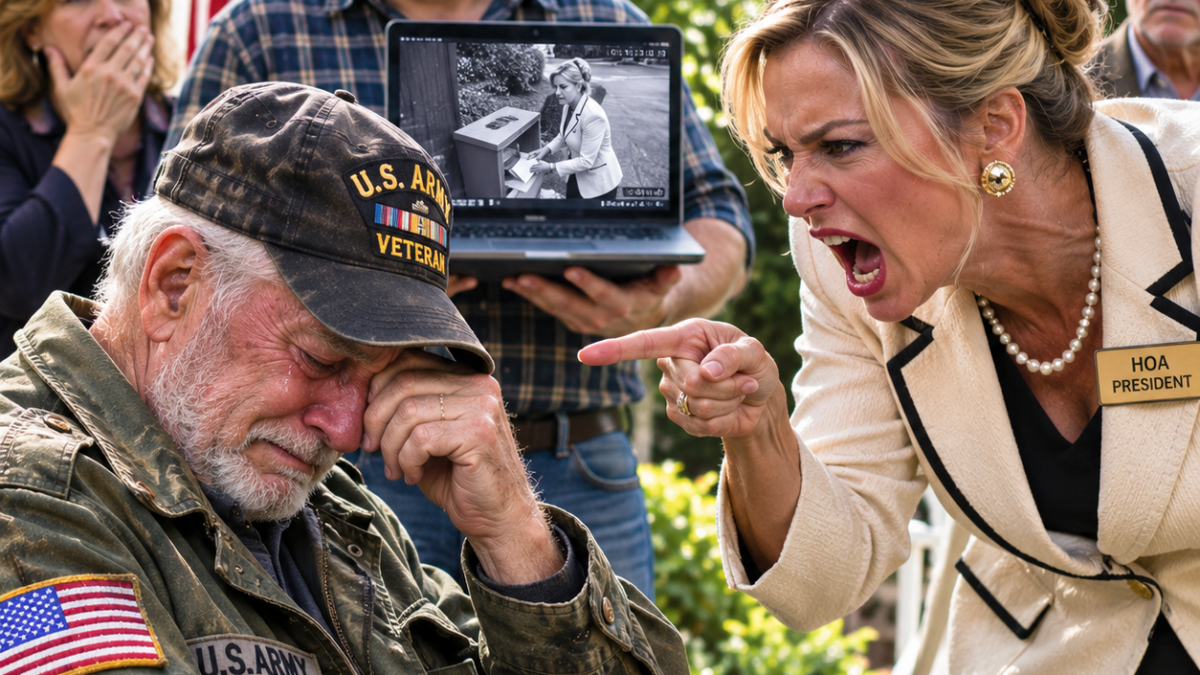
PART2
The first thing I did after Richard left was close my front door.
Not slam it.
Not throw anything.
Just close it.
Then I walked into the kitchen, placed my hands against the counter, and stared at the photograph of my daughter standing beside the refrigerator.
She was smiling in that picture.
Her husband had his arm around her.
It had been taken before their son was born.
I remembered how excited she’d sounded when she called to tell me I was going to become a grandfather.
“Dad, you’re going to have a grandson.”
I’d laughed.
Then cried.
I’d spent decades moving from one assignment to another, missing birthdays, anniversaries, graduations, and family celebrations because duty didn’t always leave room for the life waiting back home.
When my daughter was little, I missed a Christmas.
Then a school performance.
Then a birthday.
There were times when I returned home and found she’d grown several inches while I’d been away.
I had always promised myself that once I retired, I would make up for whatever time remained.
I knew you couldn’t truly replace the years you’d missed.
But you could be present for the ones ahead.
And when my grandson was born, I wanted to be the kind of grandfather who remembered everything.
His first smile.
His first steps.
The way he laughed.
The things that made him curious.
My daughter knew that.
That’s why she sent photographs.
And why losing that envelope hurt worse than any of Susan’s ridiculous fines.
I wasn’t merely angry that someone had interfered with my mail.
I was furious that she had taken something deeply personal and treated it like garbage.
My name is Thomas Vance.
I’d spent thirty years in military service before moving to Whispering Pines.
During those decades, I’d lived by routines most civilians would find exhausting.
Early mornings.
Inspections.
Training.
Deployments.
Long absences.
Responsibility that didn’t disappear simply because you were tired.
I wasn’t a perfect soldier.
Nobody is.
I made mistakes.
Learned from them.
Lost friends.
Missed important moments.
And grew older in places far from home.
When I finally retired, I didn’t want attention.
I didn’t expect anyone to salute me.
I didn’t want strangers thanking me every time I went shopping.
I wanted a comfortable house, a quiet neighborhood, and enough time to enjoy the ordinary things I’d spent years missing.
A cup of coffee without checking a schedule.
A morning walk.
A visit from my daughter.
A little flag beside my front door.
That was all.
Whispering Pines seemed ideal.
The streets curved around landscaped cul-de-sacs.
The lawns were green.
The houses were attractive but not extravagant.
There were trees along the sidewalks and benches near a small neighborhood park.
During my first visit, I saw children riding bicycles while their parents talked outside.
An elderly couple walked hand in hand.
A man watered flowers beside his driveway.
I remember thinking, This is where I can finally settle down.
The real estate agent mentioned the homeowners association.
I wasn’t thrilled.
I’d heard stories about excessive rules and neighborhood politics.
But I reviewed the documents.
The restrictions seemed manageable.
Lawn maintenance.
Exterior modifications.
Parking.
Common-area responsibilities.
Nothing that appeared unreasonable enough to prevent me from enjoying my property.
So I bought the house.
Unpacked.
And began building the quiet retirement I’d imagined.
I had no idea Susan Kensington considered that quiet a privilege she could revoke.
The flag was the beginning.
I mounted it during my first week.
Standard size.
Properly secured.
Displayed beside the front door.
I stepped back to look at it.
The afternoon sun caught the red and white stripes.
For a moment, I thought about friends I’d served beside.
Some who were still working.
Some who had retired.
And some who never came home.
I wasn’t making a political statement against my neighbors.
I wasn’t trying to provoke anybody.
The flag simply mattered to me.
The following morning, I opened the front door and found a bright yellow notice taped beside it.
VIOLATION OF HOA SECTION 4.3 — UNAPPROVED FLAG DISPLAY.
I stared at the paper.
Then looked toward the flag.
“Seriously?”
I carried the notice inside.
Opened the HOA documents.
And searched for the section Susan cited.
Nothing in the language I found justified the blanket demand she’d made.
I reviewed the architectural provisions again.
Still no clear prohibition supporting that notice.
I called the association office.
After several transfers, a woman answered.
“Mr. Vance.”
Her voice sounded as though my name were something unpleasant she’d found beneath her shoe.
“Yes.”
“This is Susan Kensington, HOA president.”
“I received a violation notice about my American flag.”
“I know.”
“I’ve reviewed the documents. I don’t see the basis for requiring its removal.”
She sighed dramatically.
“Mr. Vance, we have standards here.”
“I understand that.”
“Your flag is displayed in an unapproved location.”
I looked toward the window.
“It’s beside my front door.”
“Which requires architectural approval.”
“Then what exactly do I need to submit?”
She paused.
Apparently, she hadn’t expected me to cooperate with the procedure.
Finally, she said, “An application.”
“Fine.”
“And photographs.”
“Fine.”
“And you’ll need to wait for a decision.”
I took a breath.
“Then I’ll submit everything.”
She sounded irritated.
“Good.”
The call ended.
I stood in the kitchen staring at the phone.
I’d expected an explanation.
Instead, I’d received a lecture.
Still, I decided not to argue.
I completed the application.
Attached photographs.
Sent the requested information.
And waited.
Two weeks later, the denial arrived.
One page.
No meaningful explanation.
Just a statement that the request was rejected.
I read it twice.
Then checked the original rules again.
The more I examined the situation, the less reasonable it seemed.
Federal law provides certain protections for displaying the American flag in residential settings, subject to some permissible restrictions, and I wanted to understand how the association believed its position complied with those protections.
But before I could obtain a proper explanation, I encountered Susan near the community mailboxes.
She was walking toward her white SUV.
Her hair was perfectly styled.
Her clothes looked expensive.
And she carried the same confident expression I’d come to recognize.
“Mrs. Kensington.”
She turned.
“Mr. Vance.”
“I received the denial.”
She smiled faintly.
“I assumed you would.”
“I’d like to understand the reason.”
She adjusted her sunglasses.
“The committee has made its decision.”
“That doesn’t answer my question.”
Her smile widened.
“Not every decision requires a personal explanation.”
I stared at her.
“Then how am I supposed to correct the alleged violation?”
She tilted her head.
“Perhaps you should begin by understanding that Whispering Pines isn’t the military.”
I said nothing.
She continued.
“You can’t simply do whatever you want and expect people to approve.”
I looked at her for a long moment.
Then answered, “In the military, people were generally expected to explain the rules they enforced.”
Her smile vanished.
“Then perhaps retirement will be educational for you.”
She walked away.
And I stood beside the mailboxes realizing that my first dispute with Susan had very little to do with the flag.
The military jacket came next.
It was a chilly morning.
I pulled on an old service jacket before walking down the sidewalk to check my mail.
The fabric was faded.
The cuffs were worn.
But it was clean and comfortable.
I’d owned it for years.
I liked wearing it.
Not because I expected anyone to notice.
Because it was familiar.
Susan appeared ahead of me walking her little white terrier.
The dog was perfectly groomed and seemed more interested in sniffing the grass than listening to its owner.
I stepped aside to give them room.
“Morning.”
Susan looked up.
Her gaze moved from my face to my jacket.
Then stopped.
Her expression tightened.
“We don’t do that here.”
I frowned.
“Do what?”
She gestured toward my chest.
“That military clothing.”
I stared.
“My jacket?”
“Yes.”
I almost laughed.
“It’s cold, Susan.”
She didn’t smile.
“This isn’t a military installation.”
“I know.”
“Then you should stop dressing as though you’re trying to make some kind of statement.”
I looked down at the jacket.
Then back at her.
“What statement?”
She folded her arms.
“That you’re different from everyone else.”
For a moment, I couldn’t believe the conversation was happening.
I’d spent thirty years wearing uniforms because my job required them.
Now I was being told that a harmless old jacket made people uncomfortable.
“Susan, I’m checking my mail.”
She smiled coldly.
“And I’m telling you that our community values a certain atmosphere.”
I held her gaze.
“There’s no dress code in the HOA documents.”
Her eyes narrowed.
“Not everything has to be written down, Mr. Vance.”
I felt something inside me become very still.
“Yes,” I said. “When you’re threatening to enforce it, it generally does.”
She tightened the terrier’s leash.
“You’re going to be a problem, aren’t you?”
I shook my head.
“No.”
Then I continued walking.
“I just intend to live in the house I bought.”
After that, the notices multiplied.
My lawn was supposedly half an inch too long.
I measured it.
Trimmed it.
Photographed the result.
Then received another warning.
My garbage can had been left at the curb too long after collection.
I checked the timestamp on the notice.
The amount of time involved was almost absurd.
Still, I moved the can.
Then there was the mailbox.
Susan claimed it wasn’t the correct shade of black.
I stood at the curb holding the letter.
Looked at my mailbox.
Looked at the neighboring mailboxes.
And wondered whether anyone had ever imagined spending retirement comparing shades of black paint.
I bought paint.
Applied it.
Let it dry.
Took photographs.
For a while, I believed that if I complied with each minor request, Susan would eventually lose interest.
I was wrong.
Every correction became an invitation to find something else.
The flag.
The jacket.
The lawn.
The garbage can.
The mailbox.
There was always another problem.
Always another letter.
Always another reminder that Susan expected me to obey.
I began to recognize the pattern.
She didn’t need to win a major argument.
She only needed to keep creating small ones until I was too tired to resist.
Then my mail began disappearing.
At first, it was easy to explain away.
A bill didn’t arrive.
I assumed it had been delayed.
A birthday card from an old friend never appeared.
I blamed the postal service.
A small package went missing.
I contacted the sender.
Nothing seemed connected.
Mail occasionally gets lost.
Misdelivered.
Delayed.
It happens.
But the disappearances continued.
I started paying closer attention.
Then my Veterans Affairs checks stopped arriving.
One month.
Then another.
I had lived long enough to know that government paperwork could become complicated.
So I called the VA.
Explained what was happening.
Confirmed the relevant mailing details and the fact that the payments had been issued.
The representative suggested I contact the postal service to investigate the missing mail.
I wrote everything down.
Dates.
Reference numbers.
The addresses used.
Then I called the post office.
I expected another routine explanation.
A delivery problem.
An incorrect address.
Something administrative.
Instead, the postal worker lowered her voice.
“Mr. Vance, you’re not the first person from Whispering Pines to report missing mail.”
I sat straighter.
“What?”
She hesitated.
“I can’t discuss other customers’ private information.”
“I understand.”
“But I do think you should make a formal report.”
I stared toward the window.
My mailbox stood at the end of the driveway.
Ordinary.
Black.
Exactly where it had always been.
For the first time, I wondered whether the problem had nothing to do with delivery.
I began checking the mailbox shortly after the carrier passed.
Some days, there were letters.
Other days, nothing.
I kept a written record.
I contacted senders.
Checked delivery notifications when available.
And began noticing inconsistencies.
A friend told me he’d sent a birthday card.
It never arrived.
Another friend mailed a small package.
Missing.
A statement I expected didn’t appear.
Then my daughter called.
“Dad, did you get the pictures?”
I smiled.
“What pictures?”
There was a pause.
“The ones I mailed.”
My stomach tightened.
“Not yet.”
She sounded surprised.
“Really?”
“Maybe they’re delayed.”
“Dad, the tracking says they were delivered.”
I looked toward the mailbox.
“When?”
She gave me the date.
I checked my notes.
I’d collected the mail that evening.
The envelope hadn’t been there.
My daughter sighed.
“Oh, Dad.”
“It’s all right, sweetheart.”
“But I wanted you to have them.”
My throat tightened.
“I know.”
She continued.
“There’s one of the baby smiling.”
I closed my eyes.
“And another of him sleeping with his little hand tucked beneath his cheek.”
I swallowed hard.
“I’ll contact the post office.”
She went quiet.
Then asked, “Everything okay over there?”
I looked toward the street.
“Just a little neighborhood trouble.”
She laughed softly.
“Dad, you retired to get away from trouble.”
I tried to smile.
“Apparently, trouble didn’t get the message.”
But after we ended the call, I sat at the kitchen table for a long time.
The missing VA correspondence had frightened me.
The birthday cards had irritated me.
But the photographs of my grandson were different.
They were memories I could never reproduce exactly.
And somebody had apparently taken them before I ever got the chance to see them.
The following evening, Richard Brooks came to my porch.
I’d exchanged greetings with him a few times.
He lived nearby with his wife and young children.
A quiet man.
Friendly without being intrusive.
He generally kept to himself.
That evening, he looked nervous.
“Mr. Vance?”
I stood.
“Richard.”
He glanced toward the street.
“Could I show you something?”
I looked at the tablet in his hands.
“Sure.”
He hesitated.
“I installed a security camera after my kids’ bicycle went missing.”
I nodded.
“And?”
He swallowed.
“It covers part of the street.”
His gaze shifted toward my mailbox.
“I think you should see this.”
I stepped aside.
“Come on up.”
Richard sat beside me.
Opened a recording.
And pressed play.
That’s when I saw Susan Kensington reach into my mailbox.
And the entire dispute changed.
I watched the footage without speaking.
Susan approached my mailbox from the sidewalk.
She looked completely comfortable.
That was what disturbed me most.
She didn’t hurry.
Didn’t crouch.
Didn’t behave like someone frightened of being discovered.
She simply opened a mailbox that wasn’t hers.
Removed envelopes addressed to another person.
Examined them.
Then slipped several into her purse.
Richard let the recording continue.
Susan shut the mailbox.
Adjusted her sunglasses.
And walked away.
I stared at the screen.
“Play it again.”
He did.
This time, I focused on the date and time displayed in the corner.
It was one of the days I’d received a delivery notification but found my mailbox empty.
I took out my notebook.
Checked the date.
Then looked at Richard.
“That morning, I was expecting a letter.”
He nodded.
“I thought so.”
I looked at him.
“How long have you had this?”
“A few days.”
“Why didn’t you tell me sooner?”
His face tightened.
“At first, I didn’t understand what I was seeing.”
I waited.
He continued.
“I thought maybe she was delivering HOA paperwork.”
That wasn’t unreasonable.
Susan sometimes left notices in ridiculous places.
I’d seen yellow violation letters taped to doors and placed under windshield wipers.
But this wasn’t someone dropping off a notice.
The camera clearly showed her taking mail.
Richard opened another clip.
This time, Susan approached from the opposite direction.
She looked over her shoulder.
Removed two envelopes.
Placed one back.
Then carried the other away.
My stomach turned.
“Another day,” Richard said.
I nodded.
He opened the third recording.
The neighborhood park.
The garbage bin.
The envelopes.
I watched Susan drop them into the trash.
Then turn away.
For a moment, I couldn’t feel my hands.
I thought about all those years when the mail had been one of the few dependable connections between my family and whatever part of the world I happened to be serving in.
Letters from home.
Photographs.
Birthday cards.
Notes written by my daughter when she was little.
There had been times when a single envelope had meant more to me than anything I owned.
Susan was throwing those things away because she resented me.
I couldn’t know every thought in her head.
But the video made one fact painfully clear.
She had deliberately interfered with mail that wasn’t hers.
Richard lowered the tablet.
“I’m sorry, sir.”
I turned toward him.
“For what?”
He looked down.
“I should’ve checked the camera sooner.”
I shook my head.
“You didn’t take the letters.”
He nodded slowly.
I continued.
“And you came here once you realized what you had.”
His eyes filled slightly.
“I just couldn’t believe she’d do something like that.”
I looked toward Susan’s house.
“I wish I couldn’t either.”
For a few minutes, we discussed how best to preserve the footage.
Richard agreed to send me copies and retain the original recordings.
I saved the files separately.
Recorded when he’d given them to me.
And wrote down the camera locations and visible timestamps.
I wanted the investigating authorities to have the unaltered material available.
I wasn’t about to publish it online, confront Susan physically, or turn the situation into a neighborhood shouting match.
I’d spent enough of my life understanding why evidence mattered.
If I accused someone of stealing my mail, I wanted the investigation to rest on something stronger than anger.
And now I had that.
That night, I called the police non-emergency line.
I explained that I had video showing someone repeatedly removing mail from my mailbox.
The person I spoke with asked for the location and basic details.
When I mentioned missing VA correspondence and other delivered mail, the matter was referred for further attention.
I also understood that suspected mail theft could involve the United States Postal Inspection Service.
I wanted the evidence reviewed through the appropriate channels.
I gave my information.
Recorded the report details.
And followed the instructions I received.
Then I sat at the kitchen table.
My notebook lay open.
The recordings were safely preserved.
And for the first time since the mail began disappearing, I had an explanation that fit the facts.
But knowing what happened didn’t immediately make me feel better.
I was angry.
Deeply angry.
Not just because Susan had taken my mail.
Because she’d used the ordinary trust of a neighborhood against me.
People leave their mailboxes outside.
They expect the mail carrier to deliver letters.
They expect that private correspondence won’t be intercepted by the person who happens to control the landscaping committee.
It is such a basic expectation that most people never think about it.
Susan had treated it as another opportunity to punish someone who challenged her.
The next morning, Detective Harris arrived.
She was professional, calm, and direct.
I welcomed her into the living room.
Then placed my notebook and the relevant documents on the coffee table.
She asked me to explain the situation from the beginning.
So I did.
My move to Whispering Pines.
Susan’s flag complaint.
The military jacket.
The repeated HOA notices.
The missing letters.
The VA checks.
The photographs from my daughter.
Then Richard’s recordings.
Detective Harris listened carefully.
Occasionally she asked a question.
Sometimes she requested a date.
I gave her what I knew.
When something was uncertain, I said so.
I didn’t claim that every missing letter had necessarily been taken by Susan.
The recordings didn’t establish that.
But they showed multiple instances of her opening my mailbox and removing envelopes.
And one recording showed her disposing of mail.
That was serious enough.
I played the first video.
Detective Harris leaned forward.
Then the second.
She watched Susan remove another envelope.
Finally, the park footage.
Susan’s purse opened.
The envelopes came out.
The trash bin lid moved.
Detective Harris remained quiet until the recording ended.
Then she looked at me.
“Mr. Vance, this is serious.”
I nodded.
“That’s my understanding.”
She continued.
“Suspected mail theft can involve federal offenses. We’ll coordinate with the appropriate postal authorities.”
I felt my shoulders loosen slightly.
Not because the matter was finished.
Because someone outside the HOA had finally acknowledged what I was dealing with.
Detective Harris reviewed my written timeline and arranged to obtain the relevant video evidence properly.
She asked about possible witnesses.
I gave her Richard’s contact information.
Then she asked about Susan.
“Have you confronted her with the recordings?”
“No.”
“Does she know you have them?”
“Not from me.”
Detective Harris nodded.
I understood her caution.
A confrontation could complicate the investigation.
I had no reason to warn Susan about evidence the authorities were reviewing.
Before leaving, Detective Harris looked toward the American flag beside my front door.
It was still there.
I hadn’t removed it.
Its display remained a separate issue I was prepared to resolve through the proper process.
She looked back at me.
“Your dispute with the HOA president started over the flag?”
“That’s where it began.”
“And then the other notices followed?”
“Yes.”
She glanced toward the records.
“Keep all of those documents.”
“I have.”
She nodded.
“Good.”
I watched her walk toward her vehicle.
Then closed the door.
For a moment, I stood in the hallway listening to the quiet.
I had never wanted police involvement in my retirement.
But I was relieved that the matter was no longer confined to Susan’s version of community rules.
Three days later, I was checking my mailbox when I heard footsteps behind me.
Sharp, deliberate footsteps.
The kind produced by expensive shoes on pavement.
I knew who it was before I turned.
Susan Kensington.
She wore a pale blouse and dark trousers.
Her hair was perfectly arranged.
Her oversized purse hung from one shoulder.
I recognized it immediately.
The same style of purse visible in Richard’s footage.
She stopped several feet away.
Then smiled.
“Good morning, Mr. Vance.”
I looked at her.
“Susan.”
She glanced toward my open mailbox.
“Finding everything you need?”
The question was so calculated that for a moment I almost laughed.
She knew mail had been disappearing.
I had mentioned it before.
And now she was standing beside me asking whether I’d received everything.
I closed the mailbox.
“Actually, no.”
Her smile widened.
“Oh?”
“I’ve been missing quite a bit of correspondence.”
She tilted her head.
“How unfortunate.”
I watched her carefully.
“Some of it was important.”
She shrugged.
“The postal service isn’t perfect.”
“No.”
I paused.
“It isn’t.”
For a moment, neither of us spoke.
Then I added, “But these letters appear to have disappeared after delivery.”
Susan’s expression changed.
Only slightly.
A small tightening around her mouth.
Her fingers shifted on the purse strap.
Then she laughed.
“Mr. Vance, you can’t blame the homeowners association for every inconvenience in your life.”
I nodded.
“I wouldn’t.”
She smiled again.
“Good.”
I held her gaze.
“I’m just trying to find out what happened to my mail.”
Susan folded her arms.
“Perhaps you’re expecting too much attention.”
I frowned.
“What does that mean?”
Her eyes moved toward my service jacket.
The same one she’d criticized weeks earlier.
Then she gave a sharp little laugh.
“Some people seem to believe the world revolves around their military history.”
I remained still.
She continued.
“Veterans are always expecting recognition.”
I felt my jaw tighten.
“I’m expecting mail addressed to me.”
Susan rolled her eyes.
“Of course.”
I took a breath.
“Some of it includes correspondence from the VA.”
Her expression became colder.
“Government money.”
I stared.
“Benefits and documents.”
She waved a manicured hand.
“Whatever you want to call them.”
For a moment, I couldn’t believe what I was hearing.
The woman who had been filmed stealing my mail was now criticizing me for receiving it.
I said quietly, “Susan, I’m not asking for special treatment.”
She laughed.
“That’s what people like you always say.”
“People like me?”
She nodded toward my jacket.
“Military people.”
I felt anger rising.
But I kept my voice level.
“I’m not sure what my service has to do with my mailbox.”
Her expression tightened.
“Everything with you comes back to the military.”
I looked at her.
“You brought it up.”
She opened her mouth.
Then closed it.
For a moment, her polished composure slipped.
Her voice grew louder.
“You military types think you’re better than everyone else.”
A curtain moved in a nearby window.
I noticed.
Susan apparently didn’t.
“You expect discounts.”
I said nothing.
“Recognition.”
I remained still.
“Sympathy.”
I looked directly at her.
“I expect the mail that’s legally mine.”
Her face reddened.
She stepped closer.
“You people don’t deserve half the attention you get.”
I felt my hands tighten.
But I didn’t move.
Susan continued.
“All those thank-you cards and government handouts.”
Her voice sharpened.
“It’s disgusting.”
I heard a door open across the street.
Then another.
A neighbor stepped onto a porch.
Someone paused beside a parked car.
Susan’s voice had carried farther than she realized.
I looked around.
There were people watching.
Ordinary neighbors who had probably expected a quiet morning.
Instead, they were hearing their HOA president publicly insult a resident over his military service and government correspondence.
I turned back toward Susan.
“Are you finished?”
Her eyes widened.
“How dare you?”
I nodded slowly.
“I’ve listened.”
Her mouth tightened.
“Then maybe you’ll finally understand how things work here.”
I looked toward my mailbox.
“I think I’m beginning to.”
Across the street, Richard stepped out of his driveway.
He had his phone in his hand.
I didn’t know whether he’d been recording from the beginning.
But when Susan continued shouting, I saw him raise it.
She pointed toward my jacket.
“This neighborhood isn’t a retirement home for people who think they deserve medals for doing their jobs!”
The words hung in the air.
Nobody laughed.
Nobody agreed.
A woman near the sidewalk stared at Susan.
An older man shook his head.
Richard took another step forward.
Susan looked around.
For the first time, she seemed to realize how many people had gathered.
Her expression changed almost instantly.
She straightened her blouse.
Lowered her voice.
And forced a smile.
“I’m simply reminding Mr. Vance that the HOA has standards concerning mailboxes.”
Richard spoke before I could respond.
“That’s not what you just said, Susan.”
She turned sharply.
“What?”
He held her gaze.
“We all heard you.”
Her face went pale.
Then red again.
“Mind your own business, Richard.”
He didn’t move.
“Maybe you should mind his mailbox.”
The silence that followed was extraordinary.
Susan stared at him.
Then at me.
Her lips tightened into a thin line.
Without another word, she turned and walked toward her house.
Her shoes struck the pavement in quick, angry steps.
Her terrier wasn’t with her that morning.
Neither was her clipboard.
For once, she had nothing she could wave in my face.
Richard crossed the street after she disappeared.
He lowered his phone.
“Sorry, sir.”
I looked at him.
“What for?”
He shook his head.
“That was ugly.”
I stared toward Susan’s house.
“Yes.”
He glanced at my jacket.
“You didn’t deserve any of that.”
My throat tightened.
I nodded.
“Thank you.”
He hesitated.
Then said, “I recorded most of it.”
I looked toward his phone.
“Keep the original.”
He nodded.
“I will.”
I took a breath.
“Send a copy to Detective Harris too, if she asks.”
Richard’s expression became serious.
“Of course.”
For a moment, we stood together near the mailbox.
Then he looked toward the flag beside my front door.
“You know, my kids asked why Susan hates that flag.”
I closed my eyes briefly.
“What did you tell them?”
He smiled sadly.
“That I don’t think it’s the flag she hates.”
I looked at him.
He continued.
“I think she hates being told no.”
I didn’t answer.
Because I suspected he was right.
Two days later, my telephone rang.
Detective Harris.
I answered immediately.
“Hello?”
“Mr. Vance.”
Her voice was calm.
“We’ve made progress.”
I sat down.
“What kind?”
She explained that the matter had been coordinated with the postal authorities and that a search had been conducted as part of the investigation.
My hands tightened around the phone.
“And?”
“Mail belonging to you and other residents has been recovered.”
For a moment, I couldn’t breathe.
“Mine?”
“Yes.”
I closed my eyes.
“How much?”
She said the quantity was substantial and that an inventory was being completed.
Then she told me investigators also had the relevant footage showing mail being discarded.
I looked toward the window.
Susan’s house was partly visible beyond the trees.
Detective Harris continued.
“Ms. Kensington is being taken into custody.”
I lowered my head.
For a long moment, I said nothing.
Then whispered, “Thank you.”
She explained that the investigation was continuing and asked me to remain available for any further statements or records needed.
I agreed.
Then the call ended.
I sat quietly.
I had imagined that moment many times.
Sometimes I thought I’d feel triumphant.
Sometimes I imagined wanting to confront Susan with the videos.
Sometimes I pictured standing outside her house demanding an explanation.
But when Detective Harris told me investigators had recovered stolen mail, I didn’t feel any of those things.
I felt tired.
And relieved.
For weeks, Susan had managed to make my own neighborhood feel hostile.
Every morning, I wondered whether another violation notice would appear.
Every afternoon, I checked the mailbox with suspicion.
Every time my daughter called, I worried she’d ask whether I’d received something that had already been taken.
Now there was evidence beyond Richard’s recordings.
Actual mail.
Recovered.
Preserved.
And an investigation moving forward.
I looked toward the photograph of my daughter.
Then whispered, “Maybe we’ll get those pictures back.”
Minutes later, I heard sirens.
I stood.
Walked toward the front window.
Red and blue lights flashed along the street.
Several official vehicles had arrived near Susan’s home.
Neighbors began stepping outside.
I opened my front door.
The air was cool.
The neighborhood was unusually quiet except for the sound of engines and distant voices.
Then Susan appeared.
She was being escorted toward a patrol vehicle.
Her hands were restrained.
Her hair was disheveled.
Her face had gone bright red.
And she was shouting.
“This is ridiculous!”
I stood on my porch.
Susan struggled against the humiliation of being led through the neighborhood she’d spent years trying to control.
“I’m the president of the HOA!”
Her voice carried across the cul-de-sac.
“Do you know who I am?”
Nobody answered.
She turned toward an officer.
“I was protecting this community!”
The officer continued guiding her toward the vehicle.
Susan raised her voice.
“Our property values!”
For a moment, I almost couldn’t believe those were the words she chose.
Property values.
As though stealing correspondence from multiple residents somehow protected the appearance of the neighborhood.
As though mail theft were another architectural violation.
As though her title gave her permission to ignore the law.
Then she saw me.
Standing on my porch.
Watching.
Her expression twisted.
“There!”
She pointed toward me.
“He’s the problem!”
I remained still.
Susan shouted.
“He doesn’t belong here!”
A few neighbors turned toward me.
I felt their eyes.
Then Susan continued.
“People like him ruin neighborhoods!”
The officer closed the vehicle door.
Her voice disappeared behind the glass.
For the first time since I’d met Susan Kensington, she wasn’t the person controlling the conversation.
The vehicle pulled away.
The red and blue lights faded.
And Whispering Pines became quiet again.
I stood on the porch.
My hands rested against the railing.
A breeze moved the American flag beside the door.
For several seconds, I simply watched it.
Then I heard footsteps.
Richard approached.
He looked toward the road where the patrol car had disappeared.
Then back at me.
“Sir.”
I nodded.
“Richard.”
He held out his hand.
“I’m sorry about all this.”
I shook it.
“You’ve already helped more than you know.”
He shook his head.
“We should’ve realized sooner.”
I looked at him.
“You did what you could when you understood what was happening.”
His eyes filled.
Then he said quietly, “Other people are coming.”
I frowned.
“What?”
He glanced toward the neighboring houses.
“They want to talk to you.”
The first was an older woman who lived three doors down.
She approached carrying a small plate of cookies.
Her face looked nervous.
“Mr. Vance?”
I smiled faintly.
“Thomas, please.”
She nodded.
“Thomas.”
Then she looked toward Susan’s house.
“I should’ve said something before.”
I waited.
She swallowed.
“Susan fined me for leaving flowerpots on my porch.”
I looked at her.
“Flowerpots?”
She nodded.
“Then she threatened another violation when I asked where the rule was written.”
My stomach tightened.
She continued.
“I paid because I didn’t want trouble.”
I understood that feeling.
Too well.
She held out the cookies.
“I know it doesn’t fix anything.”
I accepted them.
“Thank you.”
Her eyes filled.
“I just wanted you to know we aren’t all like her.”
I nodded.
“I know.”
And I meant it.
Richard had proved that.
More neighbors came.
A man who had been threatened over his driveway.
A woman who’d been told her garden decorations violated standards nobody could produce.
A young father who’d received escalating fines after questioning an assessment.
They spoke quietly at first.
As though Susan might emerge from behind a hedge and punish them for talking.
Then the stories came faster.
She had threatened people.
Embarrassed them.
Used meetings to single out anyone who disagreed.
Suggested that neighbors who challenged her would have problems selling their homes.
I listened.
Not every complaint necessarily meant an unlawful act.
Some association rules could be legitimate.
Some disputes might have honest explanations.
But the pattern of intimidation was impossible to miss.
People had become frightened of asking questions.
And Susan had benefited from that fear.
One neighbor looked toward my flag.
“She told us you were causing trouble.”
I raised an eyebrow.
“Did she?”
He nodded.
“Said you were refusing to follow basic rules.”
I almost laughed.
“That’s one way to describe it.”
He looked embarrassed.
“I believed her.”
I studied him.
Then said, “You aren’t the person who took my mail.”
He swallowed.
“No.”
“But next time someone tells you a neighbor is a problem, maybe ask what actually happened.”
He nodded slowly.
“I will.”
I looked around at the people standing on my porch.
For weeks, I’d felt as though the entire neighborhood was watching me with suspicion.
Now some of those same neighbors were looking at me with understanding.
It didn’t erase what Susan had done.
But it reminded me that the woman with the loudest voice hadn’t necessarily spoken for everyone.
The following week, the postal inspector contacted me about returning the recovered mail.
I had been waiting for that call.
Every morning, I’d glanced toward the telephone.
Every time it rang, I hoped someone would tell me that the missing letters had been found.
I already knew investigators had recovered a substantial quantity of correspondence.
But knowing that mail existed somewhere in an evidence room wasn’t the same as holding it again.
When the arrangements were made for its return, I barely slept.
The next morning, I cleared the kitchen table.
Made coffee.
Then waited.
I felt oddly nervous.
There were documents I needed.
Bills I had to sort out.
VA correspondence that might require follow-up.
But most of all, there was one envelope I couldn’t stop thinking about.
The photographs.
When the recovered items were returned, I learned that more than sixty pieces of mail belonging to me had been recovered.
Sixty.
I stared at the collection.
It seemed impossible.
I’d been missing letters for weeks, but seeing them together made the scale of the theft real in a way the videos hadn’t.
There were bills.
Statements.
Government documents.
Birthday cards.
Personal correspondence.
And several pieces of mail I hadn’t even realized were missing.
I thanked the inspector and carefully followed any instructions concerning the returned documents and continuing investigation.
Then I sat at the table.
For a moment, I couldn’t touch anything.
Sixty pieces of my life.
Taken without permission.
Hidden or discarded because one woman had decided she could punish me for refusing to flatter her authority.
I began sorting them slowly.
The bills came first.
Some were overdue.
I made notes.
I would need to contact the senders, explain the theft, and resolve any consequences caused by the missing correspondence.
Then I examined the VA documents.
Seeing them made my chest tighten.
I’d spent hours calling government offices, trying to understand why expected mail hadn’t arrived.
Now the correspondence was in front of me.
I placed the documents in a separate folder for follow-up.
Then I began opening the personal letters.
An old friend had sent a birthday card.
Inside was a photograph of the two of us taken years earlier.
We were standing beside a vehicle during an assignment.
Younger.
Tired.
Smiling.
I looked at the picture for a long time.
Then read his handwritten message.
Hope retirement is treating you well, old friend.
I laughed.
Then wiped my eyes.
“Wouldn’t believe it.”
Another envelope contained a letter from someone I’d served with.
He’d written about his family.
His grandchildren.
A fishing trip.
Nothing extraordinary.
But I read every word.
It reminded me how much of military life is built on friendships that survive distance and time.
You may go years without seeing someone.
Then a letter arrives.
A photograph.
A small joke.
And suddenly you’re remembering who you were decades earlier.
Susan had taken those ordinary connections and treated them as disposable.
I placed the letter carefully beside the others.
Then reached for the next envelope.
Cream-colored paper.
My daughter’s handwriting.
I froze.
For several seconds, I simply held it.
My hands began shaking.
I recognized the return address immediately.
My daughter’s name.
Her home.
The little sticker she’d placed near the corner.
A blue star.
She’d used the same kind of stickers when she was a child.
Back then, she’d decorate birthday cards with so many that the envelopes barely closed.
Now she was a mother.
Sending pictures of her own baby.
I ran one finger along the edge of the envelope.
Then opened it carefully.
Inside were photographs.
My grandson.
I looked at the first one.
He was sleeping.
His little face turned to one side.
His tiny hand rested near his cheek.
I could see the softness of his hair.
The peaceful expression.
The way his fingers curled.
My throat closed.
The second photograph showed him awake.
His eyes were wide.
His mouth slightly open.
He looked startled by the world.
I laughed softly.
Then came the third.
He was smiling.
Not a perfect posed smile.
A beautiful, uneven little baby smile.
The kind parents spend hours trying to capture.
I stared at it.
And began crying.
I was alone in the kitchen.
The morning sunlight moved across the table.
The American flag shifted gently outside my window.
And I sat there holding a photograph of my grandson.
Something so small.
So ordinary.
So deeply important.
For weeks, I’d imagined the pictures lost forever.
Perhaps buried beneath garbage.
Perhaps destroyed.
Perhaps mixed with mail nobody would ever find.
But there they were.
The little hand.
The tiny face.
That smile.
I pressed the photographs carefully against my chest.
Then lowered my head.
I hadn’t cried like that since retiring.
Not because I was ashamed of emotion.
But because years of responsibility had taught me to keep moving even when my heart was hurting.
That morning, I didn’t keep moving.
I sat at the kitchen table.
And cried until I could breathe again.
When I called my daughter, she answered on the second ring.
“Dad?”
I tried to speak.
Nothing came out.
“Dad? Is everything okay?”
I laughed through tears.
“I got them.”
There was a pause.
“Got what?”
“The pictures.”
She gasped.
“Oh, Dad.”
My voice broke.
“I have the pictures of the baby.”
She began crying too.
“Really?”
“Yes.”
I looked at the photograph of him smiling.
“He’s beautiful.”
She laughed.
“I know.”
I swallowed.
“He looks like you when you were little.”
She went quiet.
Then whispered, “Dad.”
I wiped my face.
“I wish I could’ve been there when he smiled.”
“You will be.”
I closed my eyes.
“You’ll see him smile plenty of times.”
I nodded.
Even though she couldn’t see me.
Then she asked what had happened to the mail.
I told her.
Not every detail.
Not all the anger.
But enough for her to understand why the pictures had disappeared.
She was furious.
“Dad, that’s horrible.”
“I know.”
“How could someone do that?”
I looked toward the recovered letters.
“I’ve been asking myself the same question.”
She was quiet.
Then said something I needed to hear.
“I’m glad you didn’t let her scare you into leaving.”
I looked around my kitchen.
The home I’d bought for retirement.
The place where I wanted my grandson to visit someday.
“So am I, sweetheart.”
That afternoon, I placed the photographs on the refrigerator.
I stood back.
Looked at them.
Then adjusted the smiling one slightly so it hung straight.
For weeks, the empty space had been a reminder of something missing.
Now there he was.
My grandson.
Smiling at me whenever I walked into the kitchen.
I made another cup of coffee.
Sat down.
And watched the sunlight settle across the floor.
For the first time since moving to Whispering Pines, the house began feeling like the peaceful place I’d wanted.
The HOA board called an emergency meeting after Susan’s arrest.
I received the notice in my mailbox.
For a moment, I almost laughed at the irony.
An HOA letter had finally reached me without interference.
The meeting was scheduled for the following week.
I considered not attending.
I’d spent enough time thinking about Susan Kensington.
Enough mornings wondering what new rule she’d invented.
Enough afternoons checking whether my mail had disappeared.
I didn’t want my retirement to become a series of arguments about the association.
But then Richard called.
“Mr. Vance, are you going?”
I looked toward the notice.
“Probably.”
He hesitated.
“I think you should.”
“Why?”
“Because people want to hear what happened.”
I sighed.
“The investigators have the evidence.”
“I know.”
He paused.
“But a lot of people still don’t understand how bad it got.”
I thought about the neighbors who’d come to my porch.
The fines.
The threats.
The fear of speaking up.
Then I nodded.
“All right.”
The community room was crowded when I arrived.
I’d been there only once before, during the orientation session for new homeowners.
Back then, Susan sat at the front.
Smiling.
Speaking about community pride.
Promising to preserve the neighborhood’s character.
I remembered how impressed some residents seemed.
She spoke confidently.
Used professional language.
Made everything sound organized and important.
Now the same room felt different.
People whispered.
Chairs scraped.
A few residents looked angry.
Others looked embarrassed.
Richard spotted me near the entrance.
He waved.
“Over here, sir.”
I sat beside him.
A woman across the aisle leaned forward.
“Mr. Vance?”
I turned.
She smiled nervously.
“I’m glad you’re here.”
I nodded.
“Thank you.”
Then the meeting began.
Without Susan in the president’s chair, the board seemed uncertain.
Several members shuffled papers.
One cleared his throat.
Then an interim representative stood.
He acknowledged the investigation and the seriousness of the allegations.
He explained that the board was reviewing its procedures and records.
Then he apologized.
Not only to me.
To the residents who’d endured Susan’s intimidation.
I sat quietly.
I’d imagined an apology before.
Sometimes, when another yellow notice appeared on my door, I pictured Susan finally admitting she’d been wrong.
But hearing the words from the board didn’t make the previous months vanish.
I still remembered the missing checks.
The flag complaints.
The military jacket.
The insult about government handouts.
And the photograph of my grandson that had almost been lost.
The apology mattered.
But corrective action would matter more.
When residents were invited to speak, several stood.
A woman described receiving fines she couldn’t understand.
Another homeowner asked for a review of Susan’s enforcement decisions.
A father questioned whether the board had properly supervised the president’s activities.
Then Richard stood.
He didn’t make a dramatic speech.
He simply explained that his security camera had recorded activity near my mailbox and that he had provided the footage to the proper authorities.
He reminded the room that the investigation was ongoing.
Then he said, “I think we all need to stop assuming that someone is right just because they’re the president.”
The room went quiet.
I looked at him.
He continued.
“An HOA is supposed to serve homeowners. It isn’t supposed to frighten them.”
Several people nodded.
For a moment, I felt proud of him.
He was younger than I was.
A husband.
A father.
A quiet neighbor who didn’t like conflict.
Yet when he saw something wrong, he’d spoken up.
That mattered more than any title.
Someone asked whether I wanted to speak.
I hesitated.
Then stood.
The room became quiet.
I looked at the faces around me.
Neighbors.
People whose lawns I’d passed.
People whose children I’d seen riding bicycles.
People I wanted to know as friends rather than witnesses to a dispute.
I took a breath.
“I moved here because I wanted peace.”
Nobody interrupted.
“I served thirty years in the military. When I retired, I was ready for ordinary life.”
I glanced toward Richard.
“Coffee in the morning.”
A few people smiled.
“Walking around the neighborhood.”
I paused.
“Checking my mail without wondering whether somebody had taken it.”
The smiles disappeared.
I looked toward the board.
“I don’t expect anyone here to agree with every decision I make.”
I continued.
“I understand that a homeowners association has legitimate responsibilities.”
Then I pointed toward the documents on the table.
“But those responsibilities have limits.”
Several residents nodded.
I looked around the room.
“A title doesn’t give someone permission to insult people.”
I swallowed.
“Or threaten them.”
Then I added, “And it certainly doesn’t give them permission to take private correspondence out of a mailbox.”
The room remained still.
I took another breath.
“I don’t want this neighborhood to become known for one woman’s misconduct.”
I looked toward the people in front of me.
“I want it to become a place where people can ask questions without being afraid.”
Then I sat down.
For a moment, nobody spoke.
Then someone began applauding.
A few others joined.
The applause grew.
I felt uncomfortable.
I hadn’t come for recognition.
I wasn’t interested in becoming the neighborhood hero.
I simply wanted the truth acknowledged and the problems corrected.
Richard leaned toward me.
“Good speech, sir.”
I shook my head.
“I wasn’t trying to make one.”
He smiled.
“That’s probably why it worked.”
The board committed to reviewing past enforcement actions, improving transparency, and ensuring that residents had meaningful ways to challenge improper notices.
It also issued a formal apology.
I welcomed the steps.
But I understood they would need to be followed through.
Susan’s arrest hadn’t automatically solved every governance problem.
Other board members had allowed her to operate with too little scrutiny.
Residents had been frightened of challenging her.
And the association needed more than new stationery to rebuild trust.
Still, the meeting felt like a beginning.
People were asking questions.
The board was answering.
And nobody was shouting that disagreement constituted a violation.
I walked home beside Richard.
The evening air was cool.
Streetlights glowed along the sidewalks.
For a while, we didn’t speak.
Then Richard said, “You know, my daughter asked about you.”
I looked toward him.
“Your daughter?”
He nodded.
“She’s eight.”
I smiled.
“What did she ask?”
“She wanted to know why you didn’t yell back at Susan.”
I laughed softly.
“That’s a fair question.”
Richard looked at me.
“What should I tell her?”
I thought for a moment.
Then said, “Tell her anger isn’t the same as strength.”
He nodded slowly.
I continued.
“Sometimes the strongest thing you can do is stay calm long enough to make sure the truth gets heard.”
Richard smiled.
“I like that.”
I looked toward the sky.
“And tell her I’m still learning.”
He laughed.
We reached my driveway.
I looked toward my flag.
It moved gently in the evening breeze.
For the first time in months, nobody had placed a notice beneath it.
The story might have ended there.
Susan under investigation.
My mail recovered.
The board apologizing.
Residents beginning to speak freely.
That would have been enough for me.
But the neighborhood dispute had become public.
A local reporter learned about the arrest and the alleged theft of a retired veteran’s mail.
She contacted me.
I almost declined the interview.
I’d never wanted to become a headline.
And after decades of military service, I knew how easily a complicated story could become something distorted when reduced to a few dramatic sentences.
But I also understood that other people might be experiencing similar intimidation.
So I agreed to speak.
I kept my explanation focused on what I could document.
The missing mail.
The camera footage.
The official investigation.
The effect on my family.
And the fact that the HOA president had repeatedly criticized my military background.
I didn’t speculate about facts I couldn’t verify.
I didn’t ask the reporter to turn Susan into a cartoon villain.
Her actions were serious enough without exaggeration.
The story aired shortly afterward.
A retired veteran.
Missing VA correspondence.
An HOA president accused of stealing and discarding mail.
Security footage.
An arrest.
The report spread quickly.
People shared it.
Discussed it.
Asked how someone could have believed a neighborhood title gave her such power.
Some expressed sympathy.
Others were angry.
A few wanted more details about the legal process.
I watched the broadcast once.
Then turned off the television.
Seeing my house on the screen was strange.
Seeing my flag was stranger.
And seeing Susan’s name associated with a criminal investigation was something I never imagined when I purchased the property.
I sat in the living room for a long time.
Then went into the kitchen.
Looked at my grandson’s pictures.
And made dinner.
I wanted ordinary life back.
Even while the rest of the world seemed fascinated by what had happened.
The attention brought calls from old military friends.
People I hadn’t heard from in years.
Some were furious.
Others laughed in disbelief.
One old buddy called and opened with, “Thomas, you retire for five minutes and start another war?”
I laughed harder than I had in weeks.
“Believe me, I didn’t volunteer for this one.”
He chuckled.
Then his voice became serious.
“I’m glad you’re all right.”
I looked toward the window.
“Me too.”
He paused.
“And I’m glad somebody caught her.”
I nodded.
“So am I.”
Then we talked about other things.
Our families.
Our health.
The friends we missed.
The places we’d served.
For the first time in months, I enjoyed a conversation that wasn’t entirely about the HOA.
Then came a call I hadn’t expected.
A state senator’s office contacted me after the news report.
At first, I thought someone was playing a joke.
But the details were specific.
The senator recognized my name.
Years earlier, during military operations in Afghanistan, I’d participated in a mission involving the rescue of a unit that included his son.
He remembered what had happened.
And now, after seeing the report, he wanted to speak with me.
When we connected, I felt strangely uncomfortable.
I’d never considered my old service something that entitled me to favors.
The mission had been dangerous.
Important.
And carried out by people doing the jobs they were assigned.
I hadn’t done it for future recognition.
But the senator remembered.
He spoke about his son’s unit.
About the families who had waited for news.
About the relief when the men came home.
For a moment, I was no longer standing in my retirement house.
I was remembering the terrible uncertainty of those days.
The men I’d served beside.
The decisions that mattered.
The people who depended on us.
The senator thanked me.
I accepted his words.
Then explained the situation in Whispering Pines as accurately as I could.
I didn’t ask him to interfere with the investigation.
I wanted the legal process to remain independent.
But his call reminded me of something Susan had tried to make me forget.
My service wasn’t something shameful.
And the people who remembered it did so because of sacrifices and responsibilities far larger than a neighborhood dispute.
After the call, I sat beside the kitchen window.
My old jacket hung near the door.
The same one Susan had called inappropriate.
I looked at it for a long time.
It was just fabric.
Faded.
Comfortable.
Marked by years of use.
But the memories attached to it were mine.
Susan hadn’t earned the right to tell me what those memories were worth.
I walked over.
Took the jacket from its hook.
Put it on.
Then went outside for a walk.
Nobody stopped me.
Nobody issued a violation.
Nobody told me that the sight of an old veteran in his own neighborhood made the community uncomfortable.
A child riding past on a bicycle waved.
I waved back.
A neighbor smiled from her garden.
I nodded.
And continued walking.
It was exactly the kind of ordinary afternoon I’d wanted when I moved to Whispering Pines.
The legal proceedings began later.
I received notice that my testimony and records might be needed.
By then, investigators had the security footage, recovered correspondence, witness statements, and other evidence.
I worked with the appropriate authorities and my own legal advisers to understand what would be required.
I wasn’t excited about going to court.
I’d already spent more time thinking about Susan than I wanted to.
But I also understood the importance of following through.
If people could commit serious acts and then avoid accountability because their victims were tired of the process, the damage would extend far beyond one neighborhood.
So I prepared.
The first court appearance was crowded.
I recognized a few faces from Whispering Pines.
Neighbors.
People who had experienced Susan’s threats.
People who wanted to understand what the investigation had uncovered.
There were reporters too.
I sat quietly.
My hands rested on my knees.
I wasn’t wearing my old service jacket that day.
I wore a dark suit and a simple tie.
Not because Susan had convinced me the jacket was inappropriate.
Because court was a formal setting, and I wanted to treat it with respect.
When Susan entered, I barely recognized the woman I’d met beside the community mailboxes.
Her hair was neatly arranged, but her expression was tense.
She no longer carried a clipboard.
There was no oversized purse.
No yellow violation notice.
No sunglasses hiding her eyes.
She sat with her attorney.
For a moment, she glanced toward the gallery.
Our eyes met.
Then she looked away.
The proceedings addressed the alleged offenses connected to the stolen correspondence and related conduct.
The evidence included video recordings, recovered mail, and witness accounts.
Richard’s footage played an important part.
I watched the court review the acts I’d seen on his tablet.
Susan opening my mailbox.
Removing envelopes.
Taking them away.
Then the footage showing mail discarded in the neighborhood park.
Seeing it on a courtroom screen was different from watching it on my porch.
On the porch, I had felt anger and disbelief.
In court, I felt sadness.
The images were clear.
The conduct was deliberate.
And the consequences were now impossible to dismiss as a disagreement about community standards.
Susan’s defense attempted to explain her behavior.
There were references to neighborhood oversight.
Confusion.
Administrative responsibilities.
But controlling landscaping decisions wasn’t a legal explanation for removing someone else’s mail.
The case proceeded through the required legal stages.
The court considered the evidence and the applicable charges.
I learned more about the distinction between an HOA’s internal powers and actual governmental authority than I had ever wanted to know.
An association can regulate certain matters within the limits of its governing documents and applicable law.
It cannot authorize a president to intercept private correspondence.
A resident’s status as a veteran doesn’t automatically transform every personal insult into a separate federal offense, either.
The legal questions had to be established under the relevant statutes and facts.
But the theft of mail and the effort to obstruct its delivery were serious in their own right.
And Susan had left behind a substantial evidentiary trail.
At one hearing, the issue of bail was addressed.
The judge set it at fifty thousand dollars and imposed conditions, including surrendering her passport.
Susan looked stunned.
I remember the way her expression changed.
For months, I’d watched her speak as though consequences were reserved for other people.
Now she was sitting in a courtroom, listening to conditions imposed by an authority she couldn’t overrule with an HOA vote.
She whispered something to her attorney.
Then shook her head.
As she was escorted away, I heard her protest that she’d only been enforcing neighborhood rules.
I looked down.
For a moment, I felt almost sorry for her.
Not because she was innocent.
Not because her conduct was excusable.
But because she seemed genuinely unable to comprehend that the title she’d valued so much offered no protection from the law.
The legal process continued.
There were additional proceedings.
Evidence to review.
Witnesses to hear.
Arguments to consider.
I participated where required and remained otherwise focused on my own life.
By then, Whispering Pines was changing.
The interim HOA leadership had begun reviewing old enforcement records.
Residents had become more involved.
The association’s communications were more careful.
Minutes were distributed.
Questions were answered.
The aggressive yellow notices had largely disappeared.
Not every homeowner agreed about every issue.
Of course not.
People still argued about landscaping and parking.
There were disagreements about maintenance costs.
A few residents thought the board should be stricter.
Others wanted fewer restrictions.
That was ordinary community governance.
The important difference was that disagreements no longer automatically became personal campaigns of retaliation.
I began getting to know my neighbors.
Richard invited me to a barbecue.
His children showed me their bicycles.
The little girl who had asked why I didn’t shout back at Susan wanted to know whether I’d really been in the military for thirty years.
“Yes, ma’am,” I told her.
Her eyes widened.
“Did you get to fly helicopters?”
I laughed.
“Not everything in the military involves helicopters.”
She looked disappointed.
So I told her about some of the ordinary work.
Training.
Planning.
Taking care of the people around you.
Doing difficult things even when nobody was watching.
She listened.
Then asked, “Were you scared sometimes?”
I looked toward Richard.
He waited.
I turned back to her.
“Yes.”
She frowned.
“But soldiers are brave.”
I smiled.
“Being brave doesn’t mean you never get scared.”
She thought about that.
Then asked, “What does it mean?”
I considered my answer.
“Sometimes it means doing the right thing even when you’re frightened.”
She nodded very seriously.
Then ran off to play.
Richard smiled.
“Think she’ll remember that?”
I looked after her.
“I hope so.”
The day the case reached its final outcome, I sat quietly while the consequences were announced.
Susan was sentenced to eighteen months in federal prison, with additional supervision and financial penalties described in the case, including a five-year probationary term and twenty-five thousand dollars in fines and restitution.
I listened carefully.
There had been a time when I imagined I’d feel enormous satisfaction hearing the sentence.
But when it happened, I felt something more complicated.
Relief.
Yes.
Gratitude that the conduct had been investigated.
Certainly.
But also sadness that something so unnecessary had damaged so many lives.
My mail had been stolen.
Other residents had been affected.
Neighbors had become suspicious of one another.
The association had lost credibility.
And Susan herself was facing prison because she refused to recognize the limits of her power.
None of that had needed to happen.
She could have disagreed with my flag.
Asked for an architectural review.
Even argued about the mailbox color.
Those disputes had ordinary ways to be addressed.
Instead, she’d decided to turn an HOA disagreement into personal punishment.
And then into a crime.
As Susan was escorted away, she glanced toward me.
For one brief moment, our eyes met.
I remembered the woman standing beside my mailbox.
The smug smile.
The expensive sunglasses.
The contempt in her voice when she criticized veterans.
I remembered her asking whether I’d received everything.
And the way she’d shouted that I didn’t belong in Whispering Pines.
Now she looked angry.
Confused.
Almost disbelieving.
I didn’t smile at her.
Didn’t wave.
Didn’t say anything.
There was nothing left I needed her to hear.
The evidence had spoken.
The court had acted.
And I was ready to go home.
Outside the courthouse, reporters approached.
A microphone appeared near my face.
Someone asked whether I was happy with the sentence.
I thought for a moment.
Then answered, “I’m glad the case was taken seriously.”
Another reporter asked whether I felt vindicated.
I looked toward the courthouse doors.
“I’m relieved the truth was established.”
Then someone asked what I wanted to say to Susan.
I paused.
For a moment, I considered all the things I might say.
That she’d hurt people.
That she’d abused her position.
That she had no right to touch my mail.
That the government documents and letters she’d taken belonged to me.
That the photographs of my grandson were precious.
That her hatred of my military background said far more about her than about my service.
All of those things were true.
But I’d already spent months defending myself.
I didn’t want to spend another afternoon speaking to her through a television camera.
So I gave a simpler answer.
“I hope she understands someday that being in charge of something doesn’t mean you own the people around you.”
Then I walked away.
When I got home, Richard was waiting near his driveway.
He’d followed the news.
He walked toward me as I parked.
“How’d it go?”
I told him.
He exhaled.
“Eighteen months.”
I nodded.
He looked toward Susan’s house.
For a moment, neither of us spoke.
Then Richard turned back.
“Are you okay, sir?”
I thought about it.
Then nodded.
“Yes.”
He smiled faintly.
“Really?”
I looked toward my front door.
The flag was moving in the breeze.
“Yes, Richard.”
I smiled.
“I think I finally am.”
That evening, I made dinner.
Nothing special.
Chicken.
Vegetables.
A baked potato.
I ate at the kitchen table while looking at my grandson’s photographs.
Then I washed the dishes.
Put away the leftovers.
And checked my mailbox.
There was a letter from an old friend.
I carried it inside.
Opened it.
Read it.
And placed it on the counter.
Such an ordinary sequence.
The kind of thing people repeat every day without considering it important.
But for me, that evening, it felt extraordinary.
I had collected my mail.
And it was still there.
Over the following months, Whispering Pines slowly returned to normal.
Not the old version of normal, where neighbors lowered their voices whenever Susan’s SUV passed.
A healthier version.
People spoke at HOA meetings.
Asked questions.
Requested documentation.
Challenged fines they believed were improper.
The board responded through established procedures.
There were still disagreements.
Sometimes heated ones.
But nobody seemed willing to accept threats merely because they came from someone holding a title.
I attended a few meetings.
Then stopped going regularly.
Not because I no longer cared.
Because I didn’t want the association to become the center of my retirement.
I’d moved to Whispering Pines to live.
And at last, I could.
My daughter visited that spring.
She brought her husband and my grandson.
I had cleaned the house more carefully than necessary.
Bought extra groceries.
Checked the guest room.
And rearranged the furniture so there would be plenty of room for the baby.
When their car pulled into the driveway, I was already on the porch.
My daughter stepped out.
“Dad!”
I hurried down the steps.
She hugged me.
Then pulled back.
“Are you okay?”
I smiled.
“Better now.”
She looked toward the house.
Then toward the flag.
“Still flying.”
I laughed.
“Still flying.”
Then she opened the back door of the car.
And lifted out my grandson.
He was bigger than in the photographs.
Of course he was.
Babies change so quickly.
He had round cheeks.
Bright eyes.
And tiny hands that opened and closed as though he were trying to grab the entire world.
My daughter smiled.
“Ready to hold him?”
I stared.
For a moment, I felt more nervous than I had in court.
Then I held out my arms.
She placed him carefully against my chest.
I looked down.
My grandson looked back.
He blinked.
Then made a tiny sound.
My eyes filled.
“Hello, little man.”
My daughter smiled.
“He knows his grandpa.”
I laughed softly.
“Does he?”
She nodded.
“Of course.”
I knew babies didn’t understand family relationships the way adults did.
But in that moment, I didn’t care about technical explanations.
I was holding my grandson.
The same baby whose photographs had disappeared into Susan’s purse.
And nothing could have mattered more.
We spent the afternoon together.
My daughter helped prepare lunch.
Her husband carried bags inside.
The baby slept.
Woke.
Ate.
And made everyone laugh with the unpredictable seriousness of his expressions.
I told stories about her childhood.
She rolled her eyes.
“Dad, please.”
I grinned.
“Your son needs to know what kind of trouble his mother got into.”
She laughed.
Then leaned against my shoulder.
For a moment, we were quiet.
The baby rested nearby.
Sunlight moved through the living room.
Then she whispered, “I’m glad you’re here.”
My throat tightened.
“Me too, sweetheart.”
She looked toward the window.
“After everything Susan did, I was afraid you’d leave.”
I shook my head.
“This is my home.”
She nodded.
I continued.
“And now that you and this little fellow are here, it finally feels the way I imagined.”
She hugged me.
I closed my eyes.
For thirty years, my life had been shaped by departures.
Now I wanted to remember what it felt like when the people I loved arrived.
The next morning, I woke before everyone else.
Old habits.
Thirty years of early mornings don’t disappear simply because you retire.
I made coffee.
Opened the curtains.
And stepped onto the porch.
The neighborhood was quiet.
A few birds moved through the trees.
Someone was watering flowers near the corner.
A delivery truck rolled slowly down the street.
Richard stood near his driveway helping one of his children prepare a bicycle.
He looked up.
“Morning, Mr. Vance!”
I smiled.
“Morning, Richard.”
His daughter waved.
I waved back.
Then I looked toward my mailbox.
Black.
Ordinary.
Exactly the shade Susan had once insisted was unacceptable.
I almost laughed.
For a moment, I remembered that first yellow notice.
The way I’d held it in my hands, confused about how displaying an American flag could become such an enormous controversy.
I remembered submitting the paperwork.
The unexplained rejection.
Susan’s contemptuous smile near the community mailboxes.
Then the service jacket.
The lawn.
The garbage can.
The repeated violations.
The missing letters.
The VA checks.
My daughter’s envelope.
And the video.
Susan Kensington standing at my mailbox in broad daylight, removing mail she had no right to touch.
It was strange how much could begin with something small.
A complaint.
A refusal.
A person determined to prove she could control somebody else.
And how quickly that determination could become something genuinely destructive.
I sat in the porch chair.
The coffee warmed my hands.
For the first time in months, there was nothing urgent I needed to do.
No report to complete.
No statement to review.
No hearing to attend.
No recording to preserve.
No question about whether Susan would come walking down the street with another clipboard.
The case was over.
The consequences had been imposed.
The HOA had new leadership.
And my family was sleeping peacefully inside my house.
I let myself enjoy the silence.
After a while, my daughter opened the front door.
She stepped outside carrying my grandson.
“Dad?”
I turned.
She smiled.
“There you are.”
I stood.
“Couldn’t sleep in.”
She laughed.
“Some things never change.”
Then she handed me the baby.
He was warm and sleepy.
His little fist curled against my shirt.
I sat back down carefully.
My daughter settled in the chair beside me.
For several minutes, we simply watched the street.
Then she looked toward my old military jacket hanging near the door.
“Dad?”
“Yes?”
“Are you ever going to get rid of that thing?”
I looked at her.
She grinned.
“It’s ancient.”
I laughed.
“Watch it.”
She smiled.
“I’m just saying.”
I glanced toward the jacket.
The worn cuffs.
The faded fabric.
The memories.
Then I looked down at my grandson.
“No,” I said.
My daughter smiled.
“Didn’t think so.”
I looked toward the flag.
And laughed softly.
“Apparently, that jacket causes quite a commotion around here.”
She shook her head.
“Only with people who have too much time on their hands.”
I nodded.
Then kissed my grandson gently on the forehead.
I sometimes wonder whether Susan ever understood what she’d done.
Not simply that she broke the law.
The court had made that clear.
I wonder whether she understood the smaller things.
How it felt to be an older man checking an empty mailbox when he knew his daughter had sent pictures.
How humiliating it was to be told that a lifetime of service made you unwelcome in your own neighborhood.
How exhausting it became to wake each morning wondering what new accusation would be waiting.
How deeply a person’s sense of safety can be damaged when the people around him seem afraid to speak.
And how much courage it can take for a quiet neighbor to walk across the street and say, “I think you need to see this.”
I don’t know whether she ever understood any of that.
But I no longer need her to.
The evidence was recovered.
The truth was established.
The court imposed consequences.
And the neighborhood began changing.
That’s enough.
Richard and I remained friends.
Sometimes he stopped by for coffee.
Sometimes I joined his family for a barbecue.
His children liked hearing stories about places I’d visited during my military career.
I was careful about what I told them.
Some memories were too painful.
Others were simply too complicated for children to understand.
But I spoke about friendship.
Responsibility.
Courage.
The importance of doing the right thing even when nobody is watching.
One afternoon, Richard asked whether I regretted moving to Whispering Pines.
I thought about the question.
Then looked around.
The trees.
The lawns.
The quiet sidewalks.
The flag beside my front door.
The mailbox at the end of the driveway.
“No,” I said.
He looked surprised.
“Really?”
I shook my head.
“Not anymore.”
He waited.
I continued.
“Because if I hadn’t moved here, I wouldn’t have met you.”
Richard smiled.
I raised my coffee.
“And I wouldn’t have learned that this neighborhood has more decent people than one loud HOA president ever wanted me to believe.”
He laughed.
Then raised his own cup.
“I’ll drink to that.”
Now, when people ask me what happened in Whispering Pines, I don’t begin with Susan’s arrest.
I begin with the flag.
Because that’s where the pattern became visible.
A woman decided she didn’t like how I displayed something meaningful to me.
When I requested an explanation, she treated the question as disrespect.
When I refused to accept vague threats, she found other ways to make my life difficult.
Eventually, she crossed a line that had nothing to do with an association’s legitimate authority.
She began taking private mail.
And she made the mistake of believing nobody would notice.
But Richard noticed.
His camera recorded what happened.
The postal authorities investigated.
The missing correspondence was recovered.
And Susan discovered that an HOA presidency was not permission to ignore the law.
I think about those sixty pieces of mail.
The bills.
The documents.
The birthday cards.
The letters from old friends.
The VA correspondence.
And especially the envelope containing my grandson’s photographs.
I could replace a late bill.
I could request another statement.
I could contact the VA and resolve administrative questions.
Those things mattered, but there were ways to address them.
The photographs were different.
They represented moments my daughter wanted to share with me.
A baby sleeping.
A tiny smile.
A new life beginning.
I had spent years far from home, missing moments I couldn’t recover.
Susan had nearly made me miss another.
That was the part I found hardest to forgive.
Not the insult about my jacket.
Not the yellow notices.
Not the threats about property values.
The attempt to take something precious that had nothing to do with her.
A few weeks after my daughter visited, I bought a small frame.
Nothing expensive.
Just a simple wooden frame with space for three pictures.
I placed the photographs of my grandson inside.
Then set it on the mantelpiece.
I stood back.
Looked at it.
And smiled.
There was the little sleeping face.
The wide eyes.
The beautiful smile.
I thought about how close those photographs had come to disappearing into a trash bin.
Then I looked toward the front window.
My flag moved gently in the breeze.
The street was quiet.
And for the first time since retiring, I felt completely at home.
My name is Thomas Vance.
I served thirty years in the military.
When I retired, I wanted a peaceful life in Whispering Pines.
Instead, I encountered Susan Kensington, an HOA president who believed her title gave her the right to humiliate residents, invent violations, and punish anyone who questioned her.
She tried to control my American flag.
Mocked my service jacket.
Buried me in petty notices.
And then began stealing mail from my mailbox.
For two months, important VA correspondence disappeared.
Personal letters vanished.
And photographs of my newborn grandson were taken before I ever had the chance to see them.
Susan thought her position made her untouchable.
She thought the people around her were too intimidated to challenge her.
And she thought I would eventually surrender my dignity simply to enjoy a quiet retirement.
She was wrong.
I didn’t need to threaten her.
Didn’t need to shout louder.
Didn’t need to use my military service as a weapon.
I needed evidence.
A neighbor willing to tell the truth.
And the patience to let the proper authorities do their work.
Richard’s camera recorded her taking mail.
Investigators recovered correspondence belonging to multiple residents.
The court considered the evidence.
Susan faced serious consequences.
And Whispering Pines finally began confronting the behavior people had tolerated for too long.
Susan Kensington told me that my thirty years of military service meant nothing, that my American flag violated her precious community standards, and that veterans like me didn’t deserve recognition or government benefits. Then she stole my VA correspondence, birthday cards, and the first photographs my daughter mailed of my newborn grandson, never realizing that my neighbor’s security camera had recorded her reaching into my mailbox.
In the end, more than sixty pieces of my stolen mail were recovered, Susan was arrested and sentenced, and the HOA board apologized to the residents she’d intimidated. But the moment that mattered most to me wasn’t watching her leave in handcuffs—it was sitting at my kitchen table, opening my daughter’s long-lost envelope, and finally seeing my grandson smile.
I had spent thirty years serving my country.
I’d known danger.
Loss.
Responsibility.
And the heavy cost of being far from family.
When I finally came home, I didn’t want another battle.
I wanted ordinary mornings.
A flag beside my door.
Mail arriving in my mailbox.
And the people I loved visiting whenever they could.
Now I have those things.
And when my grandson grows old enough to ask about the photograph on my mantelpiece, perhaps I’ll tell him how it almost disappeared.
I’ll tell him about a man named Richard who noticed something wrong and chose not to look away.
About the importance of evidence.
About why titles don’t make people above the law.
And about how courage can mean standing calmly in your own driveway while someone tries to make you feel that you don’t belong.
Then I’ll show him the flag outside.
The old jacket hanging near the door.
And the little black mailbox at the end of the driveway.
And I’ll tell him something I learned later in life than I expected.
Real authority doesn’t come from making people afraid of you. It comes from accepting responsibility, respecting the rules that apply to everyone, and having the integrity to do what’s right when no one is watching.
Susan Kensington wanted me to feel ashamed of my past.
Instead, she reminded me why I had spent thirty years believing that freedom, accountability, and ordinary human dignity were worth protecting.
And now, when I open my front door each morning, I no longer look for a yellow violation notice.
I look at the flag.
At my neighborhood.
At the mailbox where my family’s letters arrive.
Then I breathe in the morning air, take a sip of coffee, and remember that I don’t have to fight for the right to be here anymore.
I came to Whispering Pines looking for peace, and after everything Susan tried to take from me, peace is finally what I have.








