PART2:“TAKE OFF THAT FILTHY ARMY JACKET OR GET OUT OF MY NEIGHBORHOOD!” HOA Karen Threatened a Decorated Veteran—She Had No Idea Who Was Coming Down the Street
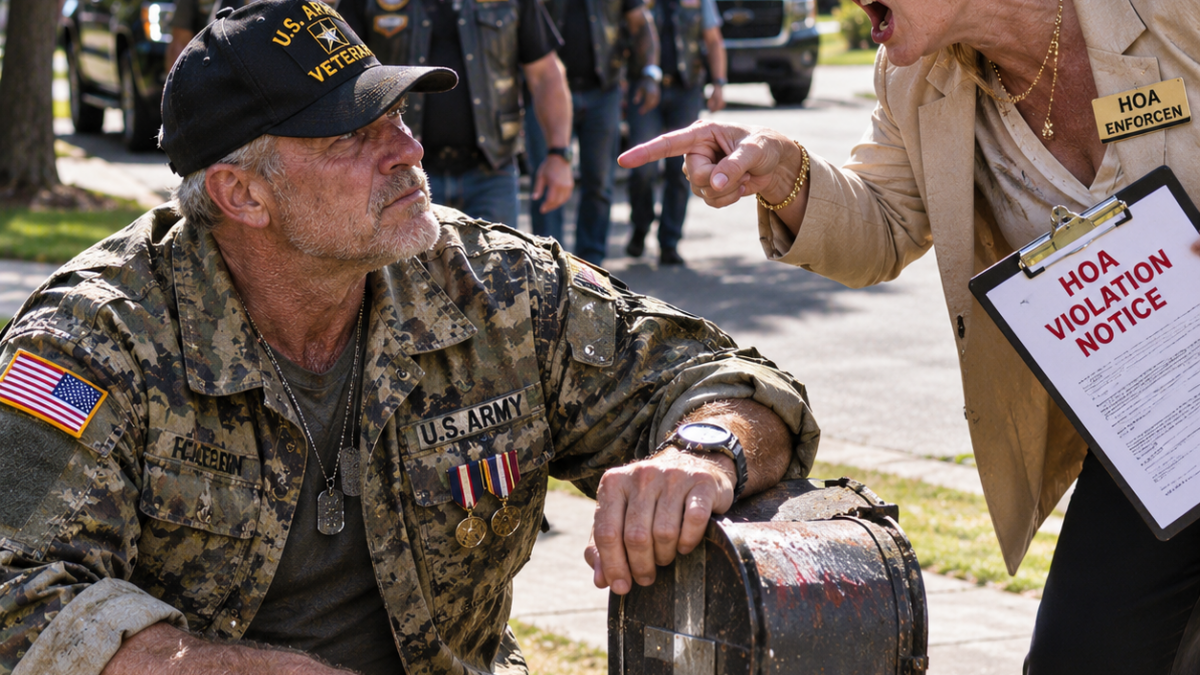
“Which HOA rule says I can’t wear this jacket?”
Her mouth tightened.
“We have appearance standards.”
“For houses?”
“For the community.”
I nodded slowly.
“And where does that say you get to choose a homeowner’s clothing?”
Her face reddened.
“Don’t play games with me.”
I wiped my hands on a rag.
“I’m not playing games. I’m asking you a question.”
She stepped closer.
“You military people are all alike. You think because you served, nobody can tell you what to do.”
I felt something tighten in my chest.
But I kept my voice level.
“That’s not what I said.”
“You think you’re special.”
“No.”
“You think your service excuses you from following the rules.”
“Karen, I’m fixing a mailbox.”
She glared.
I gestured toward the loose hinge.
“On my property.”
Her lips curled.
“And you’re doing it dressed like you’re preparing for combat.”
I looked at her.
“It’s a jacket.”
“It’s intimidating.”
I glanced around the empty street.
“To whom?”
“To residents who expect a peaceful, attractive community.”
For a moment, I couldn’t answer.
Not because she had made a convincing argument.
Because I couldn’t believe she’d turned a worn piece of clothing into a neighborhood emergency.
Then she moved closer and lowered her voice.
“Let me explain something to you, John.”
I waited.
“I have spent five years maintaining the standards that make this neighborhood desirable.”
She smiled coldly.
“People like you move here because people like me keep it respectable.”
I stared at her.
“People like me?”
Her smile vanished.
“You know what I mean.”
I did.
And I didn’t like it.
She looked down at the jacket again.
“You have ten minutes to change.”
I slowly folded the rag.
“Or what?”
She raised the yellow paper.
“Formal fines. A board hearing. Further enforcement.”
I looked toward my house.
The little American flag hanging beside the porch.
The flower bed I’d planted last spring.
The old wooden bench where I drank coffee every morning.
Everything was quiet.
Everything was ordinary.
Then I turned back to her.
“Karen, you can submit a complaint through the proper process.”
She raised her chin.
“But I’m not removing my jacket simply because you dislike it.”
Her eyes widened.
“You’re refusing a direct order?”
I almost laughed.
“I’m refusing your request.”
She stepped forward.
“YOU WILL REGRET THIS!”
A curtain moved in the house across the street.
Then another.
People were listening.
Karen seemed to notice.
Instead of lowering her voice, she shouted louder.
“I’LL MAKE SURE EVERYONE KNOWS WHAT KIND OF TROUBLEMAKER YOU ARE!”
I picked up my screwdriver.
Then looked directly into her eyes.
“Karen, I’ve dealt with people who had genuine authority over my life.”
My voice remained calm.
“They understood that authority came with responsibility.”
Her face turned crimson.
I continued.
“You’ve got a clipboard and a personal objection to my jacket.”
I paused.
“Those aren’t the same thing.”
For a second, she looked speechless.
Then her expression twisted.
“YOU PATHETIC OLD SOLDIER!”
The words struck harder than I wanted to admit.
Not because I believed them.
Because of the memories they awakened.
Names.
Faces.
Men who had stood beside me when we were all younger.
Men whose families still kept photographs beside folded flags.
I looked down at the worn sleeve of my jacket.
And for the first time that morning, my hands began trembling.
Karen mistook the movement for fear.
She smiled.
“That’s better. Maybe you’re finally understanding who you’re dealing with.”
Then, from somewhere beyond the curve of the street, I heard the low sound of engines.
One.
Then several more.
Karen glanced over her shoulder.
I looked toward the neighborhood entrance.
The vehicles were still out of sight.
But I recognized the sound of my old friend’s truck.
And suddenly, I knew the men and women who understood what that jacket meant were almost here.
PART2
I hadn’t always been the quiet man who lived at the end of Brookstone Drive.
There was a time when my life had been measured in deployments, training schedules, unfamiliar countries, and the distance between one phone call home and the next.
My name is John Mercer.
I’m fifty-four years old.
I served in the United States Army and spent part of my career in Special Forces.
I won’t pretend those years made me better than anyone else.
They didn’t.
They taught me how much I didn’t know.
How quickly life could change.
How much trust matters when people depend on one another.
And how little a person’s clothing, salary, or title reveals about their character.
I served alongside men and women who came from every imaginable background.
Small towns.
Big cities.
Wealthy families.
Families that struggled to pay the rent.
Some had college degrees.
Others had gone straight into military service.
Some were loud.
Some were quiet.
Some could make an entire room laugh with a single sentence.
Others barely spoke unless they had something important to say.
But when things became difficult, none of that mattered.
What mattered was whether you could trust the person beside you.
That lesson stayed with me long after I came home.
It was also why Karen Thompson’s behavior bothered me so deeply.
She believed respect belonged to whoever carried the most impressive title.
I had learned that respect was earned through what a person did when somebody else needed them.
The camouflage jacket had belonged to my life for longer than Karen had known me.
I’d worn it on cold mornings.
During volunteer projects.
While working in my garage.
And on days when memories became heavier than usual.
There was nothing especially valuable about the material.
The zipper sometimes stuck.
One pocket had been repaired twice.
The fabric was faded from years of washing.
But inside the left pocket, stitched beneath the lining, was a small piece of cloth bearing a name.
Daniel Reyes.
Most people never saw it.
I didn’t tell strangers about it.
I didn’t wear the jacket because I wanted attention.
I wore it because Daniel had once been my closest friend.
And because he’d never had the chance to grow old.
Daniel and I first met during training.
He was twenty-six.
I was twenty-eight.
He was from Texas, had a ridiculous laugh, and could find something to joke about during almost any difficult day.
I was more serious.
More reserved.
He used to tell me I looked like a man who’d forgotten how to smile.
“Mercer, if your face gets any tighter, we’re going to need a wrench to loosen it.”
I’d shake my head.
He’d laugh.
And somehow, even when I was exhausted, I’d find myself smiling.
Over the years, we became brothers in every way except blood.
We worked together.
Trained together.
Argued about music.
Shared stories about home.
He told me about his mother, Elena, who mailed him homemade cookies even though they usually arrived broken into crumbs.
I told him about my father, who’d taught me how to repair engines before I was old enough to drive.
Daniel was married.
His wife, Maria, had a little girl named Sofia.
He kept their photograph tucked safely inside his belongings.
Whenever he received a letter, he’d read it twice.
Then grin.
“Mercer, look at this.”
And he’d show me another drawing from Sofia.
A crooked sun.
A stick-figure family.
A little dog.
She always drew her father taller than everyone else.
Daniel would laugh.
“My girl thinks I’m a giant.”
I used to tell him he had the world’s biggest ego.
He’d answer, “Only because my daughter loves me.”
Then we’d laugh together.
I never imagined I’d someday be the one delivering some of his belongings to Maria.
I don’t tell war stories very often.
Not because I think they’re secrets that make me important.
Because many of them belong to people who aren’t here to decide how they should be told.
I learned to be careful with other people’s memories.
Daniel died during a deployment.
That is the fact I can say without reopening every detail.
I remember the news reaching home.
The long silence afterward.
The ache of knowing that somebody who had been laughing beside me not long before would never tell another joke.
I remember standing at his funeral.
The folded flag.
Maria’s trembling hands.
Sofia gripping her mother’s dress.
I remember how small the little girl looked.
How wrong the whole world seemed.
After the service, Maria handed me a small cloth patch with Daniel’s name on it.
“He would want you to have this,” she whispered.
I couldn’t speak.
She placed it in my hand.
Then she began crying.
I held her.
And for a moment, all the training and discipline in the world meant nothing.
I was simply a man who had lost his friend.
Later, I had the patch sewn inside the lining of my old jacket.
Some days, I’d touch it without thinking.
A small reminder.
Not of glory.
Not of power.
Of the cost of the life we’d chosen.
When I finally left active service, I struggled with the adjustment.
The military had shaped so much of my adult life.
For years, there had always been a schedule.
A team.
A mission.
People who understood the rhythm of my days.
Then, suddenly, there was ordinary civilian life.
Grocery stores.
Bills.
Traffic.
Appointments.
Neighbors talking about paint colors and backyard fences.
None of those things were unimportant.
They were the details of a peaceful life.
A life many people had sacrificed to protect.
But learning to live at a different pace took time.
I spent the first few months working on old engines.
My father had taught me how to use tools when I was a boy.
Fixing things gave my hands something familiar to do.
An engine didn’t care about my past.
It didn’t ask where I’d been.
It simply needed patience.
A careful diagnosis.
And someone willing to keep working until the problem made sense.
That was comforting.
Eventually, I bought a house in Brookstone Estates.
It was in a quiet American suburb, away from the congestion of the city.
The street curved past neat lawns and flowering trees.
There were sidewalks wide enough for evening walks.
A small community park.
Children’s bicycles left beside porches.
Families grilling dinner on weekends.
The house had three bedrooms, a garage, and a backyard with a maple tree that turned brilliant red every autumn.
The first time I toured it, I stood beneath that maple tree and looked toward the back porch.
Something about the place felt right.
Not luxurious.
Not impressive.
Just peaceful.
I imagined drinking coffee there.
Repairing old motorcycles in the garage.
Inviting friends for barbecue.
Maybe finally learning how to grow tomatoes without killing half the plants.
I bought it.
And for a while, the quiet suited me perfectly.
I first met Karen Thompson two weeks after moving in.
She appeared at my front door carrying a clipboard and a welcome packet.
Her hair was styled perfectly.
Her smile seemed practiced.
She wore a pale blue blouse and a gold necklace.
“John Mercer?”
I nodded.
“Yes, ma’am.”
She smiled.
“Karen Thompson. Homeowners association president.”
I held out my hand.
“Nice to meet you.”
She shook it briefly.
Then looked past me into the hallway.
“I like to welcome our new residents personally.”
I nodded.
“That’s kind of you.”
She handed me the packet.
“Brookstone Estates is a community with very high standards.”
I smiled.
“Looks like a nice place.”
She tilted her head.
“It is, because we enforce those standards.”
I glanced toward the documents.
“Of course.”
She looked toward my garage.
I had parked an old pickup in the driveway.
Its paint was faded.
But the truck ran beautifully.
Karen’s smile tightened.
“Is that vehicle staying outside?”
I looked toward it.
“My truck?”
“Yes.”
I nodded.
“Most days.”
She sighed.
“You’ll want to review the vehicle appearance guidelines.”
I stared.
“The truck’s registered and in good working condition.”
She smiled.
“That isn’t always the issue.”
I didn’t understand what she meant.
Not then.
But I would.
During the following months, I discovered Karen was constantly inspecting the neighborhood.
She walked the sidewalks with her clipboard.
Stopped to examine flower beds.
Photographed trash cans left out too long.
Criticized driveway decorations.
And issued warnings for things most reasonable people wouldn’t notice.
One neighbor received a letter because his garden border was slightly uneven.
Another was warned that his porch furniture didn’t match approved colors.
A widow named Mrs. Bennett was told to remove a small American flag from her flower bed because Karen thought the display looked cluttered.
That last complaint bothered me.
Mrs. Bennett’s husband had served in the Navy.
After his death, she placed the little flag beside a rosebush he’d planted.
It was respectful.
Well maintained.
Not obstructing anything.
But Karen decided she didn’t like it.
Mrs. Bennett called me after receiving the notice.
Her voice trembled.
“John, do you think I have to remove it?”
I looked toward the flag.
Then shook my head.
“I think we should ask the board for the actual provision they’re relying on.”
She sighed.
“Karen says it’s inappropriate.”
I looked at her.
“That’s an opinion, ma’am. Let’s see what the written rules say.”
We submitted a request for clarification.
Eventually, the notice was withdrawn.
Mrs. Bennett thanked me.
I told her she didn’t need to thank me.
But she squeezed my hand.
“After my husband died, that little flag was one of the things I could still take care of for him.”
I understood more than she knew.
That was probably when Karen began disliking me.
Not because I’d shouted at her.
I hadn’t.
Not because I’d threatened her position.
I had no interest in serving on the HOA board.
But because I had asked for a specific rule and refused to accept her personal opinion as the final answer.
Afterward, she began watching my property more closely.
I received a notice about my pickup.
Then one about the arrangement of tools inside my garage, which were visible when the door was open.
Another about a wooden bench on my porch.
Every time, I responded politely.
Asked for the relevant provision.
Complied when a real rule applied.
Questioned a notice when it didn’t.
Eventually, most of the complaints were withdrawn or went nowhere.
But Karen seemed to grow angrier each time.
She was accustomed to residents apologizing and making changes simply to avoid conflict.
I wasn’t interested in fighting her.
But I wasn’t going to pretend that an unsupported demand became legitimate because it arrived on official stationery.
The camouflage jacket became her newest obsession during the first week of October.
I’d been outside trimming a hedge when she walked past.
She stopped.
Looked at me.
Then frowned.
“John.”
I straightened.
“Morning, Karen.”
Her eyes moved toward my jacket.
“What’s that?”
I looked down.
“A jacket.”
She sighed.
“I can see that.”
I waited.
She continued.
“Do you have to wear something so aggressive-looking?”
I blinked.
“Aggressive?”
“The camouflage.”
I stared.
She gestured toward the surrounding houses.
“This is a family neighborhood.”
I looked around.
A woman was walking a stroller down the sidewalk.
Two children were drawing with chalk.
A delivery driver was carrying packages toward a porch.
Nobody seemed concerned about my clothing.
I turned back to her.
“Karen, it’s cold.”
She folded her arms.
“There are other jackets.”
I almost laughed.
“I’m sure there are.”
Her eyes narrowed.
“Then wear one.”
I took a breath.
“Thanks for the suggestion.”
Then I returned to trimming the hedge.
For a few seconds, she stood there watching me.
Finally, she snapped:
“You don’t have to be sarcastic.”
I looked up.
“I wasn’t trying to be.”
She walked away.
And I thought that was the end of it.
I couldn’t have been more wrong.
Three days later, I found a violation notice taped to my front door.
It referred vaguely to conduct inconsistent with community appearance standards.
The notice didn’t identify any approved rule prohibiting camouflage clothing.
It simply stated that residents were expected to maintain an appearance appropriate to the neighborhood.
I stared at it.
Then laughed.
A short, disbelieving laugh.
After everything I’d seen in my life, somebody was trying to fine me for wearing a jacket while working in my own yard.
I contacted the HOA office.
Asked for clarification.
Requested the exact bylaw and the board decision supporting the notice.
The administrative assistant sounded uncomfortable.
“Mr. Mercer, I’ll have to ask Mrs. Thompson.”
I nodded.
“Please do.”
She hesitated.
Then said quietly, “You’re not the first person who’s asked.”
That caught my attention.
“What do you mean?”
She immediately became cautious.
“I’m sorry. I shouldn’t have said that.”
I didn’t push.
But I remembered it.
Because if Karen was inventing standards to control me, perhaps she was doing the same to other residents.
I called an old friend that Thursday evening.
His name was Marcus Hale.
We had served together.
He’d been one of the people who helped me through the years after Daniel died.
Marcus was a big man with a quiet voice and a sense of humor that could make me laugh even when I didn’t want to.
He lived a couple of hours away.
Whenever he visited, we usually spent an afternoon working on an old vehicle, grilling dinner, and telling stories about the people we’d known.
He answered immediately.
“Mercer!”
I smiled.
“Marcus.”
“You finally calling because you miss me?”
“Don’t get excited.”
He laughed.
“What do you need?”
I looked toward the HOA letter.
“Apparently I’m committing a neighborhood offense.”
He went quiet.
“What did you do?”
“Wore a jacket.”
A pause.
Then he laughed so loudly I had to move the phone from my ear.
“You’re kidding.”
“Nope.”
“What kind of jacket?”
“The old camouflage one.”
He stopped laughing.
For a moment, neither of us spoke.
Then he asked:
“Daniel’s patch?”
I looked toward the sleeve.
“Yeah.”
Marcus exhaled.
“What happened?”
I explained.
He listened carefully.
Then said something that made me smile.
“John, I think it’s time a few of us came over for coffee.”
I looked toward the backyard.
“You don’t need to make a trip over this.”
He laughed.
“We’ve been trying to get everybody together for months.”
I hesitated.
Then smiled.
“All right.”
We arranged a Saturday visit.
A casual reunion.
Coffee.
Breakfast.
Maybe some time in the garage.
Nothing official.
Nothing dramatic.
Just old friends spending a morning together.
I told Marcus about the loose hinge on my mailbox.
He laughed.
“You’d better fix it before we get there. I don’t want to see an engineer-looking soldier defeated by a mailbox.”
I laughed.
“Get here on time and I’ll let you hold the screwdriver.”
He promised he would.
Then we hung up.
I had no idea that Karen would confront me again just before my friends arrived—or that the arrival she’d dismiss as an attempt to call in the cavalry would become the moment the whole neighborhood stopped accepting her threats.
Saturday morning arrived with clear skies and a cool breeze.
I woke at six.
Made coffee.
Checked the weather.
Then walked outside carrying my toolbox.
The mailbox had been loose for a week.
Every time the mail carrier opened it, the door dropped slightly.
It wasn’t an emergency.
But I dislike leaving small repairs unfinished.
Besides, Marcus and the others weren’t expected until later that morning.
I had time.
I put on my old camouflage jacket.
The same one I’d worn a hundred times before.
The fabric was warm.
The sleeves comfortable.
And when I slipped my left hand into the pocket, my fingers briefly brushed the hidden patch.
Daniel.
For a moment, I saw his face.
That ridiculous grin.
The way he’d call me Mercer even when everyone else used John.
I smiled sadly.
Then picked up my tools and walked toward the mailbox.
The street was beautiful.
Freshly cut grass.
Flowering shrubs.
A few American flags moving in the breeze.
I heard a garage door open somewhere down the block.
Then the soft hum of sprinklers.
I knelt and began tightening the hinge.
Three screws.
That was all.
A repair that should have taken ten minutes.
Then Karen Thompson came around the corner in her little white SUV.
She stopped beside the curb.
The driver’s door opened.
Her heels touched the pavement.
I glanced up.
Then returned to my work.
“John.”
I sighed quietly.
“Good morning, Karen.”
She stood beside the sidewalk.
Then her eyes settled on the jacket.
Her face changed.
“You’ve got to be kidding me.”
I continued tightening the screw.
“Something wrong?”
She marched closer.
“I sent you a formal violation notice.”
“I received it.”
“And yet you’re still wearing that.”
I looked down.
“It’s cold this morning.”
Her mouth tightened.
“You’re being deliberately disrespectful.”
I stood.
Wiped my hands.
Then faced her.
“Karen, I asked the HOA to identify the specific rule.”
She folded her arms.
“I’m the president.”
“I know.”
“I interpret community standards.”
I nodded.
“That doesn’t mean you can invent a clothing rule.”
Her face reddened.
“Don’t tell me what I can and cannot do.”
I looked at her.
“I’d be happy to follow any legitimate rule that applies.”
She stepped closer.
“Then take off the jacket.”
“No.”
Her eyes widened.
For a moment, she seemed genuinely stunned.
It was such a small word.
One syllable.
But I’d learned that people who rely on intimidation often treat a calm refusal as a personal attack.
Karen’s expression became furious.
“You will not defy me in front of the neighbors.”
I looked toward the surrounding houses.
Nobody had been paying attention.
Not until she began shouting.
“Karen, we’re having a conversation about a jacket.”
She snapped:
“THIS IS ABOUT RESPECT!”
I took a slow breath.
“Then I suggest we start treating each other with some.”
She stepped so close that I could smell her perfume.
A strong floral scent.
Expensive.
Overwhelming.
She raised her clipboard.
“Do you understand how much influence I have in this neighborhood?”
I remained still.
She continued.
“I can recommend fines. I can bring you before the board. I can make it very difficult for you to remain comfortable here.”
I looked toward her.
“Are you threatening me?”
Her lips curled.
“I’m explaining consequences.”
I thought about Daniel.
About the men and women I’d served beside.
About years of learning how to remain calm when everything around me became chaotic.
Then I looked at a woman who believed a clipboard gave her the right to control another adult’s clothing.
I felt something settle inside me.
Not anger.
Not amusement.
A quiet certainty.
“Karen, I bought this house legally.”
She stared.
“I pay my dues.”
Her expression tightened.
“I maintain the property.”
I gestured toward the mailbox.
“I’m repairing something that needs attention.”
I looked directly into her eyes.
“And nothing about my jacket creates a danger or interferes with another homeowner.”
She opened her mouth.
I continued.
“So if you believe I’ve violated a rule, submit the citation and let the proper process determine whether it has any basis.”
Karen’s face turned scarlet.
Then she shouted:
“YOU’RE NOTHING BUT AN ARROGANT EX-SOLDIER WHO THINKS HE’S ABOVE EVERYBODY ELSE!”
A window opened across the street.
Someone stepped onto a porch.
I didn’t look away from Karen.
“My military service doesn’t put me above anyone.”
She laughed mockingly.
“Then stop using it as an excuse.”
I took a breath.
“I’m not.”
My voice became firmer.
“But I’m also not going to apologize for it.”
Karen threw the yellow notice against my chest.
It fluttered to the grass.
I looked down.
Then back at her.
For a moment, the only sound was the sprinkler running next door.
She pointed toward the paper.
“Pick it up.”
I stared.
“What?”
“Pick up your notice.”
I glanced down again.
Then bent and retrieved it.
Not because she’d ordered me to.
Because I wasn’t going to leave trash on my lawn.
I folded the page carefully.
Placed it in my pocket.
Then looked at her.
“Anything else?”
She seemed infuriated by how calmly I spoke.
“YOU THINK THIS IS FUNNY?”
“No.”
“YOU THINK YOU CAN HUMILIATE ME?”
I shook my head.
“Karen, you’re the one shouting.”
She stepped backward.
Then raised her phone.
“Fine. I’ll record this.”
I nodded.
“That’s your decision.”
She pointed the camera toward me.
“Everyone in Brookstone Estates needs to see how this man treats HOA leadership.”
I felt my jaw tighten.
She continued.
“Refusing instructions. Disrespecting authority. Intimidating neighbors with military clothing.”
For a moment, I couldn’t believe the absurdity.
Then I heard a distant engine.
Low.
Familiar.
I glanced toward the neighborhood entrance.
Karen noticed.
“What are you looking at?”
I didn’t answer immediately.
Another engine joined the first.
Then another.
She tilted her head.
“Are you expecting somebody?”
I smiled faintly.
“Some friends.”
She laughed.
“Oh, wonderful. More people to lecture me.”
I looked toward the street.
The sound was growing closer.
And for the first time all morning, I felt relief.
Not because I needed someone to frighten Karen.
Because I was tired of being alone with the kind of person who tried to turn every disagreement into a demonstration of power.
My friends were coming.
People who knew me.
People who knew Daniel.
People who understood why I wore the old jacket.
And their presence meant I didn’t have to carry those memories entirely by myself.
The first vehicle came around the corner.
A black pickup.
Clean.
Well maintained.
Behind it rolled two dark SUVs and another truck.
They moved at normal neighborhood speed.
Nothing reckless.
No sirens.
No lights.
No dramatic maneuvering.
Just several vehicles arriving together for a planned visit.
But the low sound of their engines drew attention.
People looked through windows.
A man standing beside his garage stopped washing his car.
Two neighbors emerged onto their porches.
Karen turned toward the approaching vehicles.
Her face tightened.
“What is this?”
I watched Marcus’s truck slow.
“Friends.”
She looked back at me.
“Did you call them because of me?”
I shook my head.
“They’re visiting.”
She laughed sharply.
“Trying to intimidate the HOA?”
I looked at her.
“Karen, you’re arguing with yourself.”
Her face reddened.
The vehicles pulled over and parked legally along the curb where there was room.
Doors opened.
Men and women stepped out.
Some wore dark jackets.
Others casual clothes.
A few had military-style boots and veteran organization patches.
They were retired service members and former Special Forces personnel I’d known for years.
They weren’t acting under military authority.
They weren’t carrying out an operation.
They were my friends.
But there was something unmistakable about the way they greeted one another.
The familiar ease.
The quiet confidence.
The way people who had depended on each other for years seemed able to communicate without needing many words.
Marcus climbed out first.
He saw me.
Then grinned.
“Mercer!”
I smiled.
“Hale.”
He opened his arms.
I walked toward him.
We embraced.
For a moment, I forgot Karen was there.
Marcus slapped my shoulder.
“Still ugly.”
I laughed.
“Still late.”
He grinned.
“Traffic.”
I shook my head.
“That’s your excuse every time.”
Behind him, the others approached.
Ethan Brooks.
Caleb Turner.
Rachel Morgan.
David Cole.
And several more people whose faces brought back years of memories.
We shook hands.
Embraced.
Laughed.
Asked about families.
Old friends.
People we hadn’t seen recently.
The morning had become something entirely different.
Then Karen shouted.
“EXCUSE ME!”
Everyone turned.
Karen stood near my mailbox.
Her face was furious.
She still held her clipboard.
For a moment, she looked from one visitor to another, apparently trying to understand what she’d interrupted.
Marcus glanced toward me.
Then toward her.
“Morning, ma’am.”
She ignored the greeting.
“Who are all these people?”
I answered.
“My friends.”
She folded her arms.
“And why are they here?”
Marcus raised an eyebrow.
“We were invited.”
Karen looked toward the parked vehicles.
“This neighborhood has rules about gatherings.”
I took a breath.
“Karen, they’re visiting my house.”
She pointed toward the group.
“Are those tactical uniforms?”
Rachel looked down at her dark jacket.
Then back at Karen.
“No, ma’am.”
Karen narrowed her eyes.
“Are you military?”
Rachel nodded.
“Veteran.”
Karen’s expression tightened.
She turned toward Marcus.
“And you?”
“Retired Army.”
Ethan answered next.
“Same.”
The others nodded.
Karen looked from face to face.
Then gave a strained laugh.
“Oh, I see.”
She turned toward me.
“You called in your little military buddies.”
Marcus looked confused.
“Ma’am?”
Karen pointed at him.
“Don’t pretend.”
He glanced toward me.
I shook my head slightly.
Marcus seemed to understand.
He remained calm.
“We came for breakfast.”
Karen stared.
Then she gestured toward my jacket.
“Your friend is violating HOA standards.”
For a moment, nobody spoke.
Marcus looked at my jacket.
Then at Karen.
“By wearing that?”
She nodded sharply.
“Yes.”
He considered the statement.
Then asked:
“Which standard?”
I nearly laughed.
The same question.
The one she’d refused to answer all morning.
Karen’s mouth tightened.
“It’s an appearance issue.”
Marcus nodded slowly.
“An appearance issue.”
“Yes.”
He looked toward me.
Then back at her.
“Could you show us the written rule?”
For a moment, Karen looked genuinely uncertain.
Then she raised her voice.
“I DON’T HAVE TO EXPLAIN MY AUTHORITY TO A GROUP OF STRANGERS!”
Rachel stepped forward.
Her tone was courteous.
“No one is asking you to explain your personal authority, ma’am.”
Karen glared.
Rachel continued.
“We’re asking what rule you believe applies.”
Silence.
Then Karen snapped:
“YOU PEOPLE DON’T UNDERSTAND HOW AN HOA WORKS!”
I looked at Marcus.
He looked at me.
For one brief moment, the temptation to laugh was overwhelming.
But neither of us did.
Because Karen was clearly furious.
And the last thing I wanted was to turn a ridiculous disagreement into something dangerous.
A few neighbors began gathering.
Mrs. Bennett stood near her front steps.
Mr. Wilson, who lived across the street, approached with his coffee.
A couple from the corner house watched from their driveway.
Someone raised a phone.
Karen noticed.
Her posture changed.
She straightened her blazer.
Lifted her chin.
Then spoke loudly enough for everyone to hear.
“I’m trying to protect our neighborhood’s reputation.”
Marcus remained calm.
“From a jacket?”
Her expression hardened.
“From people who think they’re above the rules.”
I stepped forward.
“Karen, nobody here has claimed to be above the rules.”
She pointed toward me.
“You refused a direct order.”
I looked toward the neighbors.
Then back at her.
“You requested that I remove my jacket.”
Her face flushed.
“And I asked you to identify the rule.”
She opened her mouth.
I continued.
“You haven’t.”
For a moment, the crowd was silent.
Then Mr. Wilson spoke.
“Actually, I’d like to know that, too.”
Karen turned.
“What?”
He gestured toward my jacket.
“Where’s the rule about clothing?”
Her face tightened.
“Mr. Wilson, this doesn’t concern you.”
He nodded.
“I’m an HOA member.”
She stared.
He continued.
“If we’re paying dues to an association that can fine us for what we wear, I’d like to see where we agreed to that.”
A few neighbors murmured.
Karen looked toward Mrs. Bennett.
The elderly woman crossed her arms.
Then said something that surprised me.
“I’d like to see it, too.”
Karen’s expression changed.
She knew Mrs. Bennett.
Knew the widow had once backed down during a dispute about her flag.
But that morning, Mrs. Bennett stood calmly beside her garden.
Her voice steady.
“I don’t see how a veteran working on his own mailbox is hurting anybody.”
For a moment, nobody spoke.
Then another neighbor nodded.
And another.
Karen’s confidence began slipping.
Not because my friends had arrived in dark vehicles.
Because the people she was accustomed to intimidating were finally asking the same questions I’d been asking all along.
Rachel stepped toward the curb and stopped several feet from Karen.
“Ma’am, I don’t want this to become hostile.”
Karen laughed bitterly.
“Then perhaps you should leave.”
Rachel nodded.
“We will go inside in a moment.”
Her voice remained professional.
“But I think it would be helpful if everybody calmed down.”
Karen pointed toward the jacket.
“He needs to comply.”
Rachel looked at her.
“Why?”
Karen seemed stunned.
“Because I said so!”
The words rang across the street.
For a moment, the neighborhood became completely silent.
Then Rachel said quietly:
“That’s not a rule.”
Karen’s face turned red.
Rachel continued.
“That’s a personal demand.”
Marcus folded his arms.
I noticed Karen looking from one face to another.
She’d expected the arrival of my friends to give her an opportunity to accuse me of intimidation.
Instead, they were asking ordinary questions.
What written rule?
What authority?
What procedure?
What had I actually done wrong?
And she had no clear answer.
Karen snapped her clipboard shut.
“You will all regret this.”
Marcus sighed.
“Ma’am, nobody wants a fight.”
She pointed toward him.
“Don’t tell me what I want.”
He nodded.
“All right.”
She turned toward me.
“John, I’m bringing this before the board.”
I looked at her.
“That’s your right.”
Her face tightened.
“And I’m recommending the maximum penalty.”
I took a breath.
“Then please put your reasons in writing.”
She looked furious.
I continued.
“I’ll respond through the proper process.”
For a moment, she seemed unable to believe that I wasn’t frightened.
Then she glanced toward the neighbors.
Several were watching openly.
Mrs. Bennett stood beside her flag.
Mr. Wilson had his arms folded.
The couple from the corner house whispered to each other.
Karen’s voice rose again.
“YOU THINK THESE PEOPLE CAN PROTECT YOU?”
I looked toward Marcus.
Then Rachel.
Then my neighbors.
I shook my head.
“Karen, I don’t need anybody to threaten you.”
Her expression hardened.
“I need the HOA to follow its own rules.”
I paused.
“And I need you to stop trying to turn personal dislikes into violations.”
The words landed harder than I expected.
Karen stood frozen.
For a moment, she looked as though she might scream again.
Then her gaze dropped toward the yellow notice in my hand.
She turned sharply.
Walked toward her SUV.
Opened the driver’s door.
And climbed inside.
The engine started.
But before she drove away, she lowered the window.
“THIS ISN’T OVER, MERCER!”
I looked toward her.
Then nodded.
“If you submit a complaint, I’ll answer it.”
She glared.
Rolled up the window.
And drove away.
For several seconds, nobody moved.
Then Marcus turned toward me.
He looked at the screwdriver beside my mailbox.
Then at the hinge.
Then back at me.
“So.”
I raised an eyebrow.
“What?”
He grinned.
“Is the mailbox fixed?”
I stared.
Then burst out laughing.
The sound surprised me.
I hadn’t realized how tense I’d become until the laughter escaped.
Ethan laughed.
Rachel shook her head.
Caleb stepped toward the mailbox.
“Let’s take a look.”
I handed him the screwdriver.
He inspected the hinge.
Then tightened the final screw.
The little metal door opened and closed smoothly.
Caleb stepped back.
“There.”
He smiled.
“Mission accomplished.”
Everyone laughed.
And just like that, the threat and shouting began fading into the kind of ordinary humor I’d missed.
Mrs. Bennett approached us.
She looked toward my jacket.
Then at the vehicles.
Her expression softened.
“John?”
I turned.
“Yes, ma’am?”
She smiled.
“Your friends seem lovely.”
Marcus immediately straightened.
“Ma’am, nobody has ever said that about me before.”
She laughed.
“Then perhaps you should behave better.”
The group erupted in laughter.
Marcus put one hand over his heart.
“Wounded.”
I shook my head.
Mrs. Bennett looked toward me again.
Then her eyes filled.
“I’m glad you didn’t take the jacket off.”
My smile faded.
She glanced toward the flag beside her porch.
“After my husband died, people kept telling me I needed to move on.”
I swallowed.
She continued.
“As though remembering somebody is the same as refusing to live.”
For a moment, nobody spoke.
Then I touched the pocket containing Daniel’s patch.
“I understand.”
Her eyes moved toward the small gesture.
She nodded.
Then quietly returned home.
I watched her walk away.
And felt a familiar ache in my chest.
Because sometimes the things other people dismiss as old or unnecessary are the very things connecting us to people we still love.
We went inside.
I made more coffee.
Marcus opened the bag of breakfast sandwiches he’d brought.
Rachel put a container of fruit on the table.
Ethan complained that nobody had remembered his favorite donuts.
Caleb reminded him that he was capable of buying his own.
Within minutes, my kitchen was full of laughter.
The sound felt good.
Too good.
For years, I had enjoyed living alone.
But I hadn’t realized how much I missed having people around who knew me without needing an explanation.
Marcus leaned against the counter.
He looked toward the camouflage jacket hanging by the door.
Then back at me.
“You okay?”
I nodded.
“Yeah.”
He studied me.
“You sure?”
I hesitated.
Then looked toward the jacket.
My throat tightened.
“Didn’t expect her to say some of those things.”
Marcus’s expression changed.
He knew exactly what I meant.
He set down his coffee.
Then approached.
For a moment, neither of us spoke.
Finally, he asked:
“Daniel?”
I nodded.
Marcus looked down.
The laughter in the kitchen continued.
But for us, the room became quiet.
He took a breath.
“John, that jacket isn’t something she gets to define.”
My eyes filled.
“I know.”
He nodded.
“Then don’t let her words change what it means.”
For a moment, I couldn’t speak.
Then he put one hand on my shoulder.
And I felt the same steady reassurance he’d given me after some of the hardest days of my life.
Not an order.
Not a lecture.
Just a friend reminding me that I wasn’t alone.
After breakfast, the group moved into the garage.
I had an old motorcycle parked near the workbench.
It had belonged to my father.
He bought it secondhand when I was young and spent years keeping it running long after most people would’ve given up.
After he died, I brought it home.
The engine needed work.
The chrome had dulled.
One side panel had a scratch that my father always insisted was somebody else’s fault.
I had been restoring it slowly.
Not because I expected to sell it.
Because working on it reminded me of him.
Marcus immediately walked over.
“Well, look at this.”
I smiled.
“Don’t touch anything.”
He laughed.
“Still afraid I’ll improve it?”
“I’m afraid you’ll lose another bolt.”
Ethan raised his eyebrows.
“Another?”
Marcus pointed at me.
“Don’t listen to him.”
Rachel laughed.
And for the next hour, we examined the engine, exchanged suggestions, and argued about parts.
Ordinary things.
Comfortable things.
The kind of conversations that made time pass without anyone noticing.
Then my phone buzzed.
An email.
From the HOA.
I opened it.
And felt the warmth of the morning disappear.
NOTICE OF EMERGENCY BOARD REVIEW.
The subject line appeared in bold letters.
I read the message carefully.
Karen had filed a formal complaint.
She alleged that I’d engaged in disorderly conduct, created a hostile atmosphere, and arranged for a group of intimidating individuals to confront her during enforcement activity.
I stared at the screen.
Then read the part that made me almost laugh.
She described my friends as an organized tactical group whose arrival had frightened residents.
I looked toward Marcus.
He was standing beside my father’s motorcycle, holding a greasy wrench.
Ethan was eating the last breakfast sandwich.
Rachel was explaining why Caleb’s proposed repair wouldn’t work.
The most dangerous thing happening in my garage was the possibility that Marcus would drop a bolt into the engine.
I shook my head.
Unbelievable.
Marcus noticed.
“What?”
I handed him the phone.
He read.
Then whistled.
“Organized tactical group.”
Ethan looked up.
“That’s us?”
Marcus nodded solemnly.
“Apparently.”
Rachel took the phone.
Her smile disappeared as she read.
Then she looked toward me.
“John, you need to respond to this formally.”
I nodded.
“I will.”
She continued.
“Keep it factual.”
“I know.”
“No exaggeration.”
“Agreed.”
“And make sure the board gets your actual invitation messages and a clear account of what happened.”
I took back the phone.
For a moment, I felt tired.
Not frightened.
Just weary.
I had wanted one quiet morning.
Now I was facing a board hearing because a woman had decided she could regulate my clothing and hadn’t liked being questioned.
I looked toward the jacket hanging beside the door.
Then at the motorcycle.
Then at my friends.
And made a decision.
Karen had chosen to escalate.
I would answer.
But I would answer with facts.
Not anger.
Over the following days, I organized everything.
The first clothing-related notice.
The follow-up correspondence.
My request for the specific governing provision.
The emails from the HOA office.
The messages showing I’d invited my friends before the Saturday confrontation.
And photographs of my properly maintained property.
I also wrote a detailed account of the morning.
What Karen said.
Where everyone stood.
How the conversation progressed.
What requests had been made.
And how it ended.
Several neighbors offered statements.
Mrs. Bennett described hearing Karen shout at me and demand that I remove the jacket.
Mr. Wilson confirmed he’d asked to see the clothing rule and received no clear answer.
Other residents described the group of visitors standing peacefully, greeting neighbors, and entering my house after Karen left.
Nobody claimed the arrival of dark vehicles gave my friends legal authority.
It didn’t.
Nobody suggested military service made us exempt from HOA obligations.
It didn’t.
The question was simpler.
Could Karen use an association position to issue unsupported demands about a homeowner’s ordinary clothing?
And could she accuse residents of intimidation merely because they challenged her interpretation in front of witnesses?
I didn’t need a dramatic speech to answer either question.
I needed the association’s documents.
The hearing took place on Thursday evening.
It was held in a small meeting room near the community pool.
A long table stood at the front.
Six folding chairs were arranged for board members.
Rows of seats faced them.
I’d attended HOA meetings before.
Usually, the same handful of residents appeared.
People concerned about maintenance fees.
Landscaping.
Trash collection.
Occasional parking disagreements.
But that Thursday, almost every chair was occupied.
Word had spread about the confrontation.
Some residents were curious.
Others angry.
A few had experienced Karen’s enforcement tactics themselves.
I arrived carrying a folder.
No entourage.
No dramatic convoy.
Just me.
My jacket folded over one arm because the evening was warm.
Marcus had offered to come.
I told him I appreciated it, but this was a community governance meeting, not something that required my old friends to stand beside me.
He understood.
Before hanging up, he said:
“John?”
“Yeah?”
“Remember that you don’t have to win an argument to know you’re right about what matters.”
I smiled.
“Thanks, brother.”
Then I walked into the meeting room.
Karen was already seated.
Her hair was perfectly arranged.
She wore a dark blazer.
Her clipboard rested in front of her.
When she saw me, her expression tightened.
For a moment, I thought she might say something.
Instead, she turned toward the board president pro tempore, a man named Michael Reeves.
Michael was an accountant.
Quiet.
Careful.
Not particularly fond of controversy.
He had been elected to lead the hearing because Karen was the subject of the disputed conduct and couldn’t reasonably oversee consideration of her own complaint.
That detail alone seemed to irritate her.
She was accustomed to controlling the microphone.
That night, somebody else held it.
Michael tapped a pen against the table.
“Let’s begin.”
The room quieted.
He looked toward me.
“Mr. Mercer, thank you for attending.”
I nodded.
“Of course.”
Then he turned toward Karen.
“Mrs. Thompson, we’ll review the written complaint, the relevant provisions, and the witness statements.”
Karen raised her chin.
“I expect the board to take this seriously.”
Michael nodded.
“We will.”
He paused.
“And we expect all participants to remain respectful.”
Karen opened her mouth.
Then closed it.
I sat quietly.
For the first time since the confrontation, I felt that someone intended to examine the matter rather than simply accept Karen’s version.
Karen spoke first.
She described my refusal to remove the jacket.
The arrival of my friends.
The presence of several military veterans.
The embarrassment she experienced in front of neighbors.
She spoke about threats to community harmony.
The need for standards.
The importance of respecting association leadership.
I listened without interrupting.
Then Michael asked:
“Mrs. Thompson, which provision of the governing documents prohibits the clothing Mr. Mercer wore?”
Karen looked down at her notes.
“Our community has appearance standards.”
Michael nodded.
“Which section?”
She turned a page.
Then another.
For a moment, the only sound was paper rustling.
Finally, she answered:
“It’s part of our general community expectations.”
Michael leaned forward.
“Is it an adopted rule?”
Karen frowned.
“What do you mean?”
“Has the association formally adopted a rule regulating residents’ ordinary clothing on their own property?”
She stared.
“It shouldn’t have to.”
The room became silent.
Michael glanced toward the other board members.
Then back at Karen.
“We need to distinguish a personal preference from an enforceable provision.”
Her face reddened.
“I am trying to maintain standards.”
He nodded.
“But we can’t impose penalties based solely on a preference.”
For a moment, she looked stunned.
I watched her hands tighten around the clipboard.
Then Michael turned toward me.
“Mr. Mercer, would you like to respond?”
I stood.
I didn’t raise my voice.
Didn’t accuse Karen of hating veterans.
Didn’t suggest my service record gave me special privileges.
I simply placed the relevant correspondence on the table.
“I’m willing to follow the association’s lawful, adopted rules.”
Michael nodded.
I continued.
“I’ve asked repeatedly for a provision prohibiting this jacket.”
I gestured toward the folded camouflage fabric on the chair beside me.
“None has been identified.”
A few residents nodded.
I looked toward the board.
“During the confrontation, Mrs. Thompson threatened fines and other consequences.”
Karen shifted.
“Because you refused to comply.”
I turned toward her.
“With what written requirement?”
She looked furious.
Michael raised a hand.
“Mrs. Thompson, please allow him to finish.”
I took a breath.
“My friends were invited to visit before that confrontation happened.”
I placed copies of the messages on the table.
“Their arrival was not an organized enforcement action or a demonstration of military authority.”
Several board members reviewed the records.
I continued.
“They parked legally, greeted me, and asked what rule was being enforced.”
I paused.
“Then they came inside for breakfast.”
Somebody near the back let out a small laugh.
I ignored it.
“This neighborhood belongs to residents with many different backgrounds.”
My voice strengthened.
“Some are veterans. Some aren’t. Some are retired. Some work multiple jobs. Some have young children.”
I looked toward Mrs. Bennett.
“None of us should have to prove we’re important enough to receive basic courtesy.”
The room became quiet.
I looked back at Michael.
“That’s all I have to say.”
Then I sat down.
The board questioned several witnesses.
Mr. Wilson confirmed that Karen had repeatedly refused to provide a specific clothing rule.
Mrs. Bennett described hearing her threaten fines.
A younger neighbor named Emily explained that she’d watched from her porch and hadn’t seen my visitors behave aggressively.
Another resident said Karen’s shouting had drawn the crowd in the first place.
The board reviewed the correspondence.
The governing documents.
The complaint.
Then Michael called a short recess.
Residents began talking quietly.
I remained seated.
My hands rested on the folder.
For a moment, I thought about Daniel.
How he’d respond if he could see me sitting in a hearing over an old jacket.
He probably would’ve laughed.
Then he’d have told me to stop taking myself so seriously and find something useful to do with my evening.
I smiled faintly.
And suddenly, I missed him terribly.
When the board returned, Michael looked toward Karen.
Then toward me.
He cleared his throat.
“After reviewing the documents and testimony, we find no adopted association provision supporting the clothing-related violation notice.”
The room became very quiet.
Karen stiffened.
Michael continued.
“The notice will be withdrawn.”
I exhaled.
Not dramatically.
Just a slow breath.
He looked toward the board records.
“We also find insufficient support for the claim that Mr. Mercer orchestrated an intimidating enforcement confrontation.”
Karen’s mouth opened.
Michael raised one hand.
“The evidence indicates he had invited friends for a social visit before the dispute occurred.”
A few residents nodded.
He continued.
“The fact that those visitors had military backgrounds does not, by itself, make their presence threatening.”
Karen’s face reddened.
She leaned forward.
“Are you seriously saying he did nothing wrong?”
Michael met her eyes.
“I’m saying the complaint hasn’t established the violations alleged.”
She stared.
He continued.
“And we need to review how notices are being issued in the future.”
For a moment, nobody spoke.
Then Michael added:
“Association authority must be exercised within the governing documents and applicable law, not personal preferences.”
The words hung in the room.
I looked toward Karen.
For the first time, she seemed to have no answer prepared.
The hearing could have ended there.
I would have accepted it.
The notice was withdrawn.
The claim against my friends was unsupported.
And the board had agreed to clarify its enforcement process.
That was all I’d wanted.
But before Michael adjourned, Mrs. Bennett raised her hand.
He recognized her.
She stood slowly.
Her hands trembled.
“May I say something?”
Michael nodded.
“Briefly.”
She looked toward Karen.
Then toward the board.
“I don’t think this is just about John’s jacket.”
The room grew quiet.
Mrs. Bennett swallowed.
“I’ve lived here thirteen years.”
She looked down.
“My husband and I moved into our house because we wanted a peaceful place to grow old.”
Her voice trembled.
“After he died, I planted a rosebush for him.”
I felt my throat tighten.
She continued.
“And I put a little flag beside it.”
Her eyes filled.
“Karen told me to remove the flag because it didn’t fit the neighborhood’s appearance.”
A few people murmured.
Mrs. Bennett looked toward me.
“John helped me ask for the written rule.”
She swallowed.
“The notice disappeared.”
Then she turned back toward the board.
“But I was afraid to ask the question myself.”
The room became completely silent.
She continued.
“I’m seventy-six years old.”
Her voice broke.
“I shouldn’t be frightened to ask whether a rule actually exists.”
I looked toward Karen.
Her face had tightened.
Mrs. Bennett continued.
“I don’t want special treatment.”
She took a breath.
“I just want the same fair treatment as everybody else.”
For a long moment, nobody moved.
Then another resident stood.
And suddenly, the hearing became something much larger than the argument over my jacket.
Mr. Wilson described receiving a warning about a fence color that had been approved before installation.
Emily told the board she’d been threatened with a fine for children’s toys left temporarily beside her porch.
Another resident described a complaint about an old pickup that was registered, maintained, and parked legally.
One by one, people explained how the HOA’s enforcement process had begun making them feel uncomfortable in their own homes.
Not every complaint proved misconduct.
Some notices may have been justified.
Others involved genuine disagreements about the governing documents.
But a pattern was becoming clear.
Residents didn’t know how to challenge a decision.
They didn’t know who reviewed Karen’s interpretations.
And they were afraid that questioning one warning would lead to more.
Michael listened carefully.
Then asked the secretary to record the concerns for formal review.
Karen stood abruptly.
“This is a witch hunt!”
Several people turned.
She pointed toward me.
“He started this!”
I looked up.
For a moment, the old temptation to argue returned.
Then I remembered what Marcus had said.
I didn’t need to win a shouting match.
I needed the process to work.
So I remained quiet.
Michael looked toward Karen.
“Mrs. Thompson, please sit down.”
Her face changed.
“You can’t order me around.”
He paused.
Then said evenly:
“I’m chairing the meeting. We need to continue respectfully.”
A few neighbors exchanged glances.
Karen sat.
But she looked furious.
When the meeting finally ended, the board committed to reviewing its enforcement procedures, maintaining clearer records, and ensuring that future violations identified specific applicable provisions.
Karen remained an HOA officer at that moment, but she no longer had unrestricted discretion to issue clothing-related warnings based on her own interpretation.
The board also began considering changes to how complaints involving its officers would be handled.
It wasn’t a dramatic punishment.
No police arrived.
No one was arrested.
No secret legal document stripped Karen of her house.
But something important happened.
For the first time, people were asking her to explain decisions she’d previously expected everyone to accept without question.
And that shift frightened her more than a public argument ever could.
Outside, the evening air was cool.
I stepped into the parking lot carrying my folder.
The sun had set.
A few cars remained near the clubhouse.
I was about to walk toward my truck when Mrs. Bennett approached.
“John.”
I turned.
“Yes, ma’am?”
She smiled.
“I wanted to thank you.”
I shook my head.
“You did the hard part tonight.”
Her eyes filled.
“I was terrified.”
I nodded.
“I could tell.”
She laughed softly.
“Could you?”
I smiled.
“A little.”
She looked toward the clubhouse.
Then whispered:
“But I finally said it.”
I nodded.
“You did.”
Her face brightened.
“And nobody fined me for asking a question.”
We both laughed.
Then she reached toward my sleeve.
The camouflage jacket was folded over my arm.
She touched the worn fabric gently.
“Your friend must have been very special.”
For a moment, I couldn’t speak.
I looked at her.
“How did you know?”
She smiled sadly.
“People don’t hold on to things that long unless they carry somebody important.”
My throat tightened.
I thought of Daniel.
His laugh.
Maria.
Sofia.
The funeral.
The little patch stitched beneath the lining.
I swallowed.
“He was.”
Mrs. Bennett nodded.
Then squeezed my hand.
“Then keep wearing it.”
She turned and walked toward her car.
I watched her go.
And for the first time since Karen confronted me, I felt that something meaningful had come out of the whole ridiculous dispute.
Not because I’d embarrassed her.
Because a widow who had been afraid to speak was beginning to feel comfortable in her own neighborhood again.
The next morning, I woke earlier than usual.
Not because I needed to.
Because I had barely slept.
The previous evening kept replaying in my mind.
Karen’s accusations.
Mrs. Bennett’s trembling voice.
The way the other homeowners had finally begun speaking.
And the moment the board announced that the clothing notice would be withdrawn.
I got out of bed.
Made coffee.
Then walked into the garage.
My father’s motorcycle stood beneath a canvas cover.
The workbench was still scattered with tools from the previous Saturday.
Someone had left an empty coffee cup beside the toolbox.
Marcus, probably.
I smiled.
Then looked toward the camouflage jacket hanging on its hook.
For a moment, I simply stood there.
The fabric looked the same as it always had.
Faded.
Worn.
Ordinary.
But after everything that happened, I found myself looking at it differently.
Karen had spent days trying to convince me it was something shameful.
Something that didn’t belong in a respectable neighborhood.
Something that made other people uncomfortable.
Yet the jacket had never threatened anyone.
It had never harmed a neighbor.
It had never made somebody less safe.
It was only fabric.
And memories.
I reached toward the pocket.
Touched Daniel’s patch.
Then whispered:
“Well, brother.”
My voice trembled.
“You would’ve had a few things to say about this.”
I could almost hear his laugh.
I smiled through tears.
Then took the jacket from its hook and put it on.
Later that morning, I called Marcus.
He answered with his usual enthusiasm.
“Mercer!”
I laughed.
“Morning.”
“Everything okay?”
I leaned against the kitchen counter.
“Had the hearing last night.”
He became serious.
“How’d it go?”
I told him.
The notice being withdrawn.
Karen’s accusations being rejected.
The board discussing enforcement reforms.
Mrs. Bennett speaking about the flag beside her husband’s rosebush.
For a while, Marcus remained quiet.
Then he said:
“Good.”
I nodded.
“Yeah.”
He paused.
“How’re you feeling?”
I looked toward the window.
The maple tree moved gently in the breeze.
“Relieved.”
Marcus waited.
“Still a little angry.”
He chuckled.
“That’s allowed.”
I smiled.
Then added:
“Mostly, I’m tired of the whole thing.”
Marcus’s voice softened.
“I know.”
For a moment, neither of us spoke.
Then he said:
“Daniel would’ve been proud of you.”
My throat tightened.
I looked toward the jacket sleeve.
“Maybe.”
Marcus answered firmly:
“No maybe.”
I closed my eyes.
“He would’ve been.”
A tear slipped down my cheek.
I wiped it away.
Then smiled.
“You coming over next month?”
Marcus laughed.
“Depends.”
“On what?”
“Whether your neighborhood allows ugly old soldiers.”
I burst out laughing.
The sound filled my kitchen.
And for a moment, I felt something loosen inside my chest.
The changes at Brookstone Estates happened gradually.
The board began reviewing the procedures Karen had used to issue notices.
Residents received clearer explanations of the rules.
Complaints were documented more carefully.
Appeals were handled by people who weren’t personally involved in the original dispute.
The association reminded homeowners that rules concerning houses, common spaces, and property maintenance couldn’t simply be stretched to govern unrelated personal choices.
Some residents were surprised by how ordinary those changes were.
There was no revolutionary announcement.
No dramatic transformation of the neighborhood.
Just a renewed commitment to following the procedures the association should have respected all along.
Yet the difference was noticeable.
People began attending meetings.
Asking questions.
Reading the governing documents.
And challenging decisions respectfully when something didn’t make sense.
For years, Karen had treated those questions as acts of disobedience.
Now the board began treating them as part of responsible community governance.
Karen didn’t accept the changes gracefully.
At first, she continued insisting she’d been misunderstood.
She told residents that she’d merely wanted to maintain standards.
Claimed people were exaggerating the confrontation.
And suggested my friends had arrived specifically to humiliate her.
But there was a problem with her story.
Too many people had been there.
Mrs. Bennett.
Mr. Wilson.
Emily.
The other neighbors who had stepped outside.
They had seen the vehicles arrive.
Watched the veterans greet me.
Heard the questions about the supposed clothing rule.
And witnessed Karen’s threats.
She couldn’t simply rewrite the morning and expect everyone to accept her account.
Eventually, her complaints became less frequent.
She stopped approaching my property.
Stopped photographing my truck.
And stopped making comments about the jacket.
For a while, we passed one another without speaking.
That suited me fine.
I wasn’t looking for friendship.
I simply wanted peace.
Several weeks after the hearing, a board election was held.
Karen had originally intended to seek another term as president.
Her campaign message was familiar.
Strong leadership.
High standards.
Protecting property values.
Maintaining community excellence.
But the residents had begun asking what those phrases actually meant.
Did strong leadership require humiliating people?
Did maintaining standards justify issuing notices without a clear rule?
Did protecting property values mean making homeowners afraid to ask questions?
The election became the most widely attended in years.
When the votes were counted, Karen had lost.
Michael Reeves became the new president.
His first statement was brief.
He thanked residents for participating.
Promised more transparent procedures.
And asked everyone to treat their neighbors with courtesy, especially when disagreements arose.
Nobody cheered wildly.
There were no fireworks.
No dramatic speeches.
But as I watched Karen gather her belongings, I understood that the power she had spent years building was no longer unquestioned.
She could still express her opinions.
Still attend meetings.
Still submit complaints like any other resident.
But she couldn’t use the president’s title to make personal demands seem official.
And that was enough for me.
A few days later, Karen approached me near the community mailbox.
It was a cool afternoon.
I had just returned from the hardware store.
She stood beside her SUV holding several envelopes.
For a moment, we stared at each other.
Then she spoke.
“John.”
I nodded.
“Karen.”
Her expression was stiff.
“I suppose you’re pleased with yourself.”
I considered the question.
Then shook my head.
“I’m pleased the board clarified the rules.”
She looked away.
“You embarrassed me.”
I took a slow breath.
“Karen, I asked you to identify a rule.”
Her jaw tightened.
“You brought in soldiers.”
I looked toward her.
“My friends came for breakfast.”
She made a dismissive sound.
“Convenient timing.”
I nodded.
“It was.”
For a moment, she seemed to expect an argument.
But I wasn’t interested.
She looked toward the jacket I was wearing.
The same camouflage.
The same faded sleeves.
Her expression tightened.
Then she said:
“I still think it’s inappropriate.”
I met her eyes.
“You’re allowed to think that.”
She blinked.
I continued.
“And I’m allowed to wear it.”
For a moment, neither of us spoke.
Then I added:
“We don’t have to agree about every personal choice to live peacefully on the same street.”
Karen looked down.
She seemed to consider something.
Then she gave a short nod.
Not an apology.
Not an admission.
But an acknowledgment that the conversation wasn’t going to end with me surrendering.
She walked toward her SUV.
I collected my mail.
And went home.
That evening, I sat on the porch watching the sun set.
The sky turned orange above the houses.
A breeze moved through the maple tree.
Somewhere down the street, children were laughing.
A dog barked.
A lawn mower started.
Ordinary sounds.
The kind of peaceful suburban life I’d wanted when I bought the house.
I took a sip of coffee.
Then noticed Mrs. Bennett standing beside her rosebush.
She was adjusting the little American flag.
Straightening its wooden pole.
Brushing leaves from the surrounding soil.
I watched her for a moment.
Then called:
“Looking good, ma’am.”
She looked up.
Smiled.
And waved.
There was something beautiful about the simplicity of that exchange.
A widow tending a memorial for her husband.
A veteran sitting on his porch.
Two neighbors enjoying an evening without worrying that someone would turn their memories into a violation.
I smiled.
Then looked down at my jacket.
And thought about Daniel again.
A month later, Marcus and the others returned.
Not in an attempt to confront anyone.
Not to make another statement about Karen.
Just for an afternoon together.
We grilled burgers.
Worked on my father’s motorcycle.
Argued about whether Ethan had finally learned how to cook.
Rachel brought photographs from a recent family trip.
Caleb talked about his daughter’s college plans.
We spent hours laughing and remembering.
As the sun began setting, Marcus noticed the framed photograph hanging near my garage door.
It showed several of us standing together years earlier.
Younger.
Leaner.
Smiling into the camera.
Daniel stood in the middle.
His arm was draped across my shoulder.
Marcus approached.
He looked at the photograph.
Then grew quiet.
For a moment, the laughter behind us seemed to fade.
“He had the loudest laugh in the world,” Marcus said.
I smiled sadly.
“Still wasn’t as loud as yours.”
Marcus chuckled.
Then looked toward Daniel’s face.
“I miss him.”
My throat tightened.
“Every day.”
We stood together.
Two aging veterans.
Looking at a photograph of a friend whose life had ended far too soon.
After a while, Marcus placed one hand on my shoulder.
“You know what he’d say about all this HOA nonsense?”
I smiled.
“Probably something I couldn’t repeat in polite company.”
Marcus laughed.
“Absolutely.”
Then his expression softened.
“But he’d tell you not to let it steal the peace you worked so hard to find.”
I looked toward the driveway.
The maple tree.
The porch.
The house I’d chosen because it felt like somewhere I could finally rest.
I nodded.
“He would.”
That conversation stayed with me.
For months, Karen had occupied too much space in my thoughts.
I’d replayed her insults.
Prepared responses.
Reviewed documents.
Wondered whether another notice would appear.
I’d allowed a woman with a clipboard to become the center of my attention.
Not because I enjoyed conflict.
Because I hated the feeling of being unfairly treated.
But Marcus was right.
I hadn’t spent years building a new life so that every morning could begin with anger over somebody else’s opinion.
I had a home.
Friends.
Memories.
A motorcycle that still needed work.
A garden that never quite looked the way I planned.
And an entire future that deserved more of my energy than Karen Thompson.
So I made a decision.
I would remain involved when the association needed reasonable input.
I would ask questions when necessary.
I would defend my rights through the proper process.
But I wouldn’t spend my days waiting for another confrontation.
That wasn’t why I’d moved here.
The following spring, Brookstone Estates held a neighborhood barbecue.
It was organized by the new HOA board.
A simple gathering in the park.
Folding tables.
Paper plates.
Grilled hamburgers.
Lemonade.
Children running across the grass.
Nothing luxurious.
Nothing especially impressive.
Yet more residents attended than I’d ever seen at one of our community events.
Mrs. Bennett brought potato salad.
Mr. Wilson carried a tray of brownies.
Emily brought her children and a cooler of drinks.
Marcus happened to be visiting that weekend, so I invited him along.
He looked toward the crowd.
Then at me.
“Mercer, you turning into a social butterfly?”
I laughed.
“Don’t start.”
He grinned.
“Next thing you know, you’ll run for HOA president.”
I shook my head.
“Not a chance.”
He laughed.
We found a place near the picnic tables.
And for the next hour, I talked with neighbors I had barely known before.
Not about rules.
Not about violations.
About ordinary life.
Work.
Family.
Gardens.
Cars.
The weather.
It felt good.
At one point, Mrs. Bennett approached Marcus.
She looked toward his old military cap.
Then toward me.
“Is this one of your friends from that morning?”
I smiled.
“Yes, ma’am.”
Marcus immediately stood.
“Marcus Hale.”
She shook his hand.
“Eleanor Bennett.”
He smiled.
“Pleasure.”
She looked toward me.
Then back at Marcus.
“I want to thank you.”
Marcus frowned.
“For what?”
“For coming.”
His expression softened.
Mrs. Bennett continued.
“When you all showed up, I thought there was going to be a terrible fight.”
I smiled faintly.
She looked toward the children playing nearby.
“But then I watched everyone ask questions instead of making threats.”
Her voice trembled.
“And I realized some of us had forgotten we were allowed to ask questions, too.”
Marcus nodded slowly.
She continued.
“My husband served in the Navy.”
His expression changed.
“Did he?”
She nodded.
“He died six years ago.”
Marcus removed his cap.
“I’m sorry for your loss.”
Her eyes filled.
“Thank you.”
Then she looked toward the flag pin on his jacket.
“My husband used to say that courage isn’t always loud.”
Marcus smiled sadly.
“Sounds like a wise man.”
She nodded.
“He was.”
For a moment, we stood together quietly.
Then Mrs. Bennett smiled.
“Would either of you like some potato salad?”
Marcus immediately brightened.
“Ma’am, I thought you’d never ask.”
We laughed.
And the afternoon continued.
That summer, I finally finished restoring my father’s motorcycle.
It took longer than I’d expected.
There were parts to replace.
Connections to check.
Several frustrating afternoons when I thought I’d fixed one problem only to discover another.
Marcus helped whenever he visited.
Ethan offered advice over the phone.
At one point, Rachel mailed me a replacement component she’d found through an old contact.
Eventually, everything came together.
One Saturday, I rolled the motorcycle out of the garage.
The paint gleamed.
The engine was clean.
The old scratch on the side panel remained.
I’d chosen not to erase it.
My father used to laugh about that scratch.
I wanted to keep the story.
I turned the key.
The engine started.
Smooth.
Steady.
Alive.
For a moment, I simply stood listening.
Then I began laughing.
I could almost see Dad standing beside me.
His hands covered in grease.
His expression full of pride.
I looked toward the sky.
“Well, Dad.”
My voice broke.
“She’s running again.”
For a long time, I remained beside the motorcycle.
Thinking about my father.
Daniel.
The friends who’d helped me through difficult years.
And the quiet house I’d finally made into a home.
A few days later, I took a photograph of the finished motorcycle and sent it to Marcus.
He called immediately.
“Mercer!”
I laughed.
“Looks good, doesn’t it?”
He made an exaggerated sigh.
“Can’t believe you finally finished it.”
I grinned.
“Your encouragement was invaluable.”
He laughed.
“Of course.”
Then his voice softened.
“Your dad would’ve loved it.”
My smile faded slightly.
“Yeah.”
We were quiet for a moment.
Then Marcus said:
“And Daniel would’ve tried to ride it before you finished tightening the last bolt.”
I burst out laughing.
“That’s exactly what he would’ve done.”
We spent the next several minutes telling stories.
Some funny.
Some painful.
All precious.
When the call ended, I stood beside the motorcycle holding my phone.
And realized that for the first time in months, my mind wasn’t occupied by Karen or the HOA.
It was occupied by the people who mattered.
The memories I wanted to preserve.
And the ordinary happiness I’d spent so long trying to find.
I still wear the camouflage jacket.
Not every day.
Not because I need to prove a point.
Sometimes it hangs in the garage for weeks.
Other times, when the air turns cool or I want to feel close to the past, I take it down.
Slip it on.
Zip it halfway.
And go outside.
The fabric still feels familiar.
The zipper still sticks occasionally.
The left pocket still contains Daniel’s patch.
And whenever my fingers brush against it, I remember that courage doesn’t always look the way people expect.
Sometimes courage means running toward danger when somebody needs help.
Sometimes it means surviving terrible grief.
Sometimes it means learning how to live peacefully after years of hardship.
And sometimes, in the most ordinary setting imaginable, it means looking somebody in the eye and calmly saying:
“No. You don’t have the right to treat me that way.”
There is something I wish Karen Thompson had understood from the beginning.
I never wanted her to be afraid of me.
I never wanted the arrival of my friends to feel like a military show of force.
I didn’t want to make her powerless or humiliate her in front of the street.
I wanted her to stop trying to control something that wasn’t hers to control.
My jacket wasn’t a threat.
My past wasn’t an embarrassment.
And my refusal to obey an unsupported demand wasn’t proof that I thought I was better than my neighbors.
It was simply a boundary.
One that I expected to be respected.
The men and women who came to my house that morning didn’t give me rights I lacked before they arrived.
They didn’t outrank Karen.
They didn’t possess special authority over the HOA.
What they gave me was something different.
Support.
Friendship.
And the reassurance that I didn’t have to face a difficult person alone.
That mattered far more than the impressive sight of several dark vehicles rolling into the neighborhood.
Sometimes neighbors still mention that Saturday.
They remember Karen standing beside my mailbox.
Her clipboard raised.
Her voice echoing across the lawns.
Then the sound of engines approaching.
The dark vehicles pulling over.
The veterans stepping out.
The way Karen’s confidence faltered when she realized she was no longer speaking to a man she could isolate and intimidate.
People sometimes laugh when they tell the story.
I understand why.
There was something absurd about watching an HOA president attempt to regulate a homeowner’s clothing, then accuse his breakfast guests of forming a tactical operation.
But when I think about that morning, the thing I remember most isn’t Karen’s expression.
It’s Marcus embracing me beside the driveway.
Rachel asking for the written rule.
Mrs. Bennett standing beside the little flag she’d placed in memory of her husband.
And the feeling of realizing that a group of people could stand together without making anyone else afraid.
The neighborhood is quiet again now.
Karen no longer serves as HOA president.
The board publishes clearer rules.
Residents attend meetings without feeling that asking a question will automatically make them a target.
Mrs. Bennett still tends her rosebush.
Mr. Wilson still complains about the weather.
Children still ride bicycles along the sidewalk.
And my mailbox door closes properly.
That last part always makes Marcus laugh.
He insists the entire incident began because I couldn’t leave a loose hinge alone.
Maybe he’s right.
Maybe if I’d waited until Sunday to fix it, Karen would’ve found something else to criticize.
My truck.
My garden.
The bench on my porch.
Or another piece of clothing.
But I don’t spend much time wondering.
What happened happened.
The complaint was reviewed.
The unsupported notice was withdrawn.
The neighborhood learned something about its own governance.
And I learned something about how much I valued the ordinary peace I’d worked to build.
This morning, I woke just after six.
The sky was still pale.
I made coffee.
Put on my old camouflage jacket.
Then stepped outside.
The grass was wet with dew.
The maple tree moved gently in the breeze.
Somewhere down the street, a garage door opened.
I walked toward the mailbox.
Opened it.
Closed it.
The hinge worked perfectly.
I smiled.
Then looked down at the worn fabric of my sleeve.
For a moment, I thought about Daniel.
The old photographs.
His daughter.
The friends who still spoke his name.
The men and women who had shown up for breakfast because they’d promised one another long ago that distance and civilian life wouldn’t make them strangers.
My throat tightened.
I reached into the pocket.
Touched the patch.
And whispered:
“Still here, brother.”
A bird called from the maple tree.
The morning remained quiet.
Then I heard footsteps.
Mrs. Bennett was walking toward her flower bed carrying a watering can.
She looked up.
“Morning, John!”
I smiled.
“Morning, Eleanor.”
She glanced toward my jacket.
Then grinned.
“Still wearing it, I see.”
I laughed softly.
“Yes, ma’am.”
She nodded.
“Good.”
Then she went back to watering her roses.
I stood for a moment watching her.
Her little American flag moved gently beside the flowers.
Nothing about the scene was dramatic.
Nothing would make the evening news.
But it meant something to me.
A woman was tending a memorial without worrying about a violation notice.
A veteran was standing in his driveway without being told his memories were inappropriate.
And a neighborhood was finally beginning to feel like the peaceful place its residents had hoped to call home.
I lifted my coffee.
Looked toward the street.
Then smiled.
For years, my life had been filled with orders.
Some necessary.
Some difficult.
Some that placed enormous responsibility on the people giving and receiving them.
I understood authority.
I respected legitimate rules.
And I knew that discipline mattered.
But I also knew something Karen had forgotten.
Authority without accountability becomes arrogance.
Rules without fairness become weapons.
And respect demanded through humiliation is not respect at all.
When Karen stood in front of my mailbox and called me a pathetic old soldier, she believed she’d found someone she could embarrass into obedience.
She saw a faded jacket.
An aging man.
A quiet house.
And assumed there was nobody behind me.
She didn’t see the friends who still answered when I called.
The people who remembered Daniel.
The neighbors who were tired of being threatened.
Or the strength that comes from understanding you don’t need to shout to defend a reasonable boundary.
When the black vehicles arrived, Karen thought she’d discovered something dangerous.
But the truth was simpler.
She’d discovered I wasn’t isolated.
And when the entire street began asking questions, she discovered something even more important.
A clipboard doesn’t turn a personal opinion into a law. A title doesn’t give someone ownership of another person’s dignity. And a veteran doesn’t need an army standing behind him to deserve basic respect.
I took one final sip of coffee.
Then turned toward my house.
The sun was climbing above the rooftops.
I had a motorcycle to polish.
A garden to tend.
And friends coming over the following weekend.
My life was waiting.
I wasn’t going to waste another peaceful morning arguing about a jacket.
Because the greatest victory wasn’t watching Karen Thompson lose her confidence in front of my old Special Forces brothers.
It wasn’t seeing her unsupported complaint dismissed.
And it wasn’t watching the neighborhood finally question the power she’d spent years claiming.
The greatest victory was standing on my own property, wearing the old jacket that carried my fallen friend’s memory, and knowing I could finally live in peace without surrendering a single piece of who I was.








