PART2:“TAKE DOWN THAT GATE BEFORE CHRISTMAS OR WE’LL DO IT FOR YOU!” HOA Karen Tried to Claim My 8,000 Acres—Then We Found What Her Board Had Hidden for Years
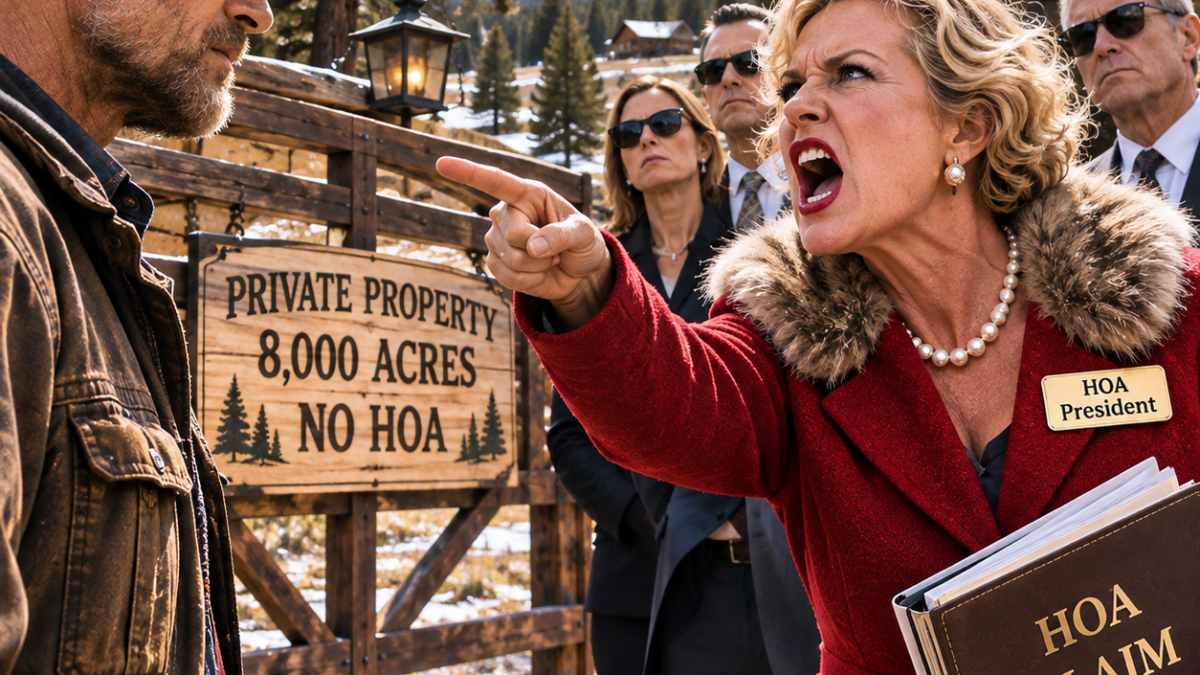
PART2
The next evening, forty-one residents of Silverpine Ridge Estates gathered beneath a twelve-foot Christmas tree in their clubhouse.
I was not there.
I learned what happened later from board minutes, emails, witness statements, and eventually from several residents who became embarrassed by how quickly everyone had accepted Vivien’s version.
She stood in front of a projected valley map and introduced me as:
“A developer from Denver who has locked a traditional community access road.”
That description achieved exactly what it was designed to achieve.
Developer.
Outsider.
Locked.
Community access.
Four words.
No deed.
No property map.
No question about whether Silverpine actually owned anything.
Gordon Price, the HOA treasurer, called me reckless.
Linda Hail, chair of landscaping, announced she had “heard” I intended to cut the forest and build luxury condominiums.
There was no source.
It did not matter.
Within ten minutes, a rumor became a threat.
“If he establishes control before we establish our rights,” Linda said, “we’ll never get them back.”
The board voted unanimously to demand permanent unrestricted access across my property.
The pressure started before sunrise.
A pickup truck with a Silverpine parking sticker crawled past my gate at walking speed.
The driver stared at the house.
That afternoon, I found a laminated sign zip-tied to the iron bars.
COMMUNITY ACCESS ROAD — DO NOT OBSTRUCT
I cut the ties.
Rolled the sign carefully.
Placed it on the porch.
Then I called Marlo Bennett.
Marlo was sixty-one, gray-bearded, permanently irritated by poorly written deeds, and probably knew more about land records in three western Montana counties than most county employees.
He arrived in a mud-splattered Jeep on December twenty-third.
“You really bought the entire Hensley tract?”
“That’s what the deed says.”
“You read the schedules?”
“Most.”
“Most is how people buy dams by accident.”
I looked at him.
“That sounds oddly specific.”
“It happened in 2007.”
He spread the closing documents across my kitchen table.
For eight hours, he barely spoke.
Then he drove back to Harlow Falls and spent another four hours in the county archive.
He returned at dusk carrying photocopies.
“The road is old.”
“I gathered that.”
“Hensley Land Company built it in the late sixties.”
“Okay.”
“When Silverpine Ridge was developed in the nineties, the Hensleys gave the HOA permission to use part of the corridor.”
“An easement?”
“No.”
That caught my attention.
Marlo sat down.
“A license.”
“What’s the difference?”
“An easement is generally a property right. This one was contractual and conditional.”
He placed a highlighted paragraph in front of me.
“Silverpine got limited residential use.”
I read.
The association had obligations.
Maintenance contributions.
Engineering inspections.
Compliance with operating rules.
“What happens if they stopped?”
“The agreement says the license can lapse.”
“When did they stop?”
Marlo looked at me.
“That’s where it gets interesting.”
Payment records became irregular after 2003.
Stopped entirely after 2011.
No documented engineering contribution since 2009.
“So what rights do they have?”
“Potentially very few under the contract as written.”
I leaned back.
That should have been the whole problem.
It wasn’t.
Marlo pulled a folded engineering map from his bag.
“There’s more.”
The map showed the valley.
Silverpine Ridge sat on a plateau west of Harlow Falls.
Between them, Black Canyon cut through the mountain.
A steel truss bridge crossed the gorge.
I knew the bridge.
I had driven across it on my way up.
Long.
Narrow.
Old steel.
More than four hundred feet above the river.
Marlo placed his finger on it.
“This bridge is tied to your purchase.”
“How?”
“It was built by the Hensley Land Company in 1968.”
“For logging?”
“Yes.”
“Silverpine uses it now.”
“Everyone uses it.”
“County road?”
“No.”
“HOA?”
“No.”
I looked at him.
“Then who owns it?”
Marlo paused.
“You.”
I thought he was joking.
He wasn’t.
He opened my closing schedule.
Page forty-three.
One line.
Silverpine Bridge, together with all appurtenant structures, access corridors, and maintenance rights.
I read it three times.
“That was included?”
“The Hensley heir wanted out of the maintenance liability.”
Marlo nodded toward the page.
“He sold you the bridge with the land.”
For the first time since Vivien arrived, I felt no irritation.
Only weight.
The bridge was not an amusing technicality.
It was the only reliable winter route from Silverpine Ridge to Harlow Falls.
The alternate road climbed Kestrel Pass.
Unpaved.
Unplowed.
Snowed shut from November through April.
School buses crossed my bridge.
Fuel deliveries.
Ambulances.
Pharmacy vans.
Every resident of Silverpine.
Marlo read my face.
“Yeah.”
“That bad?”
“Worse.”
“How much does bridge maintenance cost?”
“Depends what’s wrong.”
“And when was the last inspection?”
He looked down at his papers.
“That’s another question I don’t like.”
The next morning, Christmas Eve, a certified letter arrived from Silverpine Ridge.
It demanded that I sign a perpetual access agreement.
Irrevocable.
No cost.
No conditions.
Full rights to the road, bridge corridor, and related infrastructure.
I read it at the kitchen table with the Christmas lights glowing outside.
Marlo sat across from me.
“They’re demanding more than the old license gave them.”
“Yes.”
“They don’t even know you own the bridge.”
“Probably not.”
“You want to tell them?”
“No.”
He raised an eyebrow.
“Why?”
“Because I want to know what they actually believe before they know what I know.”
I wrote one paragraph.
Polite.
I would review any legitimate legal claim the HOA could document.
Until then, I would sign nothing.
No threat.
No mention of bridge ownership.
At four that afternoon, a young maintenance employee delivered another notice.
One sentence.
The Silverpine Ridge HOA will continue to use the bridge as it always has.
I looked at Marlo.
“Tomorrow morning.”
“What?”
“We find every document this bridge has ever touched.”
Christmas morning came clear and brutally cold.
Fresh snow covered the valley.
I drove down before nine.
The bridge’s steel trusses were white with frost.
Silverpine’s plows had cleared the deck.
And beside the eastern approach stood a brand-new green-and-gold sign.
SILVERPINE RIDGE HOA — PRIVATE COMMUNITY ACCESS
I stared at it.
Then called Marlo.
“I think they just made our evidence easier.”
By nine, Christmas traffic filled the road.
SUVs.
Children.
Gifts.
Nobody looked at the new stranger standing beside the approach.
At 9:17, Vivien’s black SUV arrived.
Behind it came Gordon.
Linda.
Three board members.
Vivien stepped through the snow.
Dark green coat.
Fur-lined hood.
She looked at me.
“You cannot close this bridge on Christmas.”
“I have never said I’m closing it.”
“Then stop pretending you might.”
“I haven’t.”
“Remove your gate.”
“No.”
She pointed toward the road.
“This is a community right.”
“Show me.”
Her voice sharpened.
“Our residents have used this bridge every day for twenty years.”
“Use is not ownership.”
“You don’t get to arrive in December and erase history because you found a line in a deed.”
That interested me.
“A line in what deed?”
She realized the mistake.
Too late.
I looked at the HOA sign.
“The only ownership sign on this bridge is yours.”
I pointed.
“And it’s bolted to property you don’t own.”
Vivien lowered her voice.
“You do not understand who owns this community.”
I looked past her.
Silverpine’s roofs glittered three miles away.
Then back at her.
“Actually, Vivien.”
I kept my voice quiet.
“I know exactly who owns it.”
Before she could answer, two younger Silverpine residents walked down the road.
One carried bolt cutters.
I saw them too late.
So did Vivien.
They went straight to my iron gate.
One shouted:
“Public right of way.”
Then snapped the padlock.
The gate swung open.
They wired it against the cedar post.
My stomach tightened.
Not because of the lock.
Because of what had just happened.
Vivien did not order them.
I could tell from her face.
But she had created the moral permission.
She had spent days telling residents that I was stealing something from them.
Now two men believed cutting my lock was public service.
I did not move.
Marlo had arrived ten minutes earlier.
He photographed everything.
The men returned to their truck.
I looked at Vivien.
“I’m not stopping anyone from crossing.”
Relief touched her face.
“Until I know exactly what rights they have.”
The relief vanished.
Then Marlo walked up carrying a gray archival box.
He looked exhausted.
“We found the original.”
The board members gathered.
He pulled out a certified copy.
June 14, 1994.
Signatures.
Walter Hensley.
Raymond Ashford, first president of the Silverpine Ridge HOA.
Marlo read aloud.
The agreement granted Silverpine a revocable residential-use license across the corridor and bridge.
No title.
No ownership.
No commercial use.
And three obligations.
Annual contribution to bridge and corridor maintenance.
Independent engineering inspection every five years.
Compliance with reasonable operating rules imposed by the bridge owner.
Gordon stopped breathing normally.
Marlo continued.
Payments regular for nine years.
Irregular after 2003.
Stopped after 2011.
No engineering contribution since 2009.
Then he read the final clause.
“Nothing in this agreement shall be construed as a transfer of title.”
The wind moved through the steel trusses.
“The association acquires no ownership interest in the bridge, corridor, or appurtenant land.”
Vivien did not move.
Marlo finished:
“And shall not represent by signage, publication, or otherwise that it holds any such interest.”
Every head turned toward the green-and-gold sign.
SILVERPINE RIDGE HOA — PRIVATE COMMUNITY ACCESS
Suddenly it looked less like authority.
More like an admission.
Marlo handed Vivien the agreement.
She read the last page twice.
I expected anger.
Instead, I saw fear.
Just for a second.
Then it disappeared behind control.
“I don’t want revenge,” I said.
She looked up.
“I don’t want tolls.”
Nothing.
“I don’t want to close the bridge.”
Behind her, Gordon shifted.
“All I want is a lawful agreement.”
I counted the points.
“Your residents contribute a fair share toward maintenance.”
“Independent inspections.”
“No claims over my land.”
“No HOA authority over my property.”
“And that sign comes down.”
Vivien folded the copy carefully.
“What you want is for Silverpine to bow.”
“No.”
“It is exactly what you want.”
“This isn’t about humiliation.”
“Then what?”
“Ownership.”
I pointed toward the bridge.
“That is mine.”
Then toward the distant subdivision.
“That is yours.”
I looked at the road between them.
“The problem begins when you pretend boundaries are insults.”
Vivien stared at me.
Then turned.
Her board followed.
Marlo watched them leave.
“She’ll hire counsel.”
“I expect her to.”
“Probably find somebody willing to tell her twenty years of use creates rights.”
“Maybe it does.”
He looked surprised.
“I’m not afraid of whatever rights they actually have.”
I looked at the bridge.
“I’m afraid nobody has inspected that thing in seventeen years.”
The sky over the western peaks had turned slate gray.
Marlo followed my gaze.
“Storm.”
“Looks like it.”
Neither of us knew the mountain was about to force every legal argument into a secondary problem.
By dusk, wind hit fifty miles per hour.
The temperature dropped twenty degrees in two hours.
Snow drove sideways.
The old timber house shook.
At 6:03 the next morning, my phone rang.
Snowplow driver Russ Delaney.
“Mr. Mercer?”
“Yes.”
“You own the bridge?”
“Apparently.”
“You need to come down.”
“What happened?”
A long pause.
“I heard it groan.”
I was already reaching for my coat.
“Where?”
“Third truss. East side.”
“Crack?”
“Yes.”
“How bad?”
“Getting worse.”
I made three calls.
Dale Whitaker in Billings.
Old business partner.
Heavy construction.
Steel.
Bridges.
Then the sheriff.
I requested deputies at both ends.
Then Marlo.
“Document every decision.”
“Already awake.”
“If this goes wrong—”
“I know.”
At 7:42, I reached the eastern abutment.
Nineteen below zero.
Wind-driven snow.
Russ stood beside his plow.
He pointed beneath the third truss.
A lower steel member had split along an old weld.
The crack was already longer than my hand.
Blue-white ice filled the fracture.
I felt sick.
Not because I owned it.
Because people had been crossing it.
Children.
Ambulances.
Fuel trucks.
For years.
No inspection.
No maintenance contribution.
No one taking responsibility because everyone assumed someone else would.
I called Dale again.
“How fast?”
“Five hours if we don’t die getting there.”
“Come.”
“Elias, this is going to cost.”
“Come.”
The sheriff’s deputies arrived.
We did not close the bridge entirely.
Dale’s engineer, working from photographs and drawings while his crew traveled, gave temporary operating restrictions.
Emergency vehicles first.
Passenger cars one at a time.
Walking speed.
No stopping.
No vehicles above five tons.
No school buses.
No delivery trucks.
Fuel trucks held.
I posted deputies at both ends.
Russ volunteered to coordinate traffic.
At nine, Vivien arrived.
Her SUV slid sideways before stopping.
She came toward me through knee-deep snow.
“You cannot ration access.”
I looked at her.
“I’m not rationing anything.”
“You are deciding who crosses.”
“Yes.”
“You don’t have the authority—”
I pointed my flashlight through the railing.
The crack had grown.
Longer now.
A forearm.
Vivien looked.
The steel groaned.
She froze.
“If this bridge goes into the canyon,” I said, “the people who die won’t be clauses in a deed.”
Her face changed.
All the anger disappeared.
For the first time, she looked like a woman standing beside a dangerous bridge instead of an HOA president standing beside a jurisdictional dispute.
A mother in a minivan arrived from Silverpine.
Her daughter had a fever.
The urgent-care clinic in Harlow Falls wanted the child seen at the hospital.
Vivien turned toward me.
“Let them through.”
I looked at the deputy.
“Emergency medical traffic first.”
The minivan crossed.
Slowly.
A pharmacy van arrived later with insulin for Harold Fitch, an elderly Silverpine resident.
We let it pass.
A fuel truck came.
Too heavy.
Held.
The driver cursed.
I did not care.
At 11:48, Dale’s convoy appeared through the storm.
Three trucks.
Chains.
Floodlights.
Steel plate.
Hydraulic jacks.
Welding equipment.
His beard was already frozen when he climbed out.
He hugged me once.
Then looked at the bridge.
“This your quiet life?”
“Apparently.”
He walked the deck.
Lay flat in the snow.
Inspected the fracture.
Returned.
“It’s ugly.”
“Can you save it?”
“Temporary reinforcement.”
“How long?”
“Twelve hours if weather doesn’t murder us.”
“Permanent?”
“Spring.”
“Do it.”
Dale looked toward Silverpine.
“Who’s paying?”
“I am.”
Vivien heard that.
She looked at me.
I did not explain.
There was no time.
Dale’s crew worked through the afternoon.
They rigged ropes beneath the deck.
Men descended over Black Canyon in thirty-below windchill.
Hydraulic jacks pulled the damaged member back into alignment.
Steel splice plates went across both sides.
Bolts thicker than my thumb.
Floodlights turned the canyon white.
From the homes in Silverpine Ridge, people could see them.
Hour after hour.
At 2:00 a.m., I stood beside a barrel fire drinking coffee that tasted like ash.
Vivien approached.
She had remained.
No SUV.
No board entourage.
Just her.
“You could have closed it.”
“Yes.”
“Why didn’t you?”
“Because people live up there.”
She looked toward the lights.
“You could have forced us to sign first.”
“Yes.”
“Why didn’t you?”
“Because emergencies are not negotiating leverage.”
She looked at me for a long time.
“You really mean that.”
“Yes.”
Something in her expression loosened.
Then:
“I still think you’re wrong about access.”
“Fine.”
She almost smiled.
“Fine?”
“We can disagree after nobody is in danger.”
At 4:17 a.m., Dale ran the first load test.
Pickup.
Then loaded plow.
The reinforcement held.
He climbed out.
“She’ll carry until spring.”
I exhaled for what felt like the first time in hours.
By dawn, the bridge was reopened under temporary weight restrictions.
The valley woke to one fact nobody could avoid.
The outsider they had accused of stealing their road had spent the night and a very large amount of money keeping their only winter road from failing.
I did not announce the cost.
Dale later told Marlo.
Marlo told nobody.
That mattered.
Because I did not want the repair becoming another weapon.
At 7:06 a.m., while Dale’s crew packed equipment, Marlo sat inside his Jeep reviewing correspondence from the Hensley estate’s attorneys.
He had requested everything.
Emails.
Letters.
Certified receipts.
He suddenly opened the door.
“Elias.”
His voice made me turn.
“You need to read this.”
Two-page letter.
March 9, 2022.
To:
President, Silverpine Ridge Estates Homeowners Association.
From:
Hensley family counsel.
The letter stated the 1994 access license had lapsed due to unpaid maintenance obligations.
It warned that no engineering inspection had been funded since 2009.
It specifically stated the bridge likely required significant repair.
Then it offered the HOA two choices.
Purchase the bridge and corridor outright.
Or negotiate a new use agreement with full maintenance cost sharing.
Otherwise, the Hensley estate intended eventually to sell the bridge with the surrounding property, after which continued access would depend on the new owner.
Attached:
Certified-mail receipt.
Signature:
Vivien Cross.
I stared.
“How long has she been president?”
“Almost four years.”
“She received this?”
“Yes.”
“Board minutes?”
“No mention.”
“Follow-up?”
Marlo handed me an email.
Six months later.
Hensley counsel asking whether Silverpine intended to respond.
No reply.
I looked toward the clubhouse plateau.
“She knew.”
“All of it.”
“Before I bought.”
“Yes.”
That changed the entire dispute.
Vivien had not misunderstood.
She had not inherited a bad assumption.
She knew the license had lapsed.
She knew the bridge was private.
She knew maintenance had been neglected.
She knew the Hensley estate planned to sell.
Then I appeared.
And she decided the safest move was to make me look unreasonable before I could discover what she had hidden.
I felt anger then.
Real anger.
The first time since she arrived.
Not because of the gate.
Not because of the sign.
Because we had spent twenty-two hours keeping a bridge from failing after she had been formally warned three years earlier that it needed attention.
People could have died.
That afternoon, I asked Vivien to meet.
She agreed immediately.
No argument.
The clubhouse conference room had a long walnut table and windows facing Black Canyon.
Vivien sat at one end.
Still wearing her coat.
I entered with Marlo.
Then asked him to wait outside.
This conversation needed only two people.
I placed the 2022 letter on the table.
Slid it toward her.
“You knew.”
She looked at the envelope.
Did not touch it.
“I knew.”
No denial.
No legal language.
Just two words.
I remained standing.
“Why?”
Vivien looked toward the window.
“When that letter arrived, I had been president eleven months.”
Her voice sounded older.
“The board reserve was already underfunded.”
She folded her hands.
“The purchase price for the bridge was manageable.”
“Repair?”
She laughed once.
No humor.
“Not remotely.”
“How bad?”
“The engineer estimated a special assessment approaching forty thousand dollars per household.”
I understood immediately.
Retirees.
Fixed incomes.
Families with mortgages.
Forty thousand was not inconvenient.
For some people, it was devastating.
“So you hid it.”
“Yes.”
“From your board?”
“Yes.”
“From residents?”
“Yes.”
“From Gordon?”
“Yes.”
“Why?”
“I thought I was protecting them.”
The most dangerous sentence in governance.
I said nothing.
Vivien continued.
“If residents learned the only road out was legally insecure, property values could fall.”
“So you kept using it.”
“The Hensley heir lived in Arizona.”
“You hoped he’d ignore it.”
“Yes.”
“Then I bought the land.”
She nodded.
“And you panicked.”
Her eyes met mine.
“Yes.”
For the first time, Vivien Cross looked completely honest.
“If you started asking questions, the board would discover I had known for years.”
“So you made me the problem.”
“Yes.”
“The sign.”
“My idea.”
“The legal demand.”
“My idea.”
“The gate pressure.”
“Yes.”
“Did you tell those men to cut my lock?”
“No.”
I believed her.
“But you made them believe they should.”
Her face tightened.
“I know.”
I finally sat.
Silence.
Then Vivien said:
“The biggest mistake wasn’t getting the legal issue wrong.”
I looked at her.
She continued.
“It was knowing I was wrong and believing I could outlast the truth.”
That was closer to accountability than anything I expected.
“So what happens now?” she asked.
I said nothing.
“You have the deed.”
Nothing.
“The original agreement.”
Nothing.
“The letter.”
Still nothing.
“You could sue us.”
“Yes.”
“You could sue me.”
“Possibly.”
“You could close the bridge.”
“I could seek restrictions.”
“What are you going to do?”
The question was not arrogant.
It was afraid.
I pulled a four-page document from my coat.
“One offer.”
She stared.
“A new agreement.”
I placed it on the table.
“Recorded.”
“Binding on future owners.”
“Residential access guaranteed.”
Her eyebrows rose.
“Guaranteed?”
“Yes.”
“For how long?”
“Permanent, subject to safety closure provisions.”
She looked at me.
I continued.
“Silverpine pays a fixed fair share of routine maintenance based on independent engineering analysis.”
“How much?”
“Not forty thousand per household.”
I turned the page.
“Major structural repairs remain primarily mine because I own the asset.”
Vivien looked genuinely surprised.
“You’re paying for the spring rebuild?”
“Yes.”
“Why?”
“Because ownership means responsibility too.”
She looked down.
“No HOA authority over my 8,000 acres.”
“Fine.”
“No signage claiming ownership.”
“Fine.”
“No commercial expansion of access without a separate written agreement.”
She nodded.
Then I turned to the last page.
“One condition.”
Her eyes narrowed.
“The entire history is disclosed.”
She stopped.
“Every resident receives the 1994 agreement.”
Nothing.
“Payment history.”
Nothing.
“The 2022 letter.”
Her face hardened.
“And the certified receipt with your signature.”
She looked at me.
“You want me humiliated.”
“No.”
“That would destroy me.”
“No.”
“It could remove me from office.”
“Yes.”
“There.”
She leaned back.
“That’s the revenge.”
I shook my head.
“The truth is not revenge.”
“Easy for you to say.”
“No.”
I leaned forward.
“You hid a bridge-safety warning.”
Her face went pale.
“A structural member cracked three days after I arrived.”
“I didn’t know it would—”
“I know.”
My voice stayed quiet.
“That is exactly why you disclose risk.”
She looked away.
I continued.
“You were trying to protect property values.”
“Yes.”
“You protected them by keeping residents from understanding the infrastructure their homes depended on.”
She said nothing.
“That cannot continue.”
“What if I refuse?”
“Then the legal process decides everything.”
She looked toward the window.
For a long time.
I placed a pen beside the agreement.
“I’m not asking you to sign now.”
She looked back.
“I’m asking you to call the meeting.”
That night, Vivien did not sleep.
I know because she told me later.
She sat alone at her kitchen table reading the 1994 agreement, the Hensley letter, and my proposed access agreement.
She thought about forty-one residents at the emergency meeting.
The men who cut my gate.
The mother crossing the bridge with a sick daughter.
Harold Fitch waiting for insulin.
The repair crew suspended above Black Canyon.
She thought about the sentence she had repeated for three years.
I’m protecting them.
At 10:04 the next morning, my phone rang.
Vivien.
“Call the meeting.”
“Are you sure?”
“No.”
A pause.
“But call it.”
December twenty-eighth.
The Silverpine clubhouse held more than one hundred residents.
Nearly every household.
Copies of the deed, 1994 agreement, payment records, Hensley letter, and certified receipt lay across the front table.
Marlo presented everything.
No commentary.
No insults.
He let the documents speak.
Confusion came first.
“We don’t own the bridge?”
“No.”
“Never did?”
“No.”
Then anger.
“You stopped paying maintenance?”
“Years ago.”
“Why?”
Then the 2022 letter.
Marlo held up the certified receipt.
Read the signature.
Vivien Cross.
The room went silent.
Every face turned toward her.
She sat in the front row.
Hands folded.
Gordon stood.
“I’ve been treasurer four years.”
His voice shook.
“I never saw that letter.”
Vivien nodded.
“I know.”
“You hid it from the board?”
“Yes.”
A man at the back shouted:
“My kids rode a school bus over that bridge!”
Another:
“You knew it hadn’t been inspected?”
Vivien closed her eyes for one second.
“Yes.”
The room erupted.
I stayed seated near the side wall.
This was not my moment.
It belonged to them.
Then Russ Delaney stood.
The plow driver.
“Everybody sit down.”
He did not have authority.
Something in his voice created it anyway.
People quieted.
“I found that crack at six in the morning.”
He pointed toward me.
“That man was there before eight.”
He described the traffic controls.
Emergency priority.
Weight limits.
The repair crew.
The overnight work.
Then Harold Fitch rose slowly.
“I needed insulin from Harlow Falls.”
He looked around.
“The pharmacy van crossed at noon.”
A young mother stood next.
“My daughter was sick.”
She looked toward me.
“The ambulance went ahead of everyone.”
The room changed.
Not completely.
People were still angry.
But anger found more precise targets.
They had been told I wanted to take something from them.
Instead, the first time I had actual power over their bridge, I used it to keep them safe.
Marlo finished.
Then I stood.
“I know a lot of you thought I came here to control this valley.”
No one spoke.
“A stranger buys eight thousand acres.”
I looked around.
“Puts up a gate.”
“Doesn’t introduce himself.”
“I would have wondered too.”
Vivien looked at me.
“I own the bridge.”
I paused.
“That’s true.”
The room tightened.
“But I don’t want to own your fear.”
Silence.
“I don’t want tolls.”
Nothing.
“I don’t want leverage over your homes.”
A few people exchanged looks.
“I want one thing.”
I pointed toward the documents.
“Clear boundaries.”
Then Vivien stood.
She faced her neighbors.
For several seconds, nothing came out.
Nobody rescued her.
Good.
Finally:
“The Silverpine Ridge HOA has never owned the Silverpine Bridge.”
Her voice shook once.
“The sign at the eastern approach was installed on my instruction.”
She swallowed.
“We had no legal basis to claim ownership.”
Gordon stared.
Vivien continued.
“I received the Hensley letter in March 2022.”
Murmurs.
“I did not provide it to the board.”
Stronger reaction.
“I did not provide it to residents.”
Her voice tightened.
“I believed disclosure would create a financial crisis.”
A man shouted:
“So you lied?”
Vivien looked toward him.
“Yes.”
The room went still.
“I told myself I was protecting property values.”
She looked around.
“I told myself the estate would never force the issue.”
She took a breath.
“And when Mr. Mercer bought the land, I tried to establish our claim before he discovered I had known the truth.”
No excuses.
No passive voice.
That mattered.
“The demands I made exceeded HOA authority.”
Her eyes briefly found mine.
“The sign was wrong.”
“The pressure over his gate was wrong.”
“And keeping the letter from you was wrong.”
She did not cry.
“I am sorry.”
Nobody applauded.
That was appropriate.
Then Gordon asked Marlo to explain the proposed agreement.
He did.
Permanent lawful residential access.
Fair annual maintenance contribution.
Independent engineering review.
Major structural responsibility with me.
No HOA authority over my land.
No false ownership signs.
The membership voted.
91 yes.
11 no.
A few abstained.
The agreement passed.
People came toward me afterward.
Some apologized.
Some shook my hand.
Some did neither.
That was fine.
I walked outside.
Snow fell lightly.
The bridge glowed far below under temporary work lights.
A few minutes later, Vivien came out.
“I want to ask you something.”
I turned.
“If you don’t need the bridge…”
She looked toward the canyon.
“Why keep it?”
I thought about the question.
Then:
“Somebody has to.”
“That’s not an answer.”
“Yes, it is.”
She waited.
“Owning something doesn’t mean you have to use it to control people.”
Vivien looked at me.
“Better that it belongs to someone who remembers that.”
For the first time since I met her, she smiled without calculation.
Small.
Tired.
Real.
January second, we signed the recorded agreement in Marlo’s office.
I signed first.
Vivien signed for Silverpine Ridge.
Marlo recorded it that afternoon.
The HOA board debated whether Vivien should be removed.
Some residents demanded resignation.
Others argued she had admitted the truth and should repair the damage she created.
The compromise surprised everyone.
She remained through the end of her term.
But the board imposed oversight requirements.
No unilateral legal threats.
No undisclosed correspondence involving major infrastructure.
Bridge matters required full-board review.
Gordon took control of financial reporting.
A resident committee received inspection records.
Vivien accepted every condition.
No speeches.
No complaint.
Three days later, she drove to my property.
The black SUV stopped at the gate.
She opened the rear hatch.
Inside lay the green-and-gold bridge sign.
And the laminated “community access road” sign I had removed from my gate.
She carried both to the porch.
Leaned them against the railing.
I stood in the doorway.
Neither of us spoke.
There was nothing left to say.
In April, Dale’s crew returned.
The temporary splice came out.
The damaged truss was rebuilt.
New steel.
New bearings.
Deck repairs.
Drainage.
Corrosion treatment.
Inspection access points.
The bridge closed in controlled windows.
Silverpine residents used scheduled convoys.
Nobody complained much.
Once people understand why a restriction exists, inconvenience becomes easier to tolerate.
The final engineering bill was enormous.
I paid the structural portion.
Silverpine paid its contractual share.
Nobody felt victorious writing checks.
That was probably a sign the arrangement was fair.
By June, the Silverpine Bridge carried a five-year inspection certificate.
At the next HOA meeting, Gordon presented the bridge reserve as a permanent budget line.
Nobody zeroed it out.
Nobody pretended postponing maintenance made the cost disappear.
Vivien stood at the side.
Not center.
That interested me.
She had learned to leave some space around herself.
I spent the summer on my land.
And proved every rumor wrong.
No condominiums.
No luxury subdivision.
No golf course.
I placed nearly six thousand acres into a permanent conservation easement.
Old-growth timber protected.
Wildlife corridor preserved.
No residential development.
No commercial resort.
When the announcement became public, Linda Hail—the woman who told everyone I planned to clear-cut the forest—drove up to apologize.
She stood awkwardly at my gate.
“I repeated something I never verified.”
“Yes.”
“I’m sorry.”
“Thank you.”
She looked toward the mountains.
“You really protected six thousand acres?”
“Yes.”
“Forever?”
“That’s what permanent means.”
She laughed.
“I deserve that.”
Probably.
I let her in for coffee anyway.
That autumn, I began building a new house.
Stone.
Timber.
Wide windows facing the valley.
The old Hensley cabin remained.
I could have demolished it.
Didn’t.
The first Christmas lights I hung in Montana had been on that crooked porch.
I wanted it left exactly where it was.
A reminder.
The new house included solar panels.
A small hydroelectric system on the creek.
Battery storage.
A workshop.
A library large enough for the box of books that had somehow turned into forty boxes.
The private road I built north through the property had nothing to do with Silverpine.
It gave me independent access to part of the acreage.
Not because I needed to prove I could live without the community.
Because redundancy matters.
That was another lesson from the bridge.
One road.
One bridge.
One hidden letter.
One decision-maker.
Systems become dangerous when everything depends on a single point.
Vivien understood that too.
Silverpine funded an emergency planning study.
Kestrel Pass would never become a good winter road.
But the county identified a possible emergency track usable in certain conditions.
Fuel reserves increased.
Medical contingency plans improved.
Nobody wanted another night where one cracked truss controlled hundreds of lives.
By autumn, I had become something I never expected.
A neighbor.
Not an HOA member.
Never that.
But a neighbor.
Russ Delaney came by occasionally.
Dale visited in hunting season.
Harold Fitch sent me a Christmas card with a handwritten line:
Thanks for keeping the insulin route open.
The young mother whose daughter crossed during the storm brought cookies.
I ate two and sent the rest home because she had five children.
Then December arrived again.
Snow covered the mountains.
The new house was finished.
I strung warm white lights along its porch.
And the old cabin too.
Far below, the bridge glowed gold.
Silverpine’s residents had voted to decorate the trusses.
They asked me first.
That mattered more than the lights.
Christmas Eve.
Light snow.
No wind.
I stood outside with coffee.
A gray sedan climbed the road.
Not a black SUV.
Vivien stepped out.
Hair loose.
No folder.
No HOA crest.
She carried a metal tin.
“Cookies.”
“That sounds suspicious.”
“They’re from the bakery.”
“Safer.”
She looked toward the open gate.
“You leave this open now.”
“Most days.”
“Why?”
“Because most people ask.”
She smiled.
We walked toward the edge of the bench.
Below us, Silverpine Ridge glowed.
The bridge stretched across Black Canyon.
Gold lights.
Dark river.
Snow.
For a while, neither of us spoke.
Then Vivien said:
“Do you still plan to live here alone?”
I looked at her.
“That is a remarkably personal question for an HOA president.”
“I’m not president anymore.”
I had forgotten.
Her term had ended the previous month.
She had not run again.
“What are you now?”
“Dangerously unemployed from unpaid volunteer authority.”
I laughed.
She looked pleased with herself.
“What will you do?”
“Consulting.”
“HOA consulting?”
“God, no.”
“Good.”
She nudged the cookie tin against my arm.
“Risk management.”
That made sense.
We stood quietly.
Then she said:
“I used to think you bought eight thousand acres because you hated people.”
“I did not hate people.”
“You definitely disliked us.”
“I disliked you.”
She laughed.
“Fair.”
I looked toward the valley.
“I wanted quiet.”
“And now?”
The question landed differently than it had a year earlier.
I thought about Russ.
Harold.
Linda.
Dale.
Marlo.
The mother with the sick daughter.
Residents who once thought I came to steal their road.
The bridge they now helped maintain.
Vivien beside me.
“I think I found a place worth staying.”
She nodded.
No romance.
No grand declaration.
Just two people looking at a bridge neither of us would ever misunderstand again.
Years passed.
The first five-year inspection came due.
Silverpine paid its share before anyone reminded them.
The engineer found minor corrosion.
Fixed.
No crisis.
The bridge reserve grew.
The recorded agreement became something new residents received at closing.
No mystery.
No folklore.
No claim that the HOA owned what it did not.
The gate at my property remained.
Sometimes open.
Sometimes closed.
Nobody cut the lock again.
The two men who had done it apologized months later.
One offered to pay for the replacement padlock.
I told him twenty dollars would cover it.
He handed me fifty.
I gave thirty back.
He looked confused.
“I broke your property.”
“You owe me for the lock.”
“That’s it?”
“That’s it.”
Justice loses meaning when it becomes an excuse to take more than you lost.
That principle became important to me.
Especially after people began telling the story.
By the third year, Harlow Falls had turned the Christmas bridge dispute into local mythology.
Depending on who told it, I was:
The billionaire who secretly bought an HOA’s only road.
The mountain recluse who almost trapped rich homeowners.
The businessman who saved Christmas.
The man who owned an entire town.
Most versions were wrong.
I owned land.
A bridge.
Not people.
That distinction was exactly what the entire conflict had been about.
One December, a reporter from Missoula called.
Wanted an interview.
“Local property-rights story.”
“No.”
“People are fascinated.”
“I’m not.”
“Did you really threaten to close the bridge?”
“No.”
“Did the HOA president threaten you?”
“She made demands.”
“Did you buy the land knowing the bridge was included?”
“No.”
That disappointed him.
Real stories often disappoint people who want perfect villains and perfect heroes.
Vivien had done something wrong.
Several things.
Serious things.
She also believed she was protecting people.
That did not excuse her.
But it mattered.
I had legal leverage.
I also had enough money to make choices ordinary owners might not have been able to make.
That mattered too.
If the bridge had belonged to someone struggling financially, Silverpine’s neglect could have destroyed them.
Responsibility cuts both ways.
I told Marlo that once.
He nodded.
“Which is why you put the cost-sharing clause in.”
“Yes.”
“Look at you.”
“What?”
“Becoming civic-minded.”
“I hate you.”
He laughed.
Eventually, Vivien moved from Silverpine Ridge.
Not far.
Harlow Falls.
She bought a modest house near the river.
We remained friends.
Careful friends.
The kind built after people have seen one another at their worst and decided truth is easier than pretending.
Sometimes she came up for Christmas.
Sometimes not.
One year, she brought the original green-and-gold sign.
I had left it stored in the old cabin.
She asked:
“Can I have this?”
“Why?”
“I want to hang it in my office.”
I stared at her.
“Seriously?”
“Reminder.”
“Of what?”
She ran her fingers over the words:
PRIVATE COMMUNITY ACCESS
“That confidence is not evidence.”
I gave it to her.
Years later, when people asked why I had bought the land, I usually gave the easy answer.
Privacy.
Mountains.
Conservation.
All true.
But not complete.
I bought 8,000 acres because I was tired of people needing something from me.
Then I discovered that isolation was not the same as peace.
Peace required boundaries.
And boundaries are not walls.
They are agreements about where one person’s authority stops and another person’s begins.
Silverpine thought my gate was aggression.
At first, I thought their bridge use was entitlement.
Both ideas were incomplete.
Their residents needed access.
I needed ownership respected.
The solution was not domination.
It was documentation.
Responsibility.
Truth.
A recorded agreement everybody could read.
The bridge taught me that.
It taught Vivien something harder.
You can do the wrong thing for reasons that feel noble.
You can hide information because you believe people will panic.
You can overreach because you think the outcome matters more than procedure.
You can tell yourself that protecting a community justifies deciding what its members are allowed to know.
And you can become dangerous without ever intending to become cruel.
That is why evidence matters.
That is why transparency matters.
That is why no president, board, owner, or wealthy stranger should be trusted simply because they believe they are right.
The old Hensley cabin still stands.
Its chimney leans a little more each year.
I repair enough to keep it safe.
Never straighten it completely.
Some things should look their age.
On Christmas Eve, I still hang lights along that porch.
The new house glows nearby.
Below, Silverpine’s lights cluster across the plateau.
The bridge shines between us.
No ownership sign.
No HOA crest.
Just structural inspection plates, weight markings, and small maintenance placards.
The most beautiful bridge signs I have ever seen.
Boring.
Accurate.
Necessary.
One Christmas, long after the original dispute, I stood at the canyon overlook with Vivien.
She was older.
So was I.
The bridge had just passed another inspection.
She asked:
“Do you ever regret buying it?”
“The bridge?”
“All of it.”
I looked at the forest.
“No.”
“Even the fight?”
I thought.
“No.”
“That is deeply annoying.”
“Why?”
“Because I regret almost every part.”
I looked at her.
“You shouldn’t.”
She frowned.
“That’s generous.”
“It’s accurate.”
“How?”
“You told the truth eventually.”
“After getting caught.”
“Yes.”
She winced.
“I’m not helping.”
I smiled.
“You stayed.”
That made her quiet.
“You stood in front of the residents.”
Nothing.
“You signed the new agreement.”
She looked toward the bridge.
“You rebuilt what you damaged.”
She shook her head.
“Not all of it.”
“No one does.”
The wind moved through the canyon.
Then she asked:
“Do you forgive me?”
I considered it.
“Mostly.”
She laughed.
“Mostly?”
“Feels honest.”
“I’ll take it.”
We stood there until the cold pushed us back toward the house.
That night, people from Silverpine came up for a holiday gathering.
Not an HOA event.
No board resolution.
No tickets.
Neighbors.
Russ brought whiskey.
Harold’s daughter came because Harold had died the previous spring.
Linda brought too much food.
Marlo argued with Dale about bridge steel as if anyone wanted to hear it.
Vivien stood by the fire.
I looked around the room.
Years earlier, I had bought the property because I wanted a place where nobody needed anything from me.
Now my house was full.
And I was fine.
Better than fine.
The difference was choice.
That was what the gate had always represented.
Not exclusion.
Consent.
You knock.
You ask.
I answer.
Sometimes yes.
Sometimes no.
The same principle applied to the bridge.
Silverpine had access now.
Real access.
Recorded.
Protected.
They did not depend on my mood.
Future owners could not suddenly decide otherwise.
That mattered.
Because good boundaries protect both sides.
The residents no longer had to wonder whether a new owner could close their road.
I no longer had to wonder whether an HOA would expand its claims into my property.
Everyone knew where the line was.
Years later, when a new Silverpine president proposed widening the bridge approach for larger delivery trucks, the board sent me a formal request.
Survey.
Engineering plan.
Traffic analysis.
Cost allocation.
I reviewed it.
Approved most.
Changed one drainage detail.
Signed.
No threats.
No emergency meeting.
No sign.
No bolt cutters.
The president joked:
“I heard the last time someone asked you about road access, it became a Christmas legend.”
I answered:
“They didn’t ask.”
He laughed.
That was the whole story in three words.
They didn’t ask.
Vivien had walked to my gate with a conclusion instead of a question.
I responded with a boundary.
She interpreted the boundary as hostility.
Then both of us discovered there was something underneath the argument more important than either of our pride.
Hundreds of people depended on old steel nobody had properly cared for.
The bridge became the evidence.
Not of who was stronger.
Of what happens when responsibility is ignored because everyone assumes somebody else owns the problem.
The Hensley family avoided the maintenance cost.
Silverpine stopped paying.
Boards stopped asking.
Vivien hid the letter.
Residents assumed access was permanent.
Then the steel cracked.
That fracture was not created Christmas morning.
It had been waiting.
Years.
Perhaps decades.
Like most serious problems.
The crisis only made it visible.
I sometimes think about what would have happened if I had never bought the land.
Another owner might have.
Maybe someone less patient.
Maybe a developer.
Maybe a corporation.
Maybe someone who genuinely wanted tolls.
Maybe the bridge would have cracked six months later under a school bus instead of during a storm while a plow driver happened to hear it groan.
Nobody knows.
That uncertainty is why I never describe myself as the man who saved Silverpine.
Luck did a lot.
Russ heard the sound.
Dale answered his phone.
The crack was discovered before catastrophic failure.
Weather, timing, people.
Systems survive because several things go right at once.
Arrogance grows when one person takes credit for all of them.
I had spent years in business watching CEOs make that mistake.
Vivien made a version of it in an HOA.
I could have made it too.
Owning the bridge gave me authority.
It did not make me morally superior.
That became my own lesson.
The first week, I enjoyed telling Vivien the HOA had no authority over my land.
Accurate.
But not the whole story.
My ownership still affected other people.
If I ignored that, I would become the mirror image of what I disliked in her.
Rights without responsibility are only another form of entitlement.
So the bridge stayed.
Maintained.
Inspected.
Shared.
Not surrendered.
Shared.
There is a difference.
By my fiftieth birthday, almost eleven years after the dispute, the new bridge deck needed replacement.
Silverpine’s reserve already held its share.
No emergency assessment.
No panic.
No hidden letter.
The engineering report went to every household.
Public meeting.
Questions.
Vote.
Work scheduled.
I sat in the back of the clubhouse.
Nobody recognized the symbolism except me.
Vivien had driven up from Harlow Falls.
She sat beside me.
The president explained detour windows.
A resident complained about noise.
Another asked about cost.
The treasurer showed the reserve balance.
Routine governance.
Boring.
Beautiful.
Vivien leaned toward me.
“This would’ve terrified me once.”
“What?”
“All these questions.”
“Why?”
“I thought if people asked questions, they’d lose confidence.”
I looked around.
“And now?”
“They trust the board more because they get answers.”
“That’s usually how it works.”
She looked annoyed.
“You could pretend I taught you something too.”
“You taught me plenty.”
“Such as?”
I thought.
“Never trust a woman in a camel coat carrying HOA letterhead.”
She elbowed me.
Hard.
The meeting ended.
The bridge project passed.
No drama.
Outside, snow had started.
Vivien looked toward the canyon.
“Eleven years.”
“Yes.”
“You still have the first laminated sign?”
“Of course.”
“You’re sentimental.”
“Evidence.”
She laughed.
That Christmas, I took the sign from storage.
COMMUNITY ACCESS ROAD — DO NOT OBSTRUCT
Cheap plastic.
Faded lettering.
I considered throwing it away.
Then mounted it in the old cabin.
Not proudly.
Not as a trophy.
Beside it, I placed a copy of the recorded access agreement.
One false claim.
One lawful solution.
Visitors sometimes asked about them.
I told the story.
Usually shorter than this.
Gate.
HOA.
Bridge.
Storm.
Truth.
Agreement.
Then I always ended the same way.
People assumed the lesson was:
Read your deed.
Good lesson.
Others thought it was:
Never let an HOA push you around.
Sometimes useful.
But the real lesson was harder.
When somebody tells you they are protecting a community, ask what they are hiding from the community in order to do it.
When somebody tells you they own something, ask for the document.
When somebody tells you a rule has always existed, ask who wrote it and under what authority.
And when you hold the stronger legal position, ask yourself whether you are protecting a boundary or simply enjoying power.
Those questions saved more than my land.
They saved Silverpine from continuing a lie until old steel finally turned the lie into a funeral.
The last Christmas Vivien visited before moving east to be closer to her sister, we stood on the bench above the lake.
Snow fell quietly.
The bridge glowed gold below.
She had brought cookies again.
This time homemade.
They were terrible.
I ate two.
She looked at the valley.
“Do you remember what I said at your gate?”
“Several unpleasant things.”
“The last one.”
I knew.
“You’ll need us before winter is over.”
She smiled.
“I was wrong.”
“Not completely.”
She turned.
“I did need people.”
“Everyone does.”
“You?”
“Yes.”
She looked genuinely surprised.
“Careful. That sounded emotionally healthy.”
“I’m aging.”
She laughed.
Then grew quiet.
“I’m glad you bought this place.”
I looked at her.
“That is not what you said the first week.”
“No.”
She watched the bridge.
“But if someone had to own it…”
She paused.
“I’m glad it was someone who didn’t need to prove ownership by hurting people.”
I thought about that.
Then:
“I almost did.”
“When?”
“Christmas morning.”
“You never threatened to close it.”
“No.”
“But when I found the original agreement?”
I looked toward the old gate.
“For about five minutes, I enjoyed knowing I could beat you.”
Vivien smiled.
“I would have deserved five minutes.”
“Probably.”
“What stopped you?”
“The bridge.”
She frowned.
“I realized winning the property argument didn’t change the fact that hundreds of people needed it.”
She nodded.
“That was the difference between us then.”
“What?”
“You saw responsibility before I did.”
I shook my head.
“I just got lucky enough to be angry second.”
She laughed.
Then handed me the cookie tin.
“I’m leaving this.”
“Absolutely not.”
“You own eight thousand acres.”
“I don’t have room.”
“Find some.”
That was our goodbye.
She moved in spring.
We still exchanged Christmas cards.
Mine usually showed the bridge.
Hers usually contained one sentence:
Still asking before assuming.
Years later, after I sold one of my remaining companies and stopped working entirely, I walked the 8,000 acres more slowly.
I knew the lake.
The ridges.
Elk routes.
Creeks.
The place where lightning had split a ponderosa pine.
The meadow where wildflowers arrived in June.
I finally understood why the Hensley family kept it seventy years.
Not because land stays unchanged.
It doesn’t.
Because stewardship creates continuity.
You inherit responsibility from people you never met and hand it to people you may never know.
The bridge was the clearest version of that.
Built by Walter Hensley for logging trucks.
Used later by families.
Neglected.
Nearly lost.
Repaired.
Then maintained by people who learned ownership and dependence could coexist.
I eventually placed the remaining two thousand acres not already protected under stricter conservation rules.
The bridge corridor remained separate because future public access needed legal clarity.
Marlo, older and even grayer, handled the documents.
At closing, he said:
“You know this means some future owner can’t turn half the mountain into a resort.”
“That’s the point.”
“You’ve become sentimental.”
“Everybody keeps saying that.”
“You also know the bridge agreement survives you.”
“Yes.”
“Good.”
He signed as witness.
I looked at him.
“Remember when you told me I bought a bridge by accident?”
“You did.”
“I hate that you were right.”
“Best part of my career.”
We had lunch afterward.
He made me pay.
Of course.
One winter evening, a group of Silverpine teenagers walked up the road asking permission to photograph the frozen lake for a school project.
They stopped at the gate.
Pressed the call button.
Waited.
I opened it.
One boy said:
“Our teacher told us we have to ask because this is private land.”
“Your teacher is correct.”
Another looked toward the bridge.
“You own that too?”
“Yes.”
“Why?”
I laughed.
“Long story.”
“Did you buy it on purpose?”
“No.”
They laughed.
Then the girl holding the camera asked:
“Can we go to the lake?”
“Yes.”
“Thank you.”
They entered.
Gate closed behind them.
No confrontation.
No fear.
No argument about access.
They asked.
I said yes.
That simple exchange meant more to me than the first court-ready legal letter ever could.
Because boundaries had become normal.
Not hostile.
The next Christmas, Silverpine invited me to their community dinner.
I almost declined.
Then went.
Gordon Price had long since retired as treasurer.
Linda chaired the conservation committee now.
Russ Delaney still plowed roads.
Harold Fitch’s daughter sat with his old friends.
There were new residents who knew me only as “the bridge guy.”
One asked:
“Were you really going to close us in?”
Before I answered, Linda said:
“No.”
The woman looked at her.
Linda continued.
“We told ourselves that because it was easier than admitting we had no idea what we actually owned.”
I looked at her.
She shrugged.
“Growth.”
The room laughed.
That was justice too.
Not punishment.
Memory corrected.
The story told accurately enough that new people did not inherit the old lie.
At the end of dinner, the current HOA president raised a glass.
“To the bridge.”
Everyone laughed again.
Then he added:
“And to asking before cutting somebody’s lock.”
The two men who had cut it were in the room.
One covered his face.
The other shouted:
“I paid for the replacement!”
More laughter.
No bitterness.
Time had done what documents alone could not.
It turned accountability into culture.
That night, I drove home across the bridge.
Stopped at the overlook.
The steel trusses glowed beneath Christmas lights.
New deck.
Inspection plaque.
Fresh paint.
Below, the river moved black beneath ice.
I thought about the first crack.
How small it began.
A hand’s width.
A weakness hidden inside old steel.
That image stayed with me because communities fail the same way.
Rarely all at once.
One unpaid maintenance contribution.
One inspection delayed.
One letter hidden.
One rumor repeated.
One gate cut.
Each small enough to justify.
Until stress arrives.
Then everything weak becomes visible.
The bridge survived because someone finally looked.
So did Silverpine.
So did Vivien, in a way.
So did I.
I had come to Montana trying to disappear from obligation.
Instead, I learned better obligation.
Chosen obligation.
Transparent obligation.
Responsibility with boundaries.
The kind that does not own you because you agree to carry it.
Years after the conflict, people still asked why I never sold the bridge to Silverpine.
The answer changed over time.
At first:
They couldn’t afford it.
Later:
The agreement works.
Eventually, the truest answer became:
Because ownership can be a form of stewardship instead of control.
I did not need the bridge.
Silverpine did.
But owning it meant I could protect it from becoming a weapon.
Against them.
Against me.
Against the next owner.
The recorded agreement guaranteed access.
The maintenance structure protected safety.
No one person could suddenly rewrite the rules.
That mattered.
If I sold it outright to the HOA, maybe that would work too.
But we had built something balanced.
Neither side controlled everything.
Neither side needed to.
That was the point.
On my sixtieth Christmas, I woke before dawn.
Snow had fallen all night.
I walked outside.
The old Hensley cabin glowed beneath its porch lights.
The new house stood dark behind me.
Far below, Silverpine Ridge slowly woke.
One by one, lights appeared.
Then the bridge lights switched off automatically with sunrise.
For a few minutes, the steel span was only steel again.
No myth.
No HOA symbol.
No private trophy.
Just infrastructure.
A bridge.
That pleased me.
I walked to the old gate.
The original cedar posts had been replaced twice.
Iron repainted.
Lock new.
I opened it.
Left it open.
Then stood there looking down the road.
I remembered Vivien’s first words.
You’re standing on land this community has used for twenty years.
I had thought the sentence was about entitlement.
Partly, it was.
But beneath it was fear.
Fear of losing access.
Fear of property values collapsing.
Fear of residents blaming her.
Fear of admitting she had hidden something too long.
Fear made her cruel.
My own fear made me cold.
I feared being controlled again after years of business obligations.
So the moment she arrived, I saw only intrusion.
The bridge forced both of us to see beyond fear.
That was why the story stayed with me.
Not because I won.
I did not.
Silverpine kept access.
I kept ownership.
Vivien kept enough dignity to rebuild trust.
Residents gained transparency.
The bridge gained maintenance.
Nobody got everything.
Everybody got what they actually needed.
That is better than victory.
The sun rose over the ridge.
Snow on the road turned gold.
A vehicle appeared below.
Small SUV.
Silverpine sticker.
It stopped before the gate.
The driver lowered the window.
Young woman.
New resident.
“Mr. Mercer?”
“Yes?”
“I’m sorry to bother you.”
She pointed toward the lake.
“My parents are visiting, and I heard there’s a public overlook near your south boundary.”
“There is.”
“Can we use this road to reach it?”
I smiled.
“Yes.”
“Thank you.”
She drove through.
Stopped.
Rolled the window down again.
“Oh—and Merry Christmas.”
“Merry Christmas.”
She continued.
I watched the SUV disappear into the trees.
Then closed the gate behind her.
Not locked.
Just closed.
A boundary.
Not a weapon.
Down in Black Canyon, the Silverpine Bridge stood beneath the morning sky.
Still mine.
Still theirs to cross.
Still carrying people from one side to the other.
And after all those years, I finally understood that was the most fitting ending any of us could have received.
Because the argument had never truly been about who owned the community.
It was about whether ownership gave anyone the right to forget everyone else.
It doesn’t.
Neither does authority.
Neither does fear.
Neither does history.
What matters is where the line is, whether everyone can see it, and whether the people standing on both sides are decent enough to respect it.








