PART2:“STILL STUCK IN MEETINGS, SWEETHEART.” My Husband Texted Me Five Minutes After I Filmed Him Pouring Something Onto My Pillow—Then Our Family iPad Lit Up
PART2
Two patrol officers arrived first.
Officer Elena Martinez and Officer Cole Brennan.
I told them exactly what I knew.
Not what I suspected.
“My husband told me he is in Dallas.”
“Okay.”
“He entered the house at 12:27.”
“You have video?”
“Yes.”
“He put an unidentified substance on my pillow.”
“Did you touch it?”
“No.”
“Good.”
“I’ve been experiencing unexplained symptoms for weeks.”
Officer Martinez’s expression changed.
Not panic.
Attention.
“And you received this?”
I showed her the iPad lock-screen photographs.
She read them.
“Beneficiary?”
“Yes.”
“Do you know what that means?”
“No.”
That answer was difficult.
My brain had already produced twenty possibilities.
Insurance.
Trust.
Investment account.
But forensic work had trained me not to marry a theory before evidence arrived.
Officer Brennan asked:
“Where is your husband now?”
“I don’t know.”
“Vehicle?”
I gave them the information.
“Any firearms in the house?”
One legally owned handgun in a locked safe.
Garrett knew the combination.
They told me not to re-enter.
A supervisor arrived.
Then a detective.
Then fire-department personnel because nobody knew what substance had been used and the bedroom potentially contained an environmental hazard.
I stood on the sidewalk watching strangers enter my home wearing protective equipment.
Mrs. Velasquez from across the street appeared at her window.
I wanted to disappear.
Instead, I called Helen.
My boss.
“Dana?”
“I’m not coming tomorrow.”
“Okay.”
“Possibly for a while.”
Silence.
“What happened?”
“I can’t explain yet.”
Another pause.
Then the tone she used during investigations.
“Do you need counsel?”
“Yes.”
“I’ll send you someone’s number.”
“Not through work.”
“Understood.”
The first thing detectives did was preserve the bedroom as a scene.
They secured the small area around my pillow.
Collected samples through proper procedures.
Recorded the bedding.
Photographed the security cameras.
Collected access information.
The bottle was gone because Garrett had taken it.
But the residue remained.
My pillow remained.
And the camera had recorded him.
That mattered.
I spent the afternoon at Northwestern Memorial.
Not because anyone knew what had been used.
Because my unexplained illness now had a possible exposure history.
Doctors repeated tests.
Asked questions I had never thought mattered.
When did symptoms begin?
Where did I sleep?
Did I feel better away from home?
That question stopped me.
“What?”
“Did symptoms improve when you slept elsewhere?”
I thought.
A conference in Milwaukee two weeks earlier.
One night.
I had awakened feeling almost normal.
Then the headaches returned after I came home.
“Yes.”
The physician wrote it down.
That did not prove cause.
But it mattered.
The hospital collected samples.
Monitored me.
Called toxicology consultation.
Nobody told me some dramatic chemical name and announced attempted murder.
Real medicine was slower.
Possibilities.
Concentrations.
Exposure routes.
Clinical correlations.
I appreciated the caution even while every part of me wanted certainty.
My phone rang seventeen times.
Garrett.
I did not answer.
Then texts.
Where are you?
Police are at the house.
Dana, what the hell is happening?
Call me.
Then:
I came back early to surprise you. I had something for your migraines. This is insane.
Something for my migraines.
On my pillow.
While wearing gloves.
Without telling me.
While pretending to be in Dallas.
He was already building the explanation.
I screenshotted every message.
Detective Nora Feldman arrived at the hospital at 6:10 p.m.
Mid-forties.
Dark hair cut short.
Direct.
“Do you feel well enough to talk?”
“Yes.”
She sat.
“We located your husband.”
My stomach tightened.
“Where?”
“O’Hare.”
That surprised me.
“He was attempting to board a flight.”
“To Dallas?”
“No.”
I looked at her.
“Where?”
“Miami.”
Of course.
Not Dallas.
“Was Lindsey with him?”
“No.”
“Did you arrest him?”
“I’m not discussing charging decisions beyond what’s appropriate right now.”
Fair.
“Did he have the bottle?”
She did not answer directly.
“We recovered items relevant to the investigation.”
My heartbeat accelerated.
Nora continued.
“The iPad.”
“Yes.”
“Did you open the message thread?”
“No.”
“Good.”
“Why?”
“Because we want to preserve it properly.”
She looked at me.
“Would you consent to providing the device?”
“Yes.”
“It belongs jointly to the household?”
“Yes.”
She documented everything.
Then:
“Do you have access to your husband’s finances?”
That question irritated me.
“I’m not illegally accessing anything.”
“I didn’t ask you to.”
I took a breath.
“Sorry.”
“Your profession?”
“Forensic accounting.”
“I know.”
Of course she did.
“I’m asking whether you already have legitimate access to any shared financial records.”
Joint checking.
Joint savings.
Mortgage.
Tax documents.
Certain insurance records.
Home-office files.
“Yes.”
“Do not start conducting your own investigation tonight.”
I almost smiled.
“You sound like my boss.”
“I imagine your boss is smart.”
“She’s annoying.”
“Good.”
Nora leaned forward.
“If this becomes a criminal case, evidence needs a clean chain. Let us handle devices and physical evidence.”
I understood.
“What can I do?”
“Protect yourself.”
That answer frustrated me.
Then she added:
“And give us what you already lawfully possess.”
Better.
I spent that night at Helen’s house.
She insisted.
My mother lived in Arizona and had already booked the first morning flight to Chicago after I finally told her what had happened.
At 2:30 a.m., I woke from a dream that Garrett was fluffing my pillow.
I sat in Helen’s guest room staring at the pillowcase.
Could not lie down again.
So I sat on the floor.
At 3:05, I remembered something.
Garrett’s life-insurance folder.
Not because I suddenly wanted to investigate.
Because “beneficiary” had been sitting inside my skull all night.
Years earlier, we each bought modest policies after purchasing the townhouse.
Mine was $750,000.
His was $1 million.
Standard planning.
Enough to cover mortgage, debts, and transition costs.
Nothing strange.
But six months earlier, Garrett had asked me to sign what he described as a “routine benefits update.”
I had refused because I was late for work.
He became annoyed.
I told him to leave it on the counter.
It disappeared.
I had forgotten.
I texted Detective Feldman.
I remembered Garrett tried to get me to sign insurance paperwork about six months ago. I did not sign it.
She responded at 6:14 a.m.
Thank you. Don’t search for documents. We’ll discuss today.
My mother arrived before noon.
Linda Whitfield.
Sixty-seven.
Retired elementary-school principal.
Absolutely no covert background.
No military rank.
No secret fortune.
Just my mother.
She hugged me in Helen’s kitchen and said:
“I never liked him.”
I stared.
“Mom.”
“I know that’s not helpful.”
“No.”
She hugged me again.
“Still true.”
Garrett called while she was holding me.
Mom looked at the screen.
“Want me to answer?”
“No.”
“Good.”
She put the phone face down.
Then:
“Now I can keep disliking him with discipline.”
That made me laugh for the first time.
Detective Feldman called later.
They had obtained additional legal authority to search portions of our residence and certain digital materials relevant to the investigation.
I was asked to identify shared files and insurance records.
At the police office, they showed me a printed document.
My name.
Policy application.
Face amount:
$4,500,000.
I stared.
“That’s wrong.”
“Wrong how?”
“I never applied for this.”
“Your signature is here.”
I looked.
It resembled mine.
But not perfectly.
“Not mine.”
“Certain?”
“Yes.”
The beneficiary was Garrett.
Primary.
Lindsey did not appear.
Policy issue date:
Four months earlier.
I felt physically cold.
“Four and a half million?”
“Yes.”
“How did this get approved?”
“We’re investigating.”
My mind shifted automatically into work mode.
Application.
Medical records.
Insurable interest.
Electronic signatures.
Premium source.
Verification.
“Premiums?”
Nora watched me.
“What?”
“Who paid them?”
“We’re working on that.”
“The deposit Lindsey mentioned.”
“Possibly.”
I shut my mouth.
Possibly.
Not fact.
The policy itself did not prove Garrett intended to kill me.
Spouses buy insurance.
The forged signature question was separate.
But paired with the bedroom footage?
My sickness?
His lie?
The iPad?
The shape of the case was becoming difficult to ignore.
Then Detective Feldman placed another page in front of me.
An email.
Garrett to Lindsey.
If the Whitfield review lands before closing, we’re both exposed.
I looked up.
“What Whitfield review?”
“We hoped you might know.”
I did not.
Then I remembered the Trent file.
Not Garrett.
But my firm had recently begun a confidential review of vendor payments for a pension investment group.
The pension group had invested in several Midwestern real-estate developments.
Garrett’s developments?
I had not known.
Conflict screening should have caught that.
Unless the entities were obscured.
My pulse quickened.
“What company?”
Nora gave me a name.
Lakepoint Redevelopment Partners III.
I closed my eyes.
“I’ve seen it.”
“In your work?”
“Yes.”
“What do you know?”
“Very little. It appears in a portfolio review.”
“Any suspected misconduct?”
“I cannot discuss client information without authorization.”
Nora actually smiled.
“You really are an auditor.”
“I’m also not losing my career because my husband may be a criminal.”
She nodded.
“Your employer’s counsel can coordinate.”
Helen’s firm did.
By that afternoon, my employer had formally screened me off the investigation because of the personal conflict.
But they confirmed something important to law enforcement.
Lakepoint Redevelopment Partners III had been under review for unusual vendor payments.
One vendor:
Crane Advisory Services.
Lindsey Crane.
Another:
Pruitt Urban Management.
Garrett.
I sat in Helen’s conference room.
My boss across from me.
Corporate counsel beside her.
“Dana.”
“Yes.”
“We need you to understand something.”
I waited.
“You did not create this investigation.”
“I know.”
“The review began before we knew of the connection.”
“I know.”
“You are not responsible for what we find.”
I looked away.
Helen knew me too well.
“I should have seen it.”
“No.”
“My husband’s company—”
“Used layered entities.”
“I audit this exact thing.”
“You audit records you are assigned.”
She leaned forward.
“You did not audit your marriage.”
That sentence hurt.
Because part of me thought I should have.
For years, Garrett had mocked my work.
Maybe because he feared it.
Maybe because contempt was easier than admitting I could understand exactly what he was doing.
The laboratory results came gradually.
Doctors told me evidence suggested I had been repeatedly exposed to a substance capable of contributing to the symptoms I described.
They did not tell me some sensational method.
They did not know every detail.
The pillow sample contained residue consistent with what was found in certain biological testing.
Enough correlation for investigators to take seriously.
Not enough for me to build a story myself.
I asked:
“Could this have killed me?”
The physician answered carefully.
“Repeated or escalating exposure to unknown substances can create serious medical risk.”
Not the dramatic answer I wanted.
The honest one.
“Am I going to be okay?”
“We expect improvement now that the exposure has stopped, but we want follow-up.”
That was what mattered.
I moved into a furnished apartment.
Garrett was prohibited from contacting me directly under temporary court conditions while the investigation proceeded.
His attorney communicated through mine.
My attorney was Priya Shah.
Family law and civil litigation.
She read the insurance policy.
Then looked at me.
“Dana.”
“Yes.”
“Did you ever discuss increasing coverage?”
“No.”
“Any estate plan?”
“No.”
“Any reason Garrett would believe four and a half million was appropriate?”
“No.”
She turned the page.
“Your alleged signature is on three separate authorizations.”
“Not mine.”
“We’ll have them examined.”
The forensic document work was not instant.
Neither was the digital analysis.
But the family iPad became the center of everything.
Once properly preserved and examined under lawful authority, it contained synced fragments Garrett had apparently forgotten were mirrored from his account.
Messages.
Deleted conversations recoverable in part.
Calendar reminders.
Photographs.
Files.
Not because technology is magic.
Because arrogant people assume deleting from one device deletes from every place a copy ever existed.
One message from Lindsey read:
You said the policy cleared. Why are you still stalling?
Garrett:
Because the current plan is drawing questions.
Lindsey:
Then stop improvising.
Another:
Thursday closes the refinance and Lakepoint wire. After that none of this matters.
Another, weeks earlier:
D: Dana is asking about headaches again.
Lindsey:
L: Tell her stress. You’ve been doing that already.
I stared at that line until Priya took the page away.
“No.”
“Give it back.”
“No.”
“Priya.”
“You have read it.”
“I need—”
“You need to breathe.”
I hated when people told me that.
She slid a glass of water toward me.
I drank.
There were no messages saying:
Let’s murder Dana.
Real evidence is rarely written that conveniently.
There were coded references.
“Schedule.”
“Policy.”
“Thursday.”
“Delay.”
“Symptoms.”
“Closing.”
Investigators built context around them.
They obtained banking records.
Insurance files.
Travel records.
Property-development records.
Garrett’s alleged Dallas trip did not exist.
No flight.
No hotel.
No Dallas meetings.
He had rented an office suite near O’Hare for two days and used it as a fake calendar location.
The “meetings” were fabricated.
Why?
So I believed he was away.
The day after police searched the townhouse, Lindsey’s attorney contacted investigators.
She wanted to cooperate.
I did not know whether to laugh or vomit.
Lindsey.
The woman who sat with me through my mother’s surgery.
The woman who sent flowers when my dog died.
The woman whose message had lit up the iPad.
She claimed Garrett had manipulated her.
Garrett’s attorney claimed Lindsey masterminded everything.
Predictable.
Then came the financial records.
Lakepoint had received approximately $18 million from institutional investors for a redevelopment project.
Several million moved through legitimate construction payments.
A significant portion moved through vendors with questionable support.
Crane Advisory received consulting fees.
Pruitt Urban Management received project-management fees.
Other entities traced back to associates.
Some invoices were legitimate.
Some appeared inflated.
Some services were poorly documented.
My firm’s original audit had begun because one investor noticed project costs rising faster than construction progress.
Garrett and Lindsey knew a forensic review was coming.
They did not know I personally worked for the firm until an internal scheduling email reached a consultant who recognized my surname.
Then Garrett panicked.
That was the prosecution theory eventually supported by evidence.
Not merely money.
Exposure.
If my firm connected Lakepoint to Garrett while I was employed there, I might be screened out—but I would immediately understand the structure.
And Garrett knew I would ask questions.
So he began encouraging me to take medical leave.
He wanted me out of the office during the most critical review period.
Whether the early exposures were intended to make me sick enough to stay home or whether the plan escalated later became one of the central questions.
The insurance policy made the worst interpretation impossible to dismiss.
Then investigators found another document.
A scheduled email draft on Garrett’s laptop.
Never sent.
Addressed to Lindsey.
If Thursday works, it ends the problem. After that the policy handles the house and the debt.
I read it once.
Then asked:
“What does ‘works’ mean?”
Detective Feldman shook her head.
“We’re not asking you to interpret it.”
Good.
Because I knew what I thought.
And knowing what you think is not the same as proving what happened.
The small dark bottle recovered from Garrett’s luggage became important.
Laboratory testing connected its contents to material detected on the bedding.
Again, I was not given operational details.
I did not want them.
What mattered was that the bottle linked him physically to the substance.
His first explanation changed.
First:
Migraine treatment.
Then:
A sleep remedy.
Then:
Something Lindsey gave him.
Then:
He never applied anything directly and the video was misleading.
The camera was not misleading.
He lifted my pillow.
Applied drops.
Photographed the result.
Put the bottle away.
He had insisted years earlier that we keep that camera active.
“Insurance,” he had said.
In a strange way, he had been right.
My mother remained with me.
She bought groceries.
Overwatered a houseplant.
Called Garrett names only when my attorney was not around.
One evening she asked:
“Do you miss him?”
I expected myself to say no.
Instead:
“Yes.”
Mom nodded.
“I miss who I thought he was.”
“That counts.”
“I feel stupid.”
“No.”
“I slept next to him.”
“Yes.”
“For weeks.”
“Yes.”
“He was doing something to me.”
Her eyes filled.
I looked away.
“How did I not know?”
Mom took my hand.
“Because marriage is supposed to be the place where you don’t have to treat every kindness like evidence.”
I cried then.
Harder than I had since the police arrived.
That sentence gave me back something important.
Trust was not stupidity.
Garrett had abused trust.
The shame belonged to him.
Lindsey accepted a cooperation agreement months later.
Not immunity.
Consequences remained.
But she provided evidence.
Meetings.
Financial records.
Garrett’s statements.
She admitted involvement in the Lakepoint fraud.
She admitted knowing about the insurance policy.
She denied participating directly in whatever Garrett had been doing inside our home.
Prosecutors tested that claim against messages and records.
One interview transcript reached me through the case process later.
Lindsey said:
“I knew he wanted Dana away from the audit.”
Investigator:
“Did you know he was making her sick?”
Pause.
“I knew she was sick.”
“That wasn’t the question.”
Longer pause.
“He told me he could keep her out of work.”
“How?”
“He didn’t say.”
“Did you ask?”
“No.”
“Why?”
“I didn’t want to know.”
That line stayed with me.
I didn’t want to know.
People imagine evil requires enthusiasm.
Sometimes all it requires is someone benefiting enough not to ask the next question.
Lindsey had benefited.
Money.
Garrett.
Yes.
That came out too.
They had been having an affair for nearly two years.
I laughed when Priya told me.
Not because it was funny.
Because after suspected poisoning, forged insurance documents, and investment fraud, adultery felt almost quaint.
“Of course.”
Priya looked at me.
“You okay?”
“He was sleeping with her?”
“Yes.”
“Fine.”
“Fine?”
“I’m running out of categories for betrayal.”
That became our darkest joke.
Garrett filed for divorce before I did.
Strategic.
His petition described the marriage as “irretrievably broken due to mutual distrust.”
Mutual.
I read that word six times.
Then filed my response.
I did not turn divorce court into the criminal case.
Priya would not let me.
Assets.
Property.
Debts.
Financial disclosure.
We followed process.
The townhouse became an issue because Garrett wanted it.
I did not.
I could never sleep in that bedroom again.
We sold it once legal restrictions allowed.
My share of proceeds went into an account solely in my name.
Garrett’s share became subject to whatever lawful claims and restrictions applied through the separate proceedings.
I never returned to pack alone.
My mother came.
So did a professional moving crew.
The pillow had long since been retained as evidence and was not there.
The empty bed looked strangely innocent.
I stood in the doorway.
Garrett’s closet was half empty because investigators had collected items and his attorney had arranged the rest.
I remembered our first night in that room.
Pizza on moving boxes.
No curtains.
Garrett saying:
“Look at us.”
I had been happy.
That memory was real.
I hated that.
For months, I wanted every good memory to become false because it made the story cleaner.
Eventually my therapist said:
“You don’t need to retroactively stop loving him to justify leaving him.”
That helped.
Garrett may have once loved me.
Then somewhere, money, resentment, entitlement, fear, or whatever else lived inside him changed what he was willing to do.
The criminal process took more than a year.
Grand jury work.
Charges.
Motions.
Expert analysis.
Financial evidence.
Digital authentication.
Medical testimony.
Defense challenges.
Not one dramatic afternoon.
Garrett was charged with serious offenses supported by the investigation, including conduct related to the financial fraud and the acts against me.
I am deliberately not turning the exact charge sheet into entertainment.
What mattered was the evidence survived scrutiny.
His attorneys challenged the camera.
Authentic.
They challenged my access.
Lawful household security footage.
They challenged the insurance documents.
Forensic review supported that the signatures attributed to me were not created through my genuine signing process and had been inserted without my authorization.
They challenged the medical link.
Experts explained what could and could not be concluded.
They did not exaggerate.
Neither did prosecutors.
That gave the case strength.
The trial began sixteen months after the Tuesday I came home sick.
I testified for two days.
The prosecutor began simply.
“Mrs. Whitfield, did you expect your husband home on March twelfth?”
“No.”
“Why?”
“He told me he was in Dallas.”
“Was he?”
“No.”
“How do you know?”
“I saw him inside our house.”
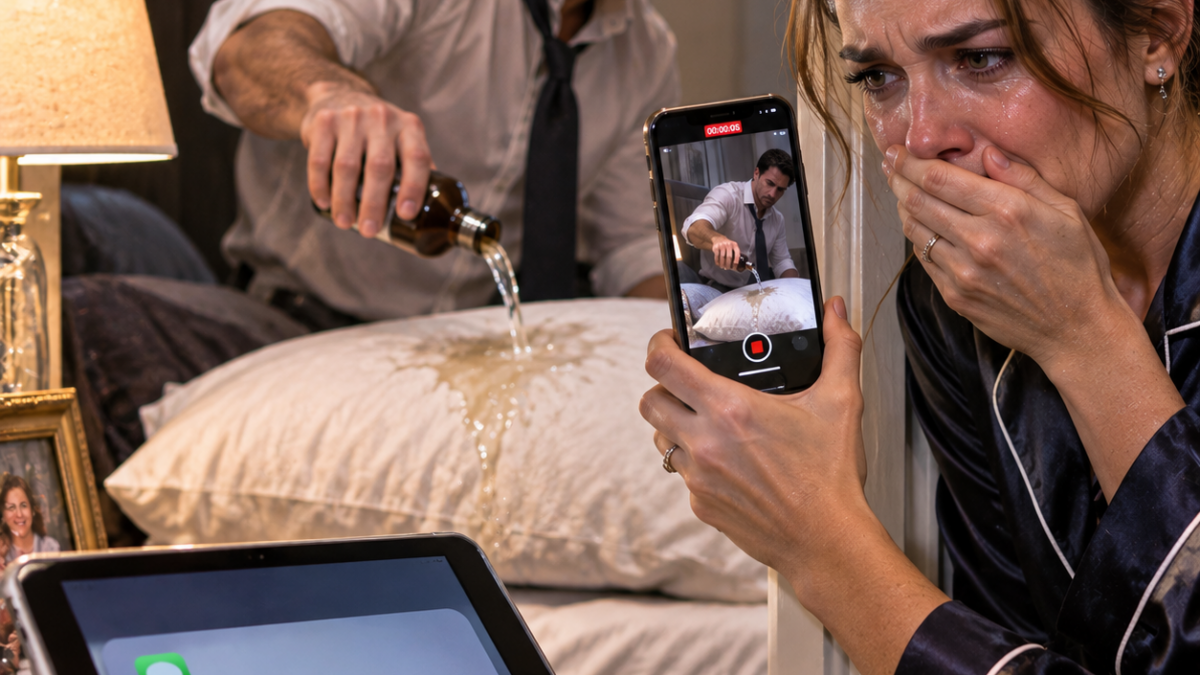
The bedroom video played.
I had watched it dozens of times by then.
Still, seeing Garrett walk toward my pillow on a courtroom screen made my skin crawl.
The prosecutor paused after he applied the liquid.
“What did you do?”
“Nothing.”
“Why?”
“I was hiding downstairs.”
“Did you confront him?”
“No.”
“Why?”
“I was afraid.”
That word was difficult.
I had spent my career being the calm one.
The expert.
The person other executives called when something looked wrong.
But in my own home, I was afraid.
I looked at the jury.
“I didn’t know what he was doing or what was in the bottle.”
Then the text appeared.
Still stuck in meetings, babe. Take care of yourself.
The courtroom remained silent.
Next came the security-access record.
The iPad notifications.
Insurance documents.
Medical evidence.
Banking evidence.
Lakepoint records.
Messages.
No single piece carried the whole case.
That mattered.
Cases built around one shocking thing can collapse if the shocking thing weakens.
This case was accumulation.
Video.
Lie.
Residue.
Bottle.
Symptoms.
Policy.
Signature.
Financial motive.
Messages.
Travel records.
Digital timing.
Each piece supported or challenged another.
My entire professional life had taught me what that meant.
A pattern.
Garrett’s attorney questioned me aggressively.
“You disliked your husband’s business practices before this incident, correct?”
“I had questions.”
“You believed he looked down on your career?”
“Yes.”
“You resented him?”
“Sometimes.”
“You were already suspicious of Ms. Crane?”
“Professionally, occasionally.”
“Personally?”
“No.”
“You want this jury to believe you had no idea your husband was having an affair?”
“I had no idea.”
“So you missed that.”
“Yes.”
“You missed alleged financial misconduct.”
“Yes.”
“You missed an affair.”
“Yes.”
“And we should trust your interpretation of everything else?”
I looked at him.
“No.”
He blinked.
“I’m not asking the jury to trust my interpretation.”
I pointed toward the evidence screen.
“I’m asking them to look at the records.”
That was the best answer I gave in the entire trial.
Because it was true.
My feelings did not make Garrett guilty.
The evidence had to do that work.
Lindsey testified under her agreement.
Garrett would not look at her.
She described the Lakepoint scheme.
The affair.
The insurance discussions.
Then prosecutors asked about “beneficiary.”
She said Garrett told her he had increased coverage on my life because “if everything went bad, at least the debts would disappear.”
She admitted paying a portion of an initial insurance-related expense through a business account at his request, believing it would later be reimbursed.
“Did you ask Dana whether she consented?”
“No.”
“Why not?”
“Garrett said she had.”
“Did you believe him?”
“At first.”
“And later?”
Lindsey began crying.
“No.”
“When did you stop believing him?”
“When she got sick.”
“Did you report your concerns?”
“No.”
“Why?”
She looked toward me.
“Because I was a coward.”
I felt no satisfaction.
Only exhaustion.
The defense attacked her credibility.
Correctly.
She had lied.
Benefited.
Committed crimes.
Accepted a cooperation agreement.
The jury had to weigh that.
But much of what she said was independently supported.
That mattered more than whether anyone liked her.
The medical experts testified carefully.
They explained that my symptoms were consistent with the detected exposure and that the evidence supported repeated contact over time.
They did not claim magical certainty about every headache.
They did not say exactly what Garrett intended on each occasion.
Intention belonged to the jury after considering all evidence.
Then came the insurance examiner.
The policy application.
Electronic audit records.
My purported signatures.
The beneficiary.
Garrett.
$4.5 million.
The examiner confirmed certain application steps had been completed through records that appeared to represent my consent.
I testified that I had not given it.
A forensic specialist explained the irregularities.
The defense suggested I simply forgot signing.
The prosecution showed Garrett’s messages about “confirming” the policy without telling me.
Memory became less persuasive than metadata.
The Lakepoint evidence established a parallel motive.
Garrett faced major financial exposure if the audit proceeded.
My temporary absence would delay recognition of my personal conflict and potentially delay questions inside my firm.
My death would do something more permanent.
The prosecutor never said that casually.
She waited until closing.
Even then:
“You do not have to speculate about every thought inside Garrett Pruitt’s mind.”
She pointed toward the evidence.
“You are asked to determine what he did and what the surrounding facts prove about why.”
Garrett testified.
Against counsel’s apparent preference.
He looked older.
Thinner.
He said the bottle contained a wellness product Lindsey had recommended.
He said he put it on my pillow because he believed aroma might help me sleep.
The prosecutor asked:
“Why gloves?”
“I didn’t want it on my hands.”
“Why not tell your wife?”
“It was supposed to be a surprise.”
“Why tell her you were in Dallas?”
“I was embarrassed.”
“About being home?”
“About cancelling the trip.”
“Why photograph the pillow?”
He paused.
“To show Lindsey.”
“Why?”
“Because she had asked if I used it.”
“Why did you say, ‘It’s done for today. She wasn’t here’?”
Silence.
“Why ‘for today’?”
His explanation became complicated.
Complicated answers are not always lies.
But this one contradicted messages.
Then the insurance.
He claimed I had authorized the policy.
I had forgotten.
He had no reason to forge me.
Four and a half million was “standard planning.”
The prosecutor showed our actual finances.
Mortgage less than $600,000.
No children.
No large joint liabilities remotely approaching the policy amount.
Then:
“Why did Ms. Crane help fund the initial premium?”
“She didn’t.”
Records.
He adjusted.
“It was reimbursement.”
For what?
No consistent answer.
Lakepoint?
He blamed Lindsey.
Lindsey blamed him.
The jury did not need to decide which of them was more morally offensive.
They needed evidence.
After deliberations, Garrett was convicted on multiple counts.
Not every charge.
That matters.
The jury rejected at least one theory the prosecution had advanced.
I respected that.
Justice was not supposed to mean giving me everything.
It meant separating what could be proven from what could not.
When the clerk read the verdicts, I felt almost nothing.
My mother squeezed my hand.
Priya watched me.
“Dana?”
“I’m okay.”
I wasn’t.
But I wasn’t falling apart either.
Garrett turned toward me before deputies led him away.
Our eyes met.
Fourteen years.
Birthdays.
Mortgage closings.
Road trips.
Funerals.
Sunday mornings.
The night we got engaged.
All of it compressed into perhaps two seconds.
He mouthed:
I’m sorry.
I did not respond.
Some apologies arrive after the person no longer controls whether you leave.
They can still be sincere.
They are simply no longer instructions.
Sentencing occurred later.
So did Lindsey’s.
The financial case resulted in restitution orders and asset recovery where legally available.
Lakepoint investors recovered only part of their losses.
That mattered too.
Financial crime does not magically reverse when someone goes to prison.
Money disappears.
Projects collapse.
Employees lose jobs.
Investors absorb losses.
Garrett and Lindsey had treated those numbers like pieces on a spreadsheet.
My job had taught me every number eventually belongs to someone.
The divorce finalized before the criminal case fully ended.
I restored Whitfield as my legal surname.
Not because Dana Pruitt had been fake.
Because I wanted my own name.
I moved into a condo near Lincoln Park.
Two bedrooms.
Large windows.
No indoor security camera.
The first night, I could not sleep.
Not because I feared Garrett.
Because the pillow smelled unfamiliar.
I bought three new pillows before finding one I could tolerate.
My therapist told me that was normal after trauma.
I told her the entire pillow industry was suspicious.
She laughed.
Eventually I did too.
Recovery came in ridiculous forms.
For months, I checked door locks twice.
Then three times.
I refused scented laundry detergent.
I woke with headaches and immediately feared exposure until doctors reminded me headaches could still simply be headaches.
My body had learned that morning discomfort meant danger.
It took time to unlearn.
Helen welcomed me back to work gradually.
The first case she gave me involved nothing remotely connected to real estate.
A manufacturing procurement review.
Thank God.
I stared at invoices for machine components and almost cried with relief.
“Boring enough?” she asked.
“Perfect.”
Six months later, I handled complex fraud again.
The first time I found a hidden related-party vendor, my hands shook.
Not badly.
Enough.
I stepped away.
Breathed.
Returned.
The vendor had nothing to do with Garrett.
I finished the report.
That felt like reclaiming something.
My profession had not betrayed me.
My husband had.
I refused to give him my work too.
My mother stayed in Chicago for three months after the trial.
Eventually I told her to go home.
“You’re evicting me?”
“Yes.”
“I cook.”
“You reorganize my cabinets.”
“They were wrong.”
“They’re my cabinets.”
She sighed dramatically.
“At least wait until spring.”
“No.”
She smiled.
“Good.”
“What?”
“You’re getting bossy again.”
Apparently that was progress.
We packed her suitcase.
At the airport, she hugged me.
Then whispered:
“I’m sorry I didn’t see anything.”
I pulled back.
“Mom.”
“I keep thinking—”
“No.”
She looked at me.
“You don’t get to do that to yourself.”
Her eyes filled.
I finally understood the instinct because I had done it too.
I should have seen.
She should have seen.
Helen should have known.
Someone should have prevented it.
But the person who knew was Garrett.
Responsibility had a correct address.
We needed to stop forwarding the mail.
My mother laughed when I said that.
“Forensic-accountant metaphor?”
“Obviously.”
Years later, that family iPad remained in evidence storage until release became possible.
I was offered its return.
I declined.
The police property clerk asked:
“You’re sure?”
“Yes.”
I did not want it.
People often ask what exactly I found on the iPad that was “worse than anything I imagined.”
The truth is no single message was worse than watching Garrett touch my pillow.
What was worse was the architecture around it.
The insurance policy.
The forged consent.
The financial exposure.
The conversations about my health as if my illness were a project variable.
The lies about Dallas.
Lindsey’s willingness not to ask.
The fact that Garrett could kiss me goodnight and then discuss “handling Dana” in the same week.
The horror was not one secret.
It was realizing my marriage had become an operational problem they were managing.
I had been reduced from wife to obstacle.
That understanding changed me more than the trial.
For a while, I stopped dating entirely.
Not dramatically.
I simply had no interest.
Then at forty-two, I met a man named Michael at a charity finance committee meeting.
Yes.
Romantic.
He was an emergency physician.
We argued about hospital procurement.
He was wrong.
Obviously.
Afterward he asked for coffee.
I said:
“You lost credibility during the ventilator discussion.”
He said:
“I’m willing to appeal.”
We dated slowly.
Very slowly.
The first time he stayed at my condo, he brought his own pillow because he knew I had complicated feelings about sharing bedding space.
That made me laugh.
Then cry.
Poor man stood in the bedroom holding a pillow like evidence.
“Did I do something wrong?”
“No.”
“What do I do?”
“Put the pillow down.”
He did.
“Now?”
“Hug me.”
He did.
I learned trust could be rebuilt without pretending danger had never existed.
Michael never demanded access to my accounts.
I never demanded his passwords.
We discussed money.
Signed documents openly.
Read what we signed.
When we eventually married, we used separate attorneys for the prenup.
That amused everyone.
“Two lawyers?”
“Yes.”
“Do you not trust him?”
I answered:
“That is what transparent agreements are for.”
Trust is not refusing documentation.
Sometimes documentation protects trust by removing ambiguity.
Garrett had taught me that accidentally.
I never thanked him.
Lindsey wrote to me once.
Five years after the trial.
The letter came through Priya.
I almost returned it unopened.
Then read.
Dana,
I have spent years trying to write something that does not ask you to make me feel better.
Good beginning.
I knew Garrett was lying to you long before I knew how far he had gone. I participated in financial crimes because I wanted the money and the life he promised me. I participated in betraying you because I wanted him. When your health began deteriorating, I deliberately did not ask questions because I was afraid of what the answers would require me to do.
I stopped.
Continued later.
That failure is mine.
No request for forgiveness.
No claim she was manipulated into everything.
She acknowledged Garrett manipulated her in some ways and that she still made choices.
At the bottom:
I am sorry for sitting beside you during your mother’s surgery and accepting your friendship while betraying you. There is no explanation that makes that less cruel.
I folded the letter.
Never responded.
I believed she was sorry.
I did not need a relationship with her.
Forgiveness and access are different things.
That lesson had become important.
Garrett wrote several times too.
The first letters blamed stress.
Lindsey.
Debt.
Fear.
Then, years later, one arrived that sounded different.
Dana, I have spent most of my life believing intelligence meant I could explain my way out of accountability.
I almost laughed.
Accurate.
I mocked your work because you could see patterns I needed you not to see.
That sentence stopped me.
I told myself you were suspicious and negative whenever you asked financial questions because making you doubt your judgment was easier than answering honestly.
I read that paragraph three times.
Then:
There is no version of what I did in our home that becomes acceptable because I was afraid of prison, financial ruin, or exposure.
I did not finish the letter that day.
Weeks later.
His last line:
You trusted me because I was your husband. That was not your failure. It was the thing I exploited.
I cried.
Not for him.
For the version of me who had sat in bed while he fluffed the pillow and thought it was tenderness.
That woman deserved someone to tell her trust was not evidence of stupidity.
So I told her.
Quietly.
Out loud.
“You didn’t know.”
It felt ridiculous.
It helped.
Garrett’s conviction became a case study in certain professional circles because of the overlap between financial motive, digital evidence, insurance fraud, and physical evidence.
I never participated in documentaries.
No podcast.
No television interview.
One producer offered a remarkable amount of money.
I said no.
Michael asked:
“Why?”
“Because I spent enough years being something Garrett managed.”
I looked at the contract.
“I don’t want to become content someone else manages.”
Instead, I eventually spoke privately to professional groups about one topic:
Bias in fraud investigations when the suspect is someone you love.
I never taught people to spy on spouses.
Never said everyone should inspect accounts.
I talked about something subtler.
Contempt.
When someone repeatedly mocks your expertise, curiosity, or judgment, pay attention to what the mockery accomplishes.
Garrett’s jokes had trained me not to ask questions in my own home.
Not because asking questions makes a healthy marriage.
Because he specifically benefited from my silence.
That distinction mattered.
One auditor asked me:
“How do you know when something is intuition and when it’s paranoia?”
I answered:
“You don’t convict anyone with intuition.”
The room laughed.
I continued.
“But intuition can tell you where to slow down.”
Then:
“Evidence tells you what happened.”
That principle had saved me from becoming consumed by theories.
The first night, I thought Garrett might be trying to kill me.
Maybe he was.
The prosecution argued intent based on the whole record.
But I did not need to independently decide every unspoken thought he ever had.
I knew what he did.
He lied about his location.
Entered our home secretly.
Applied an unknown substance to my bedding.
Had obtained a large policy on my life using authorization I denied giving.
Participated in serious financial misconduct.
Discussed my illness in incriminating contexts.
And repeatedly changed his explanations.
Those facts were enough for me to leave.
People sometimes wait for absolute certainty before protecting themselves.
I no longer believe certainty is required for distance.
Evidence sufficient for a criminal conviction is one standard.
Evidence sufficient to decide whether you feel safe sleeping beside someone is another.
I learned that the hard way.
Ten years after that Tuesday, I woke with the flu.
Michael was already dressed for work.
He touched my forehead.
“You’re burning up.”
“I’m fine.”
“Of course.”
He handed me water.
“Stay home.”
Then he reached toward my pillow.
My entire body tightened.
He stopped immediately.
Hands visible.
“What?”
I stared at him.
Old fear.
Fast.
Embarrassing.
Michael understood.
“Okay.”
He stepped back.
“I was going to straighten it.”
I breathed.
“I know.”
“Want me to leave it?”
“Yes.”
“Done.”
No hurt feelings.
No accusation that I did not trust him.
No dramatic speech.
He left the pillow exactly where it was.
Then said:
“I’ll text at lunch.”
“Actually from the hospital?”
He smiled.
“I can send geolocation, badge scan, and notarized witness statement.”
“Smartass.”
He kissed my forehead.
At lunch:
Actually stuck at the hospital, sweetheart.
I stared at the message.
Then laughed so hard I started coughing.
He knew what he had done.
A second message:
Too soon?
I replied:
Ten years and still too soon. Bring soup.
He brought soup.
That evening, I lay down on my own pillow.
No fear.
Not because memory disappeared.
Because memory no longer controlled the room.
The old townhouse eventually sold again.
I saw the listing once by accident.
New kitchen.
New floors.
Bedroom repainted.
The bed positioned differently.
I closed the page.
Somebody else lived there.
Good.
Homes should be allowed to become innocent again.
The pillow itself was ultimately destroyed after evidentiary retention ended.
I received paperwork.
Signed release for disposal.
My signature.
My real one.
I stared at the line before signing.
There was strange symmetry in that.
So much of the case began with my name being used without me.
The insurance policy.
Authorizations.
Representations.
Now the final piece required actual consent.
I signed slowly.
Dana Whitfield.
My name.
My hand.
My choice.
Then I mailed the form.
That was the ending I rarely tell people.
Not the verdict.
Not Garrett being led away.
Not Lindsey testifying.
Not the $4.5 million policy.
A disposal authorization.
Boring paperwork.
The thing Garrett always mocked me for caring about.
Paper had recorded his lies.
Metadata had recorded his timing.
Bank records had recorded the money.
Medical records had recorded what happened to my body.
Video had recorded what happened in my bedroom.
And eventually a simple signature recorded that the last physical object tying me to that morning could finally be destroyed because I—not Garrett, not Lindsey, not an insurer—had decided it could be.
Years later, Helen retired.
At her farewell dinner, she stood beside me with wine.
“Remember Trent?”
I laughed.
“The innocent marketing guy?”
“He was guilty.”
“What?”
“Different issue.”
“You never told me.”
“You had bigger problems.”
I shook my head.
“Unbelievable.”
She smiled.
“You know what I remember about that Tuesday?”
“What?”
“You apologized for leaving early.”
I had forgotten.
“You were pale, dizzy, barely standing, and you said, ‘I’m sorry, Helen. I’ll finish the review tonight.’”
My eyes filled.
She continued:
“I wish I’d told you then that you were allowed to be sick without apologizing.”
I hugged her.
Another lesson.
Garrett had made illness useful.
He had encouraged me to feel weak.
Ashamed.
Unavailable.
I spent years afterward relearning that needing care is not a character flaw.
Neither is missing warning signs.
Neither is believing your husband when he says he is in Dallas.
Trust cannot function if every statement requires forensic verification.
The solution to betrayal is not permanent suspicion.
It is better boundaries, better evidence when evidence is needed, and the willingness to leave when reality becomes incompatible with safety.
Sometimes people ask what I would do if I could return to 12:27 p.m. that Tuesday.
Would I confront Garrett?
No.
Would I follow him?
No.
Search his car?
No.
Open every message on the iPad?
No.
I would do exactly what I did.
Stay hidden.
Record.
Preserve.
Leave.
Call for help.
Because the most important discovery that day was not the substance.
Not the beneficiary.
Not Lindsey.
It was the realization that I did not need to solve the entire crime before I was allowed to protect myself.
I only needed to know something was dangerously wrong.
The rest could be investigated by people whose job it was to investigate.
Forensic auditors like certainty.
Marriage teaches faith.
Survival sometimes requires understanding which standard belongs to which moment.
At 12:27, I heard a key.
At 12:49, my supposedly distant husband told me to take care of myself.
For years afterward, that text felt like the cruelest sentence Garrett ever sent.
Eventually, I began reading it differently.
Take care of yourself.
He meant it as camouflage.
I turned it into instruction.
And I did.








