PART2:“STILL SINGLE, AUDREY?” My Sister Smirked at Her Wedding—Then My Husband Walked In and She Dropped Her Champagne
PART2
The first page was titled:
UNANIMOUS MEMBER CONSENT — KESLER FREIGHT PROPERTY HOLDINGS LLC
I read it twice.
Then a third time.
My family had owned commercial property on the edge of Norfolk for thirty years.
Thirty-one acres.
Warehouses.
Loading yards.
An old freight terminal.
Nothing glamorous.
My father built Kesler Freight & Storage from four trucks and a rented warehouse.
When he retired after his heart surgery, the operating business was leased to another logistics company, but the family retained the real estate through Kesler Freight Property Holdings.
The membership structure was simple.
I owned forty percent.
Belle owned thirty.
Mother owned thirty.
My father retained income rights under a separate retirement arrangement but no longer voted.
The operating agreement required seventy-five percent approval to sell, mortgage, or materially encumber the property.
Mother and Belle together controlled sixty.
Meaning they needed me.
I had always assumed that was intentional.
My father did not trust any one branch of the family to control everything.
Apparently my mother and sister had found another solution.
My name appeared beneath theirs.
Audrey Kesler — Member, 40%.
Signature.
My signature.
Except I had never seen the document.
I looked at Tessa.
“Where did you get this?”
“A completion notice hit your old military-transition email.”
I frowned.
“That account still exists?”
“You asked me to keep it forwarding veterans-network messages when you left active service.”
I remembered.
Barely.
“The signature platform copied every listed member after execution.”
She pushed another page toward me.
“Keep reading.”
The consent authorized the family LLC to pledge the entire thirty-one-acre property as collateral supporting financing for:
BELLEROSE RIVER HOUSE DEVELOPMENT LLC
Belle.
Colton.
River House.
Luxury event venue.
Boutique hotel.
Private club.
I remembered Belle talking about it months earlier.
She called it her dream.
I had thought it was a mood board.
Apparently it was an $8.6 million project.
“And this closed?”
“Not yet.”
Tessa pointed.
“This is the authorization packet.”
I read the financing summary.
Senior construction facility.
Bridge funding.
Equity contribution.
Proposed acquisition option.
Lender:
HARBOR COMMONWEALTH BANK
Potential institutional takeout partner:
VALE STRATEGIC HOLDINGS
I looked up.
“Who are they?”
“Big infrastructure and commercial real-estate investment firm.”
“Never heard of them.”
“You don’t read financial press.”
“I barely read regular press.”
Tessa sat beside me.
“Audrey, look at your signature.”
I did.
It was accurate.
Too accurate.
Then I recognized why.
Seven years earlier, while deployed, I had signed a limited power-of-attorney package allowing Mother to handle one specific insurance claim involving storm damage to warehouse number three.
One scanned page contained exactly that signature.
I felt sick.
“They copied it.”
“Looks that way.”
“Does Dad know?”
“I don’t know.”
“Why would they do this now?”
Tessa tapped the wedding-development proposal.
“Because they need your forty percent to get past the operating-agreement threshold.”
I stared at Belle’s name.
Then Colton’s.
My ex-fiancé.
Twenty-one days earlier, he had been planning to marry me.
Now he was financing a business with my sister using property I partly owned.
I wanted to call them.
Tessa stopped me.
“No.”
I looked at her.
“You don’t get to order me around anymore.”
“Correct.”
She pushed the food toward me.
“But I strongly recommend you eat before committing a felony.”
Despite everything, I laughed.
Then cried.
Tessa sat beside me until I stopped.
The next morning, I called attorney Claire Monroe.
Commercial litigation.
Real estate.
Former Army JAG.
Tessa knew her through a veterans’ business network.
Claire’s first question:
“Did you sign it?”
“No.”
“Did you authorize anyone to sign it?”
“No.”
“Current power of attorney?”
“No.”
“Contacted family?”
“No.”
“Good.”
That last word surprised me.
“Why good?”
“Because right now, we have documents.”
She folded her hands.
“Not an argument.”
That became the first principle of the next year.
Documents before confrontation.
Claire sent preservation notices.
Not accusations.
She notified the title company that my consent was disputed.
She requested the original signature audit from the electronic platform.
The financing process stopped.
Temporarily.
Three days later, Mother called.
Not to apologize for Colton.
Not to ask whether I was eating.
“Did you interfere with the property financing?”
I looked out my apartment window.
“How would I do that?”
“Audrey.”
“What?”
“Belle’s project has deadlines.”
“Then Belle should meet them.”
“Your father’s business property is sitting there doing nothing.”
“It produces lease income.”
“You know what I mean.”
I waited.
Mother finally said:
“We need to develop it.”
“Who is we?”
Silence.
Then:
“This family.”
“Does this family include me?”
“Of course.”
“Interesting.”
“Audrey, don’t start.”
I ended the call.
That afternoon, Claire received the signature-platform audit.
My “signature” had not been applied through my account.
It had been uploaded as an image file.
The IP address traced to a device connected with the family office.
Not proof of exactly who inserted it.
Enough to stop closing.
Harbor Commonwealth froze the loan.
The title insurer refused to issue coverage over the property until ownership consent was resolved.
Vale Strategic Holdings paused its due diligence.
Belle called fourteen times.
I answered none.
Colton sent:
WE NEED TO TALK LIKE ADULTS.
I deleted nothing.
Saved everything.
My father finally called on day six.
His voice sounded tired.
“Audrey.”
“Dad.”
“What is happening?”
That told me enough.
“You didn’t know?”
“Know what?”
My chest hurt.
I told him.
Not everything.
Just the consent.
The property pledge.
My disputed signature.
For a long time, my father said nothing.
Then:
“Your mother told me you had agreed.”
“I didn’t.”
“She said you wanted out.”
“I never said that.”
“She said Belle was buying your share.”
“No.”
My father inhaled slowly.
His doctors had warned him against stress.
For once, I cared more about truth.
“I’m sorry.”
He said:
“Don’t apologize.”
Then:
“I need to call my lawyer.”
Mother called twenty minutes later.
Furious.
“What did you say to your father?”
“The truth.”
“You upset him.”
“No.”
“You always do this.”
I closed my eyes.
There it was.
The same pattern.
Belle betrayed me.
My reaction fractured the family.
Someone signed my name.
My discovery upset my father.
Everyone’s action somehow became my consequence.
“Mom.”
“What?”
“Did you authorize my signature on that consent?”
Silence.
“Audrey, this is complicated.”
That was an answer.
“Did you?”
“We were trying to protect an opportunity.”
“Did you?”
“Belle and Colton had already spent nearly half a million dollars on planning.”
“Did you sign my name?”
“No.”
First direct answer.
“Did you authorize someone to upload my signature?”
Another silence.
Then:
“You had made it impossible to talk to you.”
I wrote that sentence down.
My military habit.
Exact language matters.
“You mean after Belle slept with my fiancé?”
“She didn’t force him.”
I felt my jaw tighten.
“I’m ending this call.”
“Audrey, if this deal collapses, your sister could lose everything.”
I almost laughed.
“She should have considered that before pledging something she doesn’t own.”
“You own forty percent.”
“Yes.”
“Forty.”
I went still.
There it was again.
As though my share were morally smaller because it was not all of it.
“The agreement requires seventy-five.”
“You’re being technical.”
“Property ownership is technical.”
“Audrey—”
I disconnected.
The financing collapsed two weeks later.
Not permanently.
But the closing date vanished.
Harbor Commonwealth wanted clean authorization.
The title company wanted a legal resolution.
Vale Strategic Holdings withdrew its preliminary interest.
That name appeared repeatedly in the correspondence.
Vale.
Still meant nothing to me.
My emotional life, however, had become very small.
Work.
Gym.
Tessa.
Attorney.
Sleep badly.
Repeat.
I had spent twelve years moving equipment and personnel through military systems.
After leaving active duty, I ran logistics planning for a regional medical-supply company.
I was competent.
Respected.
Calm.
At home, I felt like someone had reached into my chest and disconnected all the wiring.
The man I almost married had chosen my sister.
My mother had chosen the new couple.
And now they had tried to use my ownership interest because apparently even after removing me from their emotional lives, they still expected access to my signature.
That was what hurt.
Not Colton.
By then Colton disgusted me more than he broke my heart.
The family did.
Six weeks later, my company sent me to a supply-chain resilience conference in Washington.
I almost declined.
Tessa made me go.
“You need a hotel room where nobody in your family knows the number.”
“Compelling professional development.”
“Exactly.”
I gave a panel presentation on emergency medical distribution after infrastructure failure.
Afterward, a man approached.
Mid-forties.
Dark suit.
No tie.
Gray beginning at his temples.
“Your point about redundancy being useless if every backup relies on the same road was good.”
I looked at him.
“That sounds suspiciously like you stayed awake.”
“Mostly.”
He held out his hand.
“Adrian.”
“Audrey.”
No last names.
That was refreshing.
We talked twenty minutes.
Then forty.
He understood logistics.
Not theoretically.
He asked about cold-chain failures.
Port congestion.
Rail substitution.
He had the irritating habit of listening to the answer instead of waiting to speak.
Eventually Tessa appeared.
She looked at him.
Then at me.
Then at him again.
Her expression changed.
Adrian noticed.
“Have we met?”
Tessa recovered.
“No.”
She shook his hand.
“Tessa Whitlock.”
“Adrian Vale.”
I turned.
Vale.
He looked at me.
“You know the name?”
“Possibly.”
Tessa coughed.
I ignored her.
“Vale Strategic Holdings?”
“Yes.”
Wonderful.
Of all the men in Washington.
I stepped backward.
Adrian’s face changed.
“Is there a problem?”
“Yes.”
Tessa said:
“Potentially.”
I told him.
Not details.
Enough.
My family’s property.
Disputed consent.
Bellero se River House.
His company had been reviewing the takeout financing.
Adrian’s expression became immediately professional.
“I was not personally running that diligence.”
“Okay.”
“But my firm was involved.”
“Yes.”
“I need to disclose this conversation.”
“Of course.”
“And I should probably leave.”
That should have been the end.
Instead, he paused.
“I was going to ask if you wanted coffee.”
I surprised myself.
“So was I.”
He smiled.
“Bad timing.”
“Catastrophic.”
He left.
The next morning, an email came from Vale Strategic’s general counsel confirming Adrian had disclosed our social interaction and removed himself from any internal discussion involving Bellero se River House or Kesler property.
Formal.
Clean.
Appropriate.
I respected that.
Three days later, Adrian sent one message from his personal address.
When the conflict no longer exists, I’d still like that coffee.
I did not answer for two weeks.
Then:
Coffee is not a financing transaction.
He replied:
My counsel would be relieved to hear that.
Our first date lasted four hours.
He did not ask about Belle.
I did not ask how rich he was.
He told me he had been married before.
Widowed six years earlier.
His wife, Elena, had died from ovarian cancer.
No children.
He had spent several years turning work into anesthesia.
“I got very efficient.”
“At grieving?”
“At not doing it.”
I understood that better than I wanted to.
We moved slowly.
Painfully slowly, according to Tessa.
Three months before I let him meet my parents.
Five before I called him my boyfriend.
Seven before he spent the night.
He never pressured.
The first time we disagreed, I braced automatically.
He noticed.
“What?”
“Nothing.”
“You look like you’re waiting for me to become someone else.”
That embarrassed me.
“I’m fine.”
“No, you’re not.”
I almost snapped.
Then he said:
“We can stop this conversation.”
I stared.
“What?”
“We don’t have to resolve everything tonight.”
That should not have felt revolutionary.
It did.
Meanwhile, my family continued its legal and financial chaos.
The forensic review found my uploaded signature had been attached to three documents.
The LLC consent.
A lender certification.
A member representation stating no internal ownership dispute existed.
Claire filed suit seeking declaratory relief that the purported authorization was invalid.
We requested no ridiculous damages.
Just:
Void the unauthorized consent.
Confirm my ownership.
Prevent encumbrance without the required approval.
Recover reasonable legal costs as permitted.
The judge issued temporary restrictions while the matter proceeded.
Belle responded publicly.
Not naming me.
But everyone knew.
She posted:
Some people would rather sabotage family dreams than heal their own bitterness.
I screenshotted it.
Did not reply.
Colton posted:
You learn who people are when money enters the room.
Tessa sent me:
He cheated on you with your sister and is subtweeting your moral character. I require permission to commit a misdemeanor.
I replied:
Denied.
My father stopped speaking to Mother for almost a month.
They remained married.
Barely.
He called me frequently.
“Audrey.”
“Yes?”
“I’m sorry.”
“You didn’t sign it.”
“I let your mother run the family company because I didn’t want conflict.”
I understood.
“You were sick.”
“I was also comfortable.”
That honesty mattered.
“I knew she favored Belle.”
I went still.
Dad continued.
“I told myself you didn’t need protecting.”
My eyes filled.
“Because you were strong.”
I laughed bitterly.
“I’m getting tired of that word.”
“I know.”
He paused.
“Strong children get neglected in quiet ways.”
I cried after that call.
Not because he fixed anything.
Because somebody in my family finally named it.
Belle had always been the emergency.
Bad grades.
Breakups.
Debt.
Career changes.
Emotional crises.
I was reliable.
I joined the Army.
Paid my bills.
Remembered birthdays.
Called home.
So resources flowed toward Belle because Audrey would be fine.
Eventually, fairness itself began looking cruel whenever it disappointed Belle.
That pattern reached its absurd conclusion when she took my fiancé and Mother told me to manage my feelings so Belle could move forward comfortably.
Then the property.
My forty percent was simply one more thing the family expected the “strong daughter” not to make difficult.
Nine months after I caught Belle with Colton, the disputed property case moved toward settlement.
My mother finally sat across from me in Claire’s conference room.
No Belle.
No Colton.
Just Mother.
Me.
Lawyers.
She looked older.
“Audrey.”
I said nothing.
“I did authorize the use of the scanned signature.”
There it was.
Claire did not react.
Neither did I.
Mother continued.
“I believed you would approve once you saw the project.”
“You had asked me?”
“No.”
“Then how did you know?”
She looked away.
“We needed to keep the financing timeline.”
“So you signed first and planned to ask later.”
“Yes.”
“Why?”
“Because Belle had already committed money.”
“Not my problem.”
“I know that now.”
“No.”
My voice remained quiet.
“You know the deal failed.”
She looked at me.
“That is not the same as understanding why it was wrong.”
Mother’s eyes filled.
“What do you want me to say?”
“That my no would have mattered.”
Silence.
“If you had asked, and I had said no, would you have accepted it?”
She could not answer.
That was the answer.
Settlement came two weeks later.
The disputed authorizations were formally withdrawn and declared ineffective.
My forty-percent interest remained intact.
Mother and Belle agreed to cover a substantial portion of the legal expenses attributable to the unauthorized documents.
Any future property transaction required clean member approval under the operating agreement.
No shortcuts.
No uploaded signatures.
The development project was not dead.
Just no longer entitled to my land.
Belle hated me for that.
Colton hated me more.
They found another property.
Smaller.
More expensive.
They raised money from different sources.
The project became a luxury event venue called Bellero se House.
And then, because life occasionally has an indecent sense of humor, they decided to get married there.
Exactly one year after the night I caught them.
My invitation arrived in a cream envelope.
I stared at it.
Tessa said:
“You’re not going.”
“I might.”
“Why?”
“I don’t know.”
“Self-harm?”
“Possibly.”
Adrian saw the invitation later.
“Do you want to attend?”
I looked at him.
“I think I want to prove I can.”
“To them?”
“No.”
I thought.
“To myself.”
He nodded.
“Then go.”
“Come with me.”
He hesitated.
Not because he disliked the idea.
Because Vale Strategic had once been connected to their financing attempt.
“I don’t want my presence to look like a business threat.”
“You’re not involved anymore.”
“No.”
“Your firm withdrew a year ago.”
“Yes.”
“Independent teams handled it.”
“Yes.”
“Then?”
He smiled.
“Then I’d like to meet the people with such terrible judgment in men.”
I threw a pillow at him.
Two months before Belle’s wedding, Adrian proposed.
No restaurant.
No photographer.
No hidden crowd.
We were in my kitchen.
I had burned salmon.
He was opening windows.
Then he said:
“I have a question.”
I looked at the smoke.
“About fire safety?”
“More expensive.”
He took out a ring.
I stared.
“No.”
His face went white.
Then I realized how that sounded.
“No, no, I mean—”
He started laughing.
“You are terrible at proposals.”
“You’re the one asking while my kitchen is on fire.”
“Is that a yes?”
I looked at him.
This man who had never asked me to shrink.
Never made my competence a threat.
Never used money as authority.
Never treated my family story as entertainment.
“Yes.”
We married privately three weeks before Belle.
Civil ceremony.
Tessa.
My father.
Adrian’s sister.
Eight people.
Mother was not invited.
That decision hurt.
It was also mine.
I did not post photographs.
Neither did Adrian.
Belle had no idea.
Neither did Colton.
We kept our lives private because private things had begun to feel sacred.
On Belle’s wedding day, Adrian had to attend an emergency board session in New York that morning.
I told him not to race back.
“I can go alone.”
“I know.”
“I’ve done harder things.”
“I know.”
“You don’t need to make an entrance.”
He smiled.
“That sounds dangerously like permission to make an entrance.”
“Adrian.”
“I’ll behave.”
I arrived alone.
The venue was spectacular.
Stone terraces.
River views.
White roses.
Hundreds of candles.
Belle had turned the wedding into exactly what she always wanted.
A production.
Mother saw me first.
Her face changed.
“You came.”
“I was invited.”
She looked at my left hand.
My wedding ring was turned inward against my palm.
Old field habit.
Protect rings around equipment.
She did not notice.
Dad hugged me.
Longer than usual.
“You okay?”
“Yes.”
He nodded.
No pressure.
Colton saw me near the ceremony lawn.
For one strange second, I felt nothing.
He looked exactly like himself.
That was disappointing.
I had once imagined betrayal would physically transform him into a villain.
It did not.
Same smile.
Same hair.
Same way of adjusting his cuff links.
He approached.
“Audrey.”
“Colton.”
“You look good.”
“So do you.”
He seemed confused that I was polite.
“I’m glad you came.”
“I’m glad Dad wanted me here.”
That ended that.
The ceremony passed.
Belle cried.
Colton cried.
Mother cried enough for three families.
I felt occasional pain.
Not longing.
Memory.
There is a difference.
At the reception, I stood near the ballroom terrace with sparkling water.
Belle approached.
Wedding gown.
Champagne.
Triumph.
“You’re being very quiet.”
“It’s your wedding.”
“I’m surprised you came.”
“So am I.”
She leaned closer.
Then smiled.
“Still single, Audrey?”
There it was.
One year.
All the lawyers.
All the property disputes.
Everything she had done.
And she still needed to win the original competition.
“I guess some women just aren’t built to keep a man.”
I looked at her.
No anger.
Almost curiosity.
How empty did victory have to feel if she still needed me to lose?
I could have shown her my ring.
Could have said something cruel.
Instead:
“Congratulations, Belle.”
Her smile faltered.
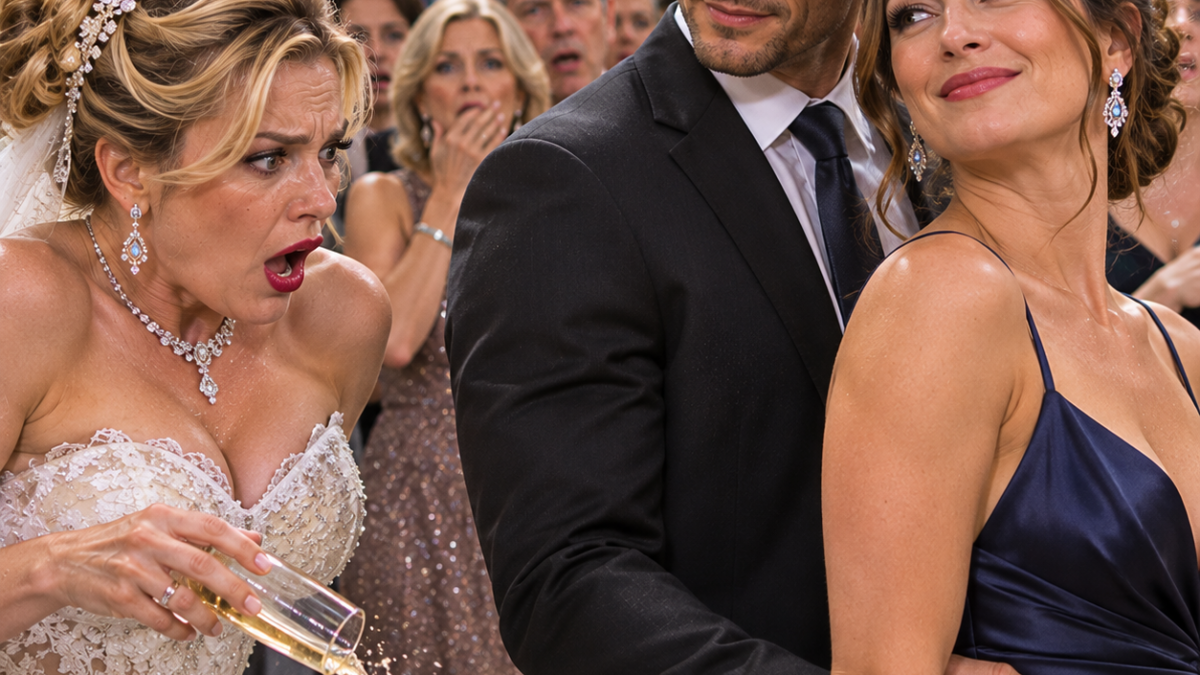
That was when an arm slid gently around my waist.
Cedar.
Familiar warmth.
Adrian kissed my forehead.
“Sorry I’m late, sweetheart.”
Belle turned.
The champagne flute fell.
Crystal hit marble.
Shattered.
People looked over.
Belle did not move.
All the color left her face.
Colton approached.
“What happened?”
Then he saw Adrian.
His expression changed too.
Not as dramatically.
But enough.
Mother followed.
“Belle?”
Belle whispered:
“Adrian Vale.”
My husband extended his hand.
“Belle.”
She stared at it.
He withdrew it.
Colton said:
“Mr. Vale.”
“Colton.”
Mother looked between them.
“You know each other?”
Belle’s eyes snapped to me.
“You married him?”
I smiled slightly.
“Yes.”
“When?”
“Three weeks ago.”
“You—”
She stopped.
Then looked at Adrian.
Vale Strategic Holdings had not merely been a name in their old financing package.
After the Kesler property deal collapsed, Belle and Colton had spent months trying to bring Vale back into a revised version of Bellero se House.
Adrian had never personally handled it.
But he was the chairman.
His name was on investor materials.
Business profiles.
Conference interviews.
Belle had sent letters to his office.
Colton had attended two presentations where Adrian spoke.
They knew exactly who he was.
And they knew Vale Strategic had rejected their project after due diligence raised concerns about governance history and disputed prior authorizations.
Belle whispered:
“You knew.”
I understood immediately.
“You think Adrian told me something confidential.”
“Didn’t he?”
Adrian answered before I could.
“No.”
His voice was calm.
“I was formally recused from every matter involving your project once Audrey and I began seeing each other.”
Belle stared.
“My company’s decision regarding Bellero se was made by an independent investment committee.”
Colton looked toward me.
“So this is why you fought us.”
I actually laughed.
“No.”
“You married the man who killed our financing.”
Adrian’s expression hardened slightly.
“I did not kill your financing.”
Colton went quiet.
“My firm declined an investment.”
Then Adrian added:
“Those are not the same thing.”
Belle looked humiliated.
Around us, conversation had slowed.
People were watching.
I hated that.
“Adrian.”
He looked at me.
“Dance?”
His face softened.
“Absolutely.”
We walked away.
That was the entire confrontation.
No announcement.
No microphone.
No public exposure.
Nothing burned down in the ballroom.
Belle’s horror came from something smaller and more painful.
She finally understood that the person she had spent a year imagining as abandoned had built an entire life she knew nothing about.
And the man beside me was somebody she had been trying desperately to impress for months.
We danced.
I looked over Adrian’s shoulder.
Belle was arguing quietly with Colton.
Mother stood between them.
Some patterns survive every venue.
“You okay?” Adrian asked.
“Yes.”
“Really?”
I thought.
“Yes.”
Then smiled.
“I am.”
After the dance, Dad approached.
He had tears in his eyes.
“You married him without telling your mother.”
“Yes.”
He nodded.
“Good.”
I laughed.
“Dad.”
“I love your mother.”
He looked across the room.
“But consequences are educational.”
That may have been the most rebellious sentence George Kesler ever spoke.
The wedding continued.
No police.
No dramatic arrest.
No lender arrived with foreclosure papers.
That was not how real consequences worked.
They came Monday.
Bellero se House had been operating on expensive bridge debt while seeking long-term institutional capital.
Vale had declined.
Two other firms had concerns about the prior title controversy.
Another required additional guarantees Belle and Colton could not provide.
Their wedding had been partially financed from business marketing funds and personal credit.
Within four months, cash flow became a problem.
I did not cause that.
Adrian did not cause that.
Bad leverage did.
Their venue was beautiful.
It also cost far more to operate than projections assumed.
Colton blamed Belle for overspending.
Belle blamed Colton for weak financial management.
Mother put more money in.
Dad refused.
That created another fracture.
One evening Mother came to my apartment.
Adrian was traveling.
I almost did not let her in.
Then did.
She sat at my kitchen table.
The same kitchen where Adrian had proposed.
Mother looked around.
“This is nice.”
“Thank you.”
“You could afford something larger.”
I smiled.
“Still you.”
She looked down.
Then:
“I came to apologize.”
I waited.
“For the documents.”
“You already settled that.”
“I apologized legally.”
Interesting phrase.
“I didn’t apologize as your mother.”
Silence.
“I used your signature because I believed your sister needed the project.”
“Yes.”
“And because I thought you would survive being angry.”
My throat tightened.
Mother’s eyes filled.
“I have done that your whole life.”
I said nothing.
“When Belle needed something, I looked at you and thought Audrey will understand.”
A tear ran down her cheek.
“When Belle failed, Audrey will cope.”
Another.
“When Belle cried, Audrey is stronger.”
I stared at the table.
“And when Belle slept with Colton…”
Mother stopped.
I looked up.
She forced herself to continue.
“I knew what she had done.”
“Yes.”
“But I looked at you.”
Her voice broke.
“And I thought you would survive it better than she would survive being condemned.”
That sentence reached somewhere the affair never could.
“So you protected her.”
“Yes.”
“From what?”
“Shame.”
“And gave it to me.”
Mother covered her mouth.
For several seconds, neither of us spoke.
Then:
“I am sorry.”
I believed her.
Believing did not erase anything.
“I needed you that night.”
“I know.”
“No.”
I looked at her.
“I don’t think you do.”
She lowered her hand.
“I didn’t need you to choose me because I was right.”
My voice shook.
“I needed you to care that I was hurt.”
Mother cried quietly.
“I know now.”
I nodded.
That was enough for one evening.
Forgiveness came slowly.
Not in a dramatic embrace.
Phone calls.
Coffee.
Boundaries.
She stopped talking to me about Belle’s financial problems.
That was important.
The first time she said:
“That is between Belle and me.”
I nearly congratulated her.
Dad improved too.
His health stabilized.
He began attending family-company meetings again.
He insisted the operating agreement be revised.
Any material property action required direct identity verification from each voting member.
No uploaded signature images.
No proxies except transaction-specific ones reviewed independently.
We made governance boring.
Boring was wonderful.
Eventually, the thirty-one-acre Kesler property received another offer.
Not from Vale.
Adrian insisted on complete separation.
An independent regional industrial developer offered $18.4 million.
Real money.
Clean transaction.
I voted yes.
So did Mother.
Belle initially resisted because she wanted the property for future expansion.
Dad asked:
“Can you finance the purchase yourself?”
She could not.
The sale passed properly.
No forged signatures.
No manipulation.
My forty-percent share went into investments and a small logistics-consulting company I started with Tessa.
We called it Whitlock Kesler Resilience.
Tessa insisted her name first because:
“I brought the takeout.”
Fair.
The company advised hospitals and regional governments on emergency supply planning.
Work I understood.
Work that felt useful.
Adrian never invested.
People assumed he did.
He refused.
“You need one thing in your life nobody can claim I gave you.”
I loved him for that.
He did, however, buy terrible office coffee for the first six months.
We nearly divorced over that.
Belle and Colton lasted twenty-two months.
I learned through Dad.
Not Mother.
Progress.
Their marriage did not end because I married Adrian.
It ended for the reason relationships often end.
The problems present before the wedding survived the flowers.
Colton had betrayed one fiancée.
Belle had betrayed one sister.
Neither trusted the other.
Belle monitored his phone.
Colton resented her spending.
She accused him of flirting with clients.
He accused her of caring more about appearances than solvency.
Eventually they separated.
Bellero se House was sold during restructuring.
The buyer kept it as an event venue.
Belle lost control.
But not everything.
She remained financially comfortable.
She rebuilt her career in design consulting.
Colton moved to Atlanta.
No one was destroyed.
I preferred it that way.
I did not need ruins.
I needed boundaries.
Belle called me after the divorce.
First time in nearly three years.
“Audrey.”
I recognized her voice instantly.
“Belle.”
“Can we talk?”
“We are.”
She laughed weakly.
“Still literal.”
“Still.”
Silence.
Then:
“I owe you an apology.”
I almost ended the call.
Not because I did not want one.
Because I had imagined it too many times.
“Go ahead.”
She breathed.
“I slept with Colton because he was yours.”
My eyes closed.
Exactly what I had said.
“I told myself it was chemistry.”
Her voice shook.
“It wasn’t.”
“Then what?”
“You.”
I waited.
“You were always the one who did everything right.”
I almost laughed.
“That is not remotely true.”
“To me it was.”
“You went into the Army.”
“You had a career.”
“Dad trusted you.”
“Mom relied on you.”
“People respected you.”
Her voice cracked.
“And I always felt like the mess standing next to you.”
“Belle.”
“I know that wasn’t your fault.”
Good.
“At first Colton flirted with me.”
I felt nothing hearing that now.
“And I liked knowing something you had could want me instead.”
There it was.
Ugly.
Human.
“So you slept with him.”
“Yes.”
“You married him.”
“I thought if he chose me permanently, it proved something.”
“What?”
“That I had won.”
I looked around my office.
Tessa arguing with a printer through the glass wall.
My own name on the door.
“What did you win?”
Belle started crying.
“Nothing.”
I did not comfort her.
That would have been dishonest.
Then:
“I am sorry.”
“For Colton?”
“For all of it.”
She mentioned the signature.
The property.
The wedding taunt.
Everything.
“I saw Adrian and I thought you had planned it to humiliate me.”
“I didn’t.”
“I know.”
“Do you?”
“Yes.”
She paused.
“That was the worst part.”
“What?”
“You had stopped competing.”
I leaned back.
“I was never competing.”
“I know now.”
That may have been the saddest sentence in our relationship.
Belle had spent decades fighting a contest only she could see.
“Do you forgive me?” she asked.
I thought carefully.
“Some of it.”
Silence.
“That’s not very satisfying.”
“It’s true.”
She laughed through tears.
“Fair.”
We did not become close.
Not immediately.
Maybe never in the way sisters are supposed to be.
But birthdays became possible.
Then Christmas.
Then occasional coffee.
Trust returned in teaspoons.
Adrian never pushed.
He remained polite to Belle.
Nothing more.
One Christmas, years later, we were all at Dad’s house.
Belle arrived early.
Helped Mother cook.
I arrived with Adrian.
For the first time, nobody measured who had the better dress.
Marriage.
Career.
Car.
Nothing.
At dinner, Dad raised a glass.
“To surviving this family.”
Mother glared.
Belle laughed.
I laughed harder.
Adrian whispered:
“I finally understand why you were good in logistics.”
“Why?”
“Hostile environment.”
I kicked him under the table.
Later that evening, Belle found me alone near the porch.
“You happy?”
“Yes.”
“Really?”
“Yes.”
She nodded.
“I’m glad.”
No poison.
No challenge.
Just glad.
That mattered.
I asked:
“You?”
She thought.
“Getting there.”
Good answer.
My marriage to Adrian remained intentionally ordinary.
That disappointed people who heard the dramatic wedding story.
They expected private jets.
Boardrooms.
Billionaire revenge.
Adrian did have money.
A great deal more than I did when we met.
But wealth was one of the least interesting things about him.
He loaded the dishwasher badly.
He hated cilantro.
He read biographies in bed.
He cried every year on Elena’s birthday.
He respected my first husband? No. Colton had only been my fiancé, and Adrian never mocked me for loving him.
That mattered.
He understood that betrayal does not prove the original love was stupid.
It proves the betrayer eventually became unworthy of it.
On our fifth anniversary, Adrian asked whether I regretted attending Belle’s wedding.
“No.”
“Not even the champagne?”
“That part was expensive.”
“Her face was extraordinary.”
“Adrian.”
“What?”
“You promised you weren’t enjoying it.”
“I promised I behaved.”
Fair distinction.
Then he became serious.
“Why are you glad you went?”
I thought.
“Because I saw Colton.”
“And?”
“I felt nothing.”
That had been the real surprise.
Not Adrian arriving.
Not Belle dropping glass.
Colton had once occupied so much of my imagined future.
Then I saw him on his wedding day and realized he no longer occupied any part of me.
That was freedom.
Adrian smiled.
“Good.”
Then:
“I was terrified walking into that ballroom.”
I stared.
“You?”
“Yes.”
“Why?”
“I knew exactly how it looked.”
“What?”
“Rich chairman enters dramatically and rescues betrayed woman.”
I laughed.
“That is exactly how it looked.”
“I hated it.”
“Why?”
“Because you did not need rescuing.”
My smile faded.
He continued.
“You had already handled the property.”
“Your life.”
“Your family.”
“Everything.”
He touched my hand.
“I was just late to a wedding.”
That may be why I loved him.
He never tried to become the explanation for my survival.
Years after the original betrayal, I found the manila envelope Tessa had brought to my apartment.
The forged consent.
Old copy.
Marked by lawyers.
DISPUTED
WITHDRAWN
VOID
I held it for a while.
Then took it to the office.
Tessa looked up.
“What is that?”
“History.”
She opened it.
“Oh.”
“Want it?”
“Why would I want your family fraud archive?”
“Sentimental value.”
“You’re deranged.”
We shredded the duplicate.
The official records remained with counsel.
I watched the pages disappear.
My fake signature.
Belle’s development dream.
Colton’s financing scheme.
All reduced to strips.
Tessa said:
“Feel better?”
“No.”
“Disappointing.”
“I feel nothing.”
She smiled.
“That might be better.”
She was right.
The document no longer had power because the outcome had been corrected.
My name belonged to me again.
That was the recurring theme of those years.
Colton had treated my commitment as something he could discard.
Belle had treated my relationship as something she could win.
Mother had treated my resilience as permission to sacrifice me.
Then they treated my signature as one more family resource.
Every time, the answer was the same.
No.
My love is not yours to reassign.
My dignity is not yours to spend.
My ownership is not yours to pledge.
My signature is not yours to borrow.
My strength is not proof that hurting me costs nothing.
That last lesson took my family longest.
It took me almost as long.
Strong people still need defending.
Competent people still feel betrayal.
The daughter who does not create emergencies still deserves a mother who asks if she is okay.
The sister who can survive humiliation is not obligated to make humiliation convenient for everyone else.
I learned that.
So did Mother.
Slowly.
On Dad’s eightieth birthday, she pulled me aside.
“You know what I regret most?”
I thought she meant the signature.
“No.”
“That night.”
I knew which.
“I saw you standing outside Belle’s room.”
Her eyes filled.
“And I knew immediately what she had done.”
I said nothing.
“I looked at your face.”
She swallowed.
“You looked like someone had died.”
That was accurate.
“And I still thought first about keeping the house calm.”
My throat tightened.
“Because of Dad.”
“That was the excuse.”
She looked toward the living room where my father was loudly cheating at cards.
“The truth is I was afraid if I acknowledged how wrong Belle was, the family would split.”
“So you asked me to absorb it.”
“Yes.”
She took my hand.
“I sacrificed the person least likely to explode.”
That sentence was painfully precise.
“I’m sorry.”
I squeezed her fingers.
This time:
“I forgive you.”
Mother cried.
So did I.
Forgiveness felt different when it arrived after years of changed behavior.
Not demanded.
Earned.
Belle’s forgiveness remained partial.
That was okay.
Our relationship became something new.
Not the childhood version.
Not the rivalry she had imagined.
Adults with history.
We respected distance.
Sometimes distance is healthy architecture.
Colton disappeared from my life entirely.
I saw one photograph years later.
Mutual acquaintance.
He had remarried.
Woman I did not know.
They looked happy.
I hoped they were.
That surprised me.
I no longer needed his unhappiness to validate what he did to me.
The betrayal was wrong even if his life later became wonderful.
My pain did not require his permanent punishment.
That understanding felt like another door opening.
Belle once asked:
“How can you not hate him?”
I answered:
“I don’t want to rent space in my life to someone who stopped paying years ago.”
She laughed.
Then wrote it down.
“Are you stealing that?”
“Yes.”
Typical Belle.
Adrian and I eventually moved to a smaller house near the Chesapeake.
Not a mansion.
A cedar-sided home overlooking a narrow stretch of water.
Tessa said:
“Your husband could buy the entire shoreline.”
I said:
“I only want one porch.”
Correct.
On summer evenings, Adrian and I sat outside.
Some nights we talked.
Some nights nothing.
The quiet never felt like punishment.
That mattered more than I can explain.
One anniversary, he came outside holding two champagne glasses.
I stared.
“What?”
“You know I hate champagne.”
“It’s sparkling cider.”
“Why glasses?”
He smiled.
“For historical comedy.”
I groaned.
He handed me one.
“To Belle’s excellent grip strength.”
“Stop.”
“To marble floors.”
“Adrian.”
“To arriving late.”
I laughed.
Then we touched glasses.
No shattering.
He looked at me.
“Still single, Audrey?”
I nearly spit out the cider.
“You have been waiting years to say that.”
“Absolutely.”
I kissed him.
Then:
“Not currently.”
“Good.”
We sat under the porch lights.
Water dark beyond the rail.
No ballroom.
No audience.
No competition.
And I thought about the woman I had been at 12:43 that rainy morning.
Standing outside Belle’s bedroom.
Watching Colton pull on his jeans.
Listening to my mother ask me not to make a scene.
I wish I could tell her one thing.
Not:
You will marry someone richer.
Not:
Belle’s business will struggle.
Not:
The forged documents will collapse.
Not even:
Your family will eventually apologize.
I would tell her:
You do not need them to understand your worth before you protect it.
That was the lesson beneath everything.
When I walked out into the storm, I thought I had lost my future.
I had actually lost a version of the future built around people who expected me to disappear whenever my needs became inconvenient.
The year that followed was painful.
Legal bills.
Therapy.
Loneliness.
Awkward holidays.
Family silence.
A relationship I was terrified to trust.
Nothing about rebuilding was easy.
But it was mine.
And by the time I stood in Belle’s ballroom one year later, I no longer needed revenge.
That was why I said nothing when she asked if I was still single.
I did not need to beat her with an answer.
My life had already answered.
Then Adrian walked in late.
He kissed my forehead.
Belle dropped her champagne.
And for a moment, everyone thought that was the twist.
It wasn’t.
The twist was that Adrian Vale was not the reason I had won.
There had never been anything to win.
He did not restore my name to the property records.
My lawyers and the evidence did.
He did not give me a career.
I had one.
He did not repair my relationship with my father.
Truth did.
He did not force my mother to confront favoritism.
Consequences did.
He did not make Belle apologize.
Time and failure and self-awareness eventually did that.
He simply loved the woman who emerged after all of it.
A woman who finally understood that being chosen by a man was never proof of value.
Colton choosing Belle did not make her better than me.
Adrian choosing me did not make me better than Belle.
The people we love are not trophies.
Relationships are not scoreboards.
And sisters should never have been opponents in the first place.
Belle had needed years to learn that.
I had needed years to stop participating in the contest by defending myself against it.
That night on our porch, Adrian eventually went inside.
I stayed.
The water moved quietly.
I turned my wedding ring once around my finger.
Not inward.
Not hidden.
Just there.
Mine.
Then my phone buzzed.
Belle.
A photograph.
Her new apartment.
Small.
Bright.
A half-finished painting leaning against the wall.
Underneath:
Bought my own place. No man involved. Try not to faint.
I laughed.
Then wrote:
Proud of you.
Three dots appeared.
Don’t get sentimental.
I replied:
Too late.
I looked out over the water again.
There are betrayals that destroy relationships.
There are others that destroy illusions.
Losing Colton destroyed both.
But once the wreckage cleared, I found something I had never really owned before.
The right to define my own life without asking whether Belle felt threatened by it, whether Mother found it convenient, or whether a man intended to stay.
And that was why, years later, when people told the story of Belle’s wedding, they always focused on the sound of that champagne glass breaking.
I remembered something else.
The quiet after.
Belle staring at Adrian.
Colton frozen.
Mother confused.
And me standing in the middle of the ballroom without the slightest need to explain myself.
For the first time in my family, my silence was not surrender.
It was peace.








