PART2:“START PACKING, YOU FILTHY COWBOY!” HOA Karen Secretly Sold My Family’s 60-Acre Ranch for $1.2 Million—She Never Expected the Real Owner to Walk Into Her Closing Meeting
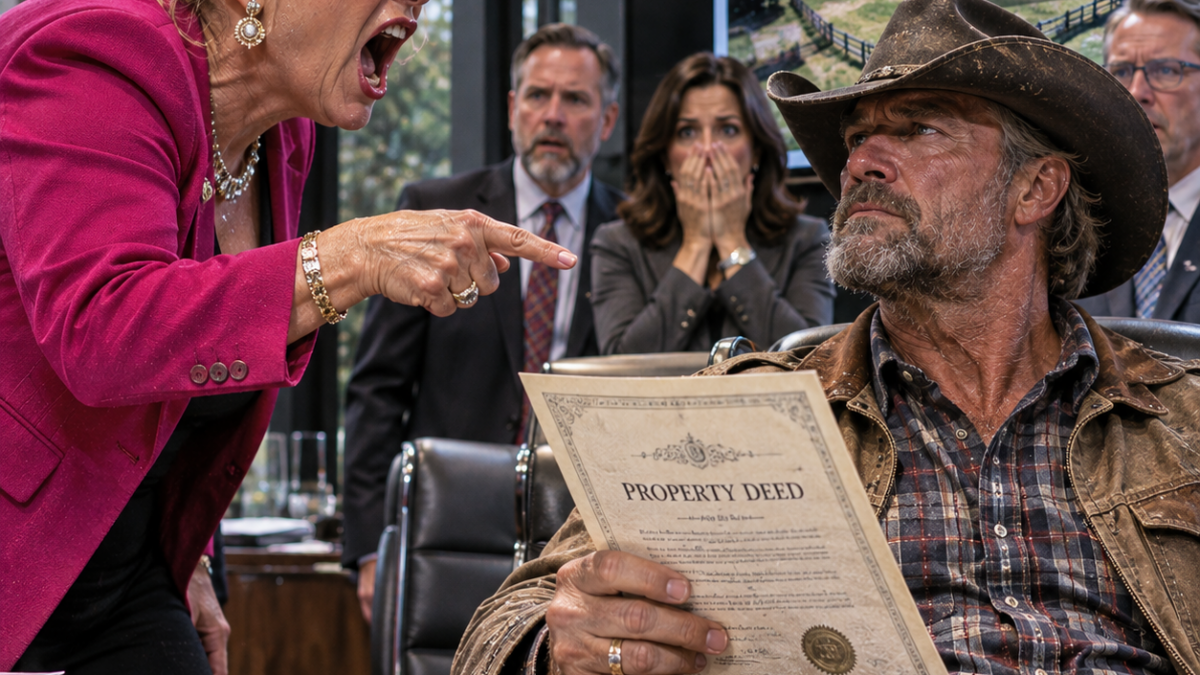
My grandfather bought the ranch in 1962, back when the road leading to it wasn’t much more than two tire tracks cut through mesquite and prairie grass.
He was thirty-four years old.
My grandmother was pregnant with their second child.
And everybody they knew told him sixty acres of stubborn Texas dirt was a foolish investment.
Granddad didn’t listen.
He built a small farmhouse, dug a well, raised cattle, and planted pecan trees along the creek.
When my father was old enough, he helped put up the first real fencing.
In 1978, they built the barn.
I was a boy then, barely tall enough to carry a full bucket without sloshing half the water down my jeans.
I remember standing beside Granddad while he set the main corner post.
He placed my little hand against the rough cedar.
“Kent, you see this?”
I nodded.
“This land won’t always make you rich. Some years it’ll barely feed you. But if you care for it, it’ll always give you somewhere to stand.”
I hadn’t thought much about those words when I was twelve.
At fifty-five, I understood every syllable.
The ranch wasn’t some romantic hobby.
It was work.
Hard work.
There were mornings when the water lines froze, afternoons when the temperature climbed above a hundred degrees, and nights when sick calves needed attention long after everyone else had gone to bed.
There were veterinary bills, equipment repairs, droughts, storms, and years when the price of cattle made me question every decision I’d ever made.
But there was also the porch.
That old wooden porch facing east.
Every morning I sat there with black coffee and watched the sun come up over land that had belonged to the Morrisons longer than I had been alive.
Sometimes I thought about my father.
Sometimes about my divorce eight years earlier.
Sometimes about my daughter, Ellie, who had grown up racing through those pastures and now lived in Austin.
She was twenty-six, sharp as a tack, and worked in a job that required more computer knowledge than I could pretend to understand.
She called every Sunday.
Without fail.
“Dad, are you eating actual vegetables?”
“Potatoes count.”
“French fries don’t count.”
“That sounds like discrimination.”
She would laugh, and somehow the house would feel less empty afterward.
Ellie loved the ranch.
But she had built a life of her own, and I was proud of her for it.
I never expected her to come home and spend every morning repairing fences.
I just wanted her to know that the place where three generations of her family had lived would still be standing whenever she wanted to visit.
For most of my life, that seemed like a reasonable thing to expect.
Then Ridgeline Estates appeared.
A developer bought three hundred acres immediately east of my property.
Within months, the bulldozers came.
The first time I heard them, I thought somebody had driven heavy machinery onto my ranch.
I walked to the eastern fence and stood watching a yellow excavator rip through the brush where deer had been crossing for decades.
I wasn’t happy about losing that view.
But the developer owned his land.
I owned mine.
That was how property rights worked.
At least, that was how I thought they worked.
The development grew quickly.
Forty-five expensive homes.
Paved streets.
Decorative streetlights.
Perfectly landscaped entrances.
A stone monument reading RIDGELINE ESTATES.
The houses sold for hundreds of thousands of dollars each, and the residents formed a homeowners association that seemed determined to control everything from mailbox colors to holiday decorations.
None of that interested me.
My ranch wasn’t part of the development.
I hadn’t sold an inch to the developer.
I hadn’t signed any covenants.
And nobody had asked me to join an HOA.
For a while, the arrangement worked.
Then Gail Prescott moved into the largest house overlooking my eastern pasture.
I met her on a Saturday morning while repairing a section of fence.
She approached from the subdivision side wearing white pants and sunglasses large enough to cover half her face.
“Are you the property owner?”
“That’s me.”
She looked over my shoulder at the cattle.
“How unfortunate.”
I remember thinking I must have misheard her.
“Ma’am?”
“Your animals. They’re terribly close to our homes.”
“They’re inside my fence.”
“That’s not what I meant.”
She gestured toward the pasture.
“Do you intend to keep them?”
I actually laughed.
“Well, yes, ma’am. It’s a cattle ranch.”
Her mouth tightened.
“Some of us paid a considerable amount of money for our homes.”
“Congratulations.”
“We expect a certain standard of living.”
I leaned against the fence.
“And I expect my cows to keep eating grass.”
That was our first conversation.
I should have known then that Gail Prescott wasn’t the kind of woman who accepted a boundary simply because a fence and a deed said it existed.
Over the following years, she became president of the Ridgeline Estates HOA.
Three terms.
Not because everybody loved her.
From what I later learned, most residents simply didn’t want to challenge her.
Gail had a talent for making ordinary disagreements feel like personal warfare.
She fined people over mailbox paint.
She threatened homeowners over driveway stains.
She once demanded that a family remove Christmas lights because the colors weren’t on the approved holiday palette.
Her husband, Lloyd, rarely appeared at neighborhood meetings.
I came to understand why.
Gail treated the HOA as her private kingdom.
And my ranch was the one piece of land she couldn’t control.
At least, not legally.
The first official notice arrived on a warm Tuesday in April.
I found a white envelope attached to my front gate.
The letterhead read:
RIDGELINE ESTATES HOMEOWNERS ASSOCIATION.
NOTICE OF NONCOMPLIANCE.
The alleged violation concerned my barn.
According to the letter, my agricultural equipment storage structure violated community aesthetic standards.
The proposed fine was $250 per day until the violation was corrected.
I read the notice twice.
Then I looked at my barn.
The same barn my father and grandfather had built in 1978.
The same barn that had stood there decades before the first Ridgeline house existed.
I called the telephone number printed on the letter.
No answer.
I left a message.
Nobody returned it.
So I placed the notice in my kitchen drawer and went back to work.
That was a mistake.
Not because the HOA had legitimate authority over my barn.
It didn’t.
But because I failed to understand what Gail was building.
She wasn’t trying to make me paint a barn.
She was manufacturing a history of alleged noncompliance.
A month later, another envelope appeared.
This time, my perimeter fencing supposedly violated community appearance standards.
Fine: $150 per day.
Then came a notice accusing me of maintaining a biological waste hazard because my cattle produced manure.
Fine: $300 per day.
Then my hay trailer became an unregistered vehicle stored on a prohibited structure.
Fine: $200 per day.
Every letter was more ridiculous than the last.
And every letter carried an increasingly large balance.
By the time the fifth notice arrived, the HOA claimed I owed $18,200.
Eighteen thousand two hundred dollars.
For operating a cattle ranch on agricultural land.
I remember sitting at my kitchen table with the letters spread out in front of me.
The refrigerator hummed.
A fly buzzed against the screen door.
Outside, my tractor sat exactly where it had sat the day before.
Everything looked normal.
But somewhere beyond my eastern fence, a woman was creating documents that claimed my normal life was an offense punishable by thousands of dollars.
I finally drove to the HOA office.
It was located inside a converted model home near the subdivision entrance.
The landscaping was immaculate.
The waiting room smelled like artificial lavender.
Behind the front desk sat a woman named Denise Callaway.
She looked exhausted.
Not physically sick.
Just worn down in the particular way people look when they’ve spent years being blamed for decisions they didn’t make.
“Can I help you?”
“I’m Kent Morrison. I own the ranch next door.”
Her face changed immediately.
“Oh.”
That single word told me she’d heard my name before.
I placed the notices on her desk.
“Your association keeps sending me these.”
Denise glanced toward a closed office door.
“Yes, sir. I’m aware.”
“I’m not a member of your HOA.”
She swallowed.
“Mr. Morrison, your parcel is listed on our master boundary map.”
I stared at her.
“Since when?”
She didn’t answer.
Instead, she turned her computer monitor slightly away, opened a drawer, and removed a printed map.
“Mrs. Prescott instructed me to use this version.”
She slid it toward me.
My ranch was outlined in red.
All sixty acres.
Inside a boundary that included Ridgeline Estates.
I stared at the map until the lines seemed to blur.
“That’s wrong.”
Denise lowered her voice.
“I only process the paperwork, Mr. Morrison.”
“Who made this map?”
“I don’t know.”
“Who approved it?”
She looked down.
“Mrs. Prescott handles board filings.”
I touched the red outline with one finger.
“Lady, my grandfather bought that property before this subdivision existed.”
“I understand.”
“No, I don’t think you do.”
She flinched.
I immediately regretted my tone.
Denise wasn’t the woman threatening my ranch.
She was the person sitting behind a desk trying to survive someone else’s decisions.
I gathered the notices.
“Tell Gail I want this corrected.”
Denise nodded.
But as I reached the door, she spoke again.
“Mr. Morrison?”
I turned.
She hesitated.
“Keep copies of everything.”
I looked at her.
Something in her expression made me stop.
“Why?”
She glanced toward the closed office.
Then back at me.
“Just please keep everything.”
I left with the uncomfortable feeling that Denise knew much more than she was willing to say.
That evening, I pulled my father’s old document box from the closet.
Inside were deeds, tax receipts, surveys, insurance papers, and photographs going back decades.
I found the original deed.
I found the survey.
I found records of property taxes paid year after year.
I found no HOA declaration affecting my ranch.
No membership agreement.
No restrictive covenant.
Nothing giving Gail Prescott control over so much as a fence post.
For the first time, I seriously considered hiring a lawyer.
Then I looked at my checkbook.
A replacement tractor part had cost me nearly three thousand dollars that spring.
Feed prices were climbing.
One of my cows had needed expensive veterinary treatment.
And I couldn’t stomach spending hundreds of dollars an hour to prove something I already knew.
So I wrote Gail a letter.
Four sentences.
I stated that my property was not part of Ridgeline Estates, that I disputed the fines, and that I demanded the association stop asserting authority over my land.
I mailed it certified.
Kept the receipt.
And waited.
Two weeks later, Denise called.
Her voice was barely above a whisper.
“Mr. Morrison, I thought you should know Mrs. Prescott received your letter.”
“Good. What did she say?”
There was a pause.
“She laughed.”
I said nothing.
“She said you were wasting your time.”
“Anything else?”
Denise hesitated.
“She said a handwritten letter wouldn’t stop a board resolution.”
I looked across the kitchen toward the pasture.
“Was there a board resolution?”
Another pause.
“I’m sorry, Mr. Morrison. I can’t discuss internal records.”
The call ended.
I sat there for a long time.
Then I folded the certified-mail receipt and placed it with the other documents.
I still didn’t understand the full danger.
That understanding arrived in another envelope.
This one came by certified mail.
And unlike Gail’s previous notices, it identified an actual filing in the county property records.
A lien had been recorded against my ranch.
The amount was $18,200.
The claimant was Ridgeline Estates Homeowners Association.
And the paperwork bore Gail Prescott’s signature.
I read it standing beside my mailbox.
Then I read it again.
The wind rattled the gate behind me.
A pickup passed on the road.
Somewhere, a mockingbird kept singing.
I remember thinking that the world had no business continuing so normally when something this wrong had just happened.
A lien wasn’t merely a nasty letter.
It could interfere with selling, refinancing, or otherwise transferring property.
Even a legally invalid claim could create a problem until somebody challenged it.
Gail had escalated from threatening me to placing a cloud over my title.
I called Ellie that night.
She answered on the second ring.
“Hey, Dad. Everything okay?”
“Your favorite HOA president filed a lien against the ranch.”
Silence.
Then:
“She did what?”
I explained.
Ellie listened without interrupting.
When I finished, she said, “Dad, you need an attorney.”
“I need that woman to leave me alone.”
“You need somebody who knows how to make her leave you alone.”
“I can’t afford a legal war.”
“You can’t afford to lose the ranch either.”
That hit harder than I wanted to admit.
I stared at the old photograph hanging above my kitchen table.
Granddad standing beside the barn.
My father beside him.
Me as a little boy holding a bucket.
“I know, sweetheart.”
“Promise me you’ll get help.”
“I’ll look into it.”
“Dad.”
“I said I’ll look into it.”
She sighed.
We changed the subject.
But after we hung up, I sat in the dark for a long time.
I had spent most of my adult life believing that being right and having proof were enough.
Now I was beginning to understand that somebody could make a terrible mess of your life before the truth ever caught up.
And Gail Prescott wasn’t finished.
Three weeks after the lien appeared, a white sedan stopped outside my gate.
A man climbed out wearing sunglasses, pressed khakis, and a polo shirt embroidered with the Ridgeline Estates logo.
He carried a clipboard.
I was beginning to hate clipboards.
“Mr. Morrison?” he called.
“Depends who’s asking.”
“Brent Holloway. HOA compliance officer.”
“Congratulations.”
He didn’t smile.
“I’m conducting an exterior assessment of the property.”
“You’re conducting what?”
“An exterior assessment.”
He lifted a camera and began photographing my barn.
Then my tractor.
Then the water trough.
Then the cattle chute.
I walked toward the gate.
“Did I invite you to do that?”
“Mrs. Prescott authorized the inspection.”
“Mrs. Prescott doesn’t own this road, and she doesn’t own my ranch.”
Brent kept photographing.
I pointed toward the road sign.
“That’s a private ranch access road.”
He lowered his camera.
“I’m acting under association authority.”
“Then you and your association need to figure out where that authority ends.”
For the first time, Brent looked uncertain.
He glanced at his clipboard.
“I’ll note that you refused to cooperate.”
“Be sure to spell my name right.”
He climbed into his sedan and drove away.
Two weeks later, Gail sent another notice.
This one classified my property as an abandoned agricultural nuisance.
I nearly dropped the letter.
Abandoned?
I was standing in the kitchen of the house where I lived.
My truck sat outside.
My cattle were grazing.
I had repaired a section of fence that very morning.
And Gail Prescott had decided, apparently, that my ranch was abandoned.
The notice cited a newly adopted HOA bylaw and threatened further remediation measures.
Then came the animal-control complaint.
An officer named Dale called and informed me that somebody had reported cattle roaming through residential streets, creating unsanitary conditions, and posing a danger to the neighborhood.
I looked through my kitchen window.
All thirty-five animals were exactly where they belonged.
Inside my fenced pastures.
“Officer, did the complainant send photographs?”
“Not that I can see.”
“Did they give you the address where my cattle were supposedly roaming?”
He read from his computer.
Then sighed.
“Mr. Morrison, I think it’d be best if you came down here with whatever records you have.”
So I did.
I brought photographs of my fencing, veterinary records, livestock registration information, and the county agricultural zoning records.
Dale was a tired-looking man in his fifties who seemed thoroughly unimpressed by dramatic neighborhood complaints.
He spread my photographs across his desk.
“These animals yours?”
“Every one.”
“Where are they kept?”
“On my sixty acres.”
“Any public roads crossing the pasture?”
“No.”
“Any escaped cattle recently?”
“No.”
He examined the complaint again.
“Well, this says they’re running loose through Ridgeline Estates.”
“Officer, if thirty-five head of cattle had wandered through that subdivision, somebody would’ve taken pictures.”
He almost smiled.
Then he opened a county map.
“Your property is agricultural.”
“Has been since before I was born.”
He studied the parcel boundaries.
“The complainant identified this as HOA-controlled residential property.”
“That’s what they’re trying to claim.”
Dale rubbed his forehead.
He asked a few more questions, reviewed the records, and told me the available evidence didn’t support the allegation.
He closed the complaint as unfounded, subject to any genuinely new information.
I thanked him.
Then I drove home more frightened than I wanted to admit.
Until that day, Gail’s campaign had mostly meant paperwork.
Now she was involving government offices.
She was trying to make people who had never met me believe I was irresponsible, dangerous, and unfit to care for my own animals.
And if she could convince the wrong person, the damage might come before I ever had a chance to explain.
That evening I walked through the pasture checking the fences.
My old Hereford cow, Daisy, followed me along the wire.
She had a white face and one crooked horn.
She had been born on this ranch.
I scratched her forehead.
“Apparently you’re a menace to society.”
She blinked.
“Try to behave yourself.”
She lowered her head and went back to eating.
For the first time in months, I laughed.
Then the laughter faded.
I stood beside that fence and realized how completely Gail had invaded my life.
I wasn’t just worrying about taxes and feed and weather anymore.
I was watching vehicles on the road.
Saving letters.
Photographing gates.
Wondering whether every unfamiliar engine belonged to somebody Gail had sent.
I couldn’t continue living like that.
The next morning, I went to the county clerk’s office.
That’s where I met Ruth Coleman.
Ruth was in her sixties, with silver hair, reading glasses on a chain, and a coffee mug that said NOT MY FIRST RODEO.
She listened while I explained the situation.
Then she pulled up my parcel record.
She examined the deed.
The lien.
The boundary documents.
Her expression grew serious.
“Mr. Morrison, your original deed doesn’t show an association covenant affecting this property.”
“That’s because there isn’t one.”
She turned the monitor slightly.
“I can see that an amended map was recorded, but recording a document doesn’t automatically establish that every claim in it is legally valid.”
That was the first sensible thing anybody in an official building had told me in months.
“Can you take the lien off?”
She shook her head.
“I’m afraid I can’t simply remove a recorded instrument because the owner disputes it. That’s something you’ll need to address through the appropriate legal process.”
I felt my shoulders sag.
“But there are records you should obtain, and there may be a way to document your dispute in the public record, depending on the filing requirements.”
She explained what her office could and couldn’t do.
She helped me identify the recorded instruments and showed me how to request certified copies.
I asked about placing a notice in the record stating that I disputed the association’s claim.
Ruth made it clear that such a notice wouldn’t itself cancel the lien or stop a sale.
But documenting the dispute and notifying the people involved could help establish that I had challenged the claims.
I requested the records, followed her instructions for submitting a written dispute, and kept the stamped copies.
Before I left, Ruth looked at me over her glasses.
“Mr. Morrison, you really should speak with a property attorney.”
“Everybody keeps telling me that.”
“There’s a reason.”
She tapped the file.
“This is too important to handle with handwritten letters.”
I knew she was right.
But pride is a stubborn thing.
So is fear.
Especially the fear of spending money you don’t have to save something you already own.
I told myself I would call an attorney if Gail sent one more notice.
Then something strange happened.
The notices stopped.
No envelopes on the gate.
No compliance officers.
No animal-control complaints.
Nothing.
For five peaceful weeks, the ranch returned to normal.
I fixed a broken hinge on the barn.
I repaired the old hay trailer.
I spent an afternoon clearing branches along the creek.
The cattle gained weight.
The weather turned warmer.
And I started wondering whether Gail had finally realized her mistake.
Maybe the county records had made somebody nervous.
Maybe a board member had challenged her.
Maybe she had simply moved on to tormenting someone about their mailbox.
I should have known better.
Gail Prescott didn’t abandon a fight because she was wrong.
She went quiet when she thought she was winning.
The truth arrived on a Sunday afternoon.
Ellie called at 3:17.
I remember the exact time because I was sitting at the kitchen table trying to repair a broken flashlight.
“Dad?”
Something in her voice made me put down the screwdriver.
“What’s wrong?”
“Are you selling the ranch?”
I frowned.
“What?”
“Are you selling the ranch?”
“Of course not.”
She didn’t answer immediately.
“Ellie?”
“Dad, I’m looking at a real estate listing.”
“For what?”
“Your property.”
I sat up straighter.
“Say that again.”
“Sixty acres. The barn. Your house. The east pasture. It’s on Zillow.”
My mouth went dry.
She continued.
“It’s listed for one point two million dollars.”
For several seconds, I couldn’t speak.
Then I managed, “That’s impossible.”
“I wish it was.”
She read the description.
An agricultural parcel presented as suitable for residential development.
Existing structures included.
HOA remediation sale.
Title issues supposedly pending resolution.
I felt physically sick.
“Who’s the agent?”
“Wade Sutton. Sutton Realty Group.”
“Who’s listed as the seller?”
“The HOA is claiming authority to arrange the sale.”
I stood so quickly that my chair scraped across the kitchen floor.
“Send me everything.”
“I’m already taking screenshots.”
“Everything, Ellie. Every picture. Every word.”
“I know, Dad.”
Then she said something that stopped me.
“The photographs look like somebody took them from outside your gate.”
Brent Holloway.
The man with the camera.
The clipboard.
The so-called compliance assessment.
I remembered every photograph he had taken.
And now those photographs were advertising my home to strangers.
Ellie sent me the link.
I opened my old laptop.
The thing took forever to start.
I sat staring at the screen, willing it to hurry.
When the listing finally loaded, there it was.
My ranch.
My gravel driveway.
My barn.
The pecan trees.
The old farmhouse.
A place filled with sixty-four years of Morrison family memories displayed beside a price tag.
$1,200,000.
I scrolled down.
One photograph showed the barn from the east road.
Another showed the cattle chute.
Another showed the house partially hidden behind the trees.
I recognized the angles.
The photographs were part of the same assessment Brent Holloway had performed without my permission.
The listing had been active for eleven days.
Eleven days.
For eleven days, strangers had apparently been looking at pictures of my home, calculating how many houses might fit on it, and imagining what they would do after I was gone.
I had been repairing fences and feeding cattle while a real estate agent marketed my family’s land.
The most insulting part was the description.
It suggested the property was unoccupied or awaiting remediation, despite the obvious signs of an active ranch.
It described the land’s development potential.
It mentioned clearing existing agricultural improvements.
Existing agricultural improvements.
That was what they called my grandfather’s barn.
I stared at those words for a long time.
Then I opened the photograph of my house.
The porch was visible.
So was the rocking chair my father had repaired for my grandmother.
I suddenly remembered Ellie sitting on that porch at six years old, eating watermelon while juice ran down her elbows.
I remembered teaching her how to tie a rope.
I remembered her standing beside my father at the barn, proudly holding a newborn calf’s bottle.
Those weren’t improvements.
They were pieces of our lives.
And somebody had decided they were obstacles to a profitable development.
I called Wade Sutton the next morning.
His office was in a strip mall between a nail salon and a tax preparer.
The lobby smelled like carpet cleaner.
Wade was in his early forties, with perfectly styled hair and a smile that disappeared the moment I introduced myself.
“I’m Kent Morrison. You have my ranch listed for sale.”
He looked at his computer.
“Yes, Mr. Morrison. I’m aware there’s an ongoing HOA matter involving the property.”
“There is no HOA matter. It’s my land.”
Wade leaned back.
“My client has provided documentation supporting the association’s authority.”
“Who is your client?”
“I’m not discussing confidential client information.”
“Then I’ll tell you something you’re free to discuss. I own that ranch. My name is on the deed. I haven’t signed a listing agreement.”
He folded his hands.
“Mr. Morrison, disputes over title and association enforcement aren’t something I can resolve at this desk.”
“Then take down the listing until you know who has the right to sell it.”
He glanced toward the door.
“I suggest you contact the association’s attorney.”
“Has anybody actually verified that Gail Prescott can sell my land?”
His expression tightened.
“We have documents.”
“That’s not what I asked.”
He stood.
“I think this meeting is over.”
I remained seated.
“Wade, I’m telling you plainly that I have not authorized any sale.”
His face turned red.
“Sir, if you continue making accusations, I may need to involve counsel.”
I got up.
“Good. Maybe your attorney will ask the questions you didn’t.”
I walked out.
That afternoon, I began taking photographs of everything.
The house.
The barn.
The fences.
The cattle.
The working well.
Every sign that this was an occupied, functioning ranch.
Ellie helped me save copies of the listing and the dates on which we had seen it.
I also sent Wade a written notice disputing his authority to advertise or sell the property, copying the brokerage and requesting confirmation that they had received it.
No confirmation came that day.
Instead, Gail Prescott arrived at my gate.
She parked her white SUV in the gravel, stepped out in that expensive blazer, and announced that my ranch had already been sold.
Nineteen days.
That was how long she said I had left.
She mocked my family.
Insulted my cattle.
Called the ranch a dump.
And spoke about bulldozers like they were a gift she was generously arranging for the neighborhood.
That was the confrontation that sent me back to Ruth Coleman’s office.
This time, I didn’t intend to leave with only a few copies and another promise to think about hiring an attorney.
I wanted every document connected to my property.
Every amendment.
Every lien.
Every recorded claim.
Ruth helped identify the relevant filings.
And when she laid the amended association map beside the original Ridgeline Estates master map, I finally saw the shape of Gail’s plan.
The original map excluded my sixty acres.
Clearly.
There was no ambiguity.
My property was outside the subdivision’s boundary.
The amended map, recorded fourteen months earlier, drew my land inside it.
Gail’s signature appeared on the filing.
The document claimed to reflect an authorized association boundary correction.
But the accompanying records did not show the approval that the association’s own governing documents appeared to require.
Ruth couldn’t tell me whether the amendment was legally effective.
That wasn’t her job.
But she could show me what had been recorded.
I stared at the two maps.
Before.
After.
One line shifted.
Sixty acres swallowed.
And suddenly every threatening notice Gail had sent made a terrible kind of sense.
She hadn’t started by fining my barn.
She had started by changing a map.
The fines came afterward.
Then the lien.
Then the nuisance classification.
Then the listing.
Each step depended on the one before it.
I felt cold despite the warm air inside the office.
“Ruth,” I asked, “can somebody really take your land just by drawing it onto a new map?”
She looked at me carefully.
“Recording a map doesn’t make somebody the owner, Mr. Morrison.”
“Then why is she doing this?”
Ruth slowly closed the folder.
“That’s a question for your attorney.”
I called Ellie from the parking lot.
She answered immediately.
“Dad?”
“Find me a lawyer.”
I heard her exhale.
“Okay.”
“A real property lawyer. Somebody who knows this county.”
“Okay, Dad.”
“And Ellie?”
“Yeah?”
“Tell them it’s urgent.”
She didn’t ask why.
She already knew.
Corinne Bradshaw didn’t look like the kind of attorney who spent much time trying to impress people.
She drove a six-year-old sedan.
Wore plain dark suits.
And carried a leather briefcase with one badly scratched corner.
Her office was on the second floor of an old commercial building above a hardware store.
Ellie found her through a friend in Austin who said Corinne had spent years handling property disputes, questionable recorded instruments, and real estate litigation in central Texas.
We met the next morning at a diner off the county road.
I arrived carrying a grocery sack filled with documents.
Corinne arrived carrying a legal pad.
She ordered black coffee.
Then she looked at the sack.
“Mr. Morrison, tell me that’s not your filing system.”
“It’s kept everything important dry for twenty years.”
“That’s not the same thing.”
Ellie smiled for the first time in two days.
I emptied the sack onto the table.
Deed.
Survey.
Tax records.
HOA notices.
Certified-mail receipts.
Lien paperwork.
Copies of the original and amended maps.
The real estate listing.
Photographs.
Everything.
Corinne spread the papers in careful rows.
Then she began reading.
She barely spoke for the next eleven minutes.
I counted.
Not because I was impatient.
Because the silence was killing me.
When she finished, she removed her glasses.
“Kent, has anyone ever asked you to sign an HOA membership agreement?”
“No.”
“Did you grant an easement or development right to Ridgeline Estates?”
“No.”
“Did you sign anything allowing Gail Prescott to act on your behalf?”
“Absolutely not.”
“Have you entered a purchase agreement with anyone?”
“No.”
She tapped the listing.
“And this property is occupied?”
“I live there. Thirty-five cattle live there. I’ve got a tractor that probably counts as a permanent resident.”
She didn’t laugh.
Instead, she looked at Ellie.
“Has your father received any actual court papers authorizing a foreclosure sale?”
“No,” I answered.
“Any court order transferring ownership?”
“No.”
“Any deed signed by him transferring the property?”
“No.”
Corinne leaned forward.
“Then let’s separate two things. Gail may have created documents that make your title difficult to deal with. That is serious. But she hasn’t magically become the owner because she recorded an amendment or claimed a lien.”
I released a breath I hadn’t realized I was holding.
“Can she sell the ranch?”
“She can attempt to arrange a transaction. She cannot convey ownership she doesn’t have merely by claiming HOA authority. A valid transfer needs an actual legal basis.”
“She’s got a closing scheduled.”
“Then we need to make certain nobody can pretend the ownership dispute was hidden.”
Corinne studied the map again.
“Give me three days to investigate. Meanwhile, don’t sign anything Gail gives you. Don’t allow her representatives onto the property. Keep documenting every contact.”
“How much is this going to cost?”
She gave me a number.
I stared at her.
Ellie reached across the table and put her hand on mine.
“Dad.”
I shook my head.
“That’s a lot of money.”
Corinne didn’t soften her expression.
“Kent, you can decide what this ranch is worth to you. I’m not going to make that decision.”
I looked down at my grandfather’s deed.
The paper was yellowed.
The ink had faded slightly.
But the names were still clear.
Walter Morrison.
The man who had believed sixty acres of difficult Texas dirt could be enough to build a future.
“All right,” I said.
Corinne nodded.
“Then we’re going to find out exactly what Mrs. Prescott thinks she’s selling.”
Over the next few days, Corinne did something I should have done months earlier.
She reconstructed the entire paper trail.
Not just the documents Gail had sent me.
The official records.
The original subdivision declaration.
The recorded master map.
The amended map.
The HOA bylaws.
The lien.
The dates.
The signatures.
The supposed authorizations.
She searched for any recorded agreement by which my family might have subjected the ranch to Ridgeline’s restrictions.
She found none.
She obtained copies of the subdivision’s original filings.
My property had not been included.
Then she compared those documents with Gail’s amendment.
The newer map purported to add my entire sixty-acre parcel to the association’s jurisdiction.
But there was no deed from me.
No written consent.
No court judgment.
And no apparent legal basis for imposing an HOA’s covenants on a separately owned ranch simply by changing an exhibit.
The missing approval was another problem.
Ridgeline’s internal rules required a documented board process for amendments of that nature.
The record Gail had submitted showed her signature, but not the required board authorization.
Corinne also investigated the lien.
The HOA claimed the $18,200 represented enforceable violations and penalties.
But it could not establish that my property was subject to its enforcement provisions in the first place.
Corinne explained that even genuine homeowners associations must follow legal requirements when assessing charges and enforcing liens, and that recording an instrument did not guarantee the instrument was enforceable.
“She wanted the county records to give her claims an appearance of legitimacy,” Corinne said.
“Did it work?”
“It worked well enough to frighten you. And apparently well enough to persuade a real estate agent to advertise a property.”
Then she found something stranger.
Supplemental property-tax payments.
For roughly two years, someone had been making small payments toward the tax account associated with my ranch.
A few hundred dollars at a time.
The payment records pointed toward a post-office box associated with Ridgeline Estates.
I stared at the statements.
“Why would she pay taxes on land I own?”
“That’s what I want to know.”
“Could she use those payments to claim the ranch?”
Corinne shook her head.
“Not by themselves. Paying somebody else’s property taxes doesn’t transfer ownership. And Texas adverse-possession law involves much more than mailing checks. You have occupied and operated this ranch continuously.”
“Then why do it?”
“Possibly to create another document trail. Possibly because she misunderstood the law. Possibly because someone advised her badly. I won’t pretend to know her intention until we have evidence.”
She paused.
“But the payments are relevant. They show someone connected to the association was involving itself with your tax account long before you learned about the sale.”
I looked at her.
“How long has she been planning this?”
Corinne didn’t answer immediately.
“Long enough that we should assume there’s more paperwork.”
She was right.
The next development came from Denise Callaway.
Denise telephoned me on a Tuesday morning.
Her voice trembled.
“Mr. Morrison, can you meet me somewhere?”
I was standing beside the cattle chute.
“At the HOA office?”
“No.”
“Where?”
“The grocery store on Route Twelve.”
“Why?”
She whispered, “I can’t talk from work.”
I felt my stomach tighten.
“Denise, has something happened?”
“Please. Can you come?”
I told her I’d be there in twenty minutes.
Then I called Corinne.
She instructed me not to pressure Denise, not to ask her to take documents she wasn’t entitled to possess, and not to promise anything about her employment.
“If she’s willing to speak, I’d rather take her statement properly,” Corinne said.
We met in the grocery store parking lot.
Denise sat inside her old sedan with the engine running.
She had dark circles under her eyes.
When Corinne and I approached, she rolled down the window.
“Thank you for coming.”
Corinne introduced herself.
Denise glanced around.
“I can’t lose my job.”
“Then we need to be careful,” Corinne replied. “But if you have firsthand knowledge of what happened, you can tell us what you personally saw.”
Denise gripped the steering wheel.
“I’ve been processing Gail’s paperwork for three years.”
I waited.
“She tells me what notices to send. What penalties to enter. What letters to prepare.”
“Did you know my land wasn’t in the HOA?”
Her eyes filled with tears.
“I knew the original map didn’t include it.”
The words hit me harder than I expected.
“You knew?”
She nodded.
“Then why did you keep sending the notices?”
“I have two children, Mr. Morrison.”
Her voice cracked.
“My husband left three years ago. This job pays the rent. Gail told me that if I questioned board decisions, she’d replace me with somebody who understood how to follow instructions.”
I stared at her.
Part of me wanted to shout.
This woman had known something was wrong while I spent months wondering whether my ranch could be taken from me.
But another part of me saw how frightened she was.
And I remembered how Gail spoke to people she believed had less power.
“Did the board approve the map?” Corinne asked.
Denise shook her head.
“Not at any meeting I attended or prepared minutes for.”
“The fines?”
“No vote that I recorded.”
“The lien?”
“Gail instructed me to process the paperwork. She said the board’s authorization was already handled.”
“Did you see that authorization?”
“No.”
Denise pulled a tissue from her purse.
“She told me the ranch was an embarrassment to the neighborhood. She said Mr. Morrison was too stubborn to accept that the area had changed.”
I felt heat rise in my face.
“Did she say she wanted my land?”
Denise looked at me.
“She said something worse.”
“What?”
“She said you were a problem that could be solved if the property changed hands.”
For a moment, nobody spoke.
Cars rolled through the parking lot.
A shopping cart rattled against a concrete curb.
Somewhere behind us, a child laughed.
And Denise continued.
“I heard her talking about a developer. She said the association could use the money for improvements and that everyone would thank her when the cattle were gone.”
Corinne asked whether Denise would be willing to provide a formal statement and identify records already available through lawful channels.
Denise hesitated.
Then nodded.
“I should’ve spoken up sooner.”
I looked at her.
“Yes,” I said quietly. “You should have.”
She started crying.
I waited until she could look at me again.
“But you’re speaking now.”
Corinne helped arrange a sworn statement.
Denise described the directives she had personally received, the meetings she had attended, and the absence of recorded board approval in the materials she managed.
She also identified an association file containing the listing agreement Gail had signed with Wade Sutton.
Through counsel, that document became part of the evidence we obtained.
There it was.
Gail Prescott.
President, Ridgeline Estates Homeowners Association.
Authorized representative for remediation sale.
Her signature was bold and confident.
But Corinne could find no accompanying power of attorney from me, no judicial authorization permitting such a sale, and no valid document showing the association had acquired title to my ranch.
“She signed as though her job title gave her ownership rights,” Corinne said.
I stared at Gail’s signature.
“That’s exactly how she acts.”
Denise wasn’t our only unexpected ally.
Harris Underwood was a retired contractor in his sixties and one of Ridgeline’s five HOA board members.
I’d seen him a few times near the entrance.
Broad shoulders.
Gray beard.
Work boots that had actually touched dirt.
He had joined the board because he thought he could help maintain the neighborhood common areas.
When Corinne showed him the map amendment, his expression changed.
“Where did this come from?”
“The county records.”
He examined the signature page.
“Gail told us she was correcting a boundary discrepancy.”
“What kind of discrepancy?” Corinne asked.
“Something about a fence line between subdivision lots.”
He looked up.
“Not a sixty-acre ranch.”
“Did the board vote to annex Mr. Morrison’s property?”
“No.”
“Did you authorize fines against him?”
“No.”
“The lien?”
He pushed the papers away.
“Absolutely not.”
His face turned red.
“She told us the rancher next door was causing complaints. I thought she was talking about asking him to improve a shared fence.”
I watched him struggle with the implications.
“Mr. Underwood,” I said, “she’s trying to sell my home.”
He looked at me.
Then down at the documents.
“That’s what this is?”
“Yes.”
He leaned back.
“Good Lord.”
Corinne asked whether he would review the association’s meeting records and provide a statement limited to what he knew.
He agreed.
When he returned with copies of the relevant minutes, there was no recorded vote authorizing Gail to add my ranch to the association.
No vote authorizing the $18,200 lien.
No vote authorizing the alleged remediation sale.
He signed an affidavit confirming his own lack of participation or approval, along with what the records he had reviewed showed.
Then he looked at me.
“Kent, I owe you an apology.”
“You didn’t send the notices.”
“I sat on that board. I should’ve asked more questions.”
I could have argued.
Instead, I nodded.
“Well, you’re asking them now.”
Harris folded his hands.
“If she’s doing this to you, we need to find out what else she’s done.”
For the first time since the lien arrived, I didn’t feel completely alone.
But we still had a problem.
The closing was approaching.
And Gail was moving forward.
Corinne explained our options.
We could seek emergency court protection, demand removal of the listing, pursue relief concerning the lien, and notify the title company and prospective buyer of the ownership dispute.
Some steps had already begun.
She had contacted the relevant parties in writing and was preparing the filings necessary to protect my title if the transaction continued.
The disputed ownership was now documented.
No legitimate title company could safely ignore that information.
But Corinne believed Gail might still appear at a scheduled signing and continue presenting herself as the authorized seller.
“If she does,” Corinne said, “we can make sure her assertions are confronted with the actual records.”
I looked at her.
“You mean go to the closing?”
“If it remains scheduled, yes. But we won’t gamble your ranch on a surprise. The title company will receive the necessary notice and documents in advance.”
That distinction mattered.
We weren’t trying to let a fraudulent sale become effective just so Gail could be embarrassed in public.
We were protecting the land first.
Then, if Gail insisted on walking into that conference room and claiming she had authority, she would have to explain herself.
I thought about her smile in my driveway.
The way she’d called my grandfather dead and irrelevant.
The way she’d promised bulldozers.
For months, she’d controlled every encounter.
She chose the notices.
The deadlines.
The accusations.
The threats.
Now she would have to face documents she hadn’t written herself.
And she would have to do it in front of the people she’d convinced to trust her.
Still, the days before the closing were the longest of my life.
Gail sent one final enforcement letter.
It demanded that I vacate the property and warned of unspecified physical remediation measures.
Corinne added it to the case file.
Then a pickup arrived at my gate.
The driver was a man in his fifties.
Clean boots.
Expensive watch.
New truck.
He climbed out and introduced himself as Nolan Driscoll.
“I’m purchasing this property,” he said cheerfully.
I stared at him.
“You are?”
“Closing next week.”
He looked beyond me at the pasture.
“Beautiful development potential.”
I leaned against the gate.
“Does this look abandoned to you?”
He frowned.
“Sorry?”
“You see the cattle?”
“Of course.”
“The working water troughs?”
“Yes.”
“The truck in my driveway?”
His smile faded.
“I’m not sure what you’re getting at.”
“Mrs. Prescott tell you nobody lives here?”
He hesitated.
“She described an abandoned property subject to HOA remediation.”
I looked him directly in the eyes.
“My name is Kent Morrison. My grandfather bought this ranch in 1962. I live in that house. I own those cattle. And I have not agreed to sell this land.”
Nolan stopped smiling.
“You’re the owner?”
“Yes.”
“Mrs. Prescott said you were a holdover occupant.”
“She lied.”
He looked toward my house again.
“That’s not what I was told.”
“Then you’ve been told something that could cost you a lot of money.”
He stepped back.
“I need to make a phone call.”
“That’s probably a good idea.”
He climbed into his truck.
Before he reached the main road, I saw him pull over and lift his phone.
I called Corinne.
She confirmed that Nolan’s side had been notified of the ownership dispute, and she sent an additional written communication recording the conversation.
I thought perhaps that would end it.
Surely a buyer wouldn’t proceed after meeting the actual owner, seeing the occupied ranch, and learning that no authorized sale existed.
But the next morning, I woke up to silence.
Not the pleasant kind of silence.
The wrong kind.
I turned the kitchen faucet.
Nothing.
I tried the bathroom.
Nothing.
I went outside and checked the well.
The pump was running.
The power was on.
But the supply line wasn’t delivering water.
I followed the pipe toward the distribution valve near the property boundary.
The valve housing was open.
The shutoff had been turned.
Deliberately.
I stood there staring at it.
Then I noticed the chain on the nearby service gate.
It had been cut.
Cleanly.
The pieces lay in the dirt.
Somebody had come onto my property.
Somebody had interfered with my water supply.
In Texas heat, that isn’t a harmless prank.
Not when thirty-five cattle depend on those troughs.
I reopened the valve, checked the system, and started restoring the water.
The troughs had fallen low.
I brought out my trailer tank and arranged emergency water from a neighboring ranch while making sure the lines and pump were working correctly.
It took hours.
By the time the animals had water and the system was functioning, my shirt was soaked through.
My hands shook from exhaustion.
I sat on an overturned feed bucket beside the barn.
Daisy stood nearby drinking.
The sound of water hitting the trough should have been reassuring.
Instead, it made me furious.
Gail had told me she could make the next nineteen days unpleasant.
Now someone had interfered with my cattle’s water.
I couldn’t prove who had done it.
And Corinne was very clear about that.
“Kent, document what you know. Don’t turn suspicion into an accusation.”
So I photographed the valve.
The cut chain.
The marks on the gate.
The condition of the troughs.
I reported the suspected trespass and property interference to the sheriff’s office and preserved the evidence.
The responding deputy took the information and explained that identifying the person responsible would require more than my belief that Gail was behind it.
I understood.
But I also installed a lock on the valve housing and improved the gate security.
That night, Ellie called.
I tried to sound normal.
She heard the exhaustion anyway.
“Dad, what’s wrong?”
I told her about the water.
She went quiet.
Then she said, “I’m coming home.”
“You don’t need to.”
“I’m coming.”
“I’ve got it under control.”
“Dad, somebody is trying to take our family’s ranch and now somebody has messed with the water. I’m not staying in Austin pretending this is normal.”
I closed my eyes.
“Ellie—”
“No. You’ve spent your whole life making sure I had somewhere safe to come home to. You don’t have to do this alone.”
I couldn’t answer for a moment.
Then I said, “Drive carefully.”
After we hung up, I sat on the porch with my father’s old photograph beside me.
I had survived droughts.
Flooded creek crossings.
A tornado that tore part of the barn roof away.
My divorce.
The death of both my parents.
But nothing had prepared me for the feeling of watching another person systematically attack the place that held all those memories.
I wasn’t afraid of working hard.
I was afraid that paperwork and arrogance could accomplish what sixty years of storms had failed to do.
Take the ranch away.
The following Monday, Gail began pressuring her own board.
Harris called Corinne after learning that Gail had contacted members individually seeking signatures on the amended map.
She described the request as correcting paperwork that should have been completed earlier.
Two members refused.
One, Lonnie Bauer, signed a document supporting her action.
It still didn’t resolve the fundamental problem.
The HOA didn’t own my ranch.
I hadn’t consented to annexation.
And a later signature couldn’t simply erase every missing legal requirement.
But Gail was clearly trying to strengthen her story.
Harris was furious.
“She told Lonnie it was just an administrative cleanup,” he said.
I shook my head.
“That’s how she described taking sixty acres?”
“Apparently.”
Corinne added the new information to our records.
Then Gail’s personal attorney, Vernon Quick, sent a stern letter accusing unnamed parties of interfering with a legitimate commercial transaction.
The letter demanded that unauthorized persons stop disrupting the closing process.
I stared at it.
“She has a lawyer?”
“She has someone willing to send a letter,” Corinne replied.
“Can he keep me out of the meeting?”
“He can assert his client’s position. He cannot make you cease to be the owner of your ranch.”
“Will the closing still happen?”
“The company says a meeting remains scheduled. But the ownership dispute has been raised and supported by records. They cannot responsibly treat this as an ordinary uncontested sale.”
She looked at me.
“Kent, I want you to understand something. The success here isn’t whether you embarrass Gail Prescott. Success is making sure nobody transfers your property without lawful authority.”
I nodded.
“I understand.”
But there was something else I wanted.
I wanted Gail to be forced to hear the truth.
Not from me standing behind a fence while she smiled.
From the documents.
From the board members.
From people whose opinions she couldn’t dismiss as an ignorant rancher’s complaints.
The final week passed slowly.
I repaired fences that didn’t urgently need repairing.
Oiled tools.
Cleaned the cattle chute.
Checked the locks.
I walked the property lines every morning and every evening.
On Wednesday night, I stood inside the barn and rested my hand on the old cedar post.
The wood was smooth where generations of hands had touched it.
I thought about Granddad standing there in 1978.
About my father teaching me how to repair a gate.
About Ellie at seven years old, insisting she was strong enough to carry a feed bucket twice the size she needed.
All of those people seemed close in that moment.
I leaned against the post.
“I won’t let her take it,” I whispered.
The barn was quiet.
Outside, the cattle shifted in the darkness.
There was no answer.
I hadn’t expected one.
On Thursday evening, Ellie arrived.
She parked beside my truck and came straight up the porch steps.
She hugged me so tightly that I laughed despite myself.
“You’re going to crack a rib.”
“Good. Then you’ll have to stop pretending you’re invincible.”
She pulled back and looked at me.
“You look tired.”
“I’ve been working.”
“You’ve been worrying.”
“That’s also work.”
She smiled sadly.
We sat on the porch with iced tea.
For a while, neither of us spoke.
Then Ellie looked toward the barn.
“Grandpa would’ve hated Gail.”
“He would’ve had a few things to say.”
“He probably would’ve marched into her office.”
“With a shotgun?”
She shook her head.
“With his walking stick.”
I smiled.
“Your grandfather always preferred a good speech first.”
Ellie leaned against my shoulder.
“Dad, remember when I was little and I asked if we were rich?”
I looked at her.
“Yeah.”
“You told me we had sixty acres, a house that didn’t leak too badly, and enough food for everybody at the table.”
“Sounds like me.”
“You said that was more than a lot of people had.”
I nodded.
She looked out across the pasture.
“I thought you were just being stubborn.”
“Probably was.”
“No. I get it now.”
Her voice grew softer.
“This place is where I learned what home means.”
I put my arm around her.
“We’re keeping it.”
She nodded.
“Yes, we are.”
Friday morning arrived.
I woke at five.
Fed the cattle.
Checked the well.
Walked the fence line.
The same chores I had performed thousands of times.
But everything looked different.
The eastern pasture glowed beneath the morning sun.
The barn cast its familiar shadow across the gravel.
A mockingbird landed on the porch railing.
The ranch was still mine.
Legally.
Historically.
Morally.
But that afternoon, I would walk into a room where another person intended to present herself as though she had the right to sell it.
I showered.
Shaved.
Put on my cleanest work shirt.
There was a small grease stain on one cuff.
I considered changing.
Then decided against it.
Ellie looked me over.
“Perfect.”
“There’s grease on it.”
“Good.”
“Why good?”
“Because you’re the rancher. You don’t have to pretend to be anybody else.”
Corinne called before noon.
The meeting was still scheduled for two o’clock at First Republic Title Company.
The title office had the ownership dispute materials.
The buyer had been notified.
The company would not disburse funds or insure a transfer while the competing claims remained unresolved.
But Gail was still expected to appear.
Corinne had arranged to attend and ensure that the relevant records were reviewed.
Harris had agreed to make himself available.
I asked one final question.
“Are you sure we can stop this?”
“The law and the records support your ownership, Kent. We’re taking the necessary steps to protect it.”
I looked at the manila folder lying on the kitchen table.
Inside were the documents Gail hadn’t expected me to gather.
The certified deed.
The surveys.
The two maps.
The lien filing.
The tax records.
The HOA minutes.
The affidavits.
The listing agreement.
The screenshots Ellie had saved.
The correspondence notifying the parties of the ownership dispute.
A year of threats, contradictions, and questionable filings organized into a single stack.
I picked it up.
It felt strangely heavy.
Ellie took the truck keys.
“I’m driving.”
For once, I didn’t argue.
We left the ranch shortly after noon.
At 1:50, we parked behind the title company’s building.
It was a small beige structure with glass windows and a parking lot just large enough for the people who worked there.
Through the conference room window, I could see Gail.
Cream blazer.
Perfect hair.
Clipboard beside her.
Wade Sutton sat on her right.
Nolan Driscoll sat across the table.
At the far end was Georgia Tate, the closing professional coordinating the appointment.
A stack of documents lay between them.
Gail was talking.
Her hands moved confidently.
She smiled.
I watched her for several seconds.
The same woman who had stood in my driveway and called my grandfather irrelevant.
The same woman who had told me my animals were disgusting.
The same woman who had promised that bulldozers would erase my family’s life.
There she was.
Smiling over documents concerning land she did not own.
Ellie looked at me.
“You ready?”
I stared through the glass.
“No.”
She squeezed my hand.
“Good enough.”
At 2:15, Corinne opened the conference room door.
I followed her inside.
My work boots made a dull sound against the carpet.
Every head turned.
Gail looked up.
Her smile disappeared.
For one beautiful second, she seemed unable to speak.
Then she pushed back her chair.
“What is he doing here?”
I stood beside Corinne.
“Afternoon, Gail.”
Her eyes dropped to the folder in my hand.
“What is this?”
I looked around the room.
Then back at her.
“I figured if you’re holding a meeting about selling my ranch, the owner ought to be invited.”
Gail recovered quickly.
I’ll give her that.
She straightened her blazer, lifted her chin, and gave me the same expression she used whenever a neighbor questioned one of her fines.
“This is a private business transaction, Mr. Morrison.”
“Concerning my property.”
“Concerning association-controlled property.”
Corinne stepped forward.
“Mrs. Prescott, I’m Corinne Bradshaw. I represent Kent Morrison, the titled owner of the sixty-acre parcel involved in this proposed transaction.”
Wade Sutton turned toward Gail.
“Mrs. Prescott, is this the individual you described?”
Gail waved one hand.
“He’s a disgruntled former occupant. We’ve been through this.”
I felt Ellie stiffen beside me.
Corinne remained calm.
“Mr. Morrison has occupied the property continuously. He has owned it for years. His family’s ownership dates to 1962.”
Gail gave a little laugh.
“People make sentimental claims about property all the time. That’s why we have legal documents.”
I looked at her.
“That’s the first sensible thing you’ve said to me.”
Her eyes narrowed.
Georgia Tate raised her hand.
“Before this goes any further, everyone needs to understand that this transaction is already subject to an unresolved ownership dispute. No transfer is being completed today unless the legal authority to convey the property can be established.”
Gail turned toward her.
“Excuse me? We have a closing scheduled.”
“We have an appointment to review the transaction,” Georgia replied. “That doesn’t mean the required conditions for closing have been satisfied.”
“But the buyer has deposited the money!”
“That doesn’t establish the seller’s ownership.”
Gail looked as though somebody had slapped her.
“This is ridiculous.”
Corinne placed a document on the table.
“Let’s begin with the deed.”
Georgia examined the certified copy.
My name appeared as the current owner.
The legal description matched the parcel involved in the proposed sale.
Corinne placed the original Ridgeline Estates master map beside it.
“Now the association’s original recorded boundary.”
Georgia studied it.
My ranch lay outside the subdivision.
Then Corinne placed the amended map on the table.
“And this is the later filing Mrs. Prescott relies upon.”
For several seconds, the room was silent.
The difference was obvious.
On one map, my sixty acres were outside the HOA.
On the other, they had been drawn inside it.
Wade leaned forward.
“Mrs. Prescott, when was this amendment approved?”
Gail clicked her pen.
“The board handled it.”
“Where is the approval?”
“In the association records.”
Corinne opened the folder.
“Those are the relevant meeting minutes we obtained.”
She placed them on the table.
“No documented vote approving the annexation appears in the records produced.”
Gail’s cheeks reddened.
“Not every administrative action requires a public discussion.”
“That may be true,” Corinne replied. “But an HOA cannot acquire legal authority over an independently owned ranch merely because its president changes a boundary map.”
Gail pointed at her.
“You’re twisting the facts.”
Corinne didn’t react.
“Then perhaps you’ll explain what instrument binds Mr. Morrison’s property to Ridgeline’s restrictions.”
Gail said nothing.
“A signed declaration? A covenant applicable to his land? An agreement by his predecessor? A valid judgment?”
Gail looked toward Wade.
“This is a technicality.”
Wade’s expression had changed.
“A technicality?”
“The association has operated under the amended map for more than a year.”
Corinne nodded toward the original deed.
“Operating under an invalid assumption doesn’t make that assumption true.”
Gail slammed her pen onto the table.
“I have tolerated this man’s filthy agricultural operation for six years! Do you have any idea what his property has done to our neighborhood?”
There it was.
The truth beneath all the paperwork.
Not a legal explanation.
Not a legitimate ownership claim.
Just contempt.
Georgia folded her hands.
“Mrs. Prescott, your personal objections to the property are not evidence of authority to sell it.”
Gail stared at her.
Then the conference room door opened.
Harris Underwood stepped inside.
He carried a thin folder.
Gail’s eyes widened.
“Harris? What are you doing here?”
“Something I should’ve done months ago.”
He approached the table and introduced himself as a current member of the Ridgeline Estates HOA board.
Then he placed his sworn statement before Georgia.
“I never voted to include Mr. Morrison’s ranch in our association. I never approved the lien. And I never authorized Gail to sell his property.”
Gail stood.
“That’s a lie!”
Harris looked at her.
“No, Gail. The lie was telling us you were correcting a minor boundary discrepancy.”
“I was acting for the good of the community!”
“You were acting without us.”
“I am the president!”
“And you’re not the owner of that ranch.”
Gail’s mouth opened.
No words came out.
Harris continued.
“You told me this was about a shared fence line. You never told the board you intended to claim jurisdiction over sixty acres of privately owned agricultural land.”
Gail reached for her clipboard.
Corinne placed another document on the table.
“Here’s the listing agreement.”
Georgia read the authorization section.
Gail had signed on behalf of the HOA, purporting to act as the authorized representative for a remediation sale.
Corinne asked one question.
“Mrs. Prescott, where is the instrument granting you authority to convey Mr. Morrison’s property?”
Gail stared down at the agreement.
“The lien gives the association enforcement rights.”
“Even an enforceable lien would not automatically make you the property owner or permit an ordinary private sale without the required legal process.”
“The property was abandoned!”
I couldn’t remain silent.
“Abandoned?”
Every head turned toward me.
I pointed at the photographs in the listing.
“Those are my cattle. That’s my truck. That’s my barn. I’ve lived in that house for years.”
Gail rolled her eyes.
“He’s emotionally attached.”
I felt something inside me finally break free.
“Emotionally attached?”
My voice was louder than I intended.
“My grandfather bought that ranch before you were born. My father spent his life working it. I raised my daughter there.”
I stepped toward the table.
“Every fence post, every water line, every gate—you called them garbage because they weren’t pretty enough for you.”
Gail’s expression hardened.
“Mr. Morrison, lower your voice.”
“No.”
The room went still.
“You came onto my property and told me my grandfather was dead and didn’t matter. You told me to pack up my life because you found somebody willing to pay you for land that was never yours.”
My hands were shaking.
Not from fear anymore.
From months of swallowed anger.
“You laughed while you threatened my home. And now you want everybody in this room to believe I’m just some confused old farmer who doesn’t understand paperwork?”
Gail crossed her arms.
“That’s exactly what you are.”
Ellie moved beside me.
“That’s my father you’re speaking to.”
Gail looked her up and down.
“And you are?”
“His daughter.”
“Then perhaps you should teach him how to accept reality.”
Ellie didn’t raise her voice.
“My father taught me something better.”
Gail sneered.
“And what was that?”
“That owning something honestly matters more than pretending you have authority over it.”
Corinne touched my arm.
I stepped back.
She opened the final section of the folder.
“There’s more.”
Georgia examined the supplemental tax-payment records.
Corinne explained that payments connected to the association’s post-office box had been made toward the ranch’s tax account.
“For approximately two years, someone using an address associated with Ridgeline made payments on property the association did not own.”
Gail stared at the documents.
“Those were administrative expenses.”
Harris frowned.
“Administrative expenses?”
“Property-management expenses.”
“We don’t manage his property.”
Gail turned on him.
“Would you stop interrupting me?”
Corinne spoke quietly.
“The payments don’t transfer ownership. But they are part of the course of conduct we’re asking the appropriate authorities to examine.”
She placed Denise Callaway’s sworn statement beside the tax records.
Gail saw the name.
Her face changed.
“Denise?”
Corinne said nothing.
Gail snatched a glance at the document.
“That ungrateful little—”
“Be careful,” Harris interrupted.
Gail glared at him.
“She works for me!”
“No,” Harris replied. “She works for the association.”
“Same thing!”
Harris shook his head.
“That right there is the problem.”
Georgia continued reviewing the documents.
The HOA minutes.
The questionable amendment.
The lien.
The listing agreement.
The statement of the employee who had processed Gail’s instructions.
Everything.
Wade Sutton had gone pale.
He looked from the deed to Gail.
“Mrs. Prescott, you represented that the HOA had lawful authority to sell this parcel.”
“We do!”
“Where is the court order?”
Gail looked confused.
“What?”
“Where is the authorization? Where is the document showing you acquired title or obtained a legally enforceable right to conduct this sale?”
She pointed toward the stack.
“It’s all there!”
“No,” Corinne replied. “It isn’t.”
Nolan Driscoll had been silent for several minutes.
Now he pushed his chair back.
“I visited this property.”
Everyone looked at him.
“Mrs. Prescott told me the owner had abandoned it.”
Gail lifted her chin.
“He has no right to obstruct the transaction.”
Nolan shook his head.
“I met the man. His cattle were there. His truck was there. He told me he owned the place.”
He looked at Georgia.
“I was assured the paperwork would resolve everything.”
Georgia answered carefully.
“The records before us establish a substantial ownership and authority dispute that prevents this transaction from proceeding as proposed.”
Nolan turned toward Gail.
“Did you know he was the titled owner when you listed the property?”
Gail said nothing.
“Did you?”
“I acted on advice from the association.”
Harris gave a bitter laugh.
“What association, Gail? You never asked us.”
Nolan picked up his folder.
“I’m not buying a lawsuit.”
He stood.
“I entered this deal because I believed the seller had the right to sell.”
Gail reached toward him.
“Nolan, don’t be ridiculous. We can straighten this out.”
He stepped away.
“No. You can straighten it out with the actual owner.”
He looked at me.
“Mr. Morrison, I apologize. I should’ve investigated more carefully.”
I nodded.
“Yes, sir. You should have.”
He left.
The conference room door clicked shut.
Gail watched him go.
For the first time, real panic crossed her face.
“Wait! What about the deposit?”
Georgia answered.
“The handling of any escrowed funds will be determined under the escrow agreement and applicable requirements. This office will not disburse them to someone who hasn’t established the right to receive them.”
Gail looked at Wade.
“Do something!”
Wade slowly closed his briefcase.
“Mrs. Prescott, I need independent legal advice.”
“Independent? I hired you!”
“And you represented that you possessed lawful authority.”
He glanced toward me.
Then back at Gail.
“I should have verified that more carefully.”
He gathered his documents.
“I can’t continue acting on those representations without reviewing this with counsel.”
Then he left too.
One by one, the people Gail had expected to help complete the sale were stepping away.
Georgia looked directly at her.
“This closing cannot proceed.”
Gail gripped the edge of the table.
“You can’t do that.”
“I can decline to complete a transaction that lacks established legal authority.”
“I’ll sue you!”
“You’re entitled to seek legal advice. But no transfer is being completed here today.”
Corinne stood.
“The property remains titled to Mr. Morrison, and we will continue pursuing relief concerning the lien and the recorded claims.”
Georgia nodded.
“The title examination materials and the disputed documents will be preserved. Any suspected wrongdoing can be referred to the appropriate authorities for review.”
Gail looked around the table.
At Harris.
At Corinne.
At Georgia.
At Ellie.
Finally, at me.
For months, she had looked at me as though I were a dirty inconvenience standing between her and something she deserved.
Now her eyes were filled with something entirely different.
Fear.
“You planned this,” she whispered.
I shook my head.
“No, Gail.”
I picked up the folder.
“You planned this.”
Her mouth trembled.
“You don’t understand what you’ve done.”
I met her eyes.
“I understand exactly what I did.”
I glanced around the conference room.
“I showed up.”
Then I walked toward the door.
Behind me, Gail shouted my name.
“Kent!”
I stopped.
“You’re going to regret humiliating me!”
I turned around.
She stood at the head of the table, one hand gripping her clipboard.
The expensive blazer.
The perfect hair.
The angry red face.
The woman who believed power meant everybody else had to surrender.
I looked at her for a long moment.
“Gail, you tried to sell my grandfather’s land.”
She opened her mouth.
I continued.
“You should be grateful all I brought was a folder.”
Then I walked out.
Ellie was waiting in the lobby.
She hugged me.
Hard.
I felt her shoulders shaking.
For one terrible second, I thought she was crying because something had gone wrong.
Then she pulled back.
She was smiling through tears.
“Dad.”
“Yeah?”
“We’re going home.”
I looked toward the parking lot.
“To the ranch?”
She laughed.
“Where else?”
The drive home was quiet.
I watched familiar roads pass beside the truck.
Fields.
Fences.
Old barns.
The feed store.
The turnoff where my father had once taught me to drive.
Everything looked exactly as it had that morning.
But I felt different.
For the first time in months, I could picture the future without Gail Prescott standing in the middle of it.
When we turned into the driveway, the sun was beginning to fall toward the western trees.
Daisy lifted her head from the pasture.
The barn stood where it had always stood.
The house windows caught the evening light.
Ellie parked beside the porch.
Neither of us got out immediately.
Then she said, “Grandpa would be proud.”
I looked at the barn.
“I hope so.”
She shook her head.
“He would.”
I took one last look at the manila folder.
Then I placed it on the seat between us.
The closing meeting was over.
But the legal consequences were only beginning.
Over the following weeks, Corinne pursued the appropriate proceedings to clear the recorded lien and address the documents Gail had used to claim authority over my property.
The evidence was no longer hidden inside HOA office drawers.
Certified county filings showed the original boundary.
The later amendment lacked the legal foundation Gail had claimed.
Board records and sworn statements challenged her supposed authorization.
And her own listing agreement established that she had attempted to market my land as though she possessed the right to sell it.
After the required legal proceedings, the disputed lien was released and the title defect was resolved.
I held the updated records in my hands for a long time.
No enforceable HOA claim clouding my ranch.
No pending transfer to Nolan Driscoll.
No basis for Gail to threaten that my cattle would be removed under her invented remediation sale.
The ranch was still mine.
Just as it had been all along.
But Gail wasn’t finished paying for what she’d done.
The matter was referred for investigation.
Authorities examined the recorded filings, the sale representations, the tax payments, and the available testimony.
They also examined the evidence concerning who had authorized the documents and what representations had been made to the prospective buyer.
Investigators treated the suspicious conduct seriously, although proving a criminal offense required more than showing that a filing was legally defective.
Ultimately, prosecutors filed charges arising from the fraudulent property-related representations.
Gail resigned as president of Ridgeline Estates shortly afterward.
No emotional farewell speech.
No ceremony.
No proud announcement about years of community service.
Just a brief resignation sent to the association.
Denise called me the afternoon she learned about it.
“Mr. Morrison?”
“Hello, Denise.”
“She’s gone.”
I sat down.
“What?”
“Gail resigned.”
I heard Denise start crying.
Not the frightened crying I’d heard in the grocery store parking lot.
Something else.
Relief.
“I thought you’d want to know.”
I closed my eyes.
“Thank you, Denise.”
“I’m sorry about everything.”
“I know.”
“I should have stood up to her.”
“Probably.”
She laughed weakly.
I looked through the kitchen window at my cattle.
“But you did when it mattered.”
The new HOA board reviewed Gail’s handling of association affairs and moved to establish clearer controls over expenditures, records, enforcement notices, and board authorization.
Lonnie Bauer, the member who had signed the later map document without proper review, lost his board position through the association’s procedures.
Harris agreed to serve as interim president.
On one condition.
“No more governing by clipboard and intimidation.”
When he told me that, I laughed harder than I had in months.
Wade Sutton’s conduct also came under scrutiny.
The real estate licensing authorities reviewed complaints concerning his handling of the listing and his failure to adequately verify the claimed seller authority.
His professional situation deteriorated as the investigation and related legal problems unfolded.
I didn’t take pleasure in every hardship that followed.
But I did believe that people trusted to handle property transactions had a responsibility to ask basic questions before trying to sell somebody else’s home.
And I never forgot that Wade had looked me in the eye when I told him I was the owner.
He’d had a chance to stop.
Instead, he’d told me to take it up with the HOA.
Then there was my civil case against Gail.
Corinne pursued damages arising from the false claims affecting my property and the costs of clearing the title.
The dispute was eventually resolved through a settlement.
Gail agreed to pay my legal expenses and $85,000 in additional compensation.
When Corinne told me the amount, I stared at her.
“Eighty-five thousand?”
“Yes.”
“On top of the agreed legal costs?”
“Yes.”
I leaned back.
“Good Lord.”
Corinne almost smiled.
“Kent, remember that a settlement also brings obligations. We’re going to review every term before you sign.”
I nodded.
I had learned not to sign anything without understanding it.
That money could have changed my life in plenty of ordinary ways.
I could have replaced my aging pickup.
Installed a new roof on the barn.
Bought better equipment.
Taken Ellie on a vacation.
Maybe even retired from some of the harder ranch work.
Instead, I kept remembering Granddad.
The land takes care of you, so you take care of what’s around it.
Those words returned to me one evening while I watched the sun settle over the pasture.
A week later, I called Ellie.
“I have an idea.”
“Does it involve another old tractor?”
“No.”
“Then I’m listening.”
I told her I wanted to establish an agricultural scholarship in our family’s name.
Five thousand dollars a year to help a student from our county pursue agricultural science or veterinary medicine.
Somebody who understood that farming wasn’t an embarrassing inconvenience.
Somebody who knew animals weren’t decorations and land wasn’t merely empty space waiting for houses.
Ellie went quiet.
Then she said, “Dad, that’s perfect.”
We worked with the appropriate people to establish the scholarship.
The first award went to a seventeen-year-old student who raised goats and dreamed of becoming a large-animal veterinarian.
At the county fair, she shook my hand so many times that I finally laughed.
“Young lady, once is plenty.”
She smiled.
“Thank you, Mr. Morrison.”
I looked at her parents standing nearby.
Then at the scholarship certificate.
Then at Ellie, holding her phone up to take a photograph.
For the first time, I understood something.
Gail had tried to turn my grandfather’s ranch into a source of money for herself and her imagined neighborhood improvement project.
Instead, part of the compensation from her actions was helping a young person build a future in agriculture.
That felt better than buying a new truck ever could.
Ridgeline Estates changed too.
Without Gail, the residents slowly discovered that their HOA didn’t have to operate like a private dictatorship.
The new board stopped treating every disagreement as a battle.
They reviewed enforcement practices.
They listened to homeowners.
And one summer, Harris invited me to the neighborhood barbecue.
I nearly declined.
After everything that had happened, the last place I wanted to spend a Saturday afternoon was inside Ridgeline Estates.
But Ellie talked me into going.
“Dad, those people aren’t all Gail.”
“I know.”
“Then go meet the ones who aren’t.”
So I did.
I brought beef from the ranch.
Good Texas beef.
Raised on the same sixty acres Gail had spent years calling a disgusting nuisance.
Forty-five families gathered beneath the neighborhood pavilion.
Kids ran around the lawn.
Parents sat at picnic tables.
The smell of grilled steak filled the air.
Harris stood beside me while we watched the crowd.
“Funny, isn’t it?”
“What?”
“Six months ago, Gail was telling everybody your cattle were ruining the neighborhood.”
I looked at the grills.
“Well, they’re certainly contributing something today.”
He laughed.
And nobody complained about the smell.
Denise remained employed by the association.
The new board gave her a clearer reporting structure and the ability to raise concerns without fearing that asking questions would cost her job.
She became more confident.
Sometimes she called Ellie with questions about records organization.
Apparently, my daughter had become the neighborhood’s unofficial expert on making sure every important document had a proper digital backup.
That seemed fitting.
One afternoon, Harris stopped by the ranch.
He stood beside the eastern fence.
For a while, we watched the cattle graze.
Then he said, “Kent, I owe you something.”
I frowned.
“What?”
“An apology.”
“You already gave me one.”
“Not a proper one.”
He removed his cap.
“I was on that board. I let Gail make decisions without asking enough questions. I thought keeping my head down was the easiest way to avoid trouble.”
I looked at him.
“And?”
“And I was wrong.”
He nodded toward my barn.
“You nearly lost a year of peace because the rest of us didn’t want to stand up to one angry woman.”
I didn’t answer immediately.
Then I said, “Harris, the important thing is what you did when you learned the truth.”
He looked at me.
I held out my hand.
He shook it.
That was enough.
The ranch itself needed attention after everything.
I replaced rotted boards along the barn’s west wall.
Patched the roof.
Repaired the gate.
Installed a better security camera at the entrance.
The water valve remained locked.
I didn’t intend to leave it vulnerable again.
But I kept the original cedar post inside the barn.
The one my grandfather had set in 1978.
Its surface was worn smooth.
Its grain had darkened with age.
It wasn’t beautiful in the way Gail Prescott understood beauty.
It wasn’t polished.
It wasn’t expensive.
But it had held up part of our family’s barn for nearly half a century.
And it still stood strong.
One evening, Ellie joined me while I finished repairing the barn door.
She ran her fingers along that old post.
“Is this the one Grandpa put in?”
“Yep.”
“The one you always talk about?”
“That’s it.”
She leaned against it.
“I remember him standing here.”
I smiled.
“Me too.”
We stayed quiet for a while.
Then Ellie looked at me.
“Dad, are you ever going to sell this place?”
I considered the question.
“Someday, maybe. If I decide to.”
She nodded.
“But not because somebody bullies you.”
“No, sweetheart.”
I rested my hand against the cedar.
“Not because somebody bullies me.”
A few months later, I learned that the criminal proceedings against Gail had reached their resolution.
The final consequences were determined through the legal process rather than through her HOA title, her threats, or her ability to intimidate people.
She no longer controlled Ridgeline.
She no longer had any claim over my ranch.
She had paid substantial civil compensation.
And the official record of what she’d done would remain long after the neighborhood stopped talking about her.
I didn’t attend every proceeding.
I didn’t need to.
There was a time when I had imagined how satisfying it would be to see Gail humiliated.
To watch her cry.
To hear her apologize.
But the longer I lived without her threatening my property, the less I needed any of that.
The strongest consequence wasn’t a dramatic speech.
It was that she could no longer hurt me through the authority she’d invented.
The paperwork she had used to frighten me had been challenged and defeated by actual records.
The people she had deceived had learned the truth.
And the ranch was still standing.
That was justice enough for me.
These days, I still wake before sunrise.
I make coffee.
Walk onto the porch.
Listen to the wind.
Sometimes the eastern gate squeaks.
I really should replace that hinge.
But every time I hear it, I remember that the sound has belonged to this ranch for decades.
I suppose there’s comfort in old things that keep doing their jobs.
Daisy still follows me along the pasture fence.
The tractor still starts reluctantly on cold mornings.
The barn still smells like hay and weathered cedar.
And Ellie still calls every Sunday.
Only now, she asks a different question.
“Dad, anybody tried to sell the ranch this week?”
I laugh.
“Not that I’ve heard.”
“Check your phone.”
She installed real estate alerts just in case.
I pretend to complain about them.
But I check.
Every time.
The empty manila folder sits on the kitchen shelf.
Once in a while, I take it down and look at it.
It isn’t much to see.
Creased cardboard.
A bent corner.
A faint coffee stain from the day Corinne and I organized the evidence.
But I remember walking into that conference room with it.
I remember Gail’s face when she saw me.
I remember hearing her insist that she had the authority to sell sixty acres of land she had never owned.
And I remember the silence when the documents proved otherwise.
Sometimes I think about how close I came to allowing fear and pride to stop me from seeking help.
If Ellie hadn’t discovered the listing, I might not have known what Gail was trying to do until much later.
If Denise hadn’t spoken up, we might have struggled to establish what had happened inside the HOA office.
If Harris hadn’t challenged Gail’s claim of board approval, she might have continued hiding behind the association’s name.
If Ruth hadn’t helped me locate the recorded filings, I might never have understood where the scheme began.
And if Corinne hadn’t taken the case, a manila folder full of papers might have remained nothing more than a collection of frightening documents on my kitchen table.
But together, those people helped turn the evidence into something that mattered.
Not because they were powerful.
Because they were willing to tell the truth.
I think Granddad would have understood that.
He believed a person’s word should mean something.
He believed ownership came with responsibility.
And he believed that no amount of money made one person better than another.
Gail Prescott believed the opposite.
She looked at my old barn and saw an eyesore.
She looked at my cattle and saw an inconvenience.
She looked at my work clothes and saw someone she could push around.
She looked at sixty acres that had belonged to my family since 1962 and saw a $1.2 million opportunity.
What she never saw was the most important thing.
The ranch wasn’t hers.
And it wasn’t abandoned.
It belonged to a family that still loved it.
On quiet evenings, I sometimes stand at the old barn door and watch the sun drop behind the western pasture.
The light turns the grass gold.
The shadows stretch across the gravel.
The cattle move slowly toward the water.
And the cedar post beside me holds steady, just as it always has.
I put my hand against it.
The wood feels warm.
I can almost hear Granddad’s voice again.
If you care for this land, it’ll always give you somewhere to stand.
He was right.
Gail Prescott had tried to take that place away from me.
She had threatened me, insulted my family, manufactured penalties, clouded my title, and arranged a sale she had no authority to complete.
She had believed that an old rancher with weathered hands and a grease-stained shirt would never challenge a woman sitting behind a desk full of official-looking papers.
But when she sat at that closing table waiting to collect the reward for everything she’d done, the man she had dismissed as an ignorant cowboy walked through the door.
And he wasn’t carrying a weapon.
He wasn’t making threats.
He wasn’t asking for mercy.
He was carrying the truth.
I look across my sixty acres now, and I know exactly what I would tell Gail Prescott if I ever saw her standing at my gate again.
“You spent a year trying to prove you were powerful enough to take my home, Gail. All I had to prove was that it was never yours.”








