PART2:“STAND UP OR GET OUT OF MY COURT!” The Judge Mocked My Wheelchair and Gave My Ex My House—Then Four Soldiers Walked In and Called Me Captain
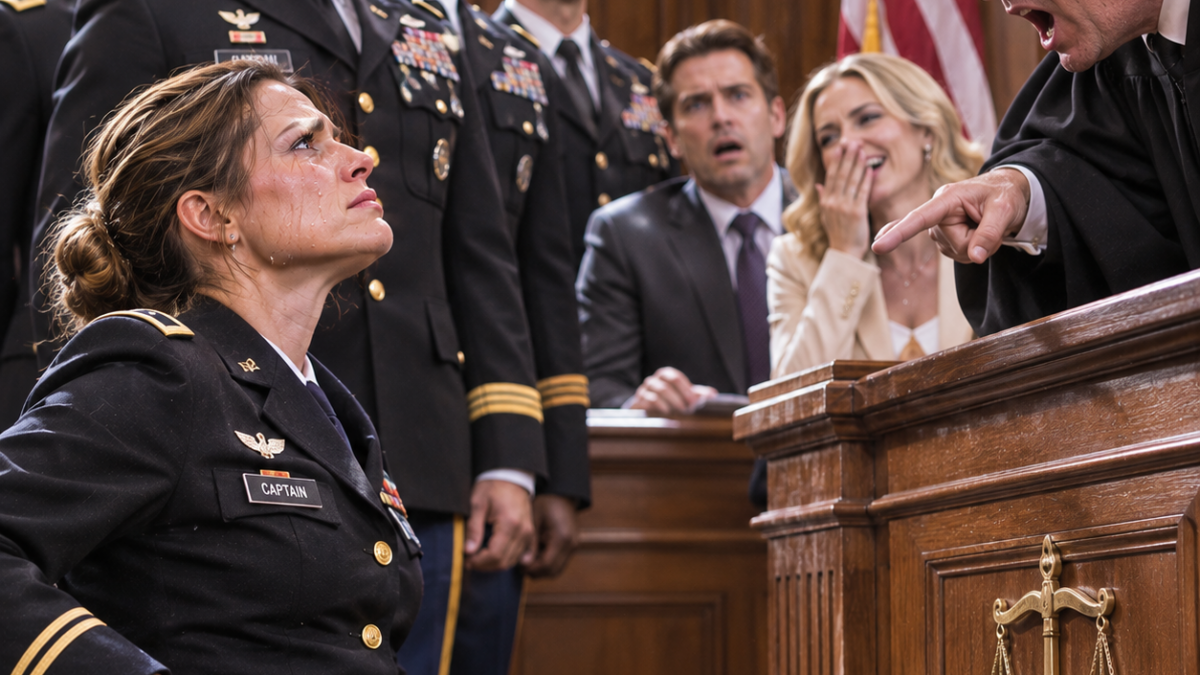
PART2
Judge Lawson leaned back.
“What’s in the wooden box?”
I glanced down.
The box rested on my lap.
Cedar.
Scratched.
Faded.
“Letters.”
“From whom?”
“Friends.”
Derek rolled his eyes.
“She drags that thing everywhere like a security blanket.”
I looked at him.
“It keeps me honest.”
Then:
“You should try carrying one.”
Someone in the gallery coughed to hide a laugh.
Lawson’s face darkened.
“Bailiff.”
Brett Miller stepped forward.
He was younger than me.
Maybe thirty-eight.
Broad shoulders.
Good eyes.
“Yes, Judge?”
“Remove her.”
Brett hesitated.
“Judge?”
“Take the long way.”
The courtroom became silent again.
I understood the message.
The main exit was ten feet away.
The freight elevator was down the opposite corridor.
Lawson wanted inconvenience.
Humiliation.
“Your Honor,” I said, “I can roll myself out.”
“I said remove.”
Brett walked behind me.
“Ma’am.”
His voice was low.
“I’m sorry.”
“You’re doing your job.”
He placed his hands on the wheelchair handles.
I hated people pushing me without permission.
But I also saw his face.
He hated it more.
We reached the center aisle.
Then Derek stretched one polished shoe into the path.
Brett maneuvered around him.
The movement tipped the wooden box.
It hit the floor.
The lid opened.
Letters exploded across the marble.
Four bundles tied in blue ribbon.
Loose pages.
Envelopes.
Photographs.
Six years of handwriting sliding beneath benches.
I cried out.
“Stop.”
Brett stopped immediately.
“My letters.”
Lawson slammed his gavel.
“Keep moving.”
I looked toward him.
“Please let me pick them up.”
“Someone will sweep them later.”
“They are personal.”
“Then perhaps you should have behaved personally responsible.”
My heart pounded.
Derek bent down.
Picked up one page.
Read the top.
“Dear Cap.”
He laughed.
“Captain of what? Bingo club?”
“Put it down.”
He held it higher.
“Thank you for carrying me when—”
“Derek.”
My voice changed.
He stopped.
“Fold that page.”
The courtroom had gone still.
“Put it back.”
He stared.
For a second, the old Derek saw something in me.
Something he remembered.
Then he dropped the page.
Not into my box.
Onto the floor.
Judge Lawson said:
“Only way you come back in here today is on your own two feet.”
I looked at him.
“You know I can’t.”
He shrugged.
“Then I guess we’re done.”
Brett pushed me out.
The doors closed.
I heard the gavel less than a minute later.
Once.
Final.
I looked at Brett.
“Was that the ruling?”
His face turned pale.
“I think so.”
The door opened slightly.
Iris slipped through.
She was carrying my box.
Every letter inside.
Even the ones that had gone under benches.
“Iris.”
She handed it to me.
“I got all of them.”
My throat closed.
“You went back in?”
“I’m already suspended.”
“You shouldn’t have.”
She smiled faintly.
“Maybe.”
Then her eyes filled.
“Who wrote those letters?”
I placed one hand on the lid.
“Four friends.”
“What kind of friends call you Cap?”
“The kind who never learned to stop.”
Before she could ask more, the door opened again.
Brett’s expression changed.
Derek stepped through.
Smiling.
“Well.”
I looked at him.
“What?”
“You lost.”
My chest tightened.
“What did he rule?”
“Default.”
“How?”
“You left.”
“I was removed.”
Derek shrugged.
“Same result.”
I felt something cold move through me.
“The house?”
He smiled wider.
“Sold.”
“My mother lives there.”
“Then Viola can start packing.”
Iris stepped between us.
“Her mother is sixty-six years old.”
Derek looked at her.
“Don’t you have a suspension to serve?”
Then he noticed the box in her hands.
“You picked those up?”
“Yes.”
“How noble.”
A courthouse administrator appeared behind him holding an envelope.
“Iris Quintero?”
She turned.
“Judge Lawson wants your badge on his desk.”
Her face went white.
“For a one-week suspension?”
The administrator looked away.
“I was told to collect it.”
Eleven years.
Gone in one morning.
Because she read a medical accommodation aloud.
I looked at Derek.
He seemed entertained.
That did something to me.
Not rage.
Clarity.
The freight lift groaned open at the end of the hall.
Derek called after me:
“Enjoy the house for one more week.”
I stopped.
Turned the chair.
“One week?”
He laughed.
“Nia, I own that judge for life.”
The hallway became very quiet.
Iris looked at me.
Brett looked at him.
Derek realized what he had said.
Then smiled.
“Figure of speech.”
I nodded.
“Of course.”
He started away.
I called:
“Derek.”
He looked back.
“I’ll be back Friday.”
“For what?”
I placed my hands on my wheels.
“The judge can stand for me.”
His smile faded.
I rolled into the freight lift.
Iris stepped inside with me.
Brett held the door.
He whispered:
“Did you mean that?”
“Every word.”
The doors closed.
By noon I was home.
The cedar ramp rose from the driveway to the porch.
Cormack built the left railing.
Mira measured the slope.
Thomas installed the landing.
Julian complained about every screw and still stayed until three in the morning.
Four people.
One weekend.
Six years earlier.
They had arrived without asking.
Exactly the kind of thing I pretended to hate.
My mother opened the front door before I reached the top.
Viola Bramwell had been a high-school chemistry teacher for thirty-four years.
Retirement had not reduced her ability to detect disaster from fifty feet away.
She looked at my face.
Then at the wooden box.
“Honey.”
“I’m okay.”
“You’re lying.”
“A little.”
She took the box.
Her expression changed.
“These letters are creased.”
I looked away.
“What happened?”
“Inside.”
“What inside?”
“Let’s go in.”
She followed me to the kitchen.
The table was set low enough for my chair.
Another thing the four had modified.
Mom placed the box carefully on the table.
Then waited.
I told her.
Not dramatically.
Judge ordered me to stand.
Iris read the file.
Suspended.
Contempt fine.
Removed.
Letters scattered.
Ruling entered.
House ordered sold.
Mom’s face grew red.
“He told you to stand?”
“Yes.”
“Did nobody read your medical file?”
“One person.”
“The clerk?”
“Yes.”
“And he fired her?”
“Apparently.”
Mom stood.
“Give me my phone.”
“No.”
“Those four need to know.”
“No.”
“Nia.”
“Do not call them.”
Her eyes widened.
“They wrote these letters every year.”
“Yes.”
“They built this ramp.”
“Yes.”
“They would drive through a wall if they knew what happened.”
“Exactly.”
Mom stared.
“Why won’t you tell them?”
“Because they have families.”
“So do you.”
“Jobs.”
“So do you.”
“Lives.”
Mom’s expression softened.
“You saved theirs.”
I looked away.
“That was my job.”
“No.”
“You were their captain.”
“I was doing my job.”
“And six years later you still cannot understand why they might consider you family.”
That hurt.
I reached for the box.
Mom placed one hand over mine.
“Why do you carry the letters?”
I stared at the cedar lid.
“You know why.”
“No.”
“Yes.”
“You tell me anyway.”
I swallowed.
“Because there are days I still think I should have moved faster.”
Mom’s face broke.
“Nia.”
“If I had reached the second vehicle—”
“No.”
“Thirty seconds earlier—”
“You went back three times.”
“I lost two people.”
“You saved four.”
I looked toward the window.
“You don’t get to count human beings like numbers.”
“Neither do you.”
Silence.
Then the doorbell rang.
Iris stood outside holding an apple pie.
Her eyes were red.
“My mother says nobody should lose a job before dinner.”
Mom pulled her inside.
“I like your mother already.”
Iris laughed weakly.
Then:
“There’s more.”
I looked at her.
“What?”
“Judge Lawson plays golf with Derek.”
Mom stopped cutting pie.
“How often?”
“Every Saturday.”
“How do you know?”
“I’ve kept Lawson’s public calendar for five years.”
“Public calendar?”
“Officially, the Saturday blocks say private recreation.”
She sat.
“But everyone knows Glen Hollow.”
I stared.
“Derek told me in the hallway he owns Lawson.”
Iris’s fork stopped.
“What?”
“Exact words.”
She looked at Mom.
Mom looked at me.
Iris said:
“Did Brett hear?”
“Yes.”
“That matters.”
Then her phone buzzed.
She looked.
Her face changed.
“What?”
Iris turned the screen.
Email.
TERMINATION OF EMPLOYMENT.
Effective immediately.
Eleven years ended in five lines.
Mom read it.
“Oh, no.”
Iris laughed once.
Not because it was funny.
“Apparently my one-week suspension lasted two hours.”
I felt sick.
“This happened because of me.”
“No.”
She looked directly at me.
“It happened because I read a file aloud.”
“You lost eleven years.”
“And now I have eleven years of knowledge.”
Something changed in her voice.
“Maybe Judge Lawson just handed you the best witness you could ask for.”
At 6:30 that evening, Rochelle Vance arrived.
She did not knock politely.
She stormed up the ramp, entered the house, dropped two legal binders on the table, and said:
“You went to a scheduling conference without me and lost your house?”
I looked at her.
“I missed you too.”
She glared.
Mom offered pie.
Rochelle accepted.
Angrily.
“This ruling is garbage.”
She opened the first binder.
“Lawson cannot convert a scheduling appearance into a final merits ruling after removing a disabled party from the courtroom for failing to perform an impossible act.”
“That sounds promising.”
“It’s beyond promising.”
She flipped pages.
“I filed an emergency motion to vacate.”
“When?”
“Thirty-seven minutes ago.”
“Rochelle.”
“And a motion for recusal.”
She looked at Iris.
“Especially after what Ms. Quintero just told me.”
Iris nodded.
Rochelle continued.
“Friday morning. Same courtroom.”
Mom nearly dropped her fork.
“The same judge?”
“For the initial recusal motion.”
“Why let him touch this again?”
“Because I want the denial on the record if he refuses.”
She looked at me.
“Then we go upstairs.”
“Appellate?”
“Chief judge first. Judicial conduct complaint second. Appellate emergency relief if necessary.”
She tapped the binder.
“And Nia?”
“What?”
“Your sealed service records would end the disability issue immediately.”
I knew that was coming.
“No.”
Rochelle’s mouth tightened.
“Nia.”
“I am not waiving my sealed record just to convince a judge that paralysis exists.”
“It isn’t about convincing him.”
“It feels like begging.”
“He’s calling you a fraud.”
“Then make him read the medical file.”
“He refuses.”
“That is his problem.”
Rochelle studied me.
My mother said softly:
“Her military record is hers.”
Rochelle exhaled.
“Fine.”
She closed the binder.
“Then we trap him on what he already knows.”
She pointed at Iris.
“Medical accommodation filed.”
“Yes.”
“Doctor’s certification.”
“Yes.”
“Court accessibility request.”
“Yes.”
“Wheelchair-height counsel table request denied?”
I nodded.
“Written?”
“Yes.”
Rochelle smiled without humor.
“Excellent.”
Iris looked confused.
“How is that excellent?”
“Because arrogance is most useful when documented.”
Friday became our deadline.
Derek had already scheduled an open house for Sunday.
He placed a real-estate sign on my lawn Thursday afternoon.
I watched from the porch as he pushed the metal stakes into the ground.
Mom came out behind me.
“Derek.”
He looked up.
“Viola.”
“Get that off our property.”
He smiled.
“Judge says I own half.”
“No final lawful judgment says any such thing.”
I rolled down the ramp.
“Remove it.”
He ignored me.
Then walked toward the ramp.
His shoe struck the lower cedar rail.
“This ugly thing goes first.”
My hands tightened.
“Don’t touch it.”
“What?”
“The ramp.”
He laughed.
“Four people who love Nia built that ramp with their own hands.”
Mom’s voice shook.
Derek looked at her.
“Love?”
He turned toward me.
“Nobody is coming for her.”
That sentence landed harder than he knew.
“Nobody ever did.”
I looked down at the wooden box on my lap.
I had been sitting outside reading one letter before he arrived.
Derek noticed.
He reached.
Before I could pull away, he snatched the page.
“Derek.”
“Let’s see what the mystery soldiers have to say.”
Mom froze.
He read aloud:
“Captain, every year on this date I remember the sound of you telling me not to close my eyes…”
His smile slipped.
I held out my hand.
“Give it back.”
He looked at the signature.
“Cormack.”
Then at me.
“Who is Cormack?”
“Not your concern.”
“Still hiding things.”
He tossed the letter.
It landed in damp grass.
Mom gasped.
I stared at him.
“Pick it up.”
“Excuse me?”
“Walk down there.”
My voice went flat.
“Pick up my letter.”
Derek smiled.
“Or what?”
He leaned closer.
“You going to stand up and make me?”
My mother inhaled sharply.
I did not move.
“Friday.”
“What?”
“Nine a.m.”
I looked at his expensive suit.
“Wear your best one.”
His smile faded.
“You’ll have nothing left by then.”
He pointed at the wooden box.
“Nothing but letters.”
I watched him drive away.
Mom retrieved the page.
Mud streaked the edge.
She wiped it with her sleeve.
“Sorry, honey.”
“It washes off.”
“What?”
“Dirt.”
I looked toward the road.
“Shame stays longer.”
That evening, unbeknownst to me, Mom broke her promise.
Technically, she would later argue, she had never promised not to ask someone else to call.
She phoned Sergeant Cormack Dunley.
Retired.
One of the four.
He answered on the first ring.
“Mrs. B?”
“Did you see the video?”
“What video?”
Ten minutes later he had.
By midnight, so had Mira Hayes.
Thomas Reed.
Julian Cole.
The clip had reached two million views.
Someone in the gallery had recorded Lawson ordering me to stand, mocking the chair, suspending Iris, and directing Brett to remove me.
The video ended before the house ruling.
That almost made it worse.
People saw humiliation without context.
Cormack called Mom back.
“Where is she Friday?”
“Courtroom 4B.”
“Time?”
“Nine.”
“She know you called?”
“No.”
“Good.”
“Cormack.”
“Yes?”
“She told me not to.”
“I know Captain.”
“She’ll be furious.”
“I’ve survived worse.”
Mom smiled.
“So have I.”
Four people started driving.
Not because I asked.
Because six years earlier, on a road in a country I still avoided naming publicly, I had gone back for them.
Cormack first.
Mira second.
Thomas third.
Julian last.
Four soldiers.
Two vehicles struck.
Incoming fire.
Smoke.
Metal.
Blood.
The memory came in fragments even six years later.
Cormack’s leg trapped.
Mira unconscious.
Thomas trying to crawl.
Julian screaming that the vehicle was burning.
I had ordered the remaining unit to pull back.
Then ignored my own evacuation window.
Went back.
Dragged Cormack.
Returned.
Carried Mira.
Returned again with another soldier for Thomas.
Then went back for Julian.
The final blast took my legs.
Not literally.
They were still attached.
The spinal injury made them useless.
Lawyers later wrote clinical language.
Permanent lower-extremity paralysis secondary to traumatic spinal cord damage.
Military records wrote other language.
Actions above and beyond expected duty under direct hostile threat.
My soldiers used simpler words.
She came back.
I received a Silver Star.
I hated the ceremony.
Not because I was ashamed.
Because two families stood in the audience whose people I had not brought home.
Hero is a difficult word when you remember names.
Afterward I packed the medal away.
My formal navy coat went into a garment bag.
The four survivors wrote on the anniversary of the blast every year.
Not emails.
Letters.
Cormack said email felt temporary.
Mira always drew something in the margin.
Thomas wrote too much.
Julian pretended he did not have emotions and then wrote six pages.
I carried the box because the letters reminded me what survived.
Not what I lost.
Friday morning, Mom brought out the navy coat.
I stared.
“No.”
“Yes.”
“I haven’t worn that in six years.”
“It still fits.”
“Mama.”
“Put it on.”
The brass buttons caught the morning light.
Formal.
Old.
Painful.
I touched one.
“This feels ridiculous.”
“You’re going to court.”
“I am not going to war.”
Mom smiled strangely.
“What?”
“Nothing.”
I narrowed my eyes.
“You’re hiding something.”
“I am seventy years old.”
“You’re sixty-six.”
“Stress aged me.”
“Mama.”
“Put on the coat.”
I did.
At 8:32 we reached the courthouse.
The main elevator was still broken.
Of course.
Brett Miller waited near the freight lift.
He looked exhausted.
“Ms. Bramwell.”
“Brett.”
His eyes moved to the coat.
Then he straightened instinctively.
Interesting.
“My mother uses a chair,” he said.
I blinked.
“What?”
“I never told you.”
He swallowed.
“She has multiple sclerosis.”
Mom’s expression softened.
Brett continued.
“Lawson ordered me to remove you again if you refused to stand.”
I stared.
“And?”
“I refused.”
My mother smiled.
“Good man.”
“He threatened my job.”
“Did you change your mind?”
“No.”
“Then definitely a good man.”
The freight lift arrived.
Brett held the door.
“May I ride with you?”
I smiled.
“You may.”
As we rose, he said:
“Chief Judge Solberg is already inside.”
Rochelle had succeeded.
Chief Judge Harriet Solberg.
Sixty-three.
Twenty-eight years on the bench.
A reputation for being polite precisely until politeness stopped being useful.
I looked at Rochelle when we reached the third floor.
“You didn’t tell me.”
“I didn’t know until twenty minutes ago.”
Iris stood beside her.
No badge.
Navy dress.
Stack of records.
“You came.”
“Of course.”
“What about the termination?”
She lifted the documents.
“I brought it.”
Rochelle smiled.
“Best exhibit all week.”
We entered Courtroom 4B at 8:58.
Judge Lawson was already on the bench.
Derek sat at counsel table.
His attorney, Martin Hale, looked nervous.
Chief Judge Solberg sat in the front gallery.
Lawson noticed my coat.
He smirked.
“Costume party?”
I stopped at my table.
“Good morning, Your Honor.”
Derek laughed.
“Nice buttons.”
I looked at him.
“Glad you wore your best suit.”
His smile faded.
Rochelle stood.
“Your Honor, before any substantive matter, respondent renews her motion that you recuse.”
Lawson leaned back.
“Denied.”
Rochelle did not blink.
“For the record, grounds include apparent personal relationship between the court and petitioner, prejudgment of disputed property rights, denial of disability accommodation, removal of respondent before final ruling, ex parte communications we believe may have occurred, and retaliatory termination of a clerk who attempted to correct the record.”
Lawson’s face became red.
“Ms. Vance.”
“Yes?”
“Careful.”
“I am.”
Chief Judge Solberg shifted slightly.
Lawson noticed.
His tone changed.
“Ms. Bramwell.”
“Yes, Your Honor?”
“Last chance.”
“For?”
“Stand.”
The room went silent.
Rochelle closed her eyes.
I said:
“I cannot.”
Lawson nodded.
“Same performance.”
Behind the doors came a noise.
Footsteps.
Several.
Lawson frowned.
“Bailiff?”
Brett did not move.
The doors opened.
Four people entered.
Cormack first.
Gray hair.
Cane from the injury he had carried ever since.
Mira beside him.
Thomas.
Julian.
All dressed formally.
All wearing service ribbons.
I stopped breathing.
“No.”
Cormack smiled.
“Morning, Cap.”
My vision blurred.
“What are you doing here?”
“Disobeying orders.”
Mira grinned through tears.
“Tradition.”
I looked at Mom.
She pretended innocence badly.
“Mama.”
She whispered:
“You could not stand.”
Then nodded toward them.
“So they came to stand.”
Lawson slammed his gavel.
“Who let this parade into my courtroom?”
Brett stayed still.
“Bailiff!”
“No, Judge.”
Lawson stared.
“What?”
“I will not remove them.”
Lawson pointed.
“I order you.”
“No.”
A ripple moved through the gallery.
Lawson turned red.
Cormack stood beside my table.
Mira on the other side.
Thomas and Julian behind.
I whispered:
“I told you to stay home.”
Cormack smiled.
“You told us that once before.”
Mira added:
“We ignored you then too.”
I cried.
Quietly.
Lawson shouted:
“Who are you people?”
Cormack turned toward him.
“Sergeant Cormack Dunley, United States Army, retired.”
He gestured.
“Major Mira Hayes, retired.”
“Sergeant First Class Thomas Reed.”
“Staff Sergeant Julian Cole.”
Lawson looked irritated.
“And?”
Cormack’s face changed.
“We wrote the letters your courtroom threw on the floor.”
Derek laughed nervously.
“Her pen pals?”
Cormack turned.
“No, Kessler.”
His voice went cold.
“The four people your ex-wife carried out alive.”
The room changed.
Derek’s smile disappeared.
Lawson snapped:
“I don’t care about military history.”
Chief Judge Solberg spoke for the first time.
“Perhaps you should care about the complete record before you order a wheelchair user to stand, Judge Lawson.”
Lawson froze.
“Chief Judge, with respect—”
“Counsel.”
Rochelle stood immediately.
“Your Honor, respondent seeks leave to introduce the sealed military accommodation record solely for the limited purpose of establishing the permanent nature and cause of Ms. Bramwell’s mobility impairment.”
I turned.
“Rochelle.”
She looked at me.
“You do not have to.”
The whole room waited.
I looked at the four.
Cormack nodded once.
Not pressure.
Permission.
I looked at Mom.
Then Iris.
Brett.
Chief Judge Solberg.
Finally Lawson.
For six years, I had refused to let the worst day of my life become identification.
I did not want strangers deciding I deserved a ramp because I had once been a captain.
A person should not need heroism to justify accessibility.
That still mattered.
I said:
“Only the medical necessity.”
Rochelle nodded.
“Understood.”
Lawson scoffed.
“This is irrelevant theater.”
Chief Judge Solberg turned.
“No.”
Her voice was quiet.
“It is evidence you refused to read.”
Lawson said nothing.
Rochelle opened the file.
“Captain Nia Elise Bramwell, United States Army, retired.”
Derek stared.
I had never discussed my rank with him after leaving service.
He knew I had been an officer.
He had never cared about details.
Rochelle continued.
“Six years ago, Captain Bramwell sustained traumatic spinal injury during a combat rescue operation.”
Lawson shifted.
“Permanent paraplegia.”
Silence.
“No voluntary motor function below the injury level sufficient for standing or independent ambulation.”
Lawson’s face changed.
Rochelle looked directly at him.
“This information was included in the accommodation request filed in your court eleven days ago.”
Iris said quietly:
“Twice.”
Lawson glared.
Chief Judge Solberg:
“Let her speak.”
Iris continued.
“I flagged the accommodation on intake.”
Rochelle nodded.
“Thank you.”
Then she looked at me.
“May I continue?”
I hesitated.
Cormack whispered:
“You don’t owe anybody the rest.”
I looked at Judge Lawson.
“No.”
Then I surprised myself.
“Read it.”
Rochelle’s eyes softened.
She did.
“During the action in which Captain Bramwell was injured, she repeatedly reentered an active danger area to extract four wounded soldiers after evacuation had been ordered.”
Lawson looked down.
“She removed Sergeant Dunley first.”
Cormack raised one hand slightly.
“I was soldier number one.”
“Major Hayes second.”
Mira’s eyes filled.
“Sergeant First Class Reed third.”
Thomas stared at the floor.
“Staff Sergeant Cole fourth.”
Julian whispered:
“She came back after she was already bleeding.”
My throat closed.
Rochelle continued.
“Following the final extraction, Captain Bramwell sustained blast trauma causing permanent spinal cord injury.”
The courtroom was silent enough to hear paper move.
“Her actions were subsequently recognized with the Silver Star.”
Derek looked at my coat.
At the buttons.
At me.
“You never told me.”
I laughed through tears.
“You never asked.”
Lawson banged the gavel.
“Military awards do not determine property rights.”
Rochelle closed the file.
“Correct.”
She turned.
“Which brings us to the property ruling you entered while my client was physically excluded from your courtroom.”
Lawson stiffened.
“My ruling stands.”
“No.”
Rochelle pulled out another binder.
“It cannot.”
Martin Hale, Derek’s attorney, stood.
“Objection.”
Chief Judge Solberg said:
“To what?”
Hale hesitated.
“The characterization.”
Rochelle handed copies to the clerk.
“Transcript shows respondent was removed on the court’s order at 9:12.”
Another page.
“Final merits ruling entered at 9:19.”
Another.
“No evidentiary hearing.”
Another.
“No opportunity to cross-examine petitioner.”
Another.
“No authentication of the alleged refinancing agreement.”
Another.
“No property valuation.”
Another.
“No determination of separate versus marital contribution.”
She looked at Lawson.
“And no respondent.”
Lawson’s mouth tightened.
“Respondent voluntarily failed to participate.”
Brett spoke.
“No.”
Everyone turned.
Lawson stared.
“Excuse me?”
Brett swallowed.
Then stood straighter.
“You ordered me to remove her.”
Lawson’s face became dangerous.
“Bailiff Miller.”
“You ordered me to take her through the rear corridor.”
“Enough.”
“You told me she could only return if she walked.”
“Enough.”
Chief Judge Solberg held up one hand.
“No.”
She looked at Brett.
“Finish.”
His hands shook.
“I followed the order.”
He looked toward me.
“I shouldn’t have.”
“You were doing your job,” I said.
He shook his head.
“Not all of it.”
Then he faced the chief judge.
“I heard Mr. Kessler tell Ms. Bramwell afterward that he owned Judge Lawson.”
Derek jumped up.
“That is not what I said.”
Iris said:
“It is.”
Derek turned.
“You weren’t there.”
“I was ten feet away.”
His attorney grabbed his sleeve.
“Sit.”
Derek sat.
Rochelle walked toward her table.
“Now we come to Saturdays.”
Lawson’s face changed.
Just slightly.
Enough.
Rochelle noticed.
So did Chief Judge Solberg.
“Ms. Quintero?”
Iris opened her folder.
“For five years, part of my duties included managing Judge Lawson’s public and administrative calendar.”
Lawson snapped:
“Confidential.”
Chief Judge Solberg said:
“Not yet.”
Iris continued.
“Thirty-one Saturdays over the previous eighteen months show recurring private blocks at Glen Hollow Golf Club.”
Derek’s attorney looked at him.
Derek looked away.
Rochelle asked:
“Do you have the club guest ledger?”
Iris handed over copies.
“My cousin works in membership administration.”
Lawson stood.
“This is outrageous.”
Chief Judge Solberg rose too.
“Sit down.”
Everything stopped.
Judge Lawson stared at her.
She repeated:
“Sit.”
Slowly, he did.
I could not breathe.
For the first time since the week began, Judge Spencer Lawson was the one being told what position his body should take.
I did not enjoy it.
Not exactly.
But I noticed.
Rochelle continued.
“Thirty-one entries show Derek Kessler as Judge Lawson’s registered guest or playing partner.”
Hale turned toward Derek.
“You told me you barely knew him.”
Derek whispered:
“Golf isn’t a relationship.”
Rochelle:
“Perhaps.”
She opened another page.
“Four dates correspond to significant rulings in this matter within forty-eight hours.”
Lawson said:
“Coincidence.”
Rochelle nodded.
“Perhaps.”
Another page.
“Three restaurant charges paid by Kessler’s consulting company following those rounds.”
Derek’s face drained.
“Business development.”
“With a presiding judge?”
“No.”
He stumbled.
“I mean not about the case.”
Chief Judge Solberg’s expression hardened.
Rochelle then introduced the viral hallway video.
Lawson laughed.
“Edited internet garbage.”
“Fortunately, the courthouse camera footage is not edited.”
That line landed.
Iris smiled for the first time all morning.
Rochelle had obtained preservation overnight.
Official security footage.
It showed Lawson entering.
The order to stand.
Iris’s intervention.
My removal.
Derek reaching for my letter.
The later hallway conversation where he said:
I own that judge for life.
Audio was weak.
Not perfect.
But enough combined with witnesses.
Derek’s attorney leaned away from him.
Lawson looked toward Chief Judge Solberg.
“This is being turned into a circus.”
She answered:
“No.”
She looked at him for a long moment.
“It became a circus when a judge decided disability accommodation was optional and due process could wait for a golf partner.”
Lawson’s face went gray.
“Harriet.”
First name.
Wrong choice.
Chief Judge Solberg straightened.
“You will address me as Chief Judge.”
Silence.
Then:
“Judge Lawson, effective immediately, I am exercising administrative authority to remove you from further participation in this matter pending formal review.”
His mouth opened.
“You cannot—”
“I can.”
“My seat—”
“Leave the gavel.”
The room stopped.
Lawson stared at the wooden gavel as though it were part of his body.
“Harriet.”
“Judge Lawson.”
Her voice remained controlled.
“Step down.”
He stood.
This time no one ordered me to.
I remained seated.
He descended from the bench.
For a second he looked at me.
Not judge to litigant.
Man to woman.
He whispered:
“I should have read the file.”
I looked at him.
“Yes.”
Then:
“And even if there had been no heroic record in it, you still should have listened when I said I couldn’t stand.”
His eyes dropped.
That mattered.
I did not want the lesson to become:
Decorated veterans deserve ramps.
Everyone deserves dignity.
He nodded once.
Then walked out.
Chief Judge Solberg took temporary administrative control of the proceeding long enough to address emergency relief.
“The previous final ruling is vacated.”
Derek stood.
“Your Honor—”
“Sit down, Mr. Kessler.”
He did.
“The petition for immediate forced sale is denied without prejudice to whatever legitimate claims may remain after proper assignment to an impartial judge and an evidentiary hearing.”
Rochelle nodded.
“Thank you.”
The chief judge continued.
“No listing.”
Derek looked toward his attorney.
“No transfer.”
His face tightened.
“No alteration of the property.”
I thought of the ramp.
My shoulders loosened.
“And no entry onto Ms. Bramwell’s property except as permitted by existing order or written agreement.”
Derek’s face went white.
The open-house sign would be coming down.
Chief Judge Solberg then looked at Iris.
“Ms. Quintero.”
Iris stood.
“Yes, Your Honor?”
“I have reviewed the preliminary employment action taken against you.”
Iris swallowed.
“Your termination is administratively stayed pending review.”
Her eyes filled.
“I cannot promise the final outcome from this bench.”
“I understand.”
“But eleven years of service will not end by retaliatory email without process.”
Iris covered her mouth.
The gallery applauded.
Chief Judge Solberg banged the gavel lightly.
“Please.”
The applause stopped.
Mostly.
Then she looked toward Brett.
“And Bailiff Miller.”
“Yes?”
“Your refusal to execute an improper physical removal order today will be documented.”
Brett looked terrified.
“Am I fired?”
For the first time all morning, the chief judge smiled.
“No.”
He exhaled.
Mom whispered:
“Good. I like him.”
The hearing ended.
I remained seated.
Everyone else stood.
This time no one cared.
Cormack came around the table.
I looked at him.
“I told you not to come.”
“Yes, Captain.”
“You drove how far?”
“Four hours.”
“Mira?”
“Three.”
“Thomas?”
“Five.”
“Julian?”
Julian shrugged.
“I was already halfway here before Cormack called.”
I stared.
“Why?”
“Because I saw the video.”
I closed my eyes.
“You have families.”
Cormack knelt awkwardly beside my chair.
“So do you.”
I started crying.
Hard.
Not dignified.
Not composed.
Six years came out.
Mira wrapped her arms around me.
Thomas placed one hand on my shoulder.
Julian stood behind pretending his own eyes were dry.
Mom cried openly.
Iris cried.
Even Rochelle looked suspicious.
Cormack whispered:
“You carried us once.”
I shook my head.
“No.”
“Yes.”
His voice broke.
“Let us stand beside you once without making it an argument.”
I laughed through tears.
“That is manipulative.”
“Learned from officers.”
The courthouse hallway filled with reporters.
We avoided most.
But Chief Judge Solberg’s office issued a statement before noon.
Judge Lawson was placed on administrative leave pending investigation by the judicial conduct authority.
The property ruling had been vacated.
The case would be reassigned.
No mention of my medal.
Thank God.
That did not stop reporters.
The video had already gone national.
Someone leaked the military connection.
Headlines became unbearable.
JUDGE MOCKS PARALYZED WAR HERO.
I hated that phrase.
War hero.
The four loved it.
Cormack texted:
CAPTAIN BINGO CLUB MAKES NATIONAL NEWS.
I replied:
I WILL BLOCK YOU.
He sent six laughing faces.
By Friday afternoon, Derek’s real-estate sign lay beside our trash bins.
Mom wanted to burn it.
I told her paint fumes were toxic.
She settled for snapping the wooden post.
At four, Derek came to the house.
Not onto the lawn.
He stopped at the sidewalk.
Rochelle had warned him.
I rolled onto the porch.
“What?”
He looked older than he had that morning.
“Can we talk?”
“From there.”
“Nia.”
“From there.”
He nodded.
“Martin withdrew.”
“Your lawyer?”
“Yes.”
“Why?”
“He says I didn’t disclose Lawson.”
I almost laughed.
“Didn’t disclose thirty-one golf rounds with the judge hearing your case?”
Derek looked away.
“It wasn’t like that.”
“What was it like?”
“We were friends.”
“Then he should have recused.”
“I know that now.”
“No.”
I shook my head.
“You knew that before.”
His expression hardened.
“You always do that.”
“What?”
“Make everything black and white.”
I looked at my chair.
“At least one thing this week was.”
He flinched.
“I didn’t know Lawson would treat you like that.”
“You laughed.”
“I was angry.”
“You picked up my letter.”
“I’m sorry.”
“You dropped it in the mud yesterday.”
His face changed.
“I was angry.”
“That sentence is doing a lot of work for you.”
He exhaled.
“I didn’t know about the Silver Star.”
“Would that have changed whether you mocked me?”
Silence.
“Would it?”
“Yes.”
I hated the answer.
“Then you still don’t understand.”
He frowned.
“Nia.”
“You should not need a medal to decide not to tell a paralyzed woman to stand.”
His face fell.
I continued.
“You lived with me after the injury.”
“For a week.”
“You knew.”
“I know.”
“You knew I could not stand.”
“Yes.”
“You still told strangers I could.”
He looked down.
“I wanted the house.”
There it was.
Clean.
Ugly.
True.
“Why?”
He laughed bitterly.
“Because I’m broke.”
That surprised me.
Not completely.
Derek had always spent like money was proof of character.
“Business?”
“Collapsed.”
“When?”
“Last year.”
“Why didn’t you tell me?”
“We are divorced.”
“Exactly.”
He nodded.
“I thought the house was my way out.”
“It isn’t.”
“I paid for renovations.”
“You may have a claim. Let a neutral court decide.”
His eyes lifted.
“You’d accept that?”
“Of course.”
“You’re not trying to take everything?”
I almost smiled.
“Derek.”
I gestured toward the ramp.
“You are the person who tried to take everything.”
He looked ashamed.
“Judge Lawson said the claim was strong.”
“And did that belief grow before or after your twenty-seventh golf game?”
He winced.
“I never paid him.”
“I didn’t say you did.”
“There was no bribe.”
“Then an investigation can determine that.”
His face tightened.
“Nia.”
“No.”
“What happens to him now?”
“Not my job.”
“And me?”
“Same answer.”
I turned my chair.
He said:
“Wait.”
I stopped.
“I’m sorry I left.”
I stared.
Six years.
Not one apology.
“What?”
“When the chair came.”
My throat tightened.
“I told myself the marriage had already been bad.”
“It had.”
“I told myself you didn’t need me.”
“I didn’t.”
“That hurt.”
I almost laughed.
“So you left.”
“Yes.”
“That makes no sense.”
“I know.”
He wiped his face.
“I needed you to need me after the injury.”
I stared.
“You had just become…”
He stopped.
“Say it.”
“Different.”
“I was paralyzed.”
“Yes.”
“And you wanted me helpless.”
His face crumpled.
“No.”
“You wanted to be necessary.”
He looked away.
Maybe that was closer.
He said:
“When you learned transfers, drove with hand controls, went back to work, handled everything…”
“You were disappointed.”
“I felt useless.”
I thought about that.
Then:
“You made my survival about your ego.”
He closed his eyes.
“Yes.”
That was probably the most honest thing Derek ever admitted.
I nodded.
“Thank you for finally saying it.”
“Does that change anything?”
“No.”
He laughed sadly.
“I figured.”
He walked away.
I watched from the porch.
Not triumphant.
Sad.
Some relationships end long before the paperwork catches up.
Ours had ended six years earlier when Derek looked at my wheelchair and saw what it took away from him instead of what had happened to me.
The judicial investigation lasted months.
Longer than the internet’s attention span.
That was good.
Actual accountability should not move at viral speed.
Investigators reviewed calendars.
Emails.
Club logs.
Financial records.
Court transcripts.
Staff interviews.
Security video.
Lawson admitted golfing with Derek.
He denied discussing the case.
Derek denied asking for favorable treatment.
There was no proven envelope of cash.
No movie-style bribe.
What investigators did establish was enough.
Judge Lawson failed to disclose a substantial personal relationship with a litigant.
He handled motions involving that litigant despite repeated opportunities to recuse.
He denied documented disability accommodations.
He retaliated against Iris.
He pressured court staff.
He entered a final property order without proper process after directing that I be removed.
His pattern in other cases also came under review.
That mattered.
I was not the first person he had humiliated.
A deaf litigant reported that Lawson once complained about interpretation delays.
A woman undergoing cancer treatment said he mocked her request for remote appearance.
An elderly man with cognitive impairment had been threatened with contempt for responding too slowly.
My video had not created Lawson.
It had made him visible.
He resigned before the formal disciplinary hearing concluded.
Some people called that escaping accountability.
Maybe partly.
His resignation did not stop the published findings.
His reputation was no longer protected by the robe.
He never became an appellate judge.
That had apparently been his ambition.
Chief Judge Solberg later told Rochelle that ambition had influenced how aggressively he controlled his courtroom.
He believed toughness looked judicial.
It looked smaller after the video.
Iris got her job back.
Not only back.
Six months later, after the existing chief clerk retired, Iris applied for the position.
She almost did not.
“I’m not qualified.”
I stared at her.
“You ran half that courthouse unofficially for eleven years.”
“That’s different.”
“No.”
She laughed.
“You sound like your mother.”
“Cruel.”
She applied.
Interviewed.
Won.
Chief Clerk Iris Quintero.
The first thing she changed was the accommodation intake process.
No medical request could be buried inside an ordinary case file anymore.
Mobility.
Interpretation.
Hearing.
Visual access.
Cognitive accommodation.
Everything flagged separately before the hearing.
She also pushed for repair of the main elevator.
That took longer than removing a judge.
Government buildings have priorities.
Brett remained a bailiff.
Then became a training officer.
He introduced a simple rule for new staff.
“An order does not stop being wrong because it comes from somebody above you.”
When he told me, I asked:
“Is that official policy?”
“No.”
“Good.”
He smiled.
The house case was reassigned to Judge Marisol Grant.
She read the entire file before the first hearing.
That alone felt revolutionary.
At the beginning she said:
“Captain Bramwell—”
I interrupted gently.
“Ms. Bramwell is fine.”
She nodded.
“Ms. Bramwell.”
That mattered.
I did not want military service becoming the price of civilian dignity.
Derek’s claim was not completely frivolous.
He had contributed approximately $46,000 toward renovations during the marriage.
Some funds could arguably be traced to joint marital income.
My pre-marital ownership was clear.
The title was clear.
But reimbursement and equitable contribution issues required actual accounting.
Judge Grant ordered an appraisal.
Bank records.
Receipts.
No shortcuts.
Rochelle expected us to win completely.
I surprised her.
“Offer reimbursement.”
“What?”
“Legitimate amount.”
“Nia.”
“If he contributed marital money, resolve it.”
“He tried to steal the whole property.”
“I know.”
“He weaponized a corrupt relationship.”
“I know.”
“He threw your letters in mud.”
“I know.”
Rochelle stared.
“Why are you being reasonable?”
“Because I want the house.”
“You already have the house.”
“I want the fight gone.”
That shut her up.
Eventually we settled.
Derek received a modest payment reflecting documented renovation contributions, reduced by amounts addressed elsewhere in the divorce history and litigation costs.
He withdrew every ownership claim.
Recorded release.
No future partition action.
No lien.
The house remained mine.
Mom remained inside.
The cedar ramp remained exactly where the four had built it.
Derek signed the papers.
Then looked at me.
“This is less than I wanted.”
“I know.”
“More than you wanted to give.”
“Yes.”
He almost smiled.
“That sounds fair.”
“Probably.”
He moved to North Carolina months later.
Started over.
We exchanged no Christmas cards.
That was okay.
The four soldiers became impossible after the courtroom.
They decided six years of my pretending not to need anyone had expired.
Cormack installed a second handrail on the back porch.
I did not ask.
Mira reorganized my garage.
Wrongly.
Thomas fixed the guest-room window.
Julian started coming every Thursday with takeout because he said my mother’s cooking had “lost operational readiness.”
Mom threatened him with a wooden spoon.
He came back the next week.
The wooden box changed too.
Year seven arrived.
Four envelopes.
Then a fifth.
I opened it.
Iris.
Dear Captain—
I groaned.
She wrote:
I know I was not in the original four, but I picked up the letters, so I believe I have earned probationary membership.
I laughed so hard Mom came in.
“What?”
I handed her the page.
She read.
“Add her.”
“You cannot add people to a military rescue.”
“Apparently you can.”
I placed Iris’s letter in the box.
The next year Brett wrote one.
Then Rochelle.
I objected.
Nobody cared.
The box became less about one day overseas.
More about people standing beside one another afterward.
That helped.
For years I carried the box because guilt made me afraid to let the four people disappear from my memory.
Eventually I carried it because gratitude felt lighter.
One afternoon Cormack asked:
“Do you still think you should have been faster?”
We were sitting on the porch.
I looked toward the cedar rail.
“Sometimes.”
“Idiot.”
“Excuse me?”
“I was unconscious.”
“You were screaming.”
“Same difference.”
I laughed.
He became serious.
“You know what I remember?”
“What?”
“You coming back.”
I looked away.
“Not how long it took.”
Silence.
“You keep remembering the clock.”
He touched his chest.
“We remember the direction.”
“What direction?”
“You were moving toward us when everybody else was trying to get out.”
That broke something open.
I cried.
Cormack pretended not to notice for thirty seconds.
Then handed me a napkin.
“Terrible captain.”
“Terrible sergeant.”
“Retired.”
“Still terrible.”
We laughed.
Mom aged.
Slowly at first.
Then all at once.
At seventy-one she developed arthritis in both knees.
At seventy-three she began using a cane.
At seventy-five, ironically, she used a wheelchair for long outings.
The first day she came home with one, she looked at me.
“Well.”
I raised an eyebrow.
“Do not.”
“I was going to say it matches the furniture.”
“Liar.”
She smiled.
Then touched my chair.
“I understand things differently now.”
“What things?”
“How exhausting it is when people talk to the person pushing you instead of to you.”
I nodded.
“How strangers grab the chair.”
“Yes.”
“How every ramp is somehow behind the building next to trash cans.”
“Yes.”
She looked at me.
“I wish I had understood sooner.”
“Mama, you understood enough.”
“No.”
She shook her head.
“I loved you.”
“I know.”
“I still thought adaptation was something you did once.”
I stared.
“What do you mean?”
“I thought the ramp was built, the chair arrived, and then life became normal.”
She sighed.
“I did not know you had to solve the same world every day.”
That was one of the best apologies I ever received.
Not for harm.
For incomplete understanding.
We all have it.
The courthouse installed automatic doors two years after Lawson resigned.
Iris invited me to the ribbon cutting.
I refused.
She called Mom.
Mom forced me.
“They are opening doors.”
“Yes.”
“Because of you.”
“No.”
“Because of a lot of people.”
“Fine.”
She smiled.
“You can say that in your speech.”
“What speech?”
Iris had betrayed me.
Again.
At the ceremony, I spoke for four minutes.
No uniform.
No medal.
Ordinary blue blouse.
Wheelchair.
I said:
“Accessibility should not depend on whether a person has done anything extraordinary.”
The room became quiet.
“You should not have to be a decorated veteran.”
I looked toward Cormack and the others.
“You should not have to save lives.”
Then toward Iris.
“You should not need a clerk willing to lose her job.”
Then Brett.
“Or a bailiff willing to risk his.”
I looked at the automatic doors.
“You should simply be a person who needs to enter.”
That quote ended up in the local paper.
I liked it more than the war-hero headline.
Judge Lawson sent me a letter three years after the incident.
I almost threw it away.
Mom said:
“Read it.”
I did.
His handwriting was unexpectedly neat.
Ms. Bramwell,
I have rewritten this letter several times because every attempt to explain my conduct becomes an excuse. I had become convinced that authority was demonstrated by immediate obedience. I mistook questions for challenges, accommodation for favoritism, and control for order.
I paused.
Then continued.
I had also allowed a personal friendship with Mr. Kessler to become normalized enough that I stopped recognizing the conflict it created. I do not claim that he purchased my decisions. He did not. That makes my failure worse, not better. I compromised judgment without needing to be bribed.
That was an interesting sentence.
Honest.
What I did to Ms. Quintero was retaliatory. What I ordered Bailiff Miller to do was unnecessary. What I said to you was humiliating.
Then:
I have thought often about the moment your attorney read your service record. My first reaction was shame because I realized who you were. My deeper shame came later when I understood that who you were should not have mattered. You told me so in the courtroom, and you were right.
I stopped reading.
Mom waited.
“What?”
“He got there.”
“Where?”
“The point.”
I finished.
I ordered you to stand. I should have sat and listened.
No request for forgiveness.
No request for public rehabilitation.
Just apology.
I wrote back.
One paragraph.
Judge Lawson, I appreciate that you understand the distinction now. I hope you carry it into whatever rooms you enter next. Dignity should never depend on a person’s ability to satisfy someone else’s idea of strength.
I signed:
Nia Bramwell.
Not Captain.
That mattered.
Derek’s apology came much later.
Seven years after he left the week my wheelchair arrived.
He called because his mother had died.
I had known her.
Loved her once.
I attended the funeral.
He looked stunned when I rolled into the church.
“You came.”
“She was my family for eleven years.”
He nodded.
After the service he walked beside me toward the parking lot.
“I read about Lawson’s letter.”
“How?”
“Iris mentioned it to somebody.”
Small towns.
He looked down.
“I owe you one too.”
“You don’t have to write.”
“I know.”
We stopped near my van.
Derek said:
“When I left after your injury, I told everyone you pushed me away.”
I waited.
“You did not.”
“No.”
“I wanted people to believe I had tried.”
“Yes.”
“I barely tried.”
“That’s true.”
He swallowed.
“I was terrified.”
“Of the chair?”
“Of what it meant.”
“What did it mean?”
“That life had changed.”
I looked at him.
“It changed more for me.”
“I know.”
He nodded.
“Now.”
Silence.
“I’m sorry.”
I believed him.
That did not mean I wanted him back.
Forgiveness is not reinstatement.
“Thank you.”
He almost smiled.
“That’s it?”
“What else?”
“I don’t know.”
“Neither do I.”
He laughed softly.
“Still you.”
“Mostly.”
He looked at the ramp mechanism on my van.
Then:
“I shouldn’t have touched the letter.”
“No.”
“Or the ramp.”
“No.”
“Or used Lawson.”
“No.”
He sighed.
“You really make people complete their apologies.”
“Occupational habit.”
“What occupation?”
I smiled.
“Captain of the Bingo Club.”
He laughed.
For the first time in years, I did too.
Then we left.
I never saw him again.
Not because he died.
Because lives separate.
That is allowed.
Not every relationship needs a final reunion scene.
Some people become part of your past without becoming enemies.
Mom lived in the cedar house until she was eighty-one.
Then her mobility needs changed enough that we converted the downstairs office into a bedroom.
She refused assisted living.
“I raised you.”
“So?”
“You survived me. I can survive your cooking.”
“I don’t cook.”
“Exactly my concern.”
The four rotated help.
Iris brought groceries.
Brett fixed things.
Rochelle handled paperwork when Mom’s insurance company became impossible.
The house Derek once tried to sell became crowded with people.
That was the part that felt like justice.
Not ownership.
Use.
Ramp scratched from years of wheelchairs.
Front porch filled with chairs.
Kitchen never quiet.
Mom died on a Tuesday morning.
At home.
I was beside her.
So were two of the four.
Cormack arrived twenty minutes later.
Mira forty.
Thomas by afternoon.
Julian drove overnight.
I placed the wooden box near Mom’s photograph at the funeral.
Not my medal.
The letters.
Because she had been right.
I had spent too long pretending strength meant carrying things alone.
At the service, Iris read from the first letter she had added.
I objected from the front row.
Nobody listened.
Typical.
Afterward, Chief Judge Solberg—retired by then—came to me.
“I’m sorry.”
“Thank you.”
She looked toward the box.
“That case changed the courthouse.”
“Good.”
“It changed me.”
I raised an eyebrow.
“You were already decent.”
She smiled.
“Decent people can still learn.”
Fair.
The cedar house became quieter after Mom.
For almost a year, I considered selling.
Not because Derek had ever been right.
Because every room sounded like absence.
Rochelle asked:
“Do you want to move?”
“I don’t know.”
“That means no.”
“What legal principle is that?”
“Expensive experience.”
The four refused to offer opinions.
Suspicious.
Finally I decided to stay.
Not forever.
For now.
I converted Mom’s old room into a reading room.
Her chemistry books went to the high school.
Her favorite chair remained.
The open-house sign Derek had planted years earlier had somehow survived in Cormack’s garage.
He brought it over.
“What am I supposed to do with that?”
“Firewood.”
I laughed.
We broke it apart.
Burned it in the fireplace.
Not symbolic revenge.
Mostly.
Julian toasted marshmallows over it.
“Property law tastes excellent.”
Rochelle said:
“That is probably toxic paint.”
We stopped.
Some endings are less poetic than expected.
The wooden box sits beside my desk now.
It is heavier.
Seven letters became eight.
Then ten.
Then more.
Cormack still writes on the anniversary.
Mira too.
Thomas developed arthritis and switched to typing, which I allowed after unreasonable debate.
Julian sends handwritten pages with coffee stains.
Iris writes every year.
Brett occasionally.
Rochelle once sent an invoice instead.
At the bottom:
BALANCE DUE: ONE PIE
I paid.
Chief Judge Solberg wrote only once.
Dear Nia, courts often talk about standing. Legal standing. Physical standing. Standing orders. Your case reminded us that justice has nothing to do with who can rise when a door opens. It has everything to do with whether the system recognizes the person already present.
I kept that one near the top.
Years after the viral clip faded, people still occasionally recognized me.
A woman at a grocery store once said:
“You’re the wheelchair captain.”
I hated the phrase instantly.
But she looked nervous.
“Yes.”
“My son uses a chair.”
I softened.
“He’s twelve.”
She began crying.
“His school keeps making him use the loading entrance because the main ramp is under repair.”
My jaw tightened.
“For how long?”
“Four months.”
I gave her Iris’s accessibility-resource contact.
Then Rochelle’s office number.
I did not call the school myself.
Growth.
Maybe.
The school fixed the entrance within two weeks after a formal complaint.
No medals required.
No viral video.
That was better.
Cormack says I became boring.
I tell him boring is the goal.
When systems work, dignity should be boring.
A ramp.
An elevator.
A clerk reading a file.
A judge listening.
No parade.
No four soldiers entering at the perfect moment.
No applause.
Just access.
The dramatic story will always be Friday morning.
Lawson ordering me to stand.
The doors opening.
Four people walking in.
Cormack saying:
She carried us once.
The Silver Star.
The golf records.
The ruling vacated.
It makes a satisfying story.
But the story I prefer happened later.
One afternoon, Iris called.
A woman using a wheelchair had a hearing in Courtroom 4B.
New judge.
New staff.
Before she arrived, the courtroom table had been adjusted.
Freight lift unnecessary because the main elevator worked.
The judge remained seated while she entered so nobody felt obligated to perform a ceremony she physically could not join.
The hearing began.
Nobody commented on her chair.
Nobody asked why.
Nobody demanded proof beyond what had already been filed.
Iris called me afterward.
“That’s it?”
I asked.
“That’s it.”
“No drama?”
“None.”
“No viral video?”
“No.”
“No hero speech?”
“Nothing.”
I smiled.
“Perfect.”
That was justice.
Not Lawson leaving the bench.
Not Derek losing the forced sale.
Not my service record becoming public.
A stranger entering a room years later and being treated normally because people had finally learned.
The four still tease me about the day.
At our annual dinner—because apparently once soldiers survive something together they invent mandatory food traditions—Cormack always raises his glass.
“To the captain who refused to stand.”
I always answer:
“I physically could not stand.”
“Ruins the toast.”
“Accuracy matters.”
Mira says:
“To the captain who made a judge stand down.”
Thomas groans.
Julian loves it.
I hate all of them.
Deeply.
They know.
One year Cormack brought the first muddy letter Derek had thrown on the lawn.
He had somehow stolen it from my box.
“You took this?”
“Borrowed.”
“You are seventy years old.”
“And still faster than you.”
I stared.
He froze.
Then his face collapsed.
“Oh, God.”
Silence.
Then I started laughing.
He stared.
“You’re laughing?”
“You finally made a wheelchair joke badly enough to regret living.”
The whole table exploded.
Cormack covered his face.
“I’m never speaking again.”
“Promise?”
Mira nearly fell out of her chair.
That night, after everyone left, I looked at the letter.
The mud stain remained faintly along one corner.
I could have replaced the page.
Copied it.
Cleaned it more aggressively.
I never did.
Dirt washes.
Some marks remain.
Not every mark is damage.
Sometimes it proves an object survived being thrown down.
The same is true of people.
I am not grateful for paralysis.
I hate inspirational stories that demand gratitude for suffering.
I would stand tomorrow if medicine made it possible.
I would run.
Dance badly.
Climb stairs without measuring them.
Kick Derek’s old sign for fun.
I miss my legs.
Still.
But I am not ashamed of the life built afterward.
Both truths can coexist.
I lost things.
I gained people.
I did not need the loss to justify the people.
They would have mattered anyway.
And strength?
Judge Lawson believed strength looked like standing when ordered.
Derek believed strength looked like money, ownership, influence.
For years I believed strength meant needing nobody.
All three of us were wrong.
Strength was Iris walking back into a courtroom after being suspended to pick up letters that did not belong to her.
Strength was Brett saying no to an improper order even when his job was threatened.
Strength was Rochelle insisting on process instead of revenge.
Strength was my mother making a phone call I explicitly told her not to make because she understood my pride had become another kind of prison.
Strength was four soldiers driving hours to stand behind a wheelchair.
Strength was Chief Judge Solberg telling another judge to step down.
Strength was Derek eventually telling the truth about why he left.
Strength was Lawson eventually writing an apology without asking me to rehabilitate him.
Strength was me accepting help without treating it as defeat.
Today the navy coat hangs near the front door.
I rarely wear it.
The Silver Star remains in a drawer.
The cedar box stays where I can reach it.
The ramp remains.
People still ask why I never replaced it with something newer.
Because four terrified young veterans built that thing in one weekend with no idea what they were doing.
The slope is slightly imperfect.
The left rail has three extra screws.
Julian measured one post wrong.
Cormack refuses to admit which one.
It is the least professionally constructed ramp in the county.
It is also the strongest.
Not because of cedar.
Because every time my wheels touch it, I remember the same thing.
I came home believing I had to learn how to live alone.
They arrived with lumber.
Years later, I entered Courtroom 4B believing the same lie.
I thought if I needed anyone to defend me, that meant Judge Lawson had already won.
Then the doors opened.
Four people walked through.
I saw their faces.
And I finally understood something I should have understood six years earlier.
The people you carry do not become your debt.
Sometimes they become the people who carry you when your turn comes.
Not because you are weak.
Because that is what standing beside someone actually means.
Judge Lawson told me nobody sits when he enters.
He believed respect was something bodies performed for power.
I know better now.
Respect is the clerk who reads the file.
The bailiff who refuses cruelty.
The lawyer who protects process.
The mother who refuses to let pride isolate her daughter.
The friends who arrive without being summoned.
And the judge who understands that justice does not become smaller because the person asking for it is seated.
The last letter Cormack sent me began with the same words he has used every year.
Dear Cap,
Then:
It has been thirteen years since you went back for us. I finally understand why you hate when we call you a hero. You think the story is about the people you could not save. We think it is about the person who kept coming back. Maybe both stories are true.
I stopped reading for a while.
Then continued.
You told us once that nobody should be measured by whether they can stand. Fine. So we stopped measuring you that way years ago. We measure you by something else.
I smiled because I knew Cormack.
He always became sentimental around page three.
When the room gets ugly, we ask: who moves toward the person everybody else is leaving behind?
My eyes filled.
That is still you, Cap. Chair or no chair. Medal or no medal. Courtroom or battlefield.
At the bottom:
P.S. Julian says the ramp is still level. He is lying.
I laughed.
Then placed the letter into the box.
The lid closed.
Outside, afternoon light fell across the cedar ramp.
Somewhere downtown, Courtroom 4B was probably hearing another case.
People standing.
People sitting.
People talking.
Hopefully someone listening.
I rolled toward the front door.
The ramp waited.
No audience.
No gavel.
No applause.
Just wood built by four people who once believed they owed me their lives until we all learned that love was never supposed to work like a debt ledger.
I touched the first rail.
And for the first time in many years, I did not think about the day I lost my legs.
I thought about every person who had stood beside me afterward.
That was enough.
More than enough.
Judge Lawson once told me I had to stand to deserve his courtroom.
He was wrong.
I had already stood where it mattered years before.
And when my turn came to sit, the people I had carried made sure I never sat alone.








