PART2:“SMASH THAT CAR—HOA ORDERS!” HOA Karen Sent Fake Officers to Destroy My Wife’s Rolls-Royce—She Never Expected the Woman Walking Out in Uniform to Be the New Police Chief
PART2
I stepped between Jake and the Cullinan.
“Don’t touch the car.”
Delilah stopped beside the curb.
Phone already recording.
“This vehicle is under enforcement.”
“Show me the rule.”
“You were cited.”
“I read the citation.”
“Then you understand.”
“No.”
I held up the HOA packet.
“Code 47B doesn’t exist.”
Jake shifted.
The other two men looked at each other.
Delilah didn’t.
She had spent too many years being obeyed to recognize the moment a room stopped believing her.
“Community safety overrides individual inconvenience.”
“Private property is not an inconvenience.”
She pointed at the car.
“This vehicle creates an ostentatious display inconsistent with community character.”
I almost laughed.
“You live in a six-bedroom house with a fountain.”
“That’s approved.”
“By you?”
Her face tightened.
“Move.”
“No.”
The tow operator remained in his cab.
Smart man.
Jake stepped forward with the crowbar.
I raised my phone.
“Jake, if you damage that car, I’m recording you doing it.”
He looked at Delilah.
She said:
“Proceed.”
“Ma’am,” one of the other men said, “maybe we should wait for legal—”
Delilah spun around.
“Do your job.”
Jake lifted the crowbar.
I shouted:
“Stop.”
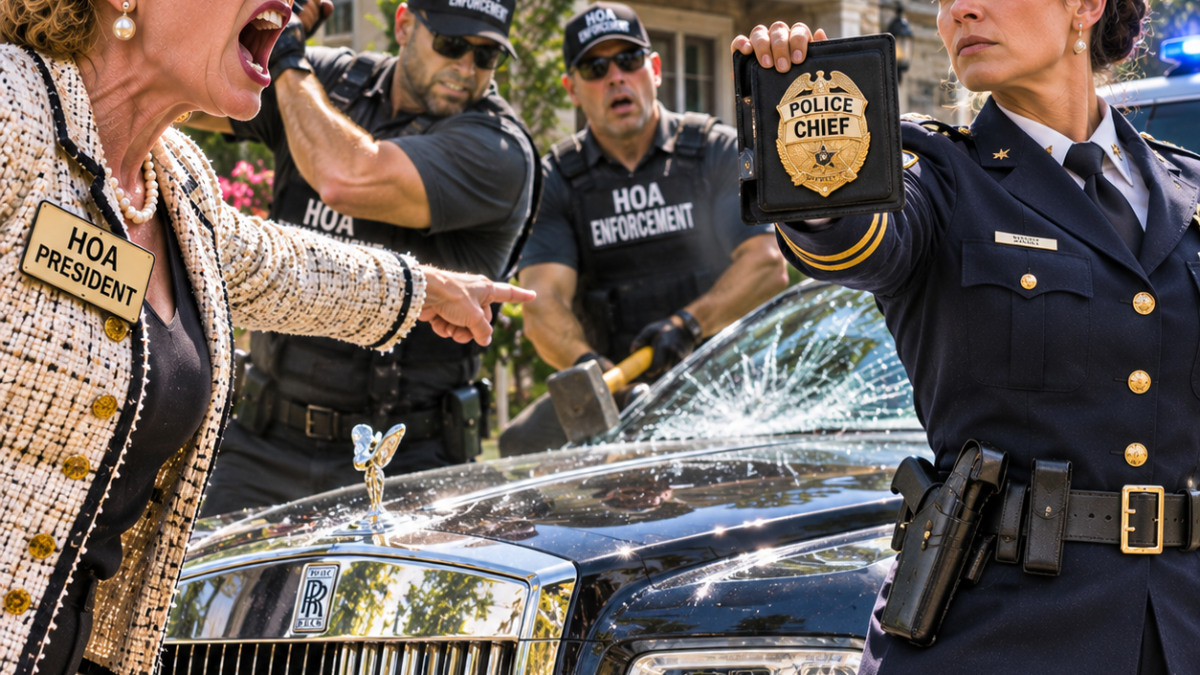
The first strike hit the driver-side window.
A deep crack.
The second shattered it.
Safety glass burst across the seat and driveway.
The sound was violent enough that Mrs. Patterson’s curtains opened across the street.
Jake stepped back.
Even he looked shocked.
Delilah did not.
“Continue.”
He damaged the door frame trying to reach the interior release.
Then dragged the tool along the paint.
I wanted to hit him.
That is the truth.
I wanted to grab the crowbar.
I wanted to knock him into the grass.
Army training does not disappear because you start installing wheelchair ramps.
But years of helping veterans rebuild their lives had also taught me something else.
One bad decision can become the only thing anybody remembers about a good man.
So I kept recording.
Then our front door opened.
Elena stepped outside.
Full dress uniform.
Dark jacket.
Polished shoes.
Badge bright enough to catch the sunrise.
She stopped.
Looked at the car.
Then at Jake.
Then Delilah.
The broken window.
The crowbar.
Tow truck.
Three fake enforcement shirts.
Glass beneath her shoes.
Her face went through shock.
Anger.
Then something colder.
Professional.
“What happened to my car?”
Delilah answered immediately.
“Community standards enforcement.”
Elena looked at me.
I nodded toward my phone.
“Been recording.”
Her eyes returned to Delilah.
“What legal authority do you have to break a vehicle window?”
Delilah smiled.
“Emergency powers.”
“Under what provision?”
“Community Association Act. Section Forty-Seven. Emergency Powers Clause.”
Elena took out her phone.
Opened the camera.
“Would you repeat that?”
Jake swallowed.
“Aunt Delilah…”
“Quiet.”
Elena said:
“I’m making an insurance record.”
That seemed to satisfy Delilah.
“HOA boards possess full authority to remove serious violations when residents refuse immediate compliance.”
“And 47B?”
“I wrote that provision myself.”
Elena paused.
“You wrote it?”
“Yes.”
“So it isn’t in the recorded covenants?”
“It doesn’t need to be.”
Jake looked toward the tow truck.
The operator started backing away.
Good instincts.
Elena kept her voice calm.
“Did you authorize the broken window?”
“Yes.”
“Did you authorize these men to enter our driveway?”
“Yes.”
“Did you instruct them to tow the car?”
“Yes.”
“And you believe you have legal authority to do all three?”
Delilah looked into the camera.
“Absolutely.”
Elena lowered the phone.
“Thank you.”
For the first time, Delilah became uncertain.
“Why?”
“Insurance claim.”
Elena smiled.
“And police report.”
The confidence in Delilah’s face cracked.
Only slightly.
Enough.
“Police?”
“Property damage exceeds two thousand dollars.”
Delilah waved one hand.
“This isn’t vandalism. It’s enforcement.”
“That will be something investigators can determine.”
Jake took one step backward.
“Maybe we should leave.”
Delilah glared at him.
“Do not show weakness to these people.”
These people.
The words sat between us.
Elena’s expression did not change.
Mine did.
Delilah looked toward Elena’s uniform.
“What exactly do you do?”
Elena glanced at her watch.
“I’m getting sworn in this morning.”
“As what?”
“Police chief.”
Nobody moved.
I wish I could tell you Delilah collapsed.
She didn’t.
Real arrogance is resilient.
She stared.
Then laughed once.
“You expect me to believe that?”
Elena pulled out the county credential wallet already issued the day before.
Displayed it.
Delilah stopped laughing.
“I’ve been with the department fifteen years.”
Elena returned the wallet to her pocket.
“Today’s the ceremony.”
Jake whispered:
“Oh, God.”
Elena looked at him.
“No.”
“Not yet.”
Then she looked at Delilah.
“This incident will be handled by officers who do not report directly to me because I’m involved personally.”
That detail mattered.
She knew it.
I knew it.
Delilah probably did not.
“My position doesn’t let me investigate my own property dispute.”
Elena stepped carefully around the broken glass.
“But it does mean I know exactly how evidence should be preserved.”
She looked at me.
“Marcus, don’t touch the car.”
I nodded.
Then Elena looked toward Mrs. Patterson’s house.
Her phone was visible in the window.
Recording.
“Looks like we won’t have to rely only on ours.”
Delilah followed her eyes.
And for the first time that morning, she looked afraid.
Mrs. Patterson’s video was twenty-three minutes long.
Every minute.
Tow truck arriving.
Delilah directing Jake.
My warning.
The first crowbar strike.
Second.
Delilah’s statements.
High-definition.
Clear audio.
Her late husband had been a postal worker.
He apparently believed in two things.
Correct postage.
Documenting everything.
Mrs. Patterson had followed both principles faithfully.
By eight that morning, we had:
My video.
Elena’s video.
Mrs. Patterson’s footage.
The fake citation.
HOA documents showing no 47B.
Tow company information.
Photographs.
Then Elena went to her ceremony.
That part mattered too.
She did not cancel.
Did not put on a badge and start personally arresting neighbors.
She turned the evidence over to the sheriff’s office and requested the matter be handled independently.
Then she stood before county officials and took her oath.
I sat in the audience thinking:
My wife’s car was attacked two hours ago and somehow this is still the proudest morning of my life.
Afterward she hugged me.
“How bad?”
“Window.”
“Door.”
“Paint.”
“Anything else?”
“My blood pressure.”
She smiled.
Then became serious.
“I can’t be the face of the investigation.”
“I know.”
“I need to recuse myself from charging decisions involving our property.”
“I know.”
“But I can still be a witness.”
“Yes.”
“And a resident.”
“Yes.”
She nodded.
“Good.”
That distinction became critical later.
Delilah would eventually accuse Elena of using police power for revenge.
The record showed otherwise.
Elena stepped away from decisions directly involving us.
Independent investigators handled the evidence.
Transparency saved her career.
It also made Delilah’s story harder to sell.
By noon, Delilah had issued twelve new violations.
Not to us alone.
Witnesses.
Mrs. Patterson received one for:
UNAUTHORIZED SURVEILLANCE ACTIVITY.
Harold Kowalski received:
AGGRESSIVE LAWN ORNAMENT POSITIONING.
His crime was a fishing gnome.
Mrs. Adrienne had one small Valentine wreath.
She received:
EXCESSIVE SEASONAL DISPLAY.
$150 each.
Forty-eight hours to comply.
I stood in Harold and Betty Kowalski’s kitchen reading the papers.
Harold was a retired union organizer.
Thirty years negotiating with companies that employed entire floors of lawyers.
He had the warm, dangerous smile of a man who had spent retirement waiting for someone to give him a reason to organize again.
“Bring coffee,” he had told me.
Betty brought cookies.
Chocolate chip.
Harold called them:
“Stick-it-to-the-man cookies.”
Betty did not disagree.
We started comparing histories.
Seven years.
That was how long Delilah had controlled Willowbrook.
Her enforcement officer?
Jake.
Her nephew.
Paid through neighborhood funds.
Then there was Rick.
Brother-in-law.
Occasional “security consultant.”
And Tyler.
Young man who seemed permanently confused.
Residents had stories.
Fines for flags.
Mailboxes.
Mulch.
Decorations.
A memorial garden.
Parking.
Grass.
Window trim.
The pattern was not merely strict enforcement.
Some alleged violations did not appear in the governing documents at all.
The worst story belonged to Luis Rodriguez.
His daughter used a wheelchair.
They had installed a front ramp.
Properly designed.
Permitted.
Needed.
Delilah had forced its removal because it “damaged architectural continuity.”
That made my hands curl into fists.
I had spent five years helping disabled veterans remain independent inside their own homes.
I knew enough accessibility law to know that disability accommodations involve rights that cannot be dismissed with:
“Doesn’t match the neighborhood.”
Elena later made sure the Rodriguez family was referred to qualified civil-rights counsel rather than pretending she personally knew every housing statute.
Again:
Real cases.
Real experts.
That became our rule.
Betty had the best records.
Not because she had any official title.
Because she kept everything.
HOA budgets.
Fine notices.
Assessment letters.
Meeting packets.
Screenshots.
Seven years.
She spread them across the kitchen table.
“According to the records we have, about $127,000 in fines were collected.”
Harold whistled.
I looked at the totals.
“Does that mean stolen?”
Betty shook her head.
“No.”
I liked her immediately.
“It means collected.”
“Good distinction.”
“We need to know which fines were authorized.”
“Exactly.”
Then she showed us emergency assessments.
Some had no clear supporting minutes.
Others referenced legal expenses that residents could not match to any known case.
We did not call it fraud yet.
We called it:
Questions.
Lots of them.
That restraint helped us later.
Delilah called a mandatory meeting.
Attendance required.
$500 fine for anyone absent.
Harold laughed so hard he almost inhaled coffee.
“She thinks she’s running a prison yard.”
Betty corrected him.
“No.”
“She thinks she owns one.”
The notice accused “outside agitators” of coordinating resistance to lawful community governance.
Outside agitators.
I had lived there.
Paid dues.
Owned property.
Apparently disagreement transformed citizenship.
Harold looked at me.
“She just put everybody in one room.”
I smiled.
“Yes.”
He understood immediately.
“Good.”
We didn’t plan a public ambush.
Not in the way Delilah later claimed.
We planned education.
Residents deserved to know:
What rules actually existed.
What financial records showed.
What legal status the association claimed.
What could be verified.
What could not.
And how to get independent advice.
That distinction matters because angry people love certainty.
Documentation rarely gives you certainty all at once.
It gives you questions strong enough to demand answers.
Then the Secretary of State records produced the biggest question.
Willowbrook Heights Community Association, as Delilah described it, did not appear in the state database under the name on her citations.
That did not automatically mean every neighborhood obligation vanished.
Property covenants and community-association structures can be complicated.
But it did mean her repeated claims of corporate authority deserved serious scrutiny.
The original developer’s company had failed years earlier.
The final association documents were incomplete.
The professional law firm Delilah listed on her letterhead told residents it did not currently represent an entity under that name.
That was enough for lawyers to start asking unpleasant questions.
Elena did not announce:
“The HOA doesn’t exist.”
Instead, she said:
“The records we reviewed do not support Delilah’s description of her authority.”
Less dramatic.
More defensible.
And far more dangerous to Delilah.
Delilah came to our house that afternoon.
Power suit.
Old briefcase.
Smile stretched too tightly.
Elena opened the door.
“Coffee?”
Delilah hesitated.
Then entered.
The dining room was covered with copies of public records and resident-provided notices.
Not confidential police data.
That distinction matters too.
Elena never used restricted law-enforcement databases to build our neighborhood case.
She knew better.
Everything on the table came from residents, public records, or evidence submitted through proper channels.
Delilah saw it.
Her face lost color.
“What is this?”
“Resident records,” Elena said.
“Why?”
“Because people have questions.”
Delilah set her briefcase down.
“You’re orchestrating harassment against me.”
“No.”
“You’re using your office.”
“No.”
Elena sat.
“I have recused myself from investigative decisions involving our personal property damage.”
Delilah blinked.
“I’m here as a homeowner.”
“You’re a police chief.”
“Yes.”
“Then stop pretending that doesn’t intimidate people.”
Elena nodded.
“That’s why I’m being careful.”
Delilah looked at the paperwork.
Then the Secretary of State search.
“What is that?”
“Public record.”
“Willowbrook Heights is legal.”
“Then the board should be able to produce the formation and governing documents supporting the authority you claim.”
“I have them.”
“Good.”
“Then bring them to the meeting.”
Delilah’s jaw tightened.
Elena continued:
“And stop issuing emergency fines against residents for witnessing what happened to our car.”
Delilah stood.
“You don’t tell me how to run my community.”
Elena looked up.
“No.”
“The governing documents do.”
Delilah picked up the briefcase.
Then turned toward me.
“This is your fault.”
I laughed softly.
“I didn’t swing the crowbar.”
She left.
By then the sheriff’s investigators had interviewed Jake.
The tow operator.
The two men in enforcement shirts.
Jake apparently believed Delilah had valid authority.
I did not know whether that was true.
But his confidence had changed.
He stopped patrolling for two days.
Then returned wearing the same uniform.
Bad choice.
Soon he was delivering official-looking notices.
Mrs. Patterson received one demanding she appear for a “community legal hearing.”
She called Elena.
Elena told her:
“Send it to the investigators and your attorney. Don’t destroy it.”
Mrs. Patterson’s late husband had been a postal employee.
She examined the paper like a detective.
“There’s no court number.”
“No.”
“No judge.”
“No.”
“No actual court.”
“No.”
“What is this?”
“Paper.”
Mrs. Patterson smiled.
“I’m keeping it.”
Delilah’s “community safety squad” grew.
Jake.
Rick.
Tyler.
Dark shirts.
Badges.
Radios.
No governmental authority.
They measured lawns.
Photographed cars.
Knocked on doors.
People who had tolerated it for years began asking:
“Are you law enforcement?”
“No.”
“Then leave.”
That single question changed the atmosphere.
Fake authority survives on ambiguity.
Once residents forced it to declare what it was, it looked much smaller.
The Hendersons were elderly.
Recently widowed mother living with her adult son.
Delilah told them a new $1,000 emergency assessment had to be paid immediately.
When I arrived, Mrs. Henderson had a checkbook open.
Delilah stood on the porch explaining that failing to pay could expose them to government action.
I stopped at the walkway.
“Mrs. Henderson.”
Delilah turned.
“This is private HOA business.”
“I’m not talking to you.”
I looked at Mrs. Henderson.
“Before you write anything, please have your son or attorney verify the assessment and the association’s authority.”
Delilah stepped toward me.
“You are interfering with board operations.”
“Then show her the documents.”
“I don’t have to show you.”
“Not me.”
I pointed gently toward Mrs. Henderson.
“Her.”
Silence.
Mrs. Henderson closed the checkbook.
That moment mattered.
Not because Delilah lost a thousand dollars.
Because an elderly woman realized she was allowed to ask:
“Why?”
That question became contagious.
Things escalated badly after that.
Jake confronted Mrs. Patterson over her surveillance footage.
He tried to take equipment.
She called 911.
Officers responded.
The situation resulted in criminal allegations handled by independent officers.
Again:
Elena stayed away from the charging decision.
Delilah then called Elena directly.
Threatened to “have her badge.”
Said she had political connections.
Elena did not threaten back.
She ended the call.
Saved the recording consistent with local law and department policy.
Turned it over.
I asked:
“Does this change anything?”
She shook her head.
“It changes the evidence.”
Not:
“We got her.”
Not:
“She’s finished.”
Evidence.
That became the most important word in our marriage that year.
The worst night came before the mandatory meeting.
Around two in the morning, Mrs. Patterson heard someone at her back door.
Her security system uploaded footage remotely.
She called 911.
Officers arrived.
Rick and Tyler were found on the property.
Delilah was nearby.
Tools were recovered.
Investigators took over.
The allegations included unlawful entry and possible attempts to obtain or destroy resident-held records.
I will never forget seeing Mrs. Patterson afterward.
Bathrobe.
Hair a mess.
Holding a mug.
Calm.
“They wanted the videos.”
I said:
“Are you okay?”
“No.”
Then she smiled.
“But the videos are in the cloud.”
Her late husband would have been proud.
That incident ended Delilah’s ability to pretend everything was merely an HOA disagreement.
Criminal investigators were now looking at conduct unrelated to paint, lawns, or dues.
Searches followed.
Financial subpoenas.
Device warrants where authorized.
Lawyers took over.
We residents stepped back.
That was when the real case began.
The mandatory meeting still happened.
Seventy-eight households attended.
Community center.
Beige walls.
Bad coffee.
Harold stood at the front.
Not Elena.
That was deliberate.
This was a resident meeting.
A rights-and-records meeting.
The first slide:
WHAT DO OUR RECORDED DOCUMENTS ACTUALLY SAY?
Not:
DELILAH IS A CRIMINAL.
That determination belonged elsewhere.
Harold went through the association records.
Formation questions.
Missing filings.
Unclear authority.
Then Betty showed financial totals.
$127,000 in collected fines across years.
Not all automatically illegal.
But many tied to alleged rules residents could not locate.
Then Mrs. Patterson showed edited portions of her footage only where her attorney said appropriate.
Then Luis Rodriguez spoke about his daughter’s wheelchair ramp.
No theatrics.
He stood beside a photograph.
Small girl.
Pink wheelchair.
Wood ramp that no longer existed.
“My daughter asked me why the neighborhood didn’t want her outside.”
That silenced the room more effectively than any police badge.
People looked down.
Not because they feared Delilah.
Because they were ashamed.
Then independent counsel explained the legal reality.
Not every HOA fine was automatically void.
Not every community rule vanished.
But Delilah’s claimed authority had serious defects.
Residents should stop paying disputed assessments until properly reviewed by counsel.
No one should sign a lien waiver, sale agreement, or settlement without independent advice.
Financial accounts needed preservation.
A forensic audit was required.
The board needed replacement or formal reconstitution according to actual governing documents and state law.
It was less satisfying than:
“Everything was fake.”
It was also real.
People finally understood that law is rarely one dramatic sentence.
It is process.
That evening, residents voted—within the procedures their attorneys advised—to remove Delilah from whatever administrative role she legitimately held and suspend the disputed enforcement system pending review.
No one cheered at first.
Then Mrs. Patterson clapped.
Others joined.
Harold raised a hand.
“No victory laps.”
The room quieted.
“We have seven years of cleanup.”
He was right.
The criminal investigation expanded after forensic accountants reviewed money flows.
Some funds had been used properly.
Insurance.
Landscaping.
Common maintenance.
Others raised serious questions.
Delilah had paid relatives.
Consultants.
Unclear enforcement expenses.
Money passed through accounts investigators linked to entities she controlled.
The final proven number was not every dollar of the $127,000.
Important.
Prosecutors only pursued what they believed evidence supported.
That mattered to me.
I had watched Delilah invent violations.
We were not going to invent crimes in return.
The Rolls-Royce repair bill was ugly.
Window.
Door trim.
Paint.
Interior damage.
Insurance handled most of it.
Restitution claims addressed the rest.
Elena considered selling the car.
“Bad memory.”
I understood.
Then she stopped.
“No.”
“Why?”
“She doesn’t get to decide what this car means.”
Months later, repaired Cullinan back in our driveway.
Elena ran her hand along the panel.
Exactly like the first night.
“Still proof?”
I asked.
She smiled.
“No.”
“What is it now?”
“A car.”
That was healthier.
The Rodriguez family reinstalled the wheelchair ramp.
This time the neighborhood showed up.
Not because they needed help.
Marcus Ramirez does ramps for a living.
I could have built the thing with two employees in one afternoon.
But twenty neighbors came.
Harold carried lumber.
Betty brought sandwiches.
Mrs. Patterson supervised from a chair as though directing a bridge project.
Elena arrived after work.
Luis’s daughter rolled down the ramp herself.
Slowly.
Then back up.
She looked at me.
“Can it be pink?”
Her father laughed.
I said:
“Absolutely.”
We painted the railing pink.
No architectural approval requested.
Qualified counsel had already confirmed the accommodation rights.
That day was better than any arrest.
Delilah’s case eventually resolved through a combination of state and federal proceedings involving proven financial and property offenses.
Not because the FBI suddenly descended on one HOA meeting like a television finale.
Because investigators spent months following bank records.
Emails.
Contracts.
Statements.
Digital evidence.
The financial scheme turned out to extend beyond normal HOA mismanagement.
Delilah and people around her had used the association’s appearance of legitimacy to collect unauthorized money and pressure residents.
Some transactions crossed jurisdictions.
Some involved vulnerable homeowners.
Prosecutors eventually filed charges they believed they could prove.
Delilah pleaded guilty to several counts and received a custodial sentence.
Eighteen months.
Some people thought that was too short.
Others thought prison over neighborhood fines sounded extreme.
I stopped debating sentence length.
That belonged to the judge.
What mattered to me was simpler.
The scheme stopped.
Residents were compensated from recovered funds where claims could be verified.
Not every dollar came back with magical interest and emotional-damage bonuses.
Real restitution is messy.
Some people had records.
Some didn’t.
Some limitations had expired.
Some losses were too indirect.
But enough money was recovered that several families received meaningful repayment.
Mrs. Henderson used hers to visit her sister in Arizona.
First vacation in years.
She sent us a postcard.
Palm trees.
One sentence:
Nobody measured my mailbox here.
Jake received probation and community service after his role was separated from Delilah’s.
He had damaged our car.
Helped deliver fake-looking enforcement notices.
Participated in harassment.
But investigators also concluded he had been manipulated by an aunt he treated as an authority figure.
That did not make him innocent.
It did make him different.
Years later, he wrote Elena a letter.
Not asking forgiveness.
Just admitting he should have stopped after the first broken window.
She never showed me the whole letter.
Her business.
She did say:
“He finally understands he wasn’t a cop.”
That was enough.
Rick and Tyler faced consequences tied to the unlawful-entry incidents and related conduct.
Not because Tyler was “too stupid to know crime,” as the original neighborhood rumor later joked.
Courts do not issue cartoon verdicts.
Their outcomes reflected what prosecutors could prove about knowledge, intent, and participation.
Again:
Less cinematic.
More real.
Willowbrook Heights rebuilt its governance.
That sentence sounds boring.
Good.
Boring governance is underrated.
Residents hired counsel.
Reviewed recorded covenants.
Formed or corrected the association structure properly where required.
Transparent accounts.
Real elections.
Published minutes.
Independent financial review.
No private enforcement squad.
No fake badges.
No nephews with crowbars.
No rules invented by one president because something annoyed her.
If the community wanted a new restriction, it followed the actual amendment procedure.
That meant notice.
Voting.
Records.
Sometimes a proposal failed.
Wonderful.
Failure is part of democracy.
Harold and Betty became the unofficial historians of the whole nightmare.
Harold refused formal presidency.
“I spent thirty years fighting management.”
“No chance I’m becoming management.”
Eventually, a retired teacher named Carol accepted.
Her first meeting began with:
“If you hear me say ‘because I said so,’ please remove me.”
Everyone laughed.
Healthy sign.
Mrs. Patterson rebuilt her late husband’s memorial garden.
The one Delilah had forced her to dismantle.
Stone border.
Small flag.
Three rose bushes.
Bench.
No grand sign.
I helped install a low-voltage lighting system.
She stood beside it at dusk.
“George would’ve liked this.”
“I’m sure.”
“He hated LEDs.”
I laughed.
“Then George was wrong.”
She slapped my arm.
The lights came on.
Warm.
Quiet.
No violation notice arrived.
My contracting business did grow.
Not because I became an HOA investigator.
I refused that label.
I was a contractor.
Still am.
But people started asking whether I could help them understand accessibility requirements and how to document accommodation requests.
That part made sense.
I built a consultation program.
Not legal advice.
Construction and accessibility planning.
We partnered with lawyers and disability advocates when rights questions arose.
The Rodriguez ramp became our first community-funded project.
Then twenty-three more modifications over the next two years.
Ramps.
Grab bars.
Doorways.
Bathrooms.
Something ugly had produced something useful.
I could live with that.
Elena built a public-education program through the department with outside legal experts.
Not:
“How to destroy your HOA.”
“How to recognize fake authority.”
How to verify an officer.
How to report property damage.
How to document threats.
How to avoid confusing civil disputes with criminal conduct.
How elderly residents can seek help when someone pressures them for money.
How officers should respond when private organizations wear uniforms that resemble law enforcement.
That last one came directly from Jake.
The program eventually got attention from neighboring agencies.
Elena hated media interviews.
I loved watching her suffer through them.
Marriage.
The most important reform involved appearance.
Badges.
Uniforms.
Official-looking notices.
People assume presentation equals authority.
Delilah exploited that.
A shirt with “Community Safety.”
A clipboard.
A seal.
A code number.
A confident voice.
Humans are trained to comply.
Elena started telling residents:
“Before arguing, verify who the person is.”
That advice saves more trouble than dramatic confrontation.
The community trust came later.
Not some grand replacement government.
A small nonprofit residents created for neighborhood improvement.
Accessibility grants.
Emergency home repairs.
Mediation.
No power to fine.
No power to lien.
No fake police.
Mr. Rodriguez coordinated accessibility projects.
I volunteered labor several weekends a year.
Betty watched every dollar like the money had insulted her personally.
Perfect treasurer.
One afternoon she called.
“Marcus.”
“Yes?”
“Your receipt is missing.”
“What receipt?”
“Grab bars.”
“I donated them.”
“Then give me an in-kind donation form.”
“Betty.”
“Marcus.”
I drove over.
Paperwork matters even when good people are in charge.
Especially then.
That may be the biggest lesson Delilah left behind.
Systems should not depend on someone remaining good forever.
Controls exist because people change.
The repaired Rolls-Royce remained.
Not forever.
Three years later Elena sold it.
Why?
“Too expensive.”
I nearly collapsed.
“You finally agree?”
“Do not enjoy this.”
She replaced it with an SUV that cost less than half.
Still nice.
No one attacked it.
I told her:
“Disappointing.”
“What?”
“Zero drama.”
“Marcus.”
“Fine.”
The original piece of shattered Rolls-Royce glass lives in a small jar in our garage.
Elena calls that weird.
She keeps her first police badge.
Same principle.
Objects become memory.
I keep one shard because it catches light.
Beautiful.
Dangerous.
Just like the morning it came from.
People tell the story now and say:
“HOA Karen smashed the police chief’s Rolls-Royce.”
Good headline.
Wrong emphasis.
Delilah did not lose because Elena was police chief.
If that had been the reason, the story would be a dangerous one.
A powerful official crushing a neighborhood enemy.
Elena protected herself from that accusation by stepping away from decisions where we were personal victims.
Delilah lost because neighbors documented conduct.
Because records contradicted claims.
Because investigators followed money.
Because witnesses spoke.
Because independent legal processes existed.
Elena’s position helped her recognize what needed preservation.
It did not make her the judge.
That difference matters.
A lot.
Sometimes strangers ask:
“Did Delilah know Elena was chief?”
No.
She knew Elena was a police officer.
Not the promotion.
And honestly, I’m glad.
If Delilah had known before raising the crowbar, maybe she would have behaved.
Then Mrs. Patterson’s garden might still be gone.
Rodriguez’s daughter might still lack a proper ramp.
Mrs. Henderson might still be paying questionable assessments.
Some systems survive because bullies are smart enough to avoid hurting powerful people.
Delilah made the mistake of treating us exactly as she treated everyone else.
That exposed the pattern.
I once told Elena that.
She stared at me.
“So you’re saying the Rolls was sacrificed for justice?”
“Basically.”
“We should’ve bought a Toyota.”
“Wouldn’t have been as cinematic.”
She threw a pillow at me.
The neighborhood never created a “Freedom from Fear Festival.”
That became another exaggerated rumor.
We did have an annual block party.
Much less dramatic.
Grills.
Music.
Kids.
Cornhole.
Mrs. Patterson’s cookies.
The first year, Harold made a sign:
NO CLIPBOARDS ALLOWED.
Carol, our actual association president, stood underneath holding meeting minutes.
Everyone laughed.
That was enough.
Mrs. Patterson became neighborhood-watch coordinator.
No badge.
No fake enforcement power.
Just:
“If something weird happens, call the actual police.”
Her rule.
Very effective.
She also became notorious for cameras.
Eight.
Maybe nine.
I told her:
“You don’t need that many.”
“Neither did you need a Rolls-Royce.”
Fair.
The Kowalskis worked with state advocacy groups on association transparency.
Not one miraculous law named after us.
Real policy work takes longer.
But they supported reforms around financial disclosure, board notice, registration, and homeowner access to records.
Harold loved committee hearings.
I would rather crawl under a house full of spiders.
Everyone has a gift.
I stayed out of politics.
Mostly.
If somebody proposed a rule that affected accessibility, I showed up.
That was my line.
Wheelchair ramps should not require a family to become legal scholars.
Neither should grab bars.
Door widths.
Handrails.
A community can care about design.
It cannot care about design more than whether a person can enter their own home.
Luis’s daughter eventually outgrew the pink ramp.
We widened it.
She wanted purple this time.
Her father looked at me.
“Will that hurt property values?”
“Catastrophically.”
We painted it purple.
Carol came by.
Looked.
“Beautiful.”
I said:
“You are a terrible HOA president.”
She smiled.
“Thank you.”
Years later, we found one of Delilah’s old fake violation books in storage.
Carbon copies.
47A.
47B.
47C.
Entire code numbers she had simply created.
Harold held it like an archaeological artifact.
“Look.”
“Garbage.”
“History.”
Betty said:
“Evidence.”
We donated copies to the association archive.
Original went to counsel for records retention.
Nobody framed it.
Enough trophies.
The hardest victim story remained Mrs. Patterson’s garden.
Not because of money.
Because the garden had belonged emotionally to her husband.
Delilah did not understand that.
People who control aesthetics forget objects carry private meaning.
Flag.
Ramp.
Garden.
Car.
Gnome.
Mailbox.
A rule sees an object.
A human sees a life attached to it.
Good governance has to remember the second part.
Jake eventually moved.
Before leaving, he came to our door.
No uniform.
No badge.
No crowbar.
Jeans.
Hoodie.
Elena was home.
He stood at the bottom of the steps.
“I’m sorry.”
She waited.
He looked at me.
“I shouldn’t have touched the car.”
“No.”
“I thought she had authority.”
“Maybe.”
“I knew she didn’t have authority to smash a window.”
There it was.
Honest.
Elena crossed her arms.
“What are you going to do differently next time somebody in authority tells you to do something wrong?”
Jake looked at her.
“Ask what gives them the right.”
She nodded.
“Good.”
He left.
I never saw him again.
I prefer remembering him that way.
Not as the idiot with the crowbar.
As someone who finally understood the question he should have asked.
Delilah never apologized to us.
Not directly.
Her lawyer sent restitution paperwork.
Court notices.
Nothing personal.
For a while, that bothered Elena.
Then she stopped caring.
I asked why.
“She apologized to the judge in sentencing.”
“Not us.”
“I don’t need her emotionally involved in my life anymore.”
Smart woman.
That is one reason she became chief.
Her career continued.
First female police chief.
That accomplishment eventually stopped being linked to the HOA mess.
Good.
She deserved an identity bigger than Delilah.
She improved domestic-violence response.
Officer training.
Community outreach.
Recruitment.
Years later, people mentioned the Rolls story less than the things she built inside the department.
That mattered to me more.
I remained the accessibility contractor.
Not “the HOA fraud guy.”
Mostly.
Some clients still recognized me.
One veteran opened his door.
“Hey, Rolls-Royce man.”
I sighed.
“Where’s the bathroom?”
He laughed.
Good.
Normal work.
The community changed.
Kids returned to front yards.
Decorations became more varied.
Not chaos.
Personality.
One house had blue shutters.
Another a ridiculous inflatable dragon every Christmas.
Harold’s lawn gnome survived.
The fishing gnome became unofficially famous.
Someone put a tiny toy clipboard in its hand.
Harold nearly cried laughing.
I still think about the first window strike.
The sound.
Glass across the driveway.
My instinct to fight.
What would have happened if I had?
Maybe Jake injured.
Maybe me arrested.
Maybe Delilah’s whole story changes.
“Violent new resident attacks community officer.”
That is why I tell people:
Do not give a bully the evidence they wish they had.
Record.
Call authorities.
Step back when possible.
You can be furious without becoming useful to the other side.
That is hard.
It is also power.
The most effective thing Elena did that morning was not showing her badge.
It was asking:
“Please repeat your authority.”
Delilah did.
Repeatedly.
That technique stayed with me.
When someone makes a big claim, let them explain it.
People sometimes expose their own weakness if you stop interrupting.
Harold called it:
“Letting management write your grievance for you.”
Army people call it something else.
Lawyers call it admissions.
Whatever the name, silence can be strategic.
Our driveway was repaired.
No glass left.
No diesel marks.
Eventually the memory detached from the concrete.
That was surprising.
For months, I saw the attack every morning.
Then one day I came outside and saw only driveway.
Healing again.
Quiet.
Unannounced.
Elena sometimes parks her current SUV exactly where the Rolls sat.
I asked:
“Does it bother you?”
“No.”
“How?”
“Because if I avoid the spot, Delilah still owns part of the driveway.”
That sounded like something she had learned from me.
I liked that.
The Willowbrook trust helped Mrs. Henderson replace an aging furnace.
Betty made her fill out one page.
Mrs. Henderson said:
“Only one?”
Betty replied:
“We are not the government.”
Harold from across the room:
“Speak for yourself.”
Same people.
Different use of power.
That is the point.
The funds recovered from Delilah’s scheme were not enough to erase seven years.
Some families had sold homes.
Some relationships were damaged.
Some people moved.
Some memories remained ugly.
Justice is not rewind.
I wish it were.
It is correction.
Compensation.
Accountability.
Then rebuilding.
Just like a ramp.
Just like a garden.
Just like a neighborhood.
One reporter asked Elena if she considered herself the hero.
She said:
“No.”
“Who is?”
“Mrs. Patterson’s camera.”
Reporter laughed.
Elena did not.
Then added:
“And every resident who kept a letter because something felt wrong.”
That was the real answer.
Betty still has the spreadsheet.
Every fine.
Color-coded.
She updates it occasionally for training sessions.
I asked:
“How long are you keeping that?”
“Until I die.”
“Then what?”
“Harold gets it.”
Harold looked horrified.
“I’m dying first.”
They have been married forty-three years.
Romance.
My personal favorite record is the original 47B citation.
Luxury Vehicle Display Violation.
I keep it in the same folder as the repair invoice.
When new community leaders train, Carol sometimes uses it.
“Question one.”
She holds up the paper.
“Where is 47B?”
Everybody answers:
“Nowhere.”
Good.
People still like the giant dramatic version.
Fake HOA police.
Police-chief wife.
RICO.
Federal agents.
Hundreds of thousands recovered.
I understand.
Drama is memorable.
But when I think about that year, the thing I remember most is Mrs. Henderson closing her checkbook.
An older woman.
Delilah on the porch.
Me saying:
“Verify first.”
The checkbook closed.
That small click.
That was power changing hands.
Not to me.
Back to her.
Exactly where it belonged.
If I had to summarize everything Delilah misunderstood, I would use one word.
Consent.
She thought being president meant consent was implied.
Fine.
Access.
Tow.
Ramp.
Money.
Attendance.
Property.
Everything.
Real authority has boundaries.
Good authority explains them.
Bad authority resents being asked.
Delilah resented the question.
That is why one imaginary code became a criminal investigation.
I sometimes wonder what would have happened if she had walked over the first night.
Seen the Cullinan.
Said:
“Beautiful car.”
Then gone home.
Nothing.
No investigation.
No community revolt.
Maybe years more of fake fines.
Maybe Mrs. Patterson never rebuilt the garden.
Maybe Luis’s daughter stayed ashamed of her ramp.
Maybe Henderson paid another thousand.
One unnecessary act of arrogance can expose an entire system.
That does not make the act good.
It means truth sometimes enters through the crack somebody else creates.
In our case, the crack was a Rolls-Royce window.
The jar with the glass shard sits in my workshop.
Beside Elena’s old promotion photo.
She hates it.
I keep it.
The glass sparkles when sunlight hits.
I think about how Delilah stood there believing she was demonstrating power.
In reality she was creating evidence.
The sound that morning felt like something breaking.
It was.
Just not our future.
It was the illusion that everybody in Willowbrook had to obey because nobody had ever forced her to prove why.
Today, Willowbrook is boring.
I mean that as praise.
Association notices:
Snow removal.
Pool maintenance.
Annual budget.
Meeting.
No emergency relocation orders.
No mandatory loyalty sessions.
No fake court summons.
No enforcement squads.
The biggest controversy last year was whether to replace the community-center carpet with gray or brown.
The vote took forty minutes.
Nobody went to jail.
Progress.
Mrs. Patterson voted brown.
Harold wanted gray.
They still argue.
Elena refuses to take sides.
I said:
“Sage green.”
Nobody laughed.
Tough room.
Sometimes Elena and I sit on the porch.
Coffee.
Kids riding bikes.
Gnome across the street.
Cars.
Ordinary.
She asks:
“Do you miss the Rolls?”
“No.”
“You loved it.”
“I loved watching you love it.”
She smiles.
“Good answer.”
Marriage.
The most expensive car we ever owned lasted three years.
The lesson lasted longer.
Status never protected us.
Money did not protect us.
Elena’s badge did not automatically protect us.
Records did.
Neighbors did.
Procedure did.
People refusing to keep being afraid did.
That is less glamorous than a $180,000 SUV.
It is also more valuable.
Delilah Thornwick stood in our driveway at sunrise and ordered a man to smash my wife’s car because she believed seven years of unchecked neighborhood authority had become the same thing as law.
She had a fake rule.
Fake enforcement power.
A nephew in a uniform.
A clipboard.
A phone camera.
And an entire street conditioned to avoid becoming her next target.
What she did not have was the authority she kept claiming.
Once people asked her to prove it, everything changed.
The car damage became a police report.
The report became questions.
The questions became records.
The records became a pattern.
And the pattern became a case Delilah could no longer control with threats.
She thought the biggest surprise was Elena becoming police chief.
It wasn’t.
The biggest surprise was discovering that the woman she tried to intimidate understood enough about real authority to know when not to use it personally.
Elena stepped back.
Independent investigators stepped in.
That decision protected the case.
Protected her career.
And made Delilah’s accusations of revenge collapse.
Real power does not mean doing whatever you can.
It means knowing exactly what you should not do.
Delilah never understood that.
She believed power meant fewer limits.
Elena had learned the opposite.
The higher your authority, the more important your limits become.
That is probably why one became chief.
And the other eventually became a defendant.
The Rolls-Royce is gone now.
The repaired memorial garden remains.
The purple wheelchair ramp remains.
The neighborhood trust remains.
The association’s transparent records remain.
Mrs. Patterson’s cameras definitely remain.
Harold’s gnome remains.
So does the little toy clipboard in its hand.
Some legacies deserve marble statues.
Others deserve a plastic fisherman.
I still work with disabled veterans.
Last week we finished a ramp for a former Marine.
He rolled outside by himself for the first time in months.
Looked at the slope.
Then me.
“Feels weird.”
“What?”
“Not asking somebody to help.”
That is why I still do the job.
Not for HOA fights.
Not headlines.
Not stories.
Access.
Control over your own home.
That was what the entire Willowbrook battle was about too, when you strip away the expensive car and ridiculous fake codes.
Who gets to decide what happens on your property?
Who gets to enter?
Who gets to take?
Who gets to demand?
And when somebody claims authority, can they prove it?
If you ever face something similar, I would not tell you to become Marcus Ramirez.
Do not buy cameras because a story online said so.
Do not assume your local law matches ours.
Do not start a war with your association.
Start smaller.
Read.
Save.
Ask.
Verify.
Get qualified help.
Keep your own behavior clean.
And if someone wearing a fake badge tells you they have the right to smash your car?
Call the real police.
Preferably before the second swing.
Elena says that joke is not funny.
I disagree.
Healing privileges.
The morning Delilah destroyed our celebration car, she believed she was teaching the new family a lesson:
Follow my rules.
Seven years later, when people in Willowbrook tell the story, they describe a different lesson.
A rule that cannot be found is not made real by a clipboard. Authority that cannot be proved is not strengthened by a badge-shaped piece of plastic. And fear only works until neighbors start comparing the letters they were too embarrassed to show one another.
Delilah thought the broken Rolls-Royce window would remind us who controlled Willowbrook Heights.
Instead, the sound woke up the whole neighborhood.
And once seventy-eight families finally opened their records, compared their stories, and started asking the same four words—
“Show me the authority.”
—her seven-year reign was already over.
The courts just had to catch up.








