PART2:“SHUT UP AND SERVE THE CHAMPAGNE, YOU USELESS WOMAN!” My Son’s Bride Slapped Me at His $100,000 Wedding — Then the Announcer Introduced Me as the Groom’s Mother, and Her Face Turned White
My name is Lauren Henderson.
I’m sixty-one years old.
And until that Saturday morning, I believed there were certain experiences a mother could prepare herself for.
Watching her child grow up.
Watching him move away.
Watching him love someone else.
Watching him become a man with decisions, responsibilities, and a life that no longer revolved around her.
I knew all those things were supposed to happen.
I’d never wanted Glenn to remain my little boy forever.
But I wasn’t prepared to discover that my son was about to marry a woman who considered his mother an embarrassment before she’d even met her.
And I certainly wasn’t prepared to learn just how carefully she’d been trying to remove me from his life.
Glenn was my only child.
His full name was Glenn Michael Henderson.
I named him after my father, Michael, a quiet, hardworking man who believed you could tell more about someone’s character by how they treated a janitor than by how they treated a company president.
Dad used to say, “Lauren, pay attention to the people who can’t do anything for you. That’s when you’ll see who somebody really is.”
I heard those words throughout my childhood.
When we went to restaurants, Dad thanked the servers.
When someone cleaned our church, he stopped to ask how their day was going.
When he saw a person struggling with groceries, he’d offer a hand.
He wasn’t wealthy.
He drove an old pickup with rust near the wheel wells.
His work boots were always dirty.
But he had the kind of dignity that didn’t require an expensive suit.
He died when Glenn was a baby.
I still remember standing beside his grave, holding my son against my chest.
Glenn was too young to understand where his grandfather had gone.
But I promised myself he would grow up knowing the kind of man he had been.
I wanted him to understand that honest work mattered.
That kindness mattered.
That nobody became more important than someone else simply because they had a larger bank account.
For most of Glenn’s life, I believed I’d succeeded.
He was a gentle little boy.
Curious about everything.
Always taking things apart.
When he was six, he dismantled the toaster because he wanted to know where the heat came from.
I found him sitting on the kitchen floor surrounded by screws.
“Glenn Michael Henderson!”
He looked up.
His eyes widened.
“Mom, I can explain.”
I folded my arms.
“You’d better.”
He held up a little metal component.
“I wanted to see how it works.”
I tried to look angry.
Really, I did.
But something about his serious expression made me laugh.
After that, I made sure he had safe things he could take apart and rebuild.
Old radios.
Broken clocks.
Mechanical toys.
He loved understanding how things worked.
By the time he was a teenager, he could repair bicycles, lawn mowers, and small engines.
He had hands like my father.
Patient hands.
Practical hands.
Hands that seemed happiest when they were fixing something.
At seventeen, Glenn told me he wanted to become an automotive technician.
I smiled.
“Then become a good one.”
Some people in our family suggested he should choose a more prestigious career.
Engineering.
Finance.
Law.
Something that required an office and a tie.
But Glenn loved working with cars.
I never saw a reason to be ashamed of that.
He was good at it.
He worked hard.
He earned a living doing something he understood.
And whenever he came home with grease under his fingernails and a satisfied smile on his face, I thought about my father.
Honest work matters.
That was the boy I raised.
And that was the man I feared I was losing.
Glenn married young.
His first marriage ended five years before the wedding at the Grand View Hotel.
I won’t pretend it was an easy time.
He and his first wife had wanted different things.
They tried.
They argued.
Eventually, they separated.
I watched my son struggle with the disappointment.
He blamed himself for things that weren’t entirely his responsibility.
He stopped visiting friends.
Stopped enjoying the hobbies he’d always loved.
Sometimes he’d come to my house, sit at the kitchen table, and stare into his coffee.
I didn’t know how to fix his sadness.
So I didn’t try to force it away.
I cooked.
Listened.
Let him talk when he wanted.
And reminded him that a failed marriage didn’t make him a failed man.
Over time, he recovered.
He found steady work at a logistics company.
His mechanical experience made him valuable.
He understood equipment, maintenance schedules, and the practical problems that other employees only saw on spreadsheets.
He bought a modest house.
A house he repaired with his own hands.
I remember the first time he showed it to me.
The kitchen needed paint.
The bathroom tiles were cracked.
One bedroom had an ugly green carpet.
But Glenn was smiling so hard he looked like a little boy again.
“Mom, look.”
I stood in the doorway.
“What am I looking at, sweetheart?”
“My house.”
He laughed.
“Mine.”
I hugged him.
“Oh, Glenn.”
He showed me every room.
Every planned improvement.
Every little repair.
And when we reached the garage, he stopped.
“This is the best part.”
I looked at the concrete floor.
The workbench.
The shelves.
Then smiled.
“Of course it is.”
He laughed.
And for the first time since his divorce, I felt certain that my son was finding his way back to himself.
Then his phone calls began changing.
At first, I barely noticed.
We’d always spoken regularly.
Sometimes once a week.
Sometimes more.
He’d tell me about work.
Ask how my garden was doing.
Complain about traffic.
Tell me which old car he was restoring in his spare time.
Then the calls became shorter.
He sounded distracted.
There was always somewhere he needed to be.
“Mom, can I call you later?”
“Of course, honey.”
“I’m busy tonight.”
“No problem.”
“I’ve got plans.”
“Have fun, sweetheart.”
I didn’t question him.
He was thirty-two.
He had a life.
I’d never wanted to become one of those mothers who demanded constant attention from an adult child.
But after a while, I noticed something.
He stopped talking about his friends.
Stopped telling me about the cars he was repairing.
Stopped mentioning the little house he’d once loved.
And whenever I asked whether he was happy, he’d answer too quickly.
“Yeah, Mom. Everything’s great.”
I wanted to believe him.
So I did.
Until the Friday morning he called to tell me he was getting married.
That weekend.
To a woman whose name I’d never heard.
I was sitting in my favorite chair beside the living-room window when the phone rang.
Outside, the garden was bright with morning sunlight.
I’d just made coffee.
My little dogwood tree was beginning to bloom.
I answered with a smile.
“Hello, sweetheart.”
“Mom.”
His voice sounded strange.
Nervous.
“Can I tell you something?”
I set down my cup.
“Of course.”
A pause.
Then he said, “I’m getting married.”
I stared at the window.
For a moment, I thought I’d misunderstood.
“Married?”
“Yes.”
I blinked.
“To whom?”
He laughed awkwardly.
“Her name’s Amy.”
“Amy?”
“Yeah.”
I sat straighter.
“Glenn, honey, I didn’t even know you were seeing somebody.”
“I know.”
He hesitated.
“Everything happened fast.”
My stomach tightened.
“How fast?”
Another pause.
“She’s incredible, Mom.”
I wanted to be happy.
I wanted to congratulate him immediately.
But something in his voice made me uneasy.
“Glenn, when is the wedding?”
He cleared his throat.
“Tomorrow.”
I almost dropped the phone.
“Tomorrow?”
“Yeah.”
“Glenn!”
“I know, Mom.”
“Why am I hearing about this now?”
A long silence.
Then he said, “Things got complicated.”
I closed my eyes.
“What does that mean?”
He sighed.
“Amy wanted to keep everything small.”
“Small?”
“Just close friends and some family.”
I stared.
“I’m your mother.”
“I know.”
His voice broke slightly.
“I know, Mom.”
For a moment, neither of us spoke.
Then he told me the location.
The Grand View Hotel.
Eight hours from my house.
I looked at the clock.
My heart was pounding.
“Glenn, I can drive.”
He sounded startled.
“Mom, you don’t have to.”
I swallowed.
“Yes, sweetheart.”
I stood.
“I do.”
There was a pause.
Then he whispered, “I’d really like you there.”
My eyes filled.
“Then I’ll be there.”
I packed that afternoon.
Not much.
A dark blue dress.
Comfortable shoes for driving.
A small handbag.
A cardigan.
My mother’s pearl earrings.
Nothing expensive.
I thought about buying a new outfit, but there wasn’t time.
Besides, I’d never believed that a person’s love became more respectable because it was wrapped in designer clothing.
I placed everything in my suitcase.
Checked the car.
Filled the gas tank.
And left before sunset.
The road stretched ahead of me.
Eight hours of highways.
Rest stops.
Coffee.
Truck headlights.
And questions.
Why hadn’t Glenn told me sooner?
Why had he kept his relationship secret?
Why did he sound nervous when he mentioned Amy?
Why had he waited until the last possible moment to invite me?
I tried to find innocent explanations.
Maybe he wanted privacy after his first divorce.
Maybe Amy’s family had arranged the wedding quickly.
Maybe he’d been embarrassed about making such a sudden decision.
I told myself not to judge somebody I hadn’t met.
I had no idea that by the following morning, Amy Wellington would give me more reasons to worry than I could have imagined.
The Grand View Hotel stood on a bluff overlooking the ocean.
It was a restored Victorian building with tall windows, white balconies, and beautifully maintained gardens.
I arrived on Saturday morning.
My back ached from driving.
My eyes felt gritty.
But when I saw the ocean beyond the hotel, I smiled.
It was a beautiful place to begin a marriage.
The kind of place people saved photographs of for the rest of their lives.
I parked.
Smoothed my dress.
Checked my hair in the rearview mirror.
Then whispered, “All right, Lauren.”
I smiled nervously.
“Let’s meet your daughter-in-law.”
I walked into the lobby.
And immediately heard a woman shouting.
“No! Absolutely not!”
I stopped.
A blonde woman stood beside an elaborate floral display.
She wore a fitted designer dress and diamond earrings.
Her hair was perfectly arranged.
Her shoes clicked sharply against the marble as she moved.
A middle-aged coordinator stood in front of her holding a clipboard.
The woman pointed toward the flowers.
“I specifically requested white peonies.”
The coordinator nodded.
“Yes, Miss Wellington.”
“These are ivory.”
He looked at the arrangements.
“They’re very close to the sample you approved.”
She stared at him.
“Do you think I’m blind?”
His face reddened.
“No, ma’am.”
“Then fix it.”
I watched quietly.
The woman continued complaining about the candles.
The chairs.
The placement of the champagne station.
Everything seemed wrong.
Everything required correction.
And every employee who approached her looked frightened.
I should have recognized the warning.
But I was tired.
And hopeful.
And convinced there must be a softer side to the woman my son loved.
So I approached with a smile.
“Excuse me.”
She turned.
I held out my hand.
“Are you Amy? I’m Lauren, Glenn’s mother.”
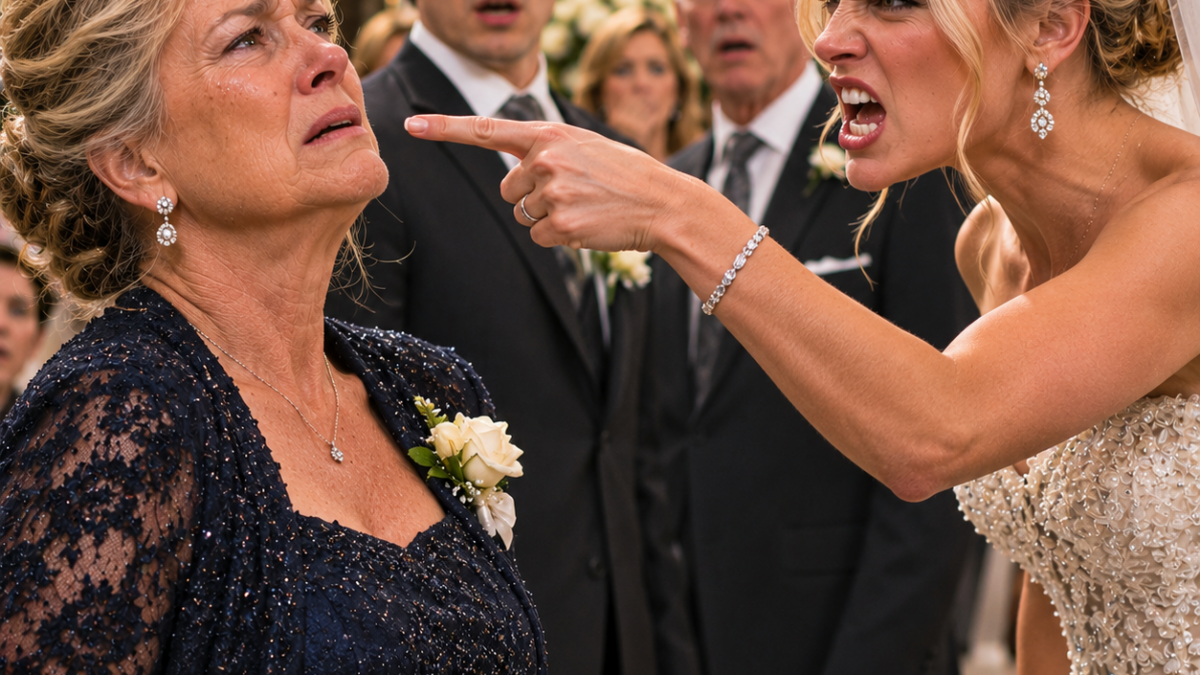
And that was when she slapped me.
I spent several minutes in the hotel restroom afterward.
I stood before the mirror beneath harsh white lights.
My cheek was red.
My lip had a small cut.
My eyes were filled with tears.
I pressed a cool, damp cloth gently against my face.
For a long time, I couldn’t understand what had happened.
She’d struck me.
A stranger.
A woman I’d approached with nothing but kindness.
She’d struck me because she believed I was a hotel employee who’d spoken out of turn.
Then she’d insulted my clothes.
Ordered me to serve champagne.
And dismissed me like an inconvenience.
I stared at my reflection.
Sixty-one years old.
Gray beginning to show at my temples.
Fine lines around my eyes.
A dress that had wrinkled during the long drive.
I looked tired.
Ordinary.
Not wealthy.
But nothing about my appearance justified what she’d done.
I lowered the cloth.
My cheek still hurt.
Part of me wanted to find Glenn immediately.
Tell him.
Show him.
Demand that he confront his bride.
But then I remembered her words.
Glenn’s mother isn’t supposed to be here.
I needed to understand why.
Because the slap was terrible.
But the possibility that my son had been persuaded to exclude me from his own wedding was something I couldn’t ignore.
I returned to the lobby.
Amy was standing with several young women in elegant dresses.
They were laughing.
She looked perfectly composed.
As though nothing had happened.
Every so often, she glanced toward the champagne station.
I stood nearby.
Not because she’d ordered me to.
Because I wanted to see what happened when Amy believed nobody important was watching.
What I saw frightened me.
She scolded a young server for setting down cutlery incorrectly.
The girl apologized immediately.
Amy continued criticizing her until the young woman turned away with tears in her eyes.
She shouted at a florist whose delivery was running slightly late.
She complained about an older hotel employee moving too slowly.
She spoke to the coordinator as though his years of professional experience meant nothing.
Then Glenn appeared.
My son.
My beautiful, hardworking boy.
He wore a black tuxedo.
His hair was neatly styled.
For a brief moment, my heart lifted.
I wanted to run toward him.
Call his name.
Hug him.
But I stopped.
Because the expression on his face made me afraid.
He looked anxious.
His smile seemed forced.
He approached Amy carefully.
“Everything okay, sweetheart?”
She turned toward him.
Her entire voice changed.
Suddenly sweet.
Gentle.
Almost musical.
“Of course, baby.”
She touched his cheek.
“Just some little problems with the staff.”
Glenn nodded quickly.
“Can I help?”
She smiled.
“Just make sure the seating is right. And please don’t let your old coworkers take over the reception.”
His expression changed.
“They’re my friends.”
She laughed lightly.
“I know, darling.”
Then she lowered her voice.
“But this is a formal event. We need people to behave appropriately.”
Glenn looked uncomfortable.
Then nodded.
I watched him walk away.
And something inside me grew cold.
Because I’d just seen my son surrender a piece of himself to avoid displeasing the woman he was about to marry.
Later, I heard Amy talking with her bridesmaids.
They stood near the edge of the reception area.
I was close enough to hear, though I wasn’t part of their conversation.
One woman asked about Glenn’s former coworkers.
Amy gave a dismissive laugh.
“Mechanics and technicians.”
She rolled her eyes.
“Can you imagine them at a wedding like this?”
Another woman laughed.
Amy continued.
“Glenn has potential, but he needs guidance.”
My chest tightened.
“He’s a little rough around the edges.”
I remembered Glenn working under his truck.
His hands stained with oil.
The proud smile when he repaired something difficult.
Amy continued.
“I’m helping him become more sophisticated.”
One bridesmaid asked, “Does he like the changes?”
Amy smiled.
“He will.”
The women laughed.
Then another asked about his family.
Amy’s expression darkened.
“Oh, that’s been a challenge.”
My heart began pounding.
“Especially his mother.”
I stood perfectly still.
Amy continued.
“She comes from a very ordinary background.”
One woman tilted her head.
“Is she coming?”
Amy smiled.
“No.”
My stomach dropped.
“I made sure Glenn understood that it would be better to keep the wedding intimate.”
Someone asked, “Was he upset?”
Amy shrugged.
“At first.”
I closed my eyes.
“Then I explained that marriage means deciding where your priorities belong.”
She laughed softly.
“His mother has had thirty-two years. It’s my turn.”
I felt as though someone had struck me a second time.
Not across the face.
Somewhere deeper.
Because Amy wasn’t simply a rude bride who’d mistaken me for an employee.
She was a woman who openly discussed my son’s love for his mother as something she needed to replace.
I walked into the garden because I couldn’t bear to listen anymore.
The ocean was bright beneath the morning sun.
White flowers bordered the stone path.
A fountain splashed quietly near a row of benches.
I sat down.
For a moment, I thought about leaving.
Getting into my car.
Driving eight hours home.
Pretending I’d never come.
But I couldn’t.
Not yet.
I had seen too much.
Heard too much.
And Glenn was preparing to make a life-changing decision.
I took a slow breath.
Then heard a man’s voice.
“Excuse me.”
I looked up.
An older gentleman stood near the bench.
Silver hair.
Dark suit.
A cigar in his hand.
He immediately put it out.
“I’m sorry. I didn’t mean to bother you.”
I shook my head.
“It’s all right.”
He smiled.
“Mind if I sit?”
I gestured toward the other end.
“Of course.”
He sat.
For several minutes, we watched the ocean.
Then he looked toward me.
“Long morning?”
I gave a tired laugh.
“You could say that.”
He studied my face.
His expression changed.
“Are you all right?”
I hesitated.
Then touched my cheek.
“I’ve had better mornings.”
He didn’t pry.
Instead, he introduced himself.
“Robert Wellington.”
I turned toward him.
“Wellington?”
He nodded.
“Amy’s father.”
My heart began pounding.
The man noticed my expression.
“You know Amy?”
I swallowed.
“We’ve met.”
He gave a weary sigh.
“Ah.”
For a moment, neither of us spoke.
Then he looked toward the hotel.
“I’m afraid my daughter can be difficult.”
I stared at him.
He smiled sadly.
“That’s putting it mildly.”
And what he told me next made me realize that the woman’s behavior that morning wasn’t an isolated incident.
It was part of a pattern her own father had watched for years.
Robert Wellington was a wealthy man.
You could tell by his clothes.
By the understated watch on his wrist.
By the ease with which he occupied the beautiful surroundings.
But what struck me most was the sadness in his voice when he spoke about his daughter.
“Amy is our only child,” he told me.
I looked toward him.
“My wife, Margaret, and I wanted to give her everything.”
He paused.
“Good schools. Opportunities. Travel. Security.”
I listened.
He looked toward the ocean.
“And somewhere along the way, I think we forgot that giving a child everything she asks for isn’t the same as teaching her how to treat people.”
His words surprised me.
I hadn’t expected such honesty.
I asked carefully, “Has Amy always been this demanding?”
He gave a tired laugh.
“Demanding is a kind description.”
I looked down.
Robert continued.
“When she was little, we thought her confidence was charming.”
His expression became regretful.
“When she became a teenager, we told ourselves she was ambitious.”
He paused.
“By the time she was an adult, disagreeing with her had become a family crisis.”
I swallowed.
He turned toward me.
“She’s had three previous engagements.”
I stared.
“Three?”
He nodded.
“None reached the wedding.”
I didn’t know what to say.
Robert continued.
“At first, every man seemed perfect.”
His voice was quiet.
“Then she began deciding what needed to change.”
I looked at him.
“His job. His friends. His clothes. His family.”
My stomach tightened.
“When he resisted, she interpreted it as rejection.”
He shook his head.
“And eventually the relationship ended with Amy insisting she’d been terribly wronged.”
I thought about Glenn.
His new job.
His reduced contact with me.
The anxious way he’d approached his bride.
I asked, “And Glenn?”
Robert’s expression became serious.
“He worries me.”
I felt my heart begin pounding.
“Why?”
He looked directly at me.
“Because he’s kind.”
I stared.
“That doesn’t sound like a flaw.”
“It isn’t.”
Robert sighed.
“But Amy seems to treat his willingness to compromise as something she can keep asking more of.”
I looked toward the hotel.
He continued.
“I’ve watched him become quieter over the last few months.”
My throat tightened.
“He used to talk enthusiastically about cars.”
I smiled sadly.
“He loves them.”
Robert nodded.
“Now he rarely mentions them.”
He hesitated.
“And my daughter is trying to persuade him to sell his house.”
I stared.
“His house?”
“The one he bought before they met.”
I thought about the garage.
The tools.
The rooms he’d repaired.
The pride in his voice.
“Glenn loves that house.”
Robert nodded.
“I know.”
I swallowed.
“Does Amy?”
He looked toward the ocean.
“She considers it beneath the life she wants.”
For a moment, neither of us spoke.
Then Robert asked me something unexpected.
“Are you close to Glenn?”
I looked at him.
My eyes filled.
“Very.”
He studied me.
I took a breath.
“At least, we were.”
I didn’t tell Robert who I was immediately.
I don’t know exactly why.
Perhaps because I was still shaken.
Perhaps because I didn’t want to turn our conversation into an accusation against his daughter before I understood him.
Or perhaps because for the first time that morning, someone was speaking honestly to me without judging my clothes.
I told him I knew Glenn.
That I’d watched him grow into a responsible man.
That he was hardworking, gentle, and proud of what he’d accomplished.
Robert smiled sadly.
“He is.”
Then he frowned.
“Which makes this all the more difficult.”
I looked toward the hotel.
“Have you talked to him?”
He sighed.
“I’ve tried speaking with Amy.”
“And?”
He gave me a humorless laugh.
“She tells me I’m trying to interfere in her happiness.”
I looked down.
He continued.
“Sometimes I wonder whether she actually believes the things she says.”
I considered that.
Then asked, “Would you want your daughter to marry someone who was frightened to disagree with her?”
Robert’s expression changed.
He looked toward me for a long moment.
Then lowered his eyes.
“No.”
His voice was almost inaudible.
“No, I wouldn’t.”
Footsteps sounded along the garden path.
I turned.
Amy was approaching.
She moved quickly, her expression irritated.
“Dad!”
Robert straightened.
“What’s wrong?”
“I’ve been looking everywhere for you.”
She stopped beside the bench.
“The photographer needs to discuss the family portraits.”
Robert nodded.
“All right.”
Then Amy noticed me.
Her face hardened.
“You again.”
My stomach tightened.
Robert looked between us.
“Amy, do you know this lady?”
She ignored him.
“Why aren’t you helping inside?”
I stared at her.
She continued.
“I specifically told you to stay near the champagne station.”
Robert’s expression changed.
He looked toward me.
Then back at his daughter.
“Amy, what are you talking about?”
She gave a sharp sigh.
“Dad, she’s one of the service workers.”
I looked at him.
For a moment, I thought I saw understanding beginning to form.
He studied my face.
Then his daughter’s.
“Amy,” he said carefully, “did you speak to this woman before?”
She rolled her eyes.
“Yes, and she was incredibly rude.”
My heart began pounding.
Robert frowned.
“What happened?”
Amy touched his arm.
“Dad, please. We don’t have time.”
He remained still.
She glanced toward me.
“The coordinator is looking for you.”
I didn’t answer.
She looked annoyed.
Then took her father’s arm.
“Come on.”
Robert hesitated.
He looked back at me.
His expression was troubled.
Then he followed her toward the hotel.
I remained sitting on the bench.
And I realized something.
Even Amy’s father was beginning to suspect that whatever had happened that morning was more serious than a misunderstanding.
When I returned inside, Glenn was standing in a quiet corner holding his phone.
His face looked tense.
I approached slowly.
I wanted to call his name.
But then I heard him speak.
“Mom, it’s not that.”
I stopped.
He was talking about me.
He listened to whoever was on the other end.
Then said, “I know I told her to come, but Amy thinks it would be better if…”
My stomach tightened.
There was a pause.
“No, I’m not saying I don’t want her here.”
He rubbed his forehead.
“It’s complicated.”
I watched him.
His shoulders were hunched.
His voice was strained.
He looked like someone trying desperately to avoid an argument.
Then he ended the call.
I took a step forward.
“Glenn?”
But before I could reach him, Amy appeared.
She slipped her arm around his waist.
“Everything okay, baby?”
He forced a smile.
“Yeah.”
She touched his cheek.
“What’s wrong?”
“Family stuff.”
Her expression softened.
Or at least her voice did.
“Oh, sweetheart.”
She leaned closer.
“You know I only want what’s best for us.”
He nodded.
She continued.
“Our marriage has to come first now.”
I watched him.
He looked down.
Then whispered, “I know.”
Amy kissed his cheek.
And led him away.
I stood beside a marble column with tears gathering in my eyes.
Because the man who used to defend people who couldn’t defend themselves seemed to have forgotten how to defend his own choices.
The wedding ceremony began shortly afterward.
Guests moved toward an enormous ballroom overlooking the ocean.
White silk covered the chairs.
Gold ribbons were tied around the backs.
Rose petals formed a path down the central aisle.
The flowers were beautiful.
The lighting soft.
Everything had been arranged with breathtaking care.
I looked around.
Then saw where Glenn’s relatives were supposed to sit.
Only a few chairs were occupied.
His old friends from the automotive shop sat together near the back.
I recognized one of them.
Daniel.
He’d known Glenn since they were teenagers.
He looked surprised to see me standing alone.
“Mrs. Henderson?”
My eyes filled with relief.
“Daniel.”
He approached.
“Ma’am, I didn’t know you were coming.”
I smiled weakly.
“Neither did most people, apparently.”
His expression changed.
He looked toward my cheek.
“Are you okay?”
I touched my face.
“It’s been a difficult morning.”
He studied me.
“Did something happen?”
I shook my head.
“Not now, sweetheart.”
He looked concerned.
Then gestured toward an empty chair.
“Come sit with us.”
I wanted to.
More than anything.
But I remembered Amy’s instructions.
The way she’d already tried to remove me.
The way Glenn seemed frightened of upsetting her.
And I didn’t want to cause a confrontation before the ceremony.
So I smiled.
“Thank you, Daniel.”
I touched his arm.
“I’ll stay near the back.”
He hesitated.
Then nodded.
But I could see the concern in his eyes.
Glenn entered through a side door.
He looked handsome.
Impossibly handsome.
For a moment, I forgot everything else.
I saw the little boy whose shoelaces I’d tied.
The teenager who came home smelling of engine oil.
The young man who stood before his first house with a ring of keys in his hand.
Now he was standing at the altar.
Ready to be married.
My eyes filled.
He looked toward the guests.
For a moment, his gaze moved across the back of the room.
Then stopped near me.
I thought he recognized me.
His expression changed slightly.
But before he could look again, the music began.
The bridesmaids entered.
One by one.
Perfectly styled.
Expensive dresses.
Matching bouquets.
Then the doors opened.
Amy appeared.
She wore a magnificent white wedding dress with delicate French lace and a long train.
Her veil shimmered under the lights.
Robert Wellington walked beside her.
His face was serious.
Amy smiled radiantly.
And for a moment, if I hadn’t known what happened in the lobby, I might have believed I was watching the beginning of a beautiful love story.
The officiant began speaking.
About marriage.
Respect.
Commitment.
The promises two people make when they choose to build a life together.
I listened.
And felt something inside me ache.
Because every word sounded beautiful.
But I’d spent the morning watching Amy behave in ways that contradicted them.
The officiant spoke about kindness.
I’d watched her make a server cry.
He spoke about patience.
I’d watched her threaten the wedding coordinator over flowers.
He spoke about love.
I’d heard her describe Glenn as a project she intended to improve.
Then he announced their names.
“Glenn Michael Henderson and Amy Elizabeth Wellington.”
My eyes filled.
Michael.
My father’s name.
The name I’d chosen so Glenn would always carry a piece of the grandfather who had taught me that every person deserved dignity.
I looked toward my son.
He was smiling at Amy.
His eyes were wet.
He seemed genuinely moved.
And that made everything harder.
Because I knew he loved her.
Or at least, he loved the woman he believed her to be.
When the vows began, Amy spoke first.
Her words were beautiful.
Elegant.
Carefully arranged.
She promised respect.
Loyalty.
Unconditional support.
I heard a woman beside me whisper, “How romantic.”
I closed my eyes.
Then Glenn began.
He didn’t read from a card.
He spoke from the heart.
“Amy, you’ve changed my life.”
My chest tightened.
He continued.
“You’ve made me believe I can become somebody better.”
I looked down.
Better.
Why did he believe the person he’d been wasn’t already worthy of love?
He spoke about their future.
Their dreams.
The life he wanted to build beside her.
His voice trembled.
He meant every word.
And for a moment, I hated myself for knowing something he didn’t.
I wished I could simply be happy.
Wish them well.
Applaud.
Dance with my son.
But the image of Amy’s hand striking my face wouldn’t leave me.
Neither would the sound of her laughing about mechanics and technicians.
Neither would the words she’d spoken about removing me from his life.
When the officiant asked whether anyone knew of a reason the marriage should not proceed, my heart began pounding.
I looked toward the altar.
For one terrible moment, I considered standing.
Speaking.
Telling everyone who I was.
Explaining what I’d witnessed.
But I remained still.
I didn’t have enough information to make such a public accusation responsibly.
And I knew that if I interrupted the ceremony, Glenn might never hear another word I said.
He would remember only that his mother had caused a scene at his wedding.
So I stayed silent.
The officiant continued.
Glenn and Amy exchanged rings.
Then came the words that made my heart sink.
“I now pronounce you husband and wife.”
The room erupted in applause.
Glenn kissed Amy.
Guests stood.
People cheered.
And I remained near the back, trying not to cry.
My son was married.
To a woman who had slapped his mother before the ceremony.
And he didn’t even know.
The reception began with music and champagne.
Guests moved through the ballroom.
Waiters carried trays.
Photographers directed groups beneath the chandeliers.
Amy smiled for every camera.
She greeted wealthy guests warmly.
Laughed.
Accepted compliments.
Thanked people for coming.
Watching her was surreal.
The woman who had screamed at a young server was now charming a room full of powerful people.
The difference wasn’t subtle.
It was as though she had two completely different personalities depending on who stood in front of her.
I stayed near the back.
Daniel approached again.
“Mrs. Henderson, are you sure you’re okay?”
I tried to smile.
“I’m all right.”
He looked doubtful.
“Do you want me to find Glenn?”
My heart tightened.
I almost said yes.
Then I looked toward the dance floor.
Glenn stood beside Amy, smiling for photographs.
I didn’t want to interrupt.
“Not yet.”
Daniel nodded.
Then he said quietly, “For what it’s worth, I’m glad you’re here.”
My eyes filled.
“Thank you, sweetheart.”
He touched my shoulder.
And returned to his friends.
It was the first kindness I’d received inside the ballroom.
I almost cried over it.
Then the master of ceremonies stepped onto the stage.
He was a young man with an enthusiastic smile and a polished voice.
He tapped the microphone.
“Ladies and gentlemen, if I could have your attention!”
The room gradually quieted.
Amy stood near the center of the dance floor.
Glenn beside her.
The announcer began introducing the families.
First, the Wellingtons.
Their business.
Their community involvement.
Their guests.
People applauded.
Robert and Margaret stood and smiled.
Then the announcer continued.
“And now, we’d like to recognize the Henderson family.”
My heart began pounding.
I looked toward Glenn.
The young man glanced at his notes.
“Although several members of the groom’s family were unable to attend, we’re delighted to welcome someone especially important to Glenn.”
I stopped breathing.
The announcer smiled.
“His beloved mother, Lauren Henderson.”
The name echoed through the ballroom.
“Mrs. Henderson, would you please stand?”
For a moment, the room seemed to stop.
Guests turned.
Heads moved.
People looked toward the tables.
Searching.
Amy’s smile froze.
She looked at Glenn.
Then scanned the room.
And when her eyes finally found me, the color drained from her face.
I stood near the champagne station.
My hands were trembling.
For a moment, nobody moved.
Then I stepped forward.
“I’m here.”
My voice was quiet.
Too quiet for most people to hear.
But Amy heard.
Her eyes widened.
The announcer looked relieved.
“There she is!”
Several guests began applauding.
Then their applause faltered.
Because Amy was moving toward me.
Quickly.
Her wedding dress sweeping across the polished floor.
Her face had changed from shock to fury.
She stopped inches away.
“You.”
I met her eyes.
“Yes.”
She lowered her voice.
“Who are you?”
I stared.
She looked ready to explode.
“Tell me who you really are.”
I took a breath.
“My name is Lauren Henderson.”
Her lips parted.
“Glenn’s mother.”
The silence was complete.
For a moment, Amy looked as though she might raise her hand again.
Then Glenn rushed toward us.
“Mom?”
I turned.
My son stood only a few feet away.
His face pale.
His eyes filled with confusion.
“Mom, what are you doing here?”
I stared at him.
The question hurt.
After eight hours on the road, a slap, and an entire morning of humiliation, those were the first words my son spoke to me.
What are you doing here?
I swallowed.
“You called me yesterday, Glenn.”
He looked toward Amy.
Then back at me.
“I know, but…”
I felt tears rise.
“But what?”
Amy interrupted.
“You told me she wasn’t coming!”
Glenn looked trapped.
“I thought she understood.”
I stared.
“Understood what?”
He rubbed his forehead.
“That the wedding was supposed to be small.”
I looked around the enormous ballroom.
At the hundreds of flowers.
The extravagant decorations.
The guests.
The expensive gowns.
Then back at my son.
“Small?”
Amy folded her arms.
“It’s about the right people being here.”
I felt my stomach turn.
“What does that mean?”
She looked directly at me.
“It means this isn’t your world.”
The words rang through the quiet ballroom.
Glenn turned sharply.
“Amy.”
But she continued.
“Look around, Lauren.”
She gestured toward the guests.
“Do you really think you fit in?”
My throat tightened.
She glanced at my dress.
Then my shoes.
“Glenn is building a better life.”
I felt tears gathering.
“And you are a reminder of everything he’s trying to move beyond.”
For a moment, nobody spoke.
Then I looked toward my son.
Waiting.
Hoping.
Begging silently for him to tell his wife that his mother wasn’t something shameful.
But Glenn stood still.
And that silence hurt more than the slap.
Robert Wellington appeared beside us.
“Amy.”
His voice was stern.
She turned.
“Dad, not now.”
He looked at me.
Then at her.
“Is this the woman you were speaking to in the garden?”
Amy’s expression changed.
“Yes.”
Robert frowned.
“The one you said was a hotel employee?”
She looked away.
He turned toward me.
“Mrs. Henderson?”
I nodded.
“Lauren Henderson.”
He stared.
Then closed his eyes.
For one brief moment, he looked profoundly ashamed.
“Glenn’s mother.”
“Yes.”
He looked toward his daughter.
“Amy, what happened this morning?”
She laughed sharply.
“Dad, please. She came in pretending to be staff.”
I felt a wave of anger.
“I never pretended to be staff.”
Amy turned toward me.
“You stood near the champagne station.”
“Because you ordered me there.”
Her face reddened.
The guests began whispering.
I took a breath.
“And before that, I told you my name.”
She looked away.
“I told you I was Glenn’s mother.”
Glenn stared at her.
Then at me.
“Mom, what are you talking about?”
I touched my cheek.
The redness had faded slightly.
But the pain remained.
I looked into his eyes.
“Your wife slapped me when I tried to introduce myself.”
The room fell silent.
Glenn’s face went white.
“What?”
Amy immediately shook her head.
“Oh, please.”
Robert stared at his daughter.
“Amy.”
She folded her arms.
“It was a misunderstanding.”
I looked at her.
“You struck a woman you believed was hotel staff.”
She opened her mouth.
I continued.
“And you told me to keep quiet and serve champagne.”
Glenn stared.
His eyes moved between us.
Then he whispered, “Amy, did you hit my mother?”
For the first time, she had no immediate answer.
The wedding coordinator appeared near the edge of the crowd.
He looked nervous.
But when Robert turned toward him, he stepped forward.
“Martin,” Robert said quietly, “were you present this morning?”
The coordinator swallowed.
“Yes, sir.”
Amy looked furious.
“Martin, you don’t need to get involved.”
Robert remained focused.
“Did you see my daughter strike Mrs. Henderson?”
Martin hesitated.
I felt my heart pounding.
Then he nodded.
“Yes.”
A collective gasp moved through the room.
Amy stared at him.
“Excuse me?”
He looked down.
“Yes, Miss Wellington.”
Glenn took a step backward.
His face crumpled.
I watched him.
The man I’d raised to believe that nobody deserved humiliation because of their job or clothing.
Now discovering that his bride had physically assaulted someone she mistook for a server.
His own mother.
Amy began speaking rapidly.
“She was approaching me. She was being disrespectful. Everything was chaotic.”
Robert raised one hand.
“None of that justifies striking her.”
Amy turned toward him.
“Dad!”
His face was grim.
“No.”
For a moment, he looked older than he had in the garden.
Then he said something that shocked everyone nearby.
“I should have addressed this behavior years ago.”
Amy stared.
“What?”
He looked at her.
“And I will not excuse it today.”
Glenn turned toward me.
His eyes were full of tears.
“Mom…”
I looked at him.
He swallowed.
“Why didn’t you tell me?”
For a moment, I couldn’t answer.
Then I said quietly, “I tried to reach you.”
He looked down.
I continued.
“I didn’t know what was happening.”
My voice broke.
“I heard things about your life that frightened me.”
He looked toward Amy.
Then back at me.
I swallowed.
“And I didn’t want the first conversation we had on your wedding day to be another argument about why I didn’t belong.”
His face crumpled.
But before he could answer, Amy stepped between us.
“Enough.”
Her voice was sharp.
“This is my wedding.”
I looked at her.
She continued.
“And I’m not letting this woman ruin it.”
Robert frowned.
“Amy.”
She ignored him.
“Glenn, tell her to leave.”
My heart stopped.
I looked toward my son.
And watched the familiar fear return to his face.
He glanced toward Amy.
Then at the guests.
Then at me.
“Mom…”
My throat tightened.
“Please.”
His voice broke.
“Don’t make this harder.”
For one moment, I couldn’t breathe.
Because he had heard that his wife slapped me.
He had seen her insult me.
He had watched her call me an embarrassment.
And still, his instinct was to ask me to disappear.
I felt tears slide down my cheeks.
Then I nodded.
“All right.”
Glenn looked startled.
“Mom…”
I swallowed.
“I’ll leave.”
Amy’s shoulders relaxed.
For a second, triumph flickered across her face.
Then I looked directly at my son.
“But before I go, there’s something you need to hear.”
I didn’t shout.
Didn’t point.
Didn’t insult Amy’s dress or her family.
I simply stood in that beautiful ballroom, with hundreds of eyes turning toward me, and spoke to the man I’d loved from the moment I first held him.
“Glenn, I drove eight hours because you told me you were getting married.”
His eyes filled.
“I came because you’re my only son.”
I swallowed.
“And I wanted to be here for you.”
He looked down.
I continued.
“This morning, I introduced myself to the woman you love.”
My voice trembled.
“She slapped me because she thought I was somebody she could treat however she wanted.”
The room remained silent.
I looked toward Amy.
“Then I watched her speak cruelly to hotel employees.”
Her face hardened.
“I heard her mock your old coworkers.”
Glenn looked up sharply.
I continued.
“I heard her describe you as a project.”
His expression changed.
“And I heard her say she’d convinced you your mother shouldn’t be invited.”
Amy stepped forward.
“That’s a lie!”
I looked at her.
“Then tell Glenn what you said.”
She opened her mouth.
Closed it.
I turned back toward my son.
“Glenn, you are a good man.”
My voice broke.
“You are hardworking.”
I swallowed.
“You are kind.”
Tears filled his eyes.
“And if somebody loves you, she should love the man you are—not the person she thinks she can turn you into.”
For a moment, he stared at me.
Then I said the words that hurt most.
“I love you, sweetheart.”
My voice trembled.
“I always will.”
I took a breath.
“But I will not stay here and be humiliated.”
I turned toward the exit.
And began walking away.
I had almost reached the doors when I heard a woman’s voice.
“Wait.”
I stopped.
Margaret Wellington stood near the front of the room.
Amy’s mother.
Elegant gray hair.
Pearl necklace.
A long silver dress.
She looked directly at her daughter.
“Amy, there is something we need to discuss.”
Amy’s face reddened.
“Mother, not now.”
Margaret shook her head.
“Yes. Now.”
The room quieted again.
She turned toward me.
“Mrs. Henderson, may I ask you something?”
I hesitated.
Then nodded.
“Of course.”
Margaret took a breath.
“Did you abandon Glenn when he was a child?”
For a moment, I couldn’t understand the question.
I stared at her.
“What?”
She looked toward Amy.
Then back at me.
“Amy told us you left Glenn when he was young.”
My knees weakened.
I reached for the back of a nearby chair.
Margaret continued.
“She said he had to raise himself.”
A terrible silence settled over the ballroom.
I stared at the woman.
Then at my son.
Glenn looked horrified.
“Mom?”
I couldn’t speak.
Margaret’s eyes filled.
“She told us you had been absent from his life for years.”
I finally found my voice.
“No.”
It came out as a whisper.
Then louder.
“No.”
I looked toward Amy.
“That’s not true.”
My hands were shaking.
“I raised Glenn.”
I turned toward Margaret.
“I was there when he was sick.”
My voice broke.
“I taught him to read.”
I swallowed.
“I worked. I cooked. I took him to school. I stayed up with him when his marriage ended.”
Tears poured down my face.
“I never abandoned my son.”
Glenn covered his mouth.
Margaret looked toward Amy.
Her expression was deeply troubled.
“Then why did you tell us that?”
Amy said nothing.
Robert Wellington stepped beside his wife.
“Amy.”
His voice was low.
“Answer your mother.”
For the first time that day, Amy seemed genuinely frightened.
Glenn turned toward his bride.
“Did you tell them Mom abandoned me?”
Amy shook her head.
“Glenn, it’s not what you think.”
He took a step forward.
“Did you?”
She began crying.
“Please, don’t do this.”
His expression changed.
“Amy.”
His voice hardened.
“Yes or no.”
She looked toward her parents.
Then toward me.
Then whispered, “I thought it would be easier.”
Glenn stared.
“Easier?”
She swallowed.
“Your family is complicated.”
He shook his head.
“My mother raised me.”
Amy began crying harder.
“I know.”
He stared at her.
“You know?”
She covered her face.
Glenn’s voice broke.
“Then why would you tell your parents she abandoned me?”
Amy couldn’t answer.
For a long moment, nobody spoke.
Then Robert Wellington looked toward his daughter.
“And why did you tell us Glenn had voluntarily cut contact with his family?”
Amy looked up.
“Dad—”
“Did he?”
She began shaking her head.
Margaret stepped forward.
“Amy, you’ve been telling us for months that Glenn wanted a new life without his mother.”
Glenn went pale.
“What?”
Margaret looked toward him.
“That’s what we were told.”
He stared at Amy.
His lips trembled.
And I saw the beginning of something painful.
My son was finally asking questions.
Questions that should have been asked months earlier.
But I couldn’t stay.
Not after everything.
I looked toward Glenn one last time.
Then whispered, “I love you.”
And walked out.
Outside, the ocean wind struck my face.
I stopped beside my car.
My hands were shaking too badly to find my keys.
I leaned against the door.
And began crying.
Not quietly.
Not carefully.
I cried the way people cry when they’ve been holding themselves together for too long.
I had driven eight hours to see my son get married.
I’d arrived with a smile.
A gift.
A heart full of hope.
And I’d spent the day being slapped, insulted, excluded, and publicly humiliated.
Then I’d discovered that Amy had told her family I abandoned Glenn.
That I wasn’t a loving mother.
That I had been absent from his life.
I thought about all the memories she had erased with those lies.
The scraped knees.
The birthdays.
The school projects.
The nights when Glenn had a fever and I sat beside his bed.
The day he got his first job.
The afternoon we painted his little house together.
The day his divorce became final and he cried in my kitchen.
All those years.
All those moments.
Reduced to a false story told by a woman who hadn’t even met me.
I covered my face.
And cried harder.
I waited before driving.
My hands were shaking.
I was exhausted.
I had barely slept.
And I knew I needed to calm down before getting behind the wheel.
I sat in the car.
Drank some water.
Let the air conditioning cool my burning cheek.
Eventually, I felt steady enough to leave, though I made sure to rest when necessary during the long journey home.
As the hotel disappeared behind me, I looked at the road ahead.
Then whispered, “Glenn, please.”
My eyes filled.
“Please remember who you are.”
I didn’t know whether he’d heard enough to question Amy.
I didn’t know whether he’d choose to believe her explanations.
I didn’t know whether he’d ever call me again.
But I knew I could no longer protect him by pretending everything was fine.
He was married now.
He had made a choice.
And he would have to decide what kind of life he wanted to build.
I couldn’t make that decision for him.
When I finally reached home, the sun had already set.
My garden was quiet.
The little dogwood tree moved gently in the evening breeze.
I carried my suitcase inside.
Placed it beside the stairs.
Then sat in my favorite chair near the window.
The house smelled familiar.
Coffee.
Old books.
The faint scent of flowers from the garden.
I looked around.
Everything was where I’d left it.
The photographs.
The cushions.
The small wooden table Glenn had made for me when he was sixteen.
I touched the table.
Then began crying again.
Because in that quiet room, surrounded by all the evidence of a life filled with love, I couldn’t understand how my son had come to believe he needed to erase his past to deserve a better future.
And I wondered whether I would ever see the boy I raised again.
For the first three days after the wedding, my phone remained silent.
I checked it more often than I wanted to admit.
In the morning.
After lunch.
Before bed.
Sometimes I picked it up simply to make sure it was working.
I knew how ridiculous that was.
Glenn had my number.
He knew where I lived.
If he wanted to talk, he could.
But a mother doesn’t stop worrying simply because she tells herself she should.
On Monday, I looked at the photographs from the wedding website.
I shouldn’t have.
I knew that.
Yet I opened them anyway.
There was Amy.
Beautiful.
Smiling.
Standing beside Glenn beneath a floral arch.
There were pictures of her parents.
Her friends.
The reception.
The ocean.
The enormous cake.
Then one photograph caught my attention.
It showed the ballroom just before the ceremony.
Guests were gathering near the chairs.
In the far background, near a doorway, I could see a small figure wearing a dark blue dress.
Me.
Barely visible.
Almost outside the frame.
I stared at the picture.
Then closed the page.
I had been present at my son’s wedding.
But I had been treated like someone who wasn’t supposed to exist.
On Tuesday, Rose called.
Rose was my closest friend.
We’d known each other for twenty years.
She knew Glenn.
She knew the difficult years after his divorce.
And she knew how excited I’d been when he called.
I hadn’t told her everything yet.
I didn’t know how.
She heard something in my voice immediately.
“Lauren?”
I tried to smile.
“Hello, Rose.”
A pause.
“What happened?”
I closed my eyes.
“Why do you ask?”
“Because you sound like you’re trying not to cry.”
That did it.
I began sobbing.
Rose didn’t interrupt.
She let me cry.
When I could finally speak, I told her.
The eight-hour drive.
The slap.
The champagne station.
The ceremony.
The announcement.
Amy’s lies.
Glenn asking me to leave.
For a long moment, Rose said nothing.
Then she whispered, “Oh, Lauren.”
I covered my face.
“I don’t know what to do.”
She took a breath.
“First, stop blaming yourself.”
I stared at the floor.
“Rose…”
“You didn’t deserve to be struck.”
Tears rolled down my cheeks.
“You didn’t deserve to be insulted.”
I nodded.
“And you didn’t deserve to have your own son stand there while somebody treated you that way.”
The words hurt.
Because they were true.
I swallowed.
“He’s married now.”
Rose was quiet.
Then she said gently, “Being married doesn’t mean he has to stop being a decent human being.”
For a moment, I couldn’t answer.
Then I whispered, “I just want him back.”
Rose sighed.
“I know.”
She paused.
“But he has to find his own way back, Lauren.”
That was the hardest lesson of those two weeks.
Waiting.
Not because I enjoyed waiting.
Because there was nothing else I could do.
I had told Glenn the truth.
Amy’s parents had begun questioning her lies.
The wedding coordinator had witnessed the assault.
Glenn had seen enough to know something was wrong.
But it was his marriage.
His choices.
His future.
I could not force him to recognize what he’d been refusing to see.
I went about my routines.
Watered the garden.
Attended church.
Visited the grocery store.
Tried to read.
Sometimes I managed to focus.
Other times I sat staring at a page for half an hour without remembering a single word.
Every time the phone rang, my heart leaped.
Most calls were ordinary.
A neighbor.
Rose.
A doctor’s office.
A wrong number.
By the end of the first week, I had begun preparing myself for the possibility that Glenn would choose silence.
And that frightened me more than I knew how to explain.
Fourteen days after the wedding, the phone rang at ten in the morning.
I was sitting beside the window.
The same chair where I’d received Glenn’s sudden wedding announcement.
I looked at the screen.
His name.
For a moment, I couldn’t move.
Then I answered.
“Hello?”
Silence.
Then his voice.
“Mom.”
My throat closed.
“Glenn?”
He took a shaky breath.
“Can we talk?”
I gripped the phone.
“Of course, sweetheart.”
A pause.
Then he whispered, “Not over the phone.”
My heart began pounding.
“Is everything all right?”
He let out a small, bitter laugh.
“No.”
I closed my eyes.
Then he said, “Can I come over?”
I swallowed.
“Yes.”
His voice broke.
“Please?”
Tears filled my eyes.
“Glenn, this is your home, too. You’re always welcome to visit.”
For a moment, he didn’t answer.
Then he whispered, “Thank you, Mom.”
The call ended.
I sat holding the phone.
And began crying.
Because for the first time since the wedding, my son was coming toward me instead of moving away.
An hour later, I heard his car in the driveway.
I went to the window.
Then stopped.
Glenn stepped out slowly.
I almost didn’t recognize him.
He’d lost weight.
His face looked pale.
His clothes were wrinkled.
The confident man who’d stood at the altar in his expensive tuxedo seemed to have disappeared.
He looked exhausted.
Like someone who’d spent two weeks carrying a weight he couldn’t put down.
I opened the door before he reached it.
“Glenn.”
He looked up.
His eyes were red.
“Hi, Mom.”
For a moment, we stood staring at one another.
Then he stepped forward.
And I opened my arms.
He held me tightly.
So tightly I could feel him shaking.
For a long time, neither of us spoke.
Then he whispered, “I’m sorry.”
My eyes filled.
I pressed my face against his shoulder.
“Oh, sweetheart.”
He began crying.
Not quietly.
His shoulders shook.
His breath caught.
I held him the way I’d held him when he was little and frightened.
And for one moment, all I could think about was how deeply I had missed my son.
We sat in the living room.
I made coffee.
Glenn held the mug between both hands.
But he didn’t drink.
For a long time, he stared at the floor.
Then he said, “Mom, I think I’ve been an idiot.”
I looked toward him.
“Glenn…”
He shook his head.
“No. Please.”
His eyes filled.
“I need to say this.”
I nodded.
He took a shaky breath.
“After you left the wedding, Amy’s parents started asking questions.”
I leaned forward.
He continued.
“About you.”
My chest tightened.
“About what Amy had told them.”
I swallowed.
He looked at me.
“Mom, she told her family you abandoned me when I was a kid.”
I closed my eyes.
“I know.”
He shook his head.
“I couldn’t believe it.”
Tears rolled down his cheeks.
“They thought I grew up without you.”
I stared at him.
He continued.
“They thought you walked away when I was young and only started contacting me again because I became successful.”
I felt sick.
Glenn wiped his face.
“Dad Wellington asked me whether I’d ever tried finding you.”
I covered my mouth.
He looked toward the window.
“Finding you.”
His voice broke.
“Like you weren’t the person who taught me to ride a bike.”
Tears spilled down my face.
“Like you weren’t the one who helped me buy my first toolbox.”
He shook his head.
“Like you hadn’t been there for every important day of my life.”
I reached for his hand.
He gripped it.
“And I realized Amy had been telling them a completely different story.”
Glenn told me he’d confronted Amy after the wedding.
At first, she denied everything.
Then she claimed her parents had misunderstood.
Then she said she’d exaggerated because she was embarrassed about how close Glenn and I had been.
Every answer changed the more questions he asked.
“Mom, I asked her why she’d say you abandoned me.”
I watched his face.
He swallowed.
“She said it was easier than explaining our relationship.”
My heart tightened.
“What relationship?”
He gave a bitter laugh.
“Exactly.”
He rubbed his forehead.
“Then she told me you’d been cruel to her on the phone.”
I stared.
He looked directly at me.
“Mom, had you ever spoken to Amy before the wedding?”
“No.”
The word came immediately.
He closed his eyes.
“I know.”
I swallowed.
“Glenn, I didn’t even know her name until the day before.”
He nodded.
“I know that now.”
For a moment, neither of us spoke.
Then he whispered, “I think part of me knew it before.”
I looked toward him.
His eyes filled.
“But it was easier not to ask.”
That sentence hurt more than I expected.
Because it was honest.
Glenn wasn’t pretending Amy had forced him to believe every lie.
He was acknowledging that he had chosen not to investigate things that didn’t make sense.
He’d been afraid of conflict.
Afraid of losing the relationship.
Afraid of admitting he might have made a mistake.
So he’d accepted explanations that allowed him to avoid difficult questions.
I looked at my son.
“Why did you stop calling me?”
His face crumpled.
He looked down.
For a moment, I thought he wouldn’t answer.
Then he whispered, “Amy told me you were angry with me.”
I stared.
“Angry?”
He nodded.
“She said you didn’t approve of our relationship.”
My mouth fell open.
“She said if I was serious about her, I needed to stop depending on you.”
I swallowed.
“Glenn…”
He rubbed his eyes.
“She made it sound like you wanted me to choose.”
His voice broke.
“And I didn’t want to hurt either of you.”
I stared at him.
“So you stopped calling.”
He nodded.
Tears fell from his eyes.
“Yes.”
For a moment, I couldn’t speak.
Then I said quietly, “Sweetheart, you could have asked me.”
He covered his face.
“I know.”
My voice trembled.
“You could have picked up the phone.”
He nodded.
“I know.”
I swallowed.
“Instead, you believed somebody who’d never even met me.”
He began crying harder.
And I let the silence remain.
Because this was something he needed to understand.
Love for my son didn’t mean pretending his choices hadn’t hurt me.
Eventually, he looked up.
“There’s more.”
My stomach tightened.
“What?”
He took a breath.
“My job.”
I frowned.
“What about it?”
He looked away.
“Amy convinced me to leave the logistics company.”
I stared.
“The job you liked?”
He nodded.
I remembered how proud he’d been when he got that position.
How it allowed him to use his mechanical knowledge while learning new skills.
“Why?”
Glenn gave a bitter laugh.
“She said it wasn’t prestigious enough.”
My heart sank.
He continued.
“She told me her father could get me something better.”
I looked toward him.
“And did he?”
He nodded.
“I started working at the Wellington import company.”
I waited.
He stared at his hands.
“Mom, I hate it.”
My chest tightened.
“Why?”
He let out a shaky breath.
“I don’t do anything that matters to me.”
I watched him.
He continued.
“I organize paperwork. Run errands. Attend meetings where nobody explains the actual business decisions.”
His eyes filled.
“And everyone acts like I should be grateful because the job came through Amy.”
I swallowed.
“Have you told her how you feel?”
He laughed bitterly.
“Every time I try, she says I need to grow up.”
I stared.
“She says I can’t spend my life fixing engines.”
Glenn looked toward me.
His face crumpled.
“Mom, fixing engines was one of the few things that always made me happy.”
I felt tears gather.
I remembered the boy sitting on the kitchen floor with a dismantled toaster.
The teenager repairing bicycles.
The young man who spent weekends rebuilding an old pickup.
I reached for his hand.
“I remember.”
He swallowed.
“Now she makes it sound like something I should be ashamed of.”
I shook my head.
“Honest work is never shameful, Glenn.”
His eyes filled.
I continued.
“You taught me that every time you came home smiling after fixing something nobody else could repair.”
He began crying again.
Then he told me about his house.
The little house he’d bought and repaired himself.
The one with the workshop in the garage.
The kitchen he’d painted.
The garden he’d planted.
Amy wanted him to sell it.
I stared.
“Sell your house?”
He nodded.
“She says it’s too ordinary.”
I felt my stomach twist.
“She wants a luxury condo.”
Glenn looked down.
“Something that looks better when her friends visit.”
I swallowed.
“And what do you want?”
He hesitated.
Then whispered, “I want my house.”
My eyes filled.
“Then why are you considering selling it?”
He looked at me.
For a long moment, he couldn’t speak.
Then he whispered, “Because every time I say no, she makes me feel like I’m holding her back.”
I sat quietly.
Glenn continued.
“She says I don’t understand the life we could have.”
His voice broke.
“She says I’m clinging to the past.”
I thought about Amy’s words at the hotel.
How she’d described Glenn’s old coworkers.
His family.
His background.
Everything that made him who he was.
I looked at my son.
“Glenn, can I ask you something?”
He nodded.
I took a breath.
“Are you happy?”
For a long time, he stared at me.
Then his face crumpled.
“No.”
One word.
Almost a whisper.
But it seemed to change the air in the room.
I reached for his hand.
He continued.
“I feel like I’m pretending.”
His eyes filled.
“Every day.”
I swallowed.
He looked around my living room.
“I don’t even recognize myself anymore.”
Then he covered his face.
And began sobbing.
I moved beside him.
For a long time, I simply held his hand.
I didn’t tell him to leave Amy.
Didn’t demand that he file for divorce.
Didn’t use the moment to list every terrible thing she’d done to me.
Because I knew he needed to make his own decision.
He needed to understand what he wanted.
Not what Amy wanted.
Not what I wanted.
What he wanted.
When he finally stopped crying, I asked quietly, “What would you do if you weren’t afraid of disappointing her?”
Glenn looked up.
He thought about the question.
Then whispered, “I’d go back to working with cars.”
I smiled sadly.
“And?”
“I’d keep my house.”
I nodded.
“And?”
He swallowed.
“I’d see my friends again.”
My throat tightened.
Then he looked at me.
“And I’d call my mother without feeling like I was doing something wrong.”
Tears filled my eyes.
I squeezed his hand.
“Those don’t sound like unreasonable things to want.”
He nodded.
“I know.”
Then he looked down.
“But Amy makes every one of them feel like a betrayal.”
I took a breath.
“Glenn, marriage involves compromise.”
He nodded.
“But compromise isn’t one person disappearing so the other can feel comfortable.”
His eyes filled.
I continued.
“You should be able to discuss your work, your home, your family, and your friendships without being threatened or humiliated.”
For a long moment, he stared at me.
Then whispered, “I think I’ve known that for a while.”
His phone rang.
We both looked down.
Amy.
Her name glowed on the screen.
Glenn’s shoulders tightened immediately.
I noticed.
He picked up the phone.
Then hesitated.
I asked softly, “What do you want to do?”
He looked toward me.
“I should answer.”
I nodded.
“Then answer.”
He took a breath.
And put the call on speaker.
“Amy?”
Her voice came through sharp and irritated.
“Glenn, where are you?”
He looked at the floor.
“At my mother’s.”
Silence.
Then Amy said, “You’re joking.”
He swallowed.
“No.”
Her voice rose.
“What are you doing there?”
“Talking.”
“About what?”
He looked toward me.
Then answered, “Our marriage. My job. My family.”
Amy laughed bitterly.
“Oh, wonderful.”
Glenn remained silent.
She continued.
“So your mother is turning you against me again.”
My stomach tightened.
He took a breath.
“Mom isn’t doing anything.”
Amy’s voice hardened.
“Glenn, I thought we agreed to keep our distance from her until things calmed down.”
He looked toward the window.
Then said something that made my heart leap.
“No, Amy.”
Silence.
Then he continued.
“You decided that.”
Her tone changed.
“Excuse me?”
“I never agreed that I should stop seeing my mother.”
Another pause.
Then she said coldly, “I don’t like the way you’re speaking to me.”
Glenn closed his eyes.
I watched him.
For a moment, I thought he might apologize.
Instead, he said, “I’m telling you where I am.”
Amy’s voice rose.
“You need to come home.”
He shook his head.
“Not yet.”
“Glenn.”
His hands trembled.
But he continued.
“I’m going to finish talking to my mother.”
The silence on the other end of the phone felt enormous.
Then Amy spoke again.
Very quietly.
Very coldly.
“If you don’t come home now, there will be consequences.”
My stomach dropped.
Glenn stared at the phone.
“What consequences?”
A pause.
Then she said, “You work for my father’s company.”
I stopped breathing.
“Remember who got you that job.”
Glenn’s face changed.
He looked at the phone.
Then at me.
For a moment, I saw the boy who used to ask whether he was doing the right thing.
Then something in his expression steadied.
“Are you threatening my job?”
Amy sighed.
“I’m reminding you what your priorities should be.”
Glenn stared at the phone.
Then said quietly, “I understand.”
Her voice softened.
“Good. Then come home.”
He shook his head.
“No.”
Another silence.
Amy sounded stunned.
“What?”
Glenn took a breath.
“I’m not coming home because you threatened me.”
His eyes filled.
“And I’m not going to keep pretending I want the life you’ve chosen for me.”
Her voice rose sharply.
“Glenn, don’t you dare—”
He interrupted.
“We’ll need to discuss what happens next.”
She sounded furious.
He looked toward me.
Then said, “But I’m done being afraid to disagree with you.”
And ended the call.
The room became silent.
Glenn stared at his phone.
His hands were shaking.
For several seconds, neither of us moved.
Then he gave a small, broken laugh.
“Well.”
I looked at him.
He swallowed.
“I think I just ended my marriage.”
My heart tightened.
I didn’t know what to say.
He looked toward the window.
For a long time, he remained still.
Then he whispered, “I’m scared.”
I moved beside him.
“I know.”
His eyes filled.
“What if I lose my job?”
I took a breath.
“Then you’ll need to find another one.”
He nodded.
“What if Amy makes everything difficult?”
I looked toward him.
“Then you’ll need support and good advice.”
His expression softened.
I continued.
“You don’t have to decide everything today.”
He swallowed.
“But you do need to decide whether you’re willing to keep living like this.”
Glenn stared at me.
Then slowly shook his head.
“No.”
A tear rolled down his cheek.
“I’m not.”
I squeezed his hand.
He looked down.
Then whispered, “Can I stay here tonight?”
My eyes filled.
“Of course.”
I stood.
“Your old room is ready.”
He looked toward me.
Then smiled sadly.
“I haven’t slept there in years.”
I touched his shoulder.
“Then perhaps tonight you’ll finally get some rest.”
That night, Glenn stayed in the bedroom he’d used when he was younger.
I brought him clean towels.
A glass of water.
An extra blanket.
The same ordinary things I’d done when he was a child.
But everything felt different.
He wasn’t a little boy anymore.
He was a grown man facing the end of a marriage and the uncertainty of rebuilding his life.
I couldn’t fix it for him.
And I didn’t want to.
Not entirely.
He needed to make decisions.
Take responsibility.
Seek appropriate legal advice.
Find work he valued.
And examine the choices that had led him so far from himself.
Still, when I stood in the doorway and saw him sitting on the edge of the bed, I felt a familiar ache.
“Glenn?”
He looked up.
“Yes, Mom?”
I smiled gently.
“Good night.”
His eyes filled.
Then he stood.
Walked toward me.
And hugged me.
“I’m sorry about the wedding.”
My throat tightened.
“I know.”
He held me closer.
“I should’ve protected you.”
I closed my eyes.
“You should’ve listened.”
He nodded against my shoulder.
“I know.”
I swallowed.
“But I’m glad you’re finally listening now.”
He began crying.
And I held him until he was ready to let go.
The next morning, Glenn returned to his house.
He intended to collect clothes, check the property, and discuss the situation with Amy when both of them could speak calmly.
Instead, he found the locks changed.
He called me from the driveway.
“Mom?”
His voice was strained.
I sat down immediately.
“What happened?”
“She changed the locks.”
I closed my eyes.
“Glenn…”
“My things are in boxes in the garage.”
I swallowed.
He continued.
“There’s a note.”
For a moment, he couldn’t speak.
Then he read it.
I hope your mother was worth losing everything for.
My heart tightened.
I looked toward the window.
“Sweetheart, don’t do anything impulsive.”
He took a shaky breath.
“I know.”
I continued.
“Speak to an attorney about the house and your belongings. Don’t force your way inside or let this turn into another confrontation.”
He was quiet.
Then he said, “I’m going to get legal advice.”
I nodded.
“Good.”
A pause.
Then he whispered, “Mom?”
“Yes?”
“I don’t think I lost everything.”
Tears filled my eyes.
He continued.
“I think I finally realized what I was losing.”
I closed my eyes.
And for the first time since the wedding, I allowed myself to feel hope.
The next several months were difficult.
I won’t pretend otherwise.
Glenn’s marriage had lasted only a short time before the relationship reached a breaking point, but the emotional damage had been building long before the wedding.
He had left work he enjoyed.
Distanced himself from friends.
Allowed his relationship with me to deteriorate.
And gradually accepted the idea that the person he had been wasn’t good enough.
Now he had to figure out what his own life should look like.
He contacted an attorney.
Addressed the issues surrounding the house and his belongings.
Began the divorce process.
And started looking for different work.
There were days when he seemed relieved.
Others when he was angry.
Sometimes he questioned everything.
Was Amy really as controlling as she appeared?
Had he misunderstood some of her intentions?
Could he have done something differently?
Had he married her because he loved her or because he wanted to believe he could finally build the perfect life after his first divorce?
Those questions didn’t have simple answers.
But gradually, Glenn began speaking more honestly about what had happened.
Not only Amy’s choices.
His own.
One afternoon, he sat beside me in the garden.
The weather was warm.
Birds moved through the trees.
He’d spent the morning reviewing job listings.
He looked exhausted.
“Mom?”
I turned.
“Yes?”
“Can I ask you something?”
“Of course.”
He studied the grass.
“Did you ever feel like you had to change who you were to make Dad happy?”
I was surprised.
His father and I had separated when Glenn was young, and we’d spent many years learning how to navigate parenting after that.
I considered the question carefully.
“Sometimes I made compromises.”
He nodded.
“But did you ever feel like you weren’t good enough?”
I looked toward him.
“For a while, yes.”
His expression changed.
I continued.
“But eventually I realized that a healthy relationship shouldn’t require one person to erase themselves.”
He stared at his hands.
I took a breath.
“People grow together, Glenn.”
He nodded.
“They learn. Adjust. Make room for one another.”
I paused.
“But if only one person is changing while the other makes all the demands, something is wrong.”
His eyes filled.
He looked toward the garden.
Then whispered, “That’s exactly what it felt like.”
I squeezed his hand.
“I know, sweetheart.”
He shook his head.
“I kept thinking if I changed one more thing, she’d finally be happy.”
His voice broke.
“My clothes. My friends. My job. My house.”
He looked toward me.
“Then she wanted me to stop seeing you.”
I swallowed.
“And I almost let her.”
For a long moment, neither of us spoke.
Then he whispered, “I don’t ever want to become that person again.”
Glenn began therapy.
At first, he was hesitant.
He’d always believed he should be able to solve his problems through hard work.
But emotional patterns aren’t engines.
You can’t always find the broken part, replace it, and expect everything to function perfectly.
He needed time to understand why he’d accepted things that made him unhappy.
Why he’d been so afraid of conflict.
Why he confused compromise with surrender.
And why the promise of money and social status had made him question the value of the life he’d already built.
The process wasn’t comfortable.
Some sessions left him quiet.
Others brought up memories he’d avoided.
But over time, I saw something change.
He stopped speaking about himself as though he were a failure.
He began recognizing the skills he had.
The things he enjoyed.
The people who cared about him.
And the fact that his worth wasn’t determined by whether Amy Wellington’s wealthy friends considered his career impressive.
Two months after the separation, Glenn found work at a classic-car restoration shop.
The position was in a supervisory role.
It didn’t offer the same social prestige Amy had promised.
But it gave him something he hadn’t felt in a long time.
Purpose.
The first week, he called me almost every evening.
“Mom, you should’ve seen the car we worked on today.”
I smiled.
“What was it?”
“A 1967 Mustang.”
I laughed.
“Oh, Glenn.”
He sounded excited.
“The owner had been saving it for years. The engine was a disaster, but we got it running.”
I could hear the happiness in his voice.
The same happiness he’d felt as a teenager repairing his first car.
I leaned back in my chair.
“Did you enjoy it?”
He laughed.
“Mom, I loved it.”
My eyes filled.
For a moment, I couldn’t speak.
Then I whispered, “I’m glad.”
He paused.
“Mom?”
“Yes?”
“I think I’m going to be okay.”
Tears rolled down my cheeks.
I smiled.
“I think you are, too.”
Six months after the wedding, Glenn returned to my garden carrying a bag of pastries.
He looked healthier.
He’d gained back some of the weight he’d lost.
His face was no longer drawn with exhaustion.
And his smile had returned.
Not the careful smile he’d worn beside Amy.
A real smile.
He kissed my cheek.
“Morning, Mom.”
I laughed.
“Good morning, sweetheart.”
We sat beneath the dogwood tree.
He told me about work.
A difficult restoration project.
A customer who’d cried when an old car was finally returned to working condition.
I watched him talk.
His hands moved as he explained the repairs.
His eyes brightened.
For a moment, I saw the little boy with the dismantled toaster again.
The teenager who loved engines.
The man who found meaning in making broken things work.
I smiled.
“It’s good to see you happy.”
Glenn looked toward me.
Then nodded.
“I’m happy, Mom.”
His eyes filled slightly.
“For the first time in a long while.”
Then he became quiet.
I noticed immediately.
“What’s wrong?”
He looked toward his coffee.
“There’s something I still need to say.”
I waited.
He took a breath.
“I’ve apologized for the wedding.”
I nodded.
“But I don’t think I’ve apologized properly for everything before it.”
My throat tightened.
He looked directly at me.
“I stopped calling.”
I swallowed.
“I know.”
“I believed things about you that I should’ve questioned.”
His voice broke.
“I let Amy decide whether you belonged in my life.”
Tears filled my eyes.
He continued.
“And when you came all that way to see me get married, I treated you like you were creating a problem.”
I looked down.
He shook his head.
“That wasn’t just Amy.”
His eyes filled.
“That was me.”
For a long moment, I couldn’t speak.
Then he said something that mattered more than any excuse.
“I was wrong.”
I closed my eyes.
He continued.
“And I am sorry.”
A tear slid down my cheek.
I reached for his hand.
“Glenn, sweetheart, what happened hurt me deeply.”
He nodded.
“I know.”
I swallowed.
“There were moments when I wondered whether I’d lost you forever.”
His face crumpled.
“I know.”
I continued.
“But you’re here.”
He nodded.
“And you’re taking responsibility.”
His eyes filled.
I squeezed his fingers.
“That matters.”
He began crying.
Then he stood and embraced me.
I held him tightly.
And for a little while, we didn’t need any more words.
Robert Wellington called several weeks later.
I was surprised to see his name.
We’d exchanged contact information after the wedding, but I’d never expected him to reach out.
I answered cautiously.
“Hello?”
“Mrs. Henderson?”
“Yes.”
“This is Robert Wellington.”
I sat down.
“Hello, Mr. Wellington.”
He hesitated.
“I hope I’m not disturbing you.”
“No.”
He took a breath.
“I wanted to apologize.”
My heart tightened.
“For what?”
“For my daughter’s conduct.”
I looked toward the window.
He continued.
“What happened at the hotel was unacceptable.”
I swallowed.
“Thank you.”
His voice sounded tired.
“Margaret and I have spent a great deal of time discussing it.”
I remained quiet.
He continued.
“We’ve encouraged Amy to seek professional help.”
I nodded.
“That sounds reasonable.”
He sighed.
“She hasn’t been receptive.”
For a moment, neither of us spoke.
Then he said, “I think we’ve spent too many years protecting her from consequences.”
I looked toward the garden.
He continued.
“And I’m sorry Glenn became part of that.”
My eyes filled.
“Glenn has made his own mistakes.”
Robert paused.
Then said, “Yes.”
His voice softened.
“But I’m glad he’s beginning to find his way again.”
I smiled faintly.
“So am I.”
Before ending the call, Robert said something I’ll never forget.
“Mrs. Henderson, I remember our conversation in the garden.”
I looked down.
“Yes?”
“I remember thinking you seemed like a kind woman.”
His voice cracked.
“And I am deeply ashamed that my daughter treated you as though kindness made you inferior.”
I couldn’t speak.
Then I whispered, “Thank you for saying that.”
The divorce process eventually concluded.
There were legal discussions and financial arrangements.
Glenn had to make difficult choices about his property and future.
It wasn’t painless.
But the final settlement allowed him to move forward.
Amy left the area and eventually moved to New York.
I heard that she’d begun seeing someone else.
A lawyer from a wealthy family.
I didn’t know the man.
I didn’t know what their relationship was like.
And I didn’t spend much time wondering.
For months, Amy had occupied too much space in my thoughts.
The wedding.
The slap.
The lies.
The humiliation.
The way Glenn had changed.
I wanted to stop allowing those memories to control my days.
So I returned to the things that made my life feel full.
My garden.
My friends.
Church.
Reading.
Cooking.
And the pleasure of hearing my son’s truck pull into the driveway on a Sunday afternoon.
One day, Glenn surprised me.
I was watering the flowers when I heard him arrive.
His pickup stopped near the house.
I looked up.
He climbed out.
Then turned toward the passenger side.
A young woman stepped onto the driveway.
She had dark hair tied loosely behind her head.
Jeans.
A simple T-shirt.
Paint stains on her fingers.
She looked toward me and smiled.
A warm, slightly nervous smile.
Glenn approached.
“Mom?”
I set down the watering can.
“Yes, sweetheart?”
“There’s somebody I’d like you to meet.”
My heart gave a little jump.
Then I reminded myself not to assume anything.
Glenn smiled.
“This is Sarah.”
The young woman stepped forward.
“Mrs. Henderson?”
I smiled.
“Lauren, please.”
She extended her hand.
Then noticed the paint on her fingers.
“Oh, I’m so sorry.”
She laughed.
“I was working on an art project before Glenn picked me up.”
I looked at her hands.
Then smiled.
“Don’t apologize.”
Her expression softened.
“People who make things usually have something on their hands.”
She laughed.
And I liked her immediately.
Sarah was an art teacher at a local elementary school.
She loved helping children create things.
Paintings.
Clay figures.
Paper sculptures.
Little projects made from materials most adults would throw away.
She and Glenn had met in a carpentry class.
Sarah wanted to learn how to make frames for her students’ artwork.
Glenn had enrolled because he wanted to try something creative that didn’t involve an engine.
They became friends.
Then began spending time together outside class.
I listened while they told the story.
They laughed easily.
Sometimes Glenn interrupted Sarah.
She teased him.
He smiled.
Nobody seemed frightened of saying the wrong thing.
Nobody corrected the other’s clothes or background.
Nobody treated an ordinary job as something embarrassing.
I watched them.
And felt a cautious warmth begin spreading through me.
Not because Sarah was perfect.
I didn’t know her well enough to make that judgment.
But because she seemed interested in Glenn as a person rather than as a collection of things she wanted to improve.
During dinner, Sarah helped me carry plates into the kitchen.
I told her she didn’t have to.
She smiled.
“I know.”
Then she picked up a towel.
“But I’d like to.”
We stood beside the sink.
For a while, we talked about her students.
Then Sarah said something that caught me off guard.
“Lauren, can I tell you something?”
I looked toward her.
“Of course.”
She smiled.
“The first time I really noticed Glenn, he was helping an older woman whose glasses had broken.”
I laughed softly.
“That sounds like him.”
Sarah nodded.
“He took a little piece of wire from his toolkit and made a temporary repair.”
I smiled.
She continued.
“He didn’t know I was watching.”
Her expression softened.
“He just saw somebody who needed help.”
For a moment, I couldn’t speak.
Because I knew that man.
That was the Glenn I’d raised.
The one who fixed bicycles for neighborhood children.
Who helped strangers jump-start cars.
Who thanked people who cleaned the places he worked.
Who believed a person should be judged by character rather than money.
Sarah looked toward me.
“And I remember thinking that somebody who does that when nobody’s watching must have something good inside him.”
My eyes filled.
I looked down.
Then whispered, “He does.”
Sarah became part of our lives slowly.
There was no rush.
No sudden wedding announcement.
No demand that Glenn change his job or social circle.
They went out for coffee.
Attended classes.
Visited local parks.
Worked on projects together.
Sometimes Sarah brought art supplies to my house and helped me make decorations for the garden.
Other times Glenn showed her how to handle simple car maintenance.
They learned from one another.
They laughed.
They disagreed.
And when they disagreed, they talked.
I watched that with particular gratitude.
Because I’d seen what happened when my son became frightened of expressing an opinion.
Now, he seemed comfortable being himself.
I didn’t assume that meant their relationship would never face difficulties.
Every relationship does.
But they were building it with respect.
And that gave me hope.
One evening, after Sarah left, Glenn sat beside me on the porch.
The sky was turning pink.
A breeze moved through the garden.
I looked toward him.
“She’s lovely.”
He smiled.
“I think so.”
I laughed.
“You sound pretty sure.”
He looked down.
Then back at me.
“Mom, I want you to know something.”
I waited.
“This time, I’m not trying to become somebody else.”
My heart tightened.
He continued.
“Sarah likes that I work with cars.”
I smiled.
“She likes my little house.”
He laughed softly.
“She even likes my terrible cooking.”
I raised an eyebrow.
“That’s impressive.”
He grinned.
Then his expression became serious.
“But more than that, I don’t feel like I have to choose between being with her and being myself.”
My eyes filled.
I looked toward him.
“That’s important, sweetheart.”
He nodded.
“I know.”
For a moment, we watched the sunset.
Then he looked at me.
“And she wants to know you.”
I swallowed.
He smiled.
“Not because she has to.”
His eyes filled.
“Because you’re important to me.”
A tear slipped down my cheek.
I reached for his hand.
“And you’re important to me.”
He leaned over and hugged me.
And I sat there holding my son, feeling more grateful than I knew how to express.
Two years later, I sat in the front row of a small outdoor wedding.
The ceremony was held in a garden beneath tall trees.
There were no enormous chandeliers.
No marble ballroom.
No extravagant floral arrangements.
No crowd of wealthy strangers watching one another’s clothes.
Just family.
Friends.
A few colleagues.
And the warm afternoon sunlight moving through the leaves.
Sarah wore her grandmother’s wedding dress.
Simple.
Beautiful.
Carefully altered to fit her.
Glenn wore a suit that had belonged to my father.
I had kept it for years.
When Glenn asked whether he could wear it, I cried.
My father’s suit.
On the grandson named after him.
Standing beside a woman who loved him.
It felt as though several generations of our family had come together for one quiet, beautiful afternoon.
Before the ceremony began, Glenn came to find me.
He stood outside the garden entrance.
His hands were trembling.
I smiled.
“Nervous?”
He laughed.
“A little.”
I stood.
He looked at me.
Then held out his hand.
“Mom, would you walk with me?”
My heart tightened.
“Of course.”
He smiled.
I took his hand.
For a moment, I remembered another wedding.
The Grand View Hotel.
The long drive.
The slap.
The champagne station.
The empty chairs reserved for the groom’s family.
And the way my son had asked me to leave.
I swallowed.
Then looked toward Glenn.
He was watching me with tears in his eyes.
“Mom?”
I smiled.
“I’m here, sweetheart.”
His face softened.
“I know.”
He squeezed my hand.
“And that’s exactly where I want you.”
The ceremony was beautiful.
Not because of the decorations.
Because of the people.
Sarah stood beneath a simple floral arch.
Her hands trembled slightly.
When Glenn approached, she smiled.
A genuine smile.
The kind that reaches the eyes.
The pastor spoke about love.
Commitment.
Kindness.
The work of building a marriage.
I listened.
And thought about how different those words felt this time.
Glenn and Sarah spoke their vows.
They promised to support one another.
To listen.
To respect each other’s differences.
To grow together without demanding that the other become someone unrecognizable.
When the pastor asked whether anyone had an objection, a few people laughed softly.
Glenn smiled.
Sarah laughed.
And I wiped a tear from my cheek.
There was no fear.
No humiliation.
No desperate need to be somewhere else.
Only two people choosing one another.
After the ceremony, Glenn spoke briefly to the guests.
He thanked everyone for coming.
His friends.
Sarah’s family.
Their colleagues.
The people who had supported them.
Then he looked toward me.
His expression changed.
“And I want to thank somebody especially important.”
My heart began pounding.
He smiled.
“My mom.”
I covered my mouth.
Glenn continued.
“She taught me that people are worth more than the jobs they have or the clothes they wear.”
Tears filled my eyes.
“She taught me to work hard.”
His voice broke.
“To help people.”
He swallowed.
“And to remember who I am.”
For a moment, he couldn’t speak.
Then he looked directly at me.
“Mom, I lost sight of those things for a while.”
A tear rolled down his cheek.
“But you never stopped reminding me.”
I began crying.
He smiled through tears.
“Thank you for being here.”
My heart felt as though it might burst.
Then he added softly, “Thank you for loving me enough to tell me the truth.”
The guests applauded.
But all I could see was my son.
The boy I raised.
The man who had made mistakes.
The man who had finally found the courage to take responsibility for them.
And the man who now stood beside someone who seemed to love him without asking him to disappear.
Later, Sarah approached me near the garden.
She was still wearing her grandmother’s dress.
Her hair had loosened slightly.
She looked happy.
“Lauren?”
I smiled.
“Yes, sweetheart?”
She took my hands.
“I wanted to thank you.”
I laughed softly.
“For what?”
“For Glenn.”
My throat tightened.
She continued.
“For raising a man who helps people without needing attention.”
Her eyes filled.
“For teaching him to respect others.”
I looked down.
She squeezed my hands.
“And for being patient while he found his way back to those things.”
I began crying.
Sarah stepped closer.
“May I hug you?”
I nodded.
And she wrapped her arms around me.
A warm, genuine embrace.
Nothing forced.
Nothing performative.
No expensive gown or grand ballroom could have made that moment more beautiful.
I held her.
Then whispered, “Take good care of each other.”
She smiled.
“We will.”
That evening, as the reception continued beneath strings of garden lights, I sat beside Glenn.
Music played softly.
People laughed.
Children ran across the grass.
Sarah was dancing with her father.
Glenn watched her.
His face was peaceful.
I looked toward him.
“Happy?”
He smiled.
“Very.”
I nodded.
“Good.”
For a while, neither of us spoke.
Then Glenn turned toward me.
“Mom?”
“Yes?”
“Do you remember the first wedding?”
My chest tightened.
I looked at him.
He swallowed.
“I do.”
His expression softened.
“I know.”
For a moment, he stared at the grass.
Then he said, “I wish I could undo what happened.”
I reached for his hand.
“I know, sweetheart.”
He looked up.
“I can still see you standing near the champagne station.”
My eyes filled.
“I remember.”
His voice broke.
“And I remember asking you to leave.”
A tear slipped down his cheek.
I squeezed his fingers.
“Glenn.”
He shook his head.
“I never want to forget what that taught me.”
I looked at him.
He continued.
“I almost lost the person who’d loved me the longest because I was afraid to disagree with somebody I’d known for a few months.”
My throat tightened.
He looked toward Sarah.
“Now I understand that real love shouldn’t make you afraid to be yourself.”
I smiled through tears.
“No, sweetheart.”
He nodded.
“It shouldn’t.”
The evening grew cooler.
Glenn stood and offered his hand.
“Dance with me, Mom?”
I laughed.
“Oh, honey.”
He smiled.
“Please?”
I looked toward the little dance floor.
Then took his hand.
He led me beneath the lights.
For a moment, I remembered teaching him to dance when he was small.
He used to stand on my feet.
I’d hold his hands and move slowly around the living room while he laughed.
Now he was taller than I was.
Stronger.
A grown man with his own life.
His own marriage.
His own future.
But when he placed one hand gently at my back, I felt the familiar warmth of my little boy.
He leaned closer.
“I love you, Mom.”
My eyes filled.
“I love you, too.”
He smiled.
“Thank you for coming.”
I let out a small, shaky laugh.
“Glenn, I wouldn’t have missed it.”
He held me a little closer.
And for the first time, those words brought no pain.
I sometimes think about that morning at the Grand View Hotel.
The marble lobby.
The beautiful flowers.
The cold voice telling me to serve champagne.
The slap that left my cheek burning.
The terrible feeling of being judged by my clothes before I’d even had a chance to introduce myself.
Then I remember something else.
The wedding coordinator who eventually told the truth.
The server who tried to comfort me.
Robert Wellington admitting that his daughter’s behavior was wrong.
Margaret questioning the lies Amy had told.
And Glenn finally beginning to see what he’d been refusing to recognize.
I remember how close I came to leaving without speaking.
How easy it would have been to take my humiliation home and keep it buried.
But I had a right to defend myself.
A right to say what happened.
A right to expect my son to treat me with dignity.
I didn’t need to destroy Amy’s reputation.
Her own behavior had already raised serious questions.
I simply needed to stop accepting the idea that my presence was something shameful.
There were days after that wedding when I wondered whether Glenn would ever come back.
Days when I sat beside the window staring at my phone.
Nights when I cried because I couldn’t understand how somebody I’d raised with so much love could become a stranger.
And yet, when he finally returned, our relationship didn’t heal because I pretended nothing had happened.
It healed because we began telling the truth.
Glenn acknowledged that he’d allowed himself to be influenced by Amy.
He admitted he’d ignored warning signs.
He accepted responsibility for how he’d treated me.
Then he changed his behavior.
He called.
Visited.
Listened.
Asked questions.
Made decisions for himself.
And gradually, we built something healthier than the relationship we’d nearly lost.
A bond between a mother and her adult son.
Not one based on obligation or control.
One based on love and mutual respect.
Today, when I sit in my garden drinking coffee, I often hear Glenn’s pickup turning into the driveway.
Sometimes Sarah is with him.
Sometimes they bring food.
Sometimes they arrive simply because they want to spend the afternoon together.
Glenn still talks about engines.
Sarah tells me about her students.
We laugh.
Eat.
Share stories.
And I watch them build a life that belongs to both of them.
Not to Sarah’s family.
Not to mine.
Not to the people who think money determines a person’s worth.
To them.
Together.
That is all I’ve ever wanted for my son.
I am Lauren Henderson.
I’m older now than I was on the morning Amy Wellington slapped me.
My hair is grayer.
My hands have more lines.
I still wear comfortable shoes.
I still drive my old car.
I still tend the same garden beside the same little house.
And I have never felt any need to become the sort of woman who impresses strangers with expensive clothes.
My life is not glamorous.
But it is mine.
And it is full of things I value.
Friends.
Memories.
Peace.
A son who has learned how much his choices matter.
And a daughter-in-law who smiles when she sees me instead of treating my existence as an inconvenience.
The last time Glenn visited, he noticed an old photograph on my mantel.
It showed him at seventeen, standing beside a car he’d repaired.
His hands were black with oil.
His smile was enormous.
I was standing beside him, one arm around his waist.
He picked up the frame.
Then laughed softly.
“Look at me.”
I smiled.
“You were so proud of that car.”
He nodded.
“I remember.”
His eyes filled.
“I used to think fixing things was the greatest feeling in the world.”
I looked at him.
He turned toward me.
“Then I spent a year believing I had to stop being that person to deserve somebody’s love.”
My heart tightened.
He set the photograph down.
Then smiled.
“I’m glad I was wrong.”
I reached for his hand.
“So am I, sweetheart.”
He hugged me.
And for a moment, I understood that although I couldn’t undo the terrible day at the hotel, I no longer needed it to be the ending of our story.
That night, after Glenn and Sarah left, I sat beside the window.
The garden was quiet.
The evening sky was filled with soft pink light.
I thought about the two weddings.
The first surrounded by luxury and fear.
The second surrounded by simplicity and love.
At the first, my son had been frightened to acknowledge me.
At the second, he had taken my hand and proudly led me down the aisle.
At the first, the bride had struck me because she believed I was a servant.
At the second, the bride had thanked me for raising the man she loved.
At the first, I left crying, wondering whether I’d lost my only child.
At the second, I went home smiling because I knew he had found his way back to himself.
I looked toward my father’s photograph.
The man whose name Glenn carries.
I remembered the lesson he taught me.
Watch how somebody treats the people who can’t do anything for them.
I smiled through tears.
“Dad,” I whispered, “you were right.”
Then I looked toward the picture of Glenn and Sarah on their wedding day.
And I felt peaceful.
Amy Wellington had believed the value of a person could be measured by clothing, wealth, family background, and social status.
She looked at my wrinkled travel dress and decided I was beneath her.
She looked at Glenn’s former work and decided he needed to become somebody else.
She looked at our family history and decided it was an embarrassment.
But she never understood something important.
Glenn’s strength had come from the very things she wanted him to abandon.
The honest work.
The humble beginnings.
The people who loved him before he had anything to offer.
Those weren’t weaknesses.
They were the foundation of the man he was.
And when he finally stopped being ashamed of them, he began becoming himself again.
I will never forget the sound of that slap.
Or the look on Glenn’s face when I told him what happened.
Or the terrible moment when he asked me to leave his wedding.
But I will remember something else just as clearly.
The day he returned to my house after two weeks of silence.
The way he stood on the porch with tears in his eyes.
The way he hugged me.
The way he admitted he’d been wrong.
And the moment he finally found the courage to tell Amy that he would no longer surrender his relationships, his work, or his identity simply to avoid her anger.
That was the beginning of his freedom.
Not the divorce.
Not the new job.
Not even the day he met Sarah.
The beginning was the moment he stopped allowing somebody else to decide who he was supposed to be.
Now, when I think about my son’s wedding, I don’t picture the Grand View Hotel first.
I picture a small garden.
Warm sunlight.
Sarah’s grandmother’s dress.
My father’s suit.
A young couple laughing beneath the trees.
And my son reaching for my hand.
“Dance with me, Mom?”
I picture myself smiling.
Taking his hand.
And stepping onto the little dance floor.
No shame.
No fear.
No one telling me I don’t belong.
Just my son.
My family.
And the simple, extraordinary happiness of being loved openly.
I look toward the photograph one last time.
Then turn off the lamp.
And whisper into the quiet room.
“Good night, Glenn.”
Because after everything, I no longer need to wonder whether my son remembers where he came from.
He does.
And he knows he will always have a mother who loves him.
The woman who slapped me at my son’s wedding believed I was nothing more than an insignificant old employee who should keep quiet and serve champagne. But when she discovered I was the mother she’d spent months trying to erase, the lies she had told began falling apart—and the greatest thing I gained wasn’t watching her perfect wedding unravel. It was seeing my son finally remember that true love doesn’t demand you abandon the people who raised you, the work that gives you purpose, or the person you were before somebody decided you needed to change.








