PART2:“SHE DOESN’T BELONG HERE—PUT HER IN THE BACK ROW!” Seven Military K9s Broke Formation for a Poor 16-Year-Old Girl—Then the General Learned Who Her Father Was
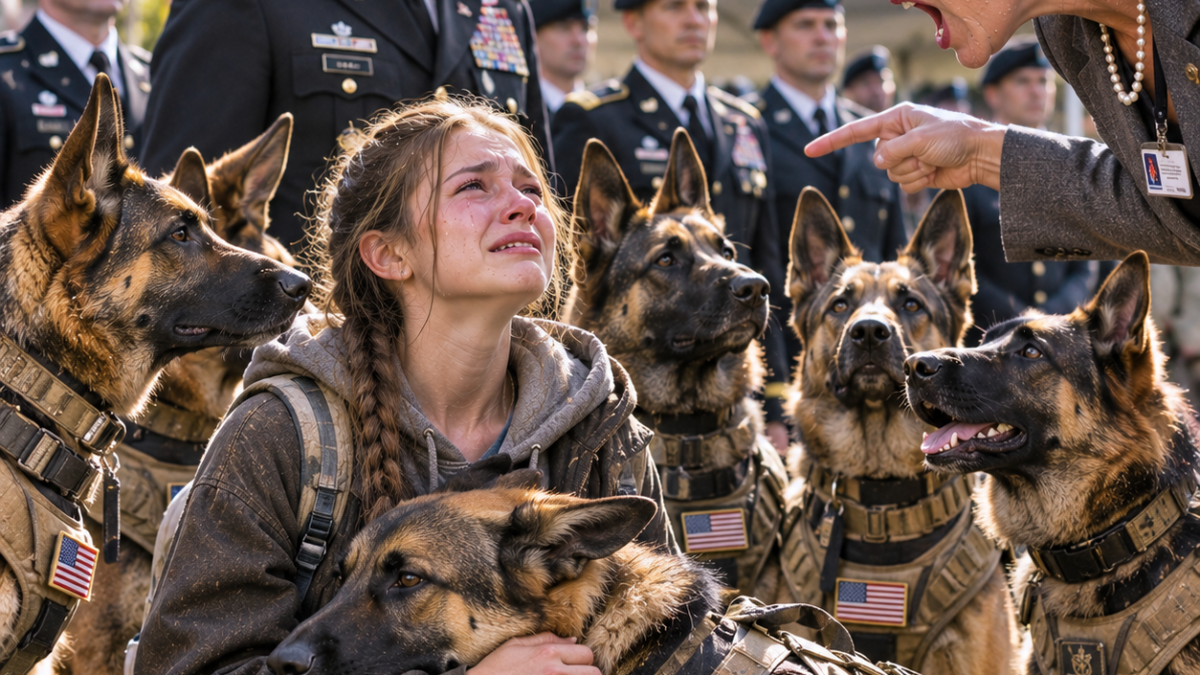
PART2
There were seven dogs.
Seven handlers.
Perfect formation.
I remember that because I was watching them more carefully than I had watched anything else all afternoon.
The first was Atlas.
German Shepherd.
Dark saddle across his back.
Powerful chest.
Focused eyes.
His handler was a young corporal named Mateo Reyes.
The others followed in staggered formation.
Bodie, a Belgian Malinois.
Daisy.
Ranger.
Echo.
Finn.
And a black German Shepherd named Storm.
Children leaned into the aisle.
Phones came up.
The handlers moved them through turns so precise the dogs looked connected by invisible wire.
Then Atlas stopped.
Not slowed.
Stopped.
His head snapped toward the bleachers.
Toward me.
Corporal Reyes gave a hand command.
Atlas did not move.
Reyes repeated it.
The dog’s ears went rigid.
I remember thinking:
Why is he looking at me?
Then Atlas ran.
“Atlas!”
Reyes shouted.
“HEEL!”
The command cracked across the gymnasium.
Atlas ignored it.
People laughed nervously because everyone assumed the break was part of the performance.
Then Bodie broke.
Then Daisy.
Then Ranger.
One after another.
Within seconds all seven dogs had abandoned formation.
Handlers shouted.
Chairs scraped.
A flag stand tipped sideways when one dog cut around it.
Someone screamed.
I did not.
That is the part people kept asking me about afterward.
“Weren’t you terrified?”
No.
I should have been.
Seven military working dogs were sprinting straight toward me.
But something in Atlas’s face did not look aggressive.
He looked desperate.
Not angry.
Not even excited.
Desperate.
I remained sitting because my legs would not move.
Atlas climbed the bleacher steps first.
Then stopped directly in front of me.
His entire body went still.
The gymnasium behind him seemed to disappear.
He looked into my face.
Then made a sound.
A long, low whine.
It was not the sound of a working dog failing a command.
It sounded like grief.
My throat closed.
Atlas stepped closer.
I slowly raised my hand.
His head pressed into my palm.
Hard.
As if he had been waiting for it.
The other dogs settled around me.
Not jumping.
Not barking.
A half circle.
Watching.
Protecting.
Three hundred people had gone silent.
For most of my life, I had hated being watched.
Now an entire military ceremony stared at the girl who had been told fifteen minutes earlier that she did not belong.
Corporal Reyes climbed the bleachers.
His face was red.
“Atlas.”
“No.”
“Down.”
Atlas did not even look at him.
Reyes stared.
I think that frightened him more than the original break.
He came closer.
“Ma’am, I am so sorry.”
“I don’t know what’s gotten into him.”
I looked at Atlas.
He had pressed his shoulder against my knee.
I whispered:
“It’s okay.”
Reyes shook his head.
“No.”
“It isn’t.”
“He has never done this.”
“Not once.”
Then something happened that I still cannot fully explain.
I looked into Atlas’s eyes.
And I thought about the photograph.
Dad.
Dust.
A German Shepherd across his lap.
I said:
“I think he might be looking for someone.”
Reyes frowned.
“Who?”
“My dad.”
The word barely came out.
I rubbed Atlas’s head.
Then whispered:
“Daniel Doyle.”
Atlas jerked.
His ears shot forward.
He barked once.
Sharp.
Startled.
Then pushed his entire body against my legs so hard I had to brace myself against the bleacher.
Corporal Reyes stopped breathing.
The other handlers did too.
I said the name again.
“Daniel.”
Atlas whined.
A man near the aisle whispered:
“Jesus.”
Then Major General Hargrove stepped away from the podium.
Everyone noticed.
Retirement ceremony.
Thirty-two years of service.
Hundreds of people there for him.
And he left his own stage to climb toward me.
“Young lady.”
His voice was softer than I expected.
“What is your name?”
“Hannah Doyle, sir.”
He glanced at Atlas.
Then at me.
“Would you mind telling me what just happened?”
“I can’t.”
“That’s the truth.”
“I don’t know.”
“My dad used to talk about a military dog sometimes.”
“I don’t remember the name.”
Hargrove’s expression changed.
“Your father served?”
“Yes, sir.”
“Full name?”
“Daniel Robert Doyle.”
The old veteran sitting several rows away lifted his head.
Hargrove looked toward the K9 supervisor.
Sergeant First Class Maria Delgado.
She had gone completely still.
Then Hargrove asked:
“Is your father here?”
I swallowed.
“No, sir.”
“Where is he?”
I hated answering.
“He died three years ago.”
The general’s eyes softened.
“I’m sorry.”
I nodded.
Then Atlas whined again.
Hargrove looked at the dog.
Then at Delgado.
“Sergeant.”
“Yes, sir.”
“I think we need a room.”
The ceremony stopped.
Not officially canceled.
Paused.
People were asked to remain seated.
The volunteer who had sent me to the back stood near the aisle.
He would not look at me.
I noticed.
Not because I wanted revenge.
Because twenty minutes earlier I had been too insignificant for him to ask one question.
Now a two-star general was walking beside me.
Humiliation and importance are both dangerous when you let strangers decide your value.
I did not understand that yet.
I just wanted to know why Atlas knew Dad’s name.
Delgado took me to a side office.
Reyes came too.
Atlas refused to leave.
Every time Reyes tried to lead him toward the K9 holding area, Atlas planted his feet and looked back at me.
Finally Reyes said:
“Sir?”
Hargrove looked at me.
I shrugged.
Atlas stayed.
The other six dogs returned to their handlers.
Reluctantly.
They kept looking toward the office door.
That became another question.
Why had all seven followed?
Delgado later believed Atlas’s sudden break and the other dogs’ response to him triggered a group reaction.
Dogs read one another faster than humans do.
Atlas knew something.
The others trusted Atlas.
But that still did not explain what Atlas knew.
Inside the office, Delgado sat across from me.
“Hannah.”
“Yes, ma’am.”
“You said your father was Army.”
“Yes.”
“Do you know his unit?”
“No.”
“Rank?”
“Specialist when I was little, I think.”
“Later maybe something else.”
“I honestly don’t know.”
That embarrassed me.
I was Dad’s daughter.
I should have known.
Delgado must have seen it.
“Hey.”
She waited until I looked up.
“You were a child.”
“There is no test here.”
I nodded.
“Did he ever work with military dogs?”
“I think.”
“What do you mean?”
I told her the story Dad had once told me.
I was ten.
Maybe nine.
He had been fixing a lawnmower in our garage.
Pepper, our family dog, lay beside him.
I asked why he always gave dogs the best part of his sandwich.
Dad laughed.
Then said:
“Because one saved my life once.”
I asked what kind.
German Shepherd.
He told me there had been a dog overseas.
Not his originally.
The primary handler got hurt during a mission.
Dad ended up caring for the dog during the chaos afterward.
Then one day the dog was badly injured.
People were moving.
Danger everywhere.
Dad said someone ordered him to leave the dog.
He refused.
I remembered being horrified.
“You disobeyed?”
Dad looked at me.
“He was alive.”
“That was enough.”
He carried the dog.
Almost two miles.
He never told me where.
Never told me what happened exactly.
Only:
“Couldn’t leave him.”
I asked the dog’s name.
Dad paused too long.
Then said:
“Doesn’t matter.”
Maybe he thought I would forget.
I did.
The name.
Not the story.
Delgado had stopped writing.
Reyes looked at Atlas.
Then at me.
“What happened to the dog?”
I said:
“Dad told me he survived.”
“He got treated.”
“Then went back into service somewhere.”
“Dad never saw him again.”
Reyes whispered:
“Oh my God.”
Delgado stood.
“I need his service number.”
“I don’t have it.”
“Your aunt?”
“Maybe.”
I called Rachel.
She answered on the second ring.
“Hannah?”
“Are you okay?”
She knew I was at the ceremony.
I said:
“I think so.”
“Aunt Rachel…”
“Do you still have Dad’s Army papers?”
Silence.
“What happened?”
“There’s a dog.”
“What dog?”
Then Atlas barked.
My aunt stopped speaking.
“Hannah.”
I explained.
Badly.
Seven dogs.
Daniel.
Atlas.
General.
Office.
By the end Rachel said only:
“I’m coming.”
She arrived thirty minutes later carrying an old shoebox.
Dad’s medals.
Discharge papers.
Orders.
A commendation I had never seen.
Delgado started searching.
Personnel archives.
K9 support records.
Deployment logs.
Hargrove returned to the ceremony while we waited.
Nobody resumed anything.
Three hundred people talked in low voices.
Some people tried photographing the office door.
Security stopped them.
Mrs. Pruitt found me.
She hugged me.
“I’m sorry.”
“What?”
“The seating.”
“I invited you.”
“I should have been there.”
“It’s not your fault.”
Her eyes moved toward the volunteer.
“It still shouldn’t have happened.”
I looked through the glass.
The woman who had whispered I did not belong stood with her husband.
She looked uncomfortable.
Part of me wanted her discomfort.
I am not proud of that.
Another part wanted everyone to stop looking.
Mostly I wanted Dad.
That is the cruelest part of discovering something important about a dead person.
You cannot call them.
Cannot say:
Why didn’t you tell me?
Cannot ask:
Was it really you?
You have to build answers from paperwork and other people’s memories.
Delgado returned after almost two hours.
Her face told me before she spoke.
“We found him.”
Aunt Rachel gripped my shoulder.
Delgado placed a service record on the table.
DANIEL R. DOYLE
Eleven years.
Two deployments.
Final four years assigned to a forward K9 support unit.
Honorable discharge.
Then a phrase:
ongoing readjustment difficulties.
I stared at those words.
That was what the Army had written for what I had watched at home.
Nightmares.
Silence.
Doors checked twice.
Dad losing track of conversations.
Dad sitting in his truck for fifteen minutes before walking into a grocery store because crowds felt wrong.
I hated the smallness of the phrase.
But Delgado pointed farther down.
Old incident log.
Primary K9 handler wounded and evacuated.
Auxiliary handler assigned temporarily:
SPC DANIEL R. DOYLE
Working dog:
ATLAS ACTUAL
I looked at Reyes.
He had gone pale.
“Atlas?”
Delgado nodded.
“The call sign is Atlas Actual.”
“It appears to be connected to the same canine service line and injury record.”
Reyes sat down.
“No.”
Then looked at his dog.
Atlas lay at my feet.
Head resting on my shoe.
Reyes whispered:
“You knew him.”
Atlas lifted his ears.
I started crying.
Hargrove returned.
Delgado handed him the file.
He read.
Then slowly sat.
“There’s more.”
She turned the page.
Combat incident.
Dog severely wounded.
Primary handler unavailable.
Evacuation under hostile conditions.
Doyle refused to abandon animal.
Transported injured K9 over approximately two miles of difficult terrain until extraction.
I could not see the page anymore.
Tears.
Aunt Rachel covered her mouth.
I whispered:
“He really did it.”
Delgado said:
“Yes.”
Then I remembered the photograph.
I reached into my backpack.
Broken zipper held with a safety pin.
Pulled out the faded picture.
“I have this.”
Everyone leaned closer.
Dad.
Young.
Dirty.
Smiling.
A German Shepherd across his lap.
Delgado took it carefully.
Then looked at Atlas.
Back to the photograph.
“Reyes.”
He stepped closer.
“What?”
“Look at the left side.”
There was a scar.
Long irregular line along the dog’s flank.
Atlas had one too.
Same placement.
Same shape.
Reyes whispered:
“That’s him.”
No one spoke.
Aunt Rachel sat down hard.
I looked at Atlas.
“You’re the dog.”
He looked up.
I said it again.
“You’re the dog Dad carried.”
Atlas stood.
Pressed his head into my stomach.
I wrapped both arms around him.
And broke.
Not graceful crying.
Not cinematic.
Three years of grief.
Three years of hearing people reduce Dad to the man who came home wrong.
Three years of wondering whether he had ever mattered beyond our small house.
I buried my face against the fur of a dog my father had once refused to leave behind.
Reyes turned away.
Delgado cried openly.
Hargrove removed his glasses.
Aunt Rachel whispered:
“He never told us.”
I answered:
“I know.”
She shook her head.
“No.”
“Hannah.”
“He never told me either.”
“He came home with medals in a box and put them in the closet.”
“Your dad could not stand when people thanked him.”
“Why?”
Her face broke.
“Because he kept saying the men who didn’t come home deserved the thanks.”
That sounded like Dad.
I asked:
“Why didn’t anyone recognize him?”
Delgado answered carefully.
“Stories disappear between units.”
“Handlers transfer.”
“Records get reduced.”
“Informal heroism doesn’t always become public recognition.”
“And after discharge…”
She looked at the readjustment line.
“Sometimes the hardest years become the only years civilians remember.”
I hated that.
Because it was exactly what happened.
Our town remembered Dad’s bad years.
Nobody remembered the two miles.
Atlas did.
That dog had carried the memory silently for longer than anyone in the room.
Then Hargrove stood.
“Hannah.”
I looked up.
“I want to ask your permission.”
“For what?”
“To finish my retirement ceremony.”
I almost laughed through tears.
“Sir?”
“But not the way we planned.”
He looked at the photograph.
“I think there is someone else who needs to be honored today.”
I panicked.
“No.”
Everyone stopped.
“I don’t want…”
Three hundred people.
Eyes.
Applause.
I hated attention.
Hargrove sat again.
“Okay.”
No pressure.
That surprised me.
He said:
“Then tell me what you can tolerate.”
I looked at Aunt Rachel.
She whispered:
“Your dad should be remembered.”
I knew.
But memory and spectacle are not the same.
I asked:
“Can you just tell them his name?”
Hargrove nodded.
“Yes.”
“And what he did.”
“Yes.”
“No making me stand on stage?”
A tiny smile.
“I can try.”
Reyes looked at Atlas.
“Sir.”
Hargrove looked over.
Reyes unclipped Atlas’s leash.
Then held it toward me.
“Maybe he gets a vote.”
I stared.
Atlas was already leaning against my leg.
I took the leash.
We returned to the gymnasium.
The doors opened.
Everyone turned.
Every single face.
I still wore the faded jacket.
Same worn sneakers.
Same backpack.
Nothing about me had improved in the last two hours.
But people sat differently.
The volunteer who had sent me away stood beside the entrance.
He whispered:
“Miss Doyle.”
I stopped.
His face was red.
“I owe you an apology.”
I wanted to say:
Yes.
Instead:
“Okay.”
He looked at the floor.
“I shouldn’t have assumed.”
That mattered more.
Assumed.
Not:
I didn’t know.
He could not have known Dad.
That was never the problem.
The problem was he decided what I deserved based on what I looked like before asking.
I said:
“Thank you.”
Then walked inside.
Atlas beside me.
The room rose.
Not applause yet.
People simply stood.
I froze.
Hargrove returned to the podium.
“Please.”
Everyone sat except me and Atlas near the side.
He looked across the gym.
“When we began today’s ceremony, we believed we were here to recognize one career.”
“Mine.”
He paused.
“Something happened during the K9 demonstration that reminded me how dangerous it is for institutions to believe the only stories worth remembering are the ones already written on programs.”
The room became silent.
He told them about Dad.
Daniel Doyle.
Eleven years of Army service.
Forward K9 support.
Wounded handler.
Injured dog.
Hostile terrain.
Two miles.
He did not turn Dad into a superhero.
I appreciated that.
He said:
“Specialist Doyle came home carrying burdens this base did not understand and his community did not fully recognize.”
“Five years later he died without the incident we discovered today ever becoming part of how most people around his daughter remembered him.”
Then his voice changed.
“I find that unacceptable.”
I cried quietly.
He held up the photograph.
“This is Daniel Doyle.”
A large screen showed Dad.
Young.
Atlas across his lap.
People gasped.
Then Hargrove pointed toward the dog beside me.
“And this…”
“Is Atlas.”
The room erupted.
Not cheering.
A collective sound.
Disbelief.
Reyes stood.
His hands shook.
Hargrove continued:
“Today Atlas broke formation for the first time anyone here can remember.”
“He crossed this gymnasium to reach the daughter of the soldier who once carried him to safety.”
“Whether he recognized a voice, a name, something in Hannah, or simply a memory we will never be able to measure, I will leave to better minds than mine.”
“But what happened afterward is not in doubt.”
He looked at me.
“Daniel Doyle mattered.”
The old veteran in the back stood.
Slowly.
Service cap in his hand.
He saluted.
One person.
Then another.
A woman.
Two handlers.
Reyes.
Delgado.
Hargrove himself.
Within seconds, almost every uniformed person in the room was standing.
I started shaking.
Atlas pressed against me.
I whispered:
“Dad.”
Then the applause began.
I hated applause usually.
That day it sounded different.
It did not feel like they were applauding me.
It felt like sound traveling backward through time toward a man who never got to hear it.
I cried harder.
Aunt Rachel stood near the aisle.
Hands covering her face.
Mrs. Pruitt sobbed shamelessly.
Even the woman who said I did not belong stood.
Her eyes met mine.
She looked away first.
I did not feel victorious.
I felt sad for all of us.
How many people do we notice only after learning they are connected to someone important?
How many names become valuable only after a story makes them dramatic?
Dad had been Daniel before the record search.
I had been his daughter while sitting in the last row.
Nothing about our worth changed.
Only what everyone else knew.
After the applause, Hargrove asked if I wanted to speak.
I said no.
Then changed my mind.
Not because I suddenly became brave.
Because I thought about Dad’s name disappearing again once everyone left.
I took the microphone.
My hands shook.
I looked at three hundred strangers.
Then at Atlas.
“I don’t know what to say.”
Small laughter.
Kind.
“I spent three years thinking nobody wanted to know who my dad was underneath what happened after he came home.”
The room went silent.
“People remembered the hard parts.”
“And they were real.”
“My dad did struggle.”
“I’m not ashamed of that anymore.”
My voice cracked.
“He had nightmares.”
“He got quiet.”
“He had bad days.”
“He also made terrible pancakes.”
A few people laughed.
“He fixed everything even when it would have been cheaper to buy something new.”
“He loved dogs.”
“He loved me.”
I looked down at Atlas.
“And apparently…”
“He carried one very heavy German Shepherd a very long way.”
Reyes laughed through tears.
I continued:
“I think my dad would be glad somebody remembered him.”
“Not because he wanted a medal.”
“He hated attention.”
“So maybe he’d be angry with me right now.”
More laughter.
Then:
“I just…”
I looked toward the last row.
My empty chair.
“I think there are a lot of people sitting in back rows because they learned nobody wanted their whole story.”
My voice steadied.
“Maybe ask.”
“That’s all.”
“Ask before you decide who they are.”
I gave the microphone back.
The room stood again.
That time I let them.
The ceremony ended three hours late.
Nobody complained.
Handlers came one by one.
Each shook my hand.
Bodie’s handler said:
“Your dad was one of ours.”
Daisy’s handler hugged Aunt Rachel.
Storm’s handler apologized because he could not stop crying.
Then Corporal Reyes sat beside me.
Atlas between us.
“I’m embarrassed.”
“Why?”
“I yelled at him.”
“He was ignoring you.”
“He has never ignored me.”
I smiled.
“Maybe he had something more important.”
Reyes nodded.
Then scratched Atlas behind the ears.
“He’s been different lately.”
“How?”
“Slower.”
“Still excellent.”
“But I’ve been thinking retirement.”
My heart stopped.
He saw.
“Don’t get ahead of me.”
I looked away.
He laughed.
“I’m serious.”
“Military working dog retirement is a process.”
“There are decisions.”
“Handlers often get first consideration.”
“Of course.”
I felt stupid for hoping.
Reyes continued:
“But if anybody asked Atlas…”
The dog had his head on my knee.
“…I think he already made his preference annoyingly clear.”
I laughed.
First real laugh all day.
That night Aunt Rachel and I went home with the shoebox.
Not Atlas.
He returned to the kennel.
I cried when he left.
Embarrassing.
I had known the dog for less than six hours.
But he felt like the last living creature who had known Dad before everything became difficult.
At home, Aunt Rachel spread Dad’s papers across the kitchen table.
We had never done that.
Not once.
The medals came out.
Photographs.
Letters.
I found things I did not understand.
A commendation.
A unit patch.
A photograph of Dad beside three soldiers.
Another of Atlas.
Aunt Rachel sat quietly.
“I should have shown you.”
“Why didn’t you?”
She rubbed her eyes.
“Because every box felt like opening him again.”
I understood.
Then:
“Did Dad ever tell you about Atlas?”
“No.”
“Not really.”
“He said there was a dog.”
“He never said what he did.”
“Why?”
Aunt Rachel smiled sadly.
“Your father never told stories where he was the hero.”
That sounded exactly right.
We stayed up until almost two.
For the first time since Dad died, we talked about him without someone lowering their voice at the word Army.
That mattered.
The next morning my school principal called.
Then local reporters.
Then a newspaper.
The ceremony had been photographed.
Someone posted a video of the dogs breaking formation.
It spread overnight.
SEVEN MILITARY DOGS ABANDON CEREMONY FOR MYSTERY GIRL
I hated “mystery girl.”
I was not a mystery.
I had a name.
Reporters came to our duplex.
Aunt Rachel told them to leave.
One shouted:
“Hannah, how does it feel knowing your father was a hero?”
I almost answered.
Then stopped.
What kind of question is that?
Dad had been my hero when nobody else knew the story.
And sometimes he had been difficult.
Sometimes angry.
Sometimes so tired he forgot things.
Hero is a dangerous word when it tries to flatten a human being from the other direction.
I told one reporter:
“My dad was a person.”
She looked confused.
I continued:
“What he did for Atlas was brave.”
“What happened after he came home was hard.”
“Both are true.”
That quote appeared in the paper.
The town changed almost immediately.
People who had barely spoken to me said:
“I knew your father.”
Some did.
Some probably remembered seeing him at the grocery store twice.
Teachers approached.
Veterans.
Neighbors.
The same man who once complained about Dad’s truck being parked too long on the street told me:
“Your old man was something else.”
I wanted to ask:
Did you think that when he was alive?
I didn’t.
Anger does not always need an audience.
Mrs. Everett—the lieutenant’s wife who had asked me to scoot over at the ceremony—came to our house.
She brought cookies.
I disliked that immediately.
Apology cookies feel dangerous.
She stood on the porch.
“I’m sorry.”
“For asking me to move?”
“For not seeing you.”
That surprised me.
She continued:
“I keep thinking about what you said.”
“Ask before deciding.”
“I looked at your clothes.”
“You were alone.”
“I decided you weren’t connected to the base.”
“I was wrong.”
I said:
“You couldn’t have known.”
“No.”
“But I could have been kind without knowing.”
That was the right answer.
I accepted the cookies.
They were terrible.
I ate two.
Two weeks later, Fort Drayton invited Aunt Rachel and me back.
Private meeting.
No reporters.
Good.
Hargrove had not technically retired yet because final administrative duties remained.
He sat with Delgado, Reyes, and a personnel officer.
They had reviewed Dad’s file.
The rescue incident had been documented incompletely.
His role had never been formally highlighted.
They could not rewrite history magically.
They could correct the record.
A formal letter of commendation would be entered.
A plaque would be installed near the K9 training field.
Not giant.
Dad would have hated giant.
Text:
IN HONOR OF SPECIALIST DANIEL R. DOYLE
WHO WOULD NOT LEAVE A SOLDIER BEHIND, EVEN ONE WITH FOUR LEGS.
I laughed when I read it.
“That sounds like him.”
Hargrove smiled.
“We hoped.”
Then the personnel officer handed me a folder.
Dad’s corrected record.
I touched his name.
Paper.
Ink.
Small things.
Still powerful.
Then Reyes cleared his throat.
“One more issue.”
He looked at Atlas.
The dog sat beside his chair.
My heart started racing.
Reyes continued:
“We’ve been evaluating Atlas for early retirement.”
“His service history and recent medical review support it.”
I looked at Reyes.
He smiled.
“Normally I would have first adoption consideration.”
“Do you want him?”
That felt cruel to ask.
He nodded.
“Yes.”
My heart sank.
Then:
“But I think he already chose.”
I stared.
Reyes scratched Atlas’s head.
“I love this dog.”
“I owe him more than I can explain.”
“But when I took him home last weekend…”
“He spent three hours sitting at the front door.”
I laughed through tears.
Reyes continued:
“So I’m submitting a recommendation that, assuming your aunt agrees and the home inspection clears…”
He looked at me.
“Atlas retires with you.”
I covered my mouth.
Aunt Rachel started crying.
Again.
She had cried more in two weeks than in the previous three years.
I looked at Atlas.
“Are you serious?”
Reyes laughed.
“Unfortunately.”
Then:
“You understand this is a working dog.”
“Not a stuffed animal.”
“Training.”
“Veterinary care.”
“Structure.”
“I know.”
“You’re sixteen.”
“I know.”
“Your aunt has final responsibility.”
Rachel immediately said:
“Yes.”
I looked at her.
“You didn’t even think.”
She smiled.
“I watched that dog find you in a gym full of people.”
“I think he earned the couch.”
The home inspection passed.
Of course.
Our duplex was small.
Fenced yard.
No luxury.
Atlas did not care.
The day he arrived, Reyes brought him.
Atlas stepped out of the vehicle.
Looked at our house.
Then at me.
I knelt.
“Hey.”
He ran.
Not military precision.
Dog.
Just dog.
He knocked me backward into the grass.
Aunt Rachel laughed so hard she cried.
Reyes pretended something was in his eye.
When he handed me the leash, his hand stayed on it for an extra second.
“Take care of him.”
“I will.”
“No.”
He looked at me.
“Promise.”
“I promise.”
He nodded.
Then leaned down.
Pressed his forehead against Atlas’s.
“Retired.”
Atlas licked his face.
Reyes cursed.
We laughed.
Then he drove away.
Atlas stood watching until the vehicle disappeared.
I understood that.
Love does not erase old loyalty when new love arrives.
That became one of the first things Atlas taught me.
He could miss Reyes and still choose our porch.
I could love Dad and still build a life after him.
Maybe both of us needed permission.
Atlas slept outside my bedroom the first night.
Not on the bed.
Would not.
He positioned himself in the hallway where he could see the front door.
Dad used to do that too.
I lay awake listening to his breathing.
At 2:13 a.m., I got up.
Atlas lifted his head.
I sat on the floor beside him.
“Did he talk to you?”
Ridiculous question.
Atlas stared.
“Dad.”
“Did he tell you about me?”
His tail moved once.
I laughed.
“Good answer.”
Then I cried.
Atlas put one paw across my leg.
That became our routine.
School changed.
Not always positively.
Some kids suddenly wanted photographs with Atlas.
I refused.
One girl who had never spoken to me invited me to sit at her lunch table.
I asked:
“Why?”
She looked embarrassed.
Fair question.
I eventually sat with two girls from orchestra instead.
They had known me before the video.
One said:
“You know we always liked you, right?”
I said:
“You never talked to me.”
She answered:
“We thought you wanted to be alone.”
That hit me.
Maybe some of my invisibility was imposed.
Some I had built myself.
After Dad died, silence became protection.
Then people interpreted silence as preference.
Human beings make terrible conclusions with limited data.
I was learning.
The base held the plaque ceremony six weeks later.
Small.
Just like promised.
Aunt Rachel.
Me.
Reyes.
Delgado.
Hargrove.
Mrs. Pruitt.
Several K9 handlers.
No television.
Atlas sat beside the plaque.
I touched Dad’s name.
Then read the line again.
Would not leave a soldier behind.
I whispered:
“You didn’t.”
Hargrove stood beside me.
“Hannah.”
“Yes, sir?”
“I’ve been thinking about something you said.”
“Which thing?”
“Your father was a person.”
I looked at him.
He continued:
“In the military, we are sometimes very good at honoring service.”
“Less good at staying connected to the person after the uniform comes off.”
I said nothing.
“My retirement gives me too much time to think.”
I smiled.
He continued:
“Your father’s post-service difficulties should not be used to diminish what he did.”
“But his heroism should not be used to hide what he needed later.”
That mattered enormously.
I said:
“He needed help.”
“Yes.”
“Did he get it?”
Hargrove answered carefully.
“Some.”
“Not enough?”
He looked at the plaque.
“Probably not.”
I had spent years angry at Dad for coming home changed.
Then guilty for being angry.
Then angry at the town for remembering only the change.
Now I realized the better question was:
Who helped him carry what he brought home?
Aunt Rachel tried.
Grandma tried before she died.
I was a child.
Dad tried too.
Some days he simply could not explain what hurt.
The plaque did not solve that.
But it allowed us to tell the whole story.
The local newspaper eventually published a long piece.
Not:
Dog Finds Hero’s Daughter.
Something better.
THE SOLDIER BEHIND THE SILENCE
They interviewed Dad’s former unit.
A man named Sergeant Calvin Price remembered him.
He called me from Arizona.
“Hannah?”
“Yes.”
“This is Cal.”
“I served with your dad.”
I sat on the kitchen floor.
Atlas beside me.
Cal told me things.
Dad hated instant coffee.
He cheated at cards.
He had a habit of giving away his socks because someone else always needed dry socks more.
During the mission where Atlas was injured, Dad had already been exhausted.
The original handler went down.
People were trying to evacuate.
Atlas had shrapnel injuries and could not move properly.
Someone said they needed to leave him for later retrieval.
Dad said:
“No.”
Cal laughed.
“Your father could make one syllable sound like a court order.”
I smiled through tears.
“How heavy was Atlas?”
“Enough.”
“Dad said two miles.”
“Closer to one-point-seven.”
“Terrain made it feel like ten.”
“Was Dad ordered to leave him?”
Cal paused.
“Things were chaotic.”
“People remember orders differently under fire.”
I appreciated that honesty.
He continued:
“What I know is Danny refused to leave that dog.”
“He kept saying, ‘He’s ours.’”
My throat closed.
He’s ours.
Dad had apparently understood belonging better in a battlefield than I did in a gymnasium years later.
Cal said:
“He saved Atlas.”
“Atlas also saved him.”
“How?”
“Your father had been barely holding together after we lost two men.”
“Taking care of that dog gave him something immediate.”
“Feed him.”
“Clean wounds.”
“Walk him.”
“Simple things.”
“That dog kept him moving.”
I looked at Atlas.
“Maybe that’s why Dad loved dogs.”
“Maybe.”
Then Cal said:
“I’m sorry we lost touch.”
“After discharge?”
“Yes.”
“I called twice.”
“Your dad stopped answering.”
“I told myself he wanted space.”
“I should have tried again.”
Another person saying:
I should have asked.
I should have tried.
I was beginning to understand that neglect is often not created by one cruel decision.
Sometimes it grows from a hundred reasonable retreats.
He didn’t answer.
She seemed private.
They probably want space.
I don’t want to intrude.
Then suddenly someone has been alone for years.
Cal visited that summer.
He brought photographs.
Dad laughing.
Dad younger.
Dad before I knew him.
Atlas sniffed Cal for ten seconds.
Then exploded.
Tail.
Whining.
Running circles.
Cal fell to his knees.
“Buddy.”
Atlas climbed almost into his lap.
I cried.
Again.
This dog was turning my teenage years into a continuous dehydration risk.
Cal stayed for dinner.
He told Aunt Rachel stories she had never heard.
Then he looked at me.
“You’ve got Danny’s eyes.”
People had said that before.
This time it meant more.
I asked:
“Was he brave?”
Cal thought.
“Sometimes.”
I liked that answer.
He continued:
“Sometimes he was scared.”
“Brave isn’t a personality.”
“It’s a decision you make while scared.”
I wrote that down later.
Dad did not become a perfect man because Atlas remembered him.
He became larger.
That was enough.
I graduated high school the next year.
Atlas attended outside.
He wore a retired military working dog vest.
No decorations beyond what was appropriate.
People recognized him.
I wanted them to recognize me too.
Not as Daniel Doyle’s daughter only.
That became another challenge.
For years, I had wanted people to see Dad.
Then once they did, some forgot Hannah.
I received scholarship offers aimed at military families.
Helpful.
But I chose veterinary science.
Everyone assumed because of Atlas.
Partly.
Actually, because Dad once told me injured animals cannot explain where it hurts.
Someone has to pay better attention.
I remembered that.
I attended a state university two hours away.
Aunt Rachel worried.
Atlas was older.
Moving him between home and campus required planning.
The university approved him in housing under appropriate retired working-dog and support arrangements after extensive paperwork.
He became the most famous student on campus without paying tuition.
Unfair.
My first semester was terrible.
Homesick.
Classes harder than expected.
People knew the video.
Someone recognized me in biology lab.
“Aren’t you the K9 girl?”
I hated that phrase.
“My name is Hannah.”
He apologized.
We became friends.
His name was Evan.
He eventually learned not to ask Atlas for selfies.
Progress.
Atlas slowed.
That scared me.
I had met him late in his life.
Every gray hair felt like theft.
Reyes visited.
He still called Atlas:
“Partner.”
Atlas still lit up.
I never felt jealous.
Because I had learned the lesson.
Love can add.
It does not have to replace.
At twenty-one, I was studying for finals when Atlas stopped eating.
Veterinarian.
Tests.
Cancer.
Aggressive.
My world stopped.
I called Reyes first.
He arrived the next day.
Aunt Rachel drove in.
Cal came by video.
Hargrove sent a message.
I sat beside Atlas.
Old.
Tired.
Still watching me.
I thought about Dad carrying him.
Two miles.
Refusing to leave.
I whispered:
“I’m not leaving either.”
For six weeks, we managed pain.
Good days.
Bad.
No heroic miracle.
I hate stories where love magically cures biology.
It doesn’t.
Love keeps company.
On Atlas’s final morning, we took him to the K9 field at Fort Drayton.
The plaque stood nearby.
Dad’s name.
Reyes sat on one side.
Me on the other.
Atlas put his head in my lap.
Almost exactly like the photograph.
I stroked his ears.
“Tell him I’m okay.”
Reyes started crying.
I continued:
“If you see Dad…”
“Tell him I know.”
I did not know exactly what I meant.
Maybe:
I know what you did.
I know you were more than your worst years.
I know why dogs mattered.
I know you loved me.
Atlas exhaled.
The veterinarian helped him go peacefully.
No crowd.
No cameras.
Just us.
I thought losing Atlas would destroy the part of Dad I had recovered.
It didn’t.
That surprised me.
For years, Atlas had felt like a living bridge.
When he died, I discovered the bridge had already carried me across.
Dad’s story lived in me now.
Reyes.
Cal.
Aunt Rachel.
Files.
Photographs.
Plaque.
No dog needed to hold it alone anymore.
We buried Atlas’s ashes partly at the base memorial garden.
Part came home with me.
I placed the small urn beside Dad’s photograph.
Aunt Rachel said:
“They found each other twice.”
I cried.
“Three times.”
“What’s the third?”
“Through me.”
She nodded.
Years passed.
I became a veterinarian.
Not military.
Civilian practice near Fort Drayton.
Of course.
Life has humor.
A large part of my work became retired working dogs.
Police dogs.
Military dogs.
Search-and-rescue animals.
Aging shepherds with arthritis.
Malinois who did not understand retirement.
Handlers struggling to accept their partners becoming ordinary old dogs.
I understood that grief before it arrived for them.
One retired K9 named Duke refused to eat unless his former handler sat beside the bowl.
The handler apologized.
“Sorry.”
“He’s dramatic.”
I smiled.
“They earn drama.”
A photograph of Dad and Atlas hangs in my exam room.
Not with a plaque explaining everything.
Just:
DANIEL & ATLAS
Patients ask sometimes.
I tell the story if there is time.
Not the viral version.
The real one.
Dad carried him.
Atlas found me.
Both struggled.
Both mattered.
Major General Hargrove—retired now—started a small initiative with Fort Drayton veterans groups focused on preserving overlooked service histories and connecting families with records.
He called me once.
“We need a name.”
“Not Dad’s.”
“That was fast.”
“He hated attention.”
“Fair.”
They called it:
The Back Row Project.
I laughed when he told me.
“Subtle.”
“You inspired it.”
“I’ll sue.”
He said:
“You can’t afford my retired-general lawyers.”
I liked him.
The project helped families request service records.
Record oral histories.
Locate old unit members.
More importantly, it trained volunteers not to treat quiet relatives at military events like outsiders simply because nobody recognized them.
The volunteer who had sent me to the back became one of the first regular volunteers.
His name was Paul Henderson.
I eventually learned.
He came to me at the first Back Row Project event.
“I’m the man who…”
“I remember.”
He looked ashamed.
“I almost quit volunteering after that day.”
“Why?”
“Because I thought I had no business dealing with families.”
“What changed?”
“Hargrove told me embarrassment is useless unless it teaches something.”
Sounds like Hargrove.
Paul continued volunteering.
Years later, I watched him greet a teenage boy alone at a ceremony.
Instead of asking:
Where does your family sit?
He asked:
“Who are you here for?”
The boy said:
“My sister.”
Paul found the sister’s unit and personally walked him to the correct section.
I cried in the bathroom afterward.
Small corrections.
Real justice.
The woman who had whispered I did not belong sent me a letter.
I never replied.
Not out of anger.
Nothing to say.
She apologized.
I believed her.
That was enough.
My relationship with Dad changed too, even though Dad was dead.
That sounds strange.
But memory evolves when you learn more.
At thirteen, after the accident, I was furious with him.
He had driven tired.
Or distracted.
We never knew exactly.
The police believed he fell asleep.
I thought:
Why did you leave me?
Then the town whispered about his struggles and I became protective.
At sixteen, Atlas made him a hero.
For a while I overcorrected.
I refused to remember anything bad.
Therapy later helped.
Dad could have been brave overseas and still difficult at home.
He could save Atlas and still fail to seek enough help.
He could love me deeply and still scare me once when he shouted after a nightmare.
Human beings do not become pure because they die.
That truth freed me.
I did not need a perfect father to have a worthy father.
The Army did not need to hide his readjustment struggles to honor his courage.
In fact, hiding them would insult him.
He carried Atlas two miles.
Then came home carrying things nobody could see.
The first burden got a story.
The second deserved care.
That became my message whenever I spoke publicly.
I did not become a motivational speaker.
God forbid.
But occasionally veterans groups invited me.
I always said:
“Please do not tell the story as ‘dog proves forgotten veteran was secretly perfect.’”
Dad was not perfect.
Neither was Atlas.
Atlas once ate an entire rotisserie chicken off Aunt Rachel’s counter.
Military discipline disappeared in retirement.
The room always laughed.
Then I said:
“Tell it as a story about memory.”
“About asking.”
“About not reducing someone to the hardest years of their life.”
“That is enough.”
At thirty, I married Evan.
Yes.
The biology-lab guy who called me K9 girl.
People can recover from stupidity.
He became a physical therapist.
We had known each other thirteen years.
Our wedding was small.
Aunt Rachel in front.
Reyes.
Cal.
Hargrove.
Mrs. Pruitt, somehow still carrying peppermints.
Near the entrance we placed two photographs.
Dad.
Atlas.
No empty chairs.
I had learned grief did not require staging absence constantly.
They were present because we remembered.
That was enough.
Hargrove gave a toast.
I warned him:
“Short.”
Retired generals do not understand short.
He ignored me.
He said:
“The first time I saw Hannah Doyle, she was sitting in the last row of my retirement ceremony.”
“I had been in the Army thirty-two years.”
“I thought I understood loyalty.”
“Then seven dogs walked out on my speech.”
Everyone laughed.
He continued:
“I learned that day that institutions forget.”
“People forget.”
“Records fail.”
“Stories shrink.”
“But loyalty sometimes finds another route.”
He looked at me.
“And if you are lucky, someone in the back row reminds you what you should have remembered in the first place.”
I cried.
Of course.
Evan whispered:
“You cry at everything.”
I said:
“Marry someone else.”
Too late.
We had a daughter two years later.
Daniela.
Not Daniel.
Daniela Rose.
Aunt Rachel cried when she heard.
I told my daughter about Grandpa Daniel gradually.
Not as legend.
As Grandpa.
He hated mushrooms.
Loved dogs.
Sang badly.
Served in the Army.
Saved Atlas.
Had hard years.
Died too young.
When Daniela was five, she pointed at the photograph.
“Is that Atlas?”
“Yes.”
“Was he Grandpa’s dog?”
“Sort of.”
“Was Grandpa his person?”
“For a while.”
She nodded.
Then:
“Then Atlas was your dog.”
“Yes.”
“So everybody got a turn.”
I laughed.
Best summary anyone ever gave.
Everybody got a turn.
Dad saved Atlas.
Reyes handled Atlas.
Atlas found me.
I loved Atlas.
No one owned the whole story.
On Daniela’s seventh birthday, we visited Fort Drayton.
The plaque remained.
Weathered now.
I ran my fingers over Dad’s name.
My daughter read:
“Who would not leave a soldier behind, even one with four legs.”
She looked at me.
“Did Grandpa really carry him?”
“Yes.”
“Two miles?”
“Almost.”
“Was Atlas heavy?”
“Very.”
She thought.
“Grandpa must’ve been strong.”
I looked at the training field.
“He was.”
Then:
“And tired.”
Both.
Always both.
The town changed too.
Not magically.
People still gossip.
Still judge clothing.
Still ignore quiet kids.
But Dad’s story became part of local history.
The high school invited me to speak once.
I declined.
Then agreed to a smaller veterans-history project.
Students interviewed families.
Not just famous ones.
Janitors.
Widows.
Grandparents.
Immigrant veterans.
People whose names were not on plaques.
One student interviewed Aunt Rachel about her brother.
She asked:
“What do you wish people knew about Daniel?”
Rachel answered:
“He was funny before he got quiet.”
That sentence destroyed me.
Funny before quiet.
That is what trauma had done in our family.
People remembered the quiet because they met him late.
Aunt Rachel remembered the boy who put frogs in her shoes.
I had forgotten she owned that version.
Afterward, I asked:
“Why didn’t you tell me those stories?”
She shrugged.
“You never asked.”
There it was again.
Ask.
Simple.
Hard.
I started asking.
Dad at twelve.
Dad dating Mom.
Dad learning I was coming.
Dad holding me in the hospital.
Dad terrified of diapers.
Dad once driving forty minutes to buy the exact stuffed bear I would not sleep without.
These stories did not compete with Atlas.
They completed him.
The photograph in my backpack eventually became too fragile to carry.
A conservator helped preserve the original.
I made a copy.
The original went into an archival sleeve at home.
For years I felt guilty taking it out of my backpack.
As if moving it meant moving Dad.
Then I remembered what I tell everyone else.
Objects are not people.
Memory can move without betrayal.
I replaced the old backpack too.
The broken zipper finally gave up.
When I threw it away, I cried.
Evan found me beside the trash.
“Hannah.”
“It’s stupid.”
“No.”
“It is.”
“That backpack cost fifteen dollars ten years ago.”
“I know.”
He waited.
I said:
“Dad’s picture lived in it.”
Evan nodded.
Then:
“Keep the safety pin.”
“What?”
The pin that had held the zipper.
I laughed.
Then kept it.
Tiny things.
Humans are ridiculous.
That pin is in the photo box now.
Atlas’s old tag beside it.
Dad’s unit patch.
Not a shrine.
A family archive.
My work with retired military dogs eventually became part of a nonprofit veterinary partnership with the base.
We provided reduced-cost care for retired working animals.
Reyes helped organize handlers.
Hargrove raised funding.
Not millions.
Enough.
We named the veterinary assistance program:
THE ATLAS LINE
I objected less.
Atlas would have liked the attention.
He was vain in retirement.
One afternoon, an elderly former handler brought in a shepherd named Rex.
Arthritis.
Gray muzzle.
The man said:
“He saved my life.”
Then laughed embarrassedly.
“Sounds dramatic.”
I looked at him.
“Not here.”
His eyes filled.
We treated Rex.
The handler returned regularly.
Months later, when Rex died, the man hugged me.
“I thought I was supposed to be ready.”
I said:
“Ready is fake.”
He laughed through tears.
That is what Atlas taught me too.
Love does not make endings easier.
It makes them worth grieving.
Years after Dad’s plaque was installed, Fort Drayton renovated the K9 field.
Someone suggested replacing the plaque with a larger memorial.
They called me.
I said:
“No.”
“Why?”
“The small one is right.”
Dad had never needed bronze greatness.
The sentence was enough.
Would not leave a soldier behind.
Sometimes I visit alone.
Stand there.
No ceremony.
I think about the sixteen-year-old girl in the denim jacket.
I almost feel embarrassed by how much she wanted everyone to disappear.
Then compassion.
She had lost her father.
Her mother had died when she was younger—something I rarely spoke about because Dad became the larger grief.
She lived with an aunt who worked constantly.
Money tight.
School lonely.
She had learned to make herself small.
Then one afternoon, seven dogs refused to let her stay invisible.
People ask:
“Did Atlas recognize you?”
The answer is:
I do not know.
Maybe he recognized Dad’s name.
Maybe my scent carried something familiar from old possessions in the backpack.
Maybe the photograph, clothes, home, family scent created a trace.
Maybe the other dogs simply followed Atlas’s intense reaction.
Maybe animal memory works in ways humans still do not understand fully.
I do not need magic.
The truth is powerful enough.
Atlas reacted.
Records connected him to Dad.
The scar matched.
Dad saved him.
Years later, Atlas found me.
That is enough.
The more important question is:
Why did it take a dog breaking formation before anybody asked who the girl in the back row was?
That question stayed with Hargrove.
With Paul.
With me.
It became bigger than Dad.
At every event, every classroom, every clinic, there are people sitting near exits.
Quiet.
Poorly dressed.
Unconnected.
Maybe they want to be alone.
Maybe they have learned they are safer being unnoticed.
Do not assume.
Ask.
Not invasive questions.
Human ones.
Who are you here for?
Need a seat?
Are you okay?
Simple.
Mrs. Pruitt did that years earlier when she invited me.
She noticed I liked dogs.
One tiny act.
Without her, I never attend.
Without attending, Atlas never sees me.
Without Atlas, Dad’s record may remain buried.
A peppermint-candy office administrator changed our family history by saying:
“Hannah might enjoy this.”
Never underestimate ordinary kindness.
I told her that once.
She cried.
Then gave me peppermint candy.
Some people do not change.
The volunteer Paul became a close friend of the Back Row Project.
At his retirement from volunteering, I attended.
He told the crowd:
“My biggest lesson came from the worst assumption I ever made.”
Then looked at me.
“I sent a Gold Star-type military family member to the back because she did not look like my idea of one.”
I corrected him later.
“I wasn’t technically Gold Star in the formal sense.”
He rolled his eyes.
“Veterinarian.”
“Accuracy.”
He laughed.
But precision mattered.
Dad did not die in combat.
We did not need to change that to honor him.
His service mattered.
His post-service death mattered.
Truth did not need embellishment.
That is another thing I learned after going viral.
People exaggerated.
Articles claimed Dad carried Atlas under “machine-gun fire.”
The record said hostile conditions.
People wrote Dad received a secret medal.
False.
Some said all seven dogs had served with him.
Impossible.
Only Atlas had the documented connection.
The others followed Atlas.
I spent years correcting people.
Evan said:
“You could just let the internet be wrong.”
“No.”
“Why?”
“Because Dad’s real story is enough.”
That became almost a mission.
Do not make pain more dramatic than it was to make it matter.
Do not make courage supernatural.
Dad was scared.
Tired.
Human.
He saw an injured dog.
He carried him.
Enough.
At forty, I returned to the exact gymnasium where the dogs had broken formation.
Fort Drayton was marking an anniversary of the K9 program.
Hargrove, now very gray, attended.
Reyes was a senior instructor.
Delgado had retired.
A new generation of dogs stood in formation.
I sat in the middle this time.
Not front.
Not back.
Middle.
Daniela beside me.
She was fourteen.
Same age range where my world had once collapsed.
A young volunteer approached.
“Dr. Doyle?”
“Yes?”
“We reserved a seat for you in front.”
I smiled.
“I’m good here.”
He nodded.
No insistence.
The K9 demonstration began.
For one irrational second, I expected the dogs to break.
They did not.
Perfect formation.
Good.
The ceremony should not repeat.
Atlas had done his part.
Afterward, Reyes joined us.
“Remember this place?”
I looked around.
“No.”
He laughed.
Daniela said:
“Mom told me Grandpa’s dog ruined a general’s retirement.”
Hargrove appeared behind us.
“Correct.”
I turned.
“Sir.”
He hugged me.
No rank now.
Just Daniel.
Hargrove looked at Daniela.
“You know what your grandfather did?”
She answered:
“He carried Atlas when Atlas couldn’t walk.”
Hargrove nodded.
“And your mother?”
Daniela smiled.
“She cried a lot.”
I stared.
Reyes laughed.
Betrayal everywhere.
Then Daniela became serious.
“And she made people remember Grandpa.”
I corrected:
“Atlas did.”
Hargrove shook his head.
“No.”
“He opened the door.”
“You walked through.”
Maybe.
We went outside.
Dad’s plaque.
Atlas Line veterinary facility nearby.
Children running.
Handlers.
Dogs.
Life continuing.
I thought again about Dad.
If he could see it, would he be proud?
Embarrassed?
Probably both.
He would hate the plaque.
Love the dogs.
Tell me the clinic sign was too large.
Then secretly tell everyone his daughter was a veterinarian.
That feels right.
Aunt Rachel died when I was forty-six.
Cancer.
Gentler than Dad’s death only because we had time.
Before she died, she gave me the original shoebox.
“I’m done carrying this.”
I cried.
“You kept it all these years.”
“Of course.”
Inside, Dad’s medals.
Letters.
The first records Delgado copied.
Then something new.
An envelope addressed to me.
Dad’s handwriting.
My heart stopped.
“When did you find this?”
“Years ago.”
I stared.
“Years?”
She looked guilty.
“It was sealed.”
“Your name.”
“I thought he wrote it before his last deployment.”
“Why didn’t you give it to me?”
“I was afraid.”
“Of what?”
“That it would hurt you.”
I almost became angry.
Then laughed sadly.
Our family tradition.
Protecting people by withholding truth.
I opened it.
Dad had written it when I was nine.
Before a deployment.
Standard precaution letter.
In case.
He wrote:
Hannah Bear,
If you ever read this, it means something did not go how I planned, and you’re probably mad at me. You’re allowed.
I cried instantly.
He wrote about school.
Aunt Rachel.
Listening to Mom—my mother had still been alive then.
Then:
You will hear people say soldiers are brave. Sometimes we are. Sometimes we are just scared people who keep moving because someone beside us needs us to. That is enough.
Cal’s words.
Almost exactly.
Maybe Dad told him.
Then:
If you ever see somebody or something everyone else has decided is not worth carrying, take one more look. People are wrong a lot.
I stopped breathing.
Atlas.
Years before Atlas was injured?
Maybe the timing meant Dad wrote it after an earlier deployment.
I checked.
Yes.
He had already met working dogs but before the rescue incident.
The principle existed first.
Then he lived it.
At the end:
I love you more than every road between us.
Dad
I held the letter against my chest.
Aunt Rachel whispered:
“I’m sorry I waited.”
I shook my head.
“No.”
Then:
“I wish you hadn’t.”
Honest.
She nodded.
“Me too.”
We had time to forgive that.
After Rachel died, the shoebox came home.
I eventually donated copies—not originals—of relevant military documents to the base archive.
The original family things stayed ours.
Institutions can remember.
Families can keep.
Both.
The Back Row Project expanded.
Not because of me alone.
Veterans groups adopted the idea.
Oral histories.
Family outreach.
One program trained military-event volunteers in something painfully basic:
Never assume a person’s connection from clothing, age, race, disability, accent, wealth, or whether they arrived alone.
I laughed when I read the training document.
It took seven dogs to produce one paragraph of common sense.
Humans.
We learn slowly.
My daughter eventually joined the Army.
That nearly killed me.
Not literally.
Emotionally.
When Daniela told me, I said:
“No.”
She laughed.
“You know you can’t say no.”
“I’m your mother.”
“Authority doesn’t work like that.”
I hated how well I had raised her.
Evan tried not to laugh.
She became a veterinarian too.
Army Veterinary Corps.
Of course.
Dad would have lost his mind.
At her commissioning, I sat front row because she asked.
No making myself small.
Afterward she handed me her cap.
“Grandpa?”
I touched the brim.
“He’d be unbearable.”
She smiled.
“Good.”
Daniela later worked around military working dogs.
The circle became almost too neat for fiction.
I told her:
“Do not try to recreate anything.”
She said:
“Mom.”
“I know.”
“Still.”
One day she called from overseas.
“Mom.”
My heart stopped.
Every military parent knows the tone they fear.
She laughed.
“I’m fine.”
“Never do that.”
“I met a dog named Atlas.”
Silence.
“Seriously?”
“Different Atlas.”
I started crying.
She said:
“Oh God.”
“Here we go.”
I laughed through tears.
Names repeat.
Stories echo.
But they do not need to repeat exactly.
My father’s story ended before he got the recognition.
Mine did not.
My daughter carried both forward without inheriting the same silence.
That is progress.
Major General Hargrove died in his eighties.
His family invited me to speak at his memorial.
I almost declined.
Then remembered him leaving his own retirement podium.
I owed him.
I told the story everyone expected.
Then added something.
“The most important thing General Hargrove did for me was not honor my father.”
“It was ask permission before turning my grief into a ceremony.”
People became quiet.
“He asked what I could tolerate.”
“That mattered.”
Power can be kind.
That is rarer than power simply being powerful.
At the end, I said:
“Daniel Hargrove once told a room that loyalty does not expire.”
“He was right.”
“Neither does the responsibility to look again when someone has been overlooked.”
Then I saluted.
Not military proper from me.
Personal.
For him.
Years later, my granddaughter asked why I kept an old photograph of “a dirty man with a dog.”
I laughed.
“That dirty man is your great-grandfather.”
She looked horrified.
“Sorry.”
“He would love that.”
I told her the story.
Simpler.
Great-grandpa saw a hurt dog.
Everybody had to leave.
He carried the dog.
Years later, the dog found Great-grandpa’s daughter.
She said:
“That’s impossible.”
Smart kid.
I smiled.
“Some parts are strange.”
“Did it really happen?”
“Yes.”
“All seven dogs?”
“Yes.”
“Did they know Grandpa too?”
“Only Atlas had the direct connection we could prove.”
“The others followed him.”
She nodded.
“Dogs do that.”
Exactly.
Then:
“Why was Great-grandpa forgotten?”
That question hurt even after decades.
I answered:
“Because people sometimes remember the part of someone’s life that is easiest to explain.”
“What part?”
“He came home sad.”
“That’s easy?”
“Easier than asking why.”
She thought.
Then:
“That’s dumb.”
Children remain excellent philosophers.
“Yes.”
I said.
“It was.”
Today I am older than Dad ever got to be.
That realization was brutal.
On my thirty-ninth birthday, I woke and thought:
I am older than him.
Impossible.
Parents remain older in your mind forever.
Then time passes them.
I stood in front of his photograph.
“You were so young.”
For years I had remembered him as father.
Adult.
Authority.
Now I saw thirty-eight.
A man.
Tired.
Trying.
I forgave things differently after that.
Not everything.
Understanding does not require pretending pain did not happen.
But I had more compassion.
Dad had returned from war with a nervous system still waiting for danger.
He tried to raise a daughter.
Work.
Sleep.
Function.
The system called it readjustment difficulty.
The town called him troubled.
I call him Dad.
All of those describe pieces.
None describe the whole.
Atlas gave me the whole back.
Not magically.
He gave me a question.
Who was Daniel Doyle before everyone decided they knew?
Then records.
People.
Memory filled in the rest.
That is why I still tell the story.
Not because seven dogs breaking formation is dramatic.
It is.
Not because a German Shepherd remembered a soldier after years.
Remarkable.
I tell it because of the girl in the back row.
The volunteer looked at her and saw:
Wrong jacket.
Wrong section.
No visible connection.
He did not see:
Daughter.
Grief.
History.
A photograph with soft edges.
A father’s name.
A story.
None of us see everything when we look at someone.
The moral cannot be:
Never judge, because the poor girl might secretly be connected to a hero.
That would be terrible.
What if my father had never carried Atlas?
Would I then have deserved the back row?
What if Dad had been an ordinary mechanic?
Would kindness matter less?
No.
I deserved courtesy before anyone knew Daniel Doyle’s name.
That is the real lesson.
The dogs did not make me worthy.
They exposed how quickly humans had decided I wasn’t.
Dad’s heroism did not create my value.
It simply forced the room to reconsider its assumptions.
I wish we could reconsider before spectacle.
That is harder.
Better.
Every year on Dad’s birthday, I visit the plaque.
Sometimes alone.
Sometimes Daniela.
Sometimes Reyes if he can.
We bring no giant wreath.
Dad would hate it.
One small flower.
Then I visit the K9 memorial garden.
Atlas’s marker.
I sit between them.
Man.
Dog.
Two lives connected by one decision:
Do not leave the living behind.
That principle became bigger for me over time.
Dad carried an injured dog.
Atlas carried Dad’s memory.
The base eventually carried his name.
I carried the story.
Then my daughter.
Then maybe someone reading it.
Carrying does not always mean lifting weight.
Sometimes it means refusing to let something disappear because remembering is inconvenient.
I used to think Dad’s story ended on a back road at night.
Then I thought it ended in a gymnasium when Atlas ran toward me.
Then when Atlas died.
Then when I became a veterinarian.
I was wrong each time.
Stories do not end where we think.
They change hands.
The last time I saw Corporal—later Sergeant Major—Reyes, he was retiring.
His ceremony was also at Fort Drayton.
He called me weeks earlier.
“Hannah.”
“Yes?”
“Promise me one thing.”
“What?”
“No dogs.”
I laughed.
“Trauma?”
“Absolutely.”
At his retirement, I sat front row.
He saw me.
Then looked suspiciously around for German Shepherds.
I held up empty hands.
He laughed from the podium.
During his speech, he said:
“Early in my career, I thought being a good handler meant my dog obeyed every command.”
“Then Atlas taught me there are moments when loyalty outranks obedience.”
Everyone looked at me.
I cried.
Reyes continued:
“He ignored me once.”
“Best decision he ever made.”
Afterward, we stood near Dad’s plaque.
Reyes touched the metal.
“You know what I remember most?”
“What?”
“Your face when Atlas ran at you.”
“I must’ve looked terrified.”
“No.”
He shook his head.
“You looked like you recognized him before you knew him.”
I thought about that.
Maybe.
Maybe grief recognizes bridges before the mind does.
Or maybe I simply saw a dog who needed someone.
Dad would appreciate that explanation more.
Reyes hugged me.
Then:
“Take care, Hannah.”
“You too.”
He walked away.
I stood alone.
Training dogs barked in the distance.
Different dogs.
Different handlers.
Atlas long gone.
Dad longer.
Still:
Not gone.
That phrase is dangerous.
People say:
They’re never really gone.
Sometimes they are.
You cannot call.
Cannot hug.
Cannot ask what they meant.
Death is real.
But influence remains.
Memory remains.
Choices echo.
Dad is gone.
Atlas is gone.
What they gave me is not.
There is honesty in holding both.
I walked toward my car.
A teenage girl sat on a bench outside the visitor center.
Oversized sweatshirt.
Backpack.
Alone.
I almost passed.
Then stopped.
“Are you waiting for someone?”
She looked up.
“My brother.”
“Graduation ceremony.”
“Do you know where?”
She showed me the paper.
Wrong building.
I knew the location.
“I’m headed that way.”
“Want me to show you?”
She hesitated.
Then nodded.
We walked together.
Nothing dramatic happened.
No dogs broke formation.
No general stopped a ceremony.
Her brother graduated.
She found her seat.
I left.
That small moment meant almost as much as everything else.
Because I noticed her before I knew who her brother was.
No story required.
No hidden hero.
No reveal.
Just a person who needed someone to ask.
Maybe that is how the story should end.
Not with applause.
Not with Atlas running.
Not with Dad’s plaque.
With a stranger on a bench.
And one simple question.
Who are you here for?
Because sometimes the difference between disappearing into the back row and finding where you belong is not a miracle.
Sometimes somebody simply bothers to ask.








