PART2:“RULES ARE RULES—MAYBE NEXT TIME YOU’LL TEACH YOUR SON BOUNDARIES.” HOA Karen Padlocked My 5-Year-Old Outside in 110° Heat—Then I Turned Her Own Records Against Her
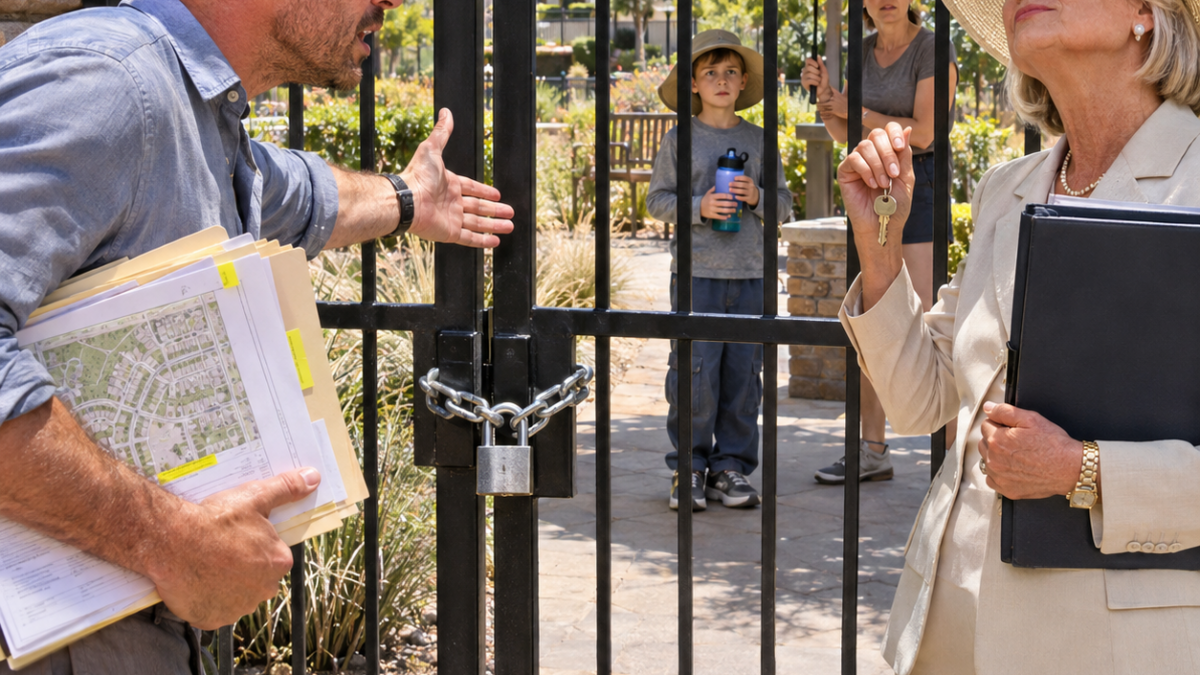
PART2
I had been living in Pinnacle Ridge Estates for three years.
Eli and I moved there after my wife, Megan, died.
Cancer.
Thirty-four years old.
Eight months from diagnosis to funeral.
People like to say grief comes in waves.
For me it came as unfinished tasks.
One toothbrush.
Two coffee mugs.
Her gardening gloves hanging in the garage.
A grocery list in her handwriting.
The green backyard fence she had painted herself one Saturday because Patty’s predecessor allowed homeowners to maintain boundary fencing as long as it met basic appearance standards.
Megan had stood in the yard with paint in her hair and said:
“If this color is ugly, don’t tell me until I’m dead.”
At the time, I laughed.
After she died, I could not repaint it.
Then Patty became HOA president.
Within four months, she sent me my first notice.
COLOR DEVIATION — COMMUNITY FENCE CONSISTENCY.
No fine.
Warning only.
Then came grass height.
Trash can placement.
The flag.
Patio furniture.
A small plastic slide Eli used in the yard.
One violation described the slide as an “unapproved recreational structure visible from shared property.”
It was three feet tall and shaped like a cartoon elephant.
I paid the first fines because fighting felt harder.
Megan had been gone eleven months.
Eli still woke asking whether Mommy could hear him.
I had no energy for HOA politics.
Patty noticed.
Predators notice exhaustion.
At first she was sweet.
“Ryan, dear, I know you’re dealing with so much.”
Then:
“We all want to support you.”
Then:
“But grief cannot become an excuse for community decline.”
That sentence stayed with me.
I said nothing.
Paid $75.
Then $125.
Then $200.
Each time I told myself peace had a price.
I was wrong.
Peace purchased through surrender becomes rent.
And the landlord always raises it.
The morning after Eli was locked outside, I dropped him at daycare.
He did not want me to leave.
“Will Patty be there?”
“No.”
“Promise?”
I hesitated.
I had learned never to make careless promises to a child who had already lost one parent.
“She cannot come into your school and take you anywhere.”
He nodded.
Then:
“Can she lock our house?”
“No.”
That one I could promise.
I kissed his head and drove directly to the community park.
Patty held what she called her “inspection walk” every weekday morning.
No bylaw required it.
She simply enjoyed walking through Pinnacle Ridge with a clipboard and two loyal board members behind her.
When I arrived, she was beneath a shade sail explaining that a homeowner on Cactus Lane still had decorative string lights visible after Easter.
I stopped ten feet away.
“Morning, Patty.”
She looked at me.
Smile.
Instant.
“Ryan. I hope Eli is feeling better.”
“He has burns on his hands.”
The other board members looked at her.
She tapped her pen.
“That seems dramatic.”
“You locked him outside.”
“I secured a restricted access point.”
“While he was on the other side.”
“He should not have been there.”
“How did he get there?”
Her smile tightened.
“Excuse me?”
“The greenway gate was open.”
Silence.
“Who opened it?”
She glanced toward the clipboard.
“We receive multiple maintenance reports.”
“That isn’t an answer.”
“Ryan, if you have concerns, file them in writing.”
“I will.”
I stepped closer.
“And while I’m doing that, when exactly are you planning to document that you padlocked a five-year-old outside in 110-degree heat?”
The park went silent.
Even the cicadas seemed quieter.
Patty leaned backward.
“You are becoming confrontational.”
“No.”
I spoke softly.
“I’m becoming specific.”
She smiled again.
“You can call the police if you like. They already understand that the strip behind your property is HOA-managed greenway.”
There it was.
Confidence.
Patty’s most dangerous weapon.
Not facts.
Certainty.
She said things like somebody had already proven them.
I walked away.
No argument.
At home, I opened my work case.
Inside was a thermal camera I used for industrial-site inspections.
I did not point it at children.
Did not stage anything.
I measured the gate.
The concrete.
The gravel behind the fence.
Shade.
Sun.
At 2:00 p.m., ambient air temperature reached 108.
The gate surface read 145.
At 4:12, with air temperature at 110, portions of the metal exceeded 148.
The gravel strip behind it was radiating heat.
I photographed every reading with timestamp and location.
Then I called our pediatrician and requested Eli’s urgent-care records.
Not because I wanted revenge.
Because Patty’s first defense had already appeared.
Nobody was in danger.
Fine.
Then we would measure danger.
The group chat was exploding.
Half the neighborhood defended her.
Patty was enforcing rules.
Why was Eli unattended?
Ryan should have supervised him.
Others responded:
She locked a kid outside.
That’s insane.
There is video.
Mrs. Alvarez posted a short clip.
Patty standing near the gate.
Eli crying behind it.
Me running toward them.
Then Patty’s voice:
Perhaps next time you’ll teach him boundaries.
The comments changed after that.
Patty posted a six-paragraph statement.
Professional.
Calm.
Full of phrases like:
community safety standards
shared liability
managed access zone
mischaracterized interaction
At the end:
We remain committed to compassionate enforcement. ❤️
I stared at the heart emoji.
Then laughed.
Not because it was funny.
Because if I did not laugh, I was going to punch a wall.
I did not respond.
Instead, I drove to the county recorder’s office.
I requested the subdivision plat.
My parcel map.
Recorded easements.
Common-area deeds.
Greenway documents.
Fence approvals.
When I gave the clerk my address, she raised an eyebrow.
“Pinnacle Ridge?”
“Yes.”
“You’re the fourth person this month asking about rear-lot lines.”
That got my attention.
“Why?”
She shrugged.
“People are saying fences don’t match the recorded plats.”
I sat down.
Three hours later, I understood why.
The green strip behind my yard was not where Patty claimed it was.
The recorded common greenway ended four feet farther east.
My deed included the full depth of my backyard.
The fence had been moved inward.
Not just mine.
Three neighboring properties had similar encroachments.
Small.
Four feet here.
Three and a half there.
Five at one corner.
But continuous.
Someone had shifted the apparent boundary.
Why?
I drove home.
Measured.
Then called a licensed surveyor.
His name was Daniel Ruiz.
He came two days later.
By sunset he had driven temporary markers into the ground.
He stood with his hands on his hips.
“Your fence is inside your parcel.”
“How far?”
“Between three feet eight inches and four feet three inches.”
“Could that be construction tolerance?”
“No.”
“Could the recorded plat be wrong?”
“Anything is possible.”
He looked toward the fence.
“But this looks intentional.”
“Why?”
“The footings line up too consistently.”
I thought of Megan painting that fence.
She had not installed it.
It was already there when we bought the house.
The HOA had rebuilt portions a year before she died under what Patty described as a “uniformity project.”
I found the email.
Rear boundary fence realignment for visual consistency and safety.
Approved by board motion.
No survey attachment.
No homeowner signatures granting land.
No easement.
No recorded boundary agreement.
The fence had simply moved.
My anger changed shape.
This was no longer only Eli.
It was land.
Process.
Authority.
And maybe money.
At the community park two days later, Carla Benson approached me.
“You’re checking the fences?”
“Yes.”
She looked nervous.
“Mine too?”
“What’s your address?”
“Juniper Court.”
I knew the parcel.
“Possibly.”
She swallowed.
“Patty fined me $400 for planting yellow marigolds.”
I blinked.
“What?”
“She said they violated the approved desert palette.”
Mike Donnelly joined us.
“She shut off my irrigation for two days.”
“Why?”
“Late assessment.”
“How late?”
“Forty-eight hours.”
He looked toward his house.
“My wife’s on home dialysis. We need water reliability.”
More people came.
Not because I organized them.
Because people who have been made to feel isolated recognize the moment someone else says:
This happened to me too.
Flags.
Planters.
Halloween decorations.
Vehicles.
Satellite dishes.
Bird feeders.
Holiday lights.
“Excessive pumpkin volume” appeared in one violation.
I made them repeat it.
“Excessive pumpkin volume?”
The homeowner nodded.
“Seven pumpkins.”
I wrote it down.
Not every complaint meant wrongdoing.
Some rules were real.
Some owners had violated them.
I said that repeatedly.
“We need facts.”
Carla looked disappointed.
“So you’re defending her?”
“No.”
“I’m separating stupid rules from misconduct.”
That mattered.
If I threw everything into one pile, Patty could dismiss all of us as angry homeowners.
I needed patterns.
Documented ones.
That evening another violation notice appeared on my door.
UNAUTHORIZED CHILD PLAY EQUIPMENT — $300.
Eli’s slide.
The elephant.
I stared at it.
The timing was almost generous.
Retaliation had just introduced itself.
I photographed the notice.
Added it to the spreadsheet.
Then saw Travis Monroe across the street.
Pinnacle Ridge maintenance supervisor.
Forty-something.
Quiet.
Always looked like he wanted to disappear into whatever wall happened to be nearest.
He was washing the clubhouse walkway.
I walked over.
“Travis.”
He stiffened.
“Ryan.”
“Not here to get you fired.”
“That’s comforting.”
“I need to ask about the rear fence.”
His grip tightened around the hose.
“What about it?”
“Who moved it?”
He looked toward the clubhouse windows.
Tinted glass.
Patty’s office.
I followed his eyes.
“She watching?”
“No idea.”
That meant yes.
“I need to know who authorized the work.”
“Board.”
“Which board action?”
“I don’t remember.”
“Was there a survey?”
Silence.
“Travis.”
He shut off the hose.
“Diner on Route 93.”
“When?”
“Tomorrow.”
He lowered his voice.
“Seven.”
Then louder:
“I’ll check the irrigation logs, Mr. Keller.”
Wrong last name.
Smart.
Patty could hear.
I walked away.
The next night Travis sat in the rear booth of the diner with coffee he had not touched.
I ordered pie.
He slid a folded work order across the table.
My hands did not move immediately.
“Where did you get this?”
“Maintenance file.”
“Original?”
“Copy.”
I opened it.
REAR BOUNDARY UNIFORMITY PROJECT.
Patty’s signature.
Instruction:
Relocate fence line to establish consistent visual corridor along HOA greenway.
No survey reference.
No homeowner approval.
No legal authorization.
Date:
Two weeks before the work began.
Travis rubbed his palms together.
“She told us the HOA owned the strip.”
“Did you question it?”
“I asked whether survey markers had been updated.”
“What did she say?”
“That legal had cleared everything.”
“Did legal?”
“I never saw anything.”
“Who poured the footings?”
“Desert Crest Fencing.”
“Paid by?”
“HOA reserve account.”
“Do you know how much?”
He nodded.
“Too much.”
I looked up.
“What does that mean?”
“Twenty-eight thousand for the rear section.”
“How much should it have cost?”
“Maybe half.”
“Maybe.”
I underlined that word.
“We don’t speculate.”
Travis studied me.
“That’s why she hates you.”
“She doesn’t know me well enough.”
“She hates people she can’t make emotional.”
Interesting.
Then Travis leaned forward.
“There are emails.”
“Where?”
“Maintenance server.”
“Do you have authorized access?”
“Yes.”
“Do not take anything you are not legally allowed to access.”
He blinked.
“You’re serious?”
“Yes.”
“I’m not asking you to hack Patty.”
His shoulders relaxed.
“What can you give me?”
“Work orders I received.”
“Emails sent to me.”
“Photos I took.”
“Anything within your normal access.”
“Exactly.”
He nodded.
“I’ve got kids too.”
His voice cracked.
“When I heard about Eli…”
He stopped.
“I helped install that padlock system.”
I stared.
“What?”
“The maintenance master key opens those gates.”
“Did Patty tell you she would lock a child out?”
“No.”
“Did she tell you to lock anyone out?”
“She told me to make sure all greenway gates could be secured after unauthorized access complaints.”
“Who complained?”
He looked at me.
“Patty.”
Of course.
He brought me a USB the next day.
I did not open it immediately.
I called an attorney.
Not because every HOA fight requires dramatic courtroom warfare.
Because once employees start handing you records alleging unauthorized spending and land encroachment, amateur revenge becomes stupid.
Her name was Leah Morgan.
Real-estate litigation.
HOA disputes.
Construction.
I told her everything.
She listened.
Then said:
“First, stop calling this evidence until we authenticate it.”
I liked her.
“Second, do not post anything from that USB.”
“I wasn’t going to.”
“Third, preserve original files.”
“Done.”
“Fourth, get medical documentation and police incident records regarding Eli.”
“I haven’t filed a police report yet.”
Pause.
“Why?”
Because some part of me still heard Patty.
Don’t make a scene.
Because widowers learn to avoid anything that could destabilize the small life they have left.
Because I hated imagining Eli being interviewed.
Leah said:
“Ryan.”
“Yes.”
“You do not have to decide today whether you want anyone prosecuted.”
“That’s not your decision anyway.”
“But if you believe an adult intentionally locked your child outside in extreme heat, reporting it creates a contemporaneous record.”
I knew she was right.
I called.
The officer who took the report did not arrest Patty at her front door.
Life is not Facebook.
He interviewed me.
Reviewed the video.
Requested urgent-care records.
Spoke with witnesses.
The matter was referred for further review.
That was enough.
The next phase was documentation.
Daniel Ruiz prepared a formal survey.
Three other homeowners hired him independently.
Same pattern.
Fence relocation onto private parcels.
The HOA did not own the land between old and new lines.
Leah requested Pinnacle Ridge records.
Board minutes.
Vendor invoices.
Reserve-fund disbursements.
Fence-project approvals.
Legal opinions.
Insurance communications.
Patty responded by issuing me three new violation notices.
Drainage.
Play structure.
Harassment of board members.
I photographed them.
Leah smiled.
“Please tell me you didn’t provoke this.”
“I’ve barely spoken to her.”
“Excellent.”
“What?”
“Bad retaliation cases require good timing.”
She was enjoying herself.
I had mixed feelings about lawyers.
The thermal report became its own project.
I measured gate surface temperatures over multiple days.
Different times.
Shade.
Sun.
Ambient humidity.
Ground temperature.
I used calibrated equipment from work with employer permission.
I did not write:
PATTY NEARLY KILLED MY SON.
I wrote:
Pinnacle Ridge Rear Access Thermal Exposure Assessment.
Dry.
Professional.
I included limitations.
A thermal camera measures surface temperature, not a child’s core body temperature.
I was not a pediatrician.
I did not make medical conclusions.
I correlated my readings with public safety guidance and Eli’s documented symptoms.
Leah read it.
“This is annoyingly responsible.”
“Thank you.”
“I meant it as an insult.”
The county building-safety department sent Inspector Mara Delgado.
She arrived at 2:35 on a brutal Wednesday.
White sedan.
Tablet.
Wide-brim hat.
She reviewed Daniel’s markers first.
Then my thermal readings.
Then touched the gate briefly.
Pulled her hand back.
“Good Lord.”
“Measured 146 ten minutes ago.”
She used her own infrared thermometer.
“147.”
I said nothing.
She looked toward the relocated fence.
“Who authorized the alignment?”
“HOA says board project.”
“Recorded boundary agreement?”
“None we found.”
Mara walked.
Measured.
Photographed.
Compared GIS parcel data with survey points.
Finally:
“This is not a minor tolerance issue.”
“What happens now?”
“I write what I observed.”
Good answer.
No promises.
No dramatic threats.
That afternoon Patty’s SUV appeared at the end of the street.
She did not approach.
Just watched.
Mara kept working.
That night I received an anonymous text.
Some fences aren’t meant to move back. Leave this alone.
I screenshot it.
Forwarded it to Leah.
Did not reply.
The next morning Travis looked like he had not slept.
He met me near the service alley behind the clubhouse.
“She ordered records deleted.”
My stomach tightened.
“What records?”
“Fence project.”
“Maintenance emails.”
“Vendor communications.”
“Did you delete anything?”
“No.”
“Why are you telling me?”
He looked toward my house.
“Because of Eli.”
Then:
“And because I’m done.”
He handed me another USB.
“I copied emails I’m authorized to retain for maintenance history.”
“Did you alter them?”
“No.”
“Did anyone else?”
“I don’t know.”
“Then we authenticate.”
He gave a bitter smile.
“You and your lawyer.”
“She’s rubbing off on me.”
The emails were worse than the work order.
Not because they contained some cartoon confession.
They did not.
Real misconduct hides inside ordinary language.
Shift rear fence inward to preserve greenway width.
No homeowner contact needed until project complete.
Use reserve maintenance account—do not create separate special assessment.
Desert Crest knows how we want invoices formatted.
One email from Patty to Travis:
Do not discuss survey questions with residents. We are standardizing the corridor and do not need another argument about private-property technicalities.
Private-property technicalities.
I read that line six times.
Then I found the invoice.
$28,450.
Desert Crest Fencing.
A second smaller payment six weeks later.
“Adjustment labor.”
$7,800.
Leah said:
“We need the HOA’s bank records and vendor backup before anyone uses words like fraud.”
Again.
Annoyingly responsible.
Patty called an emergency board meeting.
The notice said:
Unauthorized outside interference threatening community stability.
The hall was packed.
I sat in back.
Carla beside me.
Mike and his wife in front.
Travis stood near the side wall looking ill.
Patty sat at the center table.
Pastel blouse.
Pearls.
Perfect hair.
Smile.
“Thank you all for coming.”
She sounded like a principal addressing a school fundraiser.
“Certain residents have created unnecessary conflict by inviting external agencies into routine community matters.”
Murmurs.
She continued.
“Pinnacle Ridge has always prioritized safety, consistency, and property values.”
A woman behind me whispered:
“Here comes property values.”
Patty heard.
Her smile tightened.
She began describing me without naming me.
“Some individuals believe personal grievances justify harassment.”
I remained seated.
Then the back doors opened.
Mara Delgado entered.
Not with a SWAT team.
With a county code-enforcement supervisor.
Behind them was an officer from the department handling Eli’s report.
And Daniel Ruiz, the surveyor.
The room changed.
Patty stopped.
Mara waited to be recognized.
One board member whispered something.
Patty said:
“This is a private association meeting.”
Mara answered:
“I understand.”
Her voice was calm.
“We’re here because the association requested clarification regarding the compliance notices issued this week.”
Patty’s face changed.
Very slightly.
Mara handed copies to the board secretary.
The county had documented rear-fence encroachments requiring correction or legal resolution with the affected owners.
There were also safety concerns regarding the metal access gate and its use under extreme-temperature conditions.
Not criminal conclusions.
Not dramatic declarations.
Official findings.
Then Daniel presented survey overlays.
Four properties.
The recorded line.
The physical fence.
The difference.
Patty interrupted.
“These maps are being manipulated.”
Daniel looked at her.
“They are stamped surveys.”
“I’ve seen different measurements.”
“From whom?”
Silence.
Then Travis stepped forward.
I had not known he planned to.
His hands shook.
“My crew moved the fence.”
The room went quiet.
Patty turned.
“Travis.”
He kept going.
“We were told the HOA owned the strip.”
“That is not what I said.”
“You signed the work order.”
“That document is being taken out of context.”
He placed a copy on the table.
“I kept the emails.”
Patty stood.
“You violated confidential association records.”
Leah, sitting two chairs from me, finally spoke.
“Maintenance work orders distributed to the maintenance supervisor are not transformed into privileged documents because they’re inconvenient.”
Patty stared at her.
“And you are?”
“Ryan Keller’s counsel.”
There it was.
Patty’s composure cracked.
She pointed at me.
“This man has been orchestrating a campaign against me since the accident with his child.”
Accident.
My body went cold.
I stood.
Not fast.
Not angry.
Just stood.
“His name is Eli.”
Patty stopped.
“You keep calling him ‘the child’ and ‘the incident.’ His name is Eli.”
Silence.
“You locked him outside.”
“I secured—”
“You locked him outside.”
“I was enforcing—”
“The gate surface measured one hundred forty-eight degrees.”
Someone gasped.
Patty rolled her eyes.
“According to his equipment.”
Mara spoke.
“My independent reading exceeded one hundred forty-five under similar conditions.”
Patty’s face changed.
I continued.
“His hands blistered.”
“That was unfortunate.”
A sound moved through the room.
Not outrage yet.
Disgust.
Patty heard it.
Then made the worst mistake of the night.
She said:
“If Ryan had supervised his son properly, none of this would have happened.”
Mrs. Alvarez stood.
“I watched you lock that gate.”
Patty turned.
“You were across the street.”
“I was recording.”
She held up her phone.
“You looked right at him.”
Another resident stood.
“So did I.”
Then another.
The room began speaking.
Not shouting.
Testifying.
Fines.
Threats.
Water shutoffs.
Selective enforcement.
Denied appeals.
Nobody could control the flow anymore.
Patty pounded the table.
“This meeting is adjourned.”
A board member beside her said:
“No.”
She turned.
“What?”
He swallowed.
“We need to vote.”
“On what?”
“Suspending your administrative authority pending review.”
Patty stared at him as though he had become a stranger.
“You wouldn’t dare.”
That sentence did more damage than any accusation I could have made.
Because everyone heard what leadership meant to her.
Not trust.
Obedience.
The board did not “dissolve” that night.
It could not.
But a majority voted to suspend Patty’s discretionary administrative authority while outside counsel reviewed the fence project, financial records, and enforcement practices.
She remained technically a director until members could follow removal procedures.
She lost access to association accounts.
Lost unilateral authority over staff.
Lost control of enforcement letters.
That was the first real consequence.
The second came from the insurance carrier.
Leah had sent notice regarding Eli’s injury and the boundary dispute.
The HOA insurer requested records.
Then hired its own counsel.
Insurance companies dislike surprises.
They dislike undocumented land projects even more.
The independent review expanded.
Desert Crest Fencing was contacted.
The owner produced invoices and text messages.
Several did not match the HOA copies.
Now the word fraud entered the room.
Not from me.
From investigators.
One HOA invoice showed $28,450.
Desert Crest’s original invoice showed $16,900.
Another payment described as “supplemental boundary reinforcement” had no matching work.
The difference had been routed through a small consulting company.
That company was registered to Patty’s brother-in-law.
Leah stared at the corporate filing.
“Well.”
“That seems bad.”
“It seems worth investigating.”
“Lawyer.”
“Engineer.”
The finance review found more.
Not hundreds of ridiculous invented crimes.
Enough real ones.
Reserve funds transferred without board approval.
Vendor payments lacking support.
Personal landscaping work billed through common-area contracts.
Reimbursement requests signed only by Patty.
Selective late-fee waivers for favored homeowners.
Enforcement fines issued outside written policy.
Several proxy ballots from previous board elections with questionable signatures.
The association hired a forensic accountant.
That decision mattered more than any neighborhood gossip.
Numbers became evidence.
Records became chronology.
The story became less about me.
Good.
I never wanted to be the hero of three hundred homeowners.
I wanted my son safe.
I wanted my property back.
I wanted Patty unable to do this again.
The forensic report concluded that approximately $186,000 in transactions over four years lacked proper authorization or adequate support.
Not all proven stolen.
Some sloppy.
Some conflicted.
Some clearly improper.
A smaller group was referred to law enforcement for suspected theft, false invoicing, and misuse of association funds.
The county attorney’s office reviewed the boundary project separately.
Our property lawyer sent formal demands for restoration or compensation.
Three homeowners joined.
We did not ask for millions.
We asked for our land.
The green fence came down.
That day hurt more than I expected.
Megan had painted it.
Eli stood beside me while the contractor removed panels.
“Why are they taking Mommy’s fence?”
I crouched.
“They have to put it where our yard actually ends.”
“Will it still be green?”
My throat tightened.
“Do you want it green?”
He nodded.
“Mommy made it green.”
“Then green.”
I paid for the portion around my property myself after the HOA agreed to reimburse costs associated with the wrong alignment.
Same shade.
Daniel marked the true boundary.
New footings.
Correct line.
The strip of recovered yard was only about four feet.
People laughed when they heard.
Four feet?
That’s what all this was about?
No.
It was never about four feet.
It was about whether somebody could take four feet because she assumed nobody would stop her.
Eli watched the new fence go up.
Then asked:
“Where’s the lock?”
“There isn’t one on our backyard gate.”
“Never?”
“Not that can trap you outside.”
He thought.
“Okay.”
That night he slept through without waking.
For the first time in weeks.
Patty did not disappear quietly.
She hired an attorney.
Good.
She was entitled to one.
She denied intentionally endangering Eli.
Claimed the gate was secured as part of community access enforcement.
Argued she believed he could return through another opening.
Witness video contradicted parts of her account.
The investigation continued.
She also challenged her HOA removal.
Members scheduled a formal recall vote under the governing documents.
Patty campaigned aggressively.
Emails.
Flyers.
She called herself the victim of a “coordinated harassment campaign.”
She claimed outsiders were attempting to destroy Pinnacle Ridge.
One flyer featured a photograph of me.
WHO REALLY BENEFITS FROM CHAOS?
I showed Leah.
“Can I sue her?”
“Do you want to?”
“No.”
“Then stop asking fun questions.”
The recall meeting drew almost every household.
Patty spoke first.
Twenty minutes.
Property values.
Safety.
Standards.
Ungrateful residents.
Conspiracies.
She mentioned Eli once.
“An unfortunate misunderstanding.”
I felt Carla touch my arm before I reacted.
Then Mike spoke.
His wife beside him.
He described the water shutdown.
Carla described the marigolds.
Mrs. Alvarez played the gate video.
Travis read the work order aloud.
The forensic accountant summarized the financial concerns.
Then the vote.
Paper ballots.
Independent count.
Patty removed by a margin so large nobody argued.
She left before the result was formally announced.
No police escort.
No screaming.
Just pearls.
Pastel blouse.
White face.
And one cardboard box containing items from the office she had occupied for five years.
That should have felt satisfying.
It did.
For about ten minutes.
Then Eli tugged my hand.
“Can we get ice cream?”
Justice, apparently, was less important than chocolate.
“Yeah.”
We left.
I did not watch Patty drive away.
The criminal investigation took months.
That frustrated residents who expected dramatic justice immediately.
Real cases move at the speed of documents.
Subpoenas.
Interviews.
Bank records.
Vendor testimony.
Digital authentication.
Prosecutorial review.
Eventually Patty was charged in connection with specific financial transactions and record falsification tied to the fence project and other association expenditures.
Separate misdemeanor allegations arose from the gate incident involving Eli, though the exact criminal resolution was narrower than many neighbors wanted.
That mattered.
Courts do not exist to match community anger.
They exist to decide what can be proved.
Patty ultimately entered a negotiated plea resolving several charges.
She paid restitution.
Was barred for a period from serving in fiduciary positions for community associations as part of the civil resolution.
Received probation on lower-level offenses.
And served a custodial sentence on the most serious financial count.
Not decades.
Not theatrical ruin.
Consequences.
Real ones.
I attended only one proceeding.
The victim-impact portion related to Eli.
I did not call Patty evil.
I did not ask the judge to destroy her life.
I brought one photograph.
Eli’s hands.
Bandaged.
Tiny fingers.
Then I said:
“My son was five.”
That was enough.
I explained what happened afterward.
Fear of gates.
Nightmares.
Asking whether adults could lock him outside if he broke rules.
Asking whether Mommy would have stopped Patty if Mommy were alive.
My voice failed at that part.
I stopped.
Breathed.
Continued.
“I work in systems where small failures become catastrophic when nobody corrects them.”
I looked toward Patty.
“She believed rules mattered more than judgment.”
“Authority mattered more than compassion.”
“And once she decided my son was a problem, his age stopped mattering.”
I swallowed.
“I am not asking the court to punish her because I hate her.”
“I am asking the court to understand that a five-year-old child learned to fear adults with keys because one adult wanted to prove she was in charge.”
The courtroom was silent.
Patty looked down.
I sat.
That night I went home and cried in Megan’s side of the closet.
Not because of Patty.
Because I wanted my wife.
Grief does that.
It hides during crises.
Then returns when the paperwork ends.
I sat on the floor holding one of Megan’s old sweaters.
“You would have handled this better.”
Obviously no answer.
Then I laughed.
“No.”
I wiped my face.
“You would’ve punched her.”
Megan had been five-foot-three and terrifying when angry.
Eli appeared in the doorway.
“Daddy?”
I froze.
“How long have you been there?”
“Mommy would punch who?”
I laughed harder.
“Adult conversation.”
“Patty?”
“No punching.”
He considered.
“Okay.”
Then he crawled into my lap.
“You miss Mommy?”
“Every day.”
“Me too.”
We sat there together.
That was when I understood something I had missed while fighting Patty.
For three years, I had told myself I was keeping quiet for Eli.
Pay the fines.
Avoid conflict.
Stay invisible.
Keep stability.
But children do not learn safety from watching a parent accept every violation of his boundaries.
They learn safety when they see boundaries enforced calmly.
Not violently.
Not obsessively.
Clearly.
The new Pinnacle Ridge board asked me to serve.
I refused.
Absolutely not.
Carla called.
“We need reasonable people.”
“I have seen what HOA meetings do to human beings.”
“Finance committee?”
“No.”
“Safety committee?”
“No.”
“Thermal consultant?”
I paused.
“That is manipulation.”
“Yes.”
I agreed to one limited review.
The board rewrote access-gate procedures.
No locking common-area gates when a person was known to be inside.
Emergency release hardware.
Heat-safety rules.
Clear signage.
Maintenance logs.
Two-person approval for boundary-related work.
Independent surveys before fence relocation.
Financial controls.
Vendor conflict disclosures.
Reserve expenditures above a threshold required recorded board votes.
Homeowners gained easier access to records.
Appeals were heard by people other than the person who issued the original violation.
Boring.
Good.
Government and community associations should usually be boring.
Patty had turned governance into theater.
We turned it back into paperwork.
Travis kept his job.
Not automatically.
The new board reviewed his role.
He admitted moving markers and fences without personally verifying authority.
He received discipline.
Training.
Then became maintenance director under the new structure.
I respected that.
Whistleblowers do not become saints because they finally tell the truth.
He had participated.
He also helped expose it.
Both things could be true.
One afternoon he stopped by my yard.
The new fence was almost finished.
He looked at the green paint.
“Same color?”
“Exactly.”
“Your wife painted the old one?”
“Yes.”
He nodded.
“I’m sorry.”
“For what?”
“I moved it.”
“You were following an order.”
“Still moved it.”
I looked at him.
“Then don’t do it again.”
He almost smiled.
“Fair.”
Eli came outside holding a toy truck.
“Mr. Travis?”
“Hey, buddy.”
“Are you allowed to lock gates?”
Travis went still.
Then crouched.
“Not with people behind them.”
“Ever?”
“Ever.”
Eli nodded.
Good enough.
The neighborhood changed slowly.
People talked.
That sounds trivial.
It was not.
Under Patty, neighbors had learned that complaints traveled.
If you criticized the board, enforcement increased.
So people whispered.
After she left, conversations became normal again.
Children played near the park.
Parents stopped checking whether Patty’s SUV was nearby.
The absurd fines were reviewed.
Some were legitimate.
Some canceled.
Some refunded where the board concluded procedure had not been followed.
Nobody got every dollar back.
Nobody got everything they wanted.
That was how I knew it was real.
A month after the new board took office, they held a picnic.
I nearly skipped it.
Eli begged to go because someone rented a bounce house.
We went.
I stood beneath a shade structure watching him jump with other kids.
Carla handed me lemonade.
“You know what’s weird?”
“What?”
“People are laughing.”
“They laughed before.”
“Not around board members.”
She was right.
Robert Gaines, the new president, stood near the grill burning hot dogs.
No clipboard.
No pearls.
No royal court.
Just bad cooking.
“Property values are doomed,” I said.
Carla laughed.
Eli ran toward me.
“Daddy!”
I caught him.
His hands had healed.
Tiny marks remained near one palm.
He almost never mentioned the lock anymore.
Then he pointed toward the greenway.
“Can I go play?”
My body reacted before my brain.
No.
Heat.
Gate.
Patty.
I stopped myself.
“Who’s with you?”
“Carla’s kids.”
“Stay where I can see you.”
“Okay!”
He ran.
I watched.
Every instinct wanted to follow.
Instead, I let him play.
That was harder than fighting Patty.
A year passed.
Then another.
Patty became a story new residents heard in fragments.
“Wasn’t there some HOA president who moved fences?”
“Didn’t she lock a kid outside?”
“Was that here?”
Yes.
Here.
I kept my records in one cabinet.
Not because I wanted to relive it.
Because documentation matters.
Leah told me to retain them.
I obeyed.
Lawyers occasionally give useful advice.
Eli started kindergarten.
Then first grade.
He developed opinions about dinosaurs, peanut butter, and whether showers should be legally mandatory.
One afternoon he brought home an assignment.
DRAW A PERSON WHO KEEPS YOU SAFE.
He drew me.
Big head.
Stick arms.
Green fence behind me.
I stared.
“Is that our yard?”
“Yes.”
“What’s this?”
He had drawn a tiny rectangle near the gate.
“The lock.”
My chest tightened.
“Why’d you draw that?”
“Because you opened it.”
I could not speak for a moment.
He looked worried.
“Is it bad?”
“No.”
I pulled him close.
“It’s perfect.”
That night I put the drawing in my desk.
Not with the Patty records.
Separate.
Important distinction.
Patty’s story was about what she did.
Eli’s drawing was about what I did afterward.
I wanted him to remember that more.
The strangest consequence of the entire mess involved the strip of land behind our properties.
Once the fence returned to the legal boundaries, the HOA discovered the “greenway” was narrower than Patty had represented.
Too narrow in places for the landscaping vehicles she had been sending through.
The new board had choices.
Negotiate easements.
Redesign access.
Or stop pretending they needed machinery back there.
They chose the simplest solution.
Native desert landscaping.
Low-water plants.
Walking access only.
No trucks.
No fence relocation.
No taking private land.
The strip became prettier than it had ever been.
Eli called it “the lizard road.”
Tiny desert lizards loved the rocks.
Megan would have liked that.
The elephant slide remained.
The new board formally approved it.
Robert mailed the approval letter with a handwritten note:
No elephants were harmed in this architectural review.
I framed that one.
Not Patty’s notices.
That one.
People sometimes asked whether I felt sorry for Patty.
The answer changed over time.
At first:
No.
Then:
Sometimes.
Not because consequences were unfair.
Because I eventually understood that somebody who needs that much control is not living peacefully either.
That did not excuse anything.
Compassion is not exoneration.
Years later, I heard Patty had moved to another part of Arizona after finishing her sentence and supervision.
No HOA position.
No community board.
She sold her house in Pinnacle Ridge.
I did not track her.
Did not search social media.
Did not celebrate anniversaries of her downfall.
That surprised people.
“After what she did?”
Especially after what she did.
I had already given her enough of my life.
The real ending was not her losing.
It was us no longer organizing ourselves around her.
When Eli was nine, he asked about her.
We were repainting the backyard fence.
Green.
Same color Megan chose.
“Where did Patty go?”
“Moved away.”
“Because she locked me outside?”
“Partly because of things she did.”
“Did she go to jail?”
“For a while.”
He painted one board badly.
“What did she steal?”
I thought.
“Money she wasn’t supposed to use.”
“Did she steal our yard?”
“Not exactly.”
“She moved the fence.”
“Yes.”
“That’s stealing yard.”
Hard to argue.
I smiled.
“The important part is the fence is correct now.”
He nodded.
Then:
“Was she bad?”
Children want categories.
Good.
Bad.
Safe.
Dangerous.
I chose carefully.
“She made bad choices.”
“Lots?”
“Yes.”
“Was she sorry?”
“I don’t know.”
That seemed to bother him.
“Does she have to be sorry?”
“For what?”
“For us to be okay.”
I stopped painting.
No therapist had ever asked me that so cleanly.
“No.”
He looked at me.
“We can be okay even if she isn’t sorry.”
He nodded.
Then went back to painting.
That was when the story finally changed inside me.
For years, some part of me had been waiting for Patty to understand.
To admit.
To say:
I was wrong.
I endangered your son.
I abused my position.
I took land that was not mine.
I retaliated.
Maybe she understood privately.
Maybe not.
It no longer mattered.
Accountability had happened without her emotional cooperation.
That is one of the most freeing things the law can provide when it works correctly.
You do not need the person who harmed you to agree with your version before boundaries become real.
The survey did not need Patty’s belief.
The gate temperature did not need her approval.
The bank records did not care whether she felt misunderstood.
The witnesses did not need her permission to remember.
Truth was not a vote.
At work, my colleagues eventually learned about the case.
For months, they called me “Thermal Dad.”
I hated it.
Then tolerated it.
One engineer put a tiny padlock on my coffee mug.
I threatened his annual review.
He reminded me I was not his manager.
Annoying.
But humor helped.
The thermal report also became useful in an unexpected way.
Our firm added a training module about public-space material temperatures in desert environments.
Playground surfaces.
Metal fixtures.
Outdoor enclosures.
Accessible paths.
Not because of Patty.
Because Eli’s injury reminded us that people designing systems in extreme heat often think about equipment before human contact.
I presented the lesson once.
Did not mention my son by name.
At the end I said:
“Every safety factor represents somebody whose body should not become the test.”
The room went quiet.
That sentence came from Eli.
Not literally.
But from what happened to him.
The years moved.
Pinnacle Ridge became ordinary.
Beautifully ordinary.
HOA elections had low turnout again.
People complained about dues.
Somebody argued about pool hours.
A resident accused Robert of allowing “aggressive bougainvillea.”
I laughed for ten minutes.
Normal problems.
Healthy organizations do not eliminate conflict.
They stop turning every disagreement into punishment.
When Eli turned twelve, he asked if we could replace the green fence.
It had begun to weather.
My first reaction:
No.
Megan painted that fence.
Then I remembered.
Actually, Megan painted the old fence.
The one Patty’s contractors moved.
This one had already been rebuilt.
Memory had attached itself to the color, not the boards.
“What do you want instead?”
“Wood.”
“What color?”
“Natural.”
My heart hurt.
But not badly.
“Okay.”
We removed the green panels together.
He pulled one screw.
I pulled the next.
When the final section came down, I stood looking at the open yard.
For years, the fence had represented Megan.
Then Patty.
Then Eli.
Then boundaries.
Now it was simply an old fence.
That was healing too.
The new cedar fence followed Daniel Ruiz’s original surveyed line exactly.
I checked.
Twice.
I am still an engineer.
At the gate, Eli asked:
“Lock?”
I held up the hardware.
A latch operable from both sides.
“No padlock.”
He smiled.
“Good.”
So did I.
The original padlock from that day had spent years in an evidence bag, then returned after the case closed.
I had kept it in the cabinet.
Why?
No idea.
Maybe proof.
Maybe anger.
Maybe fear that forgetting would make me vulnerable again.
After installing the cedar gate, I took the old padlock outside.
Held it.
Heavy.
Rust beginning near the shackle.
Eli came over.
“What’s that?”
“You don’t remember?”
He looked.
Then his face changed slightly.
“Oh.”
I hated that.
“I’m throwing it away.”
He shrugged.
“Okay.”
That was all.
No ceremony.
No smashing it with a hammer.
No burying it.
No dramatic speech.
I dropped it in the trash.
Eli went back to the fence.
I stood there.
Then laughed.
I had imagined throwing that lock away for years.
In reality, the garbage truck took it Tuesday morning.
Life is often rude to symbolism.
That afternoon, Mrs. Alvarez stopped by.
“You changed the fence.”
“Yep.”
“Patty would hate it.”
I looked at her.
“We don’t care what Patty would hate.”
She smiled.
“Right.”
Progress.
When Eli entered high school, he joined robotics.
Of course.
Poor kid inherited my illness.
He built a temperature-monitoring project for outdoor sports.
Small sensors.
Alerts when equipment surfaces became dangerously hot.
At the science fair, his display included a photograph of playground metal under infrared imaging.
A judge asked:
“Why this topic?”
Eli looked toward me.
Then back.
“When I was little, I burned my hands on a gate.”
He did not say Patty’s name.
Did not tell the whole story.
The incident belonged to him now.
Not me.
“I thought it would be useful if people knew surfaces can be hotter than the air.”
He won second place.
I complained about judging standards.
He told me to stop being an HOA Karen.
The disrespect.
Megan would have been proud.
By then I had stopped thinking of myself as the man Patty targeted.
I was Ryan Keller.
Father.
Widower.
Engineer.
Terrible cook.
Owner of a cedar fence.
Occasional volunteer on the HOA safety committee despite repeatedly claiming I was not on any committee.
Life grew larger than the worst afternoon.
That is the justice nobody can order in a courtroom.
Years later, when Pinnacle Ridge celebrated its thirtieth anniversary, Robert asked me to speak.
“No.”
“Five minutes.”
“No.”
“Three.”
“No.”
“Eli already agreed.”
Traitor.
I stood at the community park under the same shade structure where Patty once told me to file my concerns in writing.
Residents sat on folding chairs.
New families.
Old ones.
Children running everywhere.
I kept it short.
“I’ve been asked to say something about community.”
I looked at Robert.
“This was his mistake.”
People laughed.
“Years ago, this neighborhood had a problem.”
“Not just one person.”
“A system.”
Faces became serious.
“We had rules without enough checks.”
“Authority without enough transparency.”
“People who were afraid to challenge decisions because they expected retaliation.”
I glanced toward the greenway.
“We fixed surveys.”
“Budgets.”
Appeals.”
“Vendor controls.”
“Elections.”
“But the most important change was simpler.”
I looked at the families.
“We remembered that property values are supposed to serve people.”
“People are not supposed to serve property values.”
Silence.
Then applause.
I hated it.
I sat down.
Eli leaned toward me.
“Pretty good.”
“Your mother would’ve made it funnier.”
“Definitely.”
We smiled.
I still missed Megan.
That never stopped.
But missing someone is not the same as being trapped in the year they died.
Patty almost became another kind of trap.
Another fixed point around which I arranged everything.
I am grateful I did not let her.
The last time I ever heard Patty’s voice was not in court.
Not at the board meeting.
Not through a lawyer.
It was years later.
Unknown number.
I answered.
“Ryan.”
I recognized her immediately.
My body tightened.
“Patty.”
Silence.
“I won’t keep you.”
I almost hung up.
Then she said:
“I heard Eli won some science award.”
I stared out my office window.
“How?”
“Someone I know still lives there.”
I did not answer.
She continued.
“I wanted to say…”
Long pause.
“I was wrong.”
My chest went cold.
Not relieved.
Not satisfied.
Just still.
“About what?”
Maybe cruel.
Necessary.
“About the gate.”
I waited.
“And?”
She exhaled.
“About your property.”
“And?”
Another silence.
“The fines.”
“And?”
Her voice hardened slightly.
Old Patty.
“I’m trying, Ryan.”
“I know.”
That surprised both of us.
She continued.
“I kept telling myself rules mattered because if I admitted judgment mattered, then I had to admit mine was bad.”
I sat down.
“I thought if I made exceptions, everything would become disorder.”
“That’s not what happened.”
“I know.”
“Why call now?”
“I’m in a program.”
“What kind?”
“Court-related.”
Of course.
“They said apologies should not demand forgiveness.”
Good program.
“I’m sorry.”
Simple.
No speech.
No explanation.
I looked at the framed science-fair photo on my desk.
Eli smiling beside his thermal sensor project.
“I accept that you’re sorry.”
She inhaled.
“Does that mean—”
“No.”
I said it gently.
“It means I accept that you said it.”
Silence.
“Okay.”
That was the first boundary Patty respected without argument.
We ended the call.
I never spoke to her again.
Did I forgive her?
Eventually.
But not in the way people romanticize.
Forgiveness did not mean inviting her back.
Trusting her.
Forgetting.
Erasing records.
Pretending Eli was not harmed.
It meant her name stopped changing my blood pressure.
That was enough.
Today, when I walk through Pinnacle Ridge, the strip behind my yard looks nothing like it did under Patty.
Native plants.
Shade structures.
Low-water landscaping.
Clearly marked property boundaries.
The new cedar fence sits exactly where Daniel’s survey says it should.
There is no padlock.
Eli is older now.
Tall enough that when I look at him, I sometimes see Megan.
Especially around the eyes.
He barely remembers the heat.
I remember enough for both of us.
But the memory has changed.
At first, I saw helplessness.
My child behind a gate.
Now I see what came after.
Mrs. Alvarez raising her phone.
Travis deciding not to delete records.
Carla speaking up.
Mike refusing to stay silent.
Daniel staking the correct line.
Mara measuring the gate.
Leah insisting evidence mattered more than outrage.
Residents voting.
An HOA rebuilding itself instead of pretending one bad president meant community governance itself was impossible.
And me.
A man who had mistaken silence for stability.
I used to think I won because Patty lost power.
That is not the part I’m proudest of.
I’m proud that I did not become her.
I did not manufacture evidence.
Did not exaggerate temperatures.
Did not trespass on her property.
Did not threaten her family.
Did not use Eli’s suffering as an excuse to destroy anyone I disliked.
I measured.
Documented.
Reported.
Waited.
Let other people verify.
When evidence showed something was only sloppy instead of criminal, I accepted that.
When evidence showed actual misconduct, I followed it.
When courts imposed less punishment than angry neighbors wanted, I accepted that too.
Justice cannot be credible only when it satisfies your anger.
It has to survive after your anger cools.
Mine did.
The last thing hanging in my garage from Megan’s life is still her gardening apron.
Faded.
One pocket contains an old paint-stirring stick.
Green.
Same shade as the old fence.
Sometimes I take it out.
Not because of Patty.
Because of Megan.
That distinction took years.
One Saturday morning, Eli found me holding it.
“What’s that?”
“Your mom used it.”
“For the fence?”
“Yeah.”
He smiled.
“She picked ugly green.”
“Watch your mouth.”
He laughed.
I put the stick back.
Then we walked outside.
Sun already high.
Arizona heat building.
Eli opened the cedar gate.
Stepped through.
Turned.
“Dad?”
“Yeah?”
“You coming?”
For one tiny second, I saw a five-year-old boy on the wrong side of green metal.
Then it was gone.
Just my son.
Waiting.
The gate stood open.
“I’m coming.”
I followed him.
And that is the ending I choose to remember.
Not Patty being removed.
Not the investigation.
Not the court.
Not the restitution.
Not the board meeting where she finally realized nobody feared her clipboard anymore.
A gate.
Open.
My son walking through it without fear.
No lock.
No screaming.
No woman telling him he did not understand boundaries.
Because eventually Eli learned what a boundary actually is.
It is not a weapon used by the powerful to trap somebody weaker.
It is a line that protects what matters.
My property.
His safety.
Our right to say no.
Patty spent years teaching everyone in Pinnacle Ridge that rules were strongest when nobody questioned the person enforcing them.
She was wrong.
Rules are strongest when even the person in charge has to obey them.
And the day she locked my five-year-old son outside in 110-degree heat, Patricia Bowmont thought she was teaching us both a lesson about boundaries.
She did.
Just not the one she intended.
Because once I finally measured where her authority ended, documented every line she had crossed, and stopped being afraid of what would happen if I challenged her—
the lock came off.
The fence moved back.
The records came out.
The neighbors stood up.
And Patty Bowmont discovered that the most important boundary in Pinnacle Ridge was the one she had ignored for years:
the line between having authority—
and believing you are above it.








