PART2:“PUT THAT DOG DOWN! HE’S TOO DANGEROUS TO LIVE!” My Ex-Wife Tried to Have My Missing Labrador Euthanized After Claiming He Attacked a Man — But One Microchip Scan Exposed Her Cruelest Lie
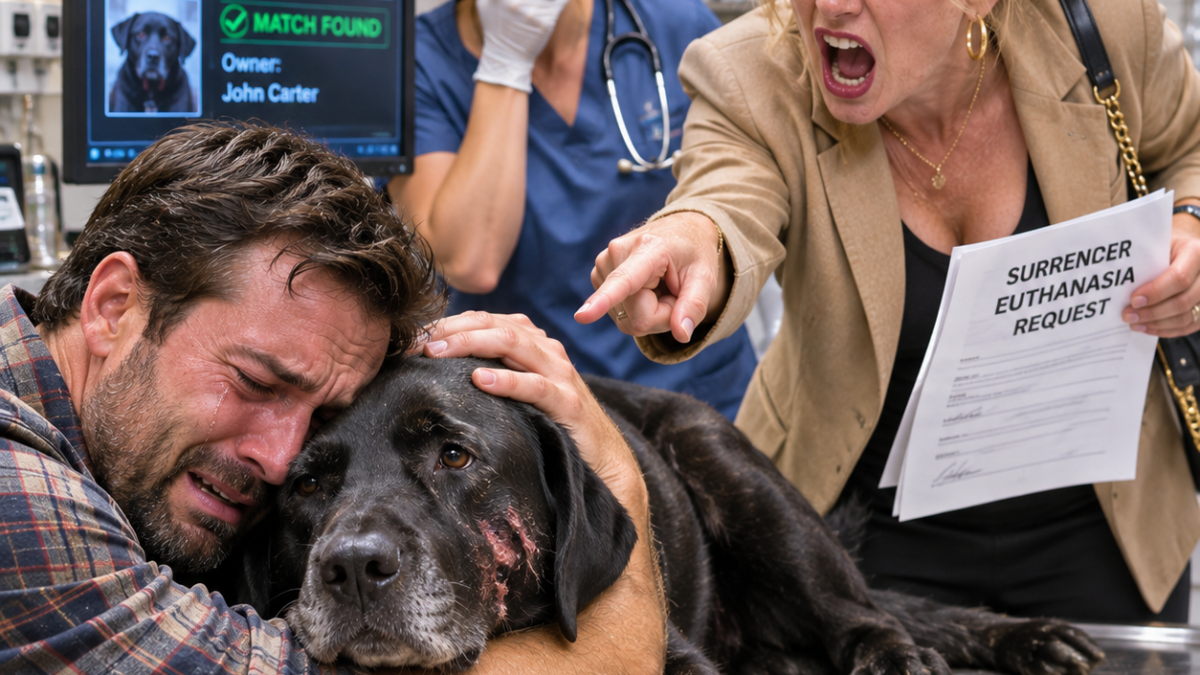
He didn’t growl.
He didn’t bare his teeth.
He walked beside her quietly, stopping every few steps to look toward the entrance.
As though someone might follow him inside.
As though the person he wanted was still somewhere beyond the glass doors.
Jessica had been impatient from the beginning.
“I don’t have all day,” she snapped when I asked her to complete the intake paperwork.
I introduced myself.
“I’m Sarah Miller. I’ll need some information about the dog.”
“His name is Bruno.”
“How old is he?”
“Seven, maybe eight. Does it matter?”
I glanced toward him.
“Yes, it matters.”
Jessica rolled her eyes.
“Look, he’s aggressive. He bit my friend. I want him euthanized before he hurts someone else.”
I looked up.
“Has the bite been medically evaluated?”
She hesitated.
Then folded her arms.
“Of course.”
“Do you have a report?”
“No.”
“Can you tell me when it happened?”
“Recently.”
I waited.
Jessica stared at me.
“Why are you interrogating me?”
“Because you’re reporting a serious bite incident, and we need to follow the proper procedures.”
Her lips tightened.
“Fine. Do whatever paperwork you need. Just get rid of him.”
Behind her, Bruno sat down.
His leash lay loosely against his front paws.
He watched the door.
I remember looking at him and feeling something tighten in my chest.
There was no way to determine a dog’s complete history simply by looking into his eyes. A calm animal might still have bitten someone. A frightened dog might behave differently in unfamiliar surroundings.
But there was something deeply troubling about the difference between Jessica’s story and what I was seeing.
She talked about Bruno as though he were a dangerous object.
He behaved like a bewildered family pet.
I asked whether she’d brought his veterinary records.
“No.”
“His vaccination information?”
“No.”
“Proof of ownership?”
She pushed a form toward me.
“I’m his owner. I signed it. What more do you want?”
I glanced down.
The paperwork identified her as Jessica Anderson.
But she had seemed uncertain about Bruno’s age, his medical history, and even the circumstances of the alleged bite.
I explained that we would need to review the case and follow our intake and safety requirements before making any decision.
She stood abruptly.
“Whatever. He’s your problem now.”
Bruno raised his head.
For one brief second, his tail moved.
I thought he was expecting her to take him back outside.
Instead, Jessica handed me the leash.
Then walked toward the door.
Bruno stood.
He took one step after her.
Stopped when the leash became taut.
And watched her leave.
When the door closed, he made a sound so quiet that I almost missed it.
Not a bark.
Not a growl.
A small, trembling whine.
I crouched beside him.
“Hey, big guy.”
He lowered his head.
I offered him my hand to sniff.
After a moment, he moved closer and rested his cheek against my knee.
My throat tightened.
“Where do you belong, Bruno?”
Later, when I scanned his microchip and found the registration, I stared at the computer screen.
Owner: Michael Anderson.
Not Jessica.
Michael.
I called the registered number.
Three rings.
Then a man’s tired voice answered.
“Hello?”
“Mr. Anderson? My name is Sarah Miller. I’m calling from an animal shelter. We have a black Labrador named Bruno, and his microchip is registered to you.”
The silence that followed frightened me.
Then I heard a sharp intake of breath.
“Bruno?”
His voice cracked.
“Did you say Bruno?”
“Yes.”
“Oh, my God.”
He began crying.
“I’ve been looking for him for two weeks.”
I gripped the telephone.
“Mr. Anderson—”
“My ex-wife threatened to take him. I knew she was angry, but I never thought she’d actually—”
His voice broke.
“Is he alive?”
I looked through the window toward the quarantine area.
Bruno was sitting near the door.
Waiting.
“Yes,” I whispered. “He’s alive.”
The man sobbed.
And I knew that whatever had brought Bruno to our shelter was far more complicated than Jessica’s surrender paperwork suggested.
Then Michael whispered, “Please don’t let her kill my dog,” and I realized the next decision we made could determine whether a man who had searched every day for two weeks would ever see his best friend alive again.
FULL STORY CONTINUATION
I stood behind the reception counter with the telephone pressed against my ear.
For several seconds, neither of us spoke.
I could hear Michael breathing.
Not steadily.
Not normally.
His breaths sounded like those of someone trying desperately not to fall apart.
Behind me, the shelter continued operating.
A dog barked somewhere down the hall.
The front door opened and closed.
One of our volunteers carried a basket of clean towels past the desk.
The printer began running.
Ordinary things.
The kind of things that happened every day.
But I barely noticed.
All I could think about was the man on the other end of the phone.
Two weeks.
Fourteen days.
Fourteen nights of wondering whether his dog was alive.
And now I was standing only a few rooms away from the animal he’d been searching for.
“Mr. Anderson,” I said gently, “I need you to listen carefully.”
He sniffed.
“Okay.”
“Bruno is safe here at the shelter right now.”
I heard him exhale.
“We have not made a euthanasia decision, and we’re reviewing the information supplied when he was brought in.”
“Thank God.”
His voice collapsed into a sob.
I waited.
Then continued.
“There is a reported bite incident. I don’t have enough verified information to tell you what happened, but I need you to bring anything that can help us establish Bruno’s ownership and history.”
Michael spoke immediately.
“I have everything.”
“Adoption paperwork?”
“Yes.”
“Veterinary records?”
“Yes.”
“Photographs?”
“Hundreds.”
He hesitated.
Then said, “And I have messages from Jessica.”
Something in his voice changed.
“She threatened me.”
I looked toward the intake paperwork.
“Can you bring those too?”
“Yes.”
I took a breath.
“Please come to the shelter as soon as you can safely get here.”
He answered before I’d finished.
“I’m coming.”
“Mr. Anderson—”
“I won’t let her do this.”
His voice trembled.
“Not to Bruno.”
I closed my eyes.
“We’ll review everything carefully.”
He whispered, “Thank you.”
Then the call ended.
I remained still for a moment.
The receiver felt heavy in my hand.
I looked at the computer screen again.
Michael Anderson.
The registration information was clear.
Bruno’s microchip had been registered to that name for years.
There was an address and contact number, along with the identifying information associated with the registration.
That didn’t mean every legal question had already been answered.
Ownership disputes could be complicated.
People sometimes failed to update microchip registrations after moving or transferring an animal.
A registration alone wasn’t a complete legal judgment.
But it was important evidence.
And it directly contradicted the picture Jessica had presented.
She had walked into our shelter claiming the right to surrender Bruno.
She had described him as dangerous.
She had insisted that we put him down.
And she had never mentioned a man who had apparently been searching for him for two weeks.
I looked toward the hallway.
Bruno was still sitting near the door of his room.
Waiting.
I whispered, “What happened to you, sweetheart?”
I had worked at the shelter long enough to know that not every animal arrived with a straightforward story.
Some were genuinely abandoned.
Some were surrendered by people facing circumstances they couldn’t manage.
Some had been found wandering.
Some came from neglectful homes.
Others arrived after family disputes or emergencies.
And sometimes the explanation given during intake wasn’t the whole truth.
My responsibility wasn’t to decide who was good or bad based on one conversation.
It was to keep animals safe, document what we knew, and make sure serious decisions were based on reliable information.
That was especially important when someone alleged dangerous behavior.
A reported bite wasn’t something we could simply ignore because Bruno seemed gentle.
But neither could we accept an unsupported accusation as proof that he deserved to die.
I took Jessica’s paperwork from the folder.
Read it again.
Then compared it with the microchip registration.
The more carefully I looked, the more questions I had.
Jessica had supplied an address.
Identified herself as the owner.
Claimed a friend had been bitten.
But she hadn’t provided a medical record, a photograph of an injury, or a clear account of the alleged incident.
And her insistence on immediate euthanasia had been unusually aggressive.
I placed the paperwork back inside the folder.
Then walked toward Bruno.
He lifted his head when he heard my footsteps.
His ears rose.
His tail moved once against the floor.
“Hi, handsome.”
I stopped beside his enclosure.
Bruno looked past me.
Toward the hallway.
Then back toward the entrance.
My chest tightened.
“Are you waiting for somebody?”
He stood slowly.
Walked toward me.
And pressed his nose against the barrier.
I offered him my hand.
He sniffed.
Then lowered his head.
I could see the sadness in the way he carried himself.
Not proof of a particular emotion or event.
But he was certainly subdued.
His movements were careful.
His attention kept returning to the doorway.
I crouched.
“Someone’s coming, Bruno.”
His ears moved.
I smiled sadly.
“I don’t know how much you understand.”
He watched me.
“But somebody’s been looking for you.”
For a moment, he simply stared.
Then his tail moved again.
I swallowed hard.
“Let’s find out whether we can get you home.”
Forty-five minutes later, I saw a man crossing the shelter parking lot.
He was tall.
About thirty-five.
He wore a faded denim jacket and dark pants.
His shoulders were hunched forward.
He walked quickly, then slowed near the front door.
For a moment, he stood outside looking through the glass.
He seemed frightened of entering.
As though he had spent fourteen days searching for Bruno and was suddenly afraid the answer might still disappear before he reached it.
Then he opened the door.
I stood from my desk.
“Mr. Anderson?”
He looked directly at me.
“Sarah?”
“Yes.”
He moved closer.
“Where is he?”
His voice cracked.
“Please.”
I could see that he hadn’t been sleeping well.
There were dark shadows beneath his eyes.
His face looked drawn.
His hands were shaking.
“Is he all right?”
I stepped toward him.
“He’s safe.”
Michael closed his eyes.
For a moment, he seemed to lose his balance.
He placed one hand on the reception counter.
“Oh, thank God.”
I waited until he could look at me again.
Then said, “Before we bring him out, we need to review the situation and confirm the appropriate steps.”
He nodded rapidly.
“Anything.”
I gestured toward my office.
“Come with me.”
Michael sat opposite my desk.
He kept glancing toward the door.
I knew he wanted to see Bruno immediately.
Every part of his body seemed to lean toward the hallway.
But the allegations Jessica had made were serious, and we needed to make sure the records were correct.
I placed the intake form on the desk.
“Bruno was brought here by a woman who identified herself as Jessica Anderson.”
Michael’s expression changed.
“Jessica.”
He whispered the name as though it physically hurt.
“She claimed that Bruno had bitten a friend.”
Michael stared at me.
Then shook his head.
“No.”
I continued.
“She also asked us to euthanize him.”
His face drained of color.
For one terrible moment, I thought he might faint.
He reached for the desk.
“What?”
I let him take a breath.
“She said he was dangerous.”
Michael looked at me.
His eyes filled.
“Bruno?”
His voice sounded almost disbelieving.
“My Bruno?”
He shook his head.
“He’s scared of the vacuum cleaner.”
Tears spilled down his face.
“He’s never bitten anybody.”
I stayed quiet.
Michael covered his mouth.
Then whispered, “She was really going to do it.”
I looked at the paperwork.
“We don’t know everything yet. But we need to establish what happened.”
He lowered his hands.
“I can tell you.”
And then he began.
Michael and Jessica had been married for seven years.
He spoke about the marriage carefully, almost reluctantly.
Not as a man eager to make his ex-wife look terrible.
More like someone trying to understand how a relationship that had once been important had become something frightening.
They had adopted Bruno when he was a puppy.
A little black Labrador with oversized paws and a round belly.
Michael smiled for the first time as he described him.
“He looked like a tiny bear.”
His eyes filled.
“He could barely walk straight.”
I smiled gently.
Michael continued.
“He used to trip over his own feet.”
For a moment, the exhausted man sitting across from me seemed different.
Younger.
Lighter.
Then the smile faded.
He looked down.
“Jessica never really liked him.”
I waited.
“She said he was too big.”
He shook his head.
“Too loud. Too much hair. Too much work.”
I glanced toward the adoption documents he had brought.
Michael continued.
“But Bruno was my dog.”
He looked up.
“I was the one who trained him.”
His voice softened.
“I took him for walks. Fed him. Took him to the veterinarian.”
He swallowed.
“He slept beside my bed.”
I felt my throat tighten.
“Every night?”
Michael nodded.
“Every night.”
He told me that Bruno followed him from room to room.
When Michael cooked dinner, Bruno lay near the kitchen doorway.
When he worked on his laptop, Bruno rested beside the chair.
When he came home, Bruno waited at the entrance.
Sometimes Michael could hear him before he’d even unlocked the door.
A tail thumping against the floor.
A small excited whine.
The scrape of paws.
Michael smiled through tears.
“He always knew when I was home.”
I looked toward the photographs he’d placed on the desk.
There was one of Bruno as a puppy.
Small black body.
Round stomach.
A face full of curiosity.
Michael held him against his chest.
Both looked happy.
Another photograph showed Bruno at a lake.
His fur was wet.
His tongue hung out.
His tail was a blur.
“He loves water,” Michael said quietly.
I nodded.
“He looks like it.”
Michael laughed once.
Then his expression collapsed.
“I thought I’d never see him again.”
The divorce had been painful.
Michael and Jessica had separated after years of growing conflict.
He didn’t give me every private detail of their marriage.
And I didn’t need them.
What mattered was the dispute over Bruno.
Michael said Jessica had become increasingly angry as the divorce progressed.
She accused him of ruining her life.
Threatened to make him regret leaving.
Told him he would lose everything he cared about.
At first, Michael dismissed the words as anger.
He hoped the bitterness would fade.
But the threats continued.
And one subject appeared repeatedly.
Bruno.
Michael’s voice grew quieter.
“She knew how much I loved him.”
I nodded.
He looked down.
“She knew he was the one thing that could really hurt me.”
I waited.
Then he whispered, “I didn’t think she’d actually take him.”
Two weeks earlier, Michael had returned home from work.
He described the evening so carefully that I could almost see it.
He’d parked in the driveway.
Carried his work bag toward the house.
And expected Bruno to be waiting.
As always.
But when he opened the door, there was no familiar sound.
No paws.
No tail.
No excited whine.
He called.
“Bruno?”
Nothing.
He went into the kitchen.
Then the living room.
Then the bedroom.
“Bruno!”
Still nothing.
He noticed the back door standing open.
His stomach dropped.
Then he saw Bruno’s collar hanging from the hook near the entrance.
The dog never went outside without his collar.
Michael stopped speaking.
His hands tightened around the water glass I’d given him.
“I knew something was wrong.”
I nodded gently.
He swallowed.
“I went into the yard.”
He searched behind the shed.
Near the fence.
Along the driveway.
He walked through the surrounding streets calling Bruno’s name.
Neighbors came outside.
Some helped look.
Others said they hadn’t seen anything.
By darkness, Michael was frantic.
He drove around the neighborhood.
Checked nearby roads.
Called local shelters.
Called veterinary clinics.
Posted notices.
Contacted friends.
Then he called Jessica.
No answer.
He tried again.
Nothing.
And the silence frightened him more than an angry response would have.
The first night, he didn’t sleep.
He sat near the front door waiting.
Every noise outside made him stand.
A car passing.
A neighbor closing a gate.
A dog barking in the distance.
He kept thinking Bruno would appear.
Perhaps he’d gotten loose.
Perhaps someone had found him.
Perhaps he’d return tired and hungry.
Michael told me he left a light on.
Placed Bruno’s food bowl near the entrance.
And kept checking the yard.
“Every time I heard something,” he whispered, “I thought it was him.”
He stared at his hands.
“But it never was.”
The next morning, he searched again.
Then the day after.
He put up notices.
Made more calls.
Drove to shelters.
Checked social media posts.
Asked strangers whether they’d seen a black Labrador.
Days passed.
No Bruno.
Michael’s voice broke.
“I kept imagining him scared somewhere.”
I looked down.
He continued.
“Or hurt.”
Then he covered his face.
“Or lying beside the road.”
I waited.
He whispered, “I couldn’t stop thinking he might be calling for me.”
By the end of the first week, Michael had barely slept.
Friends told him to rest.
Coworkers tried to help.
He kept searching.
He said he checked the same places repeatedly because he couldn’t bear the thought that Bruno might appear five minutes after he left.
He called Jessica again.
No answer.
He remembered her threats.
But he had no proof she’d taken the dog.
He couldn’t simply accuse her and expect that to bring Bruno back.
So he kept looking.
I watched him as he spoke.
His hands trembled.
His voice caught.
Sometimes he paused because he couldn’t continue.
And I thought about Bruno sitting near the shelter door.
Quiet.
Waiting.
Neither of them knew where the other was.
Michael was searching the streets.
Bruno was being held somewhere else.
And someone had apparently taken advantage of that separation.
“Do you have the documents?” I asked gently.
Michael nodded.
He opened his bag.
The first folder contained Bruno’s adoption paperwork.
The second held veterinary records.
There were vaccination documents.
Annual checkups.
Treatment notes.
Receipts.
And photographs from years of visits.
On the records, the owner’s name appeared again and again.
Michael Anderson.
I reviewed the paperwork carefully.
The dates were consistent.
The identity information matched the registration.
The records covered years.
I pointed toward one veterinary note.
“Your veterinarian describes him as calm and cooperative.”
Michael nodded.
“That’s Bruno.”
Another record used similar language.
Friendly.
Gentle.
No observed aggression.
I knew that veterinary notes couldn’t prove an animal had never bitten anyone under any circumstances.
But they established a long history inconsistent with Jessica’s unsupported description of a persistently dangerous dog.
I continued reviewing the file.
Then Michael reached for his phone.
“And there are the messages.”
He opened the voicemail application.
For a moment, he stared at the screen.
Then pressed play.
A woman’s voice filled the office.
“You’re going to regret this, Michael.”
Cold.
Sharp.
Controlled.
“You’re going to lose everything you love.”
The message ended.
Michael looked at me.
“That was during the divorce.”
I nodded.
He opened another recording.
Jessica’s voice returned.
“This dog is going to disappear.”
My whole body went cold.
“And there won’t be anything you can do about it.”
The recording ended.
Silence settled over the office.
I looked toward Michael.
He stared at his phone.
“I should have taken her seriously.”
His voice broke.
“I thought she was just angry.”
I shook my head gently.
“Michael, you didn’t make her threaten your dog.”
He covered his eyes.
“I should’ve protected him.”
I waited.
He began crying.
“Bruno trusted me.”
My throat tightened.
“He always came when I called.”
I looked toward the hallway.
“And now he probably thinks I abandoned him.”
I couldn’t know what Bruno believed.
But I understood Michael’s pain.
I reached for a tissue and placed it on the desk.
“You’ve been looking for him every day.”
Michael wiped his face.
“Yes.”
I looked at the evidence.
“And now you’re here.”
He nodded.
For a moment, neither of us spoke.
Then he whispered, “Can I see him?”
I took a breath.
“We’re working toward that. I need to have the disputed surrender and bite allegation reviewed properly.”
His face tightened.
“Please don’t let her take him again.”
I looked directly at him.
“Right now, Bruno is safe at the shelter.”
He nodded.
But I could see that the reassurance only went so far.
He’d already trusted that Bruno was safe once.
And then he’d come home to an open door and an empty house.
After Michael left the office to wait nearby, I laid out everything we’d collected.
Jessica’s surrender form.
The microchip registration.
Michael’s adoption paperwork.
Seven years of veterinary records.
The photographs.
The voicemails.
The dates Bruno had disappeared.
The date Jessica had brought him to us.
There was a clear story emerging.
But one part remained unresolved.
The alleged bite.
Jessica had named a male friend as the victim.
She claimed Bruno had attacked his hand.
She had insisted the dog was dangerous.
And that accusation could have serious consequences if not investigated carefully.
I needed to know whether an injury had actually occurred.
I needed to establish whether the named victim would confirm her account.
And I needed to preserve whatever information we obtained.
I looked toward Bruno’s file.
Then picked up the phone.
The address Jessica had provided led to a small residential neighborhood.
The houses stood close together.
There were narrow driveways, tidy lawns, and fences separating backyards.
I began making inquiries relevant to the shelter’s investigation, taking care to distinguish what witnesses had actually seen from what they might have assumed.
One neighbor was an older woman named Mrs. Harper.
She lived beside Jessica.
When I explained that I was seeking information about a black Labrador recently seen at the property, her voice changed.
“A black Labrador?”
“Yes.”
She hesitated.
“That’s strange.”
My stomach tightened.
“Why?”
“Jessica doesn’t usually have a dog.”
I took notes.
“Have you ever seen her with one?”
“Not until recently.”
I waited.
Mrs. Harper continued.
“She lives alone.”
Then she added, “Sometimes a man visits on weekends.”
I looked toward the information on Jessica’s form.
“Did you see a black Labrador there?”
“Yes.”
“When?”
“Last week.”
I gripped my pen.
“Can you tell me what you noticed?”
Mrs. Harper was quiet for a moment.
Then her voice softened.
“The poor thing looked miserable.”
I swallowed.
“What do you mean?”
“He spent so much time sitting near the fence.”
She paused.
“Just looking toward the street.”
I closed my eyes.
Mrs. Harper continued.
“I kept wondering what he was waiting for.”
I looked through the office window.
Bruno was resting near the doorway of his room.
And I thought I knew the answer.
Mrs. Harper told me the dog had appeared suddenly.
She hadn’t seen Jessica regularly walking him.
Hadn’t noticed food bowls before.
Hadn’t heard him barking aggressively at passersby.
She remembered him sitting quietly in the yard.
Watching the street.
Sometimes standing when a vehicle passed.
Then settling again.
I wrote down exactly what she described.
Not more.
Not less.
I didn’t ask her to speculate about Jessica’s motives.
I didn’t ask her to say she’d witnessed a theft.
She hadn’t.
But her account supported Michael’s timeline.
Bruno had disappeared from his home.
Then appeared at Jessica’s property.
And shortly afterward, she had brought him to the shelter claiming to be his owner.
The pieces were becoming difficult to ignore.
I thanked Mrs. Harper.
Before we ended the conversation, she hesitated.
“Is the dog all right?”
I looked toward the hallway.
“He’s safe.”
She exhaled.
“Oh, good.”
For a moment, she said nothing.
Then she whispered, “He looked like he missed somebody.”
My throat tightened.
“Yes.”
I swallowed.
“I believe he did.”
The next call frightened me more.
The number belonged to the man Jessica had identified as Bruno’s bite victim.
I found it in the surrender paperwork.
When he answered, I introduced myself and explained why I was calling.
There was a pause.
Then he asked, “Is this about Jessica?”
“Yes.”
Another pause.
His voice became nervous.
“Look, I don’t want to get involved.”
I kept my tone calm.
“I understand. I need to verify the reported incident involving the dog.”
He sighed.
“Jessica told me this might happen.”
My stomach tightened.
“What did she tell you?”
He hesitated.
Then said, “That I just needed to say the dog bit me.”
I stopped writing.
For a moment, I thought I’d misunderstood.
“I’m sorry. Can you repeat that?”
He exhaled sharply.
“She said I should tell people he bit my hand.”
I gripped the pen.
“Did he?”
“No.”
The word seemed to echo inside my office.
I sat very still.
“No?”
“I never even touched that dog.”
My heart began pounding.
He continued hurriedly.
“Jessica said it was just paperwork.”
I swallowed.
“Paperwork?”
“So they could get rid of him.”
He sounded frightened now.
“I didn’t know she was asking you to put him down.”
I closed my eyes.
The image of Bruno sitting beside Jessica at the intake desk returned with terrible clarity.
The quiet body.
The lowered head.
The leash handed over.
The woman demanding immediate euthanasia.
I took a breath.
“Would you be willing to make a statement explaining what you’ve just told me?”
He hesitated.
“I really don’t want trouble.”
“I understand.”
I explained the importance of an accurate record and asked whether he would agree to an appropriately documented statement.
After a long pause, he agreed.
I made sure the process complied with the applicable consent requirements and the shelter’s procedures.
Then he repeated the essential facts.
He had not been bitten.
He had no injury.
He hadn’t even touched Bruno.
Jessica had asked him to support a false story.
When we finished, I sat staring at my notes.
The allegation that could have cost Bruno his life had no truth behind it.
And now we had direct evidence from the person Jessica had called the victim.
For a long time, I couldn’t move.
I had seen people surrender animals for many reasons.
Some heartbreaking.
Some preventable.
Some rooted in genuine emergencies.
I had met frightened owners who cried while signing paperwork because they couldn’t afford treatment.
Families forced to move.
Elderly people who could no longer physically care for large dogs.
People who loved their animals and were devastated to give them up.
But this was different.
Bruno hadn’t been surrendered because his family couldn’t care for him.
He hadn’t been abandoned by a person who no longer wanted him.
His actual owner had been searching desperately.
And someone else had created an allegation to make the dog disappear.
I looked toward the shelter’s hallway.
Bruno was lying down.
His head rested on his paws.
He looked up when a staff member passed.
His tail moved gently.
Then he settled again.
I felt tears filling my eyes.
He had no way to explain what had happened.
No way to contradict Jessica.
No way to present veterinary records.
No way to say that the woman signing his surrender papers wasn’t the person who cared for him.
He could only wait while humans decided what his story meant.
And humans had almost believed the wrong one.
I took a breath.
Then began organizing the evidence for our organization’s attorney.
I wanted every document clear.
Every date accurate.
Every statement separated from assumptions.
It wasn’t enough to say I believed Bruno was gentle.
It wasn’t enough to say Jessica had seemed suspicious.
We had something much more important.
A consistent ownership history.
Veterinary records.
The microchip.
Threatening voicemails.
A timeline.
A neighbor’s account.
And the named bite victim’s statement that no bite had occurred.
I assembled the file.
Then called Emma Clarke.
Emma was the attorney who handled legal matters for our organization.
She had worked in animal protection for more than twenty years.
She was practical.
Careful.
And rarely impressed by dramatic descriptions unsupported by evidence.
I’d learned to appreciate that.
When she answered, I said, “Emma, I have a case you need to see.”
She asked what had happened.
I gave her the basic facts.
Then explained that a woman had surrendered a dog under a disputed ownership claim and alleged a bite that the named victim denied.
Emma went quiet.
“Do you have the documents?”
“Yes.”
“Microchip registration?”
“Yes.”
“Adoption records?”
“Yes.”
“Veterinary history?”
“Years of it.”
“And the alleged victim?”
“He says the bite never happened.”
There was a pause.
Then Emma said, “Bring me everything.”
We met the following morning.
I arrived carrying Bruno’s file.
It was heavier than a normal intake folder.
Not because the paper itself weighed so much.
Because of what every page represented.
Michael’s fear.
Bruno’s two weeks of separation.
Jessica’s threats.
The possibility of a fatal decision based on an invented allegation.
Emma sat across from me at the conference table.
She opened the file.
Then began reading.
I watched her expression change as she moved from document to document.
The adoption papers.
The microchip information.
The veterinary records.
The voicemails.
The neighbor’s account.
The alleged victim’s statement.
She asked questions.
I answered.
When I didn’t know something, I said so.
We went through the timeline carefully.
And for the first time since Bruno arrived, I felt the case becoming something more solid than my own fear.
It was a record.
A documented contradiction of Jessica’s story.
A reason to stop and review the surrender rather than treat her allegations as established fact.
Emma leaned back after finishing the last page.
For a moment, she said nothing.
Then she looked at me.
“Sarah.”
I swallowed.
“Yes?”
“This is substantial evidence.”
I felt my shoulders loosen.
She tapped the file.
“The ownership documents are consistent. The veterinary history is important. The statements directly challenge the reported bite.”
I nodded.
“And the voicemails?”
“Relevant to motive and the surrounding circumstances.”
I looked down.
“Can we get him home?”
Emma’s expression softened.
“We need to finish the legal and procedural review properly.”
I felt my stomach tighten.
“How long?”
She didn’t promise a specific time.
Instead, she explained the steps she was taking to confirm that Bruno could be released to Michael without violating the shelter’s obligations or any applicable animal-control requirements.
I listened.
Then asked quietly, “But he isn’t going to be put down because of this allegation?”
Emma met my eyes.
“The evidence doesn’t support treating that accusation as true. We’ll make sure the decisions reflect the verified information.”
I closed my eyes.
For the first time since Jessica walked through our doors, I felt I could breathe.
Emma also discussed the potential consequences for Jessica.
There were questions about false statements.
About taking Bruno.
About misrepresenting ownership.
About trying to obtain an irreversible outcome using allegations that the supposed victim denied.
Emma would work with the appropriate authorities to determine what legal steps were justified.
She was careful not to promise a particular charge or sentence.
I appreciated that.
I didn’t need Jessica punished in some spectacular way to feel that we’d accomplished something meaningful.
I wanted Bruno safe.
I wanted Michael to have him back.
And I wanted the truth documented so the same lie couldn’t be used against him again.
Everything else belonged to the proper legal process.
When the meeting ended, I remained sitting for a moment.
Emma began stacking the paperwork.
Then looked toward me.
“Sarah?”
I glanced up.
“You’ve been carrying this pretty heavily.”
I gave a weak laugh.
“Is it that obvious?”
She smiled sadly.
“A little.”
I looked down.
“I keep thinking about what would’ve happened if nobody scanned the microchip.”
Emma’s expression became serious.
I continued.
“Or if we hadn’t asked questions.”
I swallowed.
“Or if we’d accepted Jessica’s story without checking.”
She sat back down.
For a moment, neither of us spoke.
Then she said, “That’s why the process matters.”
I looked at her.
“Not because every accusation is false.”
I nodded.
“But because serious decisions deserve careful evidence.”
My eyes filled.
I thought about Bruno.
And Michael.
Two weeks apart.
Two weeks of fear.
And how close they had come to losing one another permanently because of a story that had never happened.
I went to see Bruno immediately after the meeting.
He was resting near the entrance to his room.
When I approached, he lifted his head.
His ears rose.
His tail swept gently against the floor.
“Hi, handsome.”
He stood.
Walked toward me.
Then lowered his head.
I crouched.
“Do you know something?”
He looked at me.
I smiled through tears.
“We’re getting closer.”
Bruno leaned against my leg.
His weight was warm and solid.
I stroked his shoulder.
“You’ve been a very good boy.”
His tail moved.
I looked toward the hallway.
“Someone loves you so much.”
My voice broke.
“He’s been looking everywhere.”
Bruno raised his head.
For a moment, I wondered whether he’d heard something in my voice.
Then I laughed softly at myself.
He couldn’t understand the legal file or the conversations.
But he could feel a gentle hand.
Hear a calm voice.
Rest in a place where nobody was shouting at him.
And for now, that was enough.
Michael called later that afternoon.
I recognized his number immediately.
“Sarah?”
“Hello, Michael.”
His voice sounded strained.
“Any news?”
I took a breath.
“We’ve gathered important information. Our attorney is reviewing it with the relevant authorities.”
There was silence.
Then he asked, “Can I have Bruno back?”
“That’s what we’re working toward.”
His breath shook.
“Please.”
I closed my eyes.
“I know.”
He was quiet.
Then whispered, “I can’t sleep.”
My throat tightened.
“I keep seeing him waiting at the door.”
I looked toward the kennel.
“He’s being cared for.”
Michael swallowed.
“Does he eat?”
“Yes.”
“Does he seem scared?”
“He’s quiet, but he’s receiving gentle care.”
Michael began crying.
“That’s my boy.”
I remained still.
Then he asked, “Can you tell him I’m coming?”
My eyes filled.
I knew Bruno wouldn’t understand the words the way a person would.
But I answered, “I’ll sit with him.”
Michael whispered, “Thank you.”
Then the call ended.
That evening, I stayed a little longer beside Bruno.
The shelter was quieter after the busiest part of the day.
A volunteer walked through the hallway carrying supplies.
Some dogs were settling into their bedding.
Bruno lay near me.
His head rested on his front paws.
I sat on the floor beside him.
For a while, I said nothing.
Then I whispered, “Michael called.”
His ears moved.
I smiled.
“He asked about you.”
Bruno lifted his head.
I felt tears gathering.
“He hasn’t forgotten.”
Bruno watched me.
I stroked his shoulder gently.
“He never stopped looking.”
The dog lowered his head again.
Then moved closer until his body rested against my leg.
I closed my eyes.
I wanted so badly for him to understand that this shelter wasn’t the end of his story.
That the person he’d waited for was alive.
That his home still existed.
That his name was still spoken with love.
And that someone was doing everything possible to bring him back.
The next morning, I arrived early.
I checked my messages.
Reviewed the case notes.
Then found an update from Emma.
She had spoken with the relevant local authorities and completed the necessary review concerning the disputed surrender.
The reported bite allegation had been withdrawn from the active case record after the information was verified through the appropriate process.
Bruno’s release to Michael had been cleared.
I stared at the message.
Read it again.
Then a third time.
For a moment, I couldn’t move.
After days of uncertainty, all the major questions had finally led to the answer we’d been hoping for.
Bruno could go home.
I called Emma immediately.
She answered.
“Sarah?”
I was already crying.
“Is it really cleared?”
“Yes.”
“Michael can take him?”
“Yes.”
I covered my mouth.
Emma’s voice softened.
“Bruno can go home.”
I began sobbing.
For a moment, I couldn’t speak.
Then I laughed through tears.
“Oh, thank God.”
Emma paused.
Then said, “We still have follow-up matters to handle concerning Jessica’s statements and the surrounding events.”
I nodded.
“I know.”
“But Bruno doesn’t need to remain here while those matters proceed.”
I closed my eyes.
That was all I needed to hear.
I called Michael.
Three rings.
Then his voice.
“Sarah?”
“Michael.”
He took a sharp breath.
“What happened?”
I smiled through tears.
“Can you come to the shelter?”
Silence.
Then he whispered, “Why?”
“Because Bruno is cleared to go home.”
For several seconds, I heard nothing.
Then a sound came through the phone.
A broken, disbelieving sob.
“Really?”
“Yes.”
“With me?”
“Yes, Michael.”
He began crying harder.
“Oh, God.”
I pressed one hand over my mouth.
He kept trying to speak.
“I—”
His voice broke.
“Thank you.”
I wiped my face.
“You’ll need to complete the release paperwork.”
“Anything.”
Then he said the words I’d been waiting to hear.
“I’m coming to get my boy.”
I hung up.
Then practically hurried down the hallway.
Bruno was sitting near the door.
His ears rose when he saw me.
His tail moved once.
Then again.
I crouched in front of him.
“It’s time, big guy.”
He looked at me.
I smiled.
“You’re going home.”
His head tilted slightly.
I laughed through tears.
“That’s right.”
I stroked his chest.
“Your person is coming.”
Bruno stood.
His tail began moving faster.
Perhaps he was responding to my excitement.
Perhaps he sensed the unusual activity.
I didn’t know.
But the sight made me smile.
For the first time since Jessica had handed over his leash, I wasn’t afraid of what would happen to him.
I was preparing to watch him leave with the person who’d been searching for him.
The shelter staff helped prepare his paperwork and belongings.
We checked the records.
Confirmed the information.
Made sure everything needed for his safe return was ready.
I attached his leash.
He stood patiently beside me.
Then looked toward the hallway.
Again.
The same direction he’d watched for days.
I felt my throat tighten.
“You won’t have to wait much longer.”
Michael arrived looking as though he’d run from the parking lot.
I saw him through the glass.
The faded denim jacket.
The tired face.
The same frightened expression.
But there was something different now.
Hope.
He entered the lobby.
His eyes found me immediately.
“Sarah?”
I smiled.
“Ready?”
He nodded.
Then looked toward the hallway.
His eyes were already filling.
“Where is he?”
I didn’t answer right away.
I simply turned.
And brought Bruno through the doorway.
For one heartbeat, everything stopped.
Bruno appeared beside me.
The leash hung loosely in my hand.
His head was raised.
His ears were alert.
Michael stood near the reception desk.
He looked toward the dog.
Then whispered one word.
“Bruno.”
The change was immediate.
The Labrador’s body stiffened.
His ears shot upward.
His tail began moving.
Slowly at first.
Then faster.
He took a step.
Another.
Then his entire body seemed to recognize what his eyes had found.
His tail swept back and forth so forcefully that his hips moved with it.
He pulled gently against the leash.
His breathing quickened.
Then Michael dropped to his knees.
“Bruno!”
And the dog ran toward him.
I barely had time to loosen my hold and guide the leash safely.
Bruno reached Michael in a rush of black fur and frantic joy.
He pressed his whole body against him.
His tail whipped from side to side.
His paws moved excitedly.
He tried to lick Michael’s face.
His hands.
His ears.
Every part of him he could reach.
Michael wrapped his arms around the Labrador.
And began sobbing.
“Oh, buddy.”
His voice broke.
“Oh, my boy.”
Bruno pushed closer.
He made a joyful sound.
Then barked.
A loud, clear bark that echoed through the lobby.
Michael laughed through his tears.
“That’s my boy.”
He buried his face in Bruno’s fur.
“That’s my Bruno.”
For a moment, I couldn’t move.
I had watched the dog sit beside the door.
Wait.
Look down the hallway.
Accept gentle attention from strangers without ever seeming fully at ease.
Now his entire body had come alive.
He wasn’t quietly waiting anymore.
He was exactly where he wanted to be.
With Michael.
Michael kept whispering apologies.
“I’m sorry.”
He held Bruno closer.
“I’m so sorry, buddy.”
Bruno licked his cheek.
“I looked everywhere.”
His voice broke.
“I never stopped.”
He stroked the dog’s head.
“I swear I never stopped.”
Bruno leaned into him.
His tail continued moving.
Michael laughed and cried at the same time.
“You thought I wasn’t coming, didn’t you?”
Of course, nobody could know precisely what Bruno had believed during those two weeks.
But I understood why Michael asked.
He had spent fourteen days imagining his dog alone and frightened.
Now he was holding him again.
And he needed Bruno to know that the separation hadn’t been his choice.
I stepped backward.
I didn’t want to interrupt.
The reception area had become unusually quiet.
Even people who hadn’t known the full story seemed to understand that something important was happening.
Michael remained on his knees.
Bruno stood pressed against him.
One hand held the dog’s collar.
The other moved gently along his back.
For a while, neither seemed interested in anything else.
I wiped my eyes.
Then looked toward the doorway.
Emma stood beside me.
She had arrived to make sure the release paperwork was in order.
Her eyes were wet.
I laughed softly.
“Don’t tell me you’re crying too.”
She smiled through tears.
“This is why we do this work.”
I looked toward Bruno.
Michael had his face buried in the dog’s neck again.
“Yes,” I whispered.
“It is.”
I had worked at the shelter long enough to understand that reunions don’t always look the way people imagine.
Sometimes a lost animal hesitates.
Sometimes a frightened dog needs time to recognize familiar surroundings or a familiar person.
Sometimes the owner cries while the animal seems more interested in sniffing the floor.
There is no single correct way for a dog to respond.
But Bruno’s reaction was unmistakably joyful.
His tail never seemed to stop moving.
Every time Michael pulled back to look at him, Bruno leaned forward again.
Every time Michael touched his face, Bruno licked his hand.
And when Michael said his name, the dog looked directly at him.
“Bruno.”
Those ears rose.
That tail moved faster.
“Good boy.”
Bruno pressed closer.
Michael laughed.
It was the first time I’d heard him laugh without immediately beginning to cry.
And I realized how much the last two weeks had taken from him.
He looked exhausted.
His face was drawn.
His eyes were swollen.
But standing beside Bruno, he looked different from the man who’d arrived at the shelter with trembling hands.
He looked like someone who could finally go home without being afraid of what he’d find waiting there.
Eventually, Michael stood.
Bruno remained pressed against his leg.
Every time Michael shifted his feet, Bruno moved with him.
I smiled.
“I don’t think he’s planning to let you out of his sight.”
Michael laughed through tears.
“I don’t plan to let him out of mine.”
He crouched again.
Bruno immediately lowered his head into Michael’s hands.
I watched the dog’s eyes soften.
He looked calm now.
Not exhausted in the way he’d looked when Jessica brought him in.
Comfortable.
The kind of calm that comes when an animal feels secure beside someone familiar.
Michael stroked his ears.
“You’re coming home, buddy.”
Bruno’s tail moved.
Michael smiled.
“Your bed is still there.”
I felt my eyes fill.
“Your toys are still there.”
Bruno looked up.
“And that ridiculous blanket you drag around the house.”
Michael began laughing.
“I didn’t move any of it.”
His voice broke again.
“Because I knew I’d bring you back.”
I handed Michael the final paperwork.
We reviewed Bruno’s records and the details associated with his return.
Michael listened carefully.
He asked whether Bruno needed a veterinary examination after everything that had happened.
I encouraged him to follow up with his veterinarian and discuss any concerns about Bruno’s health or behavior.
He nodded.
“I’ll call today.”
We also discussed the importance of keeping his identification information current and taking appropriate precautions to prevent another unauthorized removal.
Michael was serious now.
Not frightened in the same helpless way he’d been before.
Determined.
He wasn’t going to assume that because Bruno was home, every remaining concern had disappeared.
Jessica’s conduct still needed to be addressed.
His attorney and the appropriate authorities would deal with the legal matters.
Bruno’s immediate safety would be Michael’s priority.
Before they left, Michael reached toward me.
For a moment, I thought he wanted to shake my hand.
Instead, he asked quietly, “Can I hug you?”
I nodded.
“Of course.”
He wrapped his arms around me.
And began crying again.
I held him for a moment.
He whispered, “You saved my dog.”
My throat tightened.
I shook my head.
“A lot of people helped.”
He pulled back.
“But you didn’t believe her.”
I looked at him.
“I didn’t ignore what she said, Michael. I checked it.”
His eyes filled.
I continued.
“That mattered.”
He nodded.
For a moment, he couldn’t speak.
Then he whispered, “If you hadn’t…”
His voice broke.
He didn’t finish.
He didn’t need to.
We both knew what Jessica had requested.
And how different the day might have been if nobody had questioned her account.
Bruno stood beside us.
His tail moved steadily.
Michael looked down.
“Ready, boy?”
The Labrador lifted his head.
Michael laughed.
“Let’s go home.”
They walked toward the door together.
Not quickly.
Not because Bruno was reluctant.
But because Michael kept looking down at him.
As though he still couldn’t believe the dog was real.
As though he feared Bruno might vanish if he stopped watching.
Near the entrance, Michael crouched once more.
He placed both hands gently along Bruno’s face.
“I’m here.”
His voice was quiet.
“I’m right here.”
Bruno leaned into him.
Then Michael stood and opened the door.
I followed them outside.
The afternoon air was warm.
Sunlight lay across the shelter parking lot.
A few cars were coming and going.
Someone across the driveway was carrying a cat carrier toward the entrance.
Ordinary shelter life continued.
But for Michael and Bruno, everything had changed.
Michael opened his car.
Made sure Bruno was safely settled for the ride.
Then walked around toward the driver’s side.
Before getting in, he turned toward me.
“Sarah.”
I looked up.
“Thank you.”
I smiled.
“Take care of each other.”
He nodded.
“We will.”
Then he got into the car.
I watched through the window as Bruno looked toward him.
Michael reached back and touched the dog’s head.
Even from a distance, I could see how happy he was.
The car pulled away slowly.
And I stood in the parking lot until it disappeared.
When I returned inside, Bruno’s room was empty.
His bedding had been removed for cleaning.
His food bowl was gone.
There was no black Labrador sitting beside the door.
No gentle tail sweeping across the floor.
No pair of patient brown eyes looking toward the hallway.
For a moment, the emptiness hurt.
I’d grown attached to him.
Not in the way Michael had.
I hadn’t raised Bruno from a puppy.
I didn’t know the sound of his paws moving through a house I’d shared with him for years.
I hadn’t spent seven years waking up with him beside my bed.
But I had watched him wait.
I’d learned the quiet way he accepted a gentle hand.
The way he lifted his ears when someone approached.
The way he looked toward the door as though it held the answer to something he couldn’t explain.
And now he was gone.
For a moment, I missed him.
Then I smiled.
Because the empty room meant something wonderful.
Bruno didn’t need it anymore.
I sat at my desk.
The intake paperwork still lay inside the case file.
Jessica’s signature.
Her allegation.
Her demand.
I looked at the words.
Then thought about the Labrador who’d just left with his owner.
The contrast was almost unbearable.
When Jessica brought Bruno in, she had described him as vicious.
Dangerous.
Beyond help.
She wanted us to believe there was only one responsible outcome.
But the evidence told a different story.
A dog registered to Michael.
A long veterinary history showing calm and cooperative behavior.
A man searching desperately for two weeks.
Threatening messages.
A neighbor who’d seen Bruno appear suddenly at Jessica’s home.
And a supposed bite victim who admitted that the incident had never occurred.
I closed the file.
I felt relieved.
But I also felt angry.
Not the kind of anger that makes someone shout.
A colder anger.
The realization that a living creature had nearly paid for a human conflict he could neither understand nor escape.
The investigation into Jessica’s conduct continued through the appropriate channels.
Emma handled the legal follow-up.
There were issues surrounding the taking of Bruno, the disputed surrender, and the false statements used to support the demand for euthanasia.
I provided the records and information I’d collected.
After that, much of the process moved beyond my direct involvement.
I didn’t attend every discussion.
I didn’t hear every statement.
And I never received a complete account of what ultimately happened to Jessica.
I couldn’t truthfully tell you that she went to prison.
Or that she received a particular fine.
Or that a judge delivered a dramatic speech about animal cruelty.
I don’t know.
And inventing a punishment wouldn’t make Bruno’s reunion any more meaningful.
What I know is that the allegations against him were cleared, the evidence had been preserved, and he returned safely to Michael.
That was the ending I cared about most.
A few days after Bruno went home, Michael called.
I recognized his voice immediately.
But he sounded different.
Rested.
Almost cheerful.
“Sarah?”
“Michael!”
He laughed.
“I hope I’m not bothering you.”
“Not at all. How’s Bruno?”
There was a small pause.
Then I heard a sound in the background.
A bark.
Michael laughed again.
“Apparently, he’d like to answer that himself.”
I smiled.
“He sounds happy.”
“He is.”
Then Michael grew quiet.
“I don’t think he wants me out of his sight.”
I pictured Bruno following him around the house.
His tail moving.
His ears alert.
The old familiar routines returning.
Michael continued.
“He follows me everywhere.”
I laughed softly.
“Sounds like he remembers his job.”
Michael chuckled.
“Absolutely.”
Then his voice became emotional.
“Last night, I woke up and he was sleeping beside my bed.”
I swallowed.
“The way he used to?”
“Yes.”
He paused.
“I just lay there looking at him.”
His voice cracked.
“For two weeks, I kept waking up and remembering he was gone.”
I closed my eyes.
“And last night, I woke up and he was there.”
I felt tears gathering.
Michael whispered, “I don’t think I’ve ever been so grateful to hear a dog snoring.”
I laughed through tears.
“That’s a pretty good sound.”
“The best.”
He told me Bruno had been eating normally.
Resting.
Enjoying familiar surroundings.
They were taking things gently, making sure the transition back home was comfortable.
Michael had contacted his veterinarian.
He was attentive to Bruno’s needs.
I was relieved.
He wasn’t treating the reunion as though it erased the stress of the separation.
He knew Bruno might need time to settle.
And he was willing to give him that.
Before we ended the call, Michael grew quiet.
“Sarah?”
“Yes?”
“I keep thinking about what she almost did.”
I waited.
“I know I shouldn’t keep thinking about it.”
His voice shook.
“But I do.”
I took a breath.
“You went through something frightening.”
He was silent.
“It’s understandable that it doesn’t disappear just because Bruno is home.”
Michael exhaled.
“I guess.”
I looked toward Bruno’s photograph in the file.
Then said, “You can be grateful he’s safe and still feel upset about what happened.”
He was quiet for a moment.
Then whispered, “Thank you.”
After the call, I thought about how quickly fear can change someone’s life.
Two weeks might sound short to a person who has never lost an animal.
But when you don’t know whether your dog is alive, fourteen days can become an endless stretch of imagined disasters.
Every missed call feels important.
Every unidentified animal photograph becomes something you examine with your heart pounding.
Every sighting offers hope.
Every disappointment makes the next search harder.
Michael had experienced all of that.
And Bruno had been separated from the person who cared for him.
Whatever the precise details of his time at Jessica’s house, he had ended up at a shelter under a false accusation.
That was real.
The harm wasn’t undone simply because the ending was happy.
But the reunion meant they could begin moving forward.
Together.
The weeks passed.
New animals arrived at the shelter.
A nervous terrier who flinched when anyone raised a hand.
An elderly cat whose owner had died.
A young dog who needed patient training.
Animals with complicated histories.
Animals whose stories we might never fully know.
Every day brought new work.
Cleaning.
Feeding.
Medical coordination.
Paperwork.
Conversations with owners.
Conversations with adopters.
Occasional heartbreak.
Occasional joy.
Sometimes I went home exhausted.
Sometimes I lay awake thinking about an animal we hadn’t been able to help.
Sometimes an empty enclosure meant someone had found a loving home.
Other times, it meant something much sadder.
Shelter work never allowed me to pretend every story would end the way I wanted.
But Bruno had reminded me why careful decisions mattered.
Because one detail could change an entire case.
A microchip registration.
A missing veterinary record.
A witness willing to tell the truth.
A phone call that reached the person who’d been searching.
One morning, an envelope arrived at the shelter.
It was addressed to me.
Sarah Miller.
The return address belonged to Michael Anderson.
I recognized it immediately.
For a moment, I just stood there holding the envelope.
Then I carried it into my office.
Sat down.
And opened it.
Inside was a photograph.
Michael and Bruno.
They were standing outdoors in a beautiful green landscape.
Rolling hills stretched behind them.
The sky was clear and blue.
Michael wore casual clothes.
He had one hand resting near Bruno.
And Bruno looked toward the camera with his tongue hanging out.
His eyes were bright.
His posture relaxed.
He looked exactly like a Labrador enjoying the kind of day Labradors are meant to enjoy.
I stared at the picture.
Then began crying.
There was a letter too.
I unfolded it carefully.
Michael had written it himself.
His handwriting was slightly uneven.
As though he’d been emotional while writing.
He thanked me for helping Bruno.
For questioning the story Jessica had provided.
For checking the microchip.
For calling him.
For giving him the chance to bring his dog home.
Then I reached the part that made me put the letter down.
He wrote that every morning, when he woke and saw Bruno at the foot of his bed, he thought about the shelter.
About the call.
About the day he’d finally held his dog again.
He said he would never be able to repay what had been done for them.
But he wanted me to know that Bruno was happy.
That they were together.
That their ordinary days had returned.
I covered my mouth.
For two weeks, Michael had been waking up to an empty place.
Now he was waking up to Bruno.
I read the letter again.
Then looked at the photograph.
A dog.
A man.
A green hillside.
Nothing dramatic.
No courtroom.
No confrontation.
No revenge.
Just two companions standing together beneath an open sky.
And after everything they’d been through, it was beautiful.
I placed the photograph on my desk.
Then looked toward the wall.
There were already pictures hanging there.
Animals I’d known.
Dogs.
Cats.
A few who had found homes after long waits.
Others whose recoveries had involved extraordinary patience and care.
Each photograph meant something to me.
A name.
A memory.
A person.
A moment when an animal’s circumstances changed.
I found a place for Bruno’s picture.
Then attached it carefully.
I stepped back.
The black Labrador looked out from the photograph.
His tongue hanging out.
His eyes bright.
His owner smiling beside him.
For a moment, I remembered the way Bruno looked at me during intake.
His head lowered.
His body quiet.
His attention fixed on the door.
Then I remembered him seeing Michael.
That sudden movement.
The tail sweeping violently from side to side.
The joyful bark.
The way he pushed his face against Michael’s chest.
The image made me smile.
I often think about the difference between the Bruno Jessica described and the one we actually met.
She wanted us to believe he was a vicious animal.
A danger to people.
A dog who had to be destroyed.
But the person she named as the bite victim said no bite had occurred.
The veterinary records described a dog with a long history of calm, friendly behavior.
His registered owner had spent two weeks searching.
And when Michael finally appeared, Bruno responded with unmistakable joy.
That didn’t mean dogs are incapable of causing harm.
Or that a shelter should dismiss a bite report simply because an animal seems sweet.
Animals can react unpredictably when frightened, injured, or overwhelmed.
Safety assessments matter.
Evidence matters.
Proper procedures matter.
The lesson wasn’t that every person accusing a dog of aggression must be lying.
It was that no allegation should become an unquestionable truth merely because the person making it speaks confidently.
Especially when the consequences could be irreversible.
Jessica had almost succeeded because she understood something painful about human behavior.
People are often inclined to believe a story that arrives in the form of official paperwork.
A signature.
A reported incident.
A confident accusation.
A person insisting there is no time for questions.
She had used those things to make her version of events seem complete.
But the truth was waiting in the details.
A microchip.
Years of records.
A man who answered the phone with a broken voice.
A neighbor who’d noticed a dog sitting sadly beside a fence.
A supposed victim who admitted he hadn’t been bitten.
None of those pieces mattered because they were dramatic.
They mattered because they were verifiable.
And together, they prevented an innocent dog from being condemned by a lie.
There is one part of Bruno’s story that still hurts me.
The waiting.
I think about Michael standing in his house after work.
Calling Bruno’s name.
Walking into the backyard.
Looking along the street.
Returning home after another failed search.
Setting down his keys.
And seeing the empty place where his dog should have been.
I think about Bruno in Jessica’s yard.
Sitting near the fence.
Watching the road.
Then sitting near the shelter door.
Waiting again.
Neither of them could explain the separation to the other.
Michael couldn’t tell Bruno that he was searching.
Bruno couldn’t tell Michael where he’d been taken.
And that silence allowed Jessica’s deception to continue for two weeks.
Until the microchip gave us a name.
And the telephone connected us to the person who had never stopped looking.
Sometimes people ask why animal rescue work matters so much.
Why we spend so much time examining paperwork.
Why we ask difficult questions.
Why we challenge stories that don’t seem consistent.
Why we care about animals whose owners we don’t know.
I think of Bruno.
I think of how quietly he stood beside Jessica.
How little he understood about the danger he was in.
And how close he came to losing his life over a conflict between two people.
Bruno had no responsibility for the divorce.
He hadn’t caused the bitterness.
He hadn’t made the threats.
He hadn’t chosen to be taken from his home.
He was simply a dog who loved his person.
And someone tried to turn that love into a weapon.
I never learned exactly what happened to Jessica afterward.
Emma handled the legal follow-up.
I remained focused on shelter work and the animals who needed me.
I know the evidence was forwarded for appropriate review.
I know the false bite allegation was no longer being used against Bruno.
I know Michael’s ownership had been established sufficiently for him to take Bruno home.
And I know the dog was safe.
That is the part of the ending I can tell without uncertainty.
The part I witnessed.
The part I will always remember.
On difficult days, I look at Bruno’s photograph.
Sometimes I stand close enough to see the expression on Michael’s face.
He isn’t posing like a man trying to prove anything.
He simply looks happy.
Relieved.
As though something essential has been returned to its rightful place.
Bruno looks happy too.
His black coat catches the sunlight.
His ears rest naturally.
His mouth is open in that familiar Labrador expression.
I can almost imagine his tail moving.
Then I remember Michael’s letter.
The ordinary morning routine.
The dog at the foot of the bed.
A man waking up and finding his best friend exactly where he belongs.
I think that might be the most beautiful part of the story.
Not the confrontation.
Not the evidence.
Not even the moment Jessica’s lies began falling apart.
The quiet afterward.
The life that continued.
Because for Michael, Bruno was never just a dog whose name appeared on a registration form.
He was the puppy Michael had carried home.
The companion who followed him through seven years of ordinary days.
The dog who waited behind the door.
The friend who shared walks and weekends.
The warm body sleeping beside his bed.
The creature who had remained a source of uncomplicated love during a bitter divorce.
Jessica knew that.
That was why taking Bruno hurt so much.
And that was why bringing him home mattered more than any punishment Michael might have imagined for her.
I remember the exact moment Michael recognized him.
I remember the way his hands shook.
How he dropped to his knees.
How Bruno suddenly seemed unable to contain his happiness.
The joyful barking.
The frantic tail.
The kisses.
The way Michael buried his face in Bruno’s fur and whispered that he had never stopped searching.
I stood in that shelter lobby with tears running down my face.
And I knew I would remember the moment for the rest of my career.
Because the day had begun as an investigation.
A disputed surrender.
A questionable bite report.
A collection of documents.
But it ended with a dog running into the arms of the person who loved him.
Sometimes a happy ending is loud.
A bark echoing through a shelter lobby.
A grown man laughing and crying at the same time.
A tail striking the floor so hard that the dog’s whole body moves.
Sometimes it’s quiet.
A car pulling out of a parking lot.
A photograph arriving weeks later.
A familiar dog sleeping at the foot of a bed.
Both kinds matter.
Both tell the same truth.
Bruno was no longer waiting.
Michael was no longer searching.
They were home.
I think about the question I asked Bruno on his first day.
“Where do you belong?”
At the time, I didn’t know the answer.
I only knew that something about the surrender didn’t feel right.
I knew the story needed checking.
That the alleged bite required verification.
That his microchip might tell us something his paperwork hadn’t.
So I looked.
And found a name.
Then I called.
And an exhausted man on the other end of the line whispered the word that changed everything.
“Bruno?”
Not with anger.
Not with indifference.
With the desperate love of someone who had been searching for his friend every day.
My name is Sarah Miller.
I work at an animal shelter.
I’ve seen animals arrive frightened, sick, confused, or unwanted.
I’ve watched families make heartbreaking decisions.
I’ve seen people surprise me with extraordinary kindness.
And I’ve seen dishonesty put animals in danger.
Bruno’s story reminded me why our responsibility extends beyond simply accepting what someone says.
We have to listen.
Check.
Document.
And act carefully when the truth remains uncertain.
Because animals depend on the people around them to make decisions they cannot make for themselves.
Bruno couldn’t explain that he had been taken from his home.
He couldn’t show us Michael’s adoption papers.
He couldn’t play Jessica’s voicemails.
He couldn’t tell us that the man who supposedly suffered a bite had never touched him.
But the evidence could.
And once we found it, we had the responsibility to respond.
The picture still hangs on my office wall.
Sometimes a volunteer asks about it.
I smile.
Then tell them about a black Labrador whose ex-owner brought him to the shelter and demanded that he be euthanized.
About a microchip registered to another person.
About a man who’d searched for two weeks.
About a false bite accusation.
About a dog who spent days looking toward a door.
And about the moment that door finally opened for him.
I don’t need to exaggerate.
The story is painful enough.
And the ending is beautiful enough.
For two weeks, Michael Anderson searched desperately for his missing black Labrador, Bruno, without knowing that his ex-wife Jessica had taken him, falsely claimed he had bitten someone, and brought him to a shelter demanding that he be euthanized. Bruno couldn’t defend himself against her accusations, and Michael had no idea how close his beloved dog had come to being lost forever.
But a microchip, years of veterinary records, threatening voicemails, a neighbor’s testimony, and the supposed bite victim’s admission exposed the lie. The allegations were cleared, Bruno returned to Michael, and their reunion filled the shelter with tears, laughter, and the sound of a dog who finally recognized the person he’d been waiting for.
I still remember the way Michael held him.
One hand around Bruno’s shoulders.
The other stroking his head.
His face buried in black fur.
His voice breaking as he whispered, “I never stopped looking for you.”
And I remember Bruno’s answer.
A joyful bark.
A wagging tail.
A body pressed as close to Michael as it could get.
That was all he needed to say.
Jessica had tried to make Bruno disappear because she knew how much Michael loved him.
She wanted the separation to cause pain.
She wanted her accusation to become the final word.
But in the end, the final word didn’t belong to Jessica.
It belonged to the truth.
And the truth brought Bruno home.
I don’t know what happened to her afterward.
But I know what happened to the dog she tried to erase.
He went home with the man who had raised him.
He returned to familiar routines.
And weeks later, he stood beside Michael beneath a clear blue sky, looking healthy, happy, and loved.
That photograph remains one of my favorites.
Because whenever I see it, I remember that the most important moment in Bruno’s story wasn’t when someone signed a surrender form.
It wasn’t when Jessica accused him.
And it wasn’t when I opened the case file.
It was when Michael dropped to his knees, called his name, and Bruno ran toward him without hesitation.
For fourteen days, Michael had been searching for his dog. For fourteen days, Bruno had been waiting for his person. And when they finally found each other, there was nothing left to explain—only a man holding the friend he thought he’d lost, and a black Labrador whose whole body seemed to say, “You came back.”








