PART2:“PRETEND YOU’RE THE COOK OR YOU’LL NEVER SEE HIM AGAIN!” My Daughter-in-Law Told Everyone I Was Dead—Then the Supreme Court Justice Took One Bite of My Biscuits and Started Crying
PART2
For two hours, I became invisible.
I carried trays between people who discussed constitutional law, judicial philosophy, campaign donors, law-school endowments, and ski houses as if everyone on earth lived inside those topics.
Nobody was rude to me.
That almost made it worse.
Rudeness acknowledges a person.
Most guests simply extended a hand toward the tray without looking at my face.
“Thank you.”
“Napkin?”
“Another one.”
I watched Michael from across the room.
Handsome.
Polished.
Forty-two.
Tailored tuxedo.
The same dark eyes Earl had.
The same habit of smoothing one cuff whenever nervous.
He moved from Justice Marcus Bell to a senator, then to two appellate judges, then back to Sloan.
He never looked directly at me.
Not once.
But I knew he had seen me.
Mothers know.
His shoulders changed when I entered.
His jaw tightened.
He chose not to turn.
Henry did.
Every chance he got.
Sloan kept him close.
Once, when she crossed the ballroom to greet donors, Henry slipped away.
He reached me beside a column near the orchestra.
“Grandma.”
I almost dropped the tray.
He wrapped both arms around my waist.
I put one hand against his hair.
“Happy birthday, baby.”
“You came.”
“Of course I came.”
“Mom said—”
Sloan appeared.
“Henry.”
He froze.
“What did I say about bothering staff?”
The word struck both of us.
Henry looked at her.
“She’s not staff.”
Sloan smiled for the people nearby.
Then bent slightly.
“Go find your father.”
“No.”
“Henry.”
“She’s Grandma.”
Two guests turned.
I saw Sloan’s eyes sharpen.
I touched Henry’s shoulder.
“Sweetheart.”
He looked up.
“Your biscuits are getting cold.”
His face brightened slightly.
“You made them?”
“I did.”
“With Grandpa’s recipe?”
“Yes.”
“Can I have two?”
“Three.”
He smiled.
Sloan’s fingers closed around his shoulder.
“Your father needs you.”
She took him away.
Henry looked back the entire time.
I went to the kitchen.
Stainless steel.
Steam.
Chefs.
Servers.
Noise.
There, at least, nobody pretended I was something else.
A young woman named Lena saw my face.
“You okay?”
“I’m sixty-six.”
She laughed.
“That wasn’t the question.”
“My knees hurt.”
“That one I believe.”
I set down my tray.
Then leaned against the counter.
My hands shook.
I stared at the biscuits.
Earl’s biscuits.
Not really Earl’s.
He always called them his because he loved them so much.
The recipe was mine.
Flour.
Cold butter.
Buttermilk.
Salt.
Baking powder.
Nothing unusual.
Except one small thing.
I brushed the tops with honey butter and a little black pepper before baking.
Earl said it made them taste like Sunday morning.
Children at Jefferson Elementary used to smell them from the hallway.
Those biscuits had fed Michael through childhood.
Fed hundreds of schoolchildren.
Fed one little boy named Toby during the winter of 1989.
I had not thought about Toby in years.
Not properly.
Memory is strange that way.
A smell can pull thirty-seven years into the room without warning.
December 1989.
Dayton.
Cold enough that children arrived wearing coats inside classrooms.
I had worked the Jefferson Elementary cafeteria for only four years then.
The Army was behind me.
Earl was driving city buses.
Michael was five.
We were broke.
Not dramatic broke.
Ordinary working-family broke.
Bills paid late.
Cough medicine competing with groceries.
One car that made a grinding sound nobody could afford to investigate.
That winter the school board tightened meal-debt rules.
Children with unpaid balances did not receive the hot lunch.
They received what students cruelly called the shame sandwich.
Cheese.
White bread.
Milk.
That was the policy.
I hated it.
The morning Toby reached my line, the register beeped red.
Five dollars and twenty cents overdue.
The cashier pulled his tray away.
Toby stood there wearing a brown coat with a torn cuff.
Thin boy.
Third grade.
Too serious.
“Please.”
His voice barely carried.
“My mom gets paid Friday.”
The supervisor said:
“Policy is policy.”
Then dumped his hot meal into the waste bin.
Not because the food could not be reused.
Because once placed on the tray, health rules required disposal.
Toby watched chicken stew and two biscuits disappear into garbage.
Then looked at the cold sandwich placed in front of him.
I saw something in his face I recognized.
Not hunger.
Humiliation.
I walked over.
“Leave him alone.”
The supervisor stared.
“Dorothy.”
Back then, everyone at Jefferson called me Martha because my middle name was Martha and another Dorothy already worked the front office.
That is why, years later, some former students would remember “Miss Martha” while my family knew me as Dorothy.
I put a fresh tray in front of Toby.
Chicken.
Vegetables.
Two warm biscuits.
The supervisor snapped:
“You cannot override meal policy.”
“Charge me.”
“You don’t have authority.”
“Then deduct it.”
I took five dollars from my pocket.
Money I had planned to use for Michael’s cough medicine.
The supervisor stared.
“You keep doing this, you’ll be fired.”
“Then tomorrow you can explain why.”
Toby ate.
Slowly at first.
Then quickly.
I bent beside him.
“Save one biscuit.”
He looked confused.
“For later.”
He slipped it into a brown paper bag I gave him.
Then his hand caught my sleeve.
“Miss Martha?”
“Yes?”
“When school ends…”
His eyes filled.
“Can you lock us in here?”
“What?”
“Me and Rachel.”
His little sister.
First grade.
“Why?”
“Please.”
That word sounded different.
I sat down.
“Why don’t you want to go home?”
He looked at the cafeteria doors.
Then whispered:
“There’s no heat.”
My stomach tightened.
“And Mom?”
“She’s gone.”
“Gone where?”
“I don’t know.”
“How long?”
“Three days.”
I forgot the lunch balance instantly.
Social services were called.
Their mother had disappeared during a mental-health and substance-use crisis.
The apartment had almost no food.
Heat disconnected.
Toby had been hiding the situation because he feared foster care would separate him from Rachel.
The children were placed temporarily with a maternal aunt.
I packed two brown paper sacks before they left.
Biscuits.
Apples.
Peanut butter sandwiches.
Milk cartons.
Toby took his.
Then looked up.
“Will you remember me?”
I laughed softly.
“Of course.”
He did not believe me.
Children who have been abandoned learn not to trust permanence.
So I took the green spiral ledger I used to track small meal debts I covered myself.
I wrote:
TOBY BELL — $5.20 — PAID.
Then crossed out the amount.
Underneath:
NO DEBT.
I showed him.
“You don’t owe me anything.”
He looked at the page.
Then hugged me.
I never saw him again after that school year.
His aunt moved the children.
Life continued.
Michael grew.
Earl died.
Jefferson remodeled.
I worked until retirement.
Toby became one of hundreds of children whose faces sometimes returned when I baked.
I never knew what became of him.
Until eight-fifteen on Henry’s birthday.
The kitchen doors opened so hard one struck the rubber stopper.
Everyone looked up.
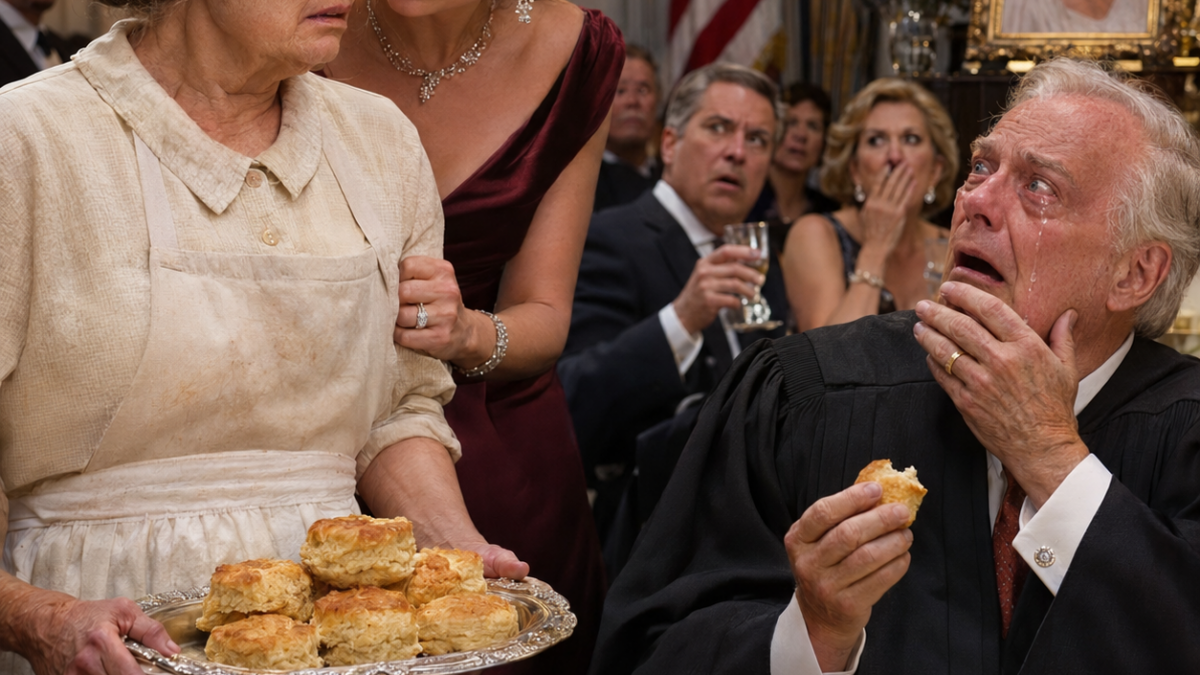
Supreme Court Justice Marcus Bell walked in.
I knew him from television.
Everyone did.
Sixty-one.
Tall.
Silver at the temples.
Famous for asking lawyers questions so quietly they became more frightening than shouting.
He held half a biscuit.
“Who made these?”
The executive chef stepped forward.
“Justice Bell, they were provided by the family.”
“No.”
Bell looked at the biscuit.
“Who made them?”
The room went quiet.
Nobody answered.
Then Lena pointed at me.
“She did.”
Bell looked.
His eyes found mine.
At first, nothing.
Then something.
He took another bite.
Slow.
His face changed.
He stared harder.
I felt uncomfortable.
“Sir?”
He walked closer.
“Honey butter.”
I blinked.
“Yes.”
“Black pepper.”
My hands stopped moving.
“Yes.”
His eyes filled.
“What is your name?”
“Dorothy Mercer.”
He looked almost disappointed.
Then:
“Did you ever work at Jefferson Elementary in Dayton?”
My throat tightened.
“Yes.”
“Were you there in 1989?”
“Yes.”
He whispered:
“Miss Martha?”
The kitchen disappeared.
Brown coat.
Torn cuff.
Thin hands.
Toby.
I stared at Justice Marcus Bell.
His mouth trembled.
“Oh my God.”
He covered his face.
The most powerful judge in the room began to cry.
People froze.
Then he stepped toward me.
“Are you Toby?”
His hands dropped.
He laughed through tears.
“No one has called me that in forty years.”
I put both hands over my mouth.
“You grew up.”
That made him cry harder.
He reached for me.
Stopped.
“May I?”
I nodded.
Justice Bell hugged me in the middle of the kitchen.
Not formally.
Not politely.
Like a child who had been carrying a memory longer than he knew where to put it.
“You fed us.”
My eyes burned.
“You were hungry.”
“You saved us.”
“No.”
“Yes.”
He pulled back.
“My sister and I still talk about you.”
“Rachel?”
“She’s a pediatrician.”
I laughed through tears.
“Of course she is.”
Bell looked down at the biscuit.
“I have searched for this taste everywhere.”
“That is a strange thing for a Supreme Court justice to spend time doing.”
“I had clerks calling bakeries in Ohio.”
I laughed.
Then the kitchen doors opened again.
Michael.
Sloan.
Both smiling.
Both expecting a harmless social moment.
“Justice Bell,” Michael said warmly. “We were wondering where you disappeared to.”
Bell turned.
His smile vanished.
Sloan saw me standing beside him.
Her face stiffened.
“Oh.”
Michael looked at my apron.
Then at Bell.
“Mother.”
First acknowledgment all night.
Bell became perfectly still.
“Mother?”
Nobody answered.
He looked at me.
Then Michael.
“This is your mother?”
Michael swallowed.
“Yes.”
Bell stared at him.
Sloan stepped forward.
“Justice Bell, there’s been a bit of confusion with the catering arrangement—”
Bell lifted one hand.
She stopped.
Then he asked:
“Why did you tell me she was dead?”
The kitchen went silent.
Michael’s face changed completely.
“I…”
Bell waited.
That was his courtroom skill.
Silence.
Michael looked toward Sloan.
Bad choice.
Bell noticed.
Months earlier, Justice Bell had met Michael during a legal conference.
The conversation turned personal.
Bell told him he had grown up poor.
Michael, eager to create connection, apparently said:
“So did I.”
Then Bell asked about his parents.
Michael told him his father died years ago.
True.
And his mother had passed away before Michael entered law school.
False.
Not merely false.
Calculated.
Michael had erased me because he thought a dead cafeteria cook sounded less embarrassing than a living one.
Bell asked again.
“Why did you tell me your mother was dead?”
Sloan answered.
“It was a misunderstanding.”
Bell looked at her.
“You were not present.”
Her mouth closed.
Michael’s eyes finally met mine.
“Mom.”
I had waited years to hear remorse in that word.
I heard fear instead.
“Justice Bell, my mother and I have a complicated relationship.”
Bell’s expression hardened.
“She paid for my lunch when I was eight years old.”
Michael blinked.
“What?”
“She and a school social worker made sure my sister and I did not spend a freezing weekend in an apartment without heat.”
He pointed at my apron.
“And you have her serving your guests?”
Michael looked at me.
I did not rescue him.
Sloan tried.
“She volunteered.”
Bell’s head turned slowly.
I felt Sloan’s panic.
“Dorothy?”
He asked only my name.
Nothing leading.
I answered:
“I came as Henry’s grandmother.”
Michael closed his eyes.
Bell looked at the apron.
“Why are you wearing that?”
Sloan said:
“This is inappropriate.”
Bell ignored her.
I could have destroyed them right there.
I could have repeated every threat.
I could have told a Supreme Court justice that Sloan said my son would sign a restraining order to keep me from Henry.
Part of me wanted to.
Then I saw Henry standing in the doorway.
He had followed his parents.
His face was pale.
Nine years old.
Birthday.
Watching adults decide whether his family would explode in front of him.
I would not make him pay for their choices.
So I said:
“We should speak somewhere else.”
Bell followed my eyes.
Saw Henry.
His expression softened immediately.
“Agreed.”
Sloan exhaled.
Too soon.
Bell walked to Henry.
“Are you the birthday gentleman?”
Henry nodded.
“Yes, sir.”
“I hear your grandmother makes excellent biscuits.”
Henry looked at me.
“The best.”
Bell smiled.
“I agree.”
Then he turned to Michael.
“We’ll talk after your son finishes his birthday.”
That scared Michael more than shouting would have.
The rest of the gala changed.
Justice Bell returned to the ballroom.
So did I.
Without the apron.
Lena untied it for me.
Sloan tried to stop me at the kitchen door.
“Dorothy.”
I looked at her.
“No.”
“One conversation—”
“No.”
“Think about Michael.”
I almost smiled.
“I have done that for sixty-six years.”
Then I walked into the ballroom in my navy dress.
Henry ran to me.
Sloan did not stop him.
He hugged me.
The cameras turned.
Not because photographers knew what happened.
Because Justice Marcus Bell stood beside us.
He placed one hand on my shoulder and told the nearest table:
“This woman kept me from going hungry when I was a child.”
Suddenly everyone could see me.
That should have felt triumphant.
It did not.
It felt sad.
I had been the same woman ten minutes earlier.
Same hands.
Same history.
Same biscuits.
The only thing that changed was a powerful man recognizing me.
That realization stayed with me.
Dignity should not require endorsement from someone important.
But social rooms often work that way.
I decided if Justice Bell’s recognition created space for truth, I would use the space.
Not worship it.
After the birthday cake, Henry asked:
“Grandma, can you sit with me?”
Sloan opened her mouth.
Michael said:
“Let her.”
The first decent thing he had done all night.
I sat.
Henry ate cake.
Then a biscuit.
“Mom said you were sick.”
I looked at Sloan.
“Did she?”
“She said that’s why I couldn’t visit.”
My chest tightened.
“What else did she say?”
Henry whispered:
“Sometimes she says you forget things.”
I stared.
I did not forget things.
Not beyond ordinary age.
Sloan had been building a narrative.
Not just poor.
Unstable.
Forgetful.
Possibly unsafe.
Useful foundation if she ever wanted a court to restrict access.
I touched Henry’s hand.
“You never have to choose between loving your parents and loving me.”
He looked relieved.
“Promise?”
“Yes.”
That became my rule.
Whatever happened next, Henry would not become a weapon.
When the gala finally ended, Justice Bell asked Michael, Sloan, and me to join him in a library off the main hall.
No staff.
No photographers.
Marcus closed the door.
Then took the brown leather chair nearest the fireplace.
He looked at Michael.
“Tell me the truth.”
Michael stood.
“What part?”
Bell’s face changed.
“All of it would be refreshing.”
Michael sat.
Sloan remained standing.
I sat opposite Bell.
Michael began carefully.
“My mother and I have had tension for years.”
“Why?”
“Social boundaries.”
I almost laughed.
Bell did not.
“Translate.”
Michael rubbed his forehead.
“She struggled with my professional world.”
I stared.
Bell glanced at me.
“Did you?”
“No.”
Michael continued quickly.
“She sometimes says things that make Sloan uncomfortable.”
“Such as?”
Michael froze.
Sloan answered:
“She talks about hardship.”
Bell looked at her.
“What hardship?”
“Michael’s childhood.”
Bell waited.
Sloan sighed.
“Money.”
Marcus Bell leaned back.
“So the embarrassing subject is that his mother was poor.”
Sloan’s face tightened.
“That’s not fair.”
“No?”
“No. It is about judgment.”
“What judgment?”
“She doesn’t understand how political careers work.”
Bell turned to me.
“Did you ask to speak at tonight’s event?”
“No.”
“Did you ask to discuss Michael’s childhood?”
“No.”
“Did you ask to speak with his professional guests?”
“No.”
“What did you ask?”
“To attend my grandson’s birthday.”
Bell turned back.
Michael looked miserable.
Then Bell asked the question that changed the conversation.
“Why did you tell people she was dead?”
Michael whispered:
“I didn’t tell everyone.”
“Did you tell me?”
“Yes.”
“Other people?”
Silence.
Sloan said:
“It simplified questions.”
Marcus Bell actually flinched.
“Simplified.”
Then he looked at me.
“How long?”
I answered:
“About three years.”
Michael’s head snapped up.
I continued.
“People stopped inviting me to his public events.”
“Mom—”
“I saw the obituary reference on a legal foundation biography.”
Bell’s eyes sharpened.
Michael said:
“That was not an obituary.”
“No.”
I looked at him.
“It said you were raised by your late parents.”
“My communications team—”
“Used information you approved.”
Silence.
I asked:
“Did you ever correct it?”
No answer.
That was answer enough.
Then Sloan crossed her arms.
“This has gotten completely out of proportion.”
I looked at her.
She knew what came next.
Bell asked:
“What happened with the apron?”
Sloan said:
“A private family arrangement.”
Marcus waited.
I said:
“She told me to pretend I was catering staff.”
Michael closed his eyes.
Bell asked:
“Why?”
“Because she said Michael’s nomination could not withstand guests knowing his mother had been enlisted Army and worked in a school cafeteria.”
Michael whispered:
“Sloan.”
She turned on him.
“Do not act surprised.”
Bell looked between them.
Then:
“Anything else?”
I hesitated.
Henry was upstairs with a sitter by then.
No child in the room.
So I told the truth.
“She said if I identified myself as Henry’s grandmother, she would file for a restraining order and make sure I didn’t see him again.”
Michael looked genuinely shocked.
That mattered.
He turned.
“You said what?”
Sloan’s expression changed.
“Michael.”
“Did you threaten my mother with a restraining order?”
“You knew we needed boundaries.”
“Did you say that?”
“She constantly undermines me.”
I almost spoke.
Bell raised one finger.
“Answer him.”
Sloan looked at Michael.
“Yes.”
His face drained.
Then:
“You said I would sign it?”
She said nothing.
Michael stood.
“Sloan.”
“You would have.”
“No.”
“You always do when Henry’s involved.”
That sentence exposed something I had not known.
Their marriage had its own system.
Sloan decided.
Michael yielded.
Again and again.
He had called it peace.
I recognized the pattern because I had raised a son who learned conflict avoidance partly from me.
After Earl died, Michael and I survived by not adding burdens to each other.
He studied.
I worked.
He never complained.
I never admitted exhaustion.
Silence became love.
Then silence became habit.
Then, around Sloan, habit became surrender.
Marcus Bell looked at my son.
“This has nothing to do with your nomination.”
Michael laughed bitterly.
“Everything has to do with the nomination.”
“No.”
Bell’s voice became harder.
“Your legal ability matters.”
“Your record matters.”
“Your judgment matters.”
He looked at me.
“Whether your mother baked school lunches does not matter.”
Then:
“But lying about whether she is alive?”
Michael lowered his eyes.
“That does matter to me.”
Sloan stepped forward.
“Are you threatening his career?”
Bell stared at her.
“No.”
“I am describing my opinion.”
“What difference does that make?”
“As a judge?”
He paused.
“Everything.”
He would not promise to block Michael.
He would not promise to help him.
That was important.
He refused to turn personal gratitude toward me into misuse of judicial influence.
He simply said:
“If I am asked for an assessment of Michael’s character, I will answer truthfully based on what I know.”
Then he stood.
Looked at me.
“Dorothy, may I ask you something?”
“Yes.”
“Do you still have the ledger?”
I stared.
“The green one?”
His eyes filled.
“Yes.”
I laughed softly.
“Somewhere.”
“I have thought about that page my entire life.”
“Why?”
“Because you crossed out the debt.”
I remembered.
NO DEBT.
Marcus swallowed.
“I had spent my childhood believing every kindness became something I owed.”
His voice broke.
“You were the first adult who told me otherwise.”
I reached for his hand.
“You were eight.”
He squeezed mine.
“I know.”
Then he said:
“That is why I became a lawyer.”
I stared.
“No.”
He smiled.
“Not entirely.”
“Good.”
“I became obsessed with rules.”
He looked toward Michael.
“Especially rules used against people who had less power.”
The room went quiet.
Marcus left soon after.
Before going, he asked for my phone number.
Not through Michael.
Mine.
Sloan stood frozen while I typed it into his phone.
Michael walked me to my car.
Sloan did not.
The cold had sharpened.
My knees hurt.
Michael carried the empty biscuit basket.
At the car, I opened the trunk.
He put it inside.
Then said:
“Mom.”
I waited.
“I didn’t know about the restraining-order threat.”
“I believe you.”
His eyes filled.
“That does not make this better.”
“No.”
“I did know about the apron.”
“Yes.”
He looked away.
“I told myself it was just for one night.”
I said nothing.
“I told myself you’d understand.”
“Understand what?”
“That these people judge.”
“Michael.”
He looked at me.
“You were one of them.”
That landed.
“I was ashamed.”
“I know.”
“No.”
His voice cracked.
“I need to say it.”
So I let him.
“I was ashamed that I grew up poor.”
“Yes.”
“Ashamed Dad drove a bus.”
“Yes.”
“Ashamed you worked cafeteria lines.”
“Yes.”
“Then the more successful I became, the more stupid the shame felt.”
I waited.
“But instead of getting rid of it…”
He looked at me.
“I got rid of you.”
My eyes filled.
There it was.
Not Sloan.
Not politics.
Not class prejudice.
My son’s choice.
“I’m sorry.”
I asked:
“Why tell Bell I died?”
“Because he asked what my mother did.”
“And?”
“I panicked.”
“Why?”
“He talked about growing up hungry.”
Michael gave a bitter laugh.
“I could have told him the truth and probably made a stronger connection.”
“Yes.”
“Instead, I heard Sloan’s voice in my head saying judges want stability, pedigree, polish.”
I shook my head.
“No.”
“What?”
“You heard your own fear.”
He looked at me.
I continued.
“Stop putting everything inside your marriage.”
He flinched.
“Sloan has done cruel things.”
“Yes.”
“You still did yours.”
“Yes.”
That was the first honest conversation we had had in years.
Then he asked:
“Will you forgive me?”
“No.”
His face fell.
I continued:
“Not tonight.”
He nodded.
That answer mattered too.
Forgiveness should not be a performance demanded immediately after confession.
He kissed my cheek.
I drove home.
At midnight, I opened the cabinet above my bedroom closet.
Old papers.
Earl’s bus-union card.
My Army discharge record.
School photographs.
A dented recipe tin.
And beneath them:
Green spiral notebook.
I sat on the bed.
Turned brittle pages.
Names.
Amounts.
Milk.
Lunch.
Field-trip fees.
Children whose balances I had quietly covered when I could.
Then:
TOBY BELL — $5.20
Crossed out.
Underneath:
NO DEBT.
I cried.
Not because Marcus became important.
Because Toby lived.
Rachel lived.
They made it out of that freezing apartment.
For thirty-seven years, I had not known.
That was the gift.
The next morning, Marcus called.
“Did you find it?”
“Yes.”
Silence.
“Could I see it?”
“Yes.”
He arrived two days later without staff.
No security spectacle.
Plain car.
He brought Rachel.
Dr. Rachel Bell-Jefferson.
Pediatrician.
Fifty-eight.
The little first grader I barely remembered ran into my house and hugged me before I could say hello.
“You smell the same.”
I laughed.
“That is impossible.”
“Flour.”
“That’s insulting.”
Marcus carried a faded brown paper sack.
My chest tightened.
“I kept one.”
I touched it.
Thin.
Fragile.
On the side, in blue ink:
T + R — FRIDAY
My handwriting.
I sat down.
Rachel cried.
Then told me what happened.
Their aunt kept them.
Worked nights.
Raised them.
Toby became Marcus officially at twelve because he hated the childhood nickname.
Rachel studied medicine.
Marcus studied law.
Their mother eventually entered long-term treatment and rebuilt limited relationships with them before she died.
Life had not become easy.
But it continued.
Marcus opened the ledger.
Found his name.
Put one finger beneath:
NO DEBT.
Then he said:
“You have no idea what that did to me.”
“I wrote that because you were a child.”
“Exactly.”
Rachel looked at me.
“At home, everything was debt.”
“Food.”
“Heat.”
“Being difficult.”
“Existing.”
She touched the notebook.
“You told him a meal could be given without a bill attached.”
I stared at them.
Thirty years serving food had always felt ordinary.
Useful.
Hard.
Never prestigious.
That afternoon I understood something Michael had forgotten.
Work does not become small because wealthy people ignore it.
A tray can matter.
A biscuit can matter.
The person carrying it can matter.
Marcus Bell did not save my dignity at Henry’s gala.
He reminded other people it had been there the whole time.
That distinction became important when the story leaked.
And it did leak.
Not from me.
Not from Marcus.
A guest had photographed Justice Bell speaking with me.
Another had noticed the catering apron.
Social media began asking:
WHO IS THE WOMAN JUSTICE BELL CALLED HIS CHILDHOOD HERO?
Then a Washington society reporter discovered I was Michael Mercer’s living mother.
That contradicted older biographies.
Questions followed.
Michael’s communications office panicked.
Sloan wanted a statement.
Michael called me.
“What are you going to say?”
“The truth if someone asks.”
“Can we coordinate?”
“No.”
“Mom.”
“I will not attack you.”
He was silent.
“I will also not lie for you.”
That sentence brought everything full circle.
Michael issued his own statement before any reporter reached me.
No excuses.
He acknowledged that previous biographical materials had incorrectly described both parents as deceased.
His father had died.
His mother had not.
He admitted he had failed to correct the record.
Then:
My mother, Dorothy Mercer, served in the United States Army and spent three decades feeding children in public schools. Any suggestion that her work was a source of embarrassment reflects a failure of judgment on my part, not a failure of dignity on hers.
I read it twice.
Sloan hated it.
I knew because Michael told me later.
She wanted wording like:
family misunderstanding.
He refused.
That was new.
The nomination process slowed.
Not ended.
Questions were asked.
Background interview.
Character review.
Michael disclosed everything.
The false biography.
The gala.
His role.
Sloan’s threat.
He did not ask Bell to intervene.
Bell did not.
Eventually Michael’s nomination did not move forward that cycle.
Not because some dramatic judge destroyed him.
Politics and judicial nominations involve many factors.
But Michael knew his credibility problems had not helped.
When he called to tell me, I waited for blame.
It did not come.
“I did this.”
He sounded exhausted.
“Yes.”
“I expected you to argue.”
“You said the accurate thing.”
He laughed weakly.
“Learning.”
His career did not end.
He remained a lawyer.
A very good one.
But the path he had imagined changed.
That hurt him.
Consequences should hurt sometimes.
Otherwise they are merely vocabulary.
The deeper collapse happened inside his marriage.
Michael stopped automatically agreeing with Sloan.
That sounds small.
It was not.
The first major argument involved Henry.
Sloan wanted to limit my contact until “public attention cooled.”
Michael said:
“No.”
She threatened separation.
He said:
“Then we discuss separation.”
The old Michael would have surrendered before the second sentence.
Sloan filed for divorce six months later.
I did not celebrate.
Henry cried.
That was enough to make any victory feel ugly.
Michael and Sloan entered a difficult custody process.
I refused to participate in character attacks.
When attorneys asked about the gala threat, I told the truth.
When asked whether Sloan loved Henry, I also told the truth.
“Yes.”
People contain contradictions.
Cruel daughter-in-law.
Devoted mother in other ways.
Controlling spouse.
Competent professional.
The legal system did not need me to turn her into a monster to understand specific conduct.
The restraining-order threat mattered.
Her treatment of me mattered.
Her relationship with Henry was evaluated separately.
That was right.
Michael received substantial parenting time.
Sloan did too.
Neither was allowed to use Henry to interfere with lawful contact with grandparents absent actual safety concerns.
That provision made me cry.
Not because I had won Henry.
Because nobody should “win” a child.
It meant access could no longer be casually threatened as punishment.
Henry started spending Saturday mornings with me again.
First thing he wanted:
Biscuits.
“Three?”
“Four.”
“You’re nine.”
“Exactly.”
We baked together.
He cut the dough too thin.
I complained.
He rolled his eyes.
Just like Michael used to.
One morning Henry asked:
“Why was Dad embarrassed of you?”
I put the biscuit cutter down.
“Because sometimes people confuse where they came from with how far they’ve gone.”
He frowned.
“That doesn’t make sense.”
“I know.”
“Justice Bell likes you.”
I laughed.
“That has nothing to do with it.”
“But he’s important.”
“So am I.”
Henry stared.
Then smiled.
“Good answer.”
Exactly.
I wanted him to learn that before adulthood.
Status does not create worth.
Prestige does not validate kindness.
And shame about poverty does not erase poverty from the past.
It only makes you cruel to the people who survived it with you.
Michael began therapy.
I knew because he told me.
I did not ask for details.
Eventually he came to my house carrying something.
A small velvet box.
Inside:
Earl’s Army medals.
I stopped breathing.
“What?”
“I found them.”
“Where?”
“An estate broker.”
That required explanation.
Years earlier, when Michael received his Michigan Law admission, tuition and living costs exceeded every aid package.
I had taken a second mortgage.
Worked nights cleaning office kitchens.
And sold several possessions.
Including Earl’s medals.
Not the official replacement set.
His original service medals.
I told myself he would understand.
He was dead.
Michael was alive.
Mothers make brutal calculations quietly.
I had never told Michael.
He somehow discovered it through an old receipt while going through family papers after the gala.
He tracked the medals.
The dealer had sold them to a collector.
Then another.
Michael spent months locating them.
Paid more than I ever received.
He set the box in front of me.
“I didn’t know.”
I touched the ribbon.
“Wasn’t your job to know.”
“You sold Dad’s medals for law school.”
“Partly.”
“And worked nights.”
“Yes.”
“Why didn’t you tell me?”
“Because then it becomes debt.”
Michael froze.
I smiled sadly.
“Toby taught me something too.”
“What?”
“Children shouldn’t owe their parents for being raised.”
His eyes filled.
“But what I did to you—”
“That is separate.”
“I still owe you.”
“No.”
“You sacrificed everything.”
“I made choices.”
He shook his head.
“Stop making this easy.”
“I’m not.”
I put one finger against the medals.
“You do owe me something.”
He waited.
“Never be ashamed of the truth again.”
His face collapsed.
“I can do that.”
“Good.”
He hugged me.
I forgave him sometime after that.
There was no ceremonial moment.
No sentence.
No sunrise.
I simply noticed one day that when his number appeared on my phone, my body no longer tightened.
That is how forgiveness often arrives.
Not as a decision.
As the absence of dread.
Sloan and I never became close.
We became civil.
For Henry.
Years later, she apologized.
Not at a gala.
Not in court.
In a school parking lot.
She stood beside her car.
“I was cruel to you.”
“Yes.”
“You could make this harder.”
“For who?”
“Me.”
“I’m not interested.”
That surprised her.
“I thought you hated me.”
“I hated what you did.”
“Difference?”
“Yes.”
She looked toward Henry’s school.
“I thought if Michael became powerful enough, everything would be secure.”
“Was it?”
She almost smiled.
“No.”
Then:
“I treated you like evidence of where he came from instead of the person who got him there.”
That was accurate.
I nodded.
“Thank you.”
She expected more.
There wasn’t more.
An apology can close a sentence without reopening a relationship.
Marcus and Rachel remained in my life.
Not constantly.
Holidays sometimes.
Letters.
Phone calls.
Marcus invited me to the Supreme Court once.
I refused twice.
Then Henry begged to go.
So we went.
Security.
Marble.
Columns.
Courtroom.
Everything designed to make a person feel small.
Marcus met us afterward.
He hugged me.
No hesitation.
A clerk stared.
Marcus said:
“This is Miss Martha.”
The clerk’s eyebrows rose.
I said:
“My name is Dorothy.”
Marcus smiled.
“Not to me.”
Then he gave Henry a tour.
At lunch, Henry asked Marcus:
“Did one biscuit really make you cry?”
Marcus laughed.
“No.”
“What did?”
“Memory.”
Henry looked confused.
Marcus explained.
“Sometimes food carries a whole place inside it.”
He looked at me.
“That biscuit tasted like the first moment I knew an adult saw me.”
I had to look away.
Marcus never publicly claimed I made him a justice.
He was too intelligent for that.
People want one origin story.
Life is not that clean.
He had teachers.
His aunt.
Scholarships.
Mentors.
Rachel.
Years of work.
But he did say one thing publicly at a legal-aid event where I sat in the audience.
“When I was eight, a cafeteria worker looked at a rule designed to humiliate a hungry child and decided compliance was less important than humanity.”
He did not use my name at first.
Then:
“Her name is Dorothy Mercer.”
The room stood.
I wanted to crawl under the chair.
Afterward I told him:
“Never do that again.”
He said:
“Absolutely not.”
Annoying man.
The attention helped raise money for school meal programs.
That I liked.
Marcus and Rachel established a fund in their aunt’s name supporting food security and emergency family services.
They asked whether they could name one cafeteria grant after me.
“No.”
Marcus said:
“Too late.”
THE DOROTHY ‘MISS MARTHA’ MERCER NO-DEBT LUNCH FUND.
I hated the name.
Children ate.
I stopped complaining.
The program’s principle was simple.
No child publicly identified for meal debt.
No trays thrown away in front of students.
No visible shame substitutes.
Families could receive assistance privately.
Schools could maintain nutrition without turning hunger into punishment.
That mattered more to me than any gala.
Michael volunteered eventually.
Quietly.
No press.
He reviewed pro bono contracts for the foundation.
The first time I saw his name on a legal document next to mine, I felt something inside settle.
He had once tried to erase me from his biography.
Now he was using his profession to support work born from mine.
Not redemption as performance.
Work.
Better.
Henry grew.
Nine became twelve.
Then sixteen.
At sixteen he was taller than Michael.
Still ate four biscuits.
One afternoon he found the old black catering apron in my pantry.
I had kept it.
I’m not sure why.
He held it up.
“This?”
“Yes.”
“The gala?”
“Yes.”
“Why didn’t you burn it?”
I considered.
“Because sometimes objects change meaning.”
“What does it mean now?”
I took it.
Cheap polyester.
Black.
The same thing Sloan had shoved into my hands while telling me to hide.
I tied it around Henry.
He laughed.
“Grandma.”
“Bake.”
We made biscuits.
Flour covered the apron.
Butter.
Buttermilk.
Honey.
Black pepper.
By the end, it no longer looked like a symbol of humiliation.
It looked like what an apron should look like.
Work.
Food.
Family.
Henry wore it every time he baked with me after that.
That was better than burning it.
I retired fully at sixty-eight.
The school district invited me to a recognition luncheon.
I expected cafeteria staff.
Maybe old teachers.
Marcus appeared.
Rachel too.
Michael.
Henry.
Even Sloan, sitting farther back.
The superintendent read a list of years.
Thirty.
Thousands of meals.
Mentoring.
Emergency assistance.
Then he mentioned the old meal-debt controversy.
I groaned.
Marcus laughed from the audience.
Afterward, a woman approached.
Midforties.
“Miss Martha?”
I looked.
No recognition.
She said:
“You used to put fruit in my backpack.”
Memory returned slowly.
“Angela?”
She cried.
“I thought you forgot me.”
“No.”
I had.
Then remembered.
Both could be true.
She hugged me.
That day taught me something else.
Marcus had become famous.
That made his story visible.
But there had been many Tobys.
Angelas.
Children whose adult lives I would never know.
Kindness does not need a later Supreme Court justice to prove it mattered.
Most kindness disappears into lives you never see again.
Still counts.
That became the story I told whenever reporters wanted the dramatic biscuit moment.
They asked:
“What was it like when Justice Bell cried?”
I said:
“Emotional.”
Then:
“The important part happened when he was eight.”
They wanted the gala.
I wanted the lunch line.
Because recognition is not the miracle.
The original choice is.
A hungry child.
A rule.
A hot meal.
Someone deciding humiliation was unnecessary.
That was all.
When I turned seventy-two, Henry gave me a framed piece of paper.
Not the apron.
Not Marcus’s photograph.
A photocopy from the green ledger.
TOBY BELL — $5.20
Crossed out.
NO DEBT.
Below it, Henry had written:
SAME RULE FOR FAMILY.
I looked at him.
“What does that mean?”
He shrugged.
“You told Dad he didn’t owe you for raising him.”
“Yes.”
“You told Justice Bell he didn’t owe you for feeding him.”
“Yes.”
“So I don’t owe you for loving me.”
My throat tightened.
“No.”
He smiled.
“But I’m going to love you anyway.”
That boy.
I cried harder than Marcus did in the kitchen.
Michael stood behind him.
He looked at the framed ledger.
Then at me.
“You taught him better than I learned.”
“No.”
I shook my head.
“You learned late.”
He nodded.
“Fair.”
There are people who think justice in a family story means total destruction.
Sloan ruined.
Michael stripped of everything.
A justice publicly humiliating them.
Henry choosing me over his parents.
None of that happened.
And I am glad.
Michael faced the truth.
His nomination stalled.
His marriage ended.
His public image cracked.
But he did not become worthless because he had once treated me as if I were.
He changed.
Sloan lost control of the story she had designed.
She could no longer threaten to erase me from Henry’s life.
But she remained Henry’s mother.
Over time, she learned boundaries.
Marcus did not abuse his position to punish my son.
That would have betrayed everything I once admired in him.
He simply refused to participate in a lie.
That was enough.
The strongest consequence Michael faced was not losing a title.
It was hearing the man he admired ask:
Why did you tell me she was dead?
Because Michael had spent years believing my life made his résumé smaller.
Then, in one kitchen, he discovered my life had shaped someone he considered one of the greatest legal minds in the country.
But even that was not the real lesson.
The real lesson was that I should not have needed Marcus Bell’s success to prove my worth.
I mattered when nobody knew my name.
I mattered in the Army supply room.
I mattered behind a cafeteria counter.
I mattered cleaning grease traps at midnight.
I mattered standing at Michael’s law-school graduation in shoes I bought secondhand.
I mattered when Sloan pushed an apron into my hands.
I mattered before a justice recognized the taste of my biscuits.
Marcus’s tears did not create my dignity.
They exposed the blindness of people who had failed to see it.
Years after the gala, Justice Bell retired.
At his farewell dinner, he invited me.
I went.
No apron.
Navy dress.
Earl’s pearls.
The same ones Sloan once told me to remove.
Marcus saw them.
“Those new?”
“No.”
“Beautiful.”
“My husband gave them to me.”
He nodded.
During his speech, he thanked teachers.
Clerks.
Colleagues.
Rachel.
His aunt.
Then he looked at me.
I shook my head sharply.
Do not.
He smiled.
Ignored me.
“And one cafeteria cook who once told a frightened child he owed her nothing.”
The room applauded.
I stared at my plate.
Afterward, Marcus gave me the last word privately.
“You were wrong.”
“About?”
“You said I didn’t owe you.”
“You don’t.”
“I do.”
“No.”
He smiled.
“I owe you the obligation to give someone else what you gave me.”
I thought.
Then nodded.
“That one I’ll allow.”
That is the kind of debt worth carrying.
Not repayment.
Continuation.
Michael eventually remarried.
Years later.
A woman named Claire.
Public defender.
First time she came to my house, she ate three biscuits.
Then asked for the recipe.
I liked her immediately.
Michael said:
“That’s all it takes?”
“Yes.”
He rolled his eyes.
Henry went to college.
Not law school immediately.
Thank God.
He studied history and public policy.
At nineteen, he called.
“Grandma?”
“Yes?”
“I’m cooking.”
“Dangerous.”
“How much buttermilk?”
I told him.
Then:
“Do not overwork the dough.”
“I know.”
“You always say that.”
“Because you always overwork it.”
He laughed.
I listened to him moving around a dorm kitchen hundreds of miles away.
The little boy Sloan once threatened to take from me had become a man calling for biscuit advice.
That was enough justice for one lifetime.
Sloan and I sat together at his college graduation.
Not close.
Civil.
She said:
“He still talks about your kitchen.”
I smiled.
“He talks about you too.”
Her eyes filled unexpectedly.
“Really?”
“Yes.”
She looked toward him.
“I made a lot of mistakes.”
“Yes.”
“You never soften that.”
“No.”
She laughed quietly.
“Maybe that’s why I believe you.”
We watched Henry cross the stage.
No cameras on us.
No VIP judges.
No nominations.
Just family.
Imperfect.
Rebuilt.
When people tell the story now, they usually start with the gala.
Daughter-in-law forces grandmother to pretend she is staff.
Supreme Court justice tastes biscuit.
Justice cries.
Secret revealed.
It makes a good headline.
But the story did not begin with the apron.
It began decades earlier when a hungry little boy stood at a cafeteria register while adults told him policy mattered more than hunger.
It began when I had five dollars that I needed for my own child and spent it on someone else’s.
It began when Toby asked if I could lock him inside because home was colder than school.
It began when social workers arrived.
It began with a brown paper bag.
And maybe, if I am honest, it began even earlier.
In the Army.
Learning no one gets left behind because they are inconvenient.
Earl.
Teaching me that feeding people is a kind of love.
Poverty.
Teaching me exactly what humiliation feels like when someone with more money treats survival as evidence of inferiority.
Those things made the biscuit.
Not just flour.
Not just butter.
Memory.
That is what Marcus tasted.
Not magic.
Recognition.
Years later, I asked him:
“Why were you so sure?”
He said:
“The pepper.”
I laughed.
“Seriously?”
“No one else did it.”
“That’s ridiculous.”
“Also the honey.”
“Still ridiculous.”
Then his face changed.
“And because nobody ever made food taste safe after that.”
I stopped laughing.
Food taste safe.
That may be the nicest thing anyone ever said about my cooking.
The old green ledger now belongs to the No-Debt Lunch Fund archive.
Not because it is historically important.
Because Marcus insisted.
I donated it on one condition:
No page displayed with a child’s full name except his, because he consented.
They made a copy for me.
Toby Bell.
$5.20.
Crossed out.
No debt.
The original apron Henry still has.
The pearls went to him too eventually.
He asked:
“What am I supposed to do with earrings?”
“Give them to someone you love.”
He smiled.
“Okay.”
My life turned out to be full of objects that changed meaning.
An apron that began as humiliation became something my grandson baked in.
A ledger that tracked debt became a reminder that children owe nothing for hunger.
Pearls Sloan called sentimental became proof that I did not have to strip away my history to enter an elegant room.
Biscuits became a bridge across almost forty years.
Even Michael’s shame changed.
He began speaking openly about his childhood when mentoring younger attorneys from working-class families.
At a bar association event, he said:
“My mother cooked school lunches and cleaned offices so I could attend Michigan Law.”
Then:
“I spent years believing that made me less impressive.”
Pause.
“It actually makes my résumé look embarrassingly easy.”
People laughed.
I cried in the back row.
He knew I was there.
This time, he looked directly at me.
That was the opposite of the gala.
No hiding.
No turning away.
He finished:
“If you come from sacrifice, do not rewrite it into pedigree. Say thank you.”
Afterward, I told him:
“Good speech.”
He hugged me.
“Too much?”
“Almost.”
He laughed.
No perfect family.
No erased past.
No dead mother invented for convenience.
Truth.
That was enough.
The last biscuit I ever baked for Marcus Bell was on his seventieth birthday.
Rachel brought him to my house.
Henry came.
Michael.
Claire.
Small table.
No photographers.
Marcus bit into one.
Closed his eyes.
Then said:
“Still right.”
I replied:
“You’re getting old. Your taste buds are unreliable.”
He laughed.
Then reached into his jacket.
Brown paper bag.
The original one had become too fragile to carry.
This was a new bag.
On the front, he had written:
DOROTHY — NO DEBT.
I stared.
“What’s this?”
“Open it.”
Inside was a copy of a scholarship announcement.
For school cafeteria employees pursuing education, certification, or emergency assistance.
Named for cafeteria workers generally.
Not me.
I liked that better.
Marcus said:
“Your rule.”
“What rule?”
“Continue the kindness.”
I looked around my little dining room.
My son.
My grandson.
Marcus.
Rachel.
People whose lives had crossed mine because somebody once needed food.
Then I thought about that gala kitchen.
Sloan pushing me into black polyester.
Michael refusing to meet my eyes.
My hands trembling against stainless steel.
I had believed the lowest moment was being mistaken for a server.
Now I understand how wrong that was.
There is nothing humiliating about serving people.
I spent most of my life doing exactly that.
The humiliation was in being told service made me less worthy of being named.
That was Sloan’s mistake.
Michael’s too.
They thought dignity came from being seated at the table.
Marcus Bell knew better.
Sometimes the most important person in the room is the one carrying the tray.
And sometimes a biscuit placed into the hands of a hungry eight-year-old keeps moving through the world for forty years before it finds its way back to the woman who baked it.
By then, I no longer needed Michael’s nomination.
Sloan’s approval.
Washington society.
A VIP introduction.
I had something better.
My grandson knew my name.
My son finally said it without shame.
And the child I once fed had grown into a man powerful enough to sit on the highest court in the country—and wise enough to remember that before anyone called him Justice Bell, somebody in a school cafeteria had looked at a hungry little boy and called him worth feeding.
That was all I had done.
It turned out to be enough.








