PART2:“PLEASE, SAVE HIM!” We Begged a Drowning Dog to Get Into Our Rescue Boat—But He Kept Swimming Away Until We Discovered Who Was Trapped Inside the Flooded House
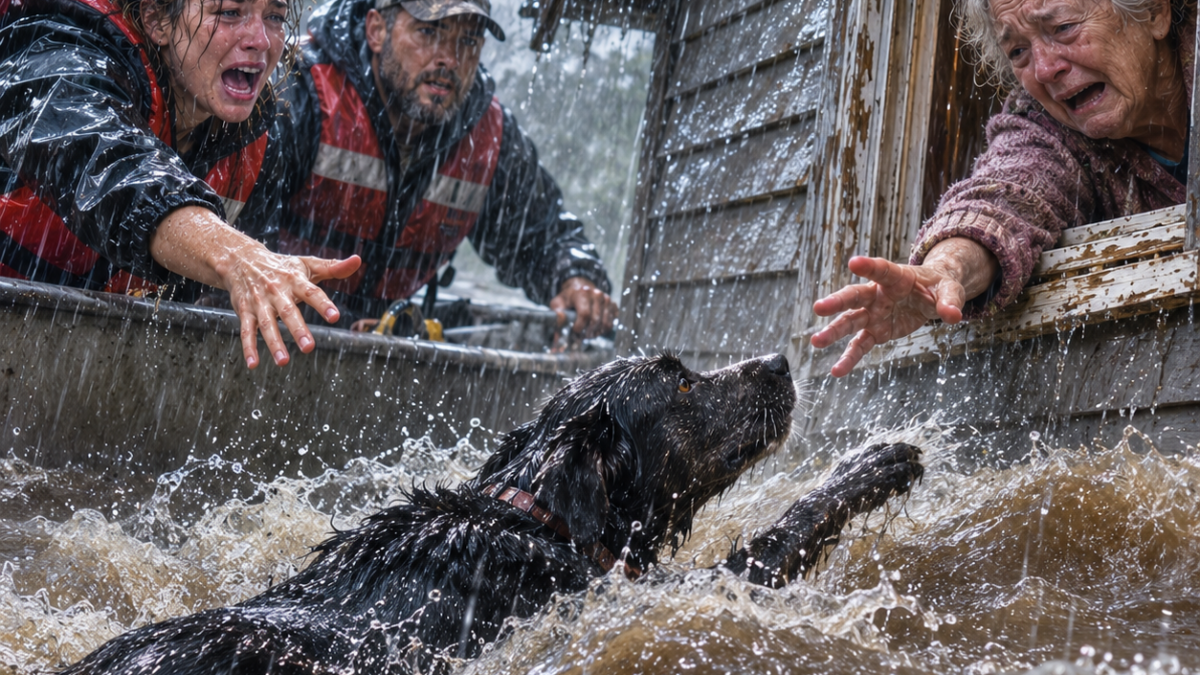
The water grew darker as we entered the old neighborhood.
I had known those streets before the flood.
They were lined with modest wooden houses, small gardens, and tall trees that provided shade in the summer.
Older people lived there.
Families whose children had grown up and moved away.
Retired teachers.
Former factory workers.
People who had spent decades paying for houses they never intended to leave.
On ordinary mornings, someone was always watering flowers.
Someone would be sweeping a porch.
A dog would bark behind a fence.
Children on bicycles would cut through the side streets on their way to school.
Now there was no sound of traffic.
No lawnmowers.
No conversations from porches.
Only water.
The creaking of damaged structures.
And the faint noise of our boat moving between submerged buildings.
I looked toward the dog.
He was still ahead of us.
Swimming slowly.
His movements were becoming weaker.
Every few strokes, his head dipped dangerously close to the surface.
Then he raised it again.
“He’s exhausted,” I whispered.
David nodded.
“I know.”
“We can’t let him keep swimming like this.”
“I know.”
I looked toward the houses.
“Then why won’t he come aboard?”
David didn’t answer immediately.
He watched the dog.
Then said quietly, “Maybe he hasn’t shown us what he wants us to see.”
I stared at the black animal fighting the current.
He turned around.
Looked directly at us.
Then released that same desperate cry.
My throat tightened.
“Okay, boy.”
I leaned forward.
“We’re coming.”
He turned and continued.
We had already rescued several people that morning.
An older man trapped on the second floor of his home.
A mother and her teenage daughter standing on a porch roof.
A frightened child clinging to a tree branch after the water swept through his family’s yard.
Each rescue had left something inside me.
The look people gave us when they realized help had finally arrived.
The way they reached for the boat.
The shaking hands.
The exhausted voices.
The desperate questions about relatives and pets.
Every rescue reminded me that when a disaster destroys a neighborhood, it destroys more than buildings.
It tears apart the routines that make people feel safe.
The little things.
The sound of a coffee machine in the morning.
A favorite chair beside the window.
Photographs on a wall.
The familiar weight of a dog sleeping beside the bed.
The belief that tomorrow will look much like yesterday.
The flood had taken all of that away from thousands of people.
And now we were following a dog through the ruins of their homes.
A dog who seemed to have lost everything familiar himself.
I watched his back rise briefly above the water.
His coat was soaked and dull.
His body looked thin enough that I worried every stroke might be his last.
I wanted to lift him out.
Wrap him in a blanket.
Give him water.
Let him rest.
But every time we brought the boat near him, he avoided our hands and continued toward the flooded houses.
I began to understand that helping him might mean following him first.
The deeper we went, the more dangerous the neighborhood became.
Some buildings had water almost to the second floor.
The lower windows were completely hidden.
Only rooftops, upper walls, and pieces of chimneys remained visible.
Broken branches floated between the houses.
Power lines sagged overhead.
Pieces of wooden siding drifted in the current.
David moved carefully.
He knew the water concealed obstacles we couldn’t see.
Fences.
Cars.
Debris.
The remains of porches.
A boat could become trapped or damaged if we approached carelessly.
I kept my eyes on the dog.
“He’s turning left.”
David adjusted our direction.
The dog swam through a relatively calmer section between two buildings.
I watched his movements.
He seemed to choose areas where the current was weaker.
Sometimes he had to struggle around debris.
Other times, he moved through narrow gaps that looked almost impossible.
I wondered how long he’d been navigating the flooded streets.
Had he been swimming since the previous night?
Had he rested somewhere?
Had he been searching for his family?
Or had he simply learned that certain paths were safer than others?
I couldn’t know.
But there was something unmistakably purposeful about the way he continued.
He wasn’t swimming randomly.
He kept returning his attention to a particular direction.
And every time we slowed too much, he looked back.
I leaned forward.
“We’re here, boy.”
He paddled on.
“We’re still following.”
Twenty minutes passed.
By then, I was terrified.
The dog was tiring.
His head sank lower.
His strokes became shorter.
I could see him fighting to maintain his position against the moving water.
“David, he’s not going to last much longer.”
My partner nodded.
“I see it.”
We approached him again.
I stretched out my hand.
“Please, sweetheart.”
My voice shook.
“Please let us help you.”
The dog turned toward us.
For a moment, his eyes met mine.
Then he looked past the boat.
Toward a house several yards away.
And released the most heartbreaking sound I’d heard all morning.
A deep whine.
Strained.
Desperate.
He began swimming toward the house.
I followed his gaze.
The building was old.
Two stories.
Wooden siding.
The entire ground floor was underwater.
Part of the roof had collapsed.
A curtain hung through an upper window, moving weakly in the breeze.
I stared.
Something about the house felt wrong.
Not simply damaged.
There was a stillness to it that made my stomach tighten.
The dog stopped in the water.
He began paddling in place.
His nose pointed toward the upper window.
Then he whined again.
I whispered, “What is it?”
David looked toward the house.
“Maybe there’s someone inside.”
I stared at the window.
At first, I saw nothing.
Just darkness.
A wet curtain.
Broken glass reflecting the gray sky.
Then something moved.
A small shape behind the window.
Pale.
Unsteady.
I leaned forward.
“David.”
He looked up.
“What?”
I pointed.
“There.”
A moment passed.
Then I saw it again.
A hand.
A human hand.
Moving weakly behind the upper window.
My heart nearly stopped.
“THERE’S SOMEBODY INSIDE!”
David immediately adjusted the boat’s course.
I looked toward the dog.
He was still paddling below the window.
His exhausted eyes fixed on the house.
And suddenly, everything made sense.
He hadn’t been trying to escape the flood.
He had been trying to bring us here.
I don’t remember shouting instructions.
I remember the feeling.
A terrible rush of urgency.
The understanding that someone had been trapped inside that house long enough to become too weak to call for help.
And the horrifying realization that we might have passed without noticing.
The window was high above the water.
Part of the upper structure had shifted.
The curtains obscured the interior.
From a distance, the building looked abandoned.
If the dog hadn’t stopped there, we might never have examined it closely.
David approached carefully.
The current pushed against the boat.
Pieces of debris drifted past.
“Stay low,” he told me.
I nodded.
We reached a position where the rescue boat could be stabilized near the damaged upper structure.
I secured my equipment.
Then looked toward the window.
The pale hand appeared again.
Weakly.
Barely moving.
I felt my throat close.
“HELLO!”
There was no answer.
I called again.
“CAN YOU HEAR ME?”
For a moment, nothing happened.
Then a face appeared behind the glass.
An elderly woman.
Pale.
Exhausted.
Her eyes widened when she saw me.
I raised one hand.
“I’m a rescuer!”
Her mouth moved.
No sound reached me.
I looked toward David.
“She’s alive.”
He nodded.
“Let’s get her out.”
Getting to the window was difficult.
The ground floor was completely submerged.
The upper window remained above our heads.
We had to approach from the accessible edge of the damaged roof.
David stabilized the boat.
I moved carefully, using the safety equipment we’d brought.
The roof was wet.
Part of it had collapsed.
The wood looked fragile.
I placed my weight cautiously.
Every movement felt dangerous.
The dog remained in the water nearby.
I could hear his weak paddling.
I looked down.
“Hang on, boy!”
He looked up.
Then turned his attention back to the window.
I climbed closer.
The elderly woman was kneeling inside.
She wore a thick coat soaked around the lower half.
Her gray hair clung to her face.
Her lips trembled.
Her eyes were wide with disbelief.
I pressed my hand against the glass.
“Ma’am!”
She looked at me.
“I’m Ella! I’m with the rescue team!”
Her mouth opened.
A faint sound emerged.
I couldn’t understand it.
I leaned closer.
“We’re going to get you out.”
Tears filled her eyes.
She lifted one hand toward the window.
Her fingers trembled.
For a moment, she looked as though she was afraid I might disappear.
I placed my palm against the glass.
“I’m real.”
My voice broke.
“I’m here.”
She began crying.
And I realized she had probably spent hours wondering whether anyone would ever find her.
David passed the necessary tools.
We assessed the window and carefully opened an exit through the damaged glass.
I shielded the woman as much as possible from sharp edges.
Then cleared a path.
She tried to move.
Her legs trembled.
She was weak.
Far weaker than I’d expected.
I reached toward her.
“Take my hand.”
She stared.
I smiled as gently as I could.
“That’s it.”
Her fingers touched mine.
They were cold.
Frighteningly cold.
She gripped my hand with almost no strength.
I felt tears gathering.
“You’re doing great.”
She tried to speak.
Her voice cracked.
I leaned closer.
“It’s okay. Save your strength.”
I helped her move toward the window.
She was light.
Almost weightless.
Her wet coat hung heavily from her shoulders.
Every movement seemed to exhaust her.
I supported her carefully.
David moved into position below us.
“Ready?”
I nodded.
We coordinated the transfer.
Slowly.
Carefully.
Making sure she was supported.
Then she was in David’s arms.
He lowered her into the boat.
Wrapped her in blankets.
And helped her sit in a safe position.
I watched her.
For a moment, she seemed unable to understand what had happened.
She looked at the boat.
At David.
At the flooded neighborhood.
Then up toward me.
Her lips moved.
I leaned close.
“What is it?”
She whispered, “Thank you.”
Her voice was barely audible.
I smiled through tears.
“You’re safe now.”
But I was wrong.
The most important moment of the rescue hadn’t happened yet.
As soon as the woman was seated in the boat, the black dog approached.
I turned toward him.
He was barely keeping himself afloat.
His head dipped.
His legs trembled beneath the water.
He had spent the entire journey refusing to climb aboard.
But now he swam directly toward us.
I reached down.
“Come here, sweetheart.”
This time, he didn’t pull away.
He allowed us to help him into the boat.
His wet body was frighteningly thin.
Water streamed from his coat.
He stood unsteadily.
His legs shook.
For a moment, I thought he might collapse.
I reached for a blanket.
But before I could wrap him, he moved toward the rescued woman.
One step.
Then another.
He stopped beside her.
Turned carefully.
And sat down.
Then he rested his head on her knees.
I froze.
The woman looked down.
Her trembling hand rose.
For a moment, she simply stared at him.
Then she touched his wet head.
Gently.
As though she had been waiting for him.
Neither made a sound.
The dog closed his eyes.
The woman began crying.
And something inside me broke.
I looked toward David.
He was staring at them.
His expression had changed completely.
David Harris, the man who always reminded me that emotions couldn’t interfere with rescue decisions, lifted the back of his hand to his eyes.
He was crying.
I had never seen him cry on a rescue.
Not once.
I looked back at the dog.
He had been too exhausted to climb aboard.
Too weak to keep swimming much longer.
Yet he’d continued until we reached that house.
And now, with the woman safely inside the boat, he had finally allowed himself to rest.
We began moving toward the rescue station.
The woman remained wrapped in blankets.
The dog sat beside her.
His head rested on her knees.
She stroked him slowly.
Her hands trembled.
I sat nearby, monitoring her condition and watching the dog for signs of distress.
After a few minutes, I asked gently, “Ma’am, what’s your name?”
She swallowed.
“Margaret.”
I nodded.
“Margaret, I’m Ella.”
Her eyes moved toward me.
“You’re safe with us.”
Tears slipped down her cheeks.
She nodded.
David looked back.
“How old are you, Margaret?”
“Seventy-one.”
Her voice was weak.
I leaned closer.
“Do you live alone?”
She nodded.
“Yes.”
I swallowed.
“Can you tell me what happened?”
She looked toward the flooded houses.
For a moment, she couldn’t speak.
Then she whispered, “The water came so fast.”
I waited.
She continued.
“I tried to leave.”
Her lips trembled.
“But the door wouldn’t open.”
I felt my stomach tighten.
She looked down at the dog.
“The water was pushing against it.”
I nodded.
She continued.
“So I went upstairs.”
Her voice broke.
“I thought it would stop.”
She looked toward the ruined neighborhood.
“But it kept rising.”
I felt tears building behind my eyes.
Margaret closed her eyes.
“I stayed near the window.”
She swallowed.
“I waited for someone to come.”
Her hand rested on the dog’s head.
“I thought they would see me.”
I looked at her pale face.
Her exhaustion.
The way she struggled to speak.
I wondered how many hours she’d spent there.
How many times she’d tried to call.
How many moments she’d believed she was going to die alone.
Then she whispered something that made my entire body go cold.
“Last night, I saw him.”
I looked toward the dog.
“Who?”
She stroked his wet head.
“Him.”
I leaned closer.
“The dog?”
Margaret nodded.
Her eyes filled.
“He was swimming outside.”
I stared.
She looked down at him.
“I thought I was imagining it.”
Her voice trembled.
“He was there in the water, looking up at my window.”
I felt my throat tighten.
David glanced toward us.
Margaret continued.
“I couldn’t call loudly anymore.”
She swallowed.
“My voice was almost gone.”
I watched her fingers moving over the dog’s head.
“But he stayed nearby.”
She paused.
“At least whenever I could see him.”
I felt my eyes fill.
She looked toward the flooded houses.
“I kept watching.”
Her voice cracked.
“I thought maybe he’d find somewhere safe.”
I waited.
“Then morning came.”
She looked at the dog again.
“And he was gone.”
A tear slid down her face.
“I thought he’d drowned.”
I pressed my hand against my mouth.
Margaret began crying harder.
“I thought he was gone, too.”
Her hand tightened gently against his fur.
“Then you came.”
She looked at me.
“And he was with you.”
I couldn’t speak.
She whispered, “He brought you.”
I looked toward David.
His jaw was clenched.
His eyes were wet.
Then I looked down at the dog.
His head was still resting on Margaret’s knees.
His eyes were closed.
He looked utterly exhausted.
But he was finally still.
Not struggling in the water.
Not crying.
Not turning toward a house nobody else had noticed.
He was resting beside the woman he had led us to.
And I understood why he’d refused to board the boat before.
Whatever his precise intentions, his repeated movements had guided us to someone who desperately needed rescue.
He hadn’t abandoned that place.
And because we followed, Margaret was alive.
I wanted to know everything about him.
Where he’d come from.
How long he’d been swimming.
How he’d survived in the flood.
Why he had stopped outside Margaret’s window.
But those questions could wait.
Right then, both needed medical care.
Margaret was exhausted.
Her condition raised concerns about dehydration and prolonged exposure.
The dog was thin, weak, and shivering.
His coat was soaked.
His eyes were sunken.
He needed veterinary attention.
I moved closer.
“Hey, boy.”
One ear shifted.
I gently placed a blanket around him.
He didn’t move away from Margaret.
I smiled through tears.
“You can rest now.”
He remained still.
I looked toward his tired face.
“She’s safe.”
His breathing was slow.
I couldn’t know whether he understood.
But I found myself saying it anyway.
“You did enough.”
I stroked his shoulder.
“You did more than enough.”
The boat continued through the flooded neighborhood.
For the first time that morning, I barely noticed the destruction around us.
My attention remained fixed on Margaret and the dog.
She stroked his head.
He rested against her.
Neither seemed interested in anything beyond the comfort of being close.
I watched the way Margaret’s hand moved.
Slowly.
Rhythmically.
As though touching the dog helped her believe she had truly been rescued.
And I wondered whether the dog felt something similar.
Perhaps after so much effort, the contact was simply comforting.
Perhaps he recognized the woman from the window.
Perhaps he had found someone whose presence mattered to him.
I couldn’t know exactly.
But I could see that they were comfortable together.
That was enough.
David looked toward me.
“How’s she doing?”
“Exhausted.”
He nodded.
“And the dog?”
I looked down.
“Same.”
For a moment, David was quiet.
Then he whispered, “I’ve never seen anything like that.”
I looked at him.
“Me neither.”
He shook his head.
“We kept trying to pull him aboard.”
I nodded.
“And he kept turning back.”
David looked toward Margaret.
“Now we know where he was going.”
I felt tears gathering again.
“Yeah.”
I watched the dog rest his head more heavily against her knees.
“Now we know.”
At the rescue station, medical personnel were waiting.
We helped Margaret from the boat.
She moved slowly.
Her legs trembled.
She was weak from the ordeal.
The dog attempted to follow immediately.
But his body seemed too exhausted to support him properly.
I crouched.
“Easy, sweetheart.”
We helped him safely onto dry ground.
He looked toward Margaret.
She was being guided toward the medical shelter.
For a moment, he became alert.
He tried to move after her.
I placed a hand near his shoulder.
“She’s right there.”
His eyes remained fixed on her.
I looked toward the medical staff.
“Can we keep them close while they’re evaluated?”
They understood.
Margaret was settled onto a bed.
The dog was given a safe resting place nearby while arrangements were made for veterinary assessment.
He remained attentive to her.
When she reached down, he moved closer.
And once again, his head found her knees.
I watched.
It was as though that small gesture had become the only thing either of them knew for certain.
The world outside had changed.
Their homes might be gone.
Their families and familiar places were uncertain.
But at that moment, they could still offer one another comfort.
The medical team examined Margaret.
She needed rest, fluids, warming, and continued observation.
Her long exposure to flood conditions had taken a toll.
But she was alive.
And receiving care.
The animal-care team examined the dog.
He was exhausted.
Underweight.
Dehydrated.
His paws showed the strain of moving through debris and water.
He needed treatment and careful monitoring.
I stood nearby while the veterinarians worked.
For the first time, I could see him properly.
His coat was black and short.
His ribs were visible.
His legs were lean.
His face had the tired look of an animal who had been struggling far too long.
But his eyes remained attentive.
Whenever someone moved near Margaret, his head lifted.
I wondered how many hours he’d spent in the water.
How many times he’d fought the current.
Whether he’d rested on debris.
Whether he’d climbed onto some piece of high ground before returning to the house.
There was no way to know.
All I knew was that he had been swimming when we found him.
And that he had refused rescue until we followed him to Margaret.
I looked down.
“You’re one extraordinary dog.”
He looked toward me.
Then toward Margaret.
I smiled through tears.
“And you deserve a very long nap.”
That evening, I sat outside the rescue shelter.
My hands were finally still.
The sky was beginning to clear.
For the first time in two days, sunlight broke through the clouds.
It touched the muddy water.
The emergency vehicles.
The tired faces of people waiting for news.
I looked toward the horizon.
Then thought about Margaret.
Seventy-one years old.
Living alone.
Trapped upstairs while water rose around her house.
Unable to call loudly enough for help.
I imagined her standing by the window during the night.
Looking out over a neighborhood transformed into a lake.
Perhaps hearing the walls creak.
Perhaps watching water creep closer.
Perhaps wondering whether her house would collapse.
Then seeing a black dog in the water.
A dog who was also stranded.
Also exhausted.
Also separated from everything familiar.
And somehow, that animal remained near enough for her to notice.
In the morning, he left.
Then returned with rescuers.
I closed my eyes.
I couldn’t stop thinking about how close she’d come to being missed.
If we’d taken the dog aboard immediately, perhaps we would have carried him to safety and never seen Margaret.
If we’d ignored his cries, we might have continued down another street.
If David hadn’t noticed where he was looking, we might never have followed.
If the dog had stopped swimming before reaching the house, we might not have known anyone was inside.
I pressed my hands together.
So many small things had needed to happen.
And they had.
Margaret was alive.
The dog was alive.
And for the first time that day, I let myself cry.
David found me sitting outside.
He carried two cups of coffee.
He handed me one.
“Drink.”
I smiled weakly.
“You sound like my father.”
He sat beside me.
“Your father sounds sensible.”
I laughed.
For a while, we sat quietly.
Then David looked toward the shelter.
“How’s Margaret?”
“Stable.”
He nodded.
“And our swimming friend?”
“Receiving treatment.”
David smiled faintly.
“Stubborn little guy.”
I looked down at the coffee.
“David.”
“Yeah?”
“Why did he do it?”
He was silent for a moment.
Then looked toward the clearing sky.
“I don’t know.”
I nodded.
He continued.
“We can recognize what he did without pretending we know exactly what was happening in his head.”
I looked toward him.
“He kept coming back.”
“Yeah.”
“He kept looking toward that house.”
David nodded.
“And he wouldn’t get into the boat.”
For a moment, neither of us spoke.
Then David said quietly, “Whatever the explanation, he led us to someone we wouldn’t have noticed otherwise.”
I swallowed.
“That part’s real.”
He nodded.
“Very real.”
I looked toward the shelter.
Then whispered, “He saved her.”
David considered the words.
Then nodded.
“His actions helped us save her.”
I felt tears gathering.
And somehow, that was even more moving.
The dog hadn’t needed to understand rescue procedures.
He hadn’t needed training.
He hadn’t worn a vest or carried equipment.
He had simply kept returning toward a person in danger.
And we had been willing to follow.
The next morning, I went to check on Margaret before my shift.
She was sitting up in bed.
Her color had improved.
She still looked tired.
But her eyes were clearer.
The black dog was resting beside her.
A blanket covered part of his body.
His head lay near her feet.
When I entered, Margaret looked up.
“Ella.”
I smiled.
“Good morning.”
She reached toward me.
I took her hand.
“How are you feeling?”
“Tired.”
She smiled faintly.
“But grateful.”
I nodded.
“That’s understandable.”
She looked down at the dog.
“He’s been here the whole time.”
I smiled.
“He seems pretty attached.”
Margaret stroked his head.
“I don’t even know his name.”
I looked at the dog.
“Neither do we.”
She was quiet for a moment.
Then whispered, “I thought I would die in that house.”
My chest tightened.
I sat beside her.
She continued.
“The water kept coming.”
Her hands trembled.
“I couldn’t open the door.”
I nodded.
“I went upstairs with a blanket.”
She looked toward the window.
“I thought someone would hear me.”
A tear slipped down her cheek.
“But the storm was so loud.”
I swallowed.
She continued.
“I screamed until my throat hurt.”
Her voice became smaller.
“Then I couldn’t scream anymore.”
I looked down.
The dog lifted his head slightly.
Margaret touched him.
“Last night, I kept thinking about whether I’d ever see another morning.”
Her eyes filled.
“Then I looked through the window and saw him.”
I waited.
“He was in the water.”
She smiled through tears.
“I thought maybe he’d found me by accident.”
I nodded.
“He might have.”
She looked at the dog.
“But he stayed around.”
Her voice broke.
“And when he disappeared in the morning, I thought I’d lost the last living thing I might ever see.”
I covered my mouth.
Margaret began crying.
“Then you came.”
I reached for her hand.
She squeezed my fingers.
“And he came back with you.”
For several seconds, neither of us spoke.
Then she whispered, “He didn’t leave me there.”
I looked toward the dog.
His head was resting against the edge of her blanket.
I felt tears fill my eyes.
“No.”
My voice broke.
“He didn’t.”
Later that day, we learned more about him.
Several neighbors had been rescued from the surrounding streets.
As people began sharing information about missing pets and damaged homes, someone recognized the black dog.
A woman looked at his photograph and said, “I know him.”
I turned.
“You do?”
She nodded.
“He lived three streets over from Margaret.”
I felt my chest tighten.
“With whom?”
She explained that he belonged to a family whose house had flooded during the first night.
The water had risen rapidly.
They’d climbed onto the roof.
The dog had remained below.
When the family was rescued, the conditions had prevented them from bringing him aboard.
He’d been separated from them in the chaos.
I stared at her.
“So he had a family.”
She nodded.
“Yes.”
I looked toward the dog resting near Margaret.
My heart ached.
He hadn’t been an abandoned stray.
He’d had a home.
People.
A familiar place.
And the flood had torn him away from them.
I wondered whether he’d spent the first night searching for his family.
Whether he’d followed familiar scents through the flooded streets.
Whether he’d reached Margaret’s house while trying to find safety.
Again, I couldn’t know.
But now I understood why he looked so exhausted.
He had been stranded in a disaster.
Separated from his household.
Surviving in dangerous water.
And somehow, during that ordeal, he’d ended up outside Margaret’s window.
I looked down.
For a moment, I wanted to cry again.
Because the dog who helped us rescue someone else had been in need of rescue himself.
We worked to confirm the family’s circumstances and proper ownership arrangements.
I was relieved to learn that the family had survived.
They had been evacuated safely.
But the flood had displaced them.
Their home was badly damaged.
They were dealing with enormous uncertainty.
The dog needed a stable place for recovery, and Margaret had already developed a strong bond with him.
The people responsible for his care discussed what would be best, and the family ultimately agreed to a permanent placement with Margaret.
I was grateful the decision was made responsibly.
The dog wasn’t simply given away because his rescue had become an emotional story.
He had been somebody’s pet.
His history mattered.
His family mattered.
And the arrangements needed to be made with care.
Once everything was settled, Margaret was allowed to adopt him.
I still remember the day she told me what she’d decided to call him.
I was sitting beside her temporary accommodation when she smiled and said, “I’ve chosen a name.”
I looked toward the black dog lying nearby.
“Have you?”
She nodded.
“River.”
I smiled.
“River?”
She stroked his head.
“Yes.”
I considered it.
“That’s beautiful.”
Her eyes filled.
“Because that’s where he found me.”
I looked at her.
She continued.
“In the water.”
Her voice trembled.
“Everything I knew was being carried away.”
She looked down at him.
“And he was there.”
For a moment, I couldn’t speak.
Then she smiled.
“River.”
The dog’s ears moved at the sound.
Margaret laughed softly.
“See?”
She looked at me.
“He likes it.”
I smiled through tears.
“He’ll learn it’s his name.”
She nodded.
Then whispered, “He’s going to have a home.”
My throat tightened.
I looked at the dog.
He rested his head against Margaret’s knees.
I remembered the first time I’d seen him.
Swimming behind our boat.
His ribs visible.
His legs exhausted.
His desperate cries.
Now he was lying beside a woman who wanted him.
A woman who had been alone in a flooded house.
A woman who had believed nobody was coming.
I looked toward Margaret.
“He’s lucky.”
She shook her head.
“No, Ella.”
Her voice broke.
“I’m the lucky one.”
The weeks after the flood were difficult for everyone.
The town had been devastated.
Families returned to damaged homes.
Furniture was ruined.
Photographs lost.
Walls collapsed.
Roads required repair.
People who had spent decades building their lives were forced to begin again.
I continued working with the rescue team.
We helped people wherever we could.
Sometimes the work was exhausting.
Sometimes heartbreaking.
There were days when I came home and cried in the shower because I didn’t know what else to do with the things I’d seen.
But I kept thinking about River.
The dog who had refused to board our rescue boat.
The dog whose actions led us to Margaret.
It reminded me that even in disasters, unexpected acts could change an outcome.
A neighbor noticing someone missing.
A rescuer checking one more building.
A frightened animal drawing attention toward a trapped person.
Sometimes the difference between being found and remaining unseen came down to one small decision.
To look again.
To listen.
To follow.
I carried that lesson into every shift.
A few weeks later, I visited Margaret.
She had settled into a safe home while recovering from the flood.
The house was modest.
Quiet.
With a comfortable living room and a window overlooking the yard.
When I knocked, I heard movement inside.
Then Margaret’s voice.
“Coming!”
The door opened.
She smiled when she saw me.
“Ella!”
I laughed.
“Hello, Margaret.”
She stepped aside.
“Come in.”
I entered.
And there was River.
He stood near the living-room doorway.
For a moment, I barely recognized him.
His coat looked healthier.
His body had regained weight.
His ribs were no longer so sharply visible.
His eyes were brighter.
He moved with more strength.
I crouched.
“Hey, River.”
He looked toward me.
Then approached.
Sniffed my hand.
His tail moved.
I smiled.
“Look at you.”
I stroked his shoulder.
“You’ve changed.”
Margaret laughed.
“He eats better than I do.”
I looked up.
“Does he?”
“Oh, yes.”
She shook her head affectionately.
“He has a schedule. And apparently, I’m expected to follow it.”
I laughed.
River returned to her side.
Then sat beside her chair.
He rested his head against her knees.
The same gesture.
The same quiet position I’d witnessed in the rescue boat.
I felt my eyes fill.
Margaret sat down.
I took the chair opposite her.
River settled at her feet.
Sunlight streamed through the window.
For a while, we talked about ordinary things.
How she was feeling.
The repairs happening around town.
The people who had helped.
The weather.
Then she looked down at River.
“Do you know what surprises me most?”
I smiled.
“What?”
She stroked his head.
“He had lost everything, too.”
My throat tightened.
She continued.
“His home.”
Her voice softened.
“His people.”
She looked toward the window.
“He must have been frightened.”
I nodded.
“We can’t know everything he experienced, but the flood clearly took a toll.”
She looked at me.
“And still, he came to that house.”
I watched her fingers moving gently through his coat.
“He stayed near the window.”
Her eyes filled.
“And somehow, he brought you.”
I swallowed.
Margaret looked down at him.
“Imagine being so frightened yourself and still becoming the reason another person survives.”
I couldn’t answer.
She smiled through tears.
“I don’t know why he did it.”
She looked toward me.
“But I’m grateful he did.”
I nodded.
“So am I.”
I watched River lift his head.
His dark eyes met mine.
For a moment, I remembered the animal fighting to keep his muzzle above floodwater.
The exhaustion.
The repeated cries.
The way he turned toward the submerged neighborhood every time we tried to lift him aboard.
Now he was warm.
Dry.
Rested.
And safe.
Margaret was safe, too.
I looked around the room.
There was a book on the table.
A folded blanket on the sofa.
A water bowl near the kitchen entrance.
A dog bed beside Margaret’s favorite chair.
Ordinary things.
Beautifully ordinary things.
I had spent two days watching everything ordinary disappear beneath a flood.
Now I was sitting in a room where ordinary life was beginning again.
And I realized how precious it was.
The right to wake up in a safe bed.
To make breakfast.
To read by a window.
To hear a dog moving through the house.
To know that somebody would notice if you didn’t get up.
Margaret had been living alone before the flood.
Now River was part of her life.
He wasn’t merely the dog who helped us find her.
He was her companion.
And she was his.
“Does he still react to the rain?” I asked.
Margaret nodded.
“Sometimes.”
She looked toward the window.
“When it starts, his ears lift.”
I watched River.
“He listens.”
She stroked his head.
“But he’s not alone anymore.”
Her voice softened.
“And neither am I.”
I swallowed.
For a moment, I couldn’t speak.
Because those words explained something I’d been feeling since the rescue.
The flood had separated River from everything familiar.
It had nearly taken Margaret’s life.
Both had been alone in a terrible situation.
Now they had found a new routine together.
Not because the disaster was good.
It wasn’t.
Nothing about the suffering needed to be justified.
But after the loss, they had been given the chance to build something gentle.
Something safe.
A home where an elderly woman could sit beside a window while a dog rested at her feet.
I looked toward Margaret.
Then toward River.
And smiled through tears.
Before I left, Margaret walked me to the door.
River followed.
She put her hand on my arm.
“Ella.”
I turned.
“Yes?”
She looked at me for a long moment.
Then whispered, “I thought I was going to die.”
My throat tightened.
“I know.”
She shook her head.
“No.”
Her eyes filled.
“I don’t think you understand.”
I waited.
She continued.
“I was sitting beside that upstairs window, and I couldn’t call anymore.”
Her voice trembled.
“The water kept rising.”
She swallowed.
“And I thought nobody even knew I was there.”
I reached for her hand.
She squeezed mine.
“Then I saw the dog.”
I looked down at River.
He stood quietly beside us.
Margaret continued.
“I didn’t know whether he could help.”
A tear slipped down her cheek.
“But seeing another living creature out there made me feel less alone.”
I felt my own eyes fill.
She looked directly at me.
“Then he came back with you.”
Her voice broke.
“And you reached through that window.”
I swallowed.
“I was just doing my job.”
Margaret shook her head.
“No, dear.”
She smiled through tears.
“You listened when he asked you to follow.”
For a long moment, I couldn’t answer.
Then I looked down at River.
The dog lifted his head.
His tail moved.
I smiled.
“Well.”
My voice shook.
“I’m glad we did.”
That evening, I drove home through streets that were still being repaired.
The floodwater had receded.
But mud remained.
Workers cleared debris.
Homeowners carried ruined furniture to the curb.
Children stood beside damaged fences.
Life was returning.
Slowly.
Imperfectly.
I stopped at a traffic light and looked toward the distant river.
The water seemed peaceful now.
Almost harmless.
It was difficult to believe the same water had swallowed entire neighborhoods.
I thought about how quickly everything could change.
A familiar house becoming a trap.
A street becoming a current.
A family being separated from its dog.
An elderly woman losing her voice while waiting for help.
And a young rescuer learning that sometimes the most important clue doesn’t come over the radio.
Sometimes it comes from an exhausted animal who refuses to leave.
I smiled faintly.
Then continued driving.
People sometimes ask me why I remember River so clearly.
I’ve participated in many rescues.
I’ve seen people survive terrible situations.
I’ve watched families reunite.
I’ve carried frightened children into boats.
I’ve helped elderly residents leave homes they never expected to abandon.
Every rescue matters.
Every life matters.
But River changed something about the way I understood my work.
Before that day, I thought of rescue as a process.
Find someone in danger.
Assess the situation.
Reach them safely.
Provide immediate assistance.
Transfer them to appropriate care.
Those steps matter.
Training matters.
Procedures matter.
Without them, rescuers can become victims themselves.
But River reminded me that noticing matters, too.
The willingness to observe something unexpected.
To ask why an animal is behaving strangely.
To consider that a frightened dog might be moving toward something important.
To listen when the situation doesn’t fit the pattern you expect.
We hadn’t planned to search Margaret’s house that morning.
We were moving through the flooded area checking for survivors.
The building was badly damaged.
The upstairs window partly obscured.
Without River’s repeated attention to it, we might not have noticed the pale hand behind the glass.
I think about that often.
And it makes me more careful.
More observant.
More willing to ask one extra question before moving on.
I also think about the way River finally climbed into the boat.
That moment remains as vivid as the day it happened.
His wet paws touching the floor.
His legs trembling.
His exhausted body moving toward Margaret.
Then his head resting on her knees.
After everything, he didn’t celebrate.
Didn’t bark.
Didn’t jump around.
He simply settled beside her.
And she stroked his head.
No words.
Just a gesture.
I have spent a long time trying to understand why that small movement affected me so deeply.
I think it’s because both were safe for the first time in too long.
Margaret had been trapped inside a house surrounded by floodwater.
River had been swimming through a dangerous, unfamiliar landscape.
Neither could know whether help would come.
Then they were together in a rescue boat.
Wrapped in blankets.
Moving toward safety.
And for a moment, neither needed to do anything else.
They could simply rest.
Sometimes I wonder what would have happened if David hadn’t pointed toward the dog.
We were exhausted.
The weather was difficult.
The water was dangerous.
There were many buildings left to check.
It would have been easy to focus only on our assigned route.
But David noticed something moving behind us.
A black head in the current.
A dog struggling to keep swimming.
He stopped.
I reached toward the animal.
We tried to help.
The dog resisted boarding.
We noticed where he looked.
Then followed.
One observation led to another.
One small decision changed what happened next.
I think about that whenever I’m tempted to rush.
Whenever the workload feels impossible.
Whenever I wonder whether stopping to investigate something unusual will slow us down too much.
Of course, rescue work requires judgment.
We can’t follow every movement blindly.
We must assess risks.
But there are moments when paying attention reveals something important.
River was one of those moments.
The next time I visited Margaret, she was sitting by the window reading.
River lay at her feet.
The afternoon sun moved slowly across the carpet.
I knocked lightly on the open door.
Margaret looked up.
“Ella!”
She smiled.
“Come in.”
River lifted his head.
His ears moved.
Then he stood and approached me.
I crouched.
“Hello, handsome.”
He sniffed my hand.
His tail wagged.
I laughed.
“Still remember me?”
He leaned toward the gentle stroke I offered.
Margaret watched.
“He likes you.”
I smiled.
“I like him, too.”
She laughed.
Then River returned to her chair.
He settled beside her feet.
Rested his head against her knees.
And sighed.
I watched.
For a moment, I could see the rescue boat again.
The blankets.
The exhausted woman.
The black dog.
Then the image faded.
And I was simply standing in a peaceful living room.
I smiled through tears.
Margaret noticed.
“Are you all right, dear?”
I nodded.
“Yes.”
She tilted her head.
“You look emotional.”
I laughed softly.
“Occupational hazard.”
She smiled.
I looked toward River.
“It’s just…”
My voice broke.
“I remember how weak he was.”
Margaret stroked his head.
“So do I.”
I swallowed.
“And you.”
She nodded.
“I know.”
I looked around the room.
“Now you’re both here.”
Margaret smiled.
“Yes.”
Her eyes filled.
“Here we are.”
For a moment, neither of us spoke.
Then she looked down at River.
“He’s made this place feel like home.”
I smiled.
“He seems pretty comfortable.”
She laughed.
“Oh, he is.”
Then her voice softened.
“And I’m grateful.”
Later, we sat drinking tea.
Margaret told me about her life before the flood.
How long she’d lived in the neighborhood.
How the house had once been full of activity.
How friends and relatives had moved away over the years.
How she’d gradually become accustomed to spending evenings alone.
She wasn’t complaining.
She spoke with the quiet honesty of someone describing a life that had become smaller without her noticing exactly when it happened.
“I used to hear children playing outside,” she said.
I listened.
“Then they grew up.”
She smiled faintly.
“Families moved.”
She looked toward River.
“And the street got quiet.”
I nodded.
She continued.
“I didn’t mind being alone most of the time.”
Her voice softened.
“But after the flood, I realized how frightened I was of being forgotten.”
My throat tightened.
She looked at me.
“When I was trapped upstairs, I kept thinking nobody would know I was missing.”
I reached for her hand.
She smiled sadly.
“Then this boy appeared.”
She stroked River’s head.
“And suddenly, there was somebody outside my window.”
I looked toward the dog.
He rested quietly.
Margaret continued.
“I don’t know why he stayed near me.”
Her voice broke.
“But seeing him gave me something to focus on besides the water.”
I swallowed.
Then she whispered, “And when he came back with you, I knew I had another chance.”
I drove home that evening thinking about the word chance.
We use it casually.
A chance to try again.
A chance to start over.
A chance to make something different.
But in rescue work, a chance can mean something far more immediate.
A person surviving long enough to be reached.
A dog keeping his head above the water for another minute.
A boat arriving before a weakened survivor loses consciousness.
A hand appearing behind a window at exactly the moment someone is looking.
Margaret received that chance.
River did, too.
And their lives became connected through a morning neither could have planned.
I thought about the dog refusing to board.
His exhausted body struggling against the current.
His cries.
His repeated glances toward the house.
Then the moment he finally rested his head on Margaret’s knees.
I smiled through tears.
He had given us a reason to look.
And sometimes, a reason to look is the difference between life and death.
Today, River lives with Margaret.
He is well fed.
His coat is healthy.
He no longer has to fight floodwater simply to stay alive.
He has a comfortable place to sleep.
Food.
Clean water.
Veterinary care.
A familiar home.
And a woman who loves him.
Margaret has companionship.
Someone who greets her.
Someone who follows her through the house.
Someone whose presence makes the evenings feel less empty.
When rain falls, River sometimes lifts his ears and listens.
Margaret notices.
She speaks softly to him.
He settles again.
I can’t know exactly what he remembers about the flood.
But I know he is no longer alone.
Neither is she.
Sometimes, after a long shift, I sit in my car before going home.
I think about the people we rescued.
The homes we couldn’t save.
The families whose lives changed overnight.
The animals we found.
The ones we were unable to reach.
The work we still have to do.
There are days when the sadness feels overwhelming.
Days when I wonder whether I’m strong enough to continue.
I’m twenty-seven.
The youngest member of the team.
Sometimes I feel much older.
But then I remember River.
That thin black dog swimming behind our boat.
Refusing our hands.
Turning toward the old neighborhood.
Looking back.
Waiting.
Then moving forward again.
I remember David saying, “Watch where he looks.”
And I remember following.
Not because I understood what the dog wanted.
Because something about his behavior told us there might be more to discover.
Twenty minutes later, Margaret was alive in our boat.
And River finally allowed himself to rest.
I think the part that moves me most is that River needed rescue, too.
He was not a strong, healthy animal who could swim endlessly.
He was thin.
Exhausted.
Dehydrated.
Separated from his family by a disaster.
Every stroke through the water cost him strength.
Every minute increased his risk.
Yet he continued toward the house where Margaret was trapped.
I don’t know whether he understood her danger.
I don’t know whether he had formed a bond with her through the window.
I don’t know whether he was searching for company, shelter, or something familiar.
Those questions may never be answered.
But his actions were real.
He repeatedly directed our attention toward the house.
He remained near it until we reached the woman inside.
And once Margaret was aboard, he accepted help and settled beside her.
Whatever was happening in his mind, the result was extraordinary.
A woman was found.
A dog was saved.
And two frightened survivors gained a future.
A few nights ago, Margaret sent me a photograph.
River was lying at her feet.
His head rested on her knees.
She was sitting beside the window with a book open in her lap.
Sunlight filled the room.
Nothing dramatic.
Nothing extraordinary.
Just a seventy-one-year-old woman and a black dog sharing a quiet afternoon.
I stared at the picture for a long time.
Then opened the first photograph I’d taken of River after the rescue.
His coat soaked.
His ribs visible.
His eyes exhausted.
I looked from one image to the other.
And suddenly, I began crying.
Not because the first photograph was more heartbreaking than the second.
Because the second photograph almost didn’t exist.
If River had stopped swimming.
If we’d failed to notice him.
If Margaret hadn’t been visible behind that window.
If the rescue had gone differently.
That peaceful living room might never have been part of their story.
I wiped my eyes.
Then looked again at the new photograph.
River was safe.
Margaret was safe.
And the little dog who had once refused to board a rescue boat was now sleeping in a home where nobody wanted him to leave.
My name is Ella Morrison.
I was twenty-seven years old when I followed a starving black dog through a flooded neighborhood.
I was the youngest member of our rescue team.
I thought I understood what it meant to save someone.
Then River taught me something no classroom could fully explain.
Sometimes help comes from an unexpected direction.
Sometimes the person you think needs rescuing is the one who leads you toward someone else.
Sometimes the most important thing you can do is stop trying to control the situation long enough to notice what another living creature is showing you.
We tried to pull River into our boat.
He refused.
We tried again.
He turned away.
He cried.
He swam toward the old neighborhood.
And finally, we followed.
I will never forget the moment he stopped outside that house.
The way he paddled in place.
The way his eyes remained fixed on the upstairs window.
The pale hand moving behind the glass.
The elderly woman kneeling inside.
The look on her face when she realized help had arrived.
And the moment River climbed aboard, walked toward her, and rested his head on her knees.
I have seen many rescues.
But few moments have stayed with me the way that one has.
The last time I visited Margaret, River followed me to the front door as I prepared to leave.
I crouched.
“Goodbye, handsome.”
He looked toward me.
I stroked his head.
“Take care of her.”
Of course, he didn’t understand the words the way a person would.
But he stood quietly.
His tail moved.
Margaret smiled.
“Oh, he does.”
I looked up.
She continued.
“He takes very good care of me.”
Her eyes filled.
“And I take care of him.”
I smiled through tears.
“That’s a pretty good arrangement.”
She laughed.
“The best.”
I stood.
Then Margaret reached for my hand.
“Thank you, Ella.”
My throat tightened.
“For what?”
She looked toward River.
“For following him.”
I couldn’t answer immediately.
Then I smiled.
“Best decision we made that morning.”
She squeezed my hand.
I stepped outside.
The sky was clear.
The street was quiet.
And behind me, I could hear River moving back toward Margaret’s chair.
I walked to my car.
Then turned for one last look.
Through the window, I could see them.
Margaret sitting down.
River settling at her feet.
His head returning to the familiar place on her knees.
I stood there for a moment.
Then smiled.
The flood had taken so much.
Homes.
Belongings.
Familiar streets.
A sense of safety.
And for River, the family life he’d known before the water came.
Margaret had nearly lost her life.
But the disaster didn’t get the final word in their story.
Because on the second day of the flooding, a tired black dog kept swimming.
Because a rescue team paid attention.
Because an old woman managed to move her hand behind a window.
And because, after everything, two survivors found comfort in each other.
I still remember the dog’s eyes when he looked back at our boat.
The exhaustion.
The urgency.
The way he turned toward that house again and again.
I remember leaning over the side and begging him to come aboard.
I thought I was asking him to let us save his life.
I didn’t realize that following him would help save someone else’s.
And now, whenever I see River resting safely beside Margaret, I think about the moment he finally stopped swimming.
Not because he’d given up.
Because he had reached the place he kept trying to show us.
And he could finally rest.
On the second day of the flood, we found a dog who was too exhausted to save himself, yet he kept swimming toward a woman nobody knew was trapped. He refused our rescue until we followed him—and when Margaret finally came aboard, he laid his head on her knees as though the only thing he’d needed all along was to know she wasn’t being left behind.








