PART2:“PLEASE DON’T LEAVE ME HERE…” I Found a Starving Dog With a Massive Cancerous Tumor Behind My Gas Station—The Vet Said He Might Not Survive a Week, But I Made Him One Promise I Couldn’t Afford to Keep…
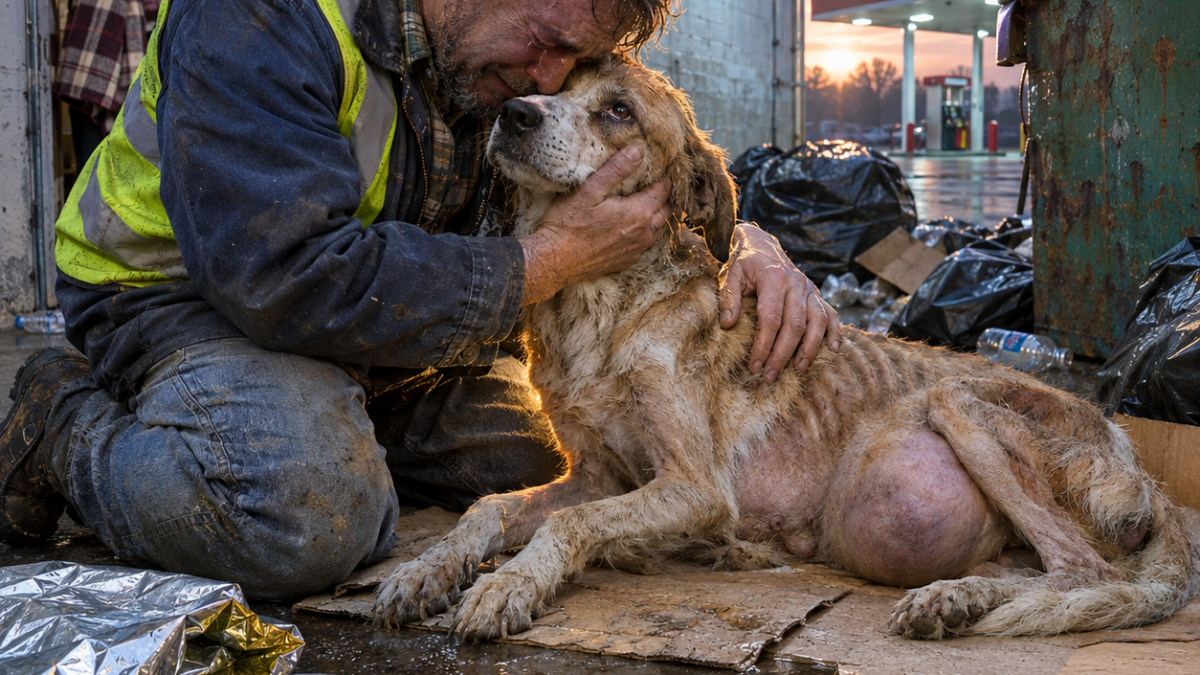
PART2
Mr. Harrison came outside while I was carrying the dog toward my car.
He stared.
“What in God’s name are you doing?”
“I found him behind the dumpster.”
“I can see that.”
“I need to take him to a vet.”
“You’re working.”
“I know.”
Mr. Harrison looked at the dog.
Then at me.
The dog lifted his head slightly.
That was apparently enough.
Mr. Harrison sighed.
“Go.”
I blinked.
“What?”
“Go.”
“But the shift—”
“I’ve owned this place forty-three years. I remember how to run a register.”
I stared.
He waved one hand.
“Before I change my mind.”
“Thank you.”
“Lucas.”
I stopped.
“If the vet says the dog belongs to someone, don’t punch anybody.”
“I wasn’t planning to.”
He looked at the dog’s condition.
“I might.”
The nearest emergency veterinary clinic was twelve minutes away.
I drove it in nine.
The dog lay across the back seat on an old blanket.
Every time I stopped at a light, I looked in the mirror.
“Stay with me.”
His eyes were open.
“That’s it.”
I had no idea whether he was actually dying.
But fear is not interested in medical certainty.
“Just stay awake.”
At the clinic, I carried him inside.
A technician came immediately.
“What happened?”
“I found him behind the gas station.”
“How long has he been like this?”
“I don’t know.”
She looked at the swelling.
Her expression changed.
“Bring him back.”
Then came the question.
“Are you the owner?”
“No.”
“Do you know the owner?”
“No.”
“Any collar?”
“No.”
“Chip?”
“I don’t know.”
She looked at me.
“Who is financially responsible for the initial exam?”
I froze.
There it was.
Reality.
I had $1,840 in savings.
Rent was due in eleven days.
My car brakes still squealed.
I looked toward the dog.
He was lying on the metal table.
Eyes open.
Watching me.
“I am.”
The words came out before the math could stop them.
The technician nodded.
“Okay.”
And somehow that was it.
One sentence.
My life changed direction.
Dr. Elena Ramirez examined him.
She was in her fifties.
Calm voice.
Steady hands.
The kind of person who could tell you terrible news without making you feel abandoned inside it.
She ran tests.
Bloodwork.
Imaging.
A physical exam.
I waited.
Thirty minutes.
Then forty.
Then an hour.
Finally, she came into the consultation room carrying a tablet.
“Lucas?”
I stood.
“Yes.”
“Sit.”
I didn’t like that.
Nobody tells you to sit before good news.
I sat.
She folded her hands.
“He’s severely underweight.”
I nodded.
“Dehydrated.”
“Okay.”
“Anemic.”
My stomach tightened.
“And there’s a large abdominal mass.”
The room went quiet.
“What does that mean?”
“We need additional testing.”
“But?”
She took a breath.
“But I’m concerned about cancer.”
I stared.
Cancer.
One word.
Suddenly the dog behind the gas station had a diagnosis big enough to swallow everything else.
“Can you treat it?”
“Possibly.”
“Possibly?”
“It depends on what the mass is, whether it has spread, and whether he is strong enough for surgery.”
I looked toward the treatment area.
“How expensive?”
Dr. Ramirez didn’t answer immediately.
That scared me too.
She gave me an estimate.
Then another if chemotherapy became necessary.
I almost laughed.
Not because it was funny.
Because the total was absurd.
More than several months of rent.
More money than I had.
Far more.
I stared at the numbers.
“There are rescue organizations,” she said gently.
“Payment options.”
I rubbed my face.
“What’s the alternative?”
Dr. Ramirez looked at me.
“We first need to determine his prognosis.”
“No.”
I swallowed.
“If I can’t pay.”
She understood.
Her voice softened.
“If nobody assumes financial responsibility and no organization can take him, decisions would have to be made based on suffering and prognosis.”
I knew what that meant.
I looked through the window.
The dog lay beneath a blanket.
Alone.
He lifted his head.
Our eyes met.
That stupid dog.
That starving, sick, possibly dying dog.
He saw me.
And his tail moved.
Once.
Slowly.
I closed my eyes.
“How soon can you do the tests?”
The biopsy and scans came back the following day.
Cancer.
An abdominal tumor.
Operable, but risky.
The good news—if you can call anything good in a conversation about cancer—was that they saw no obvious widespread metastasis.
The bad news was almost everything else.
He was weak.
Malnourished.
Anemic.
Surgery would be difficult.
Chemotherapy likely afterward.
He could die during the operation.
He could survive the operation and still lose to cancer.
I sat in the waiting room staring at the estimate.
I had been working at the gas station four days.
I had no pet insurance.
No savings worth mentioning.
No partner to split costs with.
No rich uncle.
No secret emergency fund.
Just a credit card, a small paycheck, and enough common sense to know that saying yes was financially insane.
Dr. Ramirez sat across from me.
“You don’t have to decide emotionally.”
I laughed bitterly.
“Is there another way?”
“Yes.”
She looked directly at me.
“You can ask what gives the dog the best balance of welfare and realistic outcome.”
I looked through the glass.
He was asleep.
“What would you do?”
She paused.
Veterinarians hate that question.
I could tell.
“If he were mine?”
“Yes.”
She studied the records.
“I would operate.”
My throat tightened.
“Why?”
“Because he still has fight.”
She looked toward him.
“And because this type of tumor can sometimes respond well if we can remove it and follow appropriately.”
“How much suffering?”
“Some.”
I nodded.
“How much chance?”
“Enough that I would try.”
That was it.
Enough.
Sometimes that is all hope gives you.
Not certainty.
Enough.
I signed.
Driving back to my apartment alone, I nearly had a panic attack.
What had I done?
I parked.
Sat behind the steering wheel.
Looked at my bank app.
Numbers.
Rent.
Utilities.
Car insurance.
Credit card.
I had just committed to paying medical costs for a dog I’d known less than forty-eight hours.
A stray.
A dog who might die anyway.
I laughed.
Then started crying.
“I’m an idiot.”
The car remained silent.
Usually silence at home bothered me.
That day, I wanted someone to tell me I had made the wrong decision.
Someone practical.
Someone responsible.
Someone to give me permission to walk back into the clinic and say:
I can’t do this.
Instead, I remembered the dog’s tail moving.
Once.
I remembered his eyes.
And something my mother used to say when I was younger.
You don’t have to save every animal.
Then she would always add:
But when one lands in your hands, you have to decide who you want to be.
At sixteen, I thought it was melodramatic.
At thirty-two, sitting in a car with $1,840 to my name, I finally understood.
Surgery was scheduled two days later.
I asked Mr. Harrison for the morning off.
I expected him to complain.
Instead, he said:
“Family first.”
I frowned.
“He’s not technically family.”
Mr. Harrison looked at me.
“You’re taking unpaid time from a minimum-wage-adjacent job to sit through a dog’s cancer surgery.”
He shrugged.
“Close enough.”
I didn’t correct him.
I reached the clinic at 6:00 a.m.
The dog lay on a metal table while technicians prepared him.
Sedation had made his eyelids heavy.
I stood beside him.
“We need to give him a name for the chart,” a technician said.
I looked at him.
Not yet.
Naming felt dangerous.
Like admitting he belonged somewhere.
Like admitting how much losing him would hurt.
“Can we wait?”
She smiled gently.
“Of course.”
I placed my hand on his head.
His eyes opened slightly.
“I’m here.”
One ear twitched.
“I’ll wait.”
His breathing remained slow.
“When you wake up…”
My voice caught.
I swallowed.
“When you wake up, I’ll be here.”
His eyes closed again.
“I promise.”
The operation took four hours.
Four hours is not particularly long in the context of surgery.
In a waiting room, it is an entire lifetime.
I paced.
Sat.
Stood.
Drank coffee.
Threw half of it away.
Bought another.
Checked the clock every six minutes as if time might speed up if I monitored it aggressively enough.
At 8:13, I thought about my mother.
How many times had she done this?
Twenty-two years fostering animals.
Emergency calls.
Surgeries.
Euthanasia decisions.
Treatments that worked.
Treatments that didn’t.
I had grown up watching her.
I remembered complaining.
“Why do you do this to yourself?”
She would cry when animals died.
Every time.
I once told her:
“You know you’re going to get attached.”
She answered:
“That’s the point.”
At seventeen, I thought that was stupid.
Why intentionally love something temporary?
Why create grief?
Now I sat outside an operating room waiting for a nameless dog.
And I finally understood.
Love doesn’t become pointless because it may end painfully.
Sometimes the fact that it may end is exactly why you show up while it is here.
I wanted to call my mother.
I didn’t.
Not yet.
I wasn’t ready to explain who I had suddenly become.
At 10:21, Dr. Ramirez appeared.
I stood so quickly the chair scraped the floor.
She was wearing surgical scrubs.
Mask lowered.
And she was smiling.
Small.
But smiling.
“He made it.”
My knees weakened.
I grabbed the chair.
“Really?”
“The surgery went well.”
I laughed once.
Then covered my face.
“We removed the tumor.”
My eyes filled.
“All of it?”
“What we could identify, yes.”
I stared.
“Is he okay?”
“He’s recovering.”
She lifted one hand.
“Lucas, listen.”
I forced myself to focus.
“This is the beginning.”
I nodded.
“The pathology confirms the cancer type we suspected. He’ll need chemotherapy.”
“Okay.”
“Monitoring.”
“Yes.”
“Medication.”
“Yes.”
“Nutrition support.”
“Yes.”
She smiled.
“You don’t even know the costs yet.”
“Don’t ruin the moment.”
She laughed.
Then her expression softened.
“He has a long road.”
I looked through the doors.
“However long.”
My voice cracked.
“We’ll walk it.”
I was allowed to see him later.
He was groggy.
Bandaged.
IV connected.
He looked impossibly vulnerable.
I sat beside him.
His eyes opened.
For a second, he seemed confused.
Then he saw me.
His tail moved.
Just the tip.
I started crying.
“You remembered.”
His eyes closed again.
I laughed at myself.
“Of course you remembered.”
I touched his head.
“I promised.”
The next three months were the hardest months of my life.
They were also the first months in years when my life felt like it meant something.
Those two truths can coexist.
Chemotherapy was hard on him.
Some days he ate.
Some days he wouldn’t.
Some mornings he lifted his head when I walked in.
Others he stared at the wall.
On treatment days, I sat beside him.
Sometimes talking.
Sometimes not.
At first, I believed love required constant encouragement.
“You’re strong.”
“You’ve got this.”
“Keep fighting.”
Then one afternoon, the dog looked so exhausted that every cheerful sentence felt cruel.
So I stopped.
I sat down.
Placed my hand beside his paw.
Said nothing.
Two hours passed.
That was the day I learned presence does not have to perform.
Sometimes love is not encouragement.
Sometimes love is a chair beside a cage.
A hand that stays.
A person who doesn’t leave because the room has become uncomfortable.
I worked double shifts.
Mr. Harrison let me take overtime whenever he could.
I worked register.
Stocked shelves.
Cleaned pumps.
Unloaded deliveries.
Covered weekends.
I learned which customers bought cigarettes before speaking.
Which ones wanted coffee.
Which older man came every morning at 5:40 and complained about gasoline prices regardless of price.
I also learned how quickly medical bills grow.
My savings disappeared.
Then my discretionary spending.
No restaurants.
No new clothes.
No subscriptions.
I delayed fixing my car brakes until Mr. Harrison found out and nearly shouted at me.
“You are not killing yourself driving an unsafe car while paying to save a dog.”
“It still stops.”
“That’s a low standard.”
He lent me money for repairs.
I refused.
He deducted it slowly from future checks anyway.
“Illegal,” I told him.
“Report me.”
I laughed.
Customers began learning about the dog.
Not from me initially.
From Mr. Harrison.
He told everybody.
“Lucas has a cancer dog.”
Not exactly elegant.
One morning, a regular named Mrs. Powell handed me twenty dollars.
“What is this?”
“For the dog.”
“No.”
“Take it.”
“I can’t.”
She put it in the tip jar that did not technically exist.
Now it existed.
Mr. Harrison wrote DOG FUND on a piece of cardboard.
I nearly died from embarrassment.
By the end of the week, there was $186.
“People want to help,” Mr. Harrison said.
“I made the commitment.”
“So?”
“I should pay.”
He stared at me.
“Do you think accepting help means you care less?”
I didn’t answer.
He nodded.
“Thought so.”
That lesson was harder for me than saving the dog.
I had always believed needing help was failure.
Maybe that was part of why my life had become so small.
I had built everything around being self-contained.
Then a dying dog forced me to discover community at a gas station.
Life is strange.
During the second month, the dog stopped eating for almost two days.
That was the lowest point.
Dr. Ramirez adjusted treatment.
The staff monitored him.
I visited after an eleven-hour shift.
He lay facing away from me.
“Hey.”
Nothing.
I sat.
“I had a customer scream at me today because the lottery machine was offline.”
His ear moved slightly.
“That was exciting.”
Nothing.
“Mr. Harrison says you’re costing him productivity because I talk about you too much.”
Still nothing.
I sighed.
“I don’t know what to say tonight.”
The dog remained still.
So I stopped trying.
Ten minutes.
Twenty.
Forty.
Then, sometime after nine, he lifted his head.
Turned.
Looked at me.
I reached my hand toward him.
Not touching.
Just offering.
He sniffed.
Then, for the first time since I found him behind the station, he licked my hand.
One small movement.
Wet.
Warm.
I froze.
Then laughed.
“Was that…”
He did it again.
My eyes filled.
“You’re still here.”
His tail moved.
Weakly.
But unmistakably.
“You’re still fighting.”
That night, I called my mother.
She answered on the third ring.
“Lucas?”
“Hi, Mom.”
“Is everything okay?”
I started crying before I could answer.
Parents know.
Somehow.
“What happened?”
“Nothing bad.”
That made me cry harder.
“Lucas.”
“There’s a dog.”
Silence.
Then:
“Of course there is.”
I laughed through tears.
“What does that mean?”
“You haven’t called me crying about a woman since college, so statistically it was probably an animal.”
I told her everything.
The gas station.
The dumpster.
The tumor.
Surgery.
Chemotherapy.
Double shifts.
The dog fund.
The bills.
How terrified I was that he would die.
How terrified I was that I’d made an irresponsible decision.
When I finished, there was a long silence.
I waited for practical mother advice.
Lucas, you cannot afford this.
Lucas, you’ve done enough.
Lucas, be realistic.
Instead, she said:
“I am so proud of you.”
I stopped breathing.
“What?”
Her voice broke.
“I’ve always known you were like this.”
“Like what?”
“Soft.”
I almost laughed.
“Mom.”
“No.”
She continued.
“You spent your entire adult life pretending you didn’t care too much because caring scared you.”
I said nothing.
“I watched you as a kid.”
Her voice softened.
“You always chose the animal that nobody else wanted.”
I remembered.
A three-legged cat.
An old beagle.
A pigeon I kept in a box for two days.
“I thought you hated the rescue work.”
“I did.”
She laughed.
“No.”
“I hated watching things die.”
The truth surprised me as I said it.
My mother became quiet.
“Oh, honey.”
“I hated seeing you cry.”
I wiped my face.
“So I decided not caring was easier.”
“And how did that work?”
I looked through the clinic window.
The dog was sleeping.
“Not great.”
My mother laughed through tears.
Then said:
“You don’t avoid grief by avoiding love.”
I closed my eyes.
“You just avoid love.”
That sentence changed something in me.
Then she added:
“What’s his name?”
I looked at the dog.
“I haven’t named him.”
“What are you waiting for?”
“I don’t know.”
“Lucas.”
“Yes?”
“Name your dog.”
The next evening, I sat beside him.
He had eaten half a bowl.
Progress.
I scratched his head.
“My mother says you’re my dog.”
His tail moved.
“She doesn’t even know you.”
Another movement.
“She is also extremely bossy.”
The dog looked at me.
“We need a name.”
I tried several.
Cooper.
Charlie.
Lucky.
None fit.
Then I thought about the clinic.
Every doctor saying maybe.
Every night I had driven home afraid.
Every morning I returned.
Hope mattered.
But another word came to me.
Maximum.
Because somehow this dog required everything.
Maximum courage.
Maximum money.
Maximum fear.
Maximum love.
“Max.”
His ears moved.
I smiled.
“Max?”
Tail.
One solid thump.
“That was suspiciously clear.”
Another.
I laughed.
“Okay.”
I touched his head.
“Max.”
From then on, he was Max.
At the end of the third month, Dr. Ramirez called me into her office.
I was terrified.
She only did office conversations when something mattered.
I sat.
She opened his latest results.
Then smiled.
Not the careful smile from after surgery.
A real smile.
“Lucas.”
My hands went cold.
“Yes?”
“The most recent imaging shows no detectable cancer.”
I stared at her.
“What?”
“No evidence of disease at this time.”
The words didn’t fit together.
“No…”
I looked at the report.
“Cancer?”
“We’ll continue monitoring.”
She smiled.
“But right now, Max is in remission.”
I stopped breathing.
“He’s healthy?”
“He is recovering extremely well.”
“He’s healthy.”
“For the first time since you brought him here, I feel comfortable saying he is doing very well.”
I laughed.
Then cried.
Then laughed again.
“He’s healthy.”
Dr. Ramirez’s eyes filled too.
“Yes.”
“He’s actually…”
“Yes, Lucas.”
She laughed.
“Go see your dog.”
Max was standing when I entered.
Standing.
Three months earlier, he couldn’t lift himself behind a dumpster.
Now he stood inside the treatment room.
His coat had begun shining.
Weight returning.
Eyes bright.
He saw me.
His tail moved.
Not the weak little tap.
Not the uncertain wag.
His whole back end started moving.
“Max.”
He rushed forward.
I dropped to my knees.
He hit me in the chest.
I fell backward laughing.
He licked my face.
“Stop.”
He did not stop.
“Max!”
More licking.
I was laughing and crying.
Dr. Ramirez stood near the door with two technicians.
All three were smiling.
I put both arms around him.
“You did it.”
Max buried his head against my shoulder.
“You did it.”
Then I corrected myself.
“We did.”
I officially adopted him the following day.
There was paperwork.
A formal transfer.
Signatures.
A small fee the clinic waived.
When the form asked for his name, I wrote:
Max Müller.
Then stared at it.
My last name.
Something about that hit me.
Family.
Mr. Harrison had been right before I understood.
I spent more money than I should have preparing my apartment.
Dog bed.
Toys.
Bowls.
Leash.
Harness.
Food.
A blanket.
My mother mailed another blanket because apparently one blanket was animal neglect.
Max entered the apartment cautiously.
He sniffed the sofa.
Kitchen.
Bathroom.
Bedroom.
Closet.
Then found the dog bed.
Circled twice.
Lay down.
And sighed.
Long.
Deep.
The kind of sigh that sounds like a body letting go of vigilance.
I sat beside him.
“Home.”
Max opened one eye.
“Yes.”
I touched his head.
“This is home.”
His eye closed.
Recovery didn’t magically erase everything.
Max hated being left alone at first.
The first morning I left for work, he stood at the apartment door.
I felt like a criminal.
“I have to work.”
Max stared.
“You know, to pay for your ridiculous medical history.”
Tail wag.
“I’ll come back.”
His ears lowered.
That hurt.
I knelt.
“I promise.”
He pressed against me.
“I will come back.”
I left.
Then stood in the hallway feeling horrible.
When I returned after my shift, Max heard my key.
The sound from inside was chaos.
Paws.
Scratching.
Something falling.
I opened the door.
Max launched himself at me.
“You thought I wasn’t coming back.”
He licked my face.
“I told you.”
His tail hit the wall.
“I’m coming back every time.”
After several weeks, he began believing it.
That mattered.
Trust is built by promises becoming boring.
I leave.
I return.
Food comes.
Water stays.
Hands are gentle.
Tomorrow happens.
Again.
Again.
Again.
Until fear gets tired.
Mr. Harrison allowed Max at the station during certain shifts.
Officially, he remained in the office area.
Unofficially, he became management.
Customers loved him.
Children pressed their hands against the office glass.
Older people stopped to visit.
Truck drivers brought treats.
Mr. Harrison installed a small bed in the corner.
“This dog has better benefits than I do,” I said.
“He’s better with customers.”
Unfortunately true.
Max became locally famous.
People asked his story.
At first, I hated telling it.
It felt like using his suffering.
Then I noticed what happened when people heard the ending.
They smiled.
Some donated to animal rescues.
One woman returned a week later and told me she had adopted an older shelter dog because of Max.
A teenager volunteered at the county shelter.
Mr. Harrison began keeping donation jars permanently.
Maybe stories aren’t exploitation if they point people toward compassion.
The most important part of our life wasn’t public.
It was nighttime.
My apartment.
Cheap couch.
Television.
Max’s head on my lap.
Nothing happening.
For years, I had believed a meaningful life needed something dramatic.
A career.
Success.
Travel.
Money.
Something worth posting.
Max showed me meaning can look like a dog sleeping against your leg while you watch a terrible crime show.
He didn’t care what I earned.
Didn’t care that I worked at a gas station.
Didn’t care that my apartment was small.
Didn’t care that I had no impressive plan for the next five years.
I came home.
That was enough.
There was something deeply healing about being enough for someone.
My mother met Max three weeks after the adoption.
She lived across town in a small house with a large backyard.
I pulled into the driveway.
Max’s nose was already against the window.
Mom opened the door.
The second she saw him, she started crying.
“Mom.”
“I know.”
“You haven’t even met him.”
“I know.”
Max jumped out.
Walked toward her.
She crouched.
“Hi, Max.”
He sniffed her.
Then licked her chin.
My mother laughed.
Not the polite laugh adults use.
A bright, uncontrolled laugh I hadn’t heard in years.
She hugged him.
“Oh, you are beautiful.”
Max’s tail moved violently.
I stood there watching.
Something tightened in my chest.
My mother looked at me over his back.
“You did good.”
“No.”
I smiled.
“He did.”
Later that afternoon, Max ran through her yard.
Actually ran.
Ears flying.
Tail high.
Golden coat catching sunlight.
My mother and I stood on the porch.
“Look at him.”
“I am.”
“He looks completely different.”
“He is.”
Mom shook her head.
“No.”
I looked at her.
“I think he was always that dog.”
She pointed toward him.
“The running one.”
Max chased a leaf.
“The happy one.”
My throat tightened.
“He just needed long enough to become visible.”
I looked at her.
She smiled.
“So did you.”
I pretended not to hear.
Mothers become unbearable when correct.
Months passed.
Max’s scans remained clear.
Then a year.
I got promoted at the gas station.
Not glamorous.
Assistant manager.
More money.
Regular schedule.
Health insurance.
Mr. Harrison said:
“You’re annoyingly competent.”
“Thank you.”
“Wasn’t a compliment.”
He was lying.
The extra money finally helped me pay down the debt from Max’s treatment.
Customers had helped.
My mother had secretly paid one clinic invoice and refused to admit it.
Mr. Harrison had contributed.
I still carried debt.
But I stopped resenting it.
Money returns.
Time doesn’t.
Max had time.
That was the purchase.
One afternoon, a woman came into the station.
Maybe twenty-five.
Tired eyes.
She saw Max sleeping on his bed.
“Oh my God.”
She smiled.
“What a beautiful dog.”
Max lifted his head.
“You’ve had him since he was a puppy?”
I looked at him.
Scars hidden beneath golden fur.
Gray beginning nowhere yet.
Healthy.
Safe.
“No.”
She smiled.
“Rescue?”
I thought about the question.
Then said:
“He found me.”
The woman laughed.
I didn’t.
Because it was true.
On the first anniversary of his remission, Dr. Ramirez gave him a clean exam.
I brought cupcakes for the clinic staff.
Max got a dog-safe treat.
Dr. Ramirez looked at him.
Then at the original intake photo.
“You want to see?”
I wasn’t sure.
Then nodded.
She turned the screen.
There he was.
Thin.
Weak.
Eyes hollow.
The tumor distending his body.
I stared.
Then looked at Max beside me.
Muscular.
Shiny coat.
Bright eyes.
Something broke in me.
“I forgot how bad.”
Dr. Ramirez nodded.
“That’s okay.”
“I don’t want to forget.”
“Why?”
I thought.
“Because then I might forget how much he fought.”
She smiled.
“Lucas.”
“What?”
“Don’t make suffering the proof that he deserves happiness.”
I stared.
“He doesn’t need to have almost died for this life to matter.”
That hit me.
She touched the screen.
“This happened.”
Then pointed toward Max.
“But this is happening.”
I looked down.
Max wagged.
She was right.
We sometimes honor survivors by trapping them forever inside what they survived.
Max was more than cancer.
More than the dumpster.
More than starvation.
He was Max.
A few weeks later, I returned to the space behind the gas station where I had found him.
Max came with me.
The weeds had been cut.
Dumpster replaced.
Nothing special.
I stood there.
“You remember?”
Max sniffed.
Then looked at me.
No dramatic reaction.
No fear.
He peed on the wall.
I laughed so hard Mr. Harrison came outside.
“What?”
“Nothing.”
Max trotted toward the station.
Mr. Harrison stared.
“You brought him back here for emotional closure, didn’t you?”
“Maybe.”
“And he urinated.”
“Yes.”
Mr. Harrison nodded.
“Dog has better psychological instincts than humans.”
Probably.
Two years after I found Max, I moved.
Not far.
A small rented house.
Backyard.
The first place I’d lived that felt chosen instead of tolerated.
The landlord allowed pets.
Max inspected every room.
Then the yard.
He ran three circles.
I sat on the steps laughing.
That night, he slept beside my bed.
Not on it.
Max liked dignity.
Usually.
At 3:00 a.m., I woke with his head on my chest.
Apparently dignity had limits.
My life changed because of Max in ways that had nothing to do with dogs.
I began volunteering with my mother’s rescue group.
Not constantly.
Enough.
The first time she saw me cleaning kennels, she took a photograph.
“Delete that.”
“Never.”
“You’re enjoying this too much.”
“I waited fifteen years.”
“For what?”
“For you to admit you’re my son.”
I rolled my eyes.
But she was right.
I had spent adulthood running away from a part of myself because caring felt dangerous.
Max brought it back.
I met people through rescue work.
Real friendships.
Not just coworkers.
Not just people I nodded to.
My world expanded.
One volunteer named Claire eventually became someone I looked forward to seeing more than I admitted.
Max loved her immediately.
Traitor.
When I finally asked Claire to dinner, she laughed.
“Did Max approve this?”
“I make my own decisions.”
Max leaned against her leg.
She looked at him.
“Sure.”
We dated.
Slowly.
Max came on several walks.
He slept beside our table on outdoor restaurant patios.
The first time Claire stayed late at my house, Max positioned himself between us on the couch.
“Chaperone?”
“Apparently.”
Months later, he moved.
Progress.
I don’t say Max “fixed” my life.
That would put too much responsibility on a dog.
He didn’t cure loneliness.
Didn’t choose my career.
Didn’t make every decision.
He did something simpler.
He interrupted the numbness.
He gave me something worth getting up for.
Once I remembered that caring mattered, I started applying it elsewhere.
Life followed.
Three years after the cancer, Mr. Harrison decided to retire.
He called me into the office.
“I’m selling.”
My stomach dropped.
“To whom?”
“You.”
I laughed.
Then realized he wasn’t.
“I can’t buy a gas station.”
“You can.”
“I have debt.”
“Less than you did.”
“I don’t have that kind of money.”
“Seller financing.”
I stared.
“Why?”
He looked offended.
“Because I hate everyone else.”
“Very moving.”
Then he softened.
“My wife and I built this place.”
He glanced toward Max sleeping in the corner.
“I want someone who notices when something is crying behind the dumpster.”
My throat tightened.
“Mr. Harrison.”
“Don’t cry.”
“I’m not.”
“You look like you’re going to.”
“I’m thinking.”
“Think faster. I’m old.”
Six months later, Harrison’s Fuel & Service became mine.
I kept the name.
Mr. Harrison pretended not to care.
His wife told me he cried.
The station changed.
Cleaner.
Better coffee.
Small pet-supply donation shelf.
A permanent fund for local animal rescue.
Max remained in the office.
Customers still came specifically for him.
Children knew his name.
A photograph of him on his first day home hung behind the counter.
Not the sick photograph.
The healthy one.
That mattered.
At five years cancer-free, we held a small party.
Dr. Ramirez attended.
My mother.
Mr. Harrison.
Claire.
Rescue volunteers.
Max wore a ridiculous bow tie.
He hated it.
I removed it after three photographs.
My mother said:
“Five years.”
I looked at Max.
“Yeah.”
She squeezed my hand.
“You know some cancers return.”
I glared.
“Wonderful party conversation.”
She laughed.
“I mean…”
Her voice softened.
“You spent so long waiting for bad news.”
I nodded.
“Maybe stop.”
That was harder than it sounded.
Love teaches fear too.
The more you have, the more you can lose.
But Max didn’t worry about recurrence.
He worried about dinner.
Ball.
Walk.
Claire arriving.
Mom’s treats.
Present tense.
Dogs are good at that.
Claire and I eventually married.
Small ceremony.
Backyard at my mother’s house.
Max stood beside me.
Technically.
For the first ten minutes.
Then he lay down because vows were boring.
When the officiant asked for the rings, Max snored.
Everybody laughed.
It was perfect.
My mother whispered afterward:
“Family first.”
Mr. Harrison overheard.
“That’s my line.”
Years moved more quickly once life became good.
That feels unfair.
Max’s muzzle turned white.
First just a few hairs.
Then more.
He stopped jumping into my truck.
I bought a ramp.
He looked insulted.
Then used it.
His walks shortened.
Ball games became slower.
But his scans remained clear.
Cancer never returned.
Dr. Ramirez called him her miracle patient.
I called him stubborn.
Both true.
My mother aged too.
One afternoon, Max and I visited her.
She sat in the backyard.
Max walked slowly toward her.
She crouched as much as her knees allowed.
“Hello, beautiful boy.”
He put his head in her lap.
She stroked the white fur around his eyes.
“You made him human again.”
I laughed.
“Who?”
She looked at me.
“You.”
“No.”
She shook her head.
“Max.”
I smiled.
“That seems rude.”
“Accurate.”
We watched him sleep.
Then Mom said:
“You know what I learned after all those rescue years?”
“What?”
“We don’t save them all.”
I looked at her.
She continued.
“That used to haunt me.”
I knew.
“But the ones we do save…”
She touched Max.
“They become proof that trying matters.”
I swallowed.
“Even when you lose sometimes?”
“Especially then.”
Max was thirteen when he began slowing dramatically.
Thirteen, according to our best estimate.
His joints hurt.
Hearing faded.
Vision cloudy.
Nothing unusual.
Just age.
Dr. Ramirez retired, but she still asked about him.
Then came one winter morning when Max refused breakfast.
My chest froze.
Cancer.
The word returned instantly.
Old fear does not need logic.
We went to the vet.
Bloodwork.
Imaging.
No cancer.
His kidneys were beginning to fail.
Age.
Not the enemy from before.
Another one.
Quieter.
Unbeatable.
The veterinarian explained options.
Medication.
Diet.
Fluids.
Comfort.
Time.
“How much?”
Not cost.
Time.
“We don’t know.”
I hated that answer.
I always had.
Max had good months.
Then harder ones.
Claire and I rearranged the house.
Rugs so he wouldn’t slip.
Ramp for steps.
Bed in every room.
My mother joked that he owned more furniture than we did.
Correct.
Customers at the station noticed when he stopped coming daily.
“Where’s Max?”
“Home resting.”
Cards arrived.
Treats.
Children drew pictures.
Mr. Harrison, eighty now, visited.
He sat on the floor beside Max and complained about his knees.
“Getting old is garbage.”
Max sighed.
“See?”
He looked at me.
“He agrees.”
One evening, Max woke from sleep and couldn’t get up.
I helped him.
He leaned against my legs.
His breathing was tired.
I knew.
Not that minute.
But soon.
I sat on the floor.
He placed his head on my lap.
Same position as thousands of evenings.
But different.
Claire sat beside us.
My eyes filled.
“I don’t know how to do this.”
She took my hand.
“Yes, you do.”
“No.”
“You promised him something.”
I looked at her.
“The clinic.”
The first surgery.
When you wake up, I’ll be here.
Claire whispered:
“You’ve spent his whole life keeping that promise.”
I cried.
“What if I’m not ready?”
“You’re not.”
She leaned against me.
“That isn’t the question.”
I knew.
Was Max ready?
The veterinarian came to the house two days later.
My mother arrived.
Mr. Harrison.
Dr. Ramirez, even though she had retired.
She walked inside, saw Max, and immediately started crying.
“Well.”
She knelt.
“Look at you.”
Max’s tail moved once.
She laughed.
“Still flirting.”
My mother sat beside him.
Mr. Harrison stood near the window pretending his eyes were dry.
Claire held my hand.
Max lay on his favorite blanket.
Sunlight came through the living-room window.
No clinic.
No metal table.
No fear.
I lay beside him.
“Hey.”
His eyes opened.
Old.
Cloudy.
Still Max.
“You remember the gas station?”
Tail.
Barely.
“You made me spend all my money.”
Claire laughed through tears.
Max breathed.
“You ruined my quiet apartment.”
Another breath.
“You stole my mother.”
Mom whispered:
“He improved you.”
I laughed.
Then cried harder.
Max shifted his head onto my arm.
I pressed my forehead against his.
“I promised you wouldn’t be alone.”
His eyes remained on mine.
“And you’re not.”
My voice broke completely.
“You were never alone again.”
Dr. Ramirez lowered her head.
I whispered:
“You don’t have to fight this one.”
That was difficult.
Max had been fighting when I met him.
Fought cancer.
Weakness.
Fear.
Then age.
But love does not always say fight.
Sometimes love says rest.
“I’ve got you.”
His breathing slowed.
“Just like before.”
I kissed his head.
“I’m here.”
The medication took effect gently.
Max relaxed.
His final breath left his body while my hand rested over his heart.
Then stillness.
I stayed.
Long after.
Because the promise wasn’t finished just because he stopped breathing.
That night, the house felt enormous.
Max had occupied surprisingly little physical space.
One dog bed.
Bowls.
Toys.
Yet his absence made every room bigger.
Wrong.
I walked into the kitchen.
No nails behind me.
Bathroom.
No shadow at the door.
Bedroom.
His bed empty.
I sat on the floor beside it.
Found his old collar.
Held it.
And cried until Claire sat beside me without speaking.
Presence.
Max taught me that too.
The next morning, I went to the station.
Everyone expected me to stay home.
I couldn’t.
The office bed remained in the corner.
Empty.
A regular customer walked in.
Looked toward it.
Then toward me.
“Oh.”
That was all.
She understood.
By noon, somebody had placed flowers beside the bed.
Then another customer added a tennis ball.
Then a child left a drawing.
By closing time, there were thirty notes.
One said:
Max made bad days better.
Another:
Thank you for letting us love him too.
A little girl’s note read:
I am not scared of big dogs because of Max.
I sat behind the counter.
Cried.
Mr. Harrison, who technically no longer worked there but appeared whenever he wanted, stood beside me.
“Told you.”
I wiped my face.
“What?”
“Family.”
I nodded.
“Yeah.”
We created a fund in Max’s name.
Not because I wanted a memorial.
Because bills had nearly prevented me from saving him.
I remembered sitting in Dr. Ramirez’s office staring at numbers.
Knowing what was medically possible and wondering whether money would make the decision.
I hated that feeling.
So Max’s Fund began helping local families with emergency veterinary costs.
Small amounts at first.
Two hundred dollars.
Five hundred.
Then customers contributed.
A local newspaper wrote about it.
Donations grew.
We never saved every animal.
No fund can.
But sometimes we turned impossible into possible.
That was enough.
Every acceptance letter ended with one sentence:
Someone listened when Max needed help. This is his way of listening back.
My mother framed a photograph for me.
Max running in her backyard during his first year after cancer.
Golden coat.
Ears flying.
Tail high.
No tumor.
No hospital.
No evidence of suffering.
On the back, she wrote:
This is who he was. Not what happened to him.
I keep it in my office.
People still ask me about Max.
Years later.
Customers who remember.
New employees who see the fund.
Kids who grew up.
One young woman came in recently.
She was probably twenty-four.
She pointed toward Max’s photograph.
“Was that your dog?”
“Yes.”
“He’s the cancer dog, right?”
I almost said yes.
Then stopped.
Max had been so much more.
“He had cancer.”
She nodded.
“What was he like?”
That question made me smile.
“Annoying.”
She laughed.
“He stole blankets.”
I continued.
“Hated rain.”
“Loved cheese.”
“Pretended not to hear when called inside.”
“Snored.”
“Thought every delivery driver existed specifically to visit him.”
The woman smiled.
“He sounds great.”
“He was.”
Then she asked:
“Did you save him?”
I looked at the photograph.
“No.”
She frowned.
“But…”
“I helped.”
I smiled.
“He did plenty of saving himself.”
I understand now why my mother spent twenty-two years helping animals.
Not because she believed she could stop suffering.
She couldn’t.
Not because every story ended well.
They didn’t.
She did it because when suffering entered her hands, she wanted the answer to be kindness.
Max taught me the same thing.
On the fourth day of a gas-station job I thought represented everything wrong with my life, I found a dying dog behind a dumpster.
I thought it was terrible timing.
I had no money.
No house.
No plan.
No emotional space.
Nothing about me looked ready to save anybody.
Maybe readiness is overrated.
Sometimes life does not ask whether you’re prepared.
It asks whether you’re willing.
I said yes before I knew what yes would cost.
Yes cost double shifts.
Debt.
Fear.
Sleepless nights.
Chemotherapy.
Tears.
Years later, yes cost grief so sharp I sometimes wondered whether loving him had been worth the ending.
Then I would remember Max running through my mother’s yard.
Max sleeping beside me.
Max at my wedding.
Max comforting frightened children.
Max inspiring strangers to adopt animals.
Max’s Fund saving a puppy whose family couldn’t afford emergency surgery.
And the question answered itself.
Of course.
Of course it was worth it.
Grief is not evidence that love was a mistake.
Grief is the receipt.
My life before Max had looked responsible.
Quiet.
Protected.
Nothing to lose.
That was the problem.
Nothing to lose often means very little fully held.
Max gave me something to lose.
Then gave me years before I had to.
Those years were the gift.
Sometimes I still drive behind the gas station and remember the first day.
The weeds.
Heat.
Black trash bags.
A weak sound.
I imagine another version of myself.
A version who heard the whimper and decided it was not his problem.
Maybe someone else would have found Max.
Maybe.
I hate that word.
Maybe he would have survived.
Maybe not.
Maybe I would have continued living exactly as I was.
Wake.
Work.
Pay rent.
Sleep.
Survive.
I do not like that version either.
The station is different now.
New pumps.
New sign.
Better coffee.
Same dumpster location.
Beside the back wall is a small metal plaque.
Not dramatic.
Just:
THIS IS WHERE MAX FOUND US.
Mr. Harrison insisted on us, not Lucas.
“It’s a community story.”
He was right.
Mrs. Powell’s twenty dollars.
The DOG FUND jar.
Clinic staff.
My mother.
Mr. Harrison.
Everyone.
Love sometimes begins with one person saying yes.
Then spreads.
My mother died several years after Max.
Peacefully.
Before she died, we talked about him.
She had dementia near the end.
Some days she forgot names.
But not Max.
I showed her the running photograph.
She smiled.
“Beautiful dog.”
“Yes.”
“Yours?”
I swallowed.
“Yes.”
She touched the frame.
“You always loved the ones who needed somebody.”
My eyes filled.
Even after forgetting parts of me, she remembered that.
Or perhaps she had always known me better than I knew myself.
At her funeral, I thought about Max.
Loss teaches loss.
But also companionship.
I had once tried avoiding attachment because I feared endings.
Then life gave me Max.
Then Claire.
Then friends.
Then community.
Then grief.
And somehow the grief did not erase the love.
It proved the love had occupied real space.
I no longer wanted a life without endings.
I wanted one with enough beginnings to make the endings hurt.
Max’s Fund has helped hundreds of animals now.
Not all survive.
Those cases are the hardest.
Sometimes a family receives assistance, treatment begins, and medicine still loses.
I used to feel the fund had failed.
Then Dr. Ramirez corrected me.
“Did the animal receive care?”
“Yes.”
“Was the family alone?”
“No.”
“Then you didn’t fail.”
I remembered Max.
The goal was never immortality.
The goal was never alone.
That became the fund’s motto.
Never alone.
Because that was the promise I made before I understood I was making it.
Behind the station.
At the clinic.
Through surgery.
Through cancer.
Through good years.
Through old age.
Through his final breath.
Never alone.
Sometimes people ask what Max taught me.
I could give a long answer.
About hope.
Responsibility.
Community.
Second chances.
Love.
But the simplest answer is this:
He taught me to stay.
Stay when treatment gets ugly.
Stay when someone cannot perform gratitude.
Stay when the room is silent.
Stay when you are scared.
Stay when leaving would be easier.
Stay long enough for another living thing to understand that abandonment is no longer coming.
During chemotherapy, there were days Max didn’t wag.
Didn’t eat.
Didn’t lick my hand.
Didn’t look grateful.
I stayed.
Years later, when I was grieving him, there were days I wasn’t productive.
Wasn’t cheerful.
Wasn’t philosophical.
Claire stayed.
That is how love travels.
We receive it.
Then eventually become capable of giving it in the same shape.
The last dream I had about Max was simple.
No clinic.
No cancer.
No death.
He was behind the gas station.
But healthy.
Standing.
Tail moving.
I walked toward him.
He turned.
Started walking away.
I followed.
Then he looked back.
Not afraid.
Just checking.
Making sure I was coming.
I woke smiling.
Maybe that’s what he did all along.
Led me somewhere.
Not dramatically.
One decision at a time.
Toward my mother.
Toward rescue work.
Toward community.
Toward Claire.
Toward a business I eventually loved.
Toward a version of myself who no longer believed caring was weakness.
I thought I carried Max out from behind a dumpster.
Maybe he spent the rest of his life leading me out of somewhere too.
If you had shown thirty-two-year-old me my future on the day I started at Harrison’s Fuel & Service, I would have laughed.
Gas station owner?
Married?
Animal-rescue fund?
Photograph of a dog above my desk?
Absolutely not.
Then Max happened.
Life rarely changes through one giant revelation.
Sometimes it changes because you take the trash outside on a Thursday.
Hear a sound.
Stop walking.
Listen.
That is the part I think about most.
Listening.
Max’s cry was weak.
Easy to miss.
The dumpsters were loud.
Traffic nearby.
Air-conditioning units running.
I could have ignored it.
But I heard.
And once you truly hear suffering, sometimes pretending you didn’t becomes impossible.
My mother understood that.
Max taught me.
Years after he died, a boy came into the station with his father.
Maybe nine years old.
He pointed toward Max’s photograph.
“Is that the dog who had cancer?”
“Yes.”
“Did he die?”
His father looked embarrassed.
“Buddy.”
“No.”
I smiled.
“It’s okay.”
The boy waited.
“Yes.”
I answered.
“He died when he was old.”
The boy looked sad.
“Then why is it a happy story?”
That question stopped me.
Children have a way of walking directly into the center of things adults circle around.
I crouched.
“Because dying isn’t the only thing that happened to him.”
He frowned.
“He got sick.”
“Yes.”
“He got better.”
“Yes.”
“He lived with you.”
“Yes.”
“For a long time?”
“Years.”
The boy thought.
“So the ending doesn’t erase the middle?”
I stared at him.
His father laughed.
“He reads too much.”
“No.”
I smiled.
“He reads exactly enough.”
The boy looked at Max’s photo.
Then said:
“I think it’s a happy story.”
“Me too.”
That is why I tell it.
Not because Max beat cancer forever.
He didn’t.
Not because saving him fixed every problem.
It didn’t.
Not because love defeated death.
It can’t.
I tell Max’s story because for one afternoon behind a gas station, his life could have ended anonymously.
Starving.
Sick.
Alone.
Instead, somebody heard.
Then he got surgery.
Treatment.
A name.
A home.
A family.
Sunlight.
Cheese.
Terrible television.
A backyard.
A wedding.
Old age.
A final day surrounded by people who loved him.
That is what rescue means to me now.
Not simply preventing death.
Making room for life.
The first promise I made Max was before his operation.
“When you wake up, I’ll be here.”
I kept it.
The last promise was on his final day.
“You won’t be alone.”
I kept that too.
Everything between those promises became our life.
And if somewhere there is a place where old dogs run without pain, I like to imagine Max found my mother.
She probably knelt.
He probably licked her face.
She probably said:
“There you are.”
Then immediately gave him something he was not supposed to eat.
Some things do not change.
Today, Max’s photograph still hangs above my desk.
Golden coat.
Bright eyes.
Tail blurred because he never held it still.
Underneath is a small card.
Not his cancer diagnosis.
Not his medical records.
Not the amount I spent.
Just four words.
HE WAS NEVER ALONE AGAIN.
Sometimes I look at it after a difficult day.
Especially when the fund can’t save one.
Especially when kindness feels small compared with suffering.
And I remember a sick dog lying behind a dumpster.
He could barely lift his head.
But when I crouched, his tail moved once.
That tiny movement changed the rest of my life.
On my fourth day at a job I didn’t want, I thought I found a dog who was dying.
The truth is more complicated.
I found a dog who still wanted to live.
He just needed somebody willing to believe him.
And in fighting for Max, I discovered something I had stopped believing about myself too.
I still wanted to live.
Not merely survive.
Live.
Love.
Risk grief.
Need people.
Be needed.
Build something.
Stay.
Max’s cancer disappeared after three brutal months.
Years later, age took him peacefully.
But cancer was never the most important part of his story.
Neither was the gas station.
Neither was the money.
The important part was the promise.
One frightened man.
One sick dog.
Neither of us having much.
And me whispering:
“I’m here.”
Then proving it.
Day after day.
People like to say I saved Max.
I don’t correct them as quickly anymore.
Maybe I did.
Maybe he saved me.
Maybe saving isn’t a competition.
Maybe two lives can meet at exactly the right broken moment and pull each other toward something better.
I only know this:
Before Max, I believed love had to make practical sense.
After Max, I understood some of the most important decisions in life look irrational on paper.
A nearly broke man paying for a stray dog’s cancer surgery.
A mother spending twenty-two years bringing broken animals home.
A gas-station owner putting out a donation jar.
A veterinarian staying late.
Strangers dropping five dollars into a box.
None of it efficient.
All of it human.
And whenever someone new comes into Harrison’s Fuel & Service, sees Max’s photograph, and asks:
“Was he yours?”
I smile.
I always give the same answer now.
“No.”
They usually look confused.
Then I glance at the photograph.
And finish:
“I was his.”
Because that is what Max taught me.
Family is not always the creature you rescue.
Sometimes family is the one who finally gives you somewhere to belong.
And on the fourth day of a life I thought was going nowhere, a sick dog behind a gas station looked up at me with tired brown eyes and quietly changed the destination.
I carried Max to the clinic believing he was the one who needed saving.
Years later, standing beside his empty bed, I finally understood the truth.
He had been saving me from the moment I stopped to listen.








