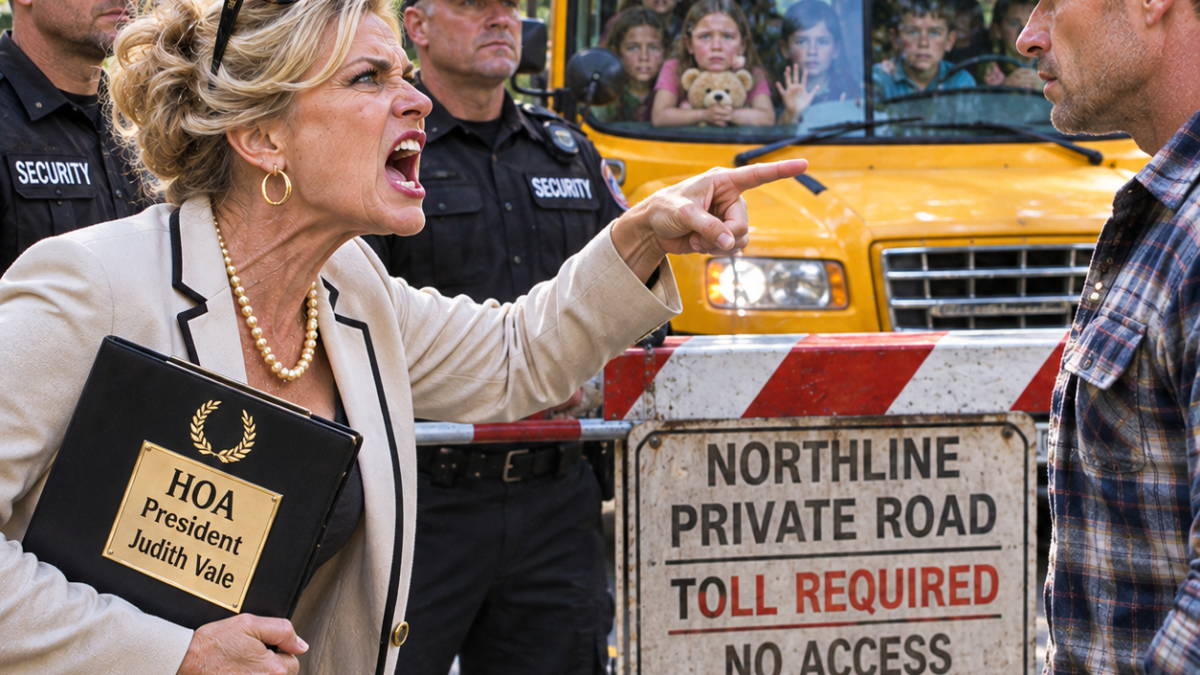
PART2:“PAY THE TOLL OR TURN AROUND—NORTHLINE OWNS THIS ROAD NOW,” HOA president Judith Vale snapped while a school bus carrying seven children sat trapped beside the new barrier she had installed across the only road into our neighborhood, even though every one of our deeds guaranteed us permanent access to our own homes.
PART2
The line reached almost to the county highway.
Parents were trying to take children to school.
A nurse was trying to reach an elderly patient.
A trash truck turned around.
A grocery delivery van sat on the shoulder while its driver called somebody for authorization.
The entrance kiosk looked brand new.
Gray siding.
Northline logo.
Plate-reading camera.
Card terminal.
Barrier arm painted white and red.
The whole thing might have looked professional if it had not been blocking the only road seventy-four families could use to reach their houses.
I was returning from a supply yard when Tessa called.
Her voice was sharp.
“Where are you?”
“Ten minutes out.”
“Milo forgot his inhaler.”
My stomach tightened.
Milo had asthma.
Usually mild.
Usually controlled.
But “usually” is not a word you trust when the school nurse calls.
“I’m bringing it.”
“No. I have it.”
“Then what’s wrong?”
“They won’t let me through.”
“What?”
“The gate.”
She sounded furious.
“Our plate isn’t registered.”
“Pay.”
“I already did.”
“Then go.”
“I am.”
She took a breath.
“Eight dollars to bring our son his inhaler.”
That sentence changed something in me.
Not because eight dollars would ruin us.
It would not.
Because the fee existed between my wife and our own front door.
By the time I reached Hawthorn Way, six vehicles waited.
The booth attendant was maybe twenty-two.
Name tag:
OWEN
He looked miserable.
I parked beside the kiosk.
“Who authorized charging homeowners?”
He glanced toward the line.
“Sir, I’m just following the system.”
“I’m not angry at you.”
He visibly relaxed.
“Can I see whatever Northline says gives you the right?”
He hesitated.
Then showed me a laminated notice.
Northline Toll Services owned Hawthorn Way.
Northline controlled entry.
Residents required passes or per-use payment.
HOA seal at bottom.
Judith Vale’s signature.
I opened my phone.
Showed him a photograph of the easement language from my deed.
Owen read it.
“I honestly don’t know.”
“Neither do I.”
“I can call my supervisor.”
“Please.”
Supervisor said the ownership transfer was valid and all access rights had been converted to a permit system.
“Who converted mine?”
Silence.
Then:
“That’s a legal question, sir.”
Exactly.
I photographed the notice.
The terminal.
The line.
My own $8 receipt.
Then paid and drove home.
That evening Elena Torres came to our kitchen carrying her closing binder.
She dropped it beside mine.
Opened directly to the easement.
“There.”
I read it again.
Permanent non-exclusive easement for vehicular and pedestrian ingress and egress over Hawthorn Way to and from the public highway.
Elena tapped the page.
“They can sell the dirt.”
She looked at me.
“They cannot sell away what these houses already have.”
“You a lawyer now?”
“No.”
“Then why do you sound so happy?”
“Librarian.”
She sat.
“I know how to find the page someone hopes nobody reads.”
Tessa brought coffee.
We opened the county recorder’s website.
Northline really had purchased the road parcel.
Recorded Friday.
$1,600,000.
Seller:
Ashwood Ridge Homeowners Association.
Buyer:
Northline Toll Services LLC.
Judith had signed as president.
But page one contained a phrase none of Northline’s letters had emphasized.
Subject to easements, covenants, restrictions, and matters of record.
We opened the title attachment.
Our access easements were listed.
Elena smiled.
“They knew.”
“Maybe.”
I stayed cautious.
“Knowing an easement exists doesn’t tell us how a judge interprets tolls.”
“Fine.”
She leaned toward my laptop.
“Then find the HOA rule about selling common property.”
That took twelve minutes.
The declaration required approval from two-thirds of all lot owners before the HOA could transfer a road.
Seventy-four lots.
Two-thirds meant at least fifty votes.
There had been no such ballot.
No meeting.
No vote.
Only our camera-and-pavement survey.
Tessa stared.
“She used that.”
“We don’t know yet.”
“What else could she have used?”
I printed everything anyway.
Deed.
Easement.
Declaration.
Sale record.
Meeting minutes.
Survey.
Then created a folder.
HAWTHORN WAY
It eventually became three boxes.
The next morning I called Sheriff Daniel Ortiz.
I expected him to say it was civil.
He did.
But he listened first.
“A recorded deed and easement aren’t things deputies adjudicate at a toll booth.”
“I understand.”
“But traffic stacking onto the county highway is my problem.”
“And emergency access.”
“Yes.”
“Can you come?”
“I can have a deputy observe.”
“What about the gate?”
“If an ambulance needs through and somebody delays it, call immediately.”
That was not a courtroom victory.
It was useful.
Judith called a community meeting that evening.
The clubhouse was packed.
She stood in front of a projector.
Cream blazer.
Leather folder.
Composed.
“The sale of Hawthorn Way was necessary to prevent a severe financial crisis.”
People murmured.
She displayed photographs of the retaining wall.
Cracked concrete.
Drainage.
Pavement.
Then a chart.
Ashwood Ridge had more debt than most residents knew.
A short-term loan.
Deferred repairs.
Rising insurance.
Judith said:
“Northline’s purchase removes the long-term road maintenance burden while immediately strengthening association finances.”
A few people nodded.
Honestly, if she had presented a transparent proposal before the sale, some residents might have supported some form of outside maintenance contract.
That was what made what came next so infuriating.
I raised my hand.
“Why does Northline’s notice say homeowners approved the transfer?”
Judith smiled.
“Residents approved the access modernization initiative.”
“No.”
Elena called from two rows behind me.
“We approved a survey.”
Judith looked annoyed.
“Which demonstrated overwhelming support.”
Elena stood.
She carried the original survey.
“Question one.”
She read aloud.
Would you support installation of an entrance camera to improve neighborhood security?
Then question two.
Would you support resurfacing Hawthorn Way if a financially sustainable option can be identified?
Elena looked at Judith.
“Where is the question asking whether we agree to sell the road?”
Judith folded her hands.
“The survey established approval in principle.”
“In principle for a camera.”
“For access improvements.”
“Not a toll.”
“You’re parsing language.”
Elena smiled.
“I’m a librarian.”
A few people laughed.
Judith did not.
Then Patrick Laird stood.
Former HOA treasurer.
Resigned two months earlier after arguing repeatedly with Judith about financial disclosure.
She hated him.
That alone made his appearance interesting.
Patrick opened his laptop.
“When I resigned, the board was discussing financing the retaining-wall work.”
Judith cut in.
“Patrick left before negotiations were complete.”
“Yes.”
He looked at the room.
“But I never saw a proposal to sell Hawthorn Way.”
Judith’s jaw tightened.
“You were not entitled to confidential negotiations after resignation.”
“This agenda is from my final board meeting.”
He projected it.
Road repair.
Insurance.
Reserve funding.
Landscaping.
No sale.
Patrick clicked.
The projector went black.
People turned.
Judith stood beside the control laptop.
“Those documents are incomplete and potentially misleading.”
Patrick stared.
“You turned it off.”
“I’m preventing misuse of board records.”
People began talking.
Judith tried calling order.
It got louder.
Tessa did something smarter.
She walked around with a notebook.
Name.
Phone.
Email.
“Anyone with a deed, toll receipt, survey copy, access problem—write it down.”
By midnight, fifty-three households were in one group chat.
Thirty-one had already paid tolls.
An eighty-two-year-old man named Harold Jenkins had missed physical therapy because the medical transport company refused to pay a private road fee that was not in its authorization.
A grocery order for Mrs. Feldman had been left near the county highway.
One home-care nurse paid personally because her patient could not safely wait.
A plumber charged a homeowner an extra trip fee after turning around.
Each story sounded small.
Together they showed what Judith had sold.
Not asphalt.
Control over daily life.
I wrote Northline the next day.
Attached easements.
Asked what legal authority converted permanent residential access into toll-based permission.
Two days later, Regional Manager Graham Bell called.
Very careful voice.
“Mr. Mercer?”
“Yes.”
“Northline received representations from Ashwood Ridge that resident access rights had been converted to a controlled permit structure.”
“Converted how?”
“Through homeowner consents.”
I sat straighter.
“What consents?”
“A schedule of approved households.”
“How many?”
“Seventy-four.”
“My household?”
“Yes.”
“Send me mine.”
“I need legal approval.”
“What did I supposedly sign?”
He paused.
“An access-upgrade consent.”
“What does it say?”
Another pause.
“I think this should go through counsel.”
That was the first moment I knew there was more than a questionable board vote.
There were signatures.
Our signatures.
Being used for something.
I drove to the county recorder.
Not online.
In person.
The clerk helped me pull the full road-transfer map.
Hawthorn Way parcel began at the county highway.
Crossed the bridge.
Included kiosk site.
Every inch of pavement.
Ended near my driveway.
Separate attachment listed recorded easements.
Not hidden.
Not omitted.
Northline bought the road with notice that every home had legal rights over it.
I photographed every page.
Sent them to property attorney Rina Shah.
Subject line:
PLEASE TELL ME IF I’M READING THIS CORRECTLY
She called the next afternoon.
“You’re reading it reasonably.”
“Meaning?”
“Meaning Northline owns the fee parcel.”
“Okay.”
“That does not automatically extinguish recorded easements.”
“Can they charge us?”
“I need more.”
“What?”
“HOA declaration.”
“Bylaws.”
“Survey.”
“Sale agreement.”
“Any access consent.”
“Any financial documents.”
Then:
“And Nathan?”
“Yes?”
“Do not touch the barrier.”
“I wasn’t planning—”
“You were thinking about it.”
I smiled despite myself.
“Maybe.”
“Do not force it.”
“It’s blocking our road.”
“And breaking it transforms a very clean document dispute into damaged private equipment.”
I hated that.
Which meant she was probably right.
“Fine.”
“Save every receipt.”
We did.
Every $8.
Every $12.
Monthly pass invoices.
Screenshots.
Photographs.
Time.
Date.
Vehicle.
The sale agreement arrived because Patrick still had access to an HOA shared archive that had not been cleaned up after his resignation.
The file name was:
ENTRANCE MAINTENANCE
Inside:
Twenty-year agreement.
Northline purchase.
Operating requirements.
Minimum resident account guarantee.
That clause made me sit back.
Ashwood Ridge promised Northline a minimum number of paid resident accounts.
If too few residents enrolled, the HOA owed the difference.
Judith had not merely sold the road.
She had guaranteed customers.
Then the spreadsheet.
Seventy-four households.
Column:
CONSENT — YES
My name.
Nathan Mercer.
Tessa Mercer.
Elena Torres.
Patrick Laird.
Every home.
Attached consent forms.
I opened mine.
My signature was real.
But the page was wrong.
At the bottom:
My signature.
At the top:
Resident Approval — Access Modernization Program
I stared.
“Tessa.”
She came over.
“That’s our signature.”
“Yes.”
“Did we sign that?”
“No.”
Then I noticed the crop.
The signature box.
Paper texture.
Alignment.
I found our original camera survey.
Placed the two side by side.
Same signature.
Same angle.
Same tiny ink break where my pen skipped.
But the question above the signature had been removed.
Our survey signature had been copied into a different context.
Tessa went pale.
“She stole our signatures.”
“Don’t say stole yet.”
“What would you call it?”
“Evidence.”
She looked at me.
“I married the most irritating man alive.”
“Useful today.”
Rina came over that evening.
Our dining room became a document lab.
Tessa taped original survey pages on the left wall.
Northline’s clipped consent pages on the right.
Household after household.
Same signatures.
Different headings.
Elena brought her original envelope with postmark.
Patrick found the board email saying:
SURVEY IS FOR PLANNING PURPOSES ONLY AND DOES NOT AUTHORIZE EXPENDITURE OR CONTRACT.
Rina stopped us.
“Nothing else gets taped.”
Tessa frowned.
“Why?”
“Because I want every original separately bagged, dated, and photographed.”
“This isn’t a murder case.”
“No.”
Rina looked at the wall.
“But somebody will eventually accuse you of manipulating these.”
That silenced us.
For the first time I understood why the question above a signature mattered just as much as the signature itself.
We had answered one question.
Judith used that answer to manufacture another.
Rina prepared an emergency petition.
Narrow request.
Not final ownership.
Not fraud findings.
Not criminal accusations.
Access.
Residents, guests, emergency vehicles, school transportation, ordinary service providers should pass without toll while the larger dispute was litigated.
“Why not put Judith’s brother in?” Tessa asked.
We had just discovered the next problem.
Patrick had pulled budget records.
Northline sale proceeds paid off a large short-term HOA loan.
That was legitimate use.
But $260,000 also went to:
VALE STRATEGIC ADVISORY LLC
Company formed six months earlier.
Owner:
Judith’s brother.
No relationship disclosure in board minutes.
Tessa stared at the number.
“Two hundred sixty thousand dollars?”
Patrick nodded.
“For transaction advisory.”
“What did he advise?”
“Apparently selling our road.”
Rina said:
“Not in the emergency motion.”
Everyone objected at once.
She raised a hand.
“We need the judge focused.”
“Residents cannot reach homes without paying.”
“That is immediate.”
“The brother’s fee matters.”
“But it can be investigated separately.”
Patrick muttered:
“Lawyers remove all the fun.”
Rina smiled.
“That is why people pay us.”
Before the hearing, Northline’s software made everything worse.
It began charging vehicles on exit as well as entry.
Their notice only described entry charges.
Owen apologized every time.
“I’m sorry.”
It became his entire vocabulary.
Then the school bus incident happened.
Seven children.
Afternoon route.
The bus entered earlier under a temporary verbal exemption.
When it tried returning through the barrier after turning around inside the neighborhood, the system demanded payment.
Driver refused.
Correctly.
Supervisor insisted commercial vehicles required authorization.
Bus sat beside the road.
Children waited.
Parents started arriving.
Elena stood at the gate.
Forty minutes.
Sheriff Ortiz came because traffic was backing toward the highway.
Judith arrived in her SUV.
She walked directly toward Elena.
“What is the problem?”
Elena pointed at the bus.
“Seven children.”
“The driver needs to follow Northline procedure.”
“The road belongs to us.”
“No.”
Judith’s voice sharpened.
“Northline owns the road now.”
“Subject to our easements.”
“Stop repeating legal language you don’t understand.”
Elena looked at her.
“I spent thirty years teaching children to read.”
Judith rolled her eyes.
“Then read the sign.”
I arrived as Sheriff Ortiz approached the booth.
He spoke to Northline’s supervisor by phone.
“Raise the arm.”
The attendant hesitated.
Supervisor argued.
Ortiz repeated:
“There are children sitting in a school bus blocking the shoulder of a county highway.”
The arm finally lifted.
Eleven minutes after the sheriff arrived.
Forty minutes after the bus stopped.
Elena turned to Judith.
“Are you charging them tomorrow too?”
Judith stared.
“The driver can get a pass.”
“You hear yourself?”
“The system works if everyone complies.”
I stepped forward.
“You sold our only entrance?”
Judith looked at me.
“Here we go.”
“Name one homeowner who voted for that.”
“You approved it.”
“No.”
“You signed.”
“A camera survey.”
“Those signatures are valid.”
“For the question we answered.”
“You don’t get to reinterpret your consent because you dislike the result.”
Sheriff Ortiz stepped between us slightly.
Not dramatic.
Enough.
I pointed at the gate.
“Lift it permanently.”
Judith smiled.
“Your tantrum won’t lift that arm.”
That sentence traveled through the neighborhood within an hour.
Not because I posted it.
A parent recorded it.
By evening, residents who had previously said the fee might be acceptable were printing bank statements.
At the next neighborhood gathering, the dining room at Elena’s house was too small.
We used Patrick’s garage.
Forty people stood between lawn equipment and storage shelves.
Elena held up a photograph of the school bus.
Tessa read a list.
Home nurse delayed.
Medical transport refused.
Groceries abandoned.
School vehicle blocked.
Plumber surcharge.
Home-health therapist rescheduled.
A father who had custody exchange twice a week had paid $96 in twelve days.
A college student delivering food had been charged both directions.
Patrick displayed the budget.
Then the $260,000 advisory payment.
Silence.
Elena said:
“Judith told us the sale saved us from an assessment.”
Patrick nodded.
“It used the sale proceeds to pay debt.”
“That part is true.”
“And her brother?”
“Also true.”
People started shouting.
I stood on a workbench.
“Stop.”
Somehow they did.
“We have documents.”
“Use them.”
“Do not threaten Judith.”
“Do not touch the gate.”
“Do not harass Owen.”
“Do not post accusations we cannot prove.”
A man named Steve muttered:
“She forged our signatures.”
Rina, standing near the garage door, answered:
“We will use the precise word a court supports after evidence is reviewed.”
Steve looked annoyed.
“You lawyers ruin everything.”
“Yes.”
She smiled.
“Please let me continue.”
The emergency hearing occurred Tuesday.
County courthouse.
Smaller room than I expected.
No dramatic television atmosphere.
Fluorescent lights.
Wood benches.
Papers.
Northline’s lawyer argued the company lawfully purchased a private road and had the right to recover maintenance costs.
Rina did not dispute the purchase deed existed.
She pointed to the easements.
Permanent.
Recorded.
Predating Northline’s purchase.
Then the HOA requirement:
Two-thirds homeowner approval before transfer.
No vote.
Then the survey.
Original question.
Then Northline’s “consent.”
Cropped signature.
The judge looked at Northline’s attorney.
“Show me a homeowner’s signed document surrendering or modifying the recorded access easement.”
The attorney turned pages.
“We relied upon the association’s certification.”
“That was not my question.”
Silence.
The judge repeated:
“Where is the owner’s signed agreement?”
They did not have one.
The temporary order came less than an hour after the hearing began.
Northline could maintain cameras for legitimate security.
Northline could continue owning the parcel while ownership issues were litigated.
But residents, their guests, school vehicles, emergency responders, delivery services, contractors, medical workers, and ordinary invitees had to pass without toll.
The barrier could not be used to extract payment from easement holders.
Not final victory.
Enough.
When I drove home that evening, the arm stood upright.
Owen sat in the booth.
He saw me.
Raised two fingers.
I waved.
No wallet.
No receipt.
For the first time in weeks, I drove onto Hawthorn Way like I belonged there.
Judith posted a statement that night.
TEMPORARY PROCEDURAL ORDER
She said the court had not invalidated the sale.
True.
She said the HOA had acted in good faith.
Disputed.
She said Northline’s advisory fees reflected ordinary transaction expenses.
Interesting.
Then Graham Bell sent Rina a letter.
Northline’s own title report had flagged every residential easement.
Their lawyers knew.
But Judith had delivered a separate HOA certification stating all seventy-four households accepted conversion to paid access.
Northline wanted clarification.
And if the certification was false, they wanted rescission.
For the first time, the toll company and homeowners were asking the same question.
Who created the consent pages?
The answer lived in the board’s email archive.
Judith had instructed an HOA administrative assistant named Marcy to send Northline the signed entrance survey.
Marcy replied:
The survey does not mention tolls or sale. It only asks about camera installation and paving.
Judith answered:
They approved the access upgrade. Legal can handle the wording. Send the signatures with the resident schedule.
I read that email three times.
Another thread began six months earlier.
Judith’s brother:
If the road transaction moves, I can structure the advisory side. Fee at 16.25% of gross proceeds is workable given complexity.
Judith:
Keep it below the level that creates questions before closing.
Patrick stared.
“What does that mean?”
Rina said:
“It means exactly what it says.”
“Is it illegal?”
“It means we give it to the right people and let them decide.”
Important distinction.
Marcy had saved the emails.
Why?
Because she was uncomfortable.
She later told us Judith had insisted nobody outside the executive group needed access until the deal closed.
After the temporary court order, three directors called a special board meeting.
Judith objected.
Did not matter.
The clubhouse overflowed.
Northline sent Graham and one lawyer.
Sheriff Ortiz attended only to keep order because people were furious.
Judith entered with her leather folder.
Again.
Always that folder.
She stood at the front.
“You are all forgetting the financial reality.”
No one spoke.
“The retaining wall is failing.”
True.
“The road needs resurfacing.”
True.
“We had debt.”
True.
“Northline gave this community $1.6 million.”
True.
Then Elena stood.
“No.”
Judith glared.
“No what?”
“We have not forgotten any of that.”
Elena carried a folder of her own.
“What we are saying is that an assessment could have been debated.”
“Rejected.”
“Modified.”
“Phased.”
“Borrowed against.”
“Bid competitively.”
She looked at Judith.
“But you hid a road sale inside a camera survey.”
Judith raised her chin.
“I saved homeowners from an assessment many could not afford.”
Elena answered:
“You removed their choice.”
The room applauded.
Judith slapped her palm against the podium.
“Enough.”
The applause stopped.
She looked around.
“You want choice?”
“Fine.”
“You can choose an assessment of thousands of dollars.”
“You can choose a collapsing retaining wall.”
“You can choose crumbling asphalt.”
“You can choose higher debt.”
“But leadership means making difficult decisions.”
Patrick stood.
“Leadership does not mean forging the meaning of somebody else’s signature.”
Judith’s face changed.
“Do not use that word.”
“Why?”
“You know exactly why.”
Patrick opened his laptop.
Displayed original survey.
Then Northline consent.
Side by side.
Judith said:
“The signatures are authentic.”
“That is the problem.”
“No.”
She pointed.
“They signed.”
“For a camera.”
“For access modernization.”
“No.”
Patrick’s voice rose.
“The question matters.”
Judith turned toward the audience.
“This is what happens when disgruntled former officers weaponize paperwork.”
Graham Bell stood from the back.
He carried Northline’s title report.
“Mrs. Vale.”
Judith looked surprised.
Graham opened a highlighted page.
“Our company’s title report identified all seventy-four residential easements.”
Judith said nothing.
He continued.
“We relied on your written certification that easement holders had accepted paid access modification.”
“I was advised—”
“By whom?”
Silence.
Graham waited.
Judith looked at her attorney.
He did not answer.
Graham continued.
“Our copy of the household approvals contains survey signatures removed from their original questions.”
The room erupted.
Judith shouted:
“They approved the program!”
Elena answered calmly:
“We approved a camera.”
“You approved modernization.”
“A camera.”
“Road improvement.”
“Not sale.”
“You are splitting hairs.”
Elena’s voice stayed quiet.
“No.”
“You split the form.”
That line ended the argument.
People stood.
Not cheering.
Angry.
Rina later said it was the moment every lawyer in the room wished nobody had phones.
Sheriff Ortiz moved closer to the front.
“Everybody remain seated.”
The board went into formal session.
One director read the motion:
Remove Judith Vale as president pending investigation and legal review.
Seconded.
Judith stood.
“You cannot remove me because people are upset.”
The vice president answered:
“We can remove an officer by board vote.”
“I negotiated the only solution to this association’s debt.”
“You negotiated without required owner approval.”
“I protected you.”
A woman near the wall shouted:
“By charging me to go to work?”
Another:
“My mother’s nurse had to pay you!”
Another:
“My grandchildren’s bus sat at your gate!”
Ortiz raised his voice.
“Enough.”
Silence returned.
Judith looked at the room.
Really looked.
Seventy-four families had spent years seeing her as the person who handled things.
Now nearly every face was turned against her.
For the first time she looked frightened.
Not sorry.
Frightened.
She pointed toward me.
“This is because of him.”
I stared.
“You think I started this?”
“You went to a lawyer.”
“You sold our road.”
“You organized homeowners.”
“You used our signatures.”
“You brought the sheriff.”
“You blocked a school bus.”
Her face reddened.
“You have been undermining me since day one.”
“I barely spoke to you before the gate went up.”
“People like you always resent strong leadership.”
I almost laughed.
“What kind of people?”
She hesitated.
“Contractors.”
The room went still.
Even she realized how ridiculous that sounded.
I walked toward the center aisle.
Not close enough to intimidate.
Close enough that I did not need to shout.
“You want to know why everybody is angry?”
“I know why.”
“No.”
“You think it’s the eight dollars.”
“It’s not.”
“You think it’s Northline.”
“It’s not.”
“You think people hate maintenance.”
“They don’t.”
I pointed toward the original survey projected behind her.
“We answered a question.”
“You changed the question after we signed.”
Her jaw tightened.
“You needed the money.”
“We needed information.”
“You needed leadership.”
“We needed a vote.”
“You would have rejected an assessment.”
“Maybe.”
“That proves my point.”
“No.”
I shook my head.
“That proves ours.”
Judith stared.
“You decided our right to make a bad financial choice was less important than your right to make the choice for us.”
No answer.
I continued.
“You could have stood in this room six months ago and said the retaining wall needs half a million dollars.”
“You could have shown us the debt.”
“You could have proposed a loan.”
“An assessment.”
“A maintenance contract.”
“Even a road sale.”
“You could have asked.”
“But asking meant we might say no.”
That was it.
The truth.
Judith had never been afraid a proposal was impossible.
She had been afraid residents might reject her answer.
She looked away.
The board voted.
Three to two.
Judith removed as president.
She remained a director temporarily.
That did not last.
Sheriff Ortiz stood by the door as she closed the leather folder.
Slowly.
Then walked out.
Nobody applauded.
That was better.
Removing her did not erase the deed.
Did not cancel Northline’s $1.6 million.
Did not repair the retaining wall.
Did not recover the advisory fee.
Did not solve debt.
For months, Ashwood Ridge lived under the temporary court order.
Barrier arm remained raised for authorized neighborhood traffic.
Northline still technically owned Hawthorn Way.
Their camera remained.
Owen remained in the booth for another six weeks, mostly reading.
Every time I passed he waved.
Eventually Northline stopped staffing it full-time.
Legal discovery began.
Ugly word.
Useful process.
Emails.
Meeting minutes.
Bank statements.
Board authorizations.
Northline due diligence.
Title report.
Transaction invoices.
Survey metadata.
Patrick spent evenings helping the new board organize years of records.
Tessa built spreadsheets.
Elena read everything.
She was terrifying.
One night I found her at our dining table reading a seventy-page title policy.
“Elena.”
“What?”
“You’re retired.”
“Correct.”
“You have hobbies?”
“This is my hobby.”
“That is disturbing.”
She smiled.
“Page forty-two is worse.”
Of course it was.
The financial picture became clearer.
Ashwood Ridge had accumulated debt because prior boards deferred road work and held dues artificially low.
Judith inherited some of that.
Important.
She did not invent every problem.
The retaining wall genuinely needed repair.
Road resurfacing genuinely could not wait forever.
Insurance had increased.
Emergency reserves were too small.
Judith’s mistake was not recognizing a financial crisis.
Her mistake was deciding the crisis authorized secrecy.
The $260,000 advisory payment became the ugliest financial issue.
Judith’s brother, Daniel Vale, claimed he had introduced Northline, structured transaction terms, coordinated due diligence, and helped negotiate debt payoff.
Some work existed.
But the relationship had not been disclosed openly.
No competitive proposal.
No member vote.
No ordinary board record showing why a fee equal to more than fifteen percent of the purchase price was reasonable.
The county investigated.
So did insurers.
So did lawyers.
Rumors exploded.
“Judith is going to prison.”
“Judith stole the money.”
“Northline bribed her.”
I refused to repeat any of it.
At one neighborhood meeting a man asked:
“You think she’s getting arrested?”
I said:
“I don’t know.”
“You’ve seen the emails.”
“Yes.”
“So?”
“So I know what the emails say.”
He frowned.
“Whose side are you on?”
“Evidence.”
People hate that answer when they want a villain faster than the facts arrive.
What I could prove was enough.
My name appeared on a consent form I had never signed in that form.
Tessa’s too.
Our deed guaranteed access.
No two-thirds vote happened.
Northline billed us anyway.
Those were facts.
The final civil hearing came almost eight months after the gate first dropped.
By then winter had become summer.
The retaining wall had more temporary braces.
Orange cones lined the creek.
Hawthorn Way looked tired.
So did everyone.
The HOA, now under interim president Patrick Laird after another board reorganization, conceded it had not obtained the required owner vote for the road transfer.
Northline did not insist on keeping a road attached to seventy-four hostile easement holders under a contract built on disputed certifications.
They agreed in principle to unwind.
Not simply erase.
Money had moved.
Debt had been paid.
Taxes, transaction costs, toll revenue, advisory payments, legal fees.
Nothing complicated becomes simple merely because everyone agrees it should never have happened.
Settlement:
Northline would reconvey Hawthorn Way to Ashwood Ridge.
The HOA would return an agreed portion of sale consideration through financing and settlement adjustments.
Northline’s disputed toll revenue would be reconciled separately.
The $260,000 advisory fee remained subject to financial claims and investigation.
Resident documented toll charges would be refunded.
The court entered an order confirming the recorded access easements.
Any future transfer had to comply with owner-vote requirements.
The HOA had to conduct an independent financial audit.
Future material contracts had to be published before approval.
The judge looked over his glasses.
“I hope nobody needs me to explain why signatures should remain attached to the questions people actually answered.”
No one did.
Judith sat behind her attorney.
She no longer held any board position.
When the judge approved the final settlement, she did not look at us.
I expected triumph.
Nothing.
Just tiredness.
Outside, reporters from one local station waited.
Rina told us:
“Say less than you think.”
Elena whispered:
“Lawyers really hate joy.”
Rina heard.
“Correct.”
A reporter asked:
“Mr. Mercer, do you feel vindicated?”
I looked toward Hawthorn Way in my imagination.
Gate.
School bus.
Tessa paying eight dollars for Milo’s inhaler.
Receipts stacked in a folder.
“No.”
“What do you feel?”
“Ready to drive home.”
That became the clip they used.
Maybe not exciting.
True.
Residents got refunds.
Mine came as a check with an itemized list.
$8.
$8.
$16 after the two-way billing error.
Guest charges.
Delivery reimbursements.
Total was not life-changing.
I deposited it.
Tessa wanted to frame one old receipt.
“Why?”
“Because you kept them like war medals.”
“They were evidence.”
“Exactly.”
She framed the first $8 receipt anyway.
Hung it inside the filing cabinet door.
I married badly.
The financial problem remained.
That was the part some neighbors found hardest.
People expected Judith’s removal to make the debt disappear.
It did not.
The retaining wall still leaned.
Pavement still cracked.
The HOA still needed money.
Northline reconveying the road did not create free asphalt.
Patrick presented a new proposal.
Public.
Detailed.
Three options.
Large one-time assessment.
Smaller phased assessment plus refinancing.
Higher dues plus delayed resurfacing.
Everybody got numbers.
Contract bids.
Interest assumptions.
Reserve projections.
No hidden survey.
No fake consent.
The meetings were ugly.
People complained.
Argued.
Some shouted.
One homeowner called the board incompetent.
Another called the assessment highway robbery.
Patrick sat there and took it.
Then Elena stood.
“We are finally having the argument we should have had before the road was sold.”
The room quieted.
She continued.
“Disagreement is not failure.”
That sentence should be engraved on every HOA clubhouse wall in America.
We chose the phased assessment.
I hated writing the first check.
I stared at it.
Tessa stood beside me.
“How much?”
“Too much.”
“But?”
“I know what it’s for.”
Exactly.
The retaining wall was rebuilt.
Not glamorous.
Concrete.
Drainage.
Tiebacks.
The road got resurfaced the following spring.
For three weeks we complained about construction delays like normal people.
One day I sat in traffic behind a paving roller for eleven minutes.
Tessa called.
“Where are you?”
“Blocked by the road we sued to get back.”
She laughed so hard she had to hang up.
Normal inconvenience felt strangely luxurious.
Judith’s story became more complicated.
She sold her house eventually.
Not immediately.
For nearly a year she remained in Ashwood Ridge without a board title.
People avoided her.
Some confronted her in the grocery store.
That I disliked.
Whatever she had done, strangers did not need to perform punishment in produce aisles.
Once, I saw someone photograph her at a gas station.
I told him to stop.
He looked shocked.
“She did this to you.”
“Yes.”
“So why defend her?”
“I’m defending public decency.”
Judith heard.
Said nothing.
Months later she came to our house.
Tessa saw her first.
“Nathan.”
“What?”
“Company.”
Judith stood on the porch.
No cream blazer.
Jeans.
Dark sweater.
Leather folder absent.
I opened the door.
“Judith.”
“Can I speak to you?”
Tessa remained in the hallway.
Good woman.
“About what?”
“The road.”
“No.”
Judith flinched.
“I mean…”
She took a breath.
“I owe you an apology.”
I waited.
“I should not have used the survey signatures.”
“That is true.”
“I believed the survey established approval.”
“For a camera.”
“I know.”
“Now.”
“Yes.”
She looked down.
“I was trying to solve a problem.”
“You keep saying that.”
“I know.”
“And every time you say it, it sounds like you still think solving the problem matters more than how you did it.”
Her eyes lifted.
“That isn’t what I mean.”
“Then what do you mean?”
She stood quietly.
Finally:
“I was scared.”
That surprised me.
“Of what?”
“The finances.”
“An assessment?”
“Failure.”
She laughed weakly.
“I became president because everyone complained nobody would fix anything.”
“The retaining wall.”
“The road.”
“Reserves.”
“Insurance.”
“Every meeting was people saying somebody should do something.”
She looked past me toward the kitchen.
“When Northline approached, it looked like a miracle.”
“Cash.”
“No maintenance burden.”
“Security gate.”
“Road repaired.”
“Debt gone.”
I nodded.
“And the toll?”
“I thought residents would be angry for a month.”
Then she smiled bitterly.
“I thought once everything looked better, they would admit I had been right.”
There it was.
Not greed first.
Certainty.
“Why hide the sale?”
“Because Patrick would have killed it.”
“Why should Patrick get to kill it?”
“He was treasurer.”
“He was always negative.”
“Why should seventy-four owners get to kill it?”
She stopped.
Exactly.
I continued.
“That was the question you never answered.”
Judith’s eyes filled.
“I thought they would say no because they didn’t understand the finances.”
“And you did.”
“Yes.”
She closed her eyes.
“God.”
“You hear it now?”
“Yes.”
I leaned against the doorframe.
“What about your brother?”
Her face tightened.
“He did work.”
“I did not ask whether he worked.”
“I should have disclosed the relationship.”
“Yes.”
“The fee was too high.”
“Probably.”
“I was told market pricing—”
I raised a hand.
“Judith.”
She stopped.
“I don’t need the defense.”
She nodded.
“I’m sorry.”
“For what?”
She looked surprised.
I waited.
A real apology needs nouns.
“For using the survey signatures outside their purpose.”
“Okay.”
“For not holding the owner vote.”
“Okay.”
“For allowing Northline to charge residents before access rights were resolved.”
“Okay.”
“For the school bus.”
Her voice broke slightly.
“That one…”
She looked away.
“I watched those children sitting there and still believed backing down would make me weak.”
That was the first sentence that sounded fully honest.
I nodded.
“And?”
“For telling you to pay the toll when your wife had just paid to bring your son his inhaler.”
I had not expected her to remember.
She did.
“For calling your objection a tantrum.”
I said nothing.
“For thinking leadership meant never letting people see me reverse a decision.”
There.
Tessa stepped closer behind me.
Judith noticed.
“Tessa.”
Tessa crossed her arms.
“You used my signature.”
“I know.”
“I signed because I wanted a camera after two garages were robbed.”
“I know.”
“You turned that into a twenty-year toll contract.”
“Yes.”
“Do you understand why that felt violating?”
Judith’s eyes filled.
“Yes.”
Tessa shook her head.
“I hope so.”
Judith nodded.
“I am sorry.”
Tessa did not forgive her.
Not then.
She said:
“Thank you for saying it.”
Different.
Judith left.
No hug.
No dramatic reconciliation.
Good.
Some stories improve when people stop demanding friendship as proof of accountability.
The independent audit later found poor controls going back years.
Not only Judith.
Prior boards had deferred maintenance.
Budgets had been optimistic.
Reserve studies ignored.
Expenses misclassified.
Judith’s secret road transaction was the worst governance failure, but she had inherited a culture where nobody wanted dues high enough to pay for reality.
That mattered.
Residents had spent years demanding perfect roads and low dues simultaneously.
We were not innocent in every sense.
We just had not consented to Judith’s solution.
Patrick said at one meeting:
“If we want boards to stop doing desperate things, homeowners need to stop punishing every board member who tells them something costs money.”
Nobody applauded.
Because he was right.
Truth rarely gets applause when it comes with an invoice.
Ashwood Ridge changed.
Budget published monthly.
Contracts above a threshold posted before approval.
Board members disclosed family and business relationships.
Meeting packets went online.
Votes recorded by name.
Any future road transfer required a separate ballot with the exact transaction stated in plain language.
Elena wrote that rule.
Of course.
It included:
No signature collected for one stated purpose may be used as evidence of consent to another transaction.
Patrick joked:
“The Elena Rule.”
She glared.
“The Reading Rule.”
Better.
Sheriff Ortiz occasionally drove through.
First time after the kiosk became permanently unmanned, he stopped beside me while I was checking mail.
“How’s the revolution?”
“Expensive.”
He laughed.
“Best kind.”
“Your sheriff training teach that?”
“No.”
“Divorce.”
I never asked.
Owen disappeared after Northline withdrew.
Then one afternoon he came to my jobsite.
No uniform.
He worked for an equipment rental company now.
“Nathan?”
“Owen?”
He smiled.
“I wanted to say thanks.”
“For what?”
“Not making me the bad guy.”
I remembered him in that booth.
Twenty-two.
Taking abuse from seventy-four homeowners over a contract he did not write.
“You weren’t.”
“Not everybody understood that.”
“People were angry.”
“Yeah.”
He shrugged.
“Northline moved me to another site.”
“Better?”
“Much.”
He smiled.
“No school buses.”
“Good policy.”
He laughed.
Then left.
That interaction stayed with me.
Systems create people who become visible targets for decisions made higher up.
Judith blamed residents.
Residents blamed Owen.
Northline blamed HOA certification.
HOA blamed debt.
Debt blamed years of low dues.
Everything had a cause.
Accountability meant tracing causes without using complexity as an excuse to avoid responsibility.
Judith still made choices.
Northline still had lawyers who saw the easements.
The board still failed its members.
Residents still ignored finances for years.
Several things could be true.
Milo grew old enough to understand the story.
At eleven, he mostly cared that the gate had once delayed his inhaler.
At fourteen, he asked:
“Why didn’t you just drive around it?”
“There was no other road.”
“Like through the woods?”
“With my truck?”
“Yeah.”
I stared.
“Your mother and I spent money raising you.”
He laughed.
Then:
“Did Mrs. Vale really steal your signature?”
I thought.
“She used it for something I didn’t agree to.”
“Same thing.”
“Not exactly.”
“Why are adults obsessed with exactly?”
“Because exactly is often the difference between true and almost true.”
He rolled his eyes.
Teenager.
Years later he understood.
His first apartment lease arrived electronically.
He called.
“Dad.”
“Yes?”
“This thing is forty-eight pages.”
“Read it.”
“Seriously?”
“Yes.”
“You’re the worst.”
“Read it.”
He did.
Found an automatic-renewal clause he did not like.
Negotiated it.
Called me.
“Okay.”
“What?”
“Exactly matters.”
I smiled all afternoon.
Elena remained our unofficial document guardian until she moved closer to her daughter.
At her farewell dinner, Patrick gave her a framed copy of the original easement.
She stared.
“You framed legal boilerplate.”
Patrick said:
“It saved the neighborhood.”
“No.”
Elena corrected him.
“Reading it saved the neighborhood.”
Everyone laughed.
She was right.
The easement had existed for years.
A right nobody remembers can become surprisingly fragile.
Not legally.
Practically.
People give away things every day because they assume a confident person has authority.
Sometimes the most powerful question is:
Where does it say that?
That was Elena’s gift to us.
She never screamed.
Never threatened.
She found the page.
Read the sentence.
Placed it on the table.
Judith hated that.
Not because Elena was rude.
Because facts were difficult to intimidate.
Tessa became the new board secretary for exactly one term.
I begged her not to.
She said:
“You created this.”
“I absolutely did not.”
“You put fifty-three people in a group chat.”
“You collected them.”
“We are married.”
“Not legally relevant.”
She became secretary.
Every meeting minute included exact vote wording.
Every ballot had one question.
No “approval in principle.”
No vague surveys.
When her term ended, she celebrated with champagne.
I said:
“You know you volunteered.”
“Never again.”
Six months later she joined the road committee.
Marriage is complicated.
The kiosk stayed for a while.
Removing it immediately cost money.
So we repurposed it.
Package shelter.
Community notice board.
Emergency phone.
The payment terminal came out.
Barrier arm removed.
The camera remained with published retention rules.
At Christmas someone hung lights around the kiosk.
Milo taped a sign inside:
FREE ENTRY
Tessa made him remove it.
I took a photograph first.
The advisory-fee dispute eventually settled privately.
Judith’s brother returned part of the payment under an agreement without admitting wrongdoing.
The HOA recovered additional amounts through insurance and claims.
County investigators completed their work.
There were consequences.
I never became interested in dramatizing them.
People online wanted something bigger.
Prison.
Handcuffs.
Secret federal charges.
Real life was more administrative.
Financial recovery.
Board removal.
Audit.
Civil orders.
Legal fees.
Insurance problems.
A reputation destroyed by documents.
That was plenty.
The hardest consequence for Judith may have been simpler.
Nobody trusted her signature anymore.
A woman who had built her identity around competence had become the person everyone double-checked.
That is a brutal cost when certainty was your entire personality.
She moved out roughly eighteen months after the final settlement.
The moving truck came on a rainy Thursday.
I drove past.
She stood near the old gate.
I slowed.
She raised a hand.
I stopped.
Window down.
“Leaving?”
“Yes.”
“Where?”
“Richmond.”
“Family?”
“Sister.”
I nodded.
She looked toward Hawthorn Way.
“The retaining wall looks good.”
“It should.”
“You still angry about the assessment?”
“Yes.”
She smiled.
“Me too.”
That surprised me.
Then:
“I wish I had trusted people enough to ask.”
I looked at her.
“What do you mean?”
“I thought if I told seventy-four households how bad the finances were, they’d panic.”
“Some would.”
“I thought they’d blame me.”
“Some did anyway.”
She laughed softly.
“Yes.”
Then:
“I thought having the answer was what made me useful.”
I understood that better than I expected.
Building contractors learn the same trap.
Crew asks question.
Client asks question.
Inspector asks question.
You want to know.
Want certainty.
But sometimes the safest answer is:
I don’t know yet.
Let me check.
Judith had never learned that.
I said:
“Next time, ask.”
She nodded.
“Next time.”
Then drove away.
That was the last time I saw her.
I heard years later she worked for a nonprofit housing organization.
Administrative role.
No HOA.
Someone told Tessa she was good at it.
I hoped so.
People should be allowed to become better without the people they hurt having to supervise the process.
Hawthorn Way returned to being boring.
That was victory.
Road.
Bridge.
Creek.
Weeds.
Potholes.
Seventy-four driveways.
No payment terminal.
No receipt.
No monthly pass.
No barrier arm.
Nothing grand.
The retaining wall was rebuilt properly.
Fresh concrete looked strange at first.
Too clean.
Within two winters it stained.
Moss appeared near the creek.
Better.
Pavement resurfaced.
Then cracked again years later because roads do that.
At a meeting someone complained:
“We just fixed this.”
Patrick answered:
“Five years ago.”
The homeowner looked offended by time.
Normal HOA problem.
I almost enjoyed it.
One evening, long after the lawsuit ended, Tessa and I drove home from the hardware store.
Milo slept in the back seat.
He had spent twenty minutes arguing he was not tired.
Then collapsed before we left the parking lot.
We crossed the county highway turn.
Approached Hawthorn Way.
The kiosk was dark.
Camera light blinked once.
No terminal.
No attendant.
At the bridge, fresh repair marks showed on the retaining wall.
Orange cones waited for the next crew.
Nothing looked triumphant.
I slowed.
Turned uphill.
And realized my right hand was still resting near my wallet.
Habit.
For months, every approach to our own road had meant:
Card.
Receipt.
Fee.
Argument.
Even after the temporary order, I had expected the barrier to drop.
I moved my hand back to the steering wheel.
Tessa noticed.
“What?”
“Nothing.”
She looked at me.
“You did it again.”
“What?”
“Reached for your wallet.”
I laughed.
“Did I?”
“Yes.”
Then she looked out the window.
“Think you’ll stop?”
“Eventually.”
She rested her hand on mine.
“We’re home.”
That was the whole story.
Not the $1.6 million.
Not the $260,000 advisory fee.
Not Judith.
Not Northline.
Home.
A road is pavement until someone puts a price between you and your own front door.
Then you understand it is also freedom.
Access.
Ambulance.
School bus.
Groceries.
A nurse.
A child’s inhaler.
A contractor returning after work.
A grandmother arriving for dinner.
A teenager learning to drive.
A husband bringing flowers because he forgot an anniversary.
All the ordinary movements that make a life.
Judith saw Hawthorn Way as an asset.
Northline saw a revenue stream.
The declaration saw common property.
The deed saw an easement.
All technically understandable.
But residents saw the road home.
The legal victory mattered because it forced those descriptions to coexist.
Yes, the HOA owned the road.
Yes, it could potentially transfer ownership under the correct process.
Yes, maintenance cost money.
Yes, Northline could own land burdened by easements.
And yes, the people whose deeds gave them permanent passage had rights Judith could not erase by clipping signatures from a survey.
That is how real justice usually works.
Not by discovering one magic sentence that makes every other fact disappear.
By putting every fact where it belongs.
Judith’s strongest defense was always:
I solved a real problem.
She did.
Temporarily.
She used sale money to reduce debt.
She shifted road maintenance.
She got security infrastructure.
She created a cleaner balance sheet.
If results were the only thing that mattered, maybe she could have called it leadership.
But process matters because people are not inventory.
Consent matters because efficiency without consent becomes control.
The road crisis taught Ashwood Ridge something we should have learned before.
Good governance is slower.
Messier.
Louder.
People complain.
Votes fail.
Budgets hurt.
Assessments make everyone angry.
But a transparent bad choice still belongs to the people who made it.
A secret “good” choice belongs only to the person who took the decision away from everyone else.
Elena said it best at the first meeting after settlement.
“We paid an assessment.”
Everyone groaned.
She smiled.
“Good.”
Patrick stared.
“Good?”
“Yes.”
She pointed around the room.
“You hate it.”
“Some of you voted no.”
“Some yes.”
“Some wanted more debt.”
“Some wanted slower repairs.”
“But every person here knew the question.”
That was the difference.
People laughed.
Then applauded.
Judith had treated disagreement like evidence residents were incapable of making responsible choices.
The new board treated disagreement like the price of allowing adults to own their decisions.
I preferred the second.
Years later, a developer proposed building another subdivision farther up the county highway.
Their access consultant contacted Ashwood Ridge.
Wanted temporary construction passage across part of Hawthorn Way.
Patrick emailed everybody:
Before anyone signs anything, Elena Torres has requested approximately twelve hundred pages of documentation. Construction may therefore begin in 2047.
Elena replied from retirement:
READ FIRST. BUILD LATER.
Some legends deserve survival.
The road-sale story spread beyond Ashwood Ridge.
Other HOAs called Rina.
Some asked how to review easements.
Others wanted advice on voting rules.
She eventually taught a seminar.
Title:
You Cannot Fix Governance With a Cropped Signature
I attended just to annoy her.
She introduced me.
“This is Nathan, who ignored his easement for eight years until somebody charged him eight dollars.”
The room laughed.
Accurate.
I said:
“In my defense, it was boring.”
Rina answered:
“Rights are often boring until somebody interferes with them.”
That line stayed with me.
People protect obvious things.
House.
Car.
Bank account.
They forget invisible rights.
Easements.
Access.
Voting thresholds.
Disclosure requirements.
Appeals.
Records.
The boring sentences buried in closing papers.
Those boring sentences are sometimes what stand between your home and somebody else’s confident idea.
I started keeping documents better.
Not obsessively.
Tessa would dispute that.
But organized.
Deeds.
Insurance.
HOA declaration.
Contracts.
Permits.
Milo made fun of me.
Then bought his first house as an adult.
He called.
“Dad.”
“What?”
“My title report says there’s a utility easement along the back ten feet.”
“Good.”
“What does that mean?”
I smiled.
“Read it.”
“Can you just tell me?”
“No.”
“You know.”
“Yes.”
“Then tell me.”
“No.”
He groaned.
“I hate you.”
“Send me the document after you read it.”
He did.
Good kid.
Tessa still has the framed $8 receipt.
It hangs inside our office.
Most visitors never see it.
Occasionally someone does.
“What’s that?”
She answers:
“The most expensive eight dollars our HOA ever collected.”
Technically Northline collected it.
She refuses corrections.
I stopped trying.
Patrick eventually left the board too.
His final report showed reserves stronger.
Debt reduced.
Retaining wall done.
Road resurfaced.
No secret contracts.
He stood at the annual meeting and said:
“I would like to resign before any of you discover another bridge.”
We let him.
The next president was a pediatric nurse named Carla.
Her first policy:
“No major decisions after ten p.m.”
Apparently good governance also requires sleep.
Sheriff Ortiz retired.
At his retirement party, Elena gave him a toy barrier arm.
He laughed.
“I should arrest you.”
“Civil matter.”
She answered instantly.
Even he applauded.
Owen married.
How do I know?
He sent an invitation.
Not sure why.
Maybe the gate had made us trauma acquaintances.
Tessa and I attended.
At the reception he introduced me to his wife.
“This guy paid me eight dollars and then destroyed my employer’s contract.”
I corrected him.
“Court did.”
“See?”
He looked at his wife.
“Still annoying.”
Good wedding.
No toll.
Northline continued operating other roads and facilities.
They did not collapse.
Graham Bell eventually told Rina his company had changed diligence procedures for HOA road acquisitions.
Direct verification of homeowner consents.
Good.
Systems improve when failure becomes expensive enough.
Ashwood Ridge improved too.
Not perfect.
Never.
One board later tried increasing landscaping without a clear vote.
Residents complained.
Board corrected.
No lawsuit.
Another board member forgot to disclose that her cousin owned a snow-removal company bidding for work.
Somebody noticed.
She disclosed.
Recused.
No scandal.
That was progress.
Governance became boring enough that people stopped attending every meeting.
That worried Elena.
“Complacency.”
Patrick said:
“Normal life.”
Both probably right.
I went when budgets mattered.
Ignored landscaping debates.
Read minutes.
Voted.
Not because I became obsessed with HOAs.
Because I learned that authority expands most easily where everyone assumes somebody else is watching.
Judith did not become powerful overnight.
She became powerful because residents were relieved someone competent handled ugly problems.
That is how many governance failures begin.
Not with evil.
With convenience.
People stop attending.
Stop asking.
Stop reading.
A confident person fills the vacuum.
Soon:
Trust me.
Then:
It’s commercially sensitive.
Then:
Legal approved it.
Then:
You already consented.
By the time the barrier drops, everyone is asking when the decision happened.
The answer is often:
Gradually.
Our story had one physical symbol.
That steel arm.
Up.
Down.
Simple.
When it was down, no legal theory mattered to a mother bringing an inhaler.
When it went up under the temporary order, the whole neighborhood breathed.
But the deeper victory happened in paperwork.
Signatures returned to their original questions.
Easements remained attached to deeds.
Votes meant actual votes.
Conflict-of-interest disclosures meant names.
Budgets meant numbers everybody could see.
That is less cinematic than somebody smashing a toll booth.
It is also much safer.
And more permanent.
I once asked Rina what would have happened if I had rammed the barrier on day one.
She smiled.
“Northline would sue you for property damage.”
“Would we still win access?”
“Possibly.”
“But?”
“You would spend six months explaining why a contractor with a deed decided to use his truck instead of a courthouse.”
Exactly.
Judith expected anger.
She knew how to manage anger.
Call it disruptive.
Threatening.
Hostile.
What she did not know how to manage was seventy-four organized folders.
That became our weapon.
Not against her personally.
Against the version of events she needed everybody to accept.
Every deed said access.
Every original survey said camera and pavement.
Every cropped form showed altered context.
Every email had dates.
Every receipt showed harm.
Every board rule showed missing vote.
Every financial record showed where money went.
The facts stacked higher than Judith’s leather folder.
Eventually she could not hold the story together.
That is the power of evidence.
It lets ordinary people challenge institutional confidence without needing institutional volume.
Elena never shouted.
Patrick rarely did.
Tessa occasionally did, but I love her anyway.
I mostly took photographs.
Rina filed paper.
Sheriff Ortiz kept a county highway clear.
Graham read his title report.
No hero.
Just people doing their part.
Maybe that is why we won.
Not because one person was smarter.
Because seventy-four households stopped treating their separate problems as separate.
Harold missed therapy.
The nurse paid.
The school bus waited.
Tessa paid for Milo’s inhaler.
A delivery stayed roadside.
A contractor surcharge appeared.
Each incident looked minor alone.
Combined, they showed what the contract actually did to a community.
Judith wanted every complaint handled individually.
That was easier.
“Get a pass.”
“Pay the toll.”
“Register the plate.”
“Tell your nurse to apply.”
“Tell your bus company to coordinate.”
“Tell your delivery driver the rules.”
Every person could adapt.
Eventually.
At personal cost.
But adaptation would have normalized the violation.
That is another lesson.
People can adapt to almost anything.
Adaptation is not proof something is acceptable.
Sometimes inconvenience is intentional.
Make resistance tiring enough and people comply.
Eight dollars.
Twelve dollars.
Phone calls.
Forms.
Passes.
Appeals.
Eventually somebody says:
“Whatever.”
That word makes bad systems rich.
Ashwood Ridge did not say whatever.
Mostly because Elena refused.
I give her credit.
She treated every document like a mystery novel.
Once at midnight she texted:
FOUND ANOTHER REFERENCE TO THE EASEMENT. PAGE 87.
I replied:
GO TO BED.
She answered:
TYRANNY LOVES SLEEPY HOMEOWNERS.
Impossible woman.
When she died years later—peacefully, eighty-three—her daughter asked me to speak at the memorial.
I told the toll-road story.
Not the whole thing.
Just her line:
“They can sell dirt. They cannot sell away what these houses already have.”
People laughed.
Then I talked about what she really taught me.
Reading is a form of self-defense.
Not suspicious reading.
Not paranoid.
Attentive.
If someone asks for your signature, know the question.
If someone claims authority, ask where it comes from.
If somebody says you already agreed, find what you actually signed.
Elena lived that way.
Her daughter gave me Elena’s original survey afterward.
The one she had preserved in the envelope.
“Mom said you’d know what to do with it.”
I placed it in the Hawthorn Way box.
Not because we needed evidence anymore.
Because history matters.
The box eventually moved to the HOA archive after Tessa insisted our dining room should stop functioning as a legal repository.
Inside:
Original surveys.
Cropped consents.
Court orders.
Settlement.
Refund schedule.
Audit.
Meeting minutes.
Patrick labeled it:
DO NOT SELL THE ROAD WITHOUT READING THIS BOX
Future-proofing.
Carla added:
SERIOUSLY.
Good governance.
One Saturday many years later, I walked down Hawthorn Way with Milo’s daughter, Sophie.
She was seven.
We reached the bridge.
She pointed at the old kiosk.
“What’s that little house?”
“Used to be a toll booth.”
“What’s toll?”
“Money you pay to use a road.”
She thought.
“Why would we pay?”
“Exactly.”
I laughed.
Then corrected myself.
“Well, sometimes toll roads make sense.”
“Did this one?”
“No.”
“Why?”
“Because this was already our road home.”
She accepted that.
Children understand fairness before they understand property law.
She skipped ahead.
At the kiosk she pressed her face to the window.
Inside, the HOA stored salt bags and traffic cones now.
“Boring.”
“Very.”
Good.
The most beautiful thing a former toll booth can become is boring.
We crossed the bridge.
Fresh retaining wall.
Creek below.
Trees moving in wind.
I remembered the first barrier.
Cars lined to the highway.
Owen apologizing.
Judith saying:
Pay or turn around.
There had been nowhere to turn.
That was the arrogance of it.
She believed ownership of pavement meant ownership of passage.
The law disagreed.
The deeds disagreed.
Eventually Northline disagreed too.
And the neighborhood learned a principle larger than one easement.
Power over infrastructure is power over people.
Roads.
Water.
Gates.
Utilities.
Parking.
Any system that controls movement can quietly become leverage.
That leverage requires more scrutiny, not less.
Judith thought she was selling maintenance responsibility.
She also sold control over every family’s entrance.
She never separated the two.
Maybe because she had never waited behind a gate with a child’s inhaler in the car.
Policy always feels cleanest from the side that does not wait.
Tessa still brings that up.
Whenever a board proposal involves something that seems minor, she asks:
“Who waits?”
Parking rule?
Who waits?
Gate?
Who waits?
Contractor hours?
Who waits?
That question finds hidden costs quickly.
Judith measured cost in dollars.
$1.6 million sale.
Debt payoff.
Reduced maintenance.
She missed time.
Humiliation.
Medical delay.
Delivery failure.
School delay.
Lost autonomy.
Those costs rarely appear in a spreadsheet until somebody insists.
A good decision considers the people living under it.
Another thing changed in me.
Before Hawthorn Way, I thought property rights were mostly about keeping someone off your land.
Fence lines.
Setbacks.
Permits.
I built houses.
That was my world.
Afterward I understood property can also mean reaching what is yours.
A house with no reliable access is a different kind of property.
That permanent easement was not decorative language.
It was part of the house.
Invisible, but real.
A buyer paid for it.
A lender valued it.
A family relied on it.
Judith treated it like boilerplate.
Graham later told me Northline’s own counsel had highlighted it during diligence.
“What did they think it meant?”
“They relied on the HOA certification.”
“Would you buy the deal again?”
He laughed.
“Not if you paid me.”
That was probably the most honest corporate answer.
Northline was not innocent.
They had sophisticated lawyers.
They could have demanded direct consents.
But they did not fabricate the survey pages.
They relied too heavily on Judith.
Their settlement acknowledged enough.
That distinction mattered to me.
I never wanted a story where every person on the other side became evil just because Judith was wrong.
Owen was doing a job.
Graham tried fixing it.
Northline protected its contract until evidence shifted.
Board directors had varying knowledge.
Even Judith believed parts of her own logic.
That makes people more dangerous sometimes.
A liar may know when to stop.
A person convinced she is saving everyone can walk much farther.
Judith kept going because she thought outcome justified authority.
She told herself:
They will thank me later.
The retaining wall will be fixed.
Debt will disappear.
Property values will rise.
Everyone will get used to the toll.
Then I’ll be right.
That is how consent becomes inconvenient.
The problem is that “later gratitude” cannot substitute for present permission.
You do not get to take someone’s choice because you predict they will eventually appreciate it.
That lesson extends beyond HOAs.
Parents.
Bosses.
Governments.
Marriages.
Anybody who says:
I know what’s best, so your no doesn’t matter.
Dangerous sentence.
Ashwood Ridge had to learn it with a gate.
Years later, when the HOA considered installing solar lighting at the entrance, the board sent a survey.
Question:
Do you support spending up to $18,000 from reserves for solar entrance lighting?
One question.
Exact amount.
Yes.
No.
Comments.
Tessa showed me.
“This is strangely specific.”
I smiled.
“Trauma.”
Residents voted no.
The board did not install it.
Amazing.
Civilization survived.
Patrick texted:
DEMOCRACY HAS DEFEATED LIGHTING.
Elena would have been proud.
My own relationship with HOAs became less hostile than people expected.
I did not become anti-HOA.
That surprised even me.
Shared roads need maintenance.
Stormwater needs management.
Common property needs insurance.
Someone has to collect money.
Someone has to hire contractors.
The answer to bad governance is not always no governance.
Sometimes it is governance with limits.
Ashwood Ridge became better because residents stopped treating the board like either servants or rulers.
Board members were neighbors given specific authority for specific tasks.
Nothing more.
The new president once told a resident:
“I cannot do that.”
The resident said:
“You’re president.”
She answered:
“That does not give me extra powers.”
I nearly applauded.
Judith would have hated the sentence.
Or maybe by then she would have understood.
I hope she did.
Not for her sake entirely.
Because people who learn stop carrying the same harm into the next place.
I heard she eventually became treasurer for a small nonprofit.
When Tessa told me, I stared.
“Financial role?”
“Yes.”
“Do they know?”
“Apparently.”
“Good.”
Tessa looked surprised.
“You mean that?”
“Yes.”
“Why?”
“Because if she learned anything, somebody should benefit.”
Tessa smiled.
“You’ve gotten soft.”
“Age.”
“Sure.”
I never contacted Judith again.
Did not need to.
One apology.
One final roadside conversation.
Enough.
Closure is not friendship.
It is the ability to remember without wanting another scene.
I got there.
Eventually.
The first year after settlement, every time I approached the old booth, my jaw tightened.
Second year, less.
Third, I barely noticed.
Fourth, I stopped reaching for my wallet.
That was when I knew the story was over inside me.
Not when the judge signed.
Not when Judith left.
Not when refunds arrived.
When my body trusted the road again.
Tessa noticed first.
We were coming home from dinner.
She said:
“You didn’t do it.”
“Do what?”
“Wallet.”
I looked down.
Hand still on steering wheel.
I laughed.
“Finally.”
She squeezed my arm.
“Welcome home.”
That phrase still gets me.
Because home is not only walls.
It is the certainty you can reach them.
Judith almost converted that certainty into a subscription.
$149 a month.
Or eight dollars per entry.
Twelve for guests.
That sounds almost funny now.
It did not feel funny when Milo needed medication.
That is why I kept the first receipt.
Not as proof Judith was evil.
As proof systems become real through ordinary moments.
Eight dollars is small.
But the receipt represented a question:
Who gets to decide whether I can reach what I already own?
The deeds answered.
The homeowners answered.
Eventually the court answered.
Not Judith.
If there is one part of the story I wish every HOA resident remembered, it is not:
Fight your board.
Boards are not enemies by default.
It is:
Read what you sign.
Keep copies.
Ask for minutes.
Know voting thresholds.
Save notices.
Understand your deed.
And when someone says:
You already agreed
do not become embarrassed because they sound certain.
Ask:
Show me.
Judith had confidence.
We had documents.
Confidence dominated the first meeting.
Documents survived the last hearing.
That is usually how it works.
Paper is patient.
My contractor father used to say:
“Measure twice.”
Building teaches you mistakes become expensive after concrete sets.
Governance is similar.
Ask twice.
Vote once.
Judith poured the concrete before asking anyone whether they wanted the foundation.
Then acted shocked when we made her tear it out.
The gate disappeared years ago.
The kiosk remains.
I like it now.
A physical reminder.
One winter storm knocked a tree across Hawthorn Way near the county highway.
At 5:20 a.m., residents organized chainsaws before the HOA contractor arrived.
I went down with my truck.
Patrick came.
Carla.
Three neighbors.
We cleared enough for emergency access.
No toll.
No permit.
Just people helping.
At one point Patrick looked at the empty kiosk.
“Should we charge eight dollars?”
I threw a glove at him.
Everyone laughed.
That was healing.
Humor arrives when fear loses ownership of memory.
We can joke now because the road is ours again.
Not because nothing happened.
Because it cannot happen the same way without fifty separate alarms going off.
Voting rule.
Published contracts.
Conflict disclosure.
Easement archive.
Residents who read.
Institutional memory.
That is what real reform looks like.
Not trusting the next leader to be nicer.
Building systems that make bad behavior harder.
Judith’s failure was personal.
Our solution could not depend on personality.
Good governance assumes even good people need limits.
Maybe especially good people.
Because a leader convinced of her goodness is capable of dangerous shortcuts if nobody can say no.
The Ashwood Ridge bylaws now require major-road decisions to be separately titled on ballots in bold.
Ridiculous?
Maybe.
Useful?
Absolutely.
The ballot template says:
THIS VOTE CONCERNS TRANSFER, SALE, LEASE, OR MATERIAL RESTRICTION OF HAWTHORN WAY.
Impossible to hide inside a camera survey.
Elena’s final gift.
When people complained the wording looked dramatic, Patrick answered:
“That’s because once we accidentally sold the road.”
Hard to argue.
Milo eventually told the story at his wedding.
I had no warning.
He stood during his toast.
“My dad taught me three things.”
I prepared for embarrassment.
“One: never trust a coffee cup left in his truck.”
Laughter.
“Two: measure twice.”
More.
“And three: if somebody says you already agreed to something, ask them to show you the paper.”
Tessa cried.
I pretended not to.
Milo looked at us.
“When I was ten, Mom paid eight dollars to get through the gate because I forgot my inhaler.”
He smiled.
“I remember Dad being angrier than I had ever seen him.”
Then:
“But he didn’t break the gate.”
“He built a folder.”
The room laughed.
“Which is possibly the most Dad thing anyone has ever done.”
Accurate.
Then he raised his glass.
“To paperwork.”
Everyone toasted.
I wanted to disown him.
Couldn’t.
His wife liked us.
The Hawthorn Way folder still exists.
Now digitized.
Of course Tessa digitized it.
Three cloud backups.
She became worse than me.
Originals remain in the HOA archive.
The first page is Elena’s original survey.
Question fully visible.
Signature fully attached.
That is intentional.
Anyone opening the box sees the truth immediately.
A signature means nothing without the question attached to it.
Maybe that is the deepest lesson Judith gave us accidentally.
Consent is contextual.
A yes can be manipulated if someone removes what it answered.
“Yes” to a camera is not “yes” to a toll.
“Yes” to road repair is not “yes” to a sale.
“Yes” to leadership is not “yes” to unlimited authority.
“Yes” to community does not mean surrendering your front door.
People deserve to know the question before anyone counts their answer.
Years later, Ashwood Ridge had another financial crisis.
Insurance premiums jumped after severe storms across the state.
Reserve contribution needed increase.
Carla called an emergency budget meeting.
Packed room.
She stood at the front.
No leather folder.
Just spreadsheet.
“We need money.”
Someone groaned.
Carla smiled.
“I thought directness might save time.”
She showed the numbers.
Three options.
People argued two hours.
Eventually approved higher dues.
Nobody enjoyed it.
On the way out Patrick said:
“Judith was right about one thing.”
I stopped.
“What?”
“Residents hate paying for things.”
I laughed.
“Yes.”
Then:
“She was wrong about what to do with that fact.”
Exactly.
Leadership is not eliminating discomfort.
It is helping people face reality without stealing their agency.
Carla did that.
Patrick learned.
We learned.
Even Judith perhaps learned.
That was the justice I care about now.
Not that she lost a presidency.
Not that Northline refunded tolls.
Not that the road deed returned.
Those mattered.
But the lasting justice was that Ashwood Ridge became harder to manipulate.
One bad decision created better rules.
One hidden transaction created transparency.
One barrier created attention.
And one retired librarian taught seventy-four families to read their own closing documents.
That is a good ending.
Not perfect.
Good.
The road still floods slightly near the creek after major storms.
We still argue about potholes.
The bridge still needs inspections.
Teenagers still drive too fast.
Delivery drivers still miss house numbers.
Someone puts political signs too close to the common entrance every election season and the board sends the same neutral reminder.
Normal neighborhood.
Beautifully ordinary.
No one asks for a credit card.
That matters.
Sometimes on early mornings I hear tires on gravel before I see the vehicle.
Exactly why I bought the house.
Sound comes around the bend.
Headlights through trees.
Then car passes.
Free.
Ordinary.
Home.
And every time I cross the bridge, I pass the old kiosk.
Empty window.
No attendant.
No Northline logo.
No payment terminal.
A small community map hangs where the fee schedule used to be.
Tessa suggested it.
At the bottom:
WELCOME TO ASHWOOD RIDGE
No fine print.
No price.
Just welcome.
The first time I saw it, I stood there longer than necessary.
Because Judith once said:
Pay the toll or turn around.
There had been nowhere to turn.
Our houses were ahead.
Our rights were on paper.
Our signatures had been repurposed.
Our own association told us the decision had already been made.
For a few weeks, it felt like the physical barrier was the powerful thing.
It wasn’t.
The powerful thing was everyone believing they had no choice.
The moment we opened our deeds, compared surveys, saved receipts, found minutes, and started asking questions together, the arm was already beginning to rise.
The court only made it visible.
That is how systems like Judith’s lose power.
Not always through one heroic confrontation.
Through people comparing notes.
Elena showing her deed.
Patrick showing the agenda.
Tessa collecting names.
Rina reading clauses.
Sheriff Ortiz keeping children safe.
Marcy saving emails.
Graham opening a title report.
Seventy-four households keeping receipts.
Each small act removed one place Judith could hide the decision.
By the end, all she had left was:
I thought it was best.
Maybe she did.
That was never enough.
Good intentions do not create authority.
Confidence does not create consent.
A crisis does not erase procedure.
A board title does not turn one person’s judgment into seventy-four homeowners’ signatures.
And owning a road does not mean you own the people who need it to get home.
Judith learned that after a judge asked one simple question:
Where is the homeowner’s signed agreement surrendering the recorded right of access?
Northline’s lawyer had no answer.
Neither did she.
Because it did not exist.
What existed was a camera survey.
A cropped page.
A copied signature.
A secret sale.
A toll booth.
And seventy-four deeds sitting quietly in filing cabinets waiting for someone to remember what they said.
We remembered.
That was enough.
The road came home before we did.
Or maybe we simply realized it had never stopped belonging to our daily lives in the first place.
And years later, whenever I turn from the county highway, cross the creek, and climb Hawthorn Way toward the house where Tessa still complains about the coffee cups in my truck, I no longer reach for my wallet.
I just drive.
Past the old kiosk.
Past the repaired wall.
Past the place where the barrier used to fall.
Up the road my deed always said I could use.
And home.








