PART2:“PAY THE $300 NOW—OR I’LL PUT A LIEN ON YOUR PROPERTY.” HOA Karen Fined Me for Building a Road on My Own Land—She Had No Idea Her Entire Neighborhood Crossed My Easement
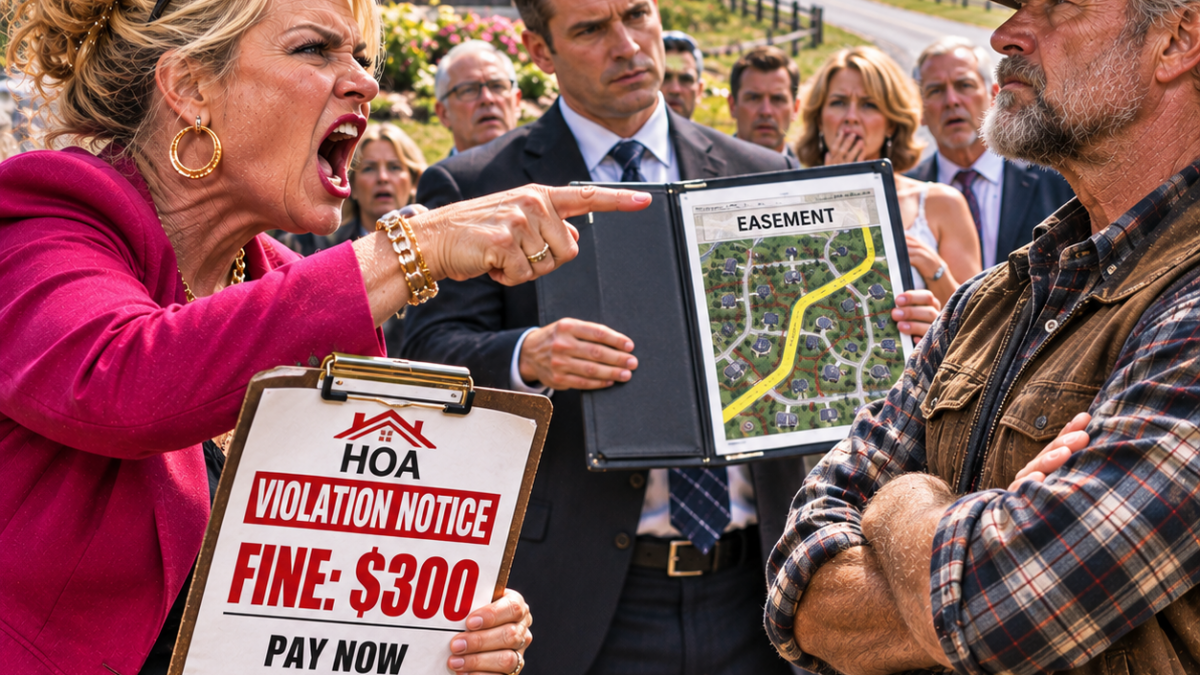
PART2
She recovered quickly.
People like Constance always do.
“You’re threatening forty-seven families because you don’t like a reasonable fine?”
“I haven’t threatened anyone.”
“You just implied you could block our road.”
“I asked whether you’ve read the easement.”
She crossed her arms.
“Mr. Webb, I strongly suggest you stop pretending technical knowledge makes you an attorney.”
“And I strongly suggest you send me the recorded covenants you believe bind my parcel.”
Her mouth tightened.
“You’ll receive whatever documentation is appropriate.”
“Good.”
She left.
Three days later, I found a certified letter wedged behind my screen door.
The original $300 fine had become $525.
Three hundred fine.
One hundred fifty administrative fee.
Seventy-five certified processing charge.
Thirty days to pay.
The letter also warned of collection remedies, including a possible lien if the account remained delinquent.
That paragraph got my attention.
You do not casually threaten a lien against a man who spent a career reading contracts.
The next afternoon Constance returned with a thin man named Curtis Bell, who introduced himself as Willow Brook’s compliance coordinator.
He carried another clipboard.
Apparently they reproduced.
“Marcus,” Constance said, “we’d prefer to resolve this amicably.”
“I’d prefer that too.”
“Then pay the balance.”
“I asked for the documents giving you jurisdiction over my parcel.”
Curtis shuffled papers.
Constance spoke first.
“We have long-standing authority over the entrance corridor.”
“That isn’t the same as my parcel being in your HOA.”
“Your property directly affects the community.”
“That isn’t the same thing either.”
Her smile began to disappear.
I continued.
“I want the declaration.”
“Recorded amendments.”
“Plat.”
“Any annexation document.”
“And the road-access agreement.”
Curtis looked at Constance.
That small glance was the first crack.
Constance said:
“Surely lawyers aren’t necessary.”
“I didn’t mention lawyers.”
She stared.
“I asked for paperwork.”
Saturday morning I went to the county archives.
The place smelled exactly the way municipal records offices always smell.
Dust.
Paper.
Old carpet.
Coffee that had given up on life.
I felt strangely at home.
I started with the subdivision plat.
Willow Brook had been created in 1987.
Forty-seven lots.
Internal roads.
Common areas.
Entrance corridor.
My parcel appeared on the map.
But not inside the subdivision boundary.
It had been designated as a separate future commercial parcel at the time.
The original developer apparently expected a gas station or small business to occupy the corner.
That never happened.
Instead, an old farmer retained ownership.
Decades later, I bought it.
I pulled the declaration.
No legal description including my parcel.
No amendment adding it.
No covenant signature by any prior owner.
No HOA jurisdiction.
Constance’s $525 demand had no recorded basis I could find.
Then I located the access document.
Ingress-Egress Easement Agreement — 1987.
The subdivision’s entrance crossed a fifty-foot strip along the edge of my parcel before connecting to County Road 18.
The easement was permanent.
That part mattered.
I could not simply wake up one morning and landlock forty-seven innocent families because their HOA president annoyed me.
But the agreement had conditions.
Willow Brook was responsible for maintaining the paved portion crossing the burdened parcel.
The association also owed the property owner an annual maintenance contribution beginning at $500, subject to later adjustment procedures.
More interesting:
The association was required to keep the access in good repair, maintain liability coverage connected to its use, and coordinate any substantial alteration with the landowner.
I searched payment records attached to older deeds.
Nothing.
The county did not maintain a complete payment ledger, so I did not leap to conclusions.
But I had found enough to ask questions.
I hired attorney Sarah Klein.
Property law.
Contracts.
HOA disputes.
Sharp enough that I disliked her for the first ten minutes.
Which was probably a good sign.
She read the easement.
Read Constance’s fine.
Read my title documents.
Then said:
“Your property does not appear subject to the Willow Brook declaration.”
“Good.”
“And no, before you ask, you cannot shut the road tomorrow.”
“I wasn’t going to.”
“You were thinking about it.”
“Maybe.”
“Permanent easement.”
“I can read.”
“Good. Saves me time.”
I pointed to the annual maintenance contribution.
“They owe me money.”
“Possibly.”
“How much?”
“We don’t know yet.”
“The document says five hundred a year.”
“And you have thirty-six years of proof no owner received payment?”
I stopped.
“No.”
“Then we investigate before we send threatening letters.”
Sarah was right.
Annoying.
But right.
We contacted the prior owner.
Then his son.
Then the estate attorney.
Some historical payments had been made in earlier decades.
Others apparently had not.
Changes in management companies had created gaps.
After reconciling what could be documented and applying the contractual terms that were actually enforceable, Sarah calculated an outstanding amount of roughly $7,500.
Not the fantasy number I had first generated by multiplying everything at full interest.
Actual supported arrears.
That distinction mattered.
I sent Constance a certified letter.
Not threatening to landlock the subdivision.
Not demanding her resignation.
One page.
My parcel was not HOA property.
The fine was rejected.
The easement remained valid.
The HOA owed approximately $7,500 in documented past-due obligations subject to final reconciliation.
Future maintenance needed to comply with the recorded agreement.
I gave thirty days for response.
Constance called in eighteen minutes.
Her voice had changed.
“What exactly are you trying to do?”
“Resolve a contract.”
“You’re retaliating.”
“You fined me first.”
“This is extortion.”
“Requesting money required by a recorded agreement?”
“Your interpretation.”
“Then send your lawyer’s interpretation.”
Silence.
Then:
“You are going to regret escalating this.”
I should have understood that as a promise.
Within forty-eight hours, Constance filed a complaint with county zoning claiming my access road violated setbacks and drainage requirements.
It did not.
I had stamped plans.
Permits.
Inspections.
She apparently assumed bureaucracy would frighten me.
Bureaucracy had paid my mortgage for twenty-five years.
The county reviewer called.
“Marcus, I’ve got a strange complaint here.”
“What’s the alleged issue?”
“Apparently your driveway is creating a community hazard.”
“Which section?”
“None listed.”
“Then what are we discussing?”
He laughed.
“We’re not.”
Complaint closed.
Constance moved to reputation.
One former municipal client called.
“Some woman from your HOA says you’re unstable and threatening to sue everybody.”
“I don’t have an HOA.”
“That’s what made the call confusing.”
Another client received something similar.
Then a local contractor.
That crossed a new line.
I documented every contact.
Sarah sent a formal letter directing Constance and the HOA not to make false statements regarding my professional business.
No dramatic lawsuit.
Not yet.
Documentation first.
Then the petition appeared.
Seventeen signatures.
REQUEST FOR COMMUNITY COMPLIANCE ACTION AGAINST MARCUS WEBB.
Taped to my door.
The language demanded my property conform to Willow Brook architectural standards despite the recorded boundary.
I recognized two names.
Neither person had ever spoken to me.
One later admitted Constance had described the petition as support for “keeping construction traffic safe.”
He had not realized it targeted me personally.
Again:
Paper mattered.
What people thought they signed mattered.
What they actually signed mattered more.
I hired Pete Dawson, the best old-school surveyor Sarah knew.
Seventy.
Sunburned.
Equipment more expensive than my truck.
He located every boundary monument.
We walked the parcel.
That was when we discovered the dumping.
Behind a stand of mesquite and scrub oak, neat piles of landscaping debris crossed onto my land.
Grass clippings.
Brush.
Broken edging.
Old irrigation pipe.
Fragments of concrete.
Not catastrophic.
But clearly beyond the easement area.
Pete marked several piles ten to fifteen feet inside my parcel.
“How long?”
I asked.
He shrugged.
“Some old.”
“Some fresh.”
Trail cameras answered the rest.
Within a week, cameras recorded Willow Brook maintenance personnel bringing yard waste to the area.
We also captured Curtis, the compliance coordinator, cutting diagonally across my land on foot to reach the rear side of the entrance infrastructure.
Nothing cinematic.
Just unauthorized use beyond the recorded easement.
Sarah smiled when she saw the footage.
“Now we have leverage.”
“Can I invoice him per step?”
“No.”
“You’re no fun.”
“We send notice.”
We did.
Stop dumping.
Stay within the easement corridor.
Remove debris.
Willow Brook’s attorney responded.
For the first time, their tone softened.
The dumping would be investigated.
Maintenance personnel would be instructed.
The road fine, however, remained “under review.”
Constance hated that phrase when other people used it.
Then Elena Rodriguez knocked on my door.
She carried tamales.
I already knew of her.
Single mother.
Two kids.
House near the entrance.
She had been one of the residents fined over bird feeders.
We sat in my kitchen.
She told me three years of stories.
Decorative planters.
Guests.
Holiday lights.
Her mailbox.
Her children’s bikes visible from the street.
Some violations were technically grounded in rules.
Others seemed stretched.
What bothered Elena was the pattern.
Residents who challenged Constance received scrutiny.
Residents who supported her received warnings.
“Why doesn’t anyone vote her out?”
I asked.
“People are tired.”
“Not an answer.”
“It is when you work two jobs.”
Fair.
Then:
“She targets people who don’t have time or money to fight.”
I looked at her.
“Who?”
She hesitated.
“Single parents.”
“Older people.”
“People whose English isn’t perfect.”
“People who rent.”
“Anyone she thinks will panic when a certified letter shows up.”
I hated that answer.
But again, stories were not proof.
I started listening.
Not promising.
Listening.
Then Constance went after Elena.
She appeared at Elena’s house after learning we had spoken.
Asked about permits.
Questioned whether extended family members living there were listed properly.
Then asked a question about documentation status.
Elena called me furious.
“She knows I’m a citizen.”
I went still.
“What exactly did she say?”
Elena repeated it.
I wrote it down.
“Did anyone hear?”
“Mrs. Patterson.”
The eighty-year-old widow next door.
Good witness.
“Do not engage her alone if she comes back.”
“You think I’m afraid of her?”
“No.”
“I think she wants you angry enough to make a mistake.”
Elena went quiet.
“You’ve figured her out.”
Maybe.
Maybe not.
The next morning my mailbox was damaged.
Bent post.
Deep tool marks.
No camera angle.
No proof who did it.
That mattered.
I did not accuse Constance.
I filed a vandalism report.
Installed another camera.
Replaced the mailbox.
Thirty-one inches high.
Because I have a sense of humor.
Constance escalated again.
She began parking an HOA maintenance vehicle partially across the entrance easement during what she called safety inspections.
Residents backed up.
Horns.
Arguments.
She told them the access crisis existed because I was “challenging community rights.”
Clever.
She wanted forty-seven households blaming me.
Sarah warned:
“Do not interfere with their lawful easement.”
“I’m not.”
“Good.”
“And do not create a gate that materially prevents reasonable access without making sure it complies with the easement terms.”
I looked at her.
“So a gate is possible.”
“Marcus.”
“Hypothetically.”
“The agreement allows reasonable access-control measures if they do not unreasonably interfere with ingress and egress, and emergency access must be preserved.”
I smiled.
She pointed at me.
“I hate that face.”
For the next month, we worked legally.
Not emotionally.
An access-control engineer reviewed the easement.
County fire officials reviewed emergency access.
Residents would retain 24/7 entry.
Emergency services would have unrestricted override.
Guests could use call access.
Service vehicles could be accommodated.
The gate would sit entirely on my property inside a location permitted by the recorded agreement.
No landlocking.
No hostage situation.
Just controlled use.
And one crucial provision:
The HOA had contractual obligations that were now formally disputed.
I offered a path to resolution.
Pay the verified $7,500 arrears.
Bring maintenance obligations current.
Provide proof of required liability coverage.
Then execute a modernized access protocol with resident cards and emergency access.
Constance refused.
Not the board.
Constance.
Former treasurer Bill Hendricks came to see me.
Retired accountant.
Briefcase.
Old Spice.
Nervous.
He had resigned from Willow Brook’s board eighteen months earlier.
“Why?”
I asked.
“Constance.”
“Specific.”
He opened the briefcase.
Meeting minutes.
Budget reports.
Bank summaries he had legally retained while treasurer.
Reconciliation worksheets.
“I started asking about reimbursements.”
“What reimbursements?”
“Legal.”
“Consulting.”
“Meals.”
He pointed.
“The numbers stopped matching.”
One group of payments totaled about $4,100.
Description:
Administrative legal consultation.
Bill had asked for supporting invoices.
Constance told him it involved confidential HOA business.
Later he learned the attorney named in the memo represented Constance personally in her divorce.
“That doesn’t prove HOA money paid her divorce lawyer.”
“I know.”
Bill looked almost offended.
“That’s why I kept asking.”
Good man.
He showed me emails.
Constance telling him to “temporarily classify” certain payments until reimbursements could be made.
No evidence reimbursement happened.
Then another set.
A consulting payment to her nephew.
Road-maintenance bills unpaid.
Landscaper balance overdue.
Insurance premium notices.
The HOA was not collapsing.
But finances were worse than residents had been told.
Sarah reviewed everything.
“This needs an independent audit.”
“Can we force one?”
“Members can.”
So I did something Constance never expected.
I stepped back.
This was their HOA.
Not mine.
Elena and Bill organized homeowners.
No secret revolution.
No manipulation.
They followed bylaws.
Collected signatures.
Requested financial records.
Petitioned for a special meeting.
Constance fought every step.
She called them disloyal.
Negative.
Dangerous to property values.
The petition grew.
Twenty-six households.
Then thirty.
More than enough under the governing documents.
Meanwhile, I installed the gate.
Not at night.
Not secretly.
Permitted.
Inspected.
Professional.
Solar backup.
Access logs.
Resident credentials ready to issue through the HOA.
Emergency services pre-authorized.
The sign read:
PRIVATE EASEMENT — CONTROLLED ACCESS
RESIDENT ACCESS WILL NOT BE DENIED
CONTACT HOA FOR CREDENTIALS
The gate activated at 6:47 on a Tuesday morning.
First resident approached at 7:15.
The system recognized the temporary universal resident code I had provided to the HOA.
Gate opened.
No issue.
Second car.
Opened.
Third.
Opened.
At 7:31, the code stopped working.
My system had not changed.
I checked logs.
Credential still active.
Then Elena called.
“Constance told everyone not to use your code.”
“What?”
“She says accepting access means admitting you own the easement.”
“I do own the land burdened by it.”
“I know.”
“She told residents to wait until she distributes official HOA cards.”
“Does she have them?”
“You gave them to the office yesterday.”
“Yes.”
“She’s refusing to distribute them.”
I closed my eyes.
There it was.
The mistake.
By 8:00, cars were backing up—not because the gate prevented access, but because residents had been told by their HOA president not to use the working temporary code while she withheld permanent credentials.
At 8:15, Constance arrived.
She stormed toward me.
“What the hell have you done?”
“Installed the access system your attorney received notice about.”
“You cannot imprison a subdivision.”
“The resident code works.”
“No one has permission to use your illegal system.”
“That sounds like a Constance problem.”
She grabbed the steel bars.
“This is extortion.”
“It’s access control.”
“You’re holding people hostage.”
“Then give them the cards in your office.”
Her face changed.
Several residents heard.
Mrs. Patterson rolled down her window.
“Constance, do you have our cards?”
Constance turned.
“We are conducting a legal review.”
“Do you have them?”
“Yes.”
“Then give me mine.”
“Not until counsel—”
“My grandson drove six hours last weekend.”
Mrs. Patterson’s voice hardened.
“You refused him visitor access because you’re fighting with this man.”
Other residents emerged from cars.
Suddenly Constance was not arguing with me.
She was explaining herself to people who paid her association dues.
That night’s emergency meeting drew nearly ninety people.
Constance called the gate “suburban terrorism.”
Actual phrase.
Someone laughed.
She did not appreciate that.
Elena stood.
“Does the system deny emergency services?”
“No,” I said.
“Does it deny residents who have credentials?”
“No.”
“Did Marcus provide credentials?”
“Yes.”
“Who refused to distribute them?”
Silence.
Everyone looked at Constance.
She said:
“This is bigger than convenience.”
Mrs. Patterson replied:
“No, dear. This is exactly about convenience. Yours.”
The room erupted.
Bill presented the unpaid easement obligations.
Then the overdue maintenance bills.
Then the request for an independent financial audit.
Constance accused him of stealing confidential records.
Bill answered calmly:
“I retained documents I was entitled to retain while serving as treasurer. Independent counsel can decide what is admissible.”
Then Elena spoke.
She described Constance’s questions about her documentation status.
Mrs. Patterson confirmed hearing them.
Constance denied discriminatory intent.
Fine.
Intent could be investigated separately.
What mattered that night was governance.
Homeowners voted to appoint independent counsel to review finances.
Constance lost control of the room.
Not yet her office.
But the room.
Two nights later, at 2:47 a.m., my security alert sounded.
I opened the live camera feed.
A woman in a light robe crouched beside the gate-control pedestal.
Bolt cutters.
Constance.
For a moment I thought I was hallucinating.
Then I watched her put the jaws around protective conduit.
The system had buried primary lines.
The visible conduit carried auxiliary components.
She cut once.
Twice.
A camera captured her face.
Another captured the BMW.
I did not go outside.
I called the sheriff.
Deputy Martinez arrived while she was still there.
Constance tried to explain she was inspecting unsafe infrastructure.
At 2:47 a.m.
With bolt cutters.
Martinez photographed everything.
Asked for identification.
Took statements.
No dramatic handcuffs immediately.
The case was referred for review.
Constance was furious.
By sunrise, residents knew.
By noon, the local newspaper had requested the incident report.
Sarah told me:
“Say nothing publicly beyond facts already documented.”
I obeyed.
Constance did not.
She began telling neighbors I was unstable.
Dangerous.
Anti-government.
Hoarding suspicious materials in my workshop.
The “suspicious materials” were PVC cement, welding gas, hydraulic fluid, concrete additives, and ordinary contractor supplies.
Then police calls started.
Strange lights.
Unusual vehicles.
Possible weapons.
Officer Martinez responded to the third.
He stood inside my workshop looking at a drill press.
“Mr. Webb.”
“Yes?”
“I’m beginning to see a theme.”
“So am I.”
I handed him the incident timeline.
“I’m not asking you to take sides.”
“Good.”
“I’m asking that repeated complaints be documented.”
“They are.”
That was enough.
Then Elena called.
She was crying.
Not angry.
Crying.
“Someone called child protective services.”
I went cold.
“What happened?”
“False neglect report.”
“Kids okay?”
“Yes.”
“Worker came.”
“Inspected.”
“Closed it.”
She inhaled.
“Then the school office told me someone called asking whether my children were legally eligible to attend.”
That did it.
Not because we could prove Constance personally made every call.
We could not.
But the pattern surrounding Elena had become serious enough for counsel.
Elena documented everything through proper channels.
No revenge.
No public accusation without proof.
Then anonymous notes appeared on her windshield.
One questioned whether her family belonged in the neighborhood.
Another called her a traitor.
Someone spray-painted TRAITOR on her mailbox.
We installed cameras.
Neighbors began escorting her children to school.
Not because Elena was helpless.
Because community should mean something.
The special audit proceeded.
That changed everything.
Bill’s suspicions were partly correct.
Partly incomplete.
The HOA had approximately $31,000 in overdue maintenance and vendor obligations.
Insurance had not vanished entirely, but there had been a serious coverage lapse requiring immediate correction.
Legal expenses lacked proper board authorization.
Some payments to Constance’s personal attorney had indeed come from association funds and had not been fully reimbursed.
Payments had also gone to her nephew for consulting work that independent reviewers could not verify.
Several “administrative lunches” were obviously personal.
Not millions.
Not a criminal empire.
Enough.
More importantly:
Records showed Constance repeatedly moved money between restricted reserve accounts and operating accounts without the approvals required by Willow Brook’s own policies.
Independent counsel recommended referral of specific transactions to law enforcement and the association’s insurer.
Residents were furious.
But the public hearing still centered on access.
County Supervisor Tom Bradley scheduled it after receiving competing complaints regarding the easement, road conditions, gate, and zoning allegations.
The conference room filled.
Residents.
Reporters.
County staff.
Sarah.
Bill.
Elena.
Constance sat front row.
I stood at the podium.
My presentation was boring.
Intentionally.
Slide one:
Recorded parcel boundary.
Slide two:
1987 easement.
Slide three:
Current maintenance obligations.
Slide four:
Documented payment history.
Slide five:
Gate-access plan.
Slide six:
Emergency-service approval.
Slide seven:
Photographs of dumping outside the easement.
Slide eight:
Security still showing Constance at the gate at 2:47 a.m.
That slide produced gasps.
I did not joke.
“This image is part of an active property-damage investigation.”
Next:
Copies of zoning approvals for my road.
Then the $300 fine.
Then proof my parcel was outside the HOA declaration.
I looked at the room.
“This started because Willow Brook fined me for improving property the association does not govern.”
Constance stood.
“Because his construction affects our community!”
Bradley said:
“Mrs. Hartwell, you’ll have time.”
She sat.
I continued.
“I do not seek to terminate lawful access.”
That mattered.
“I do not want forty-seven families landlocked.”
“I do not want property values destroyed.”
“I want the recorded agreement followed.”
“Residents retain access.”
“Emergency services retain access.”
“Maintenance obligations need to be met.”
“And my property does not become HOA property merely because the HOA president says so.”
Applause.
Bradley stopped it.
Then Constance spoke.
She called me vindictive.
Obsessed.
Dangerous.
A man using infrastructure knowledge to intimidate families.
Then she made the mistake she always made.
She exaggerated.
“He has threatened to shut down the entire subdivision and destroy every homeowner’s property value.”
Sarah stood.
“Can Mrs. Hartwell identify the document or recording containing that threat?”
Constance froze.
I had never made it.
I had discussed leverage privately with Elena.
Sarah.
Never publicly threatened innocent homeowners.
Bradley asked:
“Do you have such a communication?”
Constance changed direction.
“He is manipulating technical loopholes.”
There was that phrase again.
Technical loopholes.
Recorded boundaries.
Contractual obligations.
Permits.
Emergency access.
Apparently all loopholes when inconvenient.
Then Elena stood.
Her voice was quiet.
That made everyone listen.
“I supported Mr. Webb because I believed residents deserved financial transparency.”
She looked directly at Constance.
“After that, you came to my house and questioned whether my family belonged here.”
Constance shook her head.
“That is not what happened.”
Mrs. Patterson stood.
“I heard you.”
Silence.
Elena continued.
“Then someone made a false child-neglect report.”
“I’m not accusing you without evidence.”
“But I am saying this community became a place where disagreement made families afraid.”
That was stronger than accusation.
Because everybody knew it was true.
Then Bill carried a banker’s box to the front.
No theatrics.
No claim he personally proved crimes.
He said:
“I served as treasurer.”
“I raised questions about these accounts.”
“I resigned when I could not obtain satisfactory answers.”
“The independent audit has now confirmed several of those concerns.”
He listed transactions.
$1,200 to Constance’s personal attorney.
Another $2,900 in related payments.
$2,400 to her nephew’s consulting entity.
Restaurant reimbursements.
Unapproved reserve transfers.
Outstanding vendors.
The room grew quieter with every number.
Constance finally shouted:
“You’re twisting everything!”
Bill looked at her.
“I asked you eighteen months ago to explain these.”
“You threatened me.”
“You said you would sue.”
“I stopped asking.”
“That part is on me.”
Then he looked at the residents.
“But staying quiet was a mistake.”
The sheriff’s representative did not arrest Constance at the meeting.
That would have been dramatic nonsense.
Instead, he confirmed specific financial records and the gate incident were under review.
Independent HOA counsel confirmed the board would need to consider immediate governance action.
By the end of the night, enough directors had changed position that an emergency internal vote suspended Constance’s spending and administrative authority pending the member recall process.
She remained furious.
But for the first time, she did not control the paperwork.
Twenty-four hours later, she submitted a resignation.
Three sentences.
No apology.
She blamed “hostile conditions.”
Elena was not magically installed as permanent president.
The vice president became temporary presiding officer under the bylaws.
Members scheduled a supervised election.
Elena ran.
So did four other residents.
She won.
Narrowly.
Not unanimously.
Real democracy is messier than fiction.
Her first actions were simple.
Distribute resident gate credentials.
Bring insurance current.
Pay documented easement arrears.
Commission full road inspection.
Publish monthly financial summaries.
Residents received access cards that afternoon.
The gate became almost invisible.
Drive up.
Scan.
Open.
Drive through.
No drama.
Exactly how infrastructure should work.
The old road-maintenance problem also turned out to be real.
Potholes.
Drainage failures.
Faded signs.
Years of deferred maintenance.
I helped review the engineering report at no cost.
But I did not threaten zoning revocation or claim I could destroy forty-seven homes with a signature.
That power had never been as absolute as rumor suggested.
Instead, county officials issued repair requirements through normal channels.
Willow Brook adopted a phased maintenance plan.
A special assessment required resident approval.
Residents approved it after seeing the numbers.
Imagine that.
People will often pay when nobody lies to them.
The criminal investigation into Constance took months.
Some accusations never became charges.
No bribery charge based on a fruit basket.
No RICO.
No absurd federal conspiracy.
The evidence that survived scrutiny was simpler.
Association money had been used for personal legal expenses.
Records had been altered to obscure some reimbursements.
Payments had been made to a relative without adequate services.
The gate damage was documented.
Investigators also reviewed the false-report pattern involving residents, though attribution was harder.
Constance ultimately reached a plea agreement on several financial and property-related counts.
Restitution.
Probationary conditions.
A period of incarceration on the most serious offense.
No Hollywood sentence.
Enough to make the point.
She also became personally responsible for amounts the HOA’s insurer and civil counsel established were improperly spent.
Willow Brook recovered part through restitution and insurance.
Not every dollar.
That is reality too.
Money disappears more easily than trust returns.
The first time I saw Constance after her resignation was in court.
She looked smaller.
Not physically.
Socially.
No clipboard.
No line of nervous homeowners waiting outside her office.
No board members nodding.
Just a woman beside her attorney.
For months I had imagined what I would feel.
Triumph.
Vindication.
Maybe hatred.
Instead, I felt tired.
Sarah whispered:
“Disappointed?”
“No.”
“What?”
“I thought this would feel bigger.”
She nodded.
“Accountability usually feels less cinematic than revenge.”
Annoyingly wise.
Afterward Elena met me outside.
Her kids were with her.
Maya, the older one, had started documenting the entire HOA reform process for a high-school journalism project.
Not a viral national crusade.
A student project.
She interviewed residents.
Explained budgets.
Election rules.
Why records mattered.
Her teacher entered it in a statewide civic-media competition.
She won.
At the next Willow Brook meeting, Maya stood beside the screen wearing the kind of nervous smile teenagers use when adults start clapping too long.
Elena cried.
I almost did.
Then Maya said:
“I think communities get dangerous when people stop asking boring questions.”
That sentence was better than anything I had said at the county hearing.
She was right.
Who approved this?
Where is the invoice?
What does the deed say?
Who voted?
Why does this rule apply?
Where did the money go?
Boring questions had ended Constance’s power.
Not shouting.
Not sabotage.
Not me holding a neighborhood hostage.
Questions.
The easement arrears were paid.
$7,500.
I deposited the check.
Then did something unexpected.
I used half to upgrade the access-control system.
Better emergency override.
Better lighting.
Updated camera coverage.
The other half went into a scholarship fund Elena and Bill proposed.
Not recovered embezzlement money.
Mine.
Then residents contributed.
The association matched what it could once finances stabilized.
The Willow Brook Civic Accountability Scholarship began modestly.
$2,500 the first year.
Maya was not eligible while Elena served on the board.
Important.
No nepotism.
Maya complained.
Elena said:
“That’s literally the lesson.”
The first recipient was a senior who planned to study public administration.
The second year, the fund grew.
Maya later earned a journalism scholarship elsewhere.
She sent me a photograph from college.
Under it:
Still asking boring questions.
I printed it.
Put it in the workshop.
The transformation of Willow Brook did not happen overnight.
Some people hated Elena.
They said she published too much.
Others thought she was too cautious.
A faction wanted every fine issued under Constance refunded automatically.
Independent counsel reviewed them instead.
Some fines were canceled.
Others had been valid.
That angered people.
Good governance disappointed extremists on both sides.
Bill returned as treasurer for one limited term.
Monthly financial reports went online.
Vendor contracts above a threshold required competitive bids.
Related-party transactions required disclosure and recusal.
Reserve transfers required recorded board authorization.
Election proxies were independently verified.
Term limits were adopted.
Meeting minutes became boring enough that most residents stopped reading them.
Success.
The gate remained.
At first people called it Marcus’s Gate.
I hated that.
Then package theft dropped near the entrance.
Unauthorized dumping stopped.
The association’s insurer approved the controlled access.
Residents started appreciating it.
Eventually it became simply:
The gate.
Exactly what infrastructure should become.
Invisible when functioning.
I started consulting again.
Not full-time.
A little municipal work.
Some private drainage.
One HOA asked me to review an access dispute after hearing what happened at Willow Brook.
Then another.
I refused cases that sounded like revenge fantasies.
If somebody called saying:
“I want to destroy my HOA,”
I answered:
“Call someone else.”
If they said:
“I need to know what the recorded documents actually allow,”
I listened.
There was demand for that.
Turns out half of neighborhood warfare begins because two people are arguing about a document neither has bothered to read.
My own property settled into peace.
The three-hundred-foot road I had built became exactly what I intended.
A driveway.
Nothing dramatic.
Rain drained properly.
No mud.
No HOA fines.
The mailbox remained thirty-one inches high because lowering it two inches felt petty.
Elena teased me.
“You surrendered.”
“I complied voluntarily.”
“You’re becoming institutionalized.”
“Leave my property.”
She brought tamales anyway.
Years passed.
My divorce stopped feeling like the event defining everything.
Danielle remarried.
I attended our daughter’s wedding with her and her new husband.
It was awkward for twenty minutes.
Then normal.
Afterward Danielle asked:
“Are you happy?”
I thought about Willow Brook.
My workshop.
The road.
The friends I had not expected.
“Yes.”
She smiled.
“Good.”
That word closed something.
Not healed.
Closed.
I had once believed buying the Willow Brook parcel was leverage.
At fifty-two, freshly divorced, leverage felt safer than belonging.
Control the road.
Control the land.
Control the workshop.
Control something.
Constance recognized that instinct because she lived inside it.
That was the uncomfortable truth.
We were not the same.
But we both liked systems we could control.
The difference was what happened when people said no.
I learned to negotiate.
She escalated.
That distinction shaped everything.
One spring afternoon, I found Elena standing near the gate studying the old access corridor.
“What?”
She pointed toward a vacant strip beside the entrance.
“We need a community garden.”
“You already have yards.”
“Some people have gravel.”
“This is Arizona.”
“Exactly.”
“You’ll kill tomatoes.”
“You sound challenged.”
I stared at her.
“You’re using my engineering ego against me.”
“Yes.”
Six months later, we had raised beds.
Drip irrigation.
Shade cloth.
Native pollinator plants.
The old HOA office storage room became a tool room.
Kids painted signs.
Maya painted one:
BORING QUESTIONS GROW GOOD THINGS.
I hated it.
Everyone else loved it.
The annual access day started accidentally.
One year after the gate dispute, Elena organized a safety drill with emergency services to test access credentials and evacuation procedures.
Then somebody brought food.
Then a bounce house.
Then music.
By year three, it was a neighborhood tradition.
No celebration of defeating Constance.
No effigy.
No revenge.
Just people using a system that had once divided them.
Mrs. Patterson sat near the gate every year wearing a sun hat and complaining about music volume.
She lived to ninety-one.
At her funeral, her grandson told me:
“She always said the gate was the best thing to happen to Willow Brook.”
“That seems dramatic.”
“She was ninety.”
“Drama was free.”
He laughed.
Then:
“She said before all this, everyone lived beside each other.”
“After, they became neighbors.”
That sounded sentimental.
Also true.
Bill died two years later.
Heart attack.
His daughter gave Elena the banker’s box.
The original documents had long since been properly archived, but Bill kept his personal copies.
On top was a yellow note:
People don’t steal accountability all at once. We give it away one unanswered question at a time.
We placed the note in the HOA office.
Not framed like scripture.
Pinned beside the budget calendar.
Right where treasurers could see it.
Constance eventually completed her sentence and moved away.
I heard she lived with a sister in another state.
I did not verify.
Once, a reporter asked whether I wanted to know how she was doing.
“No.”
“Why?”
“Because accountability does not require surveillance forever.”
That answer surprised me.
Five years earlier, I would have wanted updates.
Every setback.
Every humiliation.
Every consequence.
Anger makes somebody else’s pain feel like proof you were right.
Eventually you discover peace is more useful proof.
The $300 citation still exists.
I kept it in my files.
Not framed.
Not displayed.
Once a year, when cleaning the office, I find it.
UNAUTHORIZED ROAD CONSTRUCTION.
Three hundred dollars.
Then administrative fees.
Then threats about liens.
I laugh now.
That little letter started everything.
But not because it gave me some magical power to destroy forty-seven homes.
The real discovery was better.
My parcel had rights.
Their easement had rights.
Both could exist simultaneously.
That is what Constance never understood.
She believed somebody had to dominate.
Either the HOA controlled me or I controlled the HOA.
But property law is usually less emotional.
My land.
Their access.
My right to reasonable control.
Their right to pass.
Their maintenance duties.
My obligation not to interfere unlawfully.
A relationship defined by recorded terms.
Boundaries.
Not victory.
One afternoon, a new resident named Kevin approached me at the garden.
“You Marcus Webb?”
“Unfortunately.”
“I heard you shut down the neighborhood once.”
“No.”
“You built the gate.”
“Yes.”
“You threatened to revoke access.”
“No.”
He looked disappointed.
“That’s not how people tell it.”
“People tell better stories than lawyers write.”
“So what happened?”
I pointed toward the road.
“That land is mine.”
“The right to travel across part of it belongs to the subdivision.”
“Constance tried to pretend those two facts couldn’t coexist.”
Kevin waited.
“That’s it?”
“Pretty much.”
“That’s less exciting.”
“Reality frequently disappoints.”
He laughed.
Then asked:
“Why didn’t you just pay the three hundred?”
I considered.
Because I was stubborn?
Yes.
Because she had no authority?
Yes.
Because after divorce I was tired of feeling like life kept happening to me?
Probably.
Finally:
“Because the first demand was unsupported.”
“Then the second got worse.”
“And if I paid it, she would have learned that official-looking paper mattered more than actual authority.”
Kevin nodded.
“That’s fair.”
Then:
“Still would’ve been cheaper.”
Also fair.
The road I built lasted exactly as engineered.
Ten years later, resurfacing contractor said:
“Who designed the base?”
“Me.”
“Overbuilt.”
“Thank you.”
“That wasn’t a compliment.”
“It is to an engineer.”
The gate required new motors after eight years.
I replaced them.
Insurance continued approving it.
Emergency services used the override twice.
Once for a medical call.
Once during a brush fire.
Both times it opened immediately.
The fire chief later said:
“Good system.”
That meant more to me than any applause at a hearing.
Infrastructure should work on the worst day.
That is its entire purpose.
My relationship with Elena changed too.
Not romantic.
People assumed.
They were wrong.
Elena eventually married a teacher named David.
Good man.
I gave a toast.
Maya whispered:
“Don’t make it about HOA bylaws.”
“I had seventeen minutes prepared.”
She stole my notes.
At the reception, Elena hugged me.
“You know what I hated most about Constance?”
“Everything?”
“She made me feel alone.”
I nodded.
“That’s how people like her keep power.”
“What?”
“Everyone thinks they’re the only one being targeted.”
She looked toward her kids dancing.
“Not anymore.”
That might have been the real victory.
Not my parcel.
Not $7,500.
Not the gate.
Not Constance’s conviction.
People stopped whispering individually and started comparing facts.
Bullies hate comparison.
Because one person saying:
“She treated me unfairly,”
can be dismissed.
Twenty people laying dated notices side by side becomes a pattern.
Systems.
Patterns.
That I understood.
At sixty-three, I sold most of my consulting business.
Kept only a handful of projects.
The farmhouse looked nothing like the wreck I bought after my divorce.
New roof.
Restored porch.
Workshop expanded.
Trees grown taller.
The community garden visible beyond the entrance.
One morning I sat outside drinking coffee.
The gate opened.
Closed.
Opened.
Closed.
Cars moving normally.
No one thought about me.
Perfect.
Danielle once visited while passing through town.
She stood on the porch.
“You built all this?”
“Most.”
She looked toward the gate.
“So that’s the famous road?”
“Unfortunately.”
She laughed.
“You always needed a project.”
“I know.”
“That was part of our problem.”
“I know.”
Silence.
Then she said:
“You look peaceful.”
I thought about denying it.
Instead:
“I am.”
“Good.”
She squeezed my arm.
Left.
No regret.
No fantasy about getting back together.
Just two people who had once loved each other and finally learned that endings do not have to become wars.
That realization made me think of Constance.
Her story could have ended differently at almost any moment.
When I requested documents.
She could have checked.
When I found the easement fees.
She could have paid.
When the gate plan appeared.
She could have distributed cards.
When Bill asked financial questions.
She could have opened the books.
When residents petitioned.
She could have stepped down.
When police investigated the sabotage.
She could have stopped retaliating.
Every escalation was a decision.
That is why I stopped describing what happened as something I did to her.
I did not destroy Constance Hartwell.
I stopped absorbing the consequences she kept trying to place on other people.
Eventually those consequences stayed with their owner.
That is justice in its cleanest form.
Not vengeance.
Return to sender.
The final time I saw her happened unexpectedly.
Twelve years after the $300 fine.
Grocery store.
Different town.
I was buying coffee.
She turned into the aisle.
Older.
Gray beneath blonde.
For a second, both of us froze.
I expected anger.
She looked tired.
“Marcus.”
“Constance.”
Silence.
Then she said:
“I heard Willow Brook is doing well.”
“It is.”
“Elena still president?”
“No.”
“Term limits.”
Something almost like a smile.
“Of course.”
She looked at the coffee in my cart.
Then:
“I was wrong about your property.”
I did not rescue her from the discomfort.
“Yes.”
Her eyes flickered.
“I thought you’d say more.”
“What would help?”
“I don’t know.”
Neither did I.
Finally she said:
“I kept thinking if I admitted one thing, everyone would question everything.”
“That’s what happened anyway.”
“I know.”
She looked down.
“I should have given people the cards.”
Such a strange thing to choose.
Not the money.
Not Elena.
Not the gate sabotage.
The access cards.
Maybe that was the moment she understood best.
“Yes.”
I said.
“You should have.”
She nodded.
“Take care, Marcus.”
“You too.”
Then we walked opposite directions.
No forgiveness speech.
No tears.
No dramatic reconciliation.
I never saw her again.
It was enough.
When I returned home that afternoon, the gate opened automatically.
I drove through.
The road curved toward my farmhouse.
Sunset over the mountains.
Community garden to the left.
Willow Brook beyond the wall.
For the first time, I thought about the question Constance had asked years earlier without realizing she was asking it.
Who controls this?
At fifty-two, newly divorced, I would have answered:
Me.
My land.
My gate.
My decision.
At sixty-four, I knew better.
Good systems are not built around one person’s control.
They are built around clear rights.
Clear responsibilities.
Transparent rules.
Checks.
Records.
Appeals.
And enough humility to admit when somebody else owns part of the answer.
My property carried their easement.
Their easement crossed my property.
Neither erased the other.
That was the lesson.
Constance could not fine me into HOA membership.
I could not erase forty-seven families’ lawful access because I was angry.
We all had boundaries.
Everyone did better once the paper stopped being treated as a weapon and started being treated as a map.
The original $300 fine sits in my file cabinet today.
Above it, I wrote one sentence:
READ THE DOCUMENTS BEFORE YOU FEAR THE LETTERHEAD.
That is what I tell every homeowner who calls me now.
Not:
Destroy your HOA.
Not:
Sue everybody.
Not:
Build a gate.
I tell them:
Get your deed.
Get the declaration.
Get the plat.
Get the easement.
Get the meeting minutes.
Get the invoices you are legally entitled to see.
Write down dates.
Save notices.
Ask calm questions.
And if the answer is legitimate, follow it.
If it is not, challenge it properly.
Because Constance Hartwell’s greatest weapon was never her clipboard.
It was the assumption that nobody would look behind it.
The moment we did, her power changed.
The $300 fine disappeared.
The unauthorized lien threat disappeared.
The hidden financial problems surfaced.
The residents found their votes.
Elena found her voice.
Bill found the courage to open his banker’s box.
The gate became infrastructure instead of a weapon.
Willow Brook became a community instead of one woman’s court.
And I finally understood something my divorce had been trying to teach me long before Constance arrived.
Control is not stability.
Fear is not respect.
Silence is not peace.
Sometimes the strongest thing a person can do is not dominate the system.
It is insist that the system apply to everyone.
Including the person holding the clipboard.
Especially her.
So if you ever drive through Willow Brook today, you will probably notice the gate.
Steel posts.
Card reader.
Camera.
Nothing dramatic.
It opens.
You drive through.
It closes.
Most residents barely look at it anymore.
That is exactly how I like it.
Because the best ending was never Constance standing outside a locked gate while I laughed.
The best ending was a day when nobody needed to think about her at all.
The road worked.
The neighborhood worked.
The books balanced.
The children played.
People argued about normal things.
And somewhere in my file cabinet, underneath twelve years of dust, there remained a three-hundred-dollar HOA citation issued against property the HOA had never controlled.
One piece of paper.
One bad assumption.
One woman convinced nobody would challenge her.
She thought that fine was the beginning of my surrender.
Instead, it became the first question.
And once people started asking questions, Willow Brook was never hers again.








