PART2:“PAY THE $2,400 OR GET OUT BY CHRISTMAS!” HOA Karen Tried to Foreclose on My Home—She Never Checked the 15th Property
PART2
Three weeks earlier, none of this had been inevitable.
That is what bothers me most when I think back on it.
Beverly could have stopped at any point.
After the first notice.
After the second.
After my email.
After the meeting.
After the attorney letter.
She had dozens of opportunities to step back.
Instead, every time she met silence, she assumed it meant weakness.
The first notice had been ridiculous.
My trash cans were allegedly eleven inches too far forward.
I moved them.
The second said my porch light was no longer approved.
The same fixture had been approved six years earlier, but I replaced it anyway.
The third accused my truck of remaining in the driveway more than seventy-two hours.
It had snowed all week.
I worked from home.
Still, I drove it around the block and sent a polite email.
The fourth targeted a small wooden Christmas sign beside my walkway.
It said one word:
PEACE.
Beverly said it exceeded the approved holiday-decoration dimensions by four inches.
So I took a handsaw outside and shortened it.
Every time, I complied.
Not because I believed she was right.
Because none of those things was worth a war.
Beverly read my brief confirmation emails and apparently concluded I was exactly what she liked in a homeowner.
Easy.
Then came the assessment.
That was different.
Not because $2,400 would hurt me financially.
It wouldn’t.
But if the board could invent a charge outside the governing documents and enforce it simply because most people were too tired or intimidated to object, then the bylaws meant nothing.
So I asked for documentation.
That was the moment I stopped being convenient.
Within days, neighbors began treating me differently.
One woman who had waved to me every morning for years crossed the street when she saw me heading toward the mailbox cluster.
A man from Aspen Ridge nodded at everyone except me.
Nobody accused me directly.
That was Beverly’s talent.
She never needed to say:
“Gideon is a bad man.”
She only needed to say:
“It’s unfortunate when one person refuses to support the community.”
Then people did the rest.
Walter Hollis noticed.
Walter lived next door.
Seventy-eight.
Retired machinist.
Widower.
He had been in Willow Creek since before half the houses existed.
One evening I was salting my front steps when he leaned over the fence.
“Son.”
I kept scattering salt.
“Yes?”
“Free advice.”
“Dangerous already.”
He ignored that.
“Beverly doesn’t like being told no.”
“I’ve noticed.”
“I’ve watched her run three families out.”
That got my attention.
I stopped.
“Run out how?”
“Fines. Violations. Lawyer letters.”
“Legitimate?”
Walter shrugged.
“Depends who you ask.”
He studied me.
“You planning to fight her?”
“I’m planning to ask for the rules.”
“That’s fighting her.”
I almost smiled.
“I appreciate the warning.”
Walter looked at me for another moment.
Then laughed quietly.
“You’re not worried.”
“I didn’t say that.”
“You don’t look worried.”
“Worry and panic aren’t the same thing.”
He nodded as if filing that answer away.
Later that night, I sat at the desk in my spare bedroom and opened a spreadsheet.
At the top:
PROPERTY PORTFOLIO — 15 ACTIVE PROPERTIES.
Addresses ran down the left side.
Larkspur Lane.
Cedar Hollow Drive.
Juniper Way.
Brier Court.
Aspen Ridge.
Fourteen others besides the house I lived in.
I had bought them over nine years.
Not as some grand plan to control Willow Creek.
Mostly one at a time.
Often because somebody needed out.
A machinist laid off at fifty-eight.
A nurse drowning in bills after her husband’s accident.
A widower trying to survive on one pension.
A couple facing foreclosure after a failed business.
I bought fairly.
Sometimes above market.
In several cases, former owners stayed as tenants at rents they could actually afford.
I had made my money first as an electrician, then as a contractor, then by building a renovation business across three states.
Property came later.
I never advertised it.
I did not need my neighbors to know.
What mattered to me was that roofs did not leak, furnaces worked, leases were fair, and nobody was surprised by what they owed.
One company held most of the properties.
Northgate Residential Holdings.
The fifteenth house was different.
Different trust.
Different manager.
Different paperwork.
I had done that intentionally.
The person living there had asked for privacy.
I had respected it.
At the time, I had no reason to imagine that privacy would one day collide with my own front porch.
The HOA called a special meeting the following Thursday.
The clubhouse was packed.
Forty residents.
Snow on boots.
Coffee urn hissing.
Sugar cookies shaped like stars.
Beverly sat at the center table like a judge.
Beside her was Marjorie Voss, the association secretary.
Thin woman in her sixties.
Reading glasses on a chain.
Laptop open.
She had served under Beverly for four years and, according to Walter, had never once publicly disagreed with her.
The other board members were Glenn Whitaker, Denise Albright, and Raymond Pike.
Glenn generally supported whoever sounded most confident.
Denise spent meetings looking at her phone.
Raymond was different.
Retired accountant.
Gray mustache.
Rarely spoke.
But he listened.
Beverly began with a slideshow.
First image:
My address.
Second:
My trash cans.
Third:
My porch light.
Fourth:
My truck.
Fifth:
My wooden PEACE sign.
Each “violation” had already been corrected.
She did not mention that.
“This homeowner has demonstrated a pattern of resistance to community standards.”
Murmurs.
“He is uncooperative.”
Another slide.
“He disregards our rules.”
Another.
“And now he refuses to meet his financial obligation to the rest of us.”
I sat in the back row.
Did not move.
Beverly spoke for almost twenty minutes.
By the end, I sounded less like a homeowner and more like a hostile occupying force.
Finally she set down the remote.
“Mr. Mercer. Since you decided to attend, perhaps you’d like to explain yourself.”
Every head turned.
I stood.
“Just one question.”
She smiled.
“Of course.”
“Who approved the assessment?”
“The board.”
“Where are the minutes?”
Silence.
Her smile stayed.
“And where is the membership vote required for special assessments over five hundred dollars?”
A few residents turned toward each other.
Beverly’s voice cooled.
“There is no need to turn this into a legal matter.”
“You threatened enforcement.”
“You refuse to contribute.”
“I asked for the vote.”
She leaned forward.
“If you don’t like how this association operates, you are free to sell your house and leave.”
Several people in front nodded.
I waited.
Then:
“I’m not selling.”
Her smile hardened.
“Then you will face the consequences.”
I looked at her.
“I think you will too.”
Beverly ended the meeting immediately.
No homeowner questions.
No discussion.
Just adjourned.
Outside, people gathered in small groups.
Some stared at me.
Walter gave me one slow nod.
Raymond Pike left last.
He looked thoughtful.
That mattered later.
When I got home, one email waited.
No subject.
One sentence.
They have now crossed the line. We can proceed.
It came from Dorian Vale.
My attorney.
Three days later, the certified violation notice arrived.
Everything Beverly had shown in the slideshow was listed again, including violations already corrected.
The original $2,400 assessment was included.
Additional penalties brought the total to $3,100.
A week later came a demand letter from the HOA’s collection attorney.
Ten days to pay.
Then:
NOTICE OF INTENT TO RECORD LIEN.
Beverly believed escalation would scare me.
Instead, it gave Dorian more paper.
She also started calling residents.
Juniper Way.
Cedar Hollow.
Aspen Ridge.
Always confidential.
Always concerned.
Apparently I might be in financial trouble.
Might be hiding something.
Might become “a real danger to community stability.”
By mid-December, every corner of Willow Creek had heard some version.
I remained quiet.
At home, I built a binder.
Every email I sent.
Every unanswered request.
Every notice.
Postmarks.
Bylaws.
Declaration amendments.
Assessment flyer.
Slide photographs.
Dates.
Penalties.
Walter wrote down what Beverly had said at the cookie exchange.
I added that.
When the binder was thick enough that the rings strained, I drove downtown.
Dorian Vale’s office occupied the ninth floor of an old commercial building overlooking the frozen river.
Dark wood.
No clutter.
Dorian was in his late fifties.
Silver hair.
Perfect suits.
Thirty years in real estate law.
He had represented me for more than a decade.
He knew my portfolio.
My trusts.
My history.
He also knew I hated unnecessary fights.
He read the binder silently.
Ten minutes.
Then removed his glasses.
“They have absolutely no idea who they’re dealing with.”
“I’m not interested in revenge.”
“Good.”
“I want them to follow the governing documents.”
Dorian gave me a thin smile.
“That is their problem.”
He tapped the binder.
“The assessment was not properly approved.”
Page.
“The notice period appears defective.”
Page.
“The penalties are layered onto a charge that may never have legally existed.”
Another page.
“And Beverly has been making statements about you that are getting very close to actionable defamation.”
“I don’t care about that.”
“You should care enough to document it.”
“I did.”
“I know. That’s why I like you.”
He leaned back.
“There’s something else.”
“What?”
“She’s rushing.”
I waited.
“People confident in their legal position do not usually create artificial Christmas deadlines.”
He handed me a forwarded email.
Beverly had urged the board to complete enforcement against me before the holiday so the matter could be “closed by the new year.”
Dorian tapped the sentence.
“She wants this done before somebody can inspect the process.”
That was the first time I wondered whether the assessment was more than arrogance.
Across town, that same evening, Beverly held an unannounced closed-door session at her house on Brier Court.
I did not know that yet.
Marjorie attended.
Glenn attended.
Denise and Raymond were not invited.
The meeting was never properly posted.
According to information we later obtained, Beverly laid out the timeline:
Record the lien before the twentieth.
Deliver final notice on the twenty-second.
Authorize foreclosure action Christmas Eve.
Glenn reportedly asked:
“On Christmas Eve?”
Beverly answered:
“That’s when people remember who is in charge.”
When I later read those words, something old moved in my chest.
Because I remembered another Christmas.
Another notice.
Another man trying to keep his family from seeing how afraid he was.
My father.
But Beverly knew none of that.
She thought I was simply stubborn.
She had no idea she was forcing me toward a promise I had made at fifteen years old.
Two days later I met Dorian again.
A large map of Willow Creek covered his desk.
All 112 lots.
Dorian uncapped a red marker.
He circled my house.
“One.”
Cedar Hollow.
“Two.”
Juniper Way.
“Three.”
Aspen Ridge.
“Four.”
Duplex near the clubhouse.
“Five.”
Another.
“Six.”
Corner property.
Seven.
Eight.
Nine.
Ten.
Eleven.
Twelve.
Thirteen.
Fourteen.
Then he paused over Brier Court.
One house.
Large.
Stone fireplace.
Curved drive.
Pond view.
“Fifteen.”
He drew the circle.
The map looked different with those marks.
Not because I suddenly owned power.
Because Beverly’s assumption that I was one isolated homeowner was factually wrong.
Dorian tapped the fifteenth circle.
“You still want this one kept separate?”
“Yes.”
“Even now?”
“Yes.”
He watched me.
“Why?”
“She asked for confidentiality.”
“Six years ago.”
“I gave my word.”
He nodded.
Then placed a folder on the map.
“If they continue, you have enough voting interest to demand a special meeting and full financial inspection.”
He opened Article 7.
Every lot had one vote.
Any member or group holding at least ten percent of voting interests could demand a special meeting and inspect association financial records.
Fourteen publicly traceable properties alone gave Northgate more than ten percent.
Dorian pointed.
“You do not need the fifteenth.”
“Good.”
He watched me.
“You understand what this means?”
“Yes.”
“You can force the books open.”
“I know.”
“The question is whether you want to.”
I looked at the circles.
“No.”
Dorian leaned back.
“Then the question becomes how many choices Beverly leaves you.”
The first crack in Beverly’s confidence came from a tenant named Kelsey Dunar.
She rented one of my Cedar Hollow houses.
At the holiday cookie exchange, Kelsey told Marjorie:
“I don’t understand why everyone thinks Mr. Mercer doesn’t care about the neighborhood. He’s my landlord. He came out at midnight last winter during a snowstorm to fix my furnace himself. Wouldn’t even let me pay for the part.”
Marjorie carried that comment to Beverly.
Beverly laughed.
“His landlord? That man drives a truck older than half the teenagers here. She must mean he works for the management company.”
But the comment stayed with her.
The next morning, Beverly told Marjorie to check county records.
“Just to be thorough.”
Marjorie spent hours on the assessor’s website.
Then called Beverly twice.
“Fourteen.”
“What?”
“Fourteen properties inside Willow Creek are owned by Northgate Residential Holdings.”
Silence.
“The registered manager is Gideon Mercer.”
More silence.
“Beverly, he owns more houses here than anyone.”
Fear should have slowed her.
Instead, it enraged her.
The following evening she called another emergency meeting.
Subject line:
PROTECTING WILLOW CREEK FROM OUTSIDE CONTROL.
The clubhouse overflowed.
Beverly did not wait for people to settle.
“I have learned that Gideon Mercer has been secretly buying homes in this neighborhood.”
Gasps.
“He is attempting to use money to control Willow Creek.”
I stood just inside the door.
Snow melting from my shoulders.
Beverly pointed toward me.
“He wants to overturn our rules and run this community for his own benefit.”
I walked to the front.
Placed a single typed page on the table.
Fourteen addresses.
Raymond leaned forward.
Counted.
“Fourteen.”
“Yes.”
Beverly looked confused.
“You admit it?”
“There’s a fifteenth.”
The room went silent.
Beverly stared.
“It isn’t on that page.”
“Why not?”
“Because it does not need to be.”
I turned toward the residents.
“I have owned these properties for years.”
Nobody spoke.
“Most of you never knew because it never mattered.”
A woman in the second row frowned.
“I don’t use them to control this neighborhood.”
I pointed toward the bylaws in Beverly’s binder.
“All I am asking is that the association follow the same rules it requires everyone else to follow.”
Denise Albright put her phone face down.
“Beverly.”
Beverly ignored her.
Denise tried again.
“Was the assessment actually voted on by the membership?”
A woman stood.
“I paid twenty-four hundred dollars.”
Another voice:
“My sister paid eight hundred.”
Then another:
“Why were we charged different amounts?”
Beverly grabbed the table edge.
“You cannot threaten this board with all your properties.”
“I haven’t threatened anyone.”
I tapped the address sheet.
“I’m telling you what lawful voting interests exist.”
Then Raymond Pike opened a worn binder.
He had been turning pages quietly.
“Beverly.”
She looked at him.
He held up the October minutes.
“These minutes say six owners attended and unanimously approved the assessment.”
“Yes.”
Raymond’s eyes did not leave her.
“I was there.”
Beverly said nothing.
“There were three people.”
Silence.
“You.”
He pointed.
“Me.”
Then Marjorie.
“And Marjorie.”
The room went still.
“Nobody voted.”
Marjorie stared at her laptop.
Raymond continued.
“You said you would put the assessment to the membership in November.”
Beverly’s face changed.
“You’re remembering incorrectly.”
“No.”
“These were draft minutes.”
“They were approved minutes.”
“This is not the time—”
“When is the time?”
Beverly slammed the gavel.
“Meeting adjourned.”
She walked out without gloves.
The next morning, Dorian filed a formal records demand under Article 7 on behalf of Northgate’s fourteen recorded lots.
Ten business days.
All bank statements.
Invoices.
Ballots.
Minutes.
Assessment records.
Contracts.
Beverly ignored the demand for three days.
Then Raymond and Denise pressured the management company.
The files went directly to Dorian.
He spent most of one night reading.
The next morning, he called.
“Come in.”
I knew from his voice.
At his office, documents covered the desk.
He spoke without drama.
“No proper notice.”
He moved one page.
“No membership vote.”
Another.
“The minutes record a vote that did not occur.”
Another.
“Charges are inconsistent.”
He showed me billing statements.
Residents Beverly considered cooperative:
$800.
Residents she considered difficult:
$2,400.
Landlords with renters:
often $2,400.
I looked at him.
“How was that formula authorized?”
“It wasn’t.”
He slid forward a bank statement.
“Money did not go into the association reserve.”
Account name:
WILLOW CREEK HOLIDAY RESTORATION FUND.
Opened in October.
One authorized signer.
Beverly Crane.
My jaw tightened.
“Amount?”
“About seventy thousand collected.”
“Spent?”
“Roughly nine thousand.”
“On?”
Dorian handed me invoices.
Landscaping company.
No recent work visible in Willow Creek.
Company registration:
Beverly’s brother-in-law.
I read the page twice.
“Any explanation?”
“Not yet.”
“I want to give her one chance.”
Dorian stared at me.
“She has had many.”
“One direct chance.”
“Why?”
“Because if she can explain it lawfully, I want to hear it before we do anything else.”
Dorian slowly shook his head.
“You are the least satisfying client I have ever had.”
“That’s why you charge me.”
I wrote a letter myself.
Not legal language.
Plain.
I asked Beverly and the board to explain:
The separate account.
Unequal billing.
The October minutes.
The related-party landscaping payments.
I offered to meet privately before the holiday.
Her answer came within an hour.
One paragraph.
The association did not answer to individual owners.
The records demand constituted harassment.
The board would continue enforcement against my property on schedule.
Signed:
Beverly Crane, President — Willow Creek Homeowners Association.
That was the moment I stopped waiting.
Dorian sent every board member a formal packet.
No insults.
No threats.
Just numbered problems.
Missing vote.
Defective notice.
Unequal assessment.
Separate account.
Related-party payments.
Inaccurate minutes.
Each claim followed by supporting documents.
Final line:
Resolve these issues within the prescribed period, or my client will pursue every lawful remedy available.
Raymond called Denise immediately.
Glenn read his twice.
Marjorie opened her laptop and found something she should have found sooner:
Her original October notes.
Notes showing no vote.
Beverly read the packet alone at Brier Court.
I know because she later admitted it.
She still believed she had one advantage.
Timing.
The foreclosure vote was already scheduled.
If she acted first, she believed everything afterward would look like my retaliation.
She sent an email:
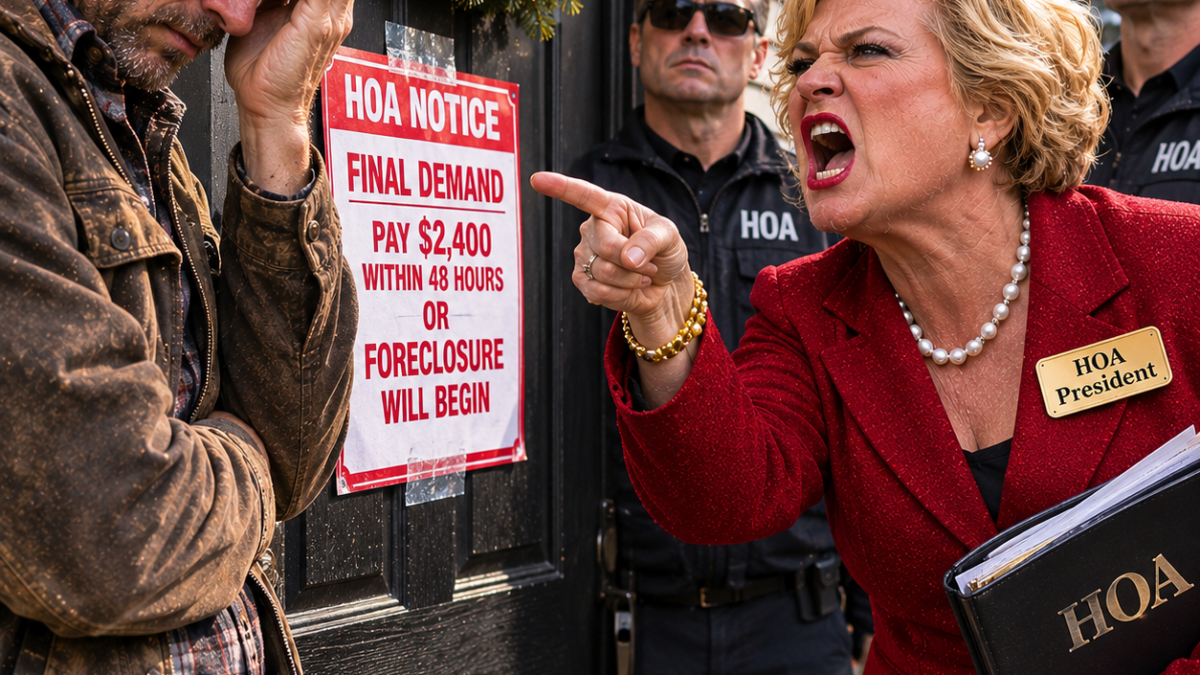
Christmas Eve. 6:00 p.m. His front door.
Denise was accidentally copied.
She forwarded it to me.
I stood in my kitchen staring at the date.
December 24.
On the wall calendar, I had circled that day years earlier.
It was the date my parents lost our home.
Twenty-six years before.
I picked up my phone.
Called Dorian.
“She’s coming tomorrow.”
He was quiet for a moment.
Then:
“Tomorrow we finish it.”
Christmas Eve arrived beneath heavy snow.
Luminaries lined sidewalks.
A church bell rang somewhere beyond the trees.
Children laughed inside houses.
At six exactly, headlights crossed my front window.
I set down my coffee.
Opened the door.
Beverly came up the walkway with Marjorie and Glenn.
Behind them, a process server carried a clipboard.
Neighbors started appearing.
Walter stood by his fence wearing a bathrobe under his coat and snow boots.
Kelsey Dunar had driven over from Cedar Hollow.
Raymond waited near the driveway.
Denise stood farther back.
Beverly took the notice from the process server.
She taped it to my front door herself.
Smoothed the corners.
NOTICE OF DEFAULT AND INTENT TO FORECLOSE.
Then she turned toward me.
“This is your final deadline.”
Her voice carried across the street.
“You’re done here.”
For a moment, I wasn’t on Larkspur Lane.
I was fifteen.
Standing in my parents’ kitchen.
Watching my father fold a foreclosure notice into smaller squares.
Watching my mother cry.
I remembered thinking:
One day, nobody is going to make me feel this helpless again.
That promise had shaped half my life.
I looked at Beverly.
“No.”
She tilted her head.
“No?”
“Tonight is not when I lose my house.”
She laughed.
“You think your lawyer is going to save you?”
“No.”
I looked toward the street.
A black sedan rolled to the curb.
Dorian stepped out in a charcoal overcoat.
Behind him came a notary with a leather case and a title examiner carrying accordion files.
Neighbors moved aside.
Dorian climbed the porch steps.
“Good evening.”
Beverly stared.
Dorian handed her a bound packet.
“This is our formal response on behalf of Gideon Mercer and Northgate Residential Holdings.”
She opened it.
First page.
Assessment defect.
Second.
False minutes.
Third.
Separate account.
Fourth.
Related-party payments.
Her smile faded.
Dorian waited.
Then handed her another set of pages.
“And this is the complete disclosure of my client’s property interests inside Willow Creek.”
Beverly tightened her jaw.
“I already know about his houses.”
Dorian looked at her.
“No, Mrs. Crane.”
Pause.
“You know about fourteen.”
He handed her one final page.
At the top:
15 PROPERTY OWNERSHIP DISCLOSURES.
Beverly read.
One.
Two.
Three.
Four.
Her face remained hard.
Ten.
Eleven.
Twelve.
Thirteen.
Fourteen.
Then fifteen.
She stopped.
Completely.
The fifteenth address:
Brier Court.
Her house.
The stone fireplace.
Curved driveway.
Pond view.
The house she had lived in for six years.
Beverly’s hand trembled.
“That’s not possible.”
Dorian said nothing.
She looked at me.
“That house belongs to a trust.”
“Yes.”
“You…”
Her voice disappeared.
Six years earlier, after a painful divorce left Beverly buried in debt, she had been days away from losing the house to the bank.
A broker arranged a private sale-leaseback.
She sold.
Received enough to settle what she owed.
Remained in the house as a tenant.
The buyer’s identity stayed behind a trust because she requested privacy.
She had never asked who ultimately owned it.
She mailed rent to a management office downtown.
For the last four months, she had stopped mailing even that.
I had not pursued her.
Not because I didn’t notice.
Because it was winter.
Because I knew her history.
Because I remembered my mother.
Dorian spoke carefully.
“My client acquired the Brier Court property through a private trust when the seller was facing foreclosure.”
The street had gone silent.
“He paid above market.”
Beverly stared at him.
“He honored the seller’s request for confidentiality.”
Snow landed on the porch rail.
“He has continued honoring that request for six years.”
Dorian paused.
“Including during the last four months, when no rent was received.”
Beverly’s face went white.
Someone behind her inhaled sharply.
Beverly recovered enough to speak.
“This is private.”
“Yes,” I said.
“It has nothing to do with the HOA.”
“You’re right.”
“You hid this to humiliate me.”
“No.”
“You set me up.”
“No.”
“Then why didn’t you tell me?”
I looked at her.
“Because you asked for confidentiality when you sold.”
She had no answer.
Dorian opened the accordion files.
Title reports.
Deeds.
Trust records.
Assessment documents.
Original October notes.
Resident invoices.
Bank statements.
Payments to the landscaping company.
Every inconsistency indexed by date.
The notary stood ready to certify copies.
Beverly looked from page to page.
Nothing disappeared when she looked away.
I spoke quietly.
“I never wanted to control this association.”
Her voice came out rough.
“Then what do you want?”
I thought of the month behind us.
The notices.
The whispers.
My parents.
Walter.
The neighbors who stopped waving.
“I want you to treat me the way you are supposed to treat everyone.”
Silence.
“No special treatment.”
I looked toward the board.
“No exemptions.”
Then Beverly.
“No threats.”
I pointed toward the notice taped to my door.
“Just the rules.”
Behind her, Marjorie slowly closed her laptop.
Then stepped away from Beverly.
For the first time in four years.
“I can’t defend this.”
Beverly turned.
“Marjorie.”
“I typed the October minutes because you told me to.”
“Not here.”
“I shouldn’t have.”
Glenn stared at the ground.
Raymond walked forward.
“As a member of the board, I move that all enforcement against Gideon Mercer be suspended immediately.”
He looked toward the residents.
“And all enforcement related to the Christmas assessment.”
Denise answered:
“Seconded.”
Glenn swallowed.
“Agreed.”
Marjorie raised her hand.
Four votes.
Beverly stood on my porch holding the foreclosure notice while the board she had controlled for four years voted around her.
Then I surprised Dorian.
Probably everyone.
“I will not sue the association.”
Dorian looked at me sharply.
Beverly stared.
I continued.
“If the board does five things.”
Raymond nodded.
“Say them.”
“Void the assessment.”
He nodded.
“Refund every dollar improperly collected.”
Another nod.
“Commission a fully independent audit.”
“Yes.”
“Publish the governing documents to the membership and follow them.”
“Yes.”
“And correct every enforcement action built on this process.”
Raymond looked around at the other board members.
“You have my word.”
Denise nodded.
Glenn too.
Marjorie said quietly:
“Mine too.”
Then Beverly looked at me.
“And me?”
It was the first question she had asked all month without command in her voice.
I met her eyes.
“That is something you’ll have to decide for yourself.”
The weeks after Christmas moved quickly.
A full membership meeting was scheduled for early January.
More than ninety owners attended.
Largest turnout in Willow Creek history.
The Christmas Community Restoration Assessment was formally voided.
Every homeowner received written notice.
An outside accounting firm was brought in.
The audit confirmed what Dorian had already found.
No valid membership approval.
Unequal charges.
Improperly maintained account.
Related-party payments.
Incomplete board oversight.
Every homeowner who had paid received a full refund.
Not credits.
Not future dues reductions.
Refunds.
The board adopted new financial controls.
Thirty days’ notice for special charges.
Membership vote where required.
Audited reserve account.
Two signatures on withdrawals.
Minutes posted publicly within one week.
The related-party landscaping payments were referred to the county prosecutor.
The money was returned within a month.
No charges followed.
Beverly resigned before a removal vote could take place.
That part mattered to some people.
They wanted spectacle.
A packed clubhouse.
Public humiliation.
Security escort.
I didn’t.
Her resignation letter was short.
She took responsibility for procedural failures and said Willow Creek needed leadership residents could trust.
That was enough for me.
Then Dorian called.
“What do you want to do about Brier Court?”
I stared out my kitchen window.
Snow still covered most lawns.
“What are the arrears?”
He told me.
“You could serve notice.”
“I know.”
“She has no ownership interest.”
“I know.”
“She tried to foreclose on you while not paying rent on your property.”
“I know.”
Dorian sighed.
“You’re going to annoy me.”
“Offer her a choice.”
“What choice?”
“New lease with a reasonable payment plan.”
Silence.
“Or?”
“She can leave at the end of winter.”
“And the arrears?”
“Forgive them if she leaves.”
Dorian was quiet for several seconds.
“Why?”
I thought about my father folding that foreclosure notice.
“Because I’m not doing to her what she tried to do to me.”
“That isn’t the same situation.”
“I know.”
“Legally, you owe her nothing.”
“I know.”
He sighed again.
“I’ll draft it.”
Beverly chose to leave.
In February, a moving truck backed into the curved driveway on Brier Court.
She left Willow Creek without a goodbye.
Nobody stopped her.
I did not go watch.
The house went through repairs.
A family eventually rented it.
They had two children.
The younger one drew stars in chalk on the driveway all spring.
That felt better than revenge ever would have.
Raymond Pike became HOA president.
Near-unanimous vote.
Marjorie stayed as secretary.
Her minutes were posted every week.
Denise began actually reading packets before meetings.
Glenn learned how to say:
“I need more information before voting.”
Which, for Glenn, was growth.
Kelsey organized a spring potluck.
Walter arrived early and criticized the grill.
The woman who had crossed the street to avoid me brought brownies.
She stood near my table.
“Gideon…”
“You don’t have to.”
“I do.”
I waited.
“I believed everything.”
“I know.”
“I judged you.”
“Yes.”
She winced.
“I deserve that.”
“That wasn’t meant to hurt you.”
She looked down.
“I’m sorry.”
“Thank you.”
That was it.
No speech.
No demand that she prove loyalty.
People are easily influenced by confidence.
I knew that.
The neighborhood slowly changed.
Residents started stopping at mailboxes to talk.
Someone created a list of older homeowners who needed help shoveling after storms.
My name appeared near the top.
The wooden PEACE sign went back outside in March.
Original size.
Nobody measured it.
Christmas night itself had been much quieter.
After Dorian and the others left, I went inside.
The red foreclosure notice was gone.
Only my evergreen wreath remained.
I made coffee.
Sat at the kitchen table.
For the first time in weeks, my house sounded normal.
At nine, someone knocked.
Walter.
Fudge tin.
Hat in hands.
“I owe you an apology.”
“You warned me.”
“I thought you were stubborn.”
“Probably fair.”
“Then I thought you were in over your head.”
“Also fair.”
He sat.
I poured coffee.
Walter looked toward the spare-bedroom hallway.
“Fifteen houses.”
“Yes.”
“Why didn’t you tell anybody?”
“Why would I?”
“You could’ve ended this the first night.”
“No.”
He frowned.
“You could’ve told Beverly you owned fifteen lots.”
“That would have changed how she treated me.”
“Exactly.”
“That’s the problem.”
Walter stopped.
I looked at him.
“I don’t think anyone should need to know how much money I have before deciding I deserve respect.”
Walter stared at his cup.
Then nodded slowly.
“That’s a pretty good answer.”
“It’s the only one I have.”
He left shortly after.
I walked him to the porch.
Snow had begun falling again.
My phone buzzed.
Dorian.
Three words:
Everything is settled.
I read the message.
Put the phone away.
The street glowed beneath Christmas lights.
Quiet.
Exactly what I had wanted from Willow Creek all along.
In the end, I had not won because I owned fifteen houses.
The houses mattered because they gave me voting rights and access to records.
They mattered because Beverly had underestimated the person she was threatening.
But legally, morally, fundamentally, none of that should have been necessary.
The fake assessment was still fake if I owned one house.
The minutes were still inaccurate if I rented.
The separate account was still improper if I had been broke.
The related-party payments still required scrutiny.
Beverly’s foreclosure threat did not become wrong only after she discovered I had money.
It had been wrong at the beginning.
That distinction mattered.
Because stories like mine are often told as:
She picked the wrong man.
I don’t like that.
What about the “right” man?
The elderly homeowner with no attorney?
The young couple with two jobs and no time?
The widow who assumes official letterhead must mean authority?
The renter whose landlord passes every penalty through because fighting is expensive?
Do they deserve less protection because they cannot produce fifteen deeds?
No.
Beverly’s mistake was not that she targeted me.
Her mistake was believing anyone could be targeted that way.
Months after the audit, Raymond asked me to join the board.
I said no.
“Why?”
“I don’t want your job.”
“You own enough property to influence every election.”
“That’s exactly why I shouldn’t need a seat.”
He laughed.
“Fair.”
“I’ll attend when something matters.”
“Everything matters.”
“Then you’re going to have a long presidency.”
He did.
And he was good at it.
Not because he never made mistakes.
Because when somebody asked for documents, he produced them.
When bylaws required a vote, he held one.
When residents challenged a decision, he did not interpret disagreement as disloyalty.
That sounds simple.
It is.
Power makes simple things difficult.
A year later, the HOA proposed a legitimate capital assessment for drainage repairs.
Actual engineering report.
Thirty-day notice.
Published cost breakdown.
Membership meeting.
Vote.
I attended.
The assessment passed.
I paid it on all applicable properties.
Kelsey found me afterward.
“You voted yes?”
“Yes.”
“I thought you hated assessments.”
“I hate unauthorized assessments.”
She laughed.
“Fair.”
That vote taught Willow Creek something too.
My fight had never been against paying.
It had been against pretending process was optional.
Beverly had framed my refusal as selfishness because that story was convenient.
The truth was boring.
I wanted the rule followed.
Sometimes fairness is boring.
That’s fine.
The most dangerous people in small institutions are not always the loudest.
Sometimes they are the ones who convince themselves that procedures are obstacles instead of protections.
Beverly had not started as some cartoon dictator.
Before all this, she had organized road repairs.
Pushed the county to address drainage.
Coordinated holiday events.
Helped improve the clubhouse.
People trusted her because she got things done.
Then getting things done became more important than how.
That is a subtle change.
At first:
“We need an assessment.”
Then:
“We don’t have time for a full vote.”
Then:
“Most people will agree anyway.”
Then:
“Some owners always complain.”
Then:
“Charge the difficult ones more.”
Then:
“Record minutes that show what should have happened.”
Then:
“Use the money now; explain later.”
Then:
“Foreclose on the one person asking questions.”
Each step feels smaller while you take it.
Only afterward does the staircase become visible.
Dorian once told me:
“People rarely wake up and decide to commit misconduct.”
I asked:
“What do they do?”
“They decide the rule should not apply this one time.”
That stayed with me.
The audit changed more than finances.
Residents began requesting records.
Not aggressively.
Normally.
Board members began asking:
“Where is that authority written?”
The phrase Beverly once hated became routine.
That was probably the best outcome.
Not my houses.
Not her resignation.
Questions.
Healthy organizations survive questions.
Fragile power hates them.
One summer afternoon, I was working on a porch at one of my rental houses when a teenager walking by recognized me.
“You’re the guy who owns all these houses.”
“Some.”
“My dad says you beat the HOA.”
“I didn’t.”
“He said Beverly tried to take your house.”
“She tried to start a process she wasn’t entitled to start.”
The boy frowned.
“That sounds like beating her.”
I smiled.
“How old are you?”
“Sixteen.”
“You’ll understand paperwork eventually.”
“Sounds terrible.”
“It is.”
He laughed and kept walking.
I looked at the house.
The tenant there was a nurse.
Single mother.
Two children.
Her furnace had failed the previous winter.
I had driven over at midnight because the contractor on call was stuck across town.
That was the story Kelsey had told Marjorie.
One small act had accidentally exposed my ownership interests.
Life is strange that way.
I sometimes wondered what would have happened if Kelsey had never mentioned me.
Beverly might have continued.
The records demand would still have come eventually.
Dorian and I were already preparing.
But the public turning point would have been different.
Maybe uglier.
Maybe slower.
Instead, the truth began leaking out before Beverly was ready.
Fourteen houses.
Then fifteen.
The fifteenth became what everyone remembered.
Of course it did.
The irony was irresistible.
HOA president tries to take homeowner’s house.
Discovers she lives in his.
But that was not the part I cared about most.
What mattered was why I owned Brier Court in the first place.
Six years before the conflict, Beverly had not been the confident woman standing on my porch.
She had been recently divorced.
Debt everywhere.
The bank approaching.
A broker contacted Northgate.
She wanted a quiet sale.
Above all, she did not want anyone in Willow Creek to know she had lost ownership.
I agreed.
Not because I knew her well.
I didn’t.
Because I understood the humiliation.
We bought above market.
Gave her enough to clear urgent debts.
Set a manageable lease.
Walled the property inside a separate trust.
Never used the information against her.
Even when she attacked me publicly.
Even when she called me financially unstable.
Even when she threatened to take my home.
I kept her secret until the moment her own legal action made disclosure necessary.
That mattered to me.
Privacy is easy to respect when the person respecting it likes you.
Character is respecting it when they don’t.
After Beverly moved, Dorian asked:
“Do you regret not exposing Brier Court earlier?”
“No.”
“Not even when she accused you of being broke?”
“No.”
“When she tried to foreclose?”
I thought about that.
“I disclosed it when it became legally relevant.”
“That wasn’t my question.”
“I know.”
He smiled.
“You are impossible.”
“Expensive too.”
“That part I appreciate.”
The county prosecutor ultimately declined charges after the questioned payments were returned and the audit documented the failures.
Some residents were angry about that.
They wanted criminal punishment.
I understood the feeling.
But I did not control that decision.
Nor should I have.
Justice is not the same as maximum punishment.
The assessment was voided.
Money returned.
Controls imposed.
Beverly lost the presidency.
The related-party money came back.
The board changed.
The records became transparent.
My home remained mine.
Sometimes restoration is justice.
One year after the confrontation, Christmas came again.
The PEACE sign stood by my walkway at full size.
Walter came over while I was stringing lights.
“You measuring that?”
“No.”
“Reckless.”
“Call the HOA.”
He laughed.
Raymond drove by.
Rolled down his window.
“Approved.”
Walter shouted:
“Corruption!”
Raymond kept driving.
I laughed.
That was what healing looked like in Willow Creek.
Not forgetting.
Being able to joke because the process had changed enough that the old fear no longer controlled the room.
I never became the neighborhood king Beverly once accused me of wanting to become.
If anything, I stayed quieter.
Property management remained behind Northgate.
My truck remained old.
My coat remained plain.
I still shoveled Walter’s walk.
Still fixed small problems myself when I felt like it.
People knew I owned houses now.
That couldn’t be undone.
But eventually it stopped mattering.
That was what I wanted.
One afternoon, a resident approached me outside the clubhouse.
Young father.
Nervous.
“I got a violation letter.”
“What for?”
“Fence height.”
“Is it wrong?”
“I don’t know.”
“Check the covenant.”
He hesitated.
“I thought maybe you could call Raymond.”
“No.”
He looked surprised.
“Why?”
“Because the rules should work without me calling the president.”
I showed him where the relevant section was online.
The fence was six inches too high.
He fixed it.
No drama.
That mattered.
I had not fought for a neighborhood without rules.
I had fought for rules that applied honestly.
There is a difference.
Another winter, Walter’s health declined.
He could no longer shovel at all.
We organized neighbors.
Two teenagers from Cedar Hollow handled his driveway.
Kelsey brought soup.
Raymond checked his gutters.
One morning Walter sat at my kitchen table and looked out the window.
“This place changed.”
“Yes.”
“Because of you.”
“No.”
“Don’t start that humble nonsense.”
I laughed.
“It changed because people started paying attention.”
He nodded.
“Same thing sometimes.”
“No.”
“Close enough.”
Walter died the following spring.
Eighty years old.
His daughter asked me to speak at the memorial.
I said no at first.
Then she told me he had written my name down.
So I went.
I talked about his bad advice.
His fudge.
His opinion that every machine built after 1995 was poorly designed.
People laughed.
Afterward, his daughter handed me a small envelope.
Inside was a note.
Two sentences.
You were right not to tell them about the houses. Respect shouldn’t depend on the size of a man’s bank account. Keep being stubborn.
I still have it.
Of everything from that winter, that note may mean the most.
Years later, people occasionally asked about Beverly.
I heard she moved to another county.
Started work for a property-management company.
I did not keep track.
One time, maybe three years afterward, I received a letter.
No return address I recognized.
Inside was a single page.
Beverly.
She did not apologize for everything.
That would have felt unrealistic.
She wrote that leaving Willow Creek had forced her to reconsider how she had used authority.
She wrote that losing control of the board had been humiliating.
She also wrote:
I understand now why you did not tell anyone about Brier Court until you had to. You gave me privacy even when I gave you none. I did not deserve that courtesy, but I recognize it now.
I read that line twice.
Then put the letter away.
I did not respond.
Not out of cruelty.
There was nothing left to resolve between us.
Sometimes closure does not require correspondence.
The house on Brier Court eventually sold.
Not to a company.
To the family renting it.
They had been there three years.
Good tenants.
Wanted roots.
I sold at a fair price.
Dorian asked:
“Emotion?”
“No.”
“Not even a little poetic satisfaction?”
“No.”
“Beverly’s old house becoming owner-occupied again?”
I considered.
“Maybe a little.”
He smiled.
“Knew it.”
Northgate continued buying properties occasionally.
Never to dominate.
Never enough that I felt comfortable using ownership as political leverage.
In fact, after the Willow Creek fight, I became more cautious.
Power can corrupt even when you believe you are using it defensively.
I had enough votes to influence board elections.
I rarely did.
Because I had learned the same lesson Beverly should have learned.
Just because you can exert pressure does not mean you should.
The difference between capacity and legitimacy matters.
That is true for HOAs.
Landlords.
Business owners.
Governments.
Anyone.
Especially anyone who believes their intentions are good.
The story people told about that Christmas became simpler over time.
HOA Karen invents fee.
Quiet homeowner refuses.
She tries to foreclose.
Turns out he owns fifteen houses.
One of them is hers.
Justice.
Simple.
Real life was messier.
There was fear.
Reputation.
Procedure.
False confidence.
People who went along because confronting a president felt uncomfortable.
A secretary who typed minutes she knew were inaccurate because “that’s how it had always been done.”
A board member who avoided speaking until the paperwork became impossible to ignore.
Homeowners who paid because $800 or $2,400 seemed cheaper than conflict.
And me.
A man who could have ended the public part sooner by announcing his money.
But doing that would have taught the wrong lesson.
I did not deserve fairness because I was rich.
I deserved it because I was a homeowner subject to the same governing documents as everyone else.
So did Walter.
So did Kelsey.
So did the people who disliked me.
So did Beverly, even after what she did.
That is why I offered her a lease option instead of throwing her out in February.
Not because she had earned kindness.
Because I did not want my principles to depend on whether the other person deserved them.
Years later, I still live on Larkspur Lane.
Same house.
Different truck now.
The old one finally died.
Walter would have blamed computers.
The porch has been repainted.
The gutter lights changed from warm white to another warm white because apparently I fear innovation.
The PEACE sign is weathered.
Still there.
Willow Creek still has disagreements.
Fence colors.
Parking.
Drainage.
Dues.
Normal neighborhood arguments.
But when special assessments come up, residents ask for the vote.
When financial reports are presented, someone actually reads them.
When minutes are posted, people compare them to what happened.
No president since Beverly has complained about that.
Good.
The strongest organizations are not those where nobody challenges leadership.
They are the ones where leadership expects to be challenged and can answer.
Every Christmas Eve, I make coffee after dark and sit at the same kitchen table.
I think of my parents.
Not every year for long.
Just a moment.
My father folding that notice.
My mother’s hands.
The empty kitchen.
For decades, I thought the lesson from losing that house was:
Own enough that nobody can take anything from you.
I was wrong.
Ownership helps.
Money helps.
Lawyers help.
But none of those are the deepest protection.
The deeper protection is a system where someone cannot simply invent power and expect everyone else to obey.
That is why documents matter.
Votes matter.
Notice requirements matter.
Audits matter.
Independent records matter.
They can feel tedious until the day somebody wants your home.
Then the boring things become everything.
On the fifth anniversary of that Christmas, Raymond invited me to the annual meeting.
I went.
Near the end, he stepped down from the presidency.
Marjorie, now older and slower but still typing perfect minutes, announced that a new board would take over.
Before Raymond left the front table, he said:
“One more item.”
He looked at me.
I immediately became suspicious.
“Five years ago, this association nearly destroyed itself because we forgot that power comes from documents, votes, and trust.”
Nobody spoke.
“Somebody reminded us.”
I shook my head.
Raymond ignored me.
“We’re adopting a permanent records-access policy tonight.”
Applause.
Not for me.
For the policy.
That made me happier.
Afterward, a man I barely knew came over.
“You must feel vindicated.”
“Sometimes.”
“You could run this place if you wanted.”
“That sounds exhausting.”
He laughed.
Then asked:
“What did Beverly say to you when she realized you owned her house?”
I thought back.
Her face.
The snow.
The papers.
“She didn’t say much.”
“What did you say?”
“I told her I wanted the rules.”
“That’s it?”
“That was always it.”
He looked almost disappointed.
People prefer dramatic revenge.
I understand.
Revenge has cleaner edges.
But justice often looks boring from outside.
Refunds.
Audits.
Corrected minutes.
A lease option.
A resigned president.
A neighborhood returning to normal.
No explosion.
No final scream.
Just the system working the way it should have worked from the beginning.
That was enough.
The red foreclosure notice from Christmas Eve is still in one of Dorian’s archived files.
I never framed it.
Never kept it as a trophy.
But once, years later, I asked to see it.
The paper had faded slightly.
The words still looked aggressive.
NOTICE OF DEFAULT AND INTENT TO FORECLOSE.
I remembered Beverly smoothing the corners against my front door.
So certain.
I folded the paper once.
Then stopped.
For a second, I saw my father again.
Folding his notice smaller.
Smaller.
Smaller.
I unfolded mine.
Laid it flat.
That mattered to me.
I could not change what happened to my parents.
Could not give fifteen-year-old Gideon back that kitchen.
But I could refuse to let fear make decisions for the man I became.
I returned the notice to Dorian.
“Done?”
“Yes.”
He put it away.
Outside, snow had started falling over the city.
On the drive home, I passed Willow Creek’s entrance.
Holiday lights wrapped around the sign.
Cars moved slowly through snow.
Families carried shopping bags.
Someone had built a crooked snowman beside the clubhouse.
Ordinary life.
That was what I had wanted from the beginning.
Not control.
Not applause.
Not to own the neighborhood.
Just quiet.
A place where rules meant what they said.
A front door nobody could threaten because they assumed I was too small to fight back.
I pulled into my driveway.
The PEACE sign stood beside the walk.
Full size.
I left it exactly as it was.
Inside, I made coffee.
Then stood at the front window looking over Larkspur Lane.
Fifteen properties had once been the twist everyone cared about.
But the number had never been the lesson.
If I had owned one house, Beverly still should have followed the law.
If I had owned none, she still should have told the truth.
If I had been broke, frightened, elderly, sick, alone, or completely unfamiliar with HOA rules, the governing documents should still have protected me.
Rights that work only for powerful people are not rights.
They are privileges.
And that was why, when Walter once asked why I had not simply told everyone how much money I had, I gave him the only answer that ever mattered.
Because nobody should need to know how much a man owns before deciding whether he deserves to be treated fairly.
Beverly thought the red notice on my door was the moment she proved who controlled Willow Creek.
She was wrong.
The real turning point had happened nine days earlier, when one quiet homeowner opened the bylaws, read the rule, and asked a simple question:
Where is the vote?
Everything after that was just the paperwork catching up to the truth.








