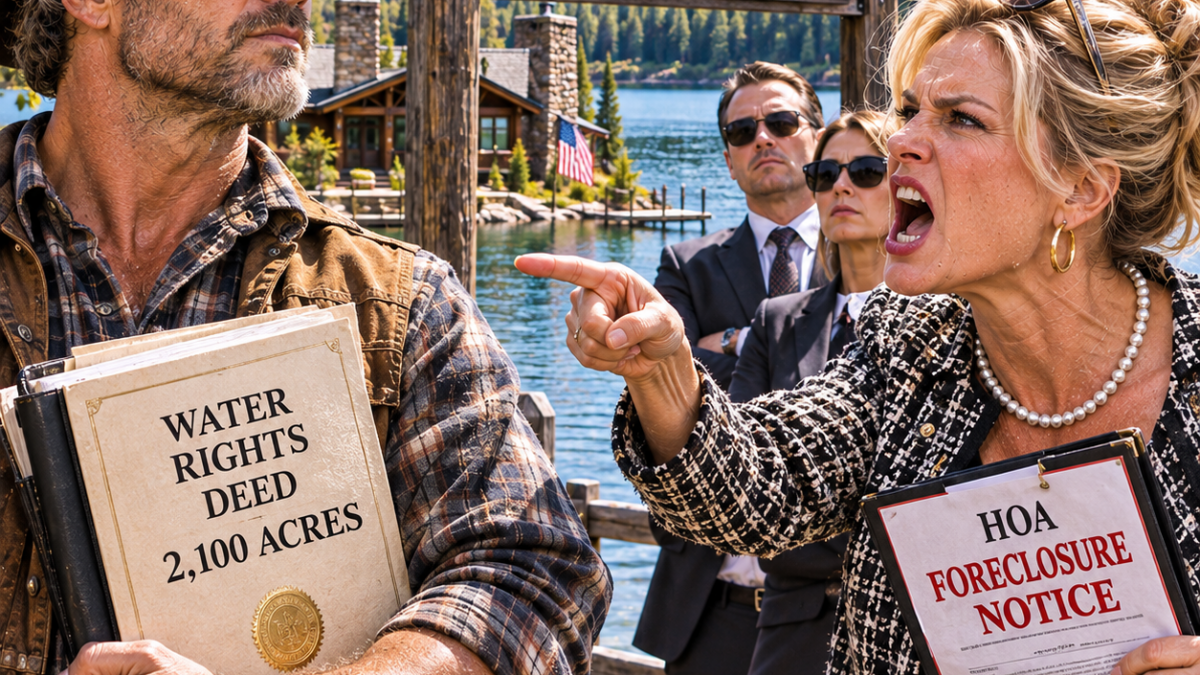
PART2:“PAY $500 A MONTH TO USE MY LAKE—OR I’LL FORECLOSE ON YOU!” HOA Karen Tried to Seize My Family’s 2,100-Acre Water Rights—Then Her Own Financial Records Destroyed Her
PART2
County records lived in a basement that appeared to have been designed specifically to punish anyone interested in history.
Fluorescent lights.
Dust.
Metal shelving.
A clerk named Betty who had worked there long enough to remember Uncle Morris personally.
“You’re Silas Whitmore’s great-grandson.”
“Guilty.”
She pushed her glasses up.
“Your uncle used to come down here every few years and check the same documents.”
“Why?”
“Because developments kept appearing.”
That was interesting.
For three hours, I reviewed deeds.
Transfers.
Plats.
Survey maps.
Recorded restrictions.
Development filings.
The original 1887 deed was not magic.
It did not make me “king of the water.”
It did something more useful.
It established what the Whitmore family had acquired and, just as importantly, what later conveyances had not transferred.
Over generations, my family sold shoreline acreage.
Those deeds included narrow access rights and limited recreational easements in some locations.
They did not transfer ownership of my remaining parcel to an HOA that did not exist until more than a century later.
They certainly did not contain language granting Lakeshore Estates the power to assess my property.
That afternoon, Betty made an authenticated copy.
I called the one attorney in town young enough to answer his own phone after five.
Thomas Reeves.
Everyone called him Tommy.
Twenty-seven.
Recently licensed.
Suit sleeves slightly too long.
Hungry in a way I recognized from myself after leaving the Army.
We met at Marcy’s Diner.
He spread my documents across a sticky table.
Then stopped eating.
“This is…”
“What?”
“Very good for you.”
“Better than five hundred dollars a month?”
He grinned.
“Significantly.”
He reviewed the recorded declaration creating Lakeshore Estates.
My parcel did not appear in the legal description.
No annexation instrument.
No signed covenant binding the Whitmore tract.
No later consent from Uncle Morris.
Tommy said:
“Based on what I’m seeing, the HOA’s authority over you is, at best, something they assumed.”
“At worst?”
“They’ve been threatening liens against property outside their declaration.”
I leaned back.
“Can they?”
“They can file paperwork.”
“That doesn’t make it valid.”
“Important distinction.”
Good lawyer.
My phone buzzed.
Unknown number.
EMERGENCY HOA MEETING TONIGHT. MANDATORY ATTENDANCE. ROGUE PROPERTY-OWNER SITUATION.
I showed Tommy.
He read it twice.
“Rogue property owner?”
“Apparently me.”
His grin returned.
“Can we go?”
“You’re asking me?”
“I’ve been licensed nine months.”
“Most of my work is divorces, traffic tickets, and one dispute over a retaining wall.”
He tapped the deed.
“This is fun.”
“Your definition of fun concerns me.”
We went.
The Lakeshore community center looked like a municipal courtroom assembled from folding chairs.
Nearly eighty residents.
Cordelia stood at the front beside three board members.
Large photographs of my dock were mounted on poster board.
She had diagrams.
Charts.
Highlighted regulations.
Theatrical preparation.
She began without acknowledging me.
“Our community faces a serious threat to established environmental and safety standards.”
My dock appeared on the projector.
Apparently it was now a threat to civilization.
“This unapproved structure has not undergone modern HOA engineering review.”
A resident raised his hand.
“Is it unsafe?”
Cordelia answered:
“We have concerns.”
Not evidence.
Concerns.
Then:
“The new owner has also refused to contribute to shared lake-maintenance costs.”
That produced murmurs.
I stood.
Cordelia looked irritated.
“Mr. Whitmore, you will have an opportunity—”
“Point of clarification.”
Tommy stood beside me.
I held up the authenticated deed.
“My property isn’t inside your HOA.”
The room quieted.
Cordelia smiled.
“That is your interpretation.”
“No.”
Tommy stepped forward.
“It is the recorded legal description.”
Several residents turned.
Tommy continued.
“The Whitmore parcel predates Lakeshore Estates by more than a century.”
“It was never annexed into the declaration we reviewed.”
“And we found no covenant authorizing Lakeshore to assess Mr. Whitmore’s parcel.”
Cordelia waved one hand.
“Technicalities.”
I almost laughed.
“Property boundaries are technicalities?”
Her face hardened.
“The lake functions as a common resource.”
Tommy said:
“Function doesn’t create ownership.”
A man near the front raised his voice.
“So why are we paying legal fees over this?”
Cordelia turned.
“Because community assets require protection.”
Another resident:
“Did the board vote on those legal fees?”
Cordelia’s expression changed.
Tiny.
But I saw it.
So did Tommy.
A woman asked:
“How much have we spent?”
Cordelia snapped:
“This meeting is not about the budget.”
Tommy whispered:
“It is now.”
Cordelia adjourned twenty minutes early.
She announced all violations remained pending “formal legal review.”
No vote.
No answer about money.
Outside, an older woman waited beside my truck.
Seventy-eight.
Bright scarf.
Cane she used more like a pointer than support.
“Mavis Lane.”
“Ezra Whitmore.”
“I know who you are.”
She looked toward the community center.
“That woman is going to make your life miserable.”
“She already started.”
Mavis shook her head.
“She forced the Hendersons to sell last year.”
“How?”
“Fines.”
“Lawyers.”
“Roof color.”
“Mailbox setback.”
“Noise complaints.”
“One thing after another.”
“Were the fines valid?”
Mavis looked at me.
“You’re asking the wrong question.”
“What’s the right one?”
“Could they afford to prove they weren’t?”
There it was.
The entire system in one sentence.
Cordelia’s next move arrived two mornings later.
Certified letter.
Fourteen-day demand.
Professional survey.
Environmental impact assessment.
Dock inspection.
Septic compliance review.
All at my expense.
Potential fines:
Ten thousand dollars per day.
I called Tommy.
He read the notice.
Then said:
“She likes zeros.”
“Can she do any of this?”
“Not under the HOA declaration if you’re not bound.”
“County can inspect, obviously.”
“Environmental agencies can act under their own authority.”
“But Cordelia can’t manufacture jurisdiction just by putting it on letterhead.”
Three days later, county inspectors appeared.
Building.
Septic.
Environmental compliance.
Three separate anonymous complaints.
I let them in.
Not because Cordelia had authority.
Because county inspectors did.
That distinction matters.
Pete Dawson, the building inspector, knew me from contracting jobs.
He looked miserable.
“Ezra.”
“Pete.”
“I’m required to inspect.”
“I know.”
“Sorry.”
“Don’t be.”
For two hours, they measured.
Photographed.
Tested.
The old dock had been reinforced by Uncle Morris eight years earlier with permitted structural repairs.
The septic system was newer than required.
Shoreline vegetation exceeded current erosion-control recommendations.
The environmental officer took water samples.
Pete finally wiped his forehead.
“I wish half the complaints I investigate looked like this.”
“So no emergency?”
“No.”
“No collapsing dock?”
“No.”
“No toxic septic apocalypse?”
He laughed.
“No.”
Deputy Roy Hutchins arrived while they were finishing.
Roy and I had known each other since high school.
He watched the inspectors leave.
Then said:
“Interesting week.”
“How?”
“Three anonymous complaints.”
“Same source number.”
I looked over.
“Can you tell me that?”
“I can tell you the reporting pattern was identical.”
He adjusted his hat.
“And I can tell you similar complaints have been filed against other Lakeshore residents.”
“Mavis?”
“Some.”
“Martinez family?”
His expression said enough.
“Careful, Ezra.”
“I’m always careful.”
“That’s why I’m saying it.”
That evening, Tommy appeared at my kitchen table carrying a rolled survey.
He opened it.
Then pointed.
“Remember how your family sold shoreline lots?”
“Yes.”
“Some retained easements.”
“Some didn’t.”
He traced a line.
Cordelia’s lakefront mansion sat on property that had once been part of a Whitmore tract.
Her home itself was on properly conveyed land.
Her dock and part of her landscaped shoreline were another matter.
The current improvements extended beyond the boundary shown in the most recent recorded survey.
I stared.
“Her boathouse is across my line?”
“Potentially.”
“We need a licensed surveyor to confirm.”
“We are not declaring victory from a paper map.”
Again.
Good lawyer.
We commissioned a boundary survey.
Result:
Part of Cordelia’s dock and several shoreline improvements occupied an area subject to unresolved Whitmore ownership and easement issues.
Not half her mansion.
Not fantasy.
Enough.
Tommy laughed when the report arrived.
I didn’t.
Something about the whole fight had stopped being funny.
Cordelia was not just mistaken about my land.
She had built an entire personality around the assumption that nobody would check hers.
Tommy started reviewing public HOA financial disclosures.
Thirty-eight thousand dollars in legal expenses that year.
Then forty.
Mostly listed under vague labels:
Compliance.
External counsel.
Community-protection matters.
No detailed member authorization appeared in the meeting minutes he could obtain.
We did not yet know whether spending violated the bylaws.
We knew residents had questions.
So we asked.
Cordelia answered with another letter.
This one threatened a lien for accumulated access fees and dock penalties.
Fifteen thousand dollars.
I called Tommy.
He said:
“Do not pay it.”
“I wasn’t planning to.”
“Do not call her.”
“That part disappoints me.”
“We respond formally.”
His letter was boring.
Perfectly boring.
It denied HOA jurisdiction.
Demanded the legal basis for assessments.
Provided recorded evidence.
Reserved claims relating to improper lien filings.
Requested preservation of financial records connected to enforcement.
Cordelia responded by declaring an environmental emergency.
That was when I realized this was no longer about a dock.
The notice claimed drought conditions required “temporary HOA water-management authority.”
Her consultant, Dr. Marcus Pembroke, issued a report claiming my dock and historic water-control structures might interfere with safe levels.
I had spent eight years in the Army Corps of Engineers.
Mostly water infrastructure.
Bridges.
Drainage.
Flood control.
Hydraulics.
I did not believe expertise made me infallible.
It made me know when to ask better experts.
So instead of writing an angry rebuttal, I hired a licensed hydrologist.
Dr. Sarah Mitchell.
Forty.
No patience.
Mud on her boots.
First morning at Mirror Lake, she read Pembroke’s report while standing beside the shoreline.
Then looked at me.
“Did he inspect the spring system?”
“He says he did.”
“Where are his flow measurements?”
“Not included.”
“Groundwater data?”
“No.”
“Outlet monitoring?”
“No.”
She closed the report.
“So he wrote conclusions before measurements.”
“Apparently.”
Sarah spent two weeks studying the system.
Mirror Lake was spring-fed.
Water levels varied seasonally but had remained within historic ranges.
The old control structures were not some secret switch allowing me to drain the lake on command.
They formed part of an overflow-management system that had been modified and regulated over generations.
Any significant operation would be subject to modern legal and environmental requirements.
That mattered.
I did not need magical nineteenth-century authority.
I needed evidence that Cordelia’s “emergency” was false.
Sarah gave me that.
Then Mavis gave me motive.
She came to the house carrying lemon cookies.
I had learned Mavis only baked before delivering dangerous information.
“Cordelia’s been promising developers something.”
“What?”
“Upscale lakefront project.”
“Condos.”
“Marina.”
“Commercial slips.”
I stopped eating.
“Where?”
“North shore parcels.”
“Some owned by current residents.”
“She’s been quietly talking about purchase options.”
“And?”
“Developers want guaranteed lake access.”
There it was.
Tommy arrived twenty minutes later.
Mavis pointed at him.
“You’re late.”
“I didn’t know we had a meeting.”
“You always have a meeting when I bring cookies.”
She had a point.
Tommy opened his laptop.
He had found public filings connected to a company called Pinnacle Lake Development.
Option agreements on multiple shoreline parcels.
One entity associated with Cordelia appeared as a consultant.
Not proof of crime.
Proof of interest.
He said:
“If the project depends on water access, your rights become a major obstacle.”
I stared out the window.
Mirror Lake looked exactly the same.
Sunlight.
Pines.
A fishing boat.
All this conflict over something that had existed quietly for generations.
Mavis said:
“She doesn’t care about your dock.”
“No.”
I looked at Tommy.
“She needs control.”
He nodded.
Then things got uglier.
Tommy obtained HOA financial materials through records available to members working with Mavis and several other residents.
Reserve funds had fallen sharply.
Legal expenses climbed.
Consulting expenses climbed faster.
Payments appeared to multiple vendors:
Blackwood Environmental Solutions.
CB Community Consulting.
Lakeshore Property Advisory.
Different names.
Overlapping addresses.
Overlapping registration agents.
Cordelia’s business office appeared repeatedly.
Tommy did not call it embezzlement immediately.
That restraint may have saved us.
“We need underlying invoices.”
He said.
“Board approvals.”
“Services actually performed.”
“Related-party disclosures.”
“If the work was legitimate and disclosed, this is ugly but not necessarily theft.”
“Can residents get those records?”
“Depending on governing documents and state law, they can demand access to certain books and records.”
Mavis smiled.
“I know twelve people who suddenly care about accounting.”
The requests went out.
Cordelia resisted.
Delayed.
Produced partial records.
Then more.
The picture sharpened.
Over roughly three years, close to two hundred thousand dollars had flowed to entities tied directly or indirectly to Cordelia.
Some services appeared real.
Some invoices were astonishingly vague.
Some lacked clear board authorization.
Several property-option deposits connected to the development project appeared to trace through accounts receiving HOA money.
That was when Tommy stopped smiling.
“Ezra.”
“What?”
“This may be criminal.”
I sat back.
“May.”
“Yes.”
“Do not say embezzlement publicly yet.”
“I wasn’t going to.”
“You were thinking it loudly.”
Fair.
We took copies to the appropriate authorities.
Not Roy alone.
Financial investigators.
State-level referrals where appropriate.
Independent review.
I did not want this collapsing because the entire case had been built by Cordelia’s neighborhood enemies.
Evidence needed neutral hands.
Meanwhile, Cordelia escalated publicly.
Anonymous Facebook posts appeared.
OUTSIDE PROPERTY OWNER THREATENS MIRROR LAKE ENVIRONMENT.
Flyers.
Rumors that I planned industrial water extraction.
One post claimed I intended to bottle lake water commercially.
I laughed.
Then stopped laughing when contractors began receiving calls asking whether my company was involved in environmental litigation.
My business was being targeted now.
Sarah wrote a technical statement.
Tommy wrote legal responses.
I said nothing publicly.
Then someone came to my dock at two in the morning.
Camera notification woke me.
I watched live footage.
Small boat.
One man.
Baseball cap.
He climbed onto the outer platform and began cutting mooring lines securing a floating section.
I called law enforcement.
Did not go outside with a rifle.
Did not confront him alone.
The man fled before deputies arrived.
Cameras captured his boat registration partially.
Investigation later identified him as a contractor who had done occasional work for a private investigator.
That connection led to Marcus Webb.
The private investigator Cordelia had hired.
I saw Marcus several days later at the hardware store.
He approached me voluntarily.
Rumpled jacket.
Nervous.
“Mr. Whitmore.”
“Yes.”
“Can we talk?”
“Depends.”
“I think I’m working for somebody who’s going too far.”
We met with counsel.
Not in the parking lot.
Marcus produced his contract.
Cordelia had initially hired him to investigate alleged environmental misconduct.
Then requests expanded.
Photograph visitors.
Track residents questioning HOA finances.
Document mail deliveries.
Look for personal leverage.
One email asked him to identify “financial vulnerabilities” among two board members.
Marcus refused that part.
Then someone associated with another contractor vandalized my dock.
He decided he was done.
He had payment records.
Emails.
Instructions.
Nothing like a Hollywood blackmail folder.
Enough to corroborate a systematic intimidation campaign.
By then, Cordelia’s board was fracturing.
Mavis called me after one meeting.
“She’s losing them.”
“How?”
“Money.”
“People tolerate arrogance longer than missing reserves.”
She was right.
Residents wanted answers.
Cordelia needed to reassert control.
So she scheduled an emergency community meeting.
Red lettering.
Mandatory language.
Local media invited.
Topic:
ENVIRONMENTAL PROTECTION AND EMERGENCY LAKE CONTROL MEASURES.
Her proposed resolution claimed the HOA could assume temporary authority over lake-adjacent property and water access to protect community safety.
Tommy read it at my kitchen table.
Then started laughing.
I waited.
He kept laughing.
“Finished?”
“No.”
Another thirty seconds.
Then:
“She is pretending an HOA has eminent-domain-type authority.”
“Can it?”
“Not like this.”
“Not even close.”
“Governmental taking powers come from law.”
“An HOA vote cannot magically create them.”
I looked at the notice.
“She invited Channel 7.”
“That is my favorite part.”
“Why?”
“Because if she proceeds after being warned, she’s creating her own record.”
I did not share his enthusiasm.
The meeting worried me.
Cornered people can become dangerous.
Roy agreed.
He said:
“We keep this calm.”
“No mob.”
“No ambush.”
“If investigators have action to take, they take it based on evidence already developed.”
“Not because a crowd gets angry.”
Exactly.
Behind the scenes, the financial investigation had advanced.
Subpoenaed records supported substantial concerns about unauthorized related-party payments.
The investigators had enough to seek warrants for records and electronic evidence.
Not a conviction.
Not guilt established.
Probable cause for further investigation.
That distinction mattered.
Tommy wanted to confront Cordelia with the records residents were legally entitled to see.
The authorities wanted preservation.
Sarah had environmental data.
Marcus had harassment instructions.
Mavis had years of member notices.
Everyone had one piece.
Cordelia thought the emergency meeting was hers.
It became something else.
The room was packed.
More than two hundred people.
Standing room.
Channel 7 near the back.
Cordelia had professional lights.
Charts.
Large photographs of my dock.
A map shaded red around the Whitmore parcel.
She wore a white blazer.
Perfect hair.
Perfect posture.
She began:
“Tonight we must decide whether one individual’s outdated claims are more important than the safety and financial security of hundreds of families.”
Applause from maybe twenty people.
Most remained silent.
She displayed Pembroke’s environmental findings.
Sarah sat three rows behind me.
I felt her physically restraining herself from shouting.
Cordelia continued.
“Our attorneys have concluded that emergency community authority permits temporary assumption of lake-management control.”
Tommy whispered:
“No, they have not.”
“How do you know?”
“Because no attorney signed this.”
He pointed at the screen.
He was right.
Cordelia moved toward the vote.
That was when Mavis stood.
“I have a question.”
Cordelia’s jaw tightened.
“Mrs. Lane, questions will follow—”
“No.”
Mavis held up a printed statement.
“Where did one hundred ninety-seven thousand dollars go?”
The room changed.
Cordelia froze.
Then:
“I don’t know what you’re referring to.”
Tommy stood.
“I do.”
Every camera moved.
He walked toward the front carrying a binder.
Not a theatrical briefcase.
A three-inch binder tabbed like an accountant’s nightmare.
“My name is Thomas Reeves.”
“I represent Mr. Whitmore.”
“I’ve also been working with Lakeshore members who requested inspection of association financial records.”
Cordelia pointed.
“You are out of order.”
Tommy stopped.
Then looked at the residents.
“If the membership wants me to sit down, I will.”
Nobody told him to.
He continued.
“We identified payments to multiple companies connected to Ms. Blackwood.”
Cordelia snapped:
“Legitimate consulting vendors.”
“Some may be.”
Tommy nodded.
“That’s why we requested supporting invoices and authorizations.”
He held up a page.
“This payment is twenty-eight thousand dollars to Blackwood Environmental Solutions.”
“Where is the board vote?”
Silence.
Another.
“Seventeen thousand five hundred to Lakeshore Property Advisory.”
“Same registered address as Ms. Blackwood’s private office.”
“Where is the conflict disclosure?”
Cordelia’s face went pale.
She looked at two board members.
Neither spoke.
Tommy continued.
“We also found property-option expenses connected to the proposed Pinnacle Lake development.”
The crowd erupted.
“Development?”
“What development?”
“Using our money?”
Cordelia shouted:
“Enough!”
The microphone amplified her voice.
Everyone stopped.
She pointed at me.
“This man is orchestrating a hostile takeover of community assets.”
I stood.
“No.”
“You want the lake.”
“I already own the rights I inherited.”
“You are manipulating old documents.”
I looked around.
“Then let a court decide that.”
Silence.
“I never asked this HOA to give me anything.”
“You asked me for five hundred dollars a month.”
“You threatened fines.”
“You threatened a lien.”
“You sent inspectors.”
“You hired people to watch residents.”
“You invented an environmental emergency.”
“And now you want your neighbors to vote you powers they cannot legally give you.”
Cordelia’s composure cracked.
“You are destroying property values.”
Sarah stood.
“May I?”
Cordelia stared.
Sarah introduced herself.
Licensed hydrologist.
Independent.
She summarized the monitoring results.
No environmental emergency.
No evidence that my dock was destabilizing lake levels.
No technical basis for several of Pembroke’s conclusions.
Then a resident shouted:
“Why did we pay for his report?”
Another:
“How much?”
Another:
“Is he one of Cordelia’s companies too?”
The room became chaos.
Cordelia pounded the table.
“Order!”
Mavis laughed.
Not helping.
Then the back doors opened.
Roy entered with two investigators I did not know personally.
The room quieted.
Cordelia looked at him.
“Deputy, remove Mr. Whitmore.”
Roy did not move.
One investigator stepped forward.
“Ms. Blackwood?”
“Yes.”
“We have a warrant authorizing seizure of specified financial and electronic records related to an ongoing investigation.”
The room inhaled.
Cordelia gripped the table.
“What investigation?”
“I’m not discussing details publicly.”
Good answer.
“This is outrageous.”
“You may contact counsel.”
The investigator handed her documents.
Channel 7 cameras captured everything.
Not handcuffs.
Not yet.
No premature arrest for television.
Something worse for Cordelia.
Process.
Neutral people taking records from the office she had controlled.
Computers.
Boxes.
Accounting files.
Member correspondence.
She looked at the residents.
“You can’t believe this.”
Mavis said:
“We believe our bank statements.”
Cordelia stared at me.
Hatred.
Fear.
Then she made the mistake that ended the meeting.
“This development was supposed to save this association!”
Silence.
Tommy slowly looked toward her.
Cordelia realized too late.
A resident said:
“What development?”
Another:
“What did you mean save us?”
Cordelia tried to recover.
“Lakeshore’s reserves are under pressure.”
“How much pressure?”
No answer.
Tommy displayed the reserve summary.
Three months of ordinary operating expenses remained under one projection.
Years of litigation and consulting costs had eaten through funds.
Cordelia said:
“The development would have generated revenue.”
Mavis shouted:
“For who?”
Cordelia pointed at me.
“He is blocking water access.”
There it was.
The truth without decoration.
Not environmental safety.
Not my dock.
Not community aesthetics.
My water rights were blocking a development deal.
Tommy displayed correspondence obtained lawfully through records and provided to investigators.
Pinnacle Lake Development.
Projected marina.
Condos.
Commercial waterfront amenities.
And a consulting arrangement tied to Cordelia.
One draft compensation schedule included a percentage-based success fee if sufficient property and water-control agreements were secured.
Residents began shouting.
Cordelia stepped away from the podium.
For the first time since I met her, she looked small.
I did not enjoy it as much as I expected.
Because two hundred families were realizing their HOA reserve might have been treated as somebody else’s opportunity fund.
That was not a victory.
It was damage.
The meeting ended without her vote.
Obviously.
Within forty-eight hours, most of the remaining board members voted to suspend Cordelia from operational authority pending investigation under procedures available in the governing documents.
Members petitioned for a special election.
Lawyers arrived.
Accountants arrived.
Auditors arrived.
Actual professionals doing boring work.
That is how corrupt systems really collapse.
Not from one speech.
From people finally opening every drawer.
The audit took months.
Not every payment was improper.
That mattered.
Roughly forty thousand dollars of Cordelia-connected consulting work could be tied to actual services and some level of board awareness.
Other payments were poorly disclosed.
Some lacked authorization.
Several appeared routed through related entities without appropriate conflict procedures.
Investigators focused on the strongest transactions.
Development deposits became critical.
So did emails.
One from Cordelia to a Pinnacle executive:
Once Whitmore signs or is forced into compliance, water access stops being a financing problem.
Another:
HOA pressure is the cheapest path. Litigation will eventually make resistance irrational.
I read that one three times.
There was my entire experience.
Not law.
Economics.
Make resistance irrational.
Another email discussed her compensation if the project closed.
Enough.
Prosecutors eventually filed charges relating to misuse of association funds, fraudulent records, and other financial conduct supported by the evidence.
The exact counts changed before trial.
Some were dismissed.
Others amended.
That is normal.
Cordelia’s attorneys fought everything.
Also normal.
Her white Escalade was not magically seized because television viewers wanted poetic justice.
Her house did not automatically become community property.
Civil recovery required separate proceedings.
Insurance claims.
Restitution arguments.
Asset tracing.
Messy.
Slow.
The internet hated the lack of instant revenge.
I preferred accuracy.
The HOA held its special election twelve days after Cordelia formally resigned from the presidency.
Mavis Lane won.
Not unanimously.
She got seventy-eight percent.
When I told her that was more believable, she hit me with her cane.
Her first speech was eight minutes.
“First.”
“We publish the books.”
“Second.”
“No president hires lawyers without board authorization except true emergencies.”
“Third.”
“Any director doing business with the HOA discloses it.”
“Fourth.”
“If I ever start acting like Cordelia, vote me out before I buy a white SUV.”
Longest applause of the night.
Residents hired an independent forensic accountant.
Reserve losses were significant.
Recovery came from multiple sources over time:
Insurance where applicable.
Civil settlements.
Restitution orders tied to criminal resolutions.
Claims against vendors where evidence supported them.
Not every dollar returned.
Enough to stabilize the association without the catastrophic special assessment residents had feared.
Pinnacle Lake Development withdrew.
Then faced its own scrutiny over what company representatives knew about the source and authorization of certain funds.
Some executives claimed they believed Cordelia had valid HOA authority.
Maybe some did.
Documents decided more than outrage.
That became the theme of the entire story.
Documents.
The old deed saved me from Cordelia’s assumptions.
Accounting records exposed the money.
Emails exposed motive.
Water data destroyed the fake emergency.
Marcus’s contract showed intimidation.
Member minutes showed what had not been approved.
People love dramatic confrontations.
Paper usually wins.
Tommy became mildly famous.
He hated when I said that.
“You introduced me to five clients this week.”
“That’s not fame.”
“You were quoted in the newspaper.”
“That’s not fame.”
“Mavis wants your autograph.”
“That’s harassment.”
His practice grew.
Not because he had performed some courtroom miracle.
Because people realized he took HOA governing documents seriously.
He began representing homeowners and associations.
Both.
That impressed me.
I asked once:
“How can you represent HOAs after Cordelia?”
“HOAs aren’t evil.”
He shrugged.
“Bad governance is evil.”
“Homeowners need rules too.”
“Shared roads.”
“Drainage.”
“Maintenance.”
“Common property.”
I stared.
“Mavis has corrupted you.”
“Probably.”
Roy later moved into an investigative role.
He never took credit for the case.
He said financial crimes made his head hurt.
The state investigators deserved more credit anyway.
Sarah remained involved longer than expected.
Mirror Lake needed a real conservation plan after years of Cordelia turning environmental language into propaganda.
We created one.
Not an HOA seizure.
Not Ezra Whitmore declaring himself water king.
A conservation framework.
Scientific monitoring.
Defined access.
Maintenance standards.
Emergency procedures.
Shoreline protections.
Resident representation.
Legal clarity.
I placed several of my family’s rights into a conservation trust structure designed with lawyers, tax advisers, environmental professionals, and community representatives.
Not because Cordelia had been right.
Because she had accidentally exposed a weakness.
Too much depended on one owner knowing what an 1887 deed meant.
What happened when I died?
Another Uncle Morris?
Another inheritance?
Another developer?
I wanted the lake protected beyond whoever happened to own the oldest paperwork.
The Mirror Lake Conservation Trust launched eighteen months after Cordelia’s emergency meeting.
Mavis sat on the board.
Sarah sat on the technical committee.
Two Lakeshore residents.
One county environmental representative in a non-voting advisory role.
An independent attorney.
And me.
Chairman.
Reluctantly.
Mavis said:
“Power looks good on you.”
I said:
“That is exactly what Cordelia thought.”
She stopped saying it.
The lake-access program became simple.
Residents with recorded rights kept them.
Other limited recreational privileges could be granted through transparent agreements.
Fees—where legally authorized and voluntarily applicable—funded water testing, habitat restoration, safety equipment, and maintenance.
Not my truck.
Not Mavis’s kitchen remodel.
Actual lake work.
Funny how popular fees become when people can see where the money goes.
We restored the old Whitmore dock.
Not removed.
Restored.
Engineers inspected it.
Unsafe sections replaced.
Historic components preserved.
A small plaque went near the entrance.
WHITMORE LANDING — EST. 1887
No mention of Cordelia.
She had already taken enough space in the story.
I found Uncle Morris’s old lure box beneath one of the planks during repairs.
Rusty hinges.
Three lures.
A note.
Just his handwriting:
If Ezra ever gets this place, tell him not to sell the dock. He’ll think he’s smarter than everybody and try to modernize it.
I laughed until I cried.
Morris knew me.
Sarah found me sitting there.
“What’s funny?”
I showed her.
She read.
Then:
“He was right?”
“Absolutely not.”
“You hired structural engineers.”
“That is different.”
She sat beside me.
Sarah and I had spent a year arguing about shoreline plantings.
Apparently that qualifies as courtship after forty.
Our first dinner was technically a disagreement about sediment monitoring that moved to a restaurant because neither of us had eaten.
Mavis called it a date.
We denied it.
Then there was a second.
Harder to deny.
My divorce had left me convinced marriage was one failed engineering calculation I would not repeat.
Sarah did not care.
She had been married once too.
No children.
No urgency.
We built something quiet.
Appropriate for a lake.
Cordelia’s criminal case ultimately ended without the dramatic televised trial everyone expected.
Plea agreements.
Restitution.
Probationary conditions.
Restrictions on fiduciary roles.
Professional consequences.
Some charges resolved.
Others did not proceed.
Civil judgments and settlements added financial consequences.
She lost the HOA presidency permanently.
Her professional reputation collapsed.
She sold the white Escalade herself.
Mavis sent me the listing.
LOW MILES. ONE OWNER. MAY CONTAIN RESIDUAL TYRANNY.
I told her to behave.
She didn’t.
Cordelia eventually sold her lakefront house too.
Not because I seized it.
Because she chose to.
Before closing, her attorney contacted Tommy regarding the unresolved dock encroachment.
The irony was not subtle.
We could have demanded removal.
Instead, we negotiated a proper easement at market terms with clear boundaries and maintenance obligations benefiting future owners.
Tommy asked:
“Are you sure?”
“Yes.”
“You’ve spent two years complaining about that dock.”
“I complained about Cordelia pretending she owned my property.”
“Different problem.”
He smiled.
“Look at you becoming reasonable.”
“Don’t spread that around.”
The new owners were a pediatric dentist and his husband.
Nice people.
They brought banana bread when they moved in.
Mavis approved.
That apparently made them official.
One afternoon, almost three years after the first violation notice, I saw Cordelia again.
County courthouse.
I had been meeting Tommy.
She was leaving another attorney’s office.
No white blazer.
No entourage.
Gray coat.
She saw me.
Stopped.
For a moment, I saw the old Cordelia.
Chin lifting.
Armor returning.
Then it disappeared.
“Ezra.”
“Cordelia.”
Silence.
She said:
“I heard the trust is working.”
“Yes.”
“Property values recovered.”
“Apparently.”
A tiny smile.
“You always did enjoy being right.”
I almost laughed.
“I learned from you.”
She accepted that.
Then:
“I thought the development would save the HOA.”
I stared.
“That’s what you said at the meeting.”
“It was true.”
“Partly.”
She nodded.
“I also would have made money.”
“Yes.”
“A lot.”
“Yes.”
She looked toward the courthouse steps.
“I convinced myself both things could be true without conflict.”
“They can sometimes.”
I said.
“Not when you hide one from the people funding the other.”
She closed her eyes briefly.
“No.”
Then:
“I’m sorry about Morris’s dock.”
I frowned.
“What about it?”
“I knew it probably wasn’t unsafe.”
That answer irritated me more than expected.
“Why target it?”
“Visibility.”
I stared.
“If you accepted HOA authority over the dock, it helped establish the story that we controlled the lake.”
There it was.
An old maneuver made plain.
Not legality.
Narrative.
I said:
“You almost destroyed half your neighborhood chasing a narrative.”
She looked at me.
“I know.”
No argument.
Then she walked away.
I never saw her again.
People later asked whether I forgave her.
Wrong question.
Forgiveness is private.
Accountability was public.
She faced consequences.
Residents recovered what they could.
Governance changed.
The lake survived.
I did not need to decide whether Cordelia deserved emotional peace inside my head.
I needed her out of my property records.
Mission accomplished.
The annual Mirror Lake Festival started almost accidentally.
Mavis wanted a barbecue after the first year of the conservation trust.
Thirty people became sixty.
Then one hundred.
Then local schools asked whether students could attend the water-quality demonstrations.
Sarah designed an educational station.
Tommy ran a ridiculous “Know Your Deed” booth.
Roy grilled burgers despite being objectively bad at it.
Kids fished.
Families used the lake.
Nobody received a violation notice for laughing after nine.
By the third year, the festival became official.
Not huge.
Local musicians.
Food trucks.
Conservation exhibits.
Historic photographs.
The Whitmore dock served as the starting point for guided lake tours.
One photograph showed Silas Whitmore standing beside the same shoreline in 1891.
Big mustache.
Suspenders.
Expression suggesting smiling had not yet been invented.
Sarah stood beside me.
“You look like him.”
“That’s insulting.”
“Same eyebrows.”
“Cruel.”
Mavis appeared.
“Sarah’s right.”
I considered ending the festival permanently.
Then a group of fourth graders arrived.
Their teacher asked:
“Mr. Whitmore, did your great-grandfather really own all this?”
I looked at the water.
“Ownership is complicated.”
Children hated that answer.
One boy said:
“My dad says you beat an evil HOA lady.”
His teacher turned red.
I laughed.
“Your dad watches too much internet.”
“Did you?”
“No.”
“What happened?”
I thought.
Then:
“A woman in charge of an HOA started believing being in charge meant she could make rules outside the authority people gave her.”
“What happened then?”
“People checked the paperwork.”
The boy stared.
“That’s boring.”
“Extremely.”
“Then why is there a festival?”
Good question.
“Because boring paperwork saved the lake.”
He looked unconvinced.
Fair.
I showed them the original deed display instead.
At some point, Tommy’s case files began appearing in seminars about community governance.
Not because our dispute created magical new law.
It didn’t.
Because it demonstrated something basic people forget.
Read the declaration.
Read the deed.
Read the easements.
Document selective enforcement.
Demand financial records through proper channels.
Separate suspicion from evidence.
And never assume official-looking letterhead creates legal authority.
Tommy said:
“If everyone did those five things, half my practice disappears.”
“You sound upset.”
“I bought a boat.”
“Terrible financial decision.”
“Worth it.”
He kept it on Mirror Lake.
Paid the correct access and storage charges.
Mavis checked.
Of course.
My personal life changed more quietly.
Sarah eventually moved into the old Whitmore house.
We did not marry immediately.
Then one November morning she was measuring my kitchen cabinets.
I asked:
“Planning renovations?”
“Planning whether my dishes fit.”
I stared.
“Are you proposing?”
She looked offended.
“No.”
“I’m informing you that if we ever get married, your cabinet layout is unacceptable.”
“Romantic.”
Six months later, we married on the dock.
Forty guests.
Mavis cried.
Tommy forgot the rings in his truck.
Roy burned part of dinner.
Perfect.
Sarah refused to let the trust name anything after us.
Good.
Power should not become family decoration.
The trust expanded shoreline restoration.
Water-quality measurements improved.
Not because Cordelia’s imaginary environmental emergency had been real.
Because every lake benefits from people paying attention.
That was another uncomfortable lesson.
Cordelia had lied about the immediate danger.
But that did not mean Mirror Lake needed no management.
Reactionary thinking is dangerous both directions.
If a dishonest person says the environment matters, you do not respond by deciding the environment does not matter.
You replace propaganda with science.
Sarah taught me that.
Repeatedly.
Loudly.
Property values around Lakeshore recovered.
Then increased.
Ironically, transparent governance made the neighborhood more attractive.
Mavis became a minor legend.
She hated HOA Karen jokes because residents kept calling her “Good Karen.”
She threatened fines.
Everybody laughed because she had very carefully removed her own unilateral fining authority.
Beautiful.
At her final annual meeting as president, she stepped down voluntarily.
I asked why.
“Because anyone who enjoys power this much should retire.”
“That is alarmingly wise.”
“I’m seventy-four.”
“Seventy-four?”
“None of your business.”
I stopped asking.
Lakeshore elected a younger board.
Transparent budgets.
Open member questions.
Conflict-of-interest policy.
The kind of organization nobody makes viral videos about.
Success.
One summer evening, Sarah and I sat on the restored dock.
Children were swimming near the public recreation area.
A fishing boat moved slowly across the far shore.
The lake was almost gold beneath sunset.
She asked:
“Do you ever think about selling?”
“No.”
“Never?”
I looked at her.
“Everything has a price, remember?”
She smiled.
“Cordelia?”
“Yes.”
“What’s yours?”
I thought.
“I don’t know.”
That answer surprised me.
Years earlier, I would have said no price.
But I had learned something.
Preserving a place does not require pretending ownership must remain frozen forever.
The trust protected key rights.
Conservation agreements protected the lake.
Future decisions could be made responsibly.
That was better than tying twenty-one hundred acres to Ezra Whitmore’s ego.
I said:
“If selling someday protected the lake better than keeping it, I’d consider it.”
Sarah leaned back.
“Look at you.”
“What?”
“Growing.”
“I preferred when you complimented my engineering.”
“I never did that.”
True.
I laughed.
Then noticed the old dock post beside us.
Silas.
Grandfather.
Dad.
Morris.
Me.
All of us had believed, in different ways, that owning land meant protecting it.
Cordelia taught me another part.
Protecting land also means protecting the rules around it from people who exploit ambiguity.
A deed is not enough if nobody reads it.
A board is not enough if nobody checks it.
A reserve fund is not safe because a treasurer says it is.
Environmental language is not science because somebody prints it in green.
And community does not mean surrendering individual rights to whoever owns the microphone.
The first morning Cordelia arrived, she thought power was simple.
She had the HOA title.
I had an old dock.
She had lawyers.
I had dirt on my boots.
She had homeowners behind gates.
I had one inherited deed.
From her perspective, the ending was obvious.
Comply.
Pay.
Remove the dock.
Accept authority.
Eventually surrender the water rights when enough pressure made resistance irrational.
What she never understood was that I did not defeat her because my deed was old.
I did not defeat her because I had been an Army engineer.
I did not defeat her because Tommy was clever.
Or because Mavis saved every letter.
Or because Roy knew how to investigate harassment.
Or because Sarah could dismantle an environmental report with real measurements.
Or because Marcus eventually refused to cross another line.
All of those things mattered.
But Cordelia defeated herself the moment she decided authority did not require consent, money did not require transparency, and a community existed to finance whatever she called its best interest.
After that, every aggressive step created another record.
Violation notice.
Inspection request.
Legal invoice.
Consulting payment.
Development agreement.
Private-investigator instruction.
Environmental report.
Emergency meeting.
She thought paperwork was her weapon.
Paperwork became ours.
Five years after the first confrontation, I found the original red-bordered violation notice in a drawer.
DOCK REMOVAL REQUIRED.
$500 MONTHLY LAKE ACCESS FEE.
I carried it outside.
Sarah was trimming shoreline plants.
“What’s that?”
“History.”
She read it.
Then laughed.
“You going to frame it?”
“No.”
“Burn it?”
“No.”
I walked onto the dock.
There was a small historical display mounted near the entrance.
Photographs.
Silas’s deed excerpt.
Map of early Mirror Lake settlement.
I slipped Cordelia’s old notice into a temporary plastic sleeve beside the exhibit.
Sarah stared.
“You’re really displaying her violation letter?”
“For the festival.”
“Why?”
I smiled.
“Educational material.”
The caption underneath said:
OFFICIAL-LOOKING DOCUMENTS SHOULD ALWAYS BE CHECKED AGAINST ACTUAL LEGAL AUTHORITY.
Tommy saw it the next week.
He laughed for five solid minutes.
Mavis wanted to add:
ALSO CHECK WHERE YOUR HOA MONEY WENT.
I refused.
Mostly because she had already printed the sticker.
That summer, hundreds of people walked past Cordelia’s notice.
Most smiled.
Some took pictures.
A few homeowners from other neighborhoods asked Tommy questions.
One elderly man stood there longer than anyone.
Then approached me.
“My HOA filed a lien against me.”
“I’m sorry.”
“I’ve been assuming they must be right.”
I looked at him.
“Maybe they are.”
His face fell.
I continued.
“Maybe they aren’t.”
“Take the documents to a qualified attorney.”
“Check the declaration.”
“Check the account.”
“Don’t assume.”
He nodded.
That conversation made the entire absurd display worthwhile.
Because that was the real ending.
Not Cordelia walking out of the emergency meeting pale.
Not investigators carrying boxes.
Not the development collapsing.
Not even the financial recovery.
The ending was people learning to ask:
Show me where it says you can do that.
Authority should survive that question.
Legitimate authority usually can.
The lake remains twenty-one hundred acres of water, pine reflections, coves, springs, and stories.
My family’s rights remain protected.
The community uses the water under clearer agreements.
The conservation trust publishes its finances every year.
Mavis reads every page despite no longer being president.
Tommy still owns the boat.
Roy still burns burgers.
Sarah still says my sediment-control ideas are unnecessarily complicated.
And I still drink coffee on the dock Uncle Morris told me not to modernize.
Sometimes I think about the first thing Cordelia told me.
“Modern rules apply.”
She was right about one thing.
Modern rules do matter.
So do old deeds.
So do current environmental regulations.
So do association bylaws.
So do fiduciary duties.
So do property boundaries.
So does consent.
The problem was never that Cordelia believed in rules.
The problem was that she believed she was the rule.
That belief cost her the office she loved, the development deal she wanted, money, reputation, and years of legal trouble.
But the community survived her.
Better than survived.
It learned.
And if you ask me what I really inherited from Uncle Morris, I no longer say twenty-one hundred acres of lake rights.
I inherited responsibility.
A place my great-grandfather had protected through a deed.
A place my uncle protected by refusing to sign away what he did not understand.
And eventually a place I protected by refusing to confuse intimidation with law.
Cordelia came to my dock believing she could make me pay for access to my own inheritance.
Years later, families from the same neighborhood she once controlled walk down that shoreline without fear, their fees publicly accounted for, their rights written clearly, their board subject to them instead of the other way around.
That is justice.
Not watching someone lose everything.
Watching everyone else finally understand what belonged to them all along.








