PART2:“PAY $25 TO USE MY FAMILY’S BOAT RAMP—OR GET OFF THE LAKE!” HOA Karen Hijacked My 1952 Ramp for Her Luxury Restaurant—Then One Locked Gate Exposed Her $400,000 Secret
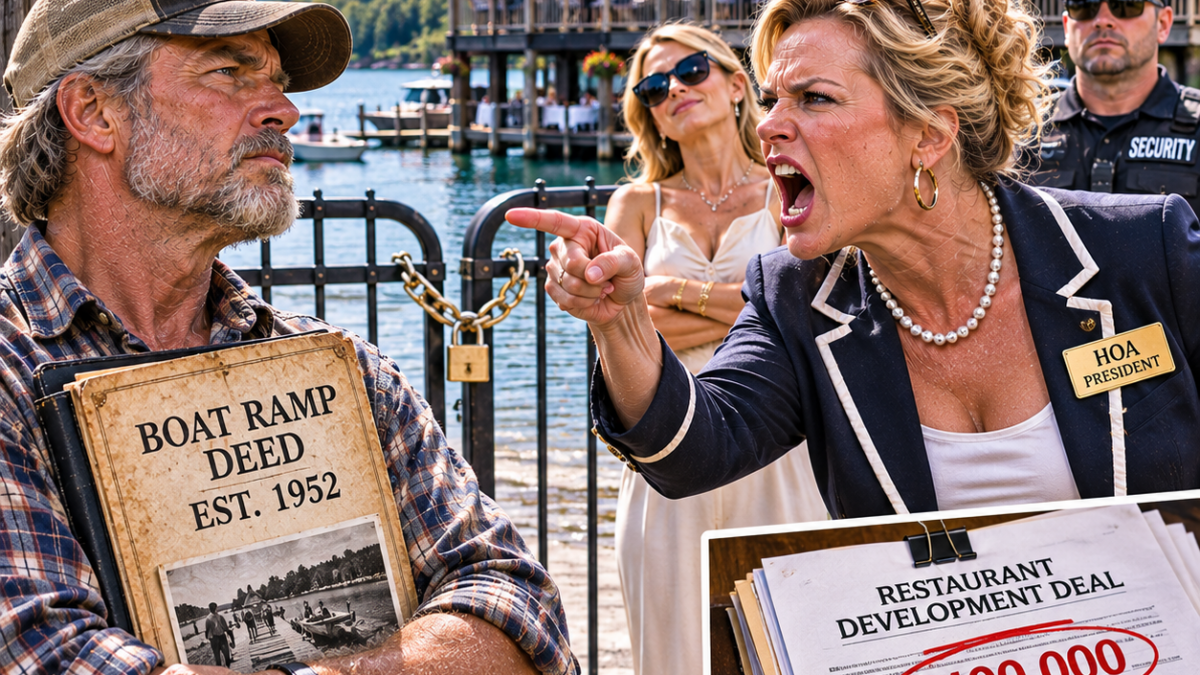
PART2
The first thing I smelled was diesel.
Not coffee.
Not pine.
Diesel.
I walked outside in pajama pants and boots to find trucks rumbling along the lakeside road.
Cranes.
Concrete equipment.
Flatbeds carrying modular platform sections.
The contractor had staging permission on HOA common property, not mine, but the noise carried everywhere.
By Wednesday, the lake in front of my dock was cloudier than normal from disturbed sediment.
The floating structure grew quickly.
Big enough for a commercial kitchen, dining room, bar, storage, docks, and utilities.
Sarah used to sit on our dock with coffee at dawn.
Now hydraulic equipment blocked half the view.
I filed a county noise complaint because work started before the locally permitted construction hour.
Two hours later, a county clerk called.
“Mrs. Blackstone’s contractor has an exemption.”
“Can I see it?”
Pause.
“I’ll have to check.”
“Please do.”
Never arrived.
That bothered me.
Not enough to accuse anyone.
Enough to start writing things down.
Forty years in engineering taught me something useful:
When people insist everything is approved, ask to see what “everything” means.
I spent three days reviewing permit databases.
The restaurant had local building approvals.
Temporary construction approvals.
Certain shoreline permissions.
What I could not find was a complete state-level commercial waterway and environmental authorization covering every aspect of the floating installation and waste-management system.
I was not an environmental lawyer.
So I did not announce Vivian had committed a felony or start posting online.
I called the appropriate state office and asked a simple question.
“Can someone confirm whether this project has all required approvals?”
An inspector arrived Thursday.
She reviewed documents.
Walked the shoreline.
Asked the contractor questions.
By noon, construction stopped pending verification of several missing or incomplete approvals.
Silence returned.
I sat on my porch with coffee.
For the first time in a week, I heard a loon.
Then Vivian’s Tesla came flying down the road.
She stepped out holding papers.
“I know you did this.”
“Did what?”
“Reported me.”
“I asked whether your project had permits.”
“That is harassment.”
“Then complete projects should be easy to verify.”
She shoved a cease-and-desist letter toward me.
I did not touch it.
“You have no idea who you’re dealing with.”
That line always interests me.
It assumes conflict is determined by identity instead of facts.
I said:
“I’m dealing with my HOA president.”
“You’re dealing with someone who has spent thirty years negotiating with men much smarter and more powerful than you.”
“Congratulations.”
Her cheeks reddened.
“This project is happening.”
“Then I hope the permits are in order.”
She stormed away.
Over the next week, people started stopping by.
Chuck brought a breakfast sandwich.
“On the house.”
“Why?”
“Because that woman banned fishing from HOA shoreline.”
I frowned.
“She did what?”
“Says rods, coolers, and tackle create an undesirable visual environment.”
I laughed.
He didn’t.
Betty Sterling came next.
Seventy.
Retired bookkeeper.
Lived three houses from the community center.
“She hasn’t shown the full financing plan.”
“For the restaurant?”
“Yes.”
“Is the restaurant owned by the HOA?”
“That depends which meeting you attended.”
Interesting answer.
She explained.
Initially Vivian described it as a community investment.
Then as a public-private partnership.
Then a Blackstone Hospitality venture operating under an HOA access agreement.
Different language.
Different nights.
Same project.
Betty had asked for detailed numbers.
Vivian told her the board’s executive committee had handled them.
“Who’s on the executive committee?”
Betty smiled without humor.
“Vivian.”
“Richard Pell.”
“And Donna Marks.”
“Do they support her?”
“Richard barely attends.”
“Donna repeats whatever Vivian says.”
Good to know.
The environmental pause lasted only seventy-two hours.
Some permits had been missing.
Others had apparently been in process.
Vivian’s attorneys and consultants moved quickly.
Conditions were added.
Construction resumed.
That did not prove corruption.
Money and motivated lawyers can make bureaucracy move faster than most people expect.
Still, something about the project felt rushed.
Then private security appeared.
Two men in tactical-looking vests.
Not police.
Contract guards.
They stood near the construction entrance and watched me whenever I walked my shoreline.
Three days later, Sheriff Martinez sent a deputy to my house.
“Mr. Holloway, there’s been a complaint.”
“About what?”
“Harassment.”
I laughed.
The deputy did not.
“Mrs. Blackstone alleges you’ve been monitoring workers and threatening the project.”
“Did she provide a threat?”
“Not that I saw.”
I showed him photographs.
Taken from my land.
Construction runoff.
Equipment encroaching near the ramp.
Dates.
Times.
He asked:
“Ever enter the site?”
“No.”
“Threaten anyone?”
“No.”
“Own a gun?”
“This is Montana.”
He almost smiled.
“Fair.”
Then:
“Keep documenting.”
“I intend to.”
Thursday night, Vivian held an emergency HOA meeting.
Thirty-two residents attended.
She stood behind a podium with a PowerPoint titled:
COMMUNITY SABOTAGE AND OBSTRUCTION.
My name appeared on slide two.
Garrett Holloway.
Retired engineer.
“Obstructionist.”
“Anti-development.”
“Threat to community economic progress.”
I almost admired the production value.
Then came the fine.
Five hundred dollars for “interference with approved community improvements.”
I raised my hand.
“Show me the covenant that binds my parcel to this fine.”
Vivian stared.
“The ramp serves our community.”
“That wasn’t my question.”
She moved on.
The motion passed by two votes.
Mostly newer residents who thought this was a minor feud between an old man and the HOA.
Then Vivian made her biggest claim.
“The Holloway boat ramp has been used by this community openly and continuously for decades.”
“Yes.”
I said.
“Because the deed allows local recreational access.”
She smiled.
“Exactly.”
“No.”
“Exactly would mean you read the next sentence.”
People turned.
I held up the deed copy.
“The access covenant does not transfer title.”
“It does not authorize commercial operations.”
“And it does not give the HOA ownership.”
Vivian folded her arms.
“Our counsel believes decades of community possession have created additional rights.”
“Adverse possession?”
She smiled.
“Among other doctrines.”
That annoyed me.
Because “adverse possession” sounds terrifying if you do not understand what must actually be proved.
I was not a lawyer.
So the next morning I hired one.
Jonathan Pierce.
Property attorney in Helena.
Twenty-two years of boundary and easement litigation.
He read Grandpa’s deed.
Read HOA documents.
Then said:
“Do not argue adverse possession with Vivian.”
“Why?”
“Because she wants you making legal statements without counsel.”
“What do I do?”
“We survey.”
So we surveyed.
José Martinez of Martinez Land Surveying—no relation to the sheriff—came with modern GPS equipment.
I walked the old lines with him.
Grandpa had placed iron markers in 1952.
We found two easily.
The third near the ramp took longer.
When I cleared pine needles, the ground around it looked recently disturbed.
Footprints.
Fresh soil.
Not proof Vivian had touched anything.
Proof someone had looked.
José documented it.
Then the survey results came back.
The ramp sat entirely inside Holloway property.
No ambiguity.
The recorded access burden benefited local recreational users under the deed’s language.
Not Blackstone Hospitality Group.
Not paying restaurant customers arriving through a commercial operation.
Not an HOA gate.
Jonathan filed a quiet-title and declaratory action to settle the legal issues before Vivian could create more confusion.
Then I installed signs.
HOLLOWAY PRIVATE PROPERTY
LOCAL RECREATIONAL ACCESS SUBJECT TO 1952 RECORDED COVENANT
NO COMMERCIAL USE WITHOUT WRITTEN OWNER AUTHORIZATION
I came out the next morning.
Signs gone.
Security camera showed Vivian herself removing one.
She looked directly at the camera.
Then carried it away.
That was useful.
She sent me an HOA violation accusing me of “vandalizing community property through unauthorized signage.”
Jonathan loved that one.
“Keep it.”
“Why?”
“She just admitted she knows your claim and is intentionally interfering while litigation is pending.”
The next escalation was uglier.
Adult Protective Services called my daughter Emma.
Someone had reported that I was showing signs of dementia.
Confusion.
Paranoia.
Dangerous fixation on imaginary property boundaries.
Emma called from Bozeman.
“Dad?”
“Yes.”
“Are you okay?”
“Define okay.”
“Someone said you’re mentally declining.”
I became very quiet.
“Who?”
“They won’t tell me.”
Of course.
Two social workers came the next day.
I let them in.
Coffee.
Financial records.
Medical information I voluntarily provided.
Project files.
Survey.
Attorney letters.
One asked:
“Do you know what day it is?”
“Wednesday.”
“Date?”
I gave it.
“President?”
I answered.
Then:
“Do you want me to solve a differential equation?”
The older social worker smiled.
“Probably unnecessary.”
They left with no concern.
Before going, she said:
“False or retaliatory reports waste resources that people in real danger need.”
“Yes.”
That made me angrier than the personal insult.
Someone was using elder-protection systems as a weapon.
I added it to the file.
Not proof Vivian made the call.
Pattern evidence if later connected.
Then she opened the restaurant.
Or tried to.
The marketing campaign was everywhere.
Full-page newspaper advertisements.
Social media.
Professional photographs.
BLACKSTONE’S FLOATING BISTRO
WHERE CULINARY EXCELLENCE MEETS MONTANA BEAUTY
Forty-five-dollar steaks.
Fifteen-dollar cocktails.
Boat valet.
Luxury sunset dining.
And a new fee at my ramp.
Twenty-five dollars daily.
Fifty weekly.
Electronic credit-card gate.
A sign:
PREMIUM LAKE ACCESS — MAINTAINED BY BLACKSTONE HOSPITALITY GROUP
I stood there for a full minute.
Then photographed everything.
The gate equipment was installed partly on the ramp approach inside my survey line.
No agreement.
No lease.
No permission.
Jonathan sent an immediate demand to cease commercial use and remove equipment.
Vivian ignored it.
The soft opening started anyway.
That Saturday, I watched Chuck Morrison arrive with his twelve-year-old grandson, Eli.
Fishing rods in the truck.
Cooler.
Same family routine they had followed for years.
The card machine rejected Chuck’s payment.
The security guard shrugged.
“No access.”
Chuck pointed at the lake.
“I’ve launched here since 1974.”
“Twenty-five dollars.”
“I tried.”
“System declined.”
Eli asked:
“Grandpa, why can’t we fish?”
I watched from my porch.
Chuck looked toward me.
I walked down.
The guard blocked the gate.
“This is restaurant-managed access.”
I said:
“No.”
He recognized me.
Called someone.
Vivian arrived fifteen minutes later.
“What now?”
I pointed toward Chuck.
“This deed gives ordinary local recreational access.”
Vivian crossed her arms.
“Subject to reasonable management fees.”
“Show me where.”
“Modern maintenance costs money.”
“You’re not maintaining my ramp.”
“We improved the access system.”
“You installed a cash register.”
Eli stood behind Chuck, embarrassed.
That hurt more than the argument.
Then Mrs. Petroski called that afternoon.
Her voice shook.
“Garrett?”
“Yes?”
“They won’t let me down to the water.”
“What happened?”
“I wanted to scatter Henry’s ashes.”
My chest tightened.
She and Henry had their first date near our dock.
He proposed there.
They were married fifty-eight years.
“He made me promise.”
She started crying.
“The man at the gate says I need to pay.”
I said:
“Stay there.”
I drove down.
The guard eventually let her through after I personally intervened and documented the encounter.
Vivian called later.
“You cannot override my staff.”
“Your staff is standing on my property.”
“Not according to our legal position.”
“Then court should be interesting.”
I hung up.
That night, I pulled Grandpa’s deed from the fireproof box.
Read it again.
The access language.
The shoreline description.
And something else I had overlooked.
A strip of lakebed rights extended from our shoreline.
Not the entire lake.
Not mystical control of the water.
A surveyed littoral strip tied to the parcel.
Jonathan had already been reviewing it.
The next morning, we overlaid the modern survey.
Part of Vivian’s floating platform anchoring system extended into the area claimed by the Holloway deed.
Jonathan cautioned me immediately.
“Do not call the restaurant yours.”
“I wasn’t going to.”
“Do not touch it.”
“Wasn’t going to.”
“Do not disconnect anchors.”
“I understand.”
“We seek an injunction.”
He filed.
Then I started researching Vivian’s business.
Not gossip.
Public records.
Corporate registrations.
Liens.
Loan filings.
I had been an engineer long enough to know boring documents can kill exciting projects.
At 3:07 one morning, I found a recorded commercial financing statement.
Blackstone Hospitality Ventures.
Four hundred thousand dollars.
I opened the supporting filing.
Then sat back.
Collateral description included interests associated with HOA common amenities:
Clubhouse.
Pool.
Tennis courts.
Certain revenue streams.
My first reaction was:
That cannot be right.
So I called Jonathan at a reasonable hour.
He reviewed it.
Then said:
“We need the loan documents and HOA authorization.”
“Could they legally pledge common property?”
“Depends on title, governing documents, lender structure, board authority, member-vote requirements, and what exactly was pledged.”
“So not automatically criminal.”
“No.”
Good.
I called Betty.
“Do you remember a member vote on a four-hundred-thousand-dollar loan?”
Silence.
“What loan?”
Exactly.
Betty organized a formal records request with other homeowners.
Board minutes.
Loan approvals.
Financial statements.
Related-party disclosures.
The documents arrived slowly.
Incomplete at first.
Then fuller after counsel became involved.
What emerged was disturbing.
The loan existed.
Blackstone Hospitality Ventures was the borrower.
HOA-related assets and income streams appeared in the collateral package.
A board resolution purported to authorize aspects of the arrangement.
But Betty and another director said they had never seen the final collateral language.
The bylaws required broader approval for certain encumbrances involving common assets.
No membership vote appeared in the records we had.
Jonathan said:
“Now we have a real issue.”
Then we looked at the payments.
Eight thousand dollars a month scheduled once full repayment began.
Restaurant projections assumed heavy summer revenue.
Montana winter was treated like a footnote.
I knew this lake.
Tourism died after the season.
Ice.
Snow.
Few boats.
A floating restaurant designed around water access had maybe a handful of strong months.
Vivian’s projected winter revenue looked absurd.
Then I found her Seattle history.
Business failure.
Creditor claims.
Tax problems.
Not proof she stole anything.
Proof she was under financial pressure.
The Tesla?
Lease.
Some properties people assumed she owned?
Leveraged.
The restaurant was not a hobby for a millionaire.
It was a rescue attempt.
That changed how I understood every aggressive move.
Vivian did not merely want prestige.
She needed revenue.
And the restaurant needed my ramp.
Its insurance file confirmed access issues mattered.
Its business plan assumed customers could reach the floating pavilion through the Holloway launch corridor.
Without dependable access, projected reservations collapsed.
I took everything to Jonathan.
He looked at me.
“What are you thinking?”
“Gate.”
He sat back.
“What kind?”
“A legal one.”
That mattered.
I was not interested in trapping people.
Not damaging boats.
Not blocking deed-protected local recreational users permanently.
I wanted to stop unauthorized commercial use while preserving the historic access rights Grandpa had created.
Jonathan and I spent three days designing the legal approach before I spent one dollar on steel.
First:
Formal notice terminating any claimed commercial permission, of which there had never actually been any.
Second:
Written accommodation for local recreational users protected by the deed.
Third:
Court request confirming my right to control unauthorized commercial traffic.
Fourth:
No interference with emergency services or lawful public authority.
Fifth:
Physical access control only after counsel confirmed the plan.
Once the paperwork was ready, I hired Rocky Mountain Security Solutions.
Owner:
Jake Reeves.
Former Marine.
Calm.
Commercial access systems.
I told him:
“I need to keep restaurant customers and unauthorized commercial traffic off private property.”
“What about residents?”
“Authorized local recreational access stays.”
“Emergency?”
“Always.”
He showed me heavy steel barriers, cameras, controlled access, tamper-resistant hardware.
I did not need a military bunker.
I needed a gate nobody could simply remove at midnight.
The system was installed Friday.
Professionally.
Permitted where required.
Surveyed.
Clearly signed.
Residents entitled to ordinary recreational access received temporary codes while the litigation proceeded.
Blackstone restaurant customers did not.
That distinction destroyed Vivian’s claim that I had “closed the lake.”
I had not.
I closed my property to her business.
At five Friday evening, I activated the gate.
The restaurant’s biggest holiday-weekend dinner service began at six.
First car:
Stopped.
Second:
Stopped.
Then a line.
Drivers got out.
Phones appeared.
One man in loafers walked around the barrier three times as though wealth might reveal a secret entrance.
Boat customers who had expected valet launching could not use the Holloway ramp commercially.
Some already on the lake faced inconvenience finding alternative lawful landing arrangements, which restaurant staff should have planned for.
I had notified Blackstone Hospitality through counsel.
Vivian knew.
She gambled that I would not enforce it.
At 5:23, her Tesla arrived.
She stopped crooked across the gravel.
Got out.
“Garrett!”
I walked onto my porch.
“Evening.”
“What did you do?”
“Controlled commercial access to my land.”
“I have fifty dinner reservations!”
“You received the notice.”
“You cannot shut down a community boat ramp.”
“I didn’t.”
I pointed to the sign.
“Local deed-protected recreational users still have access.”
“You’re discriminating against my customers.”
“Yes.”
Her mouth fell open.
I continued:
“Because your customers are using my property for your private commercial business without permission.”
“This is malicious interference.”
“Call your lawyer.”
“You’re destroying my business!”
“No.”
I looked at the restaurant lights across the water.
“You built your business around something you never owned.”
She started toward the gate.
Jake’s system did not care how angry she was.
Vivian pulled.
Kicked the lower rail once.
Pain immediately changed her expression.
I almost laughed.
Didn’t.
Cameras captured everything.
She pointed at me.
“You will regret this.”
“Get in line.”
Saturday morning, Tom Halverson called.
Tom owned shoreline farther east.
“You won’t believe this.”
“What?”
“Vivian offered me five thousand dollars to shuttle restaurant customers from my dock.”
“That seems high.”
“I said no.”
“She offered ten.”
I whistled.
Tom laughed.
“She’s panicking.”
Yes.
Sunday, Adult Protective Services returned after another anonymous report.
Different allegations.
Erratic judgment.
Dangerous financial decisions.
Possible exploitation by “younger legal advisers.”
This time, the social worker recognized my name.
She looked embarrassed.
“We’re required to document.”
“I understand.”
I showed her court filings.
Survey.
Business records.
Gate access plan.
Medical note from my regular physician confirming no cognitive concern, obtained after the previous episode.
She apologized.
I said:
“Don’t apologize for doing your job.”
“Just document that somebody keeps making reports during active litigation.”
She did.
Monday brought the first real crack inside Vivian’s own family.
Richard Blackstone discovered the loan.
Betty called me at noon.
“Her husband didn’t know.”
“How do you know?”
“He called Richard Pell on the board.”
“Apparently saw loan documents.”
That surprised me.
Richard Blackstone was rarely around.
Investment banking.
Travel.
People assumed he financed Vivian’s lifestyle.
Apparently not.
By evening, rumor said he had demanded immediate financial disclosure and separate counsel.
I did not care about their marriage.
I cared that another person with access to documents was asking questions.
Vivian filed for emergency injunctive relief against me Tuesday.
Her attorney argued:
Malicious business interference.
Improper restriction of longstanding access.
Harassment.
Economic harm.
Jonathan argued:
Private title.
Recorded covenant limits.
Commercial use outside historical access.
Modern survey.
Pending property dispute.
Unauthorized gate installation by Blackstone Hospitality earlier.
The judge did not declare me ruler of the lake.
He did something better.
Denied Vivian’s emergency request to force commercial access through my property while the title and easement dispute was litigated.
He noted that the business had been warned of contested access before opening.
Vivian’s attorney looked exhausted.
Outside court, she told reporters:
“This is temporary.”
Jonathan whispered:
“Everything is temporary if you wait long enough.”
The restaurant began hemorrhaging.
Access alternatives were terrible.
Some customers arrived by private boat from other docks.
Others drove to distant launches.
Valet service failed.
Reservations canceled.
Then employees’ paychecks started bouncing.
That part gave me no satisfaction.
Dishwashers had not stolen my ramp.
Servers had not filed false complaints.
Kitchen workers did not deserve to lose wages because Vivian built on assumptions.
Chuck’s nephew worked there.
He told Chuck the staff had been asked to work Labor Day weekend with delayed pay.
They walked.
Most of them.
Handwritten notices appeared on the restaurant entrance.
One read:
SCENIC VIEWS DO NOT PAY RENT.
Chuck photographed it.
I told him not to post it.
He posted it.
The local newspaper started investigating.
Reporter Rachel Wynn called me.
“Did you provide these loan records?”
“No.”
“Will you?”
“Talk to my lawyer.”
Good answer.
Jonathan later provided public filings and documents homeowners were legally entitled to discuss, carefully distinguishing allegations from established facts.
The article was devastating without being sensational.
HOA FINANCING QUESTIONS SURROUND FLOATING RESTAURANT
It described:
The disputed ramp.
The $400,000 loan.
Collateral language.
Lack of clear member approval.
Pending quiet-title litigation.
Payroll complaints.
Environmental permitting history.
Vivian declined detailed comment.
Then somebody did something stupid.
Fake social-media accounts appeared.
Posts called me an extremist.
Anti-business radical.
Dangerous anti-development activist.
One linked me to a militia I had never heard of.
Another claimed I intended to physically blockade the entire lake.
Small-town Montana is a terrible place for fake local identities.
People know one another.
One account used a profile photograph of a “local mother” that belonged to a realtor in Ohio.
Another claimed to live on Pine View Lane.
No Pine View Lane existed.
Residents began mocking the campaign.
Chuck’s wife posted:
Garrett Holloway has lived here fifty-eight years. Vivian Blackstone has lived here eighteen months. If your fake profile can’t spell the lake’s name, maybe stop giving us community advice.
Hundreds shared it.
Vivian denied involvement.
Fair.
We had no proof she personally hired the accounts.
I did not accuse her.
Then came a far more serious allegation.
County Commissioner Paul Williams called me.
“I need your lawyer present.”
That gets attention.
We met with Jonathan.
Williams described a conversation in which Vivian allegedly offered financial support tied to expediting a government action that would compel access across my property.
He had contemporaneous notes and had already reported the matter through proper channels.
I asked:
“Are you telling me she offered you a bribe?”
Williams said:
“I’m telling investigators exactly what she said and what I understood it to mean.”
Good answer.
That investigation belonged to authorities.
Not me.
I stayed out.
Then Vivian herself crossed a line on camera.
3:02 Thursday morning.
Gate alert.
I opened the live feed.
Vivian.
Truck.
Boat trailer.
Another man.
They were trying to manipulate the gate mechanism.
Then the trailer moved forward and struck part of the barrier.
Not hard enough to endanger a person.
Hard enough to damage the trailer and scratch the gate.
I called the sheriff’s department.
Did not go outside.
Deputies arrived.
Vivian claimed the impact was accidental.
The video became evidence.
I watched from my porch after they left.
The lake was black.
Restaurant lights glowing.
I thought of Sarah.
She would have hated every second of this.
Not because she disliked confrontation.
Sarah could argue.
Lord, could she argue.
She would have hated what the lake had become.
Sides.
Lawyers.
Cameras.
Money.
I walked to the dock.
Sat where she used to sit.
For the first time since Vivian arrived, I cried.
Not angry crying.
Grief.
Because somewhere during the fight, I had stopped remembering why the ramp mattered.
It was not because Grandpa’s deed made me right.
It mattered because Grandpa built something generous.
Sarah continued that generosity.
And now both Vivian and I were standing over it with legal documents.
I heard Sarah’s voice in memory:
A lake belongs to everyone who loves it.
Legally?
Not exactly.
Emotionally?
Yes.
That night I made myself a promise.
If I won, the ramp would not become my private trophy.
Local families would fish again.
No twenty-five-dollar gate.
No revenge fee.
No Garrett Holloway Premium Access Program.
I wanted the old spirit back.
Then the bank moved.
Foreclosure remedies began against the restaurant financing after missed payments and material deterioration in the business.
The exact collateral fight was complicated.
The lender could not simply seize every HOA amenity if the pledged interests were unauthorized.
That would have to be litigated.
But the notice terrified residents.
Pool.
Clubhouse.
Tennis courts.
For twenty years, homeowners had paid dues toward those assets.
Now they were reading a bank document suggesting Vivian’s project had put them at risk.
That changed everything.
Betty organized an emergency member meeting.
Not Vivian.
The membership.
A petition demanded:
Independent audit.
Suspension of further Blackstone Hospitality support.
Review of loan authority.
Recall vote if permitted.
Preservation of records.
The crowd outgrew the HOA community center.
The town allowed use of a municipal hall.
Local news attended.
Regional reporters came.
State financial investigators were already reviewing referrals.
Everyone wanted a climax.
I wanted documents.
Vivian arrived with a new lawyer.
Dark suit.
Expensive.
Looked miserable.
Three people outside held signs:
SUPPORT LOCAL BUSINESS
STOP PROPERTY EXTREMISM
Nobody recognized them.
Inside, the hall was packed.
Two hundred people.
Maybe more in the hallway.
Mayor Davidson opened because the facility was municipal and the financial dispute had spilled into county and state attention.
The HOA portion still belonged to its members.
Vivian demanded the microphone.
Of course.
She walked to the podium.
Projected beautiful photographs.
Restaurant.
Sunset.
Boats.
Jobs.
Visitors.
Then she put my face on screen.
“Tonight this community must decide whether we reward obstruction or embrace economic progress.”
People murmured.
Vivian continued.
“Garrett Holloway has used antiquated property claims and aggressive legal tactics to sabotage a legitimate business.”
I sat in the back.
Same flannel shirt I wore to Sarah’s memorial.
No suit.
No performance.
Vivian pointed.
“One man has decided his nostalgia matters more than jobs, tourism, and the financial future of this community.”
That word.
Nostalgia.
I looked at the photograph of our ramp.
Grandpa.
Sarah.
Eli.
Mrs. Petroski.
Nostalgia.
Maybe.
Then her lawyer described possible federal commerce claims.
Constitutional issues.
Access rights.
Public-interest arguments.
Jonathan wrote notes.
Did not react.
When Vivian finished, Mayor Davidson looked at me.
“Mr. Holloway?”
I stood.
Walked forward carrying one folder.
Not twelve.
One.
The room quieted.
I said:
“My name is Garrett Holloway.”
“I’m fifty-eight years old.”
“My grandfather bought our property in 1952.”
“He built the ramp.”
“He also made sure local residents could use it for ordinary recreation.”
I looked toward Chuck.
Betty.
Mrs. Petroski.
“So let’s start with the biggest lie in this argument.”
“I never wanted to close the ramp to our community.”
I projected the access log.
Local users had active codes throughout the dispute.
Fishing families.
Residents.
Emergency responders.
“No one was charged twenty-five dollars by me.”
“I stopped one thing.”
I looked at Vivian.
“Her private restaurant from using my land as a commercial access point without permission.”
Then the survey.
Ramp boundary.
Recorded deed.
Commercial gate Vivian installed.
Photograph of her removing my signs.
Quiet.
I continued.
“Now the money.”
Vivian’s attorney stood.
“Mr. Mayor, this meeting should not become—”
Betty shouted:
“It is our money.”
Applause.
Mayor Davidson allowed the documents already available to the membership to be discussed.
I held up the $400,000 financing record.
“This loan is real.”
I looked at residents.
“It contains collateral language involving association assets and income.”
“I am not standing here telling you every provision is enforceable.”
“That is for lawyers, auditors, and possibly courts.”
“But I am asking you one question.”
I looked toward Betty.
“Did you vote on it?”
“No.”
“Chuck?”
“No.”
“Mavis?”
She yelled:
“Hell no.”
Laughter.
I turned to the board.
“Did the membership approve encumbering common property under the procedure required by your governing documents?”
Silence.
Richard Pell finally stood.
“No.”
The room erupted.
Vivian turned toward him.
“You approved the financing package.”
“I approved exploring financing.”
“Not that collateral schedule.”
Her face changed.
There it was.
Not courtroom proof.
A board fracture in public.
Betty walked forward with copies of meeting minutes.
“No member vote.”
Another homeowner had the bylaws.
A supermajority was required for certain common-property encumbrances.
The recorded file did not show it.
Vivian grabbed the microphone.
“The restaurant was created to rescue this community from declining reserves and stagnant property values.”
Someone shouted:
“By gambling our clubhouse?”
She yelled:
“I was trying to build revenue!”
Another:
“For yourself!”
Vivian snapped:
“I invested everything in this project!”
Jonathan quietly handed me the Blackstone Hospitality ownership record.
I held it up.
“That’s part of the problem.”
Silence.
“The business making the money was primarily hers.”
“The community assets carried risk.”
Vivian’s lawyer whispered something to her.
She ignored him.
I continued.
“Now the gate.”
Security footage.
Vivian removing my property sign.
Then the 3:02 a.m. incident.
Truck.
Trailer.
Barrier.
Gasps.
Vivian shouted:
“That was an attempt to recover access you illegally stole!”
I said:
“Police can decide what it was.”
Then the Adult Protective Services documentation.
I did not accuse her.
“I received two reports alleging dementia after opposing this project.”
“The agency found no concern.”
“I do not know who made those reports.”
“If investigators establish that, they can deal with it.”
That distinction mattered.
Then Commissioner Williams entered.
He did not give a dramatic speech.
He confirmed he had reported a concerning conversation regarding expedited governmental access and that the matter was under investigation.
Vivian’s face went white.
Her lawyer closed his folder.
Then came the financial auditor Betty had hired with authorization from enough homeowners to fund an independent preliminary review.
She summarized irregularities.
Related-party transactions.
Incomplete approvals.
Questionable allocations.
Restaurant support.
Missing documentation.
She did not say:
Vivian stole exactly X dollars.
She said:
“We found enough control failures and potentially unauthorized transactions to require a full forensic audit and referral.”
That was more devastating.
Because it was credible.
Vivian looked around the room.
Neighbors she had once commanded would not meet her eyes.
Then state investigators entered with a warrant covering specified HOA and Blackstone Hospitality records.
No handcuffs.
Not yet.
Just authority backed by evidence.
Vivian whispered:
“No.”
One investigator approached.
“Mrs. Blackstone?”
Her lawyer stepped between them.
“I represent her.”
“Good.”
The investigator served the warrant.
Laptop.
Financial files.
Specified records.
Vivian’s hands began shaking.
News cameras zoomed.
I hated that part.
Not because she deserved privacy more than anyone else.
Because humiliation had become entertainment.
I stepped away from the microphone.
Betty took it.
“This meeting isn’t about Garrett anymore.”
That was exactly right.
She looked at the residents.
“It’s about whether we let one president turn an association into her personal company.”
Applause.
Then the recall motion began.
Vivian tried to speak.
Her own lawyer told her not to.
The preliminary vote to suspend her authority passed overwhelmingly under the governing procedure available pending formal recall.
Within days, Vivian resigned as HOA president.
The restaurant closed.
The bank took control of financed business assets through negotiated proceedings.
The floating platform was eventually removed after legal and environmental issues were resolved.
I watched from the dock as tugs pulled it away.
I expected satisfaction.
Instead I felt tired.
The lake looked bigger without it.
Quieter.
The forensic audit took months.
Some of what residents believed at the first meeting turned out to be exaggerated.
That happens.
Not every dollar connected to Blackstone entities was stolen.
Some consulting services were real.
Some board members had approved limited expenses.
Some financial decisions were merely reckless rather than criminal.
But enough was serious.
The loan process had bypassed required approvals.
Records contained inaccurate representations about authority.
Association resources had been used in ways that benefited Vivian’s private venture without proper disclosure and consent.
Investigators also pursued the alleged attempt to improperly influence a public official, the gate incident, and other conduct supported by evidence.
Charges followed.
Not every original allegation survived.
Some counts were reduced.
Others resolved through plea negotiations.
Ultimately Vivian admitted to financial and fraud-related conduct and accepted restitution obligations, criminal penalties, and restrictions arising from the case.
She served custodial time.
Less dramatic than the internet wanted.
More real.
Richard filed for divorce.
I stayed out of that.
Her Seattle properties became part of separate financial proceedings.
Again:
Not my business.
The HOA sued over losses.
The lender negotiated claims.
Insurance covered some areas.
Restitution recovered others.
Residents did not magically get every dollar back.
They avoided the worst-case collapse.
That mattered.
Then something surprising happened.
Betty Sterling became interim HOA president.
She hated it.
Perfect qualification.
At her first meeting, she said:
“We are publishing every monthly financial statement.”
People applauded.
“No related-party contracts without disclosure.”
More applause.
“No president gets to declare a private business a ‘community project’ without written terms and a vote where required.”
More.
Then:
“And if any of you ever let me buy a floating restaurant, remove me immediately.”
Standing ovation.
For six months, residents debated whether to dissolve the HOA completely.
Some wanted it gone.
Others pointed out shared roads, snow removal, common landscaping, and infrastructure still required coordination.
In the end, they did not abolish everything overnight.
They rewrote.
Reduced authority.
Strengthened votes.
Added spending controls.
Conflict rules.
Open records.
Term limits.
Boring reforms.
The best kind.
My gate?
Removed.
Not immediately.
First the quiet-title case finished.
The court confirmed what the survey and deed had shown:
Holloway held title to the ramp subject to the recorded recreational-access rights.
The HOA did not own it.
The historical access covenant did not automatically authorize commercial exploitation by Blackstone Hospitality.
The exact lakebed boundary issues were settled separately.
Vivian’s platform was gone by then anyway.
Once legal control was clear, I called Jake.
“Take the big commercial gate down.”
He sounded surprised.
“You paid a fortune for that.”
“I needed it for a fight.”
“Fight’s done.”
“What replaces it?”
“A simple barrier.”
“For nights?”
“Yes.”
“And free access codes for locals.”
“Grandpa’s terms.”
Jake laughed.
“Your grandfather sounds expensive.”
“He never met Vivian.”
By noon, the massive steel system was gone.
Families came back.
Chuck arrived first.
Eli jumped out with a fishing rod.
“You opening?”
I stepped aside.
“Go.”
He ran.
Chuck stopped beside me.
“You charging twenty-five?”
“Forty.”
He stared.
I smiled.
He told me exactly what I could do with that forty dollars.
Normal.
Beautiful.
Mrs. Petroski came the following week.
She carried a small urn.
Henry.
I walked her to the dock.
Then left.
Some moments do not need witnesses.
Sarah’s Memorial Bass Derby returned in October.
I expected maybe one hundred people.
Four hundred showed up.
People drove from three states because the story had spread.
I hated the publicity.
Sarah would have loved the crowd.
Kids lined the shoreline.
Grandparents unfolded chairs.
Volunteers served sandwiches.
Someone hung a photograph of Sarah beside the registration table.
Same laugh.
Same sun hat.
For about five minutes I could not speak.
Emma stood beside me.
“Dad?”
“I’m fine.”
“You’re crying.”
“I’m retired.”
“Apparently that means emotional.”
I laughed.
The derby raised enough money to start a small scholarship in Sarah’s name for local students pursuing engineering, environmental science, or natural-resource work.
That was better than any revenge.
Then I opened Sarah’s Bait and Tackle.
I had been talking about it before Vivian arrived.
The fight nearly made me abandon the idea.
Then I realized abandoning it would give the whole mess one more thing.
The shop occupied an old marina-storage building near my property.
Wood floors.
Pegboard.
Minnows.
Lures.
Basic tackle.
Coffee.
A wall titled:
FIRST FISH
Photographs of kids from decades of derbies.
Sarah appeared in half of them.
Opening morning, Chuck brought coffee.
Betty brought cookies.
Tom Halverson brought complaints about my lure prices.
Eli caught a bass from the dock before lunch.
Small.
Beautiful.
He rang one of Sarah’s old brass bells.
I cried again.
Retirement had apparently destroyed my emotional discipline.
Six months later, we partnered with Montana Fish, Wildlife & Parks on conservation education and cleanup events.
Not because Vivian had been right to weaponize environmental claims.
Because caring about property rights and caring about the environment are not opposites.
That false choice had poisoned the dispute.
Vivian said development was progress.
I initially reacted by treating change itself as suspect.
Both positions were too simple.
The lake needed water testing.
Shoreline education.
Invasive-species prevention.
Responsible access.
Waste controls.
Fish habitat work.
We created programs based on actual science.
No luxury branding.
No fake emergency.
Monthly cleanup days brought kids, retirees, fishing guides, homeowners, and people from town.
Property values recovered.
Fishing-guide businesses benefited from dependable access.
The coffee shop became unofficial headquarters for every disagreement in five miles.
Betty eventually stepped down as HOA president.
At her final meeting, she told the next board:
“The job is not to win.”
“It is to maintain roads, manage shared obligations, follow the documents, and leave people alone when the documents say you have no authority.”
I asked for that on a plaque.
She threw a folder at me.
Years passed.
The story kept circulating online.
Every retelling became more dramatic.
One version claimed I locked fifty boats inside the lake and demanded ransom.
False.
Another said Vivian rammed the gate in a Lamborghini.
Tesla and boat trailer.
Another claimed I owned the whole lake.
No.
I owned my property and specific recorded shoreline and lakebed interests.
Another said I personally arrested Vivian.
I am a retired engineer.
I would have been a terrible arresting officer.
Facts apparently need better marketing.
At a property-rights conference, someone asked me:
“What was the key move?”
They expected:
The gate.
I said:
“The survey.”
He looked disappointed.
“What about shutting down the restaurant?”
“That happened because we knew where the line was.”
“Literally.”
I continued:
“Before you fight an HOA, developer, neighbor, anybody—know what you own.”
“Read the deed.”
“Read the declaration.”
“Read easements.”
“Read the bylaws.”
“Do not assume because somebody sounds official that they are right.”
“And do not assume because you are angry that you are right.”
That last part matters.
I was lucky Jonathan stopped me from making claims beyond the documents.
Vivian made that mistake constantly.
She transformed assumptions into authority.
I almost could have transformed anger into certainty.
Both are dangerous.
Another man asked:
“Would you have closed the ramp permanently if you could?”
“No.”
“Why not?”
“My grandfather intentionally preserved local access.”
“So you were bound?”
“Legally and morally.”
He looked surprised.
“You fought for private property but allowed public use.”
“Those are not contradictory.”
Private ownership can include obligations.
Rights can coexist.
That was the part Vivian never understood.
She thought whoever controlled the gate controlled everything.
Grandpa understood better.
Title meant responsibility.
Sarah understood too.
The ramp mattered because people used it.
Not because our name was written on the deed.
One afternoon years later, I found Vivian’s old twenty-five-dollar access sign in a storage shed.
I had forgotten we kept it as evidence.
PREMIUM LAKE ACCESS
$25 DAILY
I carried it into the bait shop.
Emma saw me.
“No.”
“What?”
“You’re not hanging that.”
“Historical exhibit.”
“Dad.”
“It’s educational.”
She laughed.
I mounted it beside a copy of the 1952 deed.
Underneath, I added a small card:
THE DIFFERENCE BETWEEN AN ACCESS RIGHT AND A COMMERCIAL BUSINESS MODEL IS WORTH READING BEFORE YOU INSTALL A CREDIT-CARD MACHINE.
Chuck wanted me to change it to:
DON’T STEAL OTHER PEOPLE’S BOAT RAMPS.
I said mine was more precise.
He said mine sounded like an engineer.
Fair.
Kids ask about the sign.
Adults laugh.
Occasionally someone stops laughing and asks a serious question about their own HOA.
I always say:
“Talk to a lawyer.”
“Not me.”
I know enough now to know what I do not know.
Years after the fight, I received a letter.
No return address I recognized.
Vivian.
Handwritten.
Short.
She said:
Mr. Holloway, I do not expect a response. I spent a long time telling myself I was trying to save a failing financial situation and modernize a community that resisted change. Some of that was true. It was also true that I believed being smarter, wealthier, and more connected gave me the right to make decisions for everyone else. I was wrong.
I stopped reading.
Then continued.
I am sorry for using systems meant to protect people as tools against you. I am particularly ashamed of what happened with the reports regarding your mental competence. Whether every report can be traced directly to me or not, I created the climate that encouraged them.
That was carefully worded.
Probably lawyer-reviewed.
Still meaningful.
Then:
I saw a photograph of the Memorial Bass Derby. Your wife’s name is on the banner. I understand now why the ramp mattered to you in a way I did not when I arrived.
I folded the letter.
Did not answer.
Not out of cruelty.
I had nothing useful to say.
Forgiveness is not a receipt you owe someone after they apologize.
But I kept the letter.
Not beside the deed.
Not in the shop.
In a drawer.
Some history is public.
Some is yours.
Richard Blackstone never came back.
Vivian never lived in the community again.
The restaurant name disappeared.
Blackstone Hospitality Ventures eventually dissolved.
The floating platform was resold, modified, and reportedly became part of a marina operation somewhere else.
Good.
Steel does not carry moral guilt.
Use it better.
Sarah’s derby continued.
Eli grew up.
At eighteen, he won the adult division for the first time.
Chuck accused him of cheating.
Eli said:
“Grandpa taught me.”
Chuck said:
“Exactly.”
Mrs. Petroski stopped coming eventually.
Age.
Her daughter brought her once in a wheelchair.
We rolled her to the dock.
She looked at the water.
“Henry’s out there somewhere.”
I said:
“Probably complaining about fishing pressure.”
She laughed.
Then squeezed my hand.
“This place stayed the same.”
I looked around.
New safety rail.
Bait shop.
Conservation signs.
Updated ramp surface.
Different boats.
Different people.
“No.”
I said.
“It changed.”
She frowned.
Then I added:
“But it still belongs to the same kind of people.”
She smiled.
That was better.
A California developer later proposed luxury condos on the far shore.
Internet people expected me to start another war.
I didn’t.
I read the plans.
Checked environmental requirements.
Reviewed traffic.
Went to meetings.
Asked questions.
Some neighbors opposed it.
Others supported it.
The developer revised.
Reduced shoreline impact.
Added public access.
Improved wastewater design.
Project eventually received approval at a smaller scale.
People online were disappointed.
“Team Garrett sold out.”
No.
I never hated development.
I hated theft dressed as progress.
There is a difference.
Sarah would have understood.
She liked new restaurants.
Probably would have eaten at Vivian’s place if Vivian had asked permission, paid fair access costs, followed environmental rules, treated employees properly, and left the fishing families alone.
That may be the saddest part.
The entire disaster was unnecessary.
Vivian could have approached me.
“Garrett, I want to build this restaurant.”
“I need commercial access.”
“Can we negotiate?”
Maybe I would have said yes.
Conditions.
Insurance.
Traffic plan.
Separate commercial lane.
Protection of local access.
Fair compensation.
Environmental safeguards.
Maybe.
Instead, she assumed.
Then demanded.
Then punished resistance.
Then borrowed against assets she did not have authority to risk.
Then lied to preserve the first lie.
That is how small arrogance becomes enormous damage.
Not in one leap.
One escalation at a time.
The restaurant itself was never the true problem.
Her belief was.
If I want something badly enough, somebody else’s no is an obstacle to remove.
That belief destroys companies.
Marriages.
Governments.
HOAs.
Families.
It certainly destroyed her project.
On the tenth anniversary of Sarah’s death, we held the biggest Memorial Bass Derby yet.
No reporters.
By my request.
Just families.
Morning mist.
Coffee.
Cold dock boards.
Loons.
Exactly what I remembered from childhood.
Before sunrise, I walked down alone.
The ramp was empty.
I touched the old concrete edge Grandpa poured in 1952.
Most of it had been repaired over the years.
Very little original material remained.
That did not make it less his ramp.
Legacy is rarely untouched material.
It is continuity of purpose.
Grandpa built it so ordinary people could reach the water.
Sarah filled it with families.
I nearly turned it into a fortress because someone abused that generosity.
Then I remembered what we were protecting.
At seven, trucks started arriving.
No electronic fee gate.
No security men.
No luxury valet.
Just volunteers.
Kids.
Coolers.
Tackle boxes.
A little girl maybe eight years old stood at the edge with her father.
First cast.
Terrible cast.
Hook landed three feet away.
She laughed.
Tried again.
Twenty minutes later, she caught a tiny bass.
She screamed like she had landed a marlin.
Everybody cheered.
I walked over with one of Sarah’s brass bells.
The girl shook it.
Ring.
Ring.
Ring.
For one second, I could see Sarah again.
Sun hat.
Clipboard.
Smile.
That was the victory.
Not Vivian losing the restaurant.
Not the loan investigation.
Not court.
Not the gate.
Not news cameras.
A child catching her first fish where another child had been told he could not fish because his grandfather’s credit card failed.
That is why we fought.
People sometimes ask if I regret locking Vivian out during her busiest dinner weekend.
No.
She had notice.
Counsel.
Survey.
An opportunity to arrange lawful access elsewhere.
She gambled on bullying me.
I enforced a boundary.
But I am also glad I removed the gate afterward.
Because boundaries should protect what matters.
Not become monuments to anger.
That heavy steel barrier did its job.
Then its job ended.
The lake did not need to remember Vivian every time someone launched a boat.
Neither did I.
My life is quieter now.
The bait shop runs mostly without me.
Emma handles books.
My son David manages tournament logistics.
Grandchildren work summers and complain about wages even though I pay them more than I earned at their age.
Chuck still claims my coffee is terrible.
Betty still audits everything she can get her hands on despite no longer holding office.
Sheriff Martinez retired.
Jonathan charges more now.
I blame publicity.
Sometimes I sit on the dock after everyone leaves.
Mist over the water.
Same pine smell.
Same loons.
Different century.
I think about what Vivian said the first time.
You can’t stop progress, old man.
She was right.
Nobody can.
But progress without permission is often just trespass with better branding.
Progress without transparency becomes somebody else’s private deal.
Progress that excludes the people who built a place is not automatically improvement.
And tradition without flexibility can become another kind of arrogance.
The lesson was never:
Old good, new bad.
It was simpler.
Know what belongs to you.
Respect what belongs to others.
If a community gives you authority, use only the authority it actually gave.
If you handle other people’s money, show them where it goes.
If you want to build something, build it on a foundation you legally control.
And if your business requires someone else’s property to survive?
Ask before you install the credit-card machine.
Vivian thought my weakest point was sentiment.
The old ramp.
Sarah.
My grandfather.
She was wrong.
Sentiment was why I cared.
Documentation was why I won.
The 1952 deed.
Survey coordinates.
Access covenant.
Loan filings.
HOA bylaws.
Bank records.
Security footage.
Meeting minutes.
Permits.
Every boring page mattered more than every angry speech.
That is what I tell people now when they ask how a retired engineer beat a wealthy HOA president.
I did not beat her.
The paperwork did.
Her paperwork.
Mine.
The community’s.
The bank’s.
The county’s.
Eventually, facts stopped being something she could outtalk.
And once that happened, the people she had counted on remaining confused became very difficult to control.
There is a framed photograph in Sarah’s Bait and Tackle.
Not of Vivian.
Not of the gate.
Not of the news crews.
It shows Grandpa Walter in 1954 standing beside the ramp.
A fishing rod in one hand.
Three neighborhood kids behind him.
On the back, he wrote:
Water isn’t worth much if nobody gets to enjoy it.
I found that photograph years after the fight.
Wish I had found it sooner.
Might have saved me some anger.
Or maybe I needed the anger.
I don’t know.
What I do know is this:
Vivian Blackstone arrived believing a deed, a family tradition, an old fisherman, and a few working-class neighbors were obstacles standing between her and a profitable vision.
She built a floating restaurant.
Charged local families to reach the lake.
Tried to turn historic access into private revenue.
Used an HOA title like ownership.
And tied a business gamble to community assets without the transparency those homeowners deserved.
In the end, she lost the thing she cared most about.
Control.
But the real justice was not watching her lose it.
The real justice came the morning after the legal fight finally ended, when I stood beside the ramp and watched Chuck’s grandson launch a boat without paying anybody twenty-five dollars.
Mrs. Petroski sat on the dock remembering Henry.
Kids cast from shore.
The coffee shop opened early.
Nobody asked whether their clothes were aesthetically compatible with a premium waterfront.
Nobody scanned a card.
Nobody checked a reservation.
The lake sounded like a lake again.
And for the first time in months, I could hear the loons.








